Life has been tough for Jack Copperwaite. Born with Crouzen Syndrome, the three-year-old suffers from a rare genetic condition that causes excess fluid on the brain (hydrocephalus) and complications to the development of his skull. Since his birth, Jack has undergone 11 operations to relieve the fluid in his cranial cavity, or intracranial space. Any impact to his head could cause immediate and severe injuries, if not completely fatal.
With hopes of raising funds to offset the surmounting costs of Jack’s surgeries and care, more than 40 jet skiers rallied together to hold “a SPLASHTACULAR fundraiser,” riding from Queenscliff to the Clifton Springs’ boat ramp late last year. The effort raised an impressive $10,000 on the solitary weekend, with organizer Heath Tournier saying it was “a great turnout” for an event organized just a few weeks earlier.
Working through his charity the Tournier Foundation, Tournier aims to help other young people in need, as the $10,000 raised from this ride will go to Jack’s ongoing care needs and help fund renovations on the family home. In an article published by The Geelong Advertiser, appeals for “help in building him a new bedroom because doctors were concerned his cramped bedroom were made. A contractor, Mr Tournier quickly offered to lend a hand and is in the process of renovating a new room for Jack, the kitchen and his parents’ bedroom.”
Jack’s mother, Donna said, “We’ve got good people around us and in the community to support him and it’s overwhelming.” Present at the Clifton Springs’ boat ramp to meet the riders, Jack – despite spending more than 140 days in the hospital – couldn’t be bothered, spending the day “paddling in the shallows,” and stopping to take pictures with several of the participants.
To donate to the Foreman Jack fund go to thetournierfoundation.org
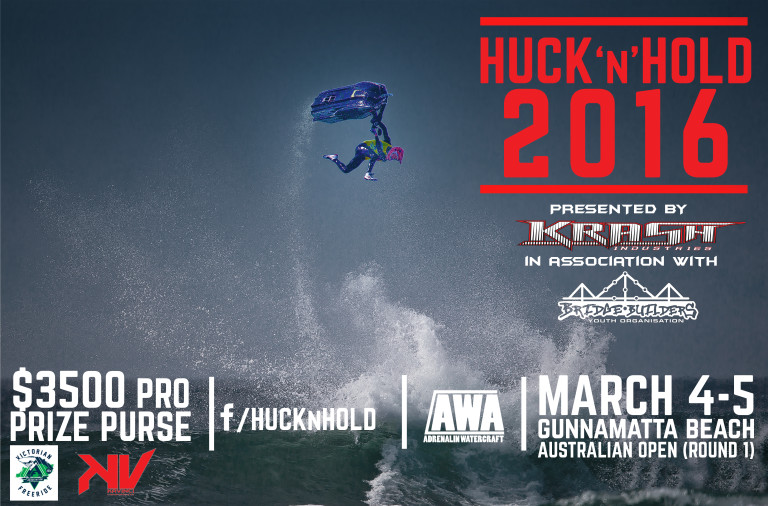
Krash Industries – out of Victoria, Australia – is back to host the annual Huck ‘N Hold event which showcases all styles of riding, from flying skis to racing. Your ability doesn’t matter since there are rookie and amateur divisions available for one to enter.
This competition is bigger than ever and The Bridge Builders Youth Organization (BBOYO) has once again stepped up to help. This is the organizations’ third year putting this event together taking place March 4th and 5th this year at Gunnamata Surf Beach in Australia.
A $3,500 purse is available for the Pro Division and prizes from Kavicini Components will be given to the Free Riders, Amateurs, Rookies, Masters, and Runabout divisions according to Huck ‘N Hold’s Facebook page. This event looks super fun.
The Bridge Builders Organization’s youth are excited about putting together the Huck ‘N Hold because it is such a cool event. The competition is another way to bring the kids together and to help them grow into productive adults.
The BBOYO is a non-profit that has discovered that by allowing teens an opportunity to organize events, their confidence is boosted and a challenge is provided. The Huck ‘N Hold does just that, provides a challenge while the youth perform a great deal of the work that goes into executing the event.
The Australian Watercraft Association will also be on hand to host the first round of the 2016 Krash Industry Nationals and Jet Ski Transport will help you get your ski to and from the event. Only 120 spots are available so submit your entry now!
It’s a really good time to be Yamaha. Not only did the 2015 Yamaha FX SVHO WaveRunner win “Watercraft of The Year,” but their all-new three-cylinder 4-stroke TR-1 receive the coveted National Marine Manufacturers’ Association (NMMA) for innovation in the watercraft division.
New for 2016, the Yamaha TR-1 HO marine engine replaces the outgoing MR-1 four-cylinder 4-stroke while being 13 percent more powerful while being 40 percent smaller in size and 20 percent lighter. Weight is shaved by eliminating a reduction gear, integrating the oil tank, and using fewer and smaller parts, resulting in quicker acceleration, higher top end speeds, and better fuel economy.
Yamaha WaterCraft Group, a division of Yamaha Motor Corporation, U.S.A., today announced that its WaveRunner product line received one of the boating industry’s most prestigious awards recognizing excellence in design from the National Marine Manufacturers’ Association (NMMA).
Honored for innovation by the NMMA in the Personal Watercraft category is the new TR-1 High Output marine engine that is featured in Yamaha’s 2016 V1 and VX Series WaveRunners.
The Yamaha TR-1 HO marine engine is the pinnacle of engine innovation. The TR-1 motor is 13 percent more powerful than the Yamaha MR-1 engine that it is replacing while being 40 percent smaller in size and 20 percent lighter in weight.
Yamaha achieves this by eliminating a reduction gear, integrating the oil tank, and using fewer and smaller parts. The result is quicker acceleration, higher top end speeds, with better fuel economy and more fun for the rider.
This is the second time in as many years that Yamaha WaveRunners have been honored by the NMMA for innovation. Last year, Yamaha’s RiDE system received the innovation award in the Personal Watercraft category. RiDE is the world’s first handlebars with dual throttle controls and is available on Yamaha’s 2016 FX and VX Series WaveRunners.
“Receiving this coveted award two years in a row reflects our commitment to constant innovation and bringing all new technologies and features to market that make our customers’ experiences with our products even better every time they are out on the water,” said Bryan Seti, general manager of Yamaha’s Watercraft Group.
The NMMA Innovation Awards are presented annually at the Miami Boat Show. Selected and judged by Boating Writers International. The Innovation Award honors manufacturers and suppliers who bring new, innovative products for the boating industry to market.
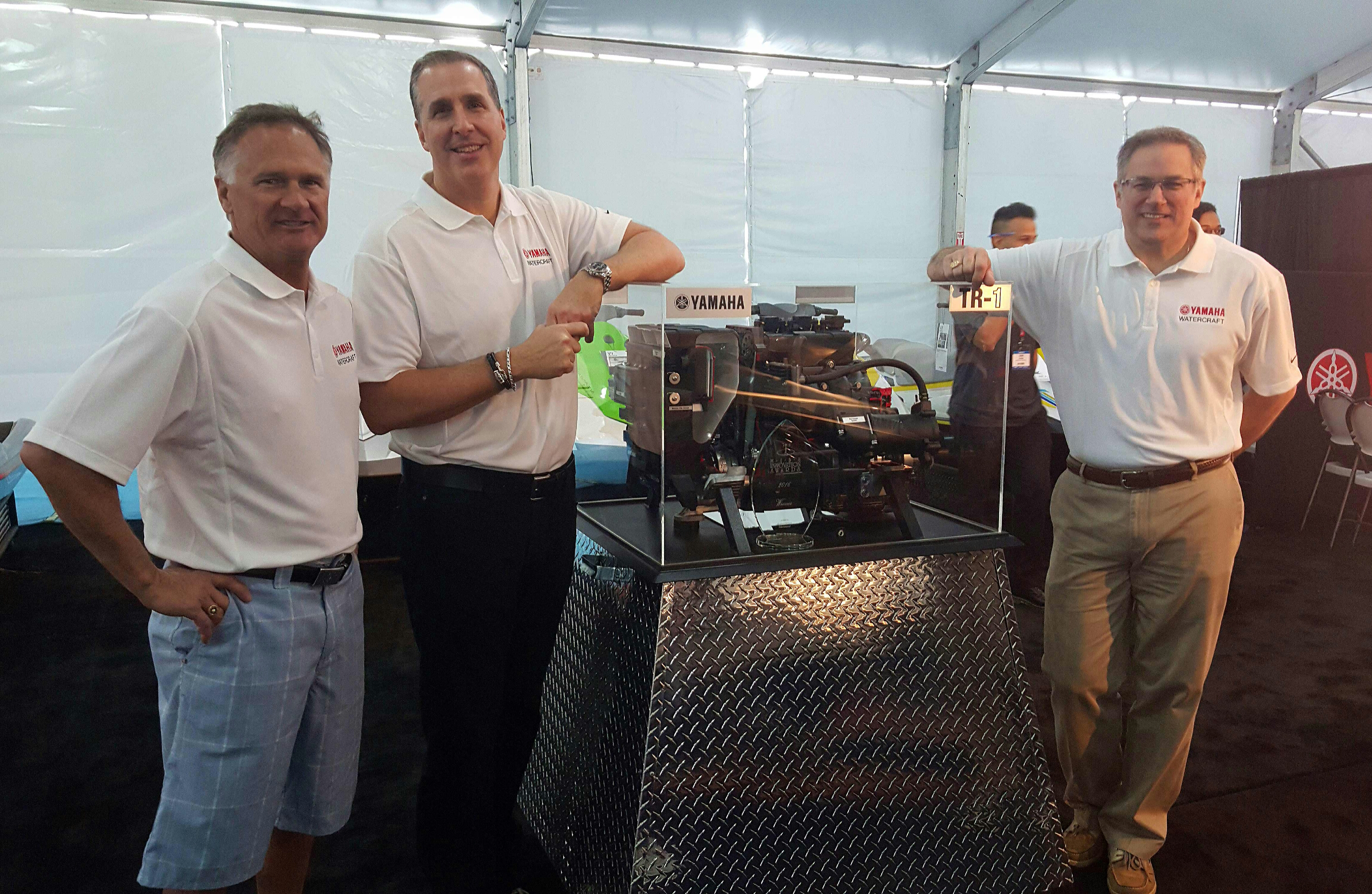
In the photo from left to right is Yamaha Watercraft’s product manager Scott Watkins, general manager Bryan Seti, and president Dean Burnett.
In addition to the sheering uniqueness that the Exoskel architecture provides the Sea-Doo Spark, it also shaves off considerable weight thanks to its open cage design. Combined with the injection-molded Polytec material that its made from, and there’s little to understand how the Spark (in its most minimal trimming) can weigh slightly over 400 pounds.
Over its first two years, the Spark’s unique layout and build material has proven to be a winner, as the entry-level Sea-Doos have outsold more units than the entirety of the Kawasaki lineup. Unfortunately, the experimental Polytec does have its downsides (albeit minor): it can be a pill to keep clean and looking fresh if you’re using the wrong cleansers, and its softness can be gouged easily if treated roughly.
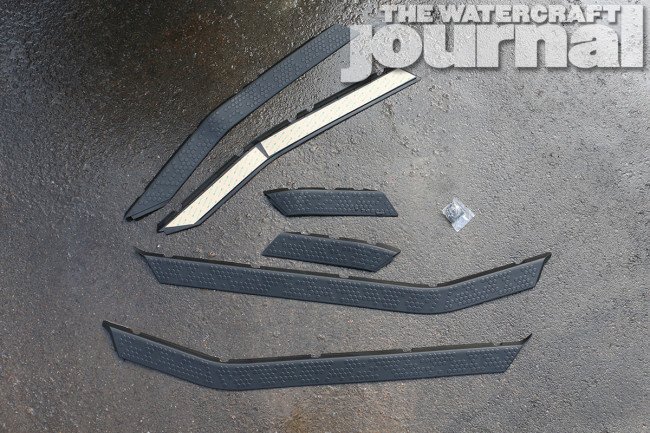
Above left: The Side Protector Kit comes with six panels (two medium-length front panels, two long-length side panels, and two short-length rear) and a small baggie of 12 plastic “darts” (knurled push-in tabs). Above middle: Each panel comes prepared with 3M heavy-duty adhesive backing. Above right: Simply peel and apply.
Above left: The forward and rearward-most panels are designed to be overlapped by the front nose bumper and rear bumpers. BRP suggests unbolting the furthest most screws, but we had enough gap to slide the edges beneath. Above middle: Be mindful to line up the side protector with the body screws. Above right: The smallest panels not only tuck beneath the rear bumpers, but also mate up with the edge of the rearward colored panel as an end cap.
Because we want to keep our two-seater 90-horsepower Spark looking its best, we considered several protective measures. Thankfully, Sea-Doo’s parts and accessory division is awash in add-ons and items that will not only retain your Spark’s luster, but add some personal flare and character to your Rec Lite watercraft.
Our Pineapple Yellow 2-up HO came with the triangular low-speed Sun Shade option, which gives our little Spark some character in and of itself, but we were looking for a little something to better keep its panels from any further scrapes and scratches. We opted for the BRP Side Protector Kit. Because of the bolt-together construction, the Spark doesn’t have a glued deck and hull, thereby not needing the typical bumper rail to cover up the unsightly bond line.
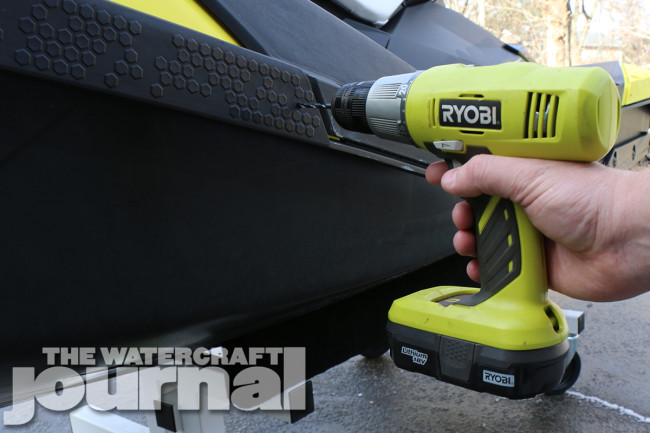
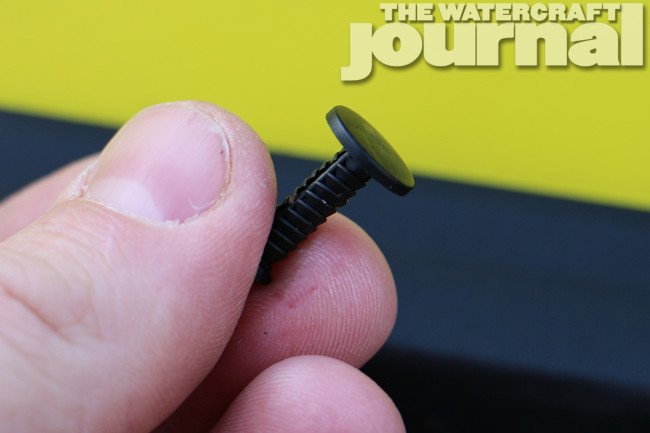
Top left: The only permanent modification made to your Spark is drilling these holes along the railing to properly secure your new side protectors in place. A 4mm (11/64-inch) drill bit is required and not included in the kit. Top right: The kit does include (12) of these plastic push pins – called “darts” in the instructions. Bottom left: The pins simply press in, their knurled sides securing it and the panel to the rail’s edge. Bottom right: You’ll need to make two holes in each panel, totaling 12 holes and pins. BRP’s instructions give good direction where the holes should be made.
The Side Protector Kit acts like a bond rail, being the first point of contact against a dock, mooring or other ski while out on the water. The Side Protectors are more malleable and thereby mold to the contours and curves of the Spark’s outer railing better. The installation took less than a half an hour, and that’s including the time it took to snap photos along the way, so we’re pretty sure it’ll take you less time than us.
The only tools you’ll need is an electric drill with a 4mm (11/64-inch) bit, as well as a spray cleaner and rag to prepare the surface before attempting to adhere the 3mm-backed panels to the Polytec panels. The kit comes complete from BRP with six panels (two medium-length front panels, two long-length side panels, and two short-length rear) and a small baggie of 12 plastic “darts” (knurled push-in tabs).
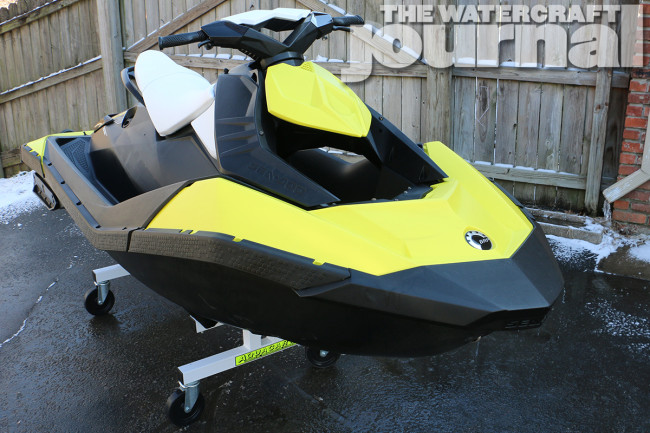
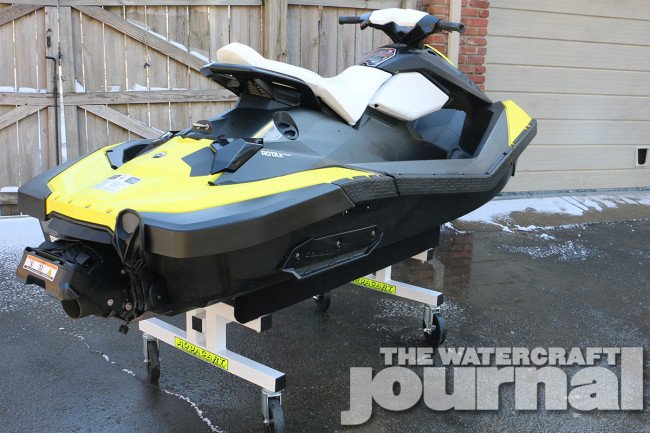
Above: We’re very happy with how the new Side Protector Kit turned out and helped break up the large yellow panels. The protectors are certain to keep our Spark’s sides safe when pulling up to the dock.
Evan Kassing has done something very unique with his custom turbocharged 2012 Sea-Doo RXP-X 260. Usually a supercharged ski, when Evan upgraded it to a GRF TiAL/Garrett turbo system, he decided the original factory Sea-Doo iControl display system just wouldn’t cut it for what he needed.
Enter the MoTec C127 digital display system. With some custom programming and management from a MoTec M150 system, Evan has managed to mate the C127 with his RXP-X jet-ski and it works brilliantly.
The C127 is a new model in MoTeC’s line-up of displays and display loggers. Featuring a high resolution, full color, 178mm ultra bright and anti-reflective screen, the C127 is sure to impress. Stylishly designed with powerful functionality, the C127 provides a sophisticated display plus data logging, auxiliary control and programmable LEDs all in one streamlined device.
Numerous selectable layouts are supplied with configurable channels, labels and color schemes. If none of the pre-loaded layouts suit your fancy, it gives you the full ability to treat your screen as a blank canvas and design your own layout with unique graphics, sponsor logos, custom icons and gauges with the new Display Creator upgrade.
The C127 also features a total of 16 full color LEDs integrated into the unit for use as shift lights (for motorcycle and automobile applications), warning lights or other driver alerts. The color, function and intensity of each LED are fully programmable allowing users to develop their own unique strategies and sequences.
West Coast racing is as strong as ever and Ross Wallach of RPM Enterprises just announced the complete Spring/Summer schedule for the 2016 “Best of The West” racing series. Teaming again with Jettribe Core Watercraft as the Title Sponsor for the Arizona/California-exclusive series, 10 rounds of racing will take place over five weekends throughout the year, spanning from April to August.
Beginning in Lake Havasu, Arizona, with the 3rd Annual Lake Havasu Watercross IJSBA Regional Championships Gary Hart Memorial, the action continues on Parker, Arizona; Lake Perris and Lake Elsinore, California; before returning back to Perris, California for the Lake Perris Jettribe Season Finals, which hopes to also turn things on its ear with a possible night race. We’re excited to see residents from Arizona join the strongest riders from across California, and expect to see a fantastic series unfold this year.
Here’s the original press release:
Jettribe Signs On Again As Title Sponsor For The 2016 IJSBA “Best Of The West” Series
RPM Racing Enterprises is proud to announce that JETTRIBE CORE WATERCRAFT Co. – www.jettribe.com has signed on for a fourth consecutive year to be the title sponsor of the IJSBA sanctioned 2016 “Best of the West” Series. RPM Racing Enterprises has been promoting PWC racing, both closed course and endurance, for the past ten years in Southern California, Arizona & Nevada.
The 2015 season ended on a high note at Round #7 of The Jettribe Best of the West Season Finals at Mossdale Quarry Lakes in Lathrop, CA with DJSA that featured the 2015 North vs. South California State Championships under the lights! With Jettribe’s continued involvement, the 2016 season looks to be even bigger & better than last year which saw the largest attended closed course races in the nation. This year RPM Racing is undertaking an ambitious 10 round series,*” according to Ross Wallach, President of RPM Racing Enterprises.
“I can’t thank Tony and the Jettribe staff enough when it comes to helping me promote these great events! Jettribe always goes above and beyond that of a typical sponsor and try’s to find more ways to help out not only the individual event but the entire sport! Tony has been an unbelievable asset and a direct reason why racing continues to thrive!” Beginning in April and running through August fans will be treated to some spectacular competition on the water at some of the best race sites when racers will be on a quest to win the title of JETTRIBE “Best of the West” Series Champion. The action on the water promises not to disappoint!
JETTRIBE Core Watercraft Co. is recognized as the industry leader of PWC Watercraft gear. From PWC covers to wetsuits, gloves, footwear, goggles, protective gear, rashguards, etc., JETTRIBE is a one stop shop for the racer and enthusiast alike. JETTRIBE’S expert knowledge and superior quality is what separates it from the rest and why more racers choose JETTRIBE when buying PWC gear. The partnership between JETTRIBE and RPM Racing Enterprises continues to serve the racer and fan alike. For More Information, Please Visit www.jettribe.com
Race Schedule Round 1 & 2: April 9th & 10th- 3rd Annual Lake Havasu Watercross IJSBA Regional Championships Gary Hart Memorial, LHC, AZ Round 3 & 4: May 14th & 15th – Blue Water Resort & Casino IJSBA Western States Nationals, Parker, AZ Round 5 & 6: June 11 & 12- Lake Perris Open, Sail Cove, Lake Perris State Park, Perris, CA Round 7 & 8: July 9th & 10th – Lake Elsinore or Vail Lake Open of Watercross (TBD) Round 9 & 10: August 13th & 14th – Lake Perris Jettribe Season Finals (North vs. South State Championships, possible night race) Sail Cove, Lake Perris State Park, Perris, CA
In a recent surprising announcement, long time Kawasaki endurance specialist Christian D’Agostin and fellow racing teammate Cameron Martin have jumped ship from their factory sponsored team Brisbane Kawasaki rides to form a new team called PTS Racing.
Racing Yamaha’s for the 2016 season; the pair announced they have recently picked up the 2016 Yamaha FZR and FX from Gold Coast WaveRunners in Queensland, Australia.
“I can’t thank Shaun and Judy Hale from Gold Coast WaveRunners enough as well as Mark Harman from Yamaha Australia for making it such an easy decision. Now the real work begins with us and the team from Worx Racing Components to fine tune both the FX and the FZR for China in March,” said Martin.
Christian and Cameron earned top honors this past year during the 2015 Yamaha Australian Jetcross Tour and Australian offshore endurance series while racing Kawasakis; so it should be interesting to watch how the team does with their new Yamahas this year! For more information on their new team PTS Racing, check out their website.
There’s no question about it, the fuel curve gurus at V-Tech Tuned are making a name for themselves when it comes to getting in and unlocking the innermost potential found within today’s high tech four-stroke machines. Their handheld MapTuner is already seeing tons of attention for both Yamaha and Sea-Doo, especially for the latest crop of ACE 300 models!
Recently, our friends at PWC Muscle announced a very cool special on V-Tech Tuning’s MapTuner for your ACE 900-powered Spark. For those already familiar, the V-Tech MapTuner allows for quick and easy engine map tune downloads, allowing you to gather and replace your factory engine map for a custom one via V-Tech.
Now, for $600, you can purchase an ECU Flash Credit that can be applied to downloading a new digital map tune for your Sea-Doo and “significantly boost your Sea-Doo’s performance!” states PWC Muscle’s website. Although the map won’t push you to speeds equal to V-Tech’s radical turbo Spark kit, it will push you well past the stock configuration’s maximum of 90-horsepower.
Of course, if you have any questions regarding application or how to get the most out of your Sea-Doo Spark, give PWC Muscle a call at (888) 605-2335 today!
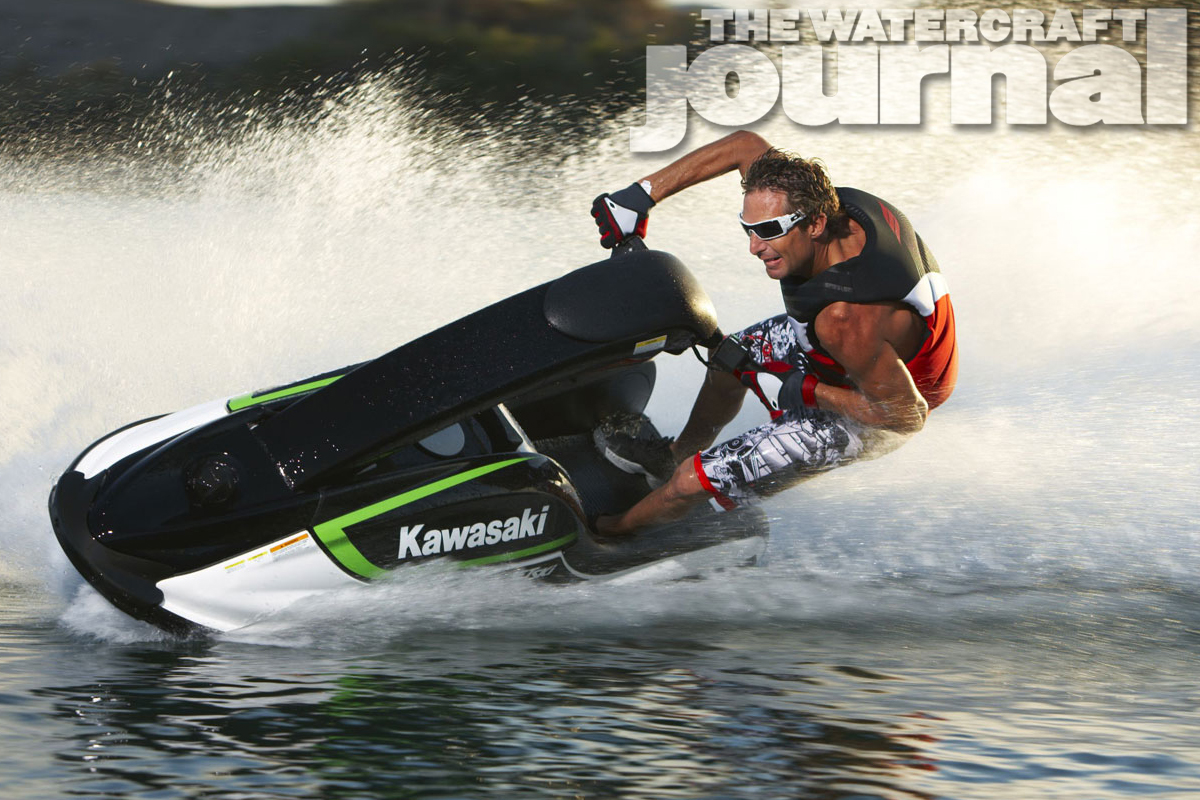
In 2011, Kawasaki Motor Corp. USA quietly announced that the SX-R 800, the progeny of the original JS400 and subsequent genealogical line of two-stroke stand-up JetSkis, would be phased out after that model year. From 2003 until that final year, the 8-year run of the SX-R was hailed with significant fanfare. The JetSki featured the widest tray of any Kawasaki before it. The hull was the direct result of decades of racing experience, incorporating several key design features to better allow the unit to rise to plane quickly, turn sharply and allow the rider to lean into said corners with confidence. The 800cc inline twin-cylinder was equally tried-and-true, bolstered by a deep well of aftermarket support.
So why did Kawasaki kill the stand-up JetSki? The quick answer is a rising trend in outlawing marine craft with two-stroke engines from lakes and rivers throughout the United States at the time. The groundswell of legislation quickly put the manufacturer under the ecological microscope, and combined with an underlying public distaste for “jet skiers” (primarily among older boating enthusiasts and private waterfront property owners stemming from decades of unmitigated bad judgement on behalf of early PWC enthusiasts), made outlawing the machines an easy target. But was that truly the central cause for Kawasaki to end a near 40-year-run of the stand-up JetSki? Sadly, the answer is no. It’s our fault.
Yes, jet ski enthusiasts could’ve written their congressional representatives strongly-worded letters. Yes, we could’ve voiced our arguments before local and municipal legislation. Yes, we could’ve filed private and class action lawsuits to stymie these bills. And yes, some of us did do such things. But the real fault that we as a community carry is that Kawasaki simply didn’t sell enough of them. The cost of production weighed against the number of units sold compacted by the growing vilification by an uneducated public made the ski’s demise a budgetary line item, not a decision of passion. So then, the query emerges: why did Yamaha continue (and continues today) to offer the SuperJet? They weren’t selling that many more SuperJets over SX-Rs. Simply put, their production costs were less and sales sightly higher.
Those two factors were enough to buoy the SuperJet through the economic storm of these past seven years; and Yamaha’s perseverance has paid in fold. SuperJet sales have increased year-to-year since 2013, so much so that demand has called for yearly increases in production. Spurring demand, Yamaha has also boldly incentivized sales, offering heavily-reduced monthly payment programs that price the two-stroke to nearly the cost of an average cellular data plan. Fatefully, the future of the SuperJet leans strongly at the introduction of a new hull design and modern 4-stroke plant to boot, while sources within Kawasaki have revealed little to no genuine interest in resurrecting the stand-up JetSki any time soon.
So, it could be argued that as our community let the Kawasaki JetSki slip into the mists of history, our collective support of the SuperJet may quite possibly reward us with a new 50-state emissions-legal stand-up. This, for all of you who forgot their high school economics class, is meant by a “free-market” – the Longman British maxim, “voting with your wallet” has never been so apropos. We, being a capitalist society, support the companies, products and venues best when we patronize them (a fact sadly lost on so many racers), and the free market allows those companies who do not garner equal support to fall by the wayside. Naturalist Herbert Spencer observed it as “survival of the fittest.”
But what if, as Darwin hypothesized, the environment – or in this example, the marketplace – fails to sustain enough life; enough for larger, more advanced predators thrive? (Because where there are several forms of predators, there is a successful ecosystem.) The African Serengeti teams with life from all links of the food chain, from pasturing impala and giraffe grazing from the billows, to packs of African wild dogs, caracal, mongoose, lions, cheetahs and pythons preying upon the first. Yet conversely, the lowest depths of the Pacific Ocean’s Mariana Trench, located just east of the Philippines, can only sustain mainly soft shelled foraminifera living in the silty bed floor, feeding on particulates and bacteria. The almost extraterrestrial temperatures and crushing pressures make the environment seemingly inhospitable.
To best understand where I’m going with this, consider the motocross industry as the African plains: the environment is lush in resources (the total US motorcycle manufacturing industry is valued at over $4 billion dollars), is rich in competition (an estimated half billion in aftermarket and correlated brands), and rife with life (a total 115,510 off-road/dual motorcycles were sold in 2014 alone). Compared to that of the personal watercraft industry (an estimated 55 million in total combined OE and aftermarket annual sales, and just over 30,000 new units sold in 2014), we start to come to terms with the hostility of our environment towards new life (ie. shops, vendors, dealers, manufacturers, media).
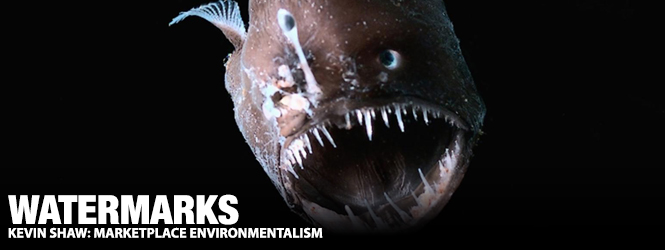
As is with the Mid-Atlantic Ridge, new life is often small, parasitic and nearly translucent – except for one: the angler fish. This terrifying creature is an unchallenged predator, deviously evolved to its environment and faced with no natural threat. Its bio-luminescent toggle hanging from above its enormous crescent-shaped mouth filled with sharp, cagey teeth is the solitary source of light in the blackness of the inky ocean. This is the best living example of being a “big fish in a small pond.” And like the crushing depths of the ocean, there are few predators within the PWC industry who have proven that can not only survive in this hostile environment but thrive. As new unit sales continue to increase, so will the aftermarket and consequently the industry as a whole. The way to grow the industry, and thereby make the environment more friendly towards new life, is to support those who support the sport.
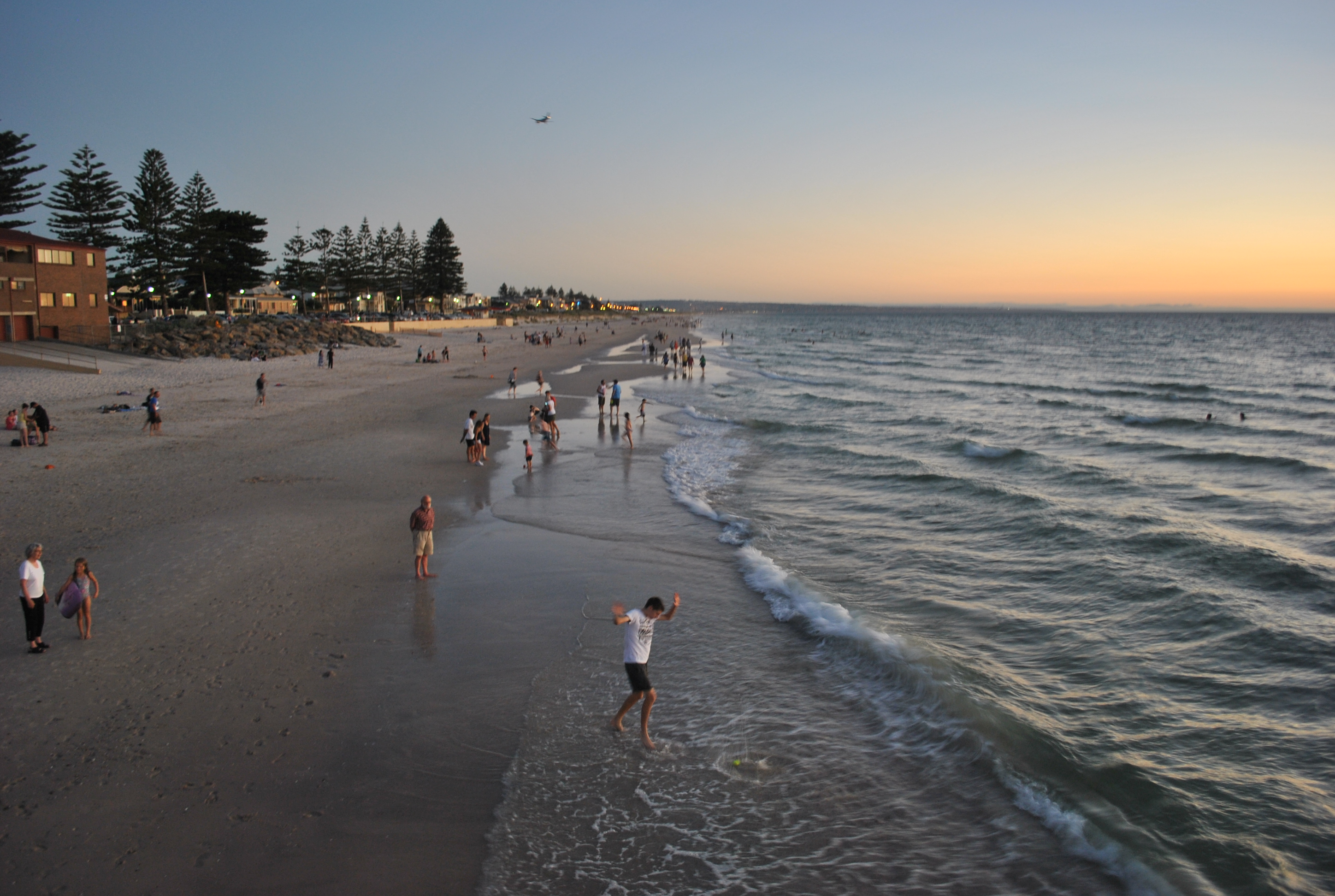
OZPWC reports that jet skis are banned again at Henley Beach in Southern Australia. This has been an ongoing saga for the Sturt Council who voted 8-to-7 to ban PWC’s and motorboats from coming within 200 meters of the shore between Torren Outlet and Grange.
The Charles Sturt Council is accepting full legal responsibility for for the zone slated for exclusion. Transport Minister Stephen Mullighan said he was pleased the council “had put its ratepayers and beachgoers first by taking this decision.”
Henley Ward Councillor Jassmine Wood, who called for the vote, was pressured by angry and worried residents for not implementing the ban this month.
“This is about safety,” Cr. Wood told this week’s council meeting. I do not have anything against jet skis — I’m happy for them to ride at West Beach — but Henley is a family beach.”
The new application will not allow ratepayers to hold the government responsible for accidents in the area. Henley Ward Councillor Bob Randall was against this specific decision and was distressed that Charles Sturt ratepayers would be prone to the legal risk the license carries with it.
The councilors did vote to ask Mullighan to put a permanent ban in place for future summers in Henley and Grange since concerned residents are really pushing for one because Henley is a family beach and safety must be a priority. Charles Sturt Mayor Angela Evans and Mullighan are seeking a permanent solution to banning personal watercraft and motor boats between Henley and Grange by using government regulation.