



 Every add-on we bolt to a personal watercraft comes with a decision attached to it. Extra storage, lighting, audio, mounts — they all change the experience in small but noticeable ways, and they all come with a cost somewhere else. Sometimes that cost is weight. Sometimes it’s speed. Sometimes it’s nothing more than visual or functional clutter. The question isn’t whether those tradeoffs exist — it’s whether they’re known, measured, and intentional.
What makes that question more relevant today is how accessory-rich modern skis have become straight off the showroom floor. Features that once required aftermarket solutions are now often standard or optional from the factory, which means most add-ons are no longer about basic functionality or comfort. They’re about choice, use, and personal taste. That hasn’t reduced the range of aftermarket options available — if anything, it’s broadened them — serving both new skis that are already well-equipped and older platforms where every change is felt more immediately.
 That mindset is what makes a recent build shared with us stand out. Guy, a rider from southeastern Michigan, put together a fully removable audio and video system for his 2019 Sea-Doo RXT-X — a red ski that’s hard to miss thanks to a set of unapologetically aggressive graphics. The goal wasn’t to permanently transform the ski, but to explore how far enjoyment-focused add-ons can go before their impact on performance becomes a known, measurable cost.
You can see the ski — and its grinning graphics — in motion in a short video Guy shared. There’s no narration, just music and multiple angles that give a good sense of how the system sits on the ski, from the handlebar-mounted phone setup to the speakers and cooler at the rear. It’s not a tutorial or a tech walkthrough — it’s a look at the ski as it was ridden, tested, and lived with over dozens of hours on Lake St. Clair.
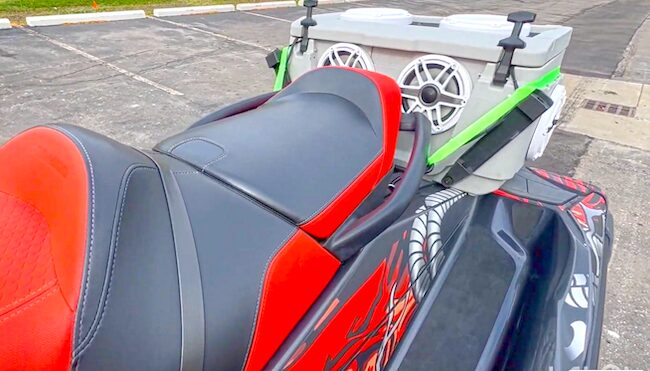
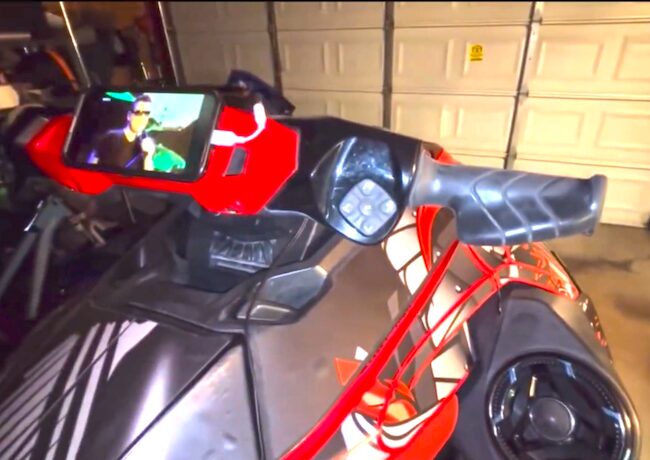 At the heart of Guy’s setup is a fully removable audio and video system that doesn’t demand a permanent commitment from the ski. Multiple lighted 7.7-inch JL Audio M6 coax speakers and a pair of 8.8-inch JL Audio subwoofers deliver serious sound, all controlled through a 13-band AudioControl crossover/EQ. A lithium-ion battery powers everything, protected by a resettable 80-amp breaker, and the whole assembly sits neatly in the rear cooler/jambox. Video can run from the handlebar-mounted phone or a tablet positioned on the back, giving riders options for how they interact with it on the water.
Even with all that gear, removability is the key design decision: the system can be lifted off in minutes, eliminating roughly 90 pounds from the ski and letting it run at full performance when desired. That 90-pound difference is tangible — on the water, Guy measured a drop from 87 mph without the stereo to 83 mph when it was mounted — a known, measured cost, not a sacrifice. It’s a concrete reminder that add-ons, no matter how tempting, always come with a tradeoff. But thanks to the removability, it’s a choice the rider can make every time they go out.
After 80 hours on the water, Guy’s system has proven that all the bells and whistles don’t need to compromise the core ride — especially when they can be removed at will. Even fully loaded, the ski still carves and accelerates like a high-performance RXT-X, and the drop in top speed is immediate, measurable, and reversible. Lake St. Clair’s mix of open water and tighter channels makes every added pound noticeable, so having the option to lift the stereo off before a long run or spirited lap is more than a convenience — it’s a design choice that preserves performance while still letting riders enjoy the extras when they want them. What stands out isn’t just the sound, or the visuals, or even the ingenuity of the setup itself; it’s the thoughtfulness in balancing “cool stuff” against measurable impact, and giving the rider the freedom to make that call every time they hit the water.