



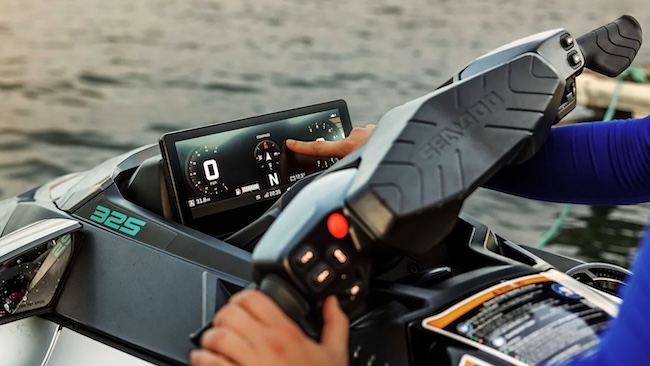
Rumors of Apple CarPlay making its way onto personal watercraft have been rippling through tech publications and industry circles alike, fueled by Sea-Doo’s confirmation that it’s exploring the idea for future high-end models. (Yes, we teased a similar “CarPlay on the water” scenario in an April Fools’ post last year — this time, it’s actually being talked about for real.) On land, the concept feels almost inevitable. On the water, it raises a more complicated question — not whether it’s possible, but whether riders actually want or need it once the throttle’s down and the shoreline disappears.
Bigger screens, bigger questions
Sea-Doo’s current 10.25-inch touchscreen is already the largest display in the personal watercraft market, now standard on nearly half of its 2026 lineup. It’s a serious piece of hardware, shared with BRP’s Can-Am three-wheel motorcycles — and notably, those Can-Am models already support Apple CarPlay.
That alone explains why this conversation exists. The technology isn’t theoretical. The screen isn’t new. The capability is already proven — just not in a marine environment.
What’s interesting is that the screen itself isn’t inherently the problem. Displays, when done right, can enhance riding. Engine vitals at a glance. Fuel range confidence. GPS navigation that opens up longer routes and farther exploration. Diagnostics that help riders understand what their machine is doing beneath them.
All of that aligns with a more capable, more adventurous kind of riding — not less.
Where things start to feel uncomfortable is when the conversation shifts from information to infotainment.
Seat-of-the-pants vs. “bigger, better, more toys”
Personal watercraft have always lived in a strange middle ground. They’re not dirt bikes, but they’re not boats in the traditional sense either. For decades, the appeal has been immediacy — throttle response, hull feedback, the physical connection between rider and machine.
Lately, the industry has been drifting in two directions at once. On one side, there’s an appreciation for bigger skis that ride better in real water, track cleaner at speed, and give riders the confidence to push farther from shore. On the other, there’s the slow creep of features that feel borrowed from cars: cupholders, massive displays, ever-expanding menus.
CarPlay sits right at that crossroads.
Is a bigger screen simply another “floating couch” checkbox? Or is it a tool that helps riders ride more — more distance, more time, more confidently?
The answer depends on what that screen is actually doing.
When tech helps — and when it competes
There’s a real difference between tech that supports riding and tech that competes with it.
Monitoring engine vitals while running hard offshore? Useful.
Knowing exactly how much fuel you have left before committing to a long run? Smart.
Seeing where you are when exploring unfamiliar water? Confidence-building.
But CarPlay isn’t designed around those priorities. It’s designed for roads, lanes, and dashboards — not chop, spray, gloves, vibration, and constant body movement. Navigation apps like Google Maps and Apple Maps don’t translate cleanly to open water. Notifications, app grids, and car-style interfaces introduce mental noise into a space that’s always demanded focus.
The moment something is called “infotainment,” it stops being about the ride and starts competing with it.
The music complication
Even the most old-school, stand-up-minded riders aren’t riding in silence. Bluetooth speakers are everywhere. Music is already part of the culture, whether we like it or not. Pretending otherwise just ignores reality.
So the real question may not be whether riders want CarPlay — but whether they want better, more reliable music control on the water.
If CarPlay’s biggest appeal is easier access to playlists and streaming apps, that’s a pretty expensive and complex solution to a relatively simple desire. Riders don’t need album art and app icons. They need volume control that works with gloves, doesn’t glitch, and doesn’t distract them at speed.
That’s a very different design problem than full-blown automotive infotainment.
Cool… but necessary?
Sea-Doo has been open about the hurdles. Marine environments are harsh. Apple’s approval process for non-automotive applications is strict. And perhaps most importantly, the company itself seems unsure whether the feature is truly needed — or simply attractive because it’s familiar.
That hesitation is telling.
CarPlay on a PWC would absolutely be cool. It would look impressive at the dock. It would generate headlines. It would photograph well.
It’s easy to see why the idea has the industry talking
Whether it actually makes riding better is a much tougher question.
At its best, modern PWC technology should fade into the background — quietly supporting the ride, not demanding attention. The challenge for manufacturers isn’t adding more features, but deciding which ones genuinely serve the experience.
CarPlay might get there someday. Or it might turn out to be one of those ideas that sounds perfect on land, but feels unnecessary once the throttle’s pinned and the water’s moving.
Either way, the conversation itself says a lot about where personal watercraft are headed — and what riders may or may not want to bring along for the ride.