


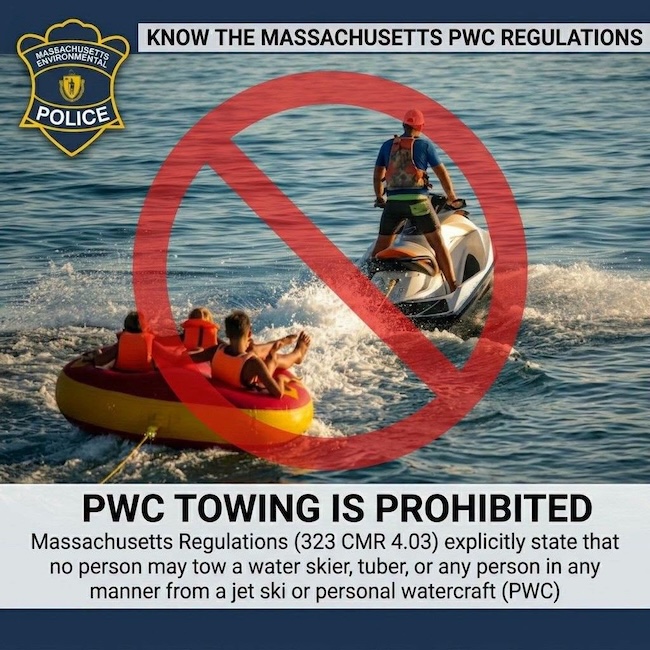
 If you missed it, the Massachusetts Environmental Police posted a reminder graphic last week that caught a lot of riders off guard: towing a water skier, tuber, or anyone else from a personal watercraft is illegal in Massachusetts. Not “illegal without an observer.” Not “illegal if your ski isn’t rated for it.” Just illegal, full stop.
The regulation itself isn’t new — 323 CMR 4.03(3) has been on the books since 2004 and reads plainly: “No person shall tow a water skier or any person in any other manner from a personal watercraft.” No exceptions carved out for three-seat skis, no capacity workaround, no observer clause. If you’re towing from a PWC on Massachusetts waters, you’re breaking the law, regardless of how your craft is set up.
What made this one land differently is the reaction. The post has pulled in nearly 1,500 comments and counting — and as of this writing, Massachusetts Environmental Police hasn’t responded to a single one. The range is exactly what you’d expect any time a state posts a “did you know this was illegal” reminder: genuine surprise, a healthy dose of Boston Harbor jokes, and a few one-liners good enough to steal. Our favorite so far, from commenter Chris Rogers: “My pwc identifies as a boat.”
 A sampling of the range:
“Oh I’m sorry, I thought this was lake America” — Chris CJ Jutras
“Oh now I see why yall always come to fl for vacation..” — Thomas Wander
“Isn’t that how almost all jet skis are used in surfing and lifeguarding?” — Eric Davis
“Let me guess who create that law, a kayak owner??” — Jaime Jaime
“If it’s fun it has to stop. Did my wife make this rule” — Beniah James
“chuckles in floridian” — Paulo Alexander Casimiro
“Probably need a permit to go on any carnival ride in that state lol” — Derek Sechrist
Not every comment was a jab, either:
“That’s a good law, especially for saltwater. Only do one stupid thing at a time.” — CR Mcsendy
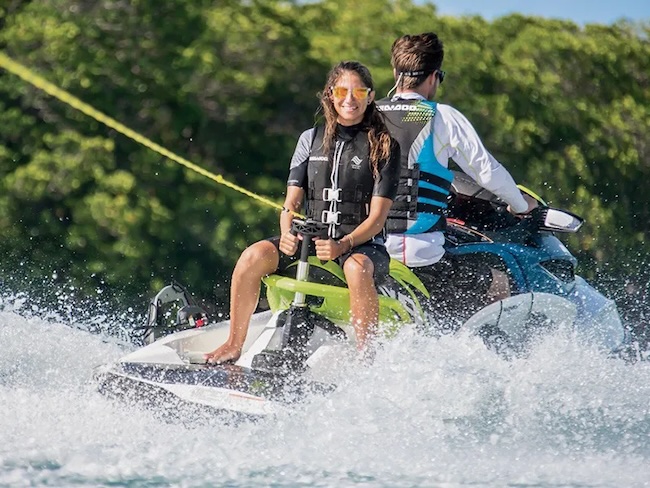
Myth check: A few commenters floated the idea that three-passenger PWCs are titled as “boats” and therefore exempt from the towing ban. That doesn’t hold up. Massachusetts defines “personal watercraft” by design, not seating capacity — under MGL c.90B §1, it’s any vessel using a water jet pump (or similar machinery) as its primary propulsion, built to be ridden sitting, standing, or kneeling on the craft rather than in it, and the statute names jet skis, surf jets, wetbikes, and water jet devices specifically. A 3-up ski meets that definition exactly the same as a 1-up ski. PWCs and powerboats do get registered under the same process, but that’s a paperwork mechanism — it doesn’t reclassify a PWC as a different type of vessel or carve it out of 323 CMR 4.03. However many seats it has, if it’s jet-propelled and you ride on top of it, it’s a personal watercraft, and the towing ban applies.
Another common pushback in the comments went the opposite direction — a few riders pointed to the standard capacity math (3-person ski = driver, spotter, and one person on the tube) as proof towing is “fine in every state.” That math is correct for most states, which is exactly the pattern in the comparison below — but it doesn’t rescue you in Massachusetts. MA isn’t layering a capacity requirement onto towing; it removed the activity outright. A 3-up ski with a spotter aboard satisfies the rule everywhere else on this list and still doesn’t satisfy 323 CMR 4.03.
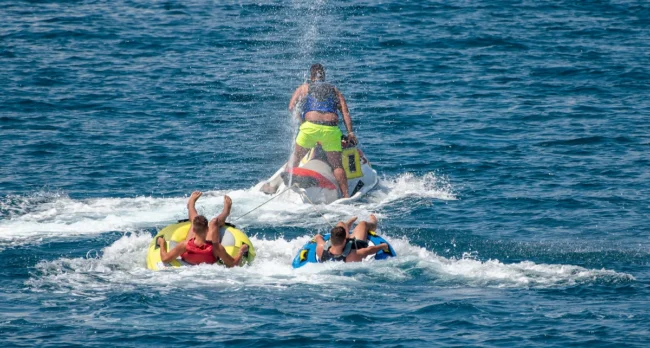 So how unusual is this, really?
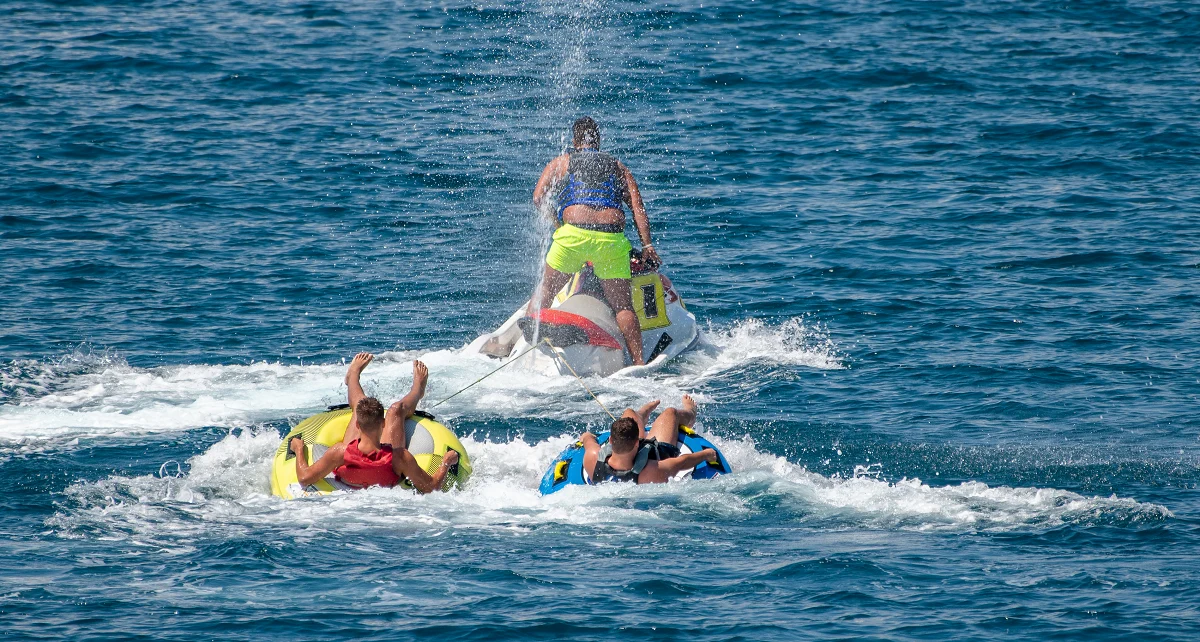
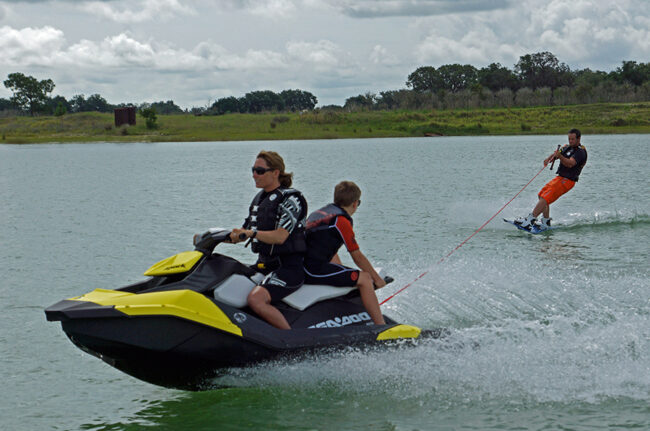
Here’s the part that actually matters if you ride outside Massachusetts: most states don’t ban towing from a PWC outright. They regulate it. Which means the rules people assume are universal — an observer on board, a minimum seating capacity, an age minimum for who can watch the person being towed — are usually the actual law, not just good practice, and they vary more than most riders realize.
A quick sample of how the “regulate, don’t ban” states handle it:
| State | Approach |
| California | Allowed — PWC must have rated capacity for operator + observer + towed person |
| New York | Allowed — observer must be at least 10 years old; PWC must be rated for 3+ people |
| Ohio | Allowed — observer required in addition to operator |
| Wisconsin | Allowed — PWC must be manufacturer-rated for 3+ people, competent observer aboard |
| Texas, Missouri, Virginia, Washington | Allowed — general vessel-towing statutes apply to PWCs; observer or approved mirror required |
Massachusetts, by contrast, isn’t regulating the activity — it’s removed it entirely. That puts it in a small minority of states that treat PWC towing as a flat no, rather than something you can do correctly if your setup and observer meet the requirements.
The most common requirements you’ll run into, state to state:
- An observer aboard — separate from the operator, watching the person being towed (age minimums vary: some states set it at 10, others 12, some don’t specify)
- Minimum seating capacity — the PWC has to be manufacturer-rated to carry the operator, the observer, and the person being towed
- An approved mirror as a substitute — a handful of states will let a properly rated mirror stand in for a human observer
- Daylight-only restrictions — many states that allow towing still prohibit it between sunset and sunrise. Not surprising on its own, since PWC operation in general is commonly restricted to daylight hours regardless of whether anyone’s being towed — this is less a towing-specific rule and more the baseline riding rule carrying over
- Distance/proximity rules — staying a set distance from docks, swimmers, other vessels, and anchored boats while towing
None of this is exotic — it’s the same skeleton of rules that governs towing from a boat. But “know before you go” applies here more than most riders think, especially if you’re trailering across state lines for a lake trip or a rental.
 While we were down this rabbit hole…
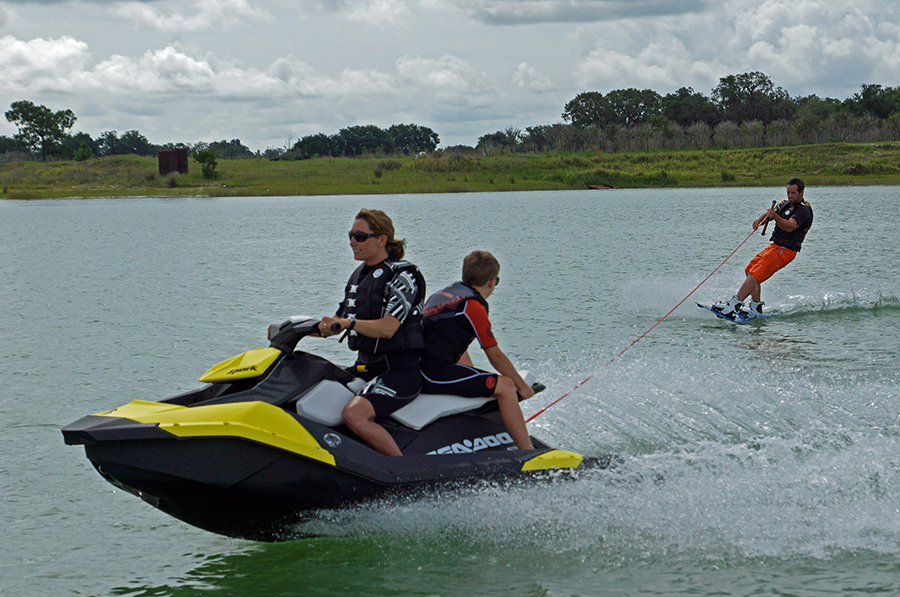
Once you start pulling state PWC regulations, a pattern shows up fast: most states land on some version of the same rulebook — 2 or 3-seat capacity requirements, an observer or mirror (sometimes both, sometimes either), an age minimum for the observer that ranges anywhere from 8 to 13 depending on the state, and a sunset-to-sunrise ban. One requirement that shows up almost everywhere and gets overlooked constantly: a visible orange or red flag whenever a skier or tuber is down in the water or the tow line is out. It’s not a formality — it’s how nearby boat traffic knows there’s a person in the water they can’t easily see.
A few states break from the pattern in ways worth knowing before you trailer across a border:
Hawaii — towing a surfer requires a weather event. Hawaii doesn’t just regulate PWC-assisted surf towing, it gates it behind conditions: towing a surfer with a jet ski is only legal during an official National Weather Service High Surf Warning, and only in designated tow-in zones. Operators need both a Boater Education Card and a separate Thrill Craft Operator Certification — a two-day course through the Division of Boating and Ocean Recreation — plus a valid tow-in decal on the craft itself. The equipment list is its own hurdle: a rescue sled at least 3 feet wide and 4 feet long, a quick-release tow rope at least 30 feet, a separate 6-foot bow towline, a two-way communication device, dive fins, and a safety knife on board. This one exists because of big-wave tow-in surfing culture, not recreational tubing — but it’s a real, codified set of requirements, not just a best practice.
Arkansas — no mirror allowed, period. Most states that permit a mirror as a substitute for a human observer draw the line at PWCs specifically (since PWCs are harder to mount one reliably on). Arkansas skips the exception entirely: no rearview mirror substitution on any towing vessel. If you’re towing in Arkansas, you need a second person aboard watching the person in tow — no equipment workaround.
Connecticut — stacks a fourth requirement on top of the usual three. Most states stop at age, certification, and observer/mirror. Connecticut adds a fourth: anyone towing a skier or tuber must be at least 16, hold a boating safety certificate, and carry a separate Connecticut Safe Waterskiing Endorsement most other states don’t require. Tubes towed in CT also need permanent (not clip-on) handholds, and operators can’t tow more than one inflatable at a time.
Oregon — one stretch of river has its own sticker. Most of Oregon follows standard towing rules, but the Newberg Pool on the Willamette River (river mile 26.6 to 55) requires a separate Towed Watersports Decal issued by the Oregon State Marine Board — proof to law enforcement that both the operator and the craft meet that specific stretch’s congestion-control rules. It’s not required anywhere else in the state. If you’ve only ever ridden outside that stretch, you’d have no reason to know it exists.
Oklahoma — the extremes on both ends. Oklahoma sets the youngest observer age minimum we found in any state at 8 years old for a non-PWC towing vessel. But if the towing craft is a PWC, the requirement flips to needing two wide-angle mirrors, not one, positioned so the operator can watch both.
New Hampshire vs. Pennsylvania — opposite philosophies on group towing. New Hampshire allows towing up to two skiers or up to six people on inflatable tubes at once (with added observer rules once you’re towing multiple tubes). Pennsylvania goes the other direction entirely: one person being towed at a time, no exceptions for tubes or groups.
Alaska — the “call first” rule. Alaska’s standard towing and proximity rules are fairly typical, but some specific areas ban PWC operation outright, and there’s no single statewide list — riders are expected to contact local land managers before launching in unfamiliar waters. It’s less a specific “don’t do” and more a reminder that “legal in the state” doesn’t always mean “legal on this particular lake.”
Have a law from your home state that catches out-of-state riders off guard? Drop it in the comments — we may be doing a follow-up.