


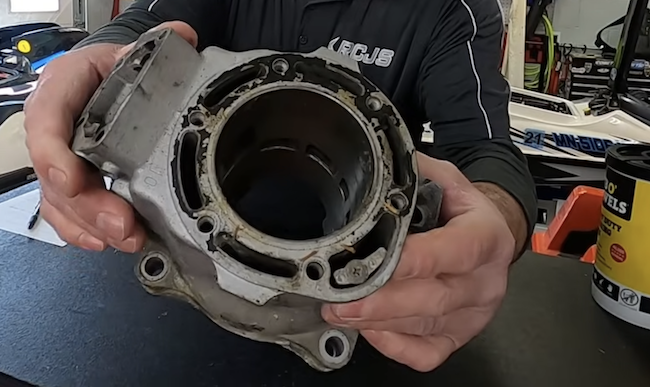
 A cylinder might look perfectly fine, with no visible scoring or obvious damage, but that doesn’t necessarily mean it’s ready to go back into an engine.
In a recent episode of his YouTube series Watercraft Talk, John Zigler of Watcon.com tackles a question that regularly comes up among PWC owners rebuilding their engines: Does this cylinder need to be bored?
According to Zigler, it’s a question that can’t be answered by posting a photograph on Facebook or asking for opinions in an online forum.
Even if the cylinder walls look smooth and there’s no damage you can feel with a fingernail, the cylinder could still be outside the manufacturer’s specifications.
The only way to know, he explains, is to measure it.
Zigler demonstrates a cylinder that appears to be in good condition while explaining the importance of using a dial bore gauge to take measurements at multiple points and in different directions.
Those measurements help determine whether the cylinder is out of round, whether it has developed a taper and whether the clearance between the piston and cylinder wall is within specification.
All three conditions matter when rebuilding an engine.
A cylinder that’s out of round or tapered may prevent the piston rings from sealing properly, resulting in reduced compression and poor performance.
Excessive piston-to-cylinder clearance can create even more serious problems, including the possibility of damaging or breaking a piston skirt.
Zigler also cautions against another common piece of online advice: simply honing a cylinder and installing new rings.
Honing removes material from the cylinder wall. If the piston-to-cylinder clearance is already near the maximum allowable specification, removing additional material could push it beyond acceptable limits.
Drawing on decades of experience working on PWC engines, Zigler says he generally prefers boring cylinders rather than honing them. In his experience, cylinders coming in for rebuilds are typically out of round, tapered or already close to the allowable clearance limit.
Boring the cylinder provides a straight, consistent surface that allows the piston rings to seal properly and helps improve the longevity of the rebuild.
The latest video builds on an earlier Watercraft Talk episode covering the machining of two-stroke PWC cylinders.
For anyone preparing to rebuild a two-stroke PWC engine, Zigler’s message is straightforward: A visual inspection is no substitute for accurate measurements.
Watch the latest episode, Does My PWC / Jet Ski Cylinder Need a Bore?, on the Watercraft Talk YouTube channel.
For additional background, watch his earlier video, Machining PWC 2-Stroke Cylinders.