


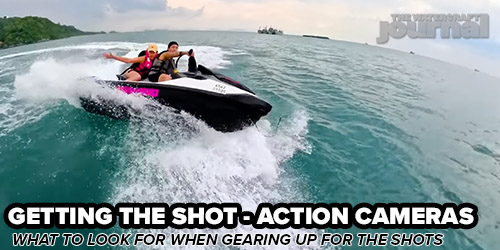
 Here’s the next installment for our multi-part series on PWC race photography. This time we’re diving into action cameras — what they are, how they vary, what to look for (especially from a racing vs cruising perspective), and the add-ons and features that can elevate your game. Think of this as a guide to putting the right lens on your watercraft world.
WHAT QUALIFIES AS AN ACTION CAMERA?
Action cameras are compact, rugged video devices designed to capture fast-moving activity from the rider’s viewpoint (or mounted vantage). These are made for movement, splash, wind, vibration, and in our case — watercraft (waves, spray, sun glare, you name it).
Some quick defining traits:
-
Wide field of view: To capture the scene around you rather than just a narrow slice.
-
High frame-rates & resolution: To capture smooth motion, capture a crash or splash in detail, or produce slow-motion replays. For example, the GoPro HERO13 Black supports 5.3K resolution.
-
Image stabilization: Because on a ski your mount is bouncing, spray is hitting it, handlebars shaking — you want footage you can watch, not make you seasick. As one review noted, the best cams deliver “sharp, stabilized footage in all conditions.”
-
Water / splash proofing + rugged mount capability: For PWC use, you want something built to handle water, maybe submersion, salt or fresh, and fixed securely so you don’t lose the camera (or the shot).
-
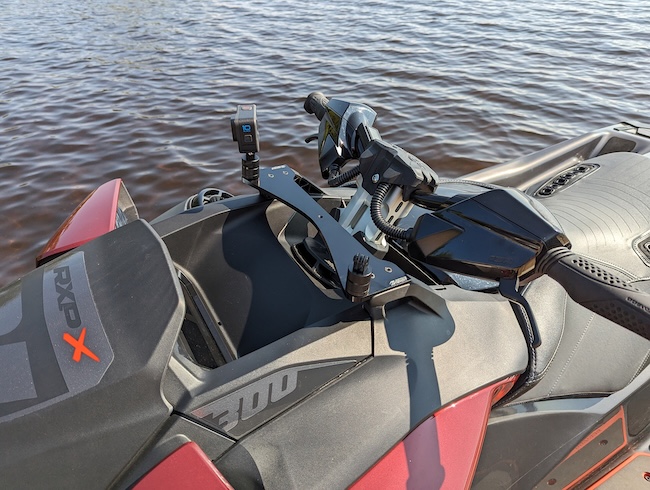
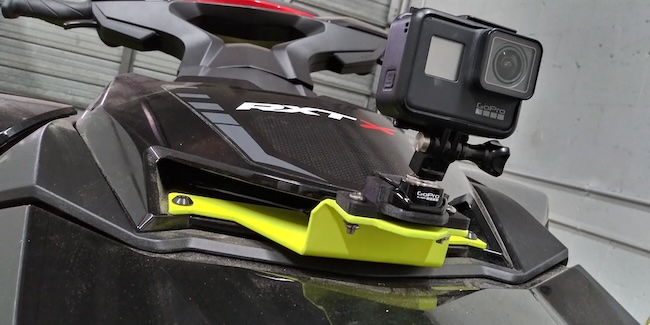
Mounting flexibility: Helmet mount, chest mount, stern facing mount, handlebar mount, suction cups — all of these have their advantages.
-
Action-ready features: Voice control, high-speed burst, time-lapse, 360° capture (in some models) for creative angles.
In short: action cameras are built to capture what happens while you’re moving.
 DIFFERENT NEEDS, DIFFERENT CAMERAS
Not all action cameras are created equal — and for our sport (jets, waves, speed) the type you pick will influence the footage you get. Here are the major categories:
1. Standard POV (Point-of-View) action cameras
These are what most people think of: a relatively rugged box-camera with a wide lens, you mount it on your helmet, chest, ski handle or stern. Example: GoPro HERO-series, DJI Osmo Action-series.
Strengths: Direct POV, easy to frame, many mounts and accessories available, proven in the field.
Weaknesses: Fixed field of view (unless you change lens), you fix the angle at mount time, might miss part of the action if you’re oriented weird.
2. 360° / “shoot-first, choose-angle-later” cameras
These capture spherical (or near-spherical) video so in post-production you can choose the framing. Example: Insta360 X4.
Strengths: Flexibility. On a PWC you might not know ahead of time where the best angle will be (front, side, behind). A 360 cam gives you more freedom.
Weaknesses: Higher cost / higher processing demands. Also you’ll spend more time editing (choosing angle) rather than just hitting record and go.
3. Mini / wearable / specialized cams
These include ultra-small cameras you can magnet-mount, clip, submerge easily, etc. Example: Insta360 GO 3S.
Strengths: Very light, less obtrusive, can go in odd mounting spots (helmet brim, under bow, behind seat).
Weaknesses: Often lower battery life or fewer features (less resolution, fewer frame-rates), may not handle heavy water use as well, may lack ruggedness.
4. Budget/basic action cams
If you’re just capturing for fun, or as a secondary camera, you might opt for a lower cost model (e.g., entry-level waterproof 4K). Example: some $50-100 units. (e.g., Paddsun 4K Action Camera)
Strengths: Affordable, decent for casual use.
Weaknesses: May lack stabilization, high frame-rates, long battery life, rugged mounting ecosystems, or consistent water-proofing.
 IS AN ACTION CAMERA RIGHT FOR YOU?
When you’re picking an action camera for PWC use (especially racing), the “good enough” may not cut it. Here are key criteria — and how priorities shift between a racer vs a cruiser.
Key criteria to evaluate
-
Resolution & Frame Rate: For racing you want the ability to capture fast movement (high speed, splash, wake). Higher frame rates (e.g., 60fps, 120fps) are useful for slow-motion or reviewing split-second events. Reviewers say this is a major differentiator.
-
Stabilization: On a PWC you’ll have vibration, spray, rough water — image stabilization is critical. Good models will use 6-axis or advanced electronic/optical stabilization.
-
Waterproofing / Ruggedness / Mounting: Racing means being wet, being near water spray, possibly submersion. You need confident waterproofing, strong mounting options (and possibly safety tethering).
-
Battery Life / Swappability: On a long race day or photo session you don’t want your camera dying mid-moto. Also changing mounts, swapping batteries mid day is helpful.
-
Lens/Field of View Options: For racing you may want ultra-wide lenses to capture your ski, the wake, the competitors, the jump, etc. For cruising you might care more about scenic environment.
-
Accessory Ecosystem: Does it mount well on PWC? Are there suction cups, clamp mounts, helmet mounts, gimbals, floatation mounts (in case it goes overboard)? For racers, quick-release mounts, helmet mounts, behind-seat mounts, throw-overboard safety may be important.
-
Ease of Use / Quick Access: On the water you want to be able to start recording, stop, switch modes, without fumbling. If you’re racing you may not have the time to fiddle.
-
Editing & Workflow: For editing after the fact you might care about 4K resolution, color grading, ability to go to 1080p slow-motion, or use 360 footage for reframe. If you’re just cruising and uploading casual clips, maybe you don’t need everything.
-
Price vs Value: High-end cams are expensive. For cruisers on a budget, a mid-range may suffice.
RACER Vs CRUISER: DIFFERENT PRIORITIES
Racer
- Needs ultra-reliable mounting and waterproofing — cannot risk the camera vibrating loose or flooding during a heat.
- More emphasis on stabilization, high frame-rate (for slow-motion replays of starts, wakes, buoy turns).
- Wider field of view to capture the ski, other competitors, and the water around you.
- Maybe less “scenic zoom” and more “capture the action from my ski”.
- Quick-change mounts (helmet, ski rear, chase boat), battery swaps between heats, and possibility to tether the camera (float, line).
- Might prefer standard POV or 360 depending on how many angles you want; but reliability is first.
Cruiser / Recreational User
- Might care more about scenic footage, the backdrop, maybe capturing rides with friends or family.
- Might accept slightly less stabilization, or lower frame-rates, or fewer accessories, in favor of price.
- Might use suction-cup mounts on the bow for scenic shots rather than helmet-mounted.
- Might prioritize ease of use and quick sharing rather than ultra-professional footage.
- Might go for a lighter, simpler action cam rather than a full pro setup.
In other words: If you’re racing, think durability and high performance along with a flexible mount system. If you’re cruising, think ease of use, lens and filter options, and budget.
WCJ PICKS
Top 5 Action Cameras for PWC Use (2025 Edition)
GoPro HERO13 Black: The top-flagship pick. Supports 5.3K/60fps video, new lens mod system, great mount flexibility. For someone serious about PWC race shoots this gives a lot of performance headroom – Our pick for racers.
Pros: High resolution, strong brand ecosystem, very good stabilization, excellent for pro/video work.
Cons: Price is higher; maybe more than you need for casual cruising; large data files and editing burden.
DJI Osmo Action 5 Pro: Premium alternative to GoPro; reviews show excellent battery life and strong low-light performance.
Pros: Top tier image & battery performance; for someone expecting to shoot long sessions or demanding environments.
Cons: Perhaps fewer accessories in the PWC world compared to GoPro’s mount ecosystem (depends on your mounts).
Insta360 X4 8K 360° Action Camera: A creative / 360°-capture option. If you want to shoot and later pick your angle (chase boat, stern, side), this can give unique shots.
Pros: 360° capture gives flexibility; might catch unexpected angles, good for creative event coverage.
Cons: Heavier editing workflow; more demanding in post; maybe overkill if you just want one simple angle.
GoPro HERO12 Black: A strong “value high-end” — many of the top features of the 13 but at better value. Ideal if you want near-top performance without absolute bleeding edge.
Pros: Good compromise; many features you’ll appreciate on the water.
Cons: Slightly less future-proof than the latest flagship; fewer lens mod options.
Insta360 GO 3S: Ultra-compact lightweight option. Great for mounting in places your big camera might be too bulky (helmet lip, behind seat, side-platform). Our pick for recreational riders.
Pros: Small size, less obtrusive, good for creative/secondary angles or cruisers who just want to capture fun.
Cons: Possibly shorter battery, fewer advanced features; may not perform as well under demanding race conditions.
And after you’ve chosen your new camera, be sure to check out our guide on proper placement for the best results.