 Whether you’re starting to prep for the trip to Havasu in little over a month, or you’re planning a post-Labor Day outing with the family or friends, or are planning on chasing the fleeing summer weather south in the coming months, its never too soon for a trailering refresher. Even if you can back up a trailer one handed and blindfolded, with a cup of coffee balanced on the dashboard, there’s always a tip you’ve forgotten, a “must have” tool you might need, or a tried-and-true trailering tip you’d like to disagree with.
So, for both the long-trip trailering neophyte and the grizzled road warrior, here is The Watercraft Journal’s 2025 Trailering Tips and Gear Guide — and jot down a reminder to drop back by The Watercraft Journal in a few days to catch our bonus section on Toy Haulers; how to pick them, how to care for them, and how to create your own budget friendly(ish) toy hauler without major power tools, construction know-how, or McGuyver on retainer.
For a long-distance trip, trailering a jet ski requires preparation of both the watercraft and the trailer, proper loading and securing, and frequent checks along the route. Neglecting one or more of these steps could lead to safety hazards or expensive damage.
Pre-trip preparation
Before you load up, perform thorough maintenance on both your tow vehicle and trailer.
FOR THE TRAILER
Inspect tires: Check your trailer tires(as well as the towing vehicle tires) for proper inflation, tread depth, and any signs of wear, dry rot, or cracks in the sidewalls. Carry at least one spare tire for the trailer and the tools to change it.
Service wheel bearings: Check the hubs for excessive heat at every stop, and ensure the bearings have enough grease. For the most security, repack the wheel bearings annually or every 10,000 miles.
Test lights and wiring: Ensure that all brake lights, turn signals, and running lights are working properly. Inspect the wiring harness for frayed wires or corrosion. (Yelling “Left turn” out an open window, or using motorcycle hand signals is an option — just not a good one.)
Check the hitch: Ensure the hitch receiver is securely fastened to your vehicle. Examine the hitch receiver, ball, and coupler for signs of rust or damage. Lubricate the ball to prevent binding during turns.
Secure the jack and chains: Make sure the trailer jack is fully raised and its handle is secured. Ensure the safety chains are in good condition and cross them under the tongue for added protection against a disconnect. Remember, nothing screams “chaotic energy” like watching your jet ski overtake you on the freeway.
Check your tie-downs: Verify that the winch and its strap are in good condition and functioning properly. Have high-quality, high-strength ratchet straps for securing the jet ski.
Brake check: If your trailer has brakes (e.g., surge brakes), check that they are properly maintained and have sufficient brake fluid. It is also wise to check the braking system on the tow vehicle.
 FOR THE JET SKI
Drain all liquids: Pull the drain plugs to empty any water from the hull. For safety, empty the fuel tank or run it to less than a quarter full.
Disconnect the battery: Prevent accidental power drain and reduce fire risk by disconnecting the battery and covering the terminals.
Remove and secure loose items: Take off or secure any loose parts, such as mirrors and flags. Remove personal belongings and store them in your vehicle.
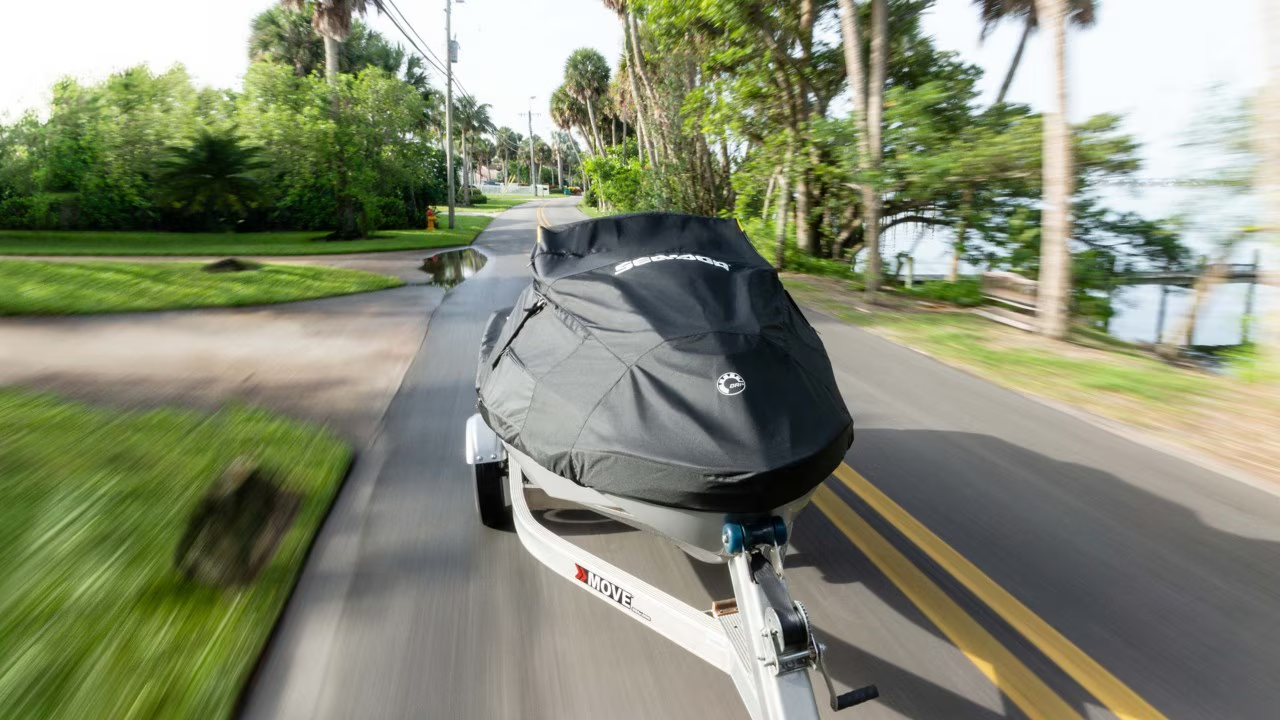
Consider a cover: A cover can protect your jet ski from road debris. However, a loose cover can flap in the wind, causing damage to both the cover and the PWC’s finish. Make sure to use a high-quality, weather-resistant option specifically designed for trailering.
Loading and securing
Improper loading can cause swaying and weight shifts during the trip, so a proper technique is crucial.
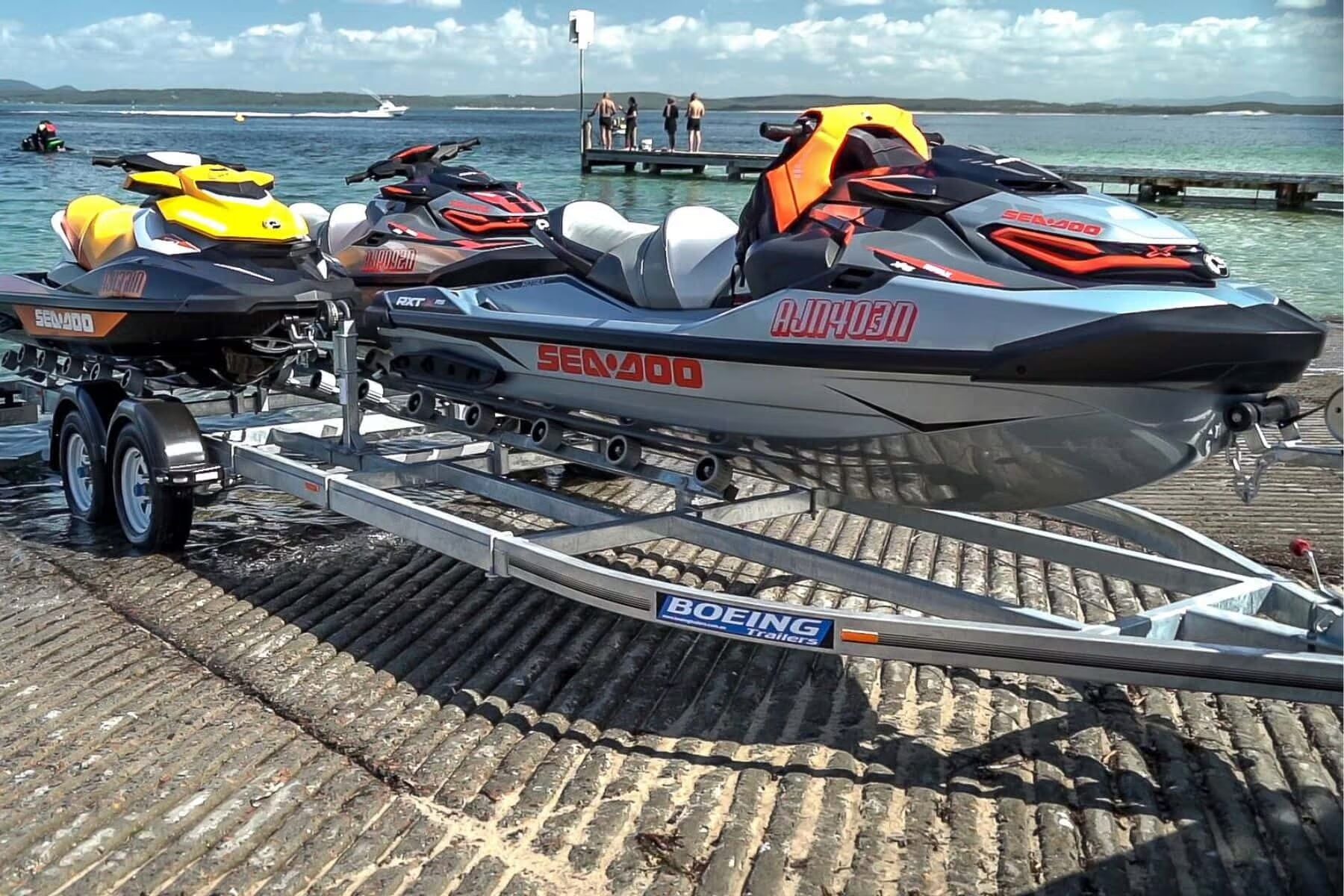
Load centered and balanced: Use the winch to pull the jet ski firmly into position, ensuring it is centered on the trailer bunks. The bow eye should be pulled snugly against the winch post. This ensures even weight distribution and prevents fishtailing.
Secure the bow: Use the trailer’s winch strap to firmly attach the jet ski’s bow eye to the bow stop. Ensure the strap is tight and the winch lever is locked.
Cross the straps in the stern: Run heavy-duty ratchet straps from each of the stern’s tie-down points to the corresponding point on the trailer frame. Crossing the straps creates an “X” pattern that provides sideways stability.
Avoid over-tightening: While straps should be snug, avoid overtightening, which can cause damage to the hull. The straps should allow a small amount of give.
Bonus tip: Test that the coupler is locked down — twice.
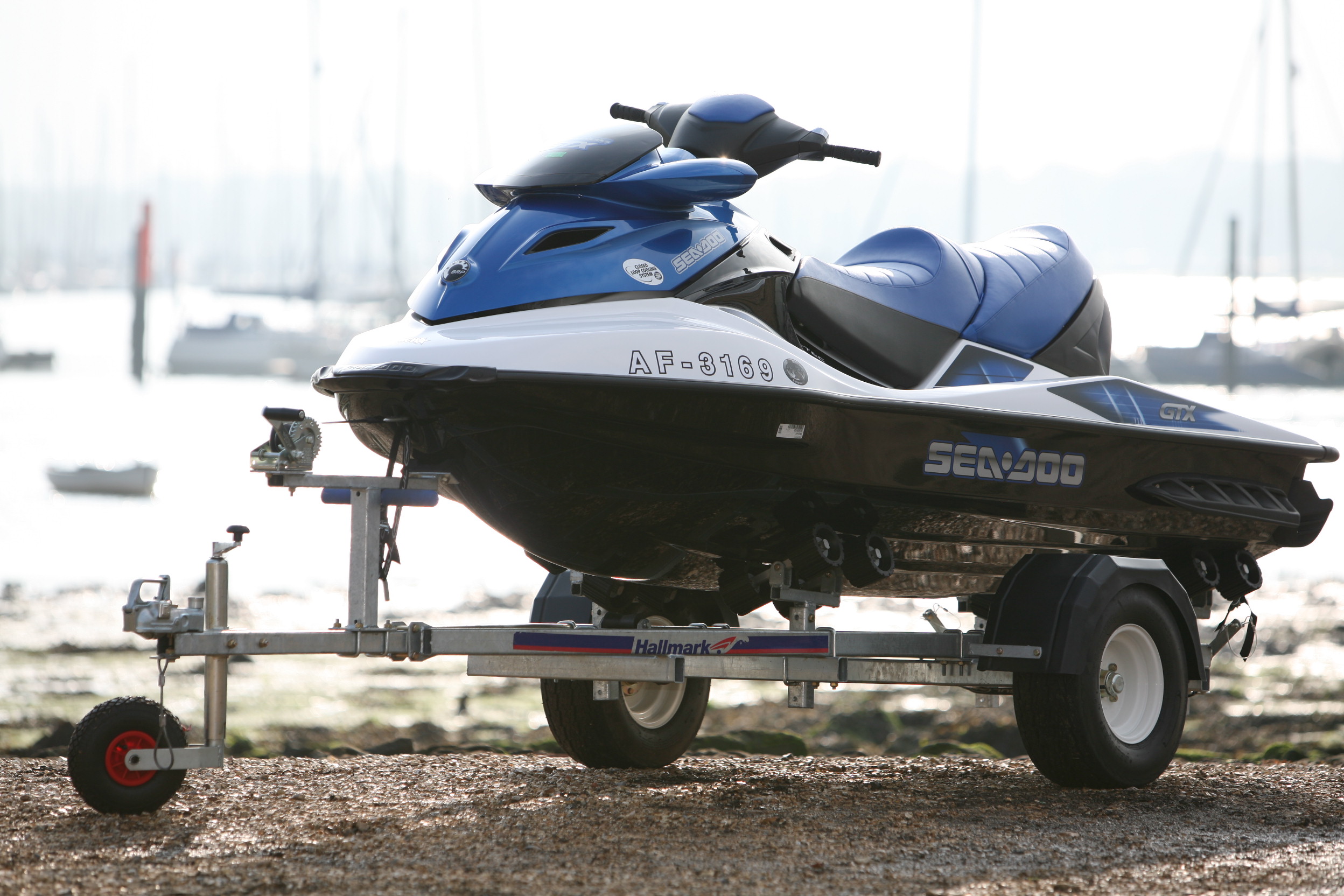 On the road
Towing for long distances requires a cautious and defensive driving style.
Practice defensive driving: Leave extra room for braking and making wide turns. Use your mirrors to constantly check the status of your trailer and load.
Make frequent checks: Stop and inspect your equipment after about an hour of driving, and at every stop thereafter. Specifically, check the tightness of the tie-down straps and ensure they haven’t loosened from road vibrations; feel the hubs for excessive heat, and inspect the tires.
Take breaks: Allow time for breaks to let your tires cool down on long drives.
Carry an emergency kit: Keep a jack that fits the trailer, wood blocks, and a lug wrench handy in case of a flat tire. (Duct tape, whiskey and prayer beads are also a good addition to the emergency kit)
Consider roadside assistance: For extra peace of mind, purchase roadside assistance insurance that covers trailer issues.
Drive moderately: Keep your speed at or below 60–65 mph to minimize tire and wheel bearing stress
GEAR GUIDE
Hitch Lock
Safety Chains (extra set)
Anti-sway Hitch
Rubber Hitch Cover
Bearing Grease + Grease Gun
LED Trailer Light Kit
Wheel Chocks
Infrared Thermometer
Ratchet Strap Set (with color-coded ends to reduce swearing)
12V Tire Inflator
Compact Tool Kit
Extended Towing Mirrors
Dash Cam
Gas Can
Funnel with splash guard
Microfiber Towels
Duct Tape
Zip Ties
First Aid Kit
Spare Keys
Folding Chair (IYKYK)
And be sure to check out more trailering essentials from RIVA