



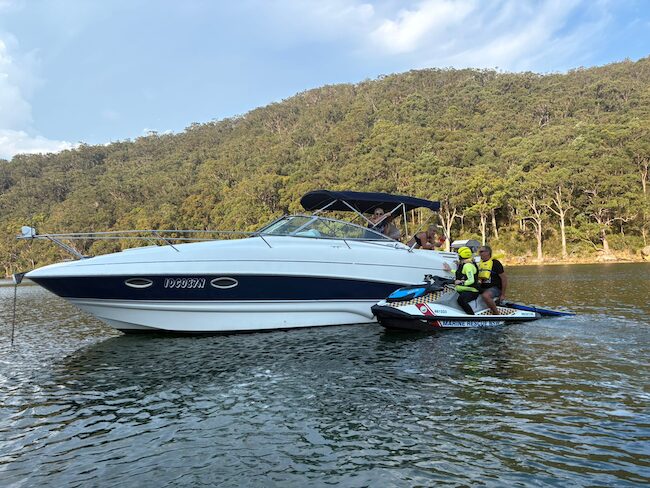
 A routine weekend training exercise became a live rescue when Marine Rescue Brisbane Water PWC operators located five people and two dogs aboard a broken-down cabin cruiser in a remote section of Woy Woy Bay.
The incident, first covered by Coast Community News, occurred during a 90-kilometre operational exercise across Brisbane Water designed to test access, communications, and rapid-response capability in shallow, difficult-to-reach areas. While operating two rescue watercraft (RWCs), volunteers Stephen Maneschi and Shane Rigney discovered the immobilized cruiser in shallow water where larger rescue vessels could not safely operate.
Due to their increased maneuverability compared to larger watercraft, the RWCs were able to reach the cruiser quickly. Two passengers were ferried to Rawson Street Public Wharf in Woy Woy, where a spare PWC was called on to recover the remainder of the group and resolve the situation.
 The broader exercise involved multiple local Marine Rescue unit departments and support from the radio room led by Mark Luland, with overall watch duties overseen by Brendon Weston and coordination by the Marine Rescue NSW Zone Duty Operations Manager. During the day’s operations, RWC crews also located three other vessels stranded in shallow areas, all of which have been subsequently reported to local authorities.
Perhaps the most interesting part of this rescue, for us at least, is the way it highlights some key aspects of water safety operations. First, it puts on display the increasing role of PWCs in rescue services, especially in environments like Brisbane Water, whose narrow channels and limited access points make it both a likely place for an accident and a nightmare for larger rescue vehicles.
Yet beyond the importance of the PWCs in this rescue is the demonstration of the value of effective organization for rescue services. Here, the implementation of a realistic, large-scale training operation, specifically designed for the unique navigational challenges of the local area, went beyond “preparation” and amounted to real impact for those whose lives were in danger. Moreover, this kind of organizational preparation, put on display by a volunteer team, shows the impact that community support can have.
Marine Rescue Brisbane Water is a volunteer organization based in New South Wales dedicated to saving lives on the water. Its PWC program is made up of 130 men and women and, along with its rescue services, offers “boating educational services including radio and boat license theory courses, safety courses for paddle craft and others,” according to their website.
The incident serves as a practical example of how investment in PWC capability and inter-unit coordination can turn a preventative training exercise into a timely, life-preserving operation, especially in parts of the bay where conventional boats cannot go.