


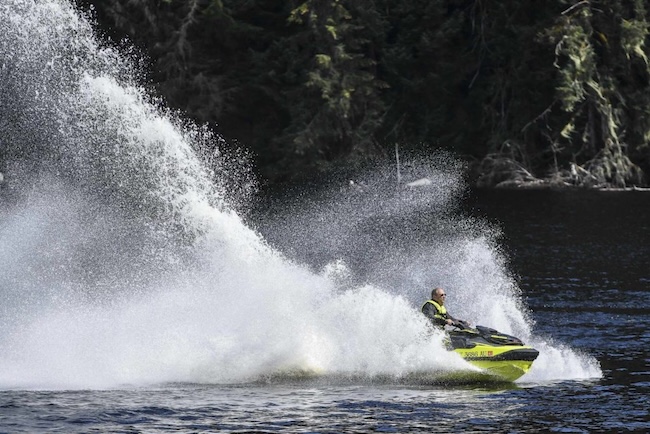
 If you’ve ever been to Kachemak Bay, you know it’s one of those places that feels almost too wild to touch — steep green cliffs, glassy water, otters bobbing in the kelp, and a whole lot of Alaskan quiet. For more than twenty years, though, there’s been one sound you wouldn’t hear echoing across the bay: the braaaap of a jet ski.
That changed in a big way this fall, when the Alaska Supreme Court struck down a lower court ruling that had kept personal watercraft (PWCs) out of the bay’s critical habitat areas. In plain English: the state’s highest court just said, “Yes, jet skis are allowed in Kachemak Bay.”
The backstory goes way back to 2001, when Alaska’s Department of Fish and Game (ADF&G) banned PWCs in Kachemak Bay and the nearby Fox River Flats, citing concerns for wildlife and sensitive habitat. Fast forward twenty years, and the machines themselves had changed dramatically — cleaner, quieter, less intrusive. Under Governor Mike Dunleavy’s administration, ADF&G revisited the ban in 2021 and decided it no longer made sense to keep it.
That’s when the legal tug-of-war began. Environmental groups sued, claiming the state didn’t have the authority to lift the ban and that doing so would violate the laws protecting those habitat areas. As covered by WCJ, a lower court agreed with them in 2023, putting the brakes on again. But in September 2025, the Alaska Supreme Court reversed that decision — and did it unanimously.
The justices said the department not only had the power to create the ban, but also to change or repeal it as conditions evolved. They even pointed out that technology and science had come a long way since the early 2000s, and it’s perfectly reasonable for an agency to adjust its rules to reflect that. In other words, state rules aren’t meant to be frozen in amber throughout the decades.
To riders across Alaska, this felt like a long-overdue win — not just for access, but for common sense. To conservationists, it was a worrying signal that long-standing protections could be undone too easily. And to everyone watching, it was a reminder that jet skis have always had a complicated relationship with environmental policy.
 Not The First Battle Over PWCs — And Definitely Not The Last
This isn’t the first time PWC access has been fought out in courtrooms or council meetings. Similar debates have popped up all over the map. California’s Monterey Bay National Marine Sanctuary still keeps PWCs out, citing wildlife and noise concerns. Up in Washington State, San Juan County’s long-standing ban has held since the late ’90s. On the flip side, lakes and recreation areas elsewhere have eased restrictions as cleaner four-stroke engines replaced the smoky, noisy two-strokes that gave jet skis their bad reputation decades ago.
Some places, like Lake Mead or Lake Mohave, only ban older engines. Others, like Lake Austin in Texas, limit jet ski use on major holiday weekends when boat traffic is chaotic anyway. The pattern isn’t “ban or bust” anymore — it’s more nuanced.
That shift says a lot about where things are heading. Instead of blanket bans, we’re seeing rules that adjust to reality: engine type, waterway use, wildlife behavior, and public tolerance. And frankly, that’s not a bad thing.
Fewer Bans, More Balance
Five or ten years ago, it seemed like every conversation about PWCs and the environment started with restrictions. Today, the tone has mellowed. While there are still a handful of local or seasonal bans being discussed, there’s no major wave of new prohibitions sweeping the country. In fact, cases like Kachemak Bay suggest a slow but steady shift toward moderation.
There are a few reasons for that. For one, modern personal watercraft are simply better neighbors. They’re cleaner, quieter, and far more fuel-efficient than the rowdy two-strokes of old. That means the data that once justified outright bans doesn’t always hold up anymore.
Public attitudes have also evolved. Instead of a “keep out” mentality, many communities are trying to strike a balance between recreation and conservation. Parks departments and wildlife agencies are increasingly looking for ways to manage access responsibly — with distance buffers, speed limits, or no-wake zones — rather than forbidding PWCs altogether.
And even as interest shifts back toward stand-ups — with riders restoring classic two-stroke skis or falling in love again with that light, nimble style of riding — the burden’s on the community to make sure that passion doesn’t undo the progress that has been made. Jet skiers themselves can play a big role here: by self-regulating, being considerate on the water, and staying mindful of environmental impacts, the PWC community can show that responsible riding and habitat protection can coexist. Working with local authorities and environmental groups, rather than against them, helps keep the conversation open and the water accessible.
Finally, there’s a broader political movement pushing for less regulation in general, especially in outdoor recreation. The Alaska decision echoed that sentiment, emphasizing that agencies should have flexibility to update their rules as technology and society change.
 Why This Ruling Matters Beyond Alaska
Even if you never plan to ride in Alaska, this decision could ripple far beyond the Last Frontier. The court’s reasoning — that agencies must have the authority to revisit old rules as conditions change — might influence how similar cases play out elsewhere.
For riders, that means bans set decades ago might not be permanent if modern evidence supports lifting them. For regulators, it’s a reminder that any rule change, whether tightening or loosening restrictions, needs a solid, science-backed record to stand up in court.
And for conservationists, it’s a wake-up call: environmental protection laws can’t just rely on inertia. They’ll need to evolve alongside technology and recreation trends if they’re going to hold up in the long term.
The Takeaway
It’s not a free-for-all, and it’s not the end of environmental oversight. But the trend is clear: we’re moving toward smarter, more flexible regulation — not blanket bans.
Expect to see more lakes and coastal regions adopt middle-ground policies: specific zones for PWCs, seasonal restrictions during nesting or migration, and continued phasing out of older, polluting engines. The goal now is to keep waterways open, clean, and safe for everyone — otters and riders alike.
And if the Kachemak Bay decision proves anything, it’s that the conversation around PWCs is still evolving. The machines have changed. The science has changed and the rules may be starting to catch up.
Reputation Rehab
This kind of ruling — restoring access, recognizing changing tech, respecting both nature and recreation — can help shift public perception of jet skis from being part of the problem to being part of the solution. But — and this is a big but — that shift only sticks if riders avoid the kinds of headlines that feed the worst stereotypes: reckless riding, ignoring safety zones, harassing other users (or wildlife), hit-and-runs, etc.
Recent news shows that it’s now always forward momentum on that front:
- In Mission Bay, San Diego, a 12-year-old girl, Savannah Peterson, was killed when she was struck by a jet ski going far above the speed limit in an area meant for slow or no-wake travel. Her family’s lawsuit highlights how signage, enforcement, and separation between swimmers/paddleboarders and faster watercraft might have prevented the tragedy. NBC 7 San Diego+1
- In Lake Grapevine, Texas, an 18-year-old kayaker, Ava Moore, was struck and killed by a PWC over Memorial Day weekend in what’s being investigated as a hit-and-run. The operator fled the scene with another person; there’s anger, grief, and outrage — and it’s exactly the sort of case that reinforces fears that jet ski operators can act irresponsibly. Midland Reporter-Telegram
- There have been numerous local complaints (for example in Lake Clarke Shores, Florida) of jet ski operators ignoring speed limits, making excessive noise, getting too close to swimmers or docks, and harassing other boaters. These kinds of reports may not always result in fatalities or legal cases, but they shape the narrative. Lake Clarke Shores, FL
If the PWC community can clean up the worst behaviors — stay out of swim zones, respect speeds, avoid harassment, don’t flee after collisions, watch for wildlife — then rulings like the one from Alaska might do more than just change laws: they might begin to change hearts and public trust.