




Lisa Caussin-Battaglia describes riding a jet ski not as control, but as connection.
“When you are on the jet ski,” she says, “you are not on the jet ski. You are with the jet ski. It’s like a dance.”
That idea—of rider and machine in motion together—has defined a career spent in one of the most physically demanding disciplines in personal watercraft sport.
And in Agadir, Morocco, it produced one of the standout performances of her career.
At the World Cup Mohammed VI of Jet Ski in Agadir, one of the most competitive international events in the discipline, Caussin-Battaglia delivered a multi-class performance that marked a new milestone in her racing profile.
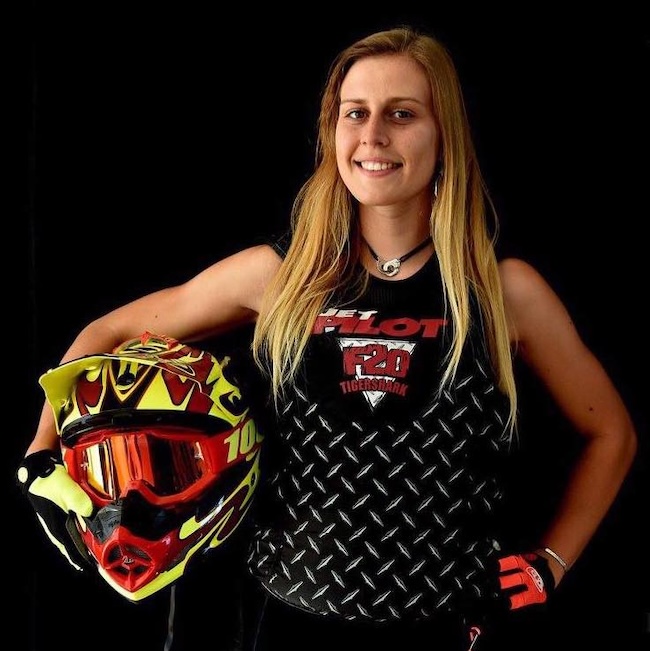
Competing in the Runabout 1100 Women’s category, she secured gold, adding a silver medal in the Runabout 1100 mixed category and finishing 7th in endurance as the top female rider in a field of 18 competitors.
Beyond the individual results, the performance carried added significance for Monaco, marking the first female podium in runabout racing for the Principality.
It was a result that extended beyond a single class or discipline and reflected a broader versatility within UIM competition.
While the Agadir result drew attention in runabout competition, Caussin-Battaglia’s primary discipline has been stand-up jet ski racing on the UIM circuit, where she has competed at world championship level for more than a decade.
For more than a decade, she has been a consistent presence in international standings, regularly finishing inside the top 10 in world championship competition.
Her results include a 4th-place finish in 2020 and multiple 5th-place finishes across European and world championship events in 2021.
Rather than a single breakthrough moment, her career has been defined by steady progression in a highly technical and physically demanding sport.

The bridge between disciplines
The Agadir result highlights a reality of modern UIM competition: athletes are increasingly competing across multiple categories within the same racing ecosystem.
While Caussin-Battaglia is known primarily as a stand-up racer, her performance in runabout competition demonstrated adaptability across different machine platforms and race formats.
It also underscored the technical overlap within personal watercraft racing, where balance, wave reading, and racecraft translate across categories even as equipment and physical demands change.
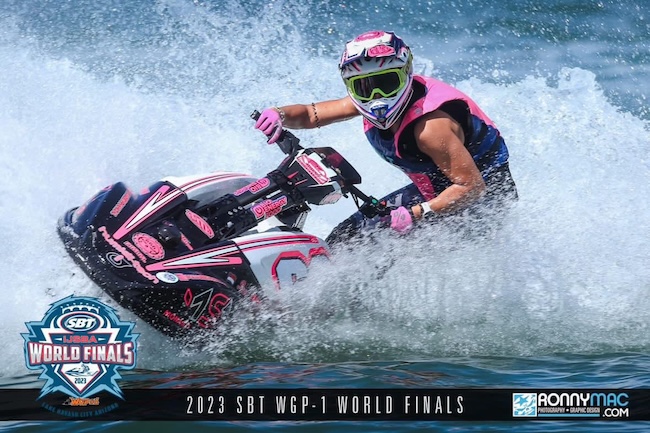
Unlike many riders who begin in early childhood, Caussin-Battaglia discovered stand-up jet ski racing at 16 through a local sports introduction program in Monaco.
Her first experience was recreational rather than competitive.
“I tried it and I was like wow—it was fantastic,” she said. “The sensation of the sea, the salt, the waves… the element.”
Initially, she approached sport as exploration rather than ambition. That changed quickly once she entered structured training and competition.
Her first races came in mixed fields, often as the only woman on the start line.
“I finished the race and I was very happy,” she said. “I knew I wanted to be a true athlete.”
Stand-up jet ski racing is often underestimated from the outside, but the physical requirements are severe.
 Riders operate at high speed over rough water conditions, absorbing continuous impact while maintaining balance and precision through buoy turns and race traffic.
Caussin-Battaglia describes the body mechanics in simple terms.
“You need to use your legs like suspension,” she said. “If you stay stiff, your back is destroyed in minutes.”
Her training reflects that reality: strength work, cardio, cycling, skiing, athletics, and endurance conditioning designed to prepare for both impact and sustained intensity.
It is a discipline where rider and machine must function as a single system under constant load.
Risk, reality, and commitment
Like many high-speed water sports, jet ski racing carries inherent risk.
Over the course of her career, Caussin-Battaglia has witnessed serious accidents within the broader racing environment, including fatal incidents.
Those experiences sit alongside the routine demands of training and competition, where risk is present but accepted as part of the sport’s structure rather than an exception to it.
At the elite level, participation in jet ski racing requires ongoing financial commitment.
Equipment, engines, maintenance, travel, and race entry costs form a continuous burden, and prize money alone does not consistently offset expenses across a season.
Caussin-Battaglia acknowledges the demands of sustaining a competitive program in a sport where access to equipment and resources directly affects performance potential.
 It is a reality shared across much of international personal watercraft racing, where talent and funding often intersect.
Born and based in Monaco, Caussin-Battaglia competes under a national identity closely tied to high-profile motorsport, but less frequently associated with watercraft racing.
Her family background reflects a deep connection to water-based sport, including Olympic sailing representation and international rowing competition within her family.
For her, representing Monaco carries both visibility and responsibility.
“I am the first woman in Monaco to be recognized as a high-level athlete in mechanical sport,” she said. “It is important for me to show it is possible.”
Across disciplines, conditions, and competition formats, Caussin-Battaglia returns to the same description of her relationship with racing.
It is not control. It is not distance.
It is connection.
“It is like a dance,” she said.
And in a sport defined by speed, endurance, and constant adaptation, that remains the simplest and most accurate explanation of all.