


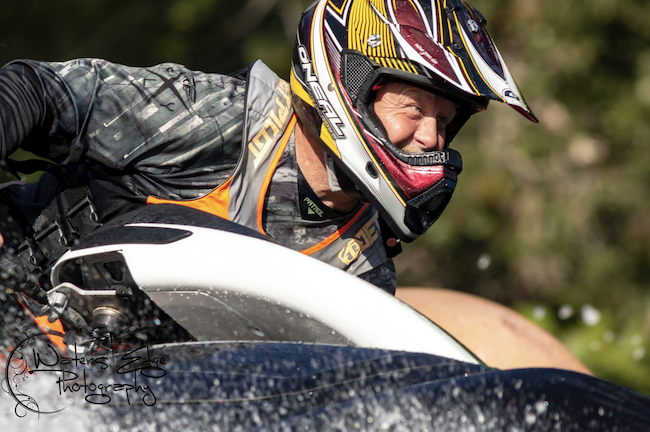
I’ve watched it happen through a long lens more times than I can count.
There’s the new rider, tentative at first, learning the machine and testing the throttle — until something changes. The shoulders loosen. The speed picks up. And even from shore, through a camera lens, you can see the moment the bug bites.
I’ve watched it happen to returning riders, too. Older now, maybe retired from racing, back on the water just to mess around — right up until muscle memory and a little competition wake up something that apparently wasn’t nearly as retired as they thought.
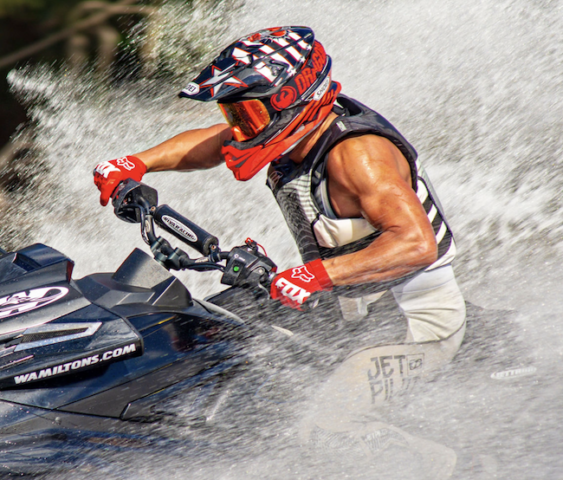
And then there are the racers. Exhausted, coming out of the final turn after spending everything they had on the course, with absolutely nothing left to prove — and somehow that throttle hand still doesn’t want to back down.
There is nothing wrong with burning fuel for fun. That’s one of the reasons we ride personal watercraft in the first place.
But if you’re trying to answer a deceptively simple question — how far will this PWC go on a tank of fuel? — that look in the rider’s eye matters.
Because the biggest variable in your PWC’s range may be sitting on the seat.
 Same Ski, Different Answer
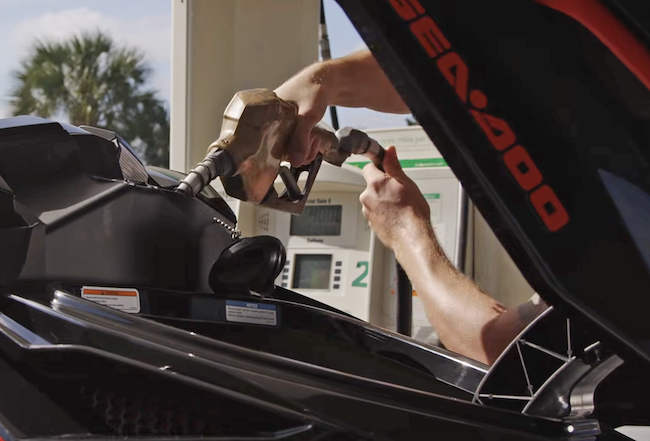
It’s tempting to think of range as another specification.
A PWC has a certain size fuel tank. It carries a certain number of gallons. Figure out how much fuel it burns, do a little math and — presto — there’s your range.
Except PWCs don’t consume fuel at one constant rate, and riders don’t ride them at one constant speed.
Put two riders on identical machines with identical full tanks and send them out on the same stretch of water. One settles into a steady, moderate cruise. The other spends the afternoon launching hard, backing off, carving, chasing wakes and grabbing another handful of throttle every time open water appears ahead.
They may return to the same dock with very different amounts of fuel remaining.
Hard acceleration asks more of an engine than maintaining a steady cruise. Sustained high-speed riding can consume considerably more fuel than cruising at a more economical pace. Repeatedly slowing and accelerating adds up, too.
And let’s be realistic: PWCs practically beg us to do all three.
I learned that part firsthand last year.
After more than four decades on motorcycles, I’m a decidedly conservative street rider. I don’t drag knees. I don’t pop wheelies. I don’t routinely pin the throttle just because the motorcycle will let me.
Then Sea-Doo put me on a PWC in Chicago.
Apparently, looping a lanyard around my wrist opens a release valve through which perfectly good judgment escapes.
Two miles later, I was apparently Erminio Iantosca on the straightaway and Chris MacClugage in the corner.
The fuel gauge, unfortunately, was under no such delusion.
 It’s Not Just Your Throttle
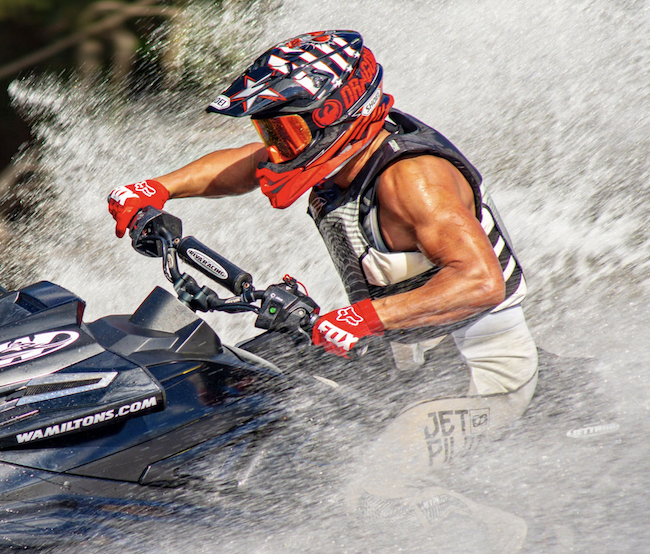
Riding style may be one of the easiest variables to overlook, but it isn’t the only thing determining how far a tank will carry you.
Add a passenger and gear and the machine has more weight to move. Rough water can change how you ride and how hard the machine works. Wind and current can help you in one direction and work against you coming home. No-wake zones, extended idling, towing and an afternoon spent playing rather than traveling from Point A to Point B all create different operating conditions.
What you’re doing matters, too.
A rider planning a 30-mile trip naturally thinks about distance and fuel. A rider spending the afternoon goofing around within sight of the launch may never think about range at all.
But distance from the truck isn’t the same thing as fuel used.
You can spend hours accelerating, carving, stopping and doing it all over again without ever getting particularly far from where you started. Meanwhile, another rider may cover considerably more distance at a steady cruise.
That’s why somebody at the ramp, in a Facebook group or on a forum telling you, “I get ___ miles out of a tank,” only tells you so much.
They very well may.
That doesn’t mean you will.
 Where You Ride Matters
It’s one thing to hear the engine sputter during a club ride in the middle of a busy lake, surrounded by other riders and within sight of shore.
It’s another to hear that same sputter as the sun disappears over a horizon that contains no truck, dock or recognizable landmass.
The amount of fuel in the tank hasn’t changed. The consequences of getting the calculation wrong certainly have.
That doesn’t mean every ride needs to become an exercise in fuel mathematics. The concept is simpler than that: know where you’re going, have some idea how much fuel you’re using, leave enough to get home and don’t plan around arriving with fumes and good intentions.
Your surroundings should be part of that judgment. Distance from shore or the launch, changing weather, current, wind, available fuel stops and whether you’re riding alone or with a group all change how much margin makes sense.
And there will eventually be something you didn’t expect.
Maybe the wind picked up. Maybe the water got rough. Maybe you took a detour. Maybe you spent considerably more time playing along the way than you intended.
Or maybe your carefully planned economical cruise lasted until the first time somebody beside you squeezed the throttle.
Keep Another Clock In Your Head
Fuel isn’t the only reason to pay attention to how you’re using your PWC.
Unlike a car or motorcycle, where owners commonly think in miles, PWC maintenance is generally tracked by engine hours and calendar intervals. Your owner’s manual — not the odometer or your buddy at the ramp — should determine when scheduled maintenance is due.
But an hour meter doesn’t tell the entire story of how those hours were accumulated.
Fifty hours spent primarily cruising and 50 hours spent repeatedly accelerating and running hard still put the same 50 hours on the maintenance clock. That doesn’t mean the machines necessarily experienced identical use.
It’s another reason “How many hours does it have?” shouldn’t be the only question when you’re evaluating how a PWC has been used — particularly if you’re shopping for one secondhand.
And don’t forget what’s already in the tank. Fuel that’s been sitting for months deserves some attention before you head out expecting a full day’s ride; manufacturers include storage and fuel-stabilization guidance for a reason. Check your owner’s manual, especially when waking a ski up after a long break.
Ask A Better Question
So when you’re standing in a dealership looking at a new PWC, don’t stop at asking how much fuel the tank holds.
Ask what kind of range riders are seeing at a normal cruising speed. Ask whether there is a particularly efficient cruising speed or operating range. Ask how dramatically aggressive riding changes fuel consumption. If you’re planning to carry a passenger and gear, ask how that changes expectations.
And ask what the fuel warning actually means on that particular machine. You don’t want your first lesson in the difference between “low fuel” and “almost no fuel” to happen miles from the launch.
Most importantly, be honest with yourself about what you’re buying the PWC to do — and how you’re actually likely to ride it once you get it.
If your plans involve long-distance exploring, your range calculation needs to reflect that. If you’re mostly going to play close to home, outright range may matter less — but that doesn’t mean you aren’t burning fuel.
And if you’re buying a high-performance PWC because you fully intend to use all the performance you just paid for, don’t calculate your fuel needs based on somebody else’s leisurely Sunday cruise with Grandma.
There is nothing wrong with burning fuel for fun.
Just remember that every squeeze of the throttle is part of the answer when you ask:
How far would you go?