



That unexpected encounter with a rock, a patch of gravel or some unseen underwater debris can turn a perfectly good day on the water into a very expensive-sounding problem.
Maybe you heard the impact. Maybe you didn’t notice anything until you accelerated again, only to discover your personal watercraft wasn’t responding quite the way it should. Acceleration feels sluggish, top speed has dropped, or the engine seems to be working harder without producing the thrust you’re accustomed to.
Before you start shopping for a replacement impeller, though, there’s another question worth asking: Can the one you already have be repaired?
For riders facing that decision, Impros Impellers offers several levels of professional impeller restoration, ranging from minor blade repairs to more extensive welding, machining and balancing.
And depending on the damage, replacing the entire impeller might not be necessary.
Small Damage, Big Problems
The impeller is one of the hardest-working components in a personal watercraft’s propulsion system. Unlike an exposed boat propeller, a PWC impeller operates inside the jet pump, drawing water through the intake and accelerating it toward the steering nozzle to generate thrust.
That location offers some protection, but it doesn’t make the impeller immune to damage.
Rocks, gravel and other debris entering the intake can nick, bend or gouge the blades. Even relatively minor damage can affect how efficiently the pump moves water, potentially reducing acceleration and overall performance.
Damage can also contribute to vibration and pump inefficiency. In some cases, riders may notice the engine revving higher without a corresponding increase in speed.
Then there’s cavitation, a condition in which localized pressure drops cause vapor bubbles to form in the water. When those bubbles collapse, they can damage surfaces and interfere with efficient propulsion.
WCJ Editor-in-Chief Kevin Shaw explored the phenomenon in Everything You Need to Know About Cavitation.
The takeaway? An impeller doesn’t have to be completely destroyed to cause noticeable performance problems, and ignoring damage can lead to additional wear elsewhere in the propulsion system.
Not Every Damaged Impeller Is a Goner
That’s where professional repair comes into the picture.
Impros offers three primary levels of impeller restoration under its Rocked and The Worx service programs, each addressing different degrees of damage.
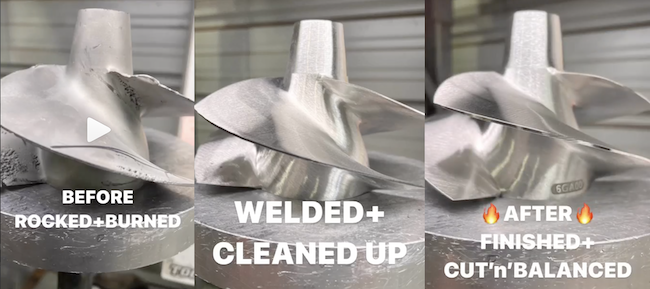
Its Rocked Stage One service is intended for impellers with relatively minor leading- or trailing-edge damage that doesn’t require welding. The service restores blade specifications and includes the company’s race-tolerance blade profile and recreational finish.
For impellers with more substantial damage, Rocked Stage Two adds welding for damaged blade edges or gouges, along with additional attention to blueprinting and balancing.
Then there’s The Worx, designed for impellers requiring more extensive restoration, including welding and machining of a worn outside diameter. The service also addresses blade damage, blade angles and balancing, with the goal of restoring the impeller to appropriate specifications and tolerances.
Impros lists base service prices of $85 for Stage One, $105 for Stage Two and $135 for The Worx, although its website notes that prices may vary depending on the repair. Additional charges apply for certain modifications and finishes, and customers should confirm current pricing directly with the company.
The important distinction is that these services aren’t simply about making a damaged impeller look better. They’re intended to restore blade geometry, balance and operating clearances that influence how effectively the pump performs.
Impros says it checks every impeller it services for balance within two-tenths of a gram, including during the finishing process.
Don’t Forget the Pump
Of course, the impeller isn’t the only component that can suffer when debris makes its way through the propulsion system.
The stationary vanes inside the pump housing can also become chipped or damaged, disrupting water flow even when the impeller itself is in good condition.
Impros offers pump-vane repair services that involve welding damaged areas and regrinding the vanes to restore their shape.
The company lists starting prices for OEM pump repairs ranging from $120 for six-vane configurations to $150 for 10-vane configurations, with final costs dependent on the extent of the damage.
That means riders experiencing persistent pump performance problems shouldn’t automatically assume a new impeller will solve everything. The condition of the pump housing, stator vanes and wear surfaces matters, too.
Repair, Replace or Modify?
There isn’t a universal answer to whether a damaged impeller should be repaired or replaced.
The extent and location of the damage, the condition of the underlying material, the cost of restoration and the availability of a suitable replacement all factor into the decision.
And for riders who have made performance modifications to their watercraft, the question can go beyond simply restoring the original setup.
Impros also offers impeller pitch modifications intended to help match impeller characteristics to a particular engine and performance configuration. Changes in pitch can affect engine loading, operating RPM and acceleration, making proper selection important.
That doesn’t mean every damaged impeller is a candidate for repair, or that every performance problem can be solved with a pitch adjustment. An inspection and evaluation are the sensible starting points.
Before You Buy Another Impeller
If your PWC has taken a hit, or its performance has changed unexpectedly, inspecting the impeller and pump is a worthwhile first step.
Look for visible nicks, bent blade edges, gouges, unusual wear and signs of contact between the impeller and surrounding components. A damaged wear ring or pump housing may also require attention.
If you aren’t comfortable inspecting or removing these components yourself, have a qualified technician evaluate them. Never reach into the intake or pump with the engine running, and follow the manufacturer’s service procedures before beginning any work.
For riders considering professional restoration, Impros provides a shipping form to accompany impellers and pumps sent in for service. The company recommends evaluating damaged pump components in person to determine an accurate repair cost.
The next time your impeller has an unfortunate meeting with something lurking beneath the surface, don’t assume the only solution is an expensive replacement.
Sometimes the better first move is finding out whether the damage can be repaired.
For information on impeller restoration, pump-vane repair and pitch modifications, visit Impros Impellers.