



 There’s a moment every supercharged Kawasaki owner recognizes, even if they don’t consciously think about it. The ski is idling at the dock, the engine note steady and familiar, and then — there it is — that faint, high-pitched whistle sitting just above the exhaust tone. It’s subtle, but unmistakable. And for many riders, it’s the sound that confirms they’re not just on a jet ski — they’re on a supercharged Kawasaki.
At KSpeed, moments like that are treated as more than background noise. They’re treated as part of the riding experience itself. While horsepower numbers and boost pressure still matter, KSpeed’s work with Kawasaki platforms starts from a deeper understanding: sound is feedback, and riders respond to it instinctively, often before they ever look at a gauge or a data log.
Supercharger sound has always lived in a strange space in the performance world. The sound itself isn’t what adds horsepower on a dyno sheet or changes top speed — the supercharger already does that job. And yet, riders obsess over the noise it makes. They chase it. They discuss it endlessly in forums and group chats. They notice immediately when it’s missing, muted, or doesn’t sound quite right. For Kawasaki riders in particular, that sound becomes part of the machine’s identity — almost as important as how the ski pulls out of the hole or how it feels at wide open throttle.
 Part of that obsession comes down to what sound represents mechanically. Kawasaki’s supercharged platforms use an Eaton Twin Vortices Series (TVS) positive-displacement supercharger, a design that delivers boost consistently across the RPM range. That consistency produces audible cues riders quickly learn to recognize — the idle whistle that signals readiness, the soft whoosh when cracking the throttle, and the sharp release of pressure when coming out of full boost. Even without gauges, those sounds tell the rider what’s happening under the seat.
Kawasaki’s approach stands in contrast to centrifugal-style superchargers found elsewhere, where boost builds differently and sound is often less pronounced at lower RPM. On the water, that difference matters. Kawasaki riders don’t just tolerate supercharger noise — they expect it. When it’s subdued, filtered out or redirected back into the intake system, even a perfectly healthy ski can feel oddly disconnected, as if part of the experience has been softened and part of the conversation between machine and rider has gone quiet.
That’s exactly where KSpeed’s new MK2 Atmospheric Bypass Trumpet enters the conversation.
Designed to work across all supercharged Kawasaki Ultra models from 2007 through 2024, the MK2 Atmospheric Bypass Trumpet takes the supercharger sounds riders already respond to and brings them forward. By venting waste air to atmosphere rather than routing it quietly back through the airbox, the system amplifies the distinctive whistle at idle, adds a pronounced whoosh when the throttle is cracked, and delivers a sharp, unmistakable “psssht” when boost is released under load.
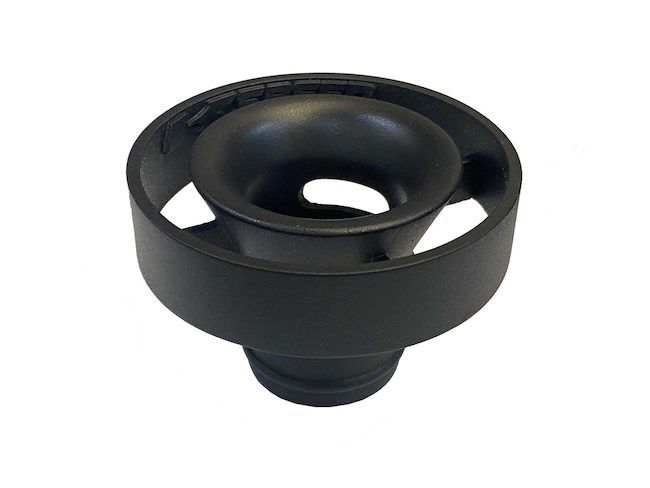 Importantly, this isn’t about making the ski obnoxiously loud. The MK2’s low-profile, OEM-like fitment integrates cleanly into the rear vent area, preserving the factory look while changing how the ski communicates. The result is a more expressive, more mechanical sound profile that mirrors what the rider is doing with the throttle in real time.
From a technical standpoint, venting hot waste air to atmosphere also helps reduce intake air temperatures, offering a subtle efficiency gain and a slight increase in available horsepower. The performance difference may not show up dramatically on a chart, but it shows up where many riders feel it most — in responsiveness, clarity, and engagement.
Installation reflects KSpeed’s practical, rider-focused approach. The MK2 installs in roughly five minutes using basic tools, with a block-off cap for the airbox, a low-profile hose clamp, and clear step-by-step instructions included. It’s a simple modification with an outsized impact on how the ski feels and sounds every time it’s ridden.
What KSpeed has found over time is that sound-focused upgrades like this often appeal most to experienced owners. Riders who already understand their ski’s power delivery and limitations aren’t always chasing more speed — they’re refining the experience. For them, sound becomes a finishing touch, a way to make a well-sorted machine feel more intentional and more alive.
In the end, supercharger sound matters because it changes how riders interact with their machines. It reinforces identity. It heightens anticipation. And it turns an already capable Kawasaki into something that feels sharper, more mechanical, and more connected — even before the throttle is pinned and the boost comes on hard.
For riders who want to lean into that experience — not just ride their ski, but hear and feel what makes it special — KSpeed’s MK2 Atmospheric Bypass Trumpet delivers exactly that. It’s a small change with a big sensory payoff, designed for riders who understand that performance isn’t just measured in numbers, but in how a machine makes you feel every time you fire it up.