



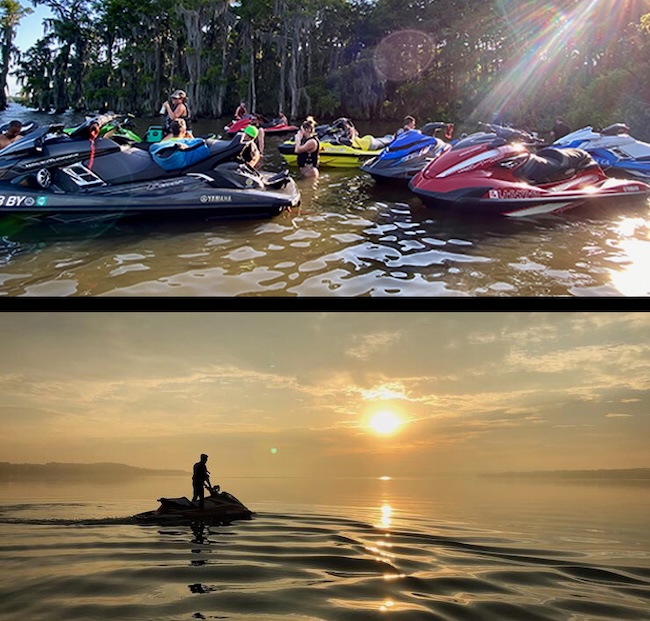
 Safety experts recommend riding with a partner whenever possible, yet many personal watercraft owners spend much of their time on the water alone. The advice is well-intentioned and grounded in simple practicality. A second rider can assist in an emergency, help with mechanical issues, or summon help if something goes wrong. Most experienced riders don’t argue with that logic.
But despite those recommendations, solo riding remains a very real part of personal watercraft ownership.
Which raises a question worth asking: must every ride be a group ride?
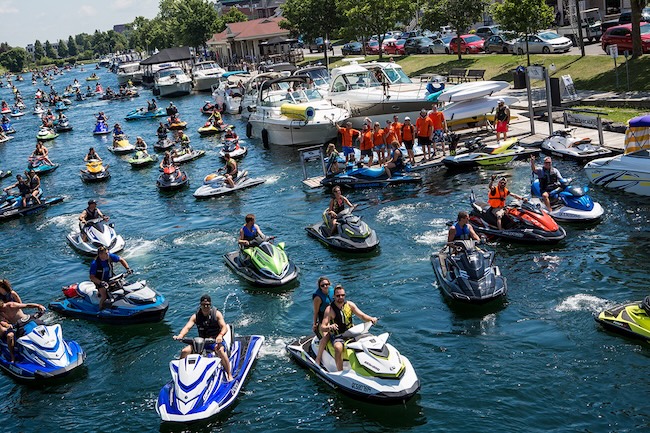
Spend a few minutes scrolling through social media and it’s easy to conclude that personal watercraft ownership is largely a group activity. Most of the images we see feature groups of riders gathered at sandbars, waterfront restaurants, organized events and destination rides.
There’s nothing wrong with that. Those rides are often memorable, photogenic and worth sharing.
Yet many riders may spend far more time riding than posting about riding.
 If that’s true, are solo rides simply underrepresented in the conversation?
Or perhaps more accurately—are they just less visible?
The personal watercraft community has no shortage of group-focused content. Poker runs, weekend meetups, destination rides, and sandbar gatherings all paint a picture of a sport built around shared experiences. And for many riders, that picture is completely accurate.
But it may not be the full picture.
The rides we remember most aren’t always the rides we do most.
For some riders, the ideal day on the water involves a convoy of skis, a planned route, and a group gathering at the end of the run. For others, it’s a launch ramp with no schedule, no group text, and no expectation beyond simply heading out and seeing where the water leads.
There’s a subtle divide there—not of right and wrong, but of purpose.
Be honest: when you think back on your last full riding season, how much of it was actually spent riding with others? And how much of it was solo?
For many owners, the answer has less to do with preference and more to do with reality.
Work schedules don’t always align. Friends may not own watercraft. Family obligations, weather windows, and last-minute free time often turn planned group rides into unplanned solo ones. In many cases, the choice isn’t between riding alone and riding with friends.
It’s between riding alone and not riding at all.
Group rides absolutely have their place. They bring energy, shared experiences, exploration of unfamiliar waterways, and the kind of memories that tend to get photographed, filmed, and repeated. There’s a reason they dominate so much of what we see online—they’re dynamic, social, and easy to share.
But that visibility can create its own impression.
If most of what we see is group riding, does that subtly suggest it’s the “standard” way to enjoy a PWC?
Or are solo riders simply quieter about how they spend their time on the water?
This isn’t about suggesting one approach is more valid than the other. In fact, most experienced riders likely move between both depending on the day, the conditions, and the opportunity.
The balance between what’s shared and what’s experienced is worth considering.
Because in many cases, the most common way people ride may not be the most visible way people ride.
 And those aren’t always the same thing.
So here’s the question:
When you look back on your time on the water this season, what defined it more—group rides or solo rides?
And maybe more importantly, does it match the picture of PWC culture most often seen online?
So which is it—solo rider, group rider, or somewhere in between? Let’s see how the WCJ community breaks it down.