At the start of the month, the U.S. Department of Homeland Security and the U.S. Coast Guard released the annual Recreational Boating Statistics report for 2024, showing that there has been a slight uptick in the total number of watercraft incidents in 2024 compared to previous years, but also showing that there has also been a dip in both deaths and injuries.
According to the report, in calendar year 2024, the Coast Guard verified 3,887 incidents that involved 556 deaths, 2,170 injuries and approximately $88 million of damage to property as a result of recreational boating incidents. The fatality rate was 4.8 deaths per 100,000 registered recreational vessels. This rate represented a 2% decrease from the 2023 fatality rate of 4.9 deaths per 100,000 registered recreational vessels. Compared to 2023, the number of incidents increased 1.1%, the number of deaths decreased 1.4%, and the number of injuries increased 2.1%. Where length was known, 4 of every 5 boaters who drowned were aboard vessels less than 21 feet in length.
Where data was known, the most common vessel types involved in incidents were open motorboats (47%), personal watercraft (19%), and cabin motorboats (14%).
Where data was known, the vessel types with the highest percentage of deaths were open motorboats (46%), paddlecraft (26%) and pontoons (8%). Paddlecraft deaths include canoes (4.5%), kayaks (16%) and standup paddleboards (5%) or SUPs.
The 11,674,073 recreational vessels registered by the states in 2024 represent a 1.1% increase from last year when 11,546,512 recreational vessels were registered.
The statistics continued to support the importance of wearing a PFD, as more than 85 percent of the fatalities were cases where lifejackets were not being worn.
While the report covers recreational boating of all sorts, it does break down the numbers by craft type, with Personal watercraft ranking as the type of watercraft with the second highest number of fatalities.
Screenshot
Screenshot
Screenshot
Screenshot
Screenshot
Screenshot
Screenshot
While “inattention of operators ranked, by a significant margin, as the top contributing factor of watercraft incidents, alcohol took the top spot spot as the contributing factor in fatal incidents.
Nearly 30 percent of PWCs involved in incidents in 2024 were rental vessels, but only roughly 15 percent of deaths that occurred involving PWCs, took place aboard rented units.
Last week, BusinessWire and several other industry and finance publications highlighted a recently released overview of the market for Personal Watercraft and other small crafts.
The 10-year Small Boats Market Outlook Report noted that “fishing and adventure drive demand amid electrification and smart navigation Innovations,” and detailed projections for 2025-2034.
Focusing on watercraft under 30 feet in length, used for recreational, commercial, patrol, and fishing purposes, the report includes data and forecasts small motorboats and sailboats, dinghies, inflatable boats, personal watercraft, and skiffs.
“Small Boats Market is valued at USD 35.6 billion in 2025,” the report states, adding, “Further, the market is expected to grow by a CAGR (Compound Annual Growth Rate) of 12.0% to reach global sales of USD 98.7 billion in 2034.”
According to Business Wire’s review of the report, “Growing interest in water-based leisure activities, rising disposable incomes, and the increased accessibility of boating have made small boats a popular choice for individual buyers and families seeking outdoor experiences. Moreover, their lower operating and maintenance costs compared to larger yachts make them attractive for both novice and seasoned boating enthusiasts.”
The report noted that, in the beginning of this year, interest in boat shows and other small watercraft events have returned to pre-pandemic levels.
Key components driving the uptick in the market, according to the report, include cleaner alternatives to traditional fuel-powered engines; features such as GPS autopilot, integrated sonar, and mobile app controls providing navigation assistance, performance monitoring, and real-time system diagnostics; modular and lightweight designs, appealing to urban buyers and casual weekend users with limited storage space; and the growth of online sales and rentals.
You can read the full review by BusinessWire below, and WCJ would love to hear our readers’ thoughts and predictions about the future of the PWC market.
Small Boats Market Outlook Report 2025-2034 | Fishing and Adventure Drive Demand Amid Electrification and Smart Navigation Innovations – ResearchAndMarkets.com
DUBLIN–(BUSINESS WIRE)–The “Small Boats Market Outlook 2025-2034: Market Share, and Growth Analysis By Product Type, By Material, By Application” report has been added to ResearchAndMarkets.com’s offering.
Small Boats Market is valued at USD 35.6 billion in 2025. Further the market is expected to grow by a CAGR of 12.0% to reach global sales of USD 98.7 billion in 2034
The small boats market comprises a diverse range of watercraft typically under 30 feet in length, used for recreational, commercial, patrol, and fishing purposes. These boats include motorboats, sailboats, dinghies, inflatable boats, personal watercraft, and skiffs.
Growing interest in water-based leisure activities, rising disposable incomes, and the increased accessibility of boating have made small boats a popular choice for individual buyers and families seeking outdoor experiences. Moreover, their lower operating and maintenance costs compared to larger yachts make them attractive for both novice and seasoned boating enthusiasts.
In commercial and security applications, small boats serve critical roles in law enforcement, coastal surveillance, and transport operations, especially in shallow or inland waterways. As environmental concerns rise, the market is also witnessing a gradual shift toward electric propulsion systems and sustainable materials. With manufacturers innovating around portability, comfort, and energy efficiency, the small boats segment is experiencing a period of steady, multifaceted growth globally.
In 2024, the small boats market recorded notable growth fueled by strong consumer interest in recreational boating, especially in North America, Europe, and Southeast Asia. Boat shows and marine expos returned to pre-pandemic levels, stimulating enthusiasm and showcasing innovations in hull design, hybrid engines, and onboard connectivity. Electrification was a key theme, with several manufacturers launching compact electric outboard motors and integrating solar-powered components to meet sustainability expectations. Government subsidies and green boating initiatives encouraged adoption of low-emission models in select coastal cities.
The fishing boat segment remained dominant, driven by both professional and sport fishing communities, while adventure boating saw an uptick among younger buyers looking for modular, lightweight vessels. On the commercial side, demand rose for fast, maneuverable patrol boats and rescue craft used by coast guards and maritime agencies. Additionally, digital platforms for boat rentals, peer-to-peer sharing, and online purchases gained popularity, further expanding consumer access and reshaping traditional sales channels.
Looking ahead to 2025 and beyond, the small boats market is expected to evolve with greater emphasis on electrification, autonomous navigation features, and smart onboard systems. Manufacturers are likely to scale up the production of electric and hybrid small boats, aided by improving battery technologies and expanding charging infrastructure at marinas. Lightweight composite materials will gain traction, helping reduce emissions and enhance fuel efficiency without compromising performance. The integration of GPS-based autopilot, sonar systems, and remote diagnostics will appeal to a new generation of tech-savvy boaters seeking safety and convenience.
Emerging markets in Latin America and Africa will offer growth opportunities due to rising tourism, coastal development, and small-scale fishing activities. However, affordability and regulatory compliance will remain critical challenges, particularly as stricter environmental regulations around fuel emissions and boat construction materials begin to take hold. Overall, innovation, digital engagement, and sustainable manufacturing will define the next chapter of growth in the global small boats industry.
Key Insights Small Boats Market
Electrification and Sustainable Propulsion: Electric outboard motors and hybrid propulsion systems are gaining popularity as boaters and regulators seek cleaner alternatives to traditional fuel-powered engines, promoting eco-conscious boating practices.
Smart Boating Features and Connectivity: GPS autopilot, integrated sonar, and mobile app controls are transforming the boating experience, providing navigation assistance, performance monitoring, and real-time system diagnostics.
Modular and Lightweight Designs: Manufacturers are focusing on collapsible, easy-to-transport boats made from durable yet lightweight composites, appealing to urban buyers and casual weekend users with limited storage space.
Growth of Online Sales and Rentals: Digital platforms for purchasing, renting, or sharing small boats are streamlining customer access and reshaping traditional distribution models with added convenience and price transparency.
Renewed Interest in Recreational Boating: Post-pandemic lifestyle shifts have led to increased participation in outdoor and water-based recreation, boosting demand for small, personal boats among new and younger demographics.
Rising Participation in Water-Based Leisure Activities: Interest in fishing, day cruising, and watersports continues to climb globally, encouraging first-time buyers and hobbyists to invest in small boats for accessible recreation.
Expansion of Coastal Tourism and Marine Infrastructure: Investments in marinas, boat ramps, and waterfront amenities are creating favorable conditions for small boat use in both developed and emerging economies.
Technological Innovations in Design and Materials: Advancements in hull design, corrosion-resistant materials, and user-friendly controls are improving performance, safety, and ease of use for new boat owners.
Government Support for Sustainable Boating: Subsidies, tax incentives, and environmental policies are encouraging the adoption of electric boats and clean technologies, particularly in eco-sensitive coastal regions.
Affordability and Regulatory Compliance Pressures: High upfront costs for electric and tech-integrated small boats, coupled with evolving safety and environmental standards, present barriers for entry-level buyers and may slow market penetration in price-sensitive regions.
Your Takeaways From this Report
• Global Small Boats market size and growth projections (CAGR), 2024-2034
• Impact of recent changes in geopolitical, economic, and trade policies on the demand and supply chain of Small Boats.
• Small Boats market size, share, and outlook across 5 regions and 27 countries, 2025- 2034.
• Small Boats market size, CAGR, and Market Share of key products, applications, and end-user verticals, 2025-2034.
• Short and long-term Small Boats market trends, drivers, restraints, and opportunities.
• Porter’s Five Forces analysis, Technological developments in the Small Boats market, Small Boats supply chain analysis.
• Small Boats trade analysis, Small Boats market price analysis, Small Boats Value Chain Analysis.
• Profiles of 5 leading companies in the industry- overview, key strategies, financials, and products.
• Latest Small Boats market news and developments.
Companies Featured
AB Volvo Penta
Polaris Industries Inc
Bombardier Recreational Products Inc
Brunswick Corporation
Beneteau Group SA
Malibu Boats Inc.
Ferretti Group S.p.A.
Sea Ray Boats Inc.
MasterCraft Boat Company LLC
Azimut Benetti S.p.A.
Marine Products Corporation
Boston Whaler Inc.
Sunseeker International Holdings Limited
S2 Yachts Inc.
Porter Inc.
Formula Boats Inc.
Pursuit Boats LLC
Grady-White Boats Inc.
Cobalt Boats LLC
Everglades Boats LLC
Seabring Marine Industries Inc.
Sea Fox Boat Company
Four Winns Boats LLC
Stingray Boats Inc.
Bavaria Yachtbau GmbH
Correct Craft Inc.
Crestliner Marine Holdings Inc.
WeLLCraft Marine Inc.
Carver Yachts LLC
If you’re a frequent reader of The Watercraft Journal, you’ll know that we are quite enthusiastic about following the exciting news that comes out of PWC racing around the world. From live, on-the-ground reporting at races to following up with racers in exclusive interviews, PWC racing is just about the bread and butter of the content we try to keep you in the loop with. However, just outside of the community interests, there’s one aspect of racing that particularly piques our interest: the builds.
For the more technically minded of our readers, it will be no surprise that the specific build of a PWC can be the deciding factor at a race—sometimes even more than the racers themselves. So, when we realized that last year’s IJSBA World Finals featured one specific boat style significantly more than any other, we wanted to find out more about the details of this hull.
A quick look at the World Finals shows that Fast Powersports’ GP1R hull was easily the most prominent boat in the competition, winning more championship titles than all other aftermarket hulls combined. After a little more research, we found out that it’s just one of three models on offer at Fast Powersports, each boasting its own set of top-performance attributes.
For example, the aforementioned GP1R is the group’s top-performing race ski, dominating the waters for the past seven years, and receiving its most recent upgrade this year. It’s been remodeled to meet the newest IJSBA criteria for dimensions, but in the process, they fine-tuned the hull’s nimbleness, weight bias, and even upgraded the materials to ensure that the 2025 model will continue to dominate the waters.
On the other hand, their F1 ski is a larger boat, with a big engine bay and notable front-end buoyancy, providing tons of stability and reliably high top speeds. While that lift ensures stability and speed for the craft, its showing at races has been more limited because the turn speed is reduced around tight corners. Even still, it’s highlighted as an incredibly comfortable ride for those looking to get maximum velocity.
Finally, there’s the newly released F16, which rides similarly to the GP1R but with more aggressive turning and responsiveness.
If you’re curious to find out more about the differences in these various hulls, as well as to learn a bit about the extensive research and development process behind one of PWC racing’s top manufacturers, it’s worth checking out this recent video from Dustin Motzouris on the Fast Powersports channel. In it, he goes through the three different styles of hulls they manufacture, pointing out the latest upgrades in each model and showing the pros and cons for different styles of riders. He also shows off some of their winning boats from past races, making it an interesting watch for anyone who enjoys PWC racing.
One of the things we found most interesting about the video was how Motzouris explains the R&D part of their process. Specifically, he explains how having three different models of PWC allows them to cross-reference a wide set of data to improve their products year after year.
Be sure to check out the video, and if you’re already sold on getting a Fast Powersports hull, you can email them at [email protected]!
One thing WCJ has let slip by over the years of coverage of Taiga, is their sister-endeavor, Taiga’s mobile app.
The company announced the release of the mobile app in 2023 with a release on PR Wire, stating “Taiga Motors Corporation, a leading electric off-road vehicle manufacturer is excited to announce the launch of the new Taiga Cloud Connected Mobile App, now available as a free download.
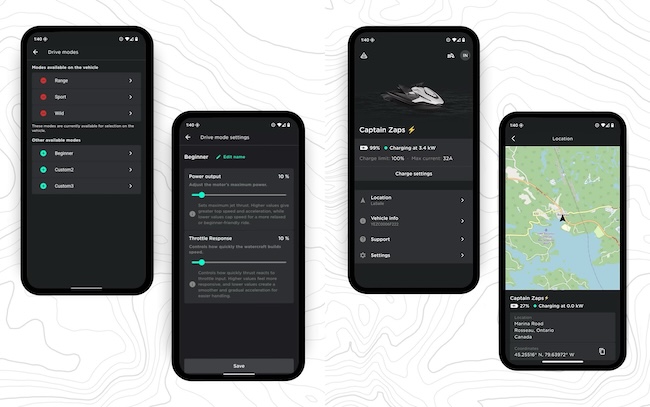
The new app brings a rich set of new features to Nomad snowmobile and Orca Personal Watercraft owners, enhancing their ownership experience whether for work or recreational usage. With the new Taiga App, industry-first real-time vehicle localization unlocks a new way for customers to interact with their vehicles, allowing them to see their global positioning and status. In addition, mode preference features, measurement system selections, and charging details make the Taiga ownership experience better than ever.”
Earlier this week, Taiga gained the attention of media outlets with the release of app updates, adding all-new drive modes and multiuser access for its electric snowmobiles and personal watercrafts.
The Taiga company, which was acquired by British electric boat entrepreneur Stewart Wilkinson last year, has continued to push forward with their focus on sustainability.
“We are excited to support the evolution of Taiga,” Wilkinson said of the deal. “Sam and his team have built great products and technology in challenging financial markets. The world urgently needs low-carbon solutions for all forms of mobility. This transaction will allow us to continue building the best technology, team, and products to propel the industry forward.”
The new additions to the mobile app supports the innovations built into the company’s PWCs, including new custom drive modes that allow riders to set and save performance profiles custom-created for specific riders or conditions.
“Whether you’re dialing back power and acceleration for a beginner, creating a fleet mode for consistent use across a rental operation, or fine-tuning acceleration and top speed for your own style, the new modes let you take control of the ride experience, directly from your phone,” states company data on the updates, adding that app admins can control which modes are available for use on the vehicle.
“These tools put safety, customization, and convenience in our owners’ hands,” says Gabriel Bernatchez, co-founder and chief technology officer at Taiga. “Our engineering teams are constantly working to enhance the ownership experience for fleet and recreational owners alike.”
The new user management system also enables secure multi-user access: vehicle owners can invite other users, allowing family, friends, or employees to use the app with their own login credentials and assigned permissions. It’s ideal for shared vehicles at the cottage, rental fleets, or families managing younger riders.
This update builds on Taiga’s existing platform, which includes:
Live encrypted GPS vehicle tracking
LTE-based remote access and control
Remote charging management
Over-the-air updates for vehicle software
Remote diagnostics and servicing
The new app features are available now on iOS and Android for all Taiga vehicle owners.
Meanwhile, Taiga, under the new ownership and partnership with several leading marine electrification companies that include Vita, Evoy, and Aqua superpower,, continues to fine-tune and update the company’s PWC offerings, which now include two models, and recently announced the beginning of customer deliveries on the 2025 Model Year Orca PWC, which features improvements in better performance and faster charging times.
According to data from Taiga, the new 2025 model Orca takes advantage of breakthrough battery cooling technology with up to 65% more power, doubles peak DC fast charging rates on Orca watercraft.
The company has also reached an increased production capacity of up to 8,000 combined units per year, “enabling delivery of cost-leading electric powertrain components to global boat manufacturers alongside Taiga’s electric vehicles.”
Taiga is now also offering sale pricing on both the Orca and the limited edition Orca Carbon, with the Orca starting at $19,499, down from $20,999, and the Orca Carbon starting at $24,499, down from $26,499.
You can find more details on both the Mobile App updates, and the 2025 Model Orca, in the full press releases below:
Taiga Launches Industry-First Features for Enhanced Controls and Safety in Mobile App Update
MONTREAL, July 14, 2025 (GLOBE NEWSWIRE) — Taiga Motors Inc. (Taiga), the pioneer in electric powersports, today announced a major update to its mobile app, introducing custom drive modes and multi-user access for its electric snowmobiles and personal watercraft—an industry first.
The new custom drive modes feature allows owners to set and save performance profiles tailored to different riders or conditions. Whether you’re dialing back power and acceleration for a beginner, creating a fleet mode for consistent use across a rental operation, or fine-tuning acceleration and top speed for your own style, the new modes let you take control of the ride experience—directly from your phone. Admins can control which modes are available for use on the vehicle.
The new user management system enables secure multi-user access: vehicle owners can invite other users, allowing family, friends, or employees to use the app with their own login credentials and assigned permissions. It’s ideal for shared vehicles at the cottage, rental fleets, or families managing younger riders.
“These tools put safety, customization, and convenience in our owners’ hands,” said Gabriel Bernatchez, Co-Founder & CTO at Taiga. “Our engineering teams are constantly working to enhance the ownership experience for fleet and recreational owners alike.”
This update builds on Taiga’s already robust connected platform, which includes:
Live encrypted GPS vehicle tracking
LTE-based remote access and control
Remote charging management
Over-the-air updates for vehicle software
Remote diagnostics and servicing
Taiga vehicles are built on a fully native software and hardware stack, following Taiga’s clean sheet design approach used across all vehicle systems. This unmatched level of digital integration in powersports allows Taiga vehicles to constantly upgrade with new features and performance updates.
The new app features are available now on iOS and Android for all Taiga vehicle owners.
Taiga Launches Production of 2025 Orca watercraft
MONTREAL, May 15, 2025 (GLOBE NEWSWIRE) — Taiga Motors Inc. (Taiga) has reached an important milestone restarting its manufacturing operations and beginning customer deliveries of the new MY25 Orca watercraft that features new innovations, including significant advancements in battery performance and faster charging times.
Important operational milestone launching production of 2025 watercraft Breakthrough battery cooling technology with up to 65% more power
Update enables double peak DC fast charging rates on Orca watercraft
Delivering on Production Milestone
The launch of vehicle assembly and automated battery production lines on the planned timeline marks an important milestone for Taiga, enabling customer deliveries of new MY25 Orca watercraft. This demonstrates Taiga’s strengthened operations as part of a new global alliance of leading marine electrification companies that include Vita, Evoy, and Aqua superpower.
Taiga will continue to strategically ramp up production at its advanced manufacturing facility in Montreal, Quebec with an installed capacity of up to 8,000 combined units per year, enabling delivery of cost-leading electric powertrain components to global boat manufacturers alongside Taiga’s electric vehicles. Taiga plans to begin producing new electric snowmobiles in the fall of 2025 to satisfy growing international demand for its products. This will continue to grow jobs and technological leadership within the Canadian EV industry.
“Restarting production in such a short time is a testament to the dedication and hard work of our team and the support of great partners,” said Matthew Taylor, Vice President, Operations. “We’ve leveraged years of operational lessons to build a robust, vertically integrated advanced manufacturing system right here in Canada. Everyone at Taiga is proud to persevere in leading production of the only personal watercraft still made in Canada.”
Breakthrough Battery Cooling – More power & faster charging
Taiga has continued to push boundaries on the foundational technology required for high-performance electric products at compelling prices to enable an accelerated transition to electric marine and powersport vehicles. The new battery cooling technology is a product of Taiga’s advanced engineering efforts and rigorous iterations over the past years.
A novel approach to optimize fluid flow across lithium-ion cell hotspots has increased thermal transfer rates and temperature uniformity in the battery pack, enabling up to a 65% increase in continuous battery power in warm weather marine environments. Alongside recent software updates, the increased cooling enables extended peak charging rates and reduces DC Fast charging times to under 30 minutes.
“The rapid introduction of new battery technologies is possible thanks to Taiga’s vertical integration bringing advanced engineering and automated production together all under one roof,” said Paul Achard, Chief of Engineering. “We are excited to implement this breakthrough battery technology in our upcoming snowmobile production and future powertrain products.”
There’s nothing like a good clearance sale to get us excited about bringing some new PWC gear home, and RIVA Racing is proving once again that high quality at a great price is just too good to pass up. They’ve currently got some strong discounts available on their Clearance Sale page, with top-tier accessories and apparel noticeably marked down.
In particular, RIVA’s clearance sale features several Jetpilot jackets and wetsuits, making it easier than ever to gear up with premium riding equipment. We love their vintage-style jackets, which not only show off a cool retro look, but also keep you performing at your best—even when the weather turns cold. The F-86 Sabre water jacket is made from ultra-soft, lightweight neoprene and features an engineered fit with minimal seams for maximum flexibility and comfort during any water sport adventure.
Then there are the wetsuits, which come in a variety of colors and styles in both youth and adult sizes. For example, the Vintage Class John blends throwback style with modern functionality, offering a streamlined, rider-focused fit. Built with 2mm Flex-lite neoprene, it delivers lightweight comfort and flexibility, perfect for warm-weather rides. Flatlock stitching helps prevent irritation, while Jet-lite knee and shin pads add extra durability where it matters most. A zip-free, hook-and-loop entry system keeps things simple and secure—ideal for riders who want that vintage look without compromising performance.
While both of these options are great deals, it’s worth browsing the RIVA Racing website to check out the full range of gloves, graphics kits, and apparel currently on clearance. Inventory moves fast, so now’s the time to stock up and save!
Putting six young guys and a vintage piece of watercraft history out in the middle of some big waves with nothing but a camera may not sound like the best idea… and, well, to be fair, we’re not sure it is—but it’s certainly interesting to watch! It’s especially intriguing because they’re trying their hand at one of the jet ski’s earliest predecessors: a 1980s vintage watercraft called the Wet Bike.
While such an old PWC—especially a model that quickly went out of fashion due to design flaws—may seem impossible to get working, the guys at the “Sickos” YouTube channel managed to get their hands on a nearly mint condition Wet Bike from Facebook Marketplace, and their video, while chaotic, is a cool way to see one in action.
Among the interesting design features is the impeller, which sticks way out of the back of the seat, while the nose of the Wet Bike lifts high out of the water. Seeing it cut through the waves is almost reminiscent of a clunkier hydrofoil. However compelling the design and function may be, the video’s title—“We Tried A JET POWERED Bike In BIG Waves”—shows the creators were aiming for something even more dramatic.
We can’t condone the safety precautions taken in the video—with maneuvers like tossing the PWC from the dock into the water, or riding dangerously close to the rock jetty in eight-foot waves certainly posing a significant risk of injury—and there are some questionable wrecks and nose-dives throughout. Still, getting the opportunity to see the Wet Bike’s riding style, propulsion, and maneuverability makes this video an interesting watch for sure.
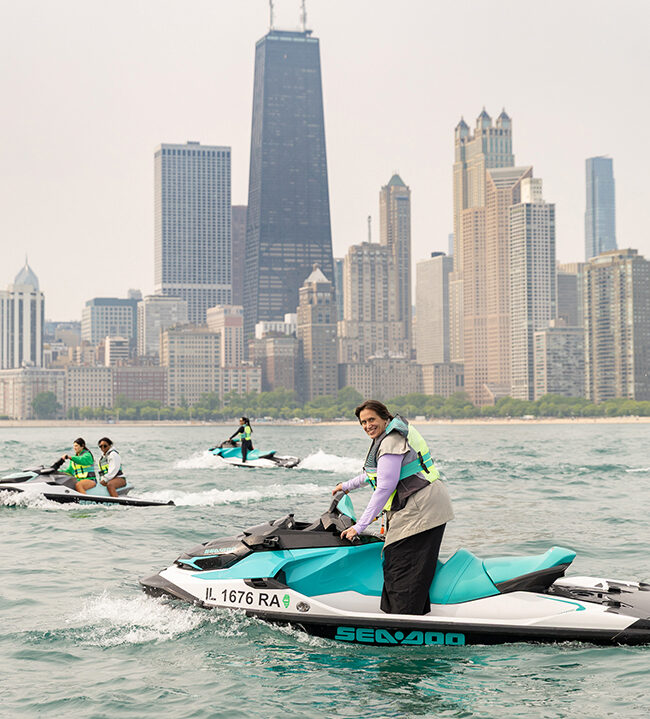
Despite covering PWC Racing for about 2 decades, the Chicago trip was my first real PWC ride. (Photo: Shaina Benhiyoun Photography)
You can’t get anywhere on a PWC by “twisting the throttle.”
That’s what happens when you put a V-twin saddle-hobo of 45 years on a jet ski and turn her loose with a handful of women in the waters outside Chicago — a day of discoveries and laughter, sunshine and sisterhood, and a brand new appreciation for the skill, talent and athleticism of the PWC racers I’ve been working with for more than 20 years.
But I’m skipping ahead in this story.
This particular adventure began several weeks before that day on Lake Michigan, when plans went into full swing for The Watercraft Journal to attend a Sea-Doo Social Club Women’s Chapter ride.
A part of the Uncharted Society program, the Sea-Doo Social Club Women’s Chapter brings women together to share the fun, relaxation, and new friendships while learning, or improving, riding skills and building confidence. Like other Uncharted Society outings, no experience is needed to take part in a Women’s Chapter rides, and the equipment — in this case, the PWC and a life jacket — is provided.
As The Watercraft Journal posted last Autumn, Uncharted Society was created specifically for the adventurous at heart, but with, perhaps, dreams bigger than their pocketbook. Uncharted Society puts dream-worthy adventures like exploring exotic destinations (aboard a Sea-Doo, of course), carving through Rocky Mountain snowy terrain (on a brand new Ski-Doo snowmobile) and or a meandering trip through a desolate western landscape (you guessed it – on a Can-Am) within reach by providing turnkey adventure packages.
Kicked off as a test project, the idea behind Uncharted Society was to eliminate a hefty portion of the cost barrier to embarking on those dreamed-of adventures. From the original 30 adventure packages, Uncharted Society has now created more than 300 unique opportunities to fit just about any outdoor adventure aspiration — and while there are a plethora of stateside adventures just waiting for your next 3-day weekend or quick jaunt — for those with eyes set beyond America’s borders, there are international opportunities galore.
With the arrangement of the website, you can find your perfect adventure a number of ways; by destination, by vehicle, by ride type (rental or guided), and by duration (Half day or less, Full-day, Multi-day, Multi-hour). The 2025 collection of outings includes adventures related to fishing, camping, mountain biking, electric vehicles and a women’s only experience.
After a quick flight from Chattanooga to O’Hare International and my first ever Uber ride (eventless, and quiet, since my driver did not speak English!) I checked into my room at the Homewood Suites by Hilton Chicago Downtown South Loop. I won’t take up to much of this article on the subject, but I feel it worth noting that this hotel — which, at a hefty several-hundred-dollar-per-night rate, I expected to be, if not luxurious, then at least comfortable and clean — was the only downside of my Sea-Doo weekend, and it was an extreme downside:
An error on their part with my reservation that almost left me without a room, clerks that were rude and unconcerned with the fact that their error, which they later admitted to — threatened to leave a guest to their city without a place to sleep, and to top it all off, a run-down, shabby room with worn out furniture, threadbare carpets, rusty fixtures, and an air conditioner that was so noisy that I had to choose between not sleeping from the noise, or turning it off and dealing with the heat.
Even that experience, however, could not diminish my enthusiasm the next morning when, not really certain what to expect of the day, I joined Jaelle LaVergne-Periard — another member of the SeaDoo team — as she thankfully took the task of navigating Chicago streets and got us both to the dock unscathed.
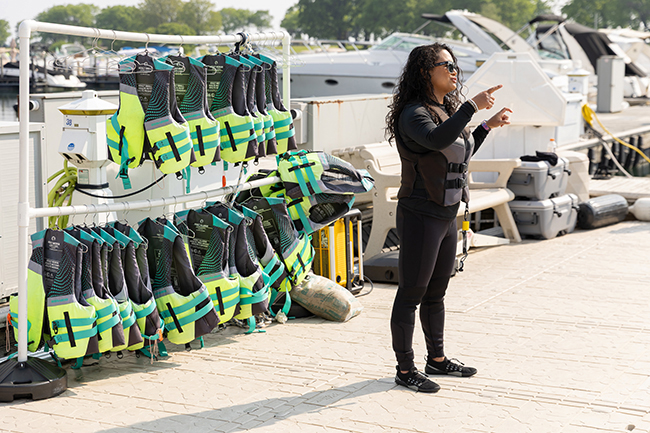
Sea-Doo Ambassador Alvean Azurin giving the pre-ride rundown of the route and schedule. (Photo: Shaina Benhiyoun Photography)
After being introduced to the other ladies taking part in the ride, as well as our head honcho(ess) of the day, Sea-Doo Ambassador Alvean Azurin, and being given a brief rundown of the ride route and schedule, as well as covering of some basic safety guidelines (don’t wander off too far, and stay away from specific shorelines where rocks lurked beneath the waves), it was time to actually step on the skis.
Since the experience level of the group ranged from a few neophytes like myself, to one more experienced rider, and a couple with limited ride time, they took their time with the process and made sure everyone was comfortable with the basic controls of the ski before we launched.
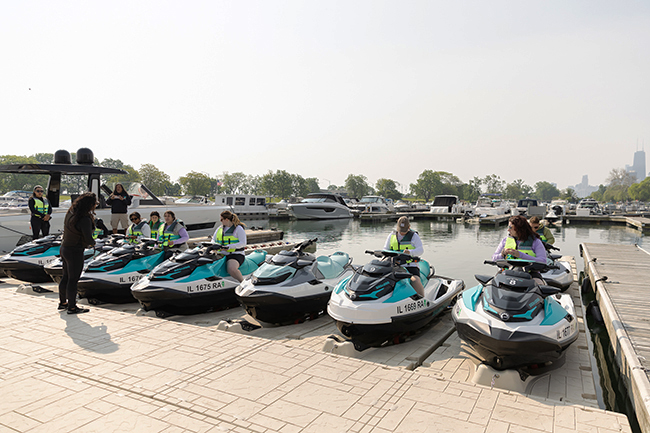
The cradles that took away any pre-ride jitters about getting on the ski, thanks to Next Wave Powersports (Shaina Benhiyoun Photography)
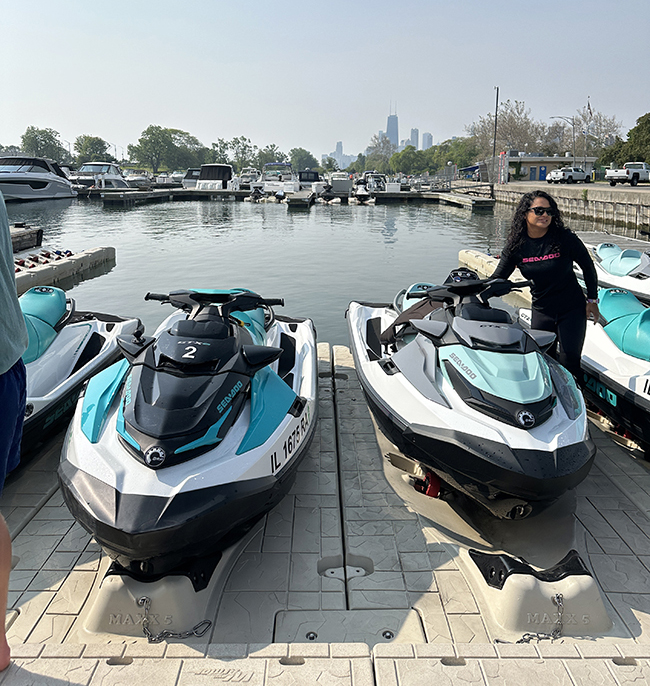
To be perfectly honest, the actual process of getting on the dang ski has been one of my biggest hesitations about learning to ride. Watching people mount skis from wobbly and bobbing docks, and after having attempted launching a kayak from similar roller-coaster docks before, the trepidation of loading my notoriously klutzy and balance-challenged self and getting situated on the ski was a big concern. But stepping onto the dock at the marina, and seeing the skis lined up, all securely nestled in their floating … “cradles” is the best term I can come up with … put me at ease on that score.
It definitely ratcheted down any nervousness about getting on the ski (especially in front of others), as it was an easy “step-onto”, a solid, firmly-in-place ski, instead of a precarious “step-down” onto a rocking, bobbing ski. It might seem like a small issue, but it was one of those small things that added up to the day’s ride being as enjoyable as it was. The staff at Next Wave played a good part in that, also, as each of them was friendly, polite, helpful and went out of their way to make me, and everyone else, feel at ease.
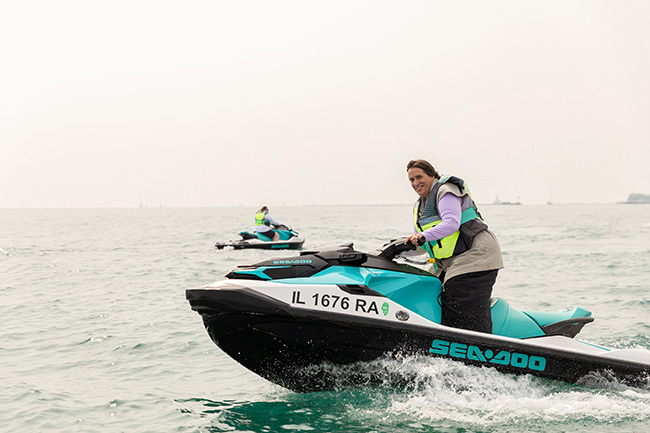
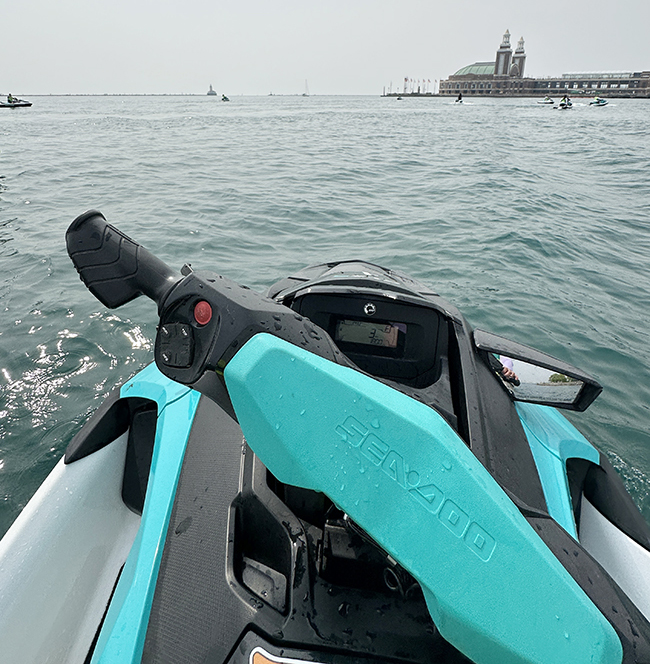
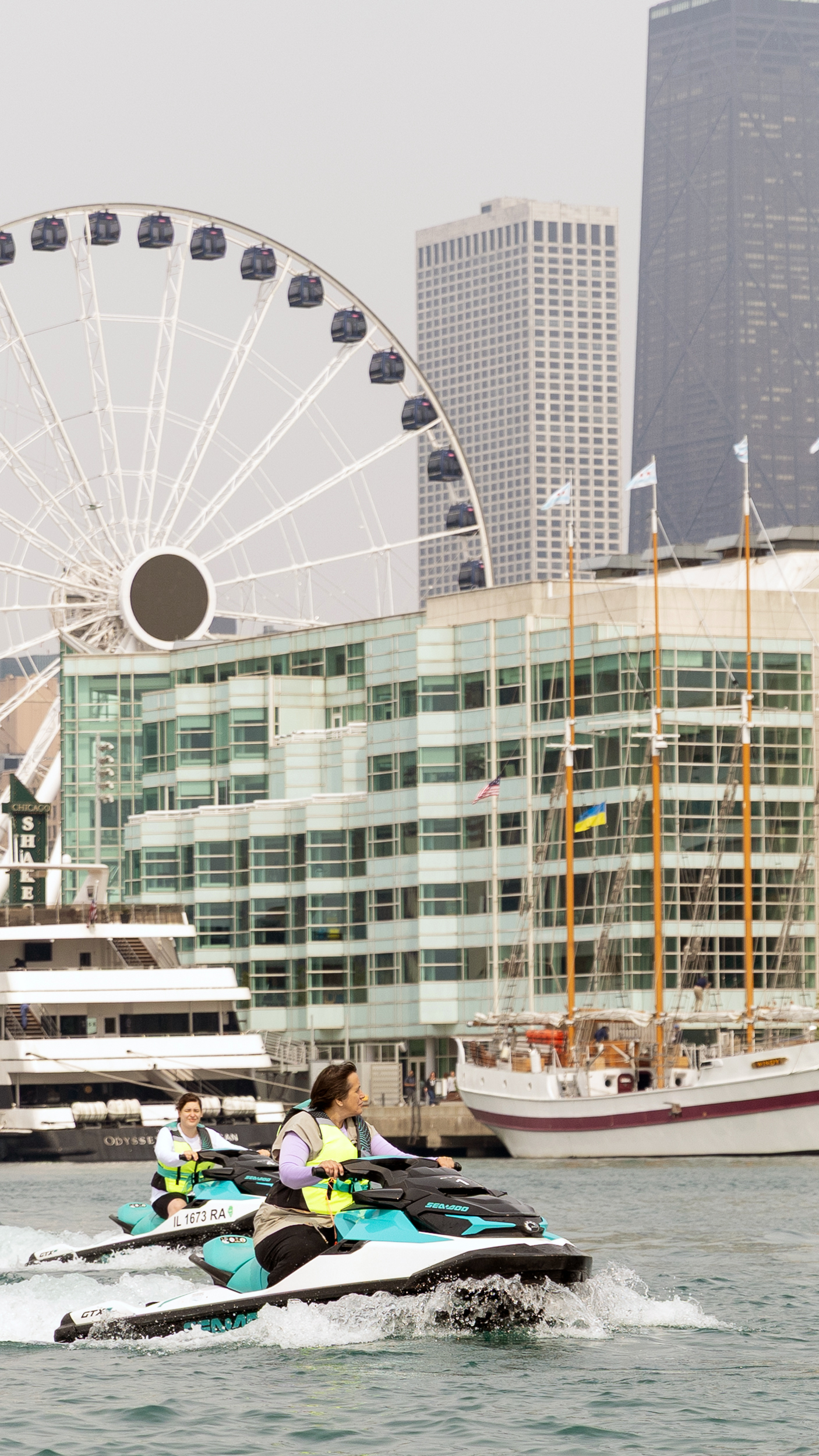
The skis themselves also made the day’s ride seem like a top-tier outing — each of us was teamed up with our very own GTX 130, which is a Sea-Doo rental-specific model, but corresponds closest to Sea-Doo’s touring line GTX 170.
Now, before any of the more experienced riders/racers heckle me for the low-end model, that 130 horse-power rating was plenty for my first outing, and even though I was all proud of myself for the fact that, by the end of our ride, I was “gunning” it (stop laughing, y’all!) and zooming around the choppy waters outside Chicago like some teen on a joyride, I can only surmise that the fact that the models you can walk into a powersports store and go away with start out at 170 hp, and range, in this model, all the way up to 325 hp for the GTX Limited, gives everyone plenty of growing room in terms of acceleration and speed.
And, taking a dive into completely “girly” topics, the fact that the rental model comes decked out in one of my favorite tealish/turquoisish colors just made my day, and only added to the sappy grin I am sure was plastered on my face the entire ride. I can definitely say the fact that current-day PWC models come with handy “brakes” and “reverse” was a more-than-pleasant fact and made it possible for even me to make it through the entire day without any bumper-car interactions with fellow riders, the shore, buoys or the dock. Another HUGE bonus of the GTX model is not only do they have a nice roomy storage compartment right in front of the seat, inside that storage compartment is an easy-to-access waterproof cell-phone holder. That discovery was akin, I would imagine, to finding out that your cute new dress has POCKETS!
(Photo: Jessica Waters)
(Photo: Shaina Benhiyoun Photography)
(Photo: Shaina Benhiyoun Photography)
Photo: Jessica Waters
(Photo: Shaina Benhiyoun Photography
(Photo: Jessica Waters)
OK, back to the play-by-play. After we all had a few minutes of practice with the throttle and how to brake and reverse, we idled through the marina and under DuSable Lake Shore Drive (passing dozens of stenciled penguins on the walls of the underpass — part of a spring rash of “graffiti” in 2023 that left the soon-to-be-loved penguins on storefronts, walls, sidewalks and windows in the nearby East Lakeview neighborhood in 2023.)
After slipping back out into the mild sunshine on the lake side of the underpass, and as we idled waiting for the everyone to regroup, I did my first bit of official “Chicago sightseeing,” put-putting around to check out the sculpture standing watch over the lakeshore and the large number of joggers and bikers enjoying the park trails. Once everyone grouped up again, we set out, following Alvean’s lead, and meandered south just off the shoreline, past the North Avenue Beach Pier.
While there was a bit of a learning curve to maneuvering (hint, there is no such thing as counter-steering on a PWC!) every minute that slipped by and every successful practice turn boosted my confidence that “even I can handle this!” (I am sure, however, that random observers wondered why the heck some old gal was doing random turns, unnecessary stops and arbitrary donuts (in reverse, even!)
The varying levels of experience and comfort of the members of the group became apparent, as some people went flying along the shore, looping around to come back to those not quite as zippy yet, while others were happy at a near-idle glide.
I would put myself in mid-pack of that range at that point … While I certainly backed off the throttle when the choppy waters tugged the bow of the GTX off course and I felt like I was going to just slide right off the side of the seat, there was a constant little voice in the back of my head throughout the day saying, “C’mon, you gotta at least ACT like you’ve been working around some of the fastest PWC racers in the world for the past two decades, surely you learned something by osmosis! (Note: I doubt water conditions that day would be termed “choppy” by more experienced riders, and I feel somewhat self conscious about even using that term after having shot several Daytona races!)
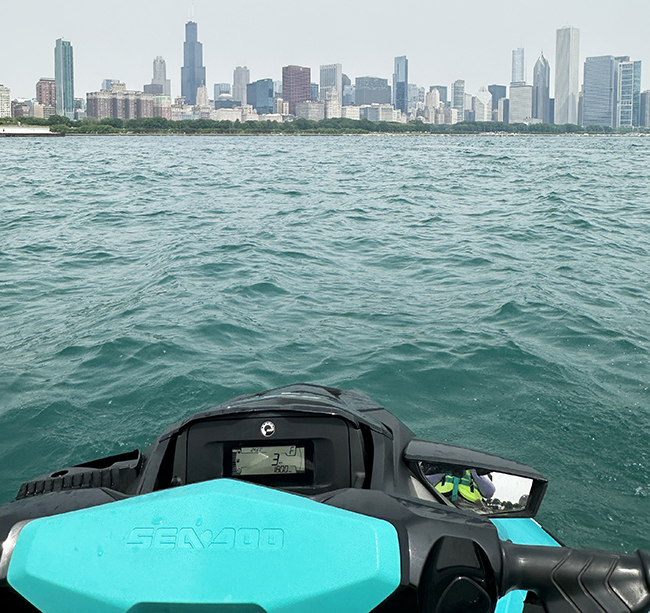
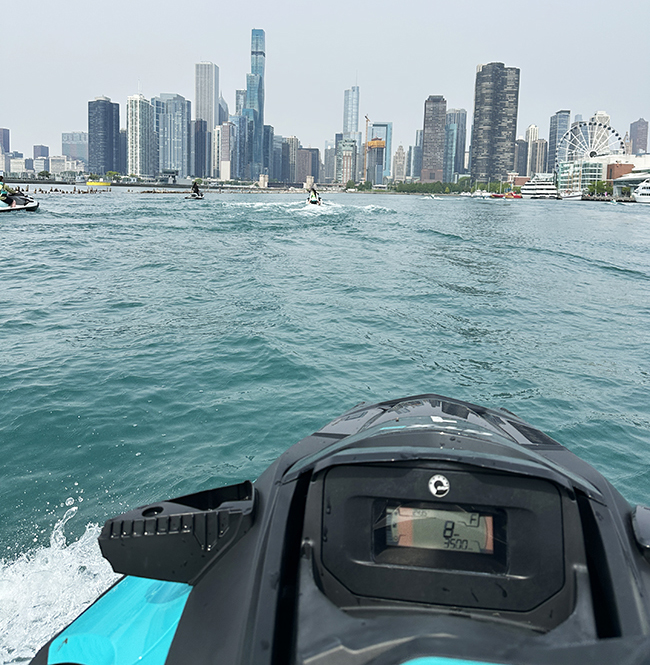
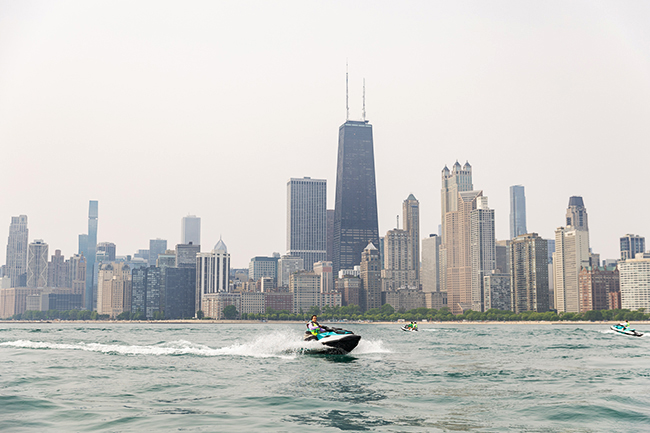
After giving the group time to find their comfort level and for the beginners to learn the controls enough to eliminate the potential for “close encounters” between riders, Alvean and the other ride wranglers gave us the opportunity to do a few loops while they took photos of each of us with the iconic Chicago skyline in the background.
(Photo: Jessica Waters)
(Photo: Jessica Waters)
(Photo: Jessica Waters)
(Photo: Jessica Waters)
(Photo: Jessica Waters)
Photo: Shaina Benhiyoun Photography)
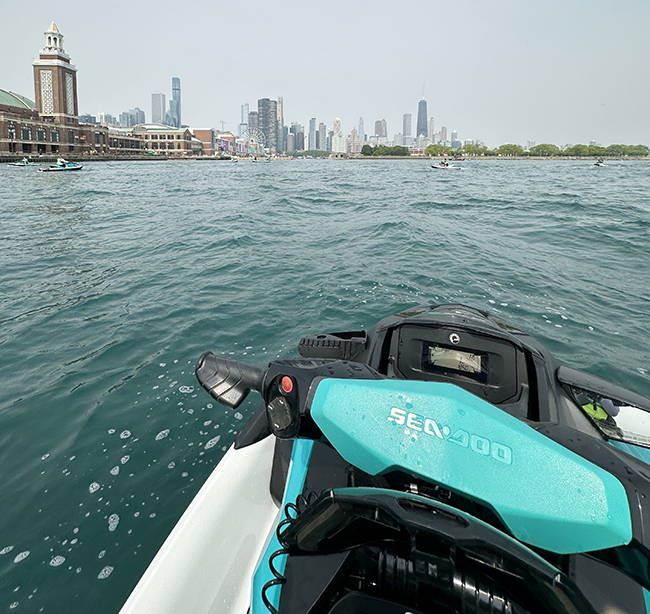
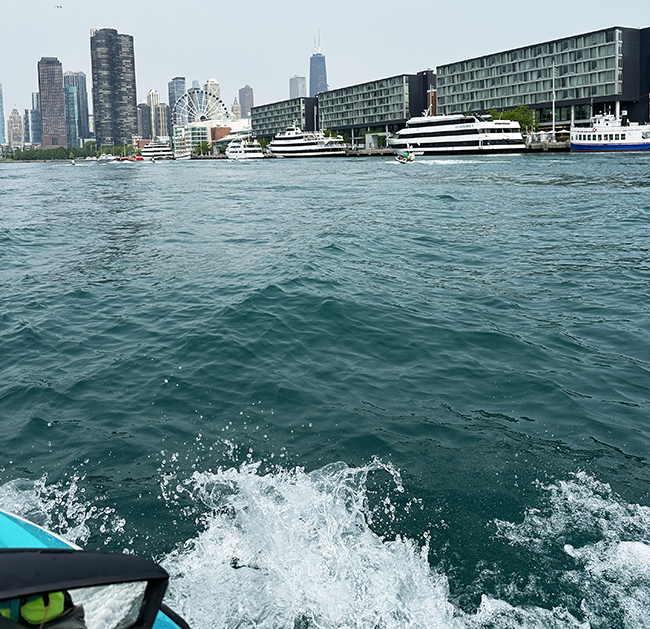
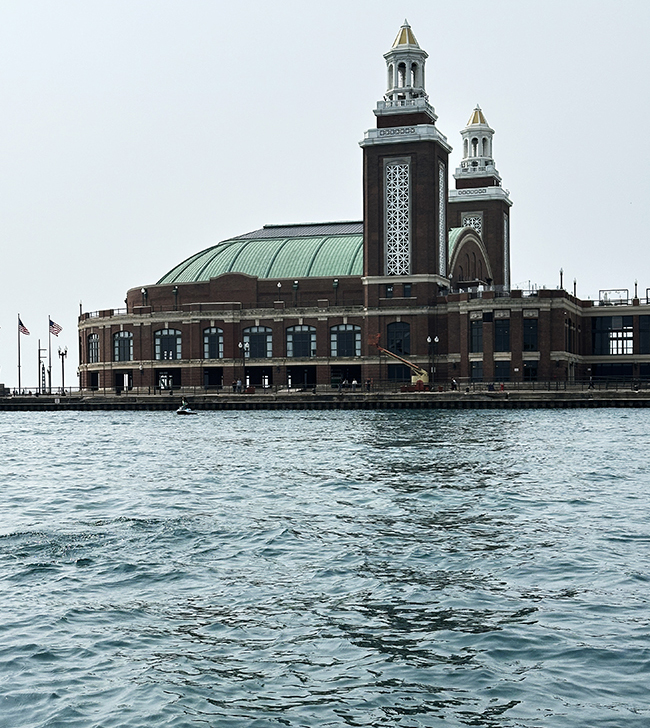
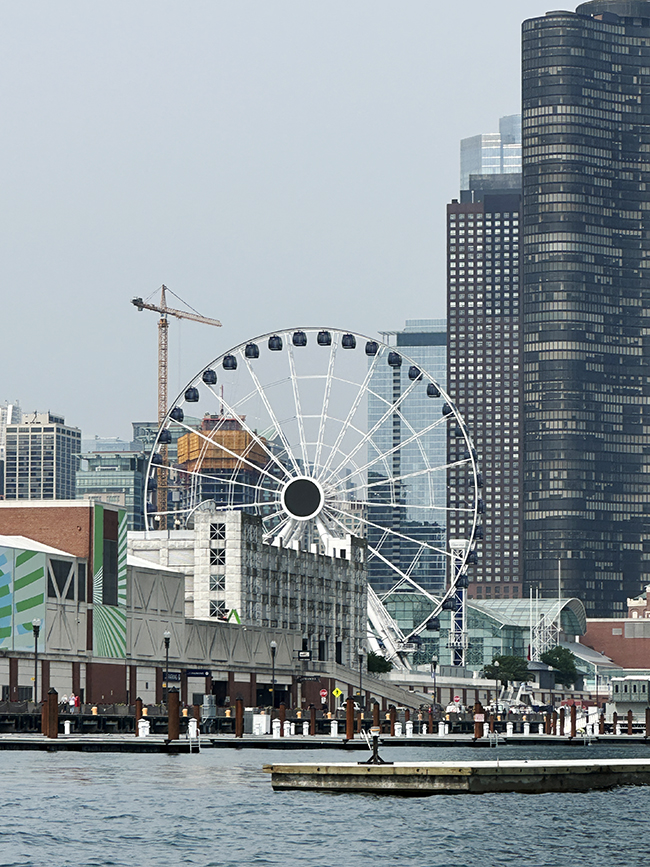
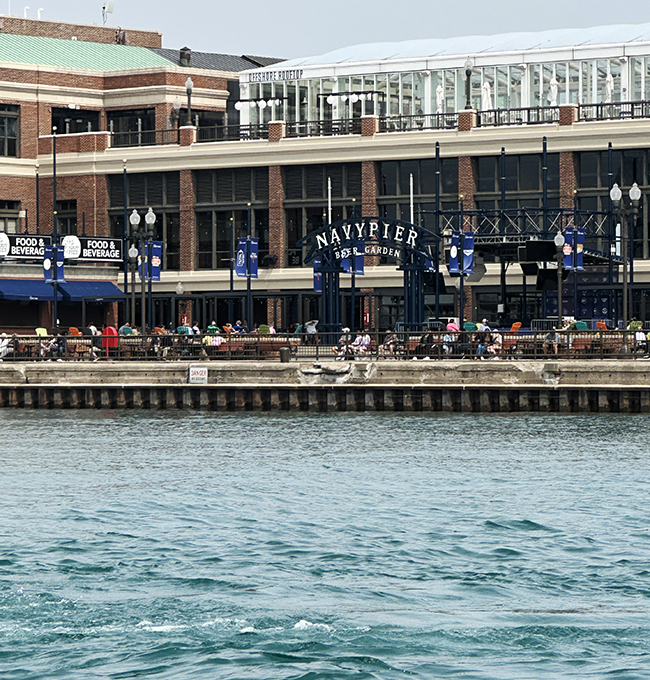
We next visited the historic Navy Pier, idling past Centennial Wheel, the unique architecture of the festival hall, the Aon Grand Ballroom with it’s 80-foot domed ceiling, and Chicago’s Shakespeare Theatre and the several resident lake cruise ships — my favorite of which was the 148-foot, four-masted gaff topsail schooner Tall Ship Windy, which was at dock when we passed by.
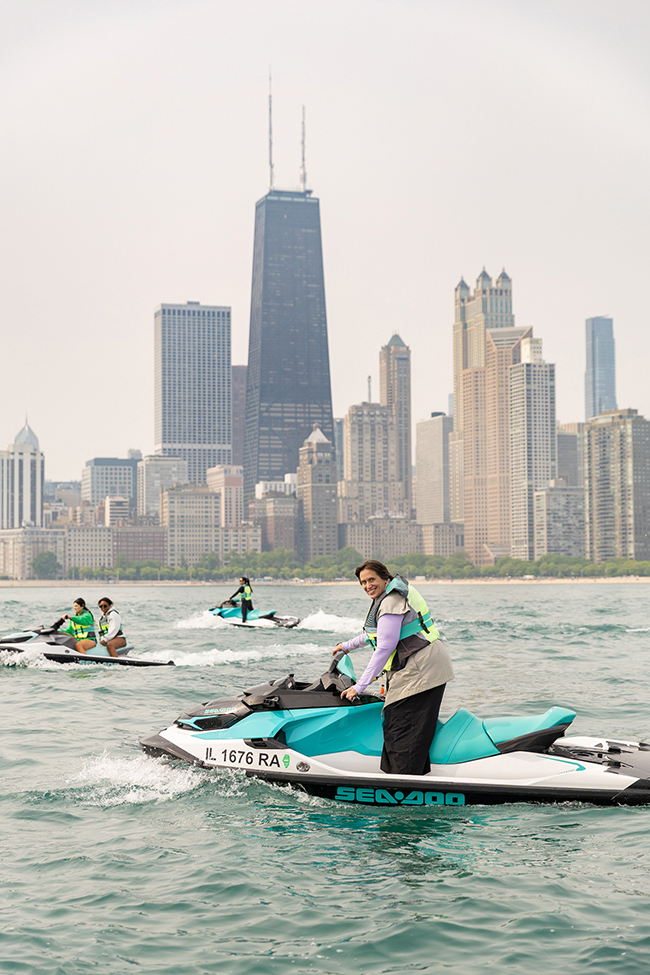
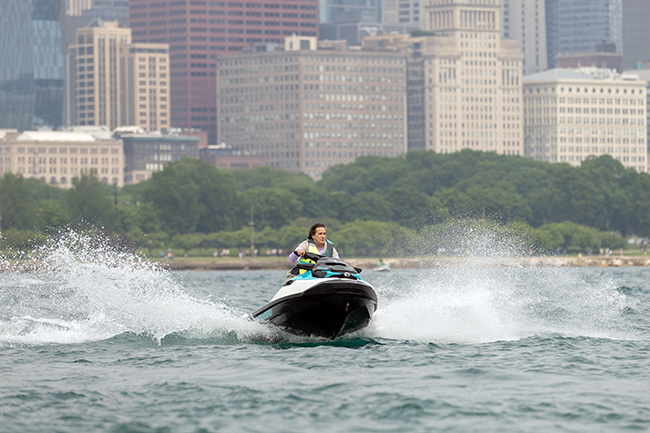
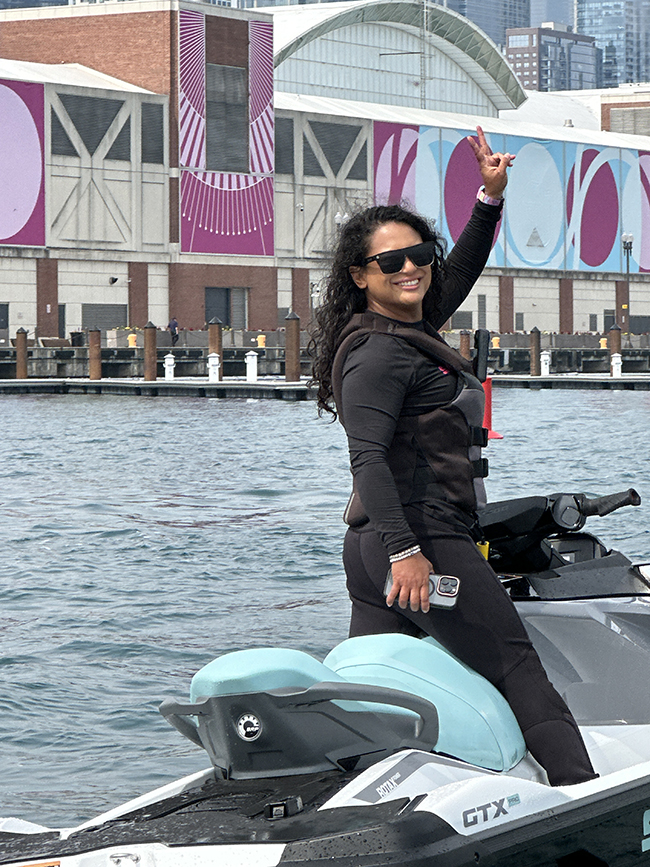
There was again time for a photo op — normally something I would avoid like the plague, but even I did a little grandstanding with my newly born on-the-water confidence and, taking some advice from Alvean, braved a standing stance as I ratcheted up my speed enough to throw a little wake for the photos … surprisingly enough, I felt like I had even a little more maneuverability and control from a standing position as opposed to seated, which seems counter-intuitive, but was an observation that lasted throughout the day (although my leg muscles did NOT last throughout the day!)
I will note that, while having a group to ride with, and the camaraderie of it being a woman-only outing, was nice, I had been concerned slightly before the event that it would be a typical “woman’s outing” where everyone was attached at the hip with their fellow females, and the focus was on gossip, makeup tips and giggling. I am happy to report that my concern was unwarranted. The Sea-Doo Women’s Chapter seems to eschew that route, we all had freedom to explore, and there was a blessed lack of girly-talk.
Adler Planetarium (Photo: Jessica Waters)
We continued just offshore, and as we took in the scenery, I was able to get answers from the group leaders to my questions about the buildings we were passing, including the 5-million gallon Shedd Aquarium that holds about 32,000 animals. It is the third largest aquarium in the Western Hemisphere and the 11th-largest aquarium in the world. We also passed the Adler Planetarium, the first planetarium in the United States.
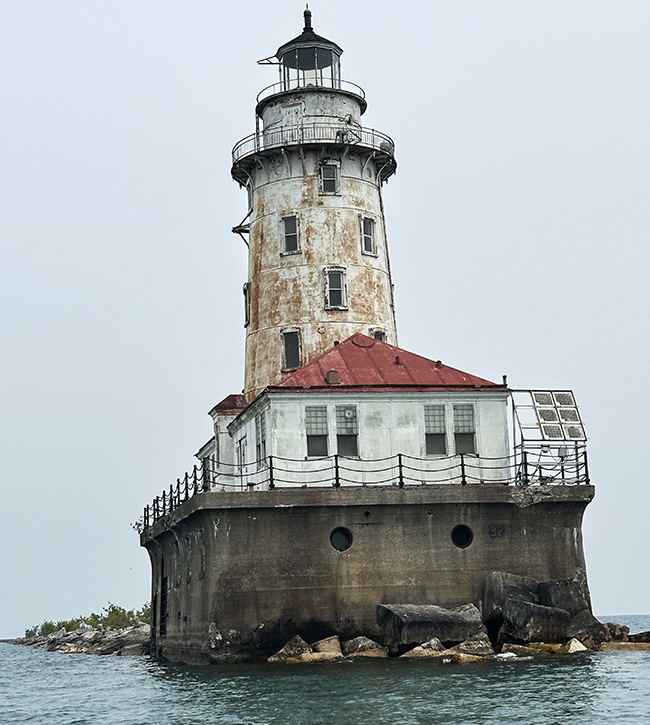
Last stop: William E. Dever Crib Lighthouse (Photo: Jessica Waters)
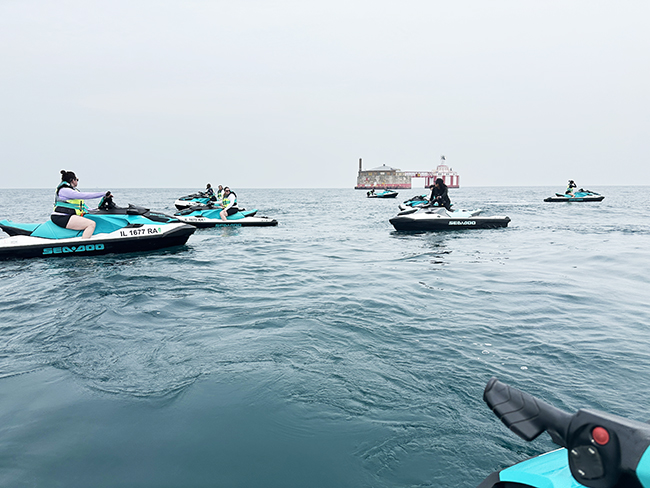
It was at that point that the little voice in my head got a bit louder, and, after enthusiastically counting myself into the group headed to the lighthouse, I apparently got a “wild hair” and set out ahead of the pack, aiming toward the landmark intake crib — one of two remaining active water cribs providing drinking water to the City of Chicago. While the trip to the structure, and the 30 or so minutes we spent at the lighthouse, could not be considered anywhere close to putting the GTX “through its paces,” it definitely counted as me putting myself through my paces:
I set out with a purpose, to push myself and see what I could do. Although there was a fairly consistent feeling of instability, especially when hitting chop from the wind or the wake left by another rider or nearby boat, I would imagine that is due to my inexperience, as opposed to the GTX, which felt solid and secure when I wasn’t intentionally crashing into and over rough water.
I realized afterwards that I unfortunately never once looked down to see what speed I actually achieved, and I doubt it was anything most would consider impressive, but as I nudged the boundaries of my comfort level, learned how to move better with the ski, discovered how to time my turns with the choppy waves a little better, (and finally figured what my racers mean when they say “hooked up”), I felt that addiction I’ve had for the PWC world for the past 20 years, turn into something entirely more personal.
And impressively, in my mind at least, the Sea-Doo Women’s Chapter team did not attempt to babysit. There was no crew trying to corral me back into the herd, there were no scolding looks, even as I did loops around the rest of the group as they chatted, trying to channel my inner Sophie Francis and pretending I was rounding buoys at Crazy Horse, and not one word was said as we pulled back into the harbor about this old gal acting like some wild-child.
I do feel bad that I can’t give more of an in-depth review of the Sea-Doo GTX, but having nothing to compare it to, and no previous ride experience to judge its handling, power and acceleration to, I don’t think any statement by me on the ski would be reliable, but I will say, at no time did I ever think, “dang, I wish I was on a different ski for my first ride.” Quite the opposite; I left the waters of Lake Michigan feeling like there was very, very little that could have improved on my “first ride” experience.
I will quickly note that the outing did not end at the dock, but instead, the Women’s Chapter treated us to lunch at a little park adjacent to the nearby North Pond Nature Sanctuary, and I had enough time left in the day afterwords to scrunch in a visit to the Aquarium, Field Museum, the Cultural Center, and the Riverwalk.
In closing, your WCJ editor now has at least one ride under her belt, which she thoroughly enjoyed and is looking forward to taking y’all along on more rides this summer as I explore the local waterways and improve my riding skills.
Denys Lapointe and the BRP Design & Innovation Team
Denys Lapointe and the BRP Design & Innovation Team
Red Dot Award: Product Design 2025 – The best designers of the year celebrate in Essen
On 8 July 2025, Essen became the hotspot of the international design scene. Creatives, companies and design enthusiasts from all over the world gathered on Tuesday evening for the Red Dot Award: Product Design 2025 award ceremony. It was an evening full of emotions, exciting moments and impressive designs, which began in the iconic Aalto Theatre – designed by Finnish architect Alvar Aalto – and ended with the Designers’ Night in and around the Red Dot Design Museum at the UNESCO World Heritage Site Zollverein. Among the approximately 1,300 guests were renowned chief designers from world-famous brands such as Philips, Thule, Walter Knoll, KIA, BRP, Lamborghini and many more. For the first time, the Red Dot Gala was also streamed live – with commentary by Jova Zec, Vice President of Red Dot, and Freddie Schürheck, presenter and journalist.
International stage for excellent design At 6 p.m. sharp, the spotlight turned to the stage of the Red Dot Gala 2025. Professor Dr. Peter Zec, initiator and CEO of Red Dot, welcomed numerous guests from the worlds of design, business, media and culture. This year’s award winners travelled from all around the world, including China, Canada, Australia, Japan, South Korea, the USA, Brazil, Sweden, Italy and the UK. They were all honoured for their exceptional design achievements, which once again underlined the global relevance of the Red Dot Award. Essen’s mayor, Thomas Kufen, also praised the creative spirit that gathers in the Ruhr metropolis year after year.
“Best of the Best” for outstanding design Together with jury members Kazuo Tanaka, Qin Li and Robin Edman, Professor Zec presented the coveted “Red Dot: Best of the Best” trophies to designers whose products impressed with their innovative strength, design precision and functional excellence. The winners, who accepted their trophies personally on stage, provided emotional highlights with their palpable joy and pride – and made the creative diversity behind the products tangible for the audience.
A choreographed interlude The performance by the Aalto Ballet provided an atmospheric interlude: with an excerpt from Johan Ingers’ ballet “Carmen”, the ensemble marked an artistic turning point in the evening’s programme and elegantly led into the festive highlight. The story is told from the perspective of a child who witnesses a tragic obsession.
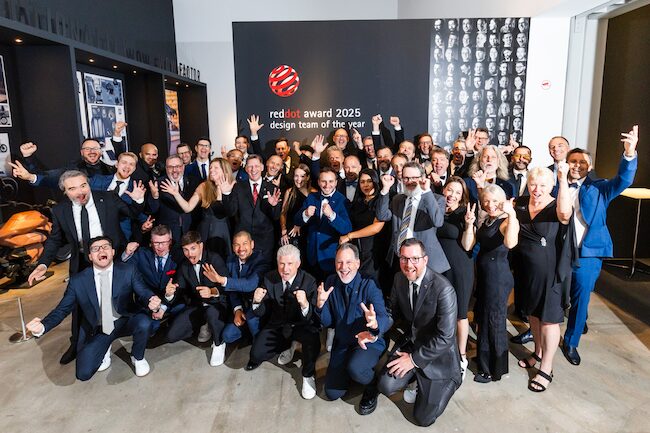
BRP named Design Team of the Year The BRP Design & Innovation Team was crowned “Red Dot: Design Team of the Year 2025” to thunderous applause – an honorary title that has been awarded exclusively to outstanding design teams on the international design scene since 1988. In recent years, Apple, Ferrari, Grohe and, most recently, Thule have received this special recognition. The “Radius” challenge cup, which bears the name of each award-winning design team, was ceremoniously presented by Henrik Eriksson, Global Design Director at Thule, to Denys Lapointe, Chief Design Officer at BRP.
In a personal laudatory speech, José Boisjoli, President and CEO of BRP, praised the team led by Denys Lapointe for its creative excellence, passion and tireless commitment to actively shaping the future of BRP. “Design is a lever of growth and it has a seat at the table where strategic decisions are made,” said Boisjoli. The title recognises BRP’s ongoing commitment to forward-looking, user-centred design and its pursuit of creating a holistic and harmonious customer experience. BRP follows Thule as the new title holder.
After-show party with an industrial backdrop The gala was followed by a celebration: for the Designers’ Night, the Red Dot Design Museum was transformed into a vibrant backdrop for conversations, encounters and a lively atmosphere. DJ CHRISSI D provided the perfect beats, while the beer garden, culinary highlights and exciting discoveries in the exhibitions ensured an all-round successful atmosphere.
A special highlight of the evening was the exclusive vehicle exhibition for the award ceremony: for the first time, all vehicles awarded a Red Dot: Best of the Best were displayed together. In a hall over 50 metres long and in the adjacent outdoor area, guests were able to experience the award-winning models up close, including highlights such as the Can-Am Pulse ’73 Electric Motorcycle from BRP, the Ferrari 12Cilindri and the Ferrari F80, the Polestar 4, the Porsche Macan Turbo, the Lamborghini Revuelto, the Kia EV3, the Valtra S Series, the Jungheinrich EJC 112i and the BRABUS BIG BOY 1200, which was presented together with the BRP motorcycle in the outdoor area.
Premieres in the museum and exclusive outdoor exhibition by BRP Three new exhibitions celebrated their premiere at the Designers’ Night in the Red Dot Design Museum: “Red Dot Milestones 2025–2026” showcases the 89 best products of the year from all competition categories until 31 May 2026. “Design on Stage 2025–2026” presents around 1,500 award-winning products on five museum floors and can also be seen until 31 May 2026. For the first time, the new One-Minute Design Challenge invites visitors to sharpen their eyes: on the second floor, a staged children’s bicycle by Woom challenges visitors to concentrate fully on its design for one minute – the solution, with surprising details, can be found directly on the back of the presentation wall.
In addition, “Adventure by Design – BRP Design & Innovation Team” offers deep insights into the creative world of the current Red Dot: Design Team of the Year until 9 September 2025. A special highlight is the extension of this exhibition to the outdoor area: until 13 July, visitors can experience an exclusive selection of 12 award-winning vehicles from the BRP Design & Innovation Team on the grounds surrounding the museum. These vehicles impress not only with their technical sophistication, but also with a powerful design language that combines a spirit of adventure, speed and precision.
Discover all the winners online All the award-winning products of the Red Dot Award: Product Design 2025 are now available online in the Winners section of the Red Dot website – including the jury’s comments, background information and images.
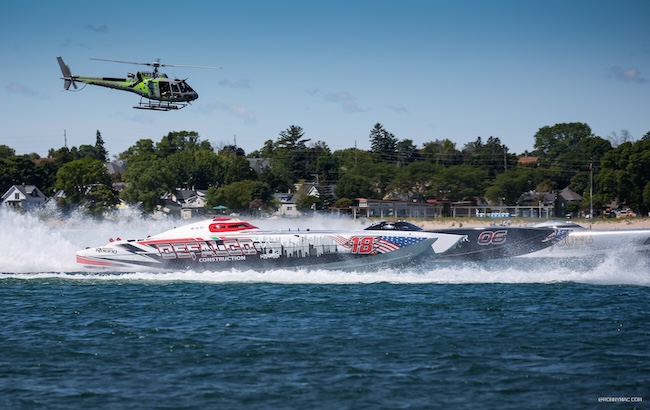
SHEBOYGAN, WI – July 9, 2025 – The 3rd Annual Mercury Racing Midwest Challenge, produced by Powerboat P1, takes place August 8-10 and promises exhilarating powerboat and jet ski racing on Lake Michigan.
The weekend promises a festive atmosphere for the entire family. The fun begins on Friday, August 8, with a Downtown Block Party featuring a variety of powerboats on display, food, drinks, and live music. Then, on Saturday and Sunday, powerboat and jet ski race teams will compete for the checkered flag. The best viewing area is along the lakefront at the end of South Pier Drive. Throughout the weekend, race teams will be on display in Deland Park. The event is free; however, VIP tickets are available and include food, beverages, a live stream of all the racing action, and the best viewing area for the event.\
Last year’s event drew 21,246 visitors and generated $3,668,924 in visitor spending. It not only boosted the local economy but also significantly raised the profile of Sheboygan, with Powerboat P1’s national and international television coverage showcasing the city’s many attractions to a worldwide audience of more than 230 million homes. Sheboygan Mayor, Ryan Sorenson, shared, “We are thrilled to bring this incredible boating event back to Sheboygan, the Malibu of the Midwest. It’s a celebration of our community, highlighting our beautiful Lake Michigan shoreline and deep-rooted boating culture. From high-speed excitement to lakeside fun, this is a moment for our city, businesses, and boating enthusiasts to come together and shine. It’s one of the highlights of our summer.”
RonnyMac.com
Community partners for the event include Visit Sheboygan, the City of Sheboygan, and the Sheboygan Chamber of Commerce. Net proceeds from the event will benefit the P1 Marine Foundation, with a portion of the proceeds earmarked for the Sheboygan Youth Sailing Center.
Sheboygan is the second stop of the Monster Energy P1 Offshore Triple Crown & P1 AquaX National Championship series. Additional races were held in New Orleans, LA and St. Petersburg, FL will host the third stop in September. In 2023 Sheboygan received “The Best Race Site” Award from the American Powerboat Association. For tickets and more information visit: POWERBOATP1.COM
While it’s never good to hear about any kind of wreck or accident—especially out on the water—we’re always happy when we get to see a successful rescue taking care of those in danger. This Monday, The Holland Sentinel—a local newspaper based in Holland, Michigan—reported on a local PWC rescue carried out by the Park Township Fire Department (PTFD). The rescue took place following an accident on the evening of July 6th, as two individuals were separated from their personal watercraft in intense water conditions out on Lake Michigan.
The two were around 100–200 yards offshore in waves reaching up to eight feet, the newspaper reported, and were first able to grab on to a nearby kayaker for support before his vessel was also capsized and he joined the pair in the water. Luckily, the PTFD Marine Division arrived on a PWC carrying a life sled, and none of the three were injured.
It’s important to stress here that all three individuals were wearing life jackets, which played a big part in their return to safety. The fire department released a statement saying that “this incident underscores the importance of always wearing a life jacket when operating or riding on a personal watercraft.”
For more information, check out the full news article available at The Holland Sentinel’s website.



 At the start of the month, the U.S. Department of Homeland Security and the U.S. Coast Guard released the annual Recreational Boating Statistics report for 2024, showing that there has been a slight uptick in the total number of watercraft incidents in 2024 compared to previous years, but also showing that there has also been a dip in both deaths and injuries.