
Home Blog Page 437

Real Review: Jettribe’s RS-16 Race Vest

1

When it comes down to it, which is more important: features or fitment? I know for myself, and to the chagrin of my wife, I would much rather trudge around in a faded t-shirt, heavily broken-in jeans and a tattered pair of tennis shoes than say suit up in dress pants, a fitted buttoned-down shirt and some polished leather shoes.

Jettribe’s RS-16 Race Vest was designed – and is best suited – for athletically-built closed course racers. Larger casual riders might tend to find the fitment less than favorable.

Sure, I might prefer to look a little less presentable, but at least I’m comfortable, right guys? Now everything has its time and place and I wouldn’t want to attend a wedding or go to court in my usual kick-around clothes, but if there was only a way to have my cake and eat it too, I’d be a happy camper.

The same philosophy translates to PWC riding gear, in fact, almost more so. We’ve all been on rides with friends who continue to wear a ridiculously sun-bleached vest, it’s retro purples and yellows dimmed to near-unrecognizable hues. When asked, their answer is always the same: “It fits great.” Men are like that. We would rather be comfortable than anything else. So when reviewing Jettribe’s RS-16 Race Vest we had to weigh it appropriately.

Like so much of Jettribe’s race-prepped riding gear, you’re going to see more included features than you can count. One of the best attributes of a company with such an active racing program is Jettribe’s propensity to listen to the suggestions of their racers as well as race officials and safety crew. The result is a line of products that meets (if not exceeds) the standards for durability, safety and protection.

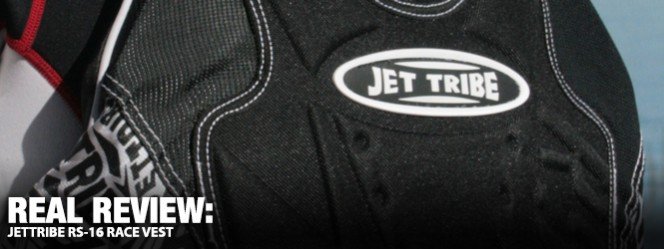
The RS-16 Race Vest is no different. Very similar in design to other side-entry race vests from JetPilot and Slippery, Jettribe’s RS-16 has a large single piece of compression molded foam for impact dissipation in front and back with an improved outer shell material for added protection.
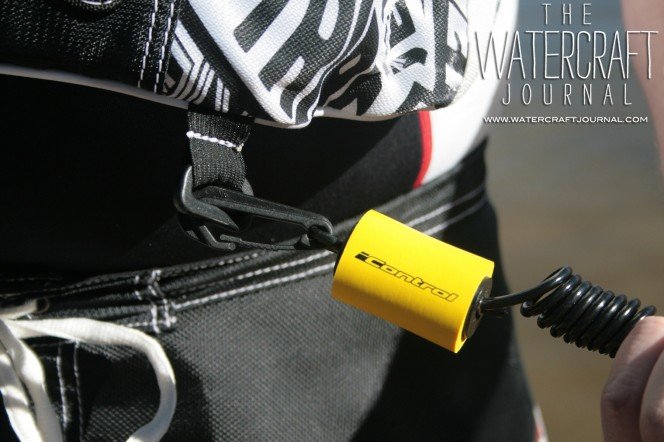
Where the RS-16 could benefit from foam molding, it shines in additional features like lanyard buckles, Velcro-nationality flag on the shoulder and impact resistance and protection.

Using a proprietary CFM material exclusive to Jettribe, the RS-16 also features dual 38mm quick-release right-hand buckles which can be exchanged with other buckles. Other bonuses include a built-in lanyard attachment and Velcro-attached interchangeable flag patch.
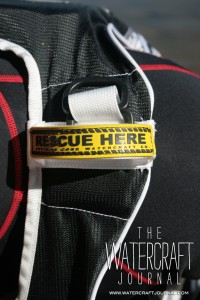
Designed for racing, the RS-16 also features this innovative rescue handle for pulling downed riders out of the water. We hope you never have to use this.

But most iconic to the RS-16 is its built-in rescue harness. Sown into the left shoulder, the handle grip allows for the “easy retrieval of downed rider during a race.” The feature has been recognized by the IJSBA, APBA, and TJSBA Rescue Course Marshals. The RS-16 is also designed to seamlessly integrate with Jettribe’s race collar harness.

But where the long list of features ended, the fitment concerns rose. Let me begin by saying that I’m 6’2″ and 220-pounds. More lean, athletically-built riders might find the fit more encompassing, but for 85-percent of Americans who are toting a few extra pounds, it leaves much to be desired.

The thick impact-resistant foam panels in front and rear are nearly slab-straight, making the RS-16 feel a little like wearing a sandwich board. No matter how tight I cinched the plastic buckles, the vest never felt form-fitting. My sides were always exposed to the nylon straps, which when worn without something underneath it, caused considerable chaffing.

It’s also worth noting that the RS-16 has yet to receive the blessing from the USCG, which can deter those who regularly ride offshore. Frankly put, this vest isn’t meant for everyone, and its fair to say Jettribe designed it as such. Since it’s DNA traces directly to closed course racing, it’s best used there.

Everything You Need to Know About Cavitation

0

You’ve heard the term used over and over again, but what exactly is “cavitation” and why does it sap power from your supercharged runabout? In an excellent essay, the eggheads at Hydronautics Incorporated properly explain the phenomenon that causes these gorgeous helices.

While the image above might look like poetry in motion, it’s actually exactly the moment when your prop looses pressure. Briefly explained by io9, “As water slips around the propellers of a boat, there are places where it experiences sudden, extreme loss of pressure. The propeller is making a ‘hole'” in the water, and the more powerful that propeller is the more water it clears away. Water appears – for the most part – as a liquid on Earth because the atmosphere on Earth keeps it under pressure. Drop the pressure and the individual molecules of water come apart. The water boils, even at very low temperatures. When propellers lower the pressure on certain areas of the water, the water boils, and we see these bubbles.”

In its worst form, and when pushed to a saturation point, cavitation can cause severe harmonics. As the bubbles collapse, they can create powerful reverberating shockwaves, which can not only disrupt the flow of water around the propeller, but actually stress, weaken and break the prop itself. This effect has been commonly attributed to a loss of acceleration, traction and thrust in PWC.

Video: The Yamaha NZ Festival of Freeride Is Back for 2014!

1

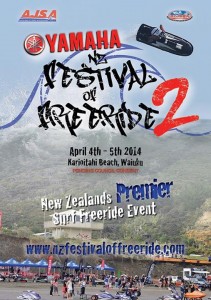
We at The Watercraft Journal are very excited to announce the return of New Zealand’s awesome Yamaha NZ Festival of Freeride. Scheduled for the weekend of April 4-5, 2014, the Festival of Freeride promises to deliver on the same level of hardcore freeride action that all of us have come to expect.

Welcoming the world’s best freeriders from across the Kiwi Nation, the Southern Hemisphere and across the globe, the Festival of Freeride is already bringing in some serious attention from sponsors and riders alike. Below is the official announcement and a cool teaser trailer for next year’s event:

It’s back! The Yamaha NZ Festival of Freeride is happening again in early April 2014. After the success of the inaugural event earlier this year there was no doubt that this would become an annual fixture in the freeride calendar. The Auckland Jet Sport Association (AJSA) is proud to be hosting this event once again.

Big news also is that Yamaha NZ have once again stepped up and will be title sponsors of this years event. It is fantastic to have them on board once again as their support plays a key part in ensuring that we have a successful event. We simply could not do it without them.

The 2014 event will be held in early April next year at Karioitahi Beach, Waiuku on Friday April 4th and Saturday April 5th (with Sunday April 6th as a backup for horrendous conditions). We have moved north from the original Port Waikato location to a section of west coast beach that will better suit the event. This is the last weekend before the clocks are turned back and daylight savings ends for summer/autumn 2014. So make sure you get this into your diaries asap and organize your leave early.

The format of the event will remain unchanged. The emphasis is on ensuring that everyone enjoys themselves in a non-competitive and festival atmosphere. Karioitahi Beach is 10mins from Waiuku, a rural town that services the Franklin area and Awhitu Peninsular. Not only are there a variety of accommodation options but a supermarket, numerous takeaway outlets, and a couple of local watering holes that will give you a lot more choice than previously.

There is plenty more information to come, and over the next month or two we will release it as it becomes available. Entries will be available to anyone and everyone and we hope to see more people entered than last year. We encourage anyone participating, or interested, in freeride to come along and enjoy riding with others of all experience levels.

We can’t wait to see everyone back again for the Yamaha NZ Festival of Freeride 2 in April 2014.

The AJSA

Below is the great teaser for next April’s Festival of Freeride:

Video: Jettribe Recaps 2013 IJSBA World Finals at Lake Havasu City, Arizona

0

It’s hard to argue that no other US-based apparel company has put up a better effort to get their brand name on the backs of more racers and personal watercraft enthusiasts than Jettribe. Helmed by standup rider and hardcore racing lover Tony Vo, Jettribe has really hit its stride the in past four-to-five years.

Nowhere was this more evident that throughout the UWP-IJSBA Watercross National Tour and at the 2013 Hot Products IJSBA World Finals in Lake Havasu City Arizona. Jettribe was literally everywhere. Even in other manufacturers’ booths (even if they didn’t know it). Heck, the Jettribe Team was the only team to represent the USA at this year’s events in China and the lauded Kings Cup in Thailand.

Recently Jettribe put out this great little video recapping the World Finals experience. Beginning the first week of October, the world’s best jet ski racers converge on Lake Havasu, AZ to battle for a World Title. Jettribe highlights some personal interviews with a couple of this year’s top racers.

Kevin Shaw: Bad Behavior

1

“So, who have you pissed off lately?”are the first words I hear on the other end of the phone. The joke has more bite than is communicated only because I know I’ve left quite the trail of ruffled feathers in my wake. Over my career as a powersports journalist, I chaffed with nearly every editor, publisher and art director I worked with. Yet, despite the occasional friction, I always managed to churn out work I was proud of, and ultimately, work people liked to read.

This time around though, I had done more than step on the proverbial toe. At September’s 2014 Kawasaki Dealer Meeting, I had managed to weasel my way aboard a ’14 Ultra 310LX. Mind you, the media wasn’t invited to ride any of the demo units, nor were any invited to do so. Nevertheless, I found myself ripping up the briny waters of San Diego’s Mission Bay atop a metallic green-and-black supercharged Kawi. It’s amazing what asking nicely can get you.

Surprisingly, I kept from crashing, sinking or setting the new ’14 FZR SVHO on fire. For me, that’s a really good day.

With the Zac Brown Band pumping out over the Jetsound speakers trying to drown out the whine of the Eaton blower, I greedily chewed up the short buoy course. While the performance of the new 310-horsepower Ultra left me swirling with glee, my goofy antics, particularly the wild get-off of mine near the beach, left many at Kawasaki ready to wring my neck. I had indeed, pissed the wrong people off.

Unfortunately, this was only one instance in a long résumé of bad behavior. Years earlier, I famously irked the good folks at Sea-Doo during the launch of the then-new RXT and GTX iS 255 runabouts. Racing alongside Greenhulk.net’s Jerry Gaddis, I managed to come up on the handlebars and completely tear the whole adjustable gauge cluster and bars free from the ski.

BRP’s engineers ballyhooed the feat and assured me that as pre-production units, the plastic used was not up to the grade that later production models would use (sure to their word, I’ve never torn another steering system free from a Sea-Doo since). Although not nearly as dramatic, I even managed to beach a RXP-X with Sea-Doo racer Cody Hawkins during a fun run up the St. Johns River where terra firma is literally nowhere to be found, just this past July.

Jerry struggled to isolate a leak that appeared after giving me a chance to run his turbo’ed VXR. The leak came from a series of cracks in the pump tunnel that I caused by running WOT for over half a mile.

Most recently, I had the opportunity to spend the better part of a week with Jerry Gaddis. Arriving to his home office in Morgan City, Louisiana, Jerry was eager to have me try out his newest creation, a near-insane turbo-powered Yamaha VXR. While I’ll be delving into the project ski a little further in a feature article to be published in the next few weeks, the turbo VXR had reached speeds in excess of 91 miles per hour with a previous setup.

This week though, Jerry was testing a new setup and trying to push the little ski-with-a-big motor back up to 90mph. Handing me the lanyard I topped Jerry’s top speed of 88.6 with 89.6, but I did so to the cost of shattering the Yamaha’s pump tunnel. At no fault of the Yamaha’s NanoXcel design, the entry level craft was never intended to cope with pressures of this magnitude, and for as long as I held into it.

Over the next few days, I was teased mercilessly that my ability to judge the difference in distance between a quarter mile and a mile needed work, as I had held into the throttle nearly four times longer during my speed run than was normal. The result was splintering the pump tunnel and cracking the reinforced thrust plate – effectively killing the ski completely.

As the new year dawns, I’ve already made vows to all three manufacturers to be on my best behavior, and to cut down dramatically on the shenanigans. It’s probably a promise I’ll fail to keep, but not for a lack of trying. I never intentionally try to spoil the fun, it just seems to end up that way. It’s got to be something hardwired in my psyche.

Go Get Wet,
Kevin

Budgets Benefit From Yamaha’s Certified Pre-Owned Program

1

For many, this Christmas might be a little lean. Times can feel pretty tight and that is why we’re in full support of Yamaha’s all-new Certified Pre-Owned Program. The first of its kind in the personal watercraft industry, all “pre-owned” Yamaha WaveRunners are thoroughly inspected, serviced and prepped prior to being wheeled out onto the showroom floor. All of this is to make owning a Yamaha WaveRunner as easy as possible.

Part of owning a Certified Pre-Owned WaveRunner is picking up a unit that has not only passed a 35-point inspection that qualifies it for special financing and an exclusive one year warranty.

As Yamaha explains, all Pre-Owned WaveRunners are “required to pass a rigid 35-point inspection performed by a skilled, Yamaha-trained WaterCraft technician. From above the waterline and below, to the engine, hull and deck, no detail is overlooked.”

Once OK’ed according to Factory Yamaha specs, the Certified Pre-Owned WaveRunner is given “the best [limited] warranty coverage in the industry” providing a level of confidence in ownership unmatched by other manufacturers. Best of all, these WaveRunners qualify for Yamaha’s special financing offers, finally making purchasing a Pre-Owned PWC an affordable and fun option for those who otherwise might not be able to enjoy the water!

Videos: Behold The Chevrolet LS1 V8-Powered Custom WaveBlaster

0

Why we didn’t see this months ago is really the big question here. How we could let news of an insanely-awesome Chevrolet LS1 V8-powered custom jet ski slip our radar for the better part of a year is nearly as baffling as the geniuses who thought a 450-horsepower all-aluminum pushrod V8 powering a Berkeley jet pump-pushing a very conspicuously-looking WaveBlaster on a custom Daytona-style hull was a good idea.

Because the idea of this machine is actually more appealing than the actual machine itself, the ride is less than stellar. The ski cavitates, and we mean badly, and the weight distribution is equally suspect, as you’ll see in later videos (and above), the LS1-powered ski bobbles and porpoises in the rough to the point that the rider really never lets the V8 stretch its legs all the way.

Nevertheless, this thing had got to be a ton of fun on some seriously glassy water – once they figure out the trim. We’d like to see this creation taken all the way and see what the final product can do. Until then, we’ve got the makings of a very wild ride. Enjoy!

Video: Massive Aussie Air at Cronulla Rip ‘N Ride 6

0

It’s been a while coming but the complete and completely awesome full video documenting this year’s stellar Cronulla Rip ‘N Ride 6 is now out and embedded below. For those who don’t know, the Cronulla Rip ‘N Ride is possibly the most hardcore freeride event in the Southern Hemisphere, welcoming the world’s best surf riders from across the globe to compete, ride and just have a great time.

As part of the event’s big finish was a giveaway grand prize of THREE brand-new Yamaha SuperJets! According to the crew at the Rip ‘N Ride, the final “Yamaha Superjet went to a entrant who was having micro surgery at the time the WaveRunner was drawn. Could not have created better script if we tried.”

Presented by High Roller Energy Drinks, Yamaha, 701 Industries and JetPilot, the Cronulla Rip N’ Ride – hosted on the shores of Cronulla, Australia – started back in 2008, and is only growing stronger with each year it continues.

Review: 2013 Offshore National Championship Race, “The LB2CAT” DVD

1

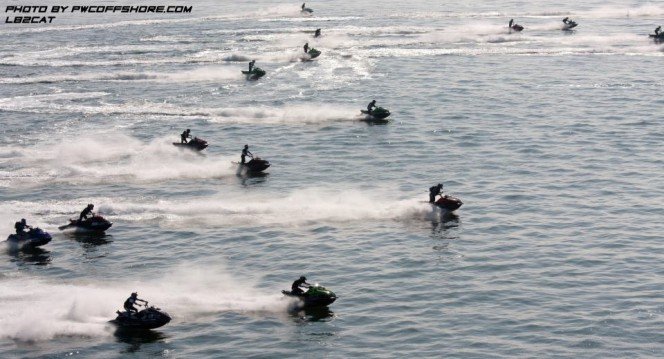
It’s the longest continuous offshore, open-ocean race in the United States. It’s also the longest-running offshore race in the US, reaching back to the mid-1990s (that is with a short break in the mid-2000s for a couple years). It’s the infamous “Long Beach to Catalina and Back” or “LB2CAT,” and it’s a 58-mile endurance sprint to the Southern Californian island and straight back. And while the course seems pretty straightforward, navigating the ever-changing sea state, cross currents, and battling the elements can quickly turn the round trip into a struggle.

Each year, the near-insane hardcore athletes of PWCOffshore.com edit together a video recap of the past July’s LB2CAT race celebrating the Offshore National Championship Race. Since we missed our chance to participate in this past year’s event (we’re planning on amending that for next year), we had to live vicariously through the DVD. And thankfully, it does not disappoint.

Cutting between exclusive “eye-in-the-sky” helicopter footage, GoPros mounted on racer’s helmets, and pre-roll interviews, the hour-plus video goes by quickly, documenting the brutal offshore action with decent pacing and informative tech tips, provided by PWCOffshore.com’s own KC Heidler, who managed to come in third place despite coming from breaking a leg only a few months earlier.

Post race interviews really revealed the toll this race took on the riders – both mentally and physically. Some were ecstatic, energized and enthusiastic to have accomplished the feat they completed, while others were clearly fatigued, almost dizzy with exhaustion. But glassy eyes, wobbling legs and disorientation are all signs that this race will truly weed the men from the boys, and that is where competition shines.

For those interested in participating in the LB2CAT next year, this is a “must buy.” You can get yours HERE. For those looking at boning up on your offshore riding, we also suggest picking up the DVD as the various tech tips and simply observing the different riding styles in action is worthwhile as well.

Video: Are You Ready For “Dangerous Waters” Season 3?

0

If you haven’t heard of the epic PWC adventure show, “Dangerous Waters” you owe it to yourself to catch up quickly. Starting off in June of 2011, expedition leader Steven Moll and a crew of five launched aboard their specially-outfitted personal watercraft from Seattle, Washington, across the Bering Strait towards the Russian coastline.

The first seasons document 65 days and 4500 miles of hair-raising adventure that’ll make you rethink what you consider “endurance riding” all the way to Russia, the crew of “Dangerous Waters” are taking a page from the epic “Long Way Round” series, and are attempting to circumnavigate the globe aboard PWC.

Now nearing into its fourth season, the daring riders of the “Dangerous Waters” crew are returning on a quartet of custom-equipped Kawasaki Ultra LX JetSkis (naturally-aspirated units of course, as they’re needing as much fuel mileage as possible).

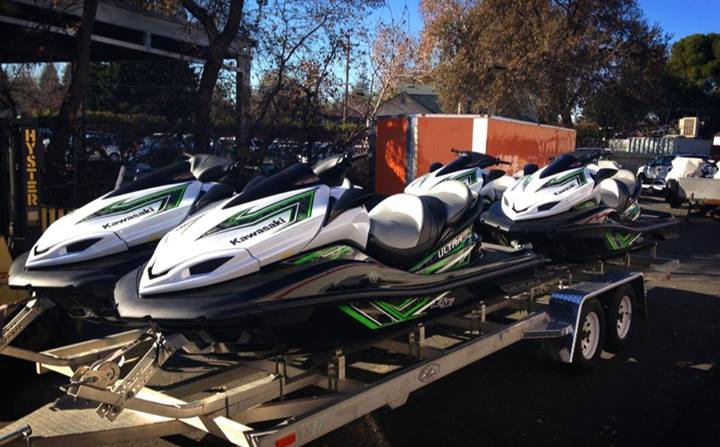
For 2014, Kawasaki has provided another handful of powerful Ultra LXs for the expedition (above). The crew learned quickly that the big Ultras are a master of rough water, sluicing through chop like a hot knife through butter. Stable and turnkey reliable, the Ultras have proven themselves as much as an equal member of the crew.

Only two seasons into their seven-season long adventure, “Dangerous Waters” is available only on MavTV. Below is the promo for Season 3: