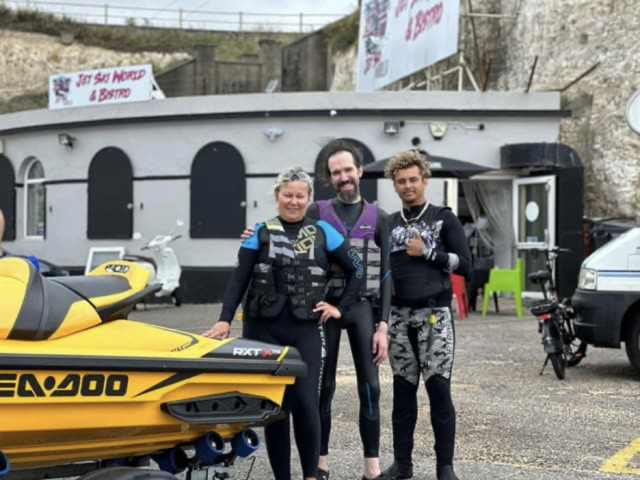
In a move that signals a fresh chapter for Palm Bay’s Jet Ski World, the young Joshua Komolangan, at only 18 years old, has taken the reins alongside his father Neil Logan.
Jet Ski World operates a Jet Ski Zone in Palm Bay in Kent, UK – a designated waterski area set in a large natural bay, below the shelter of chalk cliffs, between Margate and Broadstairs that has been designated for powered water sports by Thanet District Council.
The duo seized the opportunity in July, infusing the establishment with new energy and vision. With a total investment of £180,000 (roughly $230,350), they’ve enacted a comprehensive renovation, breathing new life into the popular site at Hodges Gap.
Joshua, already making waves as the UK’s youngest RYA (Royal Yacht Association) instructor, is now poised to lead the charge in establishing a cutting-edge training center for watercraft proficiency. Having obtained his qualifications promptly upon turning 18, his passion for personal watercraft and dedication to safety drive him as he works to train fellow enthusiasts in the Margate area. They promise one-day proficiency courses that will equip jet skiers and power boaters with the skills necessary to ensure their safety and competence on the water.
Josh’s bond with his dad extends comfortably into the business realm, with Neil’s guidance complementing Joshua’s youthful vigor. Reflecting on his journey, Joshua told The Isle of Thanet News, “I have been into the sport for years and been doing it since I was extremely young. We (Josh and dad) have been going to Jet Ski World for a long time and there have been different owners”
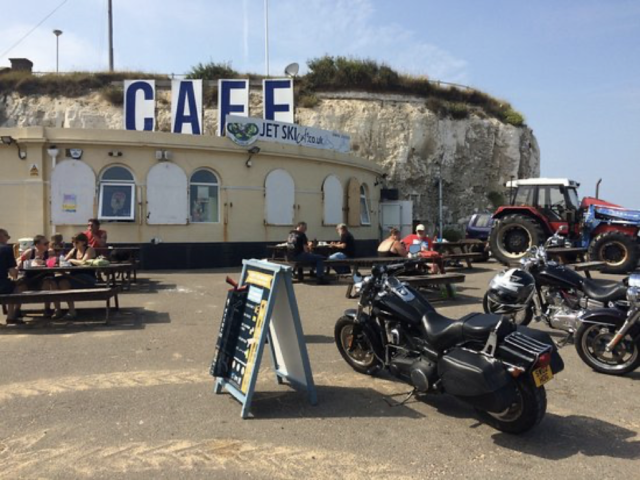
The transformation extends beyond the water, as the Jet Ski World café undergoes a complete makeover. With a revamped interior, updated menu, and an array of events on the horizon, the venue promises an enhanced experience for patrons. Neil emphasizes the family-centric ethos driving their project, highlighting the involvement of his wife Isabelle and daughter Amelia in the operation.
Despite their bustling schedule, which includes managing care homes in Margate, the family remains undeterred in their commitment to Jet Ski World’s success. In fact, Joshua’s dual role as a full-time care worker and budding manager underscores his determination to excel in everything he does.
As Jet Ski World prepares to unveil its new training center, complete with instructor courses and proficiency training, the Margate community eagerly anticipates the dawn of a thrilling era in watersports education. With Joshua and Neil at the helm, the future looks brighter than ever for enthusiasts seeking both adventure and safety on the waves.
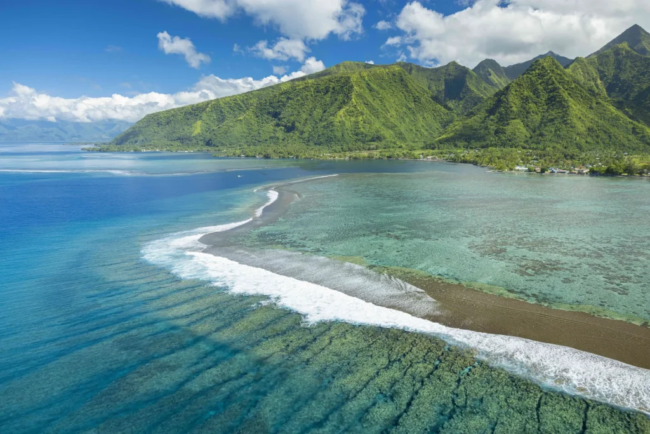
As Paris continues warming up for the Olympics, a small contingent of the 2024 Summer Games competitors will be jetting down to Tahiti to prepare for a wholly different class of competition. For the second-ever Olympic surf competition, competitors from all over the world will converge on this small Polynesian island to tackle world-class waves in an area steeped in surf mythology.
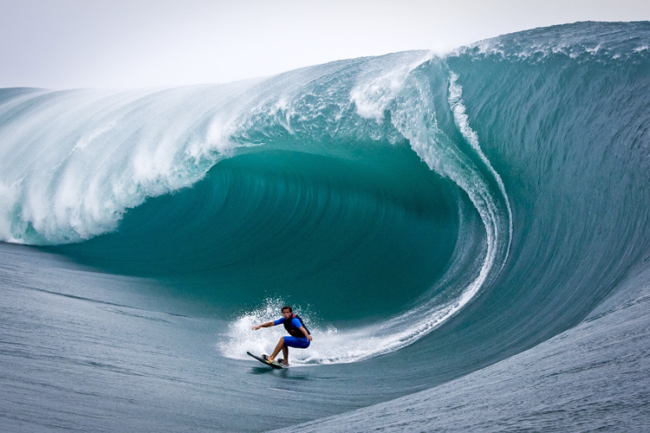
While, of course, there are plenty of viable surf locations much nearer to Paris throughout France and Europe, the conditions at Teahupo’o, a small corner of the Southwest Tahiti Iti peninsula, offer surfers and viewers alike a truly incomparable experience.
Clocking in at 20 feet, the wave at Teahupo’o is far from the world’s tallest. Instead, it’s the wave’s impressive weight that brings the challenge. Teahupo’o is formed over the top of sharp, steep coral, which causes it to rise up sharply and crash with massive force. It is propelled by a heavy surge of water which can seem to rise up from nowhere before crashing down around the barrel.
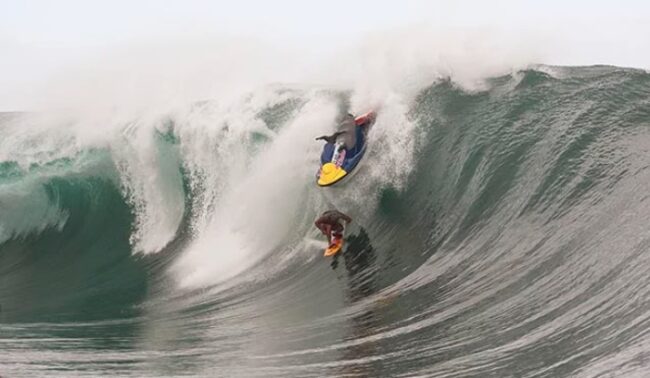
The intensity is epic – epic enough that Teahupo’o is even known in the PWC world as the location of one of the most infamous tow-in crashes in PWC and surfing history. As reported in 2016 by The Watercraft Journal, 2005 saw a huge influx of surfers to Tahiti as record swells amped up the action at the already-challenging Teahupo’o site, and an inexperienced PWC rider ended up towing a surfer buddy out into the chop. And that’s when things went sideways.
“There was big chop on the waves and it was a little stormy on that crazy day in May. This was definitely no place for a dude with no driving skills to attempt towing a surfer into a wave,” reports stated. “Bastolaer almost paid the ultimate price for their actions. The ski that McIntosh was steering was literally picked up by a thick heaving wave. He bailed off the back after losing control, leaving the jet ski alone in the surf. That’s when the riderless machine tumbled precisely over Bastolaer’s head while both were within the confines of a massive barreling wave. It’s amazing that he wasn’t hit by the ski and came out unscathed. We aren’t so sure about the watercraft though.”
You can check out the video of the crash – one that hopefully will not be repeated as Teahupo’o continues to prepare for the Olympic Surf Competition – one that is drawing more and more interest from not only fans of the Olympic competitions, but surfers and sport aficionados as word of Teahupo’os reputation and history gains momentum.
Apart from its strength, Teahupo’o draws in surfers with its rich history as well. The wave is found on the island of Tahiti in Polynesia, where surf originated in the 12th century as a sport for the island’s royalty. As for the Teahupo’o wave itself, the first recorded surfer here was a woman from the island of Raiatea in the 19th century. Many years later, in the 1980s and 90s, professional surfers returned to the area to tackle what many consider to be the world’s toughest wave.
The Olympics may bring a major draw to the surf opportunities in this remote part of the island, but for those who call Tahiti Iti home, along with those who have been making the trek to surf this wave for years, Teahupo’o’s draw goes beyond the adrenaline and hype. To hear those who have visited talk about the undeveloped shorelines–where they’d lay back and delight in Hinano beer, poisson cru, homemade jams, and chili oils–is to hear them talk of a paradise. They speak of the Mana, the Polynesian word for the spiritual energy which envelops this land.
Because of this, there will be considerations to ensure the ecological sanctity of the area, both before and after the Olympics. Olympians will be housed on boats offshore, to protect the reef and negate the need for development in the area. Islanders have already made strong opposition to the construction of a judge’s tower on the reef.
As July 27 approaches, be sure to keep an eye out for the epic water sports that will take place at Teahupo’o, to get a view of the sheer might of the ocean at one of her most legendary frontiers.
As the Olympics come closer, be sure to read Jen Murphy’s full write-up for Robb Report on her experiences and conversations with locals in Teahupo’o.
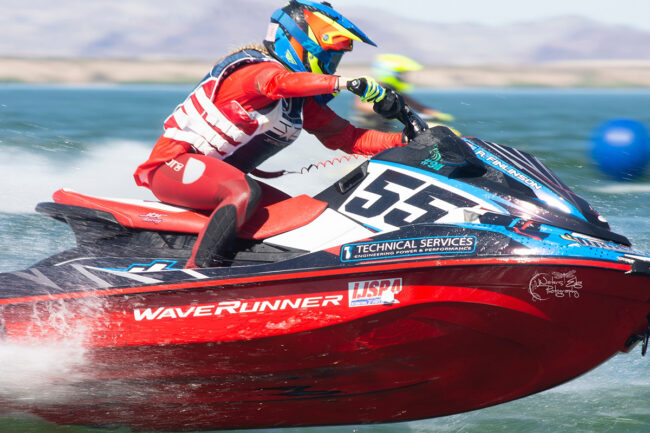
International Women’s Day may have sped by, but Yamaha knows a good thing when they see it, and they have turned the one-day recognition of the efforts, achievements and triumphs of women, especially those in the PWC world, into an ongoing effort and initiative.
Highlighting one of the most well-known, and most talented, among the elite cadre of women racers in the PWC sport, Yamaha recently put the spotlight on Sophie Francis, saying “International Women’s Day celebrates the incredible achievements of women who defy expectations and rewrite history. Meet Sophie Francis, a true trailblazer in professional watercraft racing. Sophie made history as the FIRST woman in P1 AquaX racing history to clinch a podium finish in the fiercely competitive Pro Enduro class, dominated by male athletes. What makes Sophie’s victory even more remarkable? She achieved this incredible feat just three months after having a baby.”
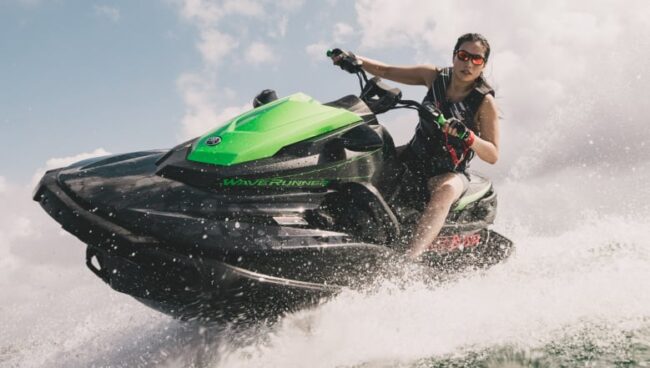
And while Sophie Francis is an apt and appropriate representative of what the women of this sport can accomplish, Yamaha is taking the heart and soul behind International Women’s Day – the celebration of all the phenomenal women who are rewriting the rules, breaking barriers, and making history – and is launching Women Run The Water, a movement that encourages and supports women who want to take control of their boating or personal watercraft experience.
Learn more about Yamaha’s Women Run the Water initiative and be sure to explore their resource library, as well as inventory of 2024 WaveRunners as well as a website full of tips, technical information, deals and ideas.
It’s been a good while since The Watercraft Journal has published an episode of “Vicious Rumors & Vile Gossip” and that’s because frankly, we haven’t encountered much in the way of verifiable leaked info. But not so when it came to future Kawasaki JetSkis. We’ve been pretty spot-on for Team Green over the years:
So when WCJ discovered that Kawasaki’s legal department had filed not one, not two but 22 patents for new designs, innovations and technologies for future JetSkis, we were floored. The first 8 patents, which are all hyperlinked in the text below and can be downloaded for better viewing, all pertain to features and designs on existing JetSkis.
Geo-Locating, Quick Retrieval & a Digital Anchor
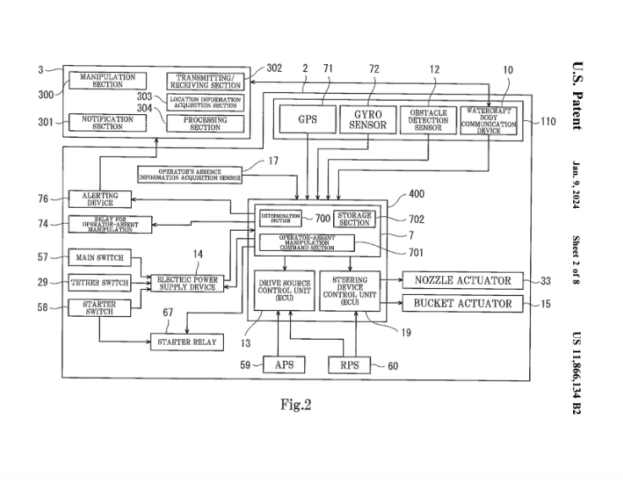
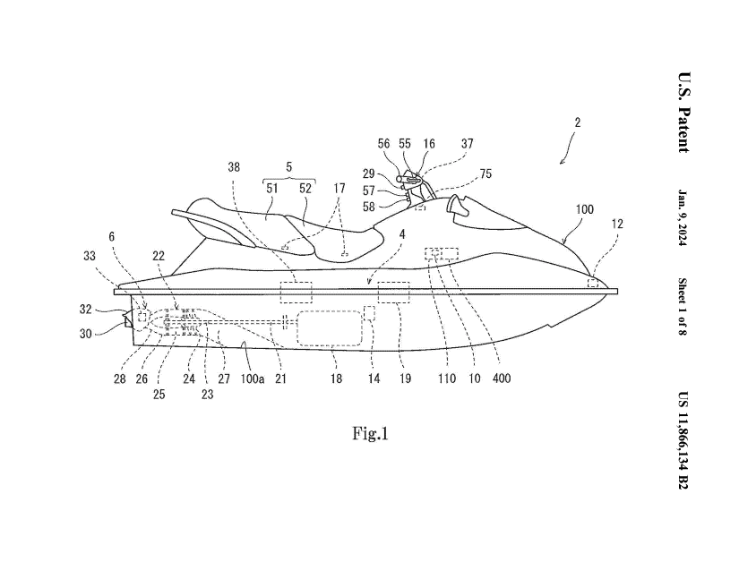
Within the document labeled US 11866134 B2 we get details how the watercraft can be operated without a rider by using a low-speed battery-powered electric drive-and-control system [a secondary propulsion system to the internal combustion engine –Ed.]. Yes, you read that right, Kawasaki’s working on a self-driving JetSki.
Imagine you’ve stopped at a sand bar. The tide comes in and the ski begins to drift away before you catch it. Suddenly, a signal alerts a secondary ECU within the ski to ignite a battery-powered drive system (US 2023/0097457 A1). The pump silently whirls to life and servos manipulate the nozzle cable, directing the ski back to its original location.
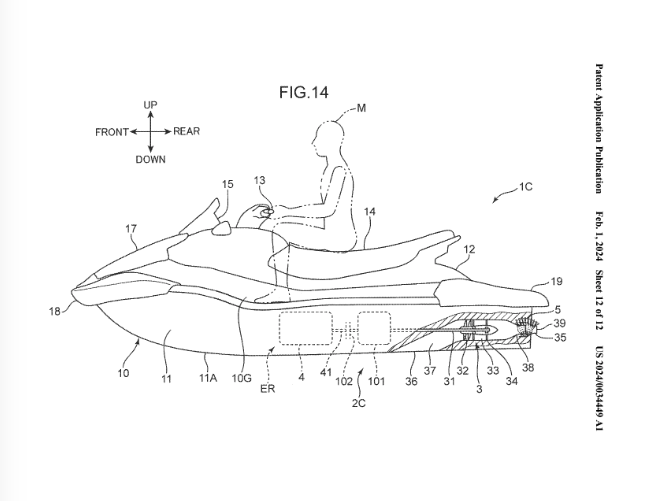
Patent US 2024/0034449 A1 is the first of three “Calling System” patents; a geo-locator that first identifies the JetSki on a GPS (global positioning system) grid; secondly, marks its current location on the grid and maps a path back to its previously marked location (where you last parked on the sand bar, in this example) carefully avoiding marked obstacles.
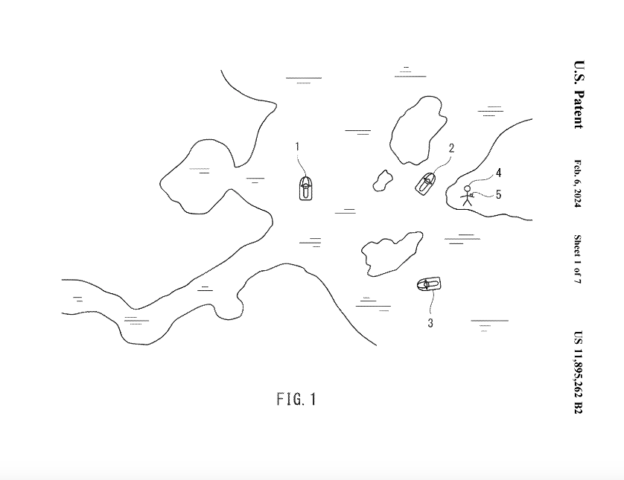
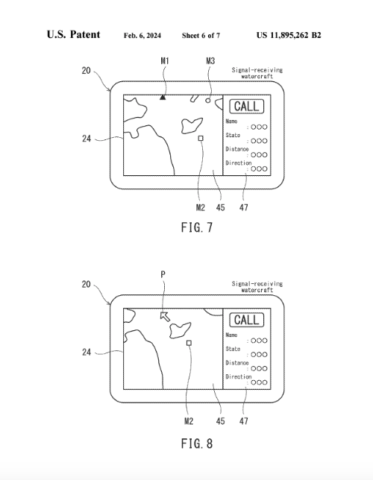
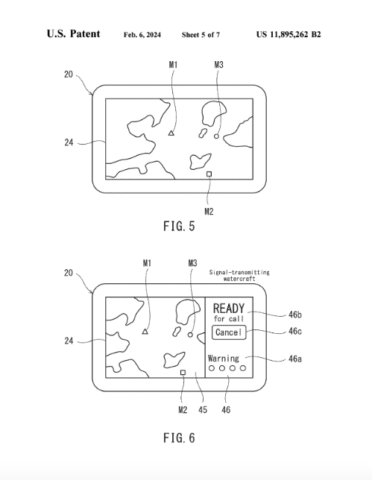
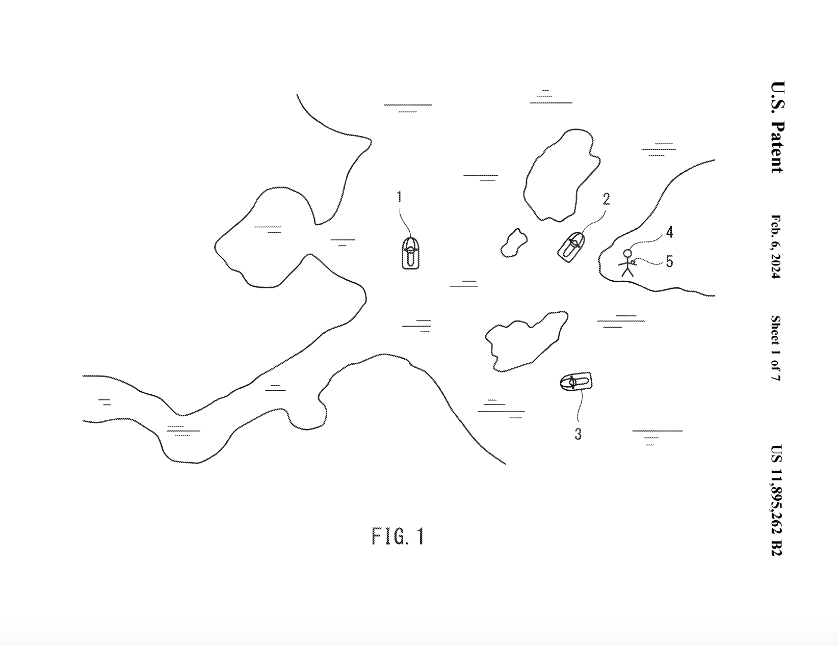
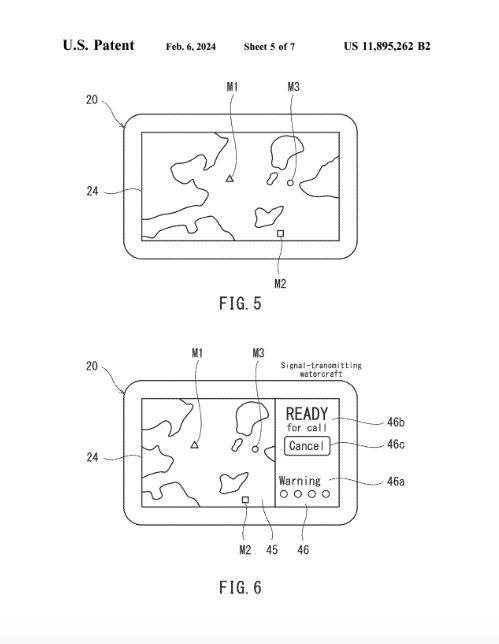
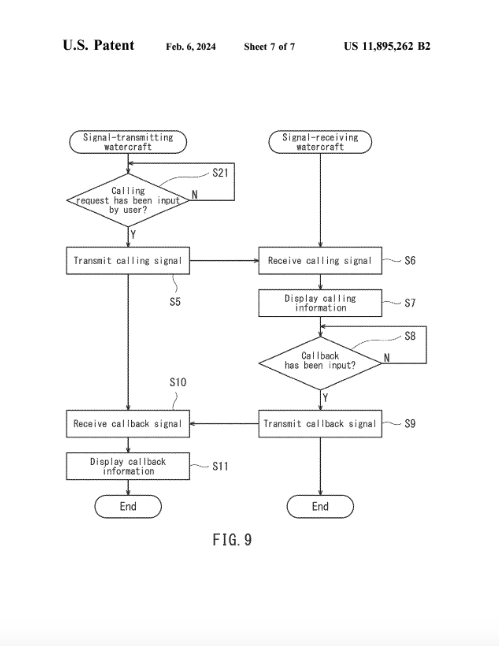
The second of three “Calling System” patents – titled US 11895262 B2 – allows this new system to not only identify its position as well as calculate the rate of speed wherein it traveled from the last pinned location (allowing it to evaluate whether the ski drifted away or the rider fell off at speed) but it also can communicate with other similarly-equipped skis.
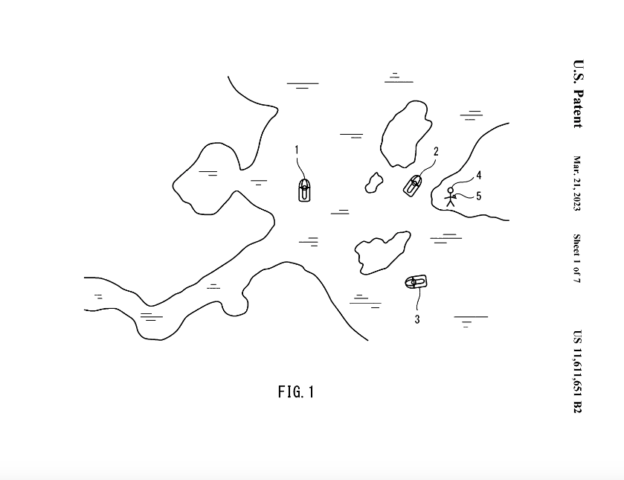
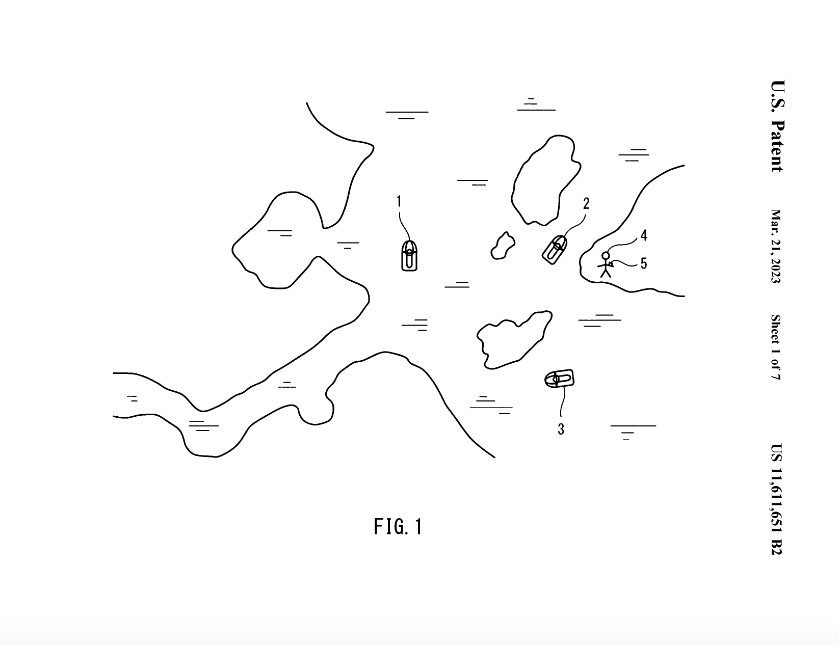
This slow-speed operation “retrieval system” has a secondary function, that of driver retrieval. The secondary ECU – patent US 11611651 B2 – will recognize the specific parameters common to a rider falling off and will engage the electric drive to return to the last GPS marker where the lanyard was removed, bringing itself back closer to the ejected rider.
Additionally, this ability for the JetSki to maintain itself near silently through a GPS-controlled electric drive system permits the “Calling System” to serve as a digital anchor. So rather than weighing an anchor overboard, a fisherman can engage the GPS locator by removing his rod from a special rod holder – indicating that he is wanting to remain stationary – and allow the electric drive to keep you steady for hours.
Collision Avoidance & Tracking
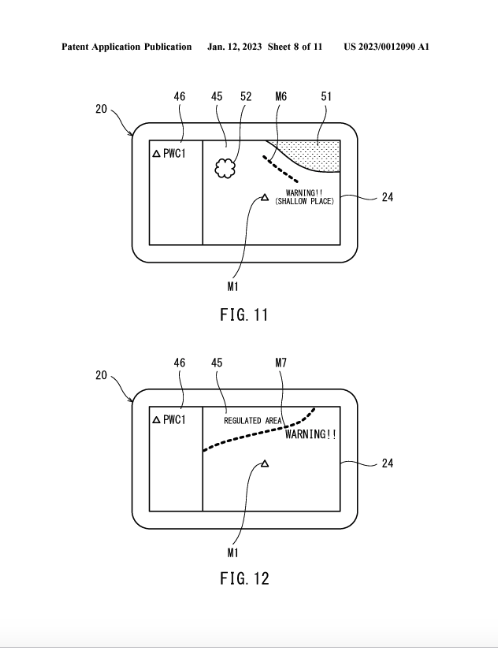
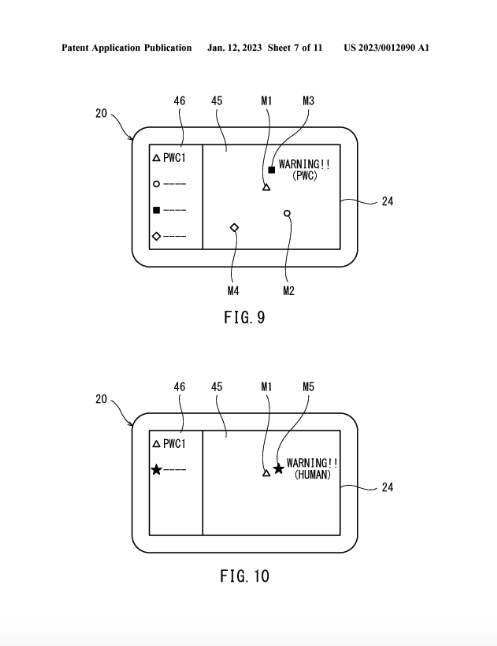
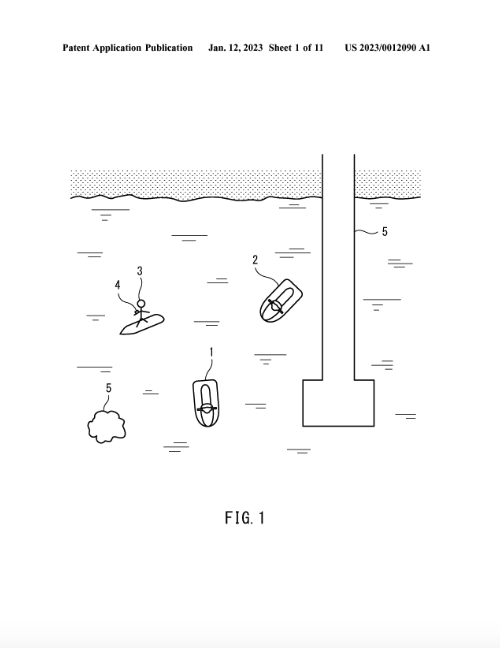
The above systems hinge upon the watercraft’s GPS signature, which all current Ultra JetSkis currently have (via its GPS-tracked speedometer). As part of the aforementioned patent, US 11895262 B2 a companion patent – US 2023/0012090 A1 – not only alerts the rider to possible collisions with stationary objects but other watercraft in motion as well.
Communicated through the TFT digital dashboard already on current Ultras, a full-color GPS aerial image will identify your JetSki, the local topography, marinas, etc. as well as other vessels – providing alerts if the GPS tracks vessels approaching at high speeds as well as periphery warnings for nearby obstacles [think blind spot alerts on modern cars –Ed.]
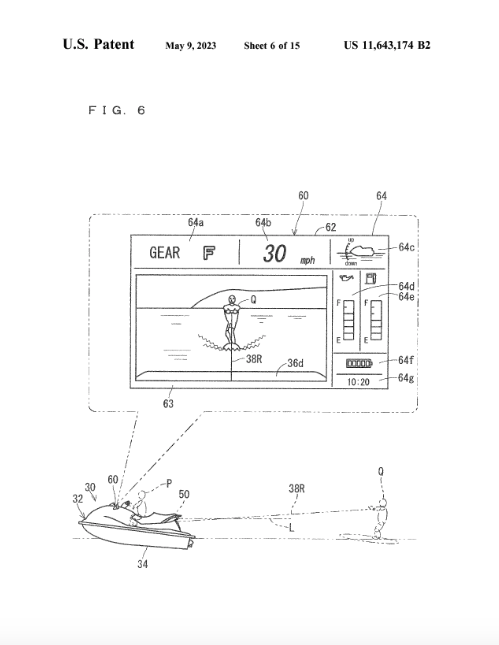
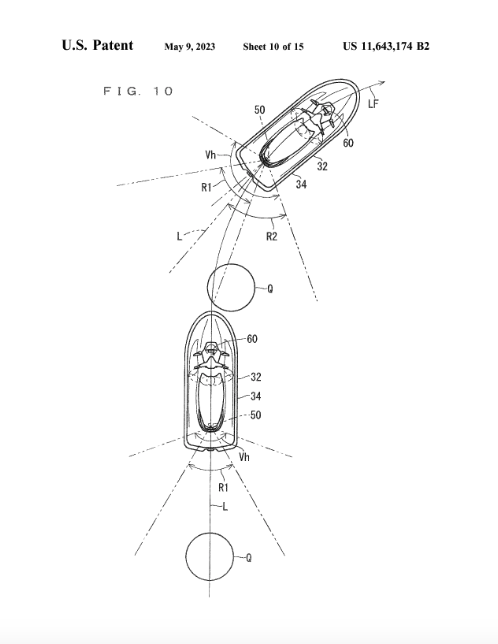
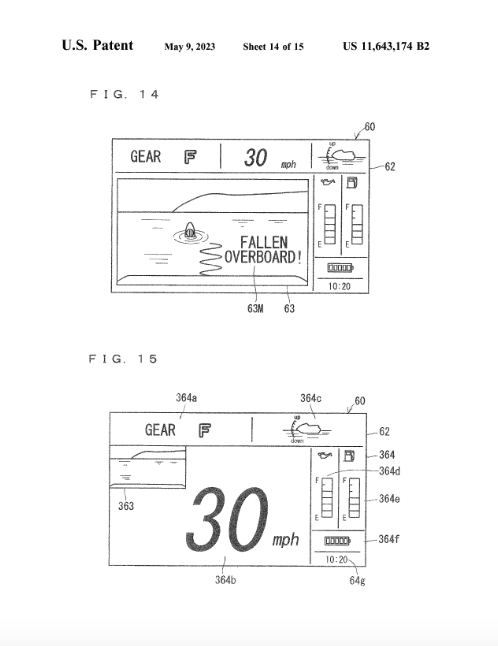
As much as the current TFT dashboard is designed to operate in this sphere, so is your rearward-facing camera: patent US 11643174 B2 details that all rearward-facing cameras are operating at a fraction of their capacity. These cameras will feed vital footage to the image processing software in a standalone CPU that will calculate your JetSki’s location in relation to obstacles and other watercraft.
Equally, the camera when used for towing skiers or towables also has the capacity to alert the driver (through the TFT dashboard) when your skier or raft passengers have “detached,” displaying an “overboard!” notification on the screen. Using the previous GPS marking software, it will also pin the last location of the fallen passenger for quick retrieval.
Of course, with this degree of GPS-tracking the Kawasaki’s TFT dashboard will now be able to provide some of the most detailed travel history data. Whether linked through your mobile device’s Bluetooth connectivity or a nearby WiFi signal, the CPU’s communication interface will be able to store terabytes of storage through internet connectivity.
Outlined in patent US 2023/0029055 A1 the new tracking capabilities will monitor GPS routes via a series of digital breadcrumbs, correlating in vehicle speed, throttle position, fuel consumption and several other factors that will equip you “long hauler” riders with some of the best data gathering available on a personal watercraft.
Water-Cooled Turbos & Electric Superchargers
If all of this high tech wizardry didn’t get you excited maybe this will: Kawasaki is developing its own double-walled, liquid-cooled turbocharger. The single-greatest hurdle for OE’s offering a turbocharged performance watercraft was heat mitigation. Turbos and their circuitous plumbing raise engine compartment temperatures far worse than superchargers.
By developing a water-jacketed turbocharger and plumbing system as outlined in patent US 11808163 B2, the cast aluminum inner housing can be enshrouded in either a second cast aluminum case or cast steel (although the patent does not restrict what materials can or will be used). This will also keep intake charges cooler and mitigate heat soak over long durations.
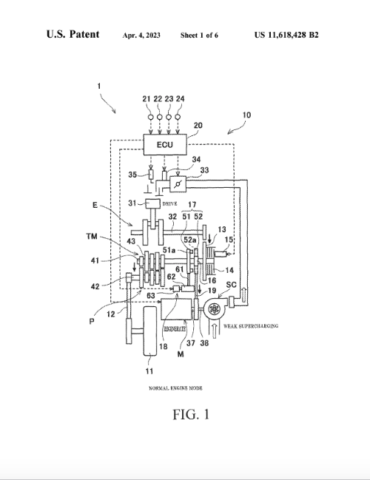
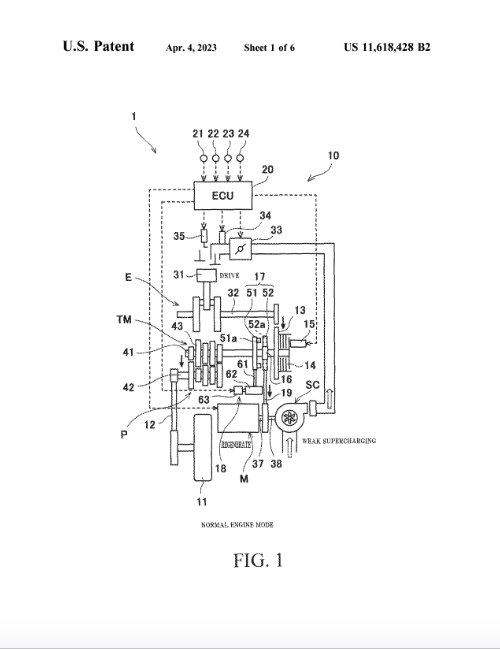
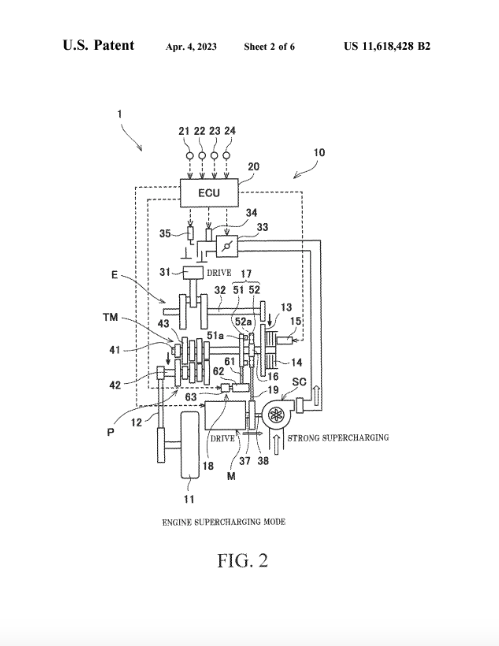
More intriguing than Kawasaki’s new marinized turbocharger is its electrically-driven supercharger. Filed as patent US 11618428 B2, the design details a method wherein the supercharger can be driven by the combustion engine, then via an electric clutch, disengaged from the mechanical drive, and when commanded, driven by an electric motor.
This would free up the combustion engine to operate at greater efficiency as the electric motor driving the supercharger would eliminate all parasitic loss or driving the supercharger.
Moreover, the electric motor can spin the supercharger at a greater RPM than what the internal combustion engine can spin, radically increasing boost, and thereby, horsepower.
Offshore racers have been employing aftermarket turbocharging systems for over a dozen years with tremendous success: both in performance as well as fuel efficiency and engine longevity. Equally, being able to free up the current internal combustion engine of parasitic loss (drag) and spinning the supercharger up above normal boost speeds all point at incredible power outputs from even the existing 1.5-liter 1,498cc 4-cylinder engine.
While there is zero indication of this within the leaked documents, the implication of a potential compound supercharged induction system is undeniable. An aftermarket tuner employing portions of both forced-induction systems presented above – a water-cooled turbo multiplying the compressed atmosphere generated by the electrically-driven supercharger – yields the potential of producing literally 1,000’s of horsepower with stock components.
Better Cooling & Improved Storage
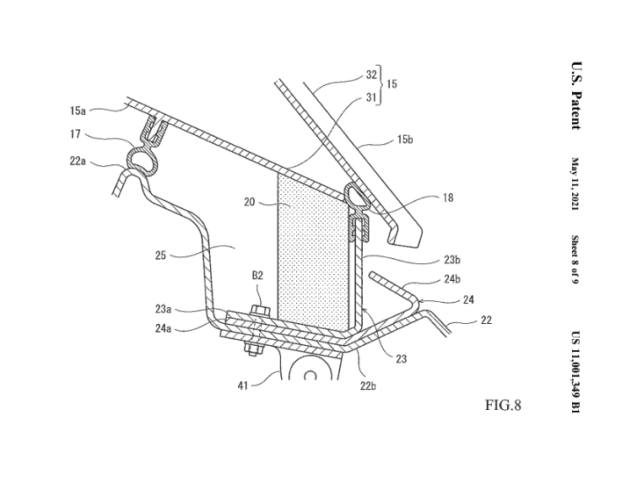
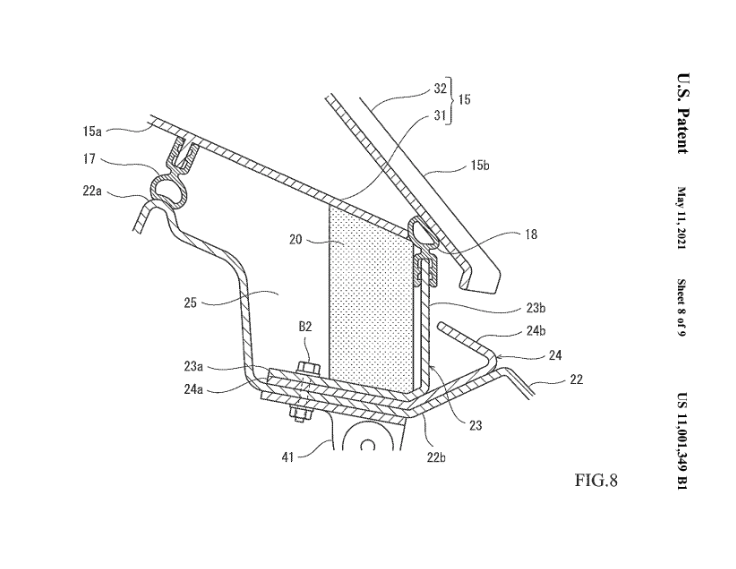
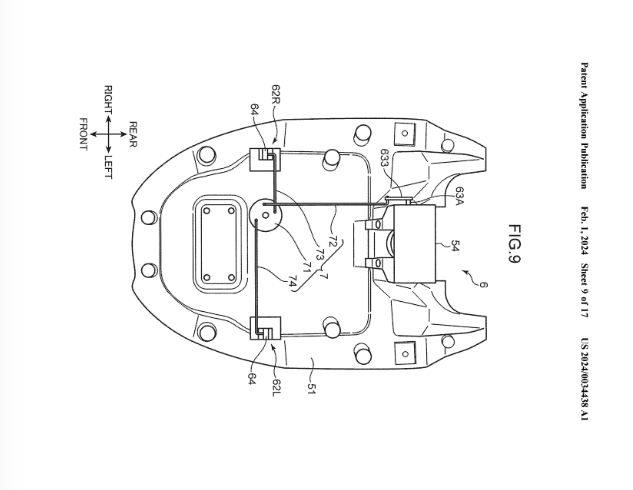
In the final documents, we’re shown a a pair of revisions to the existing STX front storage compartment: namely a water-tight membrane (seal) that keeps the hood from leaking under heavy water conditions (patent US 11001349 B1); a new three-point locking mechanism that secures the front storage lid far more firmly (patent US 2024/0034438 A1); and a electronic locking mechanism that secures the storage latches until released via the dashboard or key fob (patent US 11845518 B2) for all Kawasaki JetSkis.
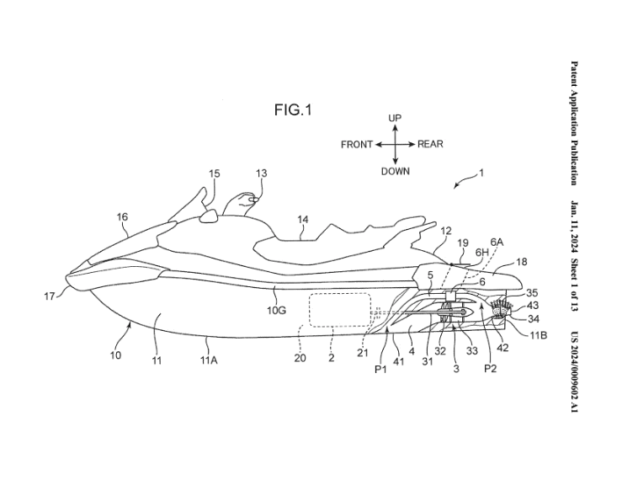
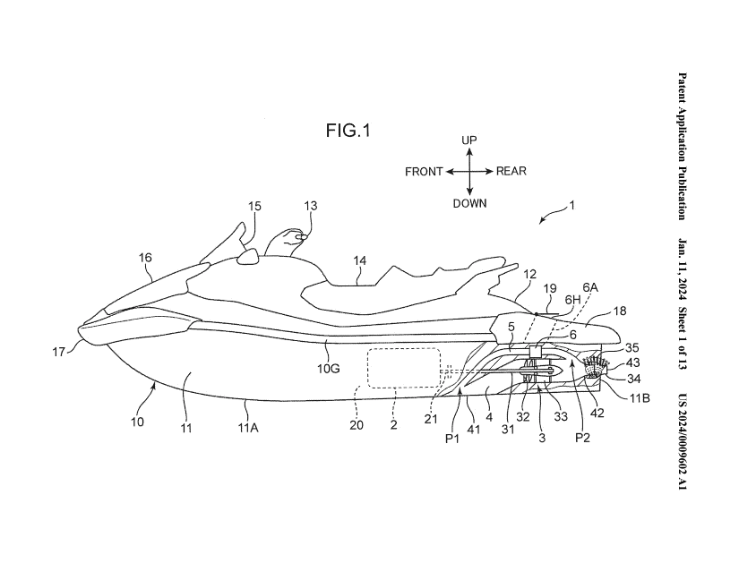
The final patent – US 2024/0009602 A1 – offers four different designs for an improved ambient water induction system to improve engine and exhaust cooling. These new inlets – infused into the hull surface itself or through inlets molded into the pump tunnel – draw in water quicker and process them through the engine and exhaust more efficiently, passing through dual mesh strainers and finally, out through the pump itself or the transom.
Conclusions
Typically, when The Watercraft Journal has received leaks like these its taken between 1-to-3 years to come to fruition in a production vehicle. Yet, many of the levels of technology being proposed in these documents seem well beyond what is seen in the powersports market currently.
Certain items like the STX hood latch, water intrusion seal, revised water-cooling ports and turbo forced-induction system all appear like “low hanging fruit” that could be quickly introduced. The self-driving “Calling System”, digital anchor and rider retrieval features are phenomenal and certainly would change the safety standards of the PWC industry.
Equally, so would collision avoidance, electric security locks, and the tow sports camera that alerts the driver of a fallen rider could radically change the public’s perception of how safe these machines are. It’s all very exciting stuff for sure – and rarely do we find patents that go unused.
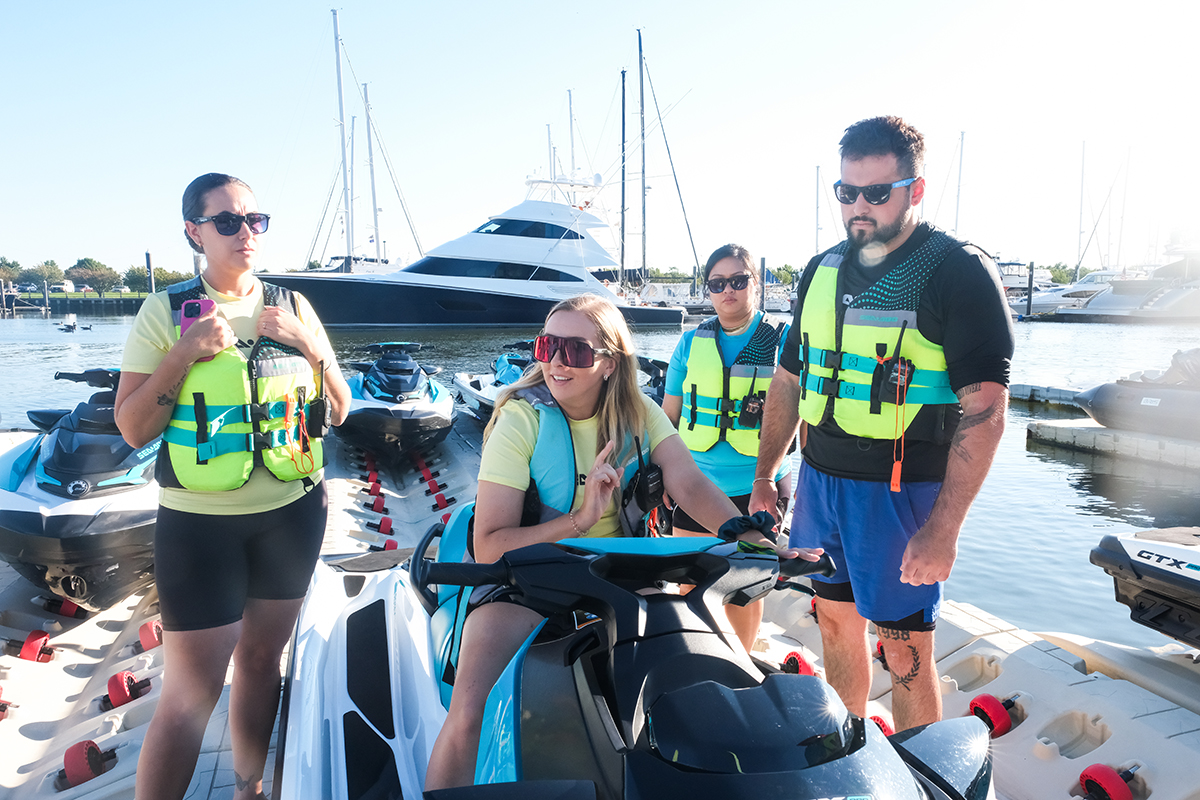
International Women’s Day was celebrated worldwide last Friday, but in the PWC world, where some of the top racers, freestylers and race promoters/organizers are female – not to mention one of the best announcers in this, or any sport – women are celebrated on the regular. Add to that, the fact that the demographic makeup of recreational riders is steadily shifting to become a more even mix of men and women, and you have a perfect opportunity to recognize the role women – and girls – play in keeping the PWC industry relevant and exciting.
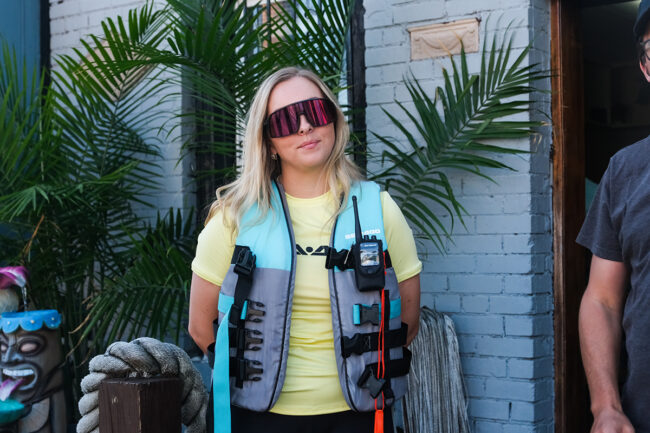
As BRP recently pointed out in a press release, women’s involvement in the powersports industry is not limited to “after the purchase;” and Sea-Doo put a spotlight on the active role played in the advancement of BPR’s line of powersport products by Product Analyst Marie-Eve Cyr – and her attention to making powersports ever more inclusive.
Read the full press release below:
BRP is known for breaking the norm, pushing boundaries, and doing things a little bit differently than everybody else, so it should come as no surprise that their teams are some of the most diverse in the industry, ensuring their products meet the needs and expectations of riders from a wide variety of backgrounds, ethnicities, and genders.
So with International Women’s Day taking place this month, we are putting the spotlight on one of the many women charting their course in the powersports industry at BRP—Marie-Eve Cyr.
As a Product Analyst on Sea-Doo’s Global Product Strategy team, Marie-Eve plays a key role in the new product development process, bringing her unique point of view and vision to strategy discussions steering the development and launch of BRP’s products.
Marie-Eve was lucky to be introduced to the world of powersports at a very young age, thanks to her family having a long-standing interest in the sport. Working at BRP, she blends fun and work, combining them to bring her experience and enthusiasm to the role.
“I am lucky to be surrounded by other women on my team, and to be able to share our experiences and visions to improve our work and our products,” said Marie-Eve. “For several years now, the women’s movement in powersports has been growing and I am grateful to be able to actively participate in it. I am lucky to be part of this community and to see it grow day by day.”
Bombardier Recreational Products Inc.
Marie-Eve’s passion for innovation in the industry guarantees all new Sea-Doo products are designed with a woman’s perspective in mind, ultimately leading to a more inclusive user experience, and hopefully, ushering a new generation of women into the sport.
With enough time cruising the water on a personal watercraft, even the most skilled rider is bound to rack up his or her fair share of scrapes and cracks over time. While a little bit of “breaking in” never hurt anybody, over the years, those scrapes and cracks can turn into actual hull damage, resulting in drag while you ride, and some major eyesores.
If, like many, the high costs of professional repairs make you think twice about ever addressing the fractures in your PWC, don’t worry, K-Speed offers an easy DIY repair solution that doesn’t mean cruising with a wad of duct tape on your hull!
MagicEzy’s watercraft repair sealants offer an economical, effective way to repair cracks and gouges of any kind. Their MagicEzy Hairline Fix is a colored sealant aimed at addressing spider cracks and hairline fractures in a matter of seconds, providing a smooth, glossy finish and preventing cracks from spreading. Their product requires no mixing or prep work and works great on fiberglass, plastic, and aluminum PWCs!
Five steps: Clean, Prime, Fill, Finish and Polish. It’s as easy as that.
Beyond that, though, the MagicEzy line of products can address significantly deeper damages.
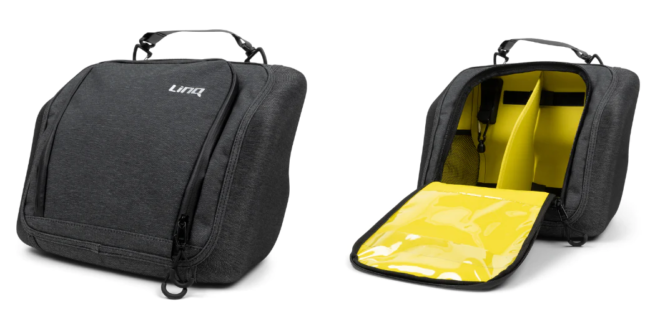
While a great personal watercraft is always the main priority for a day out on the water, sometimes it’s the often-overlooked accessories that can really ensure a perfect experience. Take the LinQ Lite Console Bag, for example. This compact 2.6-gallon (10-liter) bag is crafted with utmost practicality in mind to enhance your boating experience.
From sunscreen and sunglasses to snacks and tools, this console bag allows you to secure all your valuables in one place while keeping them organized with an inner divider and mesh pockets. That means no time wasted rummaging through cluttered compartments, as you can put everything in its designated place, keeping it readily accessible and protected all at once.
The LinQ Lite Console Bag is crafted with high-quality splash-proof material to keep your essentials protected from water splashes and unpredictable weather conditions, allowing you to focus on the thrill of the ride without worrying about your gear. It’s that added security that makes this bag a game changer, allowing you to focus on what you’re really on the water to do. Whether you’re cruising along the coastline or exploring remote waterways, this bag is your reliable companion for keeping your belongings dry and secure.
What’s more, its design integrates seamlessly with your Sea-Doo Switch, so the LinQ Lite Console Bag adds storage without sacrificing style or functionality. That’s a boost in both aesthetics and utility!
You can upgrade your Sea-Doo Switch with the LinQ Lite Console Bag by stopping in at the Cycle Springs Powersports dealership, or check out the rest of their online catalog here: Cycle Springs Powersports.
As the RIVA Racing begins to unlock the true potential within the ECU of the new 325-horsepower RXP-X and RXT-X, the rest of RIVA’s catalog needs to quickly catch up. By allowing the revised planetary-geared compressor (remember, it’s not a supercharger) to spin up beyond the factory’s near-10,000rpm, boost levels are going to far exceed that of the OE levels. Oftentimes all of that extra boost can’t be ingested by the throttle body and needs to be “scrubbed off” or risk damaging vital components.
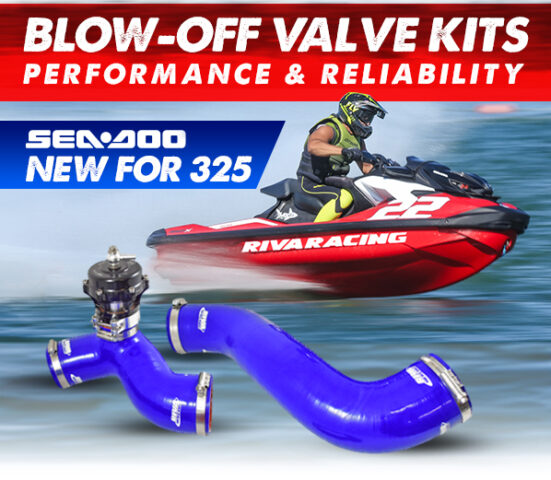
Enter RIVA Racing’s new 325 Intercooler Tubing Upgrade Kit with Tial 50mm Blow-off Valve ($539.95). This kit dramatically improves the longevity and reliability of your modded Sea-Doo by offering superior replacements to the factory purge valve and rubber intercooler hoses. Rather, RIVA provides high-strength silicone hoses that don’t swell under pressure or cavitate under severe conditions. The intake tube features an integrated 50mm billet TiAL Blow-Off Valve that replaces small plastic purge valve, eliminating unnecessary hoses and extending the life of your supercharger.
Whether you’re a weekend warrior looking for bragging rights or a closed course racer, RIVA’s 325 Intercooler Tubing Upgrade Kit is a must-have. Make sure to scroll down and watch RIVA Racing’s President Dave Bamdas walk through this new kit and all of the premier features that will keep your modified 325-horsepower Sea-Doo haulin’ harder and longer.
Key Features Include: • Large 50mm Tial Blow-Off Valve replaces small OEM plastic valve for improved performance & reliability. • Direct upgraded replacement for the factory rubber hoses found in the charge piping system. Compatible with OEM intercooler & RIVA ‘GEN-4’ Power Cooler. • High-strength multi-ply silicone hoses will not swell under pressure like original soft rubber hoses. Delivers improved throttle response & reliability with dramatically increased heat and burst resistance. Rated to 40 PSI boost pressure. • Includes aircraft grade non-perforated clamps designed to diminish the risk of boost leaks with increased connection strength and decreased hose slippage. Fits 325hp RXT & RXP models.
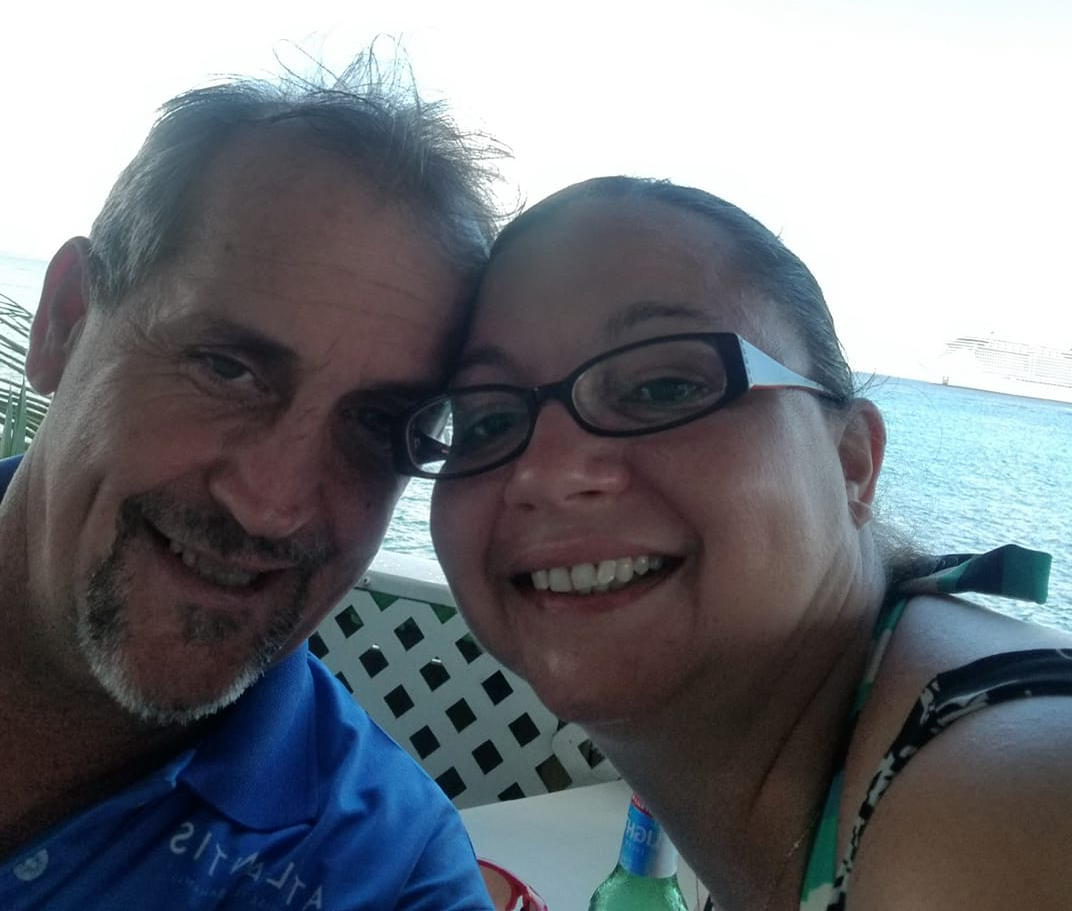
There are people that are well-known in the PWC race family. There are people that are popular, well thought-of and appreciated in the PWC industry. There are people that have contributed countless hours and untold effort to support, grow and promote the PWC community.
And then there is Mikey Young – who is all of those, and more.
And now, Mikey Young could use a return of some of that blood, sweat, tears, energy, emotion and yes, cold hard cash.
As many have heard, Young’s wife, Carrie, is facing medical battles right now, and the Young family needs the support of those in the PWC world – whether it is financial assistance, well wishes, prayers, organizing fundraising efforts, or other methods of giving back to someone who has poured so much of their life into this sport.
A Go Fund Me page has been created to help the Young family with medical bills, and efforts are underway in the community to find other ways to support Mikey and Carrie. Below is more detailed information, as provided on the Go Fund Me page and put together by Jan DeProspero of the PWC Racing FamilyFacebook page, with additional information about the medical challenges Carrie is facing, and about the Go Fund Me account.
Dear Race Family,
I reach out to each of you with a heavy heart as we stand in solidarity during a challenging time for the Young family. Mikey’s wife, Carrie, has been courageously battling in the ICU for the past eight days, striving to recover from a severe illness. Initially admitted due to an inflamed pancreas, Carrie’s condition worsened into sepsis, resulting in complications that have impacted her kidneys, gallbladder, and other vital organs. Regrettably, doctors have informed us that Carrie will require permanent dialysis, with concerns lingering about sepsis affecting her bloodstream.
Many of you have expressed a heartfelt desire to help and without sharing the private details, Carrie’s medical bills continue to mount substantially and with the absence of medical insurance you can well imagine the strain the Young family is facing financially. Mikey has exhausted their savings in his unwavering commitment to Carrie’s recovery.
So, I humbly ask that we do what we do best – to come together as a family and surround them with love, support, and unwavering belief in Carrie’s healing journey. Let us unite in prayer, lifting up Carrie and the entire Young family, asking for strength, comfort, and healing. May each word of encouragement and every act of kindness serve as a ray of hope for Carrie, Mikey, and their loved ones. In this time of need, let us offer whatever assistance we can, knowing that together, we can lighten their burden and uplift their spirits.
Father, we lift up Carrie and the Young Family in prayer, asking for your blessing upon the hands and hearts of the medical team attending to her. Grant them wisdom, skill, and compassion in their care. Strengthen Mikey, Carrie, and the entire family, guiding them through this trying journey. May they continue to feel your presence and the outpouring of love and support from our community. While Carrie is unable to speak presently may she hear every encouraging word of prayer and feel every loving touch…….
If you would like to contribute, you can do so via this Go Fund Me page. Perhaps we can also organize an auction with the proceeds going to the Young family. I ask that you PLEASE SHARE THIS POST SO WE CAN GET THE WORD OUT QUICKLY
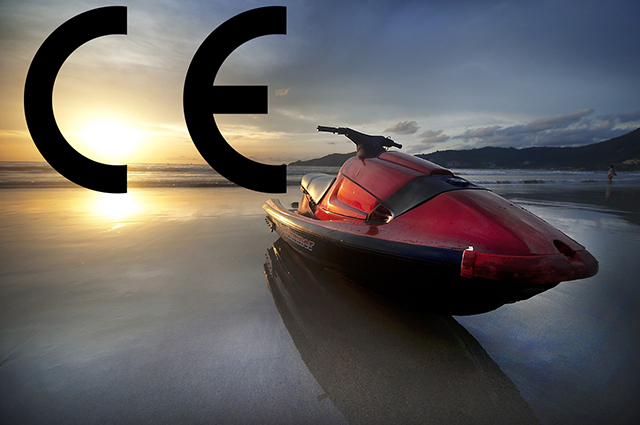
If you live in or have visited Europe, you’ve probably heard of a CE certification. If you’re considering moving here, or doing any watersports in the area for that matter, you’ll definitely want to make sure this important regulation is on your radar.
The CE Certification is a requirement for all recreational boats, yachts, and personal watercraft that are either sold or operating in European Union waters. Set up as a means to evaluate a boat’s seaworthiness, the CE certification has been around since 1998 and is used throughout the European Union to regulate where and when watercraft can travel.
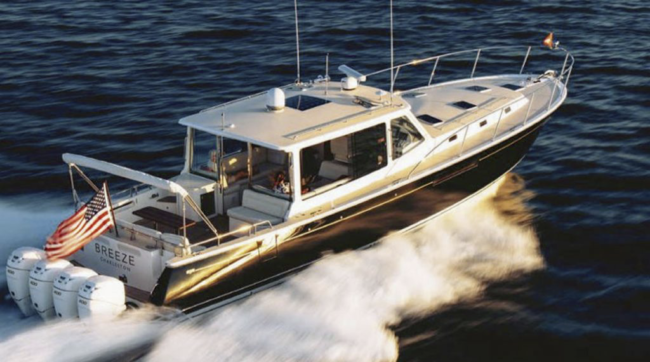
The European Commission can give boats a ranking between A-D, based on a variety of factors including construction strength, stability, reserve buoyancy, and deck drainage. For reference, Category D watercraft are only permitted inland or within sheltered waters and to operate under winds up to force 4 (16 knots). Category A watercraft, on the other hand, are cleared to travel long voyages out into oceans, with winds over 40 knots and significant weather conditions/wave height.
Each boat is assessed independently, but in general, smaller PWCs fall within the C and D categories, limiting them to coastal and inland operations. While these limitations can be frustrating for some, there’s a good argument to be made for the importance of these tight regulations.
boatsales.com.au recently ran a piece on the unexpected sinkings of a large motor yacht off the country’s coast, and one of the findings of the coroner was that implementing a CE type system would provide greater security and accountability for watercraft regulated by Australian authorities. Offering a standard by which PWC owners and manufacturers can be held to may be one of the more effective ways to prevent such tragedies.
Of note: if you’re planning on importing an internationally manufactured PWC into Europe, it’s important to seek out an EU notified body to receive an officially recognized certification.
To find out what your PWC is rated, check out the International Marine Certification Institute website.



 In a move that signals a fresh chapter for Palm Bay’s Jet Ski World, the young Joshua Komolangan, at only 18 years old, has taken the reins alongside his father Neil Logan.
  Josh’s bond with his dad extends comfortably into the business realm, with Neil’s guidance complementing Joshua’s youthful vigor. Reflecting on his journey, Joshua told The Isle of Thanet News, “I have been into the sport for years and been doing it since I was extremely young. We (Josh and dad) have been going to Jet Ski World for a long time and there have been different owners”
 As Paris continues warming up for the Olympics, a small contingent of the 2024 Summer Games competitors will be jetting down to Tahiti to prepare for a wholly different class of competition. For the second-ever Olympic surf competition, competitors from all over the world will converge on this small Polynesian island to tackle world-class waves in an area steeped in surf mythology.
 Apart from its strength, Teahupo’o draws in surfers with its rich history as well. The wave is found on the island of Tahiti in Polynesia, where surf originated in the 12th century as a sport for the island’s royalty. As for the Teahupo’o wave itself, the first recorded surfer here was a woman from the island of Raiatea in the 19th century. Many years later, in the 1980s and 90s, professional surfers returned to the area to tackle what many consider to be the world’s toughest wave.
 As the Olympics come closer, be sure to read
 International Women’s Day may have sped by, but
  And while Sophie Francis is an apt and appropriate representative of what the women of this sport can accomplish, Yamaha is taking the heart and soul behind International Women’s Day – the celebration of all the phenomenal women who are rewriting the rules, breaking barriers, and making history – and is launching








 By developing a water-jacketed turbocharger and plumbing system as outlined in patent






 International Women’s Day was celebrated worldwide last Friday, but in the PWC world, where some of the top racers, freestylers and race promoters/organizers are female – not to mention one of the best announcers in this, or any sport – women are celebrated on the regular. Add to that, the fact that the demographic makeup of recreational riders is steadily shifting to become a more even mix of men and women, and you have a perfect opportunity to recognize the role women – and girls – play in keeping the PWC industry relevant and exciting.
  BRP is known for breaking the norm, pushing boundaries, and doing things a little bit differently than everybody else, so it should come as no surprise that their teams are some of the most diverse in the industry, ensuring their products meet the needs and expectations of riders from a wide variety of backgrounds, ethnicities, and genders.
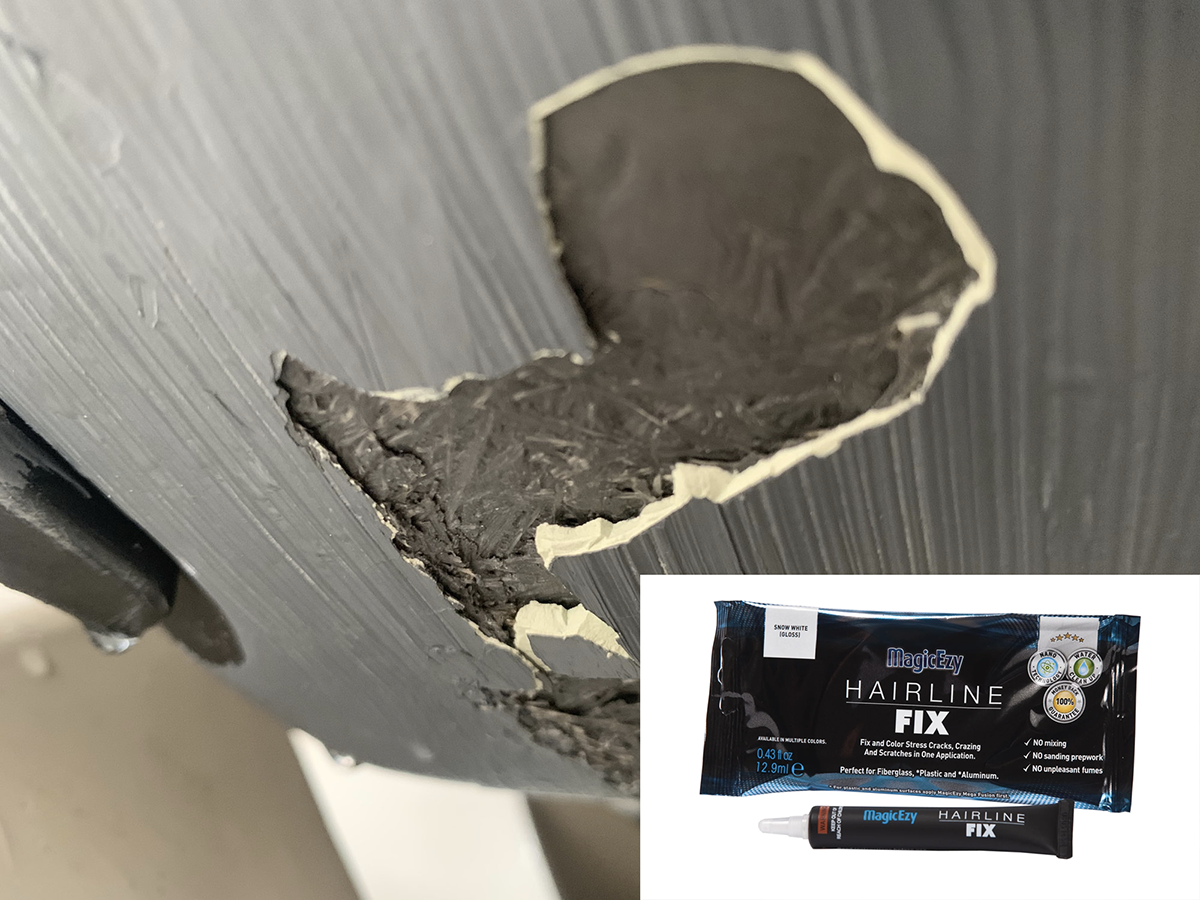
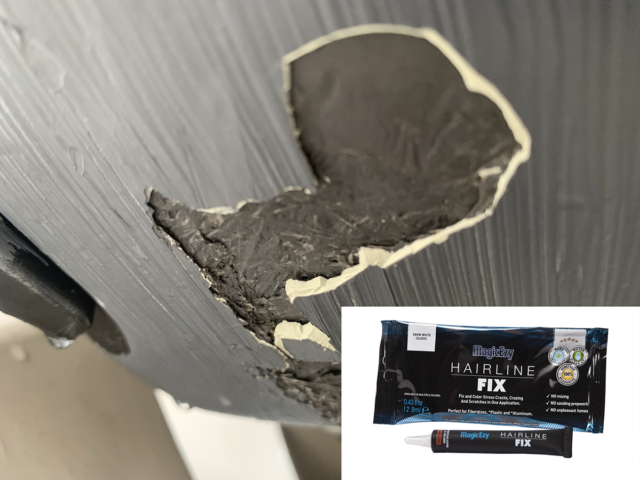 With enough time cruising the water on a personal watercraft, even the most skilled rider is bound to rack up his or her fair share of scrapes and cracks over time. While a little bit of “breaking in” never hurt anybody, over the years, those scrapes and cracks can turn into actual hull damage, resulting in drag while you ride, and some major eyesores.
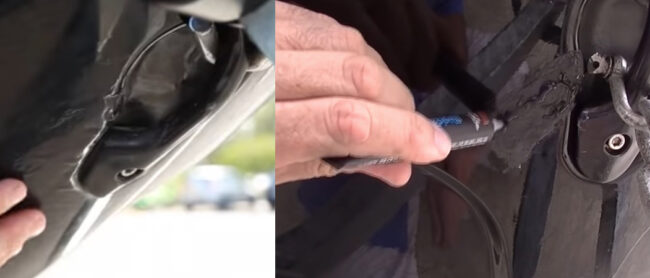 MagicEzy’s watercraft repair sealants offer an economical, effective way to repair cracks and gouges of any kind. Their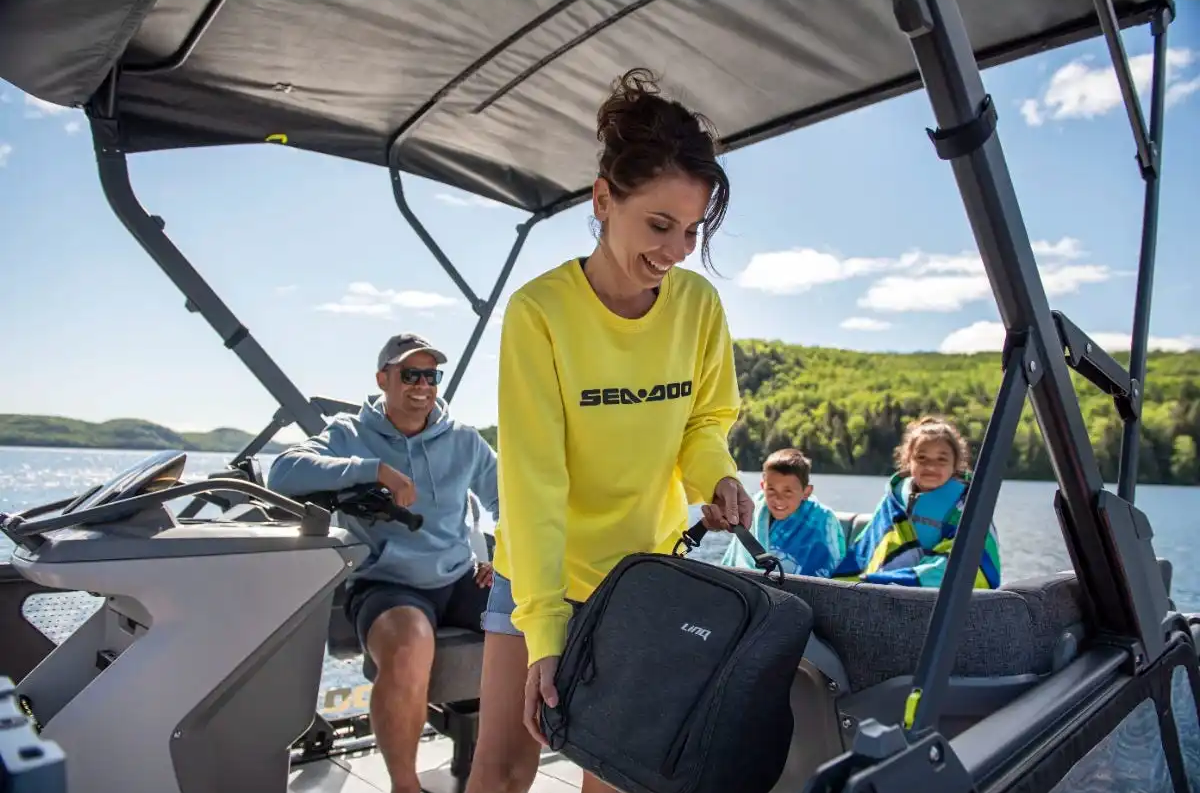

 The LinQ Lite Console Bag is crafted with high-quality splash-proof material to keep your essentials protected from water splashes and unpredictable weather conditions, allowing you to focus on the thrill of the ride without worrying about your gear. It’s that added security that makes this bag a game changer, allowing you to focus on what you’re really on the water to do. Whether you’re cruising along the coastline or exploring remote waterways, this bag is your reliable companion for keeping your belongings dry and secure.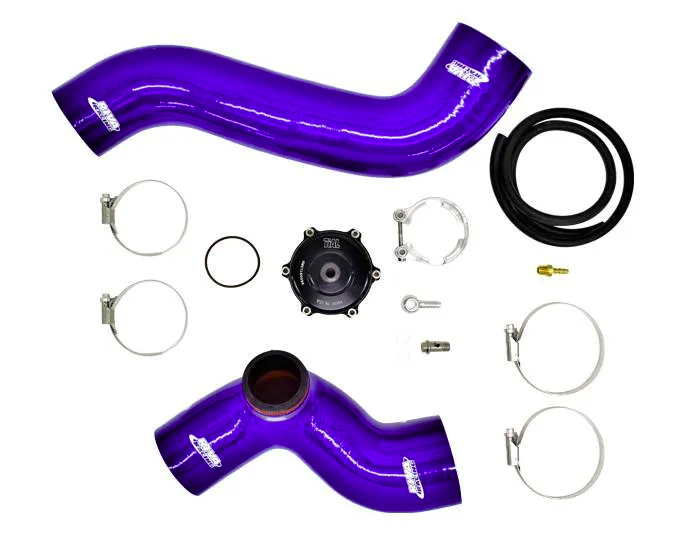
 There are people that are well-known in the PWC race family. There are people that are popular, well thought-of and appreciated in the PWC industry. There are people that have contributed countless hours and untold effort to support, grow and promote the PWC community.
 A Go Fund Me page has been created to help the Young family with medical bills, and efforts are underway in the community to find other ways to support Mikey and Carrie.
 Each boat is assessed independently, but in general, smaller PWCs fall within the C and D categories, limiting them to coastal and inland operations. While these limitations can be frustrating for some, there’s a good argument to be made for the importance of these tight regulations.