



Breathe.
Yep, that stuff. Oxygen. It — or, more precisely, the lack of it — is where the modern personal watercraft horsepower war began.
For years, PWC engines breathed perfectly well on their own. Air flowed in, fuel joined it, combustion followed, and the resulting power was enough for what riders asked them to do.
But “enough” has never enjoyed a particularly long shelf life in the powersports industry.
Riders wanted harder acceleration, higher speeds and more power from increasingly sophisticated machines. The engines needed to burn more fuel to deliver it, and to burn more fuel, they needed more oxygen than they could draw in naturally.
Imagine jogging comfortably around a track when a high school coach in spectacularly unfashionable shorts suddenly begins shouting, “Pick it up! Pick it up!” You can run faster. You just need more oxygen.
“Control the breath, control the race. Panic breathes fast; power breathes deep.”
— Ancient Track Coach Proverb, probably.
PWC engines faced essentially the same problem. The solution was forced induction: Stop waiting for the engine to inhale and begin packing more air into every breath.
The trouble with an erstwhile photographer-turned-editor tackling a technical subject is that, sooner or later, her understanding and her vocabulary part company. So I did what any resourceful journalist would do: researched until superchargers began appearing in my dreams, then combed through more than two decades of manufacturer archives and riding impressions from people who actually knew what all that compressed air was doing.
What emerged illustrates one of the great truths about engineers: Give them one destination, and they will devise several entirely different ways of getting there.
A supercharger uses power from the engine to force more air into that engine. A turbocharger harvests energy from the exhaust to do the same job. Centrifugal superchargers, such as those used by Sea-Doo and Yamaha, compress air with a rapidly spinning impeller. Kawasaki took a positive-displacement route, first with a conventional Roots-type blower and later with Eaton’s TVS design, moving a relatively fixed volume of air with every rotation.
Different paths. Same command from the coach: Breathe harder. We’re going faster.
 Sea-Doo Fires the Opening Shot
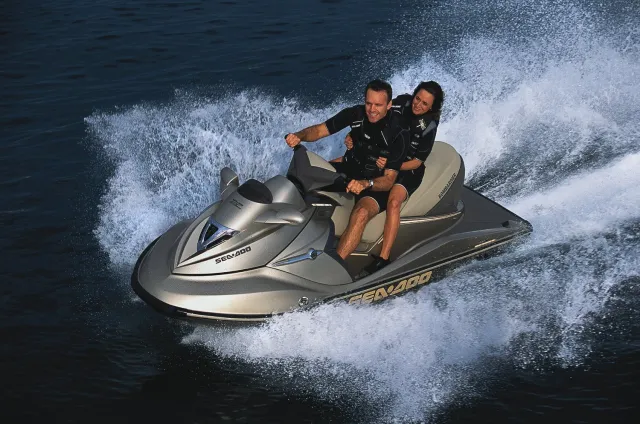
Lift the engine cover on a 2003 Sea-Doo GTX 4-TEC Supercharged and you would see red.
Literally.
Sea-Doo painted that landmark supercharger red, ensuring that anyone peering beneath the seat understood immediately that this was not an ordinary GTX. The centrifugal unit force-fed enough additional air into the 1,494cc Rotax four-stroke to produce 185 horsepower — then the most ever offered in a production watercraft.
Unlike a turbocharger, which must wait for exhaust flow to spin its turbine, the mechanically driven supercharger was always working with the engine. The payoff was immediate throttle response without turbo lag.
Sea-Doo did not introduce the machine quietly. The company used Bombardier’s connection to Indianapolis Motor Speedway and launched the 2003 GTX 4-TEC Supercharged around the Brickyard 400. NASCAR drivers Tony Stewart and Bobby Labonte rode the new watercraft to an Indianapolis dock to meet the assembled media the following morning.
Subtle, this was not.
One year later, Sea-Doo added an intercooler, increased output to 215 horsepower and placed the revised engine in the smaller, sharper RXP. Compressing air also heats it; the intercooler removed some of that heat, making the incoming air denser and allowing the engine to use still more oxygen.
Although its saddle technically accommodated two riders, Sea-Doo offered a number-plate cover that concealed the passenger portion altogether — perhaps the clearest admission that this machine was never really about sharing.
The RXP established a formula Sea-Doo would continue refining: 255 horsepower in the 2008 RXP-X, 260 in 2012, 300 in 2016 and 325 in 2024.
Those numbers tell only part of the story. Revisions to the supercharger, intercooling, engine internals, electronics, pump and hull progressively changed not only how much power Sea-Doo produced, but how effectively a rider could use it.
By 2016, The Watercraft Journal Editor-in-Chief Kevin Shaw warned that Step One in operating the RXP-X 300 was respect. He distinguished between a machine that was frightening because it was out of control and one that was frightening because its abilities exceeded those of its rider. The RXP-X was emphatically the latter.
The 300 demanded an aggressive, forward riding position and rewarded commitment with extraordinarily precise cornering. It resisted lazy sweeps and casual Sunday cruising. Shaw’s eventual verdict required no engineering glossary: It was “a Stinger missile with handlebars.”
Eight years later, the 325 did not persuade him to retire the weapons metaphors.
The most startling difference was not its top speed, but its midrange acceleration. Cruising at 35 or 40 mph could become 70 almost immediately when the throttle was squeezed. Yet the power arrived smoothly and remained linear through repeated corners, without the surging or heat soak that might make that output difficult to use.
With the factory speed limiter intervening at 7,600 rpm — well below the engine’s 8,250-rpm redline — Shaw believed an unrestricted 325 could reach approximately 75 mph “without breathing hard.”
That observation would prove prophetic.
 Honda Takes the Road not Traveled
While Sea-Doo drew power from the crankshaft to drive its supercharger, Honda looked at the hot gases rushing from the exhaust and saw energy being thrown away.
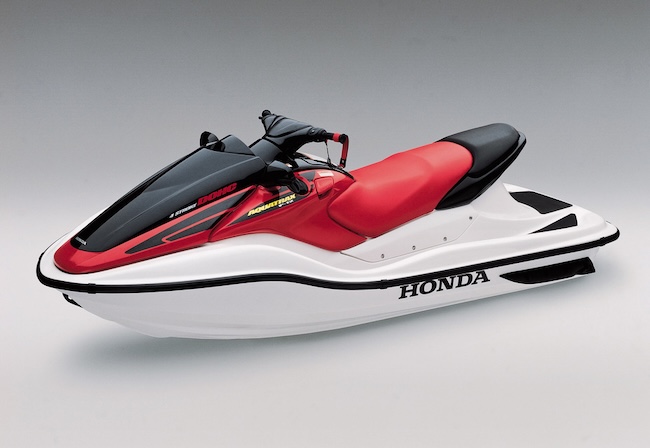
New to the PWC business in 2002 — and apparently unburdened by any obligation to do things conventionally — Honda introduced the three-passenger AquaTrax F-12X, the industry’s first turbocharged production PWC.
Honda’s reasoning was straightforward. A turbo could reclaim energy from the exhaust rather than taking power mechanically from the engine. It eliminated the parasitic loss of a supercharger and avoided the need for a crankshaft-driven power takeoff, while allowing Honda to keep the engine package relatively compact and light.
The 1,235cc four-cylinder used a water-cooled IHI turbocharger and water-cooled intercooler. At maximum boost, the system produced 13 psi and raised output 32 percent over the naturally aspirated engine, to 165 horsepower.
An electronic control unit monitored atmospheric pressure, boost, engine speed, temperature and engine knock, then managed an electronic wastegate to regulate boost and protect the machinery. Forged pistons and connecting rods helped the engine withstand the additional cylinder pressure, while a ceramic-ball turbine bearing reduced friction during sustained high-rpm operation.
One year after the F-12X appeared, Honda announced the 2004 R-12X. The same turbocharged powerplant now lived in a shorter, narrower two-person hull intended for aggressive sport riding. Honda added a racing-inspired quick-trim system and, in an otherwise sober technical release, invited readers to say “Holeshot with a capital H.”
Even engineers occasionally escape supervision.
Honda took the idea further for 2008 with the F-15X, pairing a larger 1,470cc four-cylinder with an intercooled turbocharger and a new hull. But Honda remained alone among the major PWC manufacturers in committing to exhaust-driven forced induction, and the path disappeared when Honda itself withdrew from the PWC market after the 2009 model year.
That makes Honda more than a brief curiosity in this history. It demonstrated that a factory turbocharged PWC could combine strong performance, relatively low noise and emissions compliance. But Honda’s departure left the industry without another generation to show where that road might ultimately have led.
 Yamaha Joins the Race — Quietly
Yamaha entered the forced-induction contest in 2008, but it declined to join the numerical shouting match.
Sea-Doo increasingly treated horsepower as a public scoreboard. Kawasaki would eventually stamp the score directly onto the Ultra’s name. Yamaha offered Super High Output, followed by Super Vortex High Output, and generally left the enthusiast world to argue about how many horses those vowels and consonants represented.
The machines themselves were considerably less reserved.
The 2008 FX SHO and FX Cruiser SHO introduced Yamaha’s supercharged and intercooled 1.8-liter four-cylinder. But Yamaha did not initially present boost as a bare-knuckled racing proposition. It installed the new engine in its flagship cruiser alongside electronic throttle, Cruise Assist, No Wake Mode and a NanoXcel hull Yamaha said was 25 percent lighter than its previous SMC hulls.
The FX Cruiser SHO even offered four storage areas and a beverage holder, because civilization must advance alongside horsepower.
One year later, Yamaha placed the same basic powerplant in the sport-oriented FZR. The respectable cruiser had begun removing its jacket.
Then came 2014 and the Super Vortex High Output engine. SVHO retained the supercharged, intercooled 1,812cc architecture of SHO, but revised the supercharger, intercooler, fueling and supporting systems for substantially greater performance. Yamaha gave that engine two personalities: deep reserves of power and comfort in the FX models, and harder acceleration and more aggressive handling in the FZR and FZS.
After riding the 2014 FZR SVHO, Shaw reported that it launched from zero to 30 mph in 1.3 seconds and pulled from a standstill with “excessive force.” Its lightweight NanoXcel hull was less forgiving over rough surfaces, but extraordinarily responsive and grippy in corners. It behaved less like a recreational cruiser than a race-prepared machine sold directly from the showroom.
There was, however, one Yamaha innovation he remained unwilling to embrace: the trademark plume of water spraying behind the craft. Shaw disconnected the rooster tail for the photo shoot.
Some principles survive even excessive force.
The SVHO engine ultimately moved into Yamaha’s GP performance family while remaining available in the flagship FX line. For 2026, Yamaha’s naturally aspirated performance engine has grown to 1.9 liters, but the supercharged SVHO continues with the 1,812cc platform.
Yamaha’s contemporary description of the GP SVHO includes the phrase “catch me if you can.” That is quite a journey for an engine that entered the world alongside cruise control and a cupholder.
Kawasaki Puts the Score on The Machine
If Yamaha entered the horsepower war while politely declining to disclose its troop count, Kawasaki arrived with the number printed on the hull.
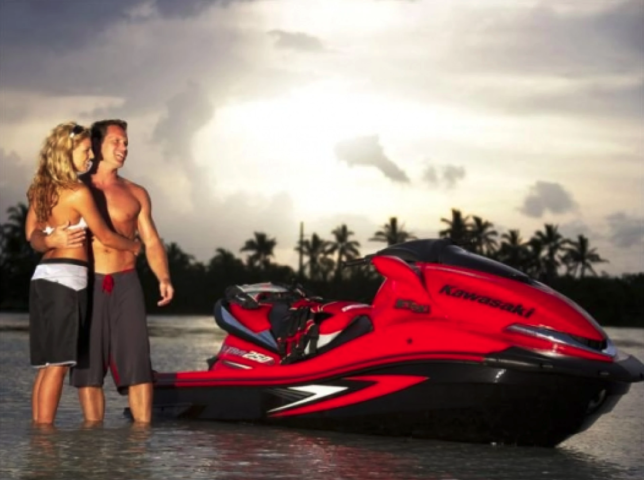
The 2007 Jet Ski Ultra 250X was Kawasaki’s first supercharged PWC. Its belt-driven Roots-type supercharger used two counter-rotating lobed rotors to deliver pressurized air to a 1,498cc inline-four, including low in the rpm range. Kawasaki paired the engine with an intercooler and a new hull, creating a three-person machine intended to accelerate hard and remain composed in rough conditions.
The 2009 Ultra 260X refined the existing formula through changes to the engine, cooling, tuning and impeller rather than replacing the supercharger architecture. Its extra 10 horsepower also returned Kawasaki to the top of the industry’s publicly advertised numbers race after Sea-Doo’s 255-horsepower RXP-X and RXT-X had edged ahead.
The larger transformation came with the 2011 Ultra 300X — and one generation earlier than many riders remember.
The Eaton TVS supercharger now strongly associated with the long-running Ultra 310 actually debuted aboard the 300X. In place of the previous two-lobe Roots blower, the TVS used twisted four-lobe rotors to provide smoother, more continuous airflow. Kawasaki claimed 28 percent greater charging efficiency while reducing mechanical loss by 10 percent.
The company paired it with a high-capacity liquid-cooled intercooler, electronic throttle, cruise control and a one-touch five-mph mode. Kawasaki also installed Fuel Economy Assistance and an illuminated ECO indicator, allowing riders to congratulate themselves on their restraint while presiding over 300 horsepower.
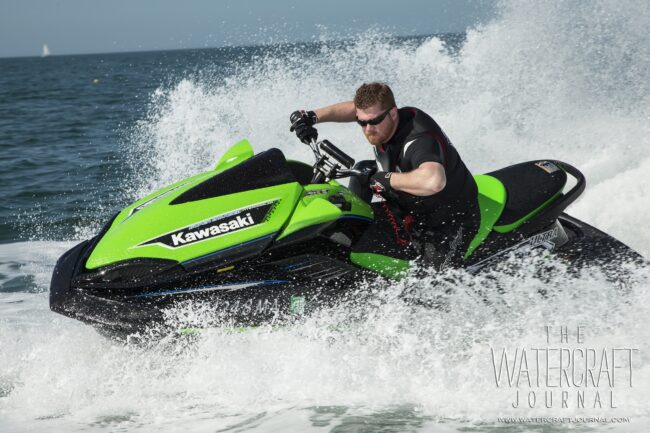
For 2014, Kawasaki retained the TVS supercharger but improved almost everything supporting it. Revised oiling and cooling, new pistons, a long-runner intake manifold, increased fuel delivery, a repitched impeller and dual blow-off valves helped manage as much as 17 psi of boost.
The result was 310 horsepower, although Kawasaki’s Bret Snider told The Watercraft Journal at the time that the additional output had not been the principal goal. It emerged from efforts to improve the engine’s efficiency and durability.
The Ultra 310 also carried approximately 56 gallons of storage, a removable drink holder and a second muffler that helped address both sound and the machine’s tendency to list during low-speed turns. Engineers had successfully forced 310 horsepower from a 1,498cc engine. Persuading several hundred pounds of stationary watercraft to sit politely beside the dock remained a separate discipline.
On the water, the results were less polite. Shaw described acceleration with sufficient force to threaten a rotator cuff, a pump that remained loaded through two- and three-foot chop, and a supercharger that whistled like a passing bullet.
More than a decade later, the 1,498cc supercharged engine remains the foundation of Kawasaki’s Ultra 310X, 310LX-S and 310LX. The names have endured because, unlike Yamaha, Kawasaki never saw much reason to conceal the score.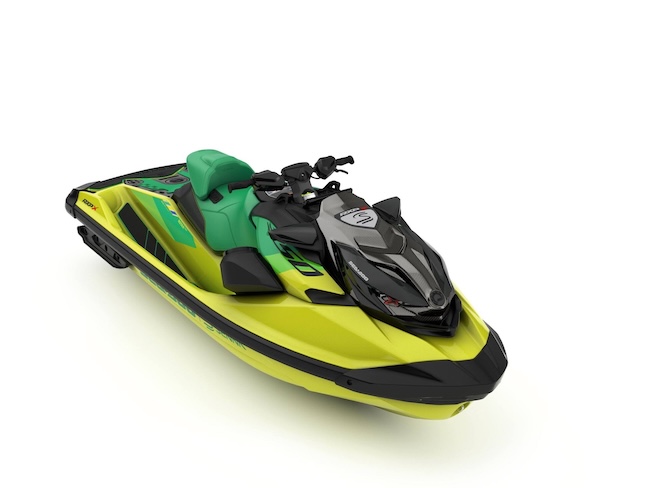 From Making Power to Using it
For 2027, Sea-Doo has returned to move the number again.
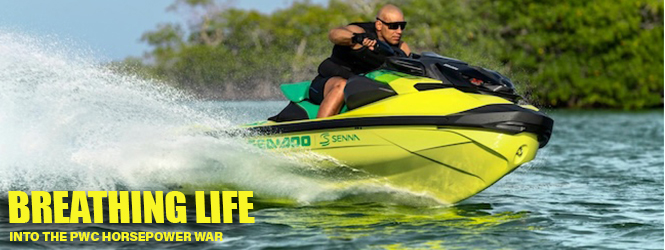
The new RXP-X 350 and limited RXP-X Senna 350 raise factory output another 25 horsepower. Sea-Doo calls the new Rotax the most powerful factory-installed engine in the industry, bringing the sequence that began at 185 horsepower in 2003 to 350 less than a quarter-century later.
But after riding both versions, racer and Sea-Doo ambassador Anthony Radetic found himself less impressed by the number than by the machine’s ability to use it.
The 350 retains Sea-Doo’s Rotax 1630 ACE architecture but increases the engine’s rev limit from 8,250 to 8,500 rpm. A larger supercharger compressor wheel — increased from 72.5 mm to 75.5 mm — moves more air and produces additional boost. Radetic also noted revisions to the rocker arms, valve lifters, piston lubrication, throttle body and engine calibration.
The changes did not stop at the engine. A redesigned intake grate and ride plate, new pump stator, lighter repitched impeller and larger-diameter driveshaft helped keep the pump loaded as the machine crossed rough, choppy water.
“The RXP-X 350 doesn’t just make more power,” Radetic wrote. “It puts that power into the water.”
That may be the most important lesson in the entire forced-induction arms race. Engineers first had to make the engine breathe harder. Then they had to cool the air, regulate the boost, strengthen the machinery and persuade a jet pump and hull to translate all of it into controlled forward motion.
Sea-Doo chose the centrifugal supercharger and kept pushing the public number higher. Honda briefly showed what an exhaust-driven turbocharger could accomplish. Yamaha developed its own centrifugal formula while declining to plant a horsepower flag atop the anthill. Kawasaki chose the immediate response of a positive-displacement blower and refined the Eaton TVS architecture it introduced on the 300X.
Different manufacturers took different paths, and each discovered that horsepower was only the beginning. More than two decades after Sea-Doo first decided its engines needed help breathing, the industry has become remarkably good at forcing air into them.
The true evolution was teaching the rest of the machine what to do with the result.