



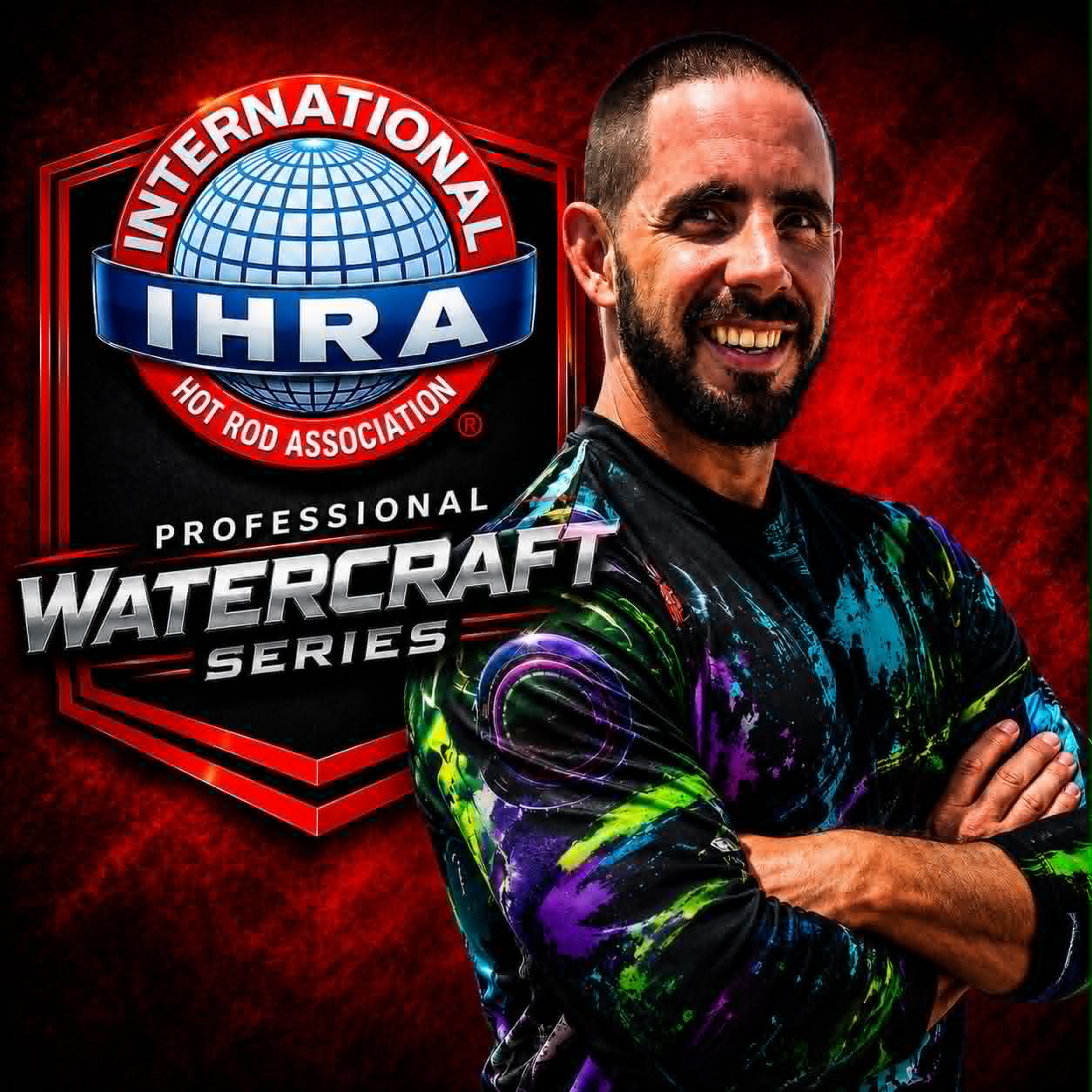
It’s 5:30 p.m. on a sweltering Monday afternoon, and Billy Tew is already prepping the truck for this weekend’s HydroDrags in Boca Raton — hip deep in packing, logistics, safety planning, promotions and a to-do list that never seems to get any shorter. But he still took time to talk with the Watercraft Journal about how the guy who used to run the PA somehow ended up running the whole show — and why, in the long run, the kid putting down the slowest pass of the weekend may matter more to the future of the sport than the rider chasing 150 mph.
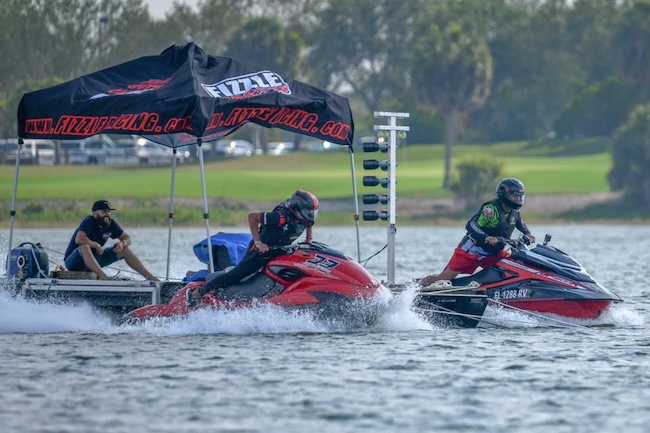 Anyone who has spent time around HydroDrags — from the start line or the shoreline — knows the name Mikey Young. Long recognized throughout the PWC racing world as one of the premier announcers in closed course and endurance racing, Young helped build HydroDrags from its earliest days. For several years, Billy Tew was simply the guy providing AV and DJ services for the event — until one year Young tossed out a question that changed everything:
“Hey, how would you like to work the event on the launch pad?”
By then, Tew was already doing double duty — handling the audio while beginning to race himself. For him, the answer was pretty obvious. “I was already there, so why not.”
Eventually Young stepped back from the promoter role while remaining the voice of the event, and Tew suddenly found himself holding the reins of one of the most unique spectacles in the PWC racing world.
The role, he admitted, comes with plenty of ups and downs. Between behind-the-scenes logistics, racer personalities, permitting, staffing and the financial balancing act, promoting HydroDrags has effectively become a second full-time job.
“I’ve never lost money on it, but you’re either breaking even or it’s just barely paying,” he said. “What I tell people is, you’ve got to love the sport. You’ve got to love racing, and you’ve got to love jet skis.”
 Part of loving the sport, Tew said, means being willing to make hard calls. Standards for sportsmanlike conduct and a family-friendly atmosphere aren’t always easy to enforce — but he’s made clear they aren’t negotiable either. The goal, he said, isn’t to change who HydroDrags is for, but to make sure it’s something everyone can be proud to be part of.
That same drive to improve the experience — for racers, for families, for first-timers — is what pushed Tew toward one of his most significant upgrades yet: the launch of the new HydroDrags mobile app.
“I’m the first PWC promoter to do an app,” Tew said. “Everything is based in the app — brackets, registration, rules, everything. So now there’s no paperwork.”
The move wasn’t just about modernization for the sake of appearances. Behind the scenes, Tew said race weekends were often bogged down by delays while staff attempted to print brackets, troubleshoot equipment issues and answer endless questions from racers trying to figure out where they stood in the lineup.
Now, racers and spectators can follow registrations, rules, live brackets and Speed Alley results directly from their phones — reducing downtime between rounds and helping keep the event moving on schedule.
“My biggest thing is timing. We don’t need to be here till 7 p.m.,” he said. “Now everything is at their fingertips.”
Even so, Tew laughed that convincing racers to actually pre-register has proven harder than developing the app itself.
“A lot of our guys are last-minute racers,” he said. “They blow their stuff up the night before. I think there’s like 20 racers signed up, which I know there’s way more teams and riders than that. I’m trying to break them of that.”
As significant as the app may become to the future of HydroDrags, Tew says the biggest shift for the organization has come through its new partnership with the International Hot Rod Association.
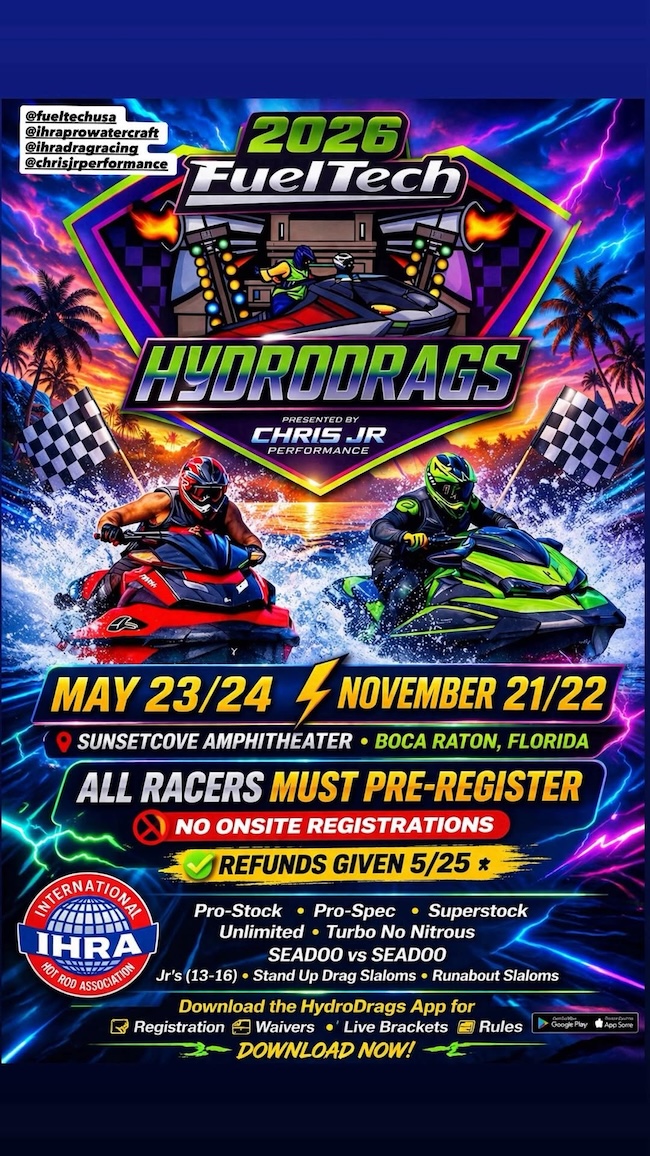 “IHRA has played a huge role behind the scenes — more support, more social media,” he said.
Tew explained that the partnership developed as he began looking beyond HydroDrags’ traditional twice-a-year schedule and started making serious plans for long-term expansion and growth.
“The way they help promote and post on social media — I’ve had people come up to me that have nothing to do with the sport and ask about the upcoming race because they saw something IHRA posted, and that’s what we need,” he said.
Beyond promotion, Tew said the organization has helped streamline permitting, recommendation letters and event operations while also bringing a more visible professional presence to the venue itself.
“IHRA sent tons of staffing shirts, signage, feather flags, tents — just the branding in general,” he explained. “Now when racers come in and they see a presence, they see people in uniform, it’s like, ‘Okay, we mean business.’ It feels more professional.”
That professionalism, however, is only part of Tew’s larger vision for where HydroDrags may be headed next.
“There are good plans coming,” he said. “HydroDrags has basically been two races — May and November — with a lot of dead space in between. I want to implement something in the middle.”
 Part of that vision includes branching beyond pure drag racing and incorporating more elements of closed course and endurance competition into future events.
“I’m talking with Dustin Farthing about trying to become a regional director down here in Florida for some closed course racing because we really don’t have anything down here,” he explained. “That’s my goal.”
Even before those larger plans take shape, this weekend’s event already reflects that shift. Tew has added new drag slalom classes designed to blend straight-line acceleration with closed course elements — riders launching off the traditional drag tree before splitting into lanes, weaving through buoy sections and racing back for a photo finish.
“I’m trying to get more of the rec guys involved,” he said.
He has also introduced a junior class for riders ages 13 to 16 — something Tew says may ultimately prove more meaningful to him than any top-speed number posted this weekend.
“I personally say the junior class is what I’m most excited about,” he said. “Even though it’s only five or six kids, it’s the start of something. I like the fast stuff, but I think watching the kids get involved is gonna be the big one for me.”
That focus on youth riders is intentional — and connected directly to Tew’s broader goal of expanding who shows up on both sides of the ropes.
“I don’t think the spectators will be the same, and that’s my goal,” he said. “I want to bring in a different crowd, some new faces.”
Longtime HydroDrags fans remain a vital part of the culture, he emphasized, but the sport has to keep evolving into something more family-friendly and accessible if it hopes to keep growing. And for newcomers walking into Sunset Cove for the first time, he believes the experience makes its own argument.
“It’s a different experience — the speed, smelling the race fuel, your eyes burning,” he said. “It’s totally different.”
Part of that spectacle comes from Speed Alley, HydroDrags’ top-speed competition, where riders make individual passes across the full length of the lake chasing maximum speed numbers — a format that surprises first-timers expecting a traditional standing-start drag race.
“The riders go out one at a time and they have the whole lake,” Tew explained. “There’s no way to hit those numbers in an eighth-mile.”
While traditional HydroDrags racing launches riders from a dead stop to speeds approaching 120 mph in just 660 feet, Speed Alley setups are built entirely differently.
“Those turbos don’t even spool up until 80 miles an hour,” he said. “They need the whole lake to make a real pass.”
That need for calm, controlled conditions is also why HydroDrags continues returning to Sunset Cove Amphitheater in Boca Raton.
 “You can’t take our sport on the ocean,” Tew said. “At these speeds, you want the safest water conditions — flat water — and that’s what I look for in a venue.”
The venue’s enclosed setup also allows HydroDrags to operate differently from many traditional racing events.
“A lot of the closed course and endurance guys, they make their money off the racers,” he explained. “I’m completely opposite. I don’t make my money off the racers — I make it off the spectators.”
And while the atmosphere may still feel raw and grassroots from the shoreline, the technology powering the sport continues escalating rapidly.
“The speeds now — who knew even five years ago?” Tew said. “It’s not just the turbo stuff either. Other classes are finding tricks. A stock supercharger can go 100 miles an hour now. Every race, there are records getting beat.”
But Tew believes the long-term health of HydroDrags depends less on the fastest skis in the pits and more on creating affordable entry points before the costs price out the next generation entirely.
“Right now, what about my juniors?” he asked. “What class are they gonna go to when they graduate? Their parents are gonna have to spend $10,000 just to bump them up, and then you lose them.”
That’s why he sees recreational classes and accessible racing categories as critical to the sport’s survival — not a concession, but a foundation.
“Yes, 80 miles an hour is boring for some people,” he said. “But it helps all of us in the long run.”