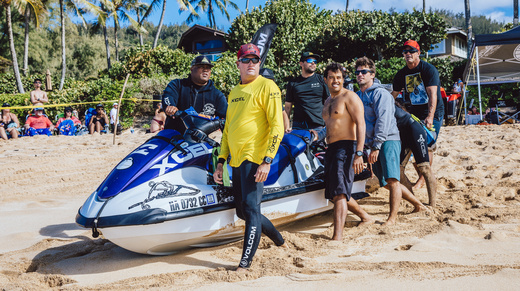
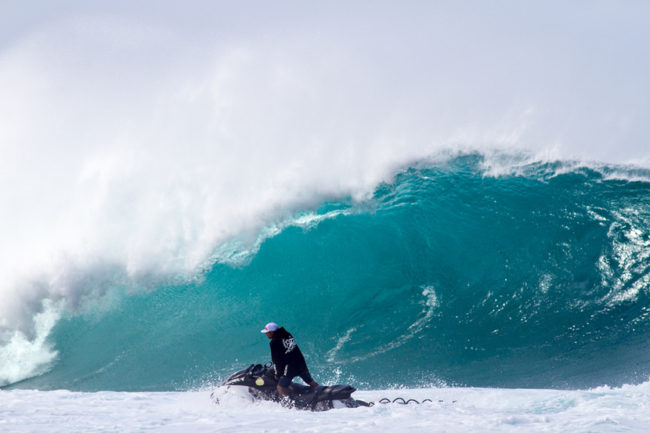
The Hawaiian Water Patrol (HWP) was founded by former Honolulu City and County lifeguards Terry Ahue and Brian Keaulana. What started out as a couple of guys on jet skis performing rogue water rescues, finally became a legal entity in the mid 1990’s. This was after scores of tickets were issued to Keaulana for launching his jet-ski. It didn’t matter that he had saved lives while off the Hawaiian Islands.
Ahue and Keaulana realized that they should engage in putting together a book of professional guidelines and standards. Prior to becoming an official organization the two men purchased a couple of skis and brought some other skilled lifeguards on board to run rescue at professional surfing events. Soon after, they built a rescue sled for transporting surfers and victims of water related incidents to safety. This method cut down on the amount of time it took to safely bring someone in from a dangerous situation.
The HWP was soon hailed as the top dog of water rescue and Hollywood approached them for stunt and safety coordination. The lifesavers even became members of the Stunt and Screen Actors Guild and that’s when their operation turned into a money maker!
According to a recent piece on surfline.com, Ahue and Keaulana became certified Hollywood stunt and safety coordinators. Technically, the group operates as “Ocean Risk and Management”, a subcontracted private business hired for any water event, film, or surf contest. The Hawaiian Water Patrol has come a long way since its rogue rescue days! The crew is always learning and staying up to date with and creating the latest rescue techniques. Like a fine wine, it gets better with age.
Thus far, throughout the journey of The Watercraft Journal’s short 4-year existence, this publication has continually and steadily grown month after month, year after year. This latest edition of “By The Numbers” will show exactly that, and during yet another “off-season” winter month. Admittedly one of the most moderate February’s in recent record – allowing many to enjoy some unseasonably temperate riding weather – we continued to welcome a 28-percent overall growth in readership, something no other PWC publication can say.
Speaking of our competition, it’s worth mentioning some other key distinguishers between The Watercraft Journal and other media outlets that are vying for your advertising dollar. The first being the sheer quantity of dyed-in-the-wool readers who come to our publication each and every day. Last year, we welcomed over 346,000 individuals to our pages. This year will be 400,000-plus. Consider that for a second. Over 400,000 committed and engaged personal watercraft enthusiasts reading up on your company’s products and services. Sounds pretty attractive, right?
Secondly, we’re the single-most consistent publisher of PWC-focused content in the world. No other magazine, website, blog or social media thread produces more usable, informative and uniquely-created content on a daily basis than The Watercraft Journal. Nobody. They all try at some time or another, and they all fall short. Don’t believe it? You’re welcome to look it up yourself (because we check ’em all everyday). Other magazines have dramatically over-promised a video, stories and more only to fall disappointingly short.
Lastly, we know who are readers are. Whether they are championship-holding racers, skilled tuners, avid club members, tire kickers or those out there “shopping around”, we pride ourselves on delivering professionally-written editorial content that can be read, accessed and used as a reference at any time. That’s what we are, after all: a resource. Those who advertise with us find this to be true, help steer the conversation with informative facts, and pierce the fog of opinion with technical reviews and bankable data. Don’t let an Instagram feed dictate popular opinion; convert them with knowledge.
February 2017
February 2016
Growing, Growing and Continuing to Grow
Growth over a year is worth evaluating. While different news and different article topics might draw in various ilks of readership, there is a constant: upward momentum. If you can see our continued skyward trajectory, you’ll know that The Watercraft Journal has yet to stop growing. Our new readership percentages are growing despite having been around for a few years now. And we want you to notice how for being the height of winter for most of the Northern Hemisphere, we are continually outperforming our previous year’s Spring season – and that is reason to take note. On every level, The Watercraft Journal is welcoming more and more readers, and at an accelerated, exponential rate. No other magazine is growing as quickly as The Watercraft Journal and that’s just the beginning.
February 2016
Total number unique readers: 20, 624*
Total number of articles read: 45,465
Percentage of new readers: 62%
February 2017
Total number unique readers: 27,645*
Total number of articles read: 51,142
Percentage of new readers: 61%
*This number is considered equal to an individual sale of a single copy of a magazine.
Consistency Is The Name of The Game
The internet is a funny thing. When you prove yourself as steady as clockwork, people tend to return more often and regularly. As we publish industry news, product reviews, ride reports and more – more regularly than anywhere else – we’ve learned that PWC enthusiasts have come to depend on new and interesting content every single day. And that means we’ve got a responsibility to deliver. Unlike anybody else, The Watercraft Journal maintains a strict publishing schedule of developing and publishing new and informative content about its advertisers and their products, as well as the industry and sport as a whole.
News articles published in January 2017: 28
Feature articles published in January 2017: 8
Total feature word count: 10,236 words
News articles published in February 2017: 27
Feature articles published in February 2017: 9
Total feature word count: 8,463 words*
*When this number is translated to print publication standards equals a 94-page magazine. Please note that this number does not include an average of two uniquely-written news articles published daily.
Putting WCJ In Front of More Eyes Than Ever Before
Many companies chose to use their social media accounts (be them personal or for business) as their sole outlet to accessing new and interested customers. Plain and simple, this is lunacy. Why? Because the people following said accounts already know who you are, and unless they are feverish return customers, you’re not getting the influx of fresh, new customers that a company needs to thrive. That’s why you need The Watercraft Journal. We are your bullhorn to the largest audience in the world. By offering our content freely and easily – whether it’s via a desktop, a laptop or a portable device, anyone can read our content. And with our Facebook, Twitter, Instagram, YouTube, and weekly newsletters, we bring our content directly to them. And that’s a huge part of our success!
February Facebook likes: 20,748
Top Five countries: United States, South Africa, Brazil, Australia, Philippines
Impressive. Most Impressive
The personal watercraft industry is an intimate one. You want to get your brand and product out in front of as many would-be customers as possible, but how do you do it? You go to the one media outlet who welcomes over a third of a million annual readers. We’re looking to surpass every major forum in the way of readership and expand our reach well beyond that of our core industry, helping to introduce more companies to the world of personal watercraft for our readers. Again, we’re a resource. And to be one, you need to act like one. And now more than ever is the time to get your company and products on The Watercraft Journal. To inquire more about advertising with The Watercraft Journal, please email [email protected]
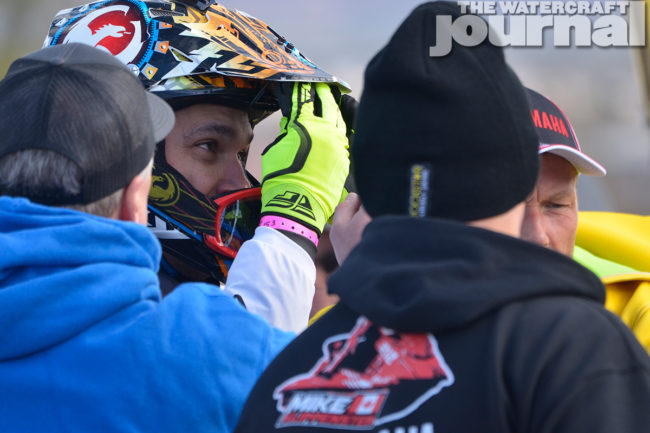
Little more than three weeks ago, the 13th annual Hot Products Mark Hahn Memorial Havasu 300 Presented by Yamaha kicked off with the bang of a shotgun. It marks a succession of first, including the debut of the Kawasaki SX-R on the race course; the return of several major players including Craig Warner, Tony Beck, Chris “The Flyin’ Fish” Fischetti, Nicolas Rius, and more; and it also heralded the beginning of world class racing here in America in 2017. After five-and-a-half hours of grueling racing, the winners were crowned and the field cleared. But much more than praising those athletes who participated to valiantly that Saturday, the men and women who helped make this year’s event possible. Below is the heartfelt gratitude of organizer Mike Follmer:
Here’s the original press release: Whether you knew him or not, we must all be thankful for the contribution Mark Hahn made to the sport of PWC endurance racing. His spirit and legacy are embodied in the Hot Products Mark Hahn Memorial race that bears his name. From its humble beginning to the Thirteenth Annual race held on February 18, 2017 the Mark Hahn Memorial has become a world class event, welcoming competitors from all parts of the globe to compete in one of the most unique and punishing endurance racing events in the world.
The 36 teams that competed in this year’s event and I owe all the success of this event to Mark’s vision and most importantly to all of the great sponsors and workers who make the event possible through their tireless efforts and generous contributions. Because of the Sunday race date this years entries were down a little, but the number of workers, sponsors, trophies and prizes were greater and along with the announcement of next years Saturday February 24 2018 race date and after the awards banquet everyone once again pledged to do even more next year.
Those who braved this year’s event are to be saluted for they truly endured the greatest test of weather anyone has ever seen at Lake Havasu! Every award and trophy was hard earned. The Mark Hahn Memorial race has always enjoyed an extraordinary amount of favorable coverage in all types of media worldwide, making it one of the most popular events in the world of PWC racing which is the true testament of the great exposure all the sponsors are enjoying.
There are several special people who merit special thanks for their dedication to the Hot Products Mark Hahn Memorial race’s thirteen year growth and success. Tom Perry of Hot Products, Jim Russell of DSM, and Ross Wallach, the race director. We all owe a great debt of gratitude to each of them for their tireless dedication over the years!
In addition to the 36 teams that competed I would really like to thank all the others who make this event the huge success that it has become:
HOT Products – Tom Perry Scott Saito YAMAHA Motor Corporation USA – Andrew Cullen Kawasaki Motor Corp USA – Joe Heim R&D Racing Products – Jettrim Go Fast US.com – Discount Tire PWC Offshore .com – Pro Rider Magazine Lake Havasu Aquatic Center & Staff – Havasu Powersports DSM – Jim Russell & Staff – Riva Racing IJSBA – Scott Frazier – Watercraft Rider.com Coach T’s BBQ – Shawana Menser Ross Wallach – Kay Sikes Missy Beck – Dave Arnold Eric Graff – Kelly Hart
I also want to extend a huge thank you to Anthony Radetic for traveling all the way from Georgia and winning the Ironman Runabout Class and awarded the Mark Hahn Memorial Cup for his outstanding performance – he is an inspiration to us all!
THANKS AGAIN! And I hope to see you all again next year at the 2018 – 14th Annual Mark Hahn Memorial! – Mike Follmer
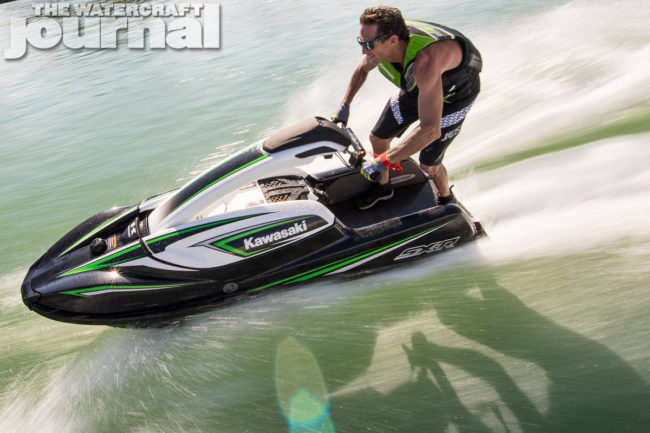
“There’s a lot riding on it,” a friend cautioned over the phone. “They’re worried about what’s being said about it.” The “they” in this conversation was Kawasaki, and the “it” was the new 1,498cc 4-stroke, 160-horsepower SX-R. Since its release to the general public over a month ago, a purported 900 units have been shipped to the fulfill the existing 2,400 units requested by dealers. Earlier this month, nine SX-Rs participated in the annual Mark Hahn Memorial (ie. Havasu 300); and to date, the SX-R has graced the covers and filled the pages of Japanese and European publications as domestic PWC and boating magazines await an overdue press introduction, scheduled for this coming April. Thus far, public opinions have been predominantly good with several vocalizing the potential impact the coming SX-R will have on the racing landscape. “Remember when the [800] came out – what? Like 15 years ago? Everyone with a 750 thought the SX-R was a pig. Now look at it,” my friend continued. “Everybody wants one. It’s the standard for racing. That’s what this thing is going to do.”
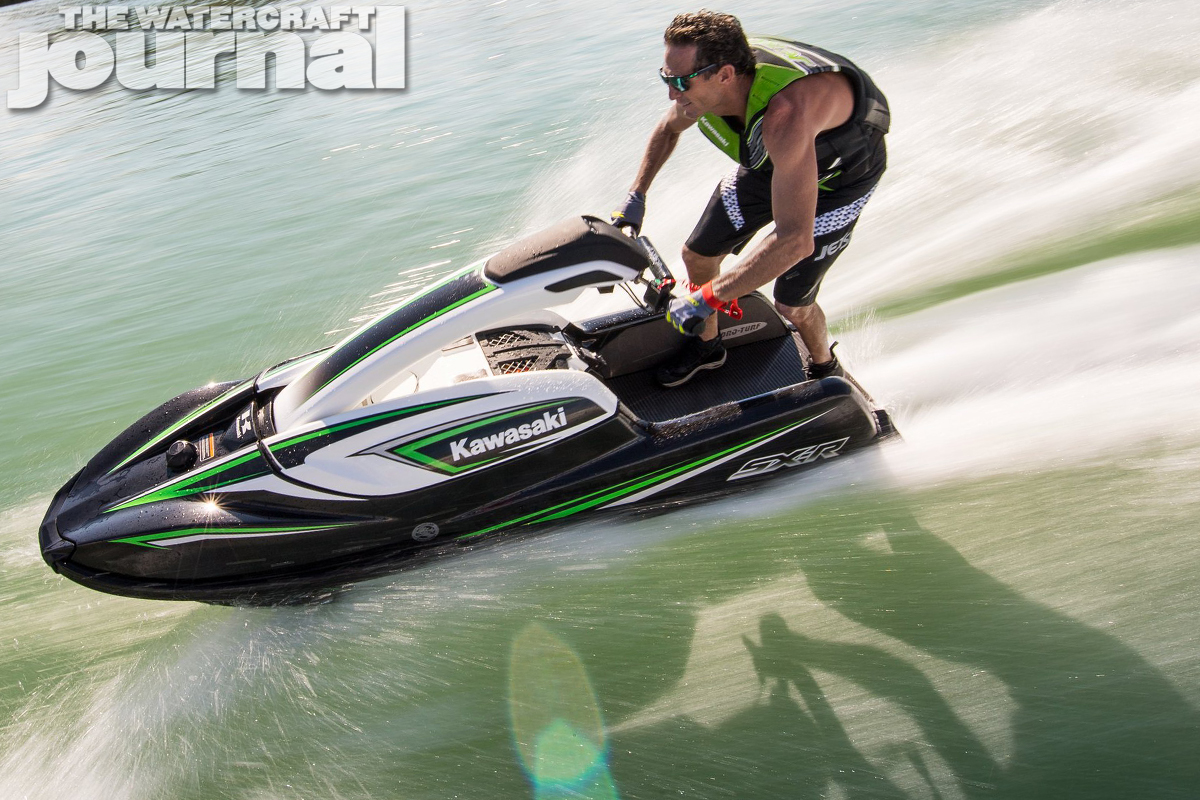
At first blush, the 8-foot, 7-inch length, and 551-pound heft of the 2017 SX-R is a lot to take in. For some, it’s too much altogether. “It’s a standabout!” commenters have howled in forums and on social media. But the truth is often quietly found below the din of so many opinions. To date, all radar and GPS records have the new JetSki reaching slightly over 62 miles per hour in showroom stock trim. These speeds were only achieved by race fuel-fed triples and turbocharged Hydros previously. Equally, the unusually tiered nose (featuring splash deflectors) and deep channels running along the strakes adds to the claims that much of the SX-R’s design DNA is culled from the STX-15F – not to mention almost the entirety of its powertrain. When questioned, the answer was clarion clear: “Because it was designed for those big, stupid IJSBA race courses. That’s why.” The tight, complex buoy course that elevated Jeff Jacobs, Chris Fischetti, and Larry Rippenkroeger to stardom have ballooned in the decades following their tenure, replacing complicated, technical courses with long straightaways, sweeping turns and the like.
Above: From its earliest beginnings, the Kawasaki JetSki existed to own a segment, to stand solitary on a precipice unoccupied and or wholly unchallenged.
Above: The progression of the Kawasaki JetSki continued as a response to the innovations of pioneering tuners and the boundaries pushed by racers such as Chris “The Flyin’ Fish” Fischetti.
Evolution within a specific sport is commonplace. From its earliest years in the Harvard Yard to the gridiron of today’s NFL, the equipment, padding, footwear and in-field communication equipment of today’s professional football players dwarfs that of thick, woolen sweaters, cotton trousers and Naugahyde-stitched leather caps of a century earlier. So to have gone the rough-hewn fiberglass hulls, and two-cylinder 2-strokes that filled the starting lines of the Budweiser IJSBA National Tour nearly 30 years ago. That progress doesn’t diminish the achievements or talents of those racers, builders and tuners; rather we owe today’s superior machines to them in large degree. The Christy Carlsons, Dave Gordons, Victor Sheldons, Scott Watkins, and Bill Chapins of the 1980s and 1990s gave us what we have (and often take for granted) today.
Certainly aftermarket hulls from skilled designers (ie. ProForce, Bullett, Trinity, etc.) have taken from existing designs and magnified their abilities to ride on the rail nearly perpendicularly to the water, their pumps remaining engaged, the rider articulated in such a precarious position that a snapshot taken mid-turn looks like a balance of chaos and ballet. By many accounts reporting in, the SX-R neither requires such acrobatics nor responds to such drastic rider inputs. Overshadowed by its power output and sheer size, the truly remarkable talent of the new 2017 JetSki SX-R very well may be its ability to preserve the rider during dire conditions. The SX-R is slowly revealing itself as the potential champion of offshore surf races, brutally wind-chopped lakes and the churning turmoil of a multi-lap race course. Mike Klippenstein who competed in three classes simultaneously at this year’s Mark Hahn Memorial (two runabout, one standup), praised the SX-R for tackling 20-30 mph wind-whipped seas, the standup actually surpassing several runabouts in the chop.
Above: The records of the sport’s biggest names in racing might have already been eclipsed, but their accomplishments remain ever as important. Persons such as Jeff Jacobs and the aforementioned Fischetti, among many, many others have raised the bar significantly.
Above: Today, modern standup racing takes many forms, many of which are both distant and not so far removed from decades earlier. The new Kawasaki SX-R aims to reclaim its class dominance in this segment by offering superior power, added stability and less wear on the rider – particularly in rough conditions.
“This isn’t the same 550 that you and I grew up on,” the voice on the other end of the line continued. “It’s not the ski you threw into the bed of your pickup, drove down to the lake, chucked out a couple buoys and ripped around on.” Rather, the JetSki that Kawasaki is rolling out is purpose-built for race class dominance. “It’s almost unfair. It’s gonna kill those guys on triples, or who have finally sunk all their money into a Hydro. You’re gonna hear a lot of crying,” he added. The thought was maddening, but relatable. It has been a very long time since a manufacturer produced a product so perfectly designed for class dominance that its introduction immediately antiquates the competition. It’s as exciting as it is frustrating – yet, the process is nothing new. The earliest decades of this sport were strictly Kawasaki territory. Even Yamaha’s early SuperJets (first introduced in 1989) took a while to earn their place on the podium. From there, the race was neck-and-neck, with various models of ski being introduced in an effort to lock in a class or out-do the other.
Certainly, the new SX-R will appeal to the civilian jet ski enthusiasts, those who wish to enjoy the thrill of standup jet skiing in lakes and bodies of water where two-strokes have since been outlawed. Equally, as given early reports of the SX-R’s characteristics, older or slightly less athletic riders will enjoy its buoyed stability and the even temperament of the digitally-fuel injected 4-stroke. Yet, the goal is singular: complete and total dominance of a category that Kawasaki has long since been absent. It’s been told that the development of the new SX-R was fueled strictly by passion, passion on behalf of Minoru Kanamori and Craig “Fuzzy” Boyd. That it was birthed during early morning testing sessions and late-in-to-the-evening wrenching hours. That it exists because of sure willpower, not because it made sense on paper or was a market segment needing to be filled. For that, much needs to be said but hasn’t. Rather, in keeping with Kanamori’s humility, he’s let the SX-R slowly speak for itself. And as the weeks and months proceed, and the Kawasakis continue to fill podiums, we’re going to know assuredly what this machine was bred to do. And that is why it needed to be built.
Go Get Wet,
Kevin
[I realize this is the second editorial in a single month, so for that I apologize. The advent of the new SX-R has been consuming my thoughts for months now – to the point of madness – and felt it necessary to expound. – Ed.]
It’s a story most all of us know by heart: Inventor and designer Clayton Jacobson II first birthed the notion of a motorized personal watercraft that was sold to Bombardier (later BRP: Bombardier Recreational Products) as the first Sea-Doo. The bright yellow two-stroke was produced for a few years before dwindling into the shadow of powersport history. Jacobson’s second design for a “dirt bike for the water” was picked up by Kawasaki and later released as the JetSki (first a 400cc model, then a 440, 550 and so forth). But, the question remains: was Jacobson’s Sea-Doo the very first PWC?
A few years ago, an archived video showing four lovely ladies and their “water scooters” produced by a company in London resurfaced. Riders were shown sitting, standing and even kneeling on these runabouts; yes, they shared many of the same physical characteristics of today’s modern sit-downs albeit sublimely antiquated. The scooters – Vincent Amanda Water Scooter, produced by the British Vincent Motorcycles Company – were propelled to a maximum 15mph by a 2-stroke, single cylinder engine that even circled the rider if they happened to fall off, something many of us remember with the earlier generation JetSkis.
The Amanda was built upon a fiberglass hull and deck, but as fiberglass was still in its infancy, when exposed to prolonged direct sunlight, the hull would distort badly. Besides this issue, the Amanda’s enjoyed decent performance, as Vincent was better known for their high-performance motorcycles and industrial engines for lawn mowers. The Amandas went through three engine configurations, the first being the original air-cooled single-cylinder 2-stroke 75cc model. That was followed by a 2.1-horsepower 100cc version of the 75cc motor, and finally a 200cc twin rated at 5.6 horsepower, using the same bore and stroke as the 100cc single.
“Australia Day” was a month ago and people are still calling in sick from the hangovers. What once was the official “National Day of Australia” to celebrate the anniversary of the 1788 arrival of the First Fleet of British Ships at Port Jackson, New South Wales, and the raising of the Flag of Great Britain at Sydney Cove by Governor Arthur Phillip – today, Australia Day celebrates “the diverse society and landscape of the nation,” according to Wikipedia, and is noted for BBQs, beach parties and a lot of questionable behavior.
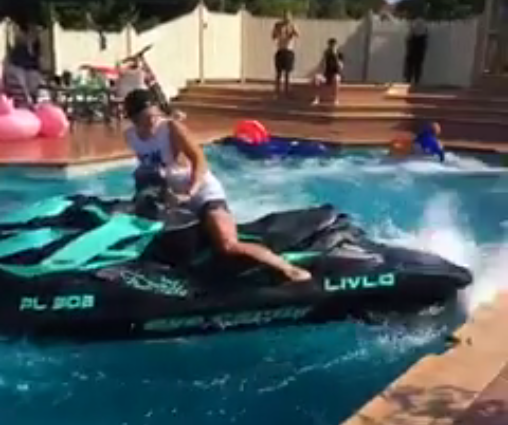
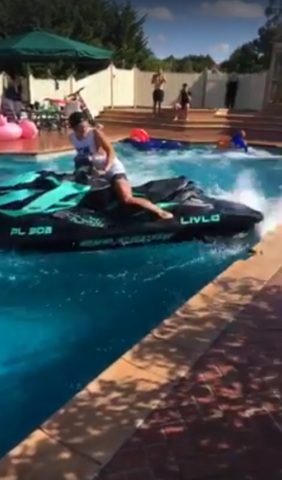
In the personal watercraft (PWC) community, one video has been making the rounds exemplifying such negligible decision making. But it bears noting that professional standup freeriders such as Mark Gomez have made a lot of headline news by performing backflips and other tricks in swimming pools. This requires a ton of skill, timing and a machine properly tuned for the close quarters. One missed entry, one slip of the throttle could spell disaster.
On January 26th, a few mates in Melbourne thought they’d celebrate Australia day in fine fashion by dragging a well-tuned and customized Sea-Doo RXP-X (dubbed “Project X”) into a friend’s pool (which had already had a dirtbike jumped into it earlier that day) and attempt to snap some turns. Unfortunately, the fiberglass Sea-Doo RXP-X made contact with the brick and concrete, smashing debris across the top of the pool. While we don’t know how the Sea-Doo’s hull fared, we can see how damaging the impact was to the pool.
For those not paying attention, the economy is banging like, hardcore. The Dow Jones Industrial has hit an all-time high for a 10th time in as many days. Equally, other financial trackers are excitedly watching industries grow at a breakneck pace. Companies are quickly making moves to relocate to more tax-friendly states while others are swinging open their doors to new hires. And this explosion is hitting the powersports world as well.
Recently, powersports equipment, riding gear and apparel juggernaut Western Power Sports sent out the call for a new IT Support Desk Technician (as well as few other full-time positions). “We are seeking individuals who are passionate about life and bring that energy to their careers,” WPS states. “As a member of our team, you will be exposed to the fast-paced powersports environment, which has experienced explosive growth over recent years. We offer competitive pay and benefits coupled with potential for career growth.”
“Love riding anything with two wheels? Four wheels? Skis? Based in beautiful Boise, Idaho, access to the great outdoors is just outside your front door,” they continue. The position is straight-forward enough: an entry level IT Support Desk Technician with an eagerness to learn, to join its fast-paced and expanding community. You’ll be required to support and maintain in-house and off-site location computer systems and desktops; including installing, diagnosing, repairing, maintaining, and upgrading hardware, software and equipment while ensuring optimal workstation performance. This role also troubleshoots problem areas in a timely and accurate fashion, and provides end user training and assistance when requested.
Obviously, some proven know-how is required but WPS emphasizes that the “ideal candidate will have excellent communication and people skills, strong analytical skills, and the ability to support a wide range of personalities at varied staff levels.” As they concluded, “If you thrive in a team environment, enjoy finding solutions to varying computer-based issues, and have a desire to break into the IT field, this is the opportunity to jumpstart your career.”
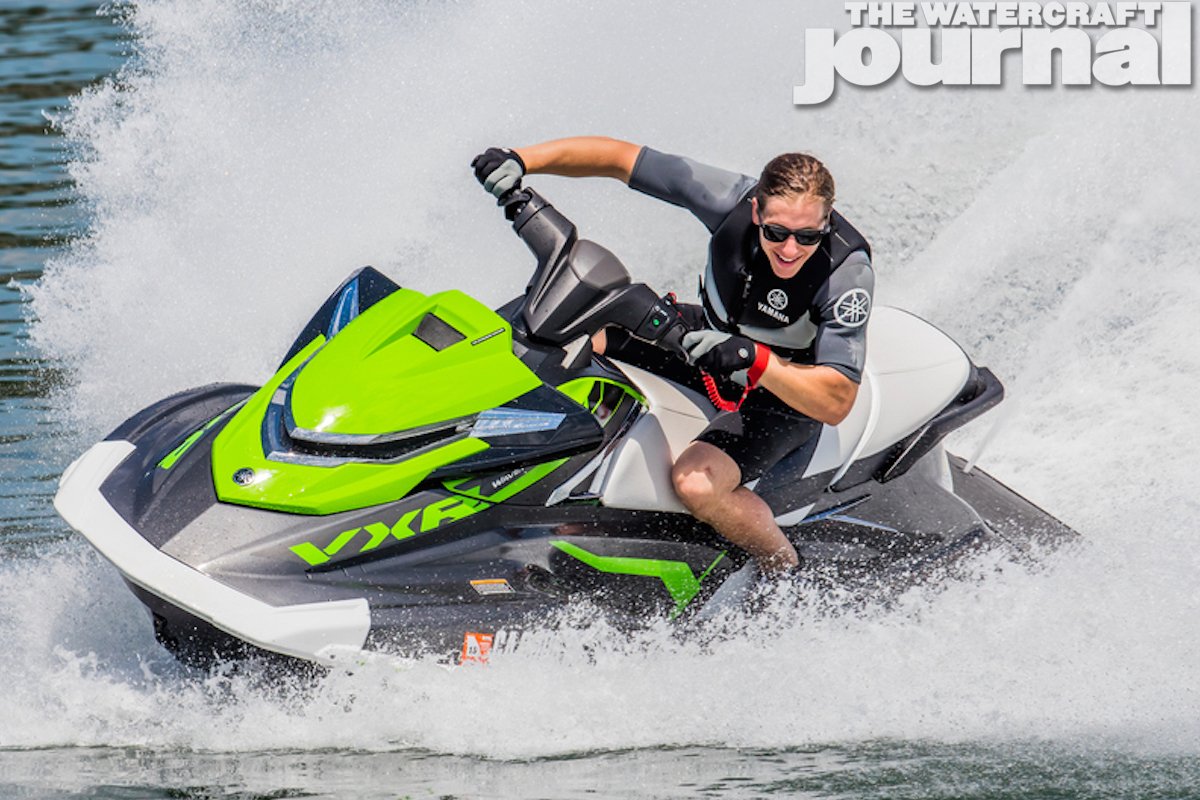
The current VX WaveRunner design configuration is now three years old, but in that time it has proven itself a formidable platform. Not only has it aptly replaced the single-most awarded runabout platform of all time (the previous VX or the now retired V1), but it also has shown that it is a watercraft for all seasons. Whether an entry level unit, a moderately-priced day cruiser, a family-friend fair weather toy, or the single most aggressive supercharged 4-stroke that Yamaha has ever produced, the VX platform out shines them all.
As Yamaha states, the VX is “the perfect combination of features, technology, and performance for the whole family starting under $10,000. This includes Yamaha’s RiDE technology, Cruise Assist and No Wake Mode, the award-winning TR-1 High Output engine, and a hull designed for 3-up stability or 1-up thrill riding.” Certainly, the entire VX lineup (and the performance-bred VXR and GP1800, which share the same design and architecture despite using Yamaha’s NanoXcel and NanoXcel2 materials) illustrate the versatility of the machine.
Whether wielding the race proven SVHO Super Vortex High Output supercharged powerplant, the naturally aspirated 1,812cc High Output 4-cylinder, or the lightweight-yet-torquey TR-1 3-cylinder 4-stroke, the VX has plenty of oomph to propel you at any desired speed. Add to it ample storage, smart instrumentation and (as mentioned) Yamaha’s intuitive dual throttle brake-and-reverse system RiDE, and you’ve got a stellar combination.
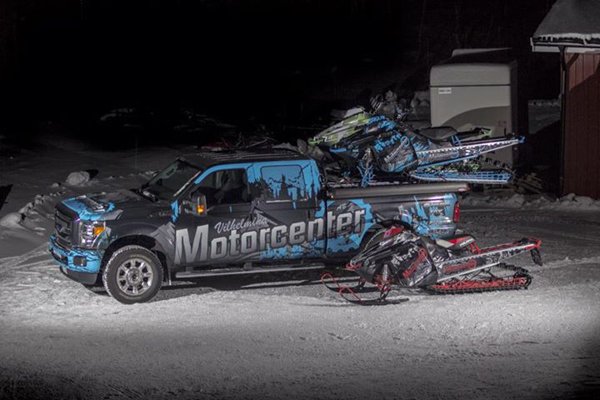
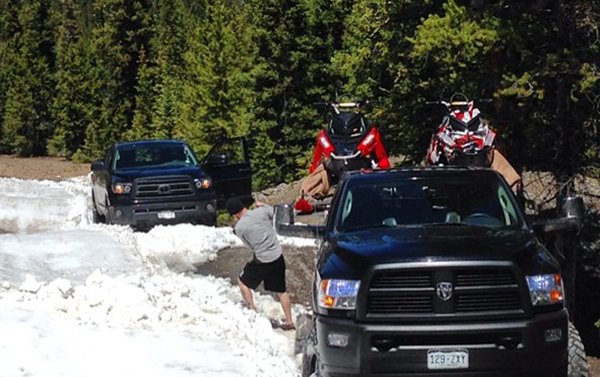
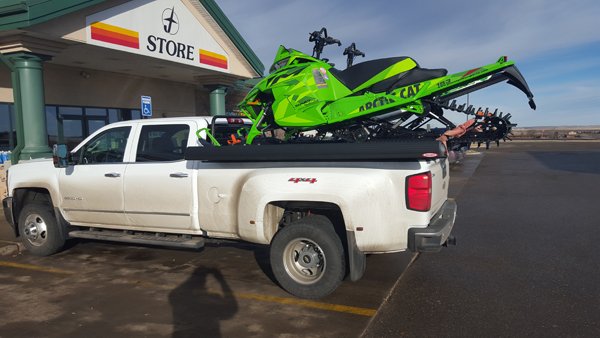
It’s been said that to best foresee the trajectory of the personal watercraft industry, one needs to only look towards snowmobiles. So much of the technology first applied to the snowmobile industry finds its way into watercraft, particularly in regards to engine design and management, but then again, that’s solely at the OE level. Many in the aftermarket equally cut the teeth of their latest products in the wintertime arena, and of those industry leaders is Truckboss Decks.
“We have been designing, manufacturing, selling and installing truck decks for over 15 years,” Truckboss’ Kent Natrass wrote. “Over 15 years of servicing this market, we listened and observed how our customers used their truck decks, what features they found lacking and how pickup trucks were evolving. After several years of concept testing and design improvements we developed our modular Truckboss product to meets these needs.”
Split between both US and Canada, Truckboss focused its early efforts in developing durable, lightweight and weatherproof truck decks for the snow and ATV markets. This began by engineering an all-aluminum system that was completely weldless. “Even when performed properly aluminum welds considerably weaken base metal strength (up to 40%), while creating start points for metal fatigue and cracking,” Natrass continued. “Our Modular System replaces welding with purpose-built aluminum extrusions to retain high base metal strength throughout every truckboss component and connection.”
And to survive the rigors of inclement weather and harsh salt deposits on roads, all Truckboss decks’ wear surfaces are treated with ExtremEtch anodizing. “This hard-wearing no-maintenance finish is an exclusive feature of our product and comes standard on every deck,” Natrass added. Years of working with avid snowmobile enthusiasts and professional riders required Truckboss to up their game. “The materials used in a standard Truckboss deck meet or exceed the fit and finish of any truck it is mounted to.”
Equally, the systems needed to be able to not only transfer from one truck to another, but outlast the truck itself. “Our product is designed to outperform and outlast anything on the market – including the trucks they are mounted to. After years of service it will transfer to another vehicle – with little effort and little or no depreciation in value,” Natrass beamed.
Since that time, Truckboss has managed to build upon its modular design, adding to it several features that have set the truck deck manufacturer at the top of its industry, one of those being the “SureSeal-Fit.” This ensures that the cargo in the bed of your truck will remain dry and safe despite the conditions outside, and when the tailgate is locked the deck provides a secure tamper-proof seal. In fact, Truckboss is the only deck system that seals around the bed rails and tailgate with a weather-proof fit.
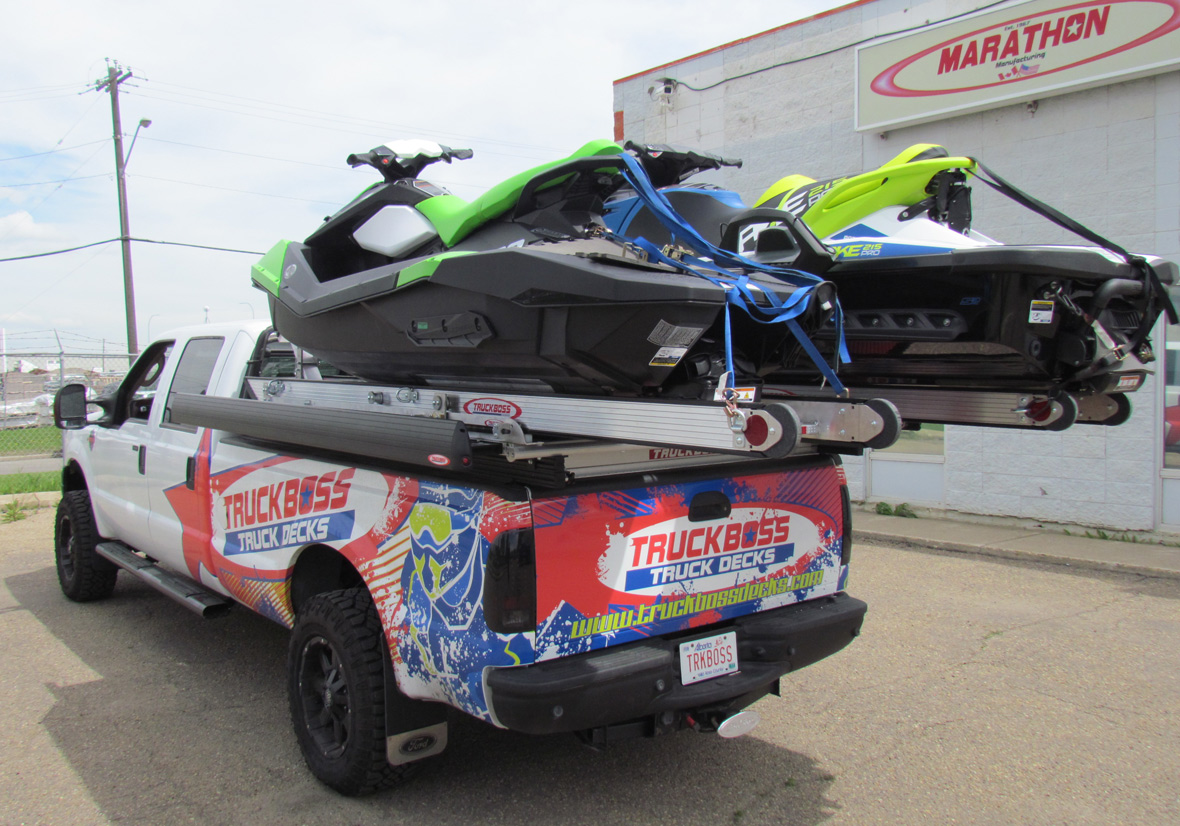
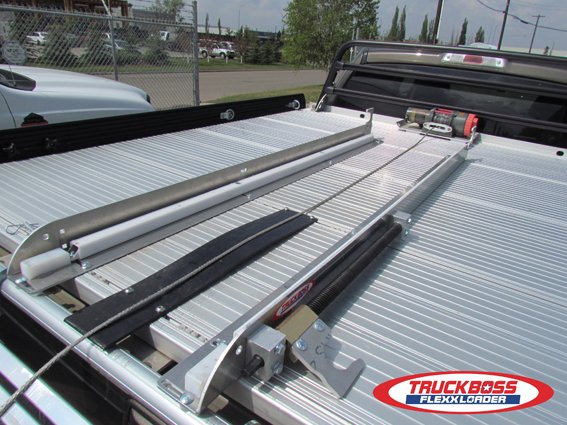
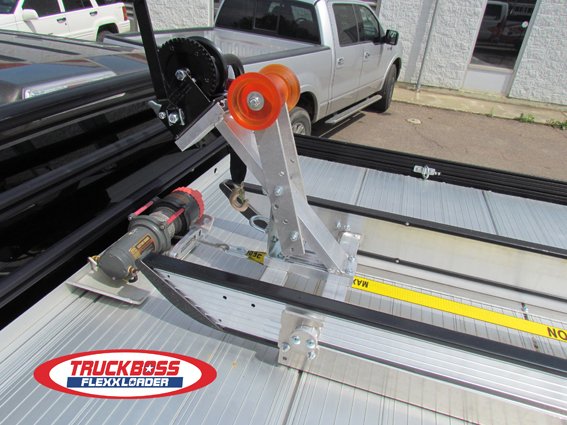
Only a few short years ago did Truckboss begin development on its first PWC application. Much of the technology created for the snow and off-road systems transferred seamlessly over to watercraft, save for a couple of items. In its original iteration, the Flexxloader provided a cart system that held the watercraft as it rode up the ramp up and onto the deck. Early last year, Truckboss made several key improvements on the Flexxloader, and developed a smoother operating, easier to secure and more diversified product.
“The [new] Flexxloader is easy and safe to load and unload using the Truckboss winch system, will allow you to unload almost anywhere – boat launches, beaches, parking lots [and] incorporates a push back system to make unloading easier and safer,” Natrass explained. “The ramp is now lighter and easier to engage, [and] with the optional buggy system, [it] becomes an ideal beach tote and a beach dock, [and] also helps with storage when you get your machines home.”
The modular aluminum construction and ExtremEtch anodizing, together with the SureSeal-Fit has never been better tested and more appropriately applied than with the PWC-focused offerings as salt water-dripping standups were first fished from the beach at the Blowsion Surf Slam two years ago. The contents of the weatherproof “Smartboxx” cargo drawer remains dry and safe from contamination even as a pair of full-sized runabouts drip-dry on the deck above, their Flexxloader racks protected from corrosion and locked in place.
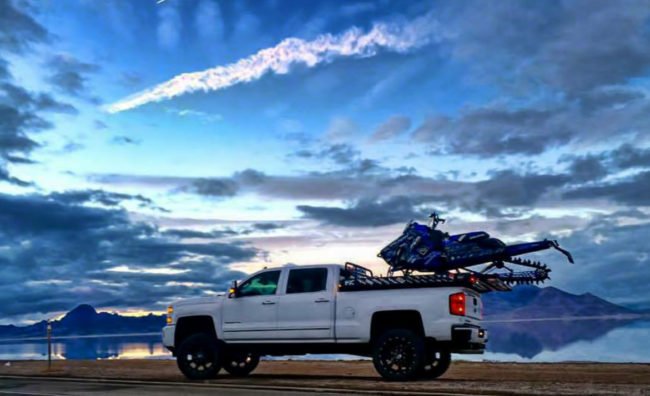
Interestingly enough, the recent innovations incorporated into the new Flexxloader have been added to the snowmobile and UTV/quad lines, bringing the Truckboss deck systems full circle. Equally, the rise of snowbikes (dirtbikes with front skis and articulated rear tread) has caused a second integration of technology – this time from the motorcycle applications to snow. It’s another testament to the flexibility of the modular Truckboss Decks design. With only some minor accessory additions, one truck deck can be used for water, snow or dirt with little effort and maximum enjoyment.
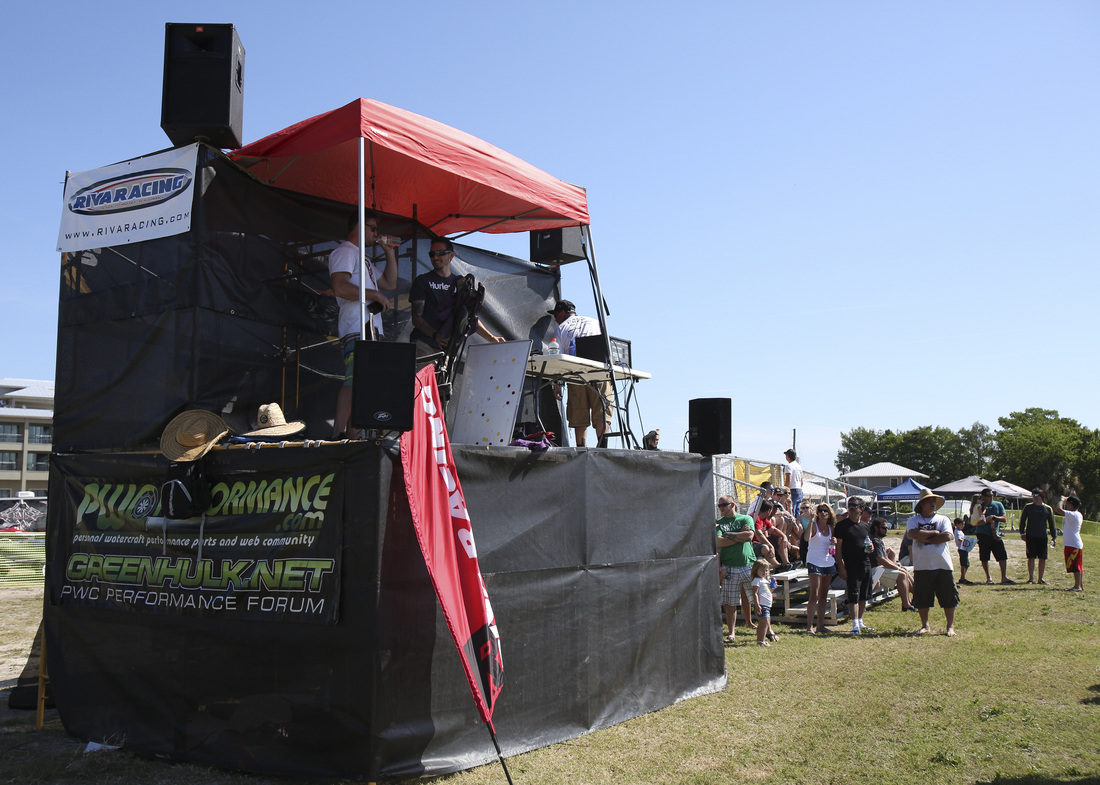
Reunited, and it feels so good! For those who were in attendance at last October’s IJSBA World Finals, you would’ve noticed a very familiar voice missing from the announcer’s tower. Mike Young, the man behind the Hydro-Turf Surf and Turf Promotions, was noticeably absent (as well as co-partner in crime, Dawn Dawson). While a recent post on the IJSBA’s website downplayed the drama, Young’s departure from the Finals – and from the IJSBA, for that matter – has come to a close, as Young will promote and organize IJSBA-sanctioned competitions in the Southern Region of the United States for 2017.
Young’s (and for that much, his Hydro-Turf Surf & Turf Promotions events) forced hiatus from the IJSBA was due to a conflict of interest: Young worked with competing PWC event organizer, AJ Handler and his growing Pro Watercross Tour last year, and the IJSBA was clearly unhappy about that, so away he went. Thankfully, it appears to be water under the bridge since Young recently paid IJSBA HQ a visit in San Francisco last week. And Young’s Surf & Turf Promotions has been welcomed back into the fold, with its schedule and many other goodies, such as race results and announcements found here.
Meanwhile, RonnyMac is hard at work with the rebirth of the IJSBA website. We are all anxiously awaiting the new design, which should be live within the next couple of weeks. In the meantime, you can still check out the old website.









 “Australia Day” was a month ago and people are still calling in sick from the hangovers. What once was the official “National Day of Australia” to celebrate the anniversary of the 1788 arrival of the First Fleet of British Ships at Port Jackson, New South Wales, and the raising of the Flag of Great Britain at Sydney Cove by Governor Arthur Phillip – today, Australia Day celebrates “the diverse society and landscape of the nation,” according to Wikipedia, and is noted for BBQs, beach parties and a lot of questionable behavior.