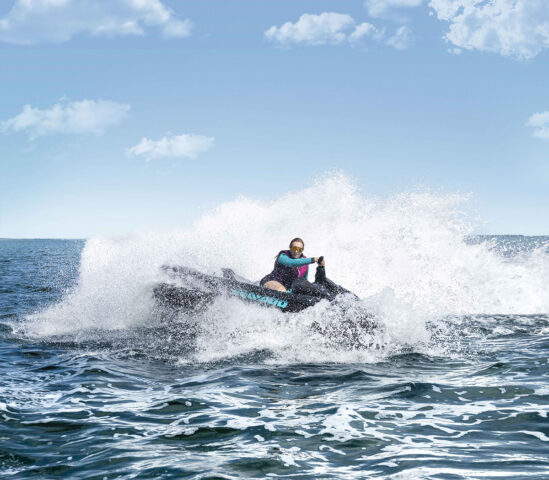
While it certainly isn’t every day that we see PWCs as a topic in Forbes magazine, it’s no surprise that world-class Big Wave Surfer Garrett McNamara would be at the center of such a story.
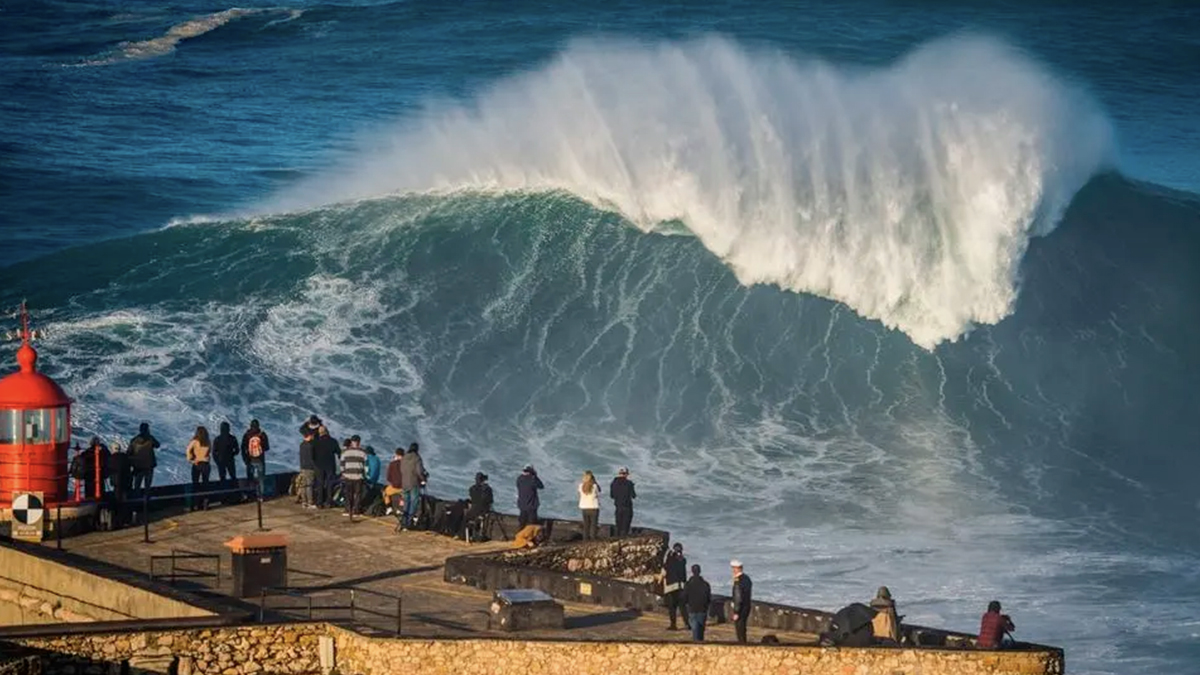
In a recent piece for the magazine, McNamara takes Forbes contributor Jim Clash out on jet skis at the notorious wave at Nazaré, Portugal, to bring the adventure writer up close and personal with this legendary wave.
In fact, Garrett McNamara is widely acknowledged for bringing about Nazaré’s recognition as a premier destination for world-class big wave surfing, when, on November 1, 2011, he set the world record for the largest wave ever surfed at 78 feet. The Hawaiian surfer has since dedicated much of his time to fostering the surfing community in Nazaré, an otherwise quiet fishing village just north of Lisbon. His accomplishment – which would later be turned into the HBO Docuseries 100 Foot Wave – set the stage for subsequent world-record breakers Rodrigo Koxa (80 feet) and Sebastian Steudtner (86 feet) at the same site.
In the Forbes piece, Clash recounts his time out on the PWC with McNamara, riding on waves of over 60 feet at times.
McNamara tells Forbes, “…we rode horizontally across the top of a 60- to 70-foot wave and watched it break under us. You could see how far down the face was, with the [Praia do Norte] lighthouse in the background. It gives a great perspective of what we, as surfers, deal with. From where you were, you could totally understand what it would look like to drop into a big wave [without doing so].”
The drama didn’t end there either, as Clash writes of the nearly disastrous flip of their Jet Ski among the waves. While everything turned out safely without casualties, that kind of accident could be catastrophic if another wave had hit at the wrong time.
To read the full story, check out Clash’s write-up for Forbes here.
While there are tons of useful knots that can be used while working with personal watercraft, the Bowline is easily one of the most important for anyone working with boats, jet skis, or just about anything on the water.
For those who aren’t yet familiar, the bowline knot is a knot used to create the loop at the end of a dockline. While some dock lines may come with a loop built in, the bowline knot is an easy way to create a strong, reliable loop at the end of any line. This allows PWC users to connect to tow points, cleats, dock pilings, and a wide variety of other uses.
The bowline knot is particularly useful because it won’t jam or slip, even under intense strain, but it can be easily loosened just by using one’s finger. In the video by JetBoatPilot, we’re walked through both the easy way, and the fast way to make this knot, making it a valuable primer for just about everyone.
If you don’t know how to tie one yet, check out the video from JetBoatPilot below to add a super useful tool to your arsenal of PWC skills.
You can learn about other handy-to-know knots in this tutorial.
A spate of sedate color schemes seem to be desaturating much of the PWC world lately, with toned-down colors and muted hues popping up in everything from rash guards to wetsuits to ski graphics.
Unlimited PWC Products, however, is having none of that nonsense! With a push of product teases and highlights over the past few months, the performance parts and apparel brand – already known for the style and flare of their offerings – has splashed bold and eye-catching color across their website and social media pages, on everything from race gear to engine parts.
And Unlimited customers are tickled (Neon) pink (and blue, and green, and highlighter yellow) about the anything-but-boring aesthetic.
With a personality that harkens back to the 80s and 90s retro style, but updated with imaginative color blocking, modern detailing, and advanced materials, Unlimited is putting some pizazz back in the PWC game. The move is one finding favor with many recreational riders who are looking for gear and decked-out skis that look as fun as the adventures they head out on. The look is also one that has secured the attention of some well known names in the PWC race world, as evidenced by Raphael Maurin and Valentina Lezcano.
Yamaha Motor Corp. USA has an unfailing grip on the jet boat market. Retaining nearly 80-percent of all total jet boat sales in the world, Yamaha is unequivocally the industry leader in this regard. But with boats exceeding $36,000 for its lowest entry point, many looking for something priced like a personal watercraft but needing a larger vessel like a jet boat are priced out of the market. That is, until recently if what we are seeing here comes to fruition…
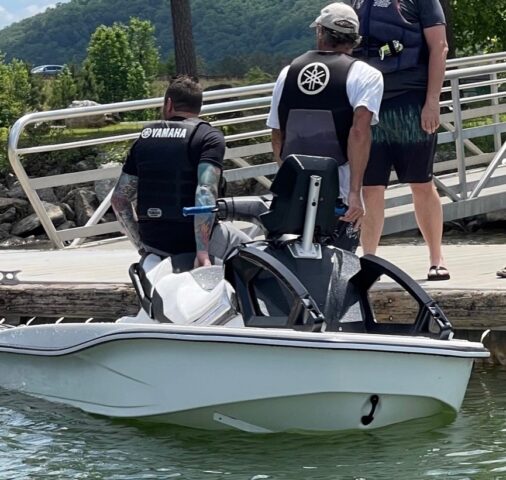
Over the weekend, social media was buzzing with speculation after a grainy cell phone image emerged of Yamaha Motor Corp. USA engineers testing a prototype WaveRunner-based vessel. Snapped from a passing boat on Allatoona Lake, the spied prototype employs existing FX WaveRunner seats, handlebars and portions of the deck; the dashboard, forward fairings and bow storage have been replaced by a durable – albeit temporary – structure and large digital screen standing on an aluminum strut.
Appearing to have large foot-to-two foot wide footwells and a thick gunwale, the Yamaha boat rides on a widened hull with a deep-set outside chine and splash deflector. Observers were quick to note that the prototype appeared to be incomplete and wholly missing its top deck cover. Powered by an existing TR-1 3-cylinder or new-for-2024 1.9L High Output marine engine, this Yamaha boat would enjoy the reliability of the WaveRunner jet-drive propulsion system and fuel delivery system.
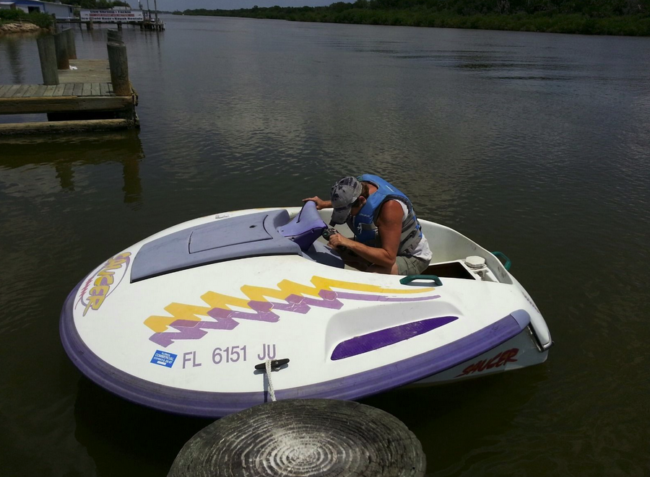
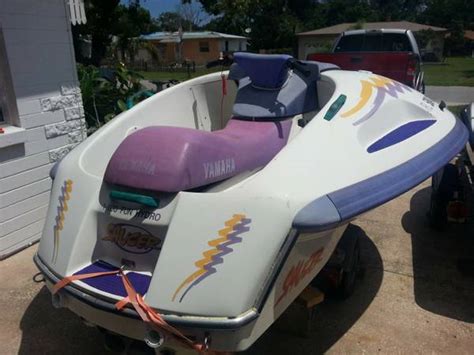
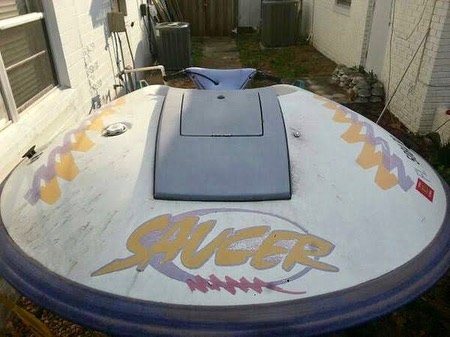
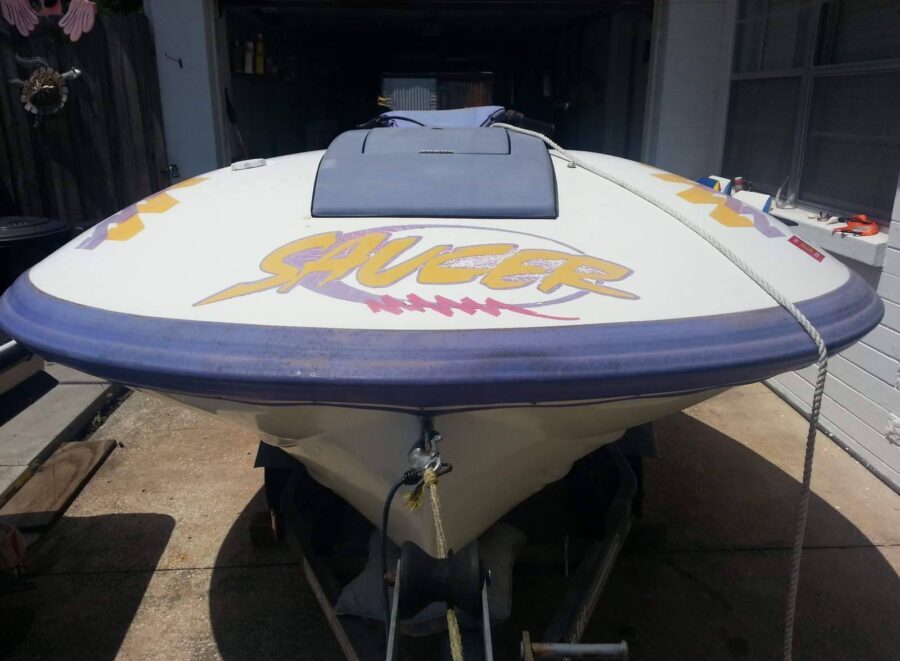
When rendered to cover the boat’s large width and low-slung profile, a handful over commenters were reminded of the short-lived “Sea Saucer,” a limited-run of 300 rental units based upon the WaveRunner 650 in 1996. For those who recall, the Sea Saucer dramatically widened the 2-seater WaveRunner 650, making tipping and rollovers neigh impossible; the massive 12-foot length and similar width also provided renters plenty of protection from impacts or collisions with other boaters.
While an unofficial product not sold through Yamaha dealerships, a small handful of rental outfits were able to purchase the Sea Saucer through official channels as a WaveRunner. It is rare to find much online regarding the Sea Saucer and rarer still to see pictures of one still in use. Yet, as Yamaha Motor Corp. USA seeks to expand its boating market, designing a WaveRunner that manages to bridge its personal watercraft division with its massive jet boat market presence could be a massive boon to the brand.
Alas, what we have to go off of here is almost entirely speculative. For all we know, this is a “test buck,” a rough-but-functional craft used solely to “durability test” different powertrain components (or otherwise). Considering Yamaha just recently introduced a new 1.9-liter naturally-aspirated 4-stroke, which was revealed to consume fuel at the same rate of the outgoing SVHO engine, we might be seeing engineers troubleshooting the new engine’s fuel consumption issues. So again, this is entirely speculative.
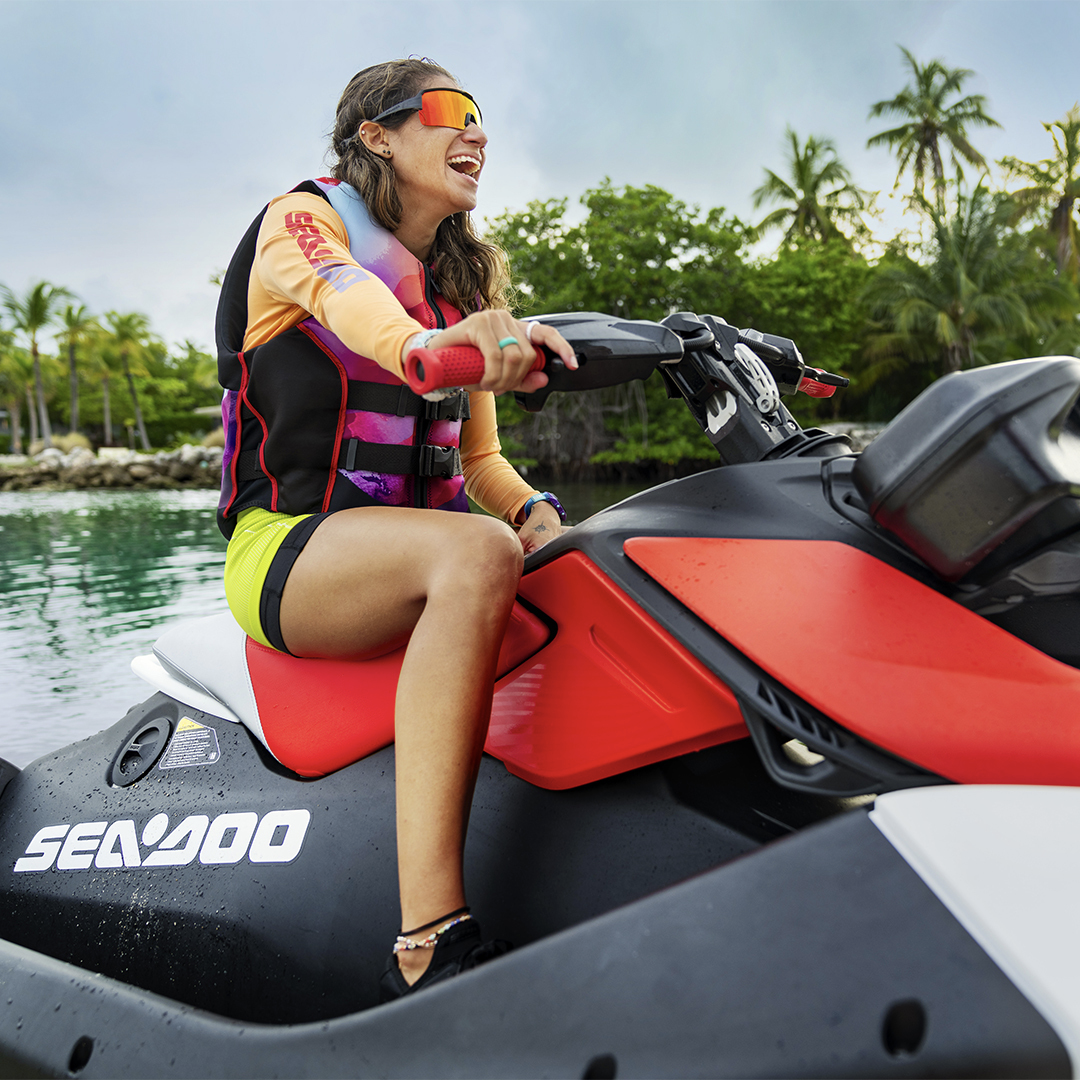
If, like us, you’re already looking ahead to those gorgeous Summer days out on the water, it might be about time to consider ordering a new watercraft for the season from our friends over at Cycle Springs Powersports. They’re offering a wide array of watercraft as we approach the season, with some real gems to highlight from the 2024 Sea-Doo lineup.
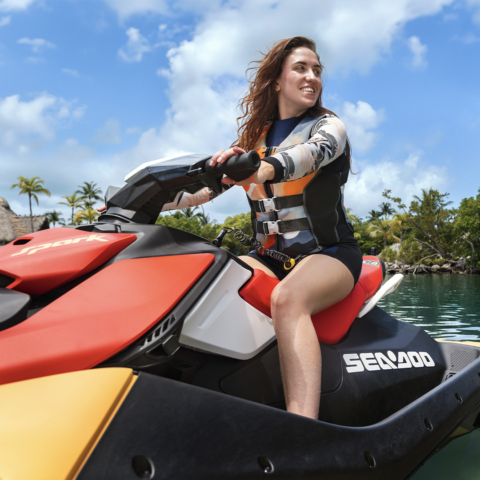
In a Facbook Post from earlier this year, they promote “Lightweight, compact and fuel-efficient, the 2024 Sea-Doo Spark is your passport to aquatic adventures. Easy to maneuver and designed for fun on the water, it’s the perfect fit for riders of all levels.” A quick visit to their online catalog shows the versatility of this affordable PWC, loaded to the brim with useful features, making it an accessible pick for a wide variety of riders, from enthusiasts to amateurs, without sacrificing an ounce of quality or power.
A little more exploration of their online catalog will bring up the 2024 Sea-Doo RXP-X, a jetski lauded for its new 325hp Rotax ACE engine, which is currently the most powerful jet ski engine out of the box! This kind of power is a boost for the most dedicated of racers, allowing you to boost from 0-60mph in a mere 3.4 seconds.
In another FaceBook post Cycle Springs promotes Sea-Doo’s line of fishing PWC, writing: “Capture thrills on the Sea-Doo FishPro personal watercraft. Enjoy hands-free fishing with rod holders and speed adjustment without touching the throttle. You’ve never fished close to wildlife like this before!” Again, they manage to show the full range and versatility of the Sea-Doo craft they’re offering this year.
Whether you’re a life-long fisher, a PWC enthusiast, or a dedicated racer– or if you’re just looking to try your hand at a new sport – be sure to check out the great deals on Sea-Doo 2024 offerings from Cycle Springs Powersports
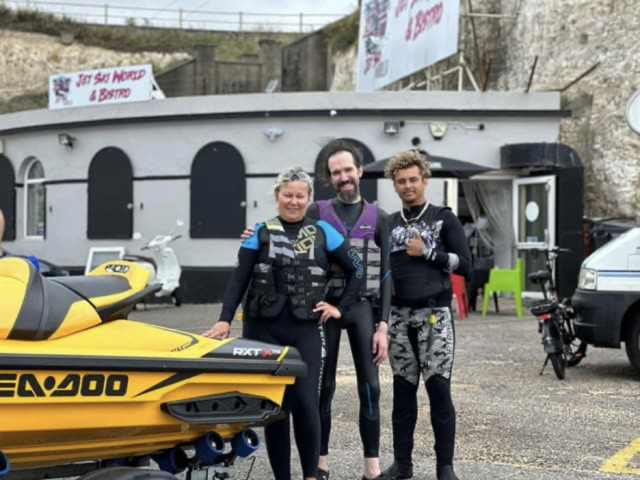
In a move that signals a fresh chapter for Palm Bay’s Jet Ski World, the young Joshua Komolangan, at only 18 years old, has taken the reins alongside his father Neil Logan.
Jet Ski World operates a Jet Ski Zone in Palm Bay in Kent, UK – a designated waterski area set in a large natural bay, below the shelter of chalk cliffs, between Margate and Broadstairs that has been designated for powered water sports by Thanet District Council.
The duo seized the opportunity in July, infusing the establishment with new energy and vision. With a total investment of £180,000 (roughly $230,350), they’ve enacted a comprehensive renovation, breathing new life into the popular site at Hodges Gap.
Joshua, already making waves as the UK’s youngest RYA (Royal Yacht Association) instructor, is now poised to lead the charge in establishing a cutting-edge training center for watercraft proficiency. Having obtained his qualifications promptly upon turning 18, his passion for personal watercraft and dedication to safety drive him as he works to train fellow enthusiasts in the Margate area. They promise one-day proficiency courses that will equip jet skiers and power boaters with the skills necessary to ensure their safety and competence on the water.
Josh’s bond with his dad extends comfortably into the business realm, with Neil’s guidance complementing Joshua’s youthful vigor. Reflecting on his journey, Joshua told The Isle of Thanet News, “I have been into the sport for years and been doing it since I was extremely young. We (Josh and dad) have been going to Jet Ski World for a long time and there have been different owners”
The transformation extends beyond the water, as the Jet Ski World café undergoes a complete makeover. With a revamped interior, updated menu, and an array of events on the horizon, the venue promises an enhanced experience for patrons. Neil emphasizes the family-centric ethos driving their project, highlighting the involvement of his wife Isabelle and daughter Amelia in the operation.
Despite their bustling schedule, which includes managing care homes in Margate, the family remains undeterred in their commitment to Jet Ski World’s success. In fact, Joshua’s dual role as a full-time care worker and budding manager underscores his determination to excel in everything he does.
As Jet Ski World prepares to unveil its new training center, complete with instructor courses and proficiency training, the Margate community eagerly anticipates the dawn of a thrilling era in watersports education. With Joshua and Neil at the helm, the future looks brighter than ever for enthusiasts seeking both adventure and safety on the waves.
As Paris continues warming up for the Olympics, a small contingent of the 2024 Summer Games competitors will be jetting down to Tahiti to prepare for a wholly different class of competition. For the second-ever Olympic surf competition, competitors from all over the world will converge on this small Polynesian island to tackle world-class waves in an area steeped in surf mythology.
While, of course, there are plenty of viable surf locations much nearer to Paris throughout France and Europe, the conditions at Teahupo’o, a small corner of the Southwest Tahiti Iti peninsula, offer surfers and viewers alike a truly incomparable experience.
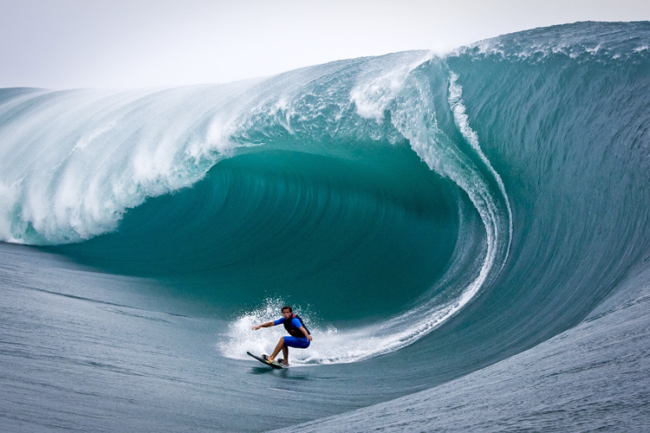
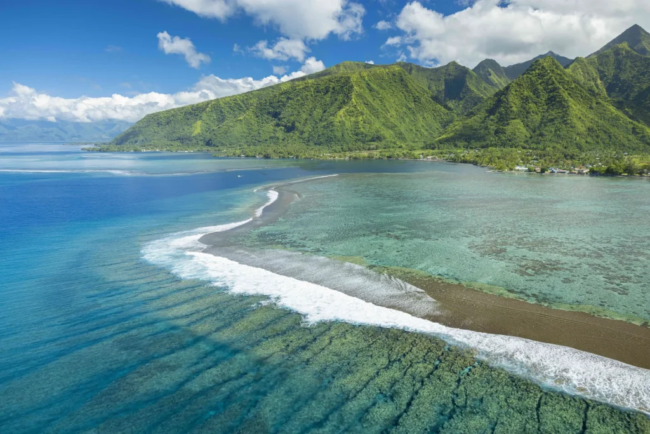
Clocking in at 20 feet, the wave at Teahupo’o is far from the world’s tallest. Instead, it’s the wave’s impressive weight that brings the challenge. Teahupo’o is formed over the top of sharp, steep coral, which causes it to rise up sharply and crash with massive force. It is propelled by a heavy surge of water which can seem to rise up from nowhere before crashing down around the barrel.
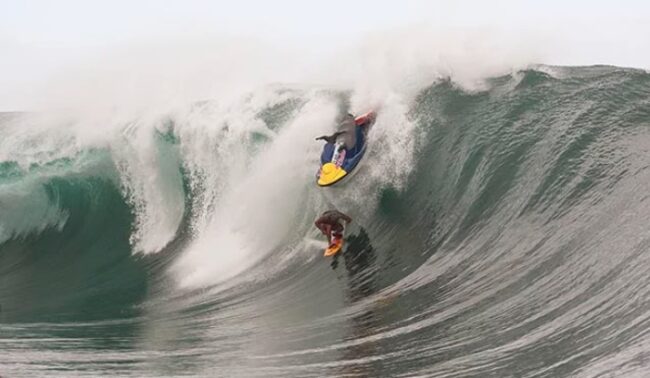
The intensity is epic – epic enough that Teahupo’o is even known in the PWC world as the location of one of the most infamous tow-in crashes in PWC and surfing history. As reported in 2016 by The Watercraft Journal, 2005 saw a huge influx of surfers to Tahiti as record swells amped up the action at the already-challenging Teahupo’o site, and an inexperienced PWC rider ended up towing a surfer buddy out into the chop. And that’s when things went sideways.
“There was big chop on the waves and it was a little stormy on that crazy day in May. This was definitely no place for a dude with no driving skills to attempt towing a surfer into a wave,” reports stated. “Bastolaer almost paid the ultimate price for their actions. The ski that McIntosh was steering was literally picked up by a thick heaving wave. He bailed off the back after losing control, leaving the jet ski alone in the surf. That’s when the riderless machine tumbled precisely over Bastolaer’s head while both were within the confines of a massive barreling wave. It’s amazing that he wasn’t hit by the ski and came out unscathed. We aren’t so sure about the watercraft though.”
You can check out the video of the crash – one that hopefully will not be repeated as Teahupo’o continues to prepare for the Olympic Surf Competition – one that is drawing more and more interest from not only fans of the Olympic competitions, but surfers and sport aficionados as word of Teahupo’os reputation and history gains momentum.
Apart from its strength, Teahupo’o draws in surfers with its rich history as well. The wave is found on the island of Tahiti in Polynesia, where surf originated in the 12th century as a sport for the island’s royalty. As for the Teahupo’o wave itself, the first recorded surfer here was a woman from the island of Raiatea in the 19th century. Many years later, in the 1980s and 90s, professional surfers returned to the area to tackle what many consider to be the world’s toughest wave.
The Olympics may bring a major draw to the surf opportunities in this remote part of the island, but for those who call Tahiti Iti home, along with those who have been making the trek to surf this wave for years, Teahupo’o’s draw goes beyond the adrenaline and hype. To hear those who have visited talk about the undeveloped shorelines–where they’d lay back and delight in Hinano beer, poisson cru, homemade jams, and chili oils–is to hear them talk of a paradise. They speak of the Mana, the Polynesian word for the spiritual energy which envelops this land.
Because of this, there will be considerations to ensure the ecological sanctity of the area, both before and after the Olympics. Olympians will be housed on boats offshore, to protect the reef and negate the need for development in the area. Islanders have already made strong opposition to the construction of a judge’s tower on the reef.
As July 27 approaches, be sure to keep an eye out for the epic water sports that will take place at Teahupo’o, to get a view of the sheer might of the ocean at one of her most legendary frontiers.
As the Olympics come closer, be sure to read Jen Murphy’s full write-up for Robb Report on her experiences and conversations with locals in Teahupo’o.
International Women’s Day may have sped by, but Yamaha knows a good thing when they see it, and they have turned the one-day recognition of the efforts, achievements and triumphs of women, especially those in the PWC world, into an ongoing effort and initiative.
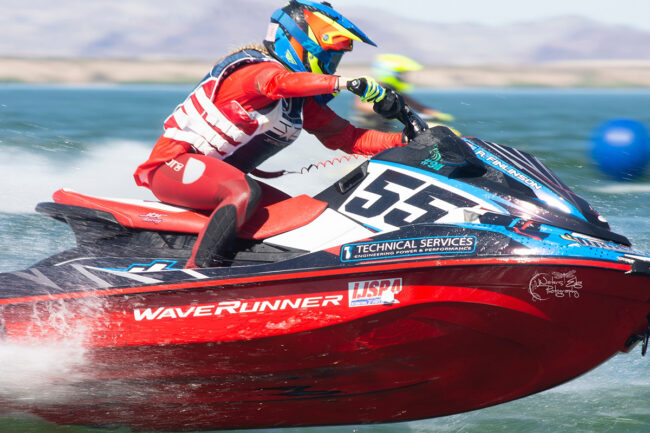
Highlighting one of the most well-known, and most talented, among the elite cadre of women racers in the PWC sport, Yamaha recently put the spotlight on Sophie Francis, saying “International Women’s Day celebrates the incredible achievements of women who defy expectations and rewrite history. Meet Sophie Francis, a true trailblazer in professional watercraft racing. Sophie made history as the FIRST woman in P1 AquaX racing history to clinch a podium finish in the fiercely competitive Pro Enduro class, dominated by male athletes. What makes Sophie’s victory even more remarkable? She achieved this incredible feat just three months after having a baby.”
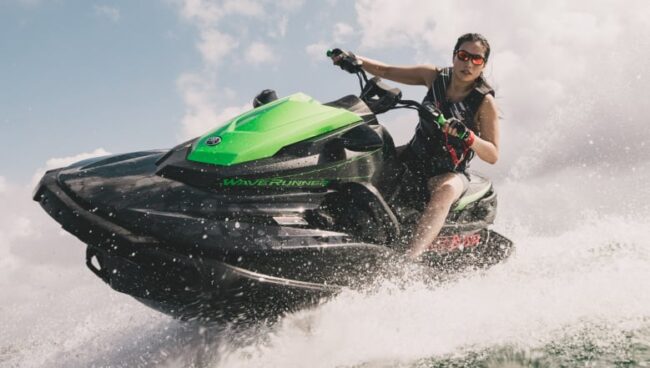
And while Sophie Francis is an apt and appropriate representative of what the women of this sport can accomplish, Yamaha is taking the heart and soul behind International Women’s Day – the celebration of all the phenomenal women who are rewriting the rules, breaking barriers, and making history – and is launching Women Run The Water, a movement that encourages and supports women who want to take control of their boating or personal watercraft experience.
Learn more about Yamaha’s Women Run the Water initiative and be sure to explore their resource library, as well as inventory of 2024 WaveRunners as well as a website full of tips, technical information, deals and ideas.
It’s been a good while since The Watercraft Journal has published an episode of “Vicious Rumors & Vile Gossip” and that’s because frankly, we haven’t encountered much in the way of verifiable leaked info. But not so when it came to future Kawasaki JetSkis. We’ve been pretty spot-on for Team Green over the years:
So when WCJ discovered that Kawasaki’s legal department had filed not one, not two but 22 patents for new designs, innovations and technologies for future JetSkis, we were floored. The first 8 patents, which are all hyperlinked in the text below and can be downloaded for better viewing, all pertain to features and designs on existing JetSkis.
Geo-Locating, Quick Retrieval & a Digital Anchor
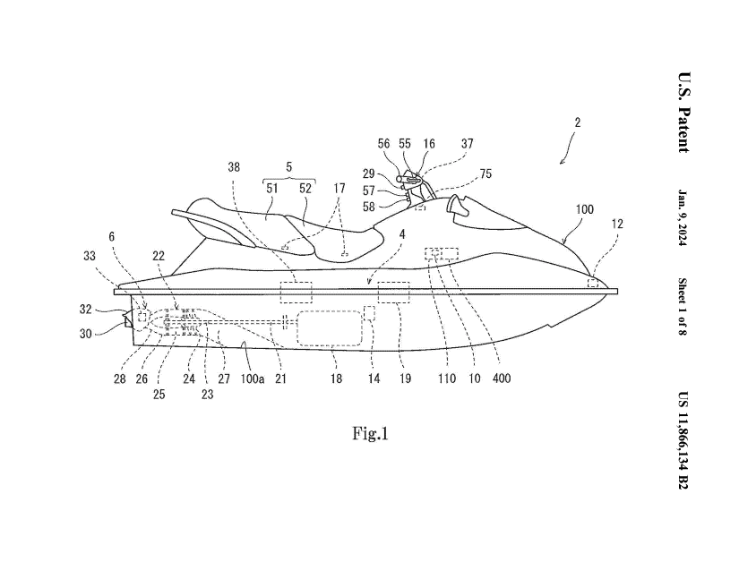
Within the document labeled US 11866134 B2 we get details how the watercraft can be operated without a rider by using a low-speed battery-powered electric drive-and-control system [a secondary propulsion system to the internal combustion engine –Ed.]. Yes, you read that right, Kawasaki’s working on a self-driving JetSki.
Imagine you’ve stopped at a sand bar. The tide comes in and the ski begins to drift away before you catch it. Suddenly, a signal alerts a secondary ECU within the ski to ignite a battery-powered drive system (US 2023/0097457 A1). The pump silently whirls to life and servos manipulate the nozzle cable, directing the ski back to its original location.
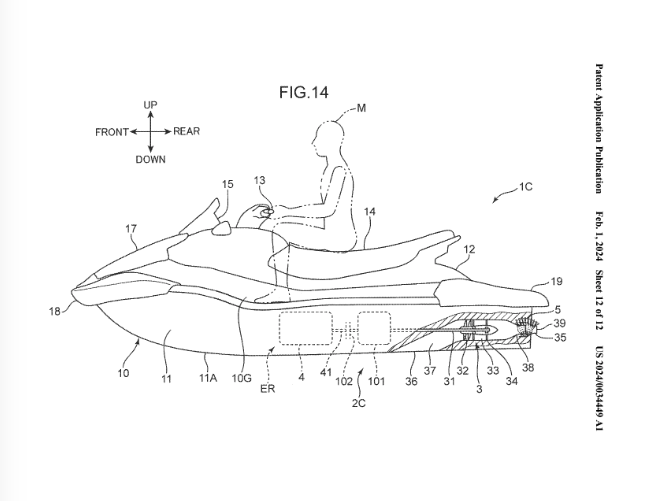
Patent US 2024/0034449 A1 is the first of three “Calling System” patents; a geo-locator that first identifies the JetSki on a GPS (global positioning system) grid; secondly, marks its current location on the grid and maps a path back to its previously marked location (where you last parked on the sand bar, in this example) carefully avoiding marked obstacles.
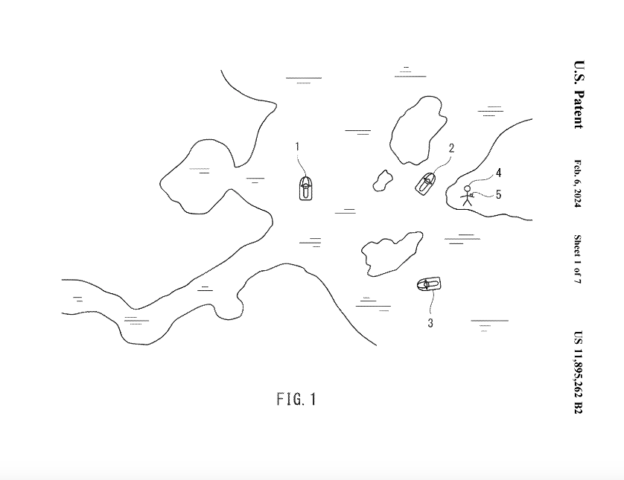
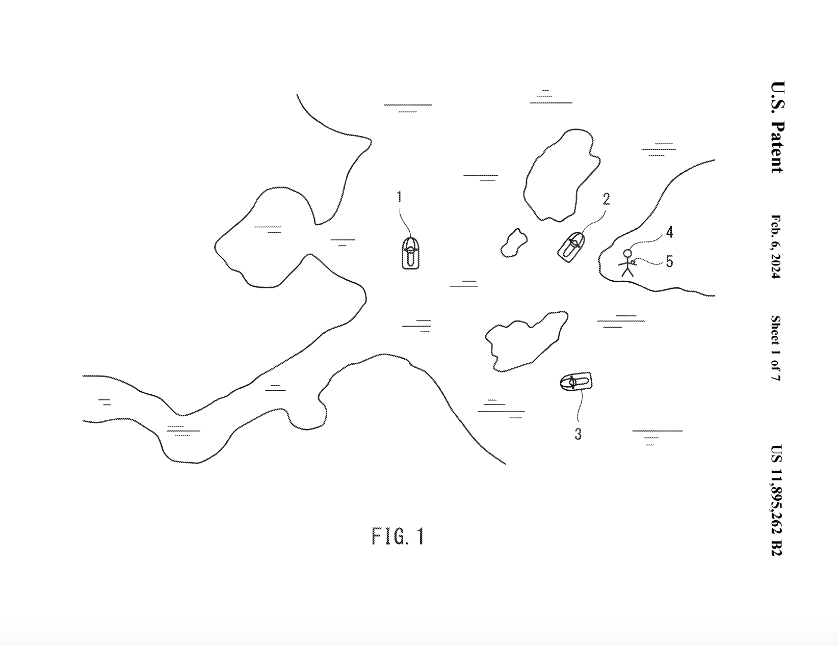
The second of three “Calling System” patents – titled US 11895262 B2 – allows this new system to not only identify its position as well as calculate the rate of speed wherein it traveled from the last pinned location (allowing it to evaluate whether the ski drifted away or the rider fell off at speed) but it also can communicate with other similarly-equipped skis.
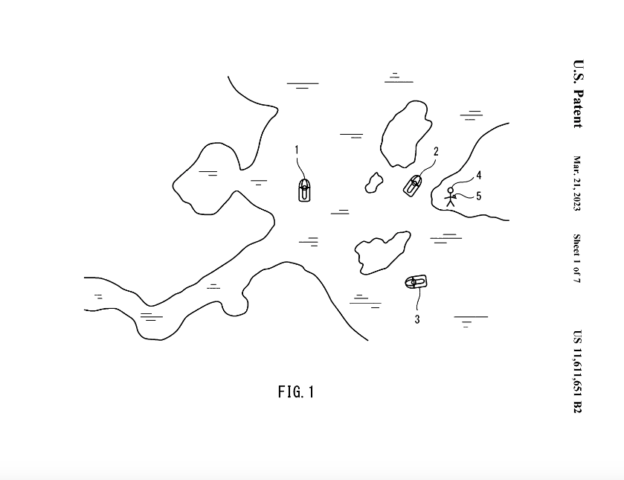
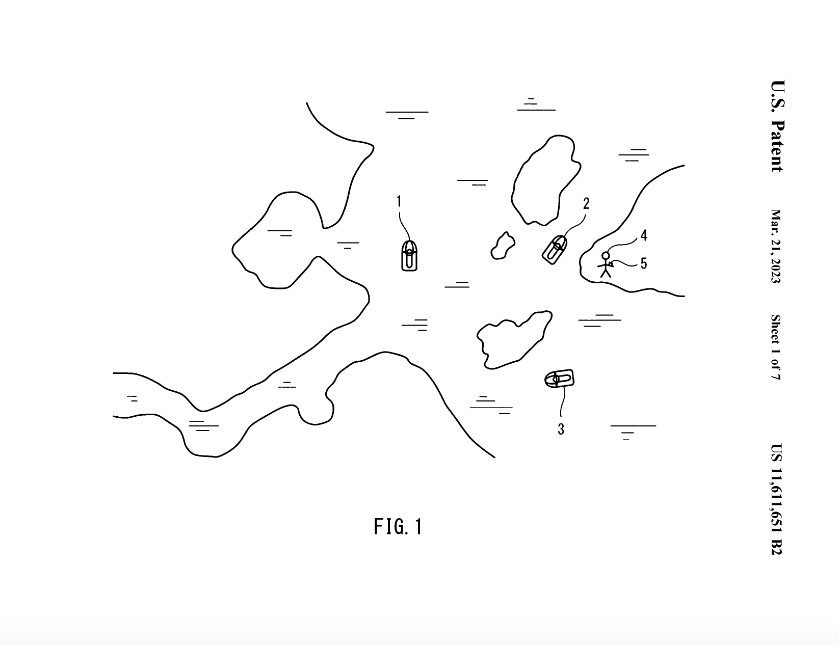
This slow-speed operation “retrieval system” has a secondary function, that of driver retrieval. The secondary ECU – patent US 11611651 B2 – will recognize the specific parameters common to a rider falling off and will engage the electric drive to return to the last GPS marker where the lanyard was removed, bringing itself back closer to the ejected rider.
Additionally, this ability for the JetSki to maintain itself near silently through a GPS-controlled electric drive system permits the “Calling System” to serve as a digital anchor. So rather than weighing an anchor overboard, a fisherman can engage the GPS locator by removing his rod from a special rod holder – indicating that he is wanting to remain stationary – and allow the electric drive to keep you steady for hours.
Collision Avoidance & Tracking
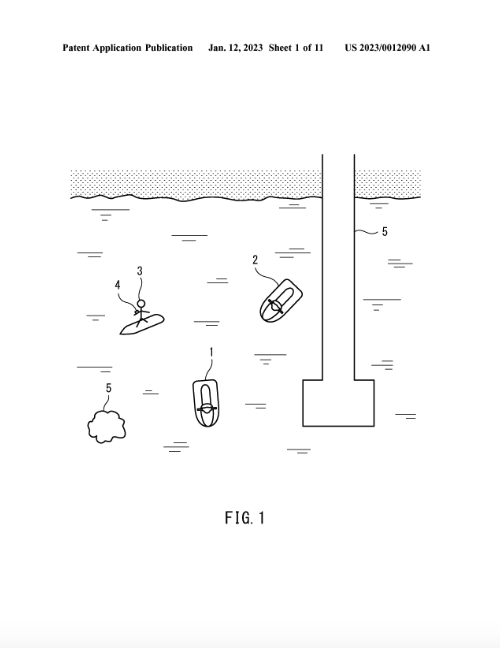
The above systems hinge upon the watercraft’s GPS signature, which all current Ultra JetSkis currently have (via its GPS-tracked speedometer). As part of the aforementioned patent, US 11895262 B2 a companion patent – US 2023/0012090 A1 – not only alerts the rider to possible collisions with stationary objects but other watercraft in motion as well.
Communicated through the TFT digital dashboard already on current Ultras, a full-color GPS aerial image will identify your JetSki, the local topography, marinas, etc. as well as other vessels – providing alerts if the GPS tracks vessels approaching at high speeds as well as periphery warnings for nearby obstacles [think blind spot alerts on modern cars –Ed.]
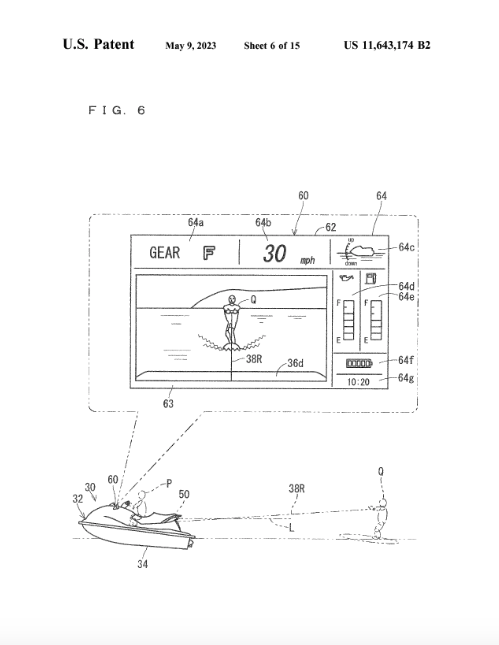
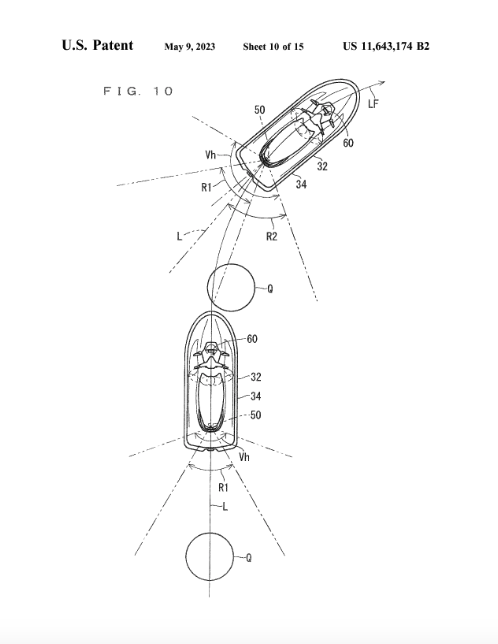
As much as the current TFT dashboard is designed to operate in this sphere, so is your rearward-facing camera: patent US 11643174 B2 details that all rearward-facing cameras are operating at a fraction of their capacity. These cameras will feed vital footage to the image processing software in a standalone CPU that will calculate your JetSki’s location in relation to obstacles and other watercraft.
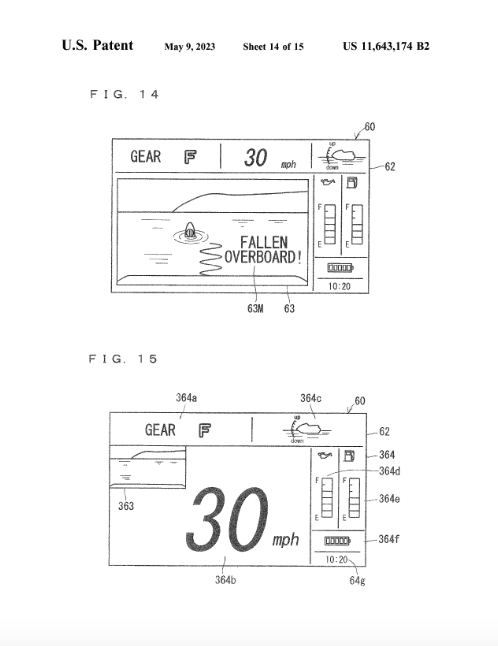
Equally, the camera when used for towing skiers or towables also has the capacity to alert the driver (through the TFT dashboard) when your skier or raft passengers have “detached,” displaying an “overboard!” notification on the screen. Using the previous GPS marking software, it will also pin the last location of the fallen passenger for quick retrieval.
Of course, with this degree of GPS-tracking the Kawasaki’s TFT dashboard will now be able to provide some of the most detailed travel history data. Whether linked through your mobile device’s Bluetooth connectivity or a nearby WiFi signal, the CPU’s communication interface will be able to store terabytes of storage through internet connectivity.
Outlined in patent US 2023/0029055 A1 the new tracking capabilities will monitor GPS routes via a series of digital breadcrumbs, correlating in vehicle speed, throttle position, fuel consumption and several other factors that will equip you “long hauler” riders with some of the best data gathering available on a personal watercraft.
Water-Cooled Turbos & Electric Superchargers
If all of this high tech wizardry didn’t get you excited maybe this will: Kawasaki is developing its own double-walled, liquid-cooled turbocharger. The single-greatest hurdle for OE’s offering a turbocharged performance watercraft was heat mitigation. Turbos and their circuitous plumbing raise engine compartment temperatures far worse than superchargers.
By developing a water-jacketed turbocharger and plumbing system as outlined in patent US 11808163 B2, the cast aluminum inner housing can be enshrouded in either a second cast aluminum case or cast steel (although the patent does not restrict what materials can or will be used). This will also keep intake charges cooler and mitigate heat soak over long durations.
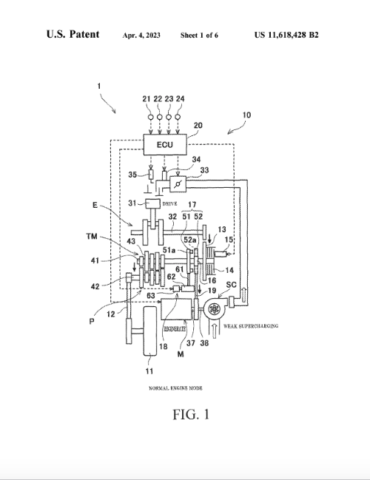
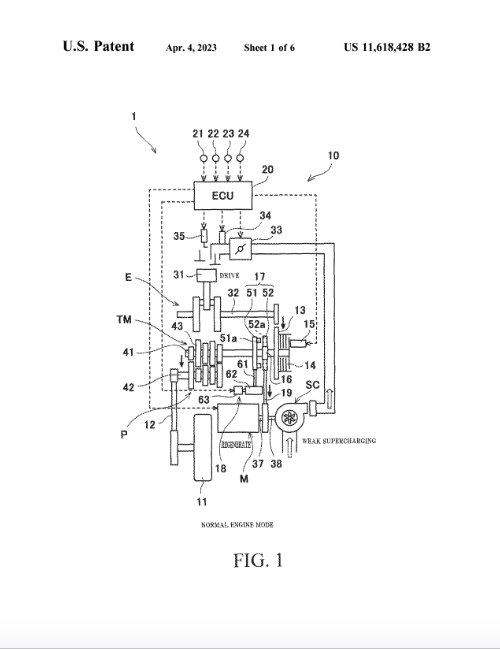
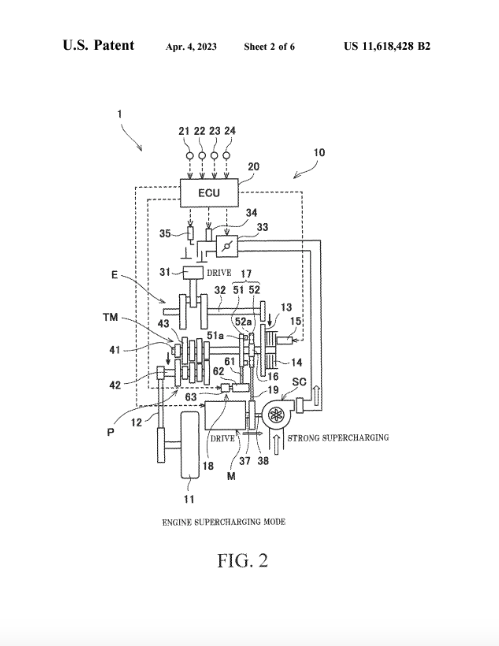
More intriguing than Kawasaki’s new marinized turbocharger is its electrically-driven supercharger. Filed as patent US 11618428 B2, the design details a method wherein the supercharger can be driven by the combustion engine, then via an electric clutch, disengaged from the mechanical drive, and when commanded, driven by an electric motor.
This would free up the combustion engine to operate at greater efficiency as the electric motor driving the supercharger would eliminate all parasitic loss or driving the supercharger.
Moreover, the electric motor can spin the supercharger at a greater RPM than what the internal combustion engine can spin, radically increasing boost, and thereby, horsepower.
Offshore racers have been employing aftermarket turbocharging systems for over a dozen years with tremendous success: both in performance as well as fuel efficiency and engine longevity. Equally, being able to free up the current internal combustion engine of parasitic loss (drag) and spinning the supercharger up above normal boost speeds all point at incredible power outputs from even the existing 1.5-liter 1,498cc 4-cylinder engine.
While there is zero indication of this within the leaked documents, the implication of a potential compound supercharged induction system is undeniable. An aftermarket tuner employing portions of both forced-induction systems presented above – a water-cooled turbo multiplying the compressed atmosphere generated by the electrically-driven supercharger – yields the potential of producing literally 1,000’s of horsepower with stock components.
Better Cooling & Improved Storage
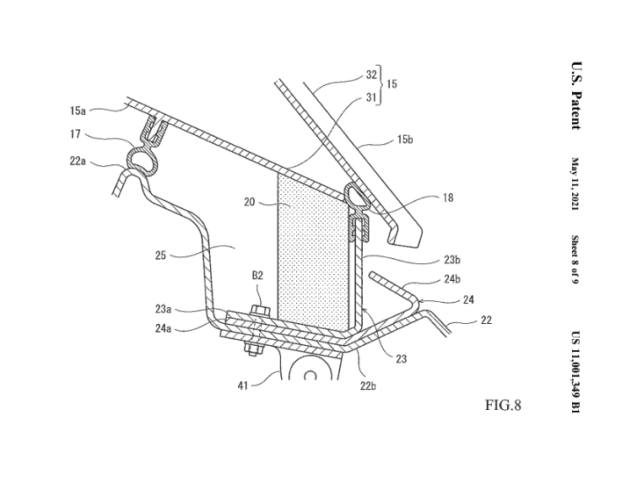
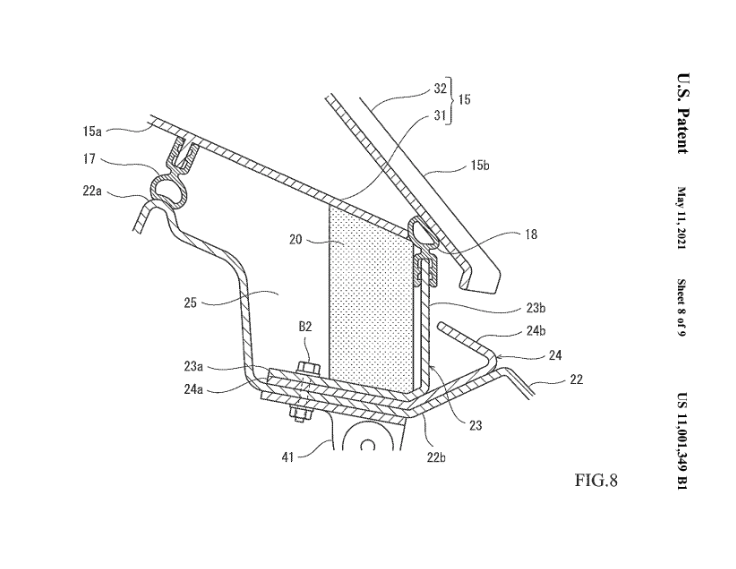
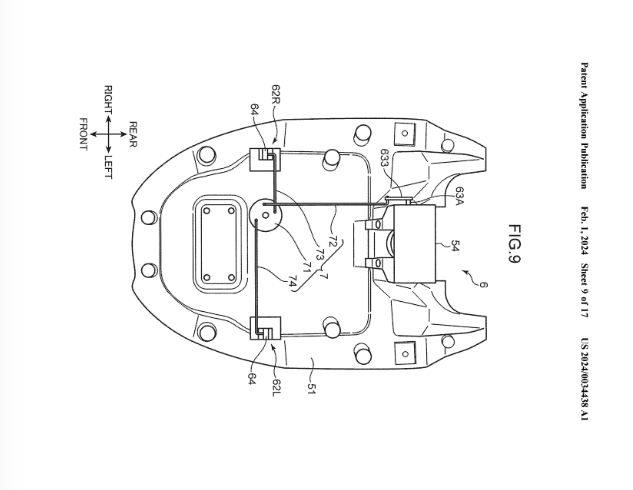
In the final documents, we’re shown a a pair of revisions to the existing STX front storage compartment: namely a water-tight membrane (seal) that keeps the hood from leaking under heavy water conditions (patent US 11001349 B1); a new three-point locking mechanism that secures the front storage lid far more firmly (patent US 2024/0034438 A1); and a electronic locking mechanism that secures the storage latches until released via the dashboard or key fob (patent US 11845518 B2) for all Kawasaki JetSkis.
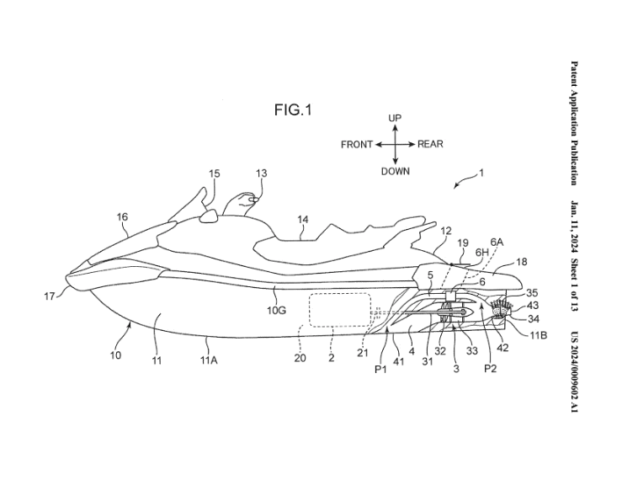
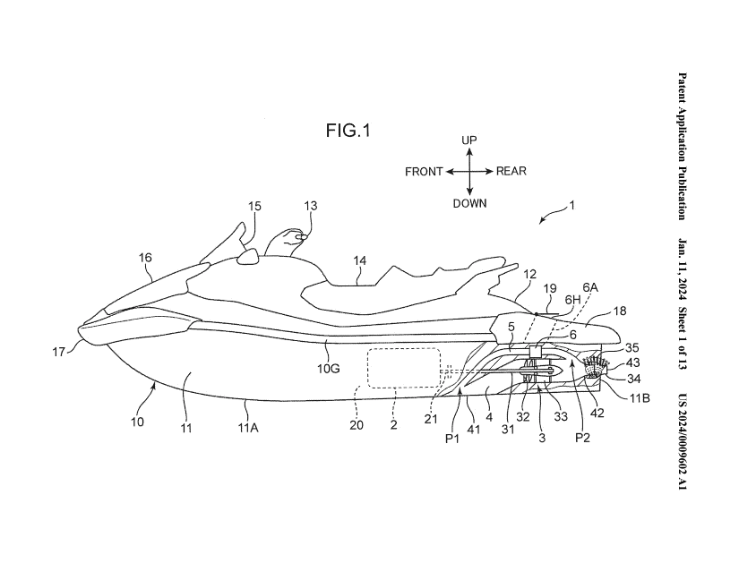
The final patent – US 2024/0009602 A1 – offers four different designs for an improved ambient water induction system to improve engine and exhaust cooling. These new inlets – infused into the hull surface itself or through inlets molded into the pump tunnel – draw in water quicker and process them through the engine and exhaust more efficiently, passing through dual mesh strainers and finally, out through the pump itself or the transom.
Conclusions
Typically, when The Watercraft Journal has received leaks like these its taken between 1-to-3 years to come to fruition in a production vehicle. Yet, many of the levels of technology being proposed in these documents seem well beyond what is seen in the powersports market currently.
Certain items like the STX hood latch, water intrusion seal, revised water-cooling ports and turbo forced-induction system all appear like “low hanging fruit” that could be quickly introduced. The self-driving “Calling System”, digital anchor and rider retrieval features are phenomenal and certainly would change the safety standards of the PWC industry.
Equally, so would collision avoidance, electric security locks, and the tow sports camera that alerts the driver of a fallen rider could radically change the public’s perception of how safe these machines are. It’s all very exciting stuff for sure – and rarely do we find patents that go unused.
International Women’s Day was celebrated worldwide last Friday, but in the PWC world, where some of the top racers, freestylers and race promoters/organizers are female – not to mention one of the best announcers in this, or any sport – women are celebrated on the regular. Add to that, the fact that the demographic makeup of recreational riders is steadily shifting to become a more even mix of men and women, and you have a perfect opportunity to recognize the role women – and girls – play in keeping the PWC industry relevant and exciting.
As BRP recently pointed out in a press release, women’s involvement in the powersports industry is not limited to “after the purchase;” and Sea-Doo put a spotlight on the active role played in the advancement of BPR’s line of powersport products by Product Analyst Marie-Eve Cyr – and her attention to making powersports ever more inclusive.
Read the full press release below:
BRP is known for breaking the norm, pushing boundaries, and doing things a little bit differently than everybody else, so it should come as no surprise that their teams are some of the most diverse in the industry, ensuring their products meet the needs and expectations of riders from a wide variety of backgrounds, ethnicities, and genders.
So with International Women’s Day taking place this month, we are putting the spotlight on one of the many women charting their course in the powersports industry at BRP—Marie-Eve Cyr.
As a Product Analyst on Sea-Doo’s Global Product Strategy team, Marie-Eve plays a key role in the new product development process, bringing her unique point of view and vision to strategy discussions steering the development and launch of BRP’s products.
Marie-Eve was lucky to be introduced to the world of powersports at a very young age, thanks to her family having a long-standing interest in the sport. Working at BRP, she blends fun and work, combining them to bring her experience and enthusiasm to the role.
“I am lucky to be surrounded by other women on my team, and to be able to share our experiences and visions to improve our work and our products,” said Marie-Eve. “For several years now, the women’s movement in powersports has been growing and I am grateful to be able to actively participate in it. I am lucky to be part of this community and to see it grow day by day.”
Bombardier Recreational Products Inc.
Marie-Eve’s passion for innovation in the industry guarantees all new Sea-Doo products are designed with a woman’s perspective in mind, ultimately leading to a more inclusive user experience, and hopefully, ushering a new generation of women into the sport.


 While it certainly isn’t every day that we see PWCs as a topic in Forbes magazine, it’s no surprise that world-class Big Wave Surfer Garrett McNamara would be at the center of such a story.
  In the Forbes piece, Clash recounts his time out on the PWC with McNamara, riding on waves of over 60 feet at times.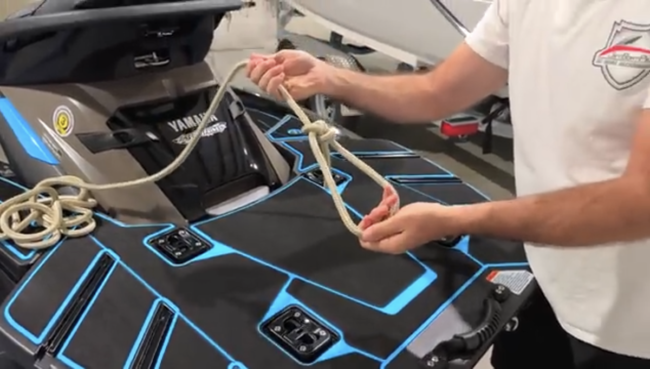
 The bowline knot is particularly useful because it won’t jam or slip, even under intense strain, but it can be easily loosened just by using one’s finger. In the video by JetBoatPilot, we’re walked through both the easy way, and the fast way to make this knot, making it a valuable primer for just about everyone.
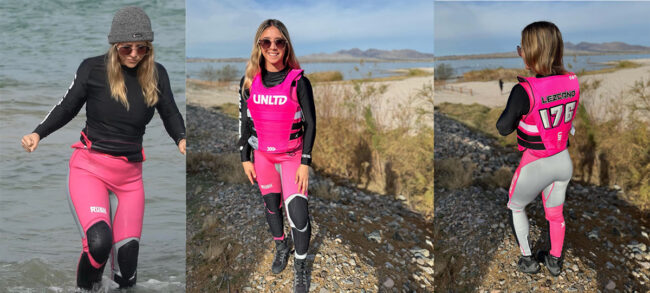 A spate of sedate color schemes seem to be desaturating much of the PWC world lately, with toned-down colors and muted hues popping up in everything from rash guards to wetsuits to ski graphics.
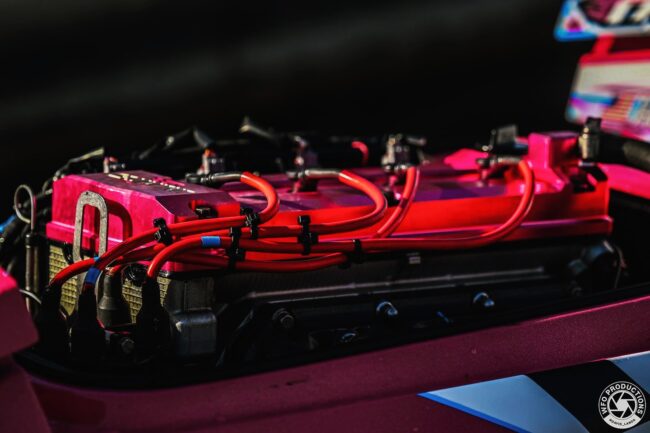 And Unlimited customers are tickled (Neon) pink (and blue, and green, and highlighter yellow) about the anything-but-boring aesthetic.
 Be sure to check out Unlimited’s website, where you can find the hue to suit you, whether you are looking for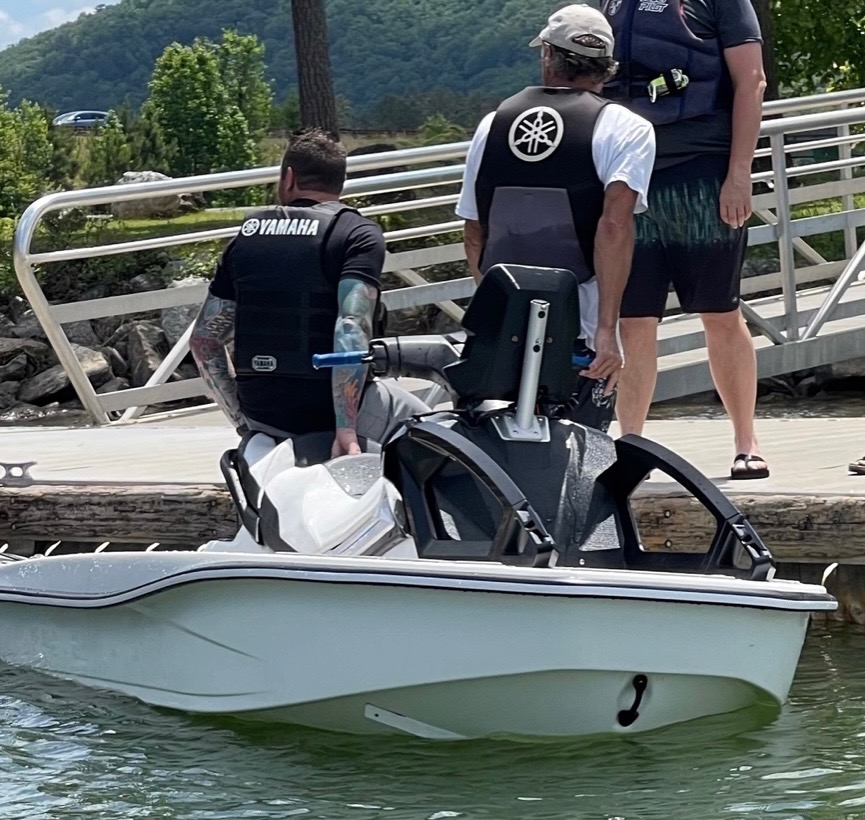






 In a move that signals a fresh chapter for
  Josh’s bond with his dad extends comfortably into the business realm, with Neil’s guidance complementing Joshua’s youthful vigor. Reflecting on his journey, Joshua told
 As Paris continues warming up for the Olympics, a small contingent of the 2024 Summer Games competitors will be jetting down to Tahiti to prepare for a wholly different class of competition. For the second-ever Olympic surf competition, competitors from all over the world will converge on this small Polynesian island to tackle world-class waves in an area steeped in surf mythology.
 Apart from its strength, Teahupo’o draws in surfers with its rich history as well. The wave is found on the island of Tahiti in Polynesia, where surf originated in the 12th century as a sport for the island’s royalty. As for the Teahupo’o wave itself, the first recorded surfer here was a woman from the island of Raiatea in the 19th century. Many years later, in the 1980s and 90s, professional surfers returned to the area to tackle what many consider to be the world’s toughest wave.
 As the Olympics come closer, be sure to read
 International Women’s Day may have sped by, but
  And while Sophie Francis is an apt and appropriate representative of what the women of this sport can accomplish, Yamaha is taking the heart and soul behind International Women’s Day – the celebration of all the phenomenal women who are rewriting the rules, breaking barriers, and making history – and is launching











 By developing a water-jacketed turbocharger and plumbing system as outlined in patent










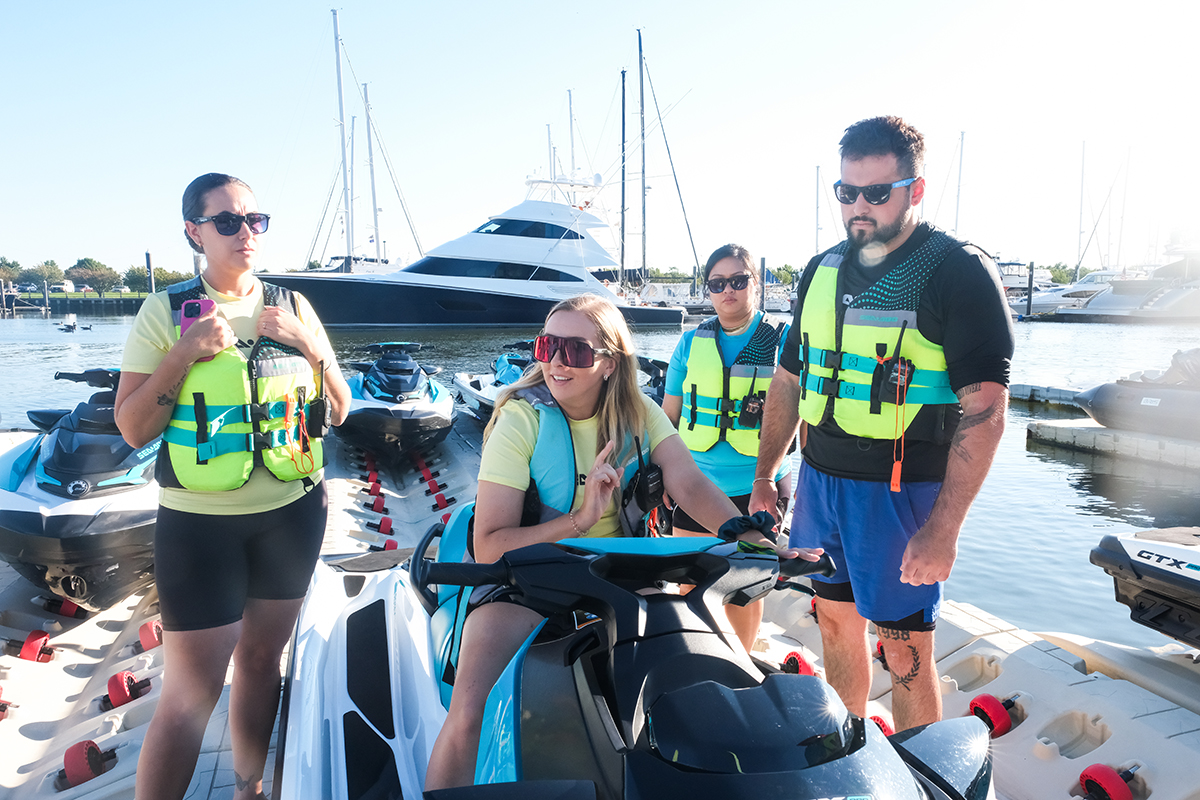
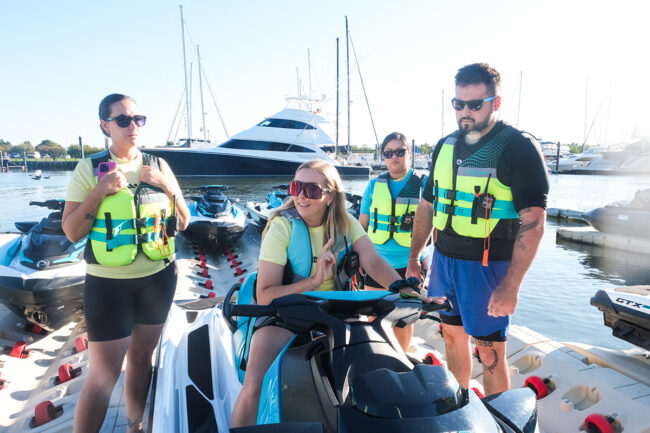 International Women’s Day was celebrated worldwide last Friday, but in the PWC world, where some of the top racers, freestylers and race promoters/organizers are female – not to mention one of the best announcers in this, or any sport – women are celebrated on the regular. Add to that, the fact that the demographic makeup of recreational riders is steadily shifting to become a more even mix of men and women, and you have a perfect opportunity to recognize the role women – and girls – play in keeping the PWC industry relevant and exciting.
 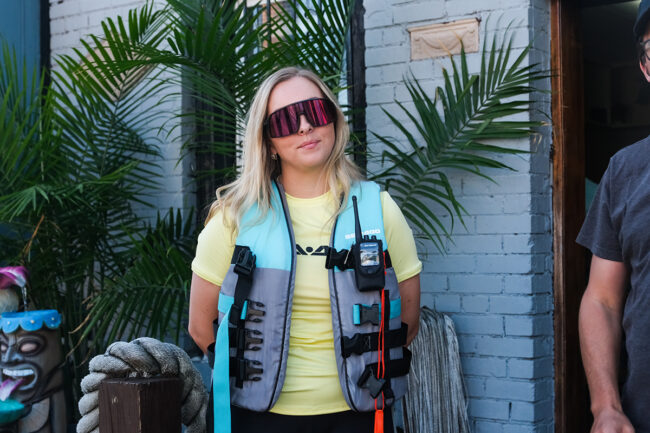 BRP is known for breaking the norm, pushing boundaries, and doing things a little bit differently than everybody else, so it should come as no surprise that their teams are some of the most diverse in the industry, ensuring their products meet the needs and expectations of riders from a wide variety of backgrounds, ethnicities, and genders.