



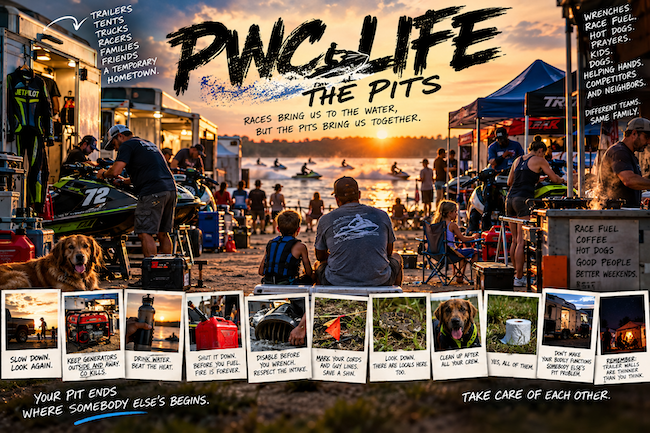
 Spend enough weekends racing personal watercraft and eventually the pits become something more than the place you park the trailer.
They become home.
There are dry pits, where trucks, trailers, vans, tents, RVs and race skis settle in for the weekend — sometimes with racers sleeping anywhere from a house-sized motorhome to the back of a van.
Then there are the wet pits, the temporary villages that spring up along the water each morning: EZ-Ups, coolers, chairs, tools, workbenches and skis waiting for the next moto. It’s where you scramble to repair the ski that just broke, talk smack with the competitor in the next tent and, occasionally, hand that same competitor your backup ski because his just broke and there is still racing to do.
The pits are garages, campgrounds, kitchens, playgrounds and neighborhoods built for a weekend.
And neighborhoods need rules.
Some are written in the event regulations. Others have been learned through years of bruised shins, near misses, bad decisions and somebody eventually saying, “For the love of God, don’t do that again.”
Here are a few of both.
Slow down. Then look again.
Pit and launch areas are crowded with people, children, dogs, trailers, skis, side-by-sides and vehicles moving in every conceivable direction. Follow the event’s speed limits and traffic rules, and save the horsepower for the racecourse.
More importantly, never assume the space around your vehicle looks the way it did the last time you checked.
I learned that lesson the “Why is the tent shaking, hon?” way. We arrived late, pitched our tent in a designated camping space and went to sleep.
The next morning, the guy in the next site woke up, wanted coffee, got into his truck – and started backing up.
When he had gone to bed, there hadn’t been a tent behind him.
There was now.
Fortunately, the lesson became a story rather than something considerably worse: Every time you move a vehicle, look again.
Oh – and if you’ve unhooked your trailer and the back of your truck protrudes into an area where people walk, remove the hitch from the receiver.
Your neighbors like their shins.
Twenty feet — and pay attention to where the exhaust goes.
Generators are as much a part of many race pits as gas cans and coolers. They’re also one of the things in the pits capable of quietly killing someone.
The Centers for Disease Control and Prevention says portable generators should be operated outdoors, more than 20 feet from windows, doors and vents. The Consumer Product Safety Commission also says the exhaust should be directed away from occupied structures.
In the pits, remember that “occupied structure” isn’t necessarily yours.
The RV, enclosed trailer or van next door may have someone sleeping inside. Wind can change. So can the arrangement of a crowded pit. Don’t simply measure your distance, fire up the generator and forget about it. Think about where the exhaust is going, and use working carbon-monoxide detectors in sleeping areas.
Carbon monoxide is colorless and odorless, and symptoms can include headache, dizziness, weakness, nausea, vomiting and confusion. Someone sleeping may not recognize the warning signs at all.
Water is water.
Race kids are a different breed.
Many have spent their entire lives around boats, skis, docks and ramps. They know the water. They respect the water. They may be more comfortable around it than many adults.
They’re still kids, and water is still water.
Wet pits are hectic places where adults are launching skis, repairing skis, watching motos, finding parts and helping other racers. Familiarity with the water does not make anyone drown-proof.
Know where your children are. Follow event and applicable PFD rules. Don’t let the bustle of race day replace supervision.
CPR is a good skill to have; it’s a really bad skill to have to use.
Heat sneaks up while you’re busy.
You’re going to drink some water after this moto.
Then after you help somebody launch.
Then after you change that part.
Then after you find the tool somebody borrowed.
Suddenly it’s midafternoon, you’re standing in 90-degree heat and you can’t remember the last time you drank anything.
Don’t wait until you’re thirsty. The CDC recommends drinking water regularly during work in hot conditions and taking breaks to cool down. Weakness, dizziness, nausea, heavy sweating and confusion are among the warning signs that heat is winning.
Look after the people around you, too. Sometimes the person who needs to sit down is the last one to realize it.
Fuel deserves your full attention.
Race fuel smells like race weekend.
It also burns.
Follow the event’s fueling rules and the manufacturer’s instructions for your watercraft and fuel containers. Shut the engine down before fueling, keep ignition sources away from fuel handling and storage, deal with spills immediately and know where an appropriate, charged fire extinguisher is before you need one.
The middle of an emergency is a terrible time to begin asking who brought the extinguisher.
And while we’re discussing mysterious liquids:
If you didn’t fill it, don’t drink it.
That unattended red Solo cup could contain water. It could contain soda. It could contain beer.
It could contain gasoline.
It could contain something we’re getting to later.
Disable it before you wrench on it.
Race weekends create an irresistible temptation to hurry.
The next moto is coming. Something isn’t right. The hood comes off and three people dive in.
Don’t let the clock override the basic precautions in your PWC manufacturer’s instructions. Disable the craft before working around moving components, and keep hands, hair and loose clothing away from intakes and other machinery.
A missed moto is better than a trip to the emergency room.
Mark the things trying to clothesline us.
Extension cords, hoses, tent stakes, guy lines and everything else necessary to build a temporary home have an uncanny ability to become invisible after sunset.
If you have to stretch something across — or even near — a place people might reasonably walk, make it visible.
This applies doubly to those thin lines strung approximately neck-high between two objects.
Conversely, if you’re walking through the pits, look where you’re going. This is not a hotel hallway. There will be tent stakes, trailer tongues, gas cans, sleeping dogs and, occasionally, exhausted racers who have ceased functioning and become part of the landscape.
Look down. And occasionally around.
Before you turn a patch of ground into your home for the weekend, look at it.
Depending on where we race, the original residents may include snakes, spiders, ticks, fire ants and, yes, occasionally alligators.
The nonliving hazards aren’t much friendlier. Animal holes, roots, uneven ground, mud and slick banks can ruin a weekend without ever biting you.
Know the environment you’re racing in, watch where you put your hands and feet and don’t assume that because hundreds of racers have arrived, the wildlife received an eviction notice.
Dogs are wonderful. Until they aren’t.
Race dogs are part of pit life.
But a friendly-looking dog is still a dog you don’t know.
Ask before petting someone else’s dog, and teach children to do the same. If your dog isn’t comfortable with strangers, that’s your responsibility to manage — not everybody else’s responsibility to discover.
Keep your dog appropriately restrained, make sure it has shade and water, and pick up its poop.
And pit-family rules apply here, too. If you notice the dog at the neighboring trailer has somehow run out of water while its human is temporarily stuck elsewhere, don’t just walk past. Help, or find someone who can.
We take care of each other here.
Speaking of poop…
Pick up after yourself.
That includes your children.
Leaving a dirty diaper in a field, along a trail or beside somebody else’s pit is an excellent way to discover that your fellow racers possess both long memories and creative ideas about returning lost property.
Likewise, dispose of gray water, wastewater and trash where the venue says they belong.
The basic rule is easy:
Don’t make your bodily functions somebody else’s pit problem.
Nobody is particularly scandalized by pit life. Racers change clothes behind truck doors. Adults occasionally disappear toward the edge of the woods. We’ve all seen human beings before.
Just don’t pee where somebody is going to walk, sit, sleep or put their equipment.
And do not pee on your neighbor’s tires.
Yes.
That apparently needs to be said.
Your pit ends where somebody else’s begins.
Race pits are loud. They’re messy. They’re hectic.
Nobody expects monastery-level silence.
But generator exhaust, music, lights, smoke, trash, water, pets and everything else produced by your temporary household eventually cross an invisible property line into somebody else’s.
So does sound.
Those staying in RVs and enclosed trailers should remember that the walls may not be quite as soundproof as the occupants occasionally imagine.
We’ll leave that one there.
Finally: Take care of each other.
This may be the most important unwritten pit rule of all.
The pits are where somebody asks for help pulling a stubborn generator to life because her arm is shot.
They’re where someone wanders over asking whether you’ve eaten, whether you need water or whether you’ve got enough gas to make it through the night.
They’re where somebody else’s kid appears, hungry, and gets fed.
They’re where competitors throw wrenches in frustration, exchange harsh words, shake hands, hug people they haven’t seen in years and then ask, “You ready for me to kick your ass on the line again?”
For years, they were places where Brian O’Rourke and Team Faith were part of race mornings, afternoons and evenings, offering prayers and hot dogs in much the same spirit: make sure the people around you are taken care of.
They’re where the sight of Sebastian Lezcano firing up the grill can turn a real bad day into a good afternoon — and that’s even before the sizzle and smell have half the race line wandering toward the Miami Jet Ski camp.
And sometimes they’re where something disappears that shouldn’t have, and people who weren’t responsible quietly pass the can until there’s enough money to replace it.
The pits can be laughter and tears, frustration and celebration, race fuel and coffee at sunrise, children and dogs and old friends and brand-new racers trying to figure out where they belong — and Dawn Dawson announcing, “Riders meeting in five!” for the fifth time.
They’re temporary communities.
So slow down. Look before you back up. Mark the guy line. Watch the kids. Mind the dog. Position the generator properly. Drink some water. Pick up your trash. Help the racer next door.
And, seriously.
Leave his tires alone.