


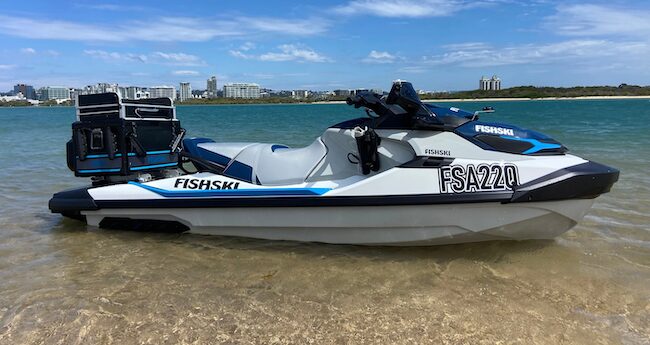
 Fishski Australia, the Sunshine Coast outfit widely credited with pushing personal watercraft fishing into the mainstream in Australia, is up for sale.
Current owner Connor Rudd posted the listing to a jet ski sales group this week, describing it as a turnkey, asset-backed operation rather than a startup pitch — stock and finished units, a full workshop fit-out in Forest Glen, an active Shopify storefront with live funnels in both Australia and the US, the brand and trademark, product CAD files, roughly 10,000 combined social followers, and an assignable lease on the workshop space. The asking price is $40,000 AUD, which Rudd says is below the cost value of the hard assets alone.
Fishski built its name on turning a stock jet ski into a dedicated fishing rig without touching the hull. The company’s roots go back to 2016, when Robert Grace and Shane Jordan built the first Fishski setups out of frustration with the lack of purpose-built fishing gear for PWCs.
What they built became something close to the standard reference point for the category in Australia. Rudd and Danielle took over the business in December 2024, and by the account in the listing, had been in the middle of a relaunch, redesigning the core product and pushing into the US market before deciding to sell.
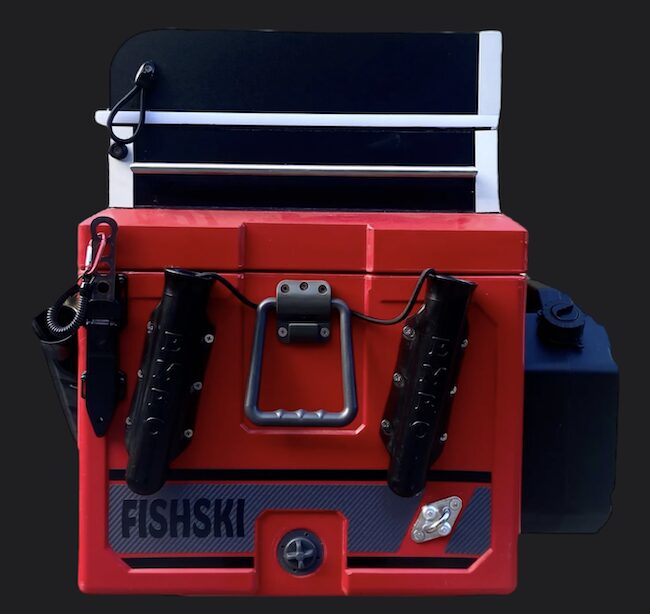
The core product is a hand-built fishing station that mounts to the ski’s rear rack or LinQ system: a built-in cooler (55 liters on current models) doubling as an esky and bait station, integrated rod holders, tackle storage, and no-drill mounting that keeps the install fully reversible. Every unit is color-matched to the customer’s ski and built to fit specific makes and models rather than sold as a generic universal rack.
It’s worth pointing out that this wasn’t a small thing in the category. Fishski’s setup, and the demand it proved existed, is a big part of why Sea-Doo, Yamaha, and Kawasaki all now offer their own factory fishing kits and accessories. The aftermarket built the market first; the OEMs followed.
 Rudd frames the sale as a matter of moving on to other ventures rather than the business failing outright, and he notes build capacity is currently ahead of sales, meaning there’s room for a new owner to grow it with the right marketing push. But the timing is hard to separate from what’s happening in the broader PWC market right now.
Sales across the category have been sliding, PWC fishing demand along with it, and all three OEMs now sell their own factory fishing kits and accessories, which puts direct pressure on aftermarket builders like Fishski that used to have that niche mostly to themselves.
None of that makes the listing itself unusual. Small manufacturers change hands for all kinds of reasons, and Rudd’s explanation may be exactly what it says it is. But a company that helped create the PWC fishing niche in Australia looking for a new owner less than two years into new leadership is worth noting as one more data point in a market that’s been contracting on several fronts at once.
Whatever category-wide struggles Fishski is riding out, the business itself is still very much operating. A promotional post from Fishski’s own page, dated the day after the sale listing went up, was offering a winter build special worth $400 in free gear (a customized lure pack and a double spear gun rack) with any Deluxe purchase through the end of July. That’s not the posture of a company shutting its doors. It’s a business still taking orders and still building while it looks for its next owner.
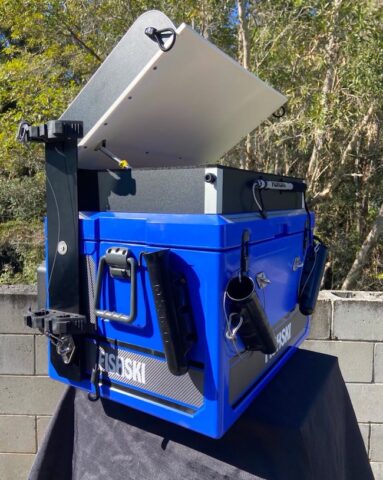
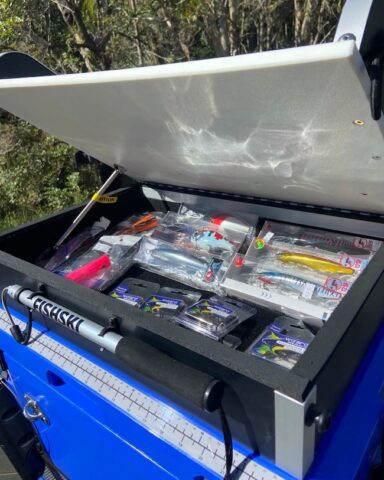
It’s also worth spelling out what a buyer would actually be taking over, since it’s more than a cooler with some rod holders bolted on. The flagship Fishski Deluxe (The Original) starts at $1,899 and is built around a 68-liter rotomoulded cooler rated to hold ice for five days in Australian heat, plus a 20-liter tackle compartment, a cutting board, gaff, and twin jerry can fuel extension, all color-matched to the customer’s ski and compatible with Kawasaki, Yamaha, Honda, and Sea-Doo (including LinQ).
At the top of the range, the Pelagic 92 Deluxe ($1,699 and up) is built for long-range offshore work on full-sized platforms like the Sea-Doo GTX and Fish Pro lines or Yamaha’s FX series, with a 92-liter cooler, a rear-mounted fuel system carrying two or three jerry cans, six rod holders, and its own bait prep station.
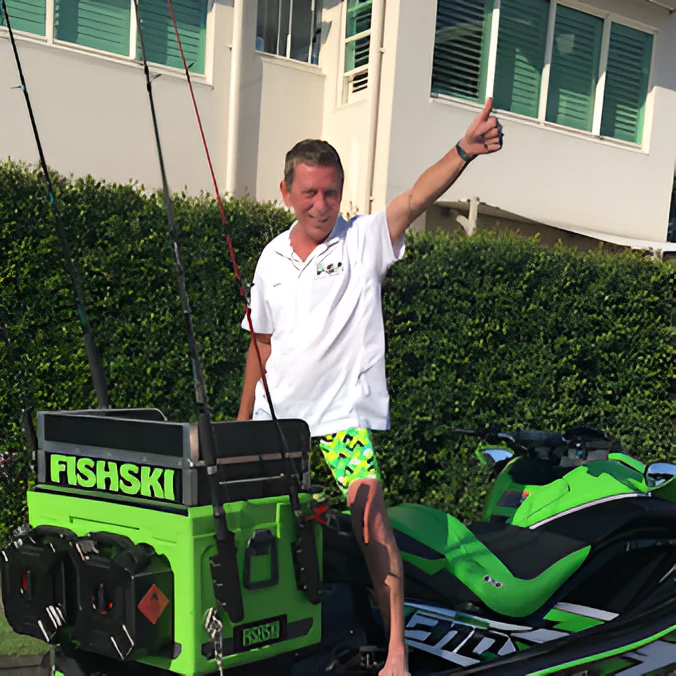 On the other end, the Fishski Basic ($745) strips things down to a rock-solid entry point, six rod holders, a built-in fish measure, and the same load-spreading feet and stainless mounting hardware as the rest of the line, aimed at undercutting other brands’ entry-level pricing without cutting corners on build quality. The tackle box ($450) is sold on its own too, built to bolt onto an existing cooler, a secondhand Fishski unit, or even a boat.
That range is a big part of why the brand carries the weight it does in this space. It’s not one product; it’s a full lineup built specifically around how Australians actually fish off a ski, developed over years on Southeast Queensland water rather than in a design studio, and it’s the template the OEMs are now chasing with their own accessory kits.
Anyone interested in the details can reach out to Connor Rudd directly through the listing or through Fishski Australia’s channels.