

Home Blog Page 10

Yamaha Marks 40 Years of WaveRunner Innovation with Anniversary FX Limited SVHO

0

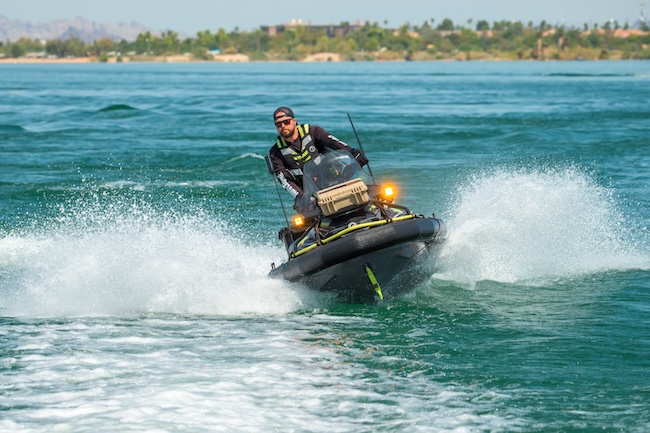
As a trailblazer of personal watercraft innovation, Yamaha marks four decades of its WaveRunner legacy with the launch of the exclusive 40th Anniversary FX Limited SVHO — a machine where luxury meets raw, super-charged performance.

At first glance, the aesthetic is unmistakably premium: gold “YAMAHA” emblems line the hull, while a bold “WAVERUNNER 40th” badge provides a visual cue that this isn’t just any ride, it’s a celebration of forty years of evolution.

Beneath the stylized exterior lies the heart of a beast: Yamaha’s supercharged 1.8-litre “Super Vortex High Output” (SVHO) engine. With a displacement of 1,812 cc and built as a 4-cylinder, 4-stroke marine engine, this powerhouse delivers more torque and thrust than any WaveRunner has previously featured. Coupled with the 160 mm high-pressure axial flow jet pump, the platform translates that brute force into responsive acceleration, carving effortlessly across open water.

Yet the 40th Anniversary FX Limited SVHO isn’t built solely for speed — comfort and convenience were clearly written into the blueprint. Yamaha’s factory-installed marine audio speakers are engineered to withstand sun, spray and speed, and the 7″ Connext touchscreen delivers smartphone connectivity, GPS-ready mapping and enhanced drive control functions at a glance. The ergonomics follow suit: an adjustable-tilt steering column, dual rope hooks at the helm, a theatre-style comfortable three-person cruiser seat, and a softer, wider re-boarding step all speak to thoughtful design for a full-day experience.

Storage hasn’t been neglected either: a watertight glove box featuring USB and 12 V outlets, generous bow storage perfect for towels and gear, and stern platform storage designed to handle towing essentials.

Meanwhile, rider controls remain intuitive and confidence-inspiring thanks to Yamaha’s RiDE dual-throttle system that simplifies shifting between forward, neutral and reverse — ideal for dockside maneuvers or rapid deceleration.

The result? A watercraft that honors four decades of Yamaha engineering and styling — one where refined comfort, next-level technology and supercharged performance merge in a seamless package.

Greenhulk Turns Up the Boost with FuelTech Sale

0

If you’ve been waiting for the right time to step up your tuning game, that time is right now. Greenhulk PWC Performance has launched a limited-time sale on FuelTech systems — the same high-end electronics trusted by pro tuners and hardcore racers around the world. From simple monitoring tools to full-on ECU management systems, every piece of gear in the lineup is engineered for precision, reliability, and total control.

And while Greenhulk might have ‘PWC’ in the name, if your tuning addiction extends to cars, bikes, or anything else with a throttle, don’t worry — this sale’s got you covered there too (and we won’t tell!).

Nano Series — Precision Data in Your Pocket

FuelTech’s Nano units pack serious capability into a compact, easy-to-use design:

  • NanoPRO – Now $269 (was $339, Save $70!)
    Turn your PWC into a full-fledged data-tracking machine. The NanoPRO monitors AFR, boost, RPM, and more on a bright, color display that puts pro-level diagnostics right at your fingertips. Small, fast, and intuitive — it’s built for riders who want to see exactly what’s happening in their setup.

  • WB-O2 Nano – Now $169 (was $199, Save $30!)
    The WB-O2 Nano is FuelTech’s simplest wideband solution — instant AFR readings with bold LED clarity. It’s compact enough to mount anywhere and powerful enough to make every tune safer and more consistent. Pair it with a NanoPRO or run it standalone for quick, accurate monitoring.

FT Series — The Heart of High Performance

From weekend warriors to full-blown racers, FuelTech’s FT line delivers serious ECU power and data control at every level:

  • FT450 – Now $699 (was $899, Save $200!)
    All-in-one EFI control, data logging, and customizable display screens — the FT450 brings advanced ECU tech to an affordable, tuner-friendly platform. Plug in, tune, and go.

  • FT550 Lite – Now $999 (was $1,299, Save $300!)
    Lightweight, fast, and built for performance. The FT550 Lite delivers race-grade ECU management, data control, and safety functions without the extras of the FT550. A perfect balance of reliability and speed.

  • FT550 – Now $1,299 (was $1,699, Save $400!)
    Designed for tuners and pros who want full system control. The FT550 includes integrated traction control, full data logging, customizable dashboards, and advanced connectivity. It’s the perfect mix of power and precision.

  • FT600 – Now $2,199 (was $2,699, Save $500!)
    The top of the line. The FT600 is FuelTech’s flagship ECU and dashboard combo, delivering total command over your engine management system. Real-time visualization, advanced safety integration, and world-class data control — built for those who demand nothing less than the best.

Every FuelTech product is crafted for ultimate precision, control, and reliability — whether you’re dialing in your tune at the track, chasing speed on the water, or perfecting a performance build.

Understanding Sea-Doo’s Proprietary Crack-Resistant Hull

0

A recent video on Sea-Doo’s official social media accounts highlights a customer’s comment that their Sea-Doo Spark’s hull has withstood the test of time. “Never cracked a hull in 12 years of owning Sparks,” the customer writes—an impressive claim for any frequent PWC rider. In the video, James Heintz, Sea-Doo’s Director of Product Strategy, goes on to explain that this sort of durability isn’t a feature typical across all PWC manufacturers and models. But it isn’t just luck, either.

Heintz explains that what makes the Sea-Doo Spark’s hull so emphatically reliable is little more than its “solid foundations”: the Polytec Generation 2 material. The material is touted as being incredibly resistant to scratches, impacts, and just about “anything you can throw at it.” “Let the kids run into the dock, miss the trailer, run that thing onto the beaches for lunch—it can take it all,” brags Heintz. Given those strong words, we wanted to take a minute to look into the new generation of Polytec and see what makes it so special.
We covered the original Polytec material back in 2017 here at The Watercraft Journal, taking an early, in-depth look at Sea-Doo’s first-generation Polytec hull and addressing the skepticism many riders had toward its lightweight, non-fiberglass construction. The Polytec material was originally implemented by Sea-Doo in 2013 and is known for its special formula of long-strand fiberglass blended with polypropylene. After several seasons on the market, the verdict was clear: Polytec had proven to be both durable and dependable. Our coverage noted how Sea-Doo’s use of the material quickly expanded from the Spark to the GTI and Wake series, underscoring the company’s confidence in its strength and longevity. We concluded that, while no hull is impervious to repeated or high-impact collisions, Polytec’s performance in real-world riding conditions rivaled that of traditional fiberglass—all while offering advantages in weight, cost, and environmental sustainability.

It’s that same foundation that has now evolved into Polytec Generation 2, which delivers an even lighter hull than the original Polytec material (which was already significantly lighter than fiberglass). That lightness makes for easier handling and greater power on a lighter overall ski. However, the Polytec 2 is also stronger than the original formula, boasting greater scratch resistance with more internal bracing and flex—making it a great hull for cutting through waves.

One thing that we find particularly special about the Polytec 2 material is that it’s a cost-effective and affordable alternative to fiberglass, both at the point of sale and over the years. Jet Drift has an article that goes into the details of repairing and cleaning the Polytec hull, but from what customers have said, the material is easier on both fronts than a traditional hull may be.

While the Polytec material was originally made for the Spark line (expanding quickly to the GTI and Wake series as mentioned above), it’s now featured on the Sea-Doo GTI SE, GTR, GTR-X, FishPro Scout, and the Switch line (including Cruise, Cruise Limited, and Sport). So, since getting a Sea-Doo these days means you’re likely to be getting a Polytec 2 hull, it’s good to know this material is packing real benefits deep into the structure of your PWC.

KSpeed Water Resistant Duffel Packs Big Capability in a Compact Design

0

Every jet ski rider knows that staying organized and dry is half the battle when you’re bouncing from one launch ramp to the next. That’s where KSpeed’s Water Resistant Duffel steps in—a rugged, do-it-all gear bag built for the realities of life on (and around) the water.

At first glance, the KSpeed duffel looks like a premium piece of adventure gear—and that’s exactly what it is. Constructed from durable, waterproof PVC tarpaulin with welded seams, it shrugs off spray, rain, and deck wash like it’s nothing. Whether you’re hauling it in the footwell of a ski, in the bed of a truck, or stowing it on a chase boat, this bag is built to take the abuse.

What really sets it apart is its versatility. KSpeed designed the duffel with both padded carry handles and adjustable backpack straps, so it transitions seamlessly from the dock to the trail. A large waterproof zipper opens to reveal a spacious main compartment that swallows helmets, wetsuits, towels, or tools with room to spare. Internal organization pockets help keep smaller items from sinking to the bottom, while reflective accents add a layer of visibility during those early morning or after-dark rides.

Of course, the KSpeed Water Resistant Duffel isn’t just for riders packing a change of clothes. It’s equally at home carrying fishing tackle, safety gear, or even a quick lunch for a long day on the lake. And thanks to its watertight build, it can also double as a safe way to transport camera gear while on the water—something that’s especially important if you’re a PWC race photographer, or have ever thought about becoming one.

After all, documenting the high-speed world of personal watercraft racing is both an exciting and surprisingly profitable pastime. For those looking to dip a toe into this hobby—and maybe even turn it into a side hustle—we’ll be kicking off a new multi-part guide here on The Watercraft Journal dedicated to getting started in PWC race photography.

In our next installment, we’ll look at beginner-friendly gear setups specifically suited for watersports photography—from entry-level cameras and lenses to filters, monopods, slings and, yes, the right bags to keep it all protected. And along the way, we’ll be talking with some of the sport’s top photographers, videographers, and drone pilots to learn their tips, tricks, and how they capture the action like pros.

Inside Jet Tech’s Rescue Sled Production

0

There’s a reason Jet Tech has become the go-to name in professional-grade jet ski accessories — their gear is built to take a beating and come back for more. Nowhere is that more obvious than with the Jet Tech Rescue Sled, the ultra-durable workhorse trusted by lifeguards, tow teams, surf patrols, and recreational riders who just want the best rescue platform out there.

Designed to mount to virtually any personal watercraft, the Jet Tech Rescue Sled combines sleek design with heavy-duty performance. Its reinforced multi-layer construction delivers impressive rigidity while keeping weight manageable, and the non-slip surface provides secure footing for both rescues and cargo. Multiple grab handles and anchor points make loading and positioning a breeze — whether you’re hauling gear, helping a downed rider, or towing big-wave surfers back into position.

Jet Tech recently shared a rare, behind-the-scenes look at how these sleds come to life in a two-part video tour of their production facility. The clips walk through each step of the build — from mold prep and lamination to quality checks and finishing touches — giving fans a firsthand glimpse at the craftsmanship behind every sled. It’s a clean, efficient operation that reflects the same professionalism Jet Tech brings to all its products.

Among the updates highlighted in the walkthroughs is Jet Tech’s new buckle system, a small but significant upgrade that makes connecting and disconnecting the sled faster, safer, and more secure. It’s the kind of thoughtful detail that comes from listening to rescue professionals and riders who use this equipment daily in the toughest conditions.

Of course, Jet Tech’s reputation didn’t happen overnight. With years of hands-on testing and feedback from water safety teams around the globe, their rescue sled has earned its place as the benchmark for dependability. Whether it’s part of a lifesaving fleet, a surf tow setup, or a weekend adventure rig, the Jet Tech Rescue Sled stands out for one simple reason — it’s built right.

For those who haven’t yet seen how much engineering goes into each unit, the full two-part production walkthrough is available now on Jet Tech’s Facebook page.

Severe Capsizing Risk Recalls ALL Sea-Doo Switch Models Produced

0

A little over a week ago (that is, as of this writing), BRP issued a full production recall of every single Sea-Doo Switch produced from 2022 until today. The recall, citing a potential capsizing risk due to weight distribution, comes after two prior recalls (Bulletin 2025-4 and Bulletin 2025-10) addressing the same concern, issued after three years of incidents, a high profile lawsuit that included an injured infant, and the full-throated caution by the United States Coast Guard citing the “vessel design to be unsafe.”

Now, there is an often undue onus prescribed to vehicles that undergo a factory recall. More often than not, the recall is issued to replace an existing part or component that has been proven to fail or degrade faster than the manufacturer deems suitable. Faulty sensors, poor electrical connectors and rubberized gaskets are the typical fare of these recalls and are routinely fixed by service departments. Again, the vast majority of OEM recalls are often routine and for the most part, insignificant. This is not the case.

But first, a little background: Initially coined as an entry level pontoon (tritoon) powered by Sea-Doo 4-stroke jet propulsion technology, the Switch was offered in three hull configurations: 13, 16 and 19-feet long, with a catalog’s worth of available accessories, deck furniture (which was easily rearrangeable using the brand’s LinQ hardware) and Bimini tops. Priced far below conventional pontoons, the Switch was immediately popular with first-time boaters – even as the Switch’s rollout was hindered by the overseas supply chain delays caused by the Covid-19 pandemic.

Seeking to vacate its assembly yards and customers wanting to see some motion forward, Sea-Doo began shipping unfinished Switches to dealers, requiring many to rent out storage yards just to contain the incomplete units. By the time Switch models were being retrofitted with overdue ECMs and dashboards, many buyers lost interest or backed out of their initial purchase. This caused dealers to sit on unsold Switches for months (if not over a year) until BRP began offering attractive rebates and discounts on existing units.

Those units that did sell did so to a segment of customers with little to no boating experience. Equipping a whole new swathe of novice boaters with an entirely novel form of vehicle left a gap in education never before seen since the advent of the sit-down jet ski. Accidents featuring untrained and unlicensed Switch owners both on the water and at the launch ramp mushroomed the already uncomfortable statistics taken by the USCG. Footage from slow speed waterways and turbulent inlets were rife with “boat fails” featuring Switches.

Following in this vein, on August 25, 2024, William Grullon and Sheila Feliciano’s 13-foot Switch rolled over after coming to an abrupt stop as it neared the Knights Landing boat ramp on the St. Johns River, ejecting almost all of the passengers. According to Clay News & Views, “their daughter Vianca, 16 months old at the time, suffered ‘a catastrophic anoxic brain injury’ after being trapped beneath the overturned Switch for more than 10 minutes.” Claiming that the manufacturer was well-aware of the vessel’s tendency to roll over, the family is currently suing BRP, Inc. for $30 million dollars.

As the suit gained notoriety, investigators for Florida Fish & Wildlife noted that Feliciano’s Switch was “extremely overloaded,” well beyond the marked capacity limit of 825-pounds “by the five adults and their gear—coolers, etc.—plus whatever the weight of the infant girl.” This overloading of the unit was what was also attributed to a similar accident earlier that same summer. On July 4th, Nadim Hussain’s daughter died when her father’s 13-foot Switch flipped nose-over-end on Virginia’s Lake Anna. Trapped behind the vinyl screen gate and her PFD, the 9-year-old girl was later discovered by rescue workers.

In a public statement, BRP spokesperson, Emilie Proulx, said that all Sea-Doo Switch watercraft comply with all ABYC and US Coast Guard regulations regarding flotation testing and weight capacity, “This product has been rigorously tested throughout its development phase and still is today. As such, BRP strongly believes that the Sea-Doo Switch watercraft is a well designed and safe product.” This statement, given in October of 2024 was shortly followed by the first of three recalls issued on February 18th, 2025 (2025-4).

The initial recall sought to address how much water the segmented pontoons collected when afloat. The pontoons are misnamed, seeing that they are actually foam-filled segmented “outriggers” and not sealed, watertight pontoons. These outriggers allow in several gallons of water when stationary, and when under acceleration or deceleration, have a tendency to shift ballast heavily if not properly managed by the driver. New gaskets sealing the segments were initially prescribed but were found to be insufficient.

Unfortunately, the first two “fixes” didn’t solve the rollover issue: On August 30th, 2025, three women were killed when their Switch capsized on Flagstaff Lake, Maine. The Switch had already undergone the second recall repair issued by BRP. And again, officials from Maine’s Inland Fisheries & Wildlife Department discovered that the Switch in question was laden with seven adults – exceeding the recommended capacity limit – at the time of the capsizing. In response, a third recall was issued by BRP re-emphasizing the same original cautionary recommendation:

Improper distribution of passengers and cargo weight could overload the front of the watercraft and cause instability, nosediving and possibly lead to capsizing. The condition worsens if water evacuation from the hull is not optimal. This could cause serious injuries or even death.

This third update will replace existing gaskets to better evacuate water from the pontoons (outriggers) stating, “All watercrafts need three gaskets in specific sections of the hull. If your watercraft presently has sealant in those sections, it will be removed prior to the installation of the gaskets. For watercrafts already equipped with gaskets, an inspection is required to ensure that all three gaskets are present.” Additionally, each unit will be fitted with new warning labels, as well as updates to “Operator’s Guide.”

While Sea-Doo seeks to physically repair all current Switch models, BRP has been tasked with repairing its reputation by refocusing on its powersports divisions (Can-Am, Spyder, Ski-Doo) and selling off its marine division (besides Sea-Doo, of course). Earlier in April of this year, BRP announced that it had sold Alumacraft to Bryton Marine Group in Washington and British Columbia. And on July 8th, BRP sold Manitou to the owners of Bentley Pontoons – almost completely erasing BRP’s investment into recreational boating.

“Today marks another key step in our process to sell our Marine businesses. I am proud of the strong foundation we have built for Manitou and I sincerely thank all employees and dealers for their commitment and resilience over the years. I wish them the very best in this next journey,” said José Boisjoli, President and CEO of BRP.

The issue at hand is multifaceted. Sea-Doo has a responsibility to build a vessel that is both safe and stable for the user, yet is not required by law to quantify the experience level of the individual piloting its products. Following that reasoning, Sea-Doo cannot be held liable when their products are misused – in this case, the vessel being overladen beyond its listed capacity. Many seek to punish the manufacturer and absolve the user for their misuse. Others press the opposite. However this plays out in the courts of law and public opinion, the Sea-Doo Switch may ultimately pay the price with its life – whether justifiably or not.

Video: Adventures Worth the Name With Dangerous Water Adventures

0

If your idea of a good ride is more than just glassy lakes and sunshine selfies, then Dangerous Water Adventures might be exactly what you’ve been waiting for. Based out of Juneau, Alaska, this small but fearless outfit leads personal watercraft expeditions through some of the wildest, most remote coastlines on the continent — places where tidewater glaciers, sea lions, and icy fjords are just part of the day’s scenery.

The company itself is the creation of Steven Moll, the founder and expedition leader who many will remember from the television series Dangerous Waters. After years of filming high-risk PWC crossings around the world, Moll and a handful of his fellow adventurers transitioned from cameras to clients — guiding riders through the same kind of rugged, remote terrain they once documented for viewers. Today, Dangerous Water Adventures (or DWA) runs multi-day tours that blend big exploration energy with top-tier safety and logistics.

Real Adventure, Not a Sightseeing Cruise

Dangerous Water Adventures isn’t your typical guided tour — it’s an expedition built by riders, for riders. From founder Steven Moll’s deep experience to the seasoned crew members who’ve spent years navigating these waters, DWA has turned adventure into an art form. For watercraft enthusiasts who want to test their limits while seeing Alaska the way few ever do, this is the trip of a lifetime waiting to be booked.

Each itinerary is designed for serious riders who want to go beyond typical guided tours. DWA handles the machines, gear, and drysuits, while riders tackle miles of open water, narrow channels, and glacial coves that few people — let alone PWC riders — ever get to experience. Weather dictates the routes, and every day brings something different. It’s part exploration, part endurance, and entirely unforgettable.

Their Great Alaskan Loop is the signature trip — a six-day circuit that starts and ends in Juneau, with multiple departures scheduled for 2026. Several dates have already sold out since booking opened last month. For those not ready for a full week in the wild, the company also offers shorter Juneau-based outings that deliver a serious taste of adventure on a smaller scale.

Short videos from their 2024 season — like this one and this one — capture the energy perfectly: small groups carving through ice-dotted water with glacier walls in the background, all while a support crew shadows them with cameras and spare gear. It’s equal parts scenic and hardcore.

For a closer look behind the operation, Moll recently posted a video update detailing the close of their 2025 season and the launch of 2026 bookings — and it’s clear this crew isn’t slowing down.

Booking Ahead for 2026

As of this week, the 2026 expeditions are open for reservations on the official site, with some already sold out. Each trip includes equipment, local guides, and a detailed safety briefing before launch. Prices vary by itinerary, but all share one common theme: access to the kind of unfiltered wilderness that most people only ever see on postcards.

Autumn Rides Are Nature’s Color Show on the Water – Where’s Your Favorite?

0

Autumn has a way of slowing everything down — the light turns softer, the air turns sharper, and even the busiest lakes take a breath. For riders, it’s like someone flipped the world to “quiet mode.” The water is smoother, the wind calmer, and the pace naturally shifts from high energy to easy rhythm.

The cooler air isn’t just refreshing; it changes the ride. Your ski feels a little snappier in the denser air, the throttle response crisp and immediate. The cold against your gloves, the faint scent of woodsmoke drifting over the water — it’s the kind of sensory mix that makes even a short afternoon ride feel like an adventure.

A short video recently making the rounds shows a young man gliding across a still Maine lake — no music, no tricks, just the soft hum of his jet ski and a halo of color around him. The trees burn gold and red, their reflections spilling across the glassy surface. A longer Autumn ride filmed by JS Caron carries the same beauty and stillness as he piloted his Sea-Doo GTI SE on the St-Maurice river in Shawinigan. 

And that’s what can make this time of year a new experience even for long-time riders. When the crowds are gone and the mornings start to bite a little, the water belongs to you again. Every turn kicks up mist instead of spray, every throttle blip echoes across empty coves, and the horizon is painted in color you can’t find any other season.

Of course, not every autumn ride has to look like that Maine video. While the clip — filmed by Ken Cheng — captures the fiery color and stillness that make New England legendary this time of year, riders across the country can find their own version of that same magic. From the mirror-flat lakes of the Midwest to winding southern rivers lined with cypress and pine, autumn brings its own kind of beauty to every shoreline.

Where to Go — Top Autumn Rides by Watercraft

New England & Maine Lakes
It’s hard to beat Maine when it comes to autumn color. Lakes like Sebago, Moosehead, and Rangeley are framed by hillsides that blaze with reds, golds, and oranges. Glide across the glassy water early in the morning, and the reflection doubles the spectacle, making it feel like you’re skiing through a living painting. Every cove offers a new tableau, and even a short afternoon ride leaves you thinking about the next trip back.

Adirondacks & Finger Lakes, New York
Heading south, the Adirondacks and Finger Lakes region of New York offer a slightly different palette. Here, the mountains meet the water, and the long stretches of untouched shoreline make every ride feel private. One moment you’re cutting across a wide open lake, the next you’re threading through a quiet inlet with maples, oaks, and birches dipping low over the water.

Great Lakes Region
From Michigan’s inland lakes to the Upper Peninsula, the Great Lakes region is a fall rider’s paradise. The vast open water creates long, satisfying runs, while the surrounding forests deliver bursts of color around every bend. Together with the vast sky and crisp air, it turns every run into a ride through a moving postcard..

Pacific Northwest
Out west, the Pacific Northwest has its own unique charm. Lakes in Washington and Oregon offer deep greens, fiery maples, and the occasional snow-capped peak in the distance. The region’s rugged shorelines and quiet coves reward those willing to explore beyond the main channels. Here, autumn rides often feel like an adventure, with mist rising from the water in the morning and the scent of cedar in the air.

Appalachian Waterways: Georgia, Tennessee, and the Carolinas
Veering east again, nestled in the rolling hills of the southern Appalachians, lakes and rivers in Georgia, Tennessee, and both Carolinas offer a mix of gentle curves, quiet coves, and autumn color that’s subtler but no less captivating. Oak, hickory, and maple brush the shorelines in warm golds and burnt oranges, while mist often lingers over the water in the early morning. It’s the kind of ride where you can drift through a winding river, watch the sunlight scatter through the trees, and feel like you’ve discovered a secret tucked just off the map.

Southern & Subtropical Rides
Even where traditional autumn colors don’t dominate, riders can find magic in their own way — whether it’s the golden grasses of Florida, misty mornings along Texas reservoirs, or a quiet sunset reflecting off calm southern waters.

For riders in Florida, Texas, and other subtropical regions, autumn brings a quieter, gentler kind of beauty. The trees may not blaze crimson and gold, but the water responds to the season in subtle, captivating ways. Cypress knees emerge from misty rivers, golden grasses shimmer along the shorelines, and the late afternoon sun drapes everything in warm, honeyed light.

It’s also the perfect time to explore waters that are often crowded in summer. Lakes and coastal inlets open up, giving riders room to carve long runs or drift through winding rivers without interruption. Wildlife becomes more visible too — herons, ospreys, and even the occasional manatee or deer can make a routine ride feel like a private safari.

Cooler air and slightly lower water temperatures make the day comfortable for longer rides, while the reflection of soft autumn sunlight on the water can turn even familiar spots into completely new landscapes. For southern riders, autumn isn’t about chasing color — it’s about finding space, perspective, and a different kind of connection to the water.

Tips for a Perfect Autumn Ride

Autumn may slow things down, but it also rewards preparation. Cooler air and shorter days mean it’s worth thinking ahead so your ride is smooth, safe, and memorable.

Dress for the Chill
A lightweight wetsuit or drysuit is your best friend when temperatures drop, especially in the morning or late afternoon. Gloves and booties keep extremities warm without restricting movement, letting you focus on the ride instead of shivering. Layering is key — start warm, and you can peel off layers as the day heats up.

Check Your Gear
Fuel, battery, and bilge checks are worth an extra look in autumn. Cold air can affect engine performance, and fewer riders on the water sometimes means fewer nearby helpers if something goes wrong. Make sure your ski is ready so you can focus on the scenery, not troubleshooting.

Plan Your Route
Autumn light changes fast. Start earlier to take advantage of the soft morning sun, or plan a late-afternoon run to catch golden-hour reflections. Look for sheltered coves and less-traveled inlets to make the most of the quieter waters.

Capture the Moment
Whether it’s a GoPro, a drone, or just your phone, autumn is made for photography. Mist rising off the water, sun-dappled trees, or wildlife sightings can turn an ordinary ride into a lasting memory. Just remember to keep safety first — no chasing shots at full throttle.

Ride Considerately
Particularly in sensitive or residential areas, keep your wakes and speed in check. Autumn may bring fewer boats, but it also brings quieter wildlife and neighbors who appreciate peace on the water. A mindful ride keeps these spots beautiful for seasons to come.

Your Turn
Whether you’re carving across a mirror-flat lake in Maine, drifting through the misty rivers of the southern Appalachians, or exploring Florida’s quiet inlets, autumn riding offers something rare: a chance to slow down, breathe, and see familiar waters in a completely new light.

That short video of Ken Cheng on a Maine lake captures it beautifully — no tricks, no speed record, just a ski gliding through golden reflections. And that’s the essence of an autumn ride: moments of peace in motion, where the world feels wide, the air crisp, and the water yours to explore.

We’d love to see your autumn adventures, too. Send us your favorite ride locations, photos, or videos and share the magic of your own autumn waters — whether it’s northern foliage, southern golden light, or somewhere in between.

So suit up, plan your route, and take a run before winter closes the season. Autumn has its own kind of magic waiting on the water, and every rider has a story to tell.

Steve Ciervo: Kawi Performance’s Take on The 2026 STX JetSki Redesign

0

The STX 160 was released in 2020, which was the very first major platform change for Kawasaki since the early 2000’s. And yes, I’m not including the 250/260/300 or Gen 1 310 since that shares the 250 hull. Almost 2 decades later and Kawasaki finally made a huge step with the new 2020 STX 160 (including all trims).

It featured everything we love about the 15F with some great improvements. Of course some minor dislikes, but nothing too detrimental. The same proven and reliable 1500 engine was carried over to the STX 160, which of course, was fantastic. Along with that, the same great STX hull.

The front storage space was much neater and cleaner just like the Ultras, as well as the rear black bucket was utilized in a different fashion, eliminating the annoying gasket under the bucket. The biggest plus and my biggest appreciation is moving to the 20.6 gallon fuel tank. More fuel means more range.

The dash was pretty much carried over from the 300/310, and the wire harness and proven electronics as well. A big step was eliminating the hybrid throttle by wire setup on the 300/310, now with a small actuator motor in the trigger instead, to help with finger fatigue on long rides. A lot of guys’ wives complained about numb fingers on long rides, so this is a real world plus. We call that EZ throttle, by the way. Although the idea was in the right direction, the EZ throttle lacks that precision feel, and fewer contact points of its predecessor. It could be fine tuned, but Kawasaki needs to know it’s not perfect first.

Contrary to the part numbers and what most believe, the throttle bodies are fully forward and backward compatible to the 300/310 and STX 160. My biggest issue is that Mikuni cheaped out along the way (in about 2018), and put out a low quality unit compared to the previous models they made. The new stuff (post 2018) tend to fail quite often, so we just install an old model throttle body. You can tell by the potted electronics on the side, it is quite larger on the old models.

My second biggest gripe with this machine is the fuel pump. The T-35 fuel pump and minuscule bag chosen to be used in a 1.5L engine is nothing short of inadequate. This is nothing but a huge headache for anyone riding this ski. The strainer clogs within 20 hours, burns out the fuel pump and continues to push people away from the brand in frustration. Thankfully, here at KP we have the fuel pump mod kit, which is the only solution for the STX. This fits the good ol’ style fuel pump from the 15F in the STX 160.

Now to my biggest issue with the STX 160: the hood. We all know the stories. Yes, people lost hoods and they did break off. There have been many fixes since, and still to this day, the hood is still plastic and very flimsy, which really is of poor design. The hood we have to live with, but the fuel pump at least we have a fix.

Then came the 2026 JetSkis. I had a chance to check out the new STX 160LX in person at the IJSBA World Finals in Lake Havasu, AZ, and unfortunately, to my surprise things do not get better for the STX 160 platform.

I have to say how out of touch Kawasaki is with the new model. Let’s start with the exterior; lots of cleats on the new JetSki and a larger bigger bumper. All cool and all but this plastic fades within 2-3 years and needs replacement. Not something I want. Also, they used the new aluminized screws on the exterior that love to rust. I can’t say how much I hate that. I want a JetSki that looks great for years.

The matting on this model really left a lot to be desired, but I’ll let that be for now. The speakers are standard on the LX, which is a great upgrade, however I dislike the controls on the speaker pod! Everyone has a phone these days, everything should be either Bluetooth or controlled by the main display. I don’t understand why we are stuck in the Stone Age.

The glove box is much bigger, which I appreciate, but the USB’s in there are the same as the previous models which rust away quickly. Use gold plated contacts, with a thread on seal to keep things rustproof. I really think they shouldn’t put anything there at all unless it will hold up way better! This model did have the front accent lights and rear camera, which again I think leaves a lot to be desired as far as functionality. Not really useful on a JetSki in my opinion. The front accent lights get wet/let water in frequently and need attention regularly.

A big fail I think on this machine, which was really painful to see, was the complete removal of the rear storage tub, replaced by another plastic see-through door like on the Gen 2 310’s. I don’t see a purpose at all, so please, I would love some feedback on that! With that said, Kawasaki gave up a ton of storage under the back seat, which was replaced by a see-through door.

I think my least favorite change to this has to be the KSRD. KSRD has been around for a few years now and has had some revisions since it’s first implementation. That’s pretty normal with new stuff, but in this case, I really think the KSRD needed way more testing and tweaking before sending to market. I do like the theory behind the KSRD but I think it’s too temperamental and can be dangerously inadequate in times of need.

On an old model with mechanical reverse, if you come up quick to something or someone in some dangerous situation, you pull the reverse lever, the nose dives in the water but you do stop quick. That’s really our last resort safety measure. Now say the same scenario with the the KSRD. By the time the bucket thinks to come down when you are in danger, you’re already in trouble or you bailed off the ski already.

I dislike KSRD because of this, and I really believe the engineers who designed this actually do not ride in real world scenarios. Safety is one of the most important goals with any type of machine. I would never allow something that isn’t as safe as possible to leave my doors.

Now lastly on a positive note: the front hood was redesigned. It finally has reverted back to the old design with a piston and metal hinge. So the hood stays up and is very sturdy. What I don’t like so much is that they used the same piston shock from the old 12F/15F. So the aluminum hinge comes up very far, and is in the way a bit. If they only made a taller piston, the hinge wouldn’t have to come up at all.

Overall, I think the bad outweighs the good on the Gen 2 STX 160. Kawasaki is trying to put out something different, which I appreciate. However, I believe the guys putting out these ideas and implementing them are not actual JetSki riders. As someone who rides quite often, I would be making constant steps forward into improving safety, usability and of course reliability, rather than additional features and gimmicks.

Video: Behind the Scenes of the World’s Major Jet Ski Manufacturing Plants

0

Perhaps one of the aspects of the PWC world that is least familiar to many fans is the most important one: the production. Not the aftermarket add-ons or the at-home tune-ups we often like to get into, but the actual first steps of the watercraft’s life—far before it’s even taken on the shape of a PWC at all. Be it Sea-Doo, Yamaha, Kawasaki, or any other PWC manufacturer, there’s always a point in time when the jet ski is no more than raw materials waiting to be shaped into something new.

While it’s certainly not easy to wrap your head around exactly how much goes into the production of a PWC, we stumbled upon a video the other day that does its best to give at least a tiny bit of insight into the process as a whole. The video comes from the team over at FRAME, a YouTube channel dedicated to showcasing the engineering side of business—the processes of designing, prototyping, and building that go into some of the biggest industries around the world.

Their recent video, titled “Inside Massive Factory Building Powerful Jet Skis From Scratch,” takes viewers into a series of PWC factories around the world, showing the various ways of constructing these watercraft we know and love.

The video covers factories from Newnan, Georgia, to Shizuoka, Japan, walking through the intricate choreography of production—from the early stages of engine assembly to the moment each completed craft rolls off the line for testing. Viewers see how Yamaha’s team in Newnan expertly joins the deck and hull after wiring the onboard electronics, how precision robotic arms and skilled workers apply the final paint coats and decals, and how each unit is submerged for waterproof verification before it earns the WaveRunner badge.

Over in Japan, Honda’s Hamamatsu plant showcases the company’s signature attention to detail, with technicians hand-torquing each bolt of the BF250 outboard motor and inspecting every engine block for microscopic imperfections. Mercury’s Suzhou facility highlights a more industrial side of the process: molten metal cast in sand molds, CNC machines carving components to exact specifications, and rigorous anti-corrosion treatments ensuring reliability in the harshest marine environments. Finally, Yamaha’s Greenfield, Indiana, facility offers a glimpse into the artistry behind the Saltwater Series II propellers, where molten alloys meet investment casting and meticulous hand-polishing to achieve that perfect finish.

It’s a captivating reminder that every jet ski on the water carries with it a story of innovation, global collaboration, and human craftsmanship long before the engine ever roars to life. You can check out that video over on the FRAME YouTube channel.