Less and 24 hours ago, Sea-Doo ambassador and adventure enthusiast Jamie Vogler set out on an extraordinary 14-day solo journey, planning to cover more than covering more than 1,500 miles, riding his Sea-Doo Explorer Pro from Tweed Heads, NSW, all the way to the tip of Cape York, QLD.
This adventure will not only test Jamie’s endurance and spirit but will also raise vital funds and awareness for Co-Exist Australia, a youth charity dedicated to conserving and protecting Australia’s beaches and wildlife.
Jamie, who has previously tackled an adventure through Malaysia, is eager to take on a new challenge in Australia.
“As a Sea-Doo ambassador, I have been fortunate enough to tackle some epic challenges over the past few years on my Sea-Doo Explorer Pro. The trip through Malaysia has given me a spark to do something similar but even better, back home. This ride all the way to Cape York is something that will be a big challenge but also a bucket list solo trip I would love to tick off,” Jamie said.
Supporting Conservation with Co-Exist Australia Co-Exist Australia is a charity led by Australians committed to conservation and education. Co-Exist Australia’s mission is to inspire the next generation to connect with the outdoors, learn about wildlife, and take action to protect the environment. All funds raised through Jamie’s adventure will go directly into conservation and education programs, helping to ensure a brighter, greener future for Australia. Jamie believes their focus on getting young people outdoors and passionate about our wild places aligns perfectly with what this journey is all about.
Sea-Doo Explorer Pro 170 The Sea-Doo Explorer is purpose-built for riders who crave adventure and long-distance exploration. With its ultra-stable ST3 hull, spacious deck, and class-leading storage, it provides the freedom to pack everything needed for epic journeys on the water. The Explorer Pro’s efficient Rotax engine delivers reliable power and impressive range, while features like the adjustable windscreen, touring seat, and LinQ accessory system ensure comfort and versatility on every trip. Whether you’re charting new coastlines or embarking on overnight expeditions, the Explorer Pro gives you the confidence and capability to go further than ever before.
Follow the Adventure Jamie will be sharing daily updates, stunning photos, and behind-the-scenes stories from his journey on social media. Supporters can follow along, donate to Co-Exist Australia, and help spread the message of conservation and adventure.
When most people think about PWCs, chances are, one (or more) of those words come to mind. And you can bet that the marking minds behind every PWC manufacturer and aftermarket innovator keep that idea front and center – after all, ramping up that enthusiasm, energy and attitude that is part and parcel of the PWC lifestyle – whether you’re racing or just out on the lake having a good time with friends.
So hearing that Sea-Doo is making a concerted effort to encourage riders to prioritize safe and responsible behavior on the water may seem counter intuitive.
However, that is exactly the message being rolled out in a strong media blitz that has both those new to the PWCs, and sport veterans taking another look at how keeping reasonable safety precautions a high property can not only help make sure you’re around for another ride tomorrow, it can be part of your routine onboard behavior without being a wet blanket on all that enthusiasm, energy and attitude.
VALCOURT, QC, May 23, 2025 /PRNewswire/ – As summer is right around the corner, Sea-Doo, iconic brand of BRP Inc. (TSX: DOO) (NASDAQ: DOOO), is inviting all boaters and personal watercraft (PWC) riders to prioritize safety on the water all season long. Sea-Doo takes safe riding seriously and, through BRP’s Responsible Rider Program, the team wants to empower all riders to ride responsibly regardless of whether they are on the ocean, a lake or a river. To do so, Sea-Doo is announcing the launch of the Water 101 module of the Responsible Rider Masterclass and sharing tips to ensure a safe and fun summer on the water.
Sea-Doo is Encouraging All Riders to Prioritize Safety and Responsible Riding This Summer. (CNW Group/BRP Inc.)
“As a leader in the personal watercraft industry, we have a responsibility to mobilize the community and encourage responsible riding. Sea-Doo wants to ensure that riders can enjoy personal watercraft for years to come,” says Jérémi Doyon-Roch, Global Marketing Director, Sea-Doo, Ski-Doo and Lynx at BRP. “As the season begins, it is our goal to offer riders the tools and resources needed to enjoy days on the water safely with family and friends.”
The Responsible Rider Masterclass, Powered by BRP BRP and Tread Lightly! launched the Responsible Rider Masterclass in February of 2025 with its first module, Snow 101. With the boating season approaching, the Water 101 module is now live and aims to equip boaters and PWC riders of all levels with the knowledge they need to ride responsibly and lead by example. The short and free online training features Sea-Doo Ambassador Daniel “Aqua Dan” do Nascimento and is based on BRP’s three Responsible Rider pillars: riding etiquette, environment and safety.
5 Tips to Ride Responsibly All Summer Long While personal watercraft and pontoons are sound and reliable machines, following some basic safety practices drastically reduces the likelihood of preventable incidents occurring on the water. Here are just a few of the many tips to keep in mind:
Plan Smart: Before you ride, make sure to check local laws, be prepared for the weather, and download a marine app like BRP GO! to find safe places to discover. Follow the rules of the water and slow down in restricted speed areas.
Heads Up: Always stop before checking your phone or GPS. Keep it sealed in a dry compartment while underway. Don’t mix recreation with drugs and alcohol and be aware of fatigue.
Protect the Playground: Clean, drain and dry your watercraft after every ride to stop invasive species. Stay away from protected zones such as coral reefs, and be mindful of not disturbing marine ecosystems. Bring a mesh bag for trash and leave every place better than you found it!
Ride Safe: Always wear neoprene shorts under your personal floating device (PFD) to stay protected on the water. Make sure your gear is properly sized and that your PFD is PWC specific and Coast Guard-approved. Attach the emergency engine cut-off lanyard to your PFD.
Respect Fellow Riders: Keep a safe distance from other boats and PWCs, and yield to non-motorized watercraft. Pay attention to noise levels in residential areas.
It’s incredible to think that 14 months ago we at The Watercraft Journalpublished the first spy shot of what could only be described as a personal watercraft-powered center console boat. The WaveRunner (shown below) featured a very wide (too wide for a conventional two-place PWC trailer) hull with large, flat outer-most chines giving the craft the utmost in stability at a standstill.
The deck too was completely level, with a wide corner-to-corner platform at the transom, wide planks on either side of the center bench (lifted directly from a full-sized FX 3-seater WaveRunner) and a weirdly stubby bow. The nose of the craft (from what is shown) features two rounded structural struts running from the handlebars and center console to the bow line. No hood or storage cover is seen.
For a full year, we had little more than this image to go off of. Despite a rather cheeky reveal (we laughingly faux-speculated “could this be the return of the Sea Saucer?”), we couldn’t shake out any new leaks. Back in April, we revisited this mysterious WaveRunner in an episode of The Watercraft Journal IRL but again, had little more than, “Yamaha really wants to sink its teeth into the PWC fishing market.”
That is until two days ago…
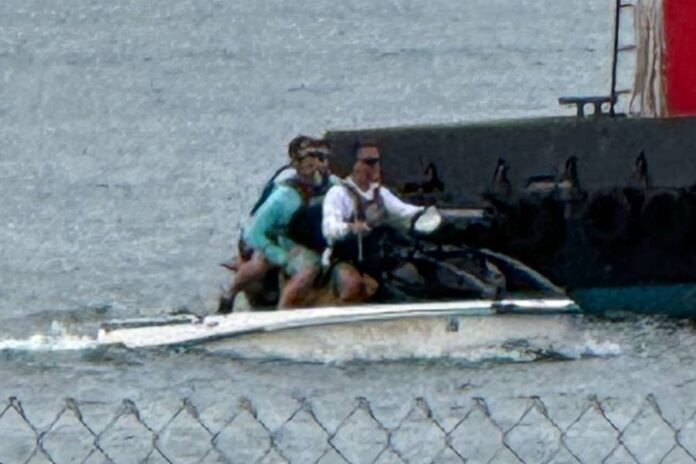
A message blipped our phone; “Hey,” it began, “I found that Yamaha boat/ski thing you reported about a while back.” Aboard the wildly-wrapped Jet Rider Nation Switch tritoon, our spy watched as the black Sprinter van lowered the Yamaha watercraft into the water at Fort Walton Beach, Florida. Three adult riders climbed aboard, tucking up tightly one behind the other, and idled their way outside of the No Wake Zone.
Our spy was easily made by the Yamaha test crew and sped away; but after loading up the Switch onto the trailer, our photographer waited for the Yamaha crew to return. All be them grainy, he managed to catch a sequence of images of the Yamaha full laden with three adult men at idle speeds. Impressively, the clearly unique hull design did not kick up any wake or over-the-bow wash, and idled dead level.
Closer inspection of the images reveal almost little-to-no more details than last year’s spy shot. What differences we can see are a revised dash panel (far wider than the near-vertical dashboard in the original image), what are likely speaker pods before the driver’s knees, and a possible clear plastic windscreen. Our spy also noted the faux-teak traction mats lining the transom and wrap-around deck.
When compared to a traditional FX WaveRunner, this machine is massive. Our photographer noted, “it’s a lot like a flats boat” noting the flat, open deck design encompassing the center seat and recessed footwells. The trailer also carried a second of the same prototype, just not side-by-side. The trailer was a full-sized boat trailer, not the usual lightweight PWC trailer, and the tow rig was a silver Ford F-350 dually.
We still don’t know for certain if Yamaha will go forward with the Jet Fish name that adorns the as-branded model sold exclusively to Australian markets, but considering the existence of the trim package and all of the legal headache that goes with filing for such a brand, it’s a strong likelihood of this being touted as the American Jet Fish for 2026 or ’27, depending if the market picks up this year.
As noted previously, Yamaha not only wants to match what Sea-Doo is offering the recreational fishing market in regards to a PWC kitted-out for fishing, but a truly dedicated craft that offers the reliability and ease of a jet driven propulsion system in the familiar packaging of a flats boat (albeit a little smaller). Creating a vehicle almost completely out of whole cloth is no small investment, so it’s an indicator that Yamaha means business.
While this craft certainly doesn’t speak to the vast majority of mainstream PWC enthusiasts, it’s fair to assume that it’s not meant to. Rather, this is targeting the multi-multi-billion dollar recreational fishing industry, which it has already garnered a significant foothold with its jet-driven FSH center console boats. This craft will likely wedge itself inside of the lineup in-between the FSH and the Jet Fish-equipped FX HO. Of course, time will tell.
Eight months ago, The Watercraft Journal reported on BRP, Inc’s continued regional expansion as the new Design & Innovation Center in Palm Bay, Florida opened its doors.
Thanks to an investment of more than $15 million into the new facility , the Center provides R&D support for the Sea-Doo, Ski-Doo and Lynx power sport brand family, and was tasked with providing design advancements across the marine industry. As we reported at the time, the opening of the center was part of the company’s ongoing focus on design innovations – innovations that had just recently earned BRP five prestigious Red Dot awards.
Often referred to as the “Oscars of Design,” the award gives recognition to the best in product design and design concepts.
Awarded annually since 1988, the honorary title “Red Dot: Design Team of the Year” is presented as part of the Red Dot Award: Product Design to a team that consistently exhibits outstanding innovation, creativity, and exceptional design quality. This honorary title recognizes a company’s overall design achievements and highlights the collaborative efforts of the design team. Awarded teams showcase a deep commitment to innovation, user-focused design, and sustainability principles. The recognition is unparalleled in the design world, with its prestige reaching far beyond the traditional design community.
Speaking on the honor of BRP Inc. being designated the 2025 Design Team of the Year, Denys Lapointe, Chief Design Officer at BRP, stated, “Our design philosophy is to create highly innovative, functional, and exciting products to exceed consumers’ needs. It’s about creating a WOW factor.”
BRP’s Design and Innovation Team is Crowned Red Dot: Design Team of the Year 2025 (CNW Group/BRP Inc.)
Lapointe, who is celebrating his 40th year with BRP, added, “I have the privilege of leading a team of 135 multidisciplinary design experts representing 21 countries, and they are a daily source of pride and inspiration. What makes our team exceptional is not just the talent but the way we push each other to grow and improve every single day. I’m still learning, still growing, and I get to do it alongside people who share the same deep belief that design can change the world. This recognition means the world to my team and me – it’s a highlight of our careers.”
You can read the full press release below:
Progress through movement – BRP Design & Innovation Team is Red Dot: Design Team of the Year 2025
BRP, a global leader in powersports products, propulsion systems and boats, has been awarded the prestigious title “Red Dot: Design Team of the Year 2025”. The title recognises BRP’s longstanding commitment to innovative and solution-driven design, and its pursuit of creating the ultimate, well balanced consumer experience.
With a reputation for reimagining adventure across asphalt, dirt, water, and snow, BRP has consistently pushed the boundaries of design, technology and performance. Its products blend functionality with striking design, delivering both high performance and powerful emotional experiences for riders.
Since its founding over 80 years ago, BRP has evolved from a snowmobile pioneer into a global force in powersports and recreational vehicles, with an extensive portfolio including iconic brands such as Ski-Doo, Lynx, Sea-Doo, Can-Am and Rotax. Each product launch reflects a deep commitment to innovation and a distinctive design language that challenges convention.
Ski-Doo MXZ XRS, Red Dot winner 2023 Having earned multiple distinctions in the Red Dot Design Award across a diverse range of vehicles like the Sea-Doo personal watercraft and the Can-Am on-road and off-road models, BRP now joins a prestigious group of design leaders – including Ferrari, Logitech and Thule – in the Red Dot Hall of Fame. The honorary title is not open to application and is awarded only to companies that demonstrate long-term, consistent excellence across their entire design portfolio.
A legacy of creativity and innovation BRP’s success is deeply rooted in its focus on user-centred design, technological advancement, and an unwavering dedication to rider experience. “Our design philosophy is to create highly innovative, functional, and exciting products to exceed consumers’ needs. It’s about creating a WOW factor”, says Denys Lapointe, Chief Design Officer at BRP, who this year celebrates 40 years with the company. “I have the privilege of leading a team of 135 multidisciplinary design experts representing 21 countries, and they are a daily source of pride and inspiration. What makes our team exceptional is not just the talent but the way we push each other to grow and improve every single day. I’m still learning, still growing, and I get to do it alongside people who share the same deep belief that design can change the world. This recognition means the world to my team and me – it’s a highlight of our careers.” BRP’s design studios in Canada, France, and the United States serve as creative hubs where cross-cultural ideas and expertise come together to shape the future of powersports.
Designing for the future At BRP, design goes beyond aesthetics – it is about solving problems, redefining what’s possible, and crafting products that connect with people emotionally. With boldness, precision, and a clear identity, BRP’s designs resonate across all terrains – from snowy landscapes to open waters.
BRP is also looking ahead, embracing sustainability, electrification, and smart technology. Design has become a strategic driver of growth and innovation. “Design is a core function at BRP. It’s part of our DNA,” Lapointe adds. “It played an instrumental role in our growth over the years and allowed us to stand out and forge a reputation for being trailblazers.”
This latest recognition marks not just a milestone but a motivator for the future. With a legacy built on curiosity, creativity, and a love for adventure, BRP remains dedicated to building products that inspire, empower, and excite riders across the globe.
Sea-Doo Explorer Pro, Red Dot winner 2023
Sea-Doo Explorer Pro, Red Dot winner 2023 Professor Dr. Peter Zec, founder and CEO of Red Dot, praises BRP’s unique contribution to the industry:
“With a clear user-centric design philosophy, the BRP Design & Innovation Team has been developing outstanding recreational vehicles for years – innovative, functional and emotionally inspiring. Under the long-standing leadership of Denys Lapointe, BRP has cultivated a design culture that runs deep within the company, making BRP an industry leader. The title ‘Red Dot: Design Team of the Year 2025’ recognises this continuous excellence. Congratulations to Denys Lapointe and the entire team on this well-deserved honorary title!”
Red Dot: Design Team of the Year Awarded annually since 1988, the honorary title “Red Dot: Design Team of the Year” is presented as part of the Red Dot Award: Product Design to a team that consistently exhibits outstanding innovation, creativity, and exceptional design quality. This honorary title recognises a company’s overall design achievements and highlights the collaborative efforts of the design team. Awarded teams showcase a deep commitment to innovation, user-focused design, and sustainability principles. The recognition is unparalleled in the design world, with its prestige reaching far beyond the traditional design community.
Hall of Fame: all winning design teams since 1988 2025 BRP Design & Innovation Team
2024 Thule Design Team
2023 Logitech Design
2022 Philips Experience Design Team led by Sean Carney
2021 Studio F. A. Porsche
2020 Fiskars Design Team led by Petteri Masalin
2019 Flavio Manzoni & Ferrari Design Team
2018 Phoenix Design Team
2017 Canyon Design Team
2016 Blackmagic Industrial Design Team led by Simon Kidd
2015 Robert Sachon & Bosch Home Appliances Design Team
2014 Veryday
2013 Lenovo Design & User Experience Team
2012 Michael Mauer & Style Porsche
2011 The Grohe Design Team led by Paul Flowers
2010 Stephan Niehaus & Hilti Design Team
2009 Susan Perkins & Tupperware World Wide Design Team
Although AquaX is making racers and fans learn the art of patience, with the first race of the 2025 Triple Crown not taking place until June 27-29, they are not just coasting until opening day.
In a press release issued yesterday, May 20, P1 AquaX announced that that Monster Energy has stepped up up as the exclusive Title Sponsor for both the 2025 A1AquaX (PWC) Championship and the P1 Offshore Triple Crown (powerboats).
You can read the full press release below:
Monster Energy New Title Sponsor of P1 Offshore Triple Crown & P1 AquaX National Championship
Powerboat P1 is proud to announce an agreement naming Monster Energy as the exclusive Title Sponsor of the P1 Offshore Triple Crown and P1 AquaX Championship for 2025. The series will be officially named The Monster Energy P1 Offshore Triple Crown and The Monster Energy AquaX Championship.
Monster Beverage Corporation was founded in 1935 in Southern California and currently holds 39% of the $86 billion global energy drink market. The deal includes exclusivity as the only energy drink brand promoted, sold, or sampled at all Triple Crown and P1 AquaX events. Monster Energy will be heavily branded at all Triple Crown and P1 AquaX races this season to include on-site fan activations, product samplings, and commercial placement on live TV coverage (RACERTV), online streaming (YouTube and Facebook), and post-produced highlight shows (FanDuel TV & Other International Networks).
“Monster Energy is enthused to announce that we will be the title sponsor of the P1 Offshore Triple Crown series in 2025, featuring major championship racing events set for New Orleans, Louisiana, Sheboygan, Wisconsin, and St. Petersburg, Florida,” said Dave Gowland, Vice President, Monster Energy Sports Marketing. “Furthermore, we continue our support with World Championship-winning M-CON Racing, and we are pleased and proud to be back with this world-class team and pilots Tyler Miller and Myrick Coil, reigning UIM Class 1 World Champions. High speeds, careening through waves, and fierce competition are what Monster Energy is all about, and we’re stoked to be a part of this awesome and totally unique form of motorsport in 2025.”
The inaugural Monster Energy P1 Offshore Triple Crown powerboat race series will launch in June in New Orleans, LA, before continuing to Sheboygan, WI, and St. Petersburg, FL over the Summer. P1 AquaX National Championship racing will provide a double bill of marine motorsport action in New Orleans, Sheboygan, and St. Petersburg, bringing nationwide high-speed watercraft racing to fans. The official charity of the Monster Energy P1 Offshore Triple Crown race series is the P1 Marine Foundation, which provides support to local charities focused on marine conservation, including research, educational programs for youth, and sustainability of our waterways.
Azam Rangoonwala, President and CEO of Powerboat P1, stated: “Monster Energy invests in an array of international sports and properties, and their decision to become Powerboat P1’s Title Sponsor for the Triple Crown is a testament to their growth as one of our key strategic partners over the past few years. Our high-energy, lifestyle events will give the brand a strong platform to interact with race fans.”
Powerboat P1 is an international sports promoter that has held more than 750 races in 19 countries on four continents to become a leading marine motorsport brand with the understanding that creative marketing and strategic partnerships are essential to achieving positive results. For more information visit: P1OFFSHORE.COM]
Riding a Sea-Doo PWC is already a blast, but if you’re looking to kick things up a notch this May, their lineup of watersports accessories might be just what you need. A recent addition to Sea-Doo’s Product Series video collection gives us a closer look at how to take full advantage of your 3-person Sea-Doo for wakeboarding, waterskiing, tubing, and more.
One of the must-haves if you’re towing a skier or wakeboarder is the LinQ Retractable Ski Pylon. It’s height-adjustable, quick to attach or remove, and elevates the tow rope above the water—perfect for wake sports. Plus, it doubles as a stabilizing point for the spotter, a critical safety position we’ve recently highlighted.
If your Sea-Doo model wasn’t originally built for watersports, no worries—the Ski & X Package Module helps optimize your settings for a smoother, safer towing experience.
Planning to pull a tube instead? All you need is the Tow Point Cleat Adapter, which converts the standard eyelet into a proper cleat for tow ropes. Want to go the extra mile? Adding a Shock Tube helps keep the rope out of the intake, saving you from potential headaches.
Beyond towing, Sea-Doo also makes life on the water a little easier. Their wakeboard rack keeps the board out of your way and your passengers’ hands free. And the boarding ladder? A total game-changer—it folds down, stays low-profile, and makes climbing back aboard a breeze, whether after a swim or a wipeout.
This is one of those accessory bundles that turns a good day on the water into a great one—so check out the full video on Sea-Doo’s YouTube and take your Summer up a notch!
The past weekend took the PWC racing focus to international shores as the first round of the WGP#1 Waterjet World Series 2025, with more than 200 elite jet ski riders from 21 countries across five continents—Europe, the Americas, Asia, Oceania, and Africa—competing in the OSAKA GRAND PRIX 2025 at Nishikinohama Beach, Osaka, Japan.
The season, and this weekend’s race opened with high ceremony, as is familiar to those who have had the opportunity to attend a World Series event. The opening ceremony included not only representatives from the race series, but government officials and leaders as well.
Osaka is honored to welcome athletes and fans from across the globe. Nishikinohama Beach and the city of Osaka are now recognized as one of the premier jet ski racing destinations in the world. We extend a warm welcome to everyone here for this historic event,” stated Executive Chairperson of the Osaka City Council Takashi Takeshita.
Parikhet Subsahakarn, Tournament Director of the WGP#1 and owner of WGP#1, added “This is a proud moment for the global jet ski community—and especially for Thailand. WGP#1 World Series has truly gone global. The Osaka Grand Prix 2025 has attracted over 200 top riders from 21 nations, and the event will be broadcast live to over 200 million households worldwide, cementing our status as the #1 jet ski tournament on the planet. We’re also looking ahead to the grand finale: WGP#1 Waterjet World Cup 2025, set for December in Thailand. We’re expecting over 3,000 international athletes to participate, delivering enormous economic and tourism value for the country.”/
After three days of competition in 21 classes, several USA racers brought home podium wins, with Factory Kawasaki’s Hyperion ski under many of them. Kommander Industries riders also put in an excellent showing in Osaka, and even independent USA riders fared well.
Podium highlights included:
PRO SKI GRAND PRIX 1st: JIMMY WILSON #300 – USA / FactoryKawasaki USA (Hyperion) 2nd: Mao Sato #88 – Japan / FactoryKawasaki USA (Hyperion) 3rd: Ryder Wildeboer #888 – USA /Kommander Industries
ENDURANCE OPEN 3rd: Hugo Pastorello # 88 – France – Pastorello Competition/FactoryKawasaki USA (Hyperion)
PRO FREESTYLE 2nd: DEMI MORGAN – USA / High Speed Industries
PRO AM WOMENS SKI GP 3rd: Sophie Francis #47 – UK (No Team sponsorship, but riding a Kawi Hyperion with stock class engine) 10: Carris Webster #210 – USA /Kommander Industries
EXPERT SKI 3rd: Hugo Pastorello # 300 – France – Pastorello Competition/Factory Kawasaki USA (Hyperion) 8th: Ryland Webster #210 – USA /Kommander Industries
IJSBA expands partnership with Lake Havasu In a mid-week post last week, IJSBA Executive Director Scott Frazier announced an expansion of the organization’s partnership with Go Lake Havasu through 2026. “We expect to soon announce the full details of how extensive this partnership will be to provide an all new World Finals experience for the next two years and bringing us to a new future in 2027,” Frazier stated.
Go Lake Havasu is the Convention and Visitors Bureau (CVB) for Lake Havasu City, Arizona.
Additional preview points for upcoming IJSBSA activities and endeavors included: A shift to multi-stop events and “ending a focus on a one size fits all single format.” Frazier added that “the goal is to branch out to multiple formats encouraging experiences in several global venues where PWC growth, travel, and relocation are goals;” announcement of the June release of a new site layout plan for World Finals, along with information on the PWC Convention and Expo Poker Run; advance notice that IJSBA will soon release new rules updates that “should be able to guide away from rogue or inconsistent rule interpretations and finalize the contributive changes posted throughout the year.”
Wednesday’s post also included notes that IJSBA will soon be releasing a conservative financial plan for the 2025 SBT World Finals and a full historic retrospect of the organization. The full press release can be read below.
AJSA made Fox News for round 1 of the 2025 season; now it’s almost time for Round 2
Coming Up
The 2nd Round of the American Jet Sport Association 2025 Season is just around the corner. After Round 1, held April 11-13 in Guntersville, Alabama, AJSA is gearing up for round 2 May 30-June 1 at Chester Frost Park in HIxon, Tenn. (outskirts of Chattanooga).
Schedule is as follows: Friday: 8:30am: Corporate Challenge; 1pm – 5pm: Practice Saturday: 9am: Practice; 10am: Racing; 12:00pm: Freestyle; 12:50pm: Pro Show Sunday: 9am: Practice; 9:30am: Racing; 10am: Pro Show; 11am: Amateur Racing; 12:00pm: Freestyle; 12:50pm: Pro Show
PWC Briefs Registration is now open for the Jettrim IJSBA Jr Nationals, which will be held on June 5 – 6 in Altus, Oklahoma. Registration Link:https://app.iraceready.com/event/jettrimjr
A Jet Ski Cruise is set for June 8 on Old Hickory Lake, a reservoir located on the Cumberland River at mile 216.2 in Sumner and Davidson counties, approximately 25 miles upstream from Nashville.
East Coast Watercross is giving away 4 VIP tickets to see the Zac Brown Band on May 30th at the Bank of NH Pavilion (Gilford, New Hampshire). Check the ECW Facebook page for details.
Jersey Show PWC Riders group will be hosting their Annual Make A Wish Charity Ride on Saturday, June 7 from 9 a.m. to 2:30 p.m.
The International Jet Sports Boating Association is pleased to announce a preview of a series of critical updates to the organization and action plans. Please share the following news with your friends and colleagues in the PWC Racing Community. Stay tuned to IJSBA for expansion of these points over the next weeks as posts will be made regularly.
IJSBA is very pleased to share that the agreement to extend the partnership with Go Lake Havasu has been extended through 2026. We expect to soon announce the full details of how extensive this partnership will be to provide an all new World Finals experience for the next two years and bringing us to a new future in 2027.
IJSBA is hopeful to announce all new partnerships for the next two years for different joint methods of multi stop events. Ending a focus on a one size fits all single format, the goal is to branch out to multiple formats encouraging experiences in several global venues where PWC growth, travel, and relocation are goals.
New media partners and plans. IJSBA has secured two new media partners for the 2025 Short Block Technologies World Finals. We are continuing to accept offers for new media and podcast partners who can each receive exclusive pre-World Finals content.
The IJSBA PWC Convention and Expo Poker Run of 2025 will be fully announced in June and will take place on October 10-12.
An entirely new World Finals site layout plan will be announced next month to host World Finals, the Trade Show, and the Owners Convention programs. The new layout will include a completely redesigned vendor and spectator area, a new entrance, and a significantly larger pit area allowing for more waterfront pitting than in previous layouts.
The week, rule updates will be posted that should be able to guide away from rogue or inconsistent rule interpretations and finalize the contributive changes posted throughout the year as well as begin a section of the rule book which includes regularly submitted rule questions that were received by IJSBA and the response given. The names of persons/contacts requesting the information will be redacted.
IJSBA will announce a conservative financial plan for the 2025 SBT World Finals fully aware that we are in an uncertain global economy. We do not anticipate any loss of amenities.
IJSBA will post a full historic retrospect of the organization, where we have been, and where we intend to go. This will be posted in the next upcoming weeks. We hope you will find the history interesting.
We hope the preview is discussion worthy and that the content will be well received when it is published. For questions or comments, please email [email protected].
4. Fine-tune, adjust, and amend solution to conform to reality
5. Implement solution
6. Repeat steps 4 & 5 as needed
Junior Ski Show Winner Cash McClure. See the PWC Sprint Racing Facebook page for more results.
Off of paper, out in the real world, it’s nowhere that simple; but that didn’t stop PWC Sprint Racing.
This past weekend, after a relatively short span of time between idea conception and implementation, John Block and the rest of the hardworking PWC Sprint Racing crew put on their first official event.
And while that timespan may have been short — The Watercraft Journal covered the initial announcement of the PWC Sprint Racing effort in December 2024 — that span of weeks and months undoubtedly contained endless hours of planning and enormous amounts of energy and effort.
The efforts paid off, however, as the weekend’s races were well-received, despite somewhat uncooperative weather and the conflict of running a race on Mother’s Day weekend. The race site at Chester Frost Park in Hixon, Tenn. (the outskirts of Chattanooga) was a prime location – conveniently close to the attractions and services in Chattanooga without feeling “urban”, plentiful parking and grassy areas and what seemed to be easy launching from the banks of Chickamauga Lake.
But that’s not the end of the process. With steps 5 complete, Block is already hitting on step 6 with a press release posted to the PWC Sprint Racing social media page on Wednesday. Not only did Block address the success and the “could have gone better” aspects of the weekend’s inaugural event, he touched on specifics, asked for input, and outlined steps forward — racers can’t ask for much more than that.
Read the full press release below: We tested it, and it worked. The format worked. The track worked. The log jumps worked. The staff was the best. The volunteers were amazing. The racers were awesome as usual and the juniors were absolutely incredible. We had multiple lead changes. Come from behind finishes. Skilled racers in a fast action packed race that could very easily be viewed from the shoreline. They raced to the limits of their ability and took it to the edge. All of this in a very safe manner going yes ELBOW TO ELBOW.
Where do we go from here? My partner Brad Hill and I financed this whole venture out of pocket. Basically the entry fees collected payed for about 5% of the cost of putting on this race. We new this would be the situation but we love jet ski racing and felt the sport needed something all new. We also believed PWC Sprint racing could work. We new that with the way the format works by having limited race classes (7 classes compared to other promoters with venues that have 30 classes and combined classes) the entry fees collected would not create enough revenue to sustain more racing. We do have other race site locations in mind and they are available but we cannot commit until we create a way to generate more revenue.
How do we create more revenue? We believe the way to generate more revenue is by sponsorship. With sponsorship not only can we cover the operating expenses we can also generate funds to support racer payouts and product for prizes.
The plan: In sprint racing the format allows for each class to have a Show per round. (Main event) There are 3 major classes. 1050 Stock, Sport Spec, Jr. Ski Sprinters. In the future more classes can be added as long as we have 4 or more entries In that class. We also have Hot Laps. (Timed laps for positioning). We plan on offering these Shows and Hot Laps available for sponsorship.
How it works: When you sponsor a Show and or Hot Laps you will receive a complimentary banner that will be displayed at the race site with your company name and logo. Your banner will be displayed directly below the PWC Sprint Racing banner on the starting line tower. It will be displayed the entire duration of the Show you choose to sponsor. The announcer will announce your company name as the title of the show. Your banner will also be in all photos with the winning racer and be posted on PWC Sprint Racing site and shared on social media.
The best part: 50% of the fees charged for your sponsorship will go directly to the racers payout. The other 50% will go to help pay expenses and keep PWC Sprint Racing alive. We believe it is time to have Sprint Racing added to the venue of jet ski racing. For years we have had close coarse racing on bigger tracks. Endurance racing and drag racing. Now is the time for Sprint Racing.
Please contact me for further details and opportunities. John Block 513-284-1644 or Brad Hill 1-828-289-0190
I have been racing and involved in the PWC community for 30 years. I KNOW WE CAN MAKE THIS WORK!
One thing that sets RIVA Racing apart is their innovative methods for taking care of issues that many might just take for granted. Their newly announced RIVA Sea-Doo 325 Intake Manifold Bushing & Seal Kit is certainly one of these instances. After hearing the common complaint about the boost leak issues on many 325hp Sea-Doo engines, they designed and manufactured a product specifically engineered to address these issues, ensuring that your PWC experience isn’t affected by minor manufacturing flukes.
In a recent Facebook post, they explain that “The original bushing and seal design is often the cause of boost leaks between the intake manifold and cylinder head. These boost leaks reduce performance and can even trigger a fault code (P2282) when more severe.” That’s why their kit includes precision-machined aluminum bushings to reestablish correct clamping force, as well as newly upgraded manifold seals made specifically to remedy this issue.
What’s more, they promise that the installation of this kit will be very easy, meaning that your improved sealing mechanism on the manifold-to-cylinder head is truly just a few steps away. Their instruction manuals are already available online, and it promises to take only approximately one hour to install this upgrade.
This application is available for 2024 and 2025 Sea-Doo 325 models (including the GTX Limited, RXT-X, and RXP-X models). They are currently available for preorder on the RIVA Racing website and will be shipped out in early June with free ground shipping anywhere inside the continental United States, so be sure to reserve yours now to ensure your Sea-Doo is running at peak performance this summer!
If you’ve ever tried figuring out which engine bearings you need for a Kawasaki motor, you know it’s not exactly the most straightforward task. Kawi Performance was getting tons of questions about this exact issue, so they decided to do something about it — and honestly, their solution is super helpful.
On the Kawi Performance website, under the “Services & Information” section, there’s now a dedicated “How to Match Up Engine Bearings” guide that takes the confusion out of the process. Whether you’re a seasoned rider or a new learner, having the proper bearings for your Kawasaki PWC engine is imperative for making sure your engine operates smoothly, so this tool is an absolute must. Kawasaki uses two different bearing color codes, and there are several combinations depending on your engine’s specs. It can get confusing fast. That’s where Kawi Performance steps in — they’ve added both an online calculator and a detailed step-by-step video that walks you through how to figure out exactly what you need.
The video starts by explaining how to check the connecting rods. You’re looking to see if there’s a letter marking — it’ll either be circled (which means it’s marked) or not circled (which means it’s unmarked). That tiny detail matters when it comes to sizing. Next, you’ll check the engine cases. This involves looking for marks between the lines on the cases, and the Kawi Performance diagram they provide makes it easy to spot exactly what you need to be looking for. After that, it’s time to measure the crankshaft. This is probably the trickiest part, but the video Kawi Performance put together shows you exactly how to measure each individual piece. It’s super helpful if you’re a visual learner or new to this kind of work.Finally, once you’ve got all the info, the video helps you match the correct bearing color for your connecting rod.
What’s more, the calculator tool on their website further ensures that the bearings you order will be properly fit to your engine, by allowing you to input information one piece at a time, and finally choosing the proper model for you. After entering information on the rods, cases, and crankshafts, Kawi Performance ensures you won’t need to second guess the bearings you buy.
If you’re working on a Kawasaki engine anytime soon, definitely check out the Kawasaki Engine Bearing Calculator section on their site — it’ll save you time, stress, and maybe even a return shipment.


 Less and 24 hours ago, Sea-Doo ambassador and adventure enthusiast Jamie Vogler set out on an extraordinary 14-day solo journey, planning to cover more than covering more than 1,500 miles, riding his Sea-Doo Explorer Pro from Tweed Heads, NSW, all the way to the tip of Cape York, QLD.
  Supporting Conservation with Co-Exist Australia