
Home Blog Page 302

Gallery: Refinishing Your Finish With Finish Renu

2

renu

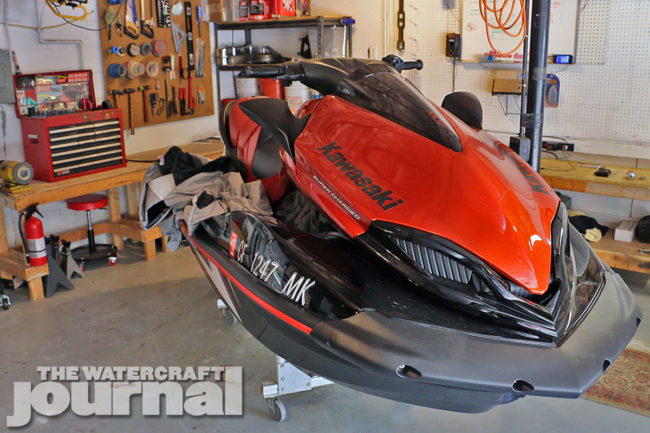
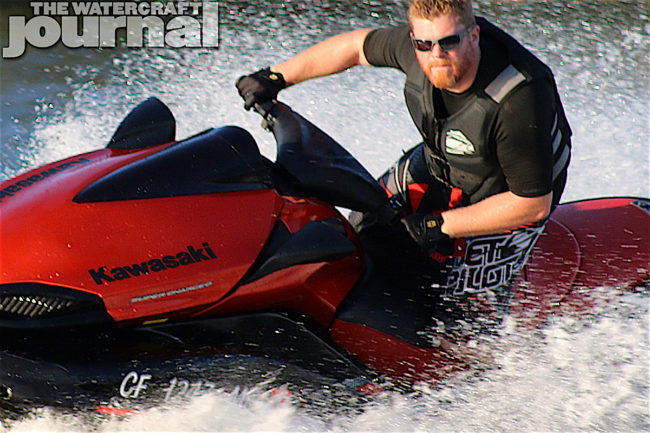
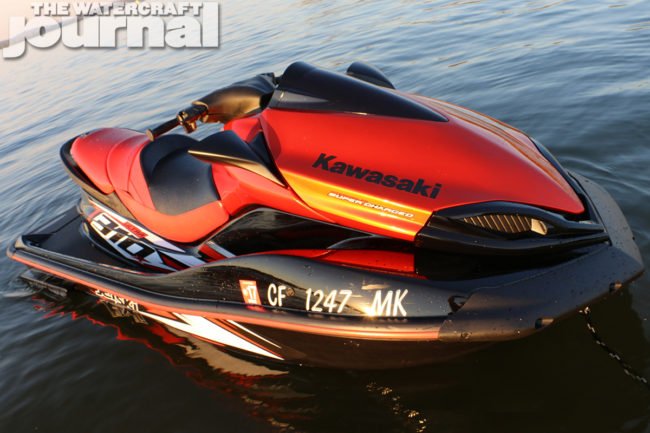
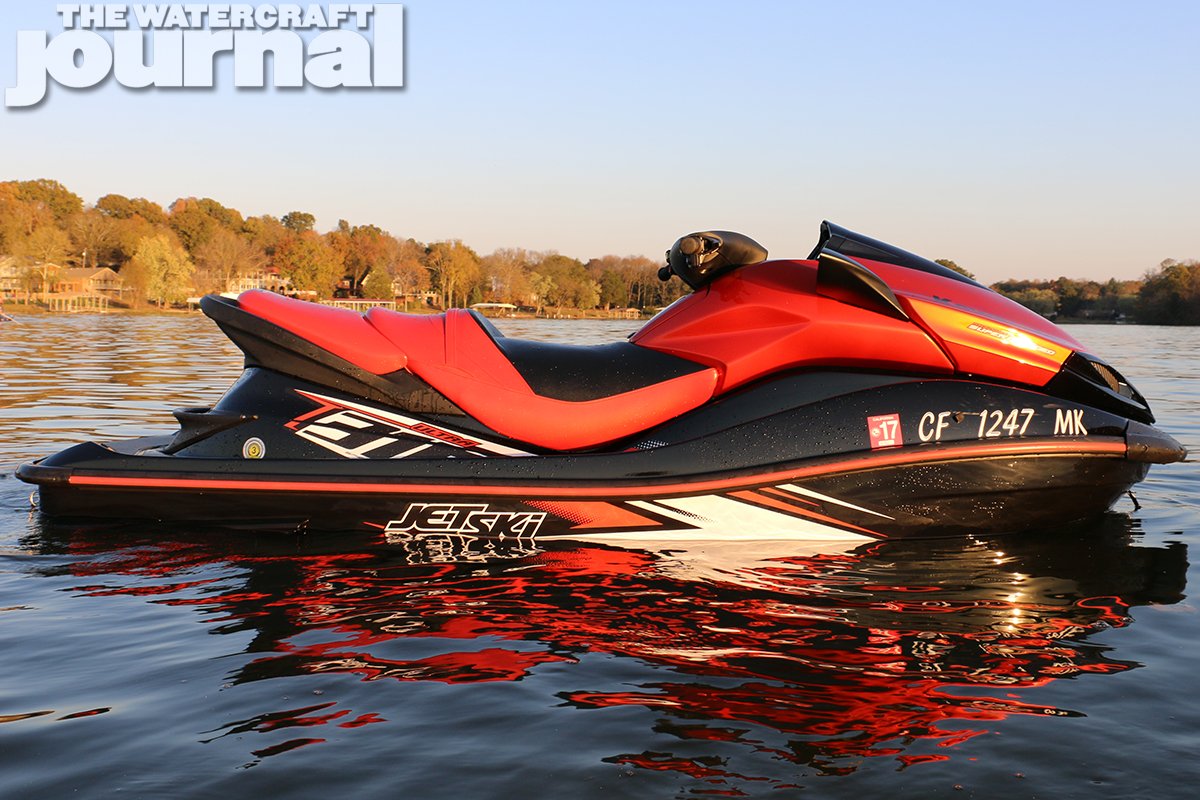
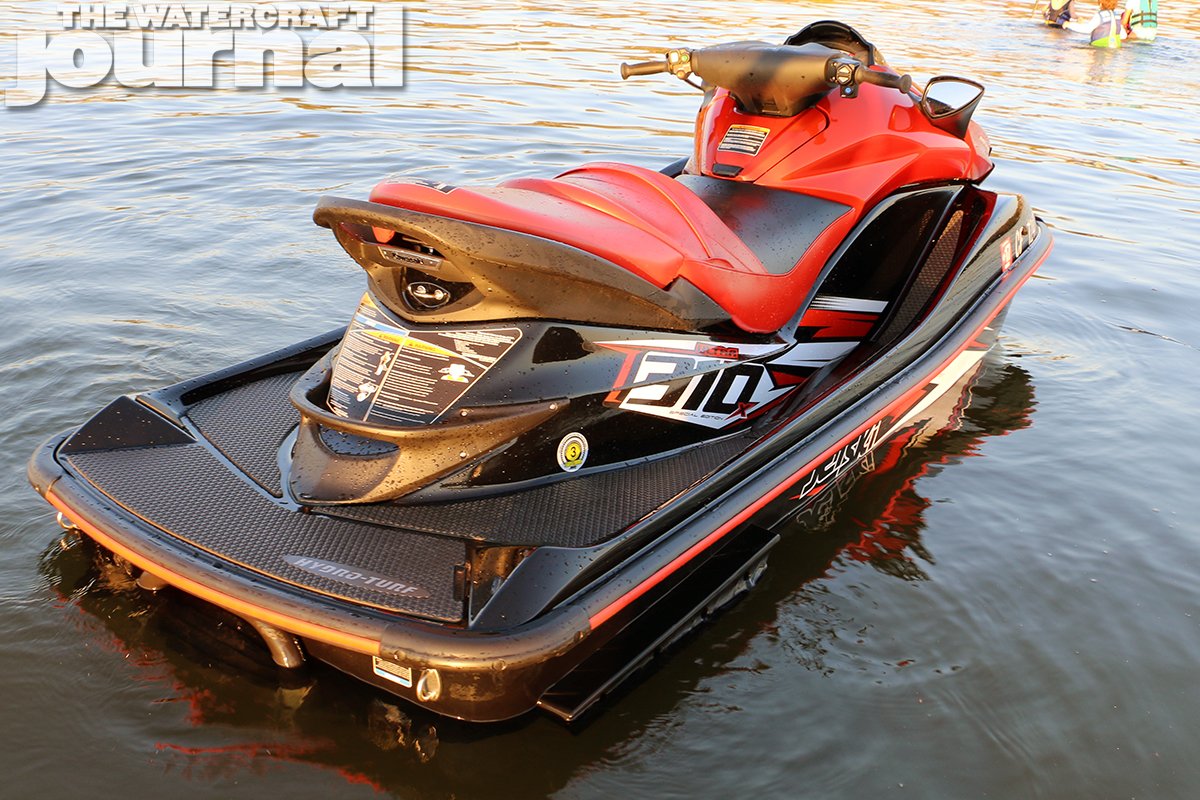
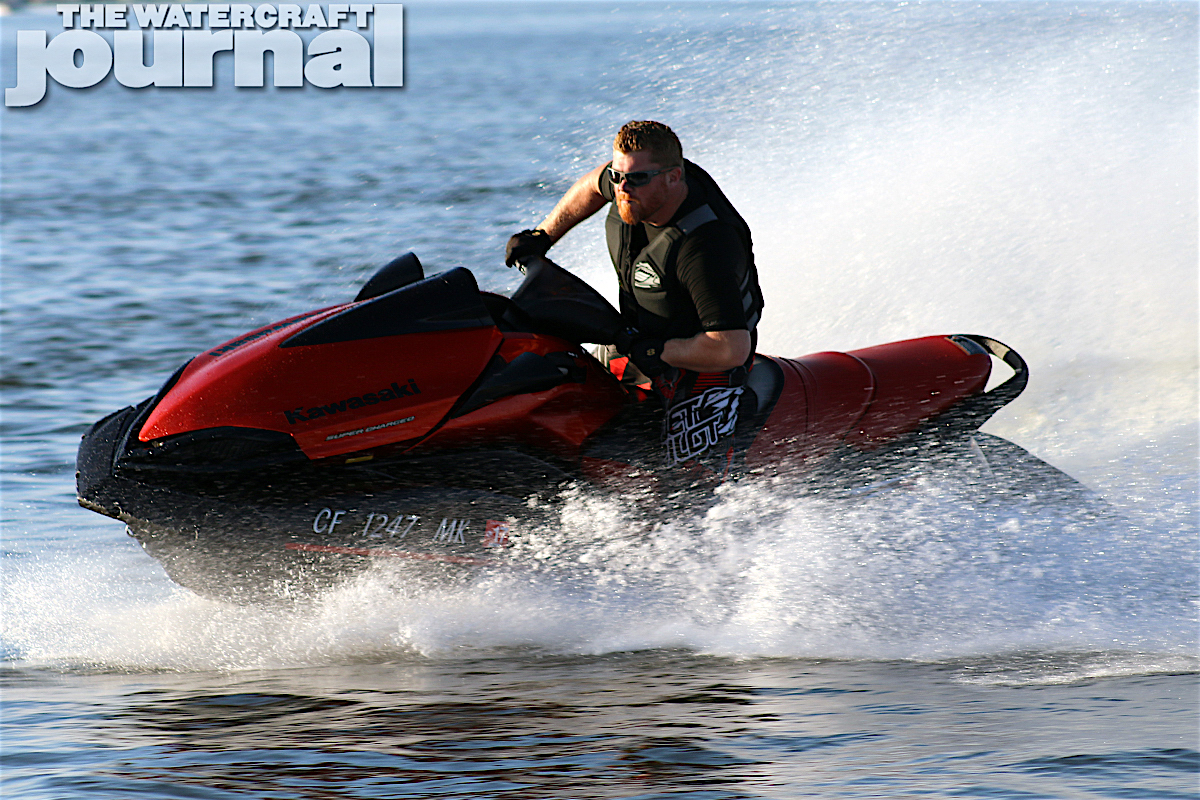
For anyone who paints cars, you’ll know that black shows everything. Every little flaw in bodywork, every shortcut in prepping the surface. You name it, black will reveal it. Heck, even if you do a shoddy job washing down you ski after a long ride, a black hull will reveal every waterspot and bit of residue you didn’t wash off. It’s too bad black looks so good, because it is just so hard to maintain. We learned this first hand this year with our long-term loaner, a 2016 Kawasaki Ultra 310X SE JetSki.

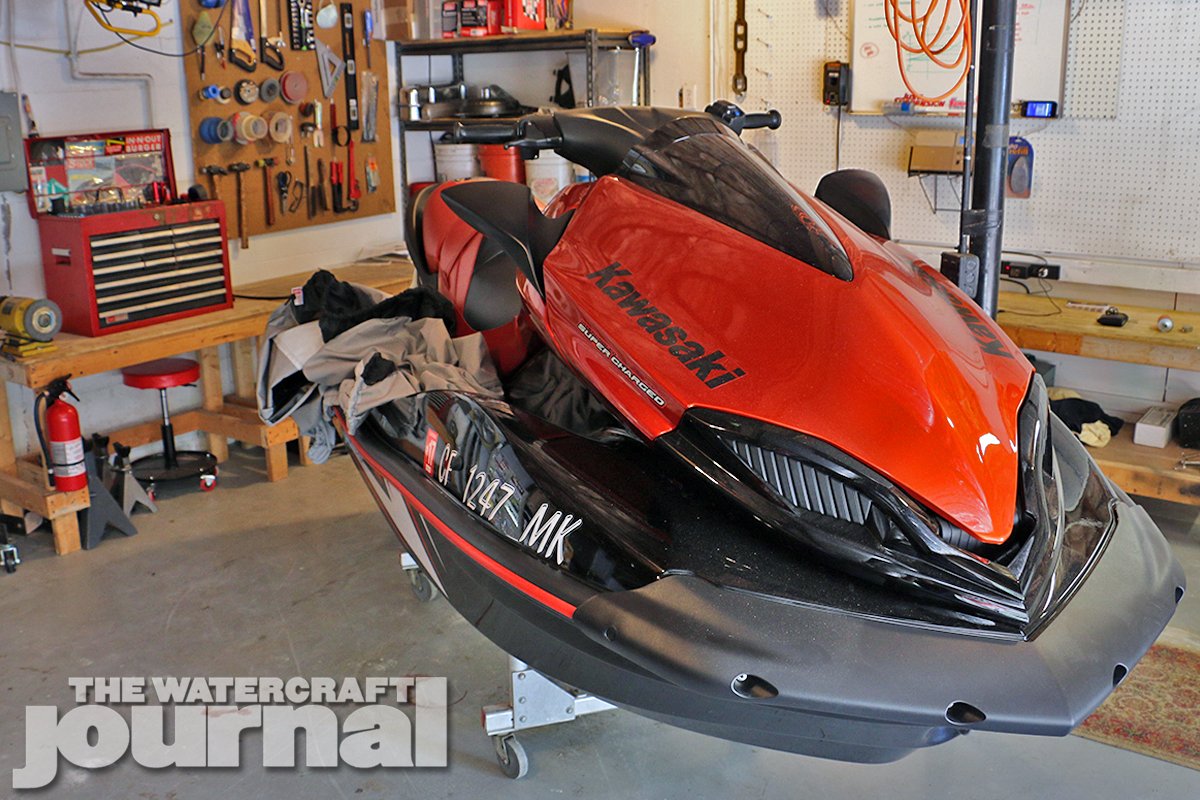
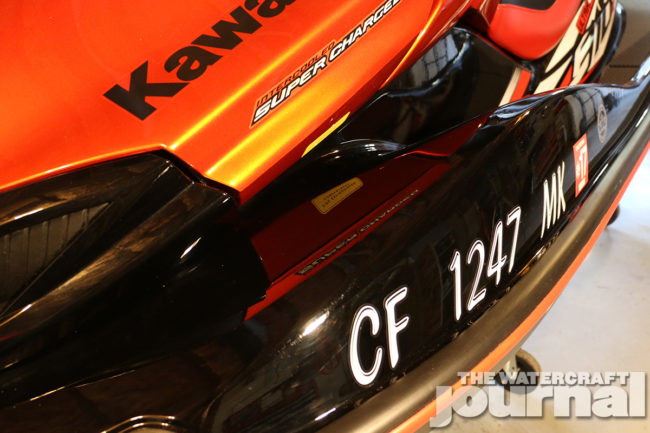
While the Candy Burnt Orange glimmered under any light, the inky black deck and hull showed every bit of dirt, grime and salt that we couldn’t (or didn’t) wash off properly. Worst of all, a year’s worth of heavy usage left the angled deck lines scuffed and gouged as one too many riders failed to slow down enough to tie up to the dock or mount the trailer bunks without a collision. One such impact with a dock left a palm-sized circular scratch on the front left corner that stuck out like a sore thumb.
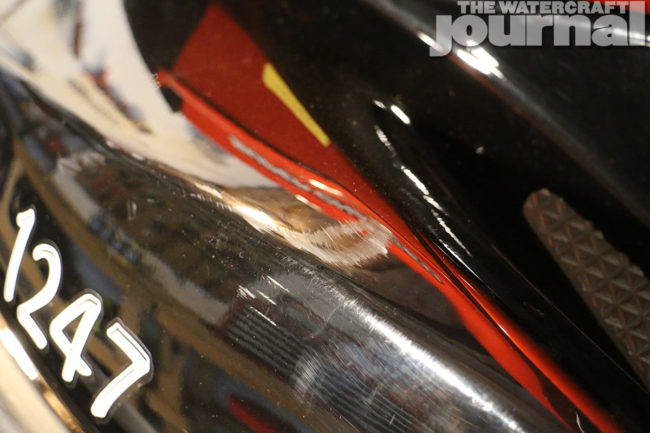
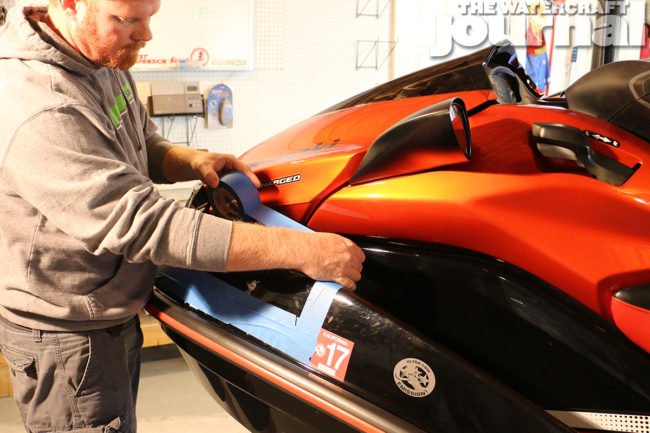
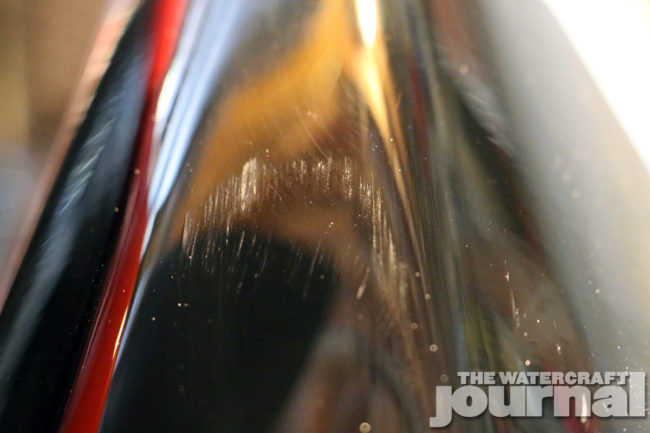
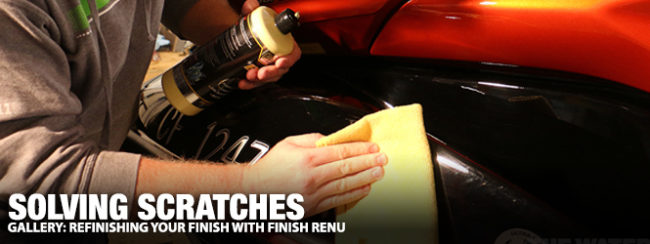
Above left: Finish Renu is the parent company of PWC cleaning gurus Jet Renu, supplying industrial-grade car car products to the automotive world. Above right: Our loaner Kawasaki Ultra 310X SE has built up a lot of wear and tear, most notably a heavy scratch on the side after rubbing up to a dock a little too hard. Below: We masked off our damaged area where we were going to be working primarily to keep our buffing wheel from wandering too far. A more mindful job would’ve had us masking off the whole front of the ski so we wouldn’t need to rewash it later.

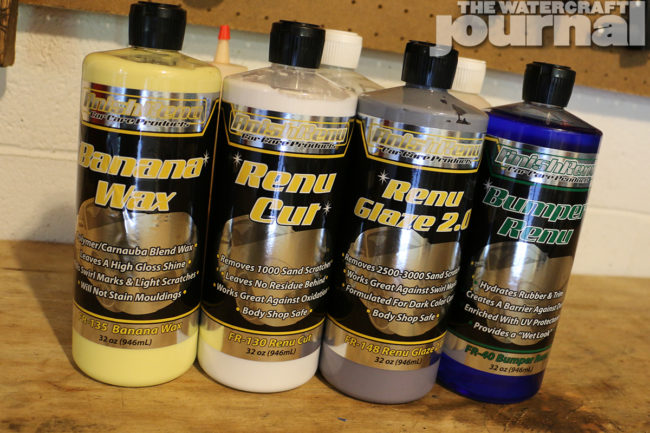
In conversation with the team from Jet Renu, we mentioned our hard luck Kawasaki and its roughed-up exterior. Immediately, they recommended their Finish Renu Renu Cut, Renu Glaze 2.0 and Banana Wax. While Jet Renu has its own line of gel coat cleaners and waxes, Jet Renu offered up their industrial body shop-grade car care products from their Finish Renu line so that we could use them on other projects for our sister publication, Mopar Connection Magazine. With our Kawasaki in dire need of some cosmetic TLC, we figured, “What the heck” and went to work with a few microfiber rags, a household electric drill, a buffing cone and a couple applicator pads.

Within an hour and a half’s time, not only were the scratches all but completely invisible, but the tuxedo-black finish of the Kawasaki was as reflective as a bathroom mirror. Over those that advertise “all-in-one,” we have found that multiple-stage buffing is worth the added time and effort as the single-bottle variety don’t offer the cutting compounds necessary, or the finalizing glazes strong enough to extract that mirror-like end result. All of Finish Renu’s products come with specific instructions to guide you through each step, to which we followed to the T.

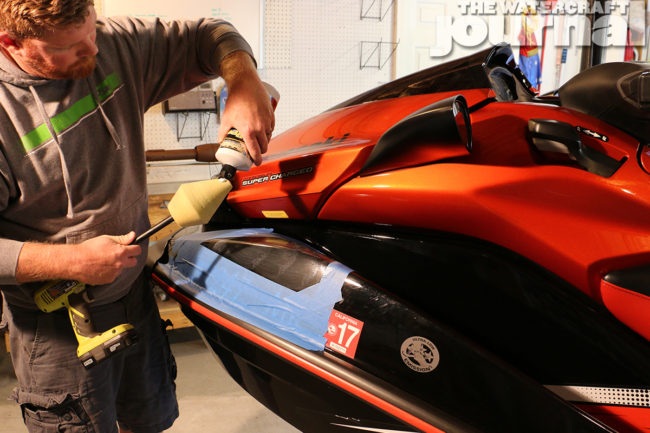
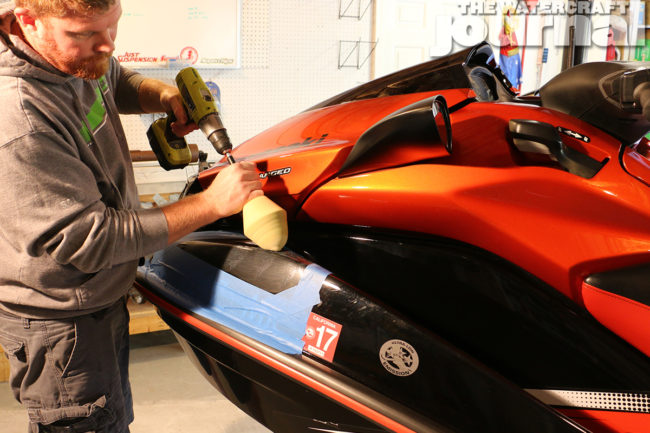
Above left: We picked up this cone-shaped buffing wheel at our local auto parts retailer for $10, which works great with our battery-powered electric drill. Finish Renu suggests applying the Renu Cut directly to the surface, which you can see us not doing. Don’t do what we did. Below left: We made several passes with the Renu Cut as it was going to be most of the work knocking down the scratch and exposing the small cuts in the surface. Below right: The result of a few minutes of buffing with the cutting compound show how effective the Renu Cut is in smoothing the surface.

Beginning with a clean surface, we properly masked off our injured areas so that we didn’t wander with our buffing wheel too far off course. While we only masked off the area to keep us focused, a more thorough job would’ve had most of our work area masked off in case of overspray, which we definitely encountered. Because we were using an electric drill and buffing cone, we applied the Renu Cut compound (rated for 1000-grit sand scratches) directly to the surface. Because Finish Renu’s materials are a zero residue chemical, we operated at a slow speed, making concentric circles until the surface was lightly hazed.

With a microfiber cloth, we wiped the surface clean and reviewed our work. Satisfied, we moved on to step too: Renu Glaze 2.0. The gray compound removed 2500-3000 grit sand scratches, which makes it ideal for removing swirl marks on darker cars and surfaces. We first opted to apply the Renu Glaze by hand with an applicator, but found that too slow for our tastes, so our came the buffer. This not only removed the tiny etches left by the more aggressive Renu Cut, but also the deeper scratches made to the JetSki over time.
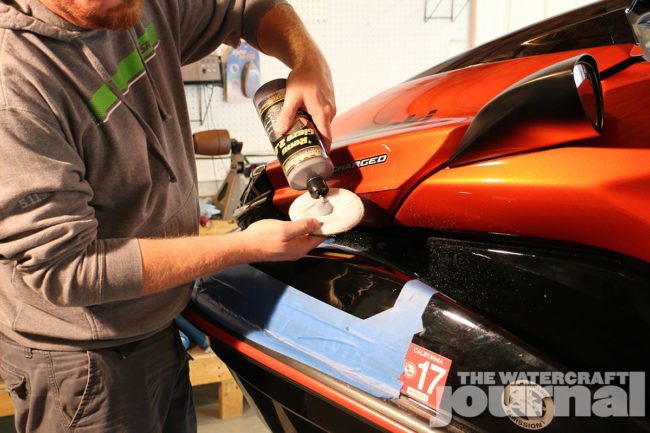
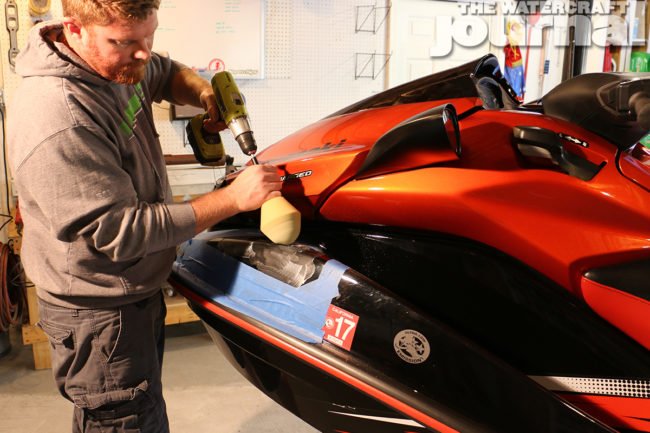
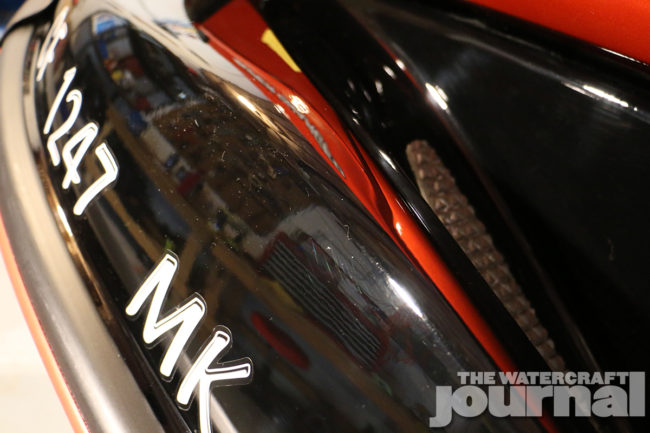
Above left: The Renu Glaze 2.0 is ideal for removing finer scratches and swirls, as well as being a great blend for darker-colored surfaces. We first applied the glaze by hand with an applicator pad and some harder pressure. We then followed up with the buffing wheel (and a little less pressure). The intermediate result was nearly enough to call it a day. Below left: The final step was applying the Banana Wax with a microfiber cloth, which rightly fills what little swirls and surface markings are left. Below right: Compare this image with the two images of the original scratch and half way through the process, and you’ll be believer as well.

Finally, we applied the polymer/carnauba blend Banana Wax. This perfectly fills what little remains of swirl marks and faint scratches, leaving a flawless, mirrored finish. We made two passes with the Banana Wax for effect, and the result was well worth it. Not only were nearly any trace of the scratches completely vanished from the black surface, but the finish look brand new. Moreover, Banana Wax won’t leave a stain or discolor mouldings, so it’s safe to make a pass over the entire vehicle.

Scratches are common on personal watercraft, but that’s no reason you have to live with them. We spent a little over an hour (including stopping to take pictures), and the end result was a near-perfect looking watercraft. We strongly suggest looking into the complete lineup of Jet Renu and Finish Renu products to find the right tools to help you keep not just your PWC, but all of your cars and toys looking new.
Above: The final result of the three-step Finish Renu process gave us a near-flawless finish that would be worthy of any showroom display.
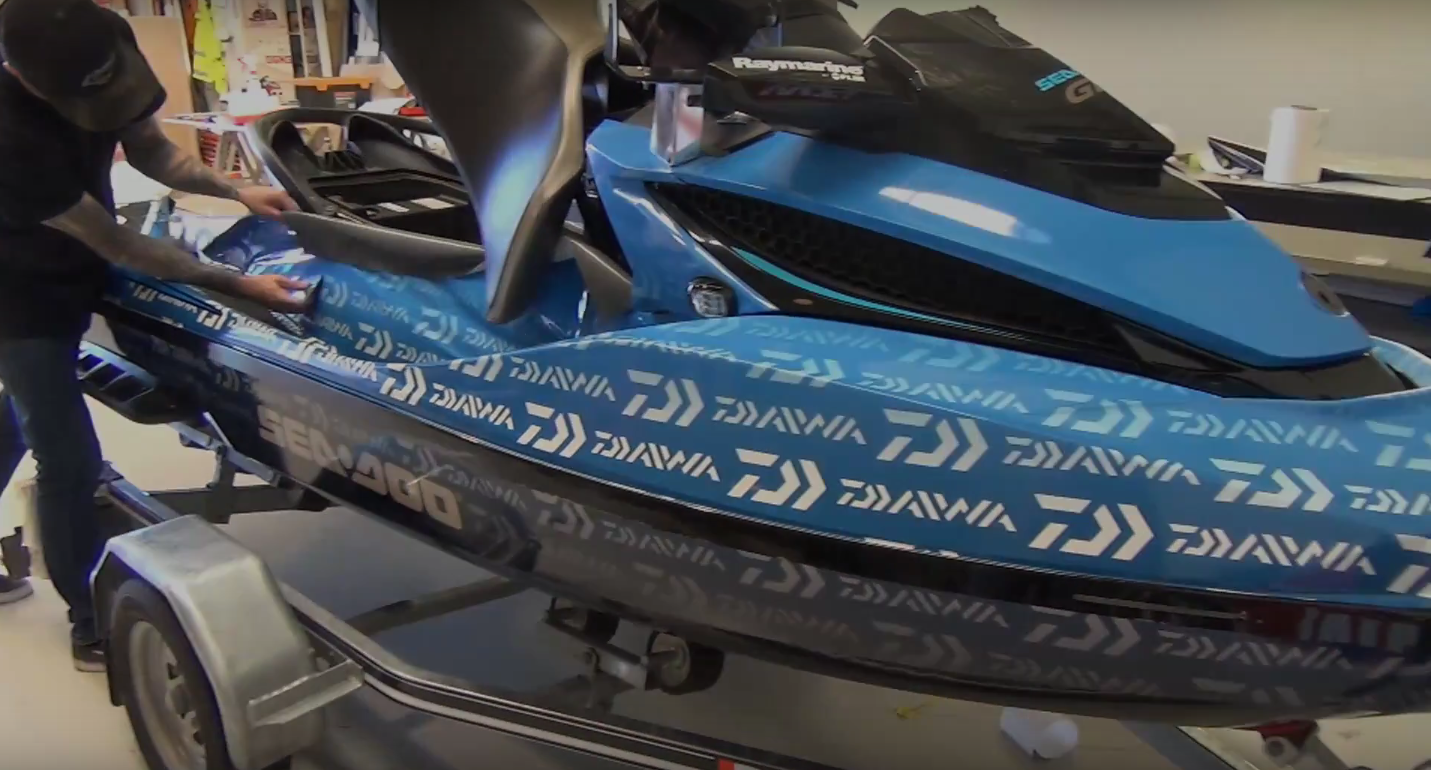
Video: Daiwa Wraps JetSkiFishing.com’s Sea-Doo In Cool Vinyl Kit

0

screen-shot-2016-11-09-at-10-09-15-am

With the explosion of interest in personal watercraft fishing, riders from all over the world have started rigging their crafts with fishing pole holders, GPS’, and coolers along with many other accessories. Riders love to personalize their ride to fit their lifestyle, adding a custom wrap will accomplish just that.

The crew over at The Sign Studio has made a great looking DAIWA sponsored vinyl wrap for JetSkiFishing’s 2016 Sea-Doo GTX 155. These guys are the kings of jet ski fishing and are always finding news ways to improve their time out fishing. This particular ski was “Rigged for JetSkiFishing with the latest Raymarine ES78 Sounder/GPS with a chirp thru-hull transducer, dual battery system, navigation lights and the Ultimate Rod Holder fishing kit,” explains JetSkiFishing.

While DAIWA owned the canvas with the size of its letters, there were many other sponsors present that made it possible to have this custom vinyl wrap done. Whether you are fortunate to have support from sponsors or are financially providing for your passion, there is a vinyl wrap for you.

These wraps are durable enough to protect the paint from rubbing up on a dock or any other objects like a fishing pole or fish! Putting a vinyl wrap on your craft will give you the peace of mind that when you have a fish on, you don’t need to worry about your paint. View a wrap as an investment because if you decide to retire your watercraft from fishing and want to use it recreationally, removing the wrap will be no problem.

Check the video out for yourself and see the process of applying a vinyl wrap and the end appearance that will surely turn eyes when people see a cooler full of fish and a great looking watercraft sporting a great looking vinyl wrap.

Come To Jet X Powersports For Service or Winterizing, Or They Can Come to You

0

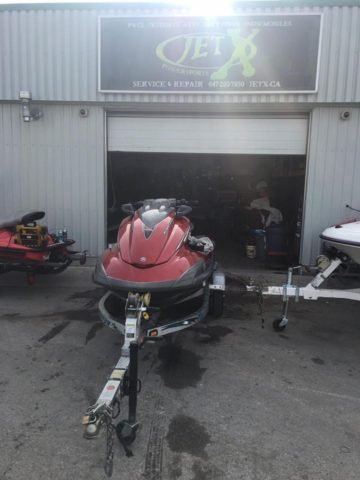
Whether you’re tucking your personal watercraft in for a long winter’s nap, you’re just needing to give your ride its regularly-schedule maintenance, there are few shops providing better service, more attentive care or professional hands-on labor than our friends at Jet X Powersports. The Woodbridge, Ontario service center has been providing service for personal watercraft, jet boats, ATVs, dirt bikes and snowmobiles for over a decade, supporting the Greater Toronto Area and Northern Ontario area. Whether you’re in need of a tune-up, jet pump service, or a full-blown engine rebuild, Jet X Powersports has the capabilities and expertise to get the job done. And if you’re looking to pump up your PWC’s performance, they’ve got that covered too.

But the biggest outlier between Jet X Powersports and most service shops, its that Jet X offers a Mobile Service that will come to you. “We have built our reputation on providing a wide range of services that can be performed at a location convenient for our clients such as winterization of boats, skis and other vehicles. If the services required cannot be completed via our Mobile Service, Jet X Powersports can also provide a pickup and delivery service,” stated Ryan Dalli, owner and chief technical expert at Jet X. In fact, Dalli was on the road to a customer when we spoke this morning, stating: “[I’m] still busy with winterizing! We usually go through 400-to-600 litres of coolant every year. It’s a large part of business.”

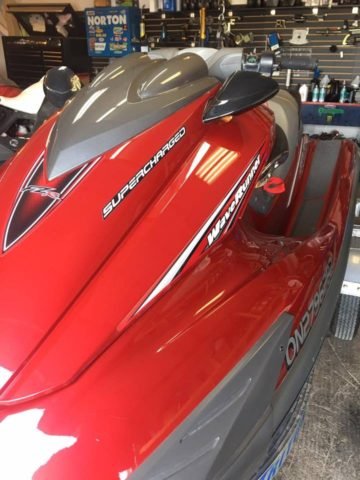
Recently, Dalli shared one happy customer who brought their Yamaha FZR in for routine maintenance. Amazingly, the Yamaha has racked up a staggering 377 hours with needing one supercharger gear and the usual service items (oil, plugs, etc.) throughout that whole duration! It’s a testament to the quality of the machine and the attention to detail that Jet X Powersports puts in to each of their customer’s toys.

Dean’s Team Riders Sweep Hydro-Turf Hydrodrag Stock, Spec and Superstock Classes

0

img_7370

This weekend’s Pro Watercross Hydro-Turf Hydrodrag World Championships shook the personal watercraft industry to its core with an all-new world record top speed of 114.2 miles per hour on a Sea-Doo Rotax-powered Yamaha FZR piloted by UJET’s Uva Perez (more on that later). While the record-setting run is clearly sucking up all of the oxygen in the room, there were some seriously impressive performances in other classes that bear noting:

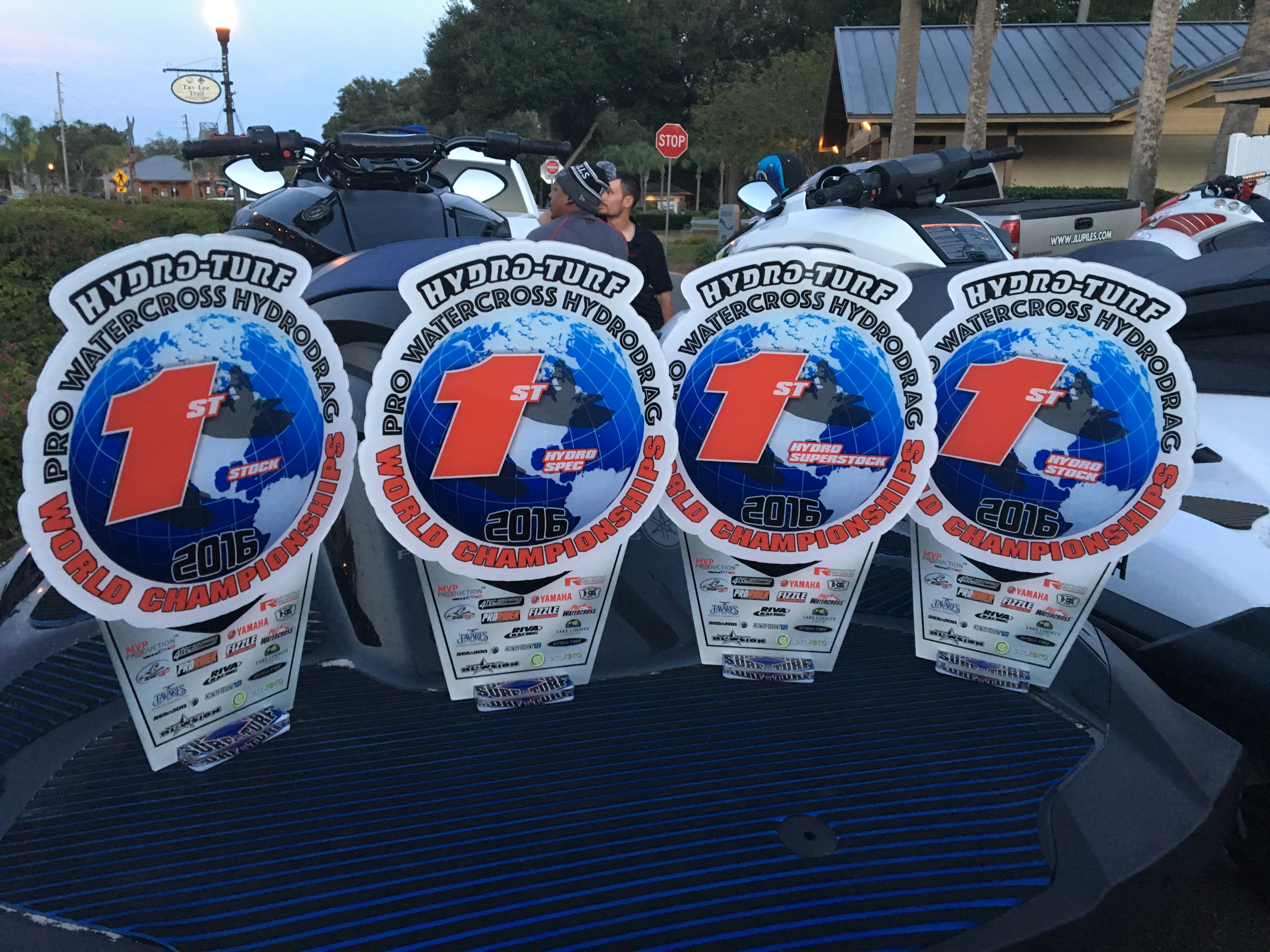
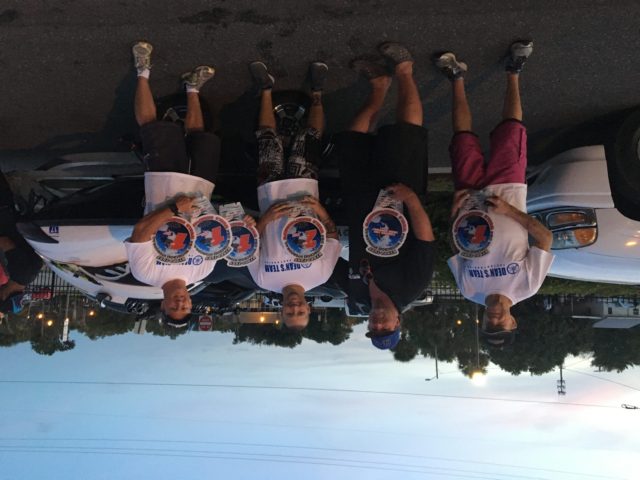
Three Dean’s Team riders, Scott Rice, Tonito Lopez and Ron Allison had a tremendous weekend. Rice swept the podiums of the Stock, Spec, and the Superstock classes; Lopez, also performed great in Stock class, coming in second against Rice; Ron Allison won the Stock class Speed Alley with a run of 92.8 MPH. All these skis were Yamaha FZ WaveRunners with Dean’s Team Performance reflashes.

The Watercraft Journal spoke directly with Dean’s Team founder Dean Charrier who said, “Scott Rice was impressive and raced the best performance I’ve seen yet from him. To sweep all those three classes is no easy feat and he consistently ran great on his Dean’s Team FZ’s.” Not only has the Dean’s Team ECU Reflash proven itself in the realm of endurance racing with AquaX all year, it’s also lead the world in closed course races earning multiple world titles at this year’s IJSBA World Finals, and now with three world titles in drag racing this weekend at the Hydro-Turf Hydrodrag World Championships.

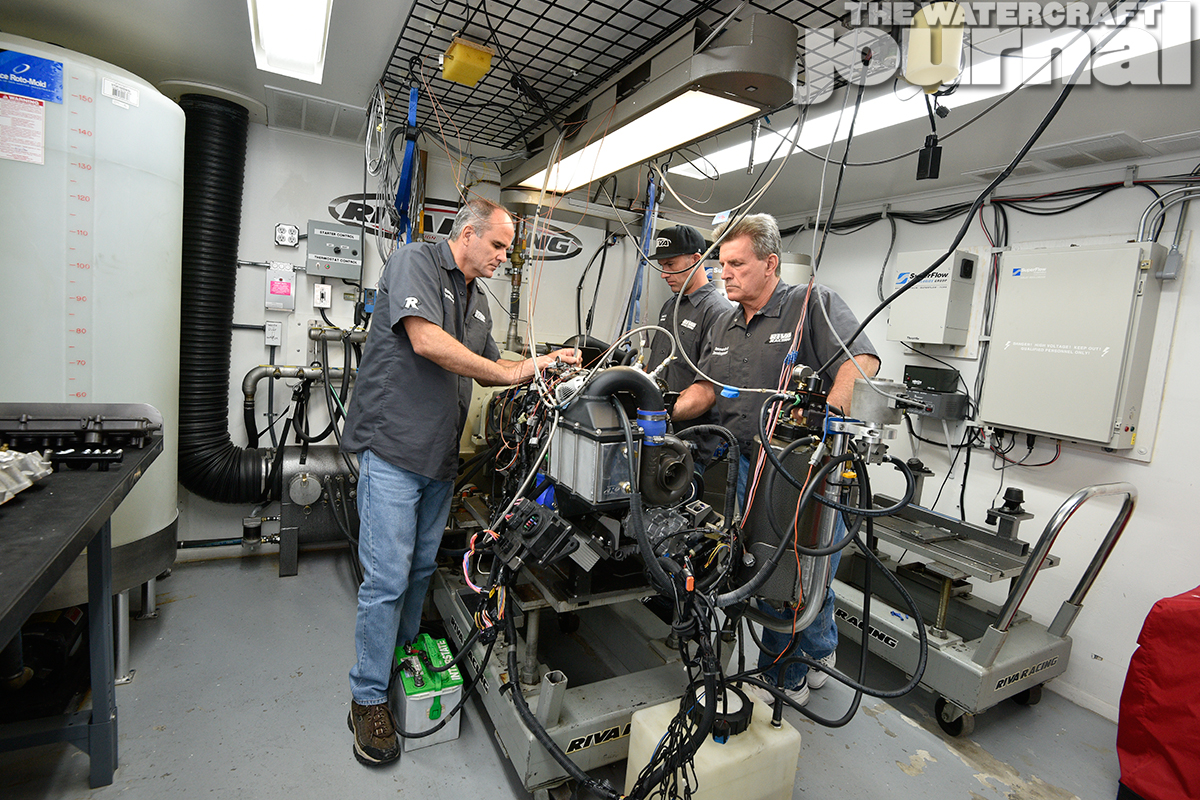
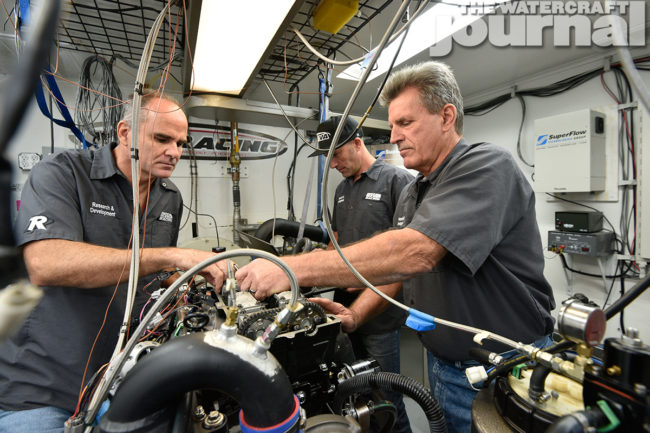
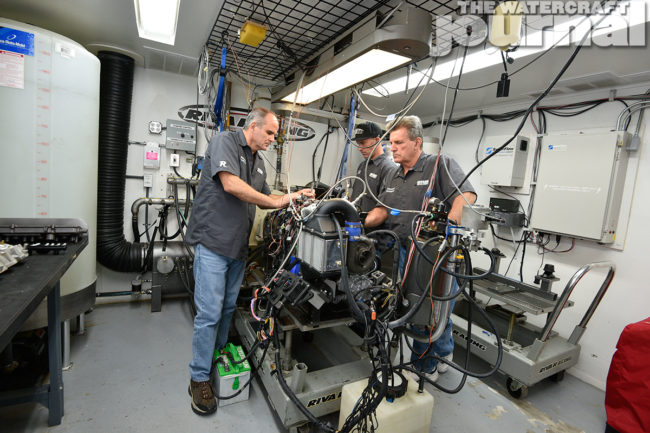
Gallery: Inside of RIVA Racing Development Team

4

works

What would you do if you had at your command a team of highly trained engine tuners, technicians, fabricators, electronics specialists and machinists all dedicated to developing every part necessary and calibrating every spectrum of performance to ensure that your personal watercraft was performing at its highest peak?

If you holed these guys up in their own 6,000-square-foot facility equipped with every tool, machine and material needed to accomplish their goal, how do you think they’d do? If you’re thinking you’d be the most dominant force in PWC racing, you’d be right – and you’d also be the head of RIVA Racing‘s Development Team.

Since launching in 1992 – under the banner of the Factory Yamaha race team – RIVA Racing division of RIVA Motorsports has occupied the same off-campus 6,047 square-foot facility. When RIVA was first tasked with running the Factory Yamaha race team, they have maintained dedicated staff of employees – comprising the Performance Parts Team – since 1992.

5

At that time, an unmarked off-site facility, separate from RIVA Motorsports’ Pompano Beach, FL. headquarters, has served as RIVA Racing’s “skunkworks.” The building’s location is both secure and confidential, with its own stand alone security to protect both all of the equipment and watercraft inside.

Beneath its roof is more than most shops could ask for. Three major rooms occupy the building, separated into a manufacturing/machine shop, with welding stations, fabrication tables, drill presses, mills, a lathe and tube bender – all put to use for developing rough-hewn prototypes that are trial fit and matched to brand-new watercraft stored in the room adjacent.

The larger room serves as the build floor, where each of the RIVA Edition watercraft (25 hand-built FZRs in 2016 and now the new GP1800R for 2017), as well as other prototype craft are assembled, as well as a prop table, and equipment for electronic testing are found.

4

Next to it is RIVA’s state of the art engine dyno, fed by temperature-controlled air and cooled by a separately temperature-controlled water reservoir. The Borghi Eddy Currant Magnetic Brake Dyno works in tandem with Superflow data gathering acquisition software, providing RIVA’s Development Team all of the pertinent information to make adjustments to their electronic tunes and hardware.

Next to the engine dyno is a clean room for engine prep. Yet, all of this serves as preliminary preparation for the final battery of testing held at RIVA’s private test lake. Located a scant 5 minutes away, the fresh water lake facility features a private launch ramp and dock currently under renovation. When complete, the waterfront facility will feature permanent cabanas, benches and lounge chairs, a full BBQ kitchenette and separate bathrooms.

1

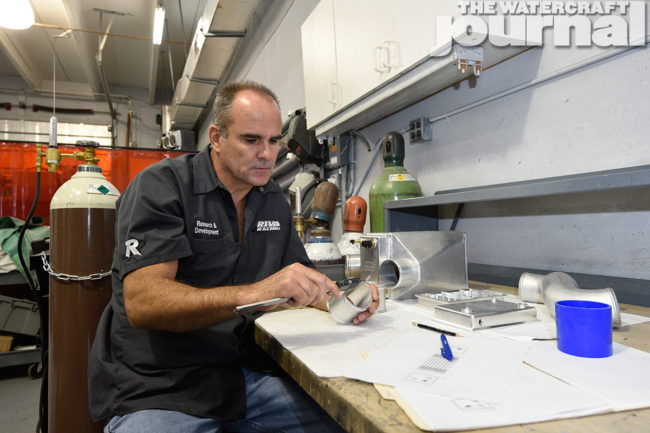
Yet, all of this would be moot without the team to operate it. Bruce Clarkson’s participation with the team dates back to 1994 when he moved from South Africa to Florida for the Factory Yamaha effort; as the senior member has earned the position of senior development specialist.

Described as a “jack of all trades,” by team leader Dave Bamdas, Bruce handles all of the design and fabrication of RIVA’s intakes and exhaust systems, fuel prototyping systems, as well as the brand’s top-of-the-line steering systems. As head over the machine shop, Bruce is a talented welder, fabricator, machinist. Bruce also works closely with RIVA’s vendors, overseeing quality control, which fits his perfectionist work ethic.

3

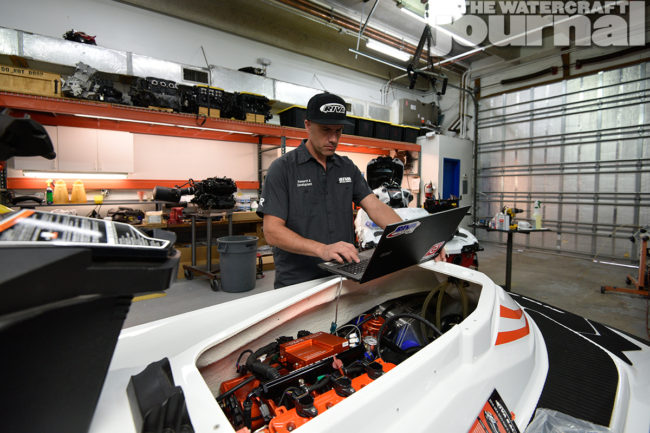
The newest member of the RIVA Development team is Jesus Garcia, having joined the ranks mid-summer of this year. Jesus’ experience with EFI tuning placed him immediately over RIVA’s engine management development, specifically the MapTunerX, as well as the ViPec ECU in a lesser extent.

Skilled with on water tuning, Jesus’ talents in setting up pumps, impellers, and ECU tuning has elevated RIVA’s level of deliverable performance and even broadened RIVA’s appeal to European racers, as well as those within the USA. Jesus is regularly seen on the beach and in the pits at local races, working with all racers regardless of their participation with RIVA Racing. Jesus’ commitment to offering superior track support has been just one of the benefits of his addition.

2

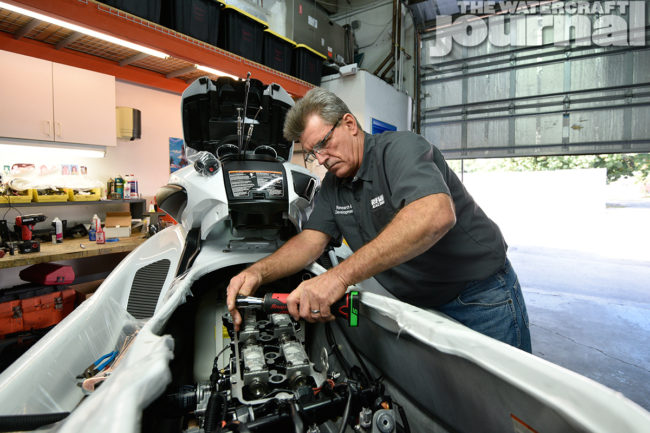
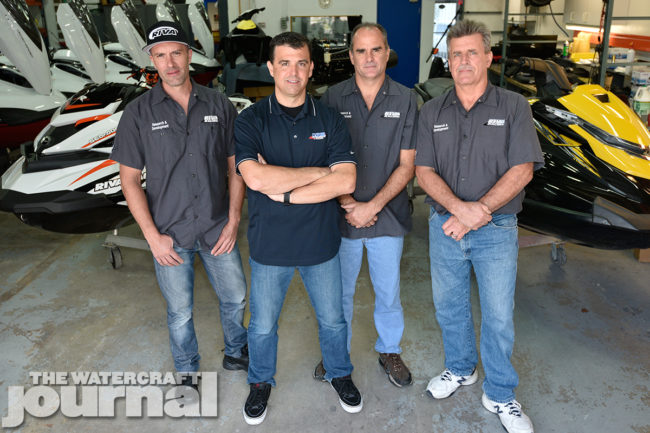
The last two members of the RIVA Development team – Mark Nystrom and Dave Bamdas – are just as important. With over 20 years with RIVA under his belt, Mark is the team’s engine specialist, providing valuable mechanical insight regarding development of engine internals, namely aftermarket pistons, rods, cams, valve kits, and coding systems. In addition to overseeing the entire dyno facility, Mark is also the leader of all special builds projects (RIVA Edition GPR, FZR) as well as the team’s head technician, and designer of parts too.

Overseeing all of this madness is Dave Bamdas himself, who serves as the team’s leader, providing projects their direction, ideas, priorities as the department reports to back on their progress and input.

6

In all, the process wherein a new part is proposed, designed, prototyped, tested and developed happens both in a short amount of time as well as with a surprisingly small collection of like-minded individuals. At the time of this story, the RIVA Development Team is currently working on several performance stages of the Yamaha GP1800 as well as assembling models to be sold as their RIVA Edition GP1800R units, as well as developing product for the soon-to-be-released Kawasaki SX-R.

“RIVA is dedicated to the new ski,” Bamdas explained to The Watercraft Journal. “We have a long history and rich background in building standup performance.” With 2017 just over the horizon, we’re certain the RIVA Development Team are hard at work getting a full catalog of products ready for the new year.

Case of The Mondays: Zapata Breaks Hoverboard Flight Record

0

hoverboard-zapata-header_tcm25-427840

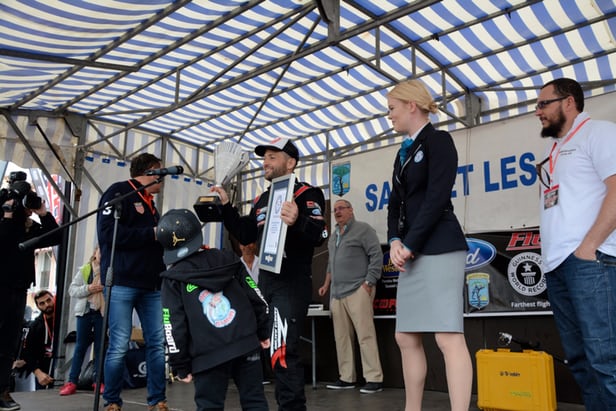
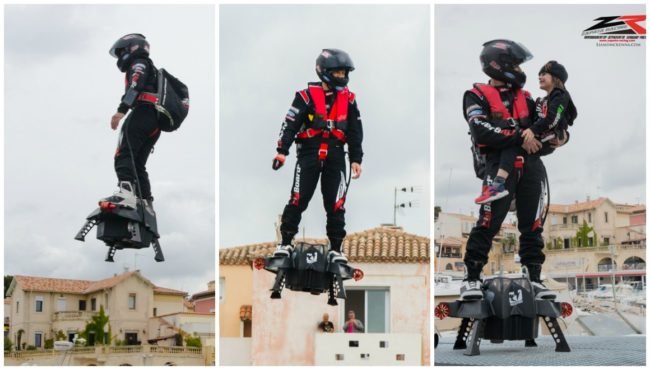
In case you missed it, earlier this year 37-year-old Franky Zapata, inventor of the Flyboard Air, broke Alexander Duru’s record of the furthest flight on a hoverboard. The record shattering flight made by the French Jet Ski champion took place April 30, 2016 off the coast of Sausset-les-Pins in the south of France. He rode his specially designed jet-powered board called The Flyboard Air, which uses an “Independent Propulsion Unit” to fly hose-free and can stay airborne for up to ten minutes. The Flyboard is not equipped with a jet ski or tether like other types of hoverboards.

The Gizmag staff was anxious to check out Zapata’s  world record attempt so they boarded a ship named Albatros, which got underway in the Mediterranean near Marseille, France. Also among the guests aboard the vessel were other members of the press and selected VIPs. The Albatross dropped anchor opposite a take-off platform at Carry-le-Rouet while everyone waited for Zapata to get suited up and fly away.

After Zapata performed a quick systems test, he climbed into the attached boots of the Flyboard Air’s carbon fiber platform and prepared for launch.  Once he cranked the jets, he was quickly airborne and cruising along the coastline. This lasted for close to ten minutes before he flew roughly 100 feet above the water, hitting a maximum speed of 44 miles per hour, prior to making his landing in the port of Sausset-les-Pins.  Zapata totally smashed Duru’s old record of 905.2 feet with his own amazing flight of 7,389.76 feet! You can check out the video right here. It’s really cool!

Video: Charging The Trees In a Flooded River On Vintage Kawis

0

screen-shot-2016-11-03-at-10-16-34-pm

Every year we field a handful of angry comments and emails from watercraft enthusiasts decrying the manufacturer’s lack of building small, lightweight runabouts. Now before you start screaming “Hello! Sea-Doo builds the Spark, you moron!” And you’d be right. And that’s the same thing we’ve said in response to said emails. It turns out that a “soft, Polytec hull” isn’t what these guys are looking for – at least, that’s what they tell us (their words, not ours).

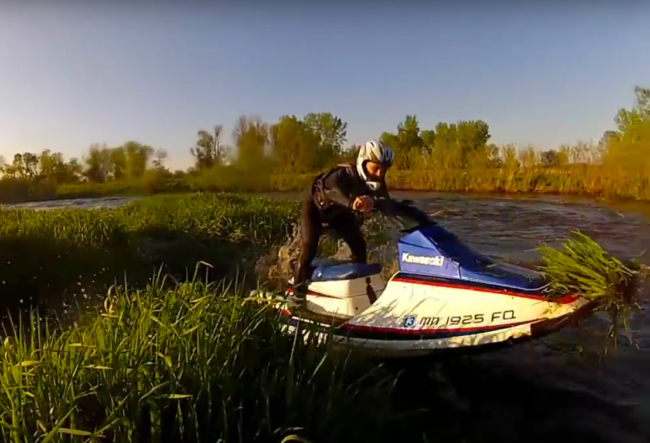
Apparently, what so many of these guys want to come back is a tiny, durable, torquey one-seater runabout that they can run through groves of trees at 30mph and not worry about it puncturing the hull. The other guys want a runabout they can jump not just off of waves, but logs, beaches, sand bars, berms or their buddy’s skis. How do we know? Because of insane videos of hilariously bad behavior like this!

Published back in 2012 when a local river flooded, this group of goofballs loaded up their Kawasaki Sport Cruisers (SC 650) and TC 650s and charged the nearby groves and swamps, doing their best to recreate their favorite scenes from “The Dukes of Hazzard” except by water. Of course, this is the sort of stuff that gets environmentalists all up in a wad, so make sure not to share this with your more “green” friends.

Truckboss Continues Package Specials Into November, Adds Two PWC Packages

0

flex2016-7

Last month, The Watercraft Journal shared four awesome truck deck packages from our friends at Truckboss Decks, namely their Snow Basic and Deluxe Bundles, and their UTV and ATV bundles, all targeted at keeping the outdoorsy powersports enthusiast up and running in time for the fall and winter. But truckboss realized that there’s still a big group of enthusiasts who aren’t beholden to the changing of seasons, or they simply don’t care and will weather the cold just to keep on riding, and that’s the personal watercraft group!

As a quick recap, Truckboss’ “UTV Bundle,” provides you with everything you need to haul your UTV. This packages promises to save you up to $698 USD, and comes with the Truckboss Base Deck, and the Base Deck Ramp Package (two 10-foot skinny ramps), a winch kit, six tie down rings, and under deck lights. The choice of a 7-foot or 8-foot deck has been reduced to $3599 USD (Regular $4279) for the 7-foot, and $3999 USD (Regular $4697) for the 8-foot, respectively. If you’d like to add on a Flip Extension, it’ll cost you only $399 over the regular $467 price.
The second is their second “ATV Bundle” which is perfect for hunting season, allowing you to haul your ATV’s with style. With a savings up to $881 USD, this package begins with the Truckboss Expandable Deck with an optional upgrade to skinny ramps, six tie down rings and under deck lighting, with three deck length options. At 6-feet you’ll pay $3799 USD (Regular $4486), 7-feet is only $3999 USD (Regular $4719), and 8-feet is $4399 USD (Regular $5280), with an optional winch package for only $499 (Save $96).

Next is Truckboss’ “Snow Basic Package” including everything you need to get you there, providing a savings up to $720 USD. It begins with a Truckboss Expandable Deck, a carbide kit, six tie down rings, and three super clamp D-rings. It too has the option of three different deck lengths, 6-feet for $3999 USD (Regular $4595), 7-feet for $4199 USD (Regular $4828), and 8-feet for $4599 USD (Regular $5389). There’s also an option to add a flip extension for only $529 (Reg $606).

Lastly, there’s the “Snow Deluxe Package,” easily the best setup for hauling sleds offering a savings of up to $899 USD. It starts with Truckboss’ Expandable Deck, a winch kit, six tie down rings, and three super clamp D-rings, two Superclamps, a carbide kit and 20″ LED light with under deck lighting. It then offers three deck lengths; 6-feet $5199 USD (Regular $6004), 7-feet $5399 USD (Regular $6237) or 8-feet at $5899 USD (Regular $6798), with the option for either a flip extension for only $529 (Reg $606), or Truckboss’ awesome Flexxloader Snow (cradle, Push Back, and buggy) for only $1099, offering a savings of $507.

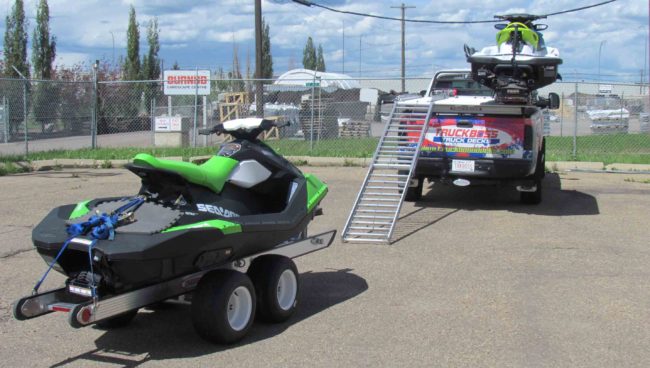
But now, Truckboss is offering you jet skiers two options of their PWC systems, beginning with their “Sit Down Bundle,” which comes with their Truckboss Expandable Deck, a PWC ramp, a winch kit, two large PWC cradles with their Push Back System, two Cradle Double Axle System, and under-deck lighting. You also have a choice of two deck lengths; 7-foot for $6,599 (saving $1,888), or 8-foot at $9,048 (saving $2,049). The second kit being their “Stand Up Bundle,” which includes a Truckboss Expandable Deck, a PWC ramp, a winch kit, two small PWC cradles with their Push Back System, two Cradle Single Axle System and under deck lighting as well. The choice of deck length are also 7-foot at $5,999 (shaving off $1,846) and 8-foot at $6,499 (saving you $1,907).

Case of The Hump Days: What The Heck is a Sea Spi?

6

14606354_319343378425666_6217396159105091066_n

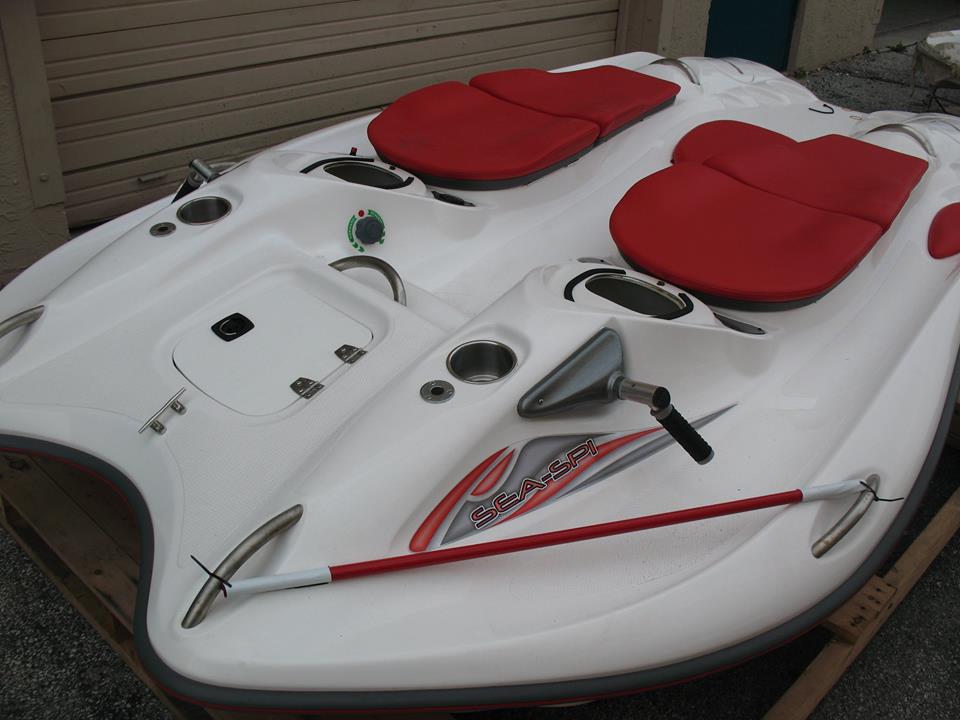
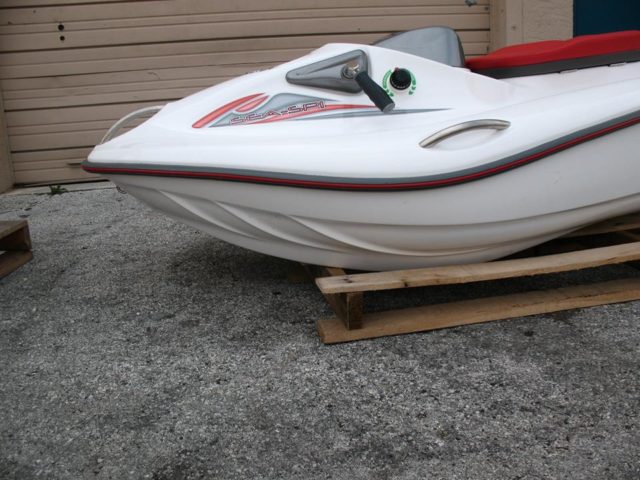
Yeah, yeah. We’re a day late on this one. But we had some other more important stuff to get out there before goofin’ on this failed PWC. The Sea Spi watercraft was (the website is down and we haven’t found anyone still selling or servicing these vehicles) a single or double-rider craft (Sea Spi I and Sea Spi II) powered by an electric motor that propelled you a wakeless idle speeds (a purported maximum speed of 4mph).

The purpose of the Sea Spi wasn’t recreational riding, but rather an alternative to snorkeling. Riders were intended to lie on their stomachs and observe the undersea world through a padded viewing glass that was built into the boat. Steered and throttled by manipulating joystick, the Sea Spi was a clever idea intended for vacationers and tourists who’d rather sunbathe on their bellies than actually exert themselves by lazily swimming around a shallow cove.

Understandably, the Sea Spi also came with certain regulations: riders couldn’t weigh more than 275 pounds for the single-rider craft. And tourist locations required a minimum age is 6 years old (!). Priced (around 2010) at $4,000 each, the Sea Spi failed to catch on with waterfront resorts and didn’t last much long after that (although we have found resorts in Key West, Grand Cayman continuing to offer rented tours).

Applying The Brakes: 2016 Kawasaki Ultra 310X SE (Special Edition)

18

se

There’s a big difference between being quick and being fast. I think people often mistake the two unknowingly in conversation, but it bears noting the distinct difference both in language as well as in describing something (ie. both are an adjective as well as an adverb). My experience with all of Kawasaki’s supercharged Ultra models has been markedly similar: the brutish delivery of industry-leading horsepower teeters on the precipice of exhilarating and irresponsible. And yet, all Kawasaki Ultras reach a crescendo below that of other supercharged PWC – albeit, the dash to that point will nearly separate tendon from bone.

But first, let me take a small thematic detour: I own a 1969 Dodge Charger that I rebuilt by hand. It’s big and brutal, both in its power and purposeful lack of comfort. There’s no air conditioning, power steering, power brakes or even a radio – and it’s great. Why? Because I made it that way. Beginning back when I bought the car, I hoisted the banner of “If it doesn’t make me faster, I don’t need it.” And true to my design, it’s fast…well, I should say quick. Because while it’s a high 10-second car in the quarter mile (clicking off low 130s through the traps), I’ve only had it up to 115mph on the highway – and neither it nor I really enjoyed that experience at all.

9

Quickness is often correlated with acceleration, while being fast is often boiled down to meaning top speed, at least colloquially. When people ask, “How fast is it?” they often don’t care about my 60-foot speed. Sure, 0-to-60 times are respectable (2.8 seconds) but most folks just want to know the fastest top speed I’ve ever pushed that flying barn to. And there’s the rub; the Dodge Charger is an aerodynamic nightmare. The recessed grille and back glass were so counterproductive, that NASCAR racers lost control at 156mph. Despite being gorgeous and frankly, one of the most photogenic designs to come from Detroit, it was miserably slow on the big end.

Not to put too fine a point on it, but the Ultra is not too far removed from my street/strip Charger. It’s quick – real damn quick. So much so, it’s spooks every single person we’ve given the lanyard to. But any racer will tell you, getting an Ultra to be fast is a full time job that isn’t very rewarding. There’s simply too much draw (amount of the hull submerged in the water) for that big belt-driven Eaton supercharger to overcome.

12

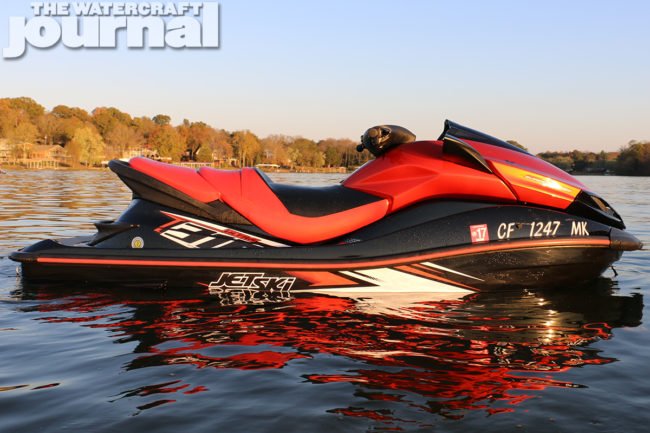
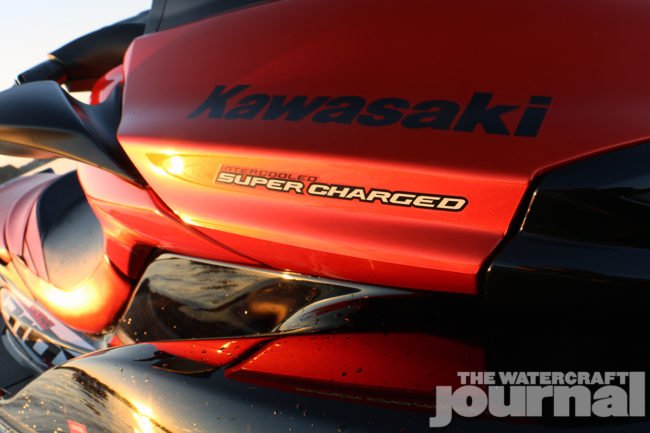
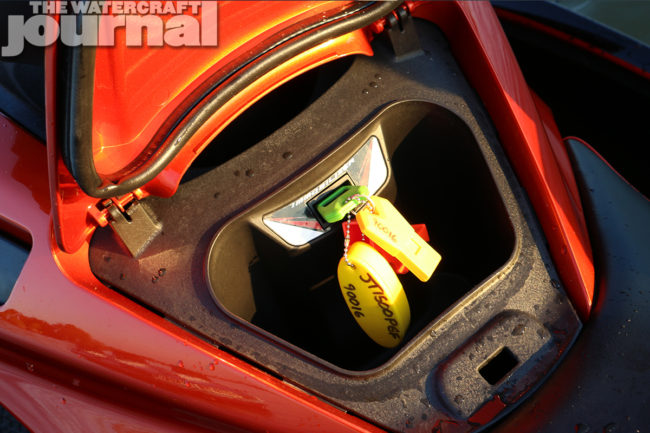
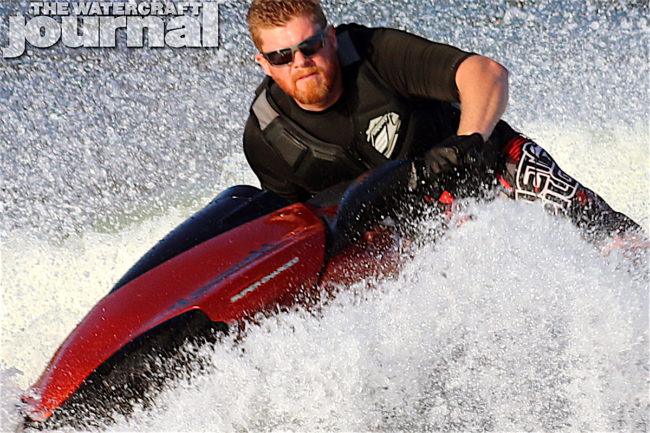
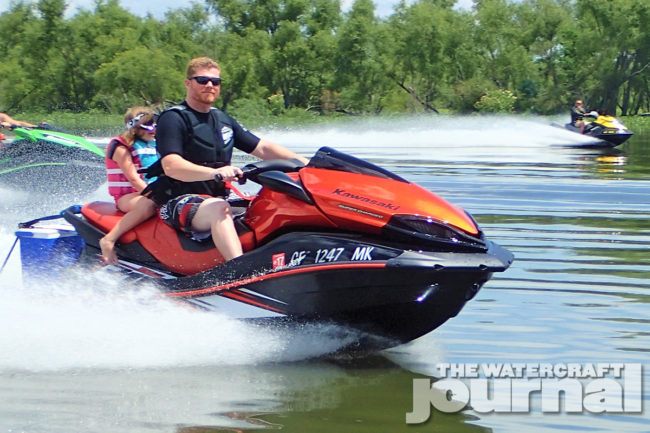
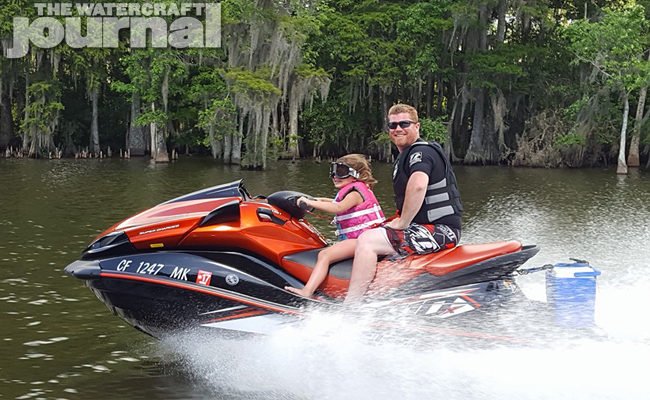
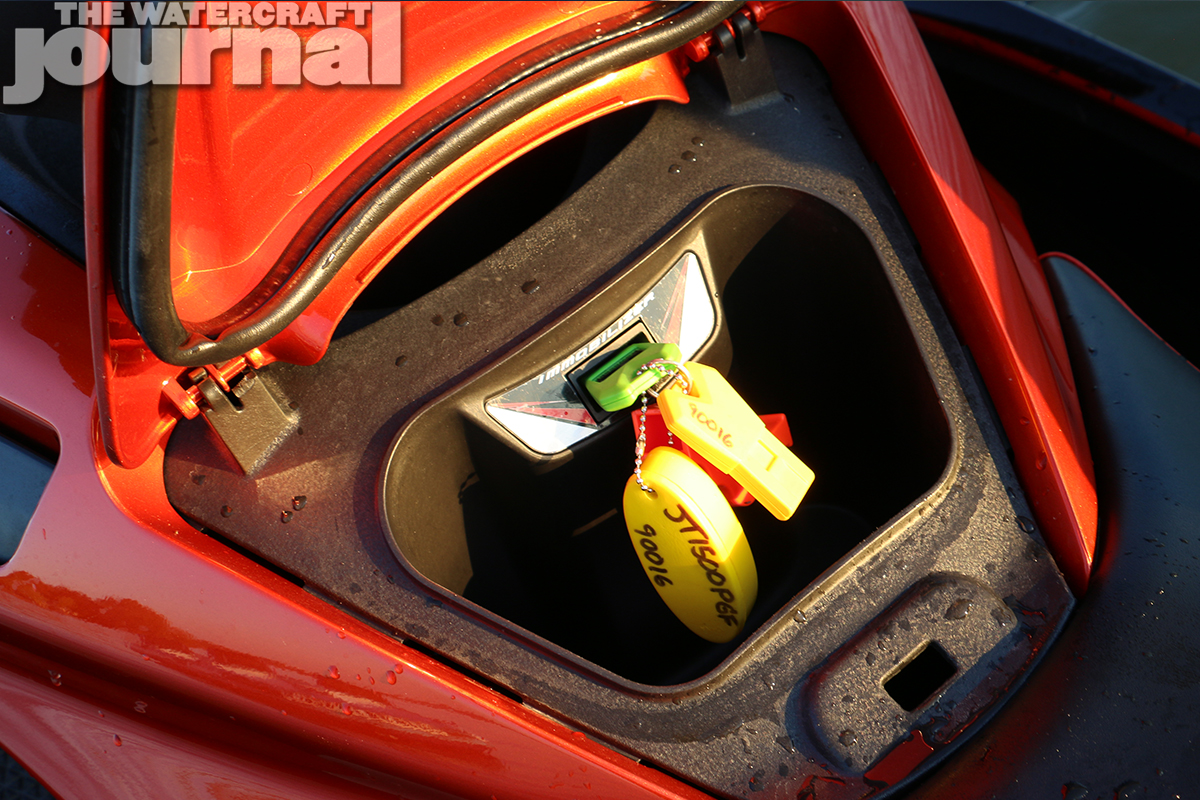
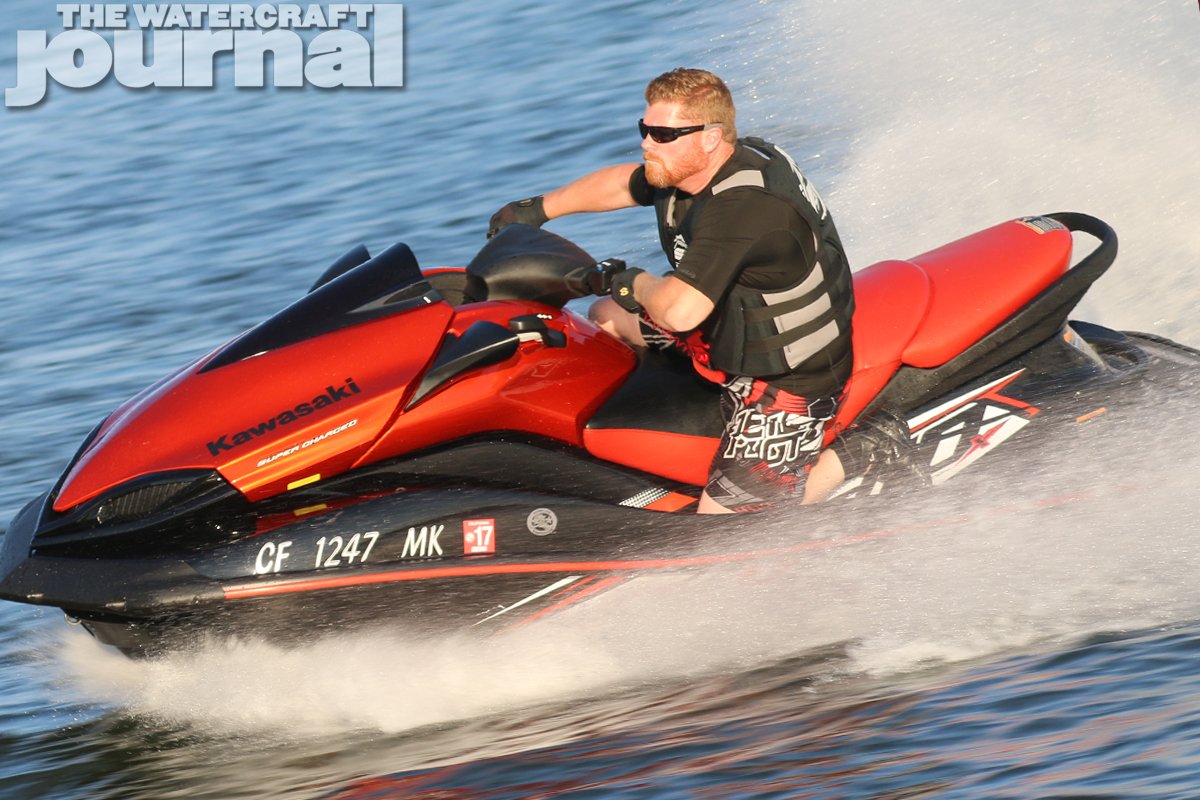
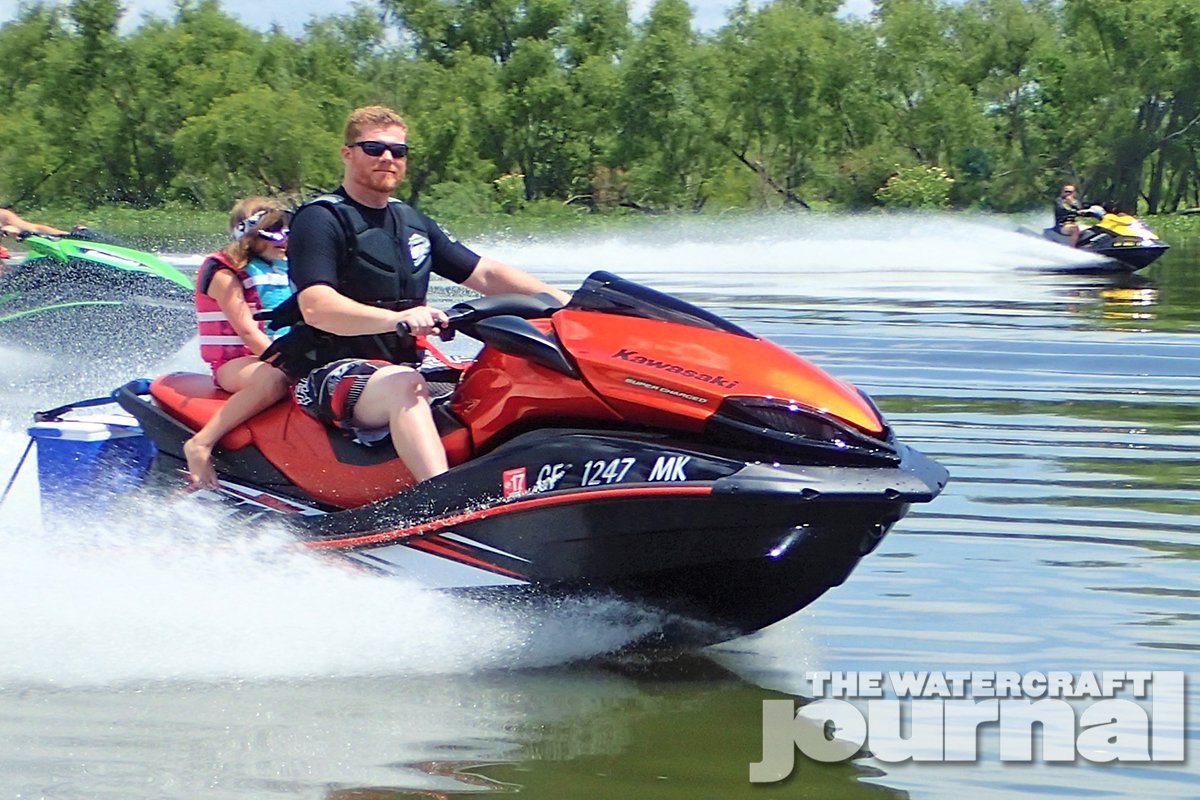
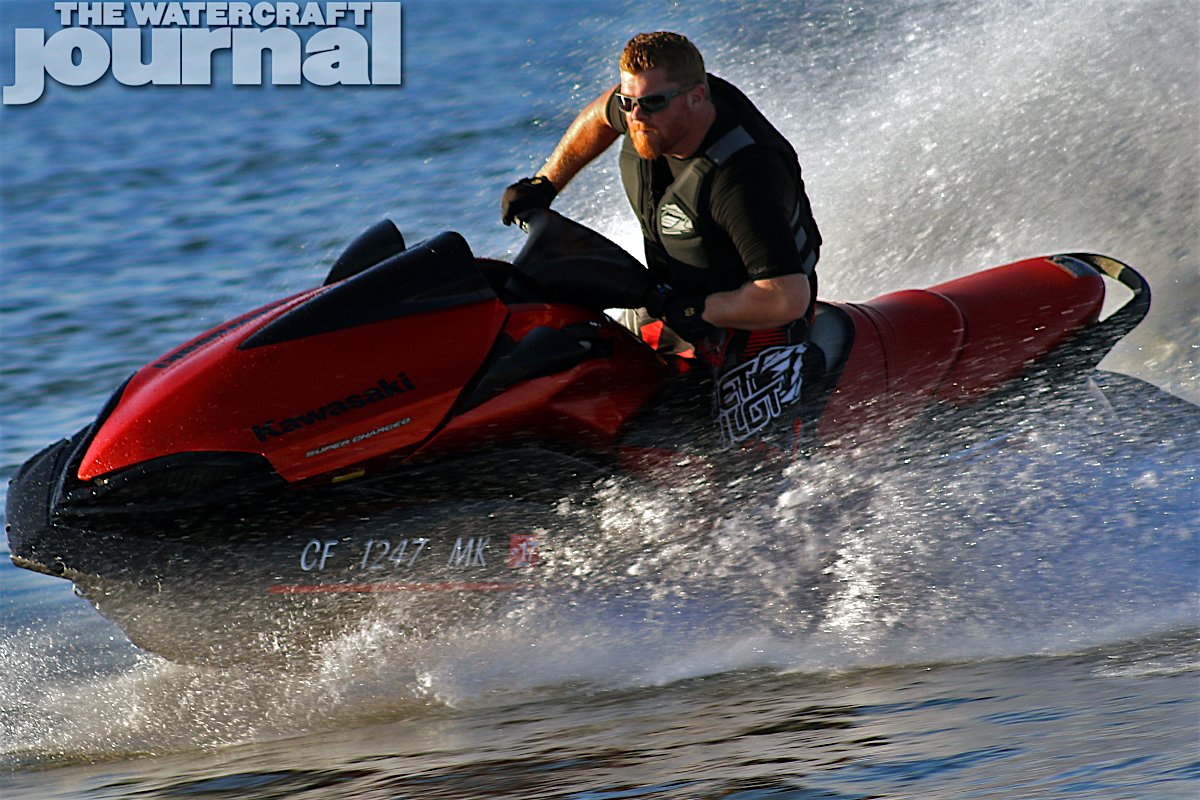
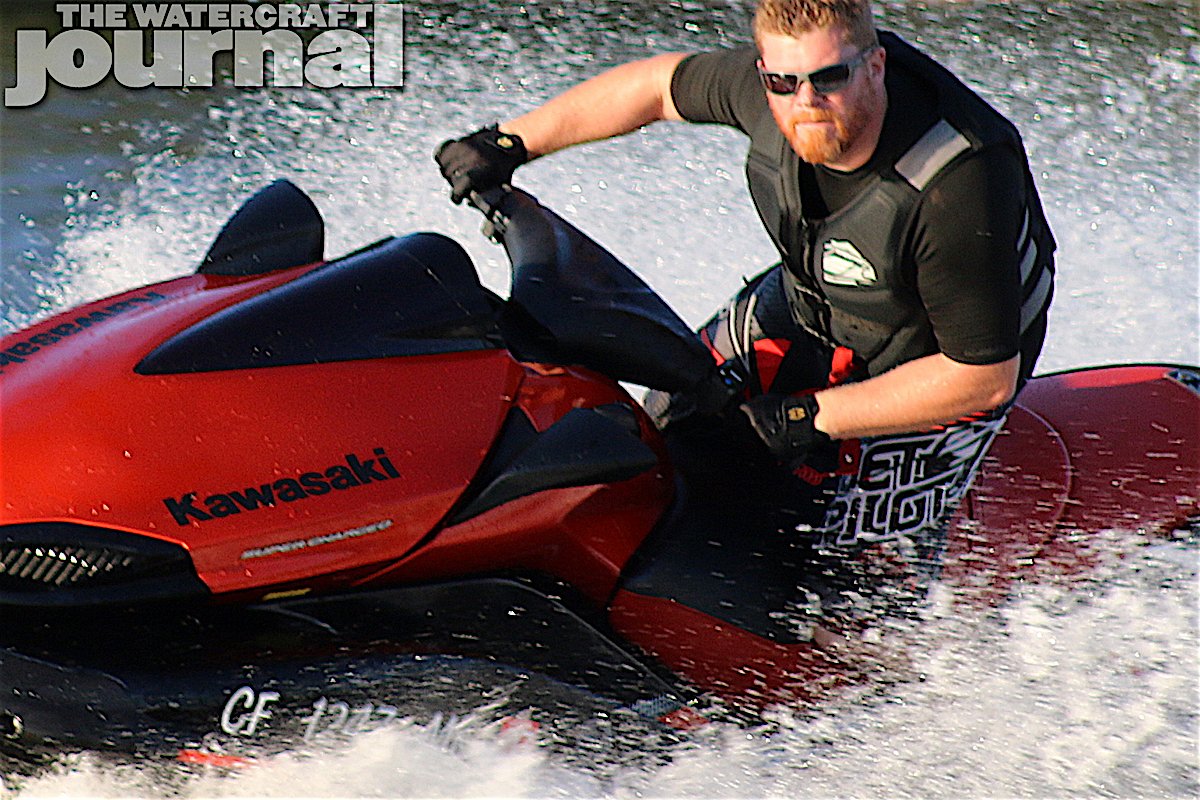
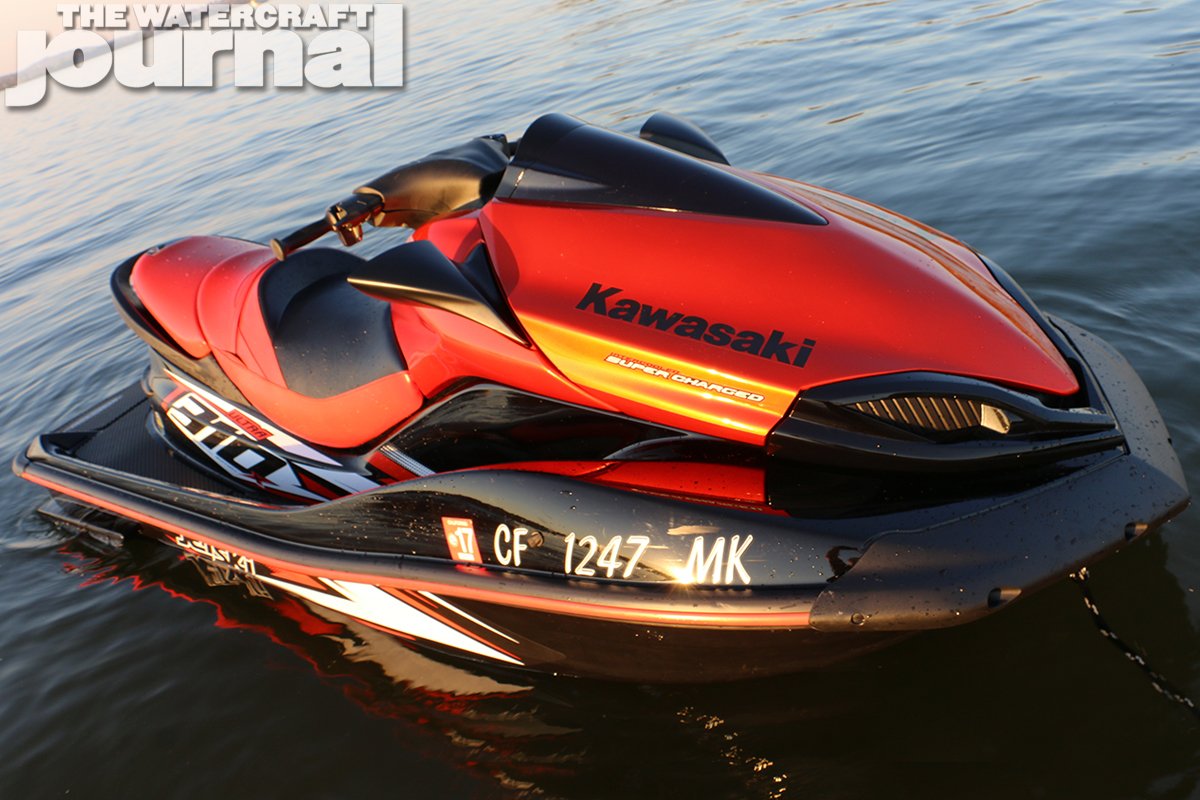
But top speed is arbitrary because all PWC need to stop at 67 (or so), that is, according the the fabled USCG agreement. And true to it, we’ve never seen much more than 68mph from a stock 310X. Earlier in the year, I was handed the yellow and green Immobilizer keys to a brand-new Candy Burnt Orange-and-Ebony 2016 Kawasaki Ultra 310X SE. Standing beneath the beating sun in Castle Motorsports’ back lot as they lowered the ski onto my trailer, I heard passersby swoon at the metallic hue as it reflected the sun’s rays.

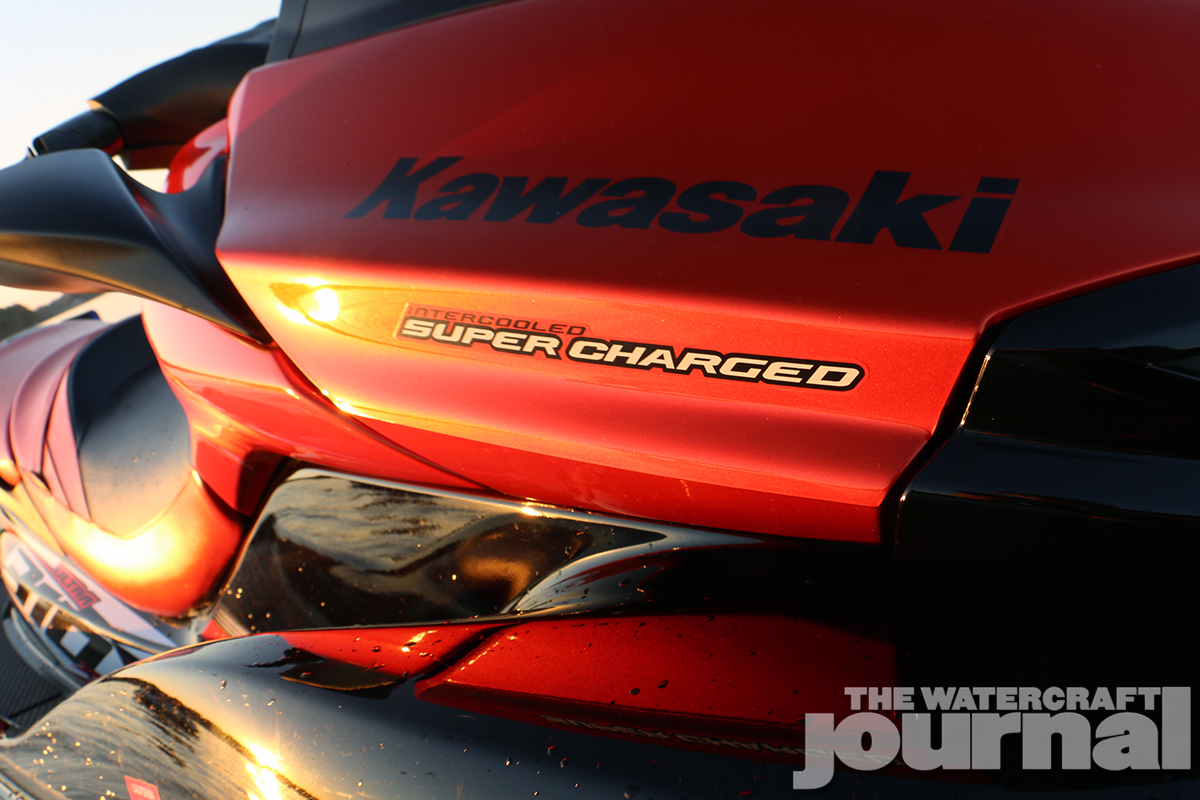
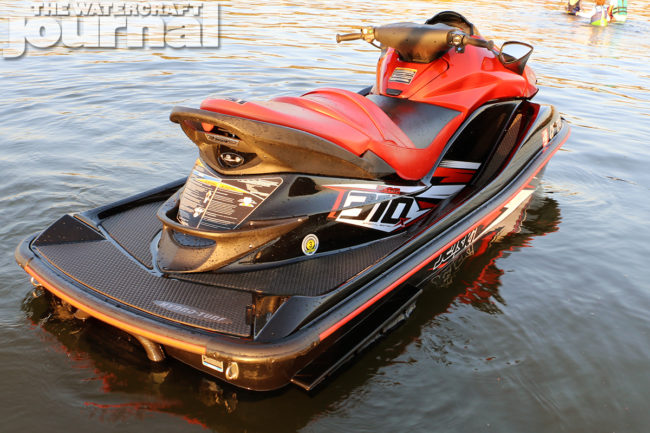
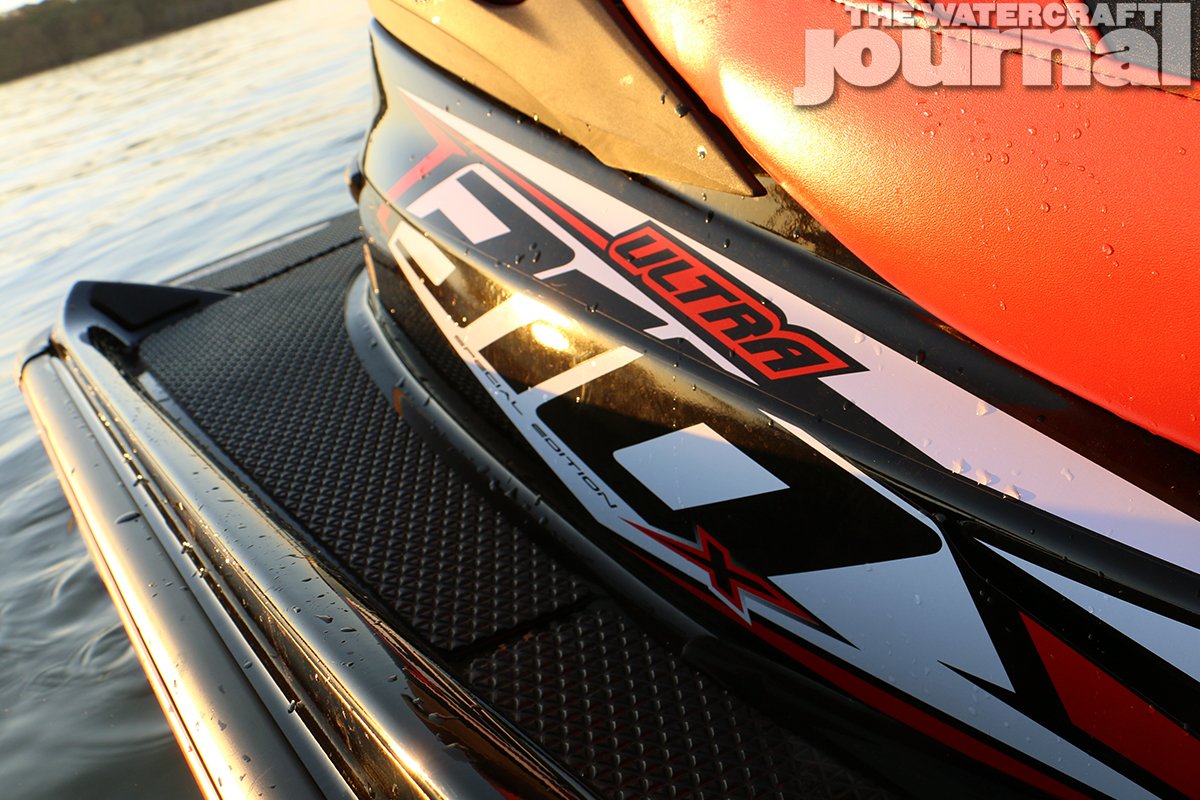
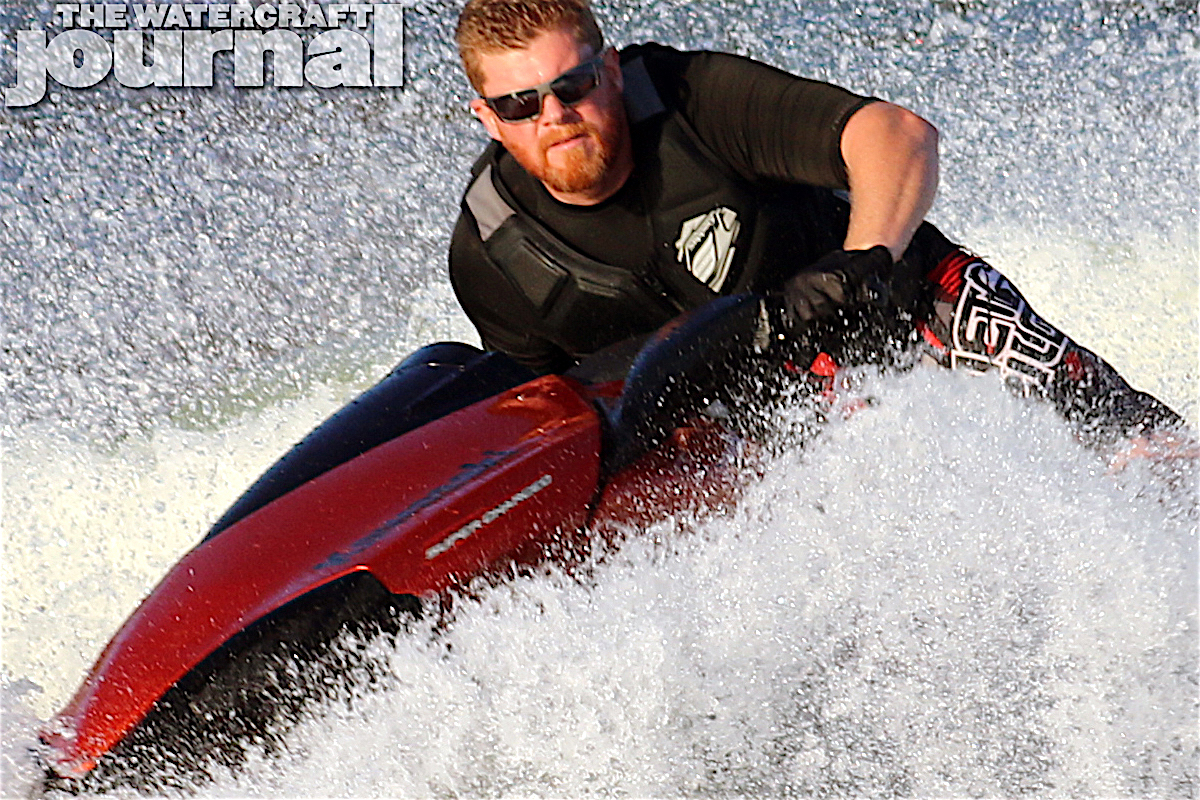
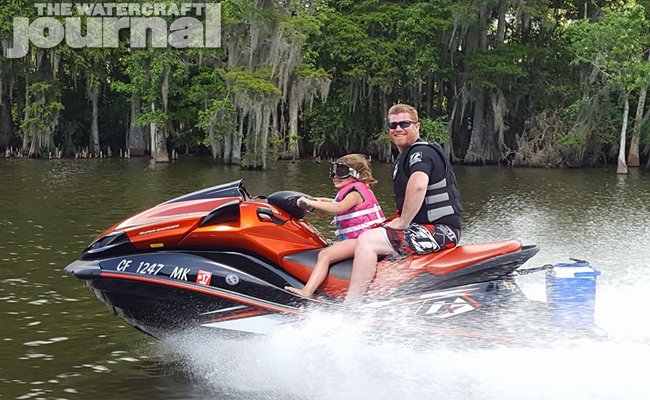
The color alone became the Ultra’s biggest draw – the horsepower output was a close second. Over the span of 7 months, people would stop me just to comment on the color. Even down in Morgan City, LA at the annual Mudbug, I had attendees mistake the color for being a custom paint job. “No, this is factory,” I’d correct them but a few didn’t believe me, saying that it must’ve been a “one-off” just to get more press in the magazine. Of the four supercharged Ultras available through Kawasaki (310X, 310R, 310X SE, and 310LX), the Special Edition is noted for only two key additions: the two-tone, scalloped seat and the color. Everything else is more or less identical with the base 310X. With a MSRP of $15,799, the SE comes in at $500 over the less-optioned sibling, and $1,200 below the fully-equipped 310LX.

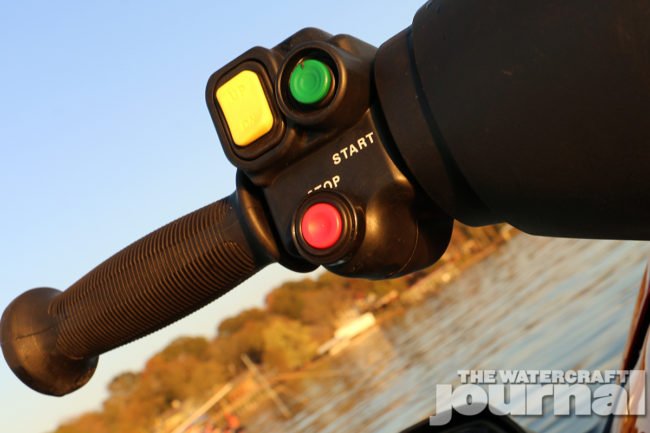
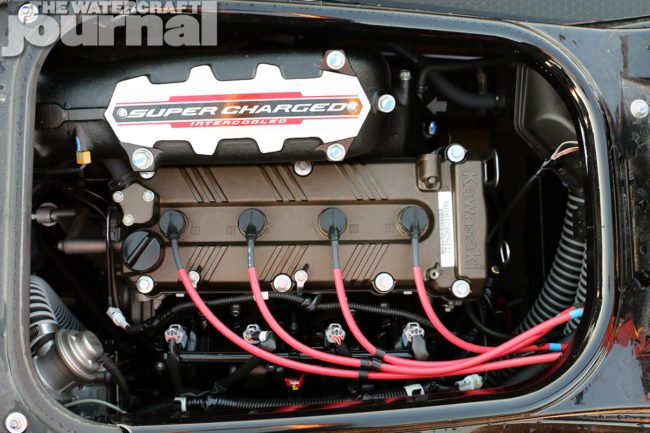
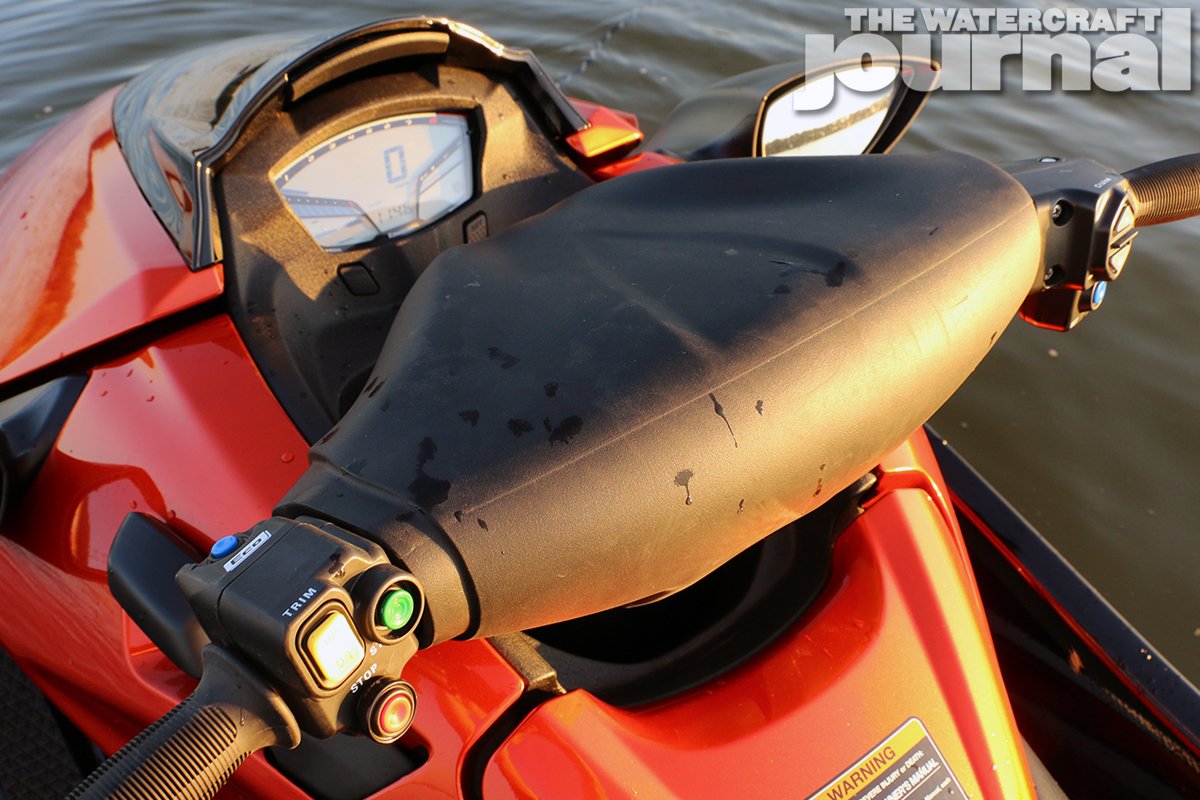
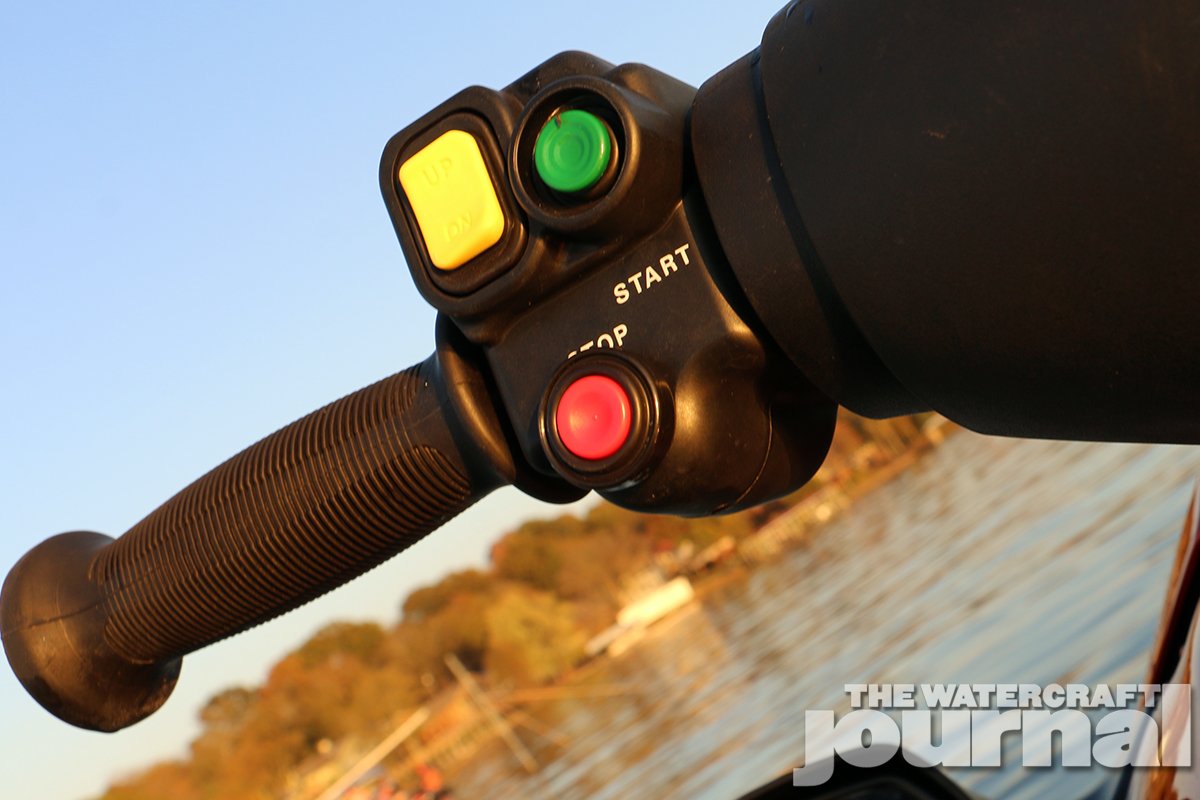
Sometime last year I realized that while I loved my old Charger, it deserved some civility (so I added fuel injection and an overdrive transmission). Kawasaki felt the same way about its Ultra lineup. So in 2011, with the advent of the new 300-horsepower Ultras, came electronic “fly-by-wire” throttle control. The advanced software allowed Kawasaki to include Cruise Control, a No Wake mode, electronic trim toggles and even an Eco setting, all operated via various inputs on the handlebars. For 2014, improvements were made to the 1,498cc, liquid-cooled inline four-cylinder plant to produce an industry-leading 310-horsepower thanks to drastically improving engine oiling, reducing heat soak and maintaining constant lower internal engine temperatures throughout the engine’s linear powerband.

The goal wasn’t to bump up the overall output another 10-horsepower, but to make the engine all that more effective. This was first achieved by re-engineering the crankcase with thicker water jackets, larger oiling passages for quicker oil return to the redesigned baffled pan that reduces oil windage and sloshing, and dual under-piston cooling oil jets (increased from one jet per piston to two). The pistons were replaced with new lightweight cast slugs featuring additional ring land V-grooves. A larger capacity fuel pump (for improved fuel flow volume) and 500cc injectors spraying into a brand-new long-runner intake manifold made from heat-resistant plastic, radically improved low-to-mid range power.

17

Force-fed by the aforementioned Eaton TVS constant-displacement, four-lobe supercharger and saved by dual blow-off valves to siphon off any extra of its 17psi of boost, the 310X’s engine features a liquid-cooled intercooler with its own cooling circuit and a second waterbox to not only muffle the staccato whine of the boosted monster, but equalize the Ultra’s low speed list. A large oil breather/catch can and articulated sprung belt tensioner also made the cut. A large 160mm 8-vane pump and a repitched 3-blade, long-snout prop all help to produce the Ultra’s maniacal 1,890 lbs. of thrust.

Depending on your riding preferences, the Kawasaki’s hull is either the single greatest design or it’s not. The vertical, Deep-V keel and layered strakes make for a rough water boat that can plow through most anything. With an excessive amount of offshore and endurance titles notched into its bedpost, the Ultra is no stranger to the winner’s circle. It’s hull depth and weight makes it stable and a great rough water ski. Whether chewing through battering ocean swells or sluicing through mild 1-to-2 foot windblown chop, the big Kawasaki (1,052-pounds curb weight, 919-pounds estimated dry weight) tracks like a US Coast Guard cutter.

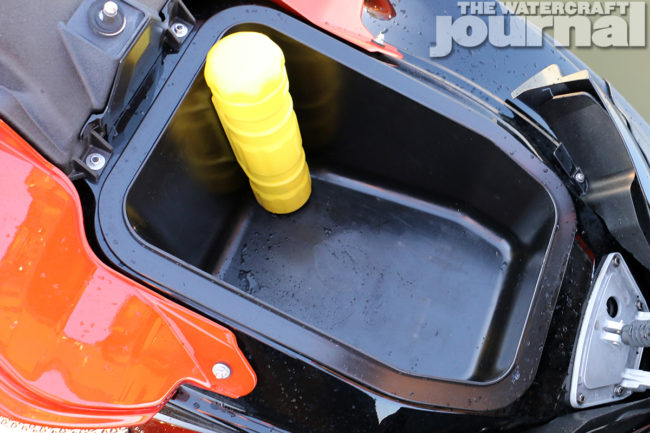
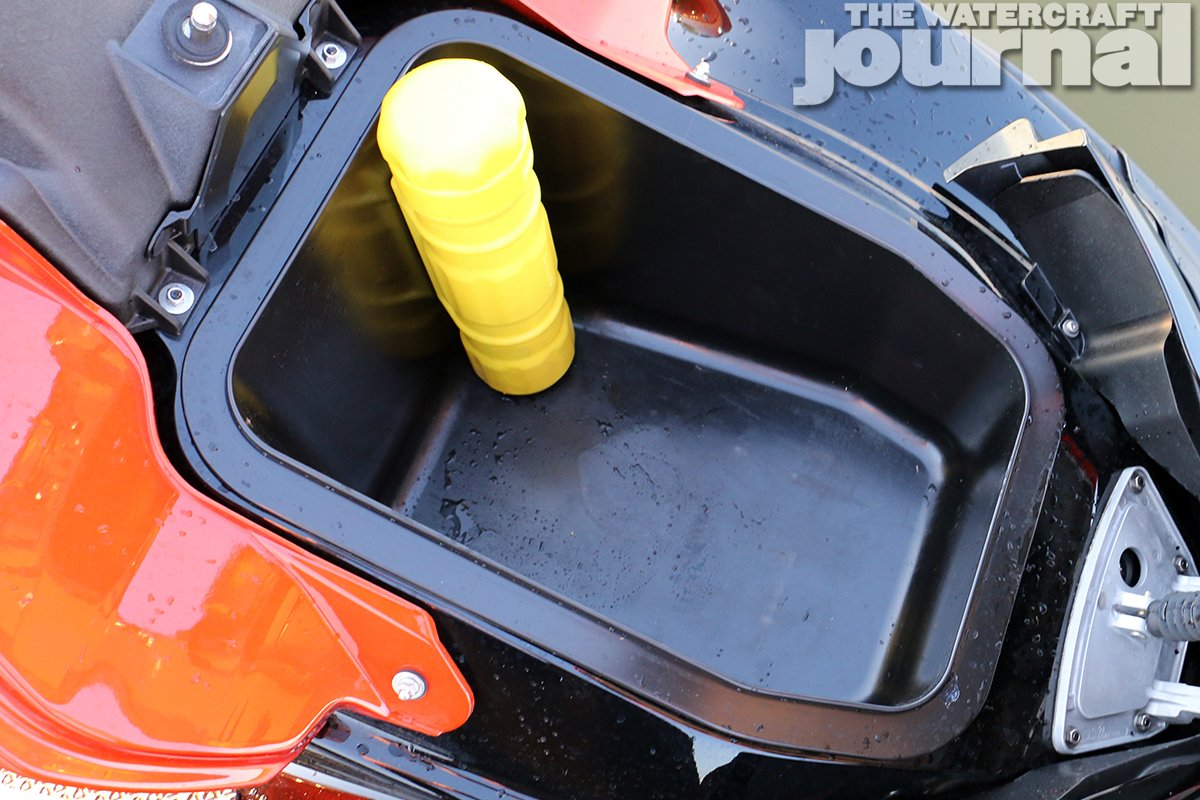
All of this is not only impressive at first blush, but even potentially overwhelming. Then again, everything about the Kawasaki is big. Power? You got it. Fuel capacity? How about 20.6-gallons? Heck, bow storage still remains the largest in the industry at 56-gallons. Even the saddle is the widest in the industry at just under 2-feet across – although, that might not be a selling point.

22

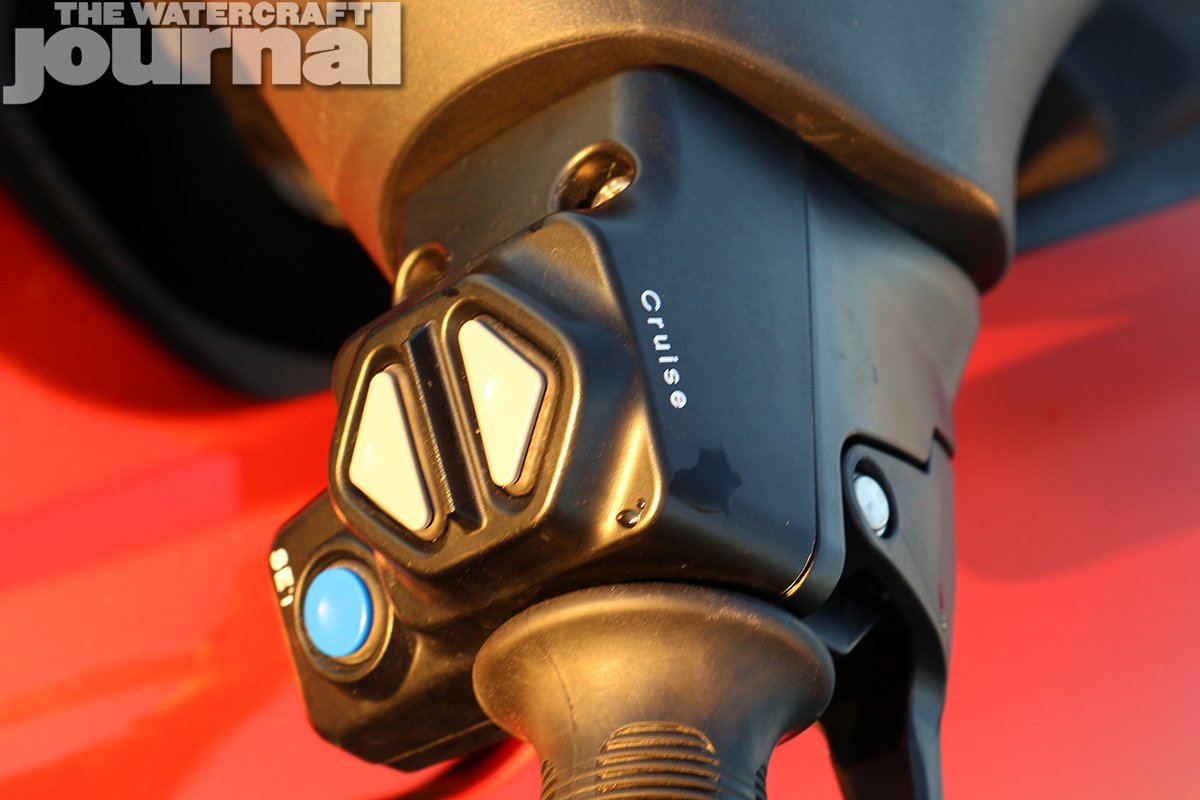
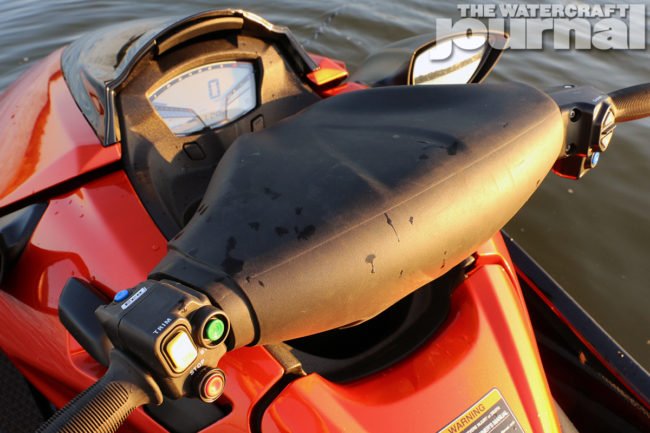
Yet over the better part of a year, certain things kept springing up that simply couldn’t go unaddressed. The electronic features like electronic trim and cruise control are there, but feel like design afterthoughts. Setting cruise is always a two-handed affair and toggling the trim up or down requires heavy inputs that illicit slow responses. The No Wake Mode and Cruise were both temperamental to set, and the Eco option is not what you’ve come to expect from Sea-Doo’s ECO Mode, wherein boost is scrubbed and top speed is capped, allowing the rider to cruise home at a fuel-sipping 40-45mph. Rather, Kawasaki’s Eco feature merely ignites a small icon on the dash when you’re operating within a fuel-conscientious speed.

Weirdly, one day the coil-sprung glovebox latch shot to apart unexpectedly, launching pieces across my garage. I found the spring under my workbench and discovered it had wiggled free of its snap-in plastic tongs. Meanwhile, as the LCD dash instrumentation is fantastically easy-to-navigate, and permits shuffling through a fuel consumption calculator, external water/air temp gauge, clock, trip and hour meters, and max speed functions, in addition to a revised boost gauge and riding mode goggles, reaching forward of the bars to activate these options is often out of the question, particularly at speed. Yet, the biggest complaint isn’t with what the Ultra 310X SE has, but what it’s lacking.

23

Brakes have become the industry standard since their first introduction (via Sea-Doo’s iBR) in 2009. For nearly a decade of riding watercraft with brakes, injuries and fatalities have dropped worldwide. Add to that the increased level of rider input, ease of loading/unloading from trailers and docking, and brakes have made riding a watercraft without them all but impossible to enjoy. The big Ultra and all of its immediate power can be pretty unruly, and feathering the pistol grip reverse lever can prove tricky because of it. But if you’re planning on stopping in the near future, you’re gonna need to plan ahead. And I mean, really ahead. (Don’t expect the off-throttle Kawasaki Smart Steering (KSS) assist to help in these split-second situations. It usually doesn’t.) Frankly put, even if future Ultras stayed the same for another 10 years, all would be forgiven if Kawasaki offered a smart on-the-water braking system.

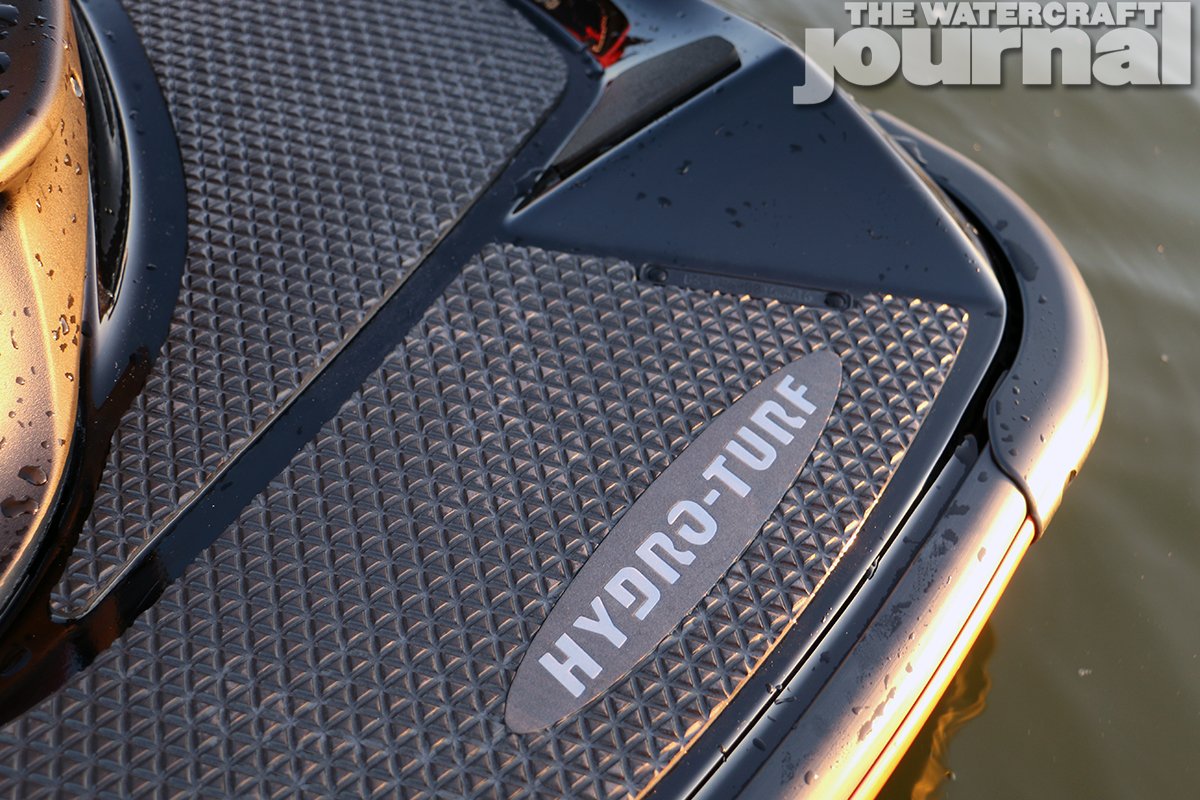
I racked up hundreds of miles and dozens of hours of operation over the year with the 2016 Kawasaki Ultra 310X SE and every time I fire it up, it still puts a smile on my face. Horsepower will always do that for me. And it’s still one of my personal favorite looking skis, but, in a world where intelligent ergonomics, rider input and boating safety is paramount, the Kawasaki feels a bit like a rebuttal. I know that’s not the intent, but its hard to think otherwise when a manufacturer ignores the entirety of the industry and doubles-down on a new 4-stroke 500-lbs. standup, while its entry-level ski is 15 years old, and none of its full-sized, supercharged runabouts offer brakes. These are the quickest, most powerful PWC on the market today, after all. A little more civility would go a long way.

Additional photography provided by Rahny Moore and Billy Crews Jr.

2 9 1 3 21 12 13 14 18 15 16 19 20 17 4 7 22 24 25 26 23 6 10 11 8 5
<
>