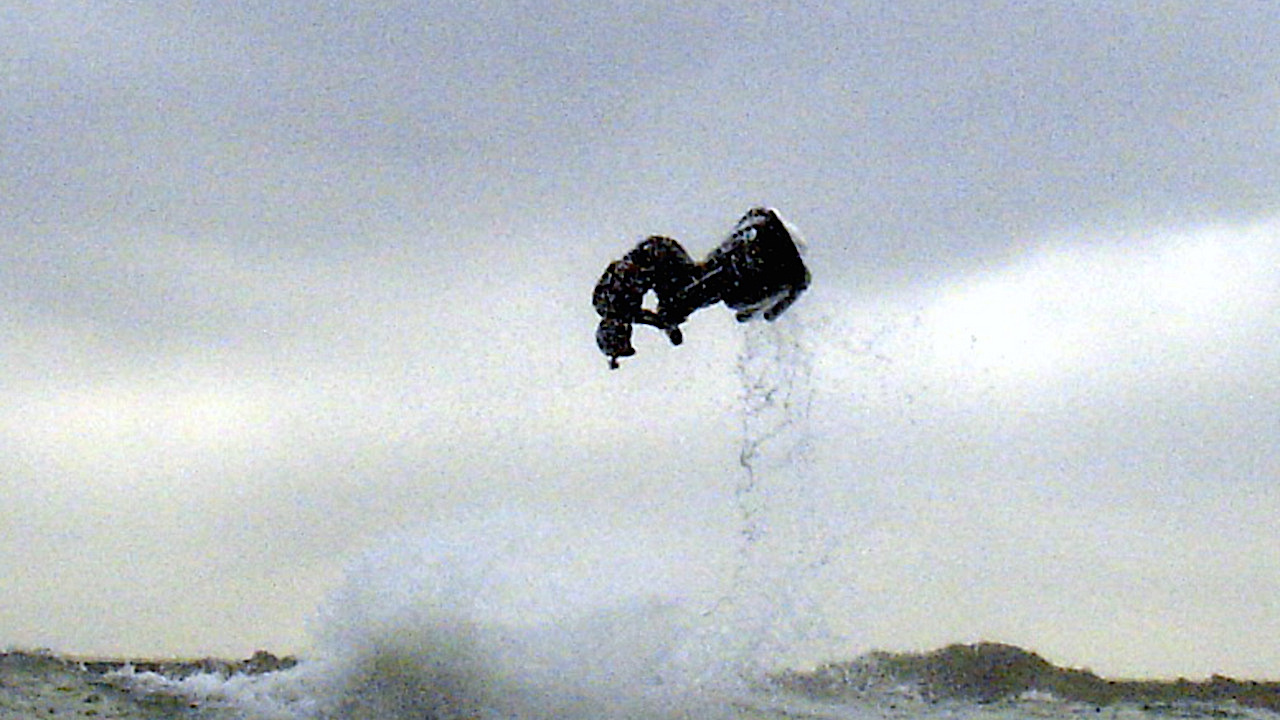
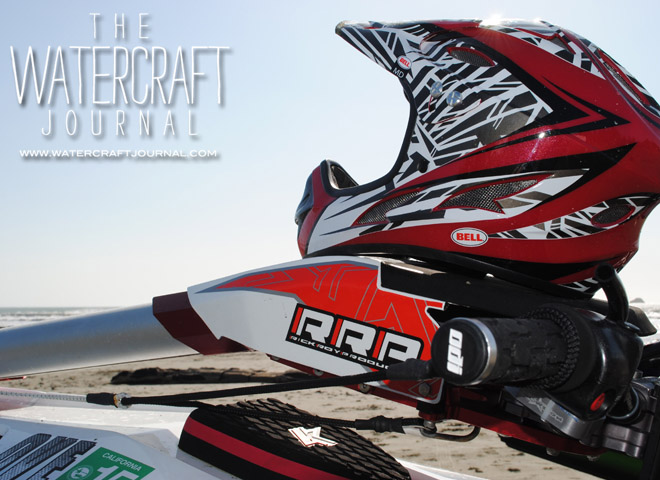
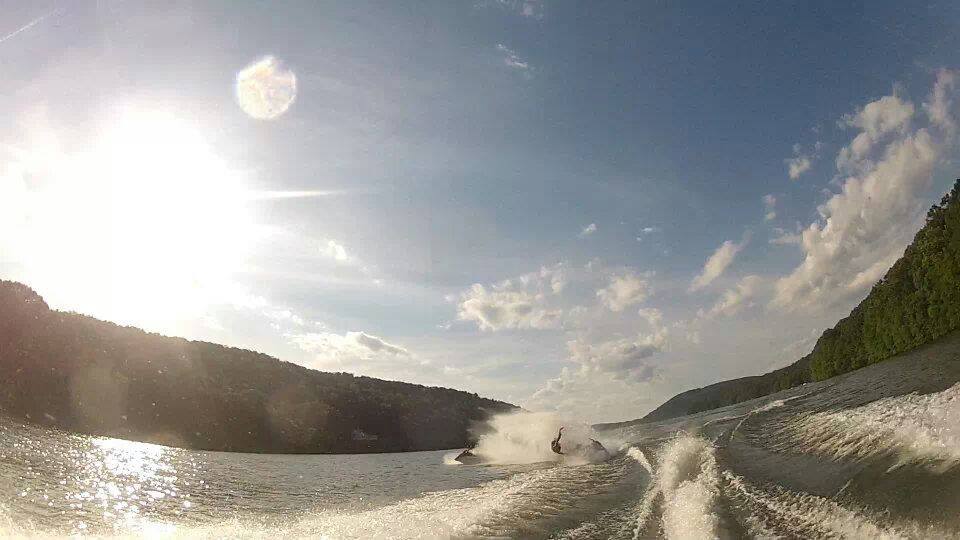
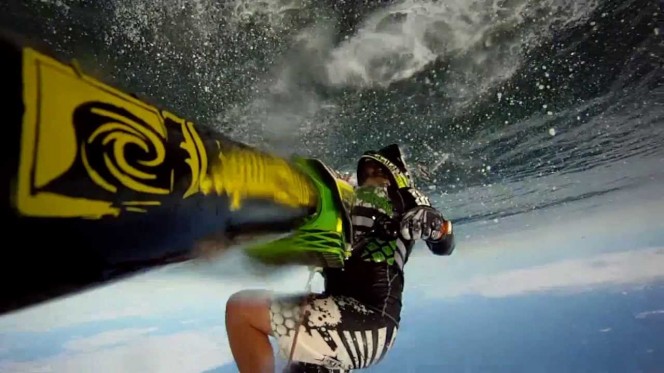
It wouldn’t be “Freeride Friday” without an awesome trick performed by arguably one of the most proficient talents in the sport, Mark Gomez. The little powder keg has risen up the ranks of jet skiing on the world stage, charging the surf on both hemispheres and impressing onlookers and his fellow freeriders alike. Mark is also one of the most affable characters, making it hard to hate him for brandishing Midas’ golden touch.
In a recent session in Oceanside, California, Mark executed one of the most difficult tricks possible: the Superflip. Requiring the utmost in athleticism and vehicle performance, the Superflip has become the top ring to reach for in the world of freeriding, and this video shows just how masterfully Mark was able to pull it off.
Mark wrote, “This video and everything I do throughout the year is made possible thanks to WORX Racing Components and Hydro-Turf. Thanks to my friends Zack Bright, Ross Champion and Brock Taylor for the coaching, and Chris Rosner for letting me borrow his Superflip bars. I was able to go out to my surf stomping grounds outside of Oceanside harbor and make it happen.
“The concept of the superflip is extremely gnarly. Go for a backflip, kick your feet out as you leave the lip, when fully extended upside down in the air, leverage yourself back into the tray using the superflip bars on your wrist to attempt to safely land the trick.
“There was not much of a way to ease into it other than to simply commit to the trick and go for it. It for sure helps to know that the 2014 Freeride jet ski I am riding is beyond capable of this and many other gnarly tricks. I am riding a Rickter FR2 EVO-1 hull with a DASA 1000cc engine pushed by a Skat-Trak 155 pump assembled by Impros, all put together by TC Freeride. The Superflip Levers I am using are Ross Champion/Cold Fusion superflip bars which are no longer available.”
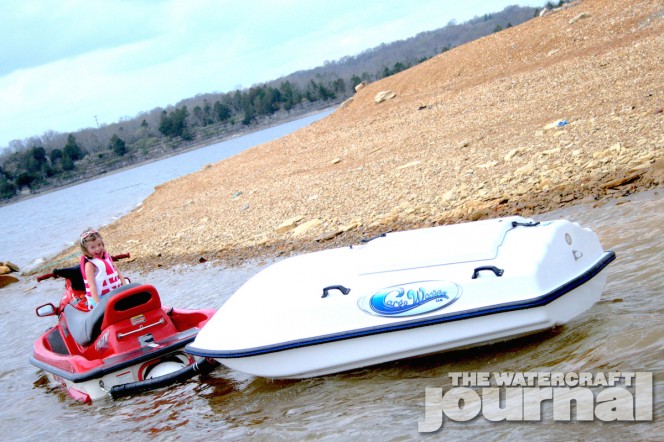
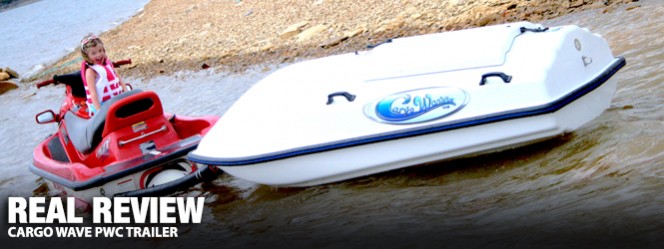
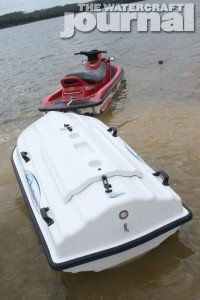
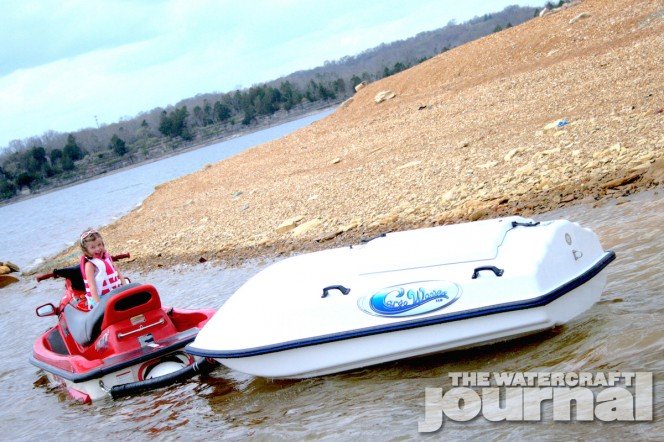
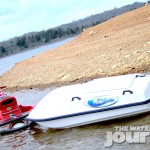
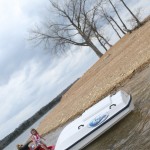
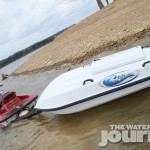
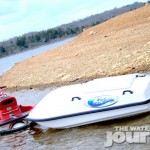
The Cargo Wave is an inclosed trailer with a watertight hatch, easily hauling camping gear or just a cooler and some towels.
I was young, but I can still remember my father attempting to tether a pair of lawn chairs to a boogie board to the back of a first year WaveRunner. He had given up trying to somehow strap a cooler down to the makeshift trailer earlier and resigned to making several trips back and forth to our daytime camping spot on the lake. The ride over was slow going as the ski wanted to swamp with all of the extra weight, and the boogie board regularly wanted to flip over, spilling its cargo into the water.
It was a frustration exercise that would be repeated countless times later in my life. Unpacking the truck only to stand on the dock scratching our heads as to how to get all of our provisions to the other side of the lake.
If I recall correctly, I have memories of my brother idling his SuperJet with a loaded Igloo cooler in the tray. My only solace is that we were not alone in our misery. Most of you reading this have grappled with the same dilemma.
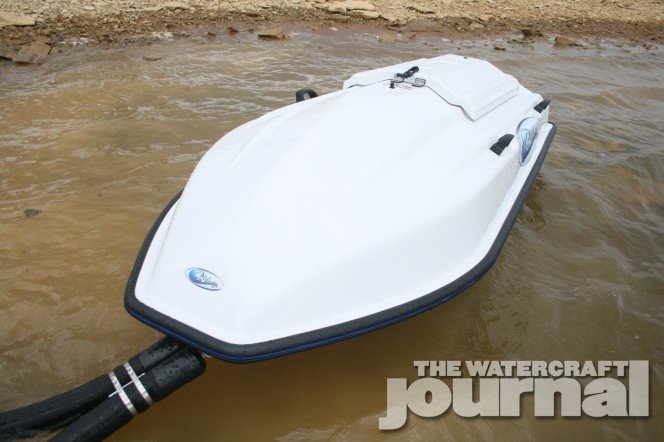
The long, low and sleek design ensures you won’t feel like you’re towing a Uhaul behind your ski, and you’ll be surprised with how smoothly it tracks on the water whether idling or at speed.Its cavernous 28-cubic-feet of storage and 200-plus-pounds of maximum weight storage promises that unless you’re trying to transport bags of cement that you won’t run out of room.
That is why the Cargo Wave PWC trailer is not only a great addition to the personal watercraft enthusiast, but a much needed, and expertly executed solution to a quarter-century’s-old problem. And unlike other PWC trailers that have come and gone before it, the Cargo Wave does not require any drilling or modification to your runabout. It doesn’t require any tricky electronics or tools to attach. It’s beautifully simple in its design, sturdy in its construction and genius in its execution.
But enough with the pleasantries. What is it? The deceptively simple design is made of two specially molded fiberglass clam shells, and bonded together in a fashion similar to your watercraft, even with a rubberized bondrail.
The top deck incorporates a flip-up hatch with steel-braided tethers, and held down with rubberized latch straps, providing a watertight seal. A one-way vent allows air circulation without letting in water, helping to keep mold from collecting inside.
Inside is 28 cubic feet of storage, with a reinforced platform with non-slip matting and railings to strap your cargo down.
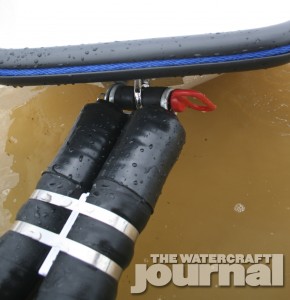
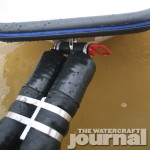
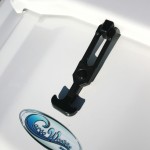
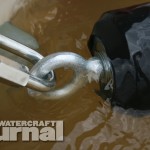
We had fun departing the launch ramp and taking our time to find a beach where we could set up our little camp. This process used to be a stressful one, as ditching all of our goods used to be a lingering threat. No longer with the Cargo Wave.Thick 3-inch steel-belted rubber hoses act as the trailing arms connecting the trailer to the factory D-rings on the back of your runabout. Connected with a central T-handle pin, attaching the Cargo Wave is easy.
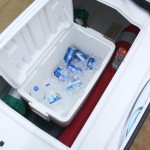
Each Cargo Wave comes with its own full sized Igloo cooler as part of purchase, and is easily tied down with a pair of crisscrossing bungee cords. Capable of hauling over 200-pounds, the Cargo Wave suddenly becomes the most useful tool in your daytime or even overnight camping arsenal. Long distance haulers with an auxiliary fuel tank in the bow will love this trailer, as limited storage is no longer a concern.
Towed via a pair of heavy-duty capped and steel-braided, rubberized 3-inch diameter hoses, the trailer mounts with the tightening of two C-rings into the cables’ stout cast O-rings, and to the trailer itself with a T-handle pin (for easy removal at the end of the day). The rubberized hoses allow enough flex to allow the trailer with naturally sway through your ski’s wake without wagging or careening into the back of you as you slow down.
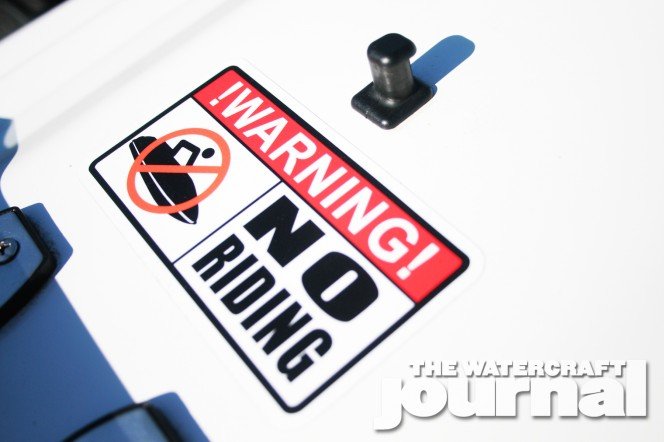
Although it’s sturdy, it’s not a toy. Always practice safe boating practices and please, don’t haul your kids, pets or buddies inside. Seriously, do we even have to ask?The Cargo Wave also lends itself to being a perfect fit for emergency and rescue applications, being able to transport medical equipment, food and water and provisions to flooded or disaster areas. As more an more departments are turning to modern runabouts, it’s not hard to imagine a Cargo Wave in tow.
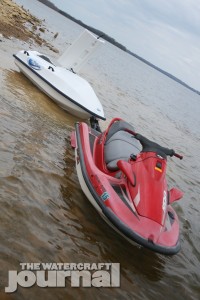
We were surprised with how well the Cargo Wave tracked behind our seemingly ancient ’97 Kawasaki STX 1100. Purposely testing a heavy laden Cargo Wave with a very underpowered two-stroke runabout was intentional.
Again, the Cargo Wave failed to “wag the dog” in long sweeping turns or jostle in rougher water. Obviously, the rules of responsible driving apply when towing anything, so hot dogging around the lake with a fully-loaded trailer of goods isn’t recommended.
Ideally, we would’ve liked to see a pair of anodized spring-loaded lockable carabiners instead of the C-rings for a little more user-friendliness, but that’s a sublimely minor detail. The long, low design of the inclosed trailer is attractive and sleek, the large accessible handles make loading and unloading out of the truck a snap, and its 110-pound overall weight is considerably light given its durability.
But for the weekend warrior or long haul rider, we’re thinking this has been a long-overdue solution to your storage and transportation needs. Priced at $1,599, the Cargo Wave isn’t cheap, but considering how many inner-tubes crammed full of coolers, chairs and kid’s toys that we’ve seen lost to the bottom of too many lakes, we’re thinking it’s the right tool for the job.
As the winter thaws into Spring, and life starts to stir, so do the seasonal companies. Recently, Jobe announced the launch of their 2015 Jobe Ruthless Model Contest. You’re probably thinking, “Wait, 2015? It’s only April of 2014. What gives?” Well, Jobe has already taken care of this year, and now they’re working on next year.
So what does it take become Jobe’s Miss Ruthless 2015, the face of all of Jobe’s marketing campaigns for next year? Not to mention the winner of a professional photoshoot and a cash prize of 500 euros! It’s actually pretty easy: Starting today and running all the way until May 14th, entries must go online and submit four photos (head, upper body, profile and full body images) as well as fill out an entry form as well as why you want to be Miss Ruthless.
Here’s the original press release:
It’s time for the 2014 Jobe Ruthless Model Contest! Jobe is hosting an online model contest on www.jobepwc.com/modelcontest in search of the new face for the 2015 Jobe PWC Ruthless range! Winning the model contest will make you Miss Ruthless 2015, including a professional photoshoot on an exciting location and a cash prize of 500 euros! As Miss Ruthless you will be the face of all Jobe PWC communication in 2015!
The Jobe Ruthless Model Contest launches on the 3rd of April 2014 and will run for one and a half month closing on the 14th of May 2014. After this period a professional jury will pick the three best entries to compete in the Ruthless Model Contest Finale. The Finale will take place from the 30th of June ‘til the 31th of July 2014.
Are you as excited as we are and want to take your shot on becoming the new face of Jobe PWC for a full year? Head over to www.jobepwc.com/modelcontest, follow the instructions and convince Jobe why YOU should become Miss Ruthless 2015!
When I was diagnosed with melanoma in 2005, I, with a good friend, rode my ski 5,000km (3,100-plus miles) around New Zealand to raise awareness of skin cancer. Over the next few years I went even further for the skin cancer cause with a cool but ultimately unsuccessful attempt to ride a ski from London to Sydney in 2010 and then three successful world distance records in 2011 and 2012.
Although Burfoot had previously circumvented the entirety of New Zealand by personal watercraft, his annual Melanoma Foundation adventure rides would take a far less grueling course.
All this took a lot of time and energy, and usually ended up costing a lot of money rather than raising it. I had heard about an event in Australia called Jet Trek which is an annual adventure over a week, raising funds for a chosen charity. The formula looked perfect: Lots of different people all having a ball, riding on a supported and preplanned adventure and helping to raise funds for a good cause.
I could see that this would work well in New Zealand and set about planning a trip in support of the Melanoma Foundation. The Aussies were very helpful in getting us setup and showing me all their procedures and templates. So with their help Ski-nZ was born. The first event was a huge success, raising $61,000 and getting the Melanoma Foundation’s message out there to the public.
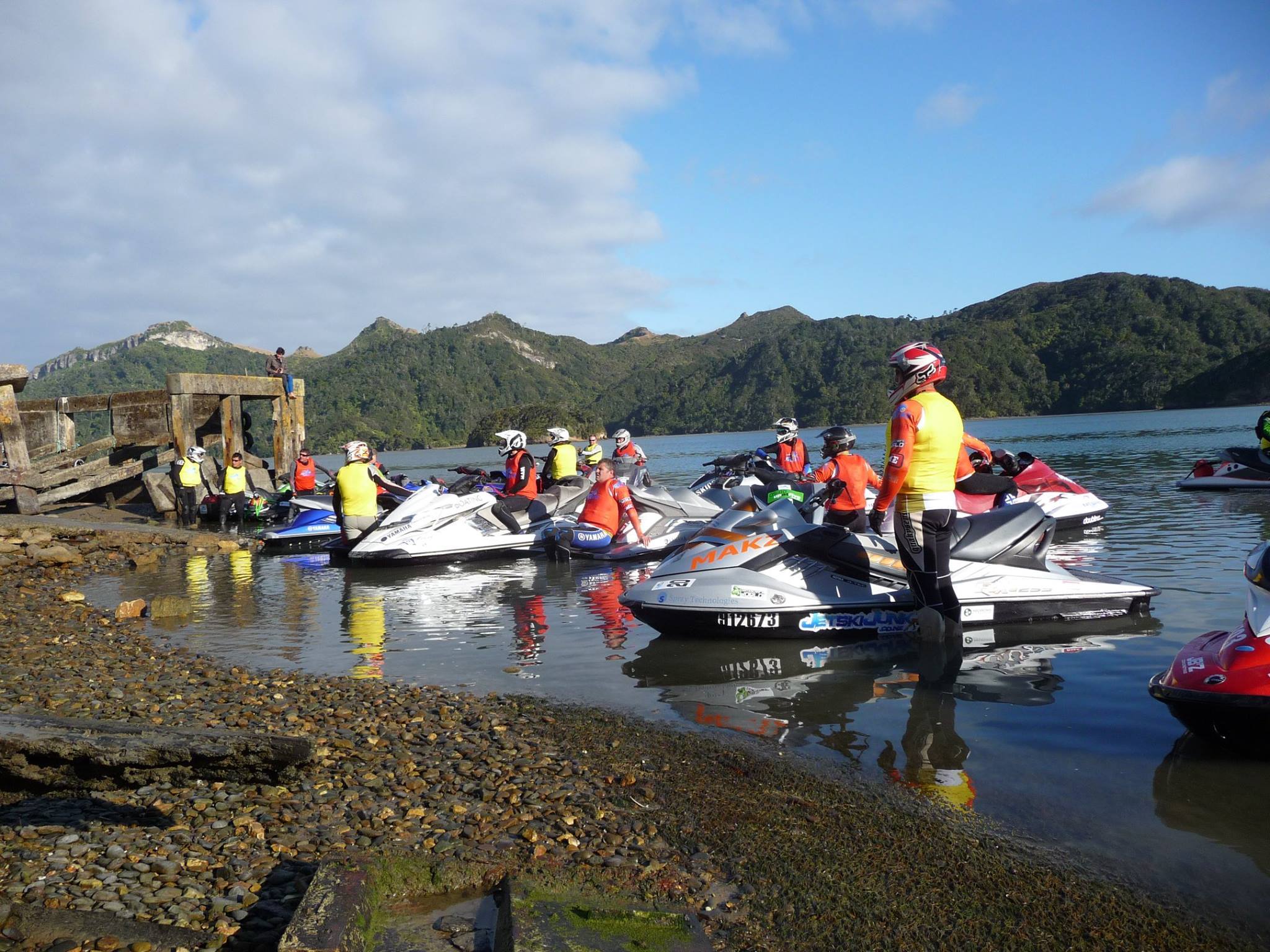
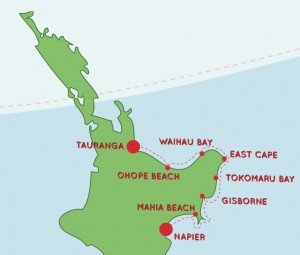
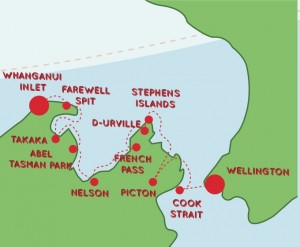
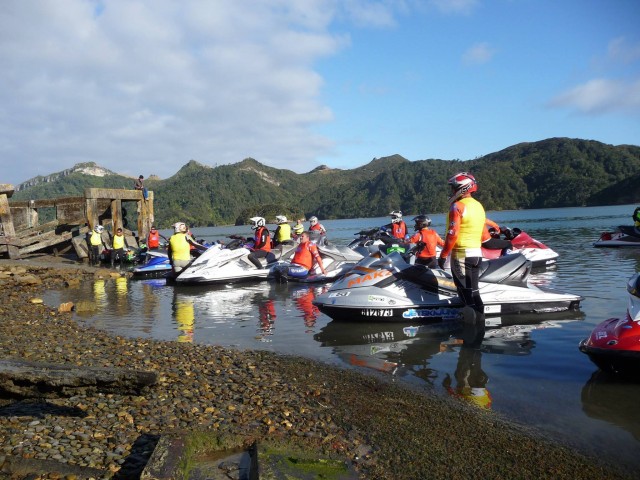
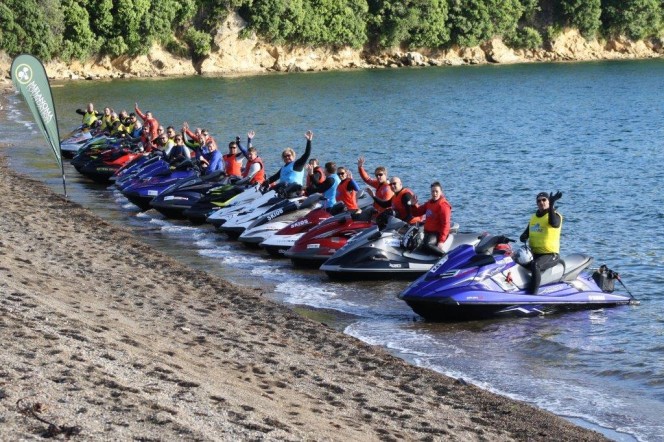
The 2014 Ski-nZ started on the 10th of March in the Westhaven Inlet at the top North West tip of the South Island. Twenty-five riders set off at 8:30 am and were treated to some stunning scenery as they rode around Farewell Spit and into beautiful Pohara in Golden Bay, arriving around lunch time. They were then able to relax for the afternoon before attending the first of the sumptuous restaurant dinners provided along the way and suffering my nightly briefing.
Normally the French Pass is a treacherous strip of water that is often a washing machine of tidal flows. Thankfully, today was a very calm day.
Day 2 was a ride through New Zealand’s famous Abel Tasman Park where hidden coves and magnificent golden sand beaches abound. There was wildlife a plenty with seals, dolphins and penguins regularly being sited. Riders met their ground crews in Kaiteriteri for lunch and then rode directly across Tasman Bay from there into the Port of Nelson. The sight of 25 PWC and a Coast Guard boat coming into Nelson side by side must have been impressive. We were supported all the way on the water by the Coast Guard and were very appreciative of their contribution to the cause and enjoyed the company of their volunteers immensely. That night we had another great dinner and an auction to raise more funds.
Unfortunately, the impending Cyclone Luci made our final day impossible, so our week-long adventure ride needed to come to a close a bit early.
Day 3 had us ride towards the North East and into French Pass. French Pass is a narrow stretch of water that passes between the mainland to the south and D’Urville Island to the north. The pass has huge tidal flows and at times looks like a raging river. We approached it with some nervousness and anticipation. But not wanting to have any drama, I had checked and timed our passage for the least amount of action and it turned out to be a non-event.
We then settled into our accommodation at French Pass with the majority of us in a big, old house appropriately named “The Big House.” We were to be in French Pass for two nights. It was a fun time with a beer or two being consumed and plenty of freshly caught fish being barbecued. A pajama party theme night was held on the first night which was a great success.
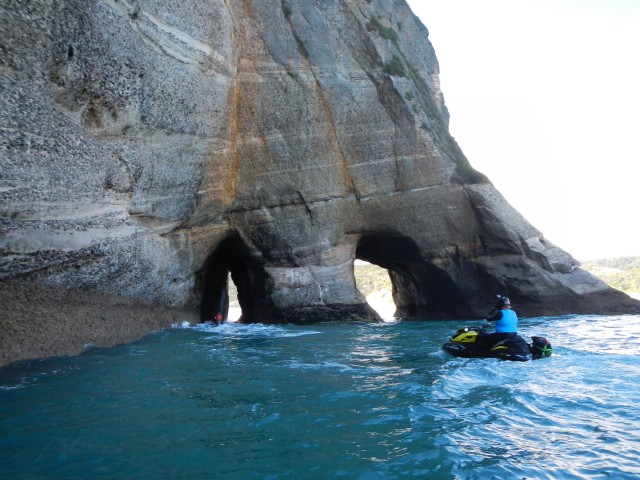
On the second day in French Pass, riders and crew were free to do what they wished with some opting for a fishing charter, some doing their own thing and others opting for the planned ride around D’Urville Island. That ride plan ultimately got changed on the fly as when we rounded the southwestern point of D’Urville we encountered strong winds and high seas, which meant that it would have been just plain hard work and no fun to get all the way up the west coast. No one was keen on that, so we turned around and went back to the protected side of D’Urville and enjoyed some stunning high speed riding very close to the deserted shoreline and in very clear water.
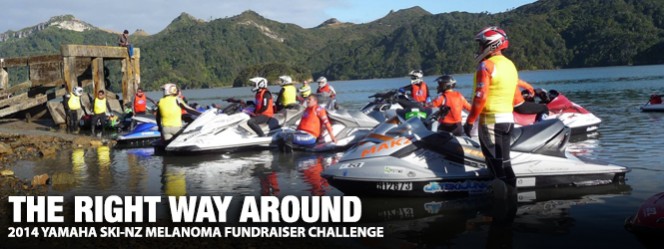
Participants in this year’s Ski-Nz Challenge – sponsored by Yamaha – were entreated to some of the most picturesque riding locations in the world, as New Zealand’s coastline is some of the most striking to be found.
On Day 5, we rode in good conditions along the top of the Marlborough Sounds for about 60km before entering the beautiful Queen Charlotte Sound. We were treated to more close in high speed running in crystal clear water for about 40km before heading into Endeavour Inlet and the famous Punga Lodge for lunch. Then it was a short ride into Picton for another great dinner and a 70s theme night.
All week we had been lucky with the weather but we had all been watching the development of Cyclone Luci, due in our area Saturday. Saturday was our final day, Day 6, and it was when we were to ride across Cook Strait to the Nation’s Capital, Wellington. Cook Strait is famous for its foul weather and large seas. I have ridden across it four times and twice I’ve been well beaten up and arrived looking like a shipwrecked sailor who’s just dragged himself up onto a beach.
This year’s riders came from all walks of life and their riding experience ranged from novice to expert. This year we had one person for the USA and one from the UK riding. We hope some of you will consider coming down to see our beautiful country, escape your winter and have your adventure of a lifetime.
At 5:30am on Day 6, things were even worse than expected with winds in the Strait of up to 40kt (or 75kph) and a gale warning in place. I made the difficult decision to call off the day’s ride and everyone traveled across on the ferry. I was grateful that everyone supported my decision and noted that some even seemed relieved. I’m sure there were a few who could have easily made it but as a large group, it was not practical and would have been just plain dangerous.
So we ferried across to Wellington for our last night dinner and prizes. It was a great night. We were able to thank everyone for their fantastic contribution to the cause. Prior to and throughout the event, this amazing group of people had raised $93,000 for the Melanoma Foundation and had had a great adventure into the bargain.
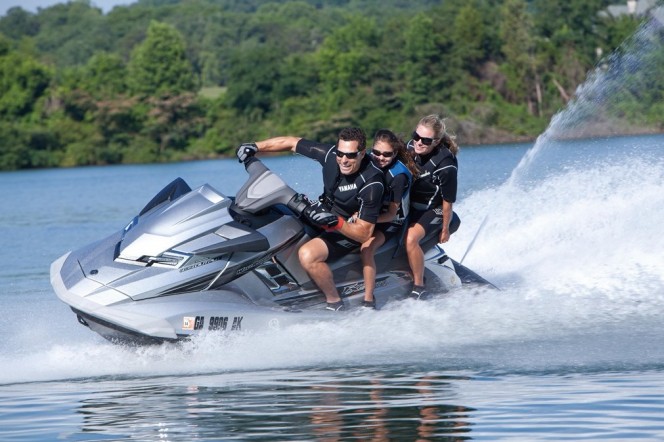
You wouldn’t buy a car without test driving it right? That’s what we thought. And likewise, that’s what Yamaha thinks too. That’s why they’re launching the very cool “On The Water” Demo Days across the nation to better familiarize you and other potential buyers with the all new 2014 lineup. Hosted by select Yamaha WaveRunner dealers from across the country, the “On The Water” Demo Days is the best way to get up close and personal with these awesome machines (that is, besides reading The Watercraft Journal’s PWC reviews of course).
And Yamaha has quite a bit to be proud of this year. Their lineup is one of the brand’s most comprehensive, with craft ranging from family budget-friendly entry level craft, fuel-sipping cruisers and long haulers, to full-blown race-ready supercharged water burners. Participation in the Demo Days is done via signup at www.YamahaOnTheWater.com, so if you want to take a crack at some of the best skis on the water, now’s your chance.
Here’s the original press release:
KENNESAW, GA – April 1, 2014 – Yamaha WaterCraft, a division of Yamaha Motor Corporation, U.S.A., announced today the 2014 Yamaha on the Water Demo Days hosted by Yamaha dealers nationwide. The national program connects interested consumers from around the country with their local Yamaha dealer, providing an opportunity for them to test a wide range of new 2014 Yamaha Watercraft products and experience first hand what a summer on the water is all about.
“We know that once consumers begin to experience the lifestyle related to our on the water products, that it is hard to resist. This year we have new value priced WaveRunners, new race performance models and our widest range of boat models for every buyer and every budget,” said Yamaha WaterCraft general manager Bryan Seti. “This program helps local dealers communicate directly with consumers about which model might be the best fit, and then provides a platform for getting out on the water and experiencing them first hand.”
The dealer search and sign up site is live right now at www.YamahaOnTheWater.com. Demo rides are free to the customer, and it is the responsibility of each participating dealer to facilitate the communication with the customer and schedule the demo ride time and day.
More information on Yamaha’s new 2014 WaveRunners and Boats can be found at www.YamahaWaveRunners.com and www.YamahaBoats.com
The American poet Henry Wadsworth Longfellow once quipped that “It takes less time to do a thing right, than it does to explain why you did it wrong.” In the brief past five months wherein The Watercraft Journal has published the Internet’s only daily personal watercraft magazine, our exponential growth evidences that our commitment to producing superior content, faster and for free is paying off.
The funny thing is that producing compelling, informative and entertaining originally-written content isn’t all that difficult. In fact, once you commit to doing the job right it sort of becomes second nature, like shampooing your hair or brushing your teeth (that is, if you have hair or all of your teeth). Then again, professional journalism is a trade that is not gifted but taught, and some simply refuse to be taught.
We are the only magazine to provide insightful and useful product and personal watercraft reviews, as well as in-depth interviews each and every week. These, in addition to our daily news articles, are mixed in with exclusive shop tours, late-breaking event coverage (regularly with huge photo galleries), videos, and technical how-to features…and we’re only a couple of days into Spring!
And again, the purpose of each month’s The Watercraft Journal By The Numbers is primarily for the benefit of current and would-be advertisers, and is, as we’ve said before, evidence of our commitment to total transparency.
March 2014
The Genuine Article(s)
Unlike other publications that merely “cut, copy and paste” articles pilfered from other sources, The Watercraft Journal prides itself on generating unique and professionally-written content, providing additional detail, quotes and/or insight when addressing a widely covered subject. But it its our full-length feature content where we shine most. We’re not seasonal. We’re not bimonthly. We’re daily, Monday-through-Friday. And that’s why more PWC enthusiasts come to us each day than any other magazine.
News articles published in March: 28
Feature articles published in March: 15
Total word count: 12,787 words*
*When this number is translated to print publication standards equals a 116-page magazine. Please note that this number does not include an average of two uniquely-written news articles published daily.
Real Readers, Real Performance
Here’s a fact: a magazine lives or dies by readership. And if the numbers teach us anything it’s that while a very healthy spike helped push February’s needle a tad higher, March’s steady consistency of increasing readers reading more articles more often means that we’re engaging our readership in new and better ways more regularly (whew! that sentence was a mouthful).
February
Total number unique readers: 7,372*
Total number of articles read: 20,172
Percentage of new readers: 57.8%
March
Total number unique readers: 6,757*
Total number of articles read: 20,220
Percentage of new readers: 54.9%
*This number is considered equal to an individual sale of a single copy of a magazine.
Socially Acceptable
Its funny how “if you can’t beat ’em, join ’em” has never been more true than this past month. Some have decried our social media effort, but in a hilarious turn of events, have about-faced on their position and greedily lapped up the benefits of digital marketing (although doing a lackluster job of mobilizing it into useful readership numbers). Our Facebook, Twitter, Instagram, YouTube, and weekly newsletter are carefully crafted, monitored and modified to derive the most efficacy, translating into engaged readers who will return again and again.
February Facebook readers: 4,476
February Facebook weekly reach: 87,034
Top Five countries: Argentina, United States, Brazil, Greece, Chile
March Facebook readers: 5,871
March Facebook weekly reach: 81,418
Top Five countries: Argentina, United States, Philippines, Brazil, Greece
Giving You One Really Good Reason
For the company looking for the maximum exposure possible for their brand from a personal watercraft magazine, there’s no better resource than The Watercraft Journal. And as this month has already shown, nobody covers all of the sport better, faster or more thoroughly…and again, it’s only the beginning of April! There’s a lot to be seen this month, including more freeride, some amazing technical articles and some really special interviews. If you’re looking at getting your brand in front of more eyes than anywhere else, then The Watercraft Journal is where you belong!
For his public humiliation, Erik is the winner of the grand prize from Jet Renu: an extensive detail kit including Jet Renu’s Pink Quick Shine, a gallon of Pink+ Shine & Waterspot Remover, Clear Glass Cleaner, Blue Plastic Polish and their MX DriWash and RenuShield MX sprays! All of it totaling $100-plus in PWC wash, cleaner and polish!
Huge thanks go to our participants, all of our readers and followers on Facebook and of course, Jet Renu for their support of The Watercraft Journal.
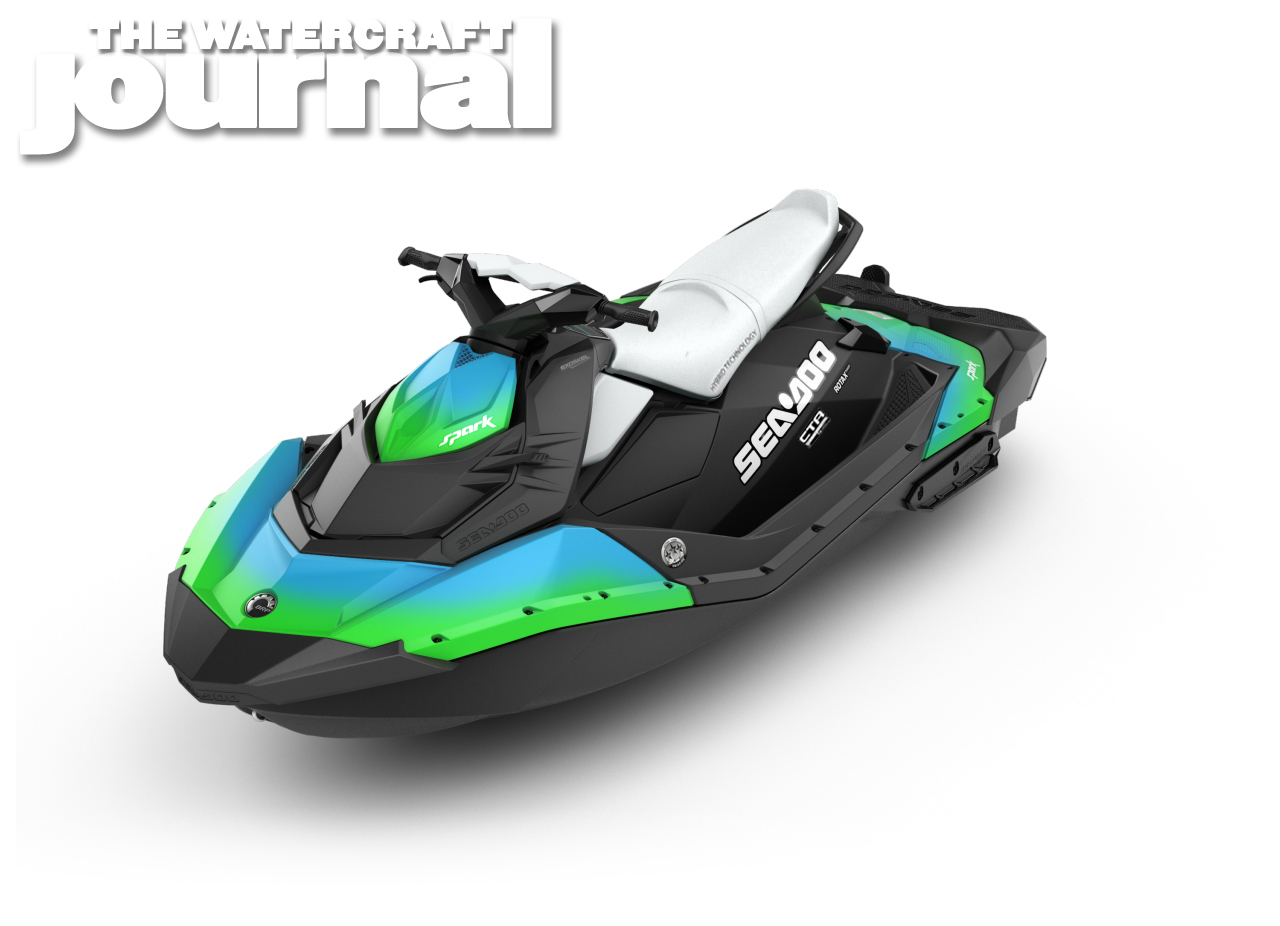
A year ago, word leaked that Sea-Doo was building a new lightweight entry-level runabout: the Spark. Since then and its worldwide public reveal last September, the Spark has breached buying demographics in nearly all categories, most notably age and price. This is only expected to continue as Sea-Doo expands its marketing reach to non-endemic PWC buyers; specifically, persons new to watercraft ownership.
The problem is getting the Spark to appeal to these potential buyers on their level.
“Early testing revealed that appealing to a very environmentally-conscious demographic with a traditional fossil fuel-burning engine wasn’t going to work,” explained BRP’s Drake Mallard to The Watercraft Journal from BRP’s Valcourt, Quebec headquarters. “We knew if we could reach these potential customers while proving that [BRP] can produce a lightweight, hybrid-electric power source for a personal watercraft – and do it in our smallest platform, the innovative Sea-Doo Spark – we could change the game completely.”
Development of the hybrid-electric power source commenced nearly simultaneously as the Spark project (then called CAFE) itself, over 5 years ago. The new hybrids are expected to arrive in showrooms as early as February of 2015.
Powering the project, appropriately titled Étincelle de Vie (or “Spark of Life”), proved to be its own challenge. The nonprofit organization Centre de technologies avancées BRP – Université de Sherbrooke (CTA) was tasked with not only developing the completely unique hybrid technology for the watercraft, but to do so using 50 percent less fuel and cutting CO2 emissions by 50 percent, and to accomplish all of this while maintaining the Spark’s speed, acceleration and agility.
The CTA’s biggest target was a total range of 150 miles, with 90 of those miles in electric mode. Mallard said that to achieve these goals, the team had to design an entirely new propulsion system, as opposed to modifying existing hybrid technology. A significant amount of weight was needed to be removed from current parts to compensate for the addition of the hybrid elements, which features two rows of next-generation NiMH batteries and a functioning transmission that will activate when the hybrid changes from gas to electric power.
“The transition from gas to electric is seamless,” Mallard continued. “A traditional 60-horsepower ACE 900 powers the Spark Hybrid until reaching a preset threshold within the power curve. Only then will an in-dash icon appear with an audible chime, indicating that the Spark has moved to electric power.”
Unfortunately, the added technology comes at a cost: the new Spark Hybrid weighs an extra 64-pounds over the standard Spark and will set the buyer back an additional $2,499.95. Because of the exclusive nature of the Spark Hybrid, dealers will be allowed to accept down payments as early as August 1st, 2014.
Obviously, unveiling a product intended for the next model year is a tremendous gamble on Sea-Doo’s part, but we all know that the industry leader in technology innovation isn’t one to take the road most traveled. There are still a lot of questions left unanswered and await further details on this groundbreaking machine. For the original announcement and some additional information on the all-new Spark Hybrid click HERE.
For those paying close attention to The Watercraft Journal these past few weeks, you would’ve noticed that we’ve really ramped up our freeride coverage. Although we were the first to print with coverage of the Thrust Innovations Daytona Beach Freeride, we’ve never missed a beat with covering the other many goings on and freeride events happening nationwide. To some of you, freeride might be a totally new form of jet skiing, one that is both exciting and slightly terrifying at the same time.
Part of understanding freeride is how tight of a community it is. Freeriders are a close-knit group of jet skiers who are usually seen charging the waves in groups. Although a fantastically talented freerider, Zack Bright by no means carries the air of an alpha in this pack. The 24-year-old has been riding for 4 years, a relatively a short time. Yet, within those short years, Zack has climbed the ranks of professional freeriders, earning the attention of several sponsoring companies Burn Industries, Hydro-Turf, Cold-Fusion, Blowsion, Fullgaz, DASA Racing, and Jet Lift.
As part of being a professional freerider, Zack has also traveled across the globe to compete among other international freeriders – from the States to France to Australia and New Zealand. Below, Zack participated in a very personal and insightful one-on-one interview which will give you a closer look at the Oceanside, California native.
It’s the subject of conversations happening all over the planet: Why aren’t more manufacturers producing new standups? Besides Yamaha WaveRunners’ continual production of the same 701cc-powered two-stroke SuperJet that has remained practically untouched for nearly a decade, the only outlet for a new standup has come from the wellspring of new aftermarket hull and engine manufacturers.
Upstarts like Rick Roy Products, Bullett Racing, Hurricane Industries, Trinity Composites, XScream and Krash Industries have all made names for themselves by cranking out outstanding niche-specific machines, be them for racing, freeride or freestyle. But producing these skis en masse has faced two major challenges: demand and powertrain.
In a conversation with Craig Warner during our tour of the new Mountain Motorsports’ Lithia Springs, GA store, he stated, “I wanted to start producing ‘Craig Warner Edition’ racing skis with a lightweight four-stroke but couldn’t get my hands on a good one. I even looked into buying a couple of those ACE 900 engines [out of the Sea-Doo Spark]. They wouldn’t sell them separately.”
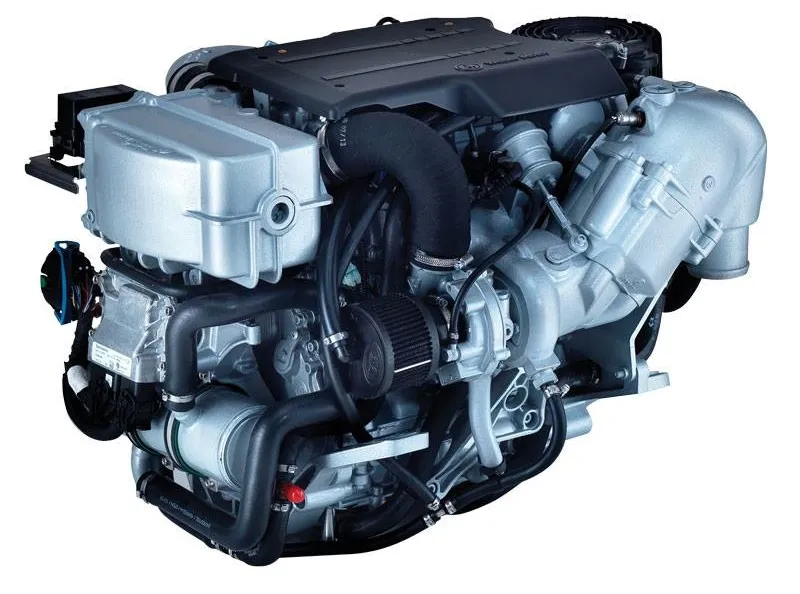
While there’s no shortage of two-stroke engine companies, going four-stroke offers certain key advantages, only as long as you can keep the weight down. That is why so many are looking at Weber’s MPE 850. While jet skiers will recognize the brand for their contribution to the Hydrospace S4, boaters will know it for powering Sea Ray’s Jet 21 and Jet 24, while auto aficionados will know Weber for its roles with “BMW, VW, Audi, Ford and Chrysler since 1969,” according to an article by Boating World Magazine.
Currently used in the new Sea Ray Jet 21, a 21-foot, 6-inch, 2,883-pound bowrider-style boat, the MPE 850 is a small (850cc or .85 liters) and lightweight (198 pounds) engine for producing a big punch. For the MPE 850 is turbocharged, producing an impressive 120-horsepower. Employing a a twin parallel-cylinder design (similar to many high performance motorcycles), a closed-loop cooling system and a dry sump oil setup.
Moreover, the MPE 850 is intercooled and fed by multipoint fuel injection, the Weber “has no discernible lag when you jam the throttle,” according to the original article, making it a prime candidate for future aftermarket skis. Availability as a “crate motor” is still mum, but is expected soon. With output nearing 200-horsepower in the hands of the sport’s best tuners, this could be the engine of the future of GP and Open standup classes.