
Home Blog Page 5

Support Juan Rada’s Cancer Treatment and Recovery

0
Screenshot

If you’ve spent any real time around PWC racing, odds are you already know Juan Rada—even if you don’t realize how many moments he’s been part of.

Juan isn’t just “around” the sport. He’s woven into it. A racer in his own right, a tireless crew member, a team guy, a holder, a helper, a problem-solver, and the kind of person who somehow manages to keep things light even when everything else is chaos. Heart of gold. Funny as hell. Always moving. Always helping. Always there.

Right now, Juan is facing something far bigger than any race weekend or mechanical issue. He’s battling cancer—and he’s doing it with grit, humor, and that familiar bad-ass, positive mindset he’s always carried. But no one should have to carry this kind of weight alone.

As Craig Warner put it:

“He doesn’t need to stress about bills right now.
He just needs that bad-ass happy mindset that he’s always had.”

That’s where the PWC family comes in.

This community has always been about more than machines and competition. It’s about showing up. It’s about helping each other load trailers, fix skis, make the next moto—and sometimes, getting through life when it hits hard.

A GoFundMe has been set up to help Juan focus on treatment and recovery without the added pressure of financial stress. Whether it’s a donation, sharing the link, or just sending support, every bit helps remind Juan that the same community he’s supported for years is standing right behind him.

GoFundMe Detail are below:


We are raising funds to support our friend Juan Rada, who has been diagnosed with Stage 2 esophageal cancer and is currently undergoing treatment. While Juan is focused on his health and recovery, the financial burden of this diagnosis has become overwhelming.

Due to treatment and recovery requirements, Juan is unable to work for an estimated 3 to 6 months. During this time, medical expenses continue to accumulate, and he is also struggling to keep up with everyday personal bills such as housing, utilities, and basic living expenses. The loss of income combined with ongoing medical costs has made this an extremely difficult period.
We are asking for help to support Juan with medical bills and essential living expenses while he focuses on treatment and healing. Any contribution, no matter the amount, will help ease the financial stress during this challenging time. If you are unable to donate, sharing this page is also deeply appreciated. Thank you for your kindness, support, and compassion.

GreenHulk Performance Solutions for Cavitation and Hookup Issues on High-Power Sea-Doo PWCs

0

One of the most common complaints we hear from riders stepping into today’s high-horsepower Sea-Doo platforms is this: the power is there, but the hookup isn’t always. Hard launches turn into brief cavitation, aggressive throttle inputs don’t always translate cleanly to forward motion, and the ski can feel like it’s fighting to put all that output into the water.

That problem isn’t unique — and it isn’t new. As factory power levels climb, the jet pump becomes one of the most important links in the chain. If it can’t move enough clean water efficiently, performance gains elsewhere start getting wasted.

That’s where solutions like the RIVA / SOLAS Sea-Doo 161mm 14-Vane Pump, available through GreenHulk PWC Performance Store, come into the conversation.

Why the Stock Pump Can Become the Bottleneck

On modern GTX, RXP-X, and RXT-X models — especially 300 and 325-horsepower platforms — the pump is asked to do a lot. Under heavy load or aggressive launches, cavitation can creep in, reducing acceleration and making the ski feel inconsistent off the line.

The issue usually isn’t a lack of power. It’s water flow control.

More controlled flow means better hookup, stronger launches, and more usable acceleration — which is exactly what higher-vane pump designs aim to address.

The GreenHulk Solution: RIVA / SOLAS 161mm 14-Vane Pump

GreenHulk’s offering of the RIVA / SOLAS 161mm 14-vane pump is designed to move more water, more efficiently, while keeping flow clean under load.

The pump uses a 14-vane stainless steel stator and matching 14-vane nozzle, increasing water control through the pump assembly and significantly reducing cavitation compared to lower-vane designs. The result is stronger hookup at launch and more consistent power delivery through the throttle.

A standout feature is the inclusion of three interchangeable stainless nozzle rings (82mm, 83mm, and 84mm ID). This allows riders to fine-tune performance while also extending service life — rather than replacing the entire housing as wear occurs.

What Riders Notice on the Water

Based on rider feedback and real-world use, this type of pump upgrade isn’t about noise or visual flash. It’s about how the ski behaves when you ride it.

Riders commonly report:

  • Quicker, harder launches

  • Reduced cavitation under heavy throttle

  • More consistent acceleration

  • Improved top-end efficiency

  • Better hookup on high-horsepower setups

As one GreenHulk customer put it in the comments, the gains are “monstrous.”

Built for Today’s High-Power Sea-Doos

The RIVA / SOLAS 161mm 14-vane pump is compatible with a wide range of modern Sea-Doo models, including GTX, RXP-X, RXT-X, and GTX Limited platforms from 2016 through current 300- and 325-horsepower models.

It’s built as a durability-minded upgrade, featuring:

  • SOLAS 161mm pump housing

  • 14-vane stainless stator section

  • Matching 14-vane nozzle

  • Stainless steel wear ring

  • Interchangeable nozzle rings for tuning and longevity

Installation does require new OEM jet pump seals, which should be planned for as part of the upgrade.

The Takeaway

If you’re riding a high-output Sea-Doo and feel like the ski isn’t always translating power into motion — especially off the line — the pump is one of the first places worth looking.

Upgrades like the RIVA / SOLAS 161mm 14-vane pump from GreenHulk focus on improving how power gets to the water, not just how much power the engine makes. For riders chasing cleaner launches, stronger hookup, and more usable performance, it’s a solution that addresses a very real problem.

Winter Weather Rescue – What’s Next If Fern Caught Your Ski Outside

0

For a lot of riders, this winter has been more stop-and-go than a clean shutdown. Mild stretches kept skis in play longer than usual, and in some parts of the country, personal watercraft never really went into “winter mode” at all. Then came the sudden cold snap — sharper, colder, and more disruptive than what many owners are used to seeing.

If your ski spent that stretch sitting outside on a trailer, at a dock, or simply exposed because you don’t have indoor storage, you’re not alone. And while cold weather plus watercraft is never ideal, a surprise freeze doesn’t automatically mean the season ended with damage. With a few smart steps now, there’s still plenty you can do to protect your ski and set it up for an easier spring.

What You Can Do Right Now

While temperatures are still hovering at or below freezing, there are a few simple but important steps you can take now.

  1. Get standing water out — wherever you can
    If your ski is sitting on a trailer, make sure drain plugs are removed and the hull is tilted so any rainwater or meltwater can escape. Standing water is the biggest risk during extended freezes, and getting it out now helps reduce ice expansion in places it doesn’t belong.
  2. Keep water from getting back in
    If the ski is outdoors, a properly fitted cover is better than nothing — and a cover plus a tarp is better still. The goal isn’t perfection; it’s keeping additional rain, sleet, or meltwater from pooling inside while cold weather continues.
  3. Don’t start it just to “warm it up”
    It’s tempting, but repeatedly starting a ski in freezing temperatures — especially without flushing or antifreeze — can do more harm than good. Unless you’re actively purging water or completing winterization, it’s usually best to leave the engine off until conditions allow you to do it properly.
  4. Pull the battery if you can
    If access allows and the ski is stored outside, removing the battery and storing it somewhere dry and above freezing is one of the easiest wins right now. Cold and moisture are hard on batteries, and this step alone can save a headache come spring.
  5. A quick visual check goes a long way
    Take a few minutes to look for obvious ice buildup around the jet pump, intake grate, steering nozzle, and controls. You’re not trying to chip ice aggressively — just making sure nothing is bound up or holding pooled water that will refreeze overnight.

If Your Ski Was Left in the Water

It’s not common, but in some cases riders weren’t able to reach their marina or dock before the cold set in. If your ski remained in the water during freezing conditions, the priority is limiting further exposure and avoiding actions that could make things worse.

If access is possible, do not start the engine until the ski can be properly removed from the water and inspected. Ice forming around the pump intake, steering nozzle, or inside the cooling system can create restrictions that aren’t always visible from the surface.

If the ski is still floating, check that it’s sitting level and not taking on additional water. Once conditions allow, the safest move is to get the ski out of the water as soon as possible, allow ice to melt naturally, and then begin draining and winterizing from there.

In most cases, brief exposure to freezing temperatures doesn’t automatically mean severe damage — problems typically arise when water is trapped and repeatedly freezes and expands. A careful, methodical approach once temperatures rise can help prevent turning a bad situation into a worse one.

Once temperatures climb back above freezing and you can safely spend time working on your ski, it’s a good moment to slow things down and take stock. Before jumping straight into a full winterizing (or-rewinterizing) routine, a quick check of a few key areas can help identify lingering moisture, ice damage, or issues caused by the sudden cold — and prevent small problems from becoming springtime surprises.

First Things to Check Once Temperatures Rise

When conditions allow you to work comfortably and safely, start with a slow walk-around. You’re not looking for worst-case scenarios — just confirming that water hasn’t settled where it shouldn’t.

  1. Hull interior and bilge
    Open the seat and check for standing water inside the hull. If water is present, drain it completely and leave drain plugs out for a short time to let moisture escape. This is also a good moment to look for signs of ice expansion, like cracked hoses or fittings that look stressed or out of place.
  2. Cooling system and exhaust
    Cooling passages, exhaust components, and waterboxes are some of the most vulnerable areas during a freeze. Make sure water has been fully drained, then flush or fill the system with RV-safe antifreeze as part of winterization. If anything looks swollen, cracked, or weepy, address it before storage.
  3. Jet pump and intake area
    Check the intake grate, pump tunnel, and steering nozzle for ice residue, debris, or anything that may have frozen in place. Everything should move freely once thawed. If it doesn’t, don’t force it — thaw and inspect first.
  4. Controls and cables
    Throttle, steering, reverse, and trim controls should all move smoothly. Freezing rain and sleet can leave moisture inside cable housings, so now is the time to lubricate exposed linkages and confirm nothing feels stiff or gritty.
  5. Battery and electrical connections
    If the battery was left installed during the cold snap, inspect terminals for corrosion or moisture. If it hasn’t already been removed, now is the time to pull it, fully charge it, and store it in a dry, above-freezing location.
  6. Seals, hatches, and covers
    Look over storage bin seals, engine bay gaskets, and the seat base. Ice can temporarily deform seals, and water intrusion often shows up here first. Dry everything thoroughly before covering the ski for storage.

If you discover cracked components, leaking fittings, or anything that doesn’t look right once the ski has fully thawed, this is the point where it makes sense to stop and seek professional guidance. A trusted dealer, service center, or experienced PWC technician can help assess whether damage is cosmetic or something that should be addressed before storage or spring launch. Catching issues now is far easier — and often less expensive — than discovering them once riding season returns.

If your ski was already winterized before the freeze — fuel stabilized, cooling system treated, battery stored — most of that protection is still doing its job. That said, a few quick follow-ups can’t hurt. Top off fuel stabilizer if water may have gotten into the tank, check cooling passages for any leftover ice or water, give the battery a charge and inspect terminals, and touch up plastics or gelcoat protectants on exposed surfaces. You’re not starting over; think of it as a quick safety check to make sure last year’s prep is still holding strong.

Caring for Plastics and Gelcoat After Extreme Cold

Even if the mechanical side checks out, extended exposure to freezing temperatures and frozen precipitation can be hard on a ski’s exterior. Taking a little extra time here can help prevent long-term cosmetic wear.

Wash and dry thoroughly
Once temperatures allow, rinse away road salt, grime, and residue left behind by melting ice and sleet. Pay attention to seams, footwells, and under-seat areas where moisture can linger. Drying the ski completely before covering it helps prevent staining and mildew.

Condition exposed plastics and rubber
Cold weather can dry out trim pieces, intake grates, and rubber components. Applying a plastic- and rubber-safe protectant can help restore flexibility and reduce fading or cracking over time.

Inspect gelcoat and painted surfaces
Look for new scuffs, stress marks, or dull areas — especially if ice sat against the hull for extended periods. While most cosmetic issues can wait until spring, noting them now helps you plan repairs instead of being surprised later.

Cover smart, not tight
Make sure covers aren’t trapping moisture against the hull. A breathable cover with airflow is better than sealing everything up while damp, especially after a freeze-thaw cycle.

Not every winter follows the same script, and this one certainly didn’t. Winter storms like Fern can catch even the most prepared riders off guard. If your ski spent more time exposed than you planned, a little patience, a careful look-over, and some basic protection now can go a long way toward keeping small issues from becoming bigger ones later. Take your time checking over your ski, address any lingering water or ice, and touch up protectants where needed. Winter will eventually loosen its grip, and when it does, the goal is simple: have your ski ready to pick up where you left off, not playing catch-up.


Impros Impellers 2026 Sponsorship Application Period Closes Tomorrow

0
Abraham Hochstrasser

For riders looking to take the next step in performance—whether in freeride, freestyle, or racing—sponsorship is about more than logos and discounts. The right partnership shapes how a ski performs on the water, how a rider approaches their setup, and how consistently results follow throughout a season.

This commitment to engineering excellence is the driving force behind Impros Impellers’ 2026 sponsorship program, which is now officially open for applications.

Impros has built its reputation on a simple principle: results come from consistency. In real-world riding, the impeller is the single most influential component of a PWC’s driveline. It dictates how power is delivered, how the ski hooks up, and how predictable the machine feels across changing conditions. Riders pushing their limits don’t need surprises—they need a setup that responds exactly the same way, session after session.

This philosophy carries across every discipline Impros supports. From the unpredictability of the surf to the precision of a race course, the common thread is repeatable performance. This reliability allows athletes to focus on lines, technique, and execution rather than second-guessing their equipment.

Abraham Hochstrasser

The current Impros roster reflects this mindset. Take world-class freerider Abraham Hochstrasser, whose discipline places extreme demands on driveline components. For Abraham, an Impros-tuned impeller is the vital link in the equation—engineered to survive the violent shock of re-entry while providing the instantaneous hook-up and explosive thrust required to launch off the face of a massive swell.

Rather than chasing fleeting trends, Impros continues to emphasize proven on-water performance. This approach also shapes how they evaluate athletes. Impros’ 2026 application process looks beyond social media reach, focusing instead on riding experience, commitment, and a clear vision for the upcoming season.

For riders serious about developing their craft and representing a brand built on real-world results, this is your opportunity to align with a team that values performance first.

Deadlines & Details:

RIVA Motorsports Offers Incentives on 2025 Models and Early Access to 2026 PWCs

0

Boat show season always brings excitement—but its still a season, right on the heels of the holidays, where buyers are more cautious and value isn’t just about price — it’s about flexibility, service, and long-term ownership. 

RIVA Motorsports in Deerfield Beach has quietly been leaning into that idea, positioning its dealership side not just as a place to buy a ski, but as a long-term hub for riders at every stage — new buyers, returning owners, and those already thinking about what the 2026 riding season might look like.

Looking Ahead to 2026 — Without Rushing It
One of the more notable moves right now is RIVA Motorsports opening pre-orders for the all-new 2026 Sea-Doo lineup, paired with three years of coverage on 2026 personal watercraft models.

That kind of early-order incentive changes the conversation. Instead of scrambling mid-season or settling for what’s left on the floor, buyers can lock in what they want ahead of time — with added coverage built in from day one.

Yamaha riders aren’t left out either. Pre-orders for 2026 Yamaha WaveRunners are also open, giving brand-loyal buyers the same chance to plan ahead instead of reacting later.

Value Still Matters — Especially Right Now
While 2026 models are the talk of the town on the boat show circuit, RIVA Motorsports hasn’t ignored the reality that many riders are shopping right now, for right now, not some future delivery date.

There’s currently a $500 rebate on all Sea-Doo models, with up to $1,000 off select 2025 Sea-Doo models through Manager Specials. Performance-focused riders will also notice a $1,000 rebate on Sea-Doo RXP-X and RXT-X models, which continue to sit at the sharp end of the recreational-performance spectrum.

On the Yamaha side, RIVA Motorsports is offering Manager Specials on select 2025 WaveRunners, giving buyers a chance to step into a proven platform at a reduced cost—without waiting another season.

Financing is part of the equation too, with rates starting as low as 3.99%, an increasingly important factor as buyers weigh monthly ownership costs just as much as sticker price.

Trade-Ins Without the Guesswork
Another area where RIVA Motorsports is clearly trying to reduce friction is trade-ins.

Instead of the usual back-and-forth, riders can get a trade-in value online in about 30 seconds, making it easier to understand what a current ski is worth before ever setting foot in the showroom. For many buyers, that clarity is what turns “just looking” into a real conversation.

Add in ongoing inventory updates available with a quick online sign-up, and the dealership experience becomes less about pressure—and more about timing and information.

More Than Just the Racing Side of RIVA
RIVA’s name is synonymous with high-performance watercraft, but the motorsports store side of the operation is equally about accessibility—sales, service, parts, and support under one roof.

Whether it’s planning ahead for 2026, finding the right deal on a remaining 2025 model, or simply understanding trade-in options, RIVA Motorsports is a click away.

For more information, visit rivasuperstore.com, facebook.com/rivamotorsports or stop by RIVA Motorsports in Deerfield Beach, Florida.

Sea-Doo Kicks Off 2026 Boat Show Season With Major Displays and a New Wake Colorway

0

Winter might still have its grip on most of the country, but Sea-Doo is already pushing the conversation toward summer. The brand has announced its 2026 boat show season plans, confirming full corporate Sea-Doo displays at six major shows across the U.S. and Canada — along with a surprise color update for the Wake lineup.

For riders itching to get hands-on with the latest Sea-Doo models, boat show season is where the countdown to riding season really begins. Sea-Doo’s 2026 tour will hit four shows in the United States and two in Canada, bringing product experts, interactive displays, and owner-focused spaces directly to the show floor.

Sea-Doo 2026 Boat Show Schedule

Sea-Doo will appear with full corporate booths at the following events:

  • Toronto Boat Show
    Began Jan 17, runs through Jan. 25
    Enercare Centre, Exhibition Place — Toronto, Ontario

  • New York Boat Show
    January 21–25
    Javits Center — New York, New York

  • Miami Boat Show
    February 11–15
    Miami Beach Convention Center — Miami, Florida

  • Detroit Boat Show
    February 12–15
    Suburban Collection Showplace — Novi, Michigan

  • Montreal Boat Show
    February 12–15
    Palais des Congrès — Montreal, Quebec

  • Atlantic City Boat Show
    February 25–March 1
    Atlantic City Convention Center — Atlantic City, New Jersey

What Sea-Doo Is Bringing to the Show Floor

Sea-Doo’s booth experience for 2026 is designed to be more than just a walk-by display. Throughout each show day, attendees can expect scheduled product walk-arounds led by Sea-Doo product experts and brand ambassadors, offering a closer look at the brand’s current hero models and answering questions from first-time buyers and longtime owners alike.

Each stop will also feature a dedicated Sea-Doo Lounge, giving owners a place to recharge after hours on the show floor, along with a Sea-Doo Social Club area where riders can connect with local chapters and swap stories about favorite riding spots.

Sea-Doo is also leaning into show-only engagement, with attendees able to spin the Sea-Doo prize wheel for giveaways. At the end of the year, one participant who provides their information will win a fully customized Sea-Doo ride — including vehicle and accessories — valued at up to $20,000 USD.

A New Look for the Sea-Doo Wake Lineup

Alongside the boat show announcement, Sea-Doo also dropped a surprise winter reveal for wake-focused riders. The 2026 Sea-Doo Wake 170 and Wake Pro 230 will now be available in a new Teal Blue/Manta Green colorway, joining the previously announced Sand/Dazzling Blue option.

The Wake models have become a favorite among tow-sports riders thanks to standard features like Ski Mode, a dedicated Ski Pylon, and an integrated Board Rack. The new colorway adds a bold visual twist, giving the Wake lineup even more presence on the water when summer finally arrives.

With boat show season officially underway and 2026 models starting to take center stage, Sea-Doo is clearly aiming to keep riders thinking past winter — and straight toward their next day on the water.

Video: Removable Audio Build Turns This RXT-X Up to 11 Without Losing Its Edge

0

Every add-on we bolt to a personal watercraft comes with a decision attached to it. Extra storage, lighting, audio, mounts — they all change the experience in small but noticeable ways, and they all come with a cost somewhere else. Sometimes that cost is weight. Sometimes it’s speed. Sometimes it’s nothing more than visual or functional clutter. The question isn’t whether those tradeoffs exist — it’s whether they’re known, measured, and intentional.

What makes that question more relevant today is how accessory-rich modern skis have become straight off the showroom floor. Features that once required aftermarket solutions are now often standard or optional from the factory, which means most add-ons are no longer about basic functionality or comfort. They’re about choice, use, and personal taste. That hasn’t reduced the range of aftermarket options available — if anything, it’s broadened them — serving both new skis that are already well-equipped and older platforms where every change is felt more immediately.

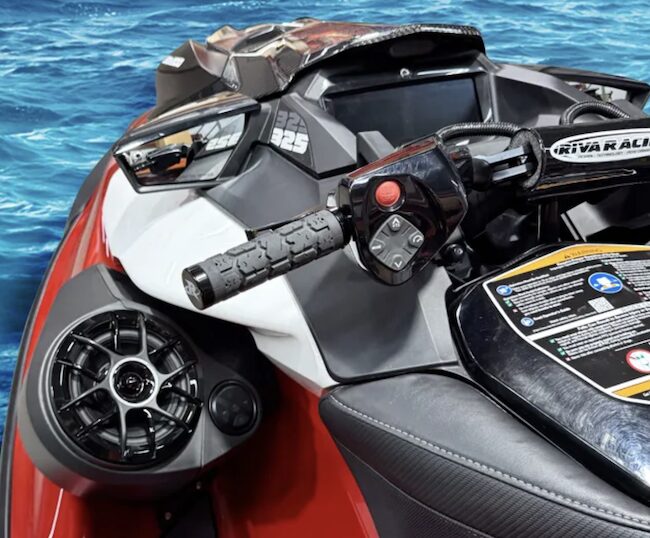
That mindset is what makes a recent build shared with us stand out. Guy, a rider from southeastern Michigan, put together a fully removable audio and video system for his 2019 Sea-Doo RXT-X — a red ski that’s hard to miss thanks to a set of unapologetically aggressive graphics. The goal wasn’t to permanently transform the ski, but to explore how far enjoyment-focused add-ons can go before their impact on performance becomes a known, measurable cost.

You can see the ski — and its grinning graphics — in motion in a short video Guy shared. There’s no narration, just music and multiple angles that give a good sense of how the system sits on the ski, from the handlebar-mounted phone setup to the speakers and cooler at the rear. It’s not a tutorial or a tech walkthrough — it’s a look at the ski as it was ridden, tested, and lived with over dozens of hours on Lake St. Clair.

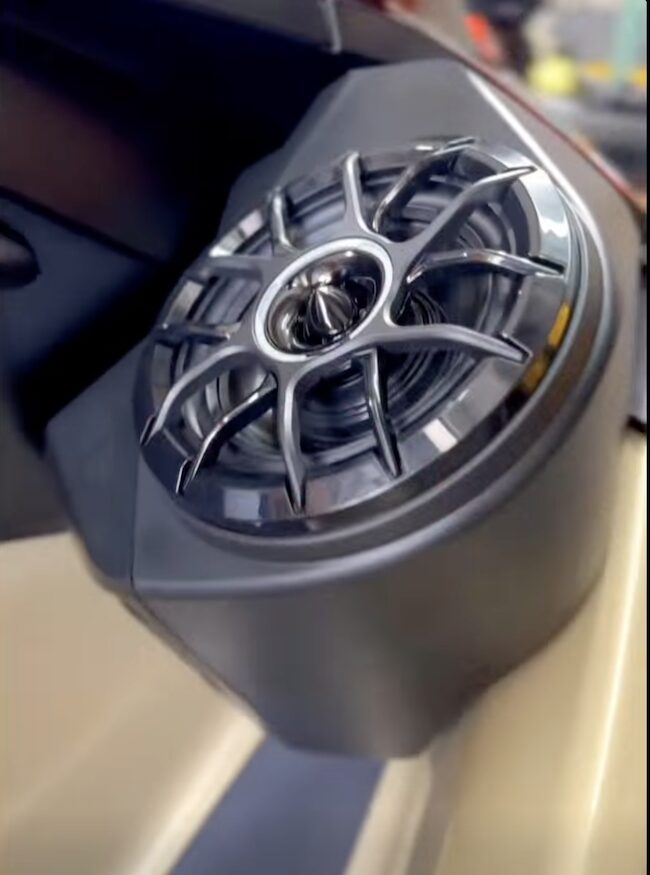
At the heart of Guy’s setup is a fully removable audio and video system that doesn’t demand a permanent commitment from the ski. Multiple lighted 7.7-inch JL Audio M6 coax speakers and a pair of 8.8-inch JL Audio subwoofers deliver serious sound, all controlled through a 13-band AudioControl crossover/EQ. A lithium-ion battery powers everything, protected by a resettable 80-amp breaker, and the whole assembly sits neatly in the rear cooler/jambox. Video can run from the handlebar-mounted phone or a tablet positioned on the back, giving riders options for how they interact with it on the water.

Even with all that gear, removability is the key design decision: the system can be lifted off in minutes, eliminating roughly 90 pounds from the ski and letting it run at full performance when desired. That 90-pound difference is tangible — on the water, Guy measured a drop from 87 mph without the stereo to 83 mph when it was mounted — a known, measured cost, not a sacrifice. It’s a concrete reminder that add-ons, no matter how tempting, always come with a tradeoff. But thanks to the removability, it’s a choice the rider can make every time they go out.

After 80 hours on the water, Guy’s system has proven that all the bells and whistles don’t need to compromise the core ride — especially when they can be removed at will. Even fully loaded, the ski still carves and accelerates like a high-performance RXT-X, and the drop in top speed is immediate, measurable, and reversible. Lake St. Clair’s mix of open water and tighter channels makes every added pound noticeable, so having the option to lift the stereo off before a long run or spirited lap is more than a convenience — it’s a design choice that preserves performance while still letting riders enjoy the extras when they want them. What stands out isn’t just the sound, or the visuals, or even the ingenuity of the setup itself; it’s the thoughtfulness in balancing “cool stuff” against measurable impact, and giving the rider the freedom to make that call every time they hit the water.

The SeaBob Is Back – This Time With Lamborghini Power

0

Back in May 2023, we first spotlighted the SeaBob as a quirky, intriguing “jet-ski-bodyboard-meets-underwater scooter” concept that had floated into the Asia-Pacific market — but with modest visibility and modest buzz compared to other personal watercraft innovations. That was an era when the SeaBob felt like a niche toy for water lovers who wanted something different: part plaything, part submersible speed sled.

Since then, the SeaBob has quietly hung around the edges of water sport culture without ever truly breaking into mainstream PWC territory — until now.

SeaBob Meets Lamborghini
Last September at the Cannes Yachting Festival, SeaBob maker CAYAGO AG dropped jaws by revealing the SEABOB SE63 for Automobili Lamborghini — a special edition electric watercraft that marries German e-propulsion engineering with genuine Italian supercar DNA.

The collaboration is more than a slapping of logos. The SE63 — where “SE” stands for Special Edition and “63” nods to Lamborghini’s founding year — is a complete reimagining of what SeaBob can be: a high-performance, super-styled electric water toy that looks more like a mini-marine hypercar than a traditional seascooter.

Speed, Style, and Supercar Flair
This isn’t your run-of-the-mill underwater sled:

  • Electric power meets exotic materials — Lightweight carbon fiber, titanium and magnesium components help keep it around 35 kg, while delivering 162 TP of thrust from a 6.3 kW motor.

  • Two modes for two moods — Normal for classic SeaBob cruising and underwater play; Sport for that extra torque rush that feels less like a toy and more like a supercar launching off the pier.

  • Dive deep or fly shallow — Certified for dives down to 25 m, or, with an optional Performance Board, it can plane — literally fly just above the water — reaching surface speeds near 35 km/h.

  • Iconic Lamborghini touches — From the trademark start button to a digital display that looks like it belongs in a supersport cockpit, this thing doesn’t just perform — it feels exotic.

So while it won’t pull wakeboarders (at least not yet), the SE63 absolutely carries the thrill vibe of a PWC, with a performance ethos borrowed straight from the automotive world.

From Festival Feature to Summer 2026 Reality
The SeaBob SE63 world premiere in Cannes wasn’t just a flashy showpiece — it was a declaration that luxury automotive brands see new horizons in marine leisure gear. Production is slated to begin in 2026, with units expected to hit the decks of superyachts and luxury docks by summer 2026 via select SEABOB partners.

No word yet on pricing (and let’s be honest — if you have to ask, you probably already know you can’t afford it), but given its materials, pedigree, and branding, this is clearly aimed at the upper echelon of playground gear — beyond the traditional PWC buyer and right into yachting, resort, and supercar lifestyle territory.

Not Exactly a PWC, But Definitely a Watercraft Future Icon
The SEABOB SE63 shows where the personal watercraft world might be headed: electrified propulsion, top-tier design collaborations, and cross-category innovation that blurs the lines between toys, tools, and tech art. It’s not a jet ski, but it lives in the same adrenaline universe — only now with Lamborghini energy and a performance narrative that feels fast, aspirational, and undeniably fun.

And while the Lamborghini-branded SE63 may be grabbing headlines, it isn’t the only automotive influence shaping SeaBob’s future. Earlier this year, the company quietly introduced an all-new generation of SeaBobs designed in collaboration with one of the most respected automotive design studios in the world — a move that may ultimately prove even more important than the flashiest special edition. We’ll take a closer look at that in an upcoming WCJ article.

Solving Fuel Starvation and Reliability Issues on Kawasaki 310 and 160 Models

0

Fuel delivery problems aren’t always dramatic — at least not at first. For many Kawasaki Ultra 310 and STX 160 owners, the early signs are subtle: inconsistent fuel pickup at lower levels, hesitation under sustained load, or a ski that suddenly feels less predictable as the tank runs down. Over time, those small issues can snowball into reliability concerns that affect everything from ride confidence to engine longevity.

A big part of the problem comes down to fuel pump design. OEM pumps often leave usable fuel sitting untouched in the tank due to short pickup placement. Plastic housings can struggle with heat management, especially when fuel levels drop, and smaller, lower-flow pump designs aren’t always ideal for riders who push their skis hard or spend long days on the water. Add in restrictive or easily clogged fuel bags, and it’s easy to see why fuel delivery becomes a weak link.

That’s exactly the problem Kawi Performance set out to solve with its Fuel Pump Mod Kit Assembly for selected Kawasaki platforms.

Designed as a true reliability-focused upgrade, Kawi Performance’s solution rethinks how fuel is picked up, cooled, and delivered inside the tank. The kit uses an original-style pump layout that sits at the very bottom of the tank, helping maximize usable fuel and improve pickup consistency. An extended float arm unlocks additional fuel range that would otherwise go unused, while the aluminum pump housing helps dissipate heat — a critical advantage when fuel levels are low and temperatures climb.

Where OEM setups rely on smaller, plastic-bodied pumps and limited-flow components, the Kawi Performance upgrade emphasizes stronger construction and higher flow capability. The result is more consistent fuel delivery and stable pressure under load, especially in conditions where stock systems can begin to struggle. High-flow fuel bags further improve reliability by reducing restriction and minimizing clogging compared to smaller OEM designs.

Rather than chasing peak numbers or short-term gains, this kit is built around longevity and dependability. It’s aimed squarely at riders who demand their ski perform the same way at the end of a long ride as it did at the beginning — whether that’s aggressive recreational use, endurance riding, or performance-focused setups where fuel stability matters.

The Kawi Performance Fuel Pump Mod Kit Assembly is designed for select models, including:

  • Gen 2 Ultra 310
  • STX 160
  • Ultra 160

By addressing known shortcomings in OEM fuel pump design, Kawi Performance delivers a solution focused on real-world riding conditions — improved pickup, better cooling, stronger construction, and more usable fuel where it counts.

For riders looking to eliminate fuel-related reliability concerns and get the most out of their Kawasaki platform, this upgrade targets one of the most overlooked but critical systems on the ski.

How High Are You? How Elevation Impacts Your Ride

0

You unload the ski, make a few passes, and immediately know something’s off. The RPM isn’t there. Acceleration feels softer. The setup hasn’t changed — the parts haven’t changed — but the ski doesn’t feel like it did last time out. For many riders, that moment triggers a familiar spiral: What broke? What’s wrong? What do I need to fix?

This is where elevation and ambient conditions quietly enter the conversation — often without being recognized at all.

Where Elevation Actually Starts to Matter

Not every change in elevation deserves a wrench and a calculator. In many cases, small elevation differences simply get lost in the noise of real-world riding — fuel load, water conditions, rider weight, and even day-to-day weather swings often have a bigger impact. If you’re riding or racing within a few hundred feet of your normal elevation, performance differences are usually subtle enough that most riders will never feel them.

That’s why many racers and recreational riders alike get away with treating nearby venues as “close enough.” Within roughly 300 feet of elevation change, horsepower loss is minimal, and any RPM variation is often inconsistent or temporary. In those situations, chasing pitch changes can create more problems than it solves.

The Gray Area Most Riders Live In

Things start to get more noticeable once elevation differences creep into the several-hundred-foot range. Between roughly 300 and 800 feet, riders may begin to see a consistent RPM drop, slightly softer acceleration, or a ski that just doesn’t feel quite as sharp as it does at home. This is often the point where frustration sets in — not because something is wrong, but because expectations don’t match conditions.

This is also where many riders blame the wrong parts. An impeller that worked perfectly a few weekends ago hasn’t suddenly become incorrect; the environment has changed. In this range, awareness matters more than action. Monitoring RPM and recognizing patterns is often enough to avoid unnecessary adjustments or purchases.

When Elevation Stops Being Optional

Once elevation changes approach four figures, the effects become difficult to ignore. Moving 800 to 1,500 feet higher than your normal riding elevation can mean a noticeable horsepower loss, and with it, a meaningful drop in RPM. At that point, skis often feel heavier, slower to accelerate, and harder to get on top of the powerband.

For racers, this is where setup decisions start to carry consequences. Ignoring elevation here doesn’t just cost a little speed — it can mean giving up the holeshot, losing consistency, or spending an entire weekend chasing a problem that isn’t mechanical at all. For recreational riders, it’s often the moment where a vacation ride or destination lake feels underwhelming compared to expectations.

When Adjustment Becomes Necessary

At elevations above roughly 1,500 feet, performance losses are no longer theoretical. The reduction in available horsepower is significant enough that running the same setup without changes almost guarantees lower RPM and reduced efficiency. In these conditions, small adjustments — such as slightly depitching an impeller — aren’t about chasing peak numbers, but about restoring balance and reducing unnecessary engine load.

This is where understanding elevation stops being a tuning hobby and becomes basic setup literacy. Riders don’t need to obsess over perfection, but pretending elevation doesn’t matter at this point usually leads to frustration, not simplicity.

Elevation Sets the Baseline — Climate Sets the Mood

Elevation isn’t the only factor at play, but it is the foundation. Ambient temperature and humidity can either soften or exaggerate its effects. Hot, humid air compounds horsepower loss, while cooler, denser air can partially offset it. The key takeaway isn’t to calculate every variable, but to understand that elevation establishes the starting point, and climate determines how forgiving — or punishing — the conditions feel.

Once elevation crosses from background noise into a measurable performance hit, the question stops being if something should change and becomes what’s worth changing. Time, tools, and logistics all matter — especially during race season, when practice and competition rarely happen at the same location, and adjustments have to be weighed against real constraints.

That same decision-making applies to recreational riders, even if the stakes are different. The goal isn’t race-day perfection, but understanding why a ski behaves differently from one location to the next, and knowing when a performance change is expected rather than a sign that something is wrong and needs to be repaired.

This is where a more flexible approach to setup becomes valuable. Instead of treating an impeller as either “right” or “wrong,” some shops treat pitch as a response to conditions. GreenHulk PWC Performance recently outlined that approach, breaking down how elevation and ambient conditions affect horsepower, RPM, and why small adjustments can restore performance rather than chase it. (See GreenHulk’s full post below)

That uneasy feeling — the one where something doesn’t feel right but nothing is obviously wrong — is often the hardest part of riding in new conditions. Elevation and climate don’t announce themselves. They just change the way a ski responds, quietly and consistently.

For racers, understanding that shift can be the difference between chasing a phantom problem and making a smart, targeted adjustment. For recreational riders, it can be as simple as recognizing that a softer ride on a destination lake isn’t a failure of parts or preparation — it’s a normal response to a different environment.

The real value isn’t knowing how to change everything. It’s knowing when you don’t have to.


Don’t Let Elevation & Climate Impact Your Performance!
Ever wondered why two identical skis with the same mods perform differently in different parts of the world? A big factor is elevation and ambient temperature!
Here’s how they affect your engine performance and impeller pitch:
The Common Mistake
Many people expect an impeller to perform perfectly right out of the box, but that’s not always the case. You might notice a loss of speed due to reduced RPM, and it’s easy to blame the impeller or think the pitch is wrong. However, no one impeller pitch is ideal for every ski in every geographical location.
Fine-Tuning for Best Results
If you want the most out of your ski, you’ll need to fine-tune your impeller for optimal RPM, which translates into higher speed. After all, RPM = Speed. Pitching your impeller is incredibly easy with the right instructions. You can follow these steps from the forum (written for Sea-Doo, but applicable to Yamaha and Kawasaki as well)
How Elevation Affects Horsepower
Elevation has a significant impact on engine horsepower. The higher your elevation, the less HP your engine generates, and the more you need to adjust your impeller pitch to keep the RPMs high. Reduced RPM means less speed!
Here’s a simple formula to calculate your HP loss at any elevation:
HP Loss = (Elevation x 0.03 x Horsepower at Sea Level) / 1000
Example: A Sea-Doo 300 HP ski at 1500 feet elevation:
1500′ x .03 x 300 HP / 1000 = 13.5 HP loss
How to Overcome HP Loss at Elevation
The simple fix for HP loss due to high altitude is to depitch the trailing edge of your impeller slightly. This adjustment will boost your RPM, improve acceleration, and increase speed.
Use this Online Calculator to Calculate HP Loss