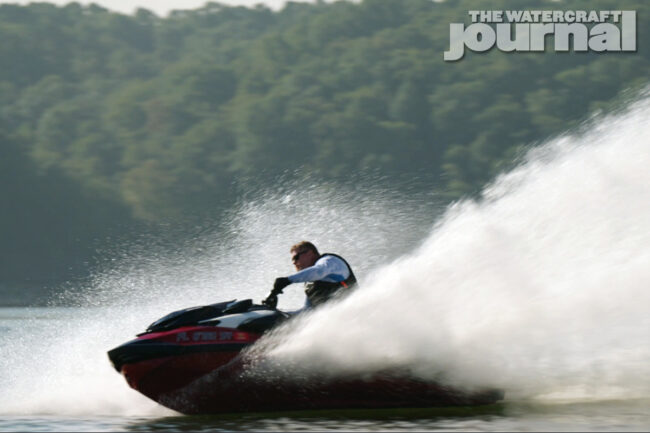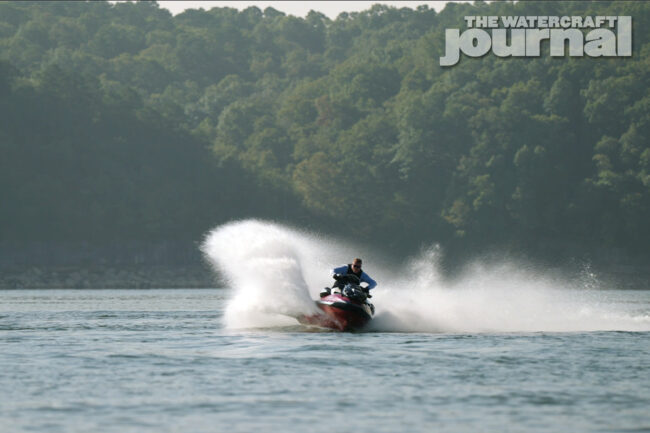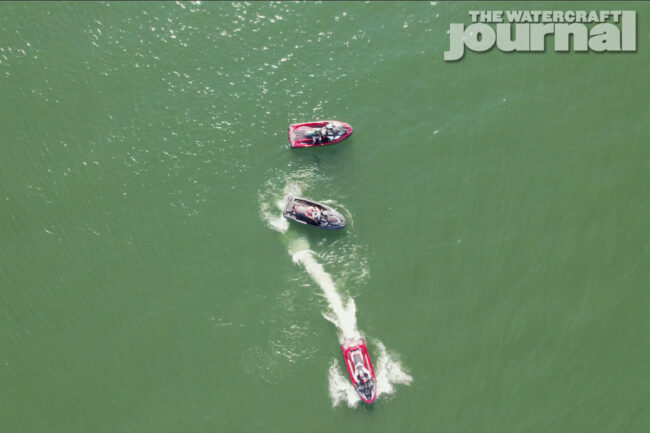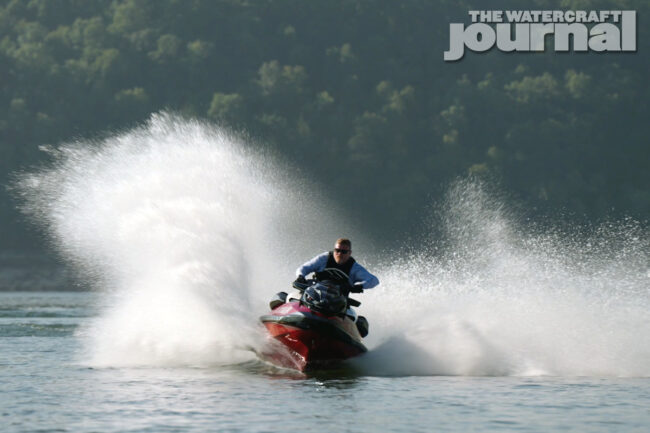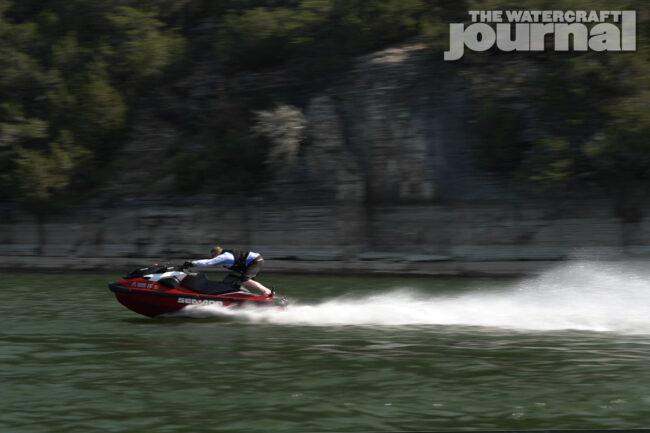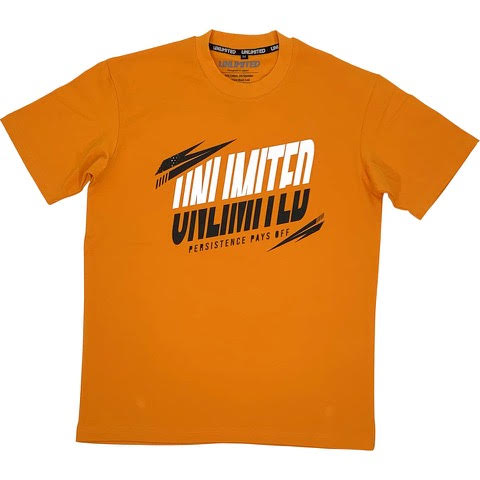

Australian Jet Ski Racer, Jett Cavanagh was seen sporting gear from Unlimited PWC at the 2023 World Series in Vichy, France. Although he didn’t get a great result, he looked good. Cavanagh was wearing the Rush S/E Life Jacket in white and black. The Rush S/E is an easy vest to put on and take off with its side entry. The jacket is made of lightweight nylon and with its flat design, it makes for an almost stress-free ride. The USCG approved Type 3 Rush S/E Life Jacket will set you back $115.00.
Cavanagh wore the comfortable X-Light Gloves, which gave him the grip he needed to hang onto his PWC and to easily operate the throttle. The gloves are equipped with reinforcement panels on the inner part of the thumb and index finger joints, which we love. Anything that cuts down on those blisters are welcome here. These make for great midsummer gloves with the super lightweight materials and breathability.
Cavanagh completed his look with the Unlimited PWC Rush Wetsuits John, which is popular with Unlimited Team Riders. The Rush line was designed in a collaboration with professional riders. It offers extreme flexibility, giving you the freedom to get after it on the racetrack. The Rush John is easy to get into and remove with its Velcro closure on the left shoulder. The Rush Wetsuits John is available in small all the way up to XL and comes in at $162. Check out the Unlimited PWC website for Cavanagh’s gear and other cool gear so you can “look fast, go fast.”
Yamaha WaveRunners recently rolled out a brand-new seven-inch touch screen for their Connext System Display and an upgraded infotainment center for the new FX models. It is packed with excellent features that will make life on the water even better. Access robust well-organized menus with just a touch of a finger. You literally have total control of your WaveRunner at your fingertips.
With the new and improved large screen it’s much easier to see important information about your PWC while underway. The latest interface has a simplified and cleaner layout, making it easy to set up the various menus in a way that works for you. This new interactive hub offers quick and easy access to navigation, entertainment, and vital watercraft information.
The Home screen features a speedometer, tachometer, fuel gauge, trim settings, battery voltage meter, and shift position. Located below the home screen are icons, which alert you to when your engine needs service. There is also a check oil light, a temperature gauge, and a mute button for the low fuel buzzer. The whole panel is well lit and the digital gauges and icons are large, and easy to read at a glance.
Several different modes can be selected as well. You can choose economy, performance, comfort, tow, or customize your own riding mode. The navigation tab is another awesome feature on the Connext panel. When activated, your region-specific map card is displayed. From the map, you can choose other navigation features like adding waypoints.
Connext has many great media functions as well. Connect your phone or other devices via Bluetooth and have access to your music, receive texts, and calls. The Connext System has one of the best security set ups on the market, especially since security is a top priority on Yamaha WaveRunners.
A key security feature is a PIN Code that you set up. This code locks the engine and prevents unauthorized start up until you enter it again. Make sure you check out the tutorial with all the features explained. With the Yamaha Connext Infotainment System, you can be sure your WaveRunner is always connected and protected.
A couple of years ago, The Watercraft Journal paired up with sailboat and maritime apparel leader, Windrider to create a unique riding long-sleeve riding shirt for those who stay out on the water all day long.
Made using Helios material proven to provide UPF 50+ protection, stellar stain resistance, superior water wicking and maximum breathability, the WCJ riding shirt isn’t the gaudy, heavily printed jerseys that you see PWC selling every day.
Rather, WCJ riding shirt is lighter and less cartoonish in its design. Each shirt features durable mesh lining the inside length of the torso all the way down the sleeve to the elbow. WCJ long sleeve riding shirt is cut slightly larger than typical shirts including a longer cut torso.
As the summer draws to an end, we wanted to provide our readership a specially reduced price that cannot be beat. We dropped the cost of each shirt to $40 each ($45 for XXL and XXXL sizes) and only available in a Sunset Red pattern. When these sell out, we can offer a new color for 2024.
Help us clear out the remaining inventory of Sunset Red WCJ riding shirts by clicking this link to go immediately to The Watercraft Journal store and pick yours up today.
Protect your watercraft with a new cover from Sea-Doo. These are great for when waxing and maintaining your watercraft’s exterior just won’t do.
Sea-Doo’s new PWC covers are perfectly fitted so your whole PWC is protected from the sun’s damaging UV rays. It is also safe from getting scratched, falling debris, rough weather, and discoloration.
They are made of heavy-duty UV resistant materials to protect your ride whether it’s trailered, or in storage. The interior is lined with a soft fabric to prevent abrasion. Areas prone to high wear feature an extra layer of canvas.
A complete line of covers is available for every model in the Sea-Doo lineup. The covers also feature an air release vent system that makes sure it’s well ventilated and allows for trouble free towing.
They have convenient zippered openings for easy access to mooring cleats, front storage, LinQ accessories on the rear deck. Additional zippered openings are available for refueling and the use of tie downs for securing your watercraft to the trailer. They also have side hooks, which enable you to secure the cover while heading out with the ski in tow.
The covers range in price from $284.99 to $339.99, which seems like a small to pay to protect your investment from damage that could land it in the shop or just make it look bad. Check out Sea-Doo’s high-quality covers and save your Sea-Doo from unnecessary damage. Whether you’ve got a Spark, Fish Pro or something in between, Sea-Doo has a cover for you!
The points race between multi-time national and world champion, Dustin Farthing and privateer Camden Powell came to a boiling point this weekend and the two battled it out for rough water supremacy at Round 2 of the P1 AquaX series at Daytona Beach.
Farthing came well-equipped with his factory Yamaha race crew but was bested in Moto 2 by Powell aboard his 310X. Undaunted, Farthing clinched the checkered in Moto 3 fetching him the overall and the second consecutive win at Daytona (2022 and 2023).
Farthing wrote, “Our team has absolutely shined the last 2 races in big surf. Thank you to an amazing group of friends that have become our family over the years. It takes a village to run a race team and help raise our boys. The team busted their ass and gave us every opportunity to win races.”
Here’s the original Facebook post from Yamaha Motor USA: Multi-time World and National Pro watercraft racing champion Dustin Farthing wins Round 2 of the P1 AquaX Pro Enduro Tour held in Daytona Beach over the weekend.
Farthing (pictured) finished the three-moto event 1-2-1 on his Yamaha FX SVHO WaveRunner, besting Camden Powell and fellow Yamaha FX SVHO pilot Tory Snyder who finished 2-3 overall, respectively.
One of the most noticeable rides of the day came from Deven Farthing, who bounced back from Moto 1 and Moto 2 DNFs to finish second in Moto 3, giving his dad Dustin, space to rack up more points over Powell, who follows him in tour points.
Tour Standings After Round 2:
1. Dustin Farthing (Y)
2. Camden Powell (K)
3. Tory Snyder (Y)
4. Sophie Francis (Y)
5. Eric Lagopoulos (Y)
P1 AquaX racing action continues Sept 1-3 at Round 3 in St. Petersberg, Fl.
Sunday evening, performance watercraft enthusiasts who happened to also be Star Wars fans all quietly murmured in their best Yoda impression, “Begun, the Horsepower Wars have.”Sea-Doo has allowed Kawasaki its time in the sun as the industry’s horsepower leader for a decade – but no more! The industry’s sales dominator just unleashed its new 1630 ACE variant, the 325 ACE.
With this new bump in horsepower, Sea-Doo has also expanded its performance segment offerings with one returning and one new entry: the long-awaited GTR-X 300 and the GTR 230. These two machines ride on the lightweight PolyTec 2.0 hulls that have proven to hold up to brutal offshore conditions as well as daring aftermarket tuners who’ve put plenty of supercharged power through their GTRs.
Additionally, Sea-Doo also pulled back the curtain on the totally redesigned Spark and Spark Trixx entry models. Marking the Rec Lite segment’s 10th anniversary, the newly minted Spark is sleeker, more refined, more ergonomic and accessory-friendly than previous versions. These promise to welcome in a new crop of PWC owners – and more importantly, PWC enthusiasts – to the hobby.
Lastly – before we dive into the nitty gritties – Sea-Doo also introduced its top-of-the-line Switch Cruise Limited. This heavily optioned tritoon includes premium features like improved seating and ergonomics for the captain’s chair, a massive touchscreen dashboard, improved sound damping, an all new BRP Premium Audio System (by JL Audio), deck LED lighting and mats, and improved charging.
Bringing Out The Big Guns
Rumors had swirled about Sea-Doo “upping the wick” on the 300 ACE, but the changes made to the 1630 ACE engine carry far greater implications than even what Sea-Doo’s own marketing department has led on. Initial predictions were minor modifications to the ignition timing or possibly a revised supercharger impeller. What we got instead is far, far more substantial.
Internally, the 325 ACE received ceramic thermal-coated pistons [think similar to Cerakote –Ed.] providing better heat mitigation and superior friction reduction. Being that the ACE engines use plasma coated cylinders, reducing heat will keep the pistons from scoring the cylinders in high temperature conditions, saving the engine from potential damage. An O2 sensor was also added to the exhaust manifold.
Above: External differences between the 300 and 325 are noticeable. On the left is the current 300 ACE. Notice the clockwise rotation of the supercharger housing and how far is sits into the PTO cover. On the right is the new 325 ACE with its larger diameter inlet and counterclockwise outlet. The new PTO cover houses the clutch and spring washers.
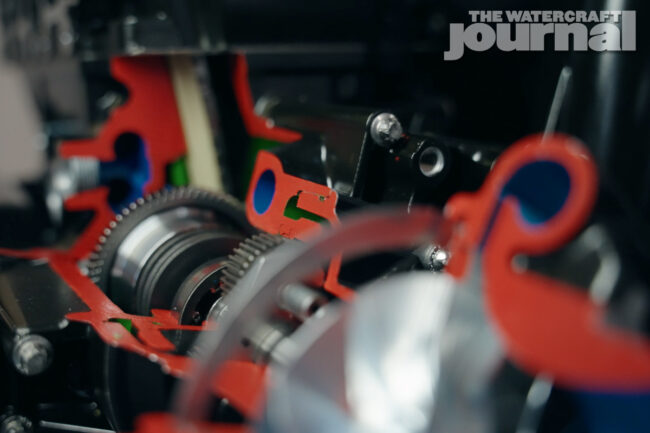
Rotax radically redesigned its supercharger from the inside out. Changes begin with upgrading to a billet impeller from cast. The impeller is smaller overall but the reversed rotation housing touts a larger diameter inlet. It also features a completely new shaft and gear design, with the clutch and spring washers in the PTO housing itself.
Adding this new planetary gear set within the housing allows for a higher gear ratio to spin the supercharger faster, producing much more boost. And true to the design, Sea-Doo states the new supercharger spins faster and produces more boost (psi) than ever before.
Mated to a revised, larger diameter and freer-flowing air intake system, the new 325 ACE draws in much more air, allowing the engine to spool up faster and deliver a denser intake charge. This required Rotax to increase the factory rev limiter from 8,000rpm to 8,250rpm. Spinning at these kinds of rpm consequently required upgrading the valve rockers to thicker forgings.
Of course, this all needed a cascade of upgrades to the ACE’s engine management, ignition coils and fuel pump – or did it? Per Greg Gaddis of Greenhulk Garage, the previous hardware could handle well over 400-horsepower; what these changes imply instead, is that Sea-Doo is intentionally overbuilding its top tier performance engine with the high performance aftermarketcommunity in mind.
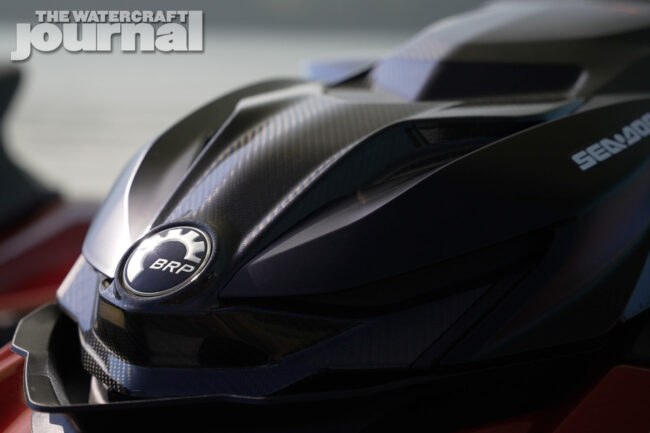
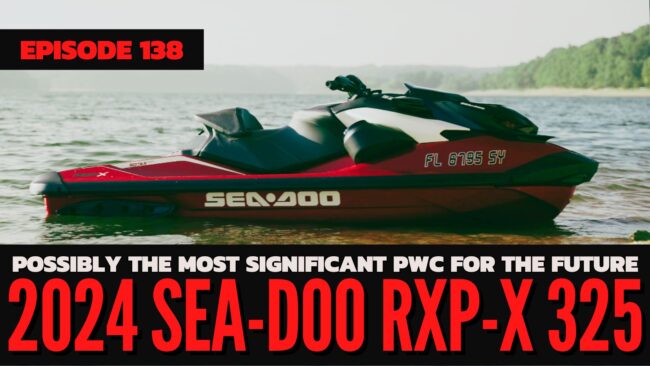
When equipped on a 2024 RXP-X, the 325 ACE rockets the Sea-Doo to an industry-leading 3.4-second 0-to-60mph. The new RXP-X 325 (MSRP $19,199) comes in either Ice Metal & Manta Green or Fiery Red Premium ($300); and just as The Watercraft Journal predicted, comes standard with the carbon fiber hood and adjustable steering damper that debuted on the 2023 Apex model.
Sharing the 325 ACE is the RXT-X (MSRP $19,999). Similarly available in either Ice Metal & Manta Green or Fiery Red Premium, the T-X cannot be optioned with iDF (due to the power output of the 325 ACE) but does come standard with the Premium Tech Package. And the RXT-X also gets a new polished impeller, extended VTS for better trim control and all previous X-Package features.
Previously, the Performance segment would be concluded with the GTR 230 (MSRP $14,099), a stellar more-playful entry in its own right, but not so for 2024. Sea-Doo revived the GTR-X now touting the 300 ACE engine. Riding atop the same PolyTec 2.0 hull as the GTR 230, the GTR-X 300 shared the deck, a modified two-seater Ergolock saddle similar to the RXP-X, and aluminum neck steering.
Unlike the GTR, which comes in Eclipse Black and Reef Blue; the GTX-R is coated in stealthy Eclipse Black and Deep Marsala. Other items shared between the GTR-X 300 (MSRP $16,999) and the RXP-X include the angled foot wedges, VTS, Launch Control and a polished impeller – making it a perfect in-between model for the performance enthusiast who is looking to boil some water.
The New Kid is All Grown Up
Celebrating its 10th anniversary, the Sea-Doo Spark – the single-most impactful watercraft on the industry in the last 20 years – received a complete redesign. Spark routinely filled the Top 5 if not Top 3 best selling models for most of the decade, with Spark Trixx accounting for 70-percent of total Spark sales. And yes, 60-percent of Trixx owners intentionally bought it to perform tricks.
In redesigning the Spark, Sea-Doo was keenly aware not to vary too far from its original design. Spark retains its open “wishbone” structure but is far sleeker in its body lines and smooths out much of its predecessor’s rough edges. Reboarding is far less cumbersome now that the rear deck is less clunky and includes grab handles (although the single-foot folding swim step returns unchanged).
Sea-Doo “upped” the Spark (MSRP $6,999) by including a backlit 4.5-inch digital display and provided a watertight phone compartment in the enlarged glove box. Sparks equipped for 2 and 3-up seating enjoy far better support, and LinQ Lite mounting ports molded into the Spark’s gunwales and hood for GoPro cameras and bumpers. And Sea-Doo opened up the access panel to reach the battery, fuse box, spark plugs and oil filter.
For the Sea-Doo Trixx (MSRP $9,099), Sea-Doo added a third seating option: a single-seater. The new Freestyle seat makes mobility easier, allowing the rider to move freer as they powerslide, launch from the lip of a wave or kick up the trim and stand on its tail.
Trixx boasts a redesigned reverse gate that, per Sea-Doo, “provides improved maneuverability at slow speeds and a new “Trixx Mode” [that] offers added stopping power enabling new tricks and stunts (like reverse donuts and nose dives).”
For 2024, the 900 ACE engine options carry over – 60-horsepower standard or an optional 90 (standard on Trixx). The new Sparks are available in either Sunrise Orange & Dragon Red or Dazzling Blue & Vapor Blue; while the Trixx can be had in Dragon Red & Bright White or Vapor Blue & Neon Yellow at no added cost. And as before, the Trixx comes with the adjustable steering neck for standing or sitting positions.
Checking In With the Rest of The Family
Before we delve into the new addition to the Switch segment, we should review the rest of the Sea-Doo watercraft lineup: The GTI 90 has been discontinued. Rather, the entry level Recreation model is the GTI 130 (MSRP 11,499) and comes in Bright White & Neo Mint. The GTI SE 130 (MSRP $12,299) comes in either Ice Metal & Neo Mint or Teal Blue & Manta Green as does the GTI SE 170 (MSRP $12,899).
The base GTX lineup all gets coated in a very fetching Abyss Blue & Gulfstream Blue combination, and can be had naturally aspirated as a GTX 170 (MSRP $15,199) or as a supercharged GTX 230 (MSRP $16,199) or GTX 300 (MSRP $17,899). All models can come optioned with iDF and/or the Premium Tech Package. The top tier GTX Limited (MSRP $19,699) comes in Blue Abyss or White Pearl Premium ($300) with the 300 ACE engine, iDF and the Premium Tech Package as well as a premium ski cover.
The only remaining change made to the Sea-Doo watercraft lineup went completely unsung: Explorer Pro can now be had naturally aspirated – with 170 horses (MSRP $18,899) – or supercharged – with 230 ponies (MSRP $19,899). We figure if you’re gonna carry over 180-pounds of LinQ fuel caddies with you, you might as well use every drop of that extra fuel, right?
Adding Another Layer to The Switch
While the Switch perfectly fills the gap in the market for entry level boaters, Sea-Doo felt that a top tier offering was warranted; enter the Switch Cruise Limited 230 (MSRP $50,999) – in exclusive Harbor Blue. Based off of the larger 21-foot Cruise model, the Limited checks off a lot of comfort and accessory boxes as well as tosses in two handfuls of extra goodies sure to bring foot traffic into the showroom.
A redesigned swim platform fills the entire transom for easier reboarding and added LinQ attachment points; a premium captain’s chair features more adjustability, thicker padding and arm rests; the handlebar now can be adjusted up or down; an addition seat has been added; LED deck lighting; an all-new 6-speaker Premium Audio System from JL Audio; and a massive 10.25″ touchscreen display is paired with the 7-inch Garmin GPS.
The remaining Switch models come in as before; the base Switch (MSRP $23,699) is only available in Lava Red; the Switch Sport can be equipped as a Sport Compact 170 (MSRP $28,999), a Sport 18 – 230 (MSRP $39,699) or a Sport 21 – 230 (MSRP $42,699) and all can be had in Dusty Navy, Lava Red or Neon Yellow.
Similarly, the Switch Cruise comes in five iterations: Cruise 18 – 130 (MSRP $33,199); Cruise 18 – 170 (MSRP $37,199); Cruise 18 – 230 (MSRP $40,699); Cruise 21 – 170 (MSRP $40,699); and finally, the Cruise 21 – 230 (MSRP $43,699). Of course with the variable accessories, add-ons and features that make the Switch so customizable, each of these prices are subject to change rapidly.
We at The Watercraft Journal have been happy to see how quickly the Radinn JetBoard has picked up among the personal watercraft community. Sure, paddleboarding is fun and good exercise, but how about surfing on a flat lake without the need of an overpriced wake boat? Recently, Radinn partnered up with Chevrolet to show how adventurous the new Silverado and electric JetBoard can be together. See the original press release included below the video here.
Here’s the original press release: In an unusual fusion of power and innovation, Radinn, the pioneers of electric jetboarding, have teamed up with Chevrolet to electrify the adventure scene. The result? An ad campaign showcasing the new Chevy Silverado ZR2 and the Radinn Jetboard, presented by JetBrada.
This collaboration marks a significant milestone in the world of outdoor exploration, as two industry giants combine their expertise to redefine what it means to embark on a truly exhilarating journey.
The sleek lines and raw power of the Chevy Silverado ZR2 perfectly complement the cutting-edge technology and performance of Radinn’s Jetboard, creating a desire to adventure enthusiasts eagerly anticipating their next escapade.
Head of Sales in North America for Radinn, Filip Holm underlines that growth in the North American market is mainly driven by partnerships and building strong personal collaborations. This is the perfect type of collaboration.
JetBrada, the exclusive distributor of Radinn, is the driving force behind this one-of-a-kind collaboration. “We are excited to bring together Radinn and Chevrolet in this venture,” said JetBrada. “
This partnership showcases the seamless integration of cutting-edge technology and power, allowing adventurers to explore both land and water in a new way never done before.”
The ad campaign, set against a stunning backdrop of untamed landscapes, captures the essence of adventure as the Silverado ZR2 in action. Viewers are invited to witness the harmonious marriage of design, power, and innovation as the Silverado ZR2 conquers rugged terrains and the Radinn Jetboard dances atop the waves.
Chevrolet stated, “Teaming up with Radinn and JetBrada allows us to showcase the spirit of exploration and the unmatched capabilities of the Silverado ZR2 in an exhilarating and unforgettable way.”
Kawi Performance out of Long Island, NY boasts an extensive catalog of innovative aftermarket products for Kawasaki Jet Skis, and The Watercraft Journal has been instrumental in giving readers an exclusive look at many of these quality parts.
For this feature, we install a set of the Kawi Performance Premium Stainless Steel Valve Cover Bolts on our Kawasaki Ultra 310 LX-S Supercharged JetSki. While many enthusiasts tend to focus on the latest and greatest in cosmetic and performance upgrades for their skis, hardware upgrades that improve the overall durability of key components should not be overlooked!
Kawi Performance is known around the globe for their exclusive selection of premium quality US-made stainless steel hardware kits for Kawasaki JetSkis. Salt water riders know that Stainless Steel is one of the few metals that can withstand the unrelenting corrosive nature of the ocean, and Kawi performance has delivered with a variety of hardware kits that enable customers to upgrade pretty much every critical nut and bolt on their ski.
Personal watercraft mechanics and do-it-yourselfers alike know that feeling of dread when bolts snap and metal parts fail due to rust and corrosion. Avoid stripped threads, rusty heads, and snaped bolts on your freshwater or saltwater machine by upgrading to stainless steel! These bolts are a solid choice, whether you are looking to upgrade a new ski to protect against corrosion or are looking to breathe some new life into an older ski with rusted out bolts.
These KP Stainless Steel Valve Cover bolts are very east to install, taking abut 15 minutes in total. Simply remove the old ones using a 10mm socket. Each bolt also has a rubber gasket/bushing- take these off your ski as well because the Kawi Performance bolts include a new set of these gasket/bushings as well.
While OEM gaskets, and those from SBT and WSM contain carbon steal rings inside, the Kawi Performance gasket/bushings contain only the highest quality stainless steel support rings, meaning these gaskets wont rust, corrode, or fail.
Once the old bolts and gaskets are removed, simply toss them in the trash (or throw them in that coffee can in your garage full of spare hardware) and thread the new ones in place. Tighten the bolts evenly, and then torque them to 75-inch lbs. And that’s it, you’re now ready to enjoy your new KP Stainless Steel Valve Cover bolts that are designed to last for the life of your machine.
Check out the short overview and installation video on The Watercraft Journal YouTube Channel:
RIVA has built a powerful Limited-Edition Yamaha GP1800 SVHO that is only available by special order. The watercraft comes in an eye-catching blue with spicy red accents and glossy red anodized components. The components stand out, adding to the stellar look of this machine with the red stitching in the custom seat cover rounding out the look.
This custom unit is equipped with a powerful engine that produces 350 horsepower and can hit a top speed of 86mph. The build is flashed with a Maptuner X Tuning License, which allows for that top speed of 86mph at 8,600rpm. The billet aluminum RIVA Yamaha 1.8L High Flow Billet Fuel Rail helps to provide this machine with boosted horsepower by replacing the restrictive factory fuel rail. It looks good too!
The RIVA Yamaha GP1800R SVHO Power Filter Kit further adds to improved acceleration and rpm. The power filter kit provides a constant flow of cool air to the supercharged engine. The RIVA Yamaha 1.8 Catch Can eliminates power-robbing crankcase fumes and oil fumes from entering the engine’s air intake and it prevents oil sludge.
The RIVA Yamaha Supercharger Shaft Upgrade Kit utilizes a hydraulic shaft stabilization bearing that limits shaft deflection and wear. High pressure oil film is fed through the shaft, maximizing lubrication to keep your watercraft s running smooth.
A high-performance watercraft has to be kept super cool so RIVA outfitted the SE with their Riva Yamaha GP1800R SVHO Gen-3 Power Cooler. It is built to keep this powerful watercraft cool up to 600hp! The component features a high-capacity cooler core than can resist heat, no matter how hard you ride.
It also provides an increase of 20 peak hp over OEM intercoolers. It runs an average of 50F cooler than stock on exit, thus increasing performance. It comes with the 50mm TIAL Blow-Off Valve for even better performance and reliability.
The cooling wouldn’t be complete without the RIVA Yamaha SVHO Pro Series Engine Cooling Upgrade Kit. The kit provides improved cooling efficiency to the engine and inter-cooler for increased performance. The high-flow billet pump strainer increases water flow, and the billet engine fitting injects water into the engine block’s hotspot. The RIVA crew added their titanium Yamaha 1.8L Valve Retainer Upgrade Kit to reduce the possibility of valve float at high rpm.
The SE wouldn’t be complete without the RIVA branded silicone Rear Exhaust Kit. This kit not only looks good, but it delivers outstanding performance and adds cutting edge style to any PWC.
Installing the rear exhaust kit allows for the removal of the restrictive sound suppression system. Engine performance is also greatly improved because back pressure is reduced as well. The engine components are topped off with a red anodized aluminum RIVA Yamaha 1.8L Billet Engine Oil Filler Cap.
A race ready machine like the RIVA Special Edition Yamaha must have upgraded steering and handling components so the rider can control this beast. A Solas Yamaha 160mm 13/18 Concord Impeller replaces the stock impeller. It is large and in charge, delivering increased acceleration and top speed with its large blade area. It reduces cavitation too enabling you to have more control.
The addition of the RIVA Yamaha GP1800 Ride Plate adds to the superior handling of the SE with its deep center skeg and channels for excellent traction in turns. Its extended length provides quicker planning and improved acceleration.
The RIVA Yamaha GP 1800 Pro-Series Sponsons will keep you charging in a straight line with their superior fin and backing fin design. Set them up how you like them with the fully adjustable three-position fin. Now onto the incredible steering components.
The standout RIVA Yamaha GP1800R Pro-Series Steering System is the ultimate for racing. The billet aluminum construction has superior strength and rigidity over bulky stock systems. This steering system is a must have if you want to have absolute control over a powerful watercraft like the custom RIVA Yamaha GP1800R, which is specifically built for racing.
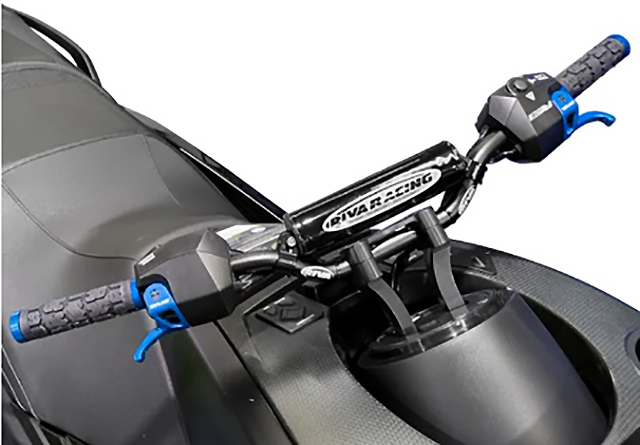
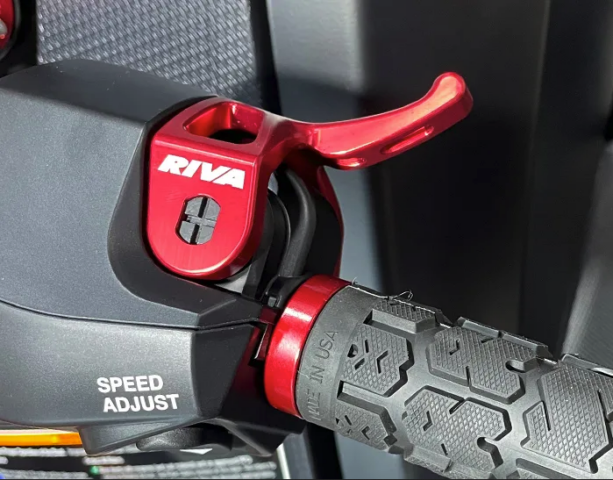
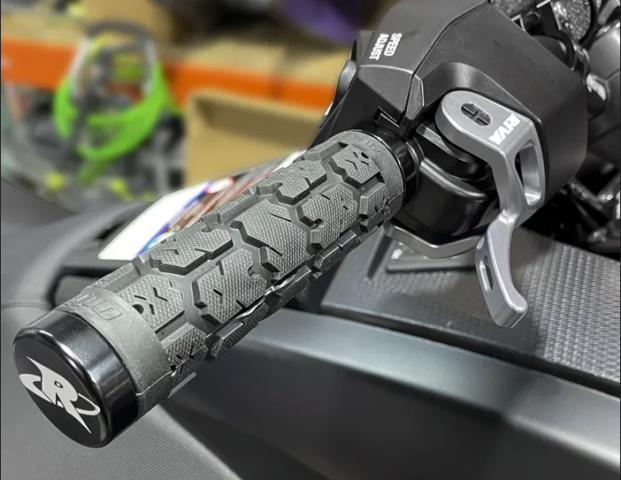
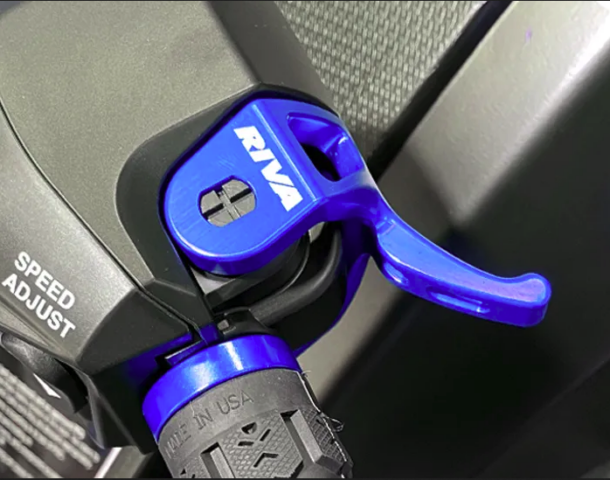
The RIVA Pro-Bar 30” Runabout Handlebars are an excellent addition to the RIVA SE Yamaha. They are built with a proprietary T6 aluminum alloy for superior tensile strength and vibration dampening, which are much needed when racing. Rounding out the handlebars are the ODI Rogue Lock-On Grips, 130MM, No Flange and the ODI Grip End Cap and Clamp Kit. The grips offer a 100% slip-free performance and the end caps keep your grips locked on.
That sums up RIVA’s latest custom build. The RIVA Special Edition 2023 Yamaha GP1800R SVHO is another stellar in-house build from the master technicians of RIVA Racing. RIVA says this watercraft will make heads turn and will make you the envy of any racecourse or local riding spot with its unique styling. Fill out the form at the top of the website and let the guys know you want this custom build.
If you think 2024 marks another year of just “bold new graphics” for Yamaha Motor Corp. USA you’re not paying attention. Despite Yamaha’s cache of 20 WaveRunners appearing mainly unchanged, this coming model year heralds a great many upgrades and innovations made by the manufacturer, some of which brings Yamaha closer to fulfilling its public commitment to becoming 100% carbon neutral by 2035.
Intriguing (and frankly, groundbreaking) plant-based, recyclable materials (more on that later); lead-free rod and main bearings; and a near-complete “blank sheet” redesign of its naturally-aspirated marine engine – for optimal fuel efficiency and reduced CO2 emissions – all indicate the direction that Yamaha is going towards.
This new 4-stroke also re-establishes Yamaha as the leader of engine displacement: a 1,898cc (1.9L) four-cylinder, 16-valve High Output marine engine – producing 200-horsepower – replaces the previous 180-horsepower Yamaha 1.8L High Output motor in all VX, GP and FX previously equipped with such.
All WaveRunners equipped with the new 1.9L receive a new overlapping impeller and redesigned intake grate for better hookup and acceleration – be it VX, GP or FX. This “top loader” design features a deeper chip for increased bite and a more aggressive scoop grate to force more water faster into the 155mm axial jet pump.
Interestingly, Yamaha rebranded the entire GP series: rechristening the GP1800R SVHO the GP SVHO, and GP1800R HO the GP HO. The GP HO also picks up features previously found only on prior SVHO skis; namely, auto trim and launch control, which is a nod at the GP HO’s potential – reaching a maximum speed of 63mph (more on that in a bit).
Other HO-equipped WaveRunners received attention as well. Yamaha caved to consumer outcry and replaced all 5-inch screens on the FX HO models with the larger 7-inch Connext touchscreen, previously only available on the SVHO models. Equally, all FX units enjoy the addition of new Drive Control options like Economy, Towing, Performance, Comfort and Custom settings.
On the flip side, Yamaha has not addressed the vexing mileage counter software that zeros out trip mileage and miles-to-empty when the ignition is killed. Despite this infuriating enthusiasts, Yamaha has stated privately that it is aware of the issue and has no plans to “patch” the current software, implying a fix will arrive with a future version of Connext …someday.
Lastly, Yamaha upped its coloration in a big way. Besides the lowly SuperJet, which remains in its “blank slate” white livery; all other models are splashed in vibrant hues and busy graphics meant to catch the eye and draw attention. Even the Parts & Accessories group gets in the action by offering three CNC-mat colorations for the RecDeck (and attachments) as a choice of black or white housing for the floating detachable EX speakers.
Gaddis explained, “[The] 1.9L engine looks very familiar to the outgoing 1.8L but hosts [several] changes to make it better, more powerful, and environmentally friendly. The main goal of the redesign is efficiency and lessening the environmental impact from production and operating. […] This engine is almost all new, meaning there are few components that will be carrying over to the new platform.
“The crankshaft, connecting rods, oil pan, pickup, oil pump, oil cooler, and PTO cover are the only components carrying over to the new engine; being that the connecting rods and crankshaft are carryover parts, Yamaha increased displacement by changing to 88 millimeter pistons (2 millimeters larger) that feature a flatter, more shallow dome which increase compression to 11.2:1 over the previous 11:1 ratio.
“Oddly enough, the 1.9L oil capacity is one quart less than the outgoing 1.8L. Both engines use the same oil pan so less oil has me puzzled; my assumption is that one quart less oil per watercraft (with thousands of units produced) is substantially lessening the environmental impact for production.
“Yamaha [is also] transitioning to lead free rod bearings and main bearings for environmental reasons. […] Lead is a natural lubricant and damper but highly toxic. Lead free bearings are environmentally safer and are more resistant to corrosion.
“The 1.9L has an all new block and cylinder head casting. Drastic changes were made to the casting for revised water jacketing and coolant passages with the intent to keep the cylinder head cool while keeping block and oil temperatures higher, […] the thermostat housing is now in the block instead of the cylinder head.”
“The rectifier is now getting cooling from the cylinder head rather than the exhaust manifold to lower the overall temperatures, as today’s more advanced electronics demand more power. One of the last major coolant changes was between the exhaust and intake ports on each cylinder. Additional cooling between the ports will further lower cylinder head temperatures and increase efficiency.
“The cylinder head features redesigned intake ports, exhaust ports, and combustion chambers. The intake ports were opened up to elongated ovals […] to flow more air into the combustion chamber. The exhaust ports were shrunk two millimeters [for better] exhaust scavenging. The combustion chambers were also opened up.
“With the addition to the new intake and exhaust ports, Yamaha had to redesign both intake and exhaust manifolds to accommodate for the new cylinder head design. The new intake manifold features a larger plenum, longer runners, 10 percent larger throttle body, and a larger flame arrestor. The throttle body is [now] 65 millimeters.
“The previous engine had a 60mm, and the flame arrestor [was] changed from a 68mm to an 88mm.” Per a recent communication from YMC confirms that “the ribbon is fully captured in the new manifold, making it essentially impossible for it to dislodge.”
“Not only is the plenum larger, but the overall shape has been revised from the basic, log style manifold. The new intake manifold integrates the manifold air pressure sensor and intake air temp sensor into one, simplifying the wire harness; the outgoing manifold had two separate sensors for MAP and IAT.
“The exhaust manifold has been narrowed and optimized for performance; runners two and three now resemble a “two-to-one” [flange] which further increases the exhaust scavenging and allows for the narrower design. Both intake and exhaust manifolds use fewer bolts and are positioned closer to the block. The slimmer design allows for more room around the engine, [easier] access to engine sensors and the sacrificial anode for servicing.
“The new block casting is equipped with a supercharger block off plate hinting at a supercharged SVHO variant in the future. The second change is a bolt going through the center of the front side of the cylinder head. This area of the cylinder head has an internal void for the timing chain which creates noise and vibration. The purpose of the bolt is to secure the front section of the cylinder head casting to reduce the noise and vibration.
Gaddis did voice disappointment that all of Yamaha’s changes resulted in a meager 20-horsepower gain, stating, “I would expect a higher horsepower gain from almost 100 more cubic centimeters, a better flowing [cylinder head, intake manifold, throttle body and exhaust manifold], and a more efficient cooling system. I believe this is due to a change that Yamaha has made to the new camshafts.
“Yamaha has made a significant change to the camshaft design [as it aimed for] a smoother idle and operation throughout the entire powerband.. While the duration and lift remain the same, the cams now have less lobe separation angle. Less lobe separation angle means more overlap and more midrange torque. Being that the new engine flows more air and has a higher compression ratio than the outgoing 1.8L, the new engine can take advantage of more overlap. Yamaha increased the intake cam overlap from 36 to 39 degrees.
“I firmly believe that this change in overlap is resulting in a smaller power increase compared to what the engine revision could have produced.” Gaddis concluded. “Aside from the change in overlap, Yamaha redesigned the camshaft caps. Yamaha moved to a simpler design; there are now four camshaft caps compared to six and the caps are slimmer. The slimmer camshaft caps resulted in a new valve cover that is sleeker, part of Yamaha’s intent for a more serviceable engine.
“Yamaha’s desire for a smoother operation led to a more revised rev limiter. Yamaha changed to a high detection resolution for revolution on the rotor. This means a more refined and controlled rev limiter. This new rotor design prevents the common “banging” off of the rev limiter and offers a smoother experience when coming unhooked in rough water.” During a private test session, Gaddis recorded slightly over 62mph aboard both the GP HO and FX HO using redundant GPS trackers.
“Obviously, these changes were made with the intent of efficiency and not for all-out performance. Yamaha seems to be making a push for more efficient engines, more efficient production, and a greener environmental footprint. This is quite obvious with Yamaha’s material choice for bearings and the new plant-infused engine cover. Yes, I said a plant infused engine cover…”
Officially, Yamaha announced: “The engine cover is also one of the first Yamaha-manufactured parts to include plant-derived cellulose nano fiber (CNF) reinforced resin. In addition to being more than 25-percent lighter than existing resin materials, CNF-reinforced resin also has excellent material recyclability, leading to a reduction in plastics used and greenhouse gas emissions, mainly carbon dioxide.”
We at The Watercraft Journal fully expect Yamaha’s CNF resin to appear in future parts and components, including replacing existing plastic fairings, panels and possibly in a future date, even hulls. Great expense was made to develop this technology and you can bet it won’t be used exclusively on a lowly engine cover.
Lastly, we come to pricing. To be expected, MSRP list prices have increased across the board, but some more than others. Beginning by segment, every Rec Lite unit is up $200: EX: $7,799, EX Sport: $9,099, EX Deluxe: $10,199 and EX Limited: $10,799. For the VX segment, it goes VX-C: $10,199 (up $200), VX: $11,399 (up $200), VX Deluxe: $12,399 (up $300), VX Cruiser: $12,799 (up $300), VX Cruiser HO: $13,599 (up $300), VX Limited: $13,999 (up $300) and VX Limited HO: $15,299 (up $300).
For the GP series both entries increase by $300 each, namely the newly minted GP HO: $14,499 and the GP SVHO: $16,799. For the Freestyle segment, both entries are up by $200 each, including SuperJet: $10,699 and JetBlaster: $10,899. Finally, for the Luxury segment, the FX HO: $15,699 (up $200), FX Cruiser HO: $16,999 (up $300), FX SVHO: $19,299 (up $300), FX Cruiser SVHO: $19,799 (up $400) and FX Limited SVHO: $20,399 (up $400).
In all, it looks like Yamaha is committed toward a cleaner, more sustainable future through producing more efficient engines through less environmentally-impactful processes, and featuring new recyclable materials. Whether customers will be drawn to Yamaha because of this remains to be seen; but what isn’t in question is the attention the new lineup is getting. Contact your dealer for more information or visit www.yamahawaverunners.com.