


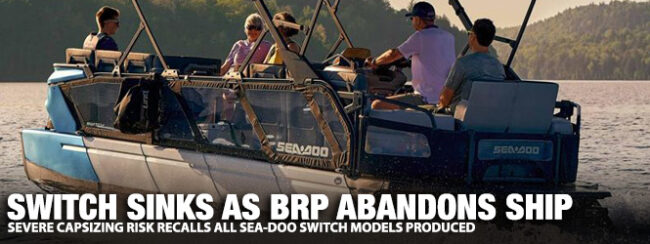
A little over a week ago (that is, as of this writing), BRP issued a full production recall of every single Sea-Doo Switch produced from 2022 until today. The recall, citing a potential capsizing risk due to weight distribution, comes after two prior recalls (Bulletin 2025-4 and Bulletin 2025-10) addressing the same concern, issued after three years of incidents, a high profile lawsuit that included an injured infant, and the full-throated caution by the United States Coast Guard citing the “vessel design to be unsafe.”
Now, there is an often undue onus prescribed to vehicles that undergo a factory recall. More often than not, the recall is issued to replace an existing part or component that has been proven to fail or degrade faster than the manufacturer deems suitable. Faulty sensors, poor electrical connectors and rubberized gaskets are the typical fare of these recalls and are routinely fixed by service departments. Again, the vast majority of OEM recalls are often routine and for the most part, insignificant. This is not the case.
But first, a little background: Initially coined as an entry level pontoon (tritoon) powered by Sea-Doo 4-stroke jet propulsion technology, the Switch was offered in three hull configurations: 13, 16 and 19-feet long, with a catalog’s worth of available accessories, deck furniture (which was easily rearrangeable using the brand’s LinQ hardware) and Bimini tops. Priced far below conventional pontoons, the Switch was immediately popular with first-time boaters – even as the Switch’s rollout was hindered by the overseas supply chain delays caused by the Covid-19 pandemic.
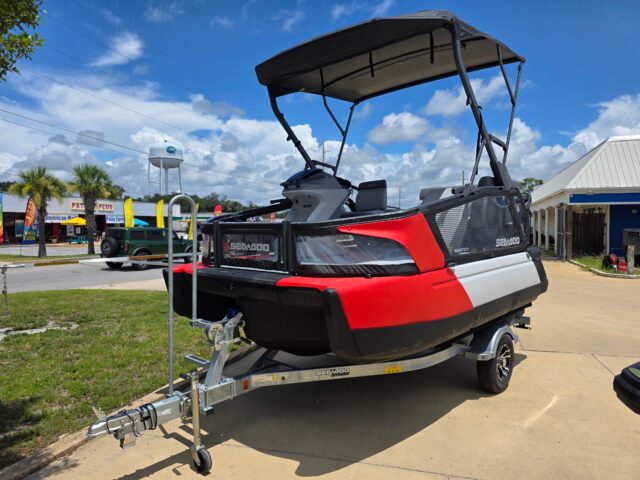
Seeking to vacate its assembly yards and customers wanting to see some motion forward, Sea-Doo began shipping unfinished Switches to dealers, requiring many to rent out storage yards just to contain the incomplete units. By the time Switch models were being retrofitted with overdue ECMs and dashboards, many buyers lost interest or backed out of their initial purchase. This caused dealers to sit on unsold Switches for months (if not over a year) until BRP began offering attractive rebates and discounts on existing units.
Those units that did sell did so to a segment of customers with little to no boating experience. Equipping a whole new swathe of novice boaters with an entirely novel form of vehicle left a gap in education never before seen since the advent of the sit-down jet ski. Accidents featuring untrained and unlicensed Switch owners both on the water and at the launch ramp mushroomed the already uncomfortable statistics taken by the USCG. Footage from slow speed waterways and turbulent inlets were rife with “boat fails” featuring Switches.
Following in this vein, on August 25, 2024, William Grullon and Sheila Feliciano’s 13-foot Switch rolled over after coming to an abrupt stop as it neared the Knights Landing boat ramp on the St. Johns River, ejecting almost all of the passengers. According to Clay News & Views, “their daughter Vianca, 16 months old at the time, suffered ‘a catastrophic anoxic brain injury’ after being trapped beneath the overturned Switch for more than 10 minutes.” Claiming that the manufacturer was well-aware of the vessel’s tendency to roll over, the family is currently suing BRP, Inc. for $30 million dollars.
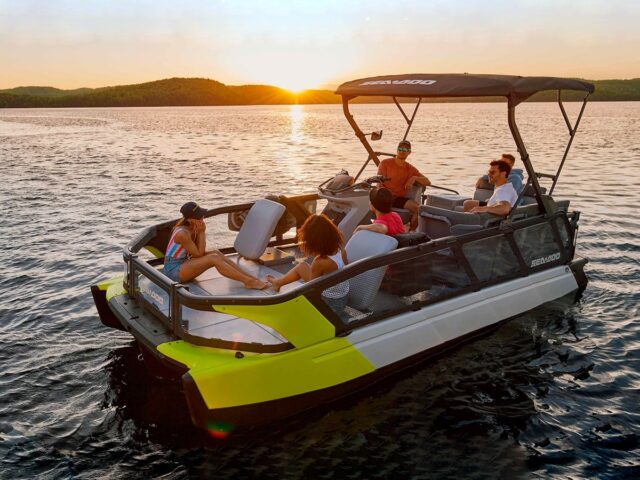
As the suit gained notoriety, investigators for Florida Fish & Wildlife noted that Feliciano’s Switch was “extremely overloaded,” well beyond the marked capacity limit of 825-pounds “by the five adults and their gear—coolers, etc.—plus whatever the weight of the infant girl.” This overloading of the unit was what was also attributed to a similar accident earlier that same summer. On July 4th, Nadim Hussain’s daughter died when her father’s 13-foot Switch flipped nose-over-end on Virginia’s Lake Anna. Trapped behind the vinyl screen gate and her PFD, the 9-year-old girl was later discovered by rescue workers.
In a public statement, BRP spokesperson, Emilie Proulx, said that all Sea-Doo Switch watercraft comply with all ABYC and US Coast Guard regulations regarding flotation testing and weight capacity, “This product has been rigorously tested throughout its development phase and still is today. As such, BRP strongly believes that the Sea-Doo Switch watercraft is a well designed and safe product.” This statement, given in October of 2024 was shortly followed by the first of three recalls issued on February 18th, 2025 (2025-4).
The initial recall sought to address how much water the segmented pontoons collected when afloat. The pontoons are misnamed, seeing that they are actually foam-filled segmented “outriggers” and not sealed, watertight pontoons. These outriggers allow in several gallons of water when stationary, and when under acceleration or deceleration, have a tendency to shift ballast heavily if not properly managed by the driver. New gaskets sealing the segments were initially prescribed but were found to be insufficient.
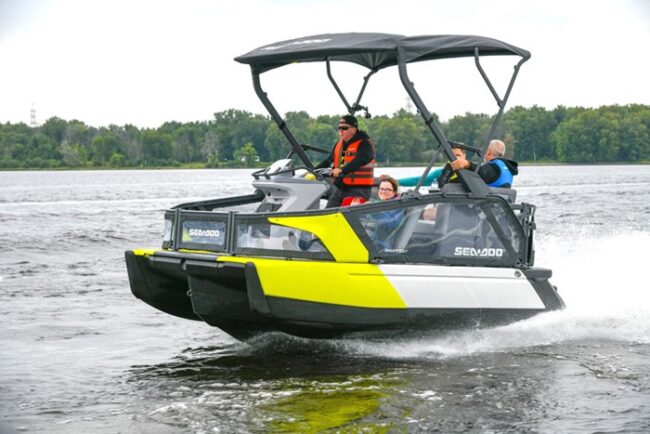
Unfortunately, the first two “fixes” didn’t solve the rollover issue: On August 30th, 2025, three women were killed when their Switch capsized on Flagstaff Lake, Maine. The Switch had already undergone the second recall repair issued by BRP. And again, officials from Maine’s Inland Fisheries & Wildlife Department discovered that the Switch in question was laden with seven adults – exceeding the recommended capacity limit – at the time of the capsizing. In response, a third recall was issued by BRP re-emphasizing the same original cautionary recommendation:
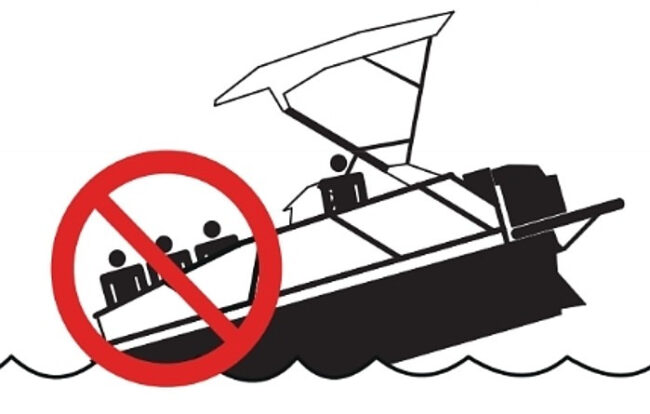
Improper distribution of passengers and cargo weight could overload the front of the watercraft and cause instability, nosediving and possibly lead to capsizing. The condition worsens if water evacuation from the hull is not optimal. This could cause serious injuries or even death.
This third update will replace existing gaskets to better evacuate water from the pontoons (outriggers) stating, “All watercrafts need three gaskets in specific sections of the hull. If your watercraft presently has sealant in those sections, it will be removed prior to the installation of the gaskets. For watercrafts already equipped with gaskets, an inspection is required to ensure that all three gaskets are present.” Additionally, each unit will be fitted with new warning labels, as well as updates to “Operator’s Guide.”
While Sea-Doo seeks to physically repair all current Switch models, BRP has been tasked with repairing its reputation by refocusing on its powersports divisions (Can-Am, Spyder, Ski-Doo) and selling off its marine division (besides Sea-Doo, of course). Earlier in April of this year, BRP announced that it had sold Alumacraft to Bryton Marine Group in Washington and British Columbia. And on July 8th, BRP sold Manitou to the owners of Bentley Pontoons – almost completely erasing BRP’s investment into recreational boating.
“Today marks another key step in our process to sell our Marine businesses. I am proud of the strong foundation we have built for Manitou and I sincerely thank all employees and dealers for their commitment and resilience over the years. I wish them the very best in this next journey,” said José Boisjoli, President and CEO of BRP.
The issue at hand is multifaceted. Sea-Doo has a responsibility to build a vessel that is both safe and stable for the user, yet is not required by law to quantify the experience level of the individual piloting its products. Following that reasoning, Sea-Doo cannot be held liable when their products are misused – in this case, the vessel being overladen beyond its listed capacity. Many seek to punish the manufacturer and absolve the user for their misuse. Others press the opposite. However this plays out in the courts of law and public opinion, the Sea-Doo Switch may ultimately pay the price with its life – whether justifiably or not.