


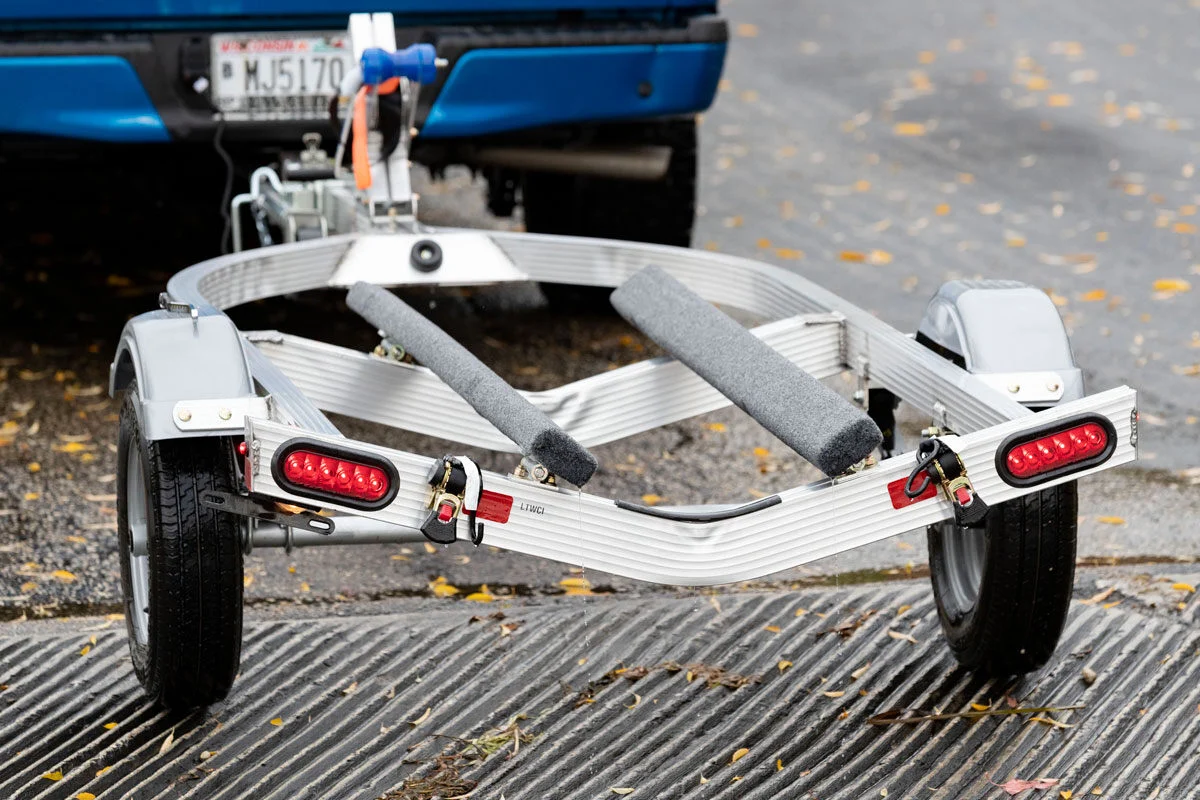
 There’s a certain kind of frustration that only shows up at the boat ramp.
You’ve got the skis fueled, the cooler packed, the weather finally cooperating—and suddenly, your trailer lights decide they’re done participating. No brake lights. No turn signals. Maybe one lonely marker light flickering like it’s trying its best.
For something so small, trailer wiring has a way of stopping an entire day in its tracks.
The good news? It’s not nearly as complicated as it looks.
Most modern trailers—especially anything set up to haul a personal watercraft—use a standard 7-pin wiring system. And once you understand what each wire actually does, troubleshooting becomes a whole lot less like guesswork and a lot more like a quick pre-ride check.
THE 7-PIN BREAKDOWN
At its core, your trailer wiring is just seven separate jobs, each handled by a different wire:
- White — Ground
The foundation of everything. This wire connects to the trailer frame and completes every circuit. - Brown — Running Lights
Powers your marker lights and tail lights so you’re visible at night. - Yellow — Left Turn & Brake
Controls the driver-side turn signal and brake light. - Green — Right Turn & Brake
Controls the passenger-side turn signal and brake light. - Blue — Electric Brakes
Sends power to trailer brakes (if your trailer is equipped). - Black — 12V Auxiliary Power
Constant power feed—often used for charging a battery or powering accessories. - Purple — Reverse Lights
Activates backup lights when you shift into reverse (if installed).
That’s it. Seven wires, seven responsibilities.
 4-PIN VS. 7-PIN: WHAT MOST PWC OWNERS ACTUALLY USE
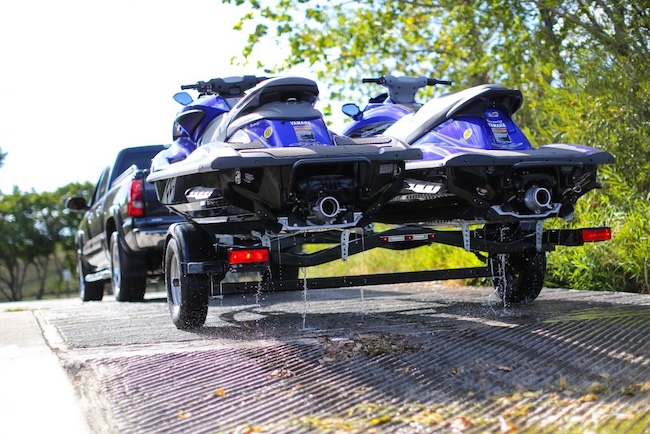
If you’re towing a single or double jet ski, there’s a good chance your trailer doesn’t even have a 7-pin connector—and that’s completely normal.
Most personal watercraft trailers use a 4-pin flat connector, which covers just the essentials:
- White — Ground
- Brown — Running Lights
- Yellow — Left Turn & Brake
- Green — Right Turn & Brake
That’s it. No extras, no complexity.
And for lightweight trailers, it works perfectly.
SO WHY DO SOME TRAILERS USE 7-PIN?
The 7-pin setup simply adds more capability for heavier or more complex trailers:
- Electric brakes (blue wire) for stopping power
- 12V auxiliary power (black wire) for batteries or accessories
- Reverse lights (purple wire) for visibility and safety
You’ll typically see 7-pin connectors on:
- Larger boat trailers
- Multi-axle setups
- Enclosed or equipment trailers
WHICH ONE SHOULD YOU CARE ABOUT
For most PWC owners, the answer is simple:
If your trailer has a 4-pin and everything works, you’re exactly where you need to be.
The only time you’d consider stepping up to a 7-pin setup is if:
- Your trailer has (or needs) brakes
- You’re towing heavier loads over longer distances
- You want added features like reverse lights or onboard power
No matter which setup you’re running—4-pin or 7-pin—the way these systems fail is surprisingly consistent.
It’s rarely something dramatic or complicated. More often, it’s a small connection issue that throws everything off just enough to leave you chasing symptoms instead of the cause.
And almost every time, it starts in the same place.
WHY “GROUND IS KING” ISN’T JUST A SAYING
If there’s one takeaway here, it’s this: most trailer light problems come down to a bad ground.
That white wire needs a clean, solid connection to bare metal on the trailer frame. Not painted. Not rusty. Not “good enough.”
Saltwater, road grime, and time all work against that connection. And when it weakens, everything downstream starts acting weird—dim lights, signals that don’t blink right, or systems that fail entirely.
If your lights are doing anything inconsistent, check the ground first. Nine times out of ten, that’s your culprit.
THE RAMP REALITY CHECK
Here’s where this really matters for PWC owners.
Unlike utility trailers that live relatively easy lives, watercraft trailers deal with:
- Repeated submersion
- Corrosion from salt or brackish water
- Long highway runs followed by sudden cooling at the ramp
That combination is brutal on wiring.
It’s also why you might have a setup that works perfectly in your driveway… and then fails the moment you back down the ramp.
Connections heat up during the drive, cool rapidly in the water, and suddenly a marginal connection becomes a complete failure.
A FEW SIMPLE WAYS TO STAY AHEAD OF PROBLEMS
You don’t need to rewire your trailer every season—but a little prevention goes a long way:
- Check your ground connection regularly
If it looks questionable, it probably is. - Protect your wiring
Split-loom tubing or proper routing keeps wires from chafing against the frame. - Use dielectric grease on connectors
Helps prevent corrosion and keeps connections consistent. - Secure loose wires
Vibration on the road will wear things out faster than you think.
THE 30-SECOND WALK-AROUND THAT SAVES YOUR DAY
Before you pull out—whether from home or the ramp—take half a minute and run through the basics:
- Left turn signal
- Right turn signal
- Brake lights
- Running lights
It’s quick. It’s simple. And it can save you from getting pulled over—or worse, dealing with a preventable issue on the road.
Trailer wiring might not be the most exciting part of owning a PWC, but it’s one of those small systems that carries a lot of responsibility. When it works, you never think about it. When it doesn’t, it’s all you can think about.
Understand the seven wires. Keep your connections clean. And give it a quick check before you roll.
Because the only thing worse than a long day at the ramp… is not making it to the water at all.