Hal Monkman from Ontario, Canada has been a white water jet skier for almost 15 years. He says “I first got into it as a professional kayaker. We bought a jet ski to use as a filming platform to make kayaking videos back in 2003. We’ve been using them since in the kayaking world for filming, safety uses and as a means to access water that we can’t easily get to in our kayaks”. He goes on to say while quite a few people in the kayaking world have jet skis, he seems to take it up a notch.
Hal is very passionate about jet skiing and spends a few hours every weekend riding his Sea-DooSpark on the Ottawa River; the location you’ll see in the video below. The Ottawa River is a very popular white water rafting river about 1.5 hrs outside of Ottawa, Ontario. Another spot Hal says he loves to frequent is the Lachine Rapids in downtown Montreal, Quebec. “There are big waves and big jumps. I love it. They also do a lot of jet boating there” says Hal.
He tells the Watercraft Journal that he has quite the adventure planned for the near future and is looking forward to sharing it with us and our viewers. “I’ve been training up and planning for a real extreme adventure for almost a year now. This adventure will see me Sea-Doo down 140 kilometers of real crazy rapids far out in the Canadian wilderness in search of a big river wave that I can surf in my kayak. It’ll be cool!” explains Hal.
We look forward to sharing that adventure with you all and hope you enjoy the video below!
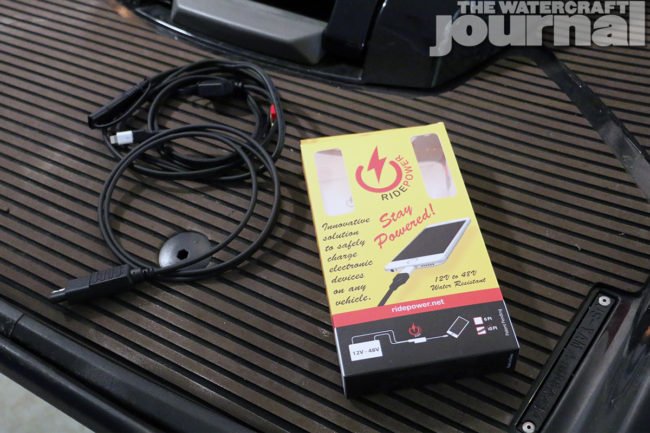
Over 3 years ago, we were first introduced to the RidePower phone charging system. Intrigued, we reached out and picked up a kit for an ’05 Sea-Doo RXP 215. The installation was straight-forward enough and took us about an hour to complete. When done, the kit (which operates “live” or without the need of turning on your PWC) worked great and continues to work flawless until this day. Using a standardized USB cell phone port for a Samsung Galaxy smartphone, the only major changes to the RidePower phone charging system is the inclusion of a Apple-style Lightning adapter and a heavily discounted cost, down from $69 in 2014 to an impressive $39.95 today.
Because of the overall length of the vessel, the various bulkheads and fairings and complexity of the current Yamaha FX WaveRunner platform, we thought we’d take a swing at installing our second RidePower charger on a ’14 FX SHO. Obviously, the process requires quite a bit more drilling, which we know frightens quite a few folks, but with the right instructions and tools, the final result can actually look like it came equipped like this from the factory. [And we wager that 12v charging ports – currently available on all Yamaha VX and FX Limited models – will become the next standard feature on all craft – Ed.]
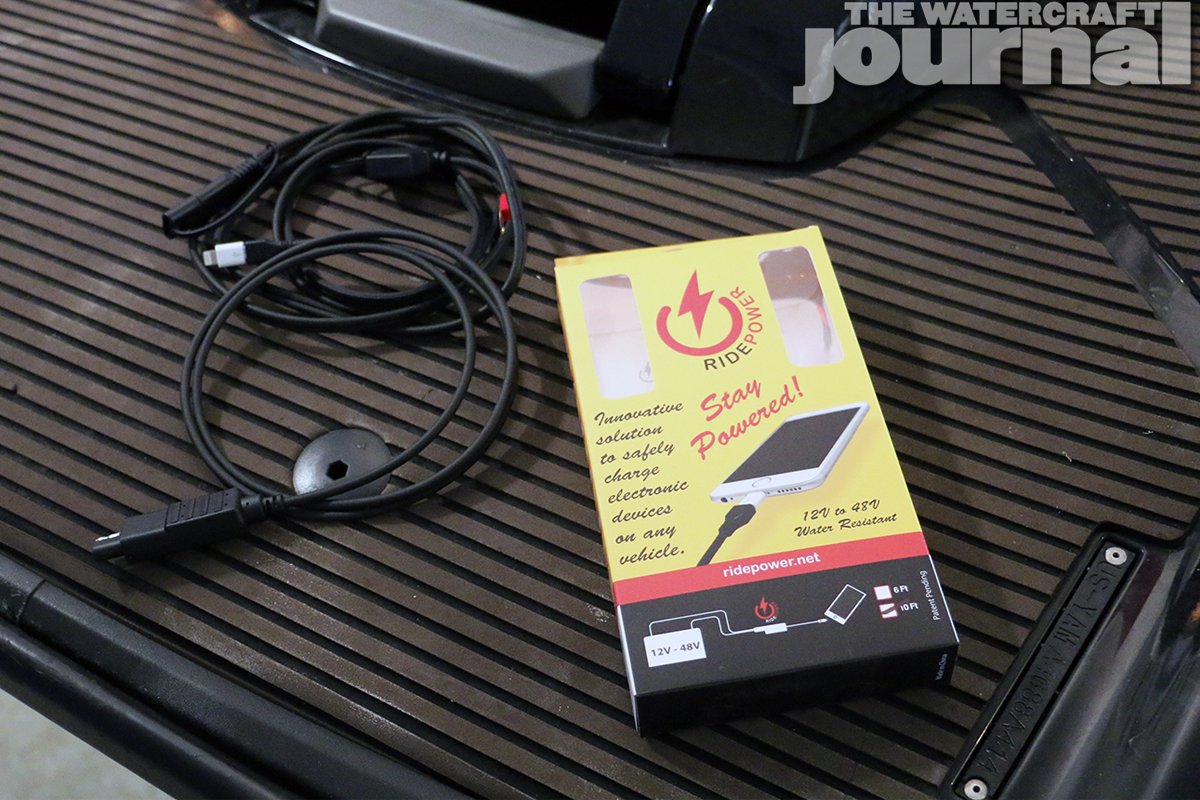
Above: Given the length of the full-sized FX SHO, we opted for the 6-foot cable, which actually ran a little long anyways. (Too much is better than not enough!)
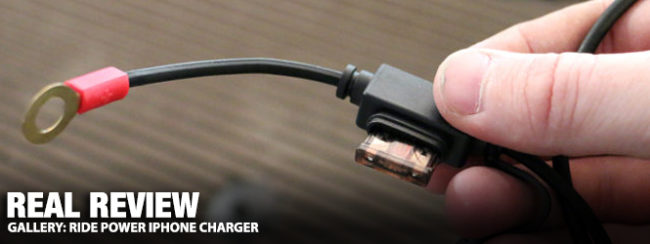
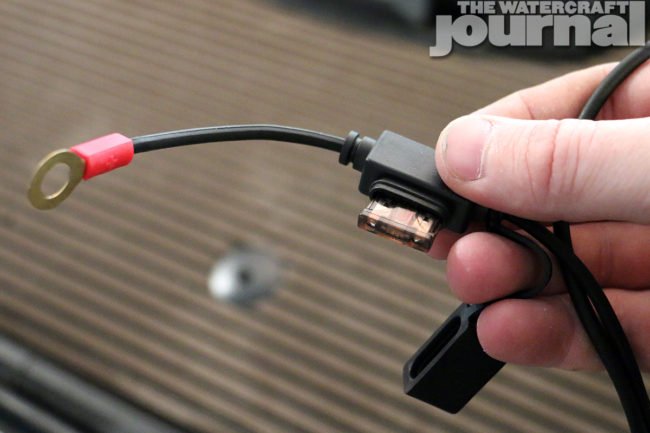
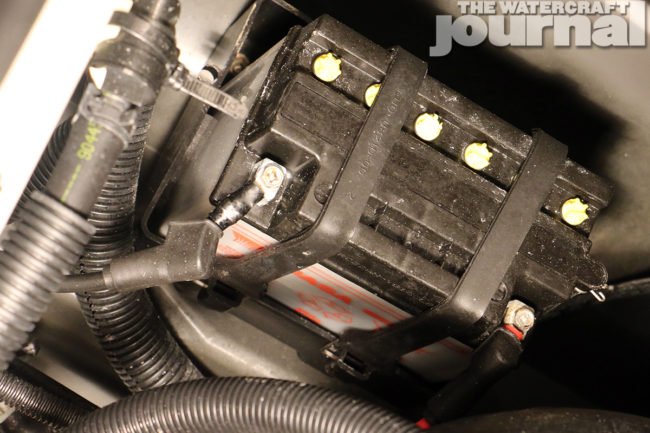
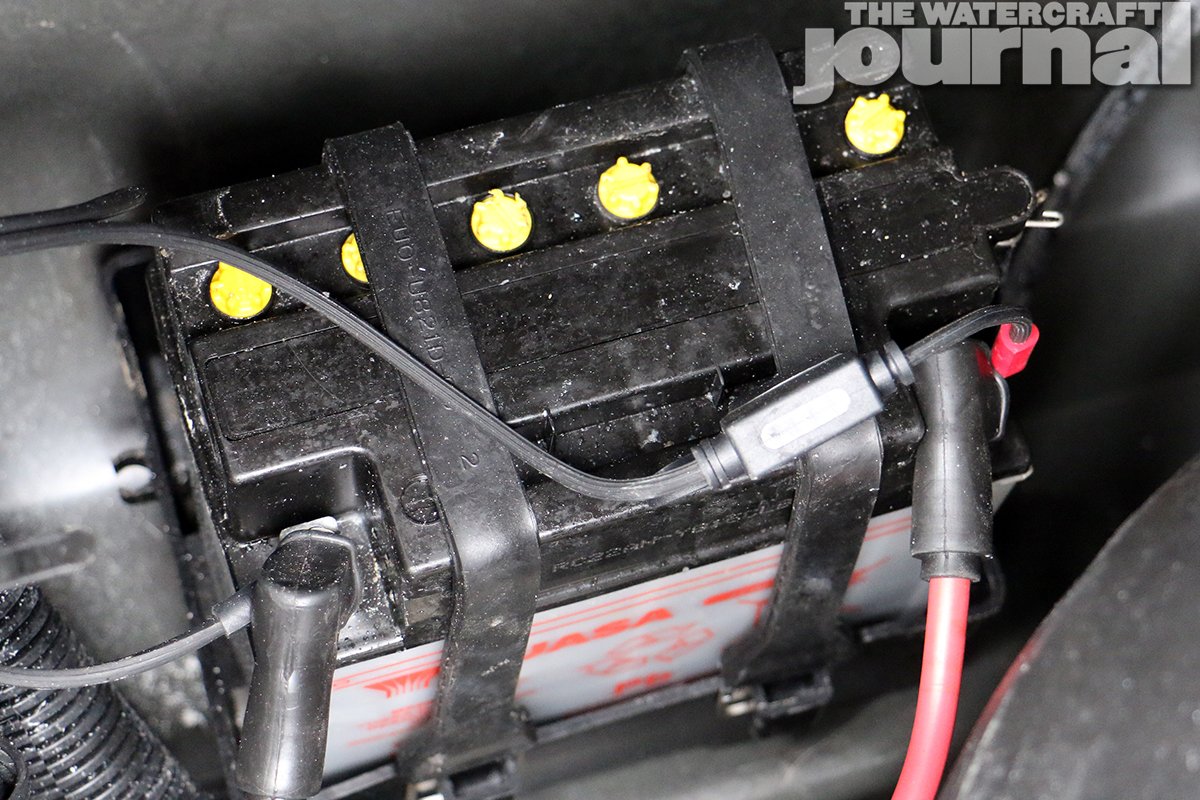
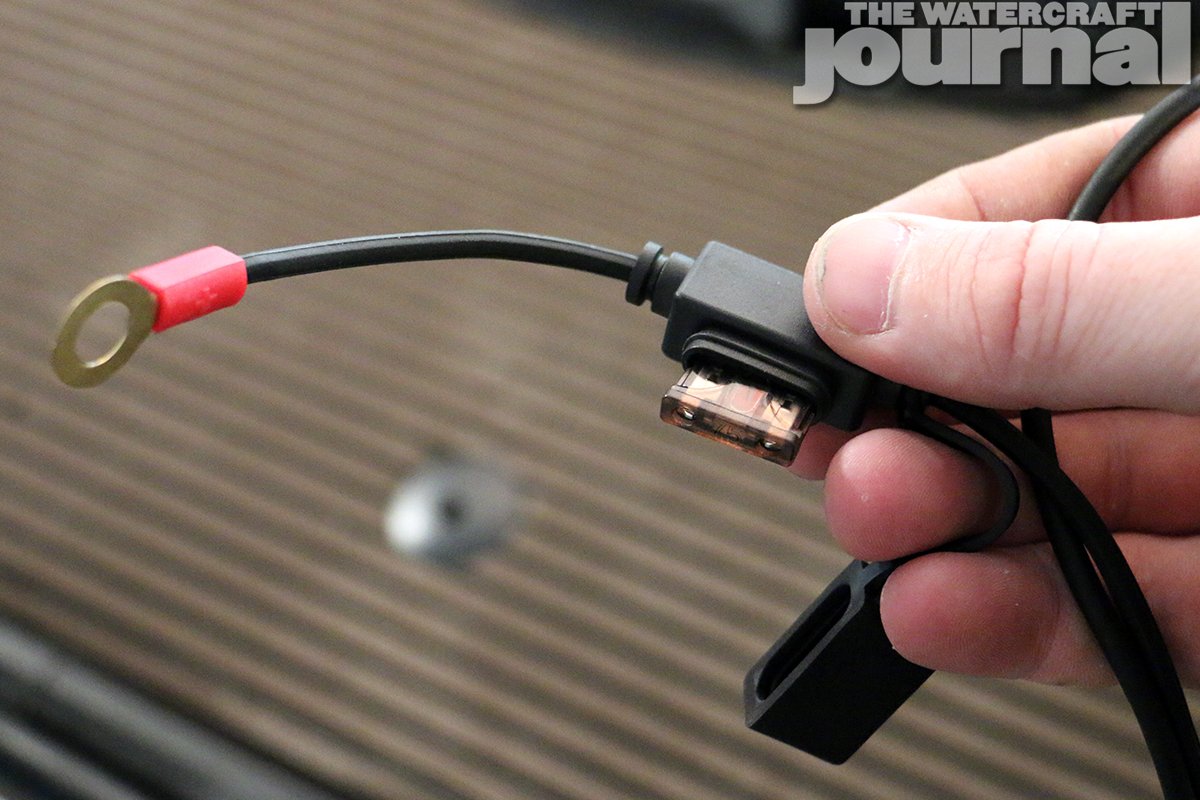
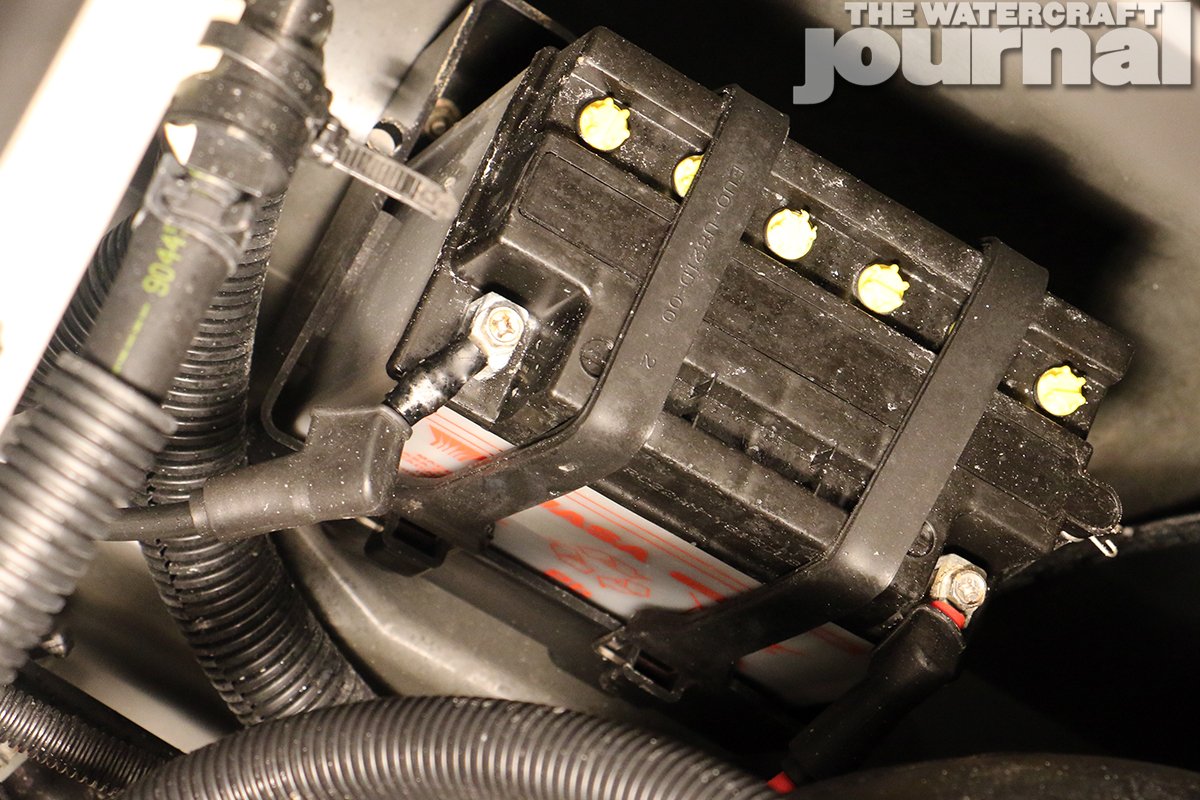
Above left: The fuseable link is a safety precaution ensuring that any power surge won’t injure the phone. Above right: The RidePower merely connects to the positive and negative terminals (respectively). The rubber boots will even cover most of the new RidePower connections.
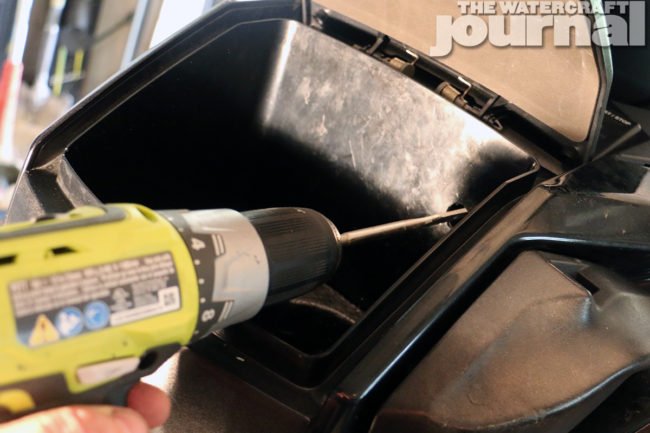
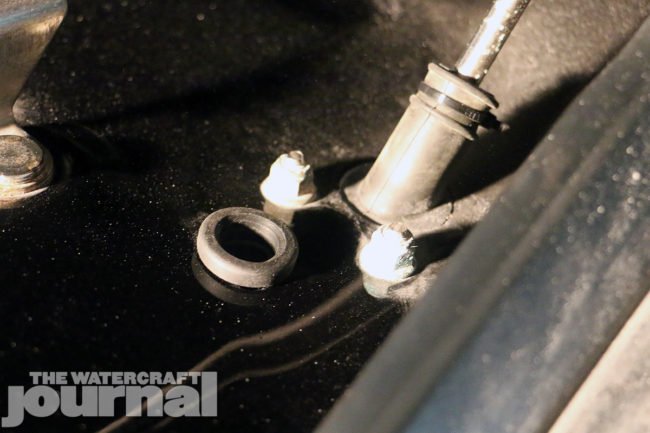
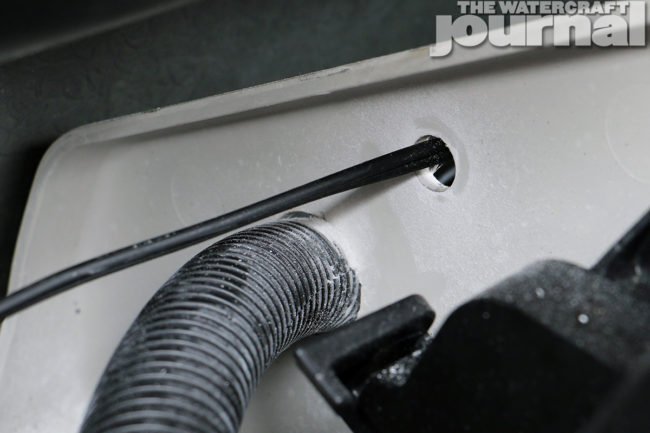
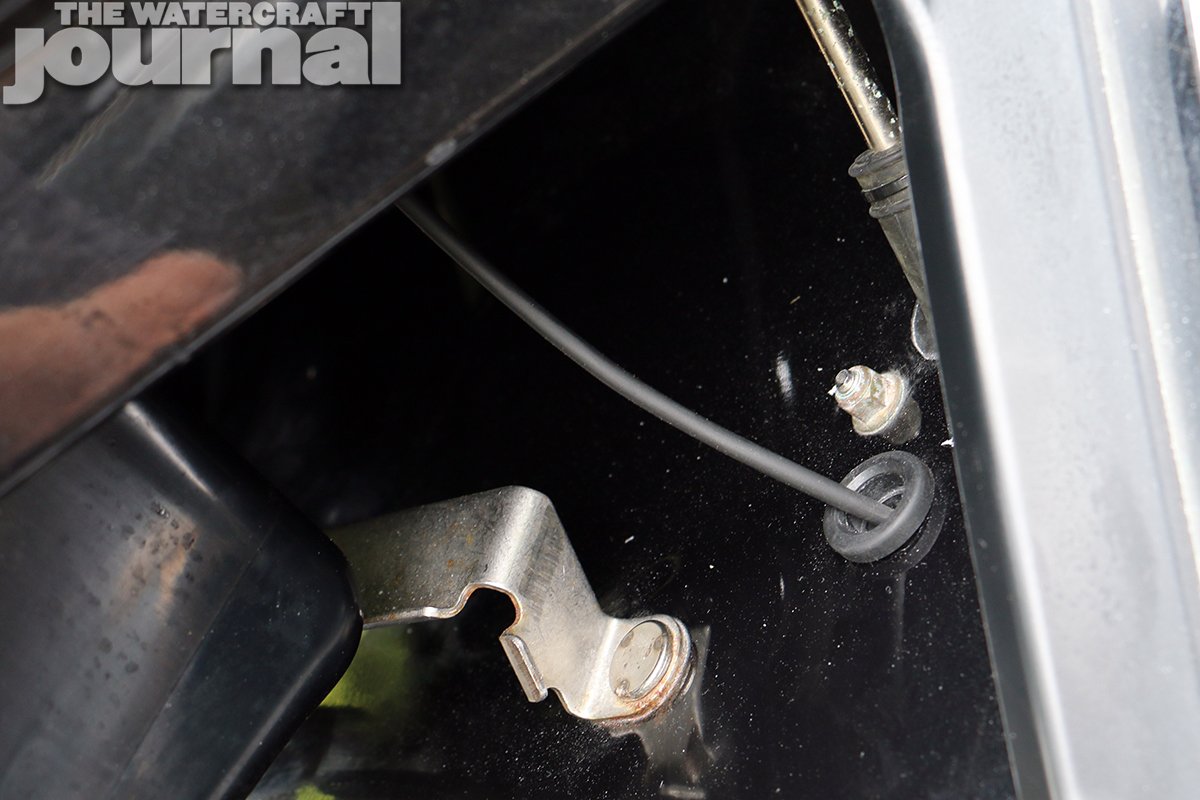
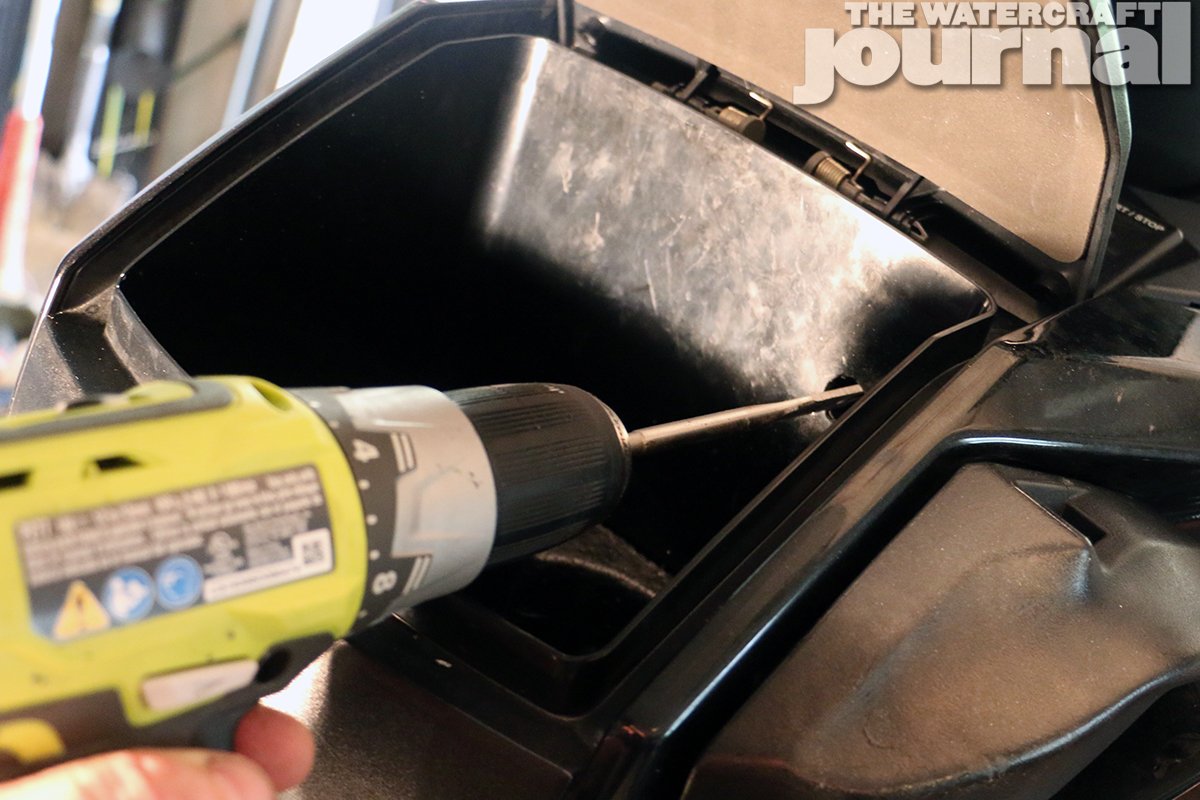
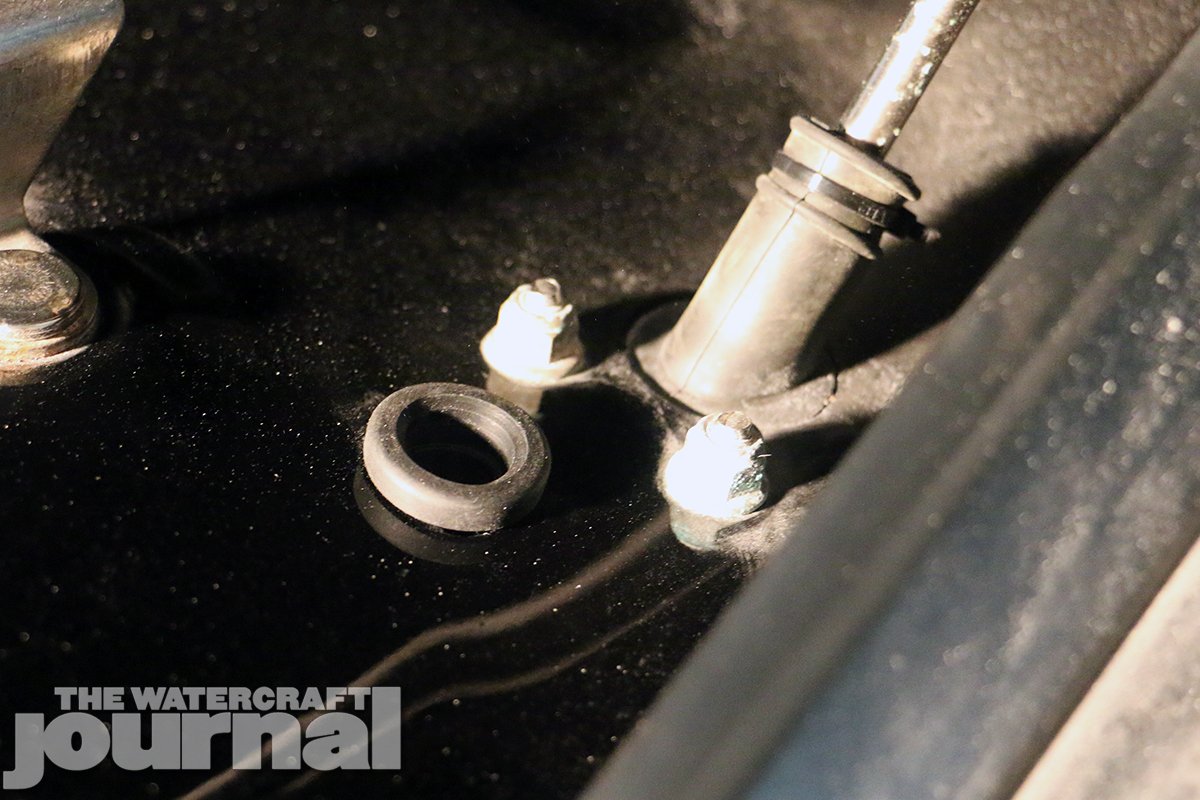
Above left: After marking our locations, drilling a pilot hole with a 1/16″ bit, we used a 1/2″ hole bit to drill into the glove box, as well as on the top of the deck, behind the fairing on the port side. We also drilled through the white bulkhead with the same bits, feeding the partitioned cable through. Above right: We sorted through a variety pack of rubber grommets purchased from our local automotive parts chain store and found properly-sized grommets to seal up our holes.
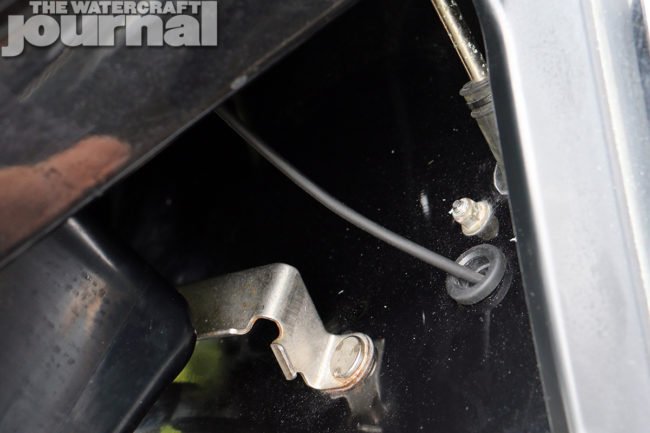
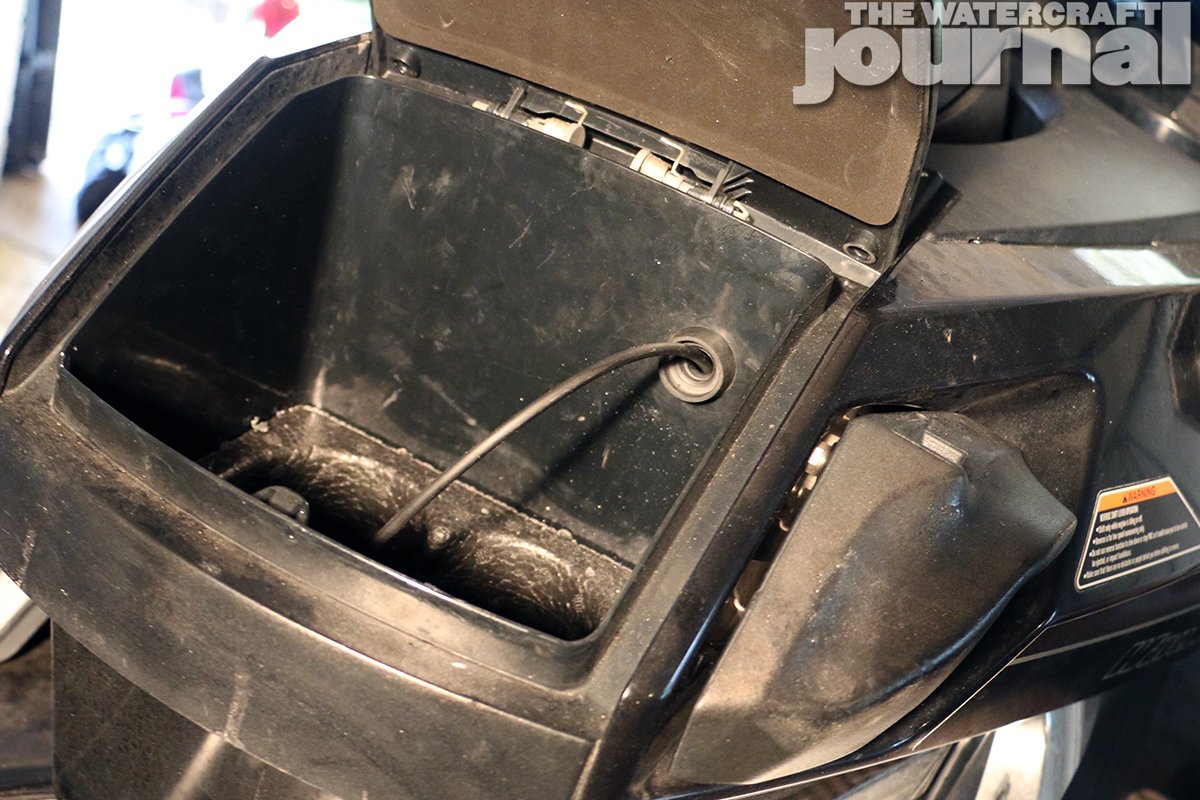
Above: As mentioned above, once we inserted our grommets, we fed the RidePower charger plug from the battery, through the firewall, pasted the engine, up through the top of the deck and into the back of the glove box.
Above: We went back over our work, careful to allow enough slack so the charger wouldn’t bind, but not enough to flop freely around. Here can be seen where we drilled into the bulkhead and also connected to the battery.
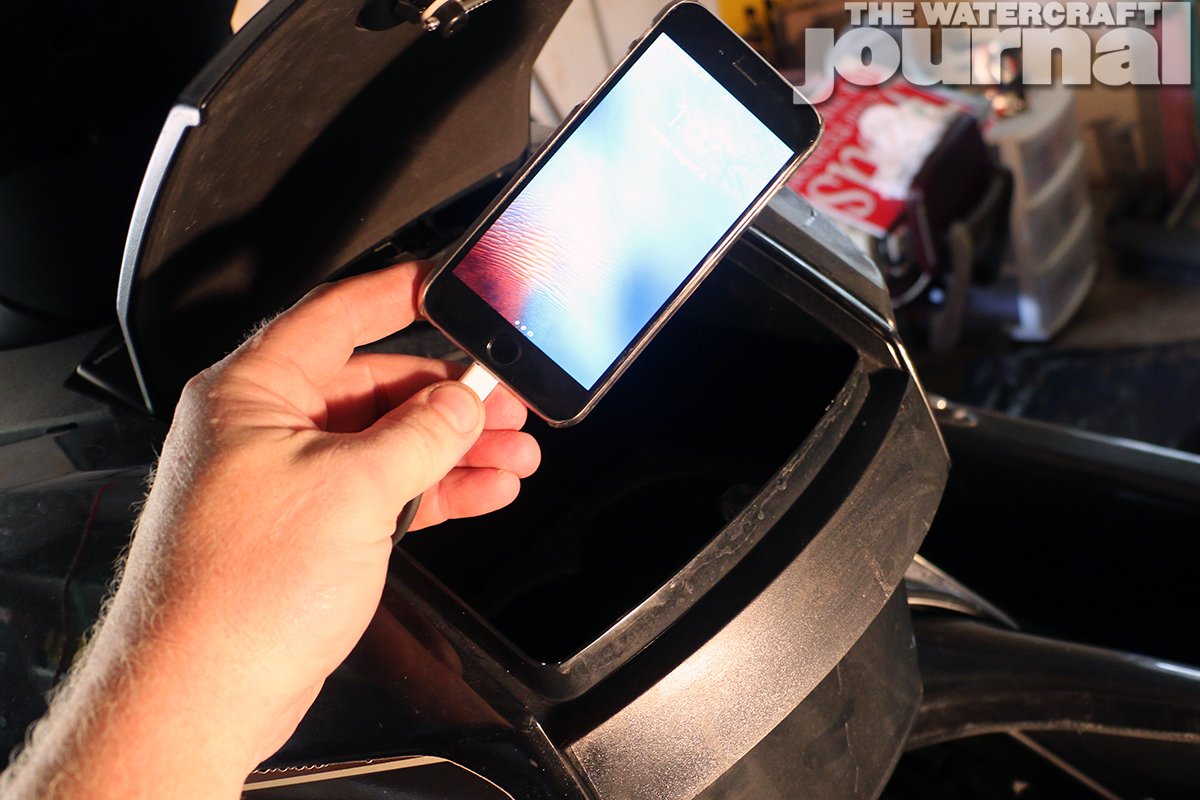
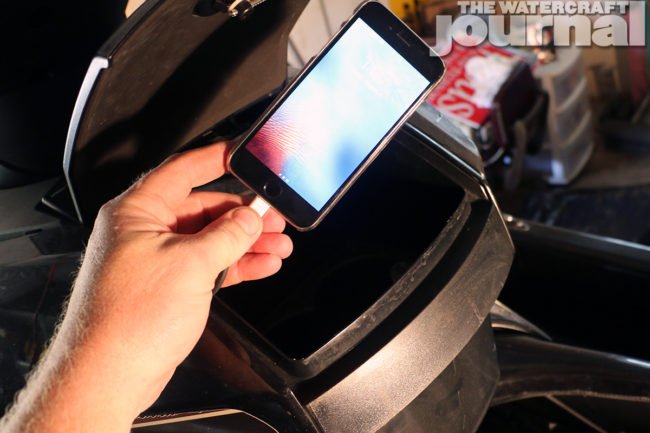
Above: Although the screen brightness glares-out the charging icon, believe us when we say it immediately went to work recharging this iPhone 6’s battery. This will definitely earn its keep while out on the water as so many of us use our smart phones to take pictures and video, and chart our progress on the water.
Again, with a heavily discounted price from three years earlier, and an incredibly easy installation, the RidePower phone charger is bar none one of the best aftermarket installations we’ve performed on a personal watercraft. As we stated earlier, we all use our phones while on the water and the fact that manufacturers aren’t offering phone charging ports like this as standard equipment is almost egregious. And that’s why we’re glad that RidePower is here doing it for them.
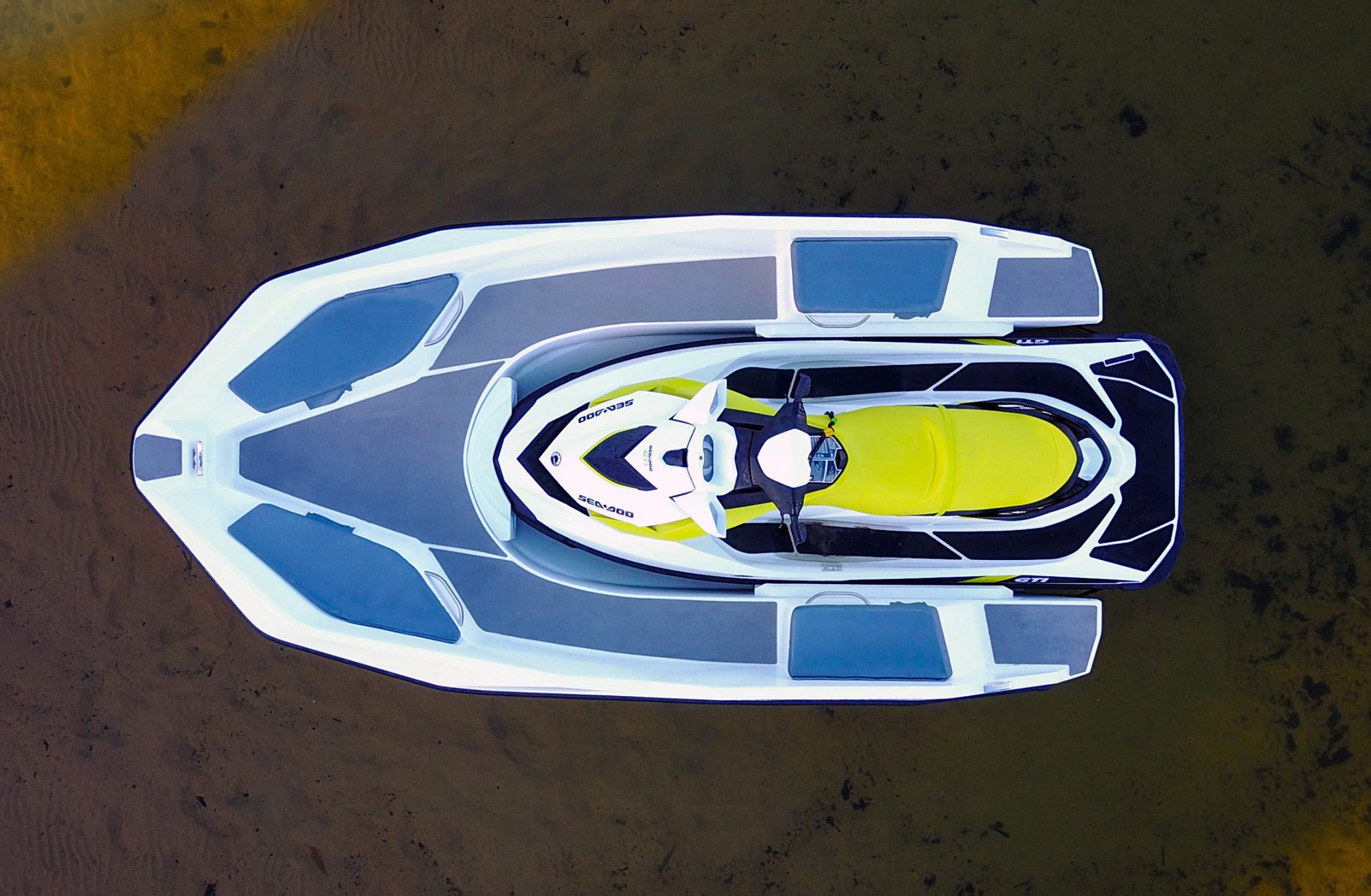
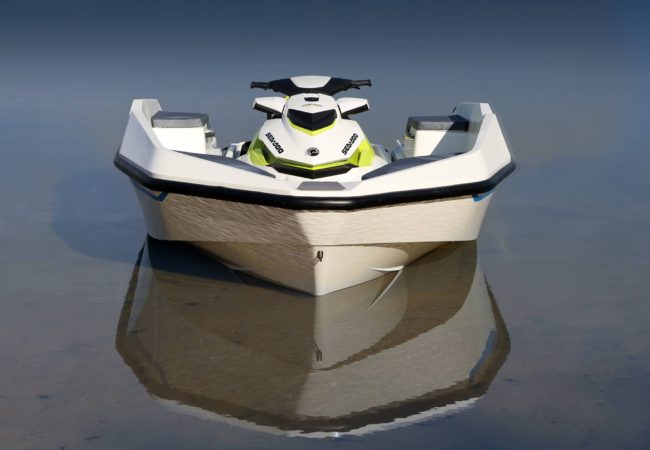
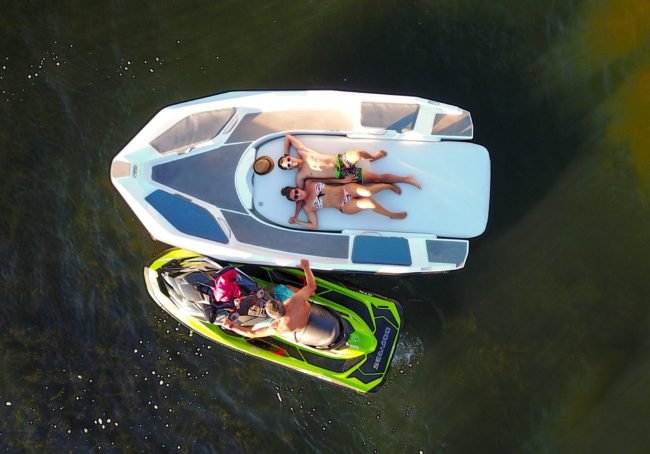
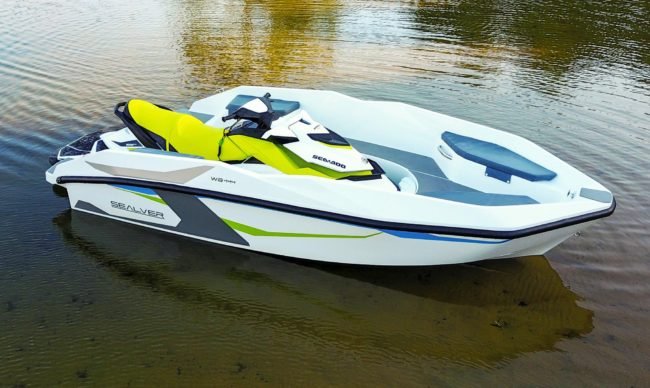
OK, we’re just going to come out and say it: we’re kinda digging on these. Literally 3 years ago, we introduced the readers of The Watercraft Journal to Sealver Waveboat with some mixed feelings as there’s still quite a few questions left to be unanswered in perusing the website and watching the videos they produce – most of which encircle the mounting process and how well the coupling works while battling late afternoon chop and big wakes. Nevertheless, the selection of craft that Sealver is now offering for hookups with today’s modern runabouts is rather impressive.
In a recent post celebrating over 500,000 views of its “Jet Ski + Boat = Wave Boat” video (which we have embedded below this article), Sealver showed off a variety of applications, be it Recreation class GTI models, larger RXT and GTX Luxury model Sea-Doos, and even VX and FX Yamaha WaveRunners. The attachment system firmly wraps around the bondlines on either side of the craft, and is expected to winch tightly to the bow eye, although we haven’t seen the actual mechanism. Once connected, the runabout acts as the powertrain and steering for the craft, although it can float freely without the PWC connected.
Variations of the Sealver line include Zodiac-style inflatable pontoon craft, small open cabin vessels, and even larger vessels featuring wake towers, a variety of storage compartments and bimini tops, not to mention running lights, drop-in cleats and comfortable bench seating surrounding the watercraft. Unfortunately, Sealver is headquartered in France, making ready commercial access to these pretty dang difficult. Once US distribution is found, we would be very interested in testing one of these for the season. (wink, wink)
“Sunday! Sunday! Sunday!” the old adage goes. Well not quite, actually Saturday! Saturday! Saturday! August 26 the H2X Extreme Water Show is coming to the Gila River Arena in Glendale, Arizona. The arena will transform into a giant indoor aquatic playground for the H2X Water Show presented by Grindco Entertainment.
The show will feature watersports riders, aerialists, fire dancers, and live music in the World’s Largest Touring Pool! Yep that’s right, more than 650,000 gallons of water are to be pumped to the area floor, creating H2X’s “World’s Largest Portable Pool.” The water circus thrill show will feature fourteen different acts including jet skis, wakeboards, Flyboards, aerialists, fire dancers, and acrobats. All acts will be set to a live electronic-rock band soundtrack.
This performance is scheduled to be the first ever of its kind staged in and flying high above the theatrically lighted enormous pool, spanning 200 feet by 100 feet inside the arena. The Gila River Arena is the home of the Arizona Coyotes of the NHL. It is a state-of-the-art, multi-purpose facility that is dubbed the “crown jewel” of sports and entertainment complexes.
Ticket prices for this spectacular event start at $10 for kids and $22 for adults. VIP tickets are available, which include floor access, inclusion during the concert finale, and a backstage meet and greet with H2X performers after the show. Tickets are already on sale at gilariverarena.com so get yours while they last!
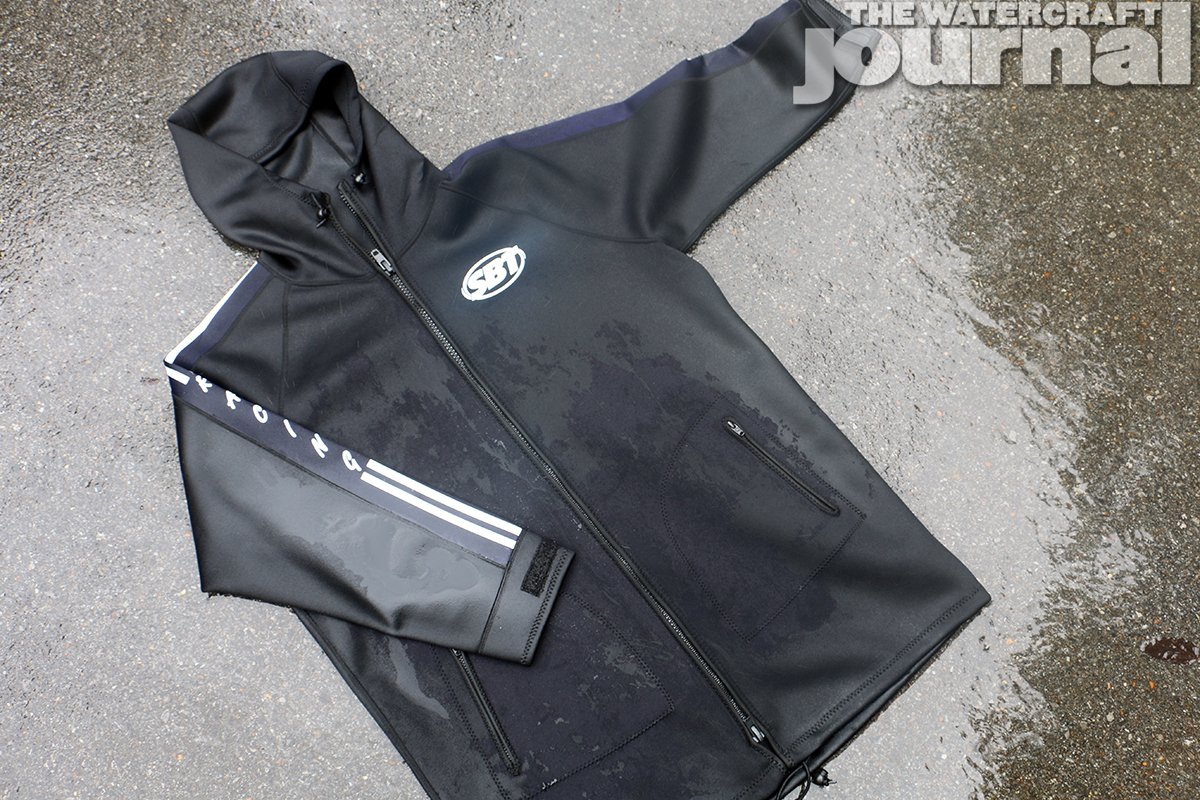
When SBT, Inc. launched its own line of riding gear and apparel – SBT Racing – one of the first items announced was a neoprene tour coat. Now, in our experiences, very little can be said for tour coats. There’s not a lot to them. In fact, we joked internally that we could wax poetic about gloves far more than we ever could about tour coats. Apart from the one or two manufacturers making their coats from heavier canvas materials (the same sort of stuff used for PWC covers and backpacks), the usual neoprene-hewn coats are typically cut large, are not exceptionally innovative, and act more like a parachute than any sort of protective covering.
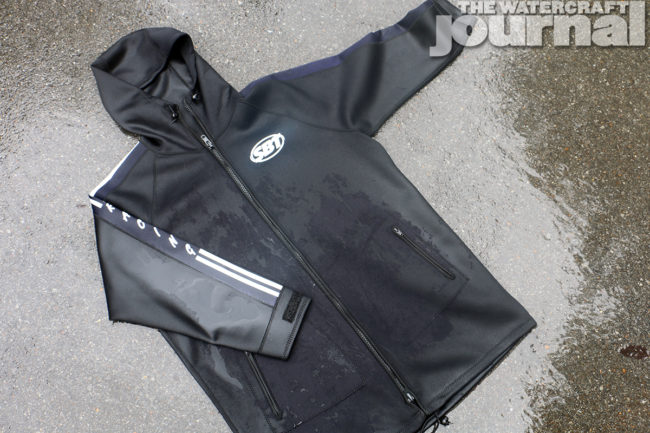
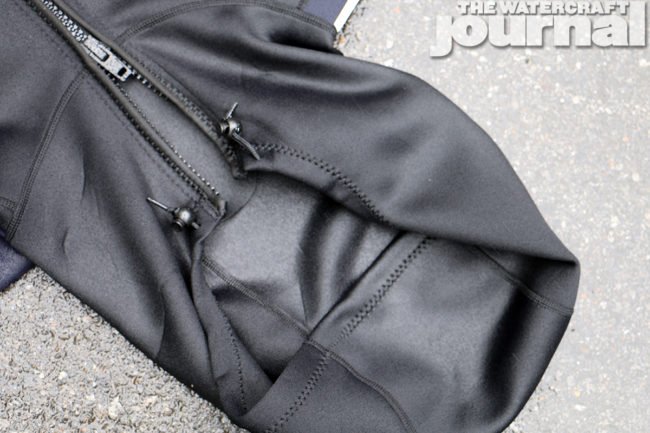
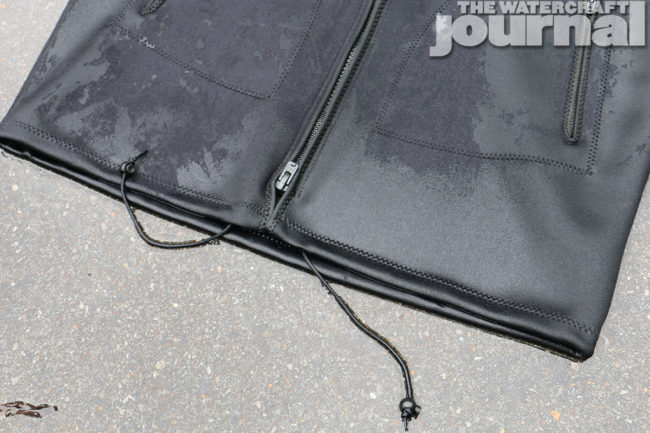
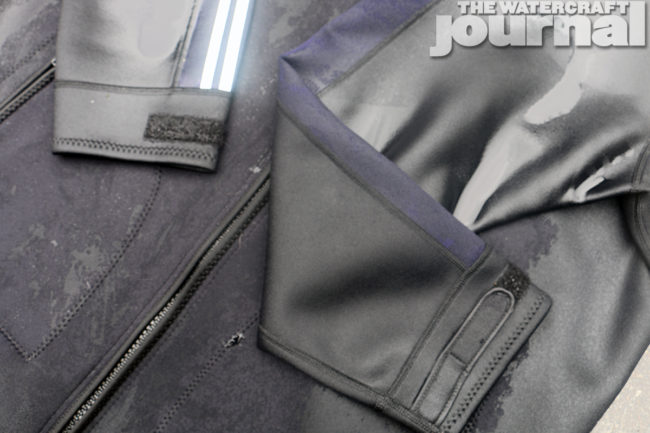
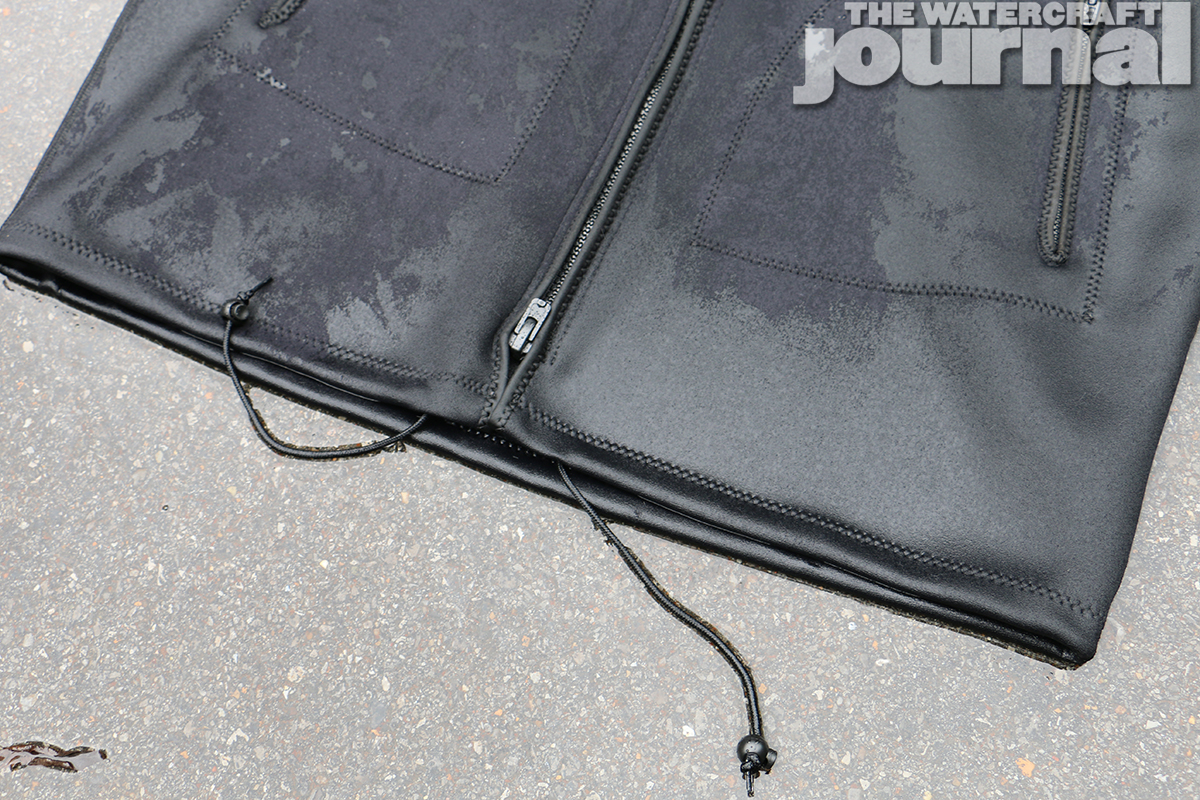
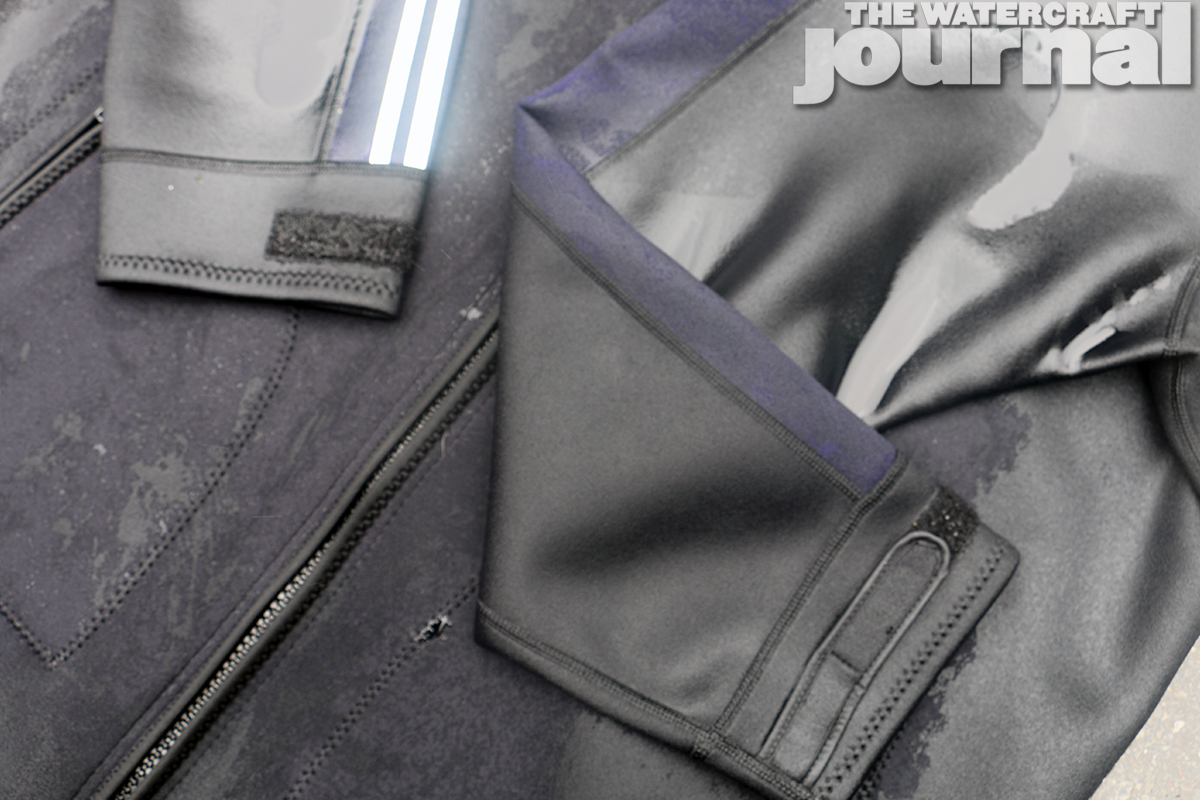
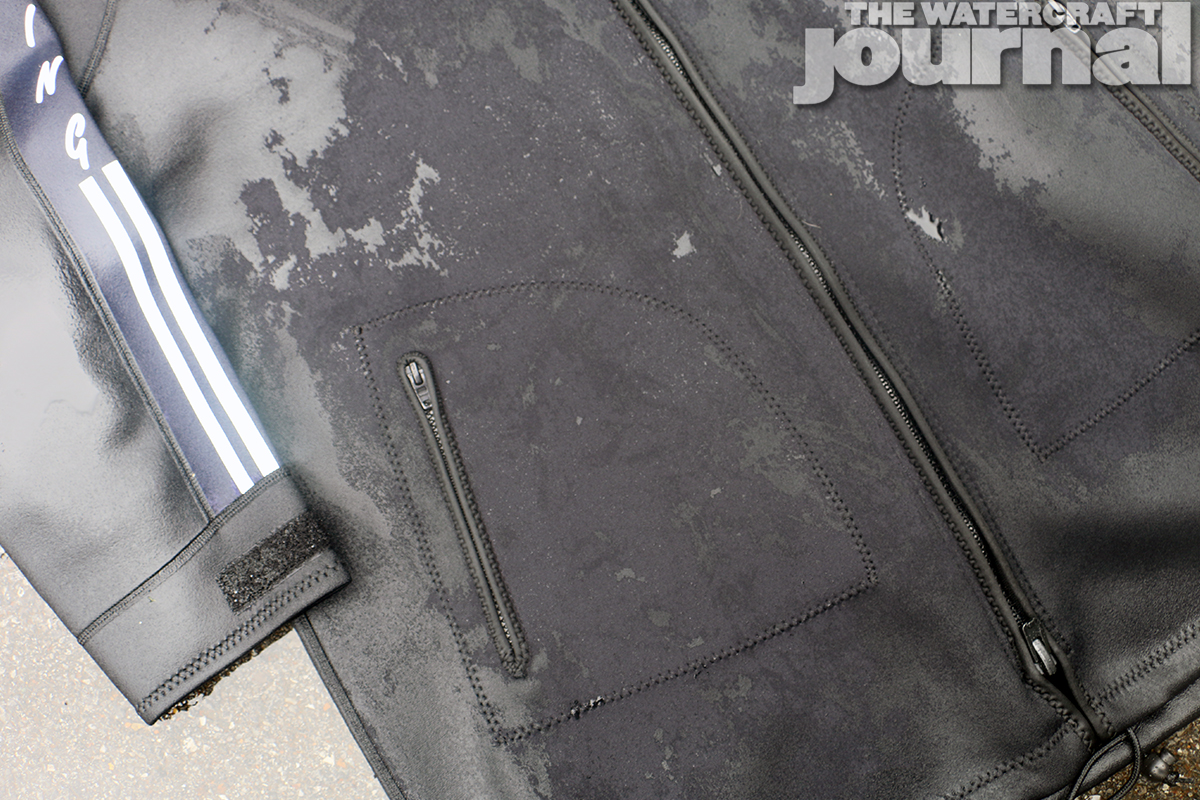
At first glance, the SBT Racing Tour Coat looked deceptively “middle-of-the-road” until we took a closer look. Small features and a few thoughtful additions are enough to set this above many others, all of which we came to appreciate. As is with most tour coats, the SBT Racing Tour Coat is designed to be worn over a life jacket in cold weather. Yet, separating this one from a few others include strong flush-loc seams throughout the entire coat, a sturdy two-way zipper unique to this piece, Velcro wrist cuffs, front neoprene pockets that close with zippers, a hood with a drawstring.
Design-wise, the SBT Racing Tour Coat comes in a single unisex design, black with blue inserts on the arms and white graphics. While the SBT logo looks strong and prominent on the chest, we did think the “Racing” script running down the right arm looked a little less thought-out. As to be expected, neoprene holds water, cooling the coat as wind passes over, but manages to sufficiently retain bodyheat as would a wetsuit. We found the overall cut of the coat to not be as wide or blousy as some others that we’ve tested in previous years, which was welcomed especially as we rode at speed. Larger-cut tour coats tend to flap annoyingly even when those with drawstrings are pulled taut.
Priced at $99.95, the SBT Racing Tour Coat is the most expensive of the SBT Racing line, but comes in $20-$30 more affordable than Slippery Wetsuits and a whole $50 less than Jettribe. Only JetPilot comes close at $109.95, still giving SBT the advantage. Considering the cost savings and the added details put into this coat’s design, we think it’s a smart purchase for those who ride in colder weather or are looking for a little added protection from the elements.
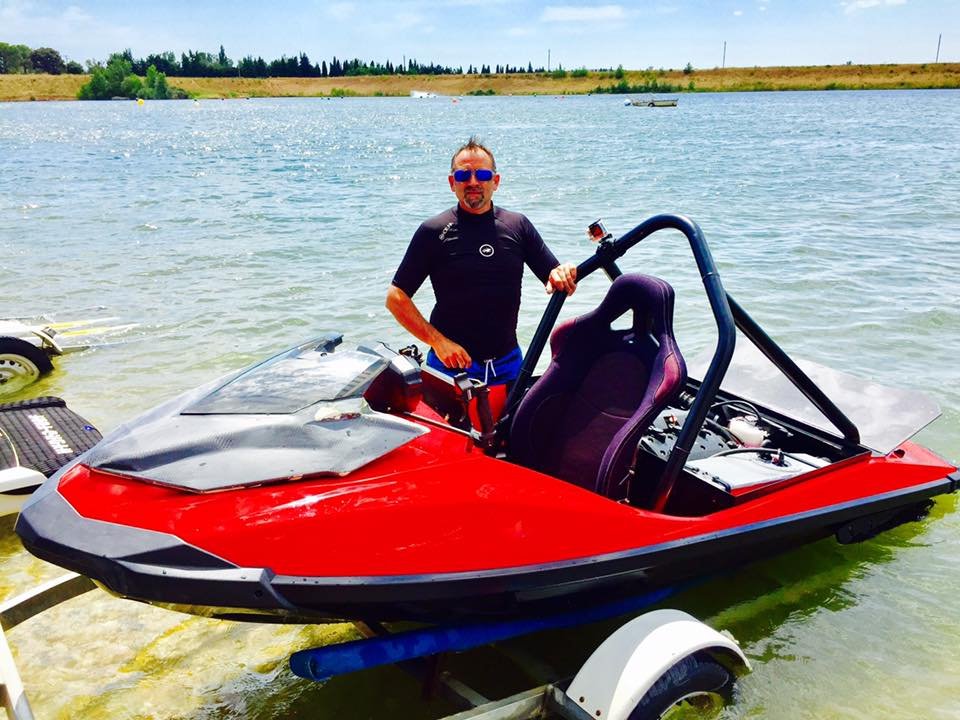
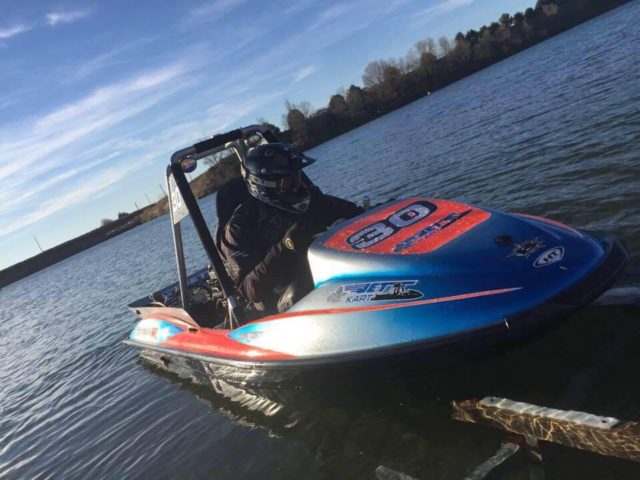
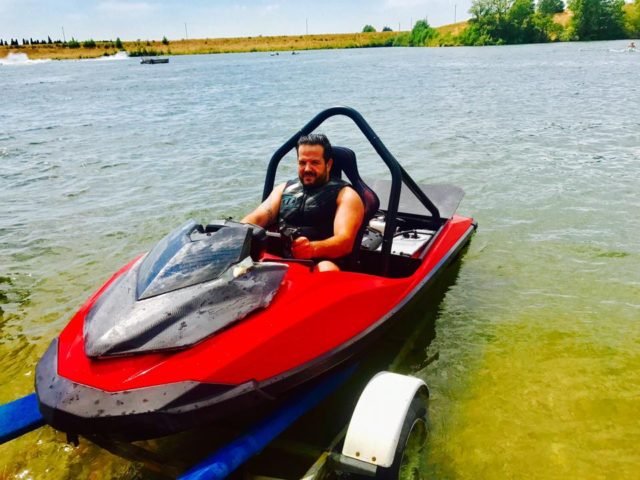
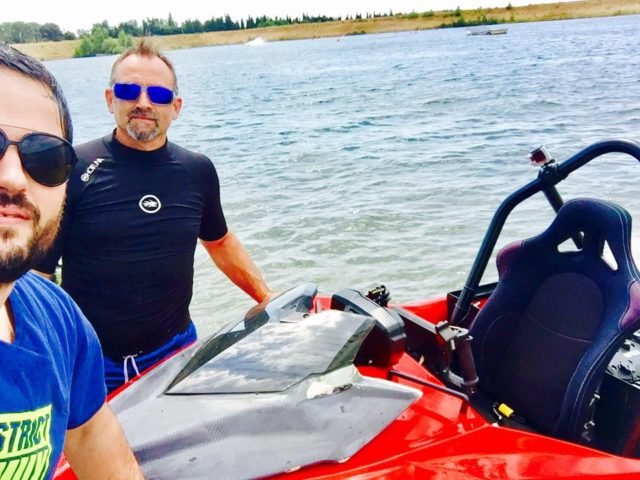
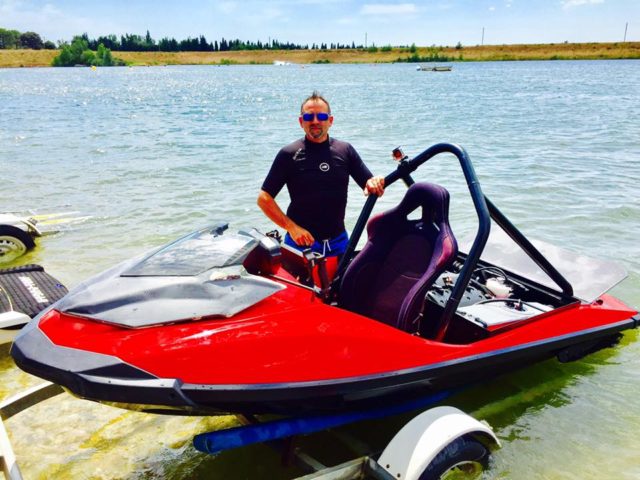
The problem with Sea-Doo’s 3D wasn’t that it wasn’t enough of a standup ski, but that it wasn’t enough of a full-blown gokart. Thankfully, Canadian fabricator Jetkart has done the world a favor and created the first 300-horsepower single-seater Sea-Doo using the fair majority of a Sea-Doo RXT-X 300 runabout.
David, the inventor wrote, “The Jetkart is a product intended for everybody (as well as the paraplegic people) to reach the water sport to motorize and to promote competitions on a circuit of jet ski.” Thus far, the Jetkart is in its primary testing and fine-tuning stages, with modifications being made to the cockpit and controls, which also utilize a large portion of the X-Steering system, giving new meaning to the old adage, “We use every part of the buffalo.”
After separating the hull from the deck, David rearranged the powertrain layout to accommodate the body-hugging race seat and four-point rollcage (similar to those seen on large flat bottom race boats). As mentioned the handlebars and gauge cluster are reconfigured into a more traditional-looking cockpit, all giving the craft an exceptionally low center of gravity.
Although still being tested, David has opened the craft for some private testing. One such was Boyadjian Jérôme who gave the Jetkart a test. He wrote, “It’s very impressive to [cruise] more than 110 km/h being so close to the water! [The] sensations are unique, [like] flying. [It’s] extreme [in the] curves at an amazing speed! Bravo David [on] a new successful concept!”
Have you ever pictured yourself doing PWC Freestyle on the big screen or in front of live audiences? Well now is your chance. Universal Studios Japan is holding auditions later this month and next month. Australian PWC magazine OZPWC has made the announcement for those interested in auditioning in Gold Coast September 18. The audition for those here in the States will be held in Los Angeles on August 17.
“Live The Life In Osaka Japan” the audition flyer says. The jet ski stunt roles for this audition series will give candidates the chance to star in the famous Water World show. According to the auditions page, contracts will be awarded for up to thirteen months. Entrants must be at least eighteen years old, in addition to a few other requirements. For full details visit the usjauditions webpage link.
According to Universal Studios, compensation is attractive. You will also be given daily per diem to cover food in addition to benefits such as travel insurance, covered airfare, accommodation, mobile phone, gym membership, and bicycle and train passes for getting around Osaka. In addition to your normal compensation, you will be awarded quarterly and completion bonuses.
Not a bad gig for riding jet ski’s daily for a living. What could be better than getting paid to ride. You can check out audition roles at the auditions link above and even view videos of the maneuvers which you will be required to perform at the audition.
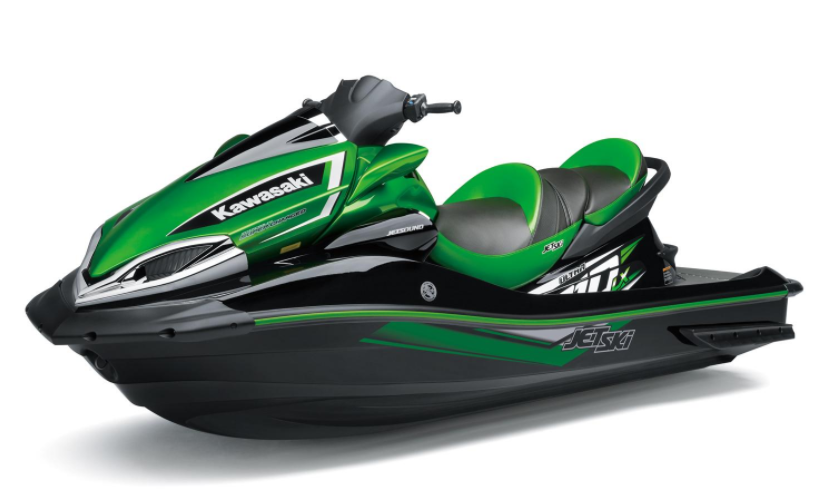
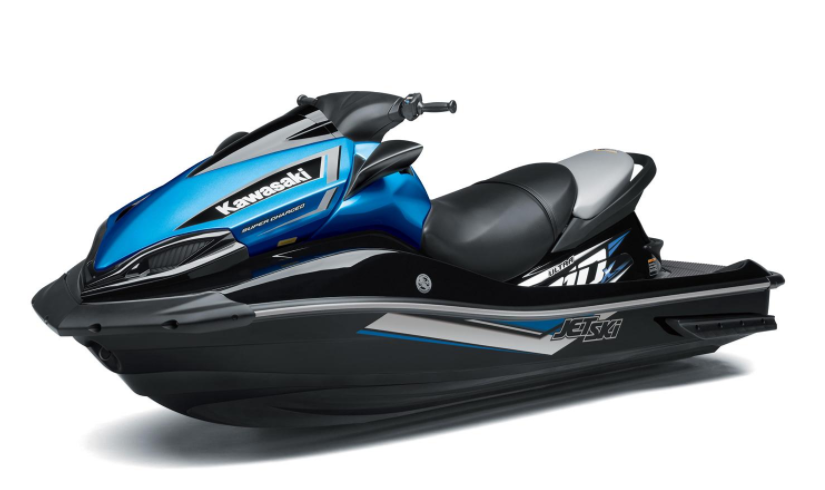
Above: The 2018 Kawasaki Ultra 310R continues all but entirely unchanged with merely a change of hood and cowl color. Even a large portion of the graphics are carried over from last year.
Two weeks ago, we revealed some very strong arguments for what we expect to see coming from Sea-Doo for 2018. As the brand celebrates its golden anniversary, we predict some very radical changes coming to a large portion of the world’s highest-selling brand of personal watercraft. But what of the world’s lowest-selling brand, Kawasaki? So much of last year’s buzz encompassed the agonizingly slow reveal of the long-awaited SX-R 1500 JetSki, ushering in the return of the standup ski from Kawasaki.
Thus far, the new SX-R has proven a hit, filling both beaches and starting lines across the country and beyond. Nonetheless, the new JetSki has yet to revitalize the brand’s withered 4-percent domestic total market share. In fact, it is reported that Sea-Doo sells nearly three times more Spark units than all of Kawasaki’s lineup (and according to some sources, that estimate is low). Undaunted, Kawasaki is pushing forward with strengthening its grip on the standup market and aspires to reignite the sport of standup riding.
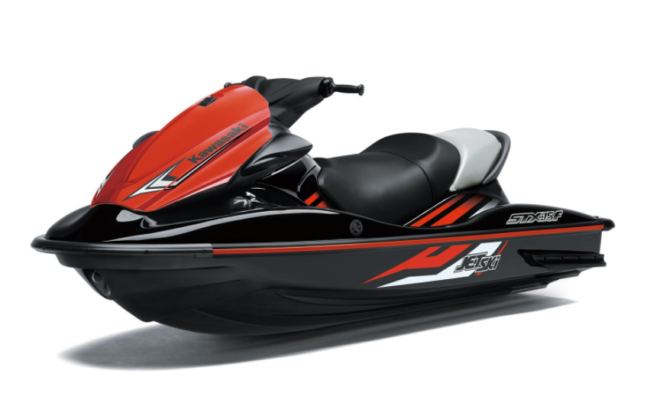
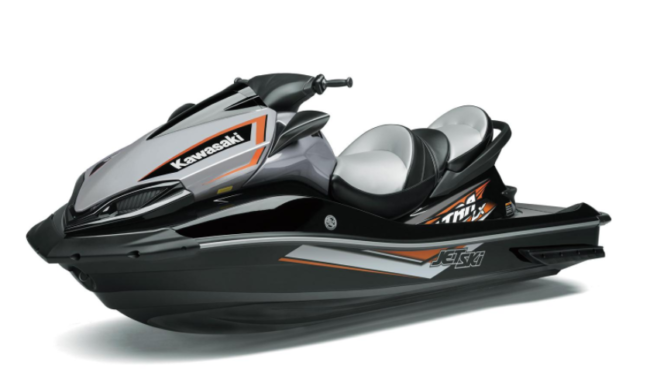
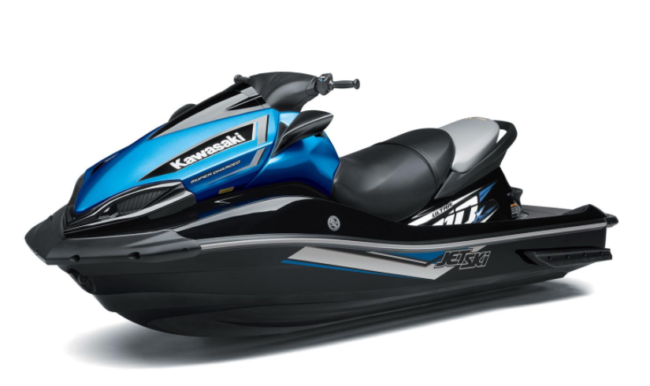
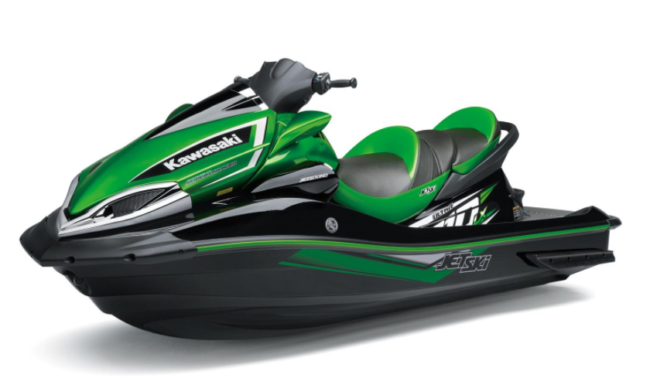
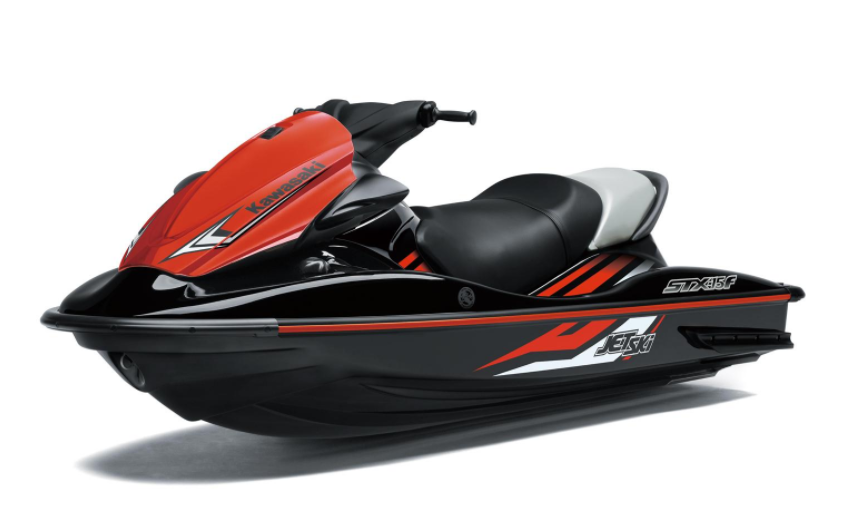
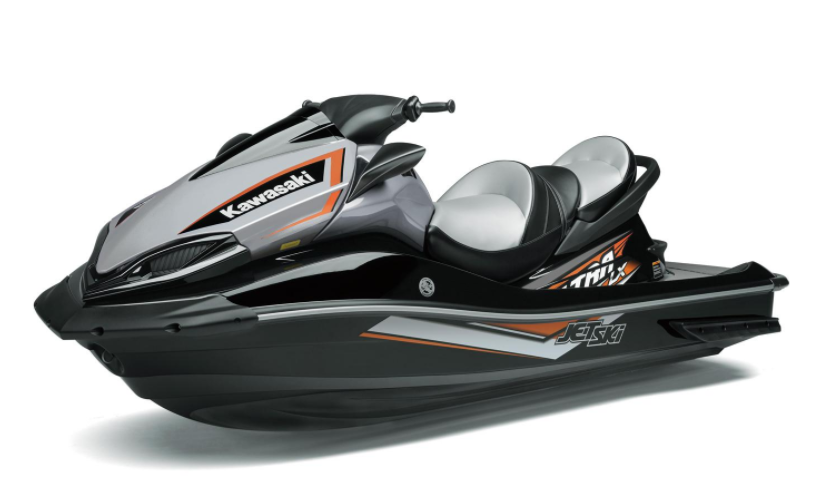
Top row: The longest carry-over of the brand’s lineup, the STX-15F remains wholly unchanged, making the craft a staggering 13 years old, since first receiving the 1.5-liter engine. Prior to the engine change, the STX hull predates that by another 3 years. The naturally-aspirated Ultra LX is given new stealth gray-and-orange livery. Bottom row: The standard 310X sports a brilliant blue hue while the top-of-the-line 310LX goes unchanged.
And while the SX-R continues to march on in this endeavor, the rest of the lineup, as these incredibly prematurely-leaked images reveal, remains all but completely the same for yet another year. In a Facebook post by 88 Motorsport Sweden last night, they write, “Kawasaki has released the 2018 models and there is nothing new coming from them. Same models than 2017 just different colors.” This, fatefully, is as we predicted in the story mentioned above, and also an indicator of Kawasaki’s total commitment to the SX-R over everything else.
During our exclusive test ride of the SX-R back in April, Kawasaki’s Off-Road & Watercraft Product Manager Dave Oventhal told The Watercraft Journal that Kawasaki was looking at developing it’s own braking system. “Trust me, we’re not ignoring them.” Oventhal admitted while discussing the industry impact of Sea-Doo’s iBR and Yamaha’s RiDE systems. As no such brake lever can be found in these images, we’re lead to believe that we are still at least another year away. And as a final observation, the absence of the Ultra 310X SE (Special Edition) and SX-R from the original post also denotes that the JetSkis have yet to reach European dealer floors, which may prove a source of frustration for some.
The West Coast Watercraft Club (WCWCC) just shared a YouTube video about the famous LB2CAT offshore endurance race. The video is produced very well and gives a neat overview and historical perspective of the IJSBA event. It also gives another overview of the 2017 race results as commentary from some of the past and present racers, including the top contenders at this year’s race.
The history of the offshore endurance race dates back to the year 1990 and was then shifted to Long Beach, California in 2002. This LB2CAT race has become the main focus of offshore racing. For most of us who are not able to attend these type of events, it is always nice to see recap videos such as this which give an in-depth review and interviews of the event. As opposed to just seeing result numbers on paper, it’s good to hear feedback from the riders themselves.
Second place rider Mike Klippenstein indicates that boat preparation is key to winning this race, and for good reason. This year’s race definitely saw its fair share of breakdowns. First place rider Cyrille Lemoine also shared some insight on his strategy for taking the top spot in this year’s endurance run.
With WCWCC being the fastest growing PWC club on the west coast, we can imagine that they have some eyes on the scene at this race including some contenders in the event. We can’t wait to see what other video productions they bring to the table for future events. As always, you can check out The Watercraft Journal review of this race including the overall results.
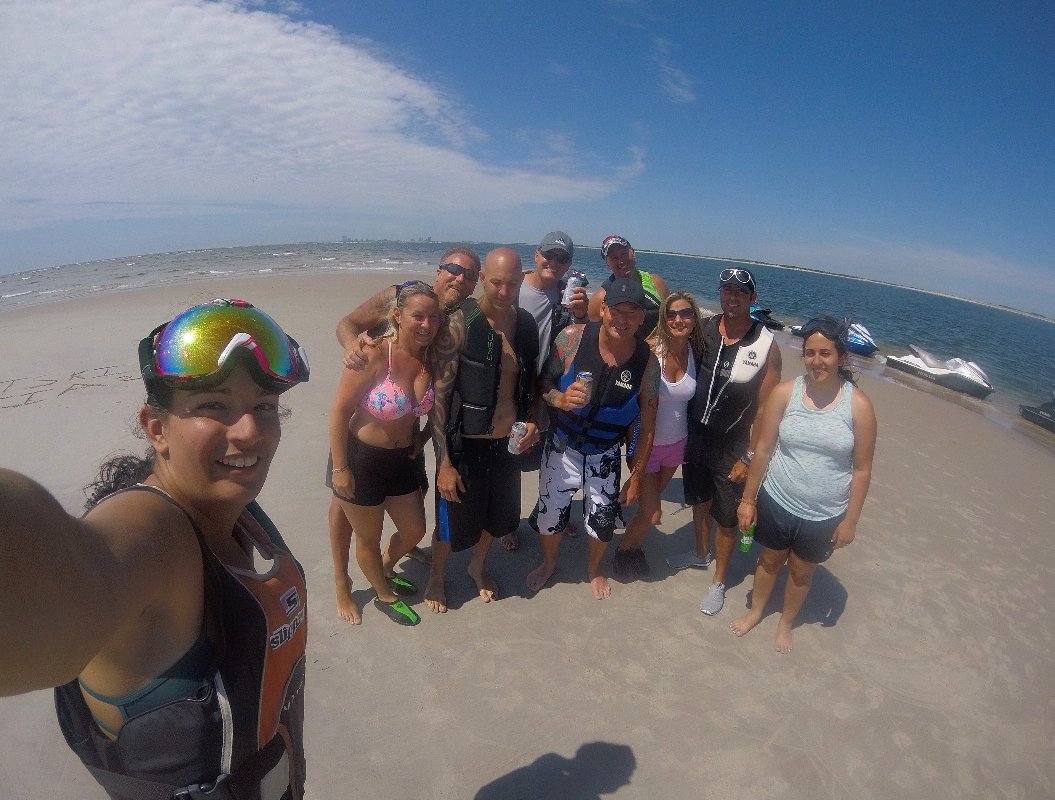
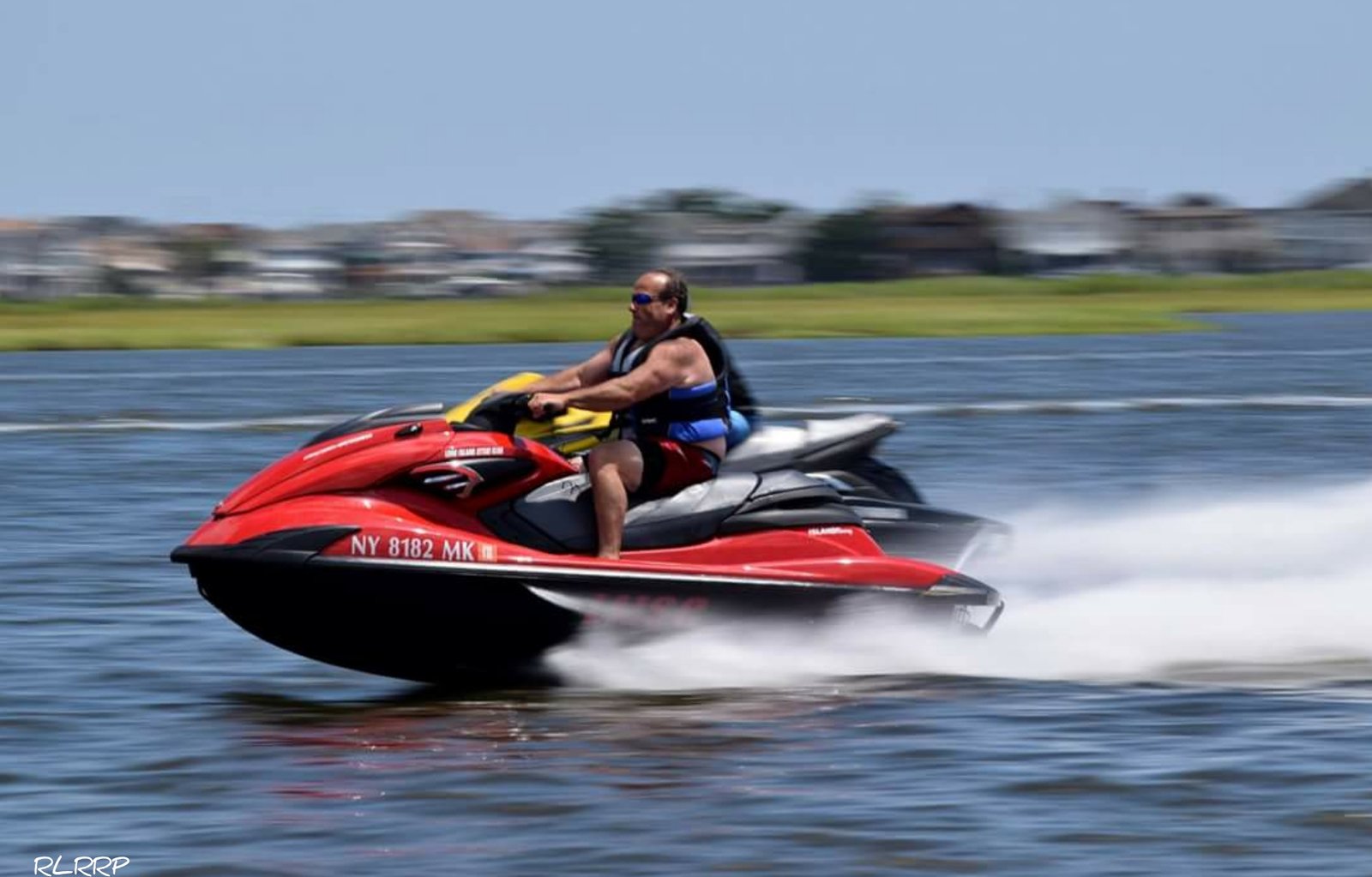
[Isn’t is amazing how social media has radically changed how we interact with one another? Not too long ago, launching a special interest group required mailing lists, newsletters, and quite a bit of legwork, now all it takes is a Facebook page, an Instagram account and some carefully chosen ad words. Recently, The Watercraft Journal received a submission for “Join The Club” that was a little bit shorter than we typically like, from the Jersey Shore Jetski Club. The club is just over a year old but appears to be hitting a pretty strong stride already. Here we let founder Rachael Russo do the talking. –Ed.]
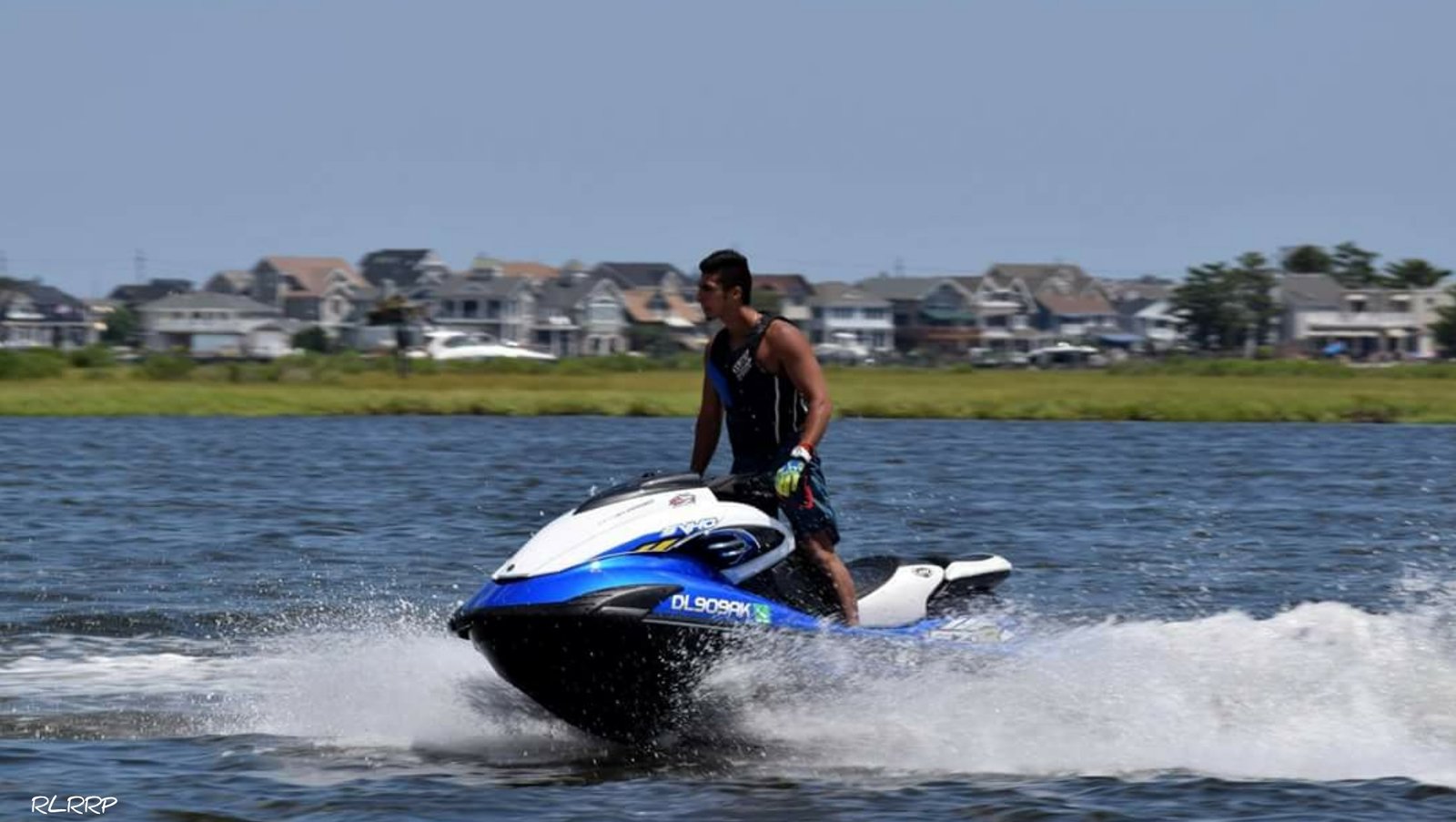
“My name is Rachael Russo, founder of Jersey Shore Jetski Club that started in June of 2016. We do weekly organized rides all over the Jersey Shore during the summer months and the group is a place to sell or trade parts, skis, etc.. We started by social media and connect through our Facebook page and Instagram, and out on the water!”
If you’re a PWC riding club president, group and/or event organizer who regularly hosts rides and is looking for greater access to a larger audience of potential members, and would like to be featured in a segment of “Join The Club” please email 300-500 words about your group, a minimum of 3 high-resolution images, and hyperlinks to your social media pages to [email protected].








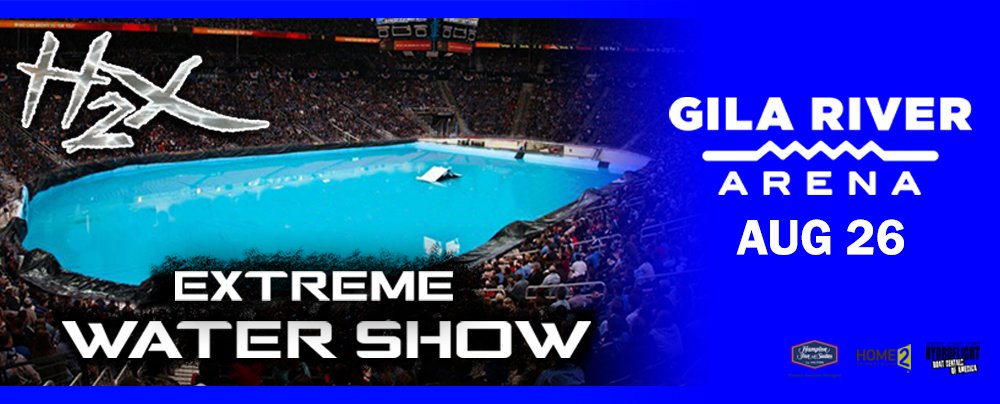
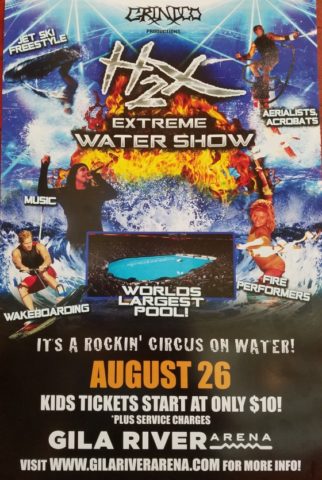 “Sunday! Sunday! Sunday!” the old adage goes. Well not quite, actually Saturday! Saturday! Saturday! August 26 the H2X Extreme Water Show is coming to the Gila River Arena in Glendale, Arizona. The arena will transform into a giant indoor aquatic playground for the H2X Water Show presented by Grindco Entertainment.