Australians have a way of making normal, good ol’ American redneck fun look like a legitimate sport. Take for example hauling over 55mph on a flat-bottomed aluminum fishing dinghy through a densely wooded marsh rife with poisonous snakes, toothy crocodiles and razor-sharp driftwood? Sounds like a suicide mission, right? Well, it’s been a source of endless smiles for southern Australians charging the local rivers around Renmark.
Yet, it wasn’t until 1981 when the Riverland Dinghy Derby actually gelled into an actual competition. Sure, it was a bet between two mates to see who was the fastest, but since that day, the Derby has become one of the premier events in South Australia, attracting competitors from as far away as Western Australia. This year – sponsored by Redbull (y’know the guys who still won’t touch jet ski racing with a 10-foot pole) – the Derby welcomed over 60 boats who competed over 62 miles of creeks, rivers and…well, rocks.
Something like aquatic rally racing, the Derby is a spectacle to witness and therefore such a smash hit. Spectators line the swampy waterfront to watch these high horsepower skiffs slide and drift around tree stumps and sandbars at top speed with only a navigator and pilot on board. No seats, no seatbelts, no nada. This year was particularly special as JetPilot’s own Kyle Pfitzner and Ryleigh Pfitzner paired up to take the win. Yeah, we know. This ain’t PWC racing. But we think we might’ve finally seen a solid use for the Alumaski.
We’re only weeks away from one of the most anticipated freeride events of the year – the 2015 OZ Surf Slam – and already the tension is mounting. As part of the 2015 IFWA World Tour, the OZ Surf Slam (not to be confused with the annual Blowsion Surf Slam happening every September in Pacific City, Oregon), the event has drawn the “attention of some of the world’s best riders including Pierre Maixent, Mark Gomez, Bruno Jacob, Jake Bright, Mick Anthony, Mitchell Young, Nick Barton, and Brandon Lawlor to name a few,” event promoter Jason Barry wrote.
Barry continued, “This will see the event extended from a two day event as originally posted to include Thursday the 19th in addition to Friday 20th and Saturday 21st of March,” which is really exciting. Of course, The Watercraft Journal will be there to provide our tens of thousands of monthly readers a full recap and photo gallery thanks to our own exceptionally talented Andrew Donovan. But there’s a catch: the OZ Surf Slam is still in need of sponsorship help.
Events like these aren’t cheap and drumming up enough prize money and goodies for the winners can be equally costly. Below is an invitation to all you manufacturers, builders and other core companies who want to continue to see this sport blossom to reach out and help support Barry and his organization.
Here’s the original press release:
To Whom it May Concern,
After exceeding all expectations in 2014, the Sunshine Coast Jet Sports Club is proud to announce that the Surf Slam is back!!
I am also proud to announce that the event has gone International with the inclusion of the first round of the IFWA’s World Tour.
2015 will see the event returning to the highly successful Alex Surf Club in the heart of the Sunshine Coast. This venue makes for a smooth event, where the riders can park their car and walk to their accommodation, the event site, the after party, food and refreshments and the sponsors had an elevated grassed platform to display and promote their product.
We appreciate your time and consideration of the attached sponsorship proposal. We hope to finalize the sponsorship list by the 2nd of March at 10am.
If you would like to discuss the proposal any further or if you have any questions please contact me without hesitation.
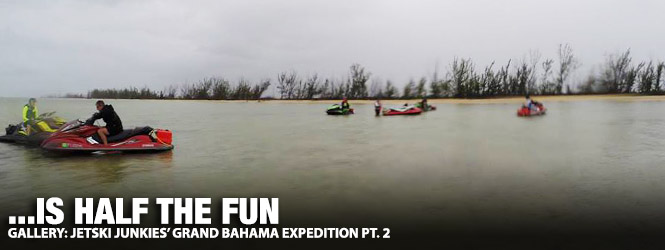
Previously, the Jetski Junkies’ Bahama Ride Crew had endured a 10 hour, 127-mile open ocean ride from Boynton Beach, Florida to Grand Lucaya, Grand Bahama Island. You can read about that here. Three days later, seven jet skis and 10 riders, which included our female solo rider, Linda Cobelo and with no chase boat, set out to find Fox Town, Little Abaco Island some 90-plus miles from where we were staying in Grand Lucaya.
Everyone checked the weather reports and other than some overcast we were a “go.” We set out at 8am Wednesday morning into the Tongue of the Ocean, riding due east along the barren shoreline of Grand Bahama Island. The beaches were much more beautiful the further east we rode, and we passed only two settlements along the way. We saw dolphins, stingrays and of course sharks, correction: big sharks in shallow water off the beaches. We also came upon what looked like an oil/fuel refilling station approximately 500 yards offshore almost to the end of Grand Bahama Island.
The waters at this point were calm with a light rise and fall, so we were able to move right along. We came into McLean’s Town, the last settlement on Grand Bahama Island, pulling into a resort inside the passage for some directions. The locals told us of fuel in McLean’s Town but not on the water. We would need to shuffle cans back and forth. All of us had plenty of fuel to continue on to Fox Town so we decided to push on through the cut. The cut runs between McLean’s Town Cay and Big Harbour Cay and is a very shallow and obstacle-filled pass that dumps you out into The Little Bahama Bank.
The Little Bahama Bank is the shallow crystal clear sound that separates Grand Bahama Island from the Abaco Islands. As we exited the cut we were pinned at WOT and sitting on the edge of our seats praying not to run aground. As luck would have it, all of us cleared the pass and moved on to deeper water. From here we took a route northeast looking for the entrance to Big Cave Cay, one of the many small uninhabited cays spanning from the northeast tip of Grand Bahama Island to the Southwest tip of Little Abaco.
As we turned into our course, the wind kicked up a bit and light rain began coming down making it hard to see and slowing our progress. We soon found ourselves in shallow sandbars. Realizing we needed an alternative route, Vince Cobelo located the entrance to the channel that led into Big Cave Cay (called “cross rocks”), so we headed south a bit and out and around the sandbars until the cross rocks were visible at which point we were able to follow the way point in a near straight line.
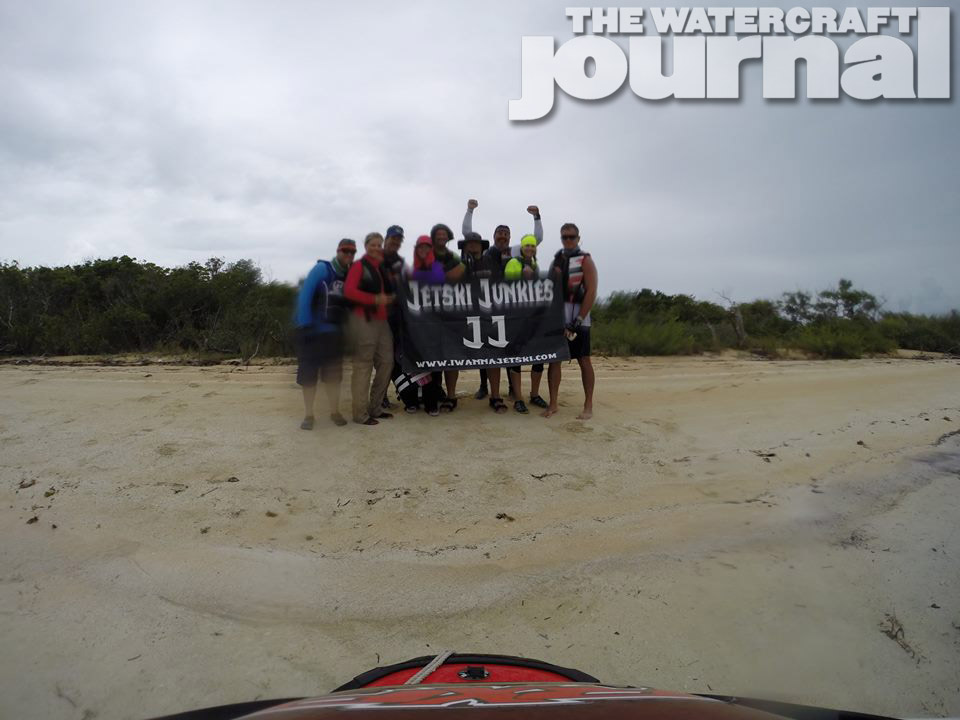
Soon we were running along the western shore of Big Cave Cay and dialing in on a perfect deserted beach for a much needed pit stop. By this time, the rain had stopped and the skies were looking beautiful all around us. It was just a little past noon and we still had a good 30 miles to go to reach Fox Town. Derek Bowles set us up for a group picture and afterwards Andy Hodgen verified our navigation from Big Cave Cay up and around West End Cay putting us in the Outer Islands of the Bahamas. All was good until we rounded West End Cay.
The wind was blowing strong from the northeast putting waves right in our face and with an added twist of having to navigate coral rock barriers like a mine field all the way into Fox Town. Once in the mine field, Ken Roseman took the lead and with perfect precision, carved the team a path through the coral rocks all the way to the fuel dock. You would only know the Fox Town fuel dock or Ronald’s Rentals if you had done your research and looked at what little pictures are out there.
A small restaurant named the Valley Restaurant sits on the bluff with a raggedy dock attached and fuel pumps up across the street near the local market. As the Team neared the docks, the locals came out in droves, yelling and pointing with excitement. The dock attendants met us with ice cold beers at the fuel dock and quickly got us off the skis, fueled and heading to the restaurant for some much needed eats. The settlement is much of what you would picture of old Bahamas, a very slow and simple way of life, not much going on.
The restaurant would scare most tourists but Judy took amazing care of us and, I kid you not, produced the best burger I’ve ever had. A pool table kept a few of us busy while Andy made sure to leave our mark in Fox Town forever with a Picasso style drawing of the JJ logo. We sat with the locals on Ronald’s deck overlooking the aqua blue waters surrounding us and answered question after question until we realized it was after 3pm and we needed to go nearly 90 miles back to Grand Lucaya.
With that said, we mounted the skis and pushed off the dock while Ken and Andy gave the locals a little show while soaking them all with spray from the skis all in good fun. We rallied and decided to take the shortest path home, which at that moment was straight down the middle of the North Sound. Approximately 40 miles into the trek we could see storms building on three sides of us. Of course, the choppy conditions in the North Sound kept us from being able to really move along fast but we kept on pushing forward.
We were halfway to the Lucayan Waterway, and directly between Great Sal Cay and Grand Bahama Island when the storm hit us. The rain fell in sheets, reducing our visibility to 5-feet at best as the winds kicked up to 30mph (or worse) causing growing waves directly in our face. Everyone came together and we rode tightly within view on a new course due south in an attempt to get to land. We were 10 miles offshore and the pace was slow. Shortly after our course change, thunder and lightning began to crash overhead.
We could see the strikes ahead of us hitting the water but we had no choice other than push on towards land. The only GPS working at this point was my trusty battery-operated Garmin 76cx. We did have our VHF radios though, and those were working fine. The conditions worsened and waves got much larger. I could not see at all so I stopped. My GPS was still working but I got turned around and I didn’t trust it. I told everyone to stay put while I tried to get a read on the GPS, but it was no use because my gut told me one thing and the GPS said the opposite.
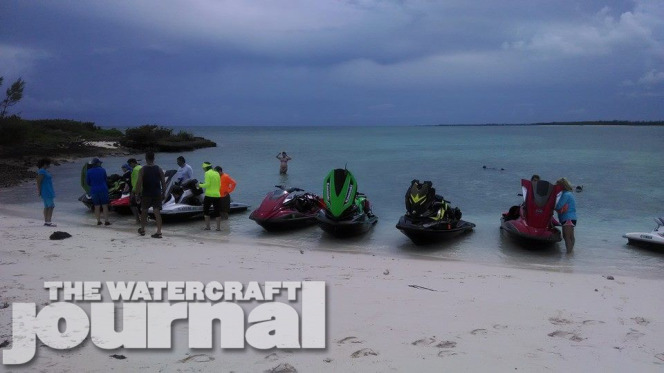
As I approached the team, Donna and Leslee both were shouting and pointing to what looked like trees in the distance. It was extremely difficult to tell due to the heavy rains but at this point, it seemed like a sign so we went for it. And as luck would have it, it was land. A beautiful sandy beach where we were able to stop and wait out the storm. It is hard to remember how long we were there but the conditions finally settled down and we headed back out.
The GPS was back in business so we rounded the tip of what we thought was a peninsula. Our plan was to run the shoreline of the island as close as you could get without smashing into rocks or hitting bottom. No sooner did we make that turn did that storm just pop right back up. Vince and I stopped and the others did also, but Derek and Donna kept on. We lost visibility again, so Mike radioed them to come back and hold tight. Again we took shelter near shore and we made the decision that we would wait it out here even if overnight.
What was funny after the fact, is we believed we were on Grand Bahama Island, a peninsula that jetted out from the island, but later we discovered that was not the case. Finally, after some time, the storm passed and the skies ahead of us cleared giving a view of a distant shoreline. We collectively made the decision to stay close to shore; however, we couldn’t stay too close due to the shallow nature of the North Sound. So the decision was made that I would run out front and all would follow in single file as best as they could.
With the storm gone, the waters smoothed and became very clear. I was able to see the depth easily making for leading the team through the shallow rock-filled waters much better. We were nearing the Lucayan Waterway when we got one last bashing from Mother Nature, hitting us with rain and wind again.
Once in the Lucayan Waterway, we were ghosts running at wide-open, cutting through the Grand Bahama Island then out into the Atlantic one last time before cutting in to Port Lucaya Channel. This brought us back to the Flamingo Bay Resort & Marina around 8pm that evening. We were met by rest of our crew who stayed back, the Harbor master and hotel staff thankful for our save arrival back at the marina.
We traveled nearly 167 miles of Atlantic Ocean in 10 hours of moving time in one day through a tropical depression. It is a story I look forward to sharing with my grand children and of course, all of you. The entire expedition was comprised of seven PWC, two chase boats, and 18 persons traveling over seven days, six nights and racking up a total of 440 miles of open ocean riding from Boynton Beach, FL to Fox Town, Little Abaco Bahamas and back.
Likewise, 2014 was a big year for Yamaha with the introduction of the Super Vortex High Output performance package. Similarly, Yamaha greatly improved their SHO plant by increasing cooling capacity, redesigning lightweight pistons, increasing the supercharger’s volume and upping boost pressures. Dropping internal temperatures, increasing boost upped the newly coined Yamaha to a dyno tested 260 ponies. Not exactly the sky-high output of the Kawasaki, but well enough to get the jump on the brand’s rival, Sea-Doo.
When compared side-by-side, the two are impressively (although not altogether equally) matched. Below we’re going to show the difference aftermarket parts make on some already impressively-powered PWC. In our first video, the 310R has already been modded with a reflashed ECU and a few “other goodies” primarily consisting of a prop, intake grate, ride plate, etc. from R&D Racing. The FZR, on the other hand is complete stock. As per JayJayPie’s own description, “If you pause the video at 35.5 seconds, you will see how far behind the FZR is (as it should be).”
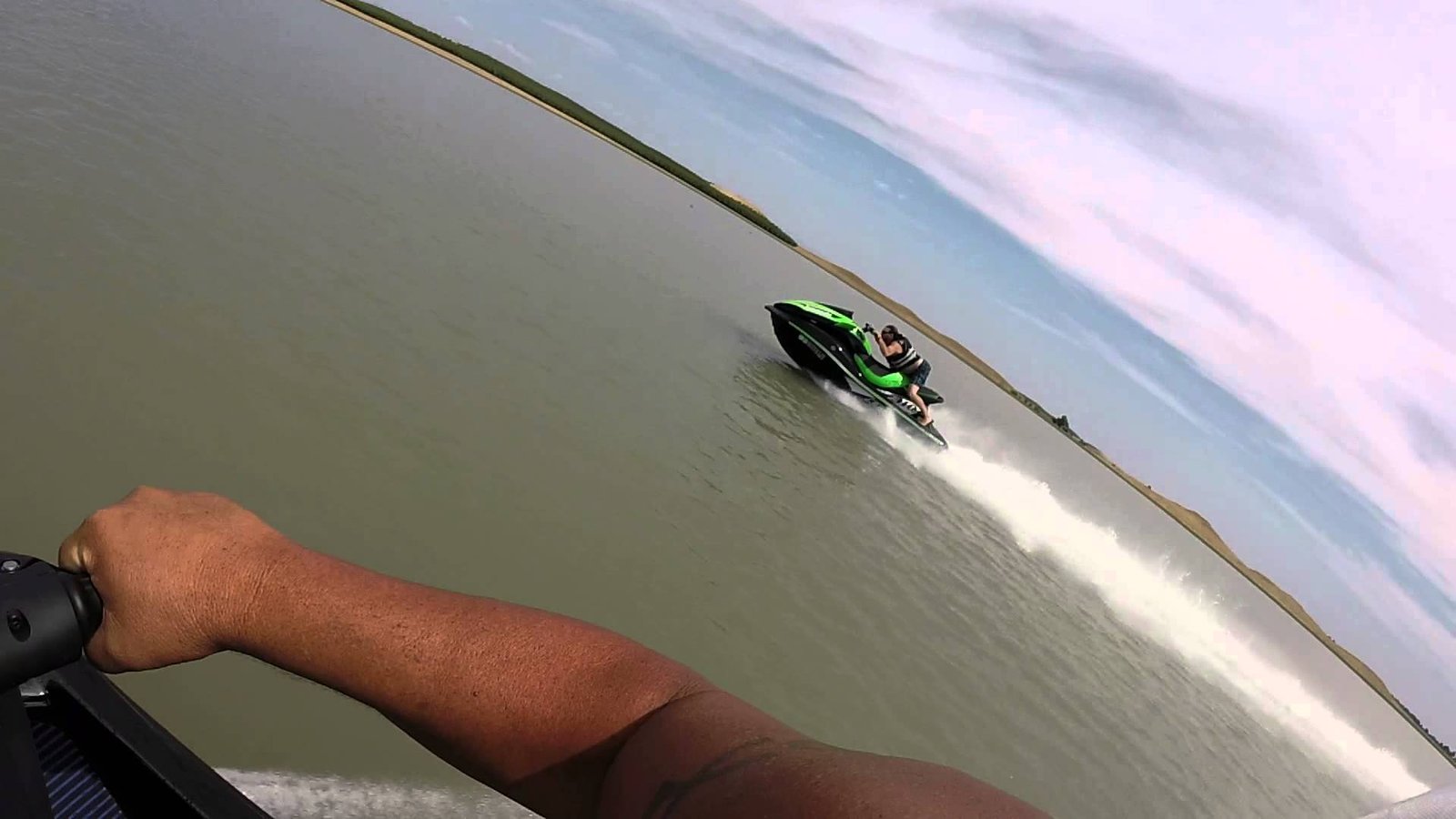
A short while later, the SVHO has been radically improved. Now equipped with a R&D Turbo Package, the 310R with its R2 reflash a stock supercharger is handily beaten. Although both skis “pretty much have the same upgrades” (again, a prop, intake grate, ride plate, etc. all from R&D), the FZR pulls away from the green-and-black 310R. Filmed on California’s Modesto Reservoir, the FZR topped out at 85.4mph, well ahead of the tweaked Kawasaki. JayJayPie does admit that, “I said in the video that my 310R had the turbo as well. [I] didn’t mean to say that. However, an R&D Turbo will be installed in the near future!
As a long range jet skier there are definite things in a PWC that I look for. Reliability, stability, the overall ride, the power, the fuel economy, the storage, the comfort and then after all that, the looks of the ski. Most of the riding that my family and Jet Ski Club do are overnight 200–to-300 mile weekend warrior tours on a monthly basis.
Most of the time, my wife and or children join us on these rides so seating comfort, stability and storage space becomes of serious importance when you are carrying gear, food, snorkeling equipment, etc. for overnight stays by PWC only. Fuel range is another issue so having a ski that can keep up with pack but not run out of gas in 20 miles is huge factor. The Kawasaki Ultra 310LX series hits all the must-haves and here’s why:
From the long stable body and it’s massive deep V-hull to it’s array of options and ridiculous amount of storage to the modes of operation and amazingly stunning looks, this ski could make anyone a better rider. This JetSki was built out of the box to cover the largest demographic as well as any PWC rider, from recreational riding one weekend to racing the next, to short heart pounding drag racing and carving up a buoy race track, to long-range endurance races and riding to multi-day touring and offshore expeditions, to just playing around with family and friends, wake boarding, tubing, knee boarding, etc.
The Kawasaki Ultra 310LX meets another check mark for me. This past Summer our daughter, Lexi, turned 14 and became legal age in our state to operate a boat (and PWC) on her own. Of course, the first requirement was her boating license, which she obtained along with picture ID. Now, Lexi is no newbie to PWC as both her and our younger son have been riding with us and the club for years now and of course, in private waters have been able to ride themselves (which of course has made it much easier for our daughter’s transition into now riding on her own with the club).
Our daughter has now ridden on her own the last two club tours and here is where the Kawasaki 310X comes in: The Ultra has a “SLO” key for for beginners, ECO mode for fuel efficiency and then rip-your-arms-off mode (for lack of a better term). Lexi was able to start in the Learning mode, which still allows the rider to go 48mph but with a slower low and middle range allowing smooth acceleration and time for the new rider to get the feel of the JetSki, its options and where everything is located.
Once comfortable, the rider can switch to the regular keys, but still have the option of ECO mode. ECO mode opens up the ski but still keeps everything smooth and caps the top speed just a little below 60mph, while keeping your fuel usage to a more efficient rate. Once Lexi was comfortable utilizing Learning Mode, she was able to easily make the change to ECO mode and now is riding what I believe to be Kawasaki’s most versatile JetSki like a pro. Not to mention, she absolutely loves the JetSound audio system, but that’s another story that she can tell.
Every year in January, over Martin Luther King weekend, the Daytona Freeride takes place in sunny Daytona Beach, Florida. This event has become one of the most popular and recognized event in the PWC freeride community. This event was founded as a surf event, but in recent years, there has been another segment that has been rapidly growing. That segment has become known as “Flatwater Friday”.
Several years ago, (at least as far back as 2010), a few guys decided to take a short trip over to Lake Dias in nearby Deland for a quick tuning session. This started out as a relatively small group of guys, with big motors and short, light carbon hulls. For the most part, these boats were considered “Flatwater only”. They ran total-loss ignitions, short poles, and were setup with massive power. They were tough to ride in the surf, and the exposed ignitions were not “salt friendly” without some extra care. This made the freshwater lake a great testing/tuning spot.
When word got out, several people either wanted to watch, or potentially ride these monster machines (they were far less common than they are now). Several guys ended up at the lake, and were allowed demo rides on these new machines. Some where there for the motors, and some to see how these newer hulls rode. Tim Berkstresser with Superfreak Skis was one of the first to have some skis out there, most noticeably the -4.3 carbon freaks of Josh Rosa and Lucas Vasconcelos. These guys were very generous with test rides, and exposed a lot of riders to the aftermarket hull/big engine experience. Sunk/hydrolocked skis were common with inexperienced riders demoing these skis, and the guys would get them running and send the next guy out. It was true jet ski comradery at its best.
This event was loads of fun, and gave people the “try before you buy” opportunity. It has continued to grow each year. The following year, Superfreak was present once again, and the guys from Xscream were on scene debuting the new “Kong” hulls. This was there first in-house carbon competition hull, and several people showed up to check them out and take a test ride. They also had various engine configurations for people to try. With the support of Xscream, Superfreak, and recently Thrust Innovations, this impromptu event has grown to be an integral part of the Daytona Freeride.
Fast forward to the last few years; this event has exploded in popularity. For the last 2-or-3 years, so many people have been in attendance that parking has been an issue at the ramp. Hundreds have been in attendance at any one time. Almost all major manufactures have a part in this, and have some demo equipment on site and available for test rides. Hull manufactures that have participated in recent years include, but are not limited to, Superfreak, Xscream, Rickter, EME, Hurricane Industries, and Rage Composite Works. Engine packages from Xscream, Thrust/Dasa, and True Performance Engineering have all been available for demo.
In addition to the demo side, there has been an impromptu thrash session with several professional freestyle riders. Jason Stoyer, Daniel Martin, Michael Ratti, Pat Bogart, Chris Anyzeski, Jeremy Parr, Jason Hurt (AKA “Tricky”), Peter Waldron, Jace Forest, Rick Roy, Ryan Doberstein, and Johnny Leftly are just a few that have shown up and thrown down! Local law enforcement came by last year to investigate all the cars, and stayed most of the day videoing and talking to the riders. They even sent their buddies by on the next shift to watch the “crazy, insane stuff” that we do. It was a great interaction, and they enjoyed the show. It was great to make some friends with the local guys and have them support us in what we do.
If you are in search of a new hull and/or powerplant, and need a demo ride, consider making it out to Flatwater Friday. Most all hull and engine manufactures will have something there for you to check out. It’s a great time with a great group of guys. It is done on Friday to have minimal impact on the event at the beach. Consequently, if its a poor surf day, attendance at the lake thrives. More guys are willing to come out and watch or test some skis out if the surf is poor.
The Watercraft Journal: Christian, thank you for taking the time to sit down with us! For many of our readers, they have no idea of your extensive racing background – dating back to Australia’s world-famous V8 Supercar series, the American LeMans and even entering into the Australian Drift Series! What drew you to these awesome racing series? Tell us how you got into racing at such a competitive level.
Christian D’Agostin: Motor racing has been a huge portion of my life, from the age of 2, dad had me at the track. He was the team manager for Garry Rogers as a driver who now runs the very successful Volvo V8 supercar teams in Australia today. My uncle built a very “agricultural” go-kart when I was 5. I basically drove that into the ground, which is when dad got serious with my potential and brought a proper Sprint Kart. So from age 10 to 20 we basically raced everywhere, every weekend.
This was an excellent baseline to go forward with. I owe all my tin top racing success and opportunities to Commordore Cup – a V8 sedan series which I won two Australian championships with, which opened the doors to V8 Supercars, in which I was able to race many rounds and seven Bathurst 1000 races.
I was in Adelaide racing at “Race of 1000 Years” where the American LeMans series was racing on the Formula 1 circuit. I was asked to race a Porsche GT3R for an American Team in the race. I had never driven a left-hand steer before and finished 7th outright and 1st in class. From there I was asked to do the Daytona 24 Hours, which was a great opportunity.
My Holden (General Motors) alliance got me a opportunity to compete in the the Australian Drift series with a 900hp Commodore (Pontiac) prototype, which was a real eye-opener coming from 20-plus-years of grip racing to drift!
WCJ: Leaping from top level auto racing to jet ski racing might be considered by some as taking a “step backwards.” Do you feel this way? What prompted you to make such a big switch?
CD: I had done everything I could do with my motorsport career within my parameters. I was lucky enough to be able to do it full time for 5 years, and 24 years in total of competition! But I never saw jet skiing as a competition for me, it was a completely recreational outlet. Being on the Gold Coast and all, we were just always in the surf on our GP1200R’s just having a blast – then in 2005 there was a surf race here on the Gold Coast, thought I would do it for a bit of fun. And look what happened! I was hooked.
In no way at all do I see jet ski racing a step back at all. The completion and competitive nature of all riders I have raced [against] are just as hungry to win as anyone I have come across – they are racers too – just with a different skill set.
WCJ: Are there any major lessons that you’ve learned from auto racing that apply to jet ski racing? What have you seen in your experience that today’s jet ski racing could learn from automotive racing?
CD: Believe it or not, I take them all to a jet ski event. Racing is racing. The skill set is a little different, but they do have a lot of similarities. The mental and physical fitness, and preparation is the biggest – especially long distance offshore racing. These jet skis are being squeezed to [their] breaking point by the riders and engineers. [It’s] no different to motor racing. So preparation of both is paramount.
Jet ski racing fundamentally suffers from the lack of corporate support. More so in Australia where even the manufactures of the skis we race is minimum across the board.
Unfortunately in my experience you can’t wait for the sponsor to be interested in the sport, you have to take the sport to the sponsor. This will always be difficult if it can’t be found on television. Although jet ski racing has been around for years, I still don’t think it’s [reached] its potential. People can’t afford to play the horsepower war any more, the OEM stock classes and “one make series,” which myself and a couple of your fellow countrymen raced in China late last year was a great success, and put on some spectacular closed racing. I think this a key to growing the sport.
WCJ: Since moving to jet ski racing, you’ve experience some marked success: winning the 2013 Australian Offshore Triple Crown and 2014 Australian endurance championship, a 1st place in this past Pro Open Runabout Enduro at Perth, (as well as a pair of podium finishes in Pro Stock and Pro Open) and even crossing the infamous Bass Strait on a JetSki to raise awareness for prostate cancer! What big goals do you have for your jet ski racing career for 2015?
CD: Now that we are the Factory Kawasaki Racing Team for Australia for 2015, I would love to repay their commitment with a third Australian title. We also as a team have to right a few wrongs – we have a lot of unfinished business with the King’s Cup Endurance races and LB2CAT – you guys would be still talking about the time we did in practice if I could of replicated in the race! Hopefully this year. But the biggest feather in our 2015 cap would be to win the World Offshore Series.
WCJ: We caught you right before you departed to Lake Havasu City, Arizona for the Mark Hahn Memorial 300. What are you bringing to this race? What class are you entering? What expectations do you have for this race?
CD: We have put everything and [more] into this event. Being our first [Mark Hahn Memorial] 300, we have buried some perfectly good components – pushing [them until] we broke it, trying to eliminate all [the] gremlins. We have a 78, 75 and 72mph configurations for the event, obviously the 72 mph gives us [the] best reliability and economy – it’s super important to finish for us as its Round 1 of the World Offshore Series. We will be doing Pro Open and I will be riding by myself [Ironman]. And of course backing myself to win, which would be huge, very hard, but not out of the question.
WCJ: Will this be the last America will see of you this year?
CD: All going well, our [Kawasaki] 310X SE will stay with you in the northern hemisphere for the rest of the year. LB2CAT is locked in, Round 2 of the World Series in Russia, the Aqua Bike Finals again in China, and all going well, we will finish the year off at King’s Cup. And of course finishing our AJSBA Tour.
WCJ: That is an extensive schedule! We wish you the very best both this weekend and throughout the year! To conclude, is there anyone you’d like to personally thank for helping get this far in your career? (Now’s the time to “shout out” to your sponsors!)
CD: First of all, Jamie Eade, owner of Brisbane Kawasaki. (The JetSki whisperer!) He has been there 100-percent all the way. I don’t think he knew what he was getting into when he met me. [Thanks for his] superb knowledge of the craft, and a man who is prepared to sacrifice to get the result. Next, Cameron Martin – the rock of the team. He’s always reliable – never missed a meeting here or overseas. He’s got it sorted while your still thinking about it. [Finally,] Tom Hayes, our shop race mechanic who never gets any accolades. [He] spends the most time in the shop fixing, building, repairing three race boats as his priority. [He] never complains, never says no, just always steps up.
[And of course,] my beautiful wife Sophie and daughter Sienna for their ongoing support of my racing, and putting up with all the away time. There’s nothing better to come home to than you two guys – I love you both. Big thanks also to Kawasaki Australia, Brisbane Kawasaki, K-Speed, PTS, MissBikiniLover.com, Jettribe, 360 Health, Fight Like a Pro, Sole Revolution and PWCOffshore.com
And already, the industry is taking notice. At this past Miami International Boat Show, Yamaha WaterCraft Group took home two prestigious NMMA (National Marine Manufacturer’s Association) awards for both their all-new Connext helm control system featured on all 24-foot Yamaha boats, and for the aforementioned RiDE control system. Both innovations provide dramatic leaps forward in driver control and maneuverability as well as added personal safety.
Yamaha WaterCraft Group, a division of Yamaha Motor Corporation, U.S.A., announces that it received two prestigious awards recognizing excellence in design from the National Marine Manufacturers’ Association (NMMA).
Honored for innovation by the NMMA in the Mechanical and Electrical category was Yamaha’s all new Connext helm control system available on all new 24-foot Yamaha boats. Connext is an easy to use, all in one system that combines an LCD touch screen with a joystick control, allowing the driver to easily and intuitively access all major electronic functions of the boat. In addition, Connext serves as the entertainment hub of the boat, providing full access to radio and stereo controls, satellite radio, Bluetooth connectivity and USB connections.
Yamaha’s new RiDE system received the innovation award in the Personal Watercraft category.
RiDE is the world’s first handlebars with dual throttle controls and is available on Yamaha’s 2015 FX and VX Series WaveRunners. Pull the right hand throttle lever to go forward, pull the left hand throttle lever to slow down and go in reverse. Let go of both levers and the watercraft is in neutral. The right and left throttle levers can work together at speed to let the driver dial in maximum control over their ride.
“Receiving these two highly coveted awards reflects our commitment to constant innovation and bringing all new technologies and features to market that make our customers’ experiences with our products even better every time they are out on the water,” said Bryan Seti, general manager of Yamaha’s Watercraft Group.
The NMMA Innovation Awards are presented annually at the Miami Boat Show. The Innovation Award honors manufacturers and suppliers who bring new, innovative products for the boating industry to market.
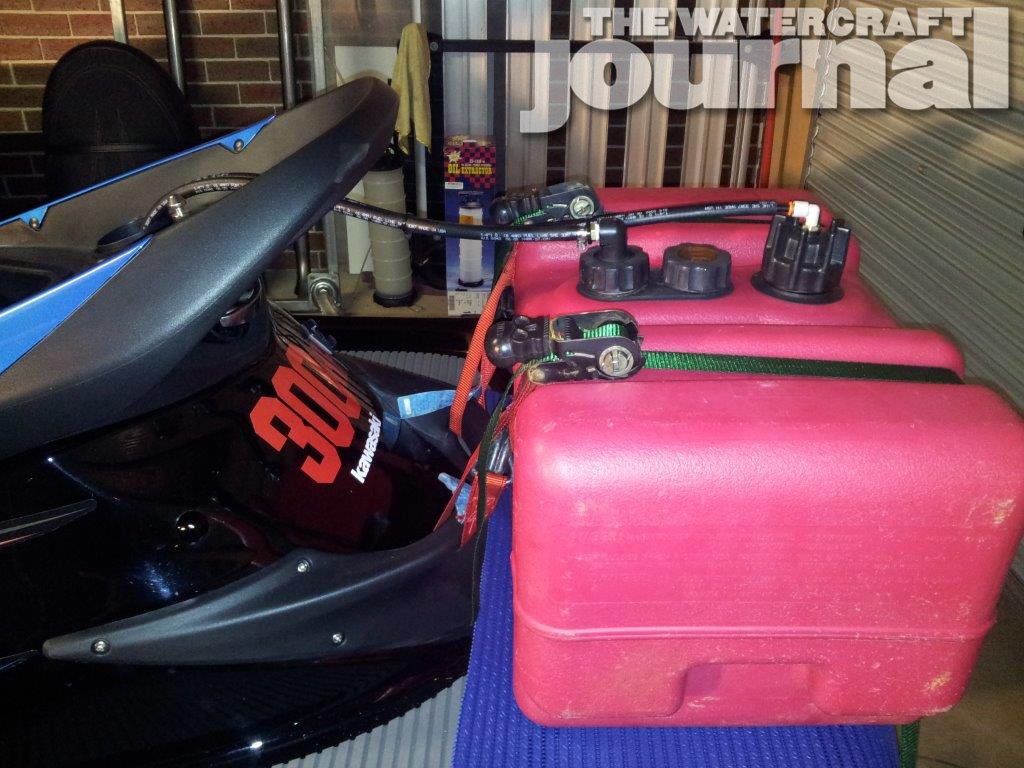
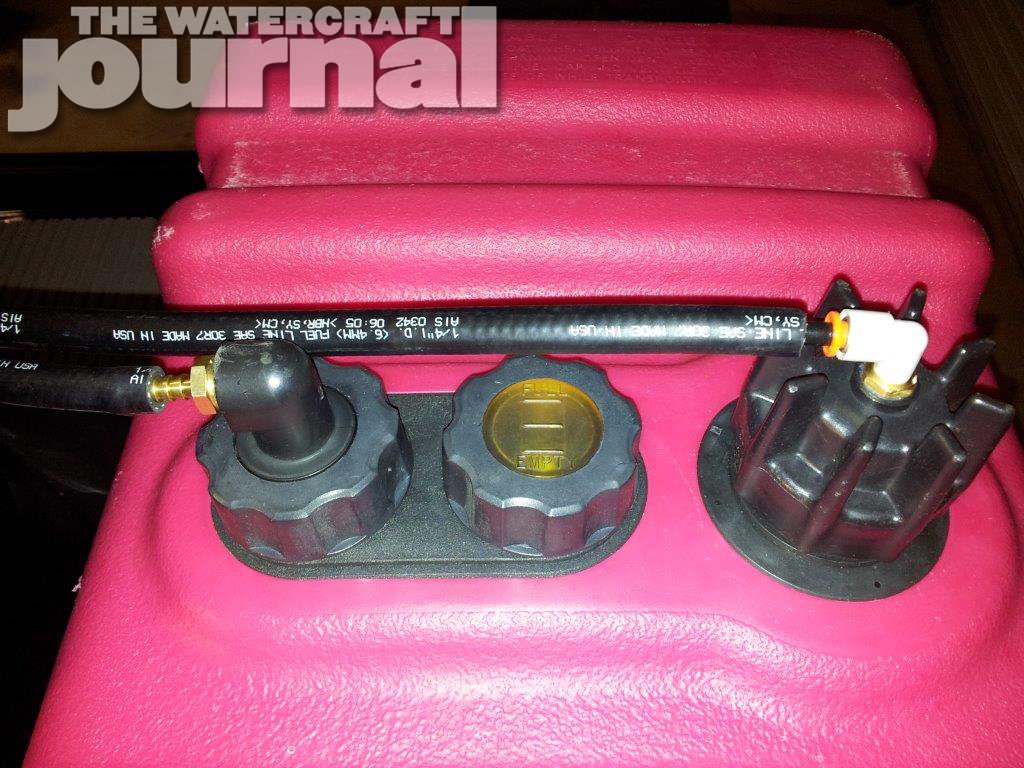
The idea came about from our riding group doing extended day rides. The long distances required us to find fuel wherever we could. This was even more difficult when riding in protected areas where fuel spillage becomes an issue. This system is very simple and it works without the use of pumps, instead working solely on the vacuum created in the main tank vent hose. The main fuel tank draws from the auxiliary tank first. This way also cuts out any chance of fuel spillages while transferring fuel from jerry cans being carried on the back.
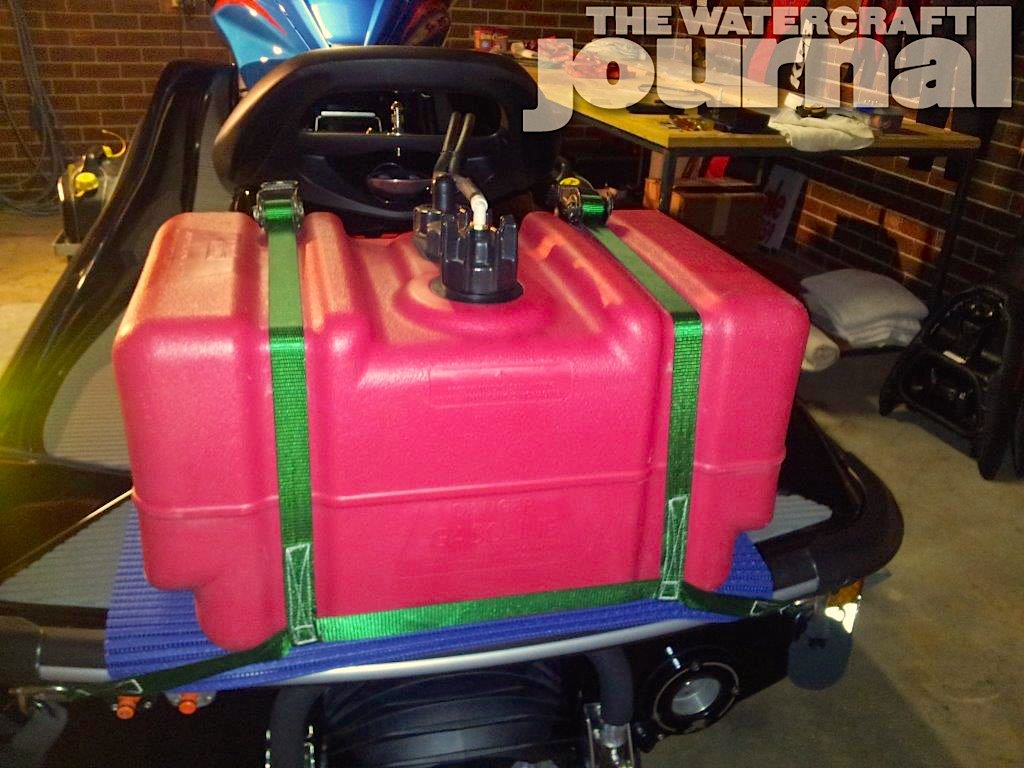
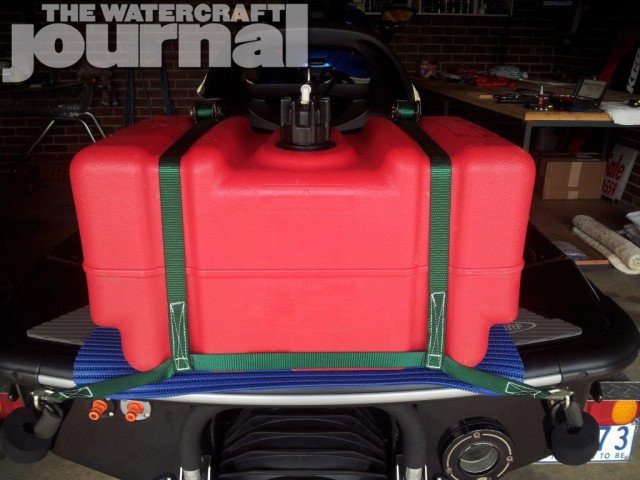
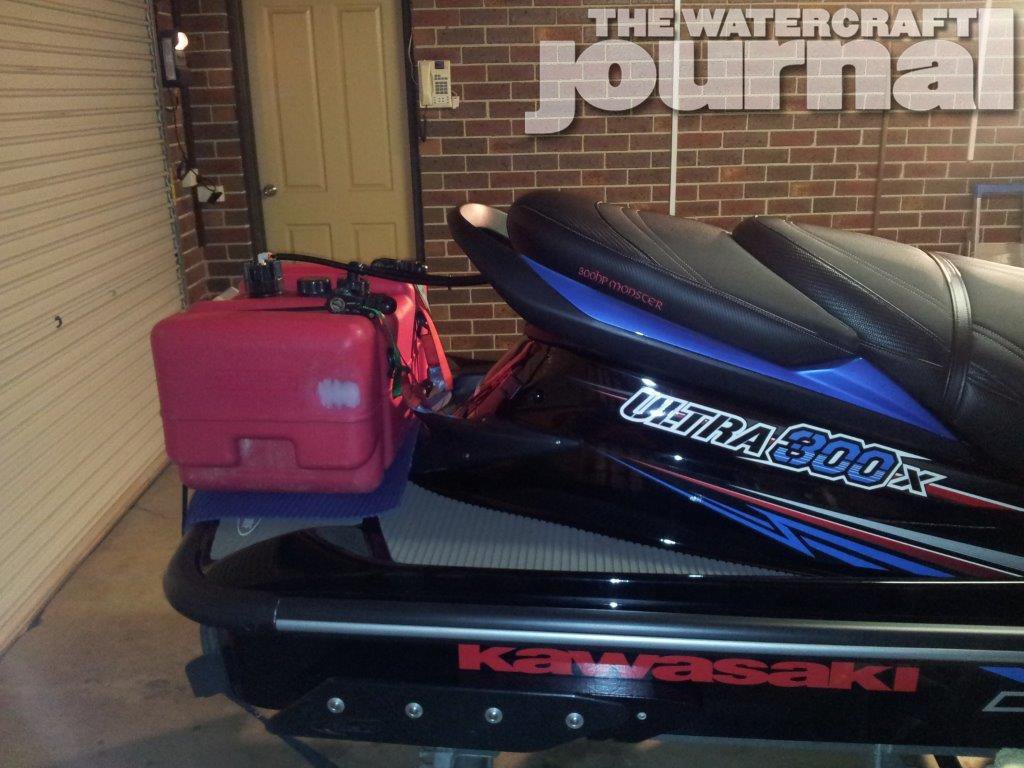
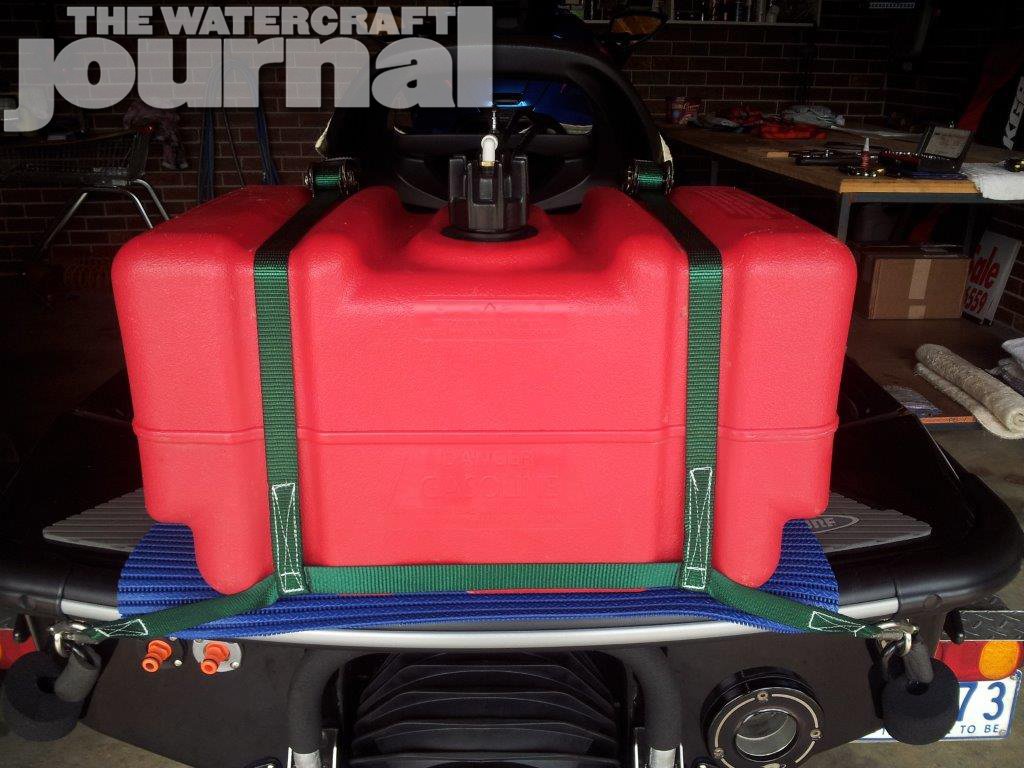
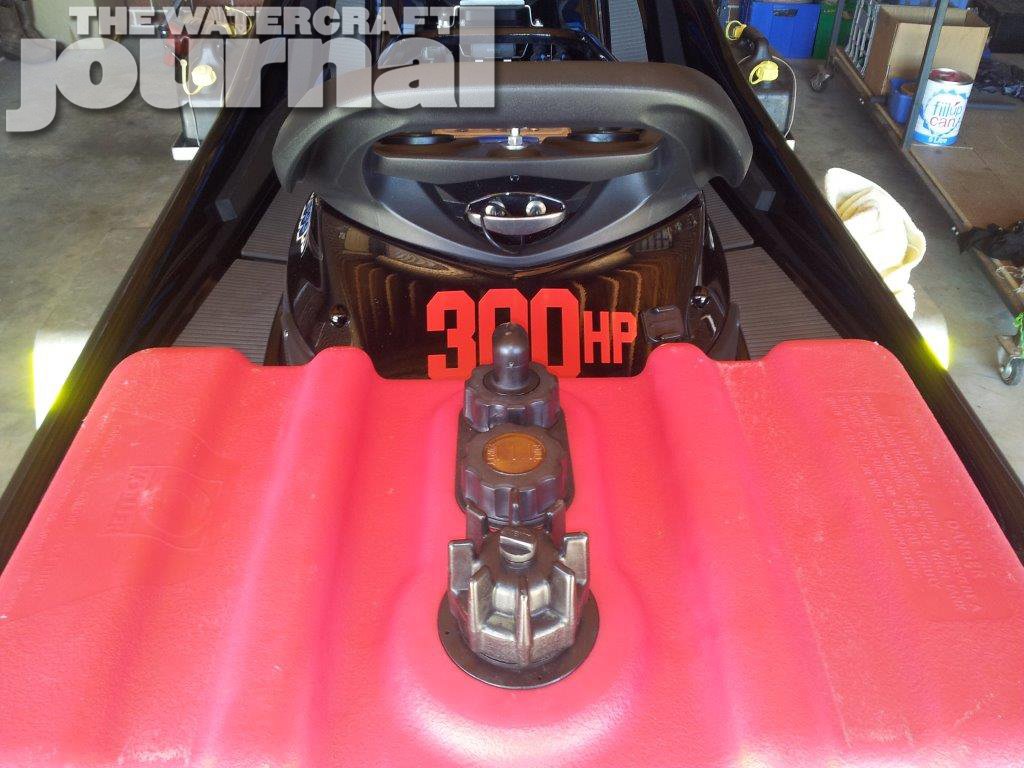
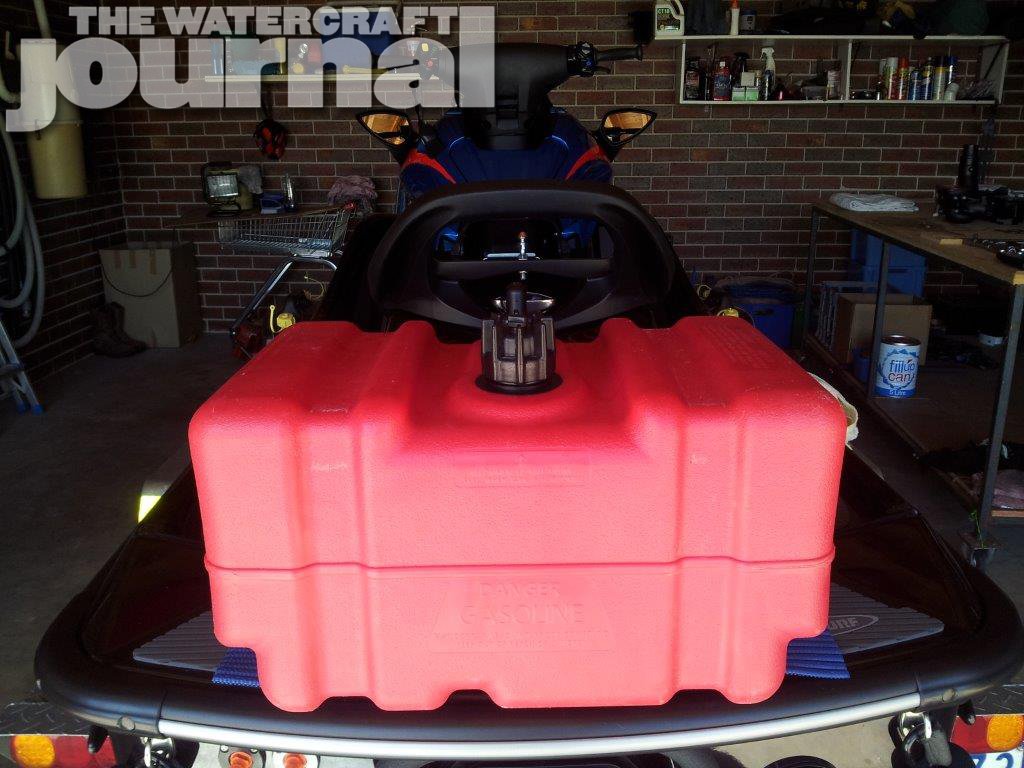
This walk-through is the first one I made using an older style fuel cell fitted to the swim platform of my own Kawasaki Ultra 300X, I have since made others using a newer style tank, and many others here in Australia have since copied the idea (with my permission) to their own skis. Many have had no mechanical knowledge and have found it very simple to replicate.
Below are the steps necessary to replicate this very easy-to-install auxiliary fuel tank to your runabout. It shouldn’t matter if it’s supercharged or not, the fuel delivery system remains the same.
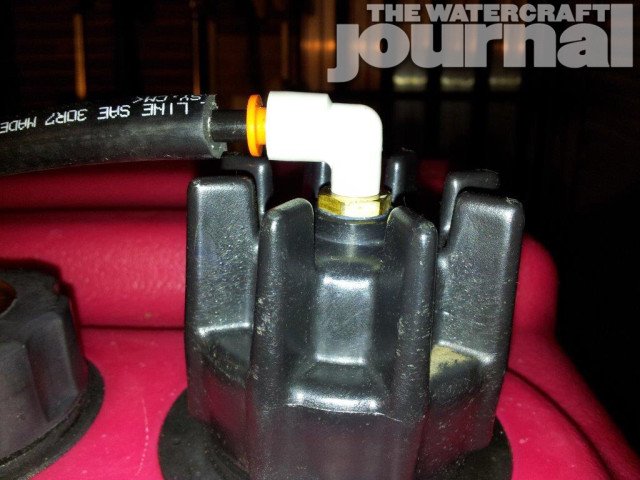
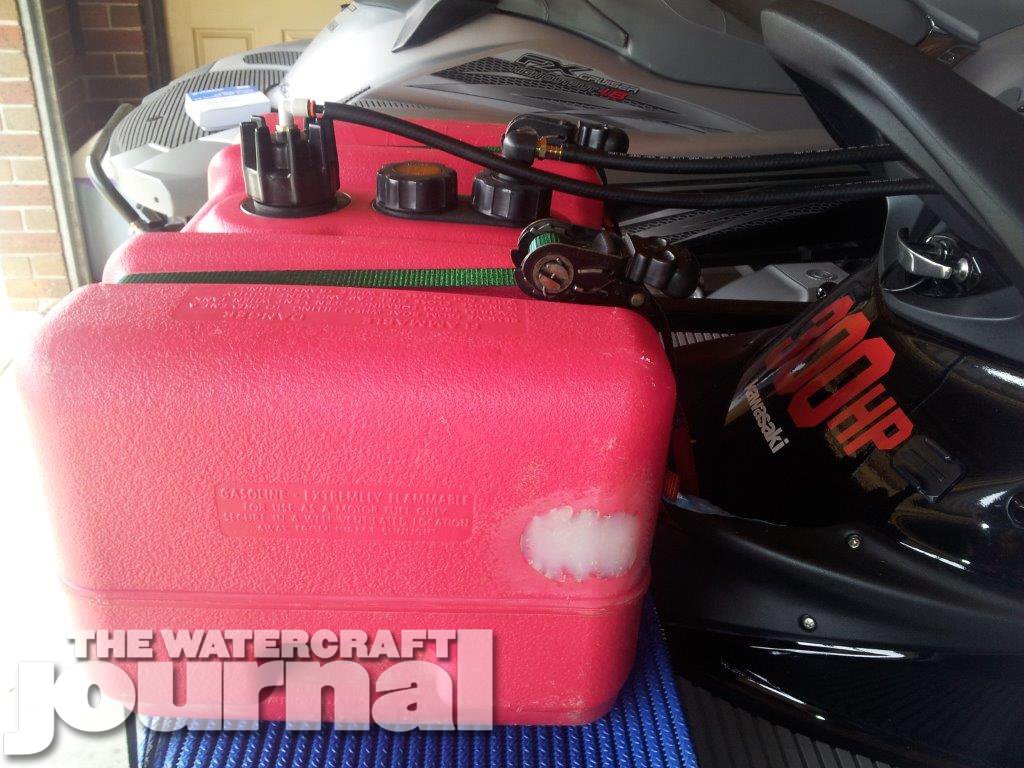
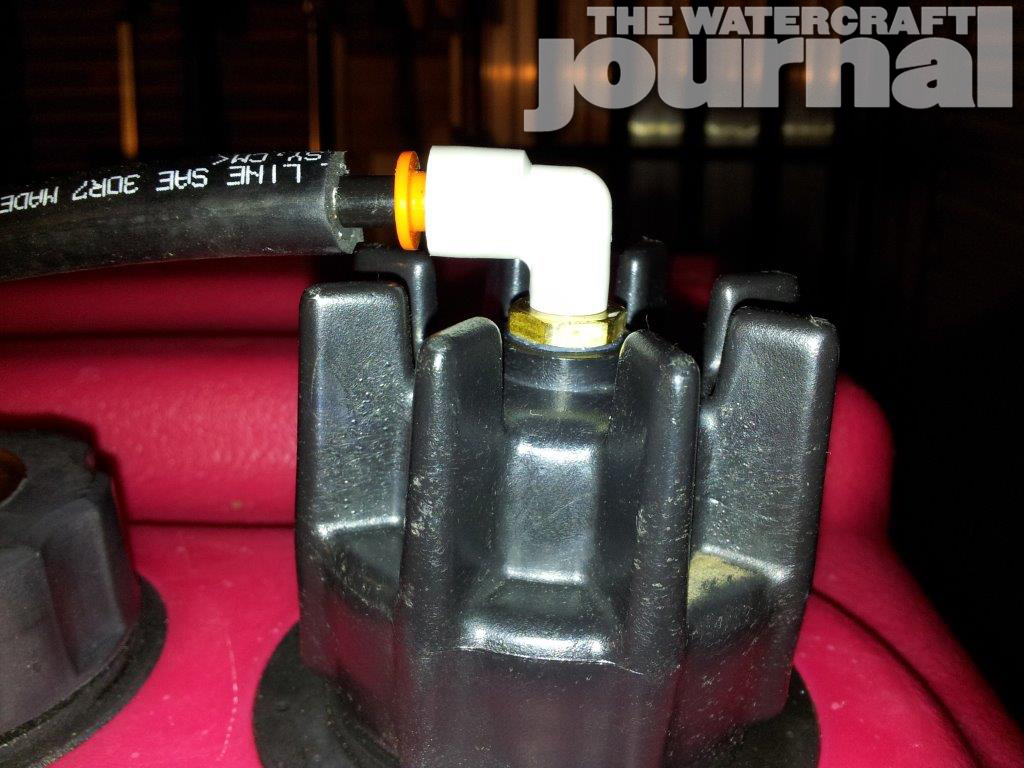
You’ll need an insulated and self-contained fuel cell, two sets of hose quick connects (more can be used if you want to remove the hose completely from the rear tank), fuel hose (6mm), ratchet-style tie downs, zip ties, hose clamps and fittings for the fuel cell.First, locate and remove your vent hose from your ski’s fuel tank. Add a length of fuel hose to the fuel tank vent nipple, on the other end of this hose you place a 6mm fuel-rated quick connect. Place the opposing quick connect on your OEM vent hose, this allows your OEM fuel tank to operate as it was designed (noting the non-return valve has not been removed).
[Above: Next, fit the fuel cell to the rear of the ski. The tank most commonly used holds 45 liters. On any of the Kawasaki’s this is easy because the rear deck is flat, on other branded skis heavy foam packers can be glued to beneath the tank to level it out. I have made a custom ratchet webbing strap to firmly hold the fuel cell in any rough conditions.]
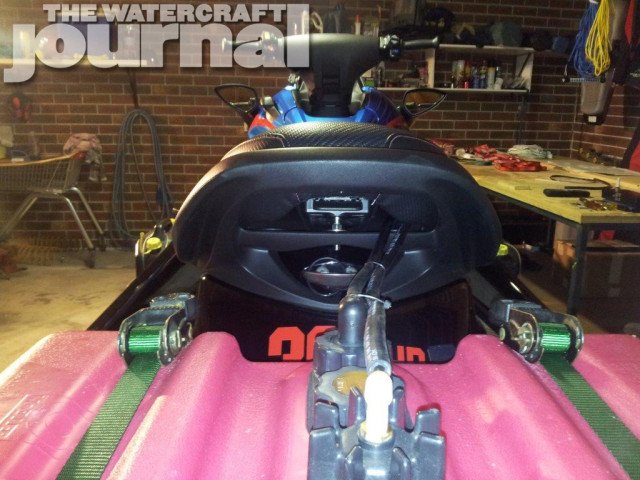
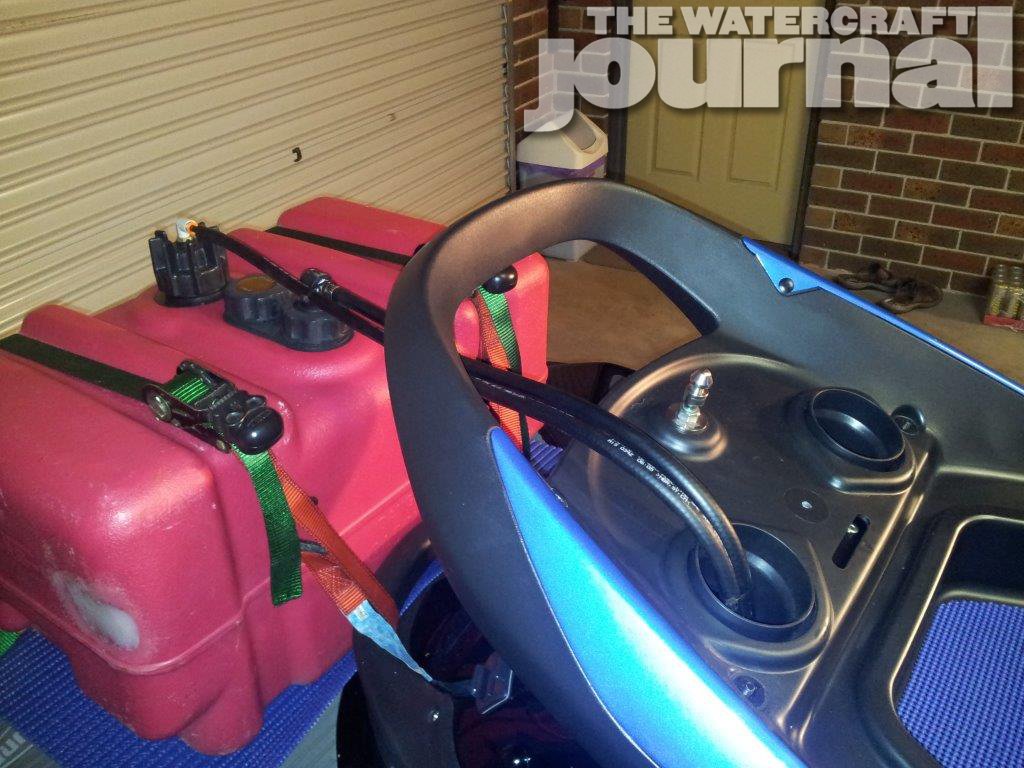
[Above: Next is to connect the 6mm fuel rated hose to the rear tank pick up and another to the vented fuel tank cap. Find or make an entry point in the rear of the ski, once again Kawasaki have made this easy with the rear vents being utilized. Others have drilled holes and used grommets when not in use.]
The fuel lines are then tied away from the engine and threaded forward to wear we made the quick connect connection on the OEM tank. Loose hanging zip ties can be seen in my pictures along with where I threaded the OEM breather through the upside down sensor bracket.Then disconnect the OEM breather quick connect and locate the hose going to the OEM tank nipple and the pick up line from the rear accessory tank, cut this to length and fit an opposing quick connect, connect these together, then locate the OEM breather hose and do the same with the breather hose coming from the fuel tank, measuring cutting and fitting another opposing quick connect. (This procedure only has to be done once as from now on it can only be fitted up one way.) The idea of the quick connects is the tank can be removed at any time and the ski returned to OEM. All within approximately 2 minutes. The quick connects are also self sealing so no spillage in your hull.
[Above: You then fill your OEM tank on the 300X (this is 82 liters to the filler neck), fill the accessory tank (of which, is 45 liters). This gives a total capacity of 127 liters. As you ride your ski the vacuum created in the OEM tank draws the fuel from the rear tank utilizing your unchanged OEM vent line with the non return valve still in place. Once the rear tank is empty the system is no different to OEM the air is now being pulled in the vent line via the rear tank.]
The 2015 racing season hasn’t even officially started and it’s looking like it’s already Bibi Carmouche’s year. Riding a Bullett-hulled SX-R, sporting support from support from some of the most iconic names in jet skiing – Jettrim, JetPilot, Skat-Trak, and Oakley to name a few – Bibi has bested her challengers from the starting band to the checkers, and now has one more massive win to announce.
The current Pro Watercross National Champion and previous IJSBA World Champion will be the first woman to be featured exclusively on the cover of Hot Products’ 2015 product catalog. The second woman ever to grace the catalog’s cover – sharing the honor with Mrs. Rachel MacClugage – Bibi’s iconic black-and-neon pink color combination also heavily influences the book’s design.
While we’re sure to see an official statement and press release from Hot Products, we didn’t want to sit around and wait to share the good news. The Watercraft Journal got a chance to talk to Casey Mauldin of IPD Graphics who beamed with pride:
“We are so proud of Bibi for making the cover of the Hot Products catalog, she is changing a lot of things right now for women in the jet ski racing industry! Not only is she the first women to be featured exclusively on this iconic cover, but she is setting a great example to other women regarding what they can accomplish, and setting the bar much higher in a time when we need it most. As thousands of these catalogs get printed and distributed onto dealers counters around the world, this gives the opportunity for girlfriends, daughters, mothers, etc, to be inspired to want to be more of a part of our great industry. Much props Bibi, you’re our hero!”
We too agree that there’s no arguing with the scoreboard, and Bibi has clearly risen the ranks to become one of the most influential young women in jet ski racing in recent years. We look forward to seeing more from Ms. Carmouche as she pursues her goals of world domination!