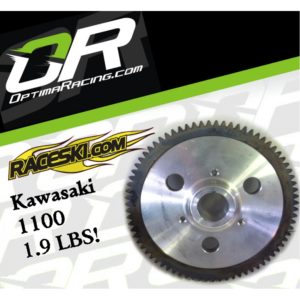
Honed on and proven on the battleground of the UWP-IJSBA Watercross National and CWA Tours as well as the hallowed waters of the IJSBA World Finals, RaceSki’s all-new lightweight total-loss flywheel for the 1100cc Kawasaki race-bred SX-R is finally available for the public.
Weighing in at a svelte 1.9-pounds, the total-loss wheel is possibly the lightest flywheel on the market, and helps to free up horsepower that otherwise would be absorbed by parasitic loss of the reciprocating assembly.
Available exclusively at Optima Racing for $499, if you’re running a full-race setup in your SX-R, RaceSki’s got the answer for you.
Here’s the official release:
Finally after four years of testing on the enduring proving grounds of the IJSBA National Tour, CWA Tour and IJSBA World Finals, the ultimate in lightweight total-loss flywheels for your Kawasaki SX-R 1100 race ski ski available to the public from RaceSki. Weighing in at only 1.9lbs, this is the lightest weight flywheel you can get for your Kawasaki 1100. This is a total loss, non charging flywheel.
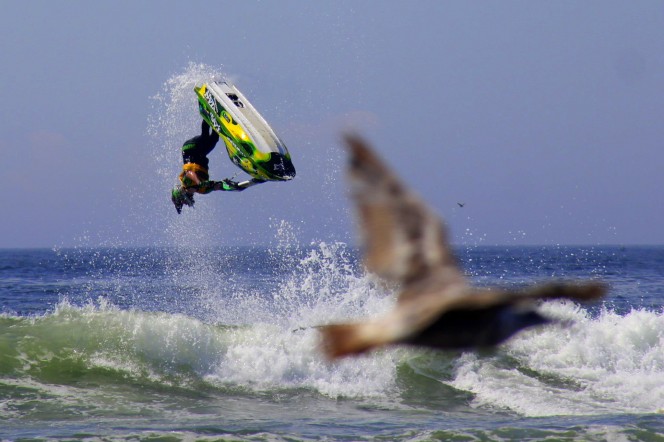
What used to be an annual tradition held the weekend right after the World Finals, the biggest non-event, the Pismo Freeride is happening this upcoming Saturday, March 15, 2014. Titled the “Pismo Spring Break Freeride,” the weekend promises to be a whole lotta fun with plenty of surf riding, some duning, and a whole lot of shenanigans.
Below we’ve included an abbreviated version of the press release including most of the pertinent information you’ll need to attend. But there’s still news unfolding as we near March, so make sure to check in regularly (or just join the group) on the official Facebook page. It’s something every surf rider needs to attend at least once. Heck, you’ll also be able to rub elbows with some of the biggest names in freeride, and that’s always fun.
It’s that time again! As tradition follows we are all going to get together at Pismo Beach for a weekend of good times in the surf! If I left out any details let me know! again I am just trying to get the word out.
What? 2014 Pismo Spring Break Freeride!
Where? Pismo/ Oceano Dune’s Mile Marker 4!
From 101 Freeway take Grand Ave exit until you cross a set of train tracks that takes you to the beach entrance about 500 feet ahead. Grand Ave has everything from markets, 7-11’s, restaurants, coin washes, banks, gas, and almost everything else you will need on the way in or out of the beach.
Entrances: The Grand Ave entrance is open from 6am to 11pm. If you arrive or need to leave late the Pier Ave entrance is open 24 hours. Depending on the time of year this entrance is usually the most hard packed. Don’t forget to air down and or bring tow straps!
Camping: Through www.Reserveamerica.com you can pre order your camping passes for $10 a night. Pre purchasing tickets seem to make it a much more less questions asked entry to the beach for all the gear and shenanigans we tend to bring in the back of our trucks/ trailers. The location is actually considered the Oceano Dunes. The Direct link to Oceano Dunes reservations for our weekend is here.
Pismo is well known to be blown out. Pismo can also be very nice weather but it never hurts to prepare for cold and heavy winds blowing constantly from 11am to 7pm.
Tents: • Stake or sand bag em down! • Dig a burm facing the wind and throw a tarp over the top of your tent anchoring it down with the weight of the sand burm to deflect the wind and morning dew that will soak your tent.
RV’s/Trailers: • Please keep an eye out on arrival park in a semi circle with other RVS to help block the wind for the party in the center! • You will make plenty of friends with a place to hang out, shower, or use your bathroom.
• Want to rent an RV? These people deliver on the beach!
Quads/ Sand toys: • Have legit registration • Must have a flag whip and helmet to ride around even “in the campsites” • Pismo Sheriffs are quick to issue and investigate possible DUI’s so have fun but be cautious. • 15MPH on the sand highway in front of the camp across the whole beach.
What will be going on and who will be there? • People will be in or out of the water riding the gnarly to mellow Pismo surf. It is quite possible high winds will come through anywhere around 11am-2pm and not lighten up until about 6-8pm. Most people hop on their quads and dirtbikes and demolish the sand dunes 100 yards behind from the campsite.
• There are a few out houses along the campsite other than that bring an RV or make friends with people who have one.
• Please bring firewood to pitch into the community bonfire because Pismo does get pretty dark and chilly at night.
• As the tide comes up move your stuff. It makes us look like weirdos when nobody can drive down the beach. The last thing we want is to draw attention to us (including the rangers) because they have to weave between ski’s and cars parked too low. Try to leave room for 2 rows of traffic to drive through thanks
• MX/quad riders if you guys could help us jetskiiers out by setting up your camps a little further up toward the dunes that would help out a ton. will keep us jetski riders closer to the beach and obviously keep us all closer to what we all like to ride through out the day. We had some issues last year with bikes and quads mixed up in the camp kicking up sand within camp when guys were trying to fix jetski engines & things during the day.
The beach is big enough for the both of us and its going to be a great time for sure! No love lost to our new guests, I just ask on behalf of the jet ski freeride community that we give each other some space this year so people who want to rage heavy through the night (which involved fireworks and cops coming to our area last year) can do so ruthlessly without being in the middle of the freeride party who isn’t quite on that level all together.
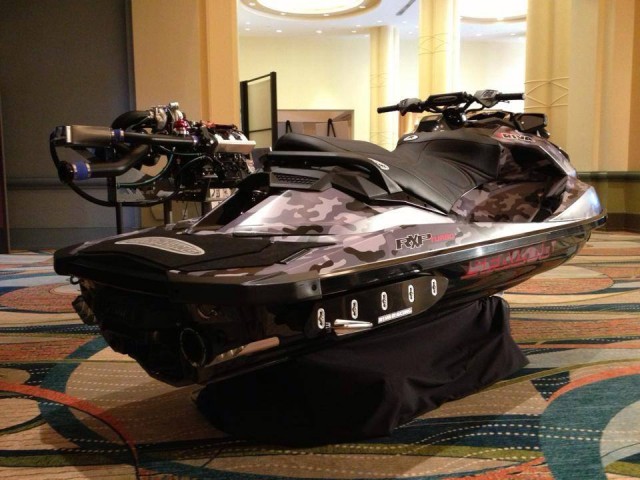
If you didn’t see what RIVA Racing unveiled at the official Sea-Doo dealer show last fall, you my friend, are been living under a rock. Shocking the hardcore horsepower crowd, the mad scientists at RIVA pulled the shroud off of an insane 400-horsepower, turbocharged Sea-Doo RXP-X.
The trick RXP-X came wrapped in a slick camouflaged livery but that was only the beginning.
While we couldn’t find the official list of go-fast goodies on this unit, we’re pretty sure the the turbo 400 is using the proven RIVA Racing Stage IV kit with a new modifications.
Squeezing out an impressive 400-horsepower from a 1.5-liter three-cylinder Rotax is actually quite regularly accomplished, so we wonder if RIVA will start offering completely outfitted packages similar to this sick machine. RIVA’s no ingenue to turbo kits, as this package isn’t too far removed from the turbo RXP-X RIVA showcased at the 2012 IJSBA World Finals. Where is this particular ski? Was it bought up? Are there more of these on the water? We demand answers!
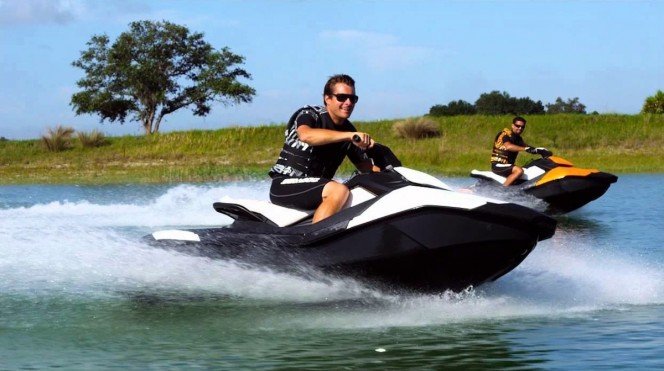
OK, here’s one that we’re not too sure what to think of. First, it’s become pretty obvious that Sea-Doo isn’t exactly elated with the initial reception of the Spark – at least when it’s related to sales. While the Spark is selling and is generating absurd levels of attention from the PWC community, Sea-Doo was really hoping that it would be the misplaced Y-generation millennials snatching up the first rounds of Sparks.
Here’s the problem: millennials are broke. They live with their parents until they’re 30. Most would rather own a new iPad than a car. Heck, they can’t even afford the “Affordable Health Care” they voted for. They’re drowning in school loans (that Bachelor of Arts focusing on early 20th Century Expatriate American Authors isn’t cheap). Oh, and consequently, their credit scores are abysmally low, meaning they can’t get OK’ed for financing through BRP.
DERP!
So who’s buying up the Sparks? Dudes in their 40’s and 50’s who have been jonesin’ for a new mini-runabout that rides like their old WaveBlaster from 20-years-ago (y’know, back when they had hair and that Scorpions cassette in their Pontiac Fiero could actually get them laid). Videos of 40-somethings rallying Sparks in the surf or attempting old freestyle tricks they mastered on their XP have already hit the intarwebs.
But this isn’t a surprise. In fact, we called this a while ago. And it comes as no shock that the Spark has been OK’ed for use in IJSBA race events although Sea-Doo designed the Spark for strictly recreational use. The plastic hull can’t take the forces imposed by excessive speeds, the impact of “rubbing rails” in the turns or equipped with the intake and pump combo to be a true buoy course killer. That’s what the RXT and RXPs are for.
Buy hey, people are excited to hot rod the Spark and that’s good news.
Here’s the official release:
IJSBA is pleased to announce that the Sea-Doo Spark has met homologation standards for both worldwide competition and United States-based competition. Effective immediately, the Sea-Doo Spark may be used in any IJSBA approved competition class in which the Spark is eligible.
Note: The Spark 2Up and 3Up are be considered separate models despite being listed as the same PWC with different seating options. Parts that solely appear on the 2Up will not necessarily be legal to exchange with the 3Up and vice versa. The High Output option is considered the same model as units outfitted with the standard 900 ACE engine.
It is the responsibility of the competitor to determine whether any options selected for the Sea-Doo Spark are consistent with permitted accessories in the IJSBA Rule Book.
For questions about this notice, or about IJSBA homologation policies, please email: [email protected].
When people reminisce to the heydays of jet skiing’s height of popularity, being the late ’80s through the mid-1990s, much of the their grievance with today’s slump is – among slowed sales, a drastic decline in racing and recreational riding venues, and the like – often associated with jet skiing once having a look, a feel and a spirit.
The iridescent pinks, yellows and greens, the wrap-around Oakleys and the low-cut tank tops and high-cut shorts that once embodied the jet ski life has gone the way of the dodo. And that’s OK. It’s not an embarrassment or something to be ashamed of. But today, the look of a jet skier is less “river rat” and more “soul surfer.”
The few helping to establish a new look to the sport are the freeriders – those jet skiers who spend their lives in the water, be it under throttle or paddling out on a long board. While some would want to steer the casual look of the sport closer to motocross, the freeriders and the companies they command are doing a far better job of marrying surfing’s soul into the sport. And we’re OK with that.
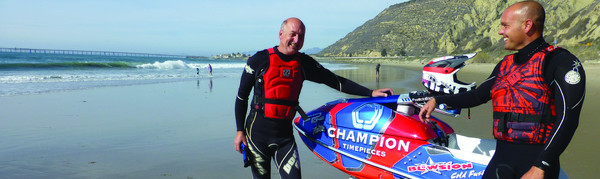
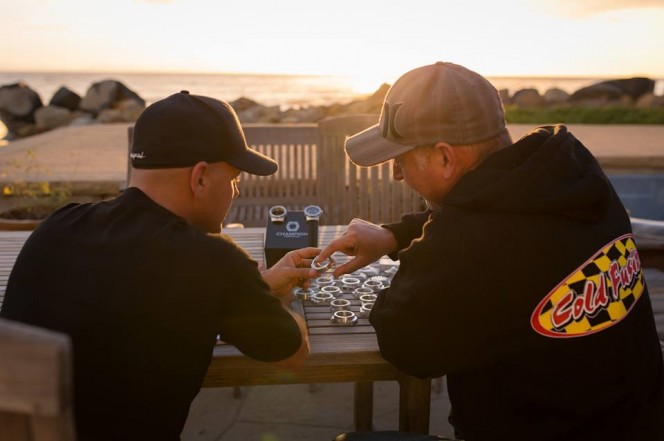
Last week, one of our favorite people on the planet – Ross Champion – announced the release of the much anticipated Champion Timepieces. A combined effort between the famed IFWA world champ and Cold-Fusion’s Carl Gramberg, the new watchmaker promises to provide the PWC community a quality waterman’s watch that will perform as good as it looks. We could ramble on, but it’s best we let you read the official release in Ross’ own words:
Carl Gramberg and I (Ross Champion) are extremely happy to finally be able to announce Champion Timepieces. Champion Timepieces is a watch company with a vision for building a brand strongly rooted in jet ski culture that will be shared with the world.
We have been working hard the past 13 months on developing the company’s first entry in to the world of watch making the “Fusion.” We are very proud to be able to announce this venture, along with the Fusion at this year’s Daytona Freeride.
If you are reading this, chances are our first model was made specifically for you. We created the Fusion to be an authentic representation of the culture that so much of our lives revolve around. To do that we use many of the same materials and manufacturing techniques in building the Fusion that have made our world of high performance watercraft what it is today.
The Fusion’s body (case) is meticulously machined from a block of 6061 t6 Billet Aluminum at our facility in Oxnard, California. To create the case we employ multiple processes using state of the art CNC equipment and fixtures before each individual case is hand polished and sent to anodizing.
This is the very same material and process used to create the beautiful Billet components that have helped take our sport to new heights.Using this material and manufacturing process really set Champion Timepieces apart from the rest of the watch industry.
We used a real carbon fiber face in the design of the Fusion as a nod to the incredible hull builders who picked up where the OEM’s left off and have literally helped the sports of freestyle and freeride reach a level that could not have been imagined in years past. Besides, for beauty it’s hard to beat raw carbon fiber and aluminum.
The band that secures the Fusion to the rider’s wrist gets it’s strength from the very same nylon webbing material that is used to make straps that help keep the hood in place on serious surf boats. But this band is something very unique and very special in the watch industry. Coming to us under special license from Reactor Watches the Fusion’s band uses nylon webbing for strength, but is co-molded with silicone rubber for comfort.
The Fusion’s name is symbolic of the partnership that was formed between Ross and Carl to bring this watch to life. It also pays homage to Carl’s brand Cold-Fusion through which he has made ground breaking Billet jet ski components for the past quarter century.
While Champion Timepieces is a partnership between Ross and Carl, the business is by no means a two man show.We are very fortunate to have a great team advising and helping us as we enter the world of horology. Carl’s long time friend Jerry Jacob was the founder and CEO of the iconic brand and watch company Freestyle until selling the business in 2000. Jerry and one of his partners in Freestyle, Jimmy Olmes (the founder and current CEO of Reactor Watches) have been kind enough to help us navigate the process of sourcing the best components and assembly possible for Champion Timepieces.
The vision for Champion Timepieces is pretty simple. We want to create bold, functional time keeping machines that are representative of the things in life we are most passionate about and reflect our values.We hope these watches will resonate with those that share our same feelings. And we will use the amazing machines, people and imagery that surrounds those passions to market our watches to a broad audience.
In so doing, we hope to be able to provide a positive impact on the athletes and sport that means so much to both of us.
With that in mind, I am very proud to be able to announce the Champion Freeride Team. Consisting of Randy Laine, Mike Serlin, Jake Montadon, Zack Bright, Mark Gomez, Darin Andersen, Jake Bright, Pete Mcafee, Ludo Mouveau, Carl Gramberg and Ross Champion; this team has been assembled to travel the globe in search of great waves and good times.Our first project is slated to begin filming mid February.
This dream, goal and vision is so close to becoming a reality. But we are not quite there yet. To make it all happen, we are humbly asking for your help. To date we have invested over a years worth of work many thousands of dollars, and have called in all kinds of personal favors to get where we are today. But we are still not quite there. All our our design, engineering, prototyping and testing has been done.
Component manufacturing is in process and our complete production samples will be back from the assembler later this month. But to get this business off the ground, we really need your help.
We need to have orders for 50 Fusions before we will be able to begin production on our run of 100 watches. Our website will go live on Jan 15th and we will release the first 10 serial numbers for sale at premium prices for those that would like to own a piece of history, and would like to go above and beyond in helping us turn this vision in to a reality.
The next 40 serial numbers will also be available to be ordered at our regular price of $350. Serial numbers 011 – 050 will be sold on a first come first serve basis.
As a special thank you, the first 50 Fusion’s will come with a custom engraved plaque in the watch box containing a personalized thank you note from Carl and myself. All of the Fusions will come with the serial number engraved on the box as well as the watch. When Fusion serial number 050 is ordered, production will begin and watches will be delivered within 60 days.
Thank you in advance for your support in helping us make this dream a reality. And if you are unable to buy a watch at this time, but believe in our vision, we would ask that you please share our message and help us get the word out.
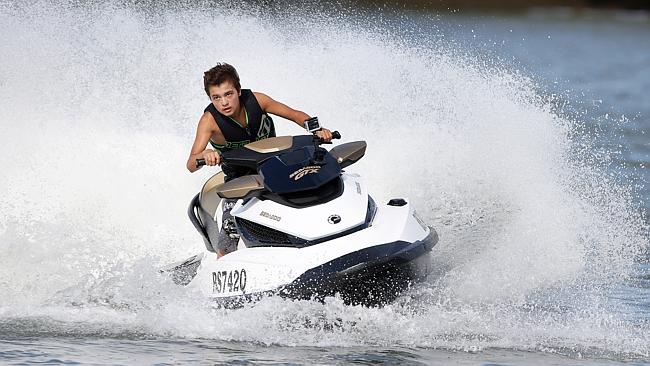
Coen Ashton looks to complete a near 1,250-mile journey aboard a PWC 15 months after his double lung transplant. Image: Liam Kidston. News Limited
People can do amazing things particularly in the face of daunting circumstances. Australian 16-year-old Coen Ashton, who was born with cystic fibrosis, received a cut-down pair of lungs in October, 2012. The decision to alter the donor lungs came after fearing Ashton might die before a suitable donor lungs would become available. Thankfully, a pair of donor lungs became available before Ashton’s condition deteriorated to the point that doctors would’ve resorted to putting him on life support.
Fifteen months after the operation in Melbourne, Ashton is preparing to repeat a 2000km (1,240-plus-miles) PWC ride up the Murray River in February to mark DonateLife week – three years after he first completed the feat. According to news.com.au, Ashton aims to finish the trip in seven days, instead of seven weeks.
“I want to show what a difference a transplant can make,” he said. “I can now laugh, run, walk for as long as I like. I can keep up with my mates and half of them, I can even beat.”
He continued, “Transplant isn’t a cure, but it’s a better life than what I had before. It’s 110 per cent improvement.”
Ashton encouraged more than 1,000 people to enlist into Australia’s organ donor registry during his previous Murray River adventure and hopes to double that this time.
“I want to get the message out that everyone can be a hero,” he said. “If you sign up to be an organ donor, you have the chance of saving up to nine lives. In my book, that counts as being a hero.”
His Murray River trip will begin on February 22, starting at Goolwa on the South Australian coast where he concluded his 2011 adventure. He hopes to finish in Yarrawonga, Victoria, on March 2.
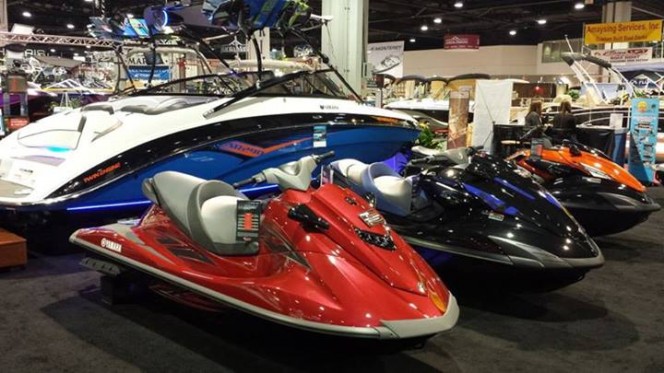
We’re in the thick of boat season and the excitement is growing (in exact opposite to the mercury in the thermometer. Seriously, what’s up with that?) We’ve already seen New York, Miami and Atlanta come and go, but there’s still plenty of big venues left on the calendar, giving you the chance to cash in on some seriously great deals.
If a new personal watercraft is within your budget, there are swarms of dealers looking to quickly offload their unsold 2013 stock as well as make great beginning of the year deals on all-new 2014 models. Helping support their dealers in this effort is Yamaha Motor Corp. USA, who working with Officialboatshows.com is offering amazing programs to help new first-time buyers and returning enthusiasts to get their hands on a new VX, FX or FZ runabout or SuperJet.
Yamaha also has many of the same discounts and boat show specials listed over on their “Offers” page of the official Yamaha WaveRunners webpage. These include reduced monthly payment programs, extended warranty offers and much, much more. Seriously, there’s some good deals being offered here, guys.
Personal watercraft racing is a tricky thing. There’s no doubt that pushing these machines to their maximum is what provides manufacturers the test data to constantly improve upon their products, but also creates spirited debate on forums and enthusiasm in the media. Basically, racing is good press. But there’s an equally sharp edge on the other side of this sword.
Like racers, not all racing is created equal. And PWC racing is a very polarizing practice that scares away a lot of otherwise casual PWC owners and hobbyists, which is really sad because racing your runabout can be just as fun as any day spent leisurely cruising your local lake or riverfront. And that is why P1 AquaX exists.
Debuted early last year in the US, the P1 AquaX is “a new style of watercraft competition for sea-riding enthusiasts who just want to pull back the throttle,” according to their press info. The series was directly designed to welcome novice and “fence sitting” enthusiasts who otherwise have steered clear of on water competition.
“The courses are big, but fun to ride, giving the competitors the chance to open up their throttles and enjoy the full performance of their craft in a safe and controlled environment. The courses also provide a real sense of achievement for those who complete the task.
“AquaX split into 3 categories – 200hp, 250hp, 300hp – to accommodate huge diversity in engine displacements. Two-stroke craft and naturally aspirated four-stroke craft under 160hp will qualify to compete in the 200hp, whereas the 250hp and 300hp classes will be reserved for the more powerful turbo and supercharged four-strokes of today. All craft may be modified, however four-stroke craft must remain stock as from the manufacturer, with the exception of handling modifications.”
For 2013, all four events were held in and around Florida – Daytona Beach, Pahokee, Space Coast and St. Cloud. Starting off with a relatively humble turnout in Daytona, word of mouth continued to spread and soon, by the end of the series, the lineup was nearly 40 skis deep! Here’s ALL of the recap videos from 2013 for whet your whistle for 2014:
For those visiting The Watercraft Journal for the first time, you might be thinking we’re all about freeriding these days. With yesterday’s publication of our much anticipated next-day event coverage of the 2014 Thrust Innovations Daytona Freeride, and today’s announcement, we can see where you’d get that. Frankly put, there’s just a lot of awesome stuff happening in the freeride community and we’d be remiss to not shout it from the rooftops.
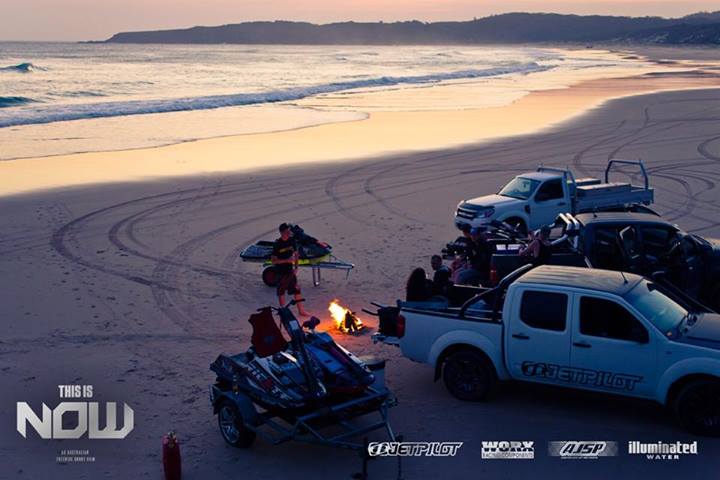
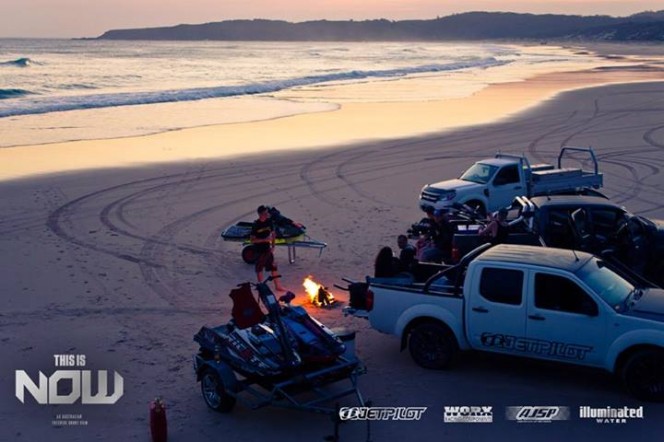
Recently, our friends at JetPilot released an awesome little film trailer for a freeride-focused short film “This is Now.” Chocked full of amazing freeride action, gorgeous scenery and some astounding aerial trickery, “This is Now” is sure to deliver. Starring Brodie Copp, Like Emanuel and Mitch Young, “This is Now” charts the adventures of the trio around the east coast of Australia. Read the official press release:
Gold Coast, Queensland, Australia. “This is Now.” the highly anticipated Free ride short film produced by Jetpilot in association with AJSP, WORX and Illuminated Water storms onto the world stage February 5th 2014.
The team from Jetpilot, filmmaker Allan Hardy and a handful of Australia’s best up and coming riders including Brodie Copp, Luke Emanuel and Mitch Young scoured the east coast of Australia in an effort to capture the camaraderie and essence that is free riding. With new ski technology allowing the guys to blast bigger and better tricks, “This is Now.” redefines what the sport is all about.
Backed with an original music score, developed by London musician Oliver Lyu, “This is Now” provides a progressive and cinematic feeling to the film, something that has never been associated with the sport of free riding.
“Free riding is often overlooked as a sport and doesn’t get the respect from the mainstream media like snowboarding or FMX does,” said Chris Dunn, Co-Producer of “This Is Now.” “This film is going to change the way that people perceive the sport of free riding and take it to a whole new audience.
Using state of the art equipment and with access to the young blood of free riding in Australia, we have created a short film that redefines the genre. Cinematographer Allan Hardy utilized the red epic cinema camera to capture remarkable riding and breathtaking undiscovered coastline in real time and super slow mo at up to 300 frames per second, giving the viewer a unique perspective similar to that of the highest quality nature films.
I was debating whether it would be too snarky to begin with saying, “See, I told you so.” About a month ago, The Watercraft Journal had the chance to spend a couple of days with the much improved 2014 Yamaha FZR SVHO, where we claimed that it was “a performance-bred Yamaha that the likes of which no dealership showroom has seen since the GP1200R.”
We later caught some heat online from the doubting Thomases arguing that the SVHOreally couldn’t be that much of an improvement over the previous SHO. We, and Greenhulk.net’s Jerry Gaddis, assured that it was, but simply couldn’t convince everyone. Well, we hope that today’s news will help fix that:
As of Friday afternoon, Greenhulk.net was able to break the 80-mile-per-hour line with their SVHO with no more than an ECU reflash and removing the spacer plates found between the ride plate and hull. If you think the 80.5mph top speed is impressive, consider that it was at a very mild 8380RPM.
Here’s Jerry’s account in his own words:
“Guys, I’ve been working hard with V-Tech to develop a reflash that will work on the new SVHO ski. We have finally got it nailed down and my ski just hit 79-plus-mph with no other modifications whatsoever. That’s right, this ski is completely stock with the exception of the reflashed ECU.
“When I mean completely stock I mean it. Untouched impeller, stock supercharger, stock intercooler, stock everything!
“I was using an iPhone app called Max speed and initially saw 79.1 mph. I second guessed the accuracy of it and went straight to Wal-Mart to buy a Garmin and went straight back out to the water and BAM! 79.2 mph. So much for iPhone GPS app’s being inaccurate.
“RPM’s were firmly planted at 8360-8380 RPM. It just goes to show you how good of a job Yamaha has done with this ski. Now it’s time to let the mods begin and get some big numbers out of this beast.”
Jerry went back a little bit later and updated the post with the following:
“I just removed the spacer plates from between the ride plate and the hull and went back to the water and the ski hit 80.5 mph.
“Guys, while these preliminary numbers are extremely impressive without any other modifications, it will not be safe to run a ski like this continually without engine cooling and intercooler upgrades. It’s winter time, temps here yesterday during my testing were only 62 degrees and water temp in the 50’s. Dean [Charrier of Dean’s Team – Ed.] has similar numbers during his testing. Despite cooler ambient temps, Dean’s logs show a steady climb in engine temp and a steady climb in air intake temps during a prolonged wide open throttle pull. This means the stock cooling system and stock intercooler are not up to the task at these higher RPM levels. In hot 95 degree summer air and 90 degree summer water these temps will climb at an alarmingly fast and dangerous rate.
“Keep in mind that the stock engine cooling and stock intercooler were designed for a stock ski. A stock ski only turns a measly 7300 RPM when the limiter kicks in… that is nothing! Add 1000, or 1500 more RPM and you better be upgrading the engine cooling and intercooler.
“I will be upgrading mine in the very near future and watch the speed numbers improve even more because of it.”



 Honed on and proven on the battleground of the UWP-IJSBA Watercross National and CWA Tours as well as the hallowed waters of the IJSBA World Finals, RaceSki’s all-new lightweight total-loss flywheel for the 1100cc Kawasaki race-bred SX-R is finally available for the public.