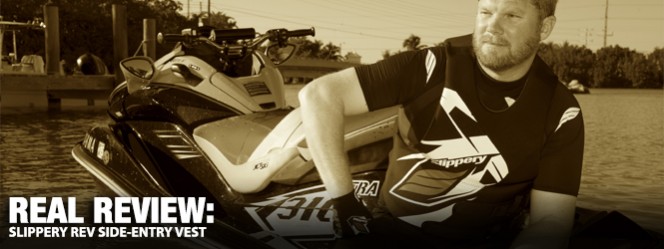
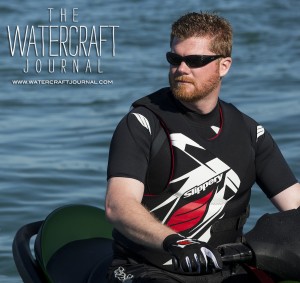
So far, we’ve had nothing but great things to say about Slippery’s products in our weekly “Real Reviews” section, and for good reason. Slippery, part of the Parts Unlimited family and younger sibling to motocross gear and apparel maker Thor, uses nothing but the best materials, molds and stitching to provide the utmost comfort and durability to its product lineup.
The chest and back are broken up by “breaks” in the foam allowing a rider to bend and twist, as well as ride seated on their runabout without the vest bunching up.
Now, it’s with a degree of bias that we admit that side-entry vests aren’t our favorite. While almost universally popular among the more svelte racers, freeriders and freestylers, side-entry vests typically don’t fit larger riders; particularly thicker or more protective race- or high performance-grade side-entry vests fit little better than clunky sandwich boards. Thankfully, such was not the case with Slippery’s eye-catching Rev Side-Entry Vest.
What qualms we had with the Rev Side-Entry Vest were overshadowed with the pluses, but again, we’d be remiss not to air what we thought were some shortcomings. Surprisingly, the Rev, unlike other side-entry vests we’ve reviews, fit too snuggly. Although the same size as our Switch Molded Vest, the Rev required a little more tugging and coaxing to get zipped up.
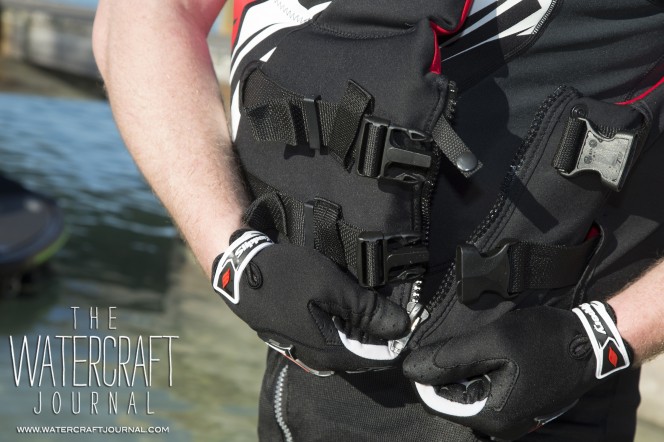
Relaxing the two 1.5-inch straps all the way, which are tastefully hidden inside of the neoprene body, helped, but we did feel a little squeezed. We suggest ordering your Rev Side-Entry Vest a size larger and cinching up the belts rather than what we had to do. The Rev features the same heavy-duty zipper with a snap-over zipper buckle. While the USCG-approved Type 3 vest required some pulling to get on, the stretchy neoprene construction had plenty of give and was comfortable on bare skin, which is rare.
Apart from Slippery’s use of comfortable materials, is its commitment to improving life vest mobility. This is accomplished in the Rev by employing several “hinges” in the foam throughout the back and chest molds. The chest and back are broken up by these “breaks” in the foam allowing a rider to bend and twist, as well as ride seated on their runabout without the vest bunching up. There’s ample room around the armpits and shoulders to free up mobility.
Overall we enjoyed the Rev Side-Entry vest, but found ourselves wishing we had our standard front-entry vest if only for the extra breathing room. The Rev is attractive, made from the best materials around, is surprisingly lightweight (even when sopping wet), and very forgiving. We just found it a little too snug, which is probably a reflection on our eating habits rather than Slippery’s products.
The Slippery Rev Side-Entry Vest required a little more coaxing to zip up than our standard front-entry vests, but it’s snug fit remained comfortable even after a full day of riding.
We think we Americans throw around the term “world champion” a little too loosely. The Major League Baseball World Series are conspicuously void of international teams and we all know a greasy spoon with the “World’s Greatest” cheeseburger, ribs and/or BBQ. As difficult as it is for us to admit, just because we claim it to be the best in the world, we need to actually include the rest of the world to truly validate the claim.
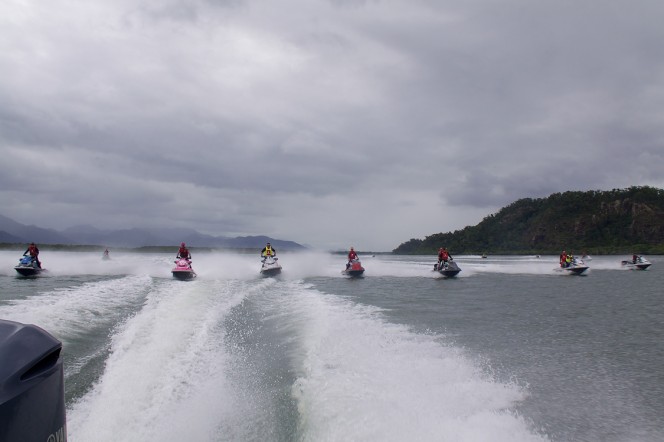
That’s why we’re stoked to announce the UK’s Russell Marmon’s dominance at this weekend’s first stop in the international 2014 Jetrace Series held in beautiful Martinique. The Caribbean island welcomed 20 racers from across the globe including Belgium, France, Great Britain, USA, and neighboring Guadalupe Island, as well as some locals.
The three-day race boiled down to a showdown between local racer Jean-Luc Jahsi and Marmon who both piloted Kawasaki Ultras – Jahsi on a new 310R and Marmon on his tried-and-true 300X. After the final day of battle, it was Marmon who claimed the victory, according to Jet Ski’n World.
The grueling schedule saw racers completing multiple long-distance heats in a single day, lapping the island almost continuously. Between racing past Club Med, spectators were entreated with flyboard and freestyle presentations.
A couple of days ago, we caught wind of a tease by the IJSBA promising some big news for the 2014 IJSBA World Finals, saying that Hot Products, USA would be replaced as its title sponsor. We had heard some chatter beforehand, but were pleasantly surprised to learn today that Southern Californian apparel and riding gear manufacturer, Jettribe would be taking over the mantle.
Beginning on October 4th and running through October 12th, the 2014 Jettribe World Finals will take place again at the Crazy Horse Resort and Campgrounds, in Lake Havasu City, Arizona, USA. Of course, those who’ve been will recognize Jettribe as a regular vendor at the finals (almost always in the same corner spot for several years!).
According to an announcement made by the IJSBA, “In addition to World Finals, they have also provided title sponsorship for the following: Jettribe Pro Hydro Cross Tour, Jettribe West Coast Series, and Jettribe Europe Tour. Jettribe has also been the associate sponsor for at least four other events or series. Jettribe is also top tier sponsor of 16 competitors worldwide. Jettribe attended 19 events in 2013 and plan to double the overseas events in 2014- they have two dedicated racing support rigs sent to competitions all over North America.”
In addition the the States, Jettribe has become a major figure in over 28 countries world wide. Jettribe offered the following statement, “The IJSBA World Finals has always been a big part of our life for over 15 years. Jettribe’s humble beginning with World Finals began with a 10×10 foot booth at the Nautical Inn in the parking lot. Now fast-forward to 2014, we are truly grateful to have the opportunity to be the Title Sponsor the Jettribe 2014 IJSBA 33rd World Finals at Lake Havasu, AZ. To follow the footsteps and traditions of great title sponsors Hot Products, quakeysense, McGraw Insurance, Dos Equis, Skat-Trak, and Budweiser is an honor.”
So, the weather, right? What’s up with that? In the past month alone we (being the East Coast, the Southeast, and the United States as a whole) experienced three historic cold snaps. In the space of one month, we saw some really historic lows (not including a pretty underwhelming Super Bowl last night). Unfortunately, too much depends on the weather, and when Florida starts seeing snow, people’s moods begin to sour.
That was slightly the case for the first month of the New Year. But today also marks the beginning of our second quarter, meaning we also get to provide a very exciting overview of the explosive growth we’ve experienced in our first three months of publication! (We know, you must be on the edge of your seats. We are too.) Starting from zero and reaching nearly 18,000 unique readers with almost 60,000 articles being read is really, really fun stuff – particularly during one of the most historically depressing winters in the last quarter century.
This particular edition of “The Watercraft Journal By The Numbers” will outline the magazine’s quarterly growth over these short months (oh, and it bears noting that The Watercraft Journal was officially launched November 9th, 2013 – so our count is shorted by over a week’s time). Obviously, as boat show season turns to Spring, and Spring into Summer, we look forward to further growth.
November 2013 Through January 2014
January 2014
Better Content and More Of It
The Internet has managed to screw us all up. Because we have immediate access to nearly all of the combined knowledge of mankind for the cost of a DSL connection, people aren’t willing to wait or pay for the content they crave. The days of sitting and waiting idly by the mailbox for the latest issue of your favorite magazine are all but over. Rather, The Watercraft Journal produces its originally-composed content on a daily basis. We give you a reason to check in with The Watercraft Journal every single day.
Total Feature Articles Published in 1st Quarter: 42 (excluding daily news)
Total Articles Read in 1st Quarter: 58,048
Highest Read Article in 1st Quarter: 2,261 views
Feature articles published in January: 16
Total word count: 14,116 words*
*When this number is translated to print publication standards equals a 116-page magazine. Please note that this number does not include an average of two uniquely-written news articles published daily.
Hardcore Readers And More Of Them
Even during some pretty gloomy winter months, readers of The Watercraft Journal continually came in to see what the latest news, product reviews and stories we had on a daily basis. We saw an increase in return readership as well as a steady influx of new readers. We’re excited about our international readership, but The Watercraft Journal still remains a clear favorite among domestic PWC enthusiasts, meaning our advertisers have exclusive access to more potential clients than with any other publication. That’s Marketing 101.
Total Readers in 1st Quarter: 28,947
Total Unique Readers in 1st Quarter: 17,777*
Top (5) Nations in 1st Quarter:
United States – 17,491
Australia – 2,469
United Kingdom – 1,464
Canada – 645
France – 434
Total Percentage of Mobile Device Users: 36%
*This number is considered equal to an individual sale of a single copy of a magazine.
More Readers With a Wider Reach
Since our initial launch on October 1st of 2013 of our Facebook, Twitter, Instagram, YouTube pages, The Watercraft Journal has made it a point to use social media to bring the PWC enthusiast industry all of its daily content in the easiest-to-reach and fastest ways possible. To better do this, we partnered with Greenhulk.net to reach the most diehard enthusiasts as much as possible.
Total Facebook Followers in 1st Quarter: 2,003
Average New Daily Facebook Followers in 1st Quarter: 17
Total Twitter Followers in 1st Quarter: 51
Total Instagram Followers in 1st Quarter: 79
Total Weekly Newsletter Subscribers: 696
http://youtu.be/FsqJFIJ5lLs
There’s Much More Where That Came From
With January over and February underway, we’ve got some big stuff for you! Sure, there’s the Mark Hahn Memorial 300 – celebrating its 10th anniversary – as well as some pretty exclusive interviews and shop tours, not to mention product and vehicle reviews to boot! And it’s not even springtime yet. Trust us, The Watercraft Journal is looking down the barrel of a heck of a year and it hasn’t even warmed up out of winter. If you’re a reader, welcome to The Watercraft Journal and never hesitate to contact us with article ideas or questions. If you’re a potential advertiser, we’d invite you to consider supporting The Watercraft Journal as no other magazine provides its supporters better exposure and return on investment.
Australia is ready to do it for the kids, again. The 2014 Ride the Tide Yamaha Variety Jet Trek will be a 50 PWC ride down the coastline between Port Macquarie and Mooloolaba on the Sunshine Coast. This event will raise money through Variety – the Children’s Charity for Queensland – for Australian children in need.
“We’ve taken the same mix of camaraderie, adventure and philanthropy that you see on the Variety Bash and with the help of our sponsor, Yamaha, transferred it on to the water and created this brilliant event to help Queensland kids in need,” said Rob Goodwin, Motoring Events Director at Variety Queensland.
Trekkers for the cause have come from places as far as Tasmania, Sydney and northern Queensland to participate in hopes of helping the sick, disadvantaged or special needs kids of Australia. Participants will travel through towns and communities, visiting and in some cases delivering equipment and assistance to children and schools in need along the way.
Over the course of 6 days, participants will travel approximately 600km, leaving from Port Macquarie on February 24 and arriving in Mooloolaba on March 1. They will visit towns such as: Port Macquarie, Nambucca Heads, Coffs Harbour, Wooli, Yamba, Ulmarra, Ballina, Kingscliff, Jacobs Well, Brisbane, Bribie Island and Sunshine Coast.
Throughout the course of their journey, the participants will be part of a coastal convoy that will include medical staff, mechanics and other PWC specialists in order to maintain a safe ride for all the Trekkers.
In order to be apart of the trek, participants have to raise a minimum of $2,000 donation as an entry fee. With the kids on their minds, many trekkers stretch far above the minimum.
For inquiries or to book a place on the adventure, visit HERE.
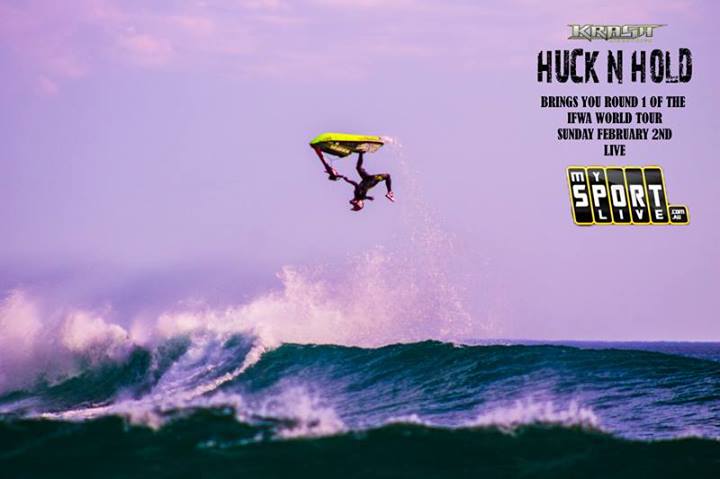
Not all of us can afford to hop a plane and travel to the other side of the globe, so attending many of the biggest freeride events is just out of the question. That’s why we’re excited to announce that mysportlive.com.au will be broadcasting the first round of the IFWA World Tour live from Portsea Back Beach, Victoria on Sunday, February 2nd.
Working together with Krash Industries, My Sport Live stated, “[We’re] pleased to bring you the opening round of the International Freeride Watercraft Association World Titles, LIVE. The event will take place on Sunday the 2nd of February, and will be broadcast live on the My Sport Live website direct from Portsea Back Beach.”
The event will incorporate the second round of the Krash Industries Australian Titles, the infamous Huck n’ Hold, and will welcome competitors from across the planet to participate in such a high-profile showdown. You can watch all the action LIVE from 9am via the My Sport Live website HERE.
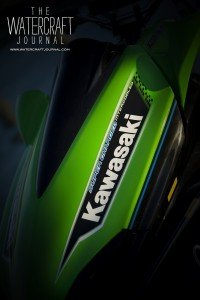
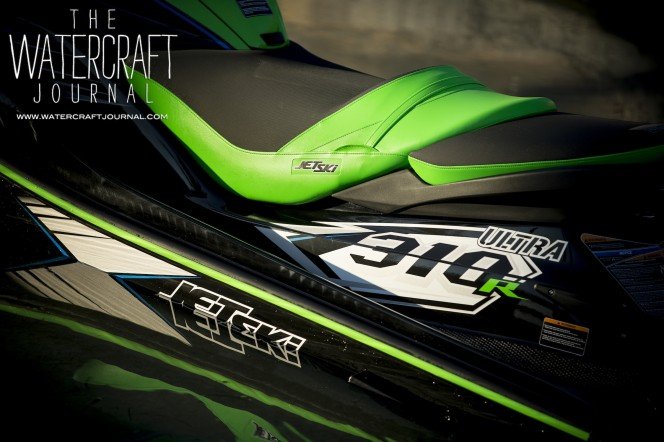
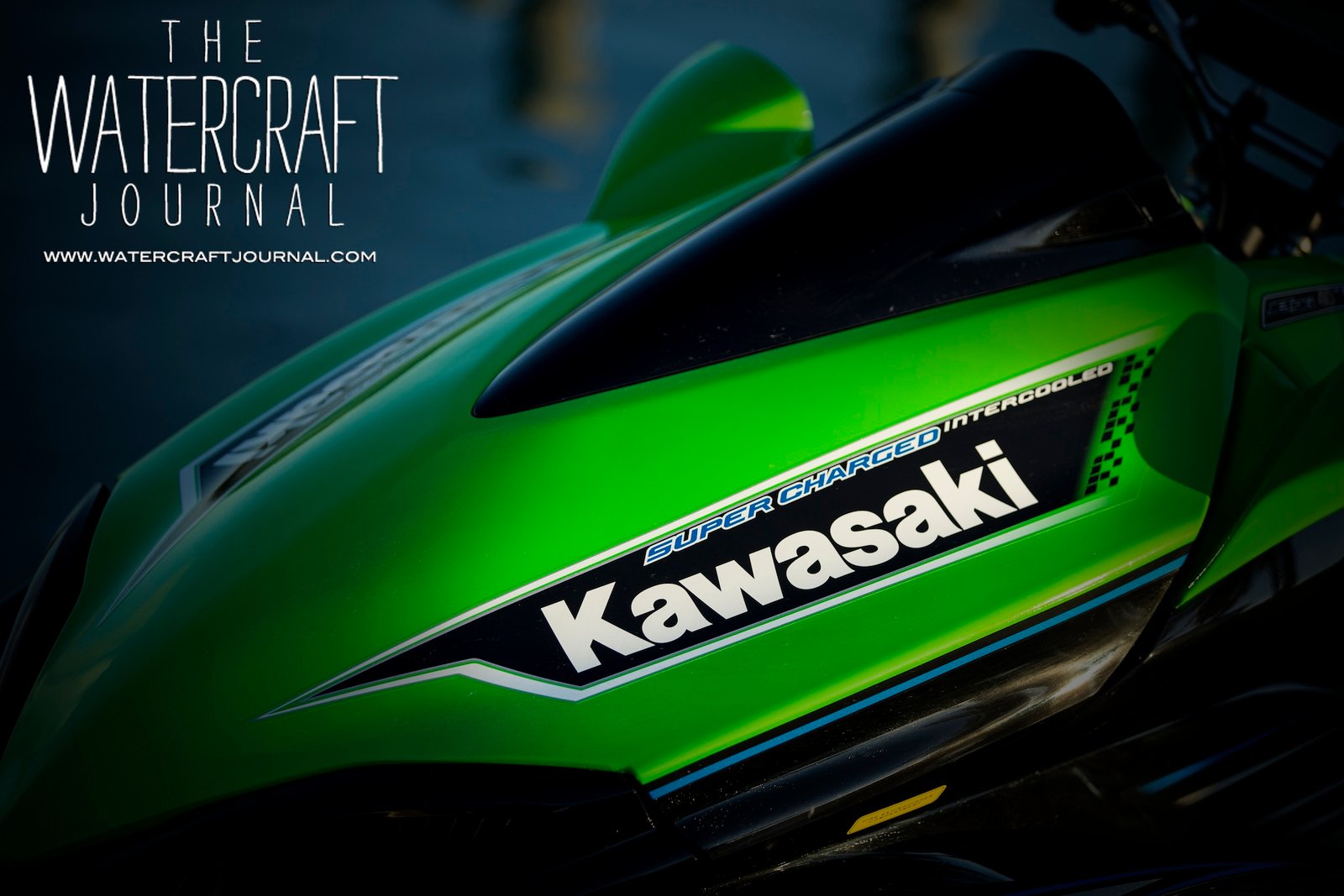
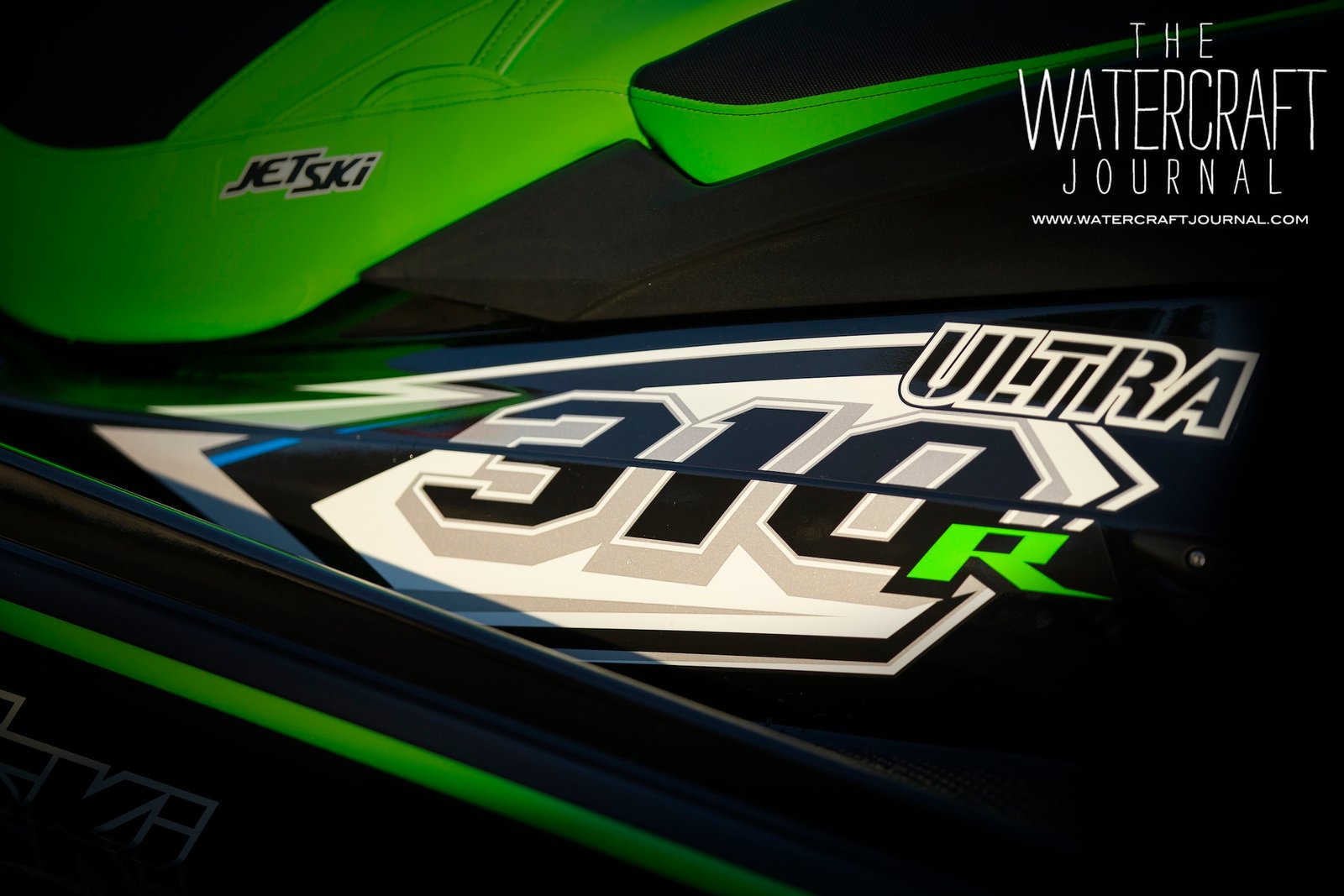
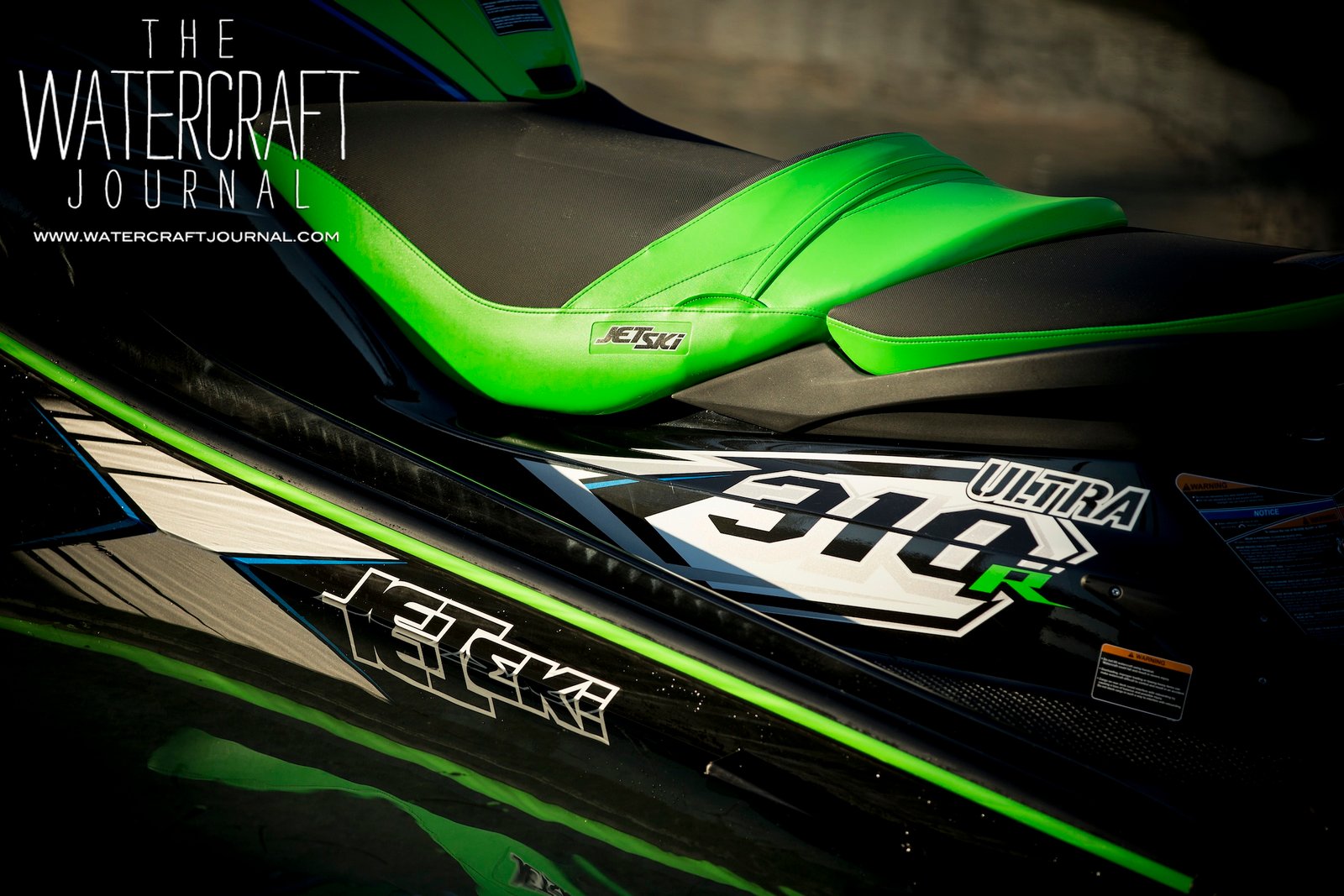
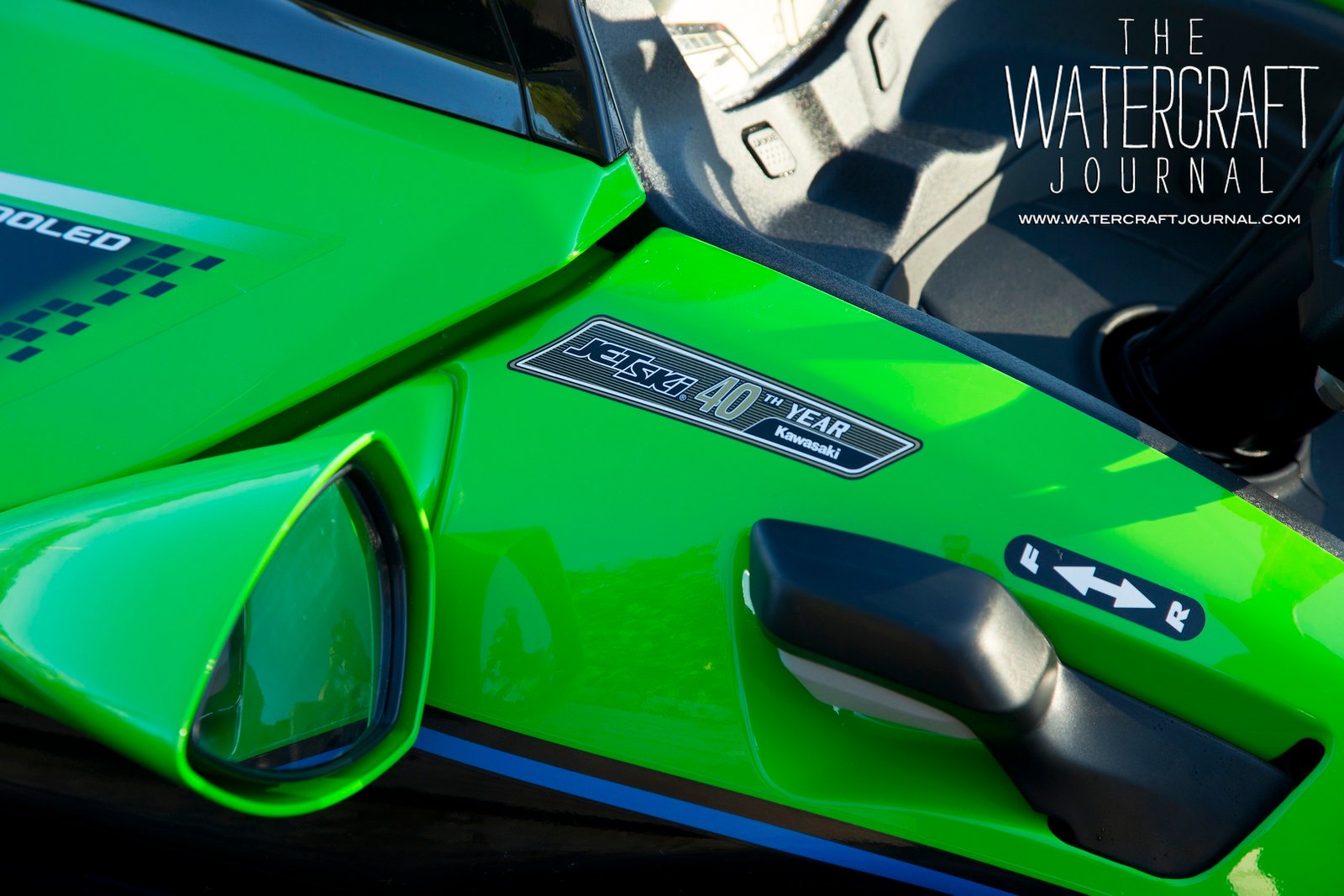
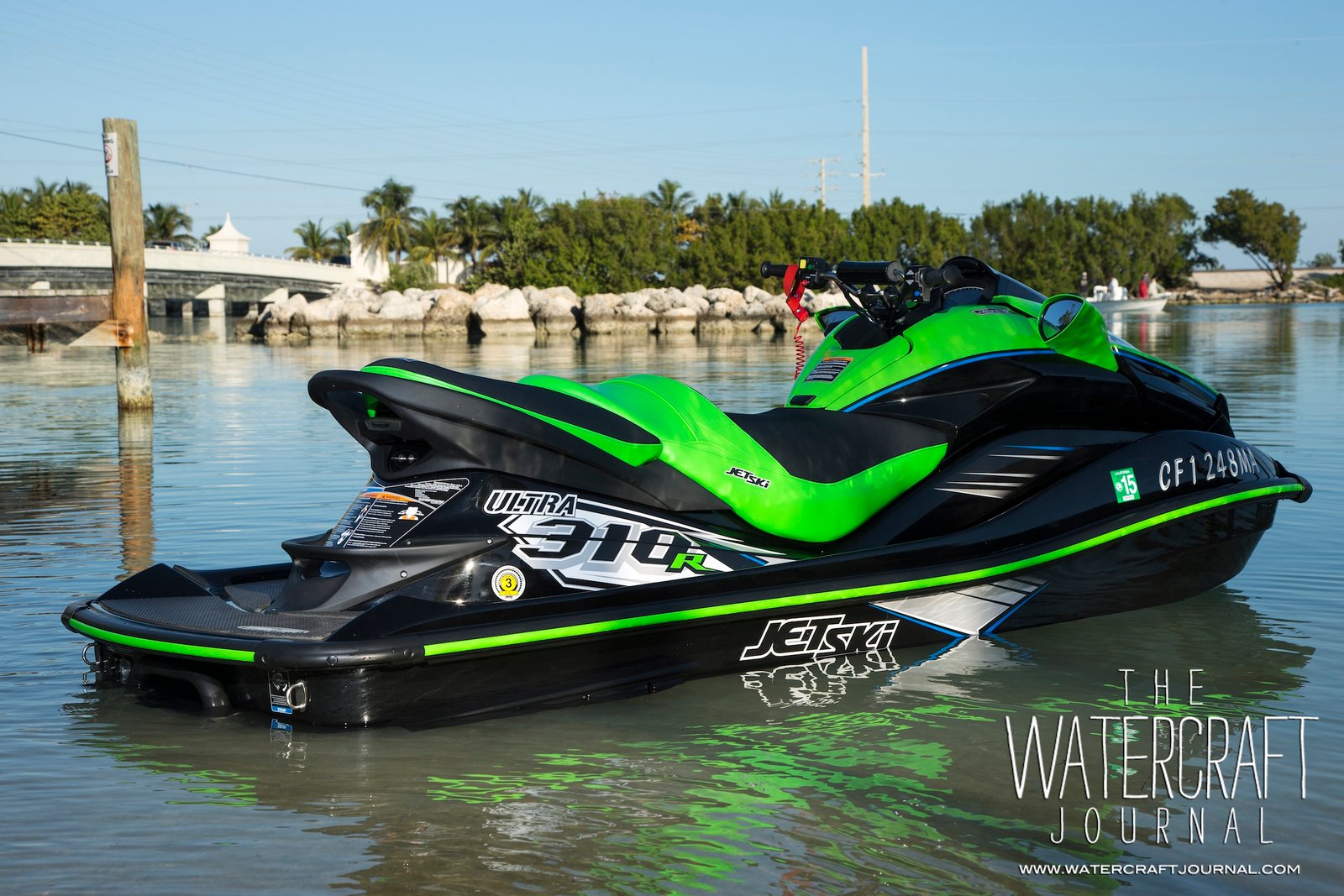
2014 marks the 40th anniversary of Kawasaki’s JetSki. The 310R comes after years of consumer input and is designed for those offshore and endurance riders.
Decades ago, celebrating in the end zone wasn’t an illegal offense. Players crossing that final yard line regularly danced, gyrated and cartwheeled in elation before their felled opponents. Today, a whole generation of football players and fans have been raised thinking that such behavior is the height of bad sportsmanship. So when Kawasaki announced the arriving Ultra 300X’s output had increased to 310, many considered it akin to spiking the football.
Kawasaki already led the industry with a significant gap in horsepower over its competition. With nearly 80-horsepower over Yamaha and 40-plus over Sea-Doo, the Big K really didn’t have much to worry about in the “numbers race.”
Moreover, the podiums of every single offshore championship featured nothing but Ultra 300Xs in 2013. Even last year’s Pro Stock Runabout class champion of the UWP-IJSBA Watercross Tour was a 300X, besting both Sea-Doo and Yamaha’s close course darlings.
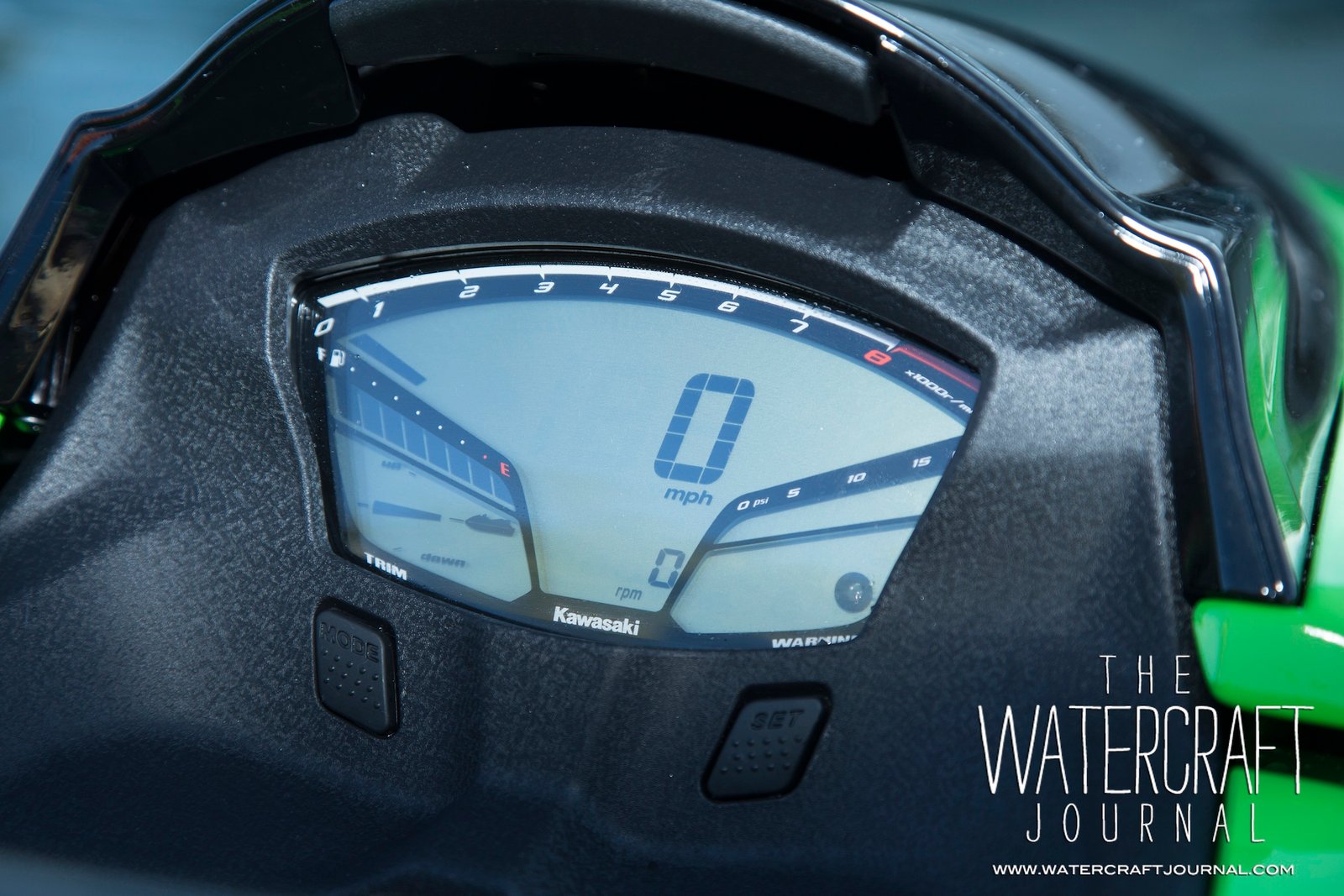
The previous iterations of the Ultra were all stepping stones to the 310. For those willing to look, the modifications made to this year’s Ultra are the result of countless hours of polishing.A fantastically easy-to-navigate LCD instrumentation allows you to shuffle through a fuel consumption calculator, external water/air temp gauge, clock, trip and hour meters, and max speed functions, in addition to a revised boost gauge and riding mode goggles.
Building off of the renowned Ultra platform – first introduced (in this form) in 2007 as the 250X and the later-redesigned 300X in 2011 – the 310 series benefits from nearly a decade of race course dominance, as well as consumer class leading stability, storage and thrilling performance. That’s quite the résumé. So why wouldn’t Kawasaki leave well enough alone and refocus its efforts on something else?
Let me begin by saying that the extra 10-horsepower was a byproduct. “Gaining more horsepower was never the goal,” Kawasaki’s Bret Snider explained. “We managed to free up the extra power by making major improvements in the engine’s efficiency.”
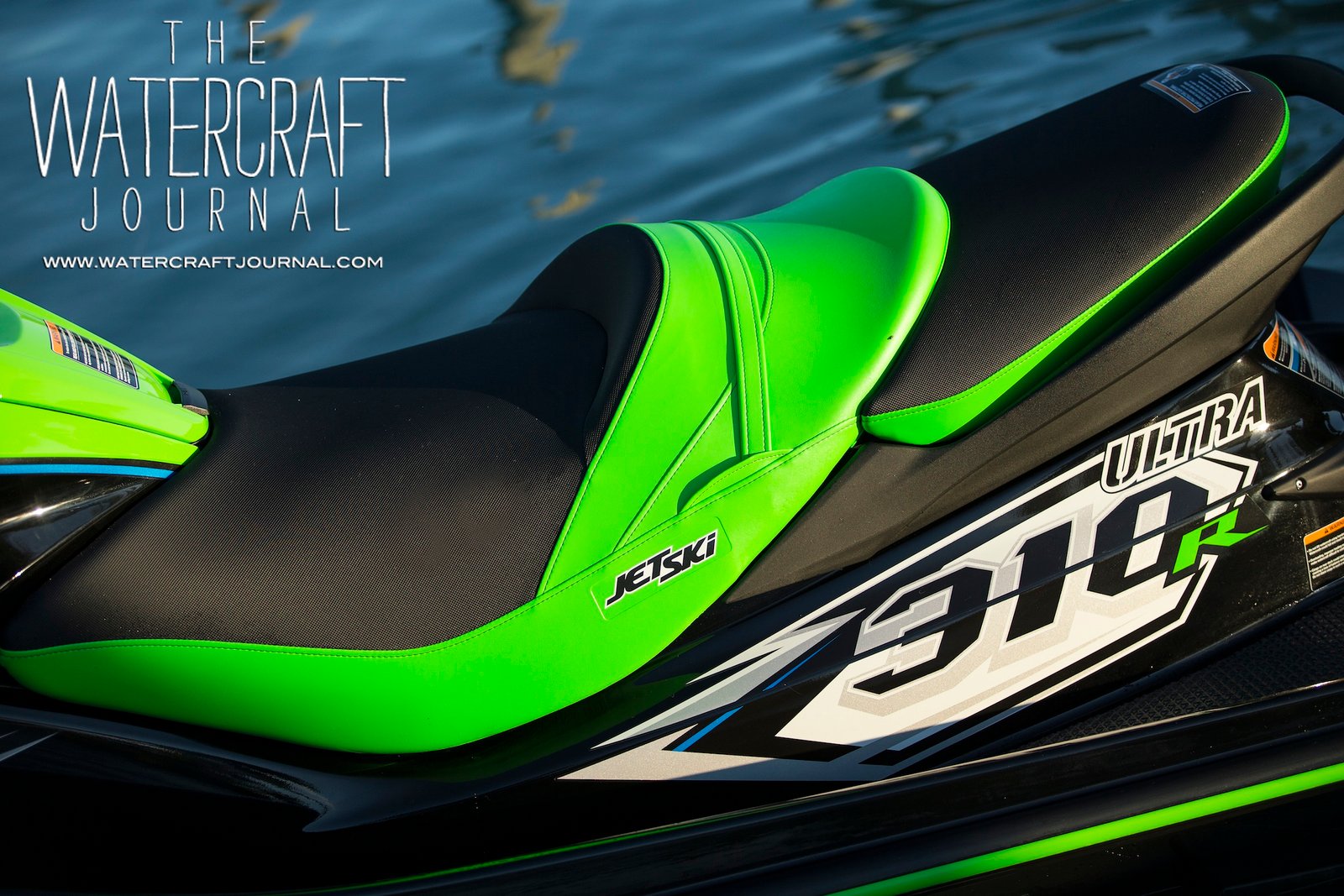
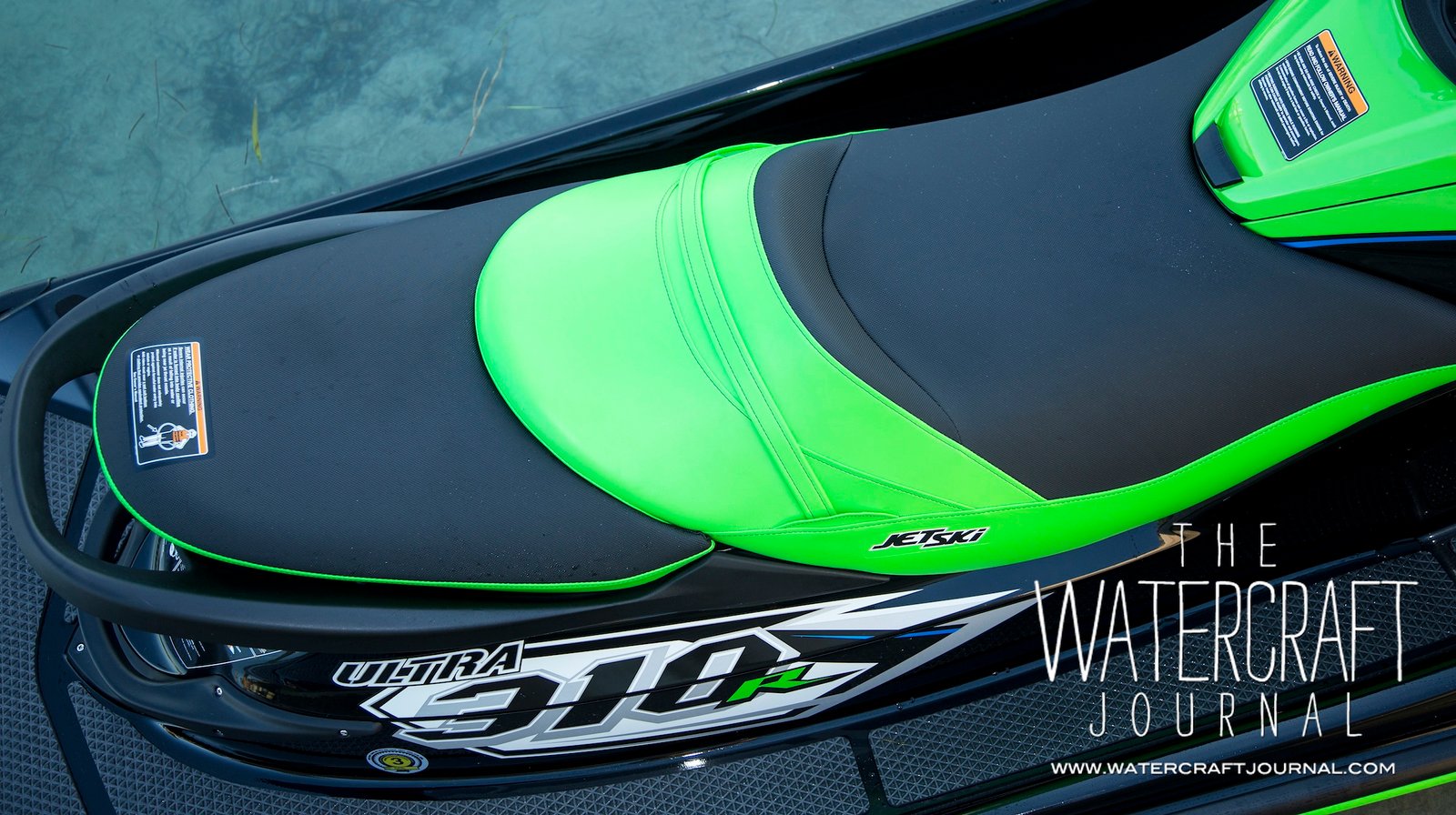
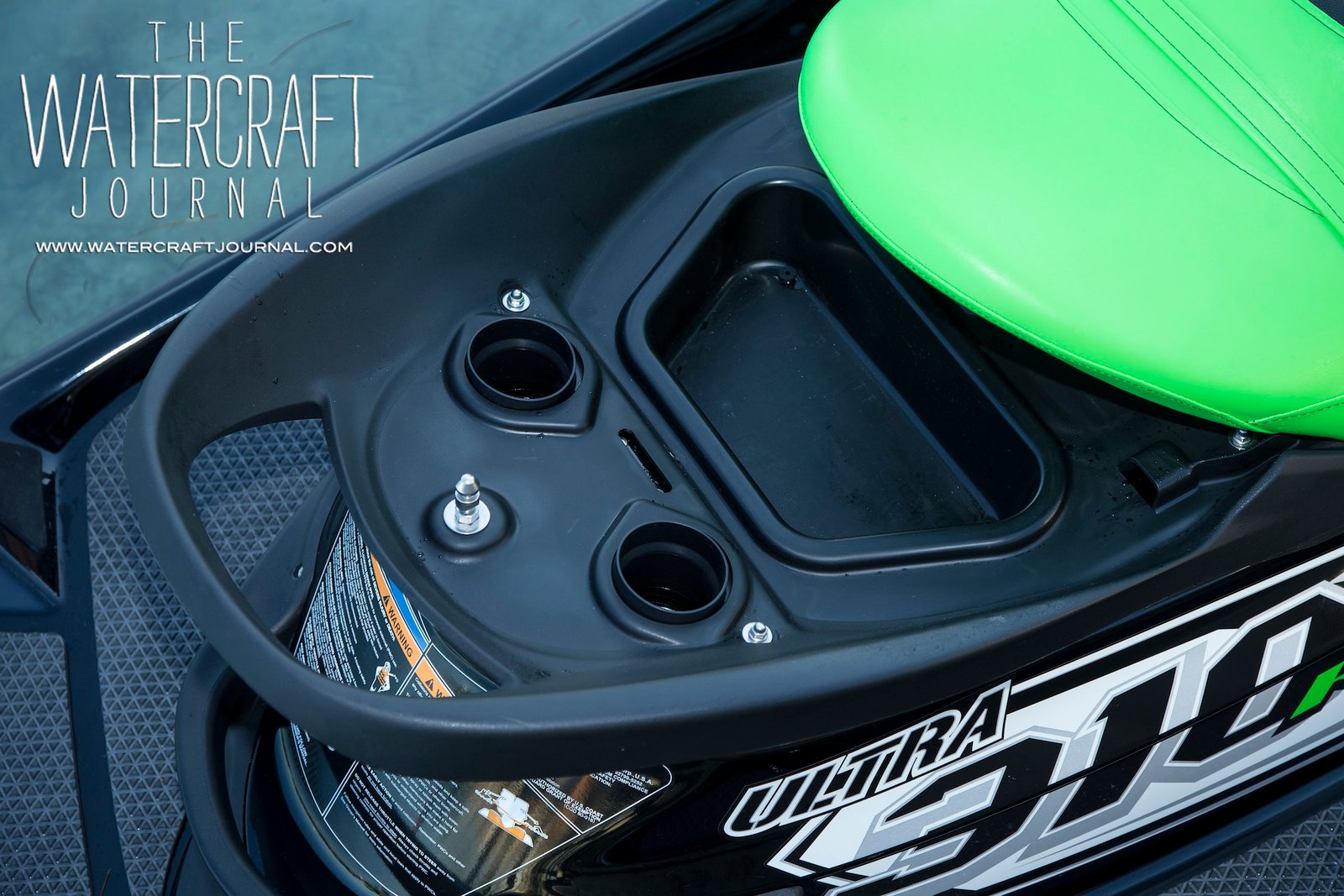
The narrow-contoured Sportseat is wrapped in grippy textured canvas for improved traction. The seat is supple and supportive and is a marked improvement. We noted the rear passenger strap ends with two flaps on either side covering a sharp-edged plastic fastener. These flaps need to be sown down to keep from scraping uncovered legs.Externally, the changes of the 310R over the rest of the Ultra lineup are visible, but again, only if you’re looking for them (like this custom diamond patterned Hydro-Turf traction mat). Internally, it’s a different ball game.
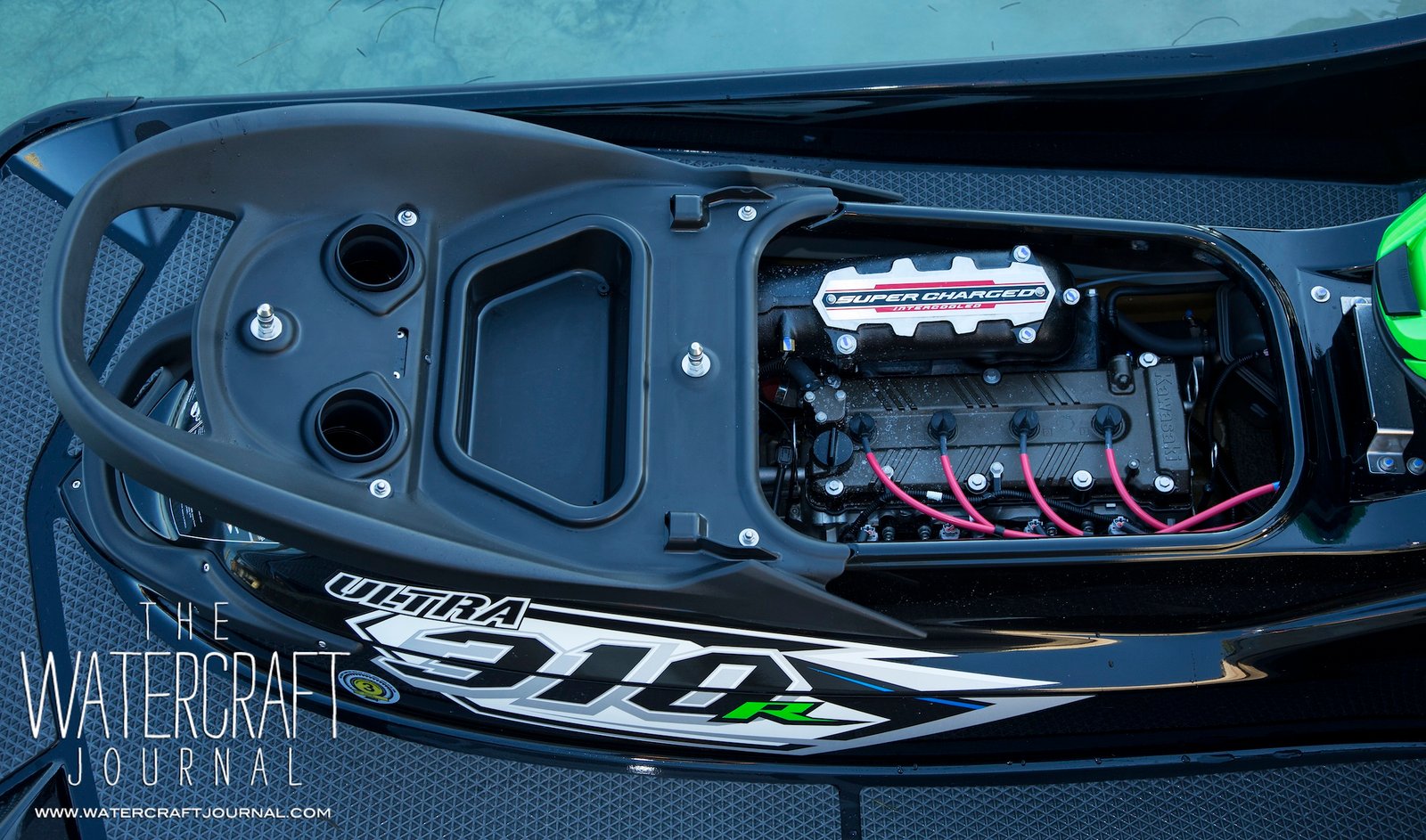
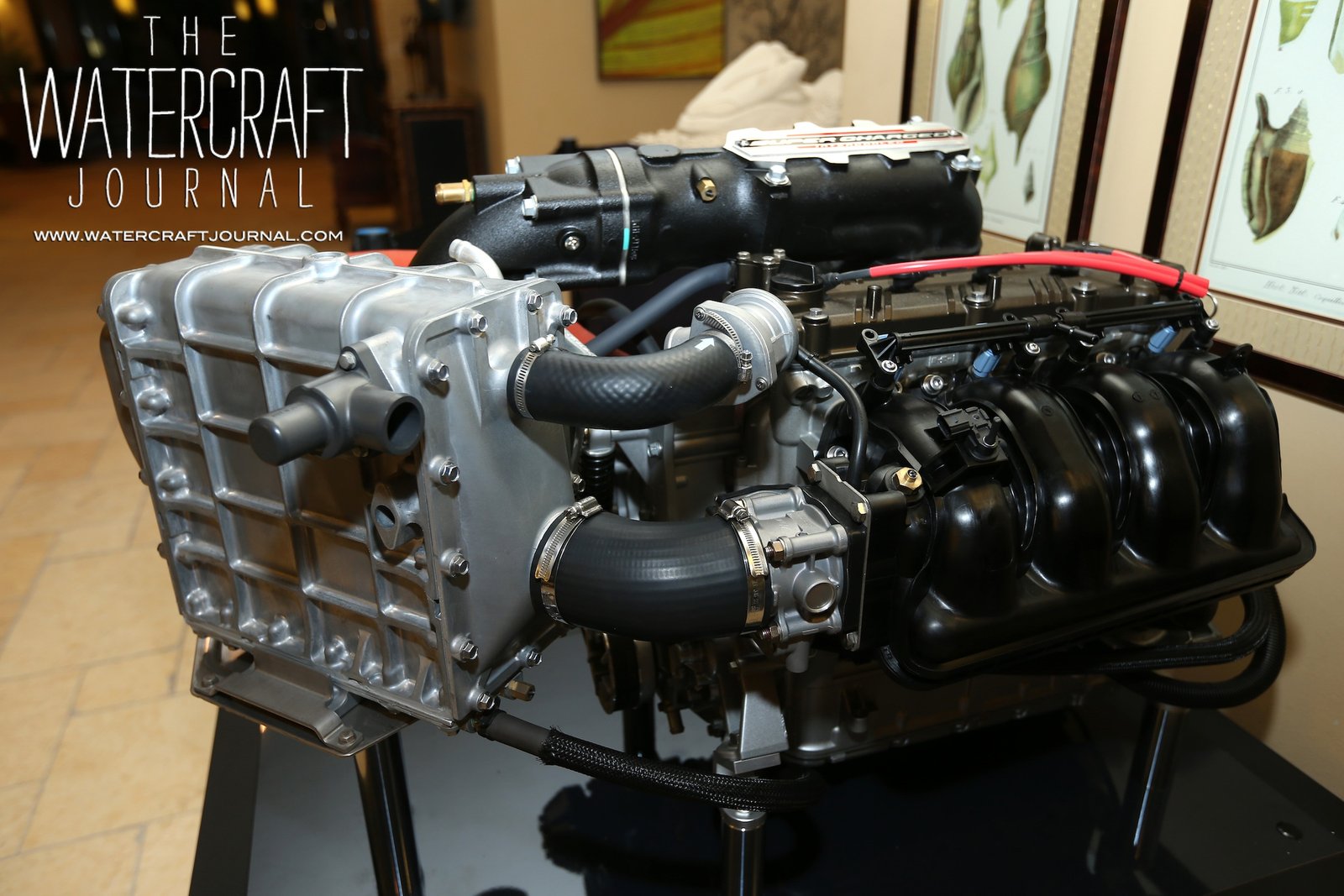
The 1,498cc, liquid-cooled inline four-cylinder plant spins out an industry-leading 310-horsepower thanks to drastically improving engine oiling, reducing heat soak and maintaining constant lower internal engine temperatures throughout the engine’s linear powerband. This was first achieved by re-engineering the crankcase with thicker water jackets, larger oiling passages for quicker oil return to the redesigned baffled pan that reduces oil windage and sloshing, and dual under-piston cooling oil jets (increased from one jet per piston to two).
Speaking of the pistons, the new Ultra 310 gets new lightweight cast slugs featuring additional ring land V-grooves.
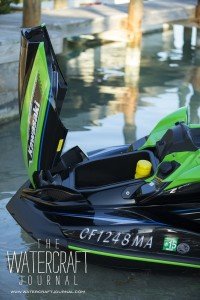
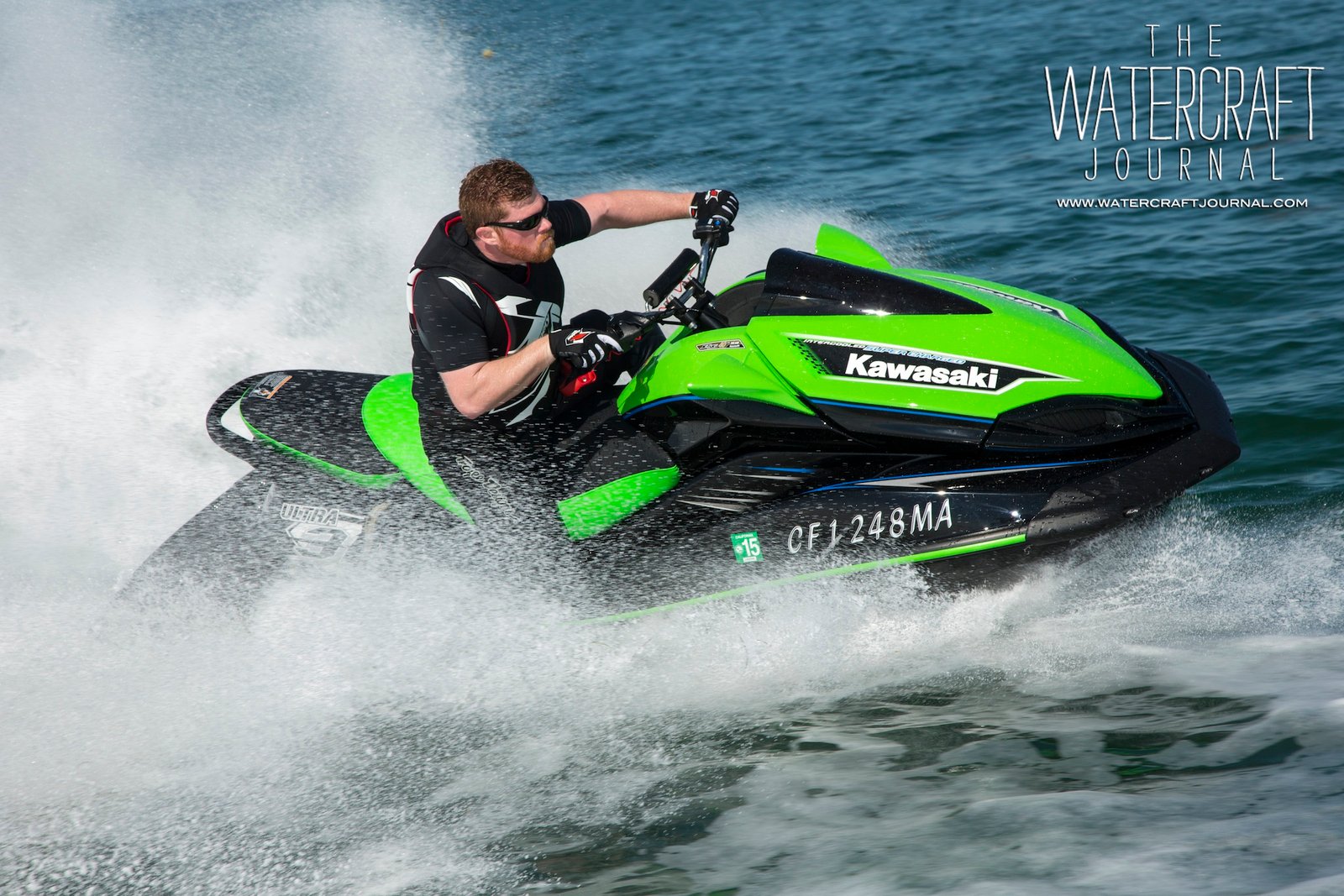
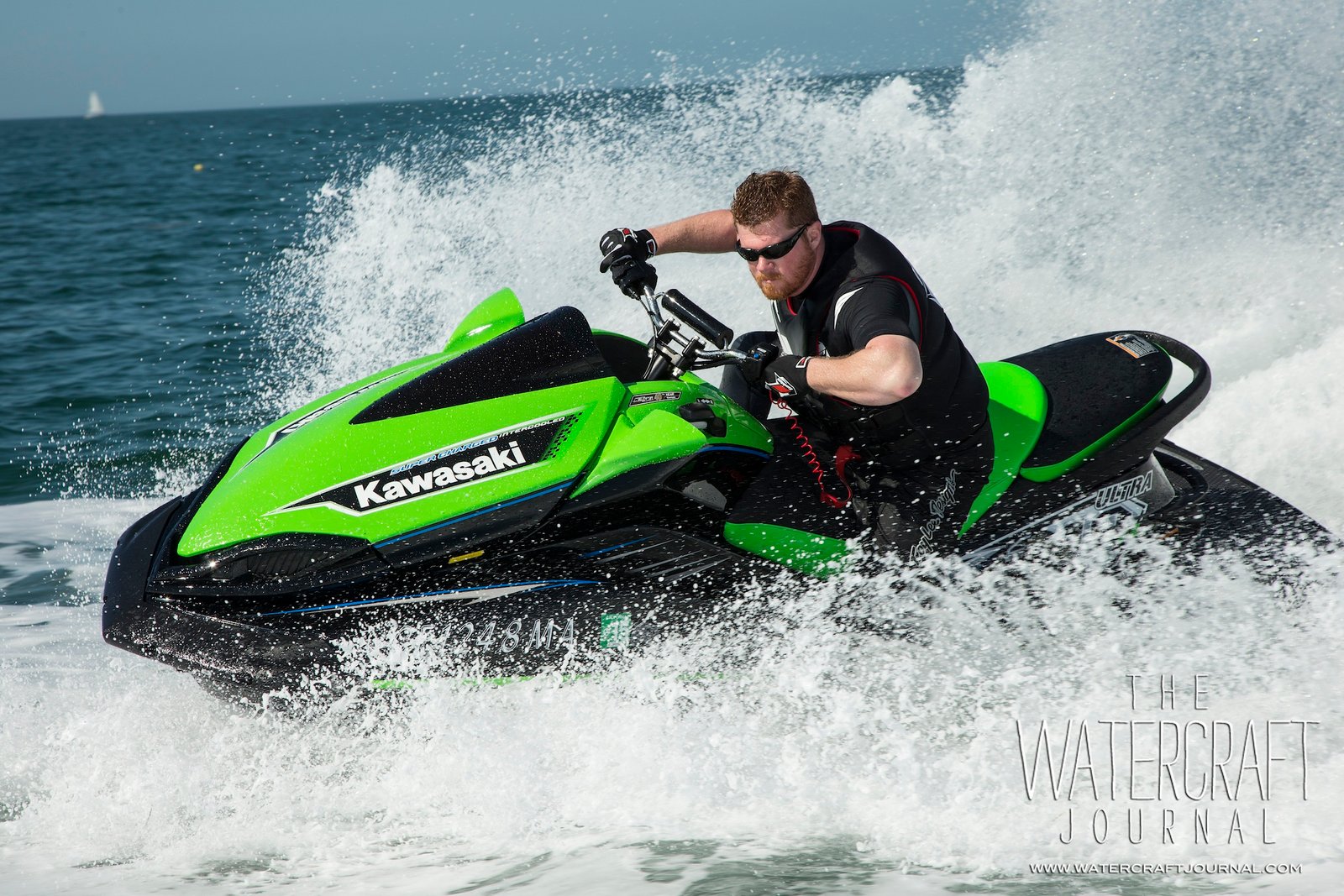
In the turns, the Ultra 310R’s steering response is immediate. The hull reacts deftly to the tiller; the low, wide bars of the 310R aptly communicating the rider’s immediate commands.The Ultra 310R still touts some of the most voluminous storage (56 gallons worth).
Kawasaki bumped up to a larger capacity fuel pump for improved fuel flow volume and 500cc injectors spraying into a brand-new long-runner intake manifold. Made from heat-resistant plastic, the intake radically improves low-to-mid range power.
Fed by the same Eaton TVS constant-displacement, four-lobe supercharger as last year, the Ultra touts dual blow-off valves to siphon off any extra of its 17psi of boost when needed. The previous model’s liquid-cooled intercooler returns as well. But what isn’t mentioned is the return of the second waterbox. The original 250X touted dual waterboxes but was reduced to one for the 260X and 300X. The second muffler not only drops the decibel output, but also addresses the previous Ultra’s troublesome low speed list while turning.
In fact, much of the aforementioned improvements came after studiously addressing consumers’ and technicians’ most reported issues with prior models.
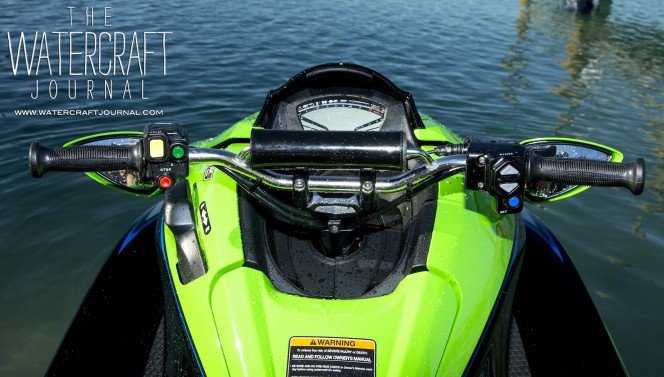
The biggest distinguishing feature of the 310R over the rest of the Ultra lineup are the electro-coated stainless steering neck and MX-style bars. Even with the sturdy steering neck replacing the plastic tilt steering, we noted a little play that could benefit from shimming up.The 310R is surprisingly unchanged from its siblings. Rather, Kawasaki opted to leave well enough alone, as in its current form, the setup of 310R is nearly perfect for most offshore riders (as it was this group the limited-run 310R was targeted for).
Overheating, burning and scavenging for oil, and even fuel over-consumption were mitigated with the above revisions. Even the large oil breather/catch can and articulated sprung belt tensioner are OE-level solutions first developed by the aftermarket. The large 160mm 8-vane pump also benefits from a repitched 3-blade, long-snout prop – also very similar to what tuners and racers use.
But all of these improvements are found across all of the 310 models, X, X SE, R and LX. What makes the 310R stand out among the rest? Well, if there was ever a personal watercraft that was specifically tailored to fit me – and lot of you who think like me – it would be the 2014 Kawasaki Ultra 310R.
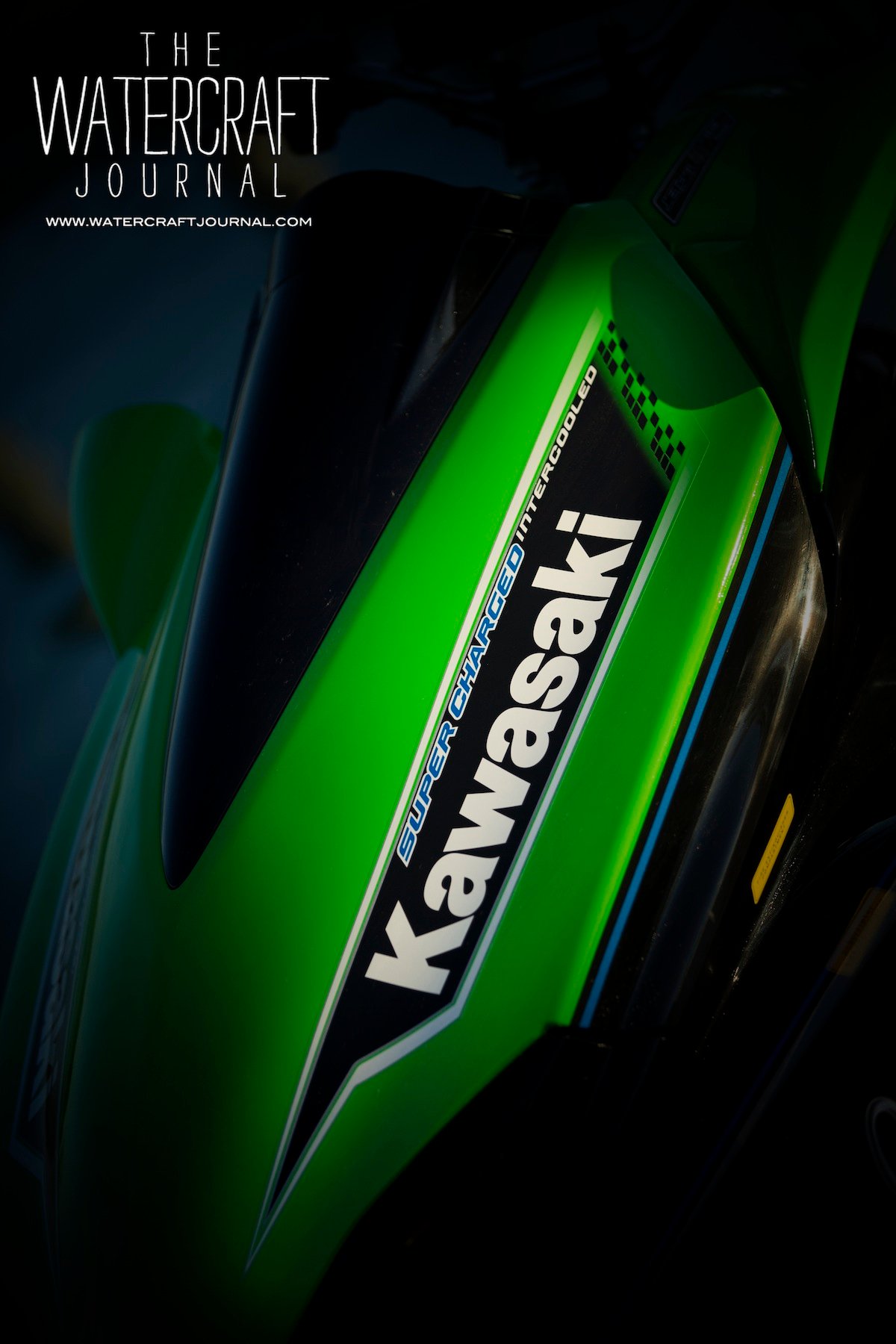
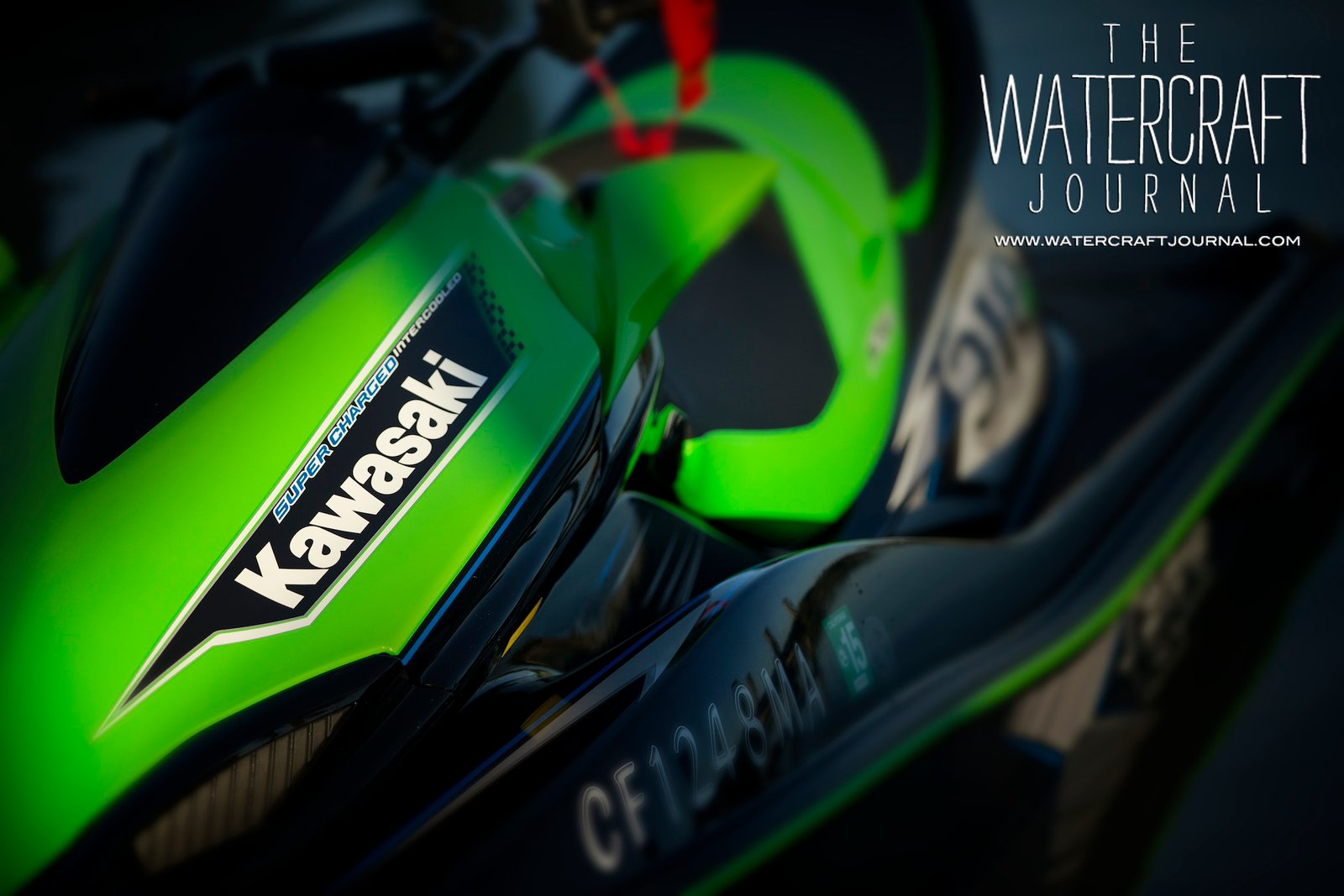
Other changes made to the 310 series from the 300X include a much-needed redesign of the passenger handrail, not only relocating the grip for easier, more ergonomically-friendly handling, but also has been narrowed so it won’t chafe inside of riders’ legs while riding standing up as before. Additionally, the mirrors have been replaced with more convex lenses.The Ultra series shows how a personal watercraft can be both a apt cruiser as well as an aggressive top performance vehicle. Back in a big way is Kawasaki’s signature Lime Green livery.
It’s everything I would have ever wanted from the previous model – the seemingly unstoppable Ultra 300X. The Ultra 310R is the project ski I didn’t have to build. It’s got 99.9-percent of all the mods I would see myself bolting on a Saturday morning before giving it a right good flogging the next day.
The 310R gains Kawasaki’s new Sportseat, wrapped in grippy textured canvas and a deep-grooved Hydro-Turf traction mat kit. Replacing the plastic tilt steering is a fixed electro-polished stainless steel steering neck and race-grade MX-style handlebars. These of course, can be adjusted fore and aft by loosening the hex head bolts with an Allen wrench.
As always, it’s while in the rough stuff that the Ultra shines.
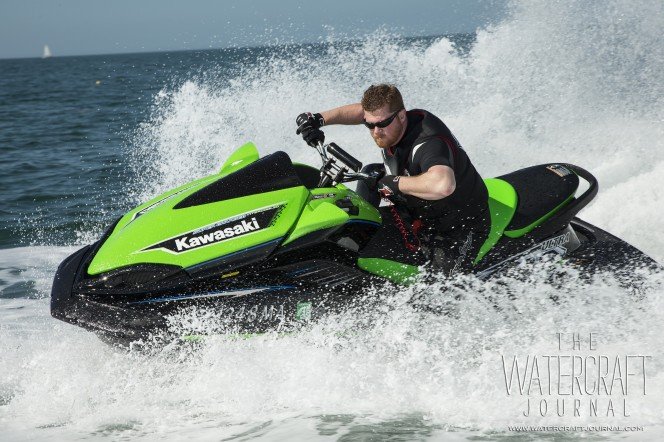
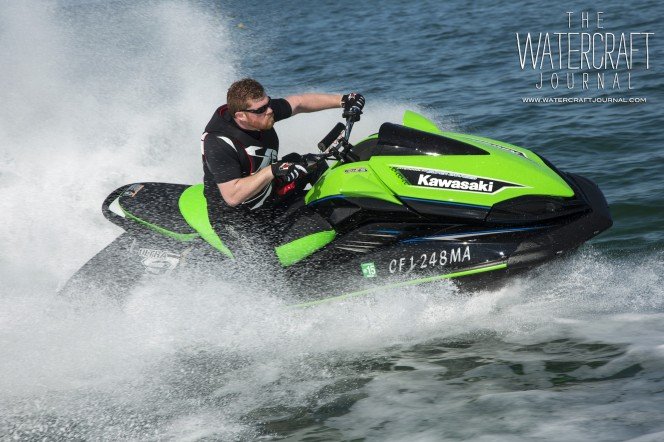
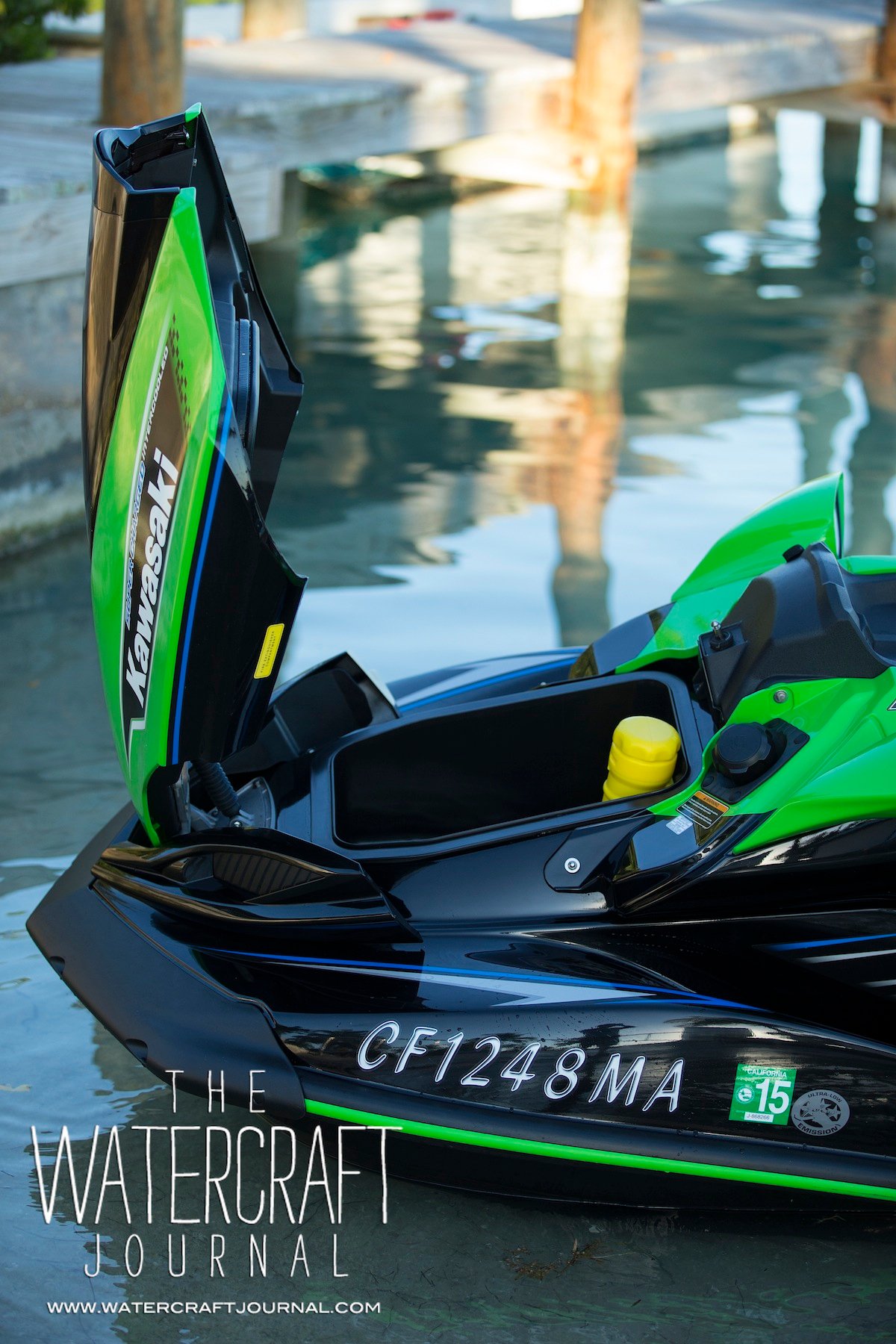
On the water, the 2014 Ultra 310R pulls with rotator cuff-tearing force. The Lincoln Tunnel-sized pump bites hard and remains loaded even while streaking over 2-to-3 foot Gulf Coastal chop. The fly-by-wire throttle response is immediate, almost precognitive. At speed, the supercharger whistles like a near-passing bullet. There’s no chatter of loose plastic or rattling, proof of superb fit and finish.
I did note some definite reaction lag in the electronically-assisted trim control toggle. Like the Cruise Control button, bumping the trim up or down requires holding down it one or two beats for it to respond – which is difficult to manage while under throttle.
Apart from these little quibbles, the Ultra 310R – and all of the 310-powered Ultras – adds up to quite literally the best runabout that Kawasaki has produced in its 40 years. And Kawasaki’s 310R is the Ultra that guys like you and me have been waiting for.
It was bound to happen, we suppose. Troy Snyder announced on Liquid Speed Radio last night that he will be switching from competing aboard a Sea-Doo RXP-X to racing on a Yamaha FZR SVHO for 2014. The supercharged 1.8L Yamaha will be built by the nearly unstoppable Dean’s Team, who has shown a tremendous affinity for the new SVHO plant.
Snyder beamed on the show, “I’d really like to thank Dean Charrier. He and Scott Watkins are really the guys who put this whole deal together for me.” This of course, ups the ante between the simmering rivalry between he and National Stock Class Champion Eric Francis, who will be piloting a 310-horsepower Ultra 310X for 2014.
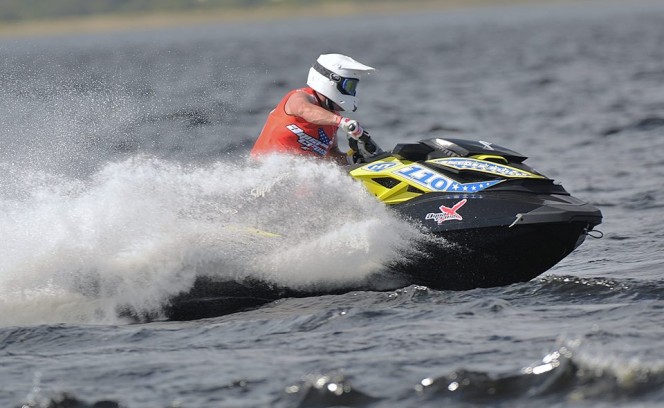
Moreover, Snyder states he will abscond with his usual #110 number plate for a more suitable #2, as Snyder earned said ranking in 2013. “Hopefully we will be able to change that to a #1 in the near future,” Snyder said.
Following Snyder across battle lines will be main mechanic, Bo Dupriest. Additionally, sponsors Slippery Wetsuits and RIVA Racing will also continue supporting Snyder’s racing efforts, “RIVA and Dave Bamdas were a big part of my program last year, and he was real excited to hear I made the switch to Yamaha.”
Yet, central to Snyder’s efforts is Tim Judge of Judge Motorsports. Judge will continue to support Synder through this transition. Synder told The Watercraft Journal, “Tim is my mentor, race coach, he’s my on-the-water tuner. He rides all my boats before I go to the line. Tim is a racer himself with multiple world titles. He knows what racers want to feel and how it needs to feel through the power band. He’s a big part of my program.”
[Editor’s note] I’ll preface this news post by publicly and wholeheartedly thanking one of the most talented, respected and personable powersports journalists in our industry, Jeff Hemmel for reaching out to me to conduct an inside-look at the creation of The Watercraft Journal for the renowned industry trade publication, Motorcycle & Powersports News. To be featured in such a presigious magazine is a very big compliment, and I thank Jeff and the staff of MPN.]
I hope not too sound gaudy writing a news article about an article talking about ourselves, but we were recently the subject of a great interview and introspective feature article on Motorcycle & Powersports News titled, “Industry Vet Launches Personal Content Site & E-Commerce Storefront.” Backtracking from the end of last year’s short-lived “dry run” of an online personal watercraft magazine that has since shuttered up its windows, to the creation of The Watercraft Journal to our plans for the near future, it’s a story that helps clear up a lot and tease the next few months.
I do need to note that as of today, the official launch of www.WatercraftOutfitters.com has been pushed back to March. Getting an e-commerce store up is easy. Getting an e-commerce store up so it works and looks good is entirely different. We only want to provide all of you the best resource we can offer, and that’ll take just a little more time.
In addition to this article, I want to personally thank all of you for your ongoing support in making The Watercraft Journal such an immediate success.
Why on earth are we publishing an announcement of Nissan’s new ZEOD RC Le Mans racecar? Trust us, it sounds a little weird to us too. But hear us out. This could seriously change how you look at Sea-Doo…
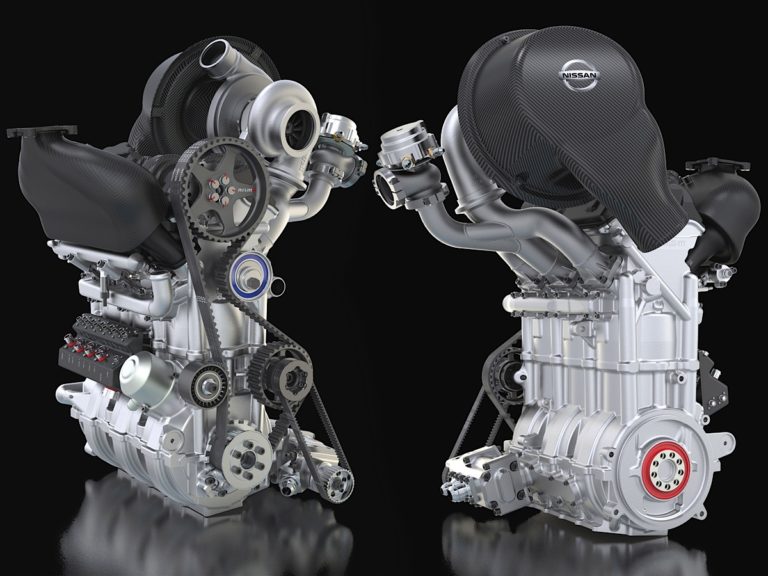
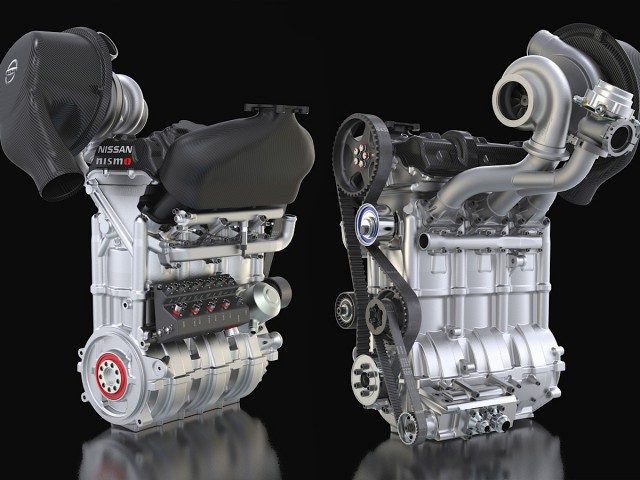
Nissan designed its futuristic ZEOD RC Le Mans racecar to compete under electric power, but battery life only goes so far these days, so Nissan’s performance branch, NISMO developed a very capable turbocharged, direct-injected 1.5-liter 3-cylinder engine that produces a staggering 400 horsepower.
The gas-powered DIG-T R engine is incredibly compact and lightweight, totaling just 88 pounds – as they point out, the engine could fit inside a carry-on suitcase! According to EngineLabs.com, “Nissan says it will rev to 7,500 rpm and dish out 380 Nm of torque (around 280 lb-ft), which is a comparable power-to-weight ratio as a F1 engine.”
Why we bring this to your attention is to reiterate our previous case that rumors of a four-cylinder Rotax being necessary to bring Sea-Doo back into the fray of competition is not only unfounded, but unnecessary. A three cylinder properly designed and executed is more than capable of leveling the playing field, and we see much of the characteristics necessary to do so in the ACE 900 motor (found in the Spark).
For more on the NISMO-built DIG-T engine, see below: