The Grammy award winning producer, DJ Khaled recently launched a worldwide chicken wing delivery company, named Another Wing. Khaled’s shops are operated as “Ghost Kitchens,” which became popular during the pandemic when dine in restaurants were forced to shut down. Owners had to get creative to make money and that’s when delivery-only ghost kitchens blew up. It is still going strong, and Khaled is capitalizing on it as only he could.
After partnering with ghost kitchen operator, Reef Technology; Khaled has launched over 150 Another Wing kitchens in five countries on three continents! As terrestrial business cranks up, Another Wing will also take to the water and offer boatside chicken wing delivery by jet ski!
“Sharing something I love, like delicious food with my fans all over the world, how could I say no? It’s all about spreading love and showing people what is possible when you dream,” [Khaled] said, adding that “we goin’ global.”
The menu features bone-in and boneless chicken wings starting at $6.95 for a six-piece order. Eight flavors are available, and the menu will be expanded to add jalapeno cheese fries, onion rings, and chocolate chip cookies for dessert.
“Wings stood out as something that’s universally loved and can be brought to many areas,” Alan Philips, Reef’s chief creative officer, told Bloomberg of thinking of the business idea with Khaled. When Another Wing makes its splash into boatside watercraft delivery, we will provide you with an update. We are anxious to see how well this concept plays out.
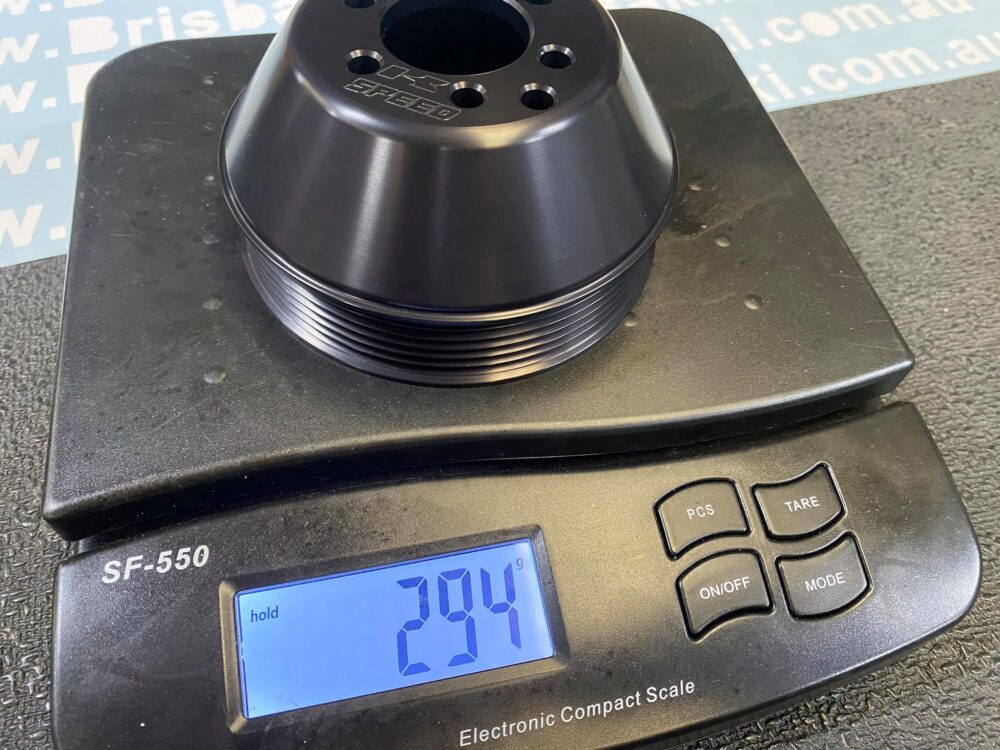
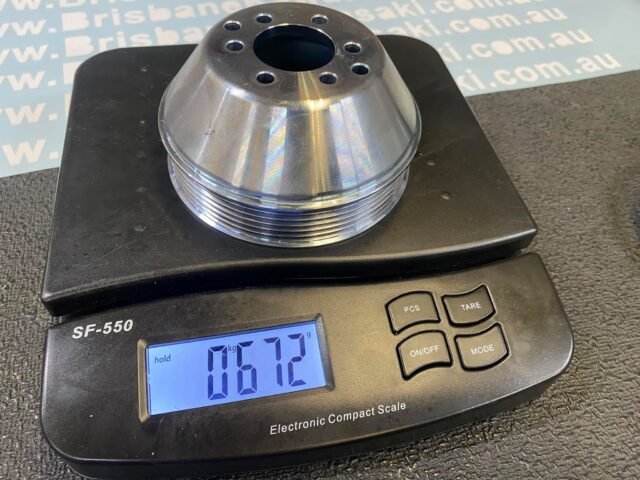
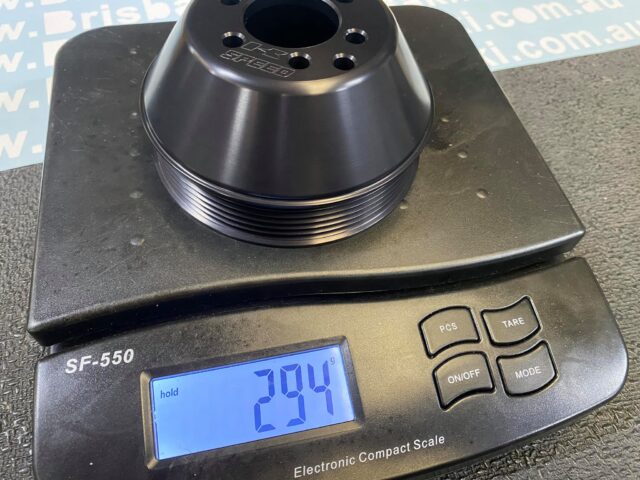
Above you’re looking at a side-by-side comparison of the factory supercharger pulley and the new billet pulley from Kspeed, which is a direct replacement for stock wheel. As you can see, the factory pulley is quite a bit heavier, and for those who already know, are prone to rusting.
The Kspeed pulley comes in at half the weight, which means a quicker spool time and (in the case of the 108mm pulley) 1.2psi more boost, putting the total closer to 18psi. Kspeed makes each of their pulleys from aircraft grade billet aluminum alloy and has them anodised for superior protection from salt and corrosion.
Kspeed offers two sizes of their lightweight pulleys too: the 109mm pulley can “go on any ski, and is a cheaper replacement option than [stock],” according to them. While you’ll see a slight boost increase, you won’t get the “full effect” until you reflash the ECU. The 109mm costs $212 AUD.
For those looking to really increase the boost of their supercharged Kawasakis, Kspeed’s 108mm pulley is their race spec offering. For this one, you MUST run 98-octane fuel (Australia) or 93-octane (USA). It also comes with a new idler to reduce belt slack. The 108 is priced at $250 AUD.
It makes sense for manufacturers to design and build a powerplant that can (and often will) surpass the expectations of the general riding public. In doing so, the OE can detune or otherwise restrict to the engine from performing at its peak limit, and rather, offer the customer a portion of its full potential. This saves the engine from operating within the narrow boundaries wherein a minor error could spell disaster.
All three manufacturers do this – Kawasaki, Yamaha and Sea-Doo – and for good reason. Equally, the aftermarket seeks to “unlock” this otherwise buried potential often through expensive and invasive means. Yet, what if you could unleash the latent power within say, Sea-Doo’s 300 ACE 1630 3-cylinder four-stroke within a matter of seconds. (Yes, seconds not minutes or hours.)
And what if guaranteeing engine longevity and improving straightline stability at speed and high speed cornering could be done nearly as quickly? Below we’ll list three “must have” performance upgrades from RIVA Racing that will unlock the hidden potential within your 300-horsepower supercharged Sea-Doo all without any permanent modifications, drilling or cutting. Yup, everything here is 100% reversible and can be done in less than an hour.
In the case of all supercharged 300-horsepower Sea-Doos, BRP intentionally caps the 300 ACE engine at just above 8,000rpm. For units sold in the United States, that means an RXT-X 300 or GTX Limited 300 might blip the speedometer at 70 (or even 71) miles per hour before the dashboard communicates to the ECU, which then dictates to the throttle body to ease back to 68 or so. All of this is done within fractions of a second, of course, but that’s how it works.
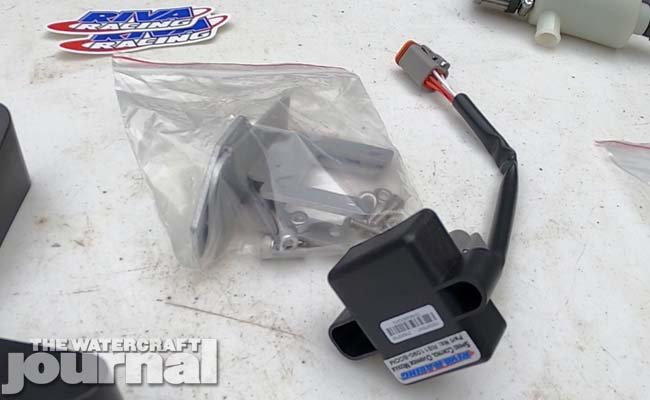
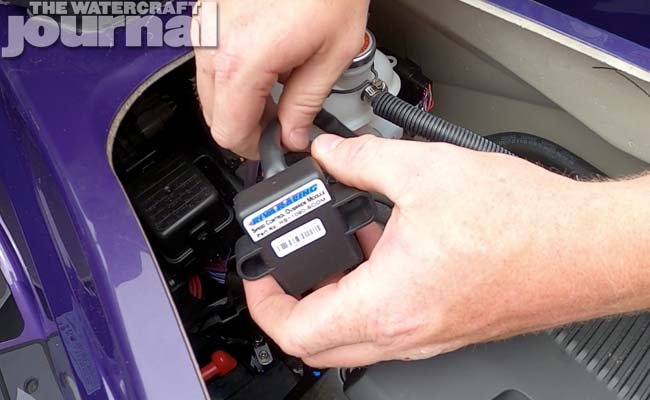
For international units (an “RS” unit), the RPM cap remains the same, but the speedometer is allowed to climb a little deeper into the 70s. To interrupt this signal, RIVA Racing engineered its Speed Control Override Module (or SCOM). The Speed Control Override Module does not connect to your Sea-Doo’s ECU whatsoever. It merely interrupts the signal between the GPS speedometer and the ECU, keeping the computer from backing off of the throttle once it hits its preset max speed.
Again, the ECU’s cap on RPM remains in place meaning you will not see excessive RPM that would void the OE warranty, but the SCOM will allow the Sea-Doo to proceed to speeds within the mid-to-high 70’s when ideal conditions. RIVA Racing includes a pair of brackets (one for the RXP-X and the other for the RXT-X/GTX). Rather than use the bracket, we opted to secure the SCOM with a couple of heavy duty zip ties. It won’t bounce or jostle much more than it would on the bracket, and it can be quickly removed whenever we want.
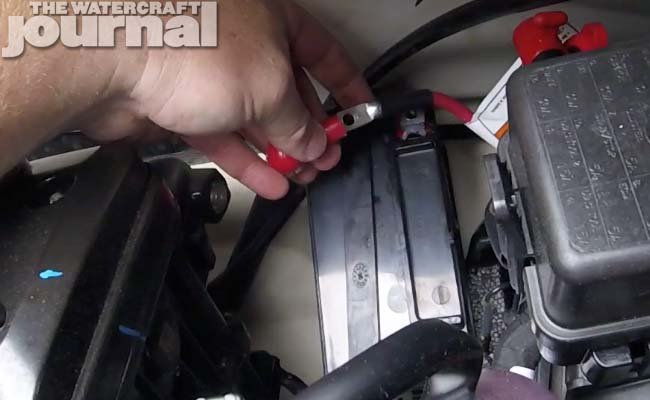
Prior to installation, always disconnect the battery. We had attempted to install a SCOM on a RXT-X 300 without doing so, and the effects of the override module weren’t visible at first. Once installed, our 2021 Sea-Doo RXP-X 300 (as will as SCOM-installed machines) began in “Sport Mode” – the prompt crossing the bottom of our dashboard. All other dashboard features remain in full function of course, as the SCOM does not reprogram the ECU.
Next on our list is RIVA Racing’s Oil Catch/Separator. As many are prone to say, all engines are effectively air pumps with negative atmosphere (vacuum) pulling air in, and positive atmosphere (pressure) pushing air out. The intake charge is hyper-pressurized by the supercharger, and “blows by” the sides of the pistons, pressurizing inside of your Sea-Doo’s crankcase while under throttle.
This pressurized air mixes with oily vapor that’s roiling inside of your crankcase and needs to be extracted. Normally, this oily vapor would be siphoned out and sucked in past the throttle body, through your intercooler and past your supercharger; coating everything in an oily film.
In small doses, this won’t hurt your engine – and in some instances when riding in salty air, the oily coating can sometimes help protect these sensitive parts. But if left unchecked, the film that can collect over time may heavily hinder your intercooler’s ability to chill an intake charge, and worse yet, cause carbon build up in your cylinders, clogging combustion.
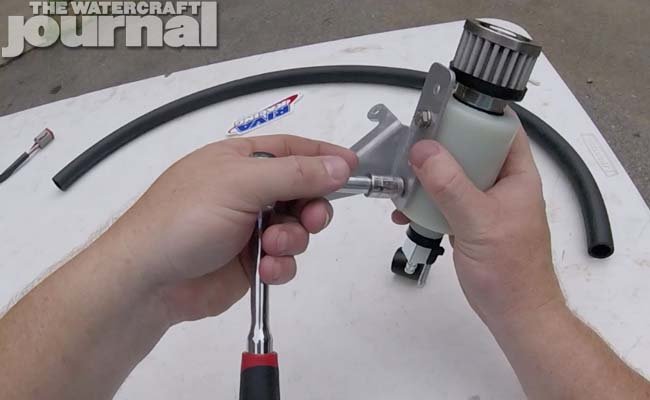
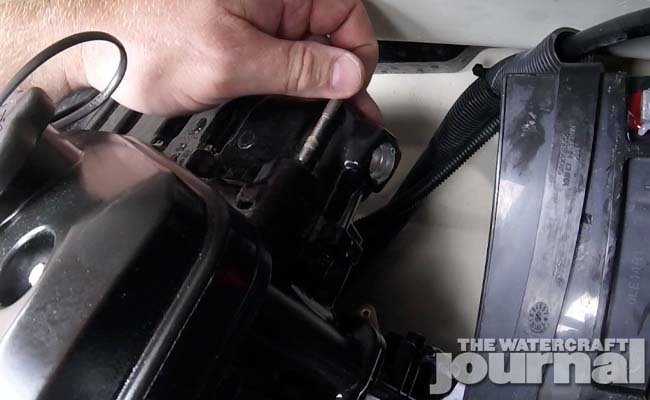
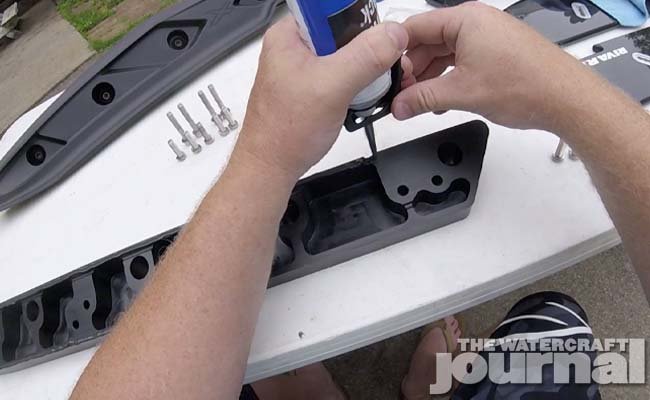
The catch can retrieves and separates the oil from the air, evacuating it through a screened filter. In doing this, the catch can is definitely a “must have” for those looking to rack up some serious hours on their supercharged Sea-Doo; and like the SCOM installs in minutes without any permanent cutting or drilling. The bottle mounts to the provided CNC-cut aluminum bracket, which for our 2021 RXP-X, mounted up using the existing outermost bolts of the exhaust manifold.
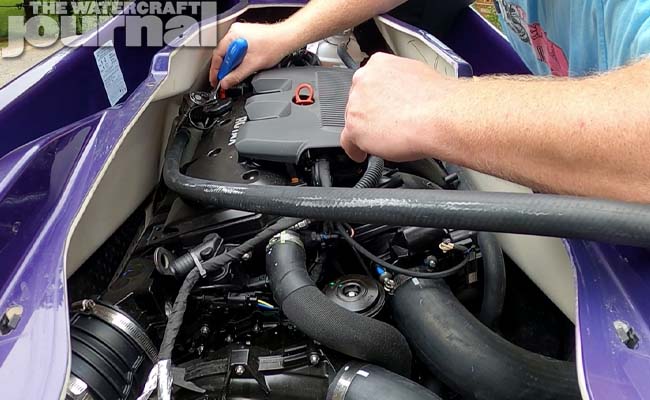
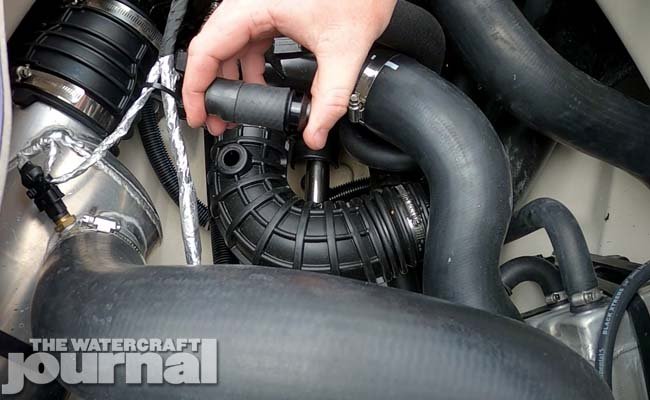
RIVA includes several feet of PCV hose to connect the catch can to the factory PCV valve; simply reuse the factory hose clamps and re-ziptie the wire loom to the new hose. Although not part of RIVA’s kit, we addressed the hole in the intake tube by snipping a short length of the provided PCV hose and capping it with a black rubber boot we had in the garage. This cap slipped over the plastic factory nipple, sealing off the vacuum leak the hole would leave.
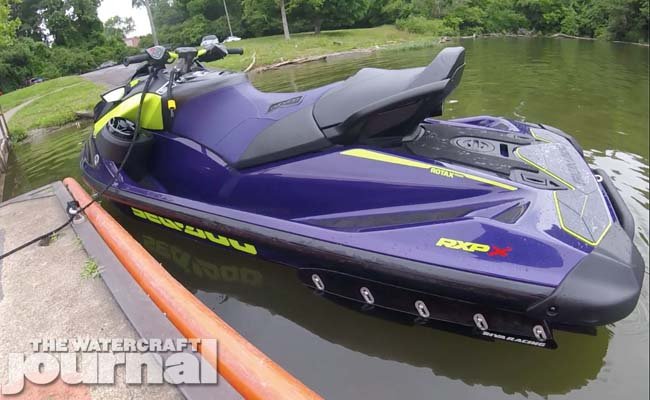
Finally, we can reattach our battery’s terminals, reinstall the engine inspection cover and seats, and begin our sponson upgrade. But why? The factory sponsons on the current RXP-X 300 (which are also identical to the sponsons found on the 2018-and-newer RXT-X 300) are a single piece of molded plastic; gone are the adjustable X-sponsons from previous years. The blades are somewhat deeper than the standard sponsons, but are rather blunt, kicking up a wide roost and offering only the slightest bit of improved traction due to their increased drag.
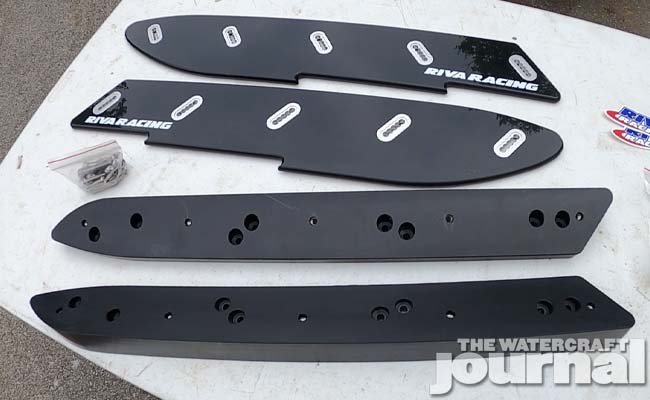
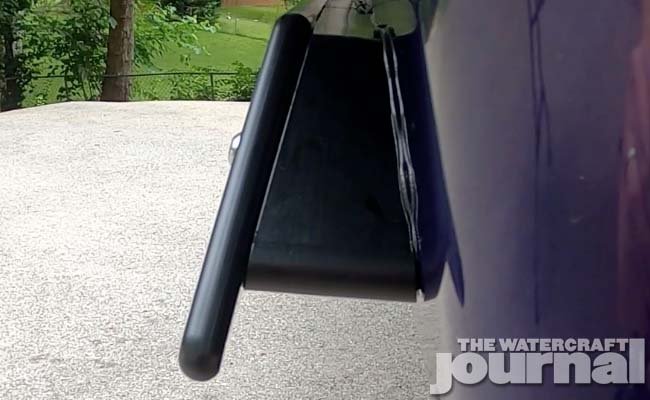
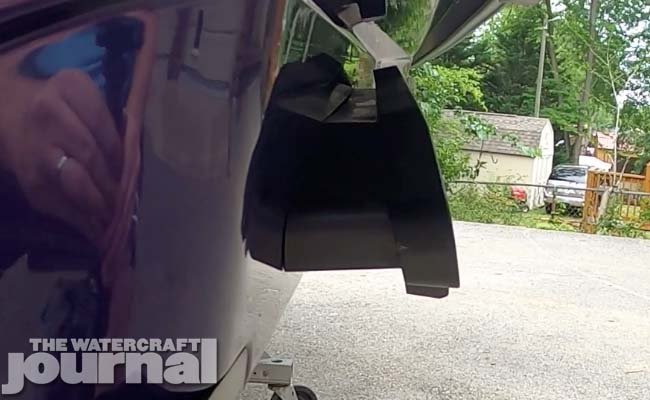
The best way to demonstrate the night-and-day difference between the RIVA Pro Series Sponsons and the factory sponsons is in a side-by-side comparison. Notice that the depth and angle (what you might call “negative camber”) of the blade is considerable, allowing the sponson to cut far deeper and at a vertical angle when the RXP-X rolls into a tight corner. The deepest portion of the blade is at the foremost, pushing the hull’s “pivot point” forward.
Effectively, the RIVA Pro Series Sponsons permits the RXP-X’s T3R hull to perform far more aggressively than the factory blades would allow. The molded plastic OE sponsons failed to give sufficient “bite” in full-throttle, leaned-over turns; the Pro Series do. Equally, the Pro Series Sponsons do not rely on generating drag alone (as indicated by the stepped edge of the blade) but rather, favoring forward and tapering at the tail, placing all of the traction around the intake grate.
We discovered how aggressive these new sponsons could be during our first “test run” of our trio of upgrades. Even with the engine cold, we quickly sped up to 71mph with a half-full tank of fuel. With the blades set to #4, the RXP-X bit sharply, snapping the ski hard inward, and high-siding us nearly off of the unit. In full speed runs, the deep-set blades could easily be felt “guiding” our tail, which was more engagement than we wanted.
Returning a couple of days later with less fuel in the tank and the sponsons moved up one spot to the #3 position, we could snap a hairpin with ease and confidence without much effort. Equally, we clicked off a consecutive series of 75 and 76mph top speed runs on the dashboard’s speedometer. Our iPhone’s GPS app read a more conservative 74.9mph, so we averaged the two for a safe 75.5mph, which we felt was impressive given our 240-pound rider and 445-foot elevation.
In all, an hour’s worth of work and three extraordinarily easy-to-install parts from RIVA Racing are all it takes to unlock a large portion of any 300-horsepower Sea-Doo. Best of all, each of these are 100-percent reversible and transferable to another 300 ACE-powered machine (yes, from a RXT-X to a RXP-X to a GTX 300). Go to the links provided above or visit www.rivaracing.com and check ’em all out there.
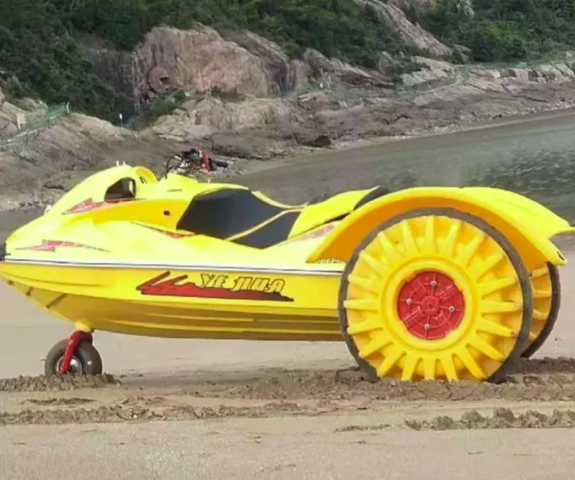
When inept political demagogues bow to foreign powers and refuse to enforce international laws pertaining to intellectual property, you get insane mutant rip-offs like this bizarre electric-powered paddle wheel-propelled personal watercraft listed on Australian vendor site “Gumtree” as a “New Durable Amphibious Electric Jet Ski.”
Selling for a bargain price of $18,200 AUD (roughly $13,390 in USD), the details are slim to none pertaining to pretty much everything besides the title. Claiming a top land speed of 21kmph (13mph) and a whopping 10kmph max speed on water (6.2mph), you’re not looking at anything that’s going to set any IJSBA records.
Lastly, when the listing claims the “Durable Amphibious Electric Jet Ski” is made from aluminum alloy, we’re presuming the trike rides on an aluminum chassis tucked within its fiberglass shell. Borrowing heavily from what appears to be decades of previous Sea-Doo designs, we see portions of the previous RXT 260 in its pseudo S3-hull and Ergolock seat.
In all, this thing is pretty much a disaster. Curiously, we think this would be ideal candidate for the “Jet Ski Brothers” YouTube channel to relocate their LS V8-swap build’s powertrain. If you haven’t already seen that, do yourself a favor and locate that series of videos.
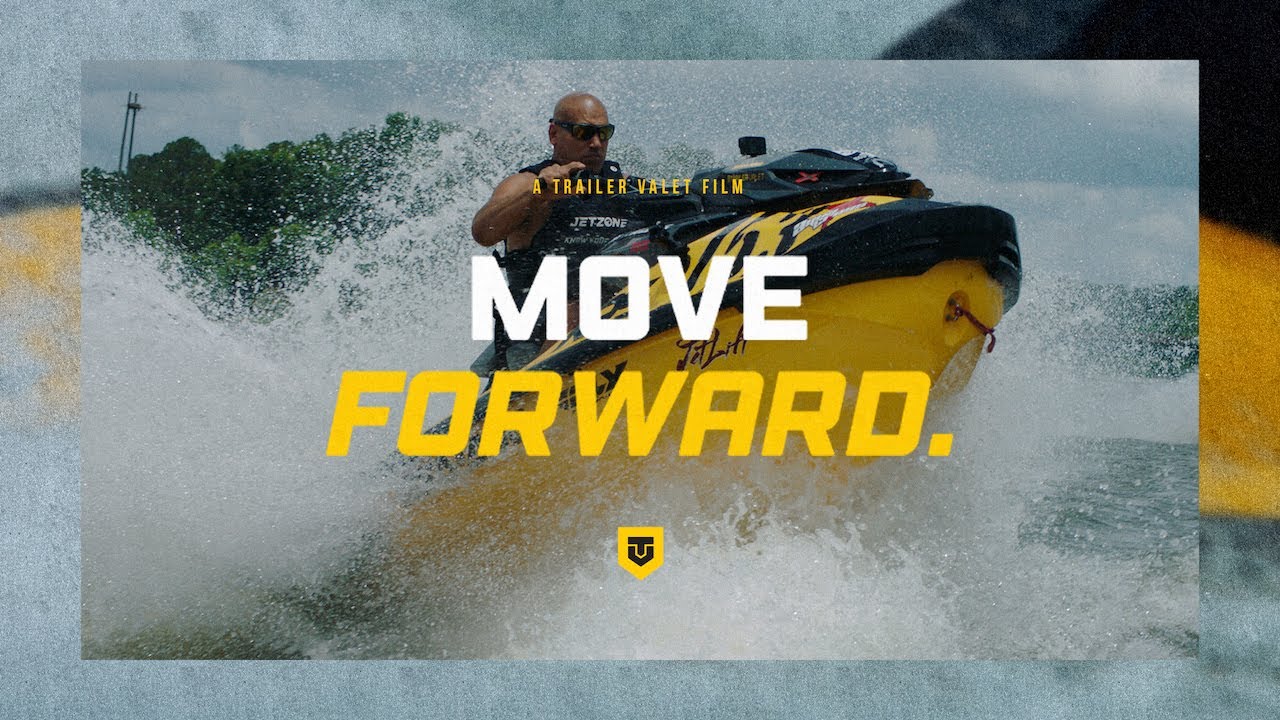
The truly inspirational story of Sea-Doo racer and ambassador Anthony Radetic has just been revealed in a brand new production by Trailer Valet. The documentary series Move Forward premiered with the Radetic piece on November 11th, 2021, and the short film’s star is indeed “very stoked” with the result.
Anthony Radetic is an amazing adaptive athlete. A former military helicopter pilot, he was injured in 2004 while stationed in Ft. Rucker and left paralyzed. With both his army career and his primary source of adrenaline and excitement taken from him, Radetic faced more than just the prospect of being wheelchair bound; he also had a lifestyle and a way of being that needed to be reclaimed.
After successful stints in hand cycling and mono skiing, it was actually Radetic’s wife who came up with the fortuitous idea of entering the sport that he is now so well known for. Following a theme that is typical of competitive athletes, things moved quickly for Radetic from initially just working out how to ride a PWC effectively to racing the machines in open competition.
The Sea-Doo PWCs that he races are set up specifically to accommodate the position and movement limitations he has, which add to the physical challenges of PWC competition. Due to an enormous amount of hard work and training, along with meticulous machine preparation, the Radetic / Sea-Doo partnership has proven to be very successful.
Whether you have been following the racing career of Anthony Radetic for years or are new to this story, make sure you don’t miss it’s cinematic retelling in this surprisingly deep and expressive short documentary. Watch Moveforward featuring Anthony Radetic here:
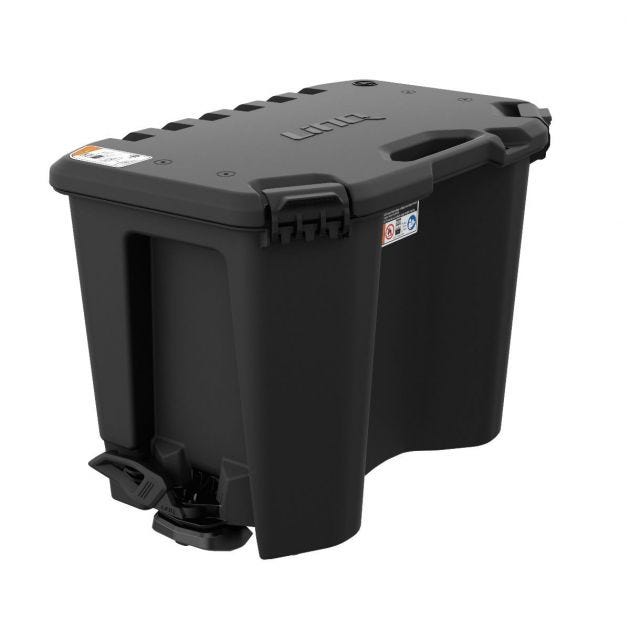
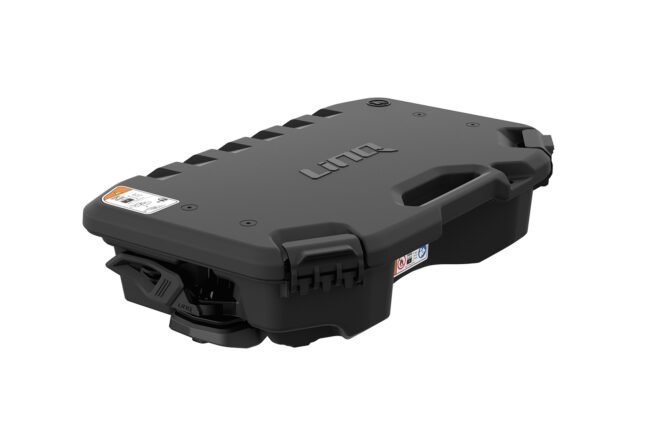
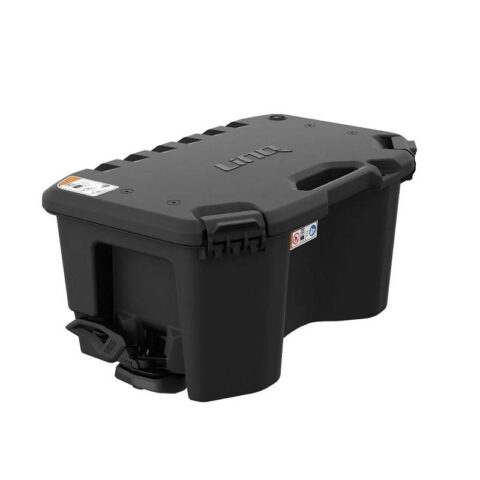
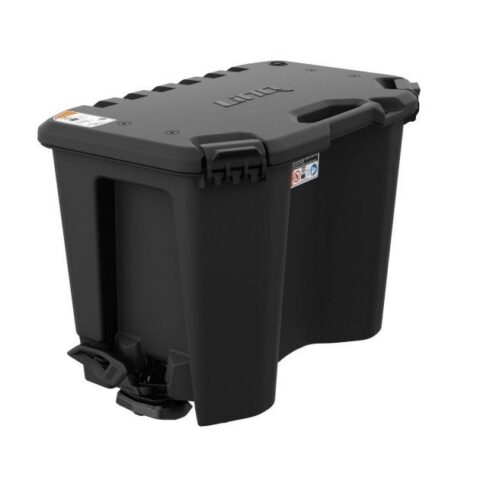
Sea-Doo added a 30-Liter Modular Cargo Box to its LinQ accessories lineup. This box is a beast and if you were looking for ways to stow more gear on your Sea-Doo, this is the storage box for you. It is a large rugged hard sided box with a 30-liter capacity and weather resistant lid. The box fits on all LinQ with a 16” base.
If one big box isn’t enough, add more modular boxes or a LinQ Dry Bag. The LinQ 10 Liter Modular Box and the 20 Liter Modular Box offer the perfect solution. For the important stuff like dry clothes, the dry bag gives you added waterproof protection. The 10 Liter box retails for $129.99, and the 20 Liter is $149.99.
You can stack them or set them side by side, whatever you choose. No tools are required because they quickly attach to the LinkQ base. The 30L box will give you peace of mind knowing your gear is safe and secure while you’re riding hard on the water. The 30 Liter box retails for $169.99.
Black Friday is coming up and your local Sea Doo dealership will have some killer sales. That’s prime time to get your new box and to find out how much gear it will hold. Practice packing it while taking advantage of the sale priced goods!
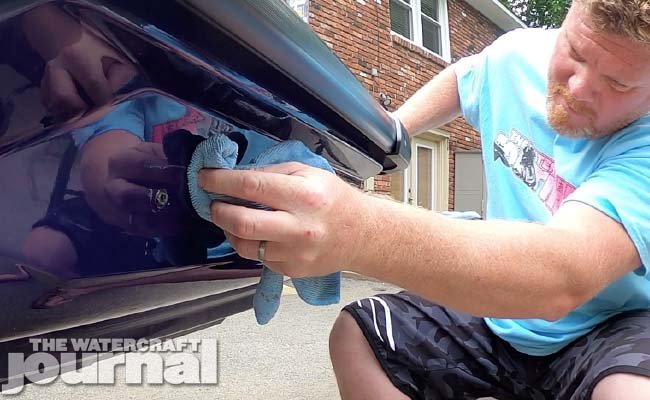
Let’s face it, regularly riding your personal watercraft can leave quite a bit of wear and tear on your machine. Launching off of carpeted bunks, bumping up against docks, or running up on the sandy banks of a riverbed or shoreline can quickly scrape, scratch and mar your otherwise pristine ski’s finish. And considering that all three OEs use different materials for their hulls, it’s hard to know which is best for each application.
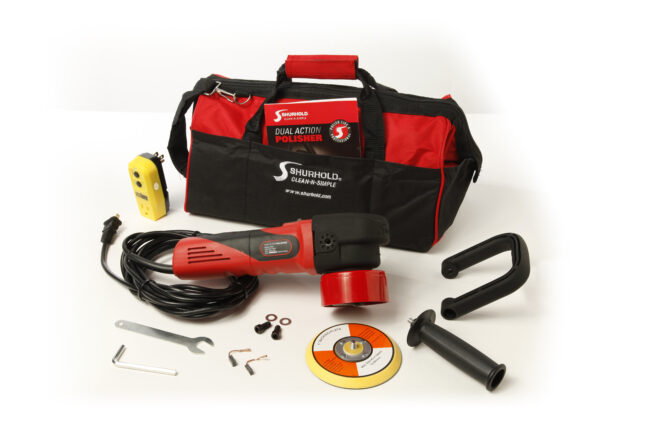
Thankfully, Shurhold’s Dual Action Polisher is the right tool for the job. Many polishers come in “too hot” applying far too much power to otherwise sensitive surfaces. Too much torque, too high of RPM or too concentric the swirl. The Shurhold polisher offers a smart oscillating pattern with an adjustable (2,500-6,500) orbit speed with a quick-change 5-inch head ensuring that even the most novice DIY’er won’t burn through his paint or dig into the gel coat. Priced at $155.98, the complete kit that is detailed below:
Here is the official press release: The combination of UV rays, blowing dirt and accumulated grime can leave a boat’s fiberglass and paint dull and chalky. Restoring the rich, high-gloss finish is easy with Shurhold’s World’s Best Dual Action Polisher. Ideal for buffing and waxing, it quickly brings back the surface’s original sparkle without damaging from too much power.
Unlike professional-grade tools that, if not used properly, can burn the surface or leave swirl marks, the Dual Action Polisher has a 5″ oscillating head that’s effective yet safe in the hands of DIYers. The quick-change Velcro backing plate makes switching pads fast and easy. Speed can be adjusted from 2,500–6,500 orbits per minute to match the work being done, whether cleaning, buffing, waxing, polishing or removing paint defects.
The Dual Action Polisher is built for all-day comfort. It features a removable handle that fits on either side of the polisher and a soft-touch D-handle that pivots to position the tool to the perfect angle. The main grip has a convenient thumb power switch and rubberized insert for a firm grasp.
A counterweight helps eliminate vibration from the oscillation. The heavy-duty 20′ power cord with GFCI plug provides ample length to work uninterrupted—and safely. A video is at www.bit.ly/ShurholdDualActionPolisher.
Shurhold’s World’s Best Dual Action Polisher includes a sturdy storage bag, all the tools needed to assemble and use the polisher, and a spare set of motor brushes. It costs $155.98.
Dedicated to educating boat owners, Shurhold provides key tips for boat value preservation at www.shurhold.com. Inventor of the One Handle Does It All system, Shurhold manufactures specialty care items and accessories to clean, polish and detail.
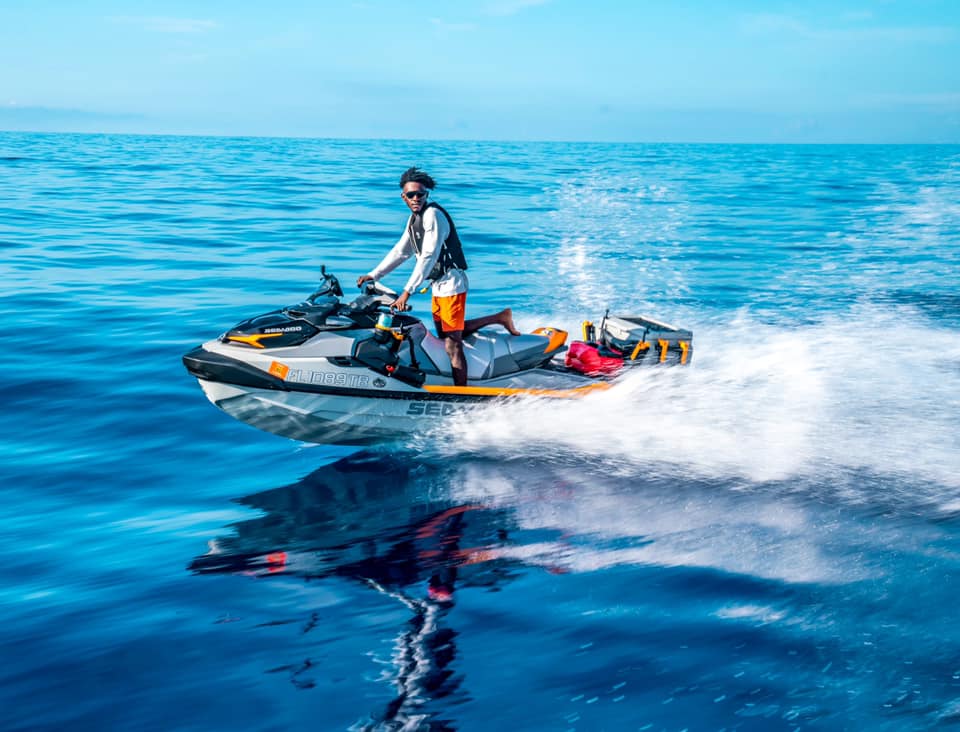
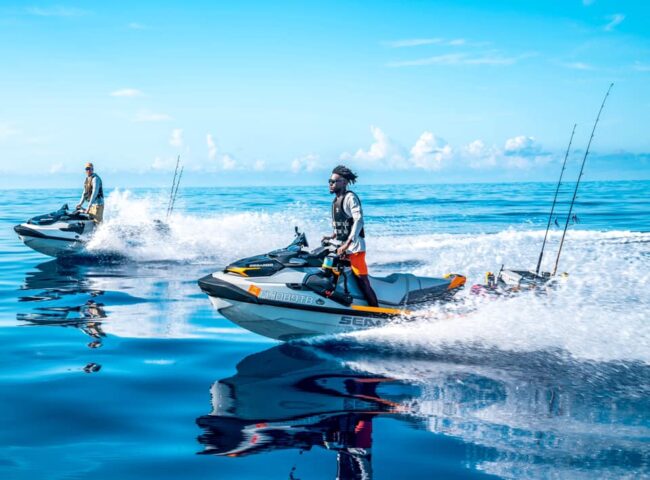
We are super stoked about this video from Emmanuel Williams. He operates the YouTube channel, iBelongOutdoors and produces stellar content. This video is the first in a 3-part series featuring his 112-mile trip to the Bahamas. Williams exudes such a good vibe that you can’t keep from smiling and getting pumped and planning your own long trip. The video showcases the versatile Fish Pro and how comfortable it is when cruising long distances. It makes for a great watercraft for going on expeditions or strike missions while doing fishing along the way.
Williams was riding the Fish Pro Trophy, which is outfitted for a long ride and James was on the Fish Pro Sport, also set up for a long ride. Both men were ready for adventure when they got underway from Stuart, FLA. A support boat accompanied them as well. Williams described the trip as they cruised across the beautiful glassy blue water. Williams spotted a bunch of balloons and pulled them out of the water. He was not pleased and popped them and stashed them on his ski. He provided a short PSA requesting that we grab any balloons we see and dispose of them.
They were soon underway again and at the 60-mile mark, they refueled the skis and took a break for water. 100 miles into the trip, they spotted their destination and an approaching storm looming in the distance. They hauled ass in the rain to get to the dock and to tie off the skis. Williams was stoked to make the 112-mile trip to the Bahamas. Check out the video for some spectacular drone footage and killer water shots. We enjoyed this video and think you will too.
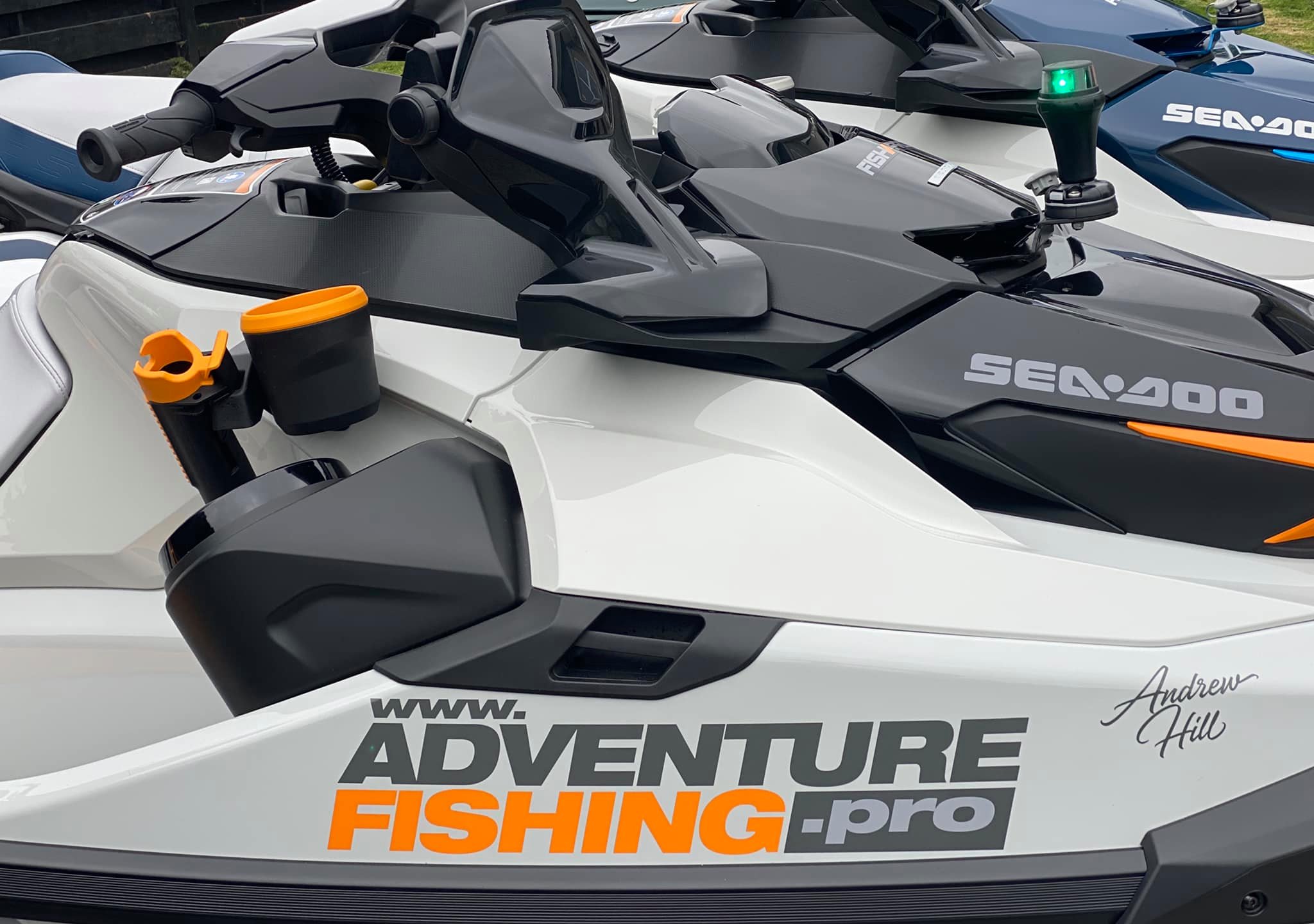
Easily one of the biggest surprise additions to the 2022 Sea-Doo lineup was BRP’s expansion of its singular Fish Pro into a trio of machines: the Fish Pro Scout (based on the GTI platform); the Fish Pro Sport (the standard ST3-based model); and the Fish Pro Trophy, a fully-equipped, top-of-the-line PWC fishing platform unlike anything offer by the OE’s before. To kick off the fishing season right, Sea-Doo rushed a pair of 2022 Fish Pros to its New Zealand ambassador, Andrew Hill who wasted little time putting the two machines to work.
Obviously, the Trophy would grab anyone’s attention first as it did with Andrew, who played a pivotal role in the early development of the Fish Pro program. Prior to his involvement, Hill was a consummate PWC angler, racking up over 10 years of experience directing fishing expeditions aboard Yamaha WaveRunners. Hill made the jump to a heavily-customized GTX 155 with its own 7-inch GPS fish finder, navigation lights, dual battery harness and ersatz cooler system. It didn’t take long for Sea-Doo to catch wind of Hill’s exploits and the rest is history.
The 2019 Fish Pro set the groundwork for what would become BRP’s newest segment of Sea-Doos; the Trophy takes everything that the first Fish Pro established and raises the bar higher, with a live well, deck washing system, massive split-level cooler, a Garmin GPS and sounder system, it’s own deployable and dedicated anchor, a dual battery harness, full smart phone integration, multiple rod holders and positionable mounts, and of course, the industry’s first swivel seat.
Hill promises to illustrate every detail of his Trophy over the coming weeks so enjoy the video below and subscribe to his channel for new content coming shortly.
In possibly one of the most explosive freshman years ever in the history of Pro Runabout racing, Tory Snyder has achieved a feat only accomplished once before, and that by one of the sport’s most acclaimed racers, Chris MacClugage. The Bradenton, Florida native and son of multi-championship winner Troy Snyder, charged into the 2021 season aboard two Snyder Build, Judge Motorsports-tuned Yamaha SVHO WaveRuners and took home a shelf-full of national and world titles.
A month earlier, Snyder fought back fierce international competition to earn his first Pro-Am Runabout Stock world championship at the 40th annual IJSBA World Finals in Lake Havasu City, AZ.
Snyder wrote in a trending post, “This one means a lot to us. This wouldn’t be possible without these 4 guys [Troy Snyder, Tim Judge, Dean Charrier and Michael Bouchard] They built me an unbelievable ski.”
For Tory’s final race of the year, the 18-year-old capped off his undefeated year with two national championships in Pro Runabout GP and Pro Runabout Stock.
Snyder told The Watercraft Journal, “[What an] unbelievable weekend in Naples; I took the win in Pro Stock. I’m the first person since [Chris MacClugage] to win Pro [Runabout] Stock in Havasu and Naples in the same year.”
For this past weekend at the Pro Watercross World Championships, Snyder piloted a Yamaha GP1800R SVHO with a Dean’s Team tune and several “goodies” from Judge Motorsports that Tory joked as being “classified” – fair enough.
Tory concluded, “I couldn’t have done it without my dad and mom, Snyder Built, Judge Motorsports, Dean’s Team, Yamaha, JetPilot, and Saints of Speed. Thank you!”















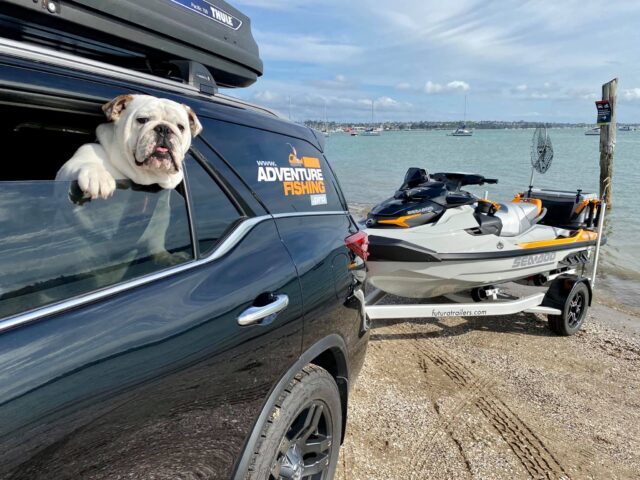
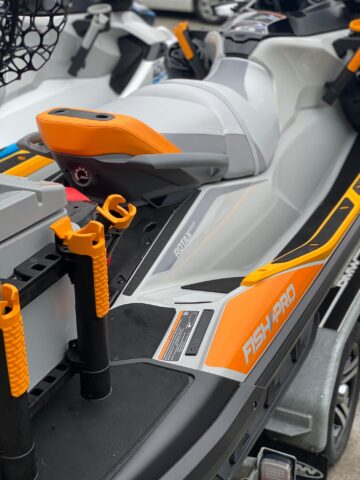 Obviously, the Trophy would grab anyone’s attention first as it did with Andrew, who played a pivotal role in the early development of the Fish Pro program. Prior to his involvement, Hill was a consummate PWC angler, racking up over 10 years of experience directing fishing expeditions aboard Yamaha WaveRunners. Hill made the jump to a heavily-customized GTX 155 with its own 7-inch GPS fish finder, navigation lights, dual battery harness and ersatz cooler system. It didn’t take long for Sea-Doo to catch wind of Hill’s exploits and the rest is history.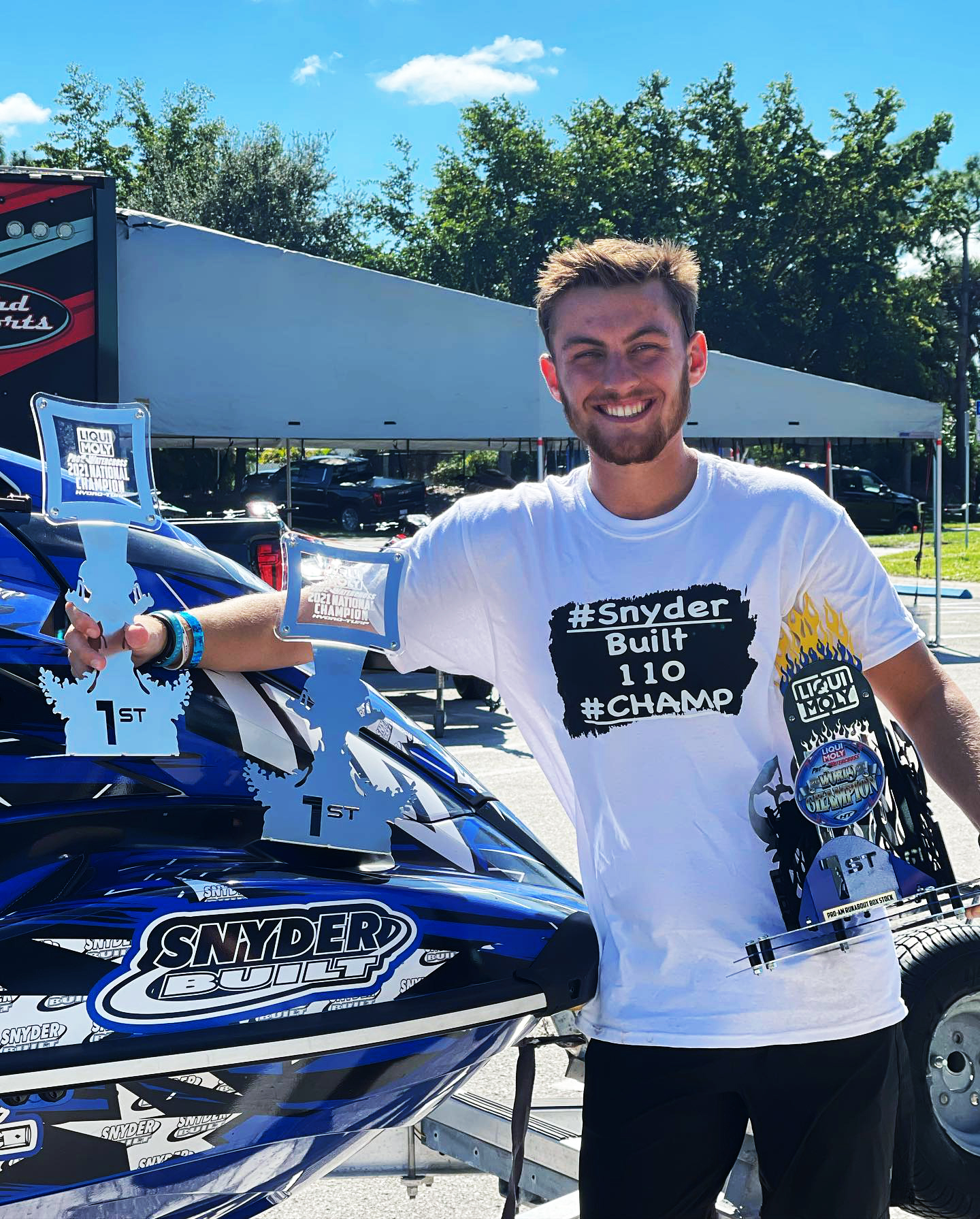
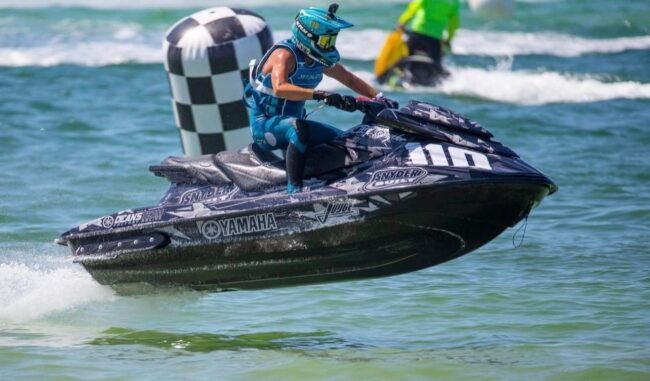
 A month earlier, Snyder fought back fierce international competition to earn his first Pro-Am Runabout Stock world championship at the 40th annual IJSBA World Finals in Lake Havasu City, AZ.