Dustin Farthing serves as an example of how a talented watercraft racer segued his racing career into a lucrative business within the powersports industry. Now the proprietor of Speedzone Motorsports in both Gadsen and Oxford, Alabama, Farthing is still active as both a racer (even claiming yet another IJSBA World Championship this past October in Sport GP) as well as coaching his son Deven, who too actively competes.
One admirable trait of Farthing’s is his keen awareness of what brought him the success he enjoys currently, and the multi-world champion has recently expressed dissatisfaction with the fractured state of the world of professional jet ski racing. So much so, that Farthing shocked the racing community by proposing a 3-day annual world class event that would beckon athletes from around the globe to Atlanta, Georgia with the allure of a $200,000 purse.
The response was overwhelming. At the time of this writing, the proposal has received over 200 comments, 46 shares and hundreds of responses. Farthing wrote in a Facebook post:
Jet ski friends,
This is a question for everyone involved with racing. We all know there’s dozens of series, sanctioning bodies, [and] championship events that claim to be the World or National Championship. We all wait around for schedules, locations, dates and venues constantly every year.
What racers from around the world would support a one-off championship race located in Atlanta, Georgia with a $200,000 payout?
This would be one weekend of racing and the $200,000 purse [would] be paid out to all classes offered. The payout would include amateur, junior, pro am and professional [classes], like it use to in the “old days.”
Atlanta offers the largest airport in the USA, hotels, restaurants, Six Flags [Over Georgia] amusement park, water parks, [World of] Coca-Cola, Georgia Aquarium, College Football Hall of Fame, basketball Arena and more.
Shipping into nearby ports are easy in Savanna, Georgia and New Orleans, Louisiana. Airport shipping directly into Atlanta and easy entrance for anyone driving into the state.
Tag a friend, and comment if this is a race you would like to see happen?
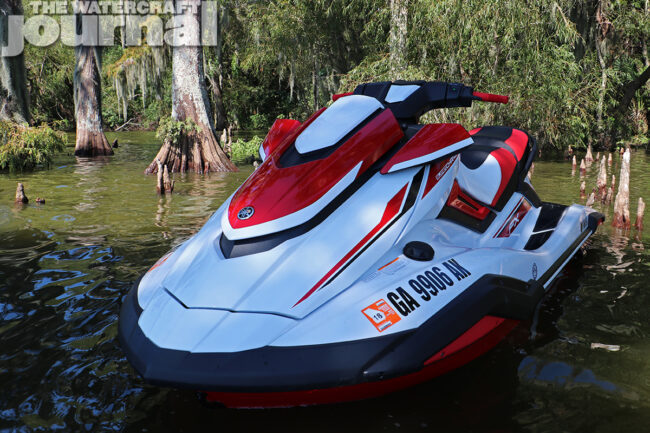
It has become a bit of a litmus test for me in recent years. While incredibly unique in its topography, the narrow canals, serpentining routes through densely-packed cypress and mossy banks make the circuitous trails of Morgan City, Louisiana an exemplary test bed for new watercraft. Radical swings in weather quickly churn larger bodies of water into brutish chop. A steady stream of recreational boaters, concrete barriers and continual barge traffic all require honed reflexes and a craft responsive to input. In attending the annual Mudbug event, I’ve wily used it also as a proving ground of sorts.
Using what particle of celebrity my position here at The Watercraft Journal can muster, I’ve muscled in on several groups’ rides over the elongated weekend – always equipped with a new or current model machine for the precise reason mentioned. The more technical the route the better. In a good single day’s ride, evaluations on fuel consumption, ergonomic comfort, access to storage and features can be quickly gauged; in addition to assessing rough water tracking, rider response and handling. Truly, the backwaters of the Louisiana bayou have provided this magazine with chapters of data.
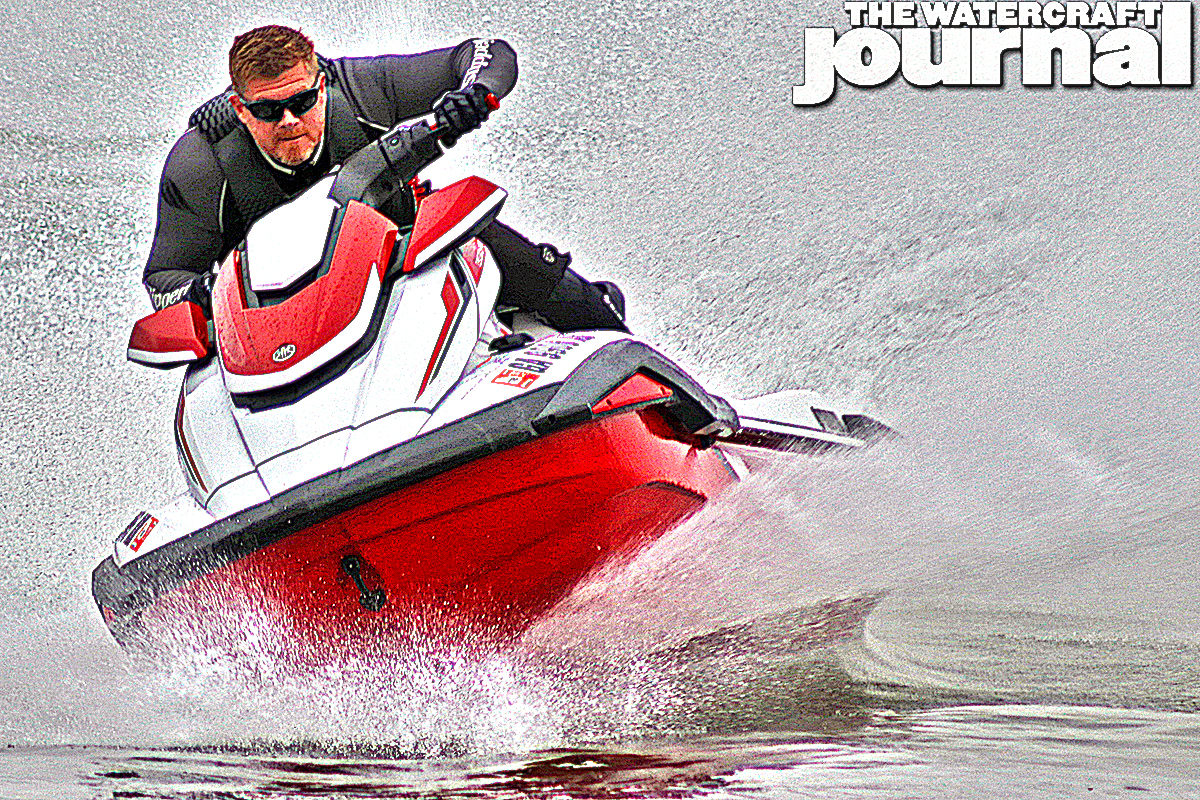
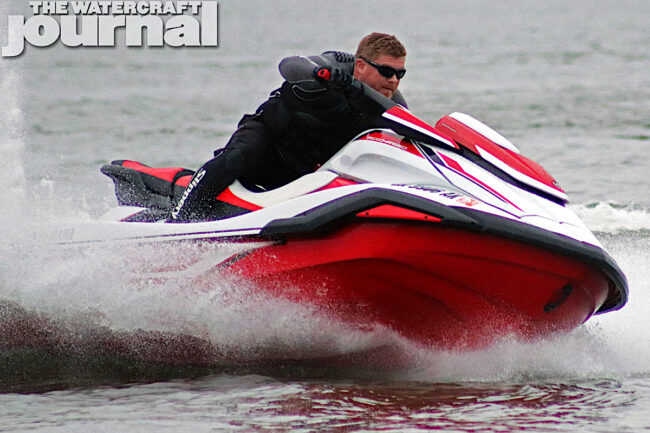
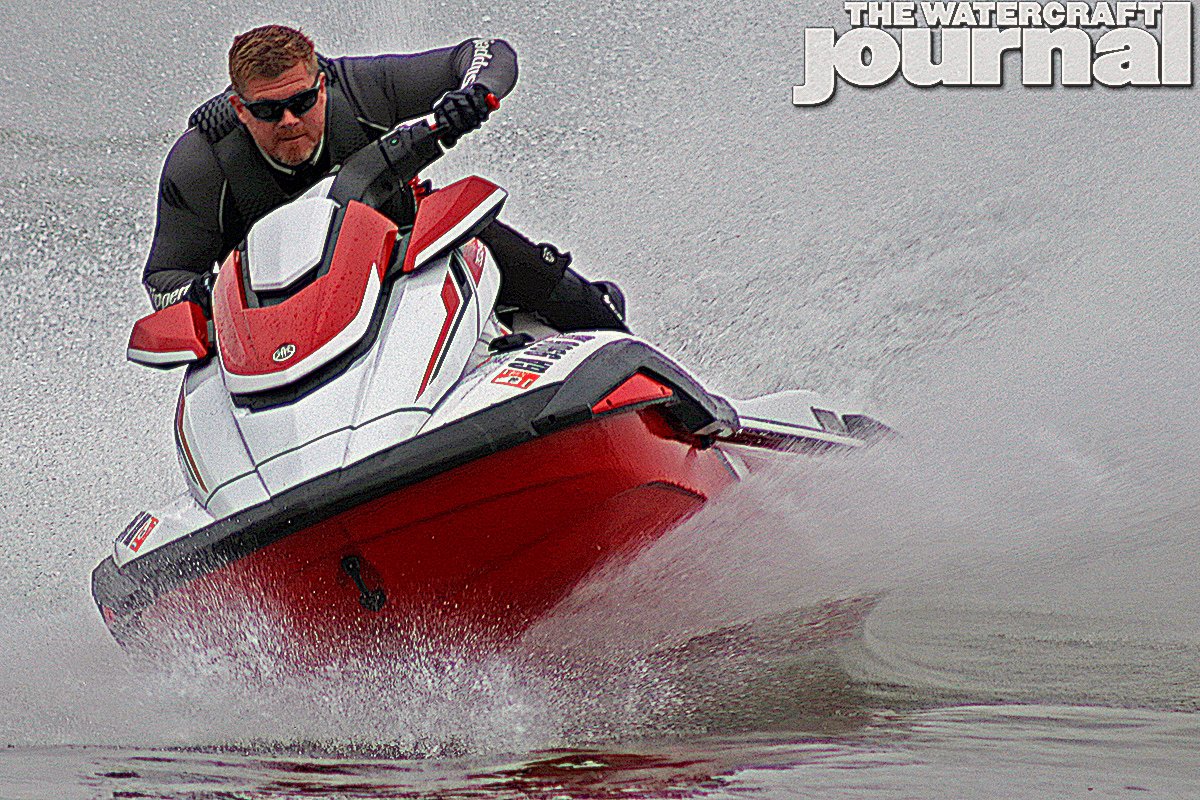
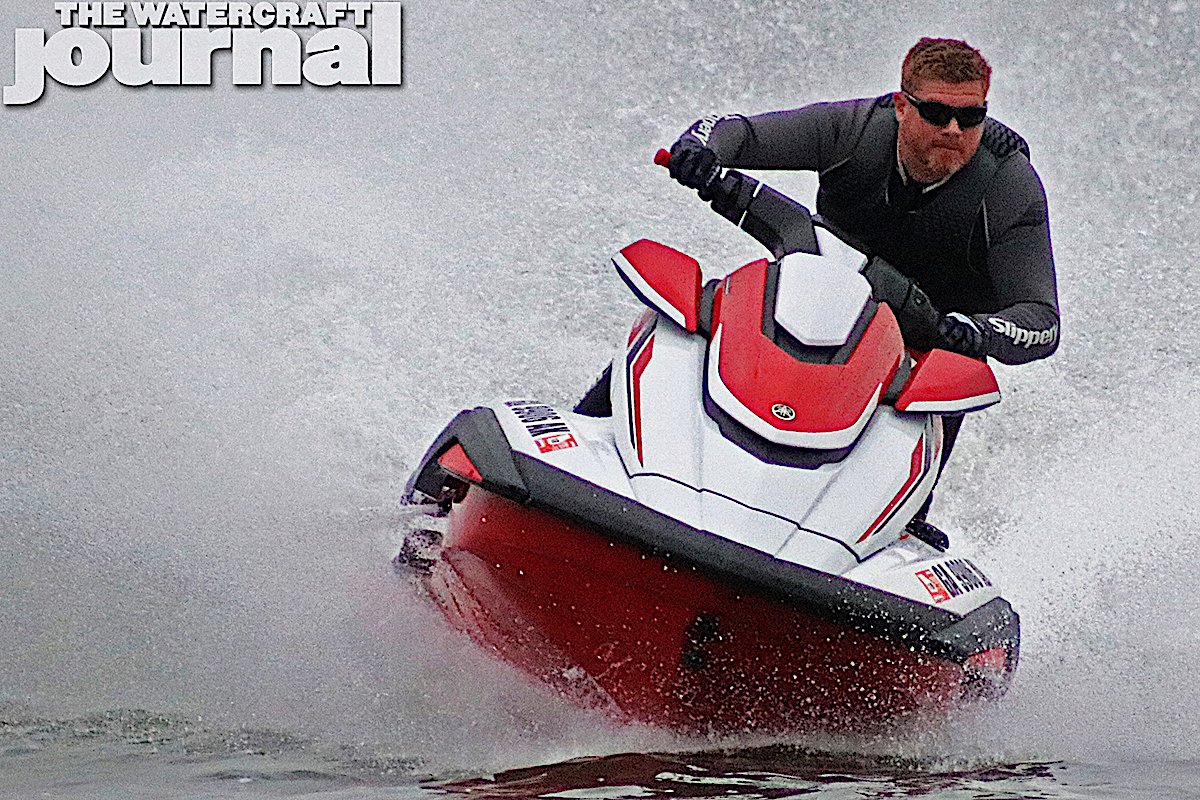
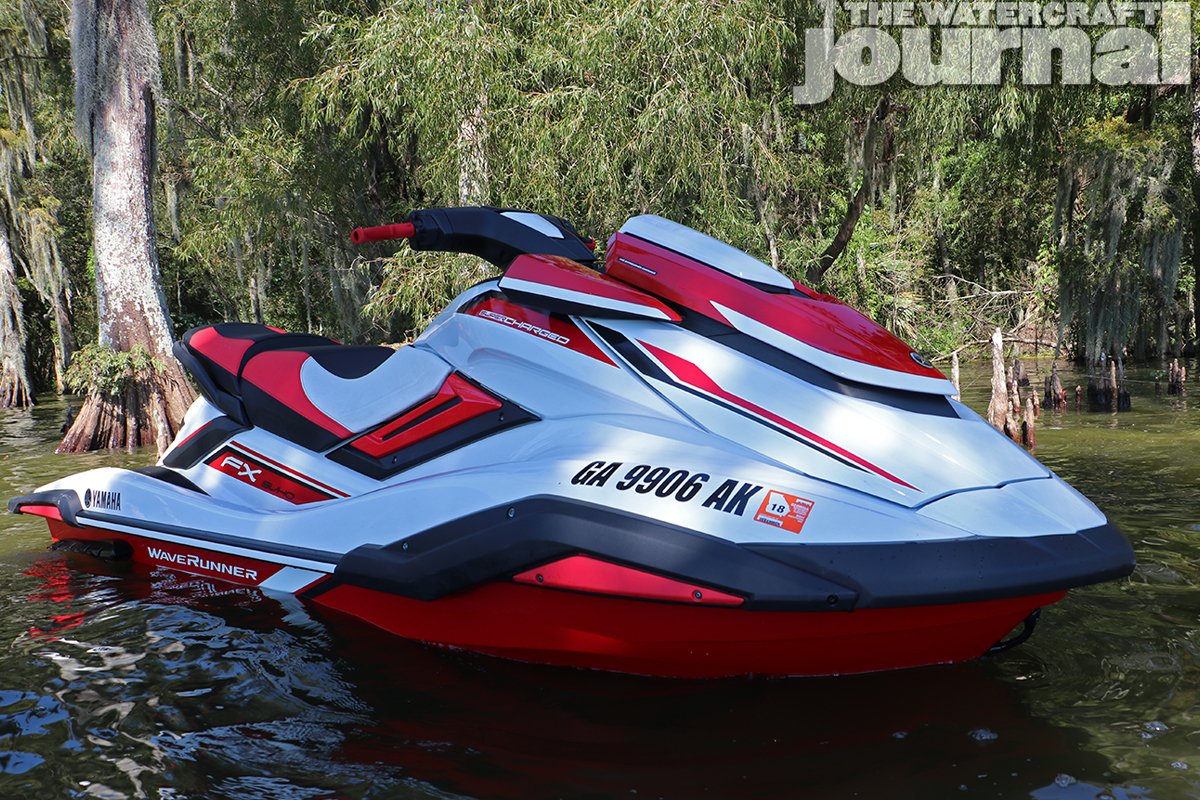
Yet, the real testing didn’t begin until weeks later in Morgan City. The Fall Mudbug fell on the same weekend as the IJSBA World Finals; and frankly, a weekend spent riding a brand-new SVHO-powered FX wide-open with friends sounded far more appealing than the other option. Temperatures cooled somewhat since June’s mid-summer Mudbug, and while attendance was lessened, the riding schedule was robust. Hundreds of miles through the St. Mary Parish swamps passed beneath the FX’s redesigned hull and through its 160mm 8-vein pump.
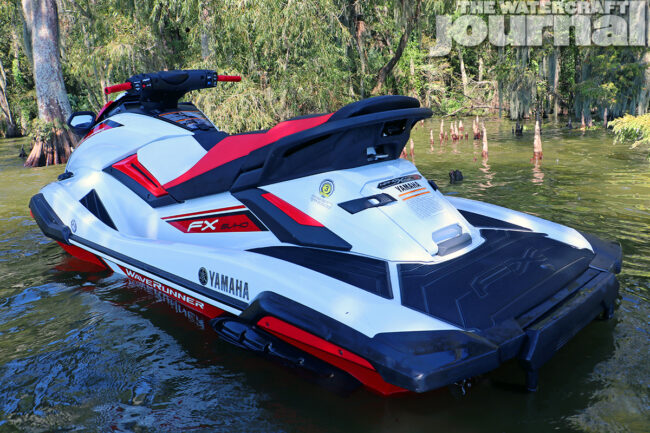
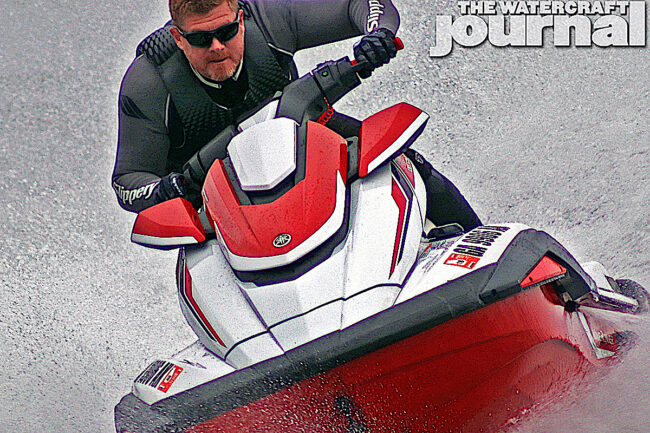
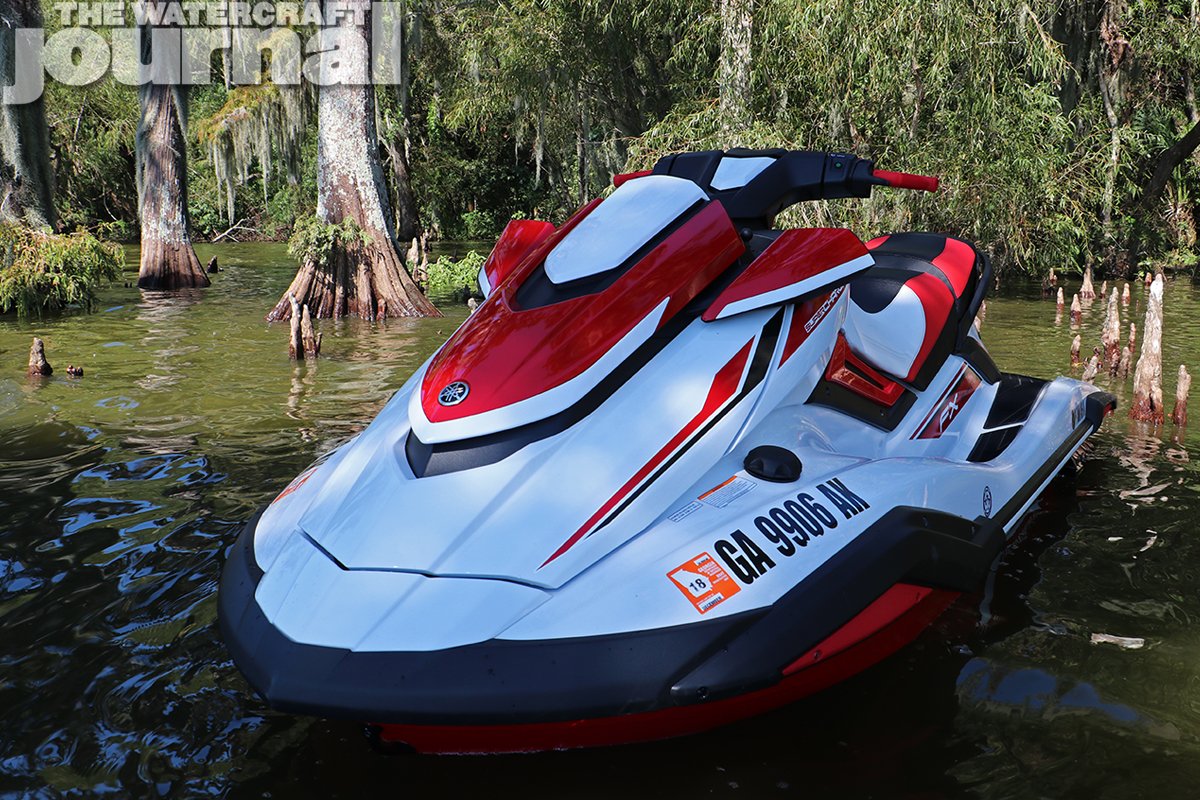
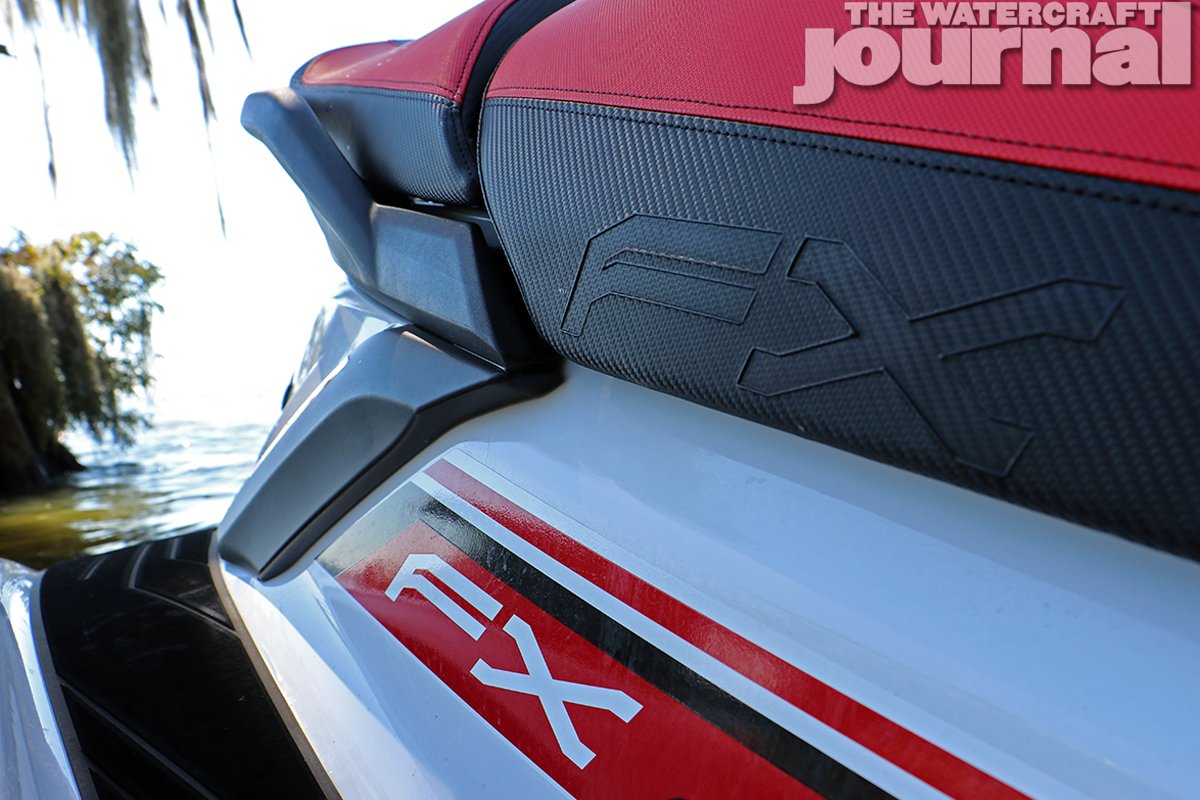
Changes made to the FX platform can nearly be measured in similarities shared with the current GP1800R. Yamaha views its lightweight, podium-dominating GP1800R as a bit of a magnum opus these days; seeing to apply much of the design techniques learned here and used on the FX. For 2019, the footwells are wider, sloping and flanked by shallow gunnels. This permits the more aggressive rider greater ease to reposition their footing when entering into a tight hairpin as well as comfortably moving around the saddle when sitting stationary.
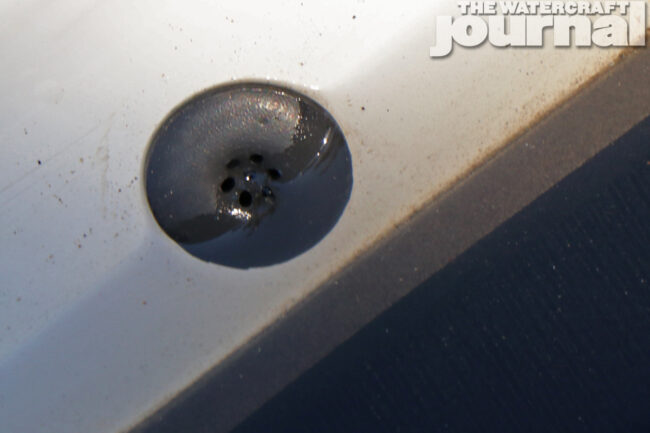
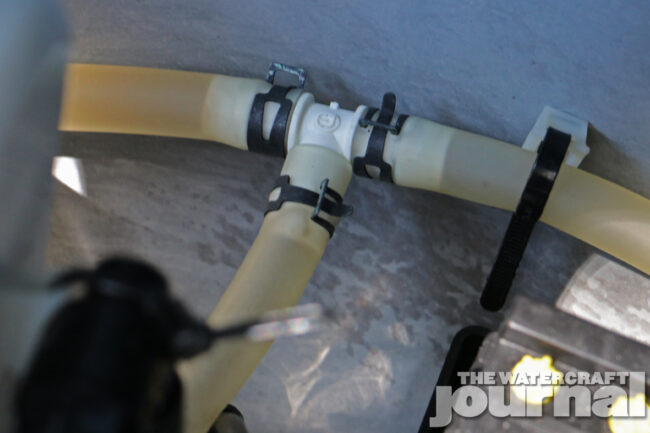
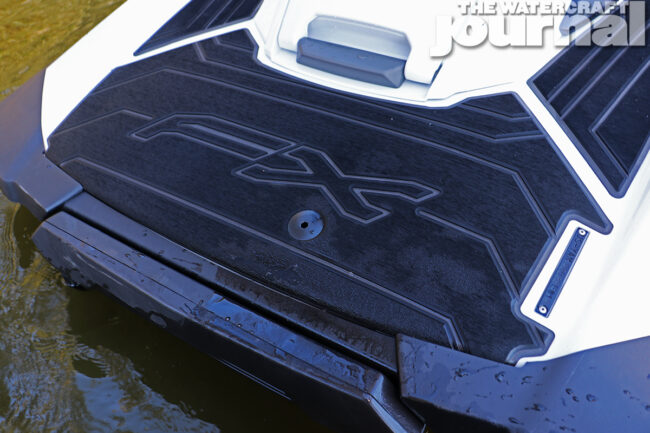
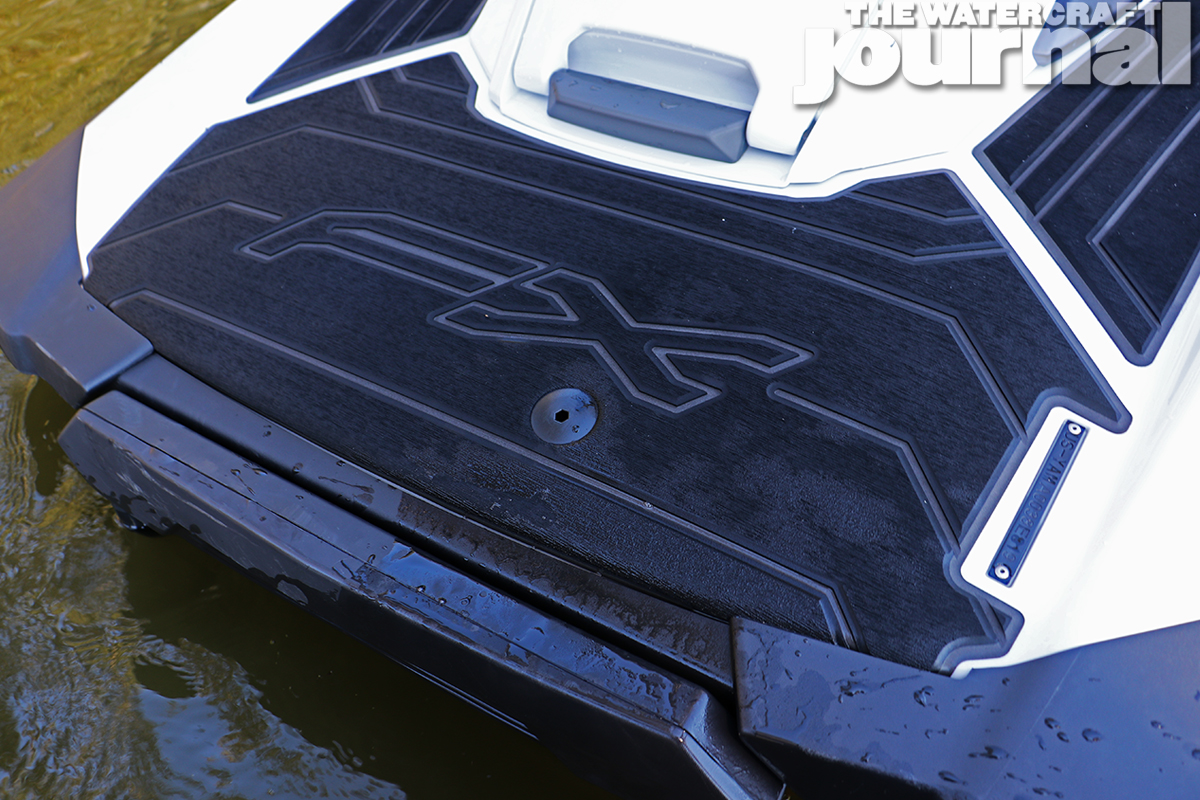
Lined with CNC-cut, two-tone Hydro-Turf traction mats that meet together on a broadened swim platform, the footwells also feature the industry’s first drains. A perforated rubber grommet is backed by a half-inch clear tube running along the left-hand inside, meeting at a T-fitting, and then out of the pump tunnel. It’s gravity siphon, so it works best when either out of the water or at speed. It’s surprisingly low-tech but functional as long as you keep the grommets clear of debris. As hinted, the wide rear platform is relieved to fit a thickly padded, boxed swim step – another “first.”
Aesthetically, the FX’s design is an evolution of the previous model; smoothing the edges and rounding the contours, giving the full-sized 3-seater a swooping, fluid flowline. Dimensionally, the new machine is ever so slightly larger: 140.9-inches long (140.4-inches), 48.4-inches tall (48-inches); 50-inches wide (48-inches); yet impressively, 15-pounds lighter than its predecessor (818-pounds vs. 833-pounds).
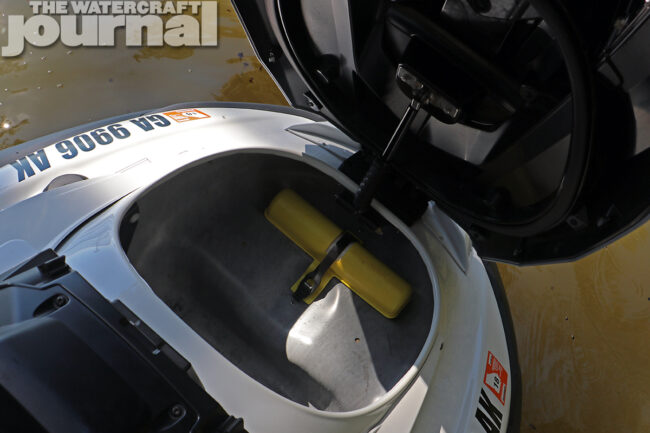
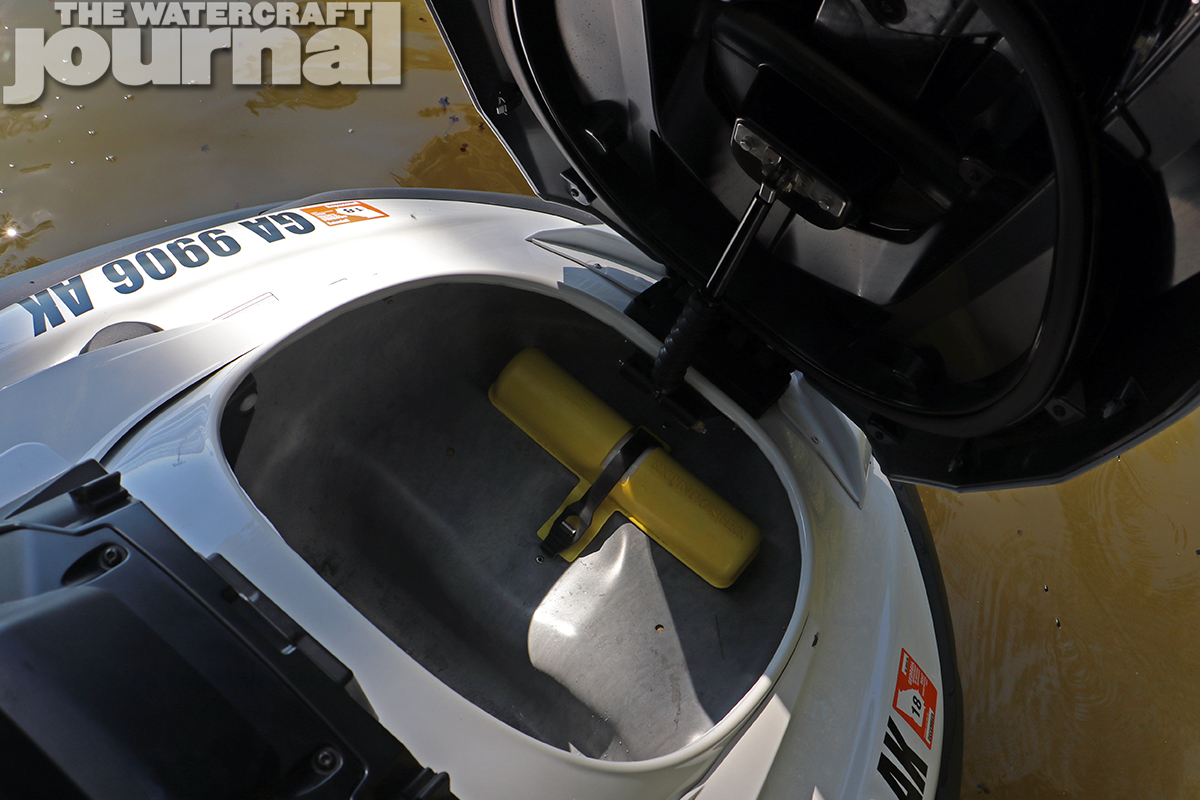
And all accomplished while increasing total storage an impressive 11-gallons (44-gal. vs. 33.2-gal.) with most of the gain found in a widened and deepened bow locker. Although standard equipment for the fully-loaded FX Limited SVHO, a soft-sided cooler was designed specifically for the deep recess in the bow. We found our rigid Igloo and camera bag also fit snugly there as well.
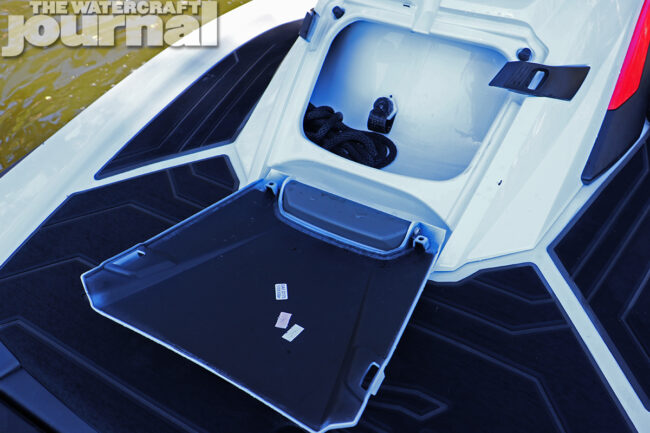
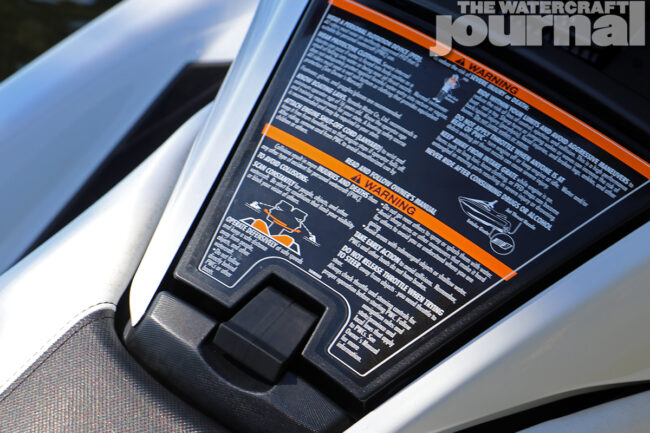
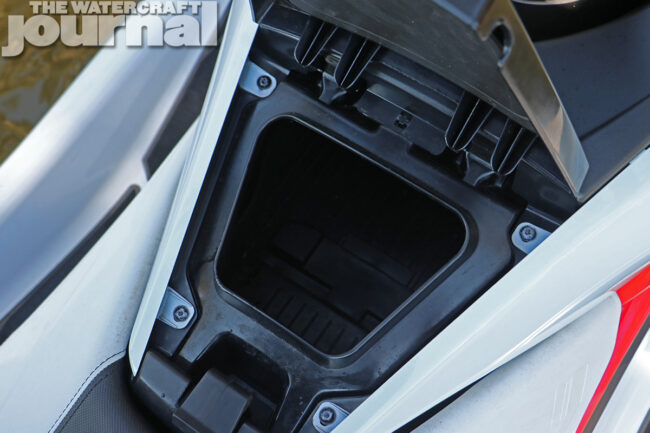
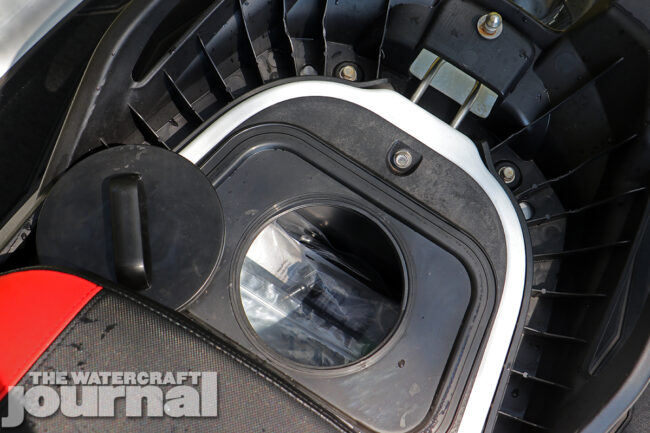
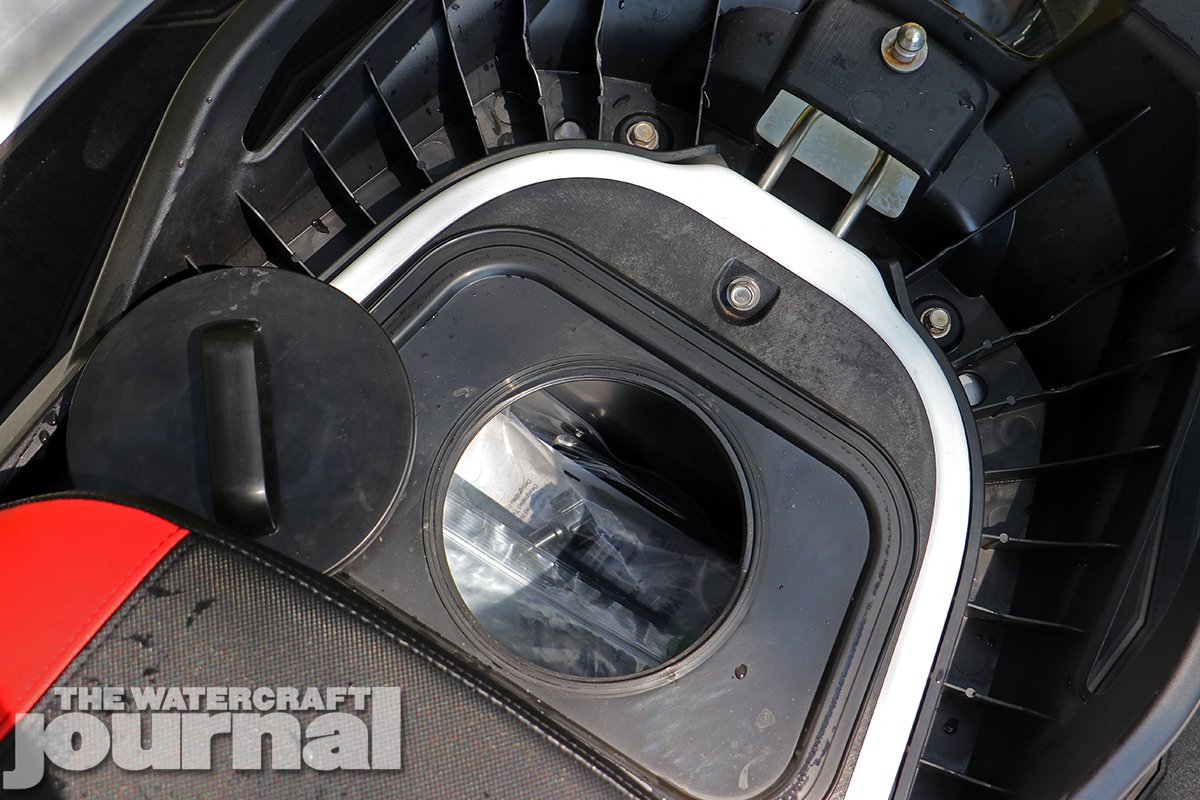
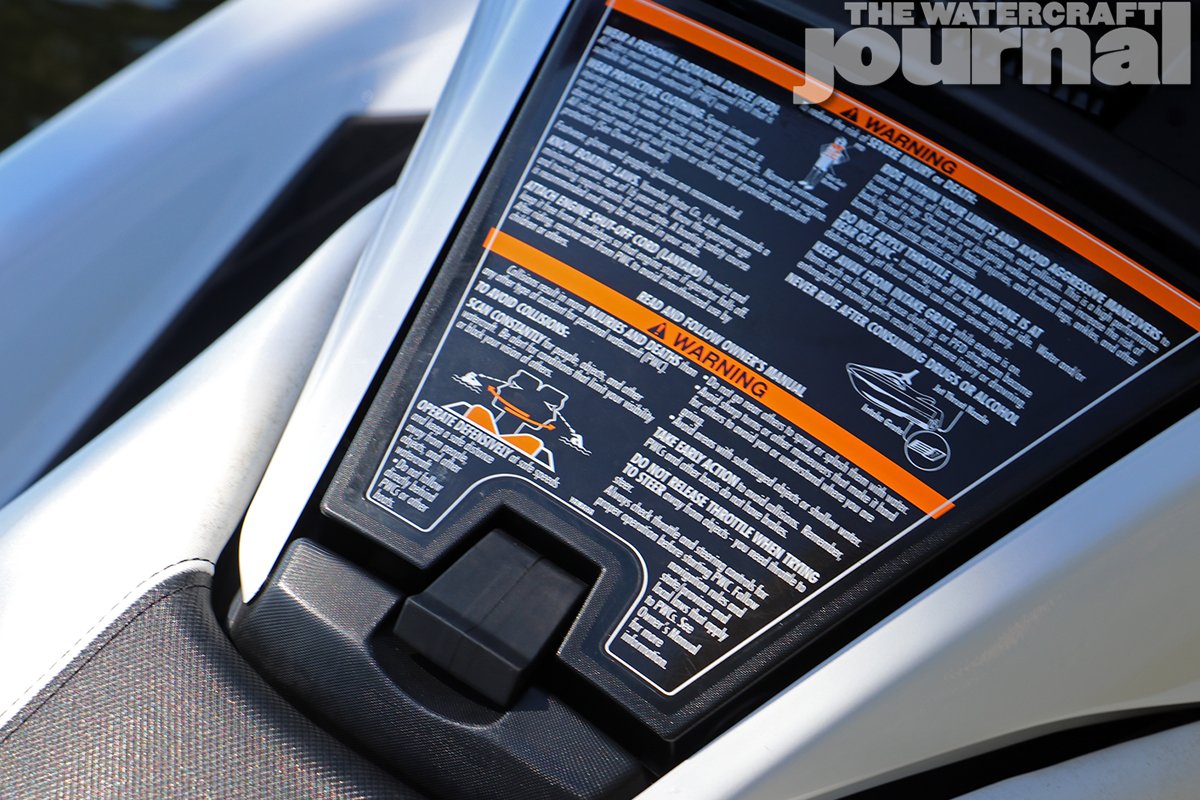
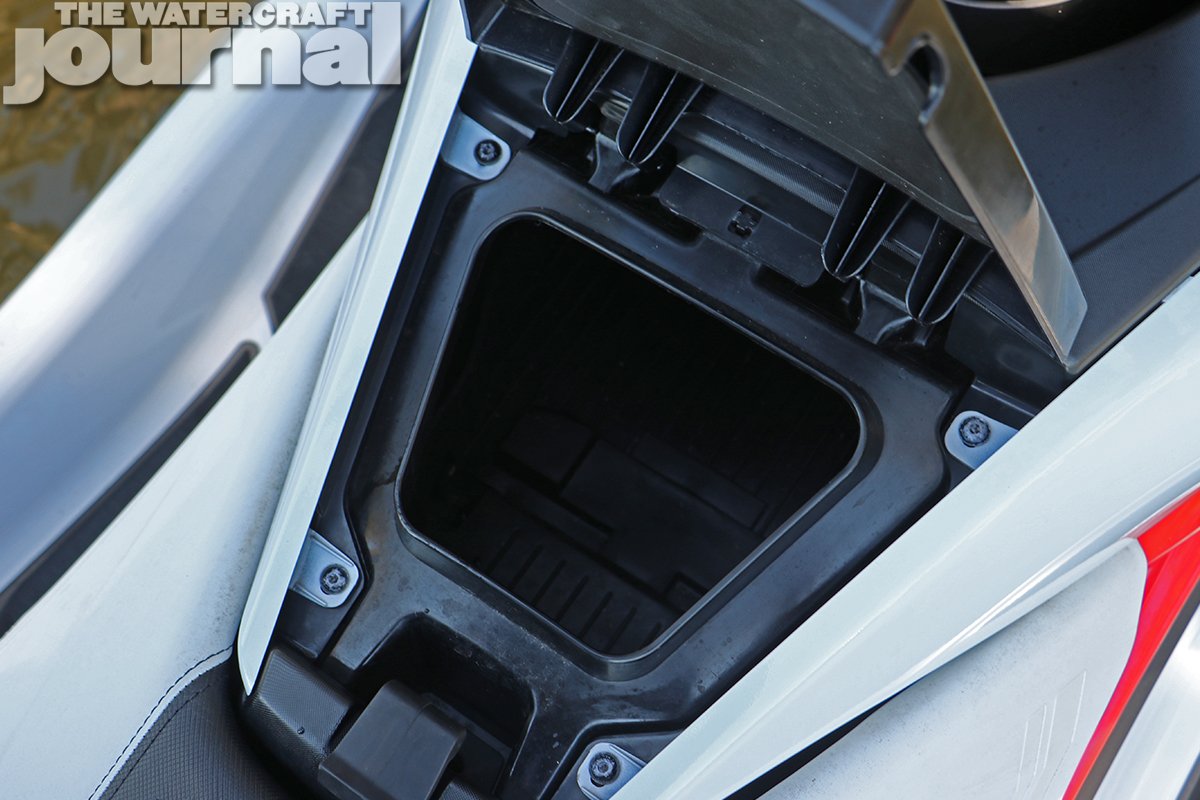
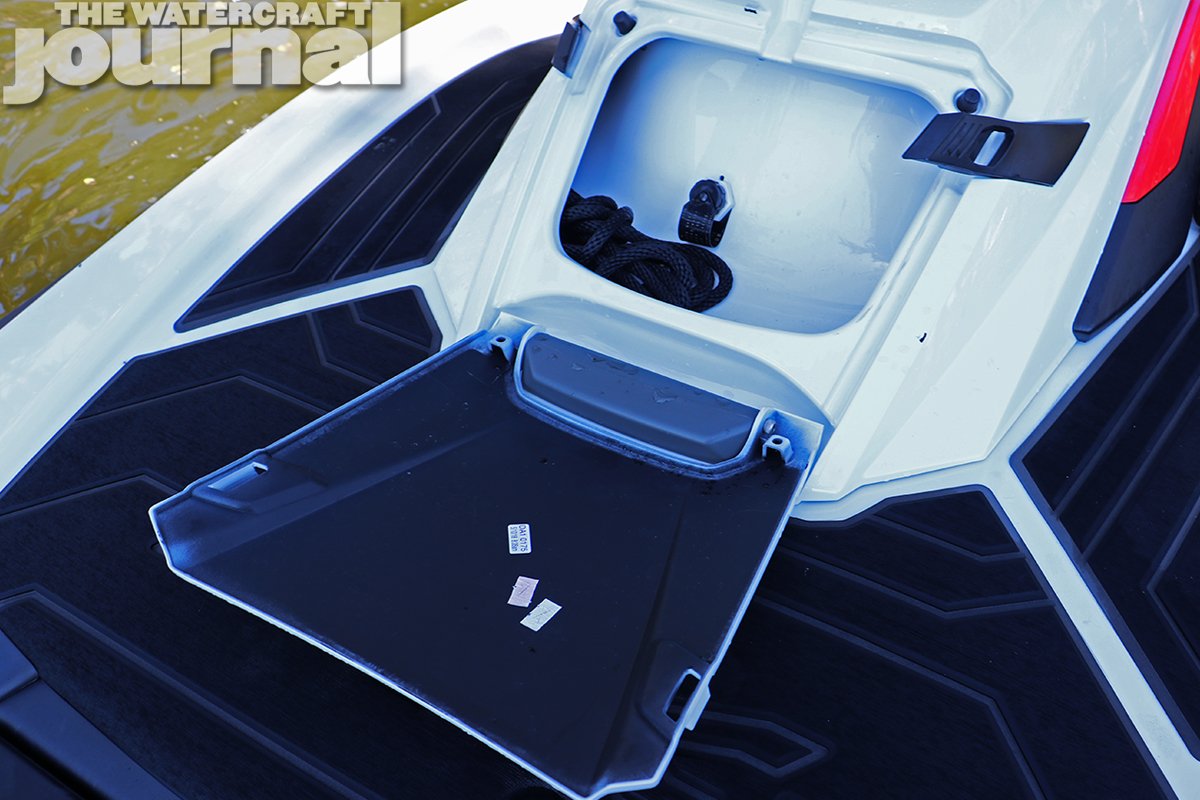
Yamaha also radically redesigned its glove box. The result is a easy-to-access, padded and rubber-lined bin nearly a foot deep with a wide entry allowing us to store our full-sized DLSR and other equipment without fear – because it’s also the first watertight glove box in the industry. The soft rubber latch requires some acclimating, but is serviceable once you’ve familiarized yourself with it. Of course, as is with all FX’s, a gasketed watertight screw-top storage pail is fixed beneath the rear passenger; and a dual-latched “wet storage” cubby for a tow rope or other items, is found on the stern as well.
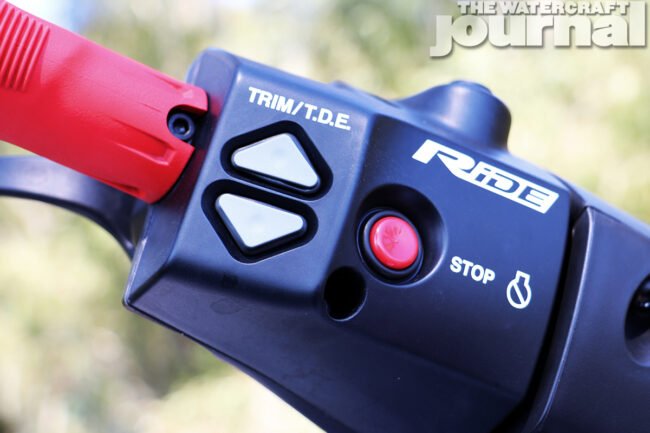
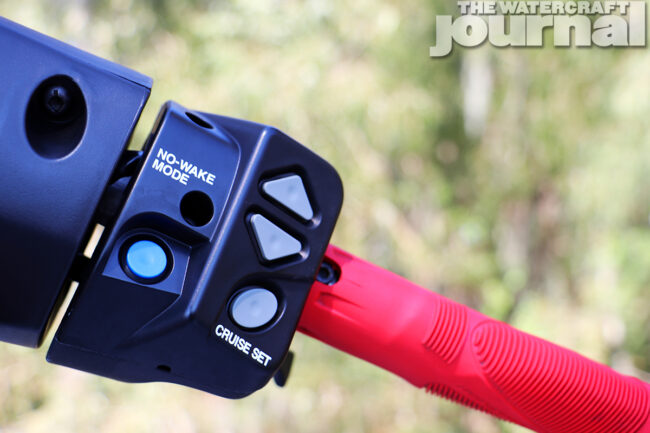
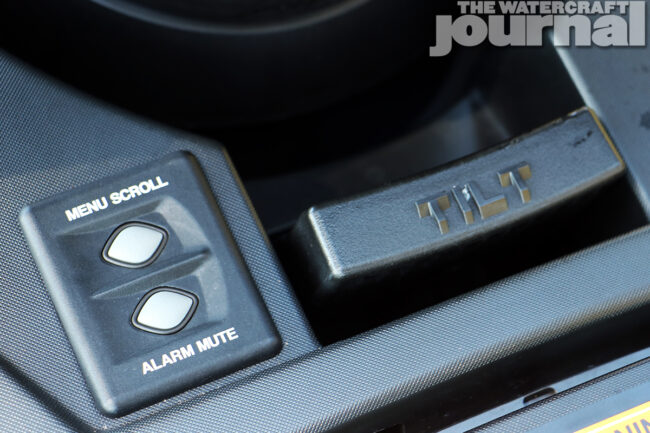
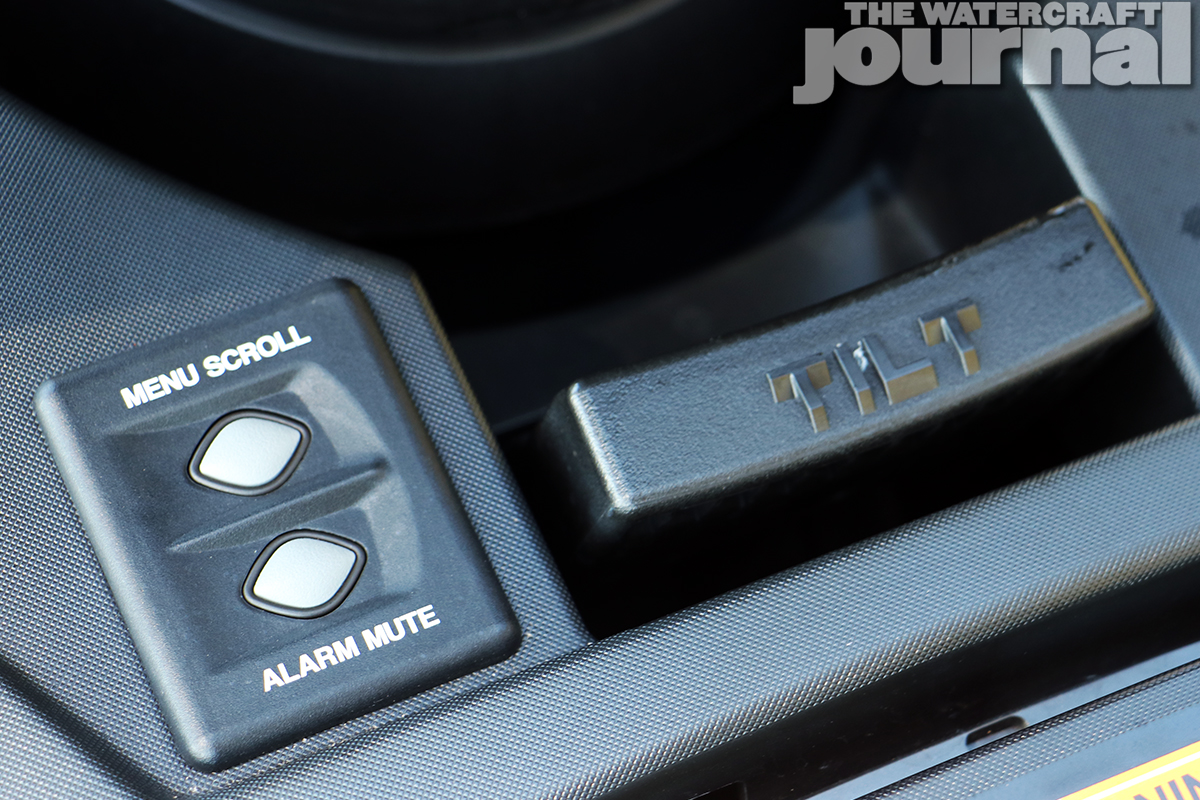
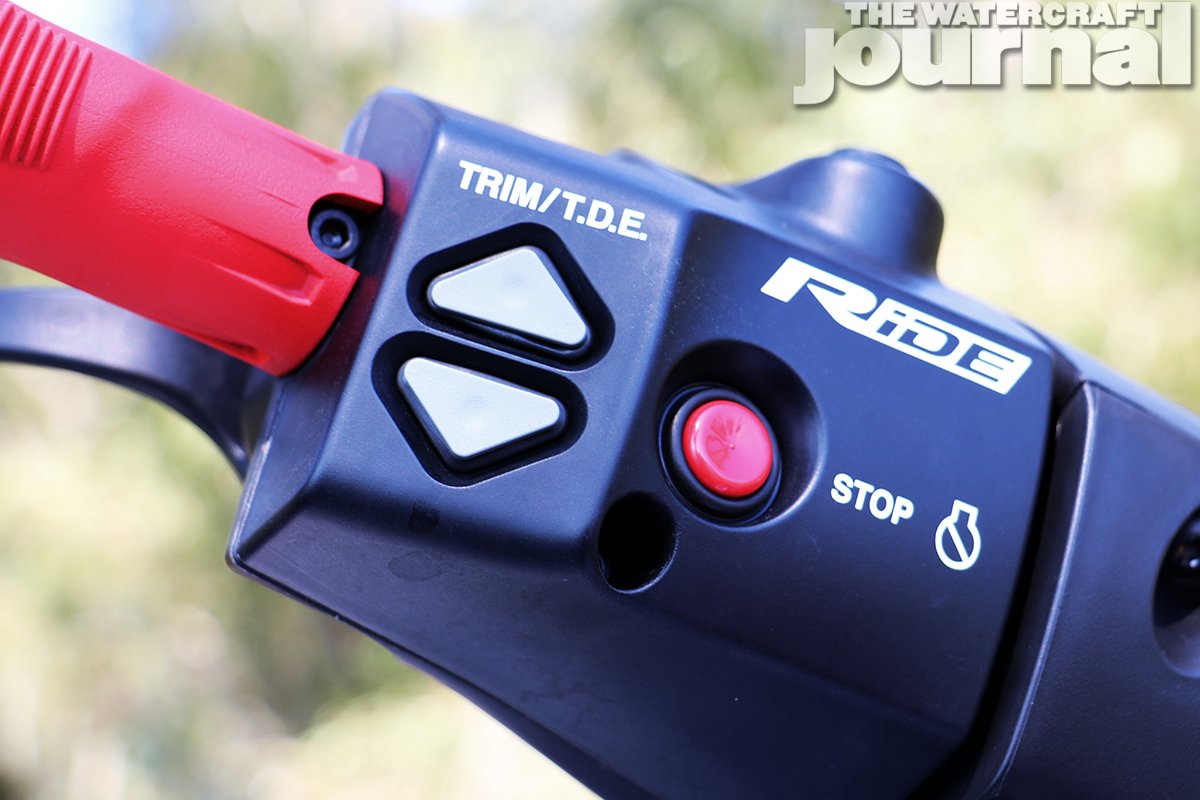
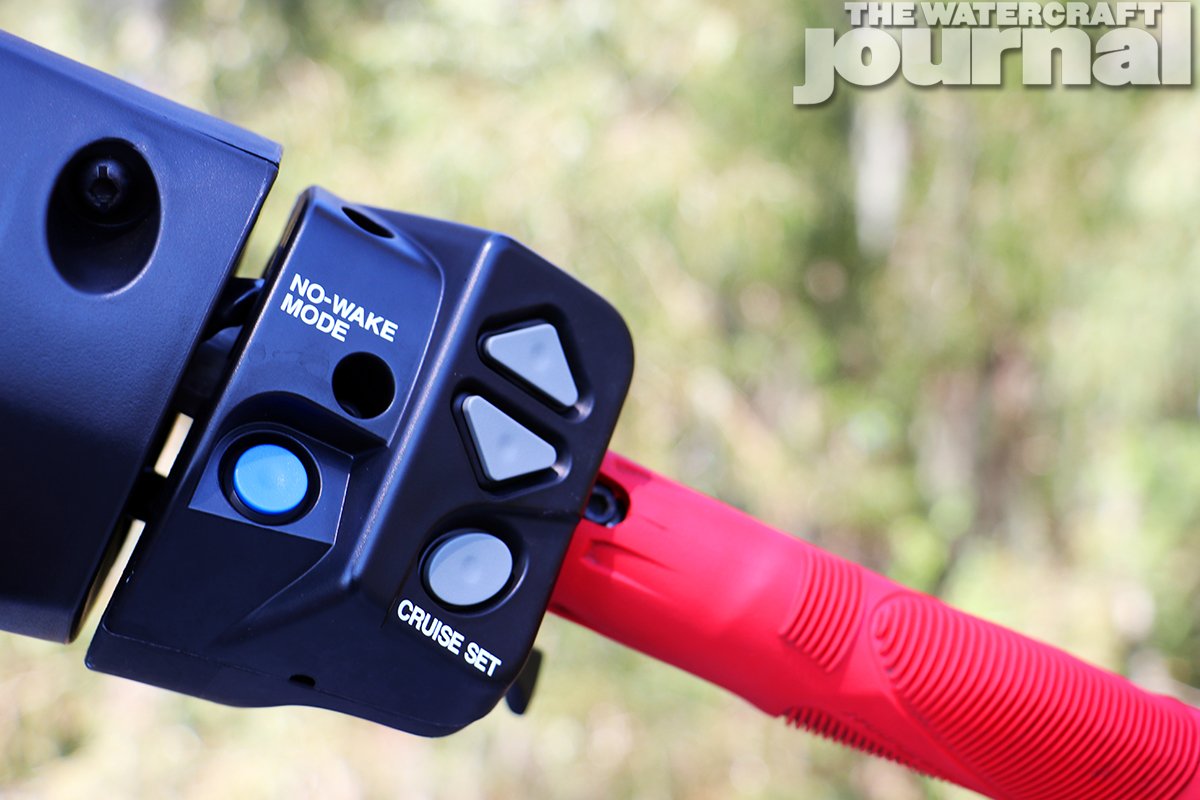
Ergonomically, the new cockpit (or “cabin” as some marketing materials write) feels low-slung and reclined somewhat. The three-tone cut-and-sew seat is moderately bolstered, with attention given towards pinching inward at the knees. The elongated neck sets the steering controls further back, particularly when adjusting the 5-way tilt steering to its lowest setting. Throttle triggers (including RiDE with Traction Control) as well as controls for electric trim, Cruise Assist, No Wake Mode are all within reach, including Yamaha’s new “zero crank” automatic Start button.
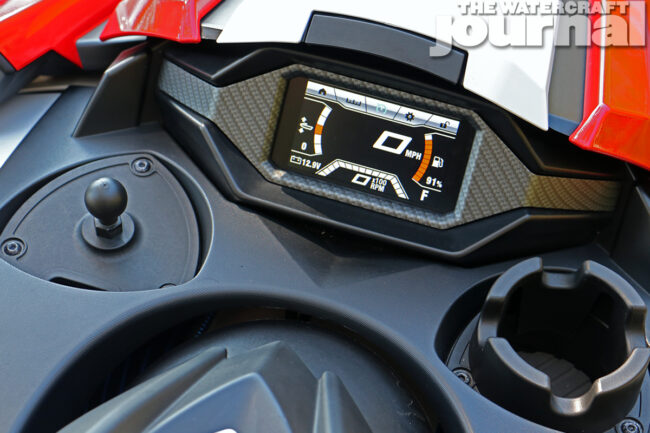
Fore of the steering neck are the two ports for the RAM multi-mount system. For the FX SVHO, a single RAM mount puck is provided, paired with a (gratefully deeper) beverage holder. The cup holder can be removed (with the use of a hexed wrench) and upgraded with another RAM base plate, or traded to the other side. The two are identical and can be customized to fit your needs. For most of our time with the 2019 WaveRunner, we kept our Garmin GPSmap76CS on hand, tracking our speed, mileage and so forth. And yes, in Louisiana’s cool morning air, we clicked off a sustained top speed of 68.6 miles per hour (and that was with a 235-pound rider and 64-pound passenger).
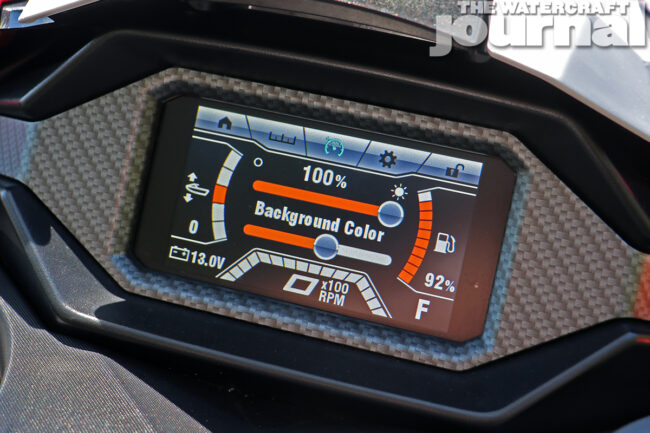
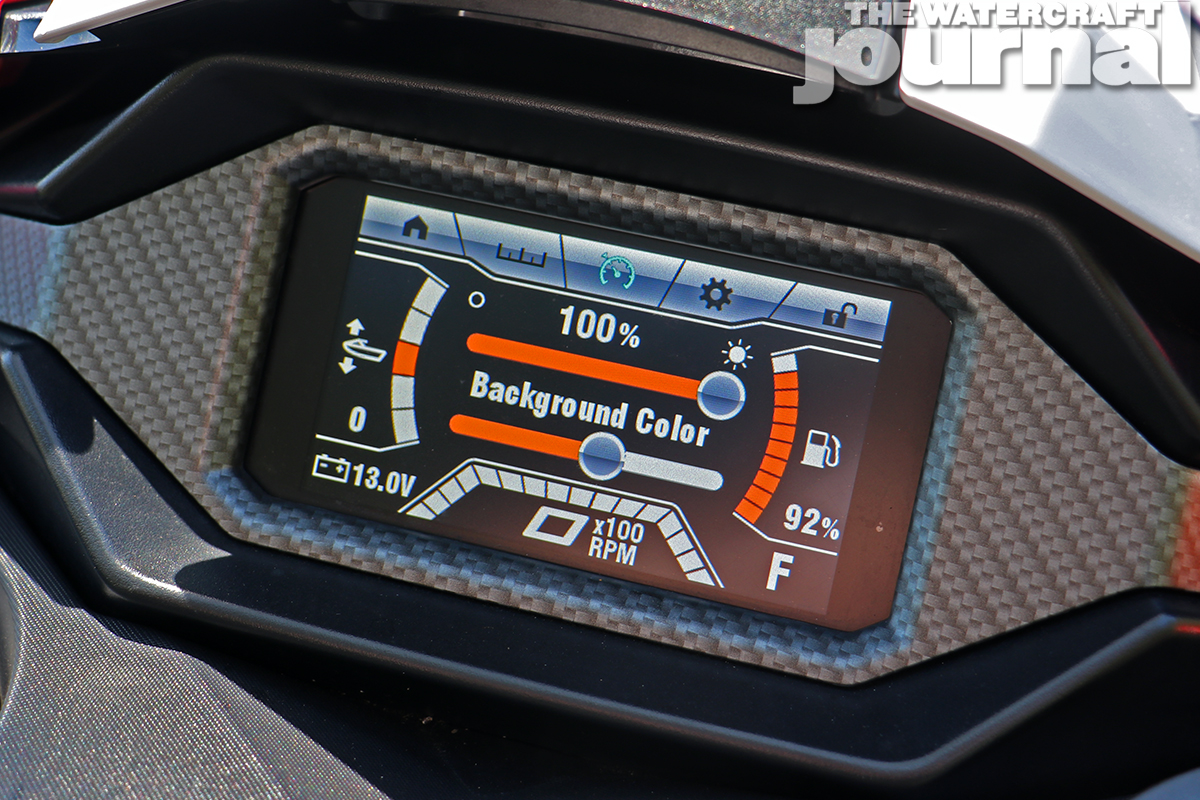
Of course, the major addition to all FX machines is the addition of the industry’s first full-color, digital touchscreen dashboard. Operating Yamaha’s ConNext software, operators can toggle through a series of prompts to customize their display colors, input a unique PIN number (thus eliminating the security key fob), as well as observe fuel consumption rates, estimated miles until empty, and engine service alerts. A key feature is the Drive Control feature, allowing the PIN holder to preset maximum speeds and acceleration curves, ideal for new, novice or less-than-trustworthy operators.
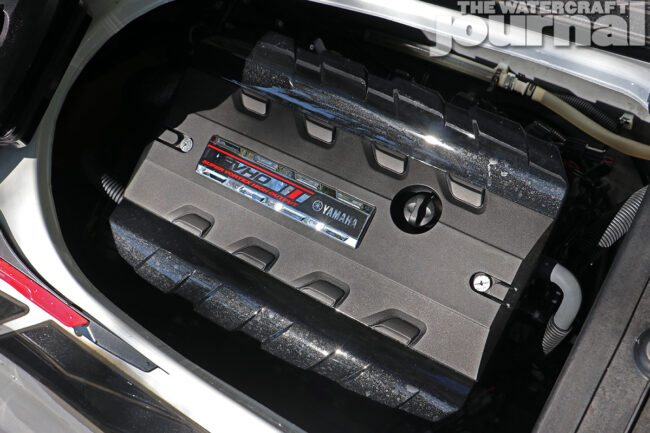
Beneath the two-piece saddle rests Yamaha’s Super Vortex High Output centrifugally-supercharged 1,812cc 4-stroke marine engine. The four-cylinder SVHO has been a mainstay of the brand’s top performing WaveRunner lineup since 2014, and has only seen minor changes and material upgrades since its introduction. At 1.8L, it continues as the industry’s largest-displacement 4-stroke available, delivering plenty of low-end grunt to launch the FX SVHO out of the gate, until the boost kicks in rocketing the WaveRunner toward its aforementioned top speed.
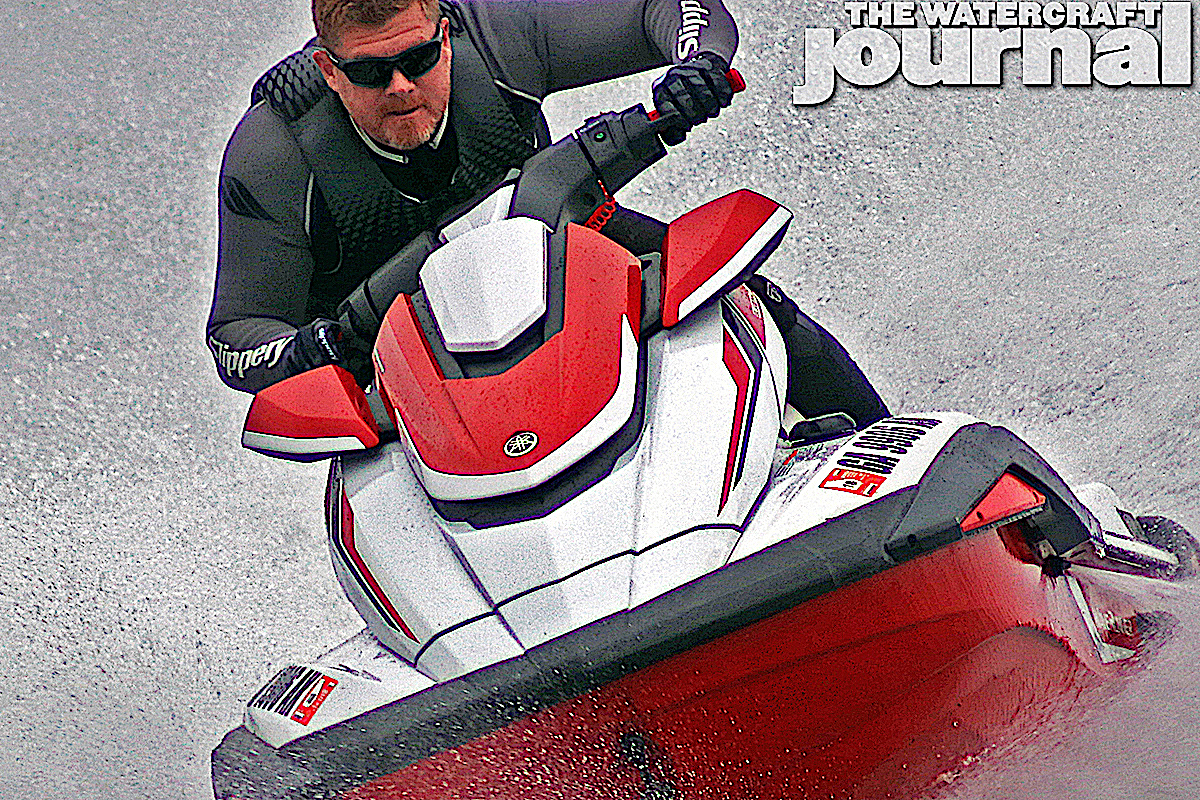
Unlike the progressively stepped-V hull of the outgoing FX, the current model borrows heavily from the unbeatable GP1800R. Bellow the pointed splash-guard chine, resides the signature “anchor head” dual coved hull design of the GP. The rounded chines split and divert the water into twin wakes as long lifting strakes run nearly the length of the ski. These give the ski enough lift to ride on the keel without requiring an exaggerated deep-V, which often creates significant drag. When not at a rapid clip, the FX floats on the split cushions produced by this anchor head-design, providing a comfortable, easy ride.
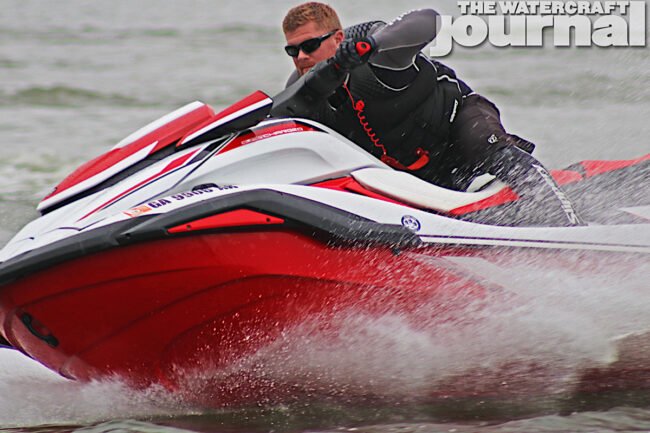
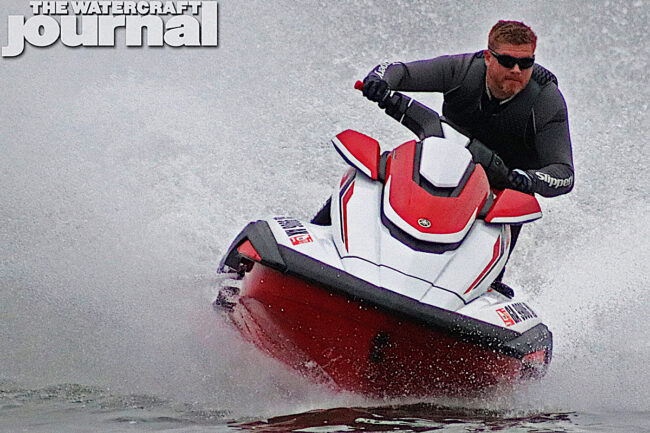
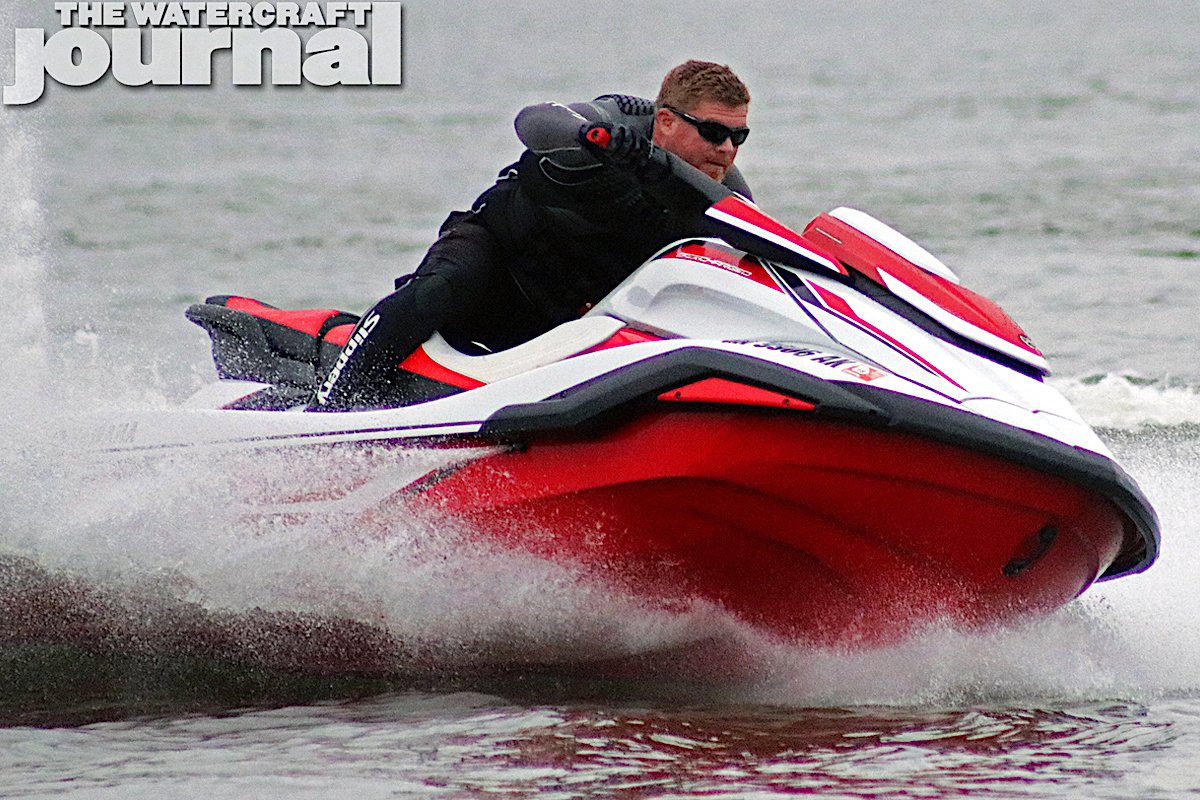
Yet, when wrung out, the FX’s comes to life in a ferocious way. Featuring the most intuitive inside lean of any full-sized runabout available today, the FX SVHO rolls inward, reeling naturally like a sport bike, encouraging the rider to vise the throttle further open. Steering input at these speeds is instantaneous – almost precognitive – and entirely predictable. The WaveRunner rides instinctively forward on its haunches, requiring little added downward trim to really bite into the corners. Coaxing the runabout through the tight twisties of the bayou can appear a bit raucous in the video below but to the pilot, it feels as natural as a water skier threading the buoys.
A weird quirk for the redesigned FX SVHO was an issue with excessive fuel spillage at the pump. For 2019, the filler neck was relocated from high up on the deck (tucked beneath the front cargo hatch) to outside, on the left-side fender. The low sloping, nearly-horizontal angle of the filler tube tends not to evacuate air as rapidly as the previous high-mounted filler, causing the neck to burp up fuel when pumping at too quick of a rate. I learned to slowly fill the tank with the pump nozzle held up over the filler neck to let air escape.
Admittedly, this review comes a little late as gains have already been made by RIVA Racing and other professional tuners, pushing the new FX SVHO to speeds in excess of 84 miles per hour. The potential within the 2019 Yamaha FX SVHO WaveRunner is akin to the unlockable speeds extracted by performance enthusiasts from the GP1800R. Priced at $15,499, the major takeaway from Yamaha’s redesigned FX SVHO is a sportier, more nimble and far more responsive full-sized runabout than ever before. And that is something that will please all of those looking for a top tier 3-seater that can also serve double duty as a riotous, fun-loving performer.
Man, Scott Frazier and the team at IJSBA has been busy. These guys have been globe-trotting for months now, and for good cause. Recently, IJSBA just announced its newest affiliate, The Haiti Watercraft Group. Although still ranked as the poorest sovereign nation in the Western Hemisphere, apparently there is enough of a personal watercraft presence – both recreational and racing – that they met the qualifications to become an affiliate. That’s great news!
Even better news is the organization and announcement of the first-ever Haiti International Jetski Fest scheduled to be held this coming July 20-21st in Cap-Haitien. To learn all about it, here’s the original press release as published on IJSBA.com:
IJSBA is pleased to announce the newest IJSBA Affiliate, The Haiti Watercraft Group. Led, by Calherbe Monel, they have an ambitious first year in mind. The pinnacle of their inaugural year will be the Haiti International Jetski Fest held July 20-21 in Cap-Haitien.
Cap-Haitien has a rich history in Haiti. Formerly the capital of the nation, Cap-Haiten continues to preserve the reputation as the cultural and educational hub of Haiti. Haiti, itself, is a refresher in elementary school subjects of geography and history. Haiti shares the Island of Hispaniola with the Dominican Republic.
Hispaniola is, notably, the landing location of Christopher Columbus marking modern mankind’s concept of the New World and the first celebration of Christmas in the American Continents. All wonderful things to discuss, at some point, but the point of this posting is to announce an amazing IJSBA Sanctioned Personal Watercraft event.
The Haiti Watercraft Group looks forward to hosting a formal competition as well as a sportsman event. This year will also bring forth a component competition in the state of Florida. IJSBA will be bringing news to the community very soon as well as news about how this fits into our greater expansion in the Caribbean.
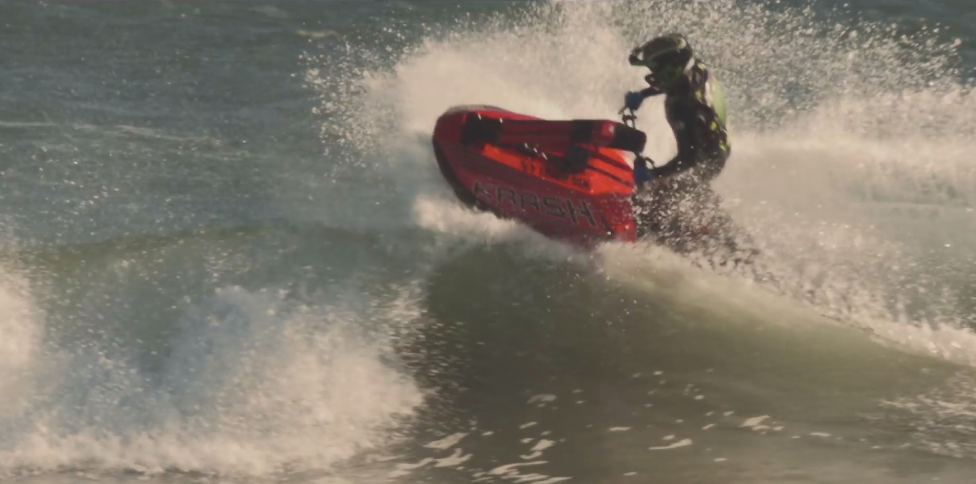
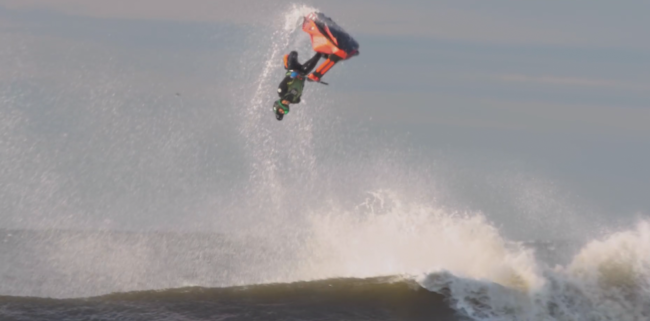
When you think of big surf breaks, the coast of New York typically doesn’t come to mind. Well, Krash Army team rider Tom Scaccianoce and the video below is enough to strongly reconsider. Showing off his killer home break, Scaccianoce demonstrates how potent his 50cal and Predator ski operate in the winter swells – as well as through the twisties through the marshes. Seriously, if you thought what Krash Industries was putting out was just for aerobatics, you gotta look again.
Krash’s complete range of RTP (Ready to Perform) watercraft is something unlike anything we’ve seen from the industry; a complete line of 50-state legal 2-stroke standups that excel at dang near anything you ask them to – be it launching sky high in the surf and darting around the river. As Krash writes, “It’s no wonder this guy knows how send it when his training ground looks like this!”
To view Krash Industries’ complete lineup, head to www.krashindustries.com
It is a sobering reality when one realizes that the innovation and technology that appears on the latest personal watercraft has often lived a vibrant life of several years on another vehicle within the manufacturer’s respective catalog; Kawasaki’s STX-15F is powered by the identical 1,498cc engine borrowed from the Ninja ZX-14R sportbike. All current ST3-based Sea-Doos feature the same LCD dashboard taken directly from the Spyder three-wheeled motorcycles – even down to the turn signal indicators. Like the youngest child in a large family, PWC are last to receive the well-worn hand-me-downs.
This pecking order of technology does have its benefits, though. By the time a new engine, electronic fuel injection system, induction system or other engine management software lands into our laps, the manufacturer has had plenty of time to work out the kinks and troubleshoot the bugs. In fact, it’s a bit of a blessing. It also permits the aftermarket tuners to glean from the original powersport’s pool of tuners to quickly adapt performance parts. This process permits the PWC industry some of the fastest turnaround from introduction of a new craft, to development and manufacture of performance parts, to finally, the open market.
Above: Can-Am and Ski-Doo are enjoying increased market share and enthusiast response thanks to their respective transition to turbocharging its 900 ACE engines. Eking more power from smaller displacement engines is fetching plenty of class leading sales for both powersport brands.
All in The Family
Due to the size and scope of Bombardier Recreational Products’ (BRP) array of brands, Sea-Doo benefits from a generous family of market-leading vehicles to cull from. As noted, the current full-sized runabouts (categorized by their ST3 platform), employ the Spyder’s all-digital LCD dashboard for the 2019 models and beyond. Beyond that, Sea-Doo shares the same operating software and engine management hardware – iTC (Intelligent Throttle Control) – with all Can-Am and Ski-Doo vehicles. Equally, Can-Am’s side-by-side 4-wheelers all use Ergolock-branded ergonomic designs throughout the cockpit (although the application between a SxS and a PWC are vastly different).
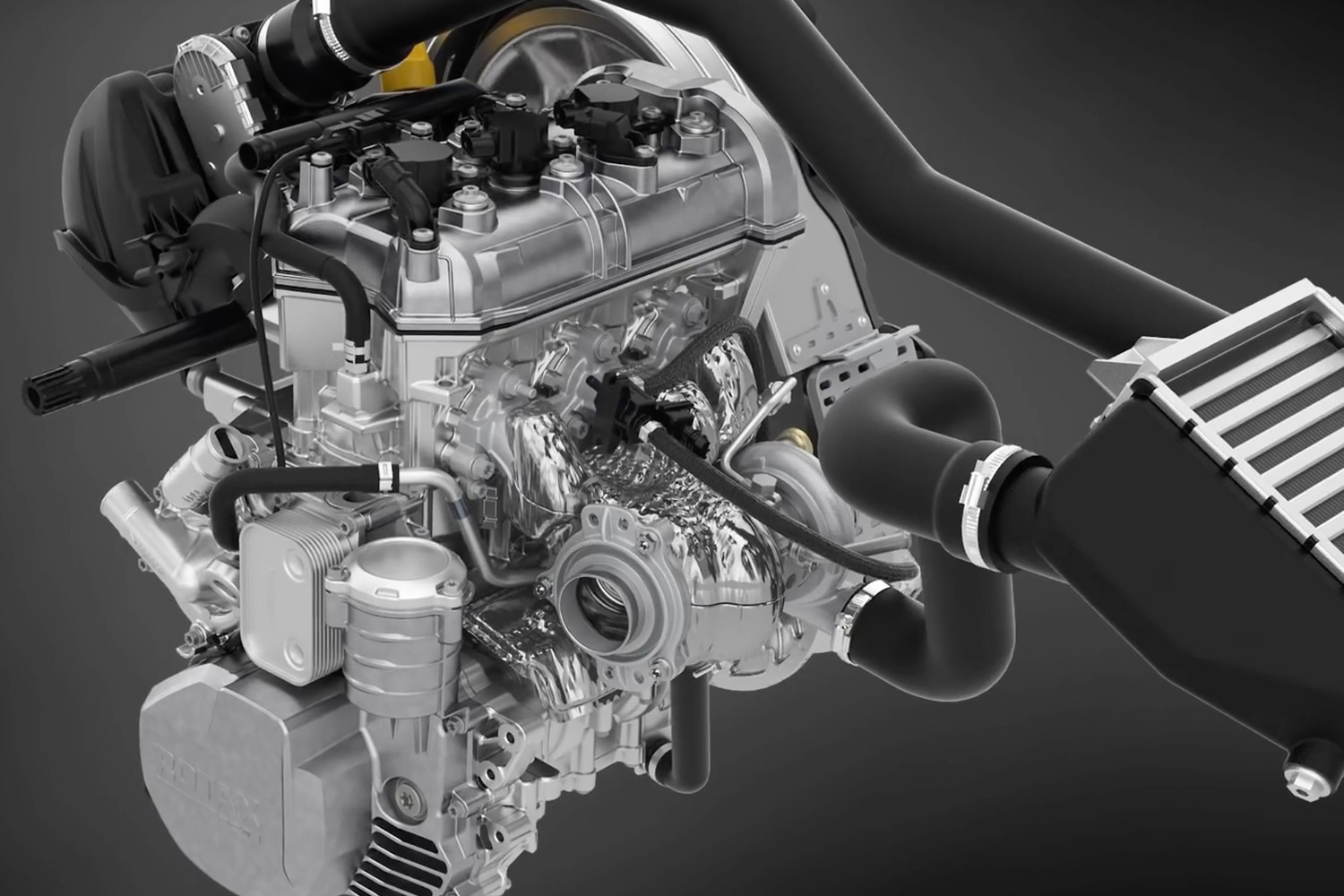
Moreover, all three branches – Sea-Doo, Ski-Doo and Can-Am (SxS and Spyder) – employ BRP’s Rotax ACE (Advanced Combustion Efficiency) technology in a variety of engine applications. For Sea-Doo, the first application was the direct crossover of the 900 ACE engine from Ski-Doo for the introductory 2014 Spark. At 899cc’s, the 4-stroke three-cylinder provided either 60 or 90-horsepower from a powerplant weighing slightly over 120-pounds. Later, the same ACE technology was applied to the supercharged ACE 300 engine powering the RXT-X 300, RXP-X 300 and GTX Limited 300. At 1,630cc’s, it’s the biggest displacement engine offered by any of BRP’s powersport lines.
For lesser-tiered supercharged Sea-Doos, a 1500 HO ACE was introduced, producing an advertised 230-horsepower (found on the GTR 230, GTR-X 230, RXT 230, GTX 230 and GTX Limited 230). For those looking to save a few bucks at the pump, naturally-aspirated Sea-Doos are the last to carry the 4-tec 1503 Rotax. At 1,494ccs, the 4-tec is the longest-running engine Sea-Doo has employed in nearly 20 years, eking out either 130 or 155-ponies the old fashioned way. Interestingly, when introduced to the then-new 1500 HO ACE engine, The Watercraft Journal asked if the same long block would eventually be used for the current naturally-aspirated models. The answer was no.
Above left: The Ski-Doo Renegade X RS Turbo features a 899cc 900 ACE Turbo pushing 12psi of forced induction to a maximum of 150-horsepower. Above right: The Maverick X RS Turbo produces a class-leading 172-horsepower. The extra 12 horsepower is attributed to Can-Am’s air induction system and intercooler.
Bigger Bang From a Smaller Package
Now, we have learned why. The 4-tec 1,494cc engine is due to be retired for 2020. At 18 years, the 3-cylinder has enjoyed a long and fruitful career. In its stead will come something that is sure to surprise many: the 150-horsepower Rotax 900 ACE Turbo from Ski-Doo’s snowmobiles – most famously, the Renegade X-RS. Well, OK. Not exactly. While the Ski-Doo limits the top revolutions to a conservative 7,750rpm, and stock 900 ACE’s with the HO tune see 8,000rpm regularly, we expect the marinized 900 ACE Turbo to spin closer to 8,600rpm.
As noted, the output delivered by the Ski-Doo 900 ACE Turbo is a square 150-horsepower, 5-ponies shy of the current engine. While minor adjustments to the AFR (air fuel ratio) curve could quickly amend that, we see the gains made by trading out the heavy 1503 4-tec for the lighter powerplant. Plus, the Ski-Doos are pressing 12psi of boost down the ACE’s gullet, which when compared to what stock ACE 300 engines are spinning, is child’s play. Turning up the wick to 16 or 18psi could not only pick up the missing 5-horsepower, but push the 899 3-cylinder closer to 160. Again, these aren’t earth-shattering numbers, but for Sea-Doo’s Recreation segment, a freshly-minted turbocharged plant is something to talk about.
More importantly are the implications of what the new 900 ACE Turbo means for the Sea-Doo Spark. Talk of a race-ready Spark – colloquially known as the “Spark X” – have been swirling long before the Trixx ever saw the light of day. Even as forums and message boards have been pontificating over the X’s impending arrival, Yamaha managed to steal a little of Sea-Doo’s thunder by releasing the shaved-down and tuned-up EXR. Now with Yamaha’s racy Rec Lite soaking up the spotlight, Sea-Doo is not one to share center stage for every long.
Above: Southern California Rec-Lite racer Justin Black thought this “prank” decal would garner a few laughs on Facebook. The viral response was far more than he ever expected.
Aftermarket tuning of the Sea-Doo Spark was nearly instant thanks to – as noted earlier – the shared technology already pioneered on previous vehicles. Currently, major gains have been made by race teams in Thailand who are developing both fiberglass and carbon fiber hulls for the Spark. As it stands, the numbers coming from Pattaya are staggering; 78mph on fiberglass hulls, mid-80s on carbon fiber – with a great deal of potential still left on the table. The Watercraft Journal also received word that the Thai teams are helping test the soon-to-be-released turbocharged Spark X, reaching “conservative” speeds of 62mph in stock trim.
It was communicated months earlier that Sea-Doo’s central focus for the next two years has been on properly launching the FishPro and placing it in the right places and in front of the right eyes; and dramatically re-energizing the Spark brand. The Trixx was a tremendous success that first year, and Sea-Doo wisely knows that the X is both hotly anticipated and due to make its long awaited entrance. The transition to turbocharging across BRP’s Ski-Doo and Can-Am brands has been a wildly successful one, and with it (and the cost of development), BRP seeks to wisely recoup that investment as quickly as possible making Sea-Doo’s reception of this technology all the more logical for 2020.
[Right about now, most of you are not thinking about sunglasses. Heck, most of you are looking down the barrel of sub-zero temperatures so it’s a little humorous for us at The Watercraft Journal to be going on like it’s the midst of summer. Nevertheless, we’ve got plenty of content and products to review, so hopefully this gets you revved up for riding season. – Ed.]
It’s not the first time that I’ve soliloquized about my love for a certain pair of horribly scarred and scratched Arnette Catfishes. To this day, they remain the best non-floating sunglasses that I have worn while riding at speed. Their wraparound frames hug comfortably, their featherweight resting nicely on my nose and ears as if hardly there at all. And nary once have they been blown off.
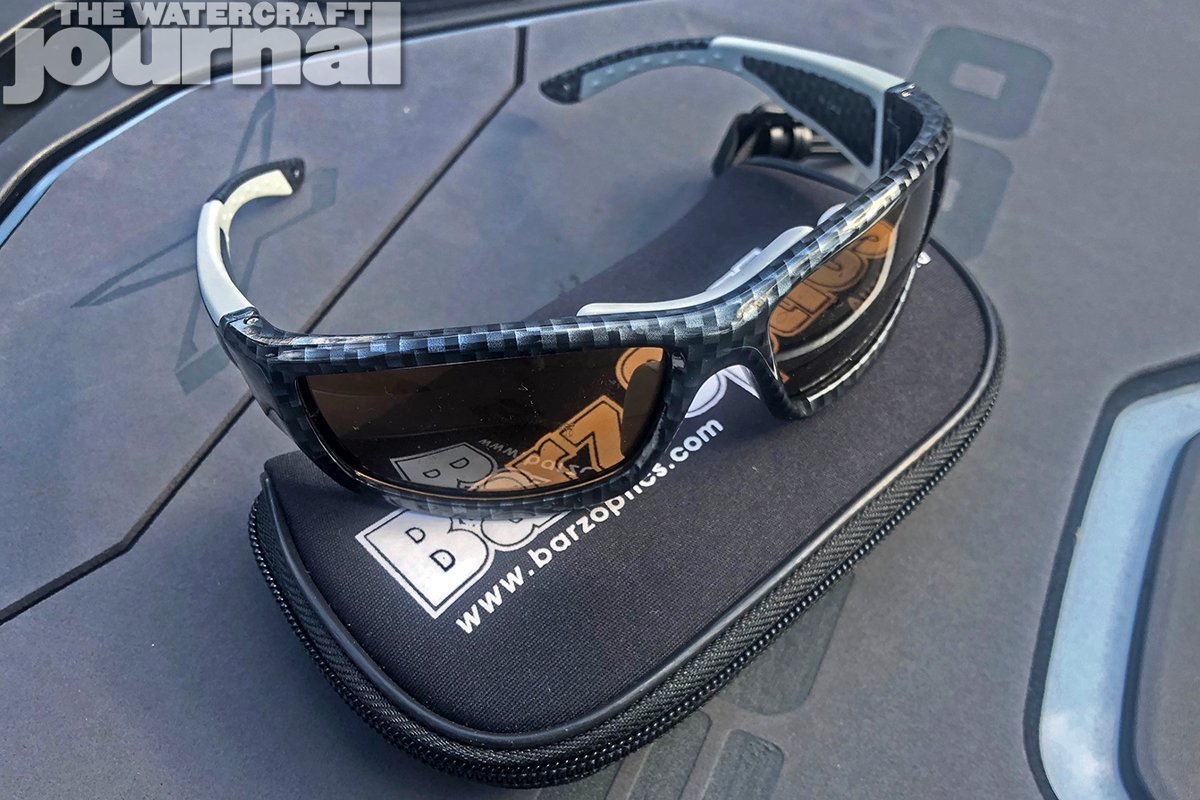
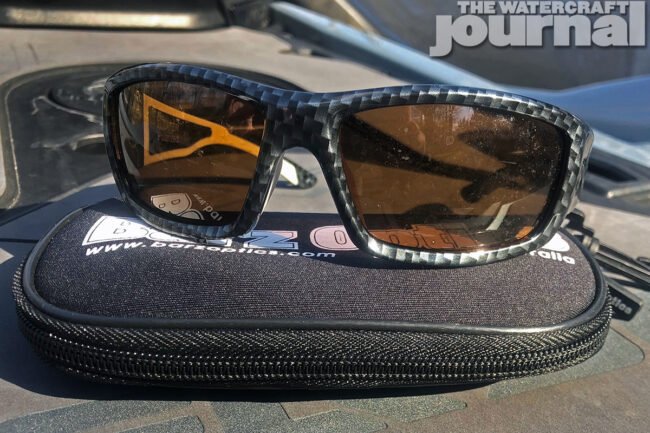
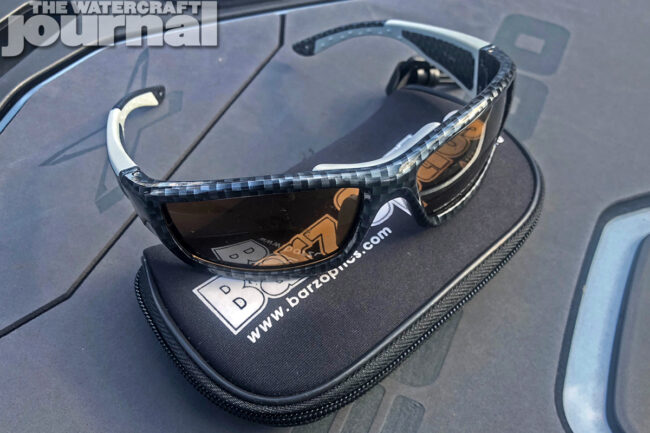
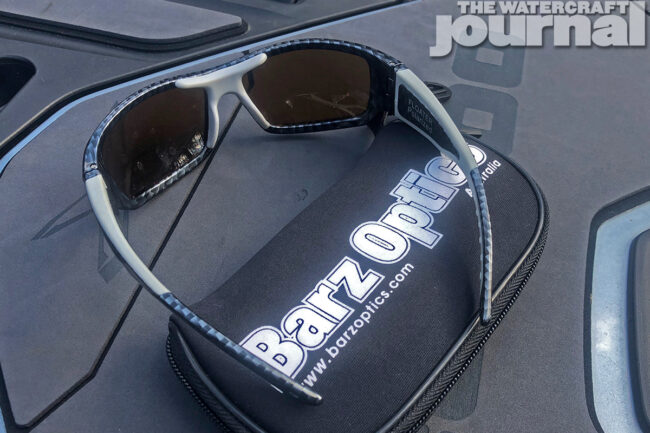
That is why the Barz Optics Floater Acetate Polarized sunglasses struck a chord with me. Much of their shape and design are similar to the 20-year-old shades that I have long since retired. Yet, more importantly, the Acetates are smartly designed, incorporating lightweight buoyant padding in the arms to keep these sunglasses from sinking to the bottom of the lake.
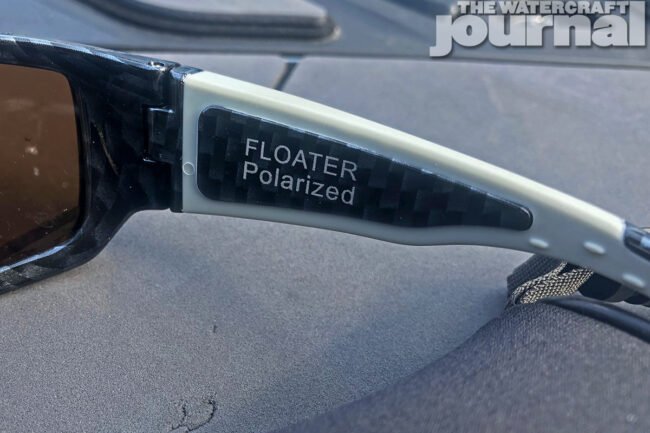
This added material does give the Acetates a fair more heft and thickness, but nowhere near as much as some mainstream floating sunglasses that resort to merely gluing squares of Hydro-Turf to their sides. Equally, the durable TR90 frame features non-slip padding at temples and at the nose and brow. This also keeps them from fogging up quickly. A nice addition.
While the faux carbon fibre coloring may not be a personal favorite, the Acetates do come in three other color options: matte grey with apple green temples and nose piece; matte black with grey temples and nose piece; and gloss tortoise with tan temples and nose piece. And like ours, all come with a supplied neoprene case, microfiber cloth and retainer strap.
Priced at $90 each, the Barz Optics Floater Acetate Polarized sunglasses are comfortable, sturdy and again buoyant, which is a must for most of us. They did feel a bit bulky at times, and at no point did we become unaware that we weren’t wearing a pair of sunglasses – as we tend to do with sunglasses with lighter, thinner frames. It’s a bit subjective, yes, but worth noting.
Powerboat Nationals has just announced that they will be offering veteran-owned businesses throughout the United States the chance to grow their business through motorsports marketing. Motorsports marketing has proven to be successful in growing businesses and expanding clientele. “According to Vetrepreneur magazine, veterans own and operate more than 2.5 million businesses in the United States.”
A new racing series called, “Vets First” will allow veteran-owned business to showcase their goods and services through discounted team and series sponsorships, television and social media advertising, and race event activations. With the Powerboat Nationals’ 2019 race season expecting to be shown in over 73 million households, this is a great way to grow your business at an absolute unbeatable cost. The 2019 Powerboat Nationals will be televised on networks including MAVTV, FOX Sports Southeast and AT&T Sports Network.
“Powerboat Nationals’ media are a powerful way to promote any business,’ said series Managing Director Dan Bunting. “We are excited to support our nation’s veterans by helping them affordably build awareness of their brands through our television, social media, and racing events across our country.” This initiative has a place for almost every company to get involved in, so what’s holding you back! Jarred Romesburg, series Director of Communications and Media, and veteran, strongly believes that this is a great and affordable way to promote this series.
Our veterans have given us the freedom to live here in the United States and it is really good to see that many companies are wanting to help veteran-owned companies.
Right about now, I’m reeeally hating my computer. It’s a 5-year-old Apple MacBook Pro with the 15-inch screen. I bought a few years ago from a highly reviewed guy here locally in Nashville, Tennessee, who buys, cleans and refurbishes Apple products and flips them on Craigslist. The laptop came with both extra memory card slots filled with updated cards, and at the time, was easily the fastest computer I had ever owned.
Yet, as time rolled on, I quickly filled the hard drive’s usable memory with video, photography and just a whole lot of iTunes music. Today, I’ve got two portable hard drives hosting all of my media; in fact, I’m operating with about 70-percent of the computer’s hard drive completely vacant – but damn if this thing isn’t running slower than ever. Browser windows lock up, downloading images from Apple Photos or transferring from one of the portable hard drives to the desktop always takes forever.
It’s a nightmare. And it all started to go down after last Mojave MacOS update. (More on that in a second.)
The big seller for owning anything from Apple is the convenience. “Oh, they’re so convenient!” everybody says. “Everything syncs right up to each other!” “All of your Mac products will share the same photos, music and other stuff!” Yeah, yeah, yeah. I know. I swallowed the bait hook, line and sinker. And yes, I do prefer Apple over a PC for many of these same reasons. Yet, relinquishing all of that hands-on control (endemic to owning a PC) in favor of predesignated convenience also has its drawbacks – most notably, I am now a slave to Apple’s whim.
Think that sounds ridiculous? I’ve got monthly fees feeding two iCloud accounts (personal and work), an iTunes account that taps into my bank account effectively mainlining new music into my veins like an IV, an Adobe Suite monthly fee (not Apple per se, but a crappy decision by Adobe to sell “subscriptions” to their software instead of selling the suite itself), and much more of the same. My accounting spreadsheet looks like a leaky dam, with cracks and fissures springing tiny revenue streams. And all for the sake of convenience.
A little over a year ago, Apple was slapped with a class action lawsuit after the tech giant admitted to slowing down older iPhones. It was widely believed that the company was doing the same with its laptops. Known within the tech industry as “planned obsolescence,” the practice basically hinders the operating speed, capacity and functions of existing hardware (computers, laptops, smartphones, etc.) to make the newest products look favorable. Certainly not a practice unique to Apple, the policy of intentionally planning or designing a product with an artificially-limited usefulness is, by almost all accounts, nefarious at the least.
Shortly after my 5-year-old MacBook Pro was sold as new, Apple decided to do away with traditional disc-style drives (or Small Computer System Interface (SCSI)) and go with Solid State Drives (SSD). And the move made sense to most; SSDs produced less heat, almost zero noise, and were less prone to failure due to vibration, impact or jolting. This upgrade almost instantaneously outdated my then one-year-old laptop. All service centers (including Apple’s own Genius Bar) were told to push the new laptops instead of repairing “outdated” units. This eventually trickled down into smaller specialty shops.
Now I’m stuck with a dinosaur; a laptop nobody either wishes to, has the parts or even knows how to repair. And now we see how planned obsolescence is great for the investors but horrible for the consumer. I mention this because the same can be seen in even our own personal watercraft industry. Innovations, technologies and materials that make for great marketing fodder often don’t survive longer than a few years at best, and consequently leave consumers scratching their heads as to how to maintain their investment.
When first introduced, Sea-Doo’s awesome 2009 RXT iS 255 (and the equally-equipped GTX Limited iS 255) were absolutely revolutionary. Not only because of their use of a first-generation iBR (Intelligent Brake & Reverse) but in my mind, for the perpetually-self adjusting Intelligent Suspension system. In its nascent form, iS would automatically throttle the coil spring tension depending on the undulation of the water. If the shock was compressing and expanding in long throws, a threaded chuck would spool up, tightening the coil. If the system read sharp, shallow and quickly-repeating jolts, the chuck would unwind, softening the blows. Frankly, I absolutely loved it – and I know I’m not the only one.
Besides being incredibly advanced, it was also expensive to repair (both in parts and labor) and the problem was that needed repair often. It didn’t take long for Sea-Doo to wisely phase the iS option out from the roster, which was really a shame because when iS worked, it worked great. (Manual versions of iS, such as aS and S lasted slightly longer.) Yet, that is the downside to innovation; hardly ever is the first draft ever perfect and that means previous iterations will be outdated. Sea-Doo is currently on its third version of iBR since first testing the prototype that August morning in Quebec so long ago. Forward progress leaves much in its wake.
Thankfully, unlike my MacBook Pro, nobody at Sea-Doo or elsewhere, is conspiring to build watercraft with built-in expiration dates. Yes, today’s machines will be outdated with newer, more impressively innovative products in the future, but not at the cost of purposefully alienating the consumer. Yes, certain parts are designed to be consumable (wear rings, props, etc.) the same as the tires and brake pads on your car. That’s not the same as planned obsolescence. That’s simply wear and tear. Now, if the day comes that we have to upload new operating software for our PWC via WiFi, we might be having a different conversation.
A jet ski ride organized by Victorian Jet Ski Club president, Jimmy Chaanine was set up in protest to the recent complaints and a petition set forth to outlaw jet skis along the Mornington Peninsula. Some bad apples are ruining the sport for safe and conscientious riders. Chaanine and his crew of over 100 jet skis were underway a little after 10am from Patterson River on Sunday the 13th of January. Their final destination was Rye and the ride went well. There were no instances of riders misbehaving. We hope the good behavior was favorably looked upon by those who protest PWC riders.
Prior to the ride, using Facebook Live, Chaanine set forth a plea to fellow jet ski enthusiasts; “Speaking to a few of the boys this morning, I think it’s time we put our foot down and show that it’s a very small minority that are ruining the sport. Whether it’s jet skis, motorbikes, dirt bikes, or cars, there’s always going to be that minority. We’re going to show them that the majority are respectful. The majority are family people. The majority love this sport. We need to get out there and show them that it’s only a small minority [that do the wrong thing],” he said.
Chaainine hopes to take the targets off the backs of well-behaved jet ski riders. However, Mornington Mayor David Gill said the enforcement of hoon legislation on jet skis was “not satisfactory or effective in addressing safety concerns.”
Gill continued his call for more enforcement by increased surveillance, more law enforcement, and PWC patrols along the peninsula coastline. He also said that authorities can’t ignore the problem any longer and a solution is needed so that children and wildlife are safe. Chaanine told The News that “the day was a success, and everyone was well behaved. This showed that there is plenty of support to combat the small minority.”
A little less than two years ago, Polaris announced the closure of its Victory motorcycle brand, with Polaris Industries Chairman and CEO Scott Wine stating, “Over the past 18 years, we have invested not only resources, but our hearts and souls, into forging the Victory Motorcycles brand, and we are exceptionally proud of what our team has accomplished. […] This move allows us to optimize and align our resources behind both our premium, high performing Indian Motorcycle brand and our innovative Slingshot brand, enhancing our focus on accelerating the success of those brands.”
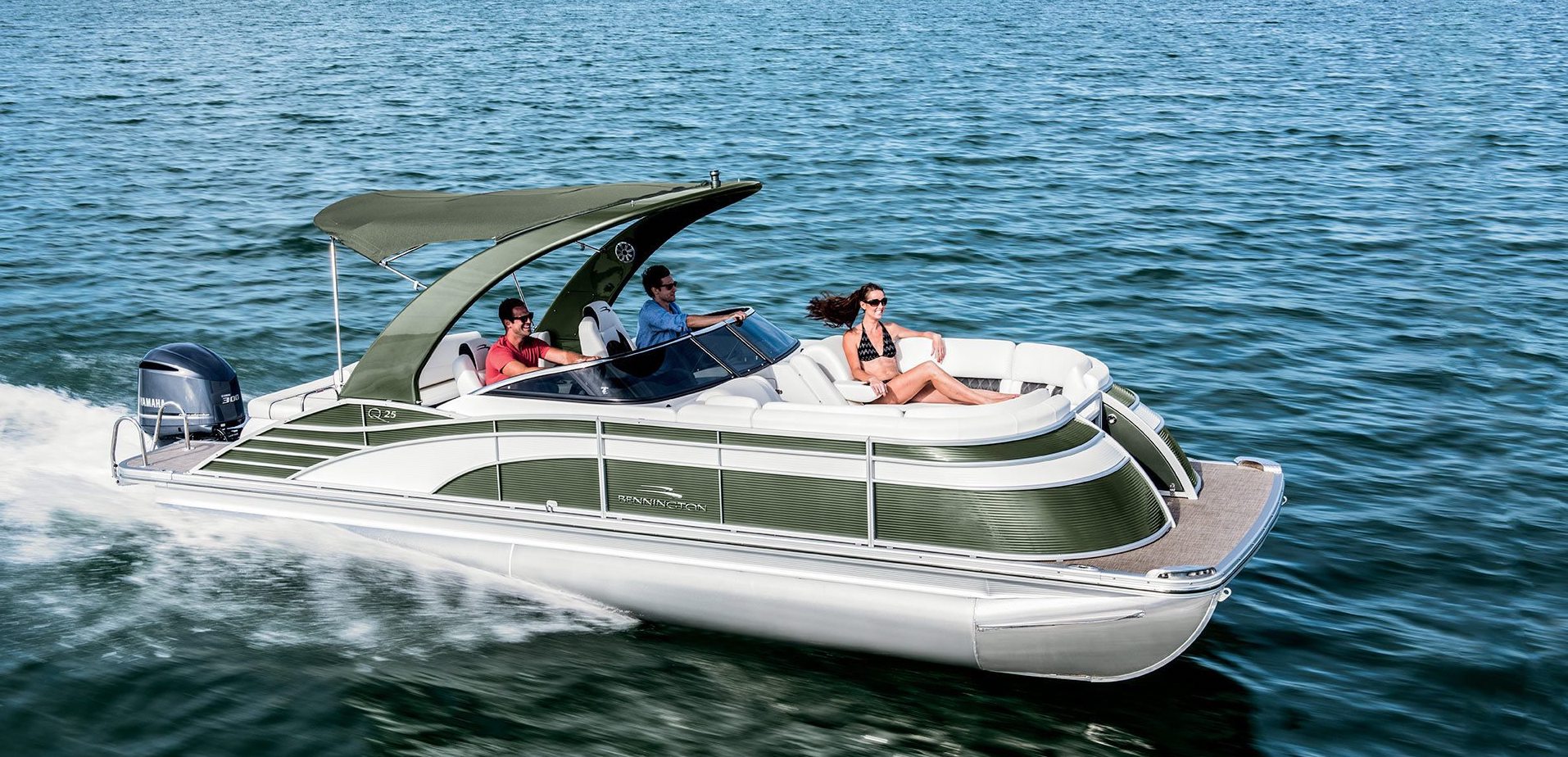
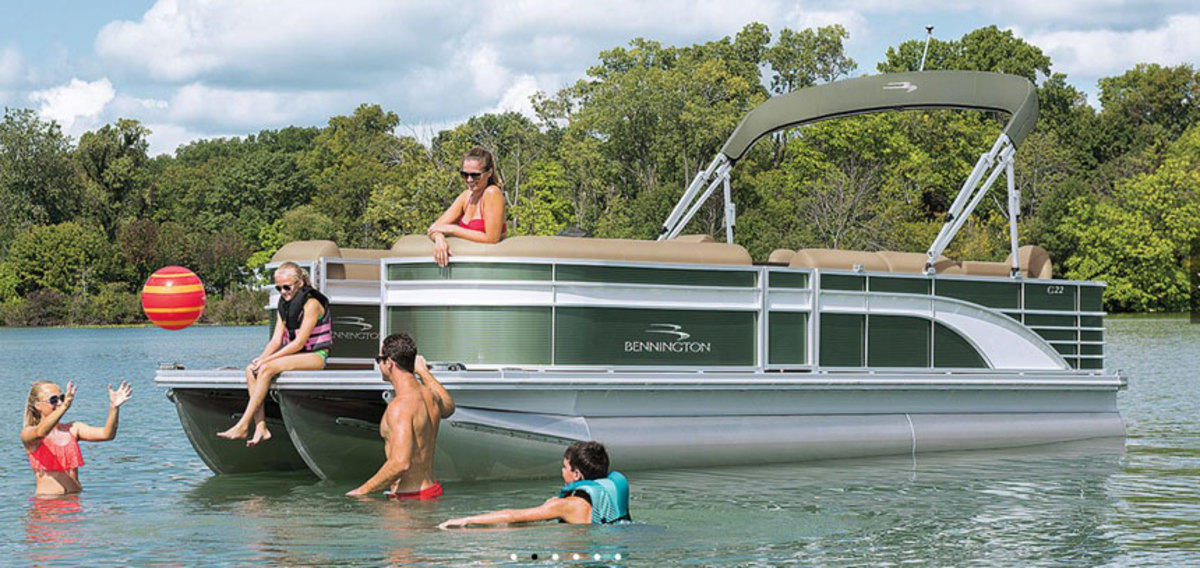
One year later, Polaris announced the massive acquisition of Boat Holdings, the nation’s largest manufacturer of pontoon boats, for $805 million in an all-cash transaction. Polaris CEO Scott Wine told Forbes, “Most of our competitors have water products. We’re kind of late to the party,” While Forbes notes that Yamaha, Kawasaki and others that compete with Medina, Minnesota-based Polaris in these existing markets, Kawasaki does not offer boats or outboards; strictly JetSkis. Yamaha, conversely, is the industry leader in jet boat sales, and wields the second-largest marketshare in PWC sales. BRP, Polaris’ biggest competitor on this scale, builds both Side-by-Sides, snowmobiles, outboard engines and PWC.
Regarding side-by-side sales, Polaris is roundly the leader with over a 50-percent share of the market and “a stranglehold on the hero-building Pure Sport segment with the company’s RZR performance vehicles,” according to SuperTraxMag. Moreover, Polaris’ snowmobile division is the second most successful in the marketplace. The purchasing of Boat Holdings instantaneously gave Polaris a massive foothold in the boat sales network, nearly paralleling its grip on the powersports marketplace.
Now, Polaris has announced the purchase of Larson Boat Group from Marquis-Larson Boat Group. Previously, Larson model boats included the Larson, Larson FX, Striper, Triumph, and Escape (the luxury Carver Yacht and Marquis Yacht brands remain with Pulaski, Wisc.-based Marquis). However, according to Powersports Finance, dealers told Polaris plans to discontinue the Escape line of pontoon boats, as its Boat Holdings’ ownership has the pontoon market fully covered, with “some of the Larson Boat Group assets will be moved to the Polaris production facility in Syracuse, Ind., where the company currently produces Rinker boats.”

















 It’s a nightmare. And it all started to go down after last Mojave MacOS update. (More on that in a second.)