PWC Muscle Performance Parts have quite a few new products on offer. Browse the site to see what’s new. We touched on the products just to give you an idea of what’s available.
The service manual for the Yamaha GP1800 is priced to sell at $75.00. It’s for the 2017 and 2018 models.
Need a throttle cover for your Yamaha GP1800? PWC Muscle has the P3 Labs throttle cover in stock. This piece covers the hole that is left by aftermarket steering systems on the throttle lever.
Grab yourself a 30 piece pack of Sea-Doo Spark High Impact Plastic Washers for $35.00. They come in multiple colors and are made in the USA. This is an inexpensive way to customize your Spark or use them to replace cracked or broken washers.
When it’s time to change the oil in your Sea-Doo Spark, PWC Muscle has you covered with the Sea-Doo ACE 1630 Oil Change Kit. This is the ultra-convenient “all-in-one” oil change kit, which will save time and money. It includes XPS Synthetic Blend Oil, oil filter, and o-rings. Add spark plugs for $21.99. The kit alone is $67.99.
Wanna turbo charge your Spark? Purchase the V-Tech Victory Sea-Doo Spark Turbo Kit for $4,225.00. PWC Muscle is now taking pre-orders for the kit, which includes everything you need. This super charged kit will create 160hp-180hp! The kit requires the Maptuner X. If you don’t have it, add it to your cart for an additional $850.
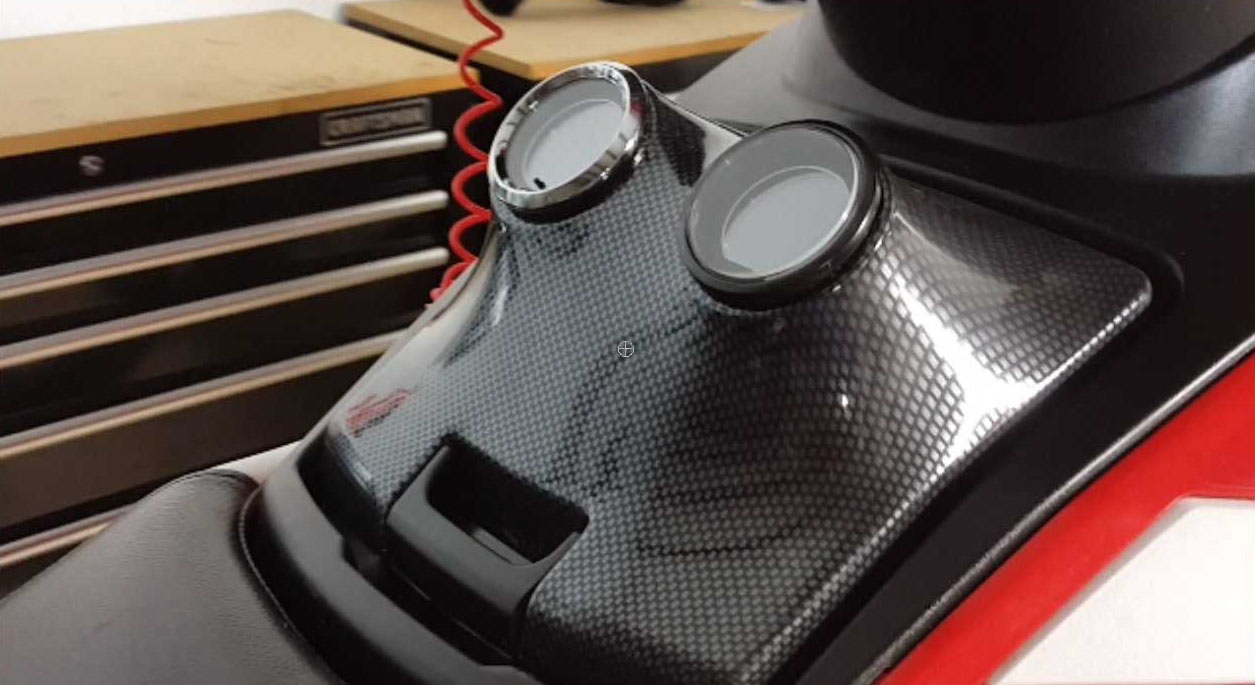
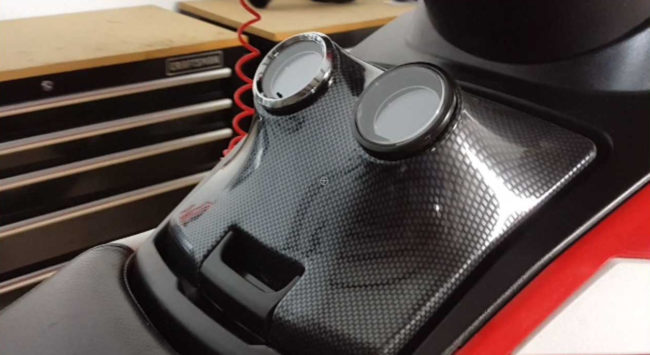
Also available are custom built gauge pods from P3 Labs. These fit the Yamaha GP1800. The pods cost $119.99. Click the link for all the details.
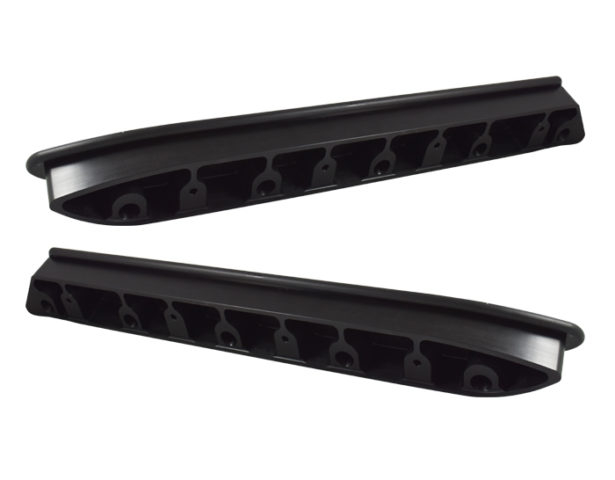
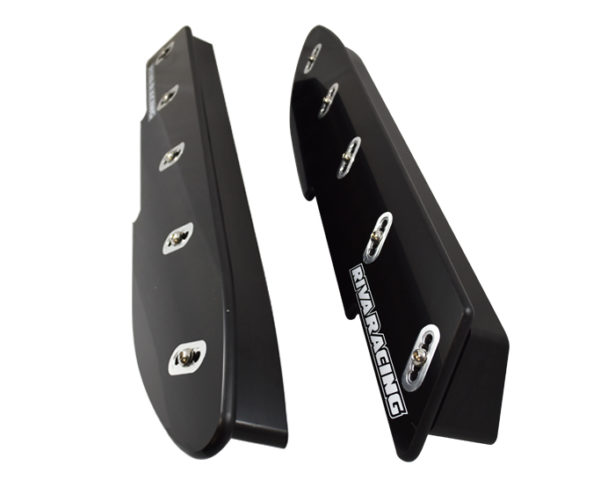
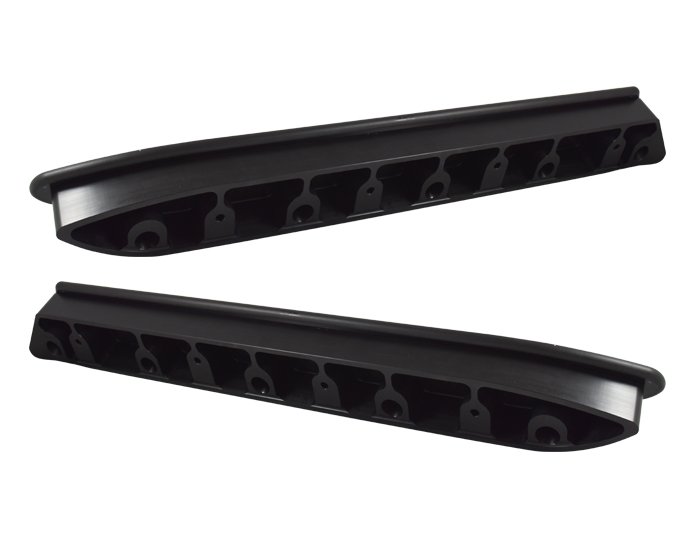
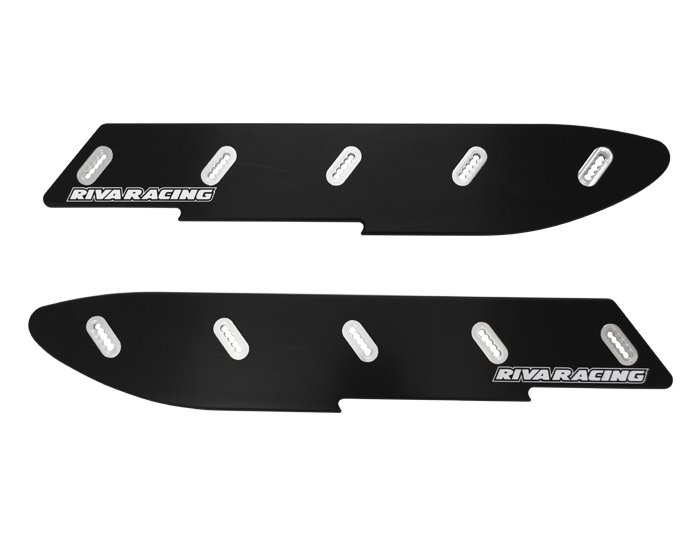
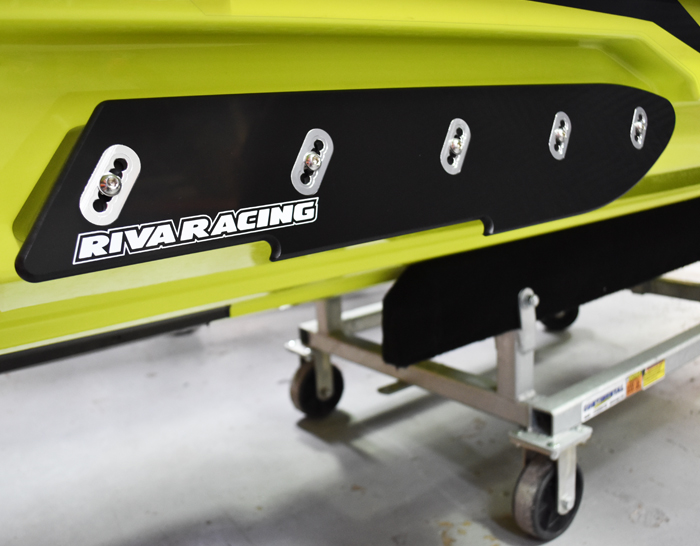
PWC Performance now offers RIVA Yamaha GP1800/VX Pro Series Sponsons. $499.95 is the cost to improve handling and straight line stability for your PWC. The sponsons have three fully adjustable positions and easy bolt on installation.
Check out the RIVA Yamaha O2 Sensor Mounting Kit for 2012 and newer 1.8L engines. $219.99 buys you a mounting kit that requires no drilling, machining, or welding.
Another new product offered by PWC Muscle is the RIVA LC1 Wideband Lambda Controller for $249.99 The LC-1 is a complete wide-band Lambda controller built into a sealed cable and wired specifically to connect to the RIVA Athena ECU via a waterproof factory connector.
All products come with PWC Muscle Performance Parts price match guarantee. Free shipping is available for orders over $139.00 with special terms and conditions.
The waves that form off the coast of Nazare, Portugal are world renowned for their extreme size and power. Big wave surfers monitor weather forecasts and keep their eyes on marine and buoy forecasts, so they can be ready to go at a moment’s notice when a big swell is on the way and Nazare will be firing.
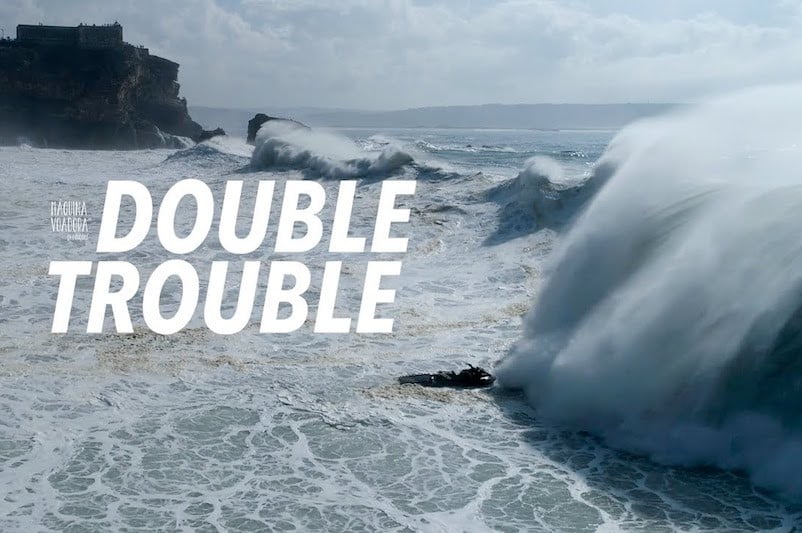
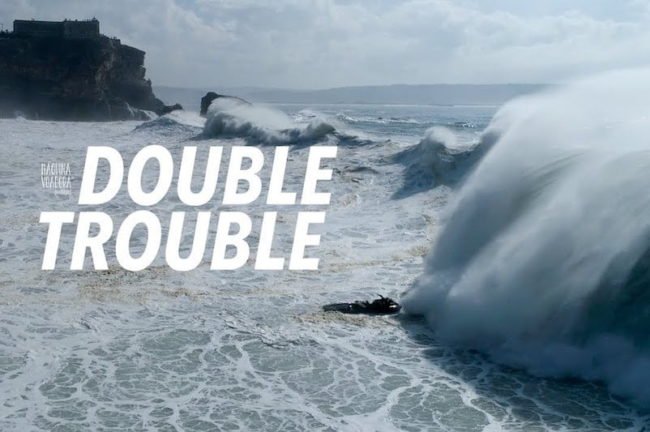
A drone captured just how gnarly Nazare really is during a massive swell. Non-surfers will wonder why jet ski teams attempt to motor into the giant waves and why surfers attempt to paddle into waves of that magnitude. A lot is at stake when heading into big waves. Lives are on the line and it takes super experienced watermen and women to survive the nearly non-existent line up at Nazare. Mountains of water break all over the place.
The footage captured by the drone shows just what it takes to survive a big wave wipeout with a surfer, a jet ski, and jet ski driver. This particular incident occurred on February 16,2018, just as Portugal’s big wave season was coming to an end. The video begins with professional surfer Alex Botelho trying to paddle into a giant wave. Botelho is engulfed by the monster, losing his board during the wipeout. Another set wave slams him and pushes him down. His teammate, Hugo Vau, was idling nearby on his jet ski and sees what is happening and motors in to help to Botelho. A life threatening situation begins to unfold when a massive wave approaches and takes out both men and the PWC.
More set waves approach and the guys are left floundering for the ski as it’s tumbled when they try to scramble for it. The crew is rag-dolled, held down, and beat up by the oncoming waves. Miraculously, they survive and the PWC only suffers minor damage.
Thanks to footage captured by drones, GoPro’s, and other camera equipment, we have the luxury of sitting in front of our computer monitors and are able witness scenes like this from the safety of our homes. Giant Nazare is not a break for inexperienced surfers. Fortunately, Botelho and Vau have trained and continue to train for big wave surfing. They know what to do during a dangerous wipeout and thankfully, they survived this one.
“The Children’s Hospital, Birmingham, AL is a member of the Children’s Miracle Network Hospitals, an alliance of premier hospitals for children and one of the world’s leading children’s charities working to save and improve the lives of millions of children. The TWRA is an organization dedicated to the preservation, conservation, and enhancement of Tennessee’s outdoors, including fostering the safe use of the state’s waters. The event is also designed to promote Tennessee tourism and water safety, as well as to portray PWC’s in a positive light, and is the longest running organized event in the United States for personal watercraft.”
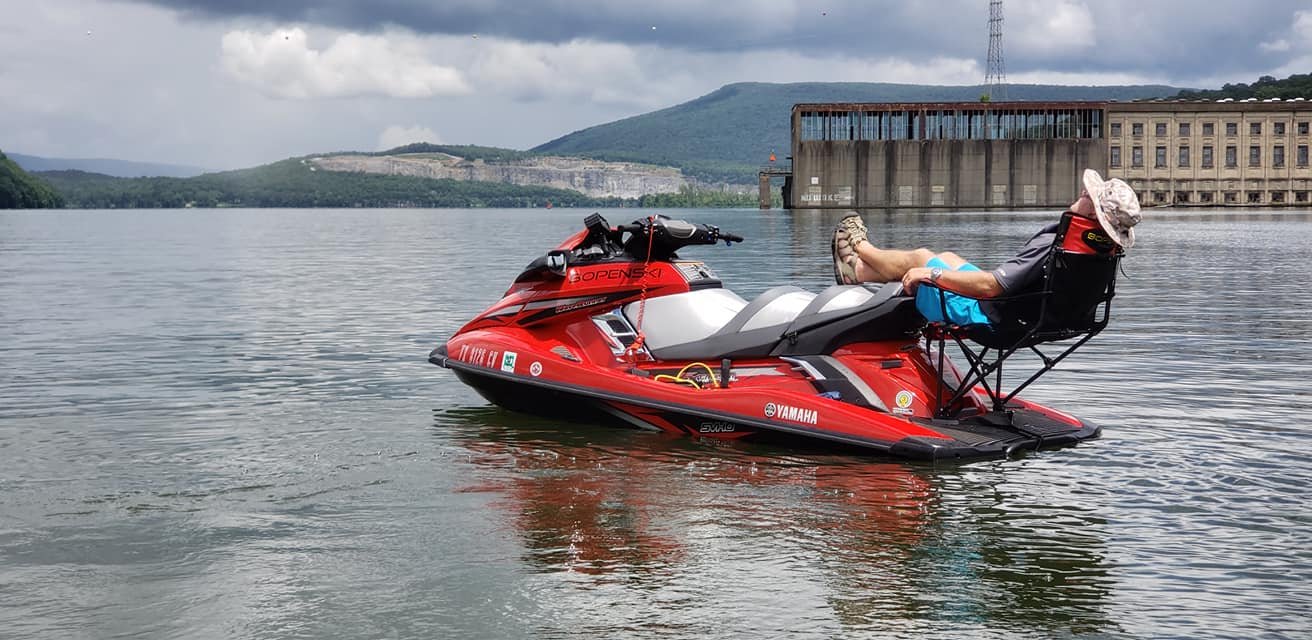
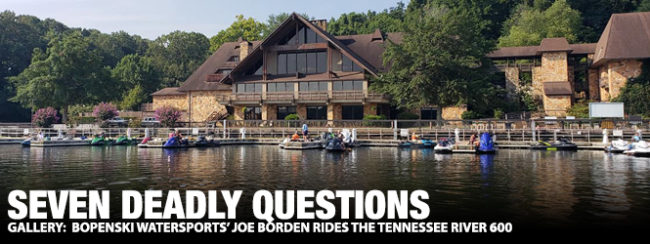
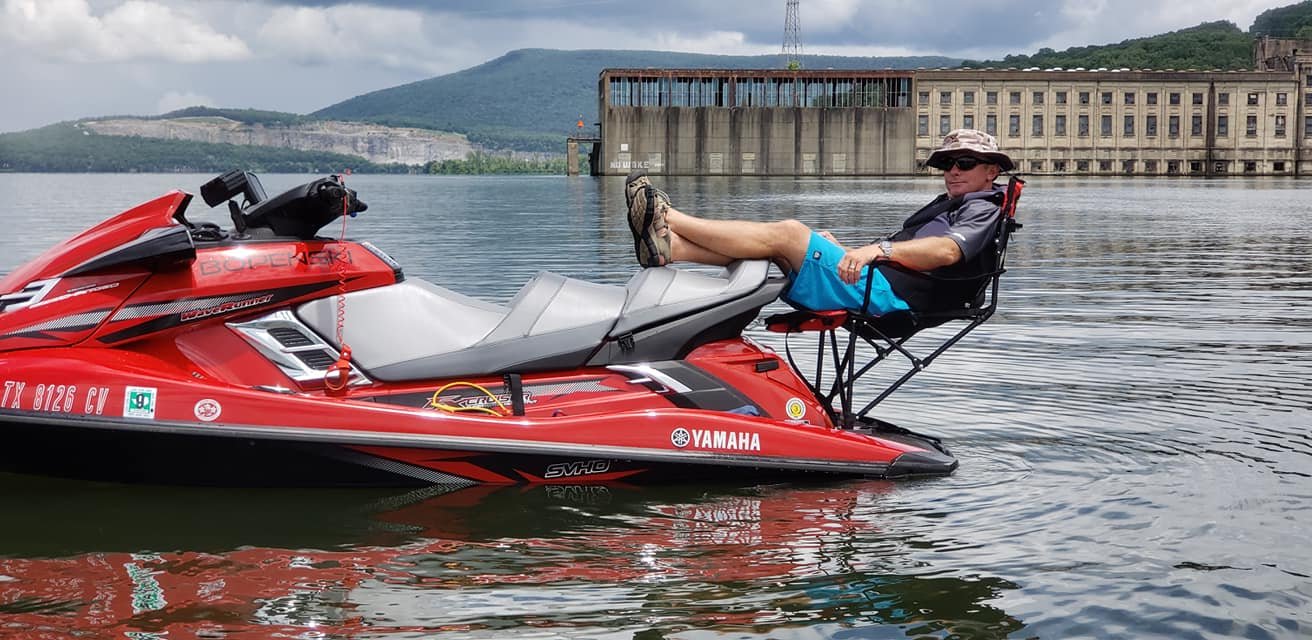
Celebrating its 22nd year (beginning back in 1997), the Tennessee 600 has raised nearly a quarter-million dollars for these charities and organizations while welcoming riders from across the US, Canada and beyond. This year, Joe Borden of Bopenski Watersports (y’know, the guys who make the awesome KickBack PWC chair) thought he’d try out the 8-day event. Once the saddle sores mended, we reached out to see what Joe thought.
The Watercraft Journal: How did you first hear about the Tennessee River 600 (TNR600)?
Joe Borden: I heard about the ride from a couple we met at the MudBug in Morgan City, Gregg and Jenn Andreachi. They said the TNR600 is the first ride they put on their calendar every year, it’s that good.
WCJ: What helped you make the decision to go? Who joined you?
JB: I was having a conversation with my brother, Jamey about how much fun my wife, Shari and I had riding through the bayous at the MudBug with the groups, and that he and his wife, Georgia would love it. He asked if there was another ride coming up anytime soon and I told him about the TNR600. It was decided about 2 minutes later.
WCJ: Tell me a little about the trip to Knoxville, how was the drive?
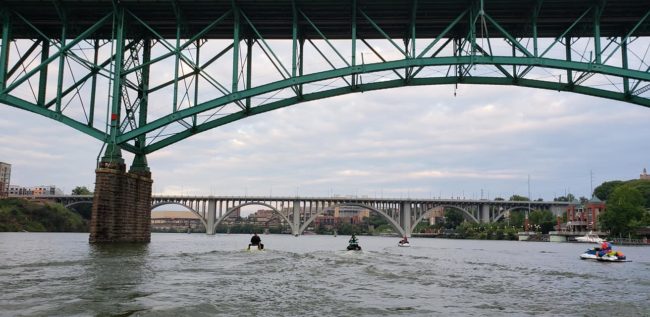
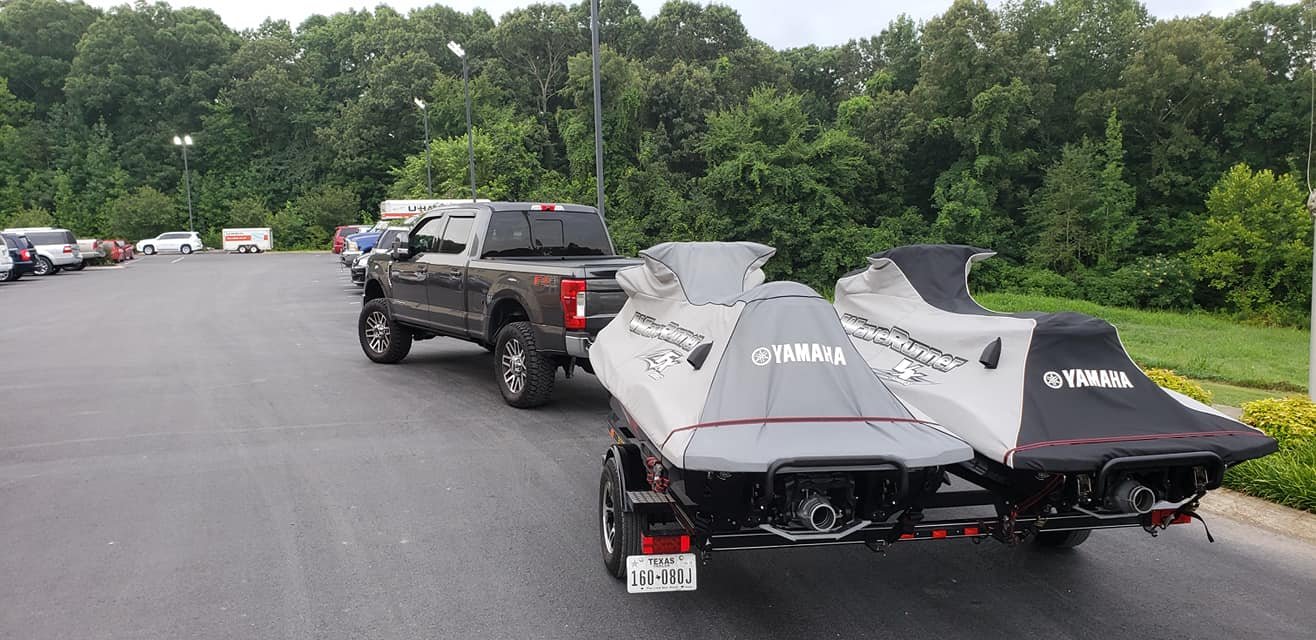
JB: It was an easy 880 miles – no troubles. We reworked the bearings and put new tires on the trailer prior to the trip – like our dad always said, prevention is easier than correction. We hadn’t been through Arkansas and Tennessee in many years, so getting to spend time with my brother and see some beautiful country was a lot of fun. The drive from Nashville to Knoxville is just stunning.
WCJ: How long was the first day’s ride? It’s typically the most grueling.
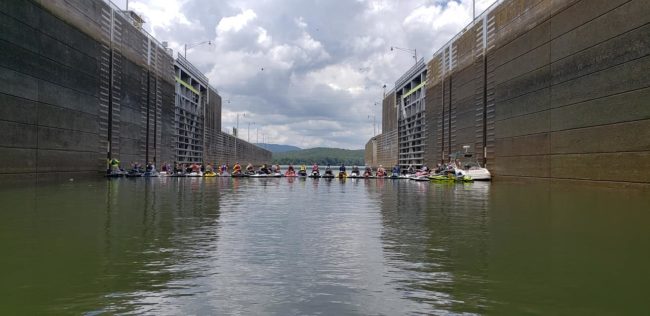
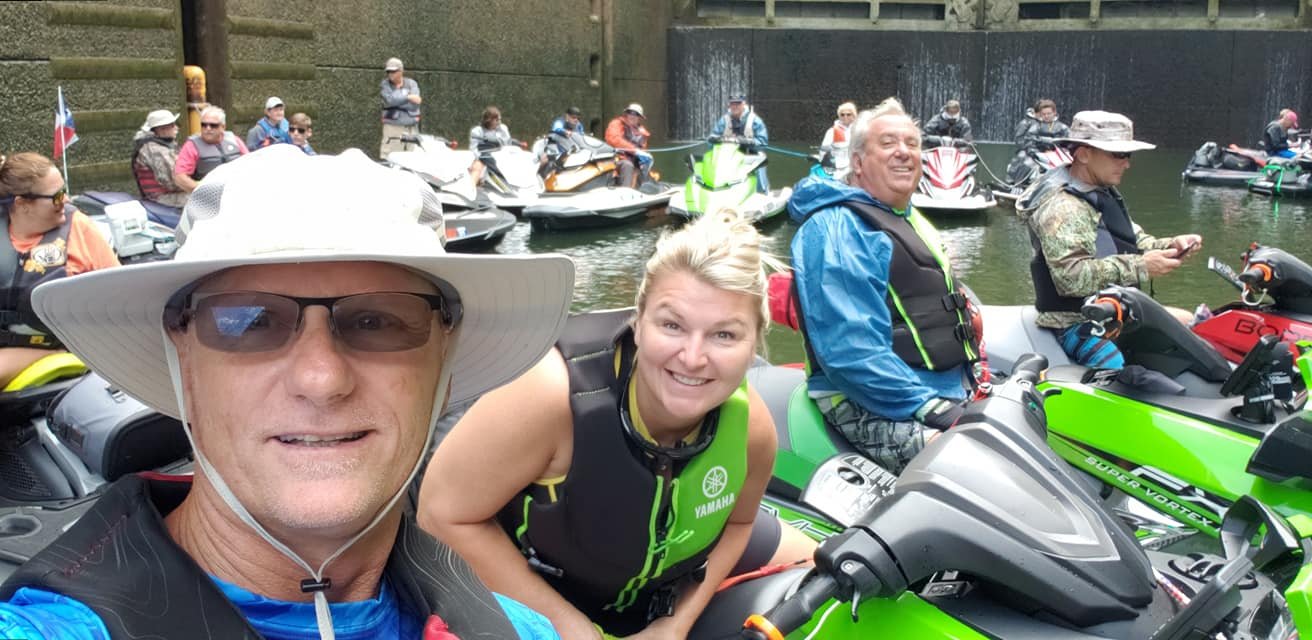
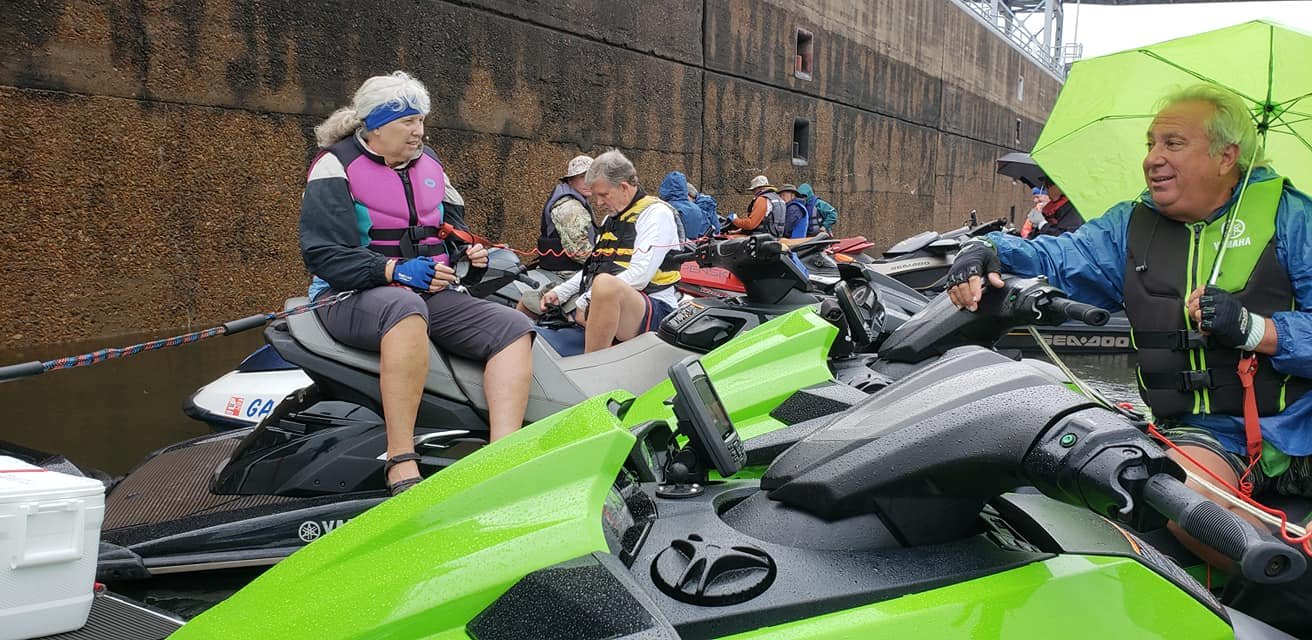
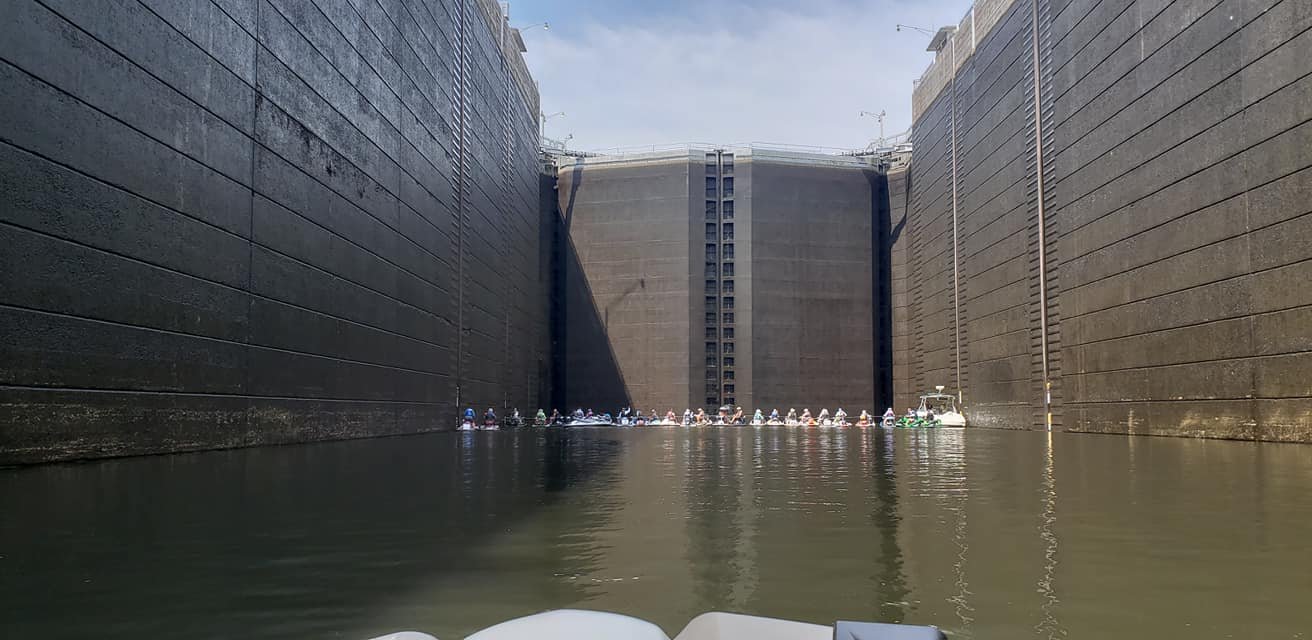
JB: We went about 140 miles through 3 locks on our way to Chattanooga, but it didn’t feel like a haul at all. The river was calm with postcard views around every bend, not to mention the homes/estates we were able to encounter, beautiful places. It was our first time experiencing a lock. Watching the walls grow 50 to 100 feet in about 20 minutes was incredible.
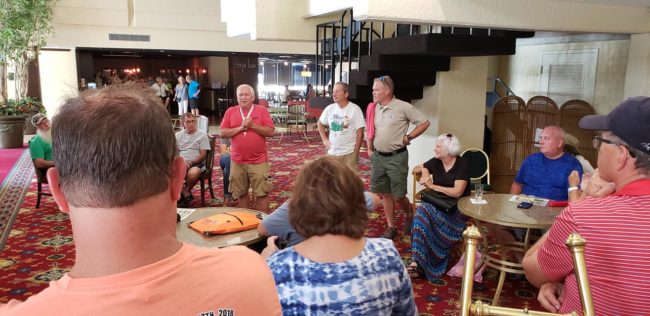
Dennis Beckley and his team of TNR600 organizers did an outstanding job informing everyone (especially us newbies) of the day’s scheduled stops, river rules and regulations, and marina locations for pit-stops and refueling. Each day, Dennis had organized at least one meal we would all gather as a group for, which was a great time to hear the day’s stories.
WCJ: What cities (or landmarks) did the group stop at?
JB: First and second nights were in Chattanooga. Day 2 was a play day. You could site-see around Chattanooga or explore the river. We came to ride, so my brother and I took the opportunity to ride the Gorge (Chattanooga to Hale’s Gate about 35 miles) by ourselves – what a beautiful ride! And we were able to take our time and really soak in the views in the canyons.
The third night was at the Wyndham Garden Lake in Guntersville, Alabama. It’s right on the water and close to the next day’s lock – Guntersville Lock. The fourth night’s stay was probably my favorite at Joe Wheeler State Park – I could have spent several days there between the beautiful scenery around the river, golf course and miles of hiking trails. The sunrise from any of the room’s balcony is incredible, and the staff is outstanding.
The fifth day ride from Joe Wheeler to Pickwick State park was a lot of fun as well going about 70 miles. We stopped by the River Bottom Grille at Florence Harbor (AL) for lunch and the burgers were excellent. A lot to see and do along this stretch including a great cliff to jump off of. Pickwick State Park is also a great stop with plenty to do, including the famous fifth night fish fry Dennis and his team put on for the group.
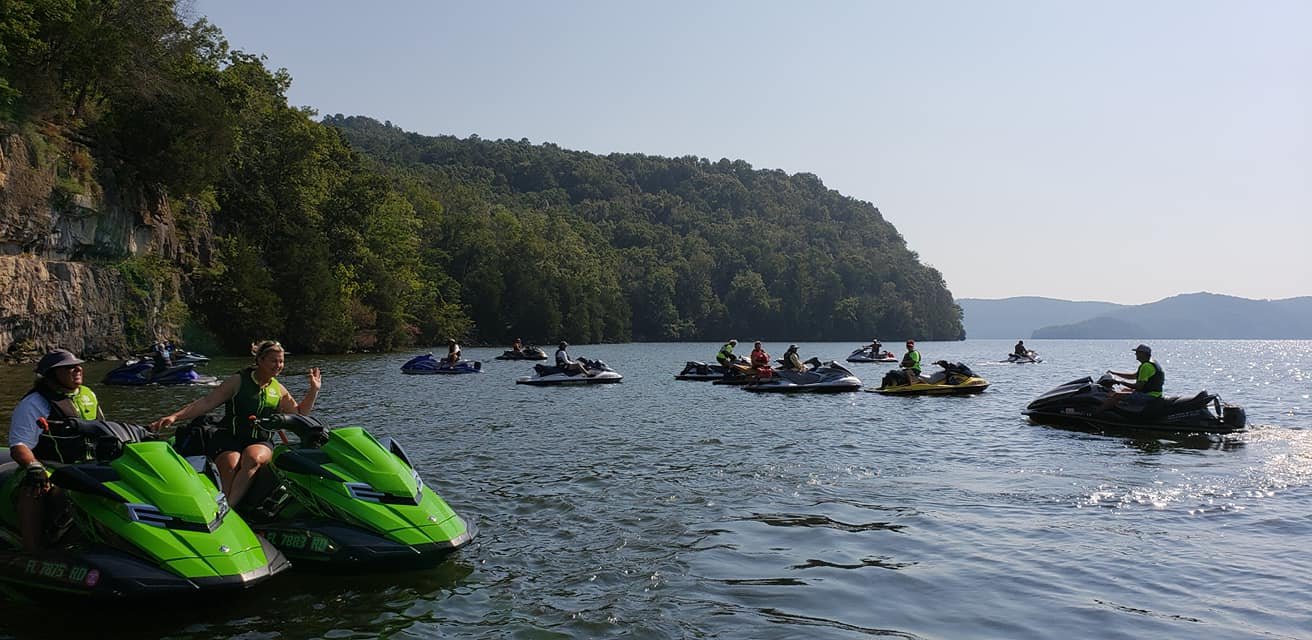
Great food and a lot of laughs from all the stories being told from the last 5 days of riding. The last day is about a 140 mile ride, but it sure doesn’t feel like it. This stretch of the Tennessee River is as beautiful, yet different from the rest, and we found ourselves stopping often for pics and to just take it all in. We made it to the end of the ride at Paris Landing in about 4 hours and although a little tired, we found ourselves wishing we had a couple more days.
WCJ: Tell us a little of your day-to-day; did you develop a routine in packing your ski, riding styles, etc?
JB: Gregg and Jenn prepped us really well in what to take and how to pack. In the skis we had bumpers for each side, two dock lines, tools for pulling out anything that might get caught in the impeller (and needed once!), rain gear, face mask, goggles and our KickBack. The only things we took to the hotel each evening were a small backpack containing our valuables, snacks, the Garmin and coolers. (If you leave food in your ski overnight the raccoons can make quite a mess.)
Everything else including the life vest we left on the ski in the marinas and never had a problem. Having the rain gear, goggles, facemask quickly accessible for the occasional shower made riding in the rain fun, something we would have found hard to believe prior to the trip. And the way Dennis and his team handled all the logistics of our luggage from hotel to hotel made the trip so easy, everything would be waiting for us when we got off the water.
WCJ: Give us some concluding thoughts – did you like the group? Did you like the average speed? did you like the selected stops each night?
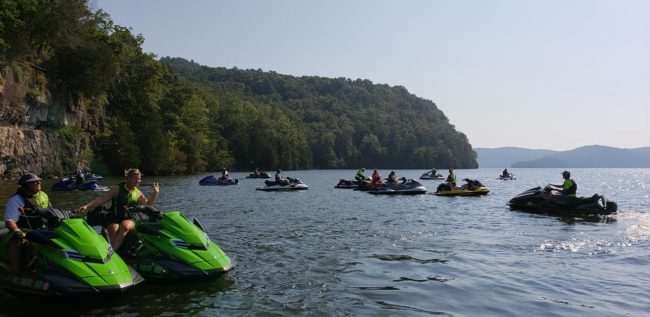
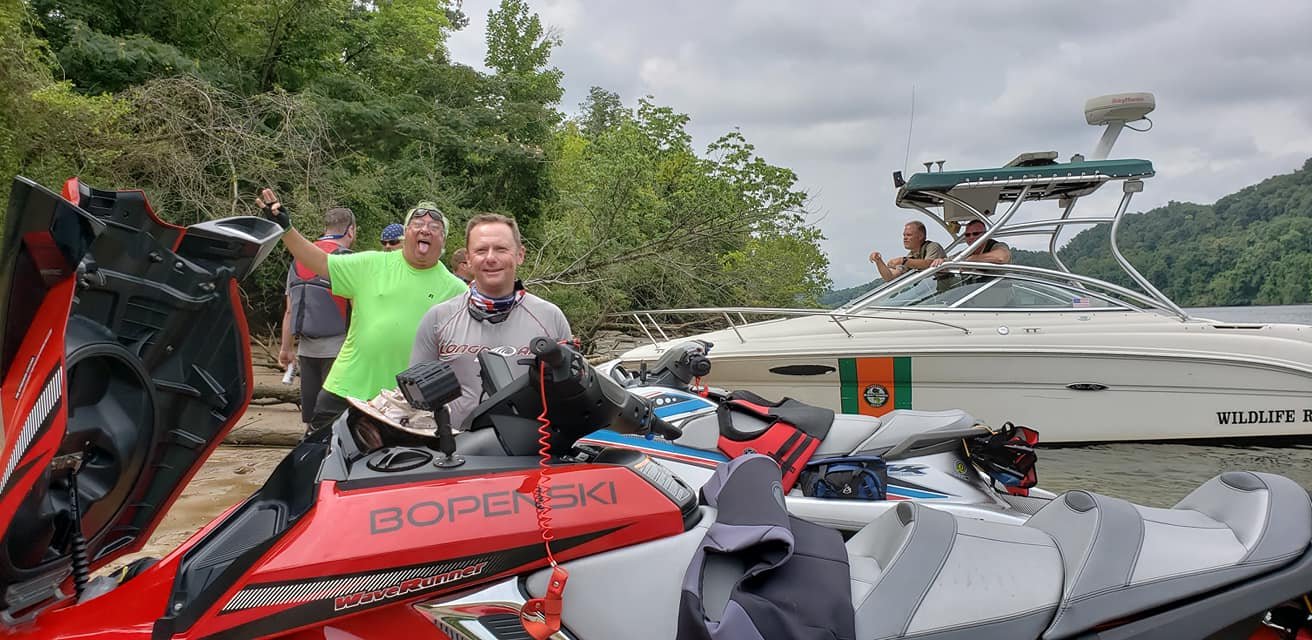
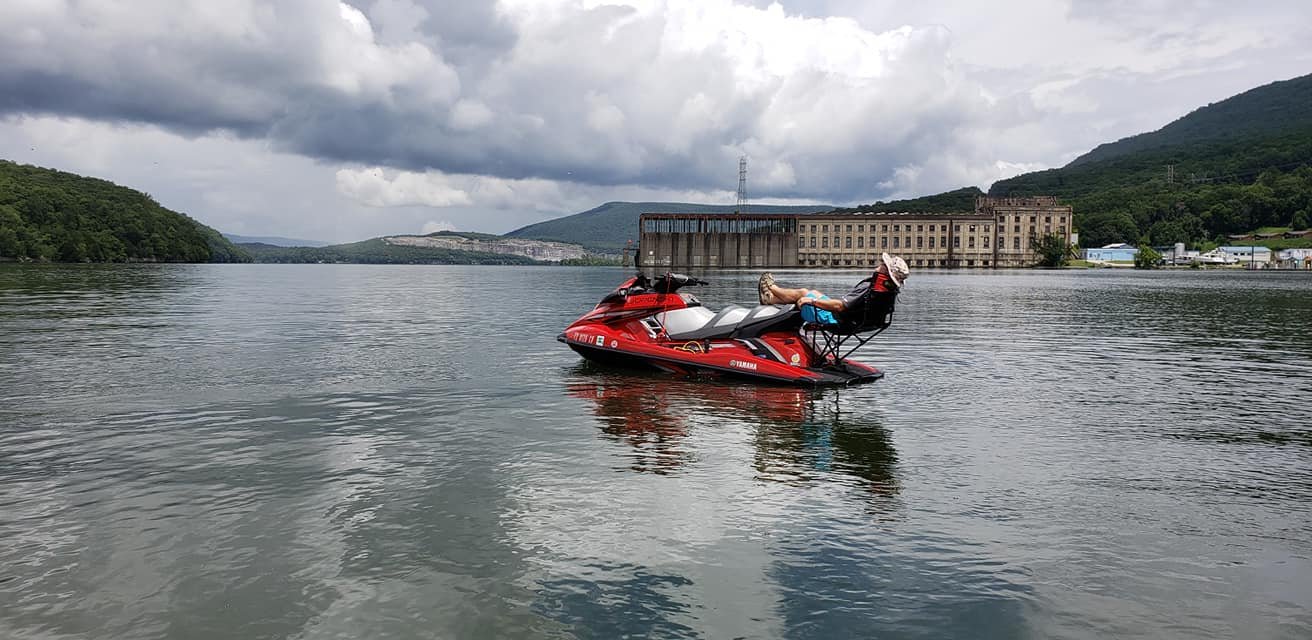
JB: We had a blast! And we will be back next year along with several others from our clan that are already sold from the pictures, videos and stories. Did we like the group? Absolutely! Within a couple of days everyone started to feel like family, and the way everyone helped each other made us feel like we hadn’t left Texas! There were 10-20 people we rode with each day that enjoyed riding the speeds we did. As a group we rode between 40-50mph with frequent stops just to kickback, talk and enjoy the views. For most of the 600 miles the water this year was glass (or close to it), which just begged for speed. With there being almost 100 participants, no matter what speed you enjoy riding there is a group for you.
So far for the 2018 racing season, Yamaha has a lot to celebrate as the GP1800 WaveRunner continues to dominate. Yamaha is proud to announce that ‘Yamaha racers are winning more championships than ever before. Our GP1800 WaveRunners remain unbeaten on the racing circuit.’
Recently earlier this month of course we saw Yamaha overwhelmingly sweep the LB2CAT offshore championship with Mike Klippenstein take the championship win aboard his FX SVHO and Cyrille Lemoine next in line on his GP1800.
In fact Yamaha not only took all podium positions, but they dominated the first eight positions in this championship endurance race.
We also recently saw Yamaha racers sweep the top ten spots at round 3 of P1 AquaX. Of course world champion Brian Baldwin took first place aboard his GP1800 followed by Chris MacClugage and Eric Francis who also rode the rocket-like GP1800 WaveRunner.
With all of the innovations such as NanoXcel2 employed on the hull and deck as well as the powerful SVHO engine in the GP1800, it’s no wonder why Yamaha continues to dominate the race circuit.
When you give the racers an industry-leading power-to-weight ratio, you give them the tools they need to dominate the competition.
For more information and race results regarding Yamaha WaveRunners, check out Yamaha news here.
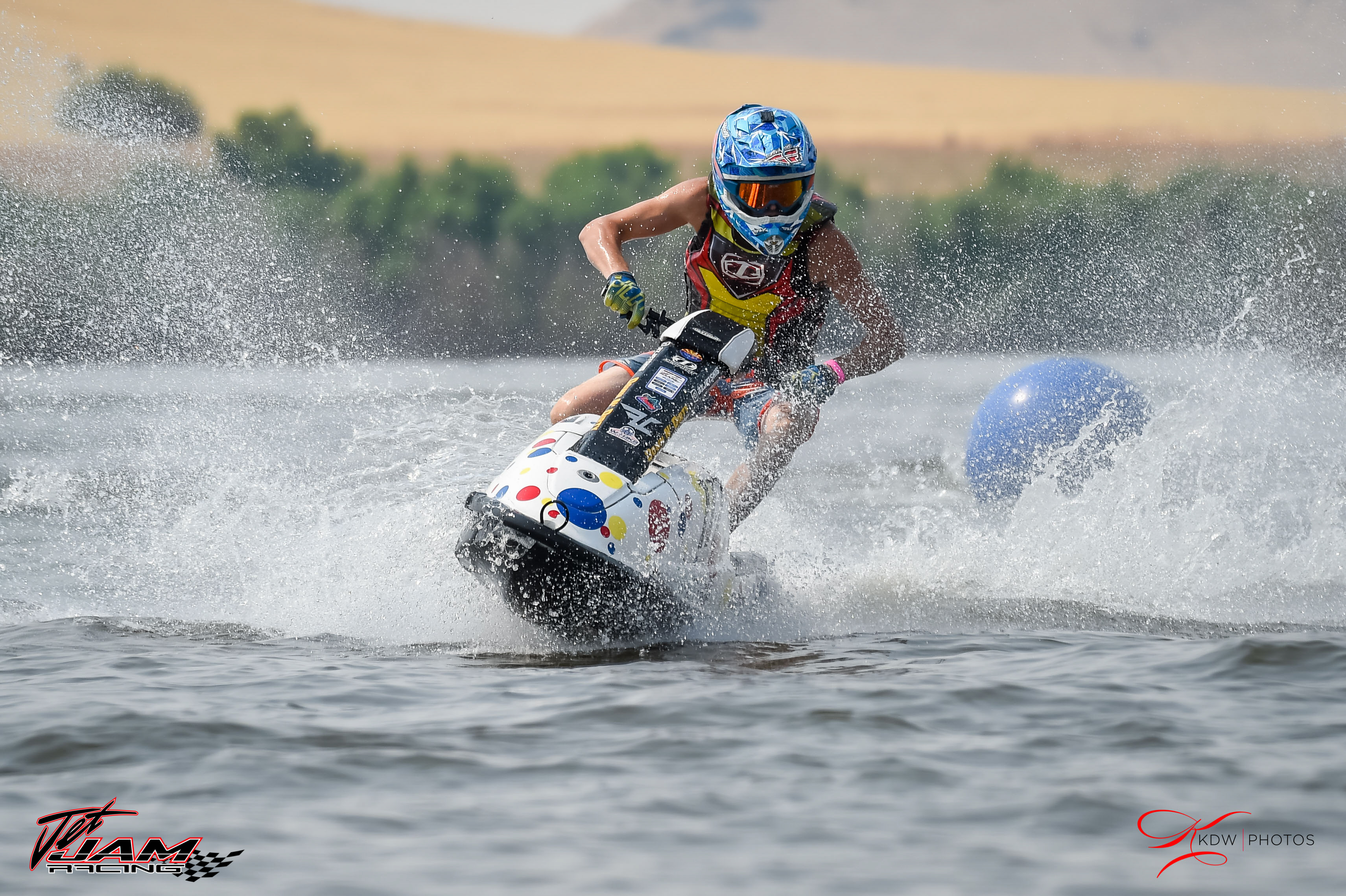
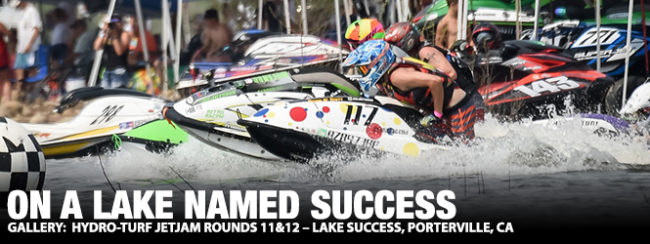
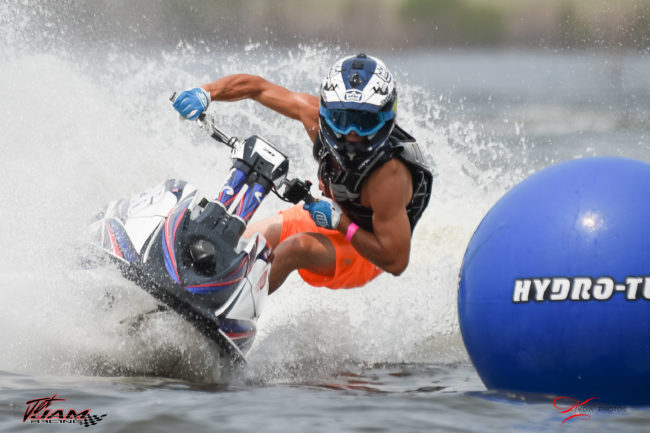
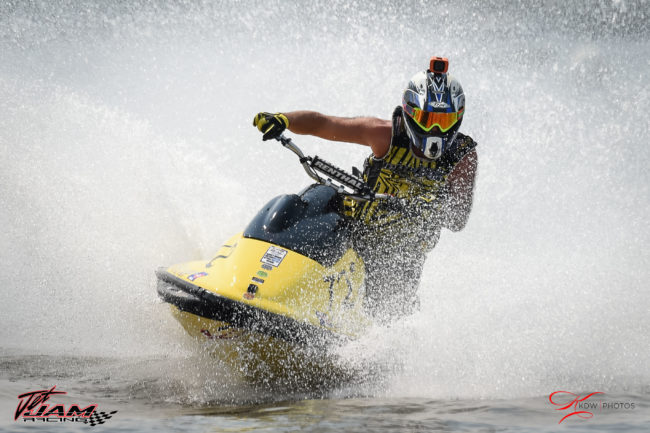
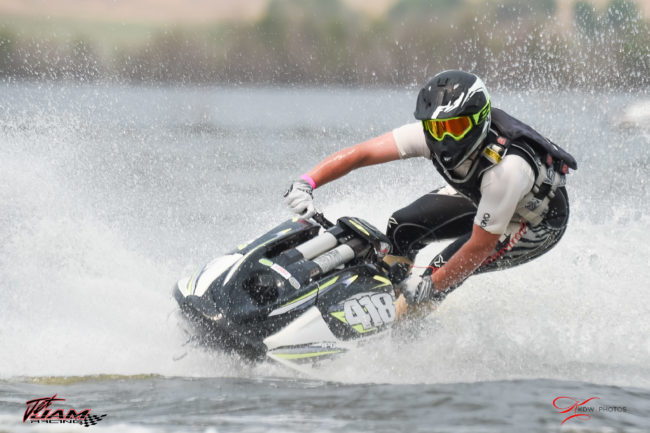
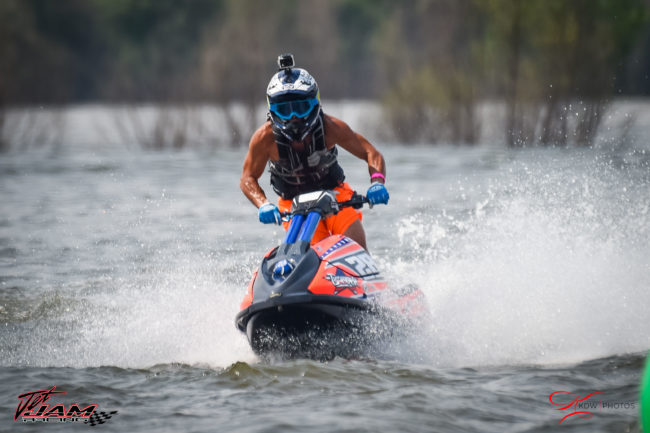
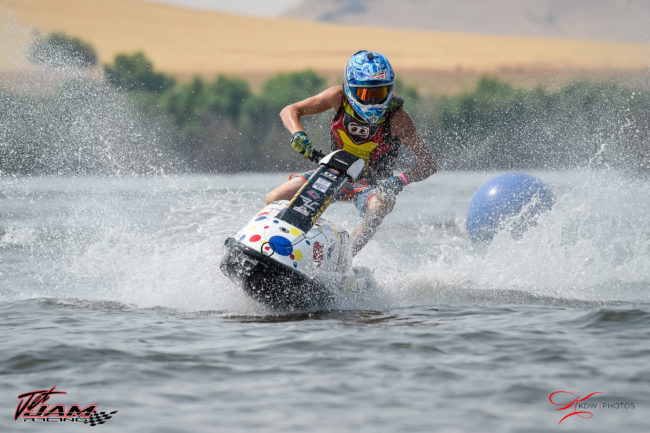
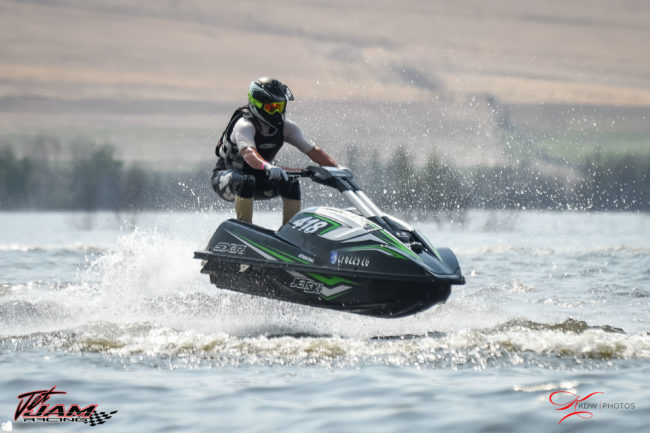
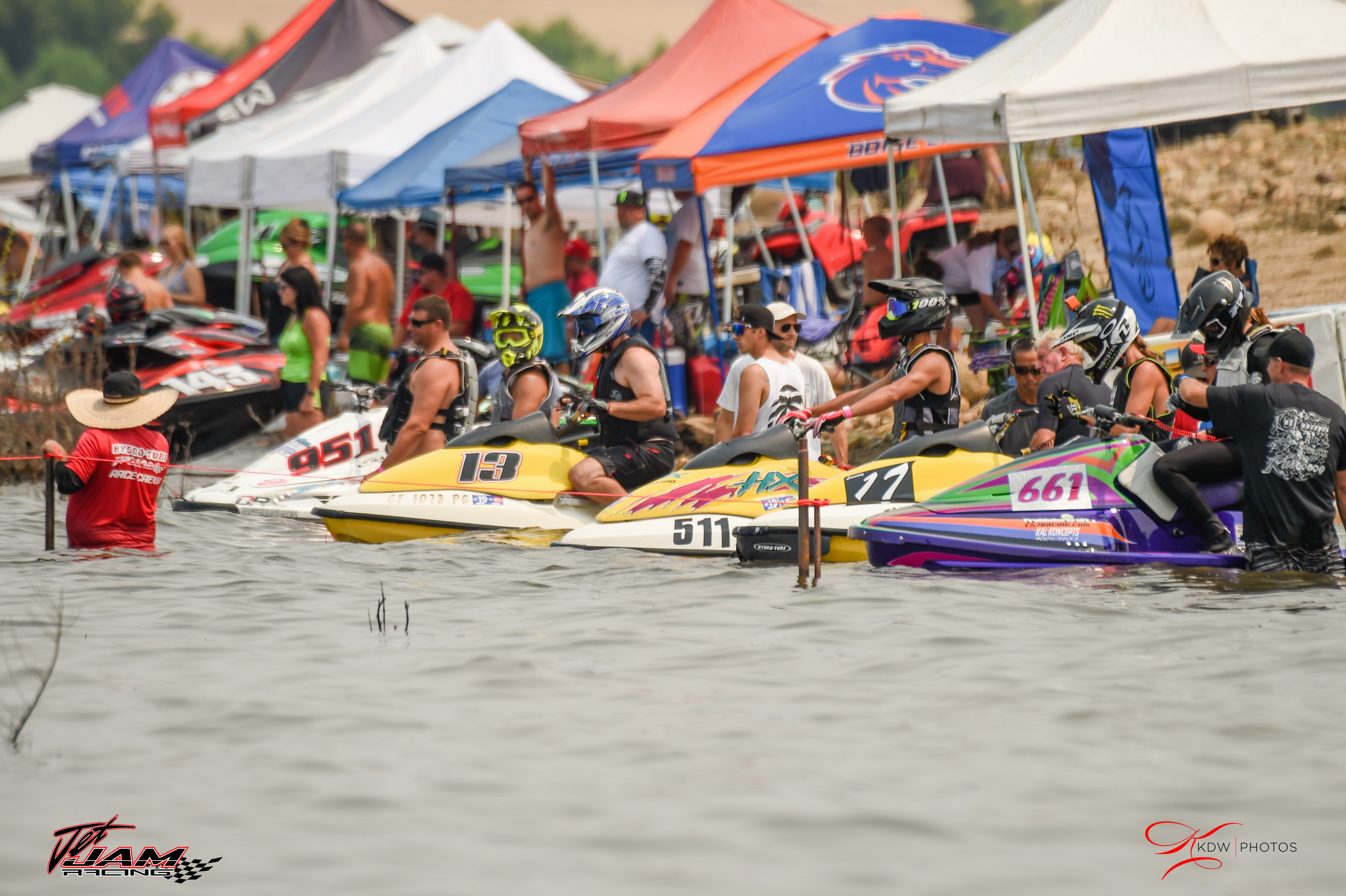
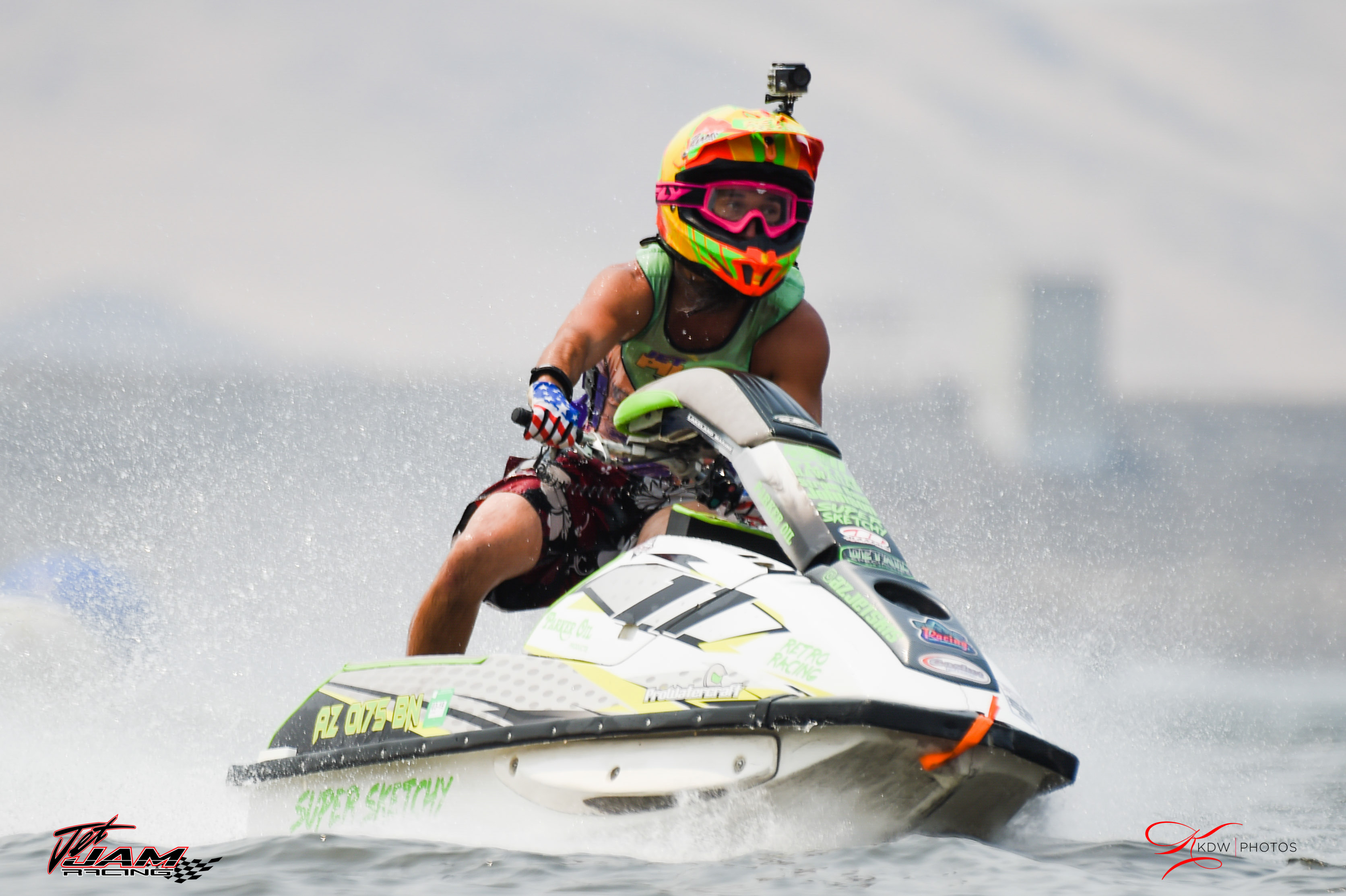
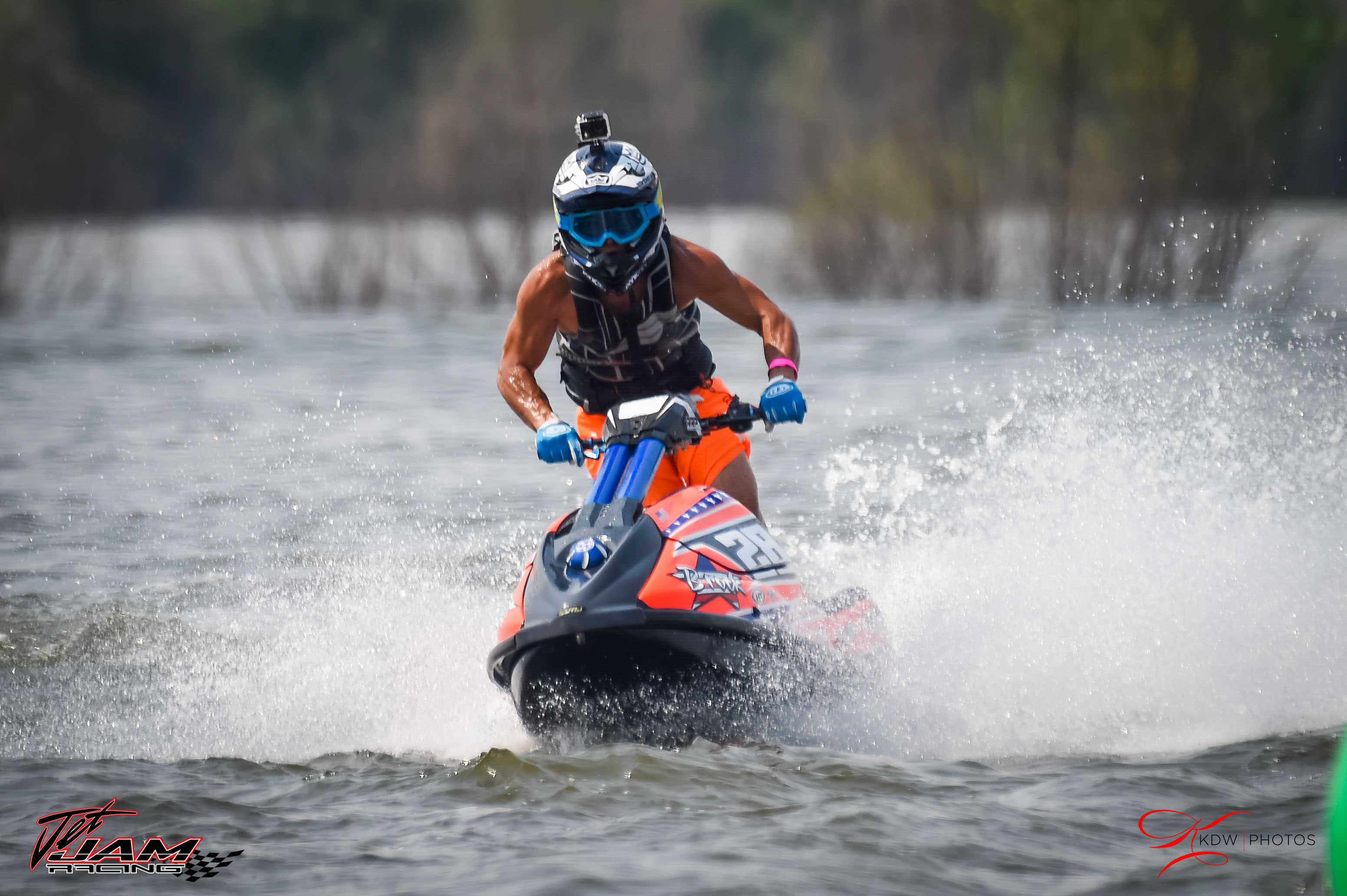
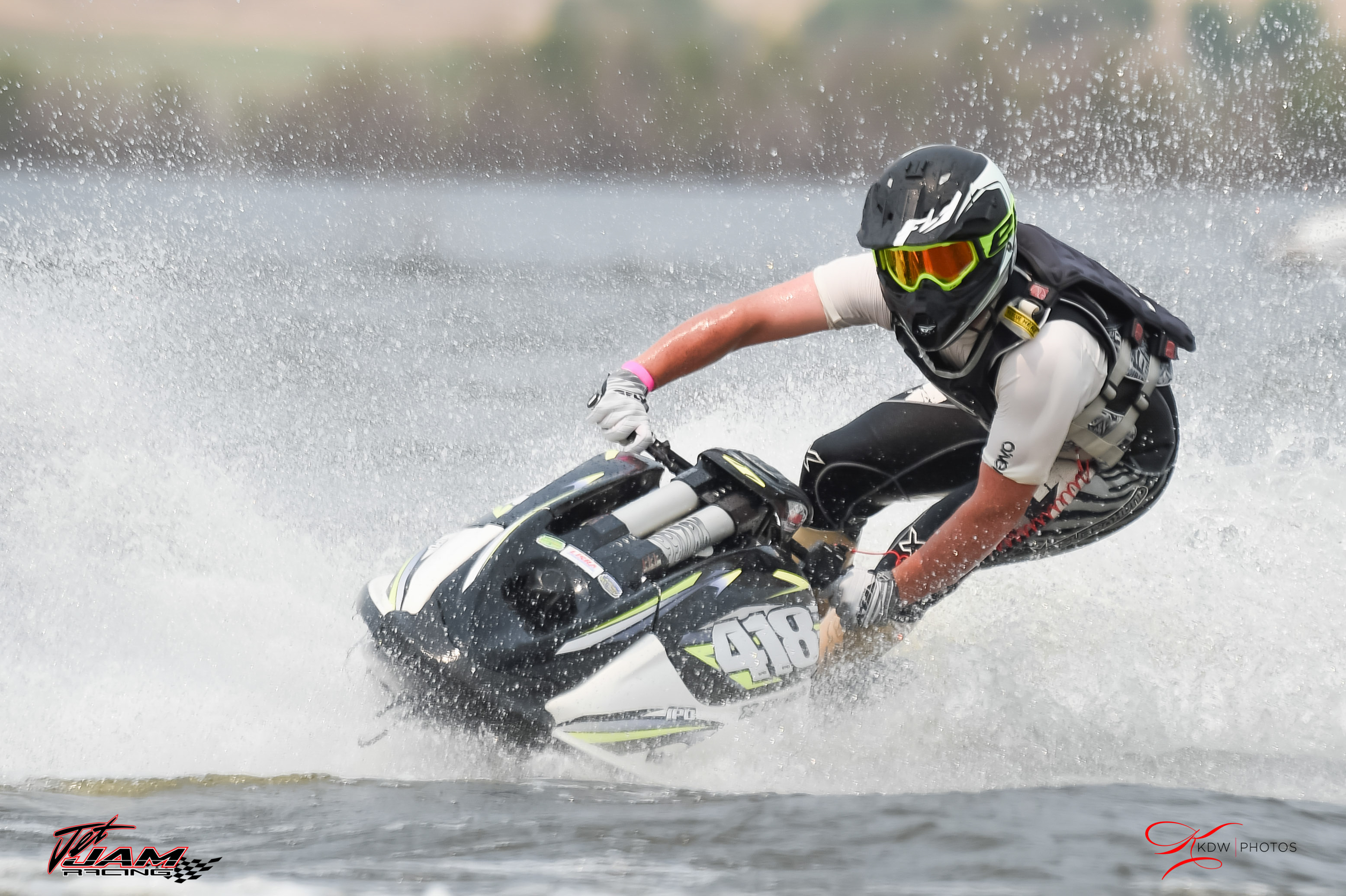
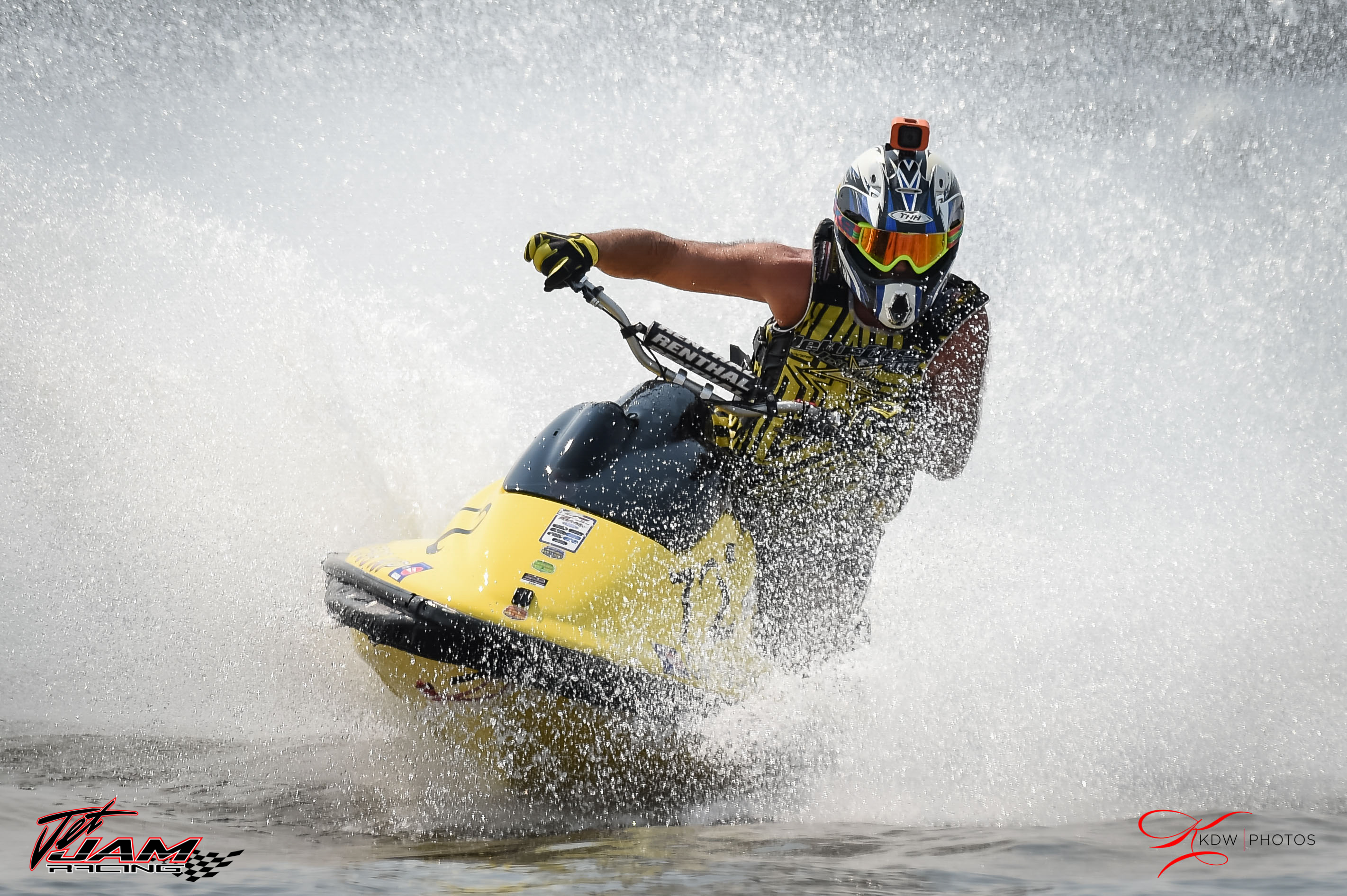
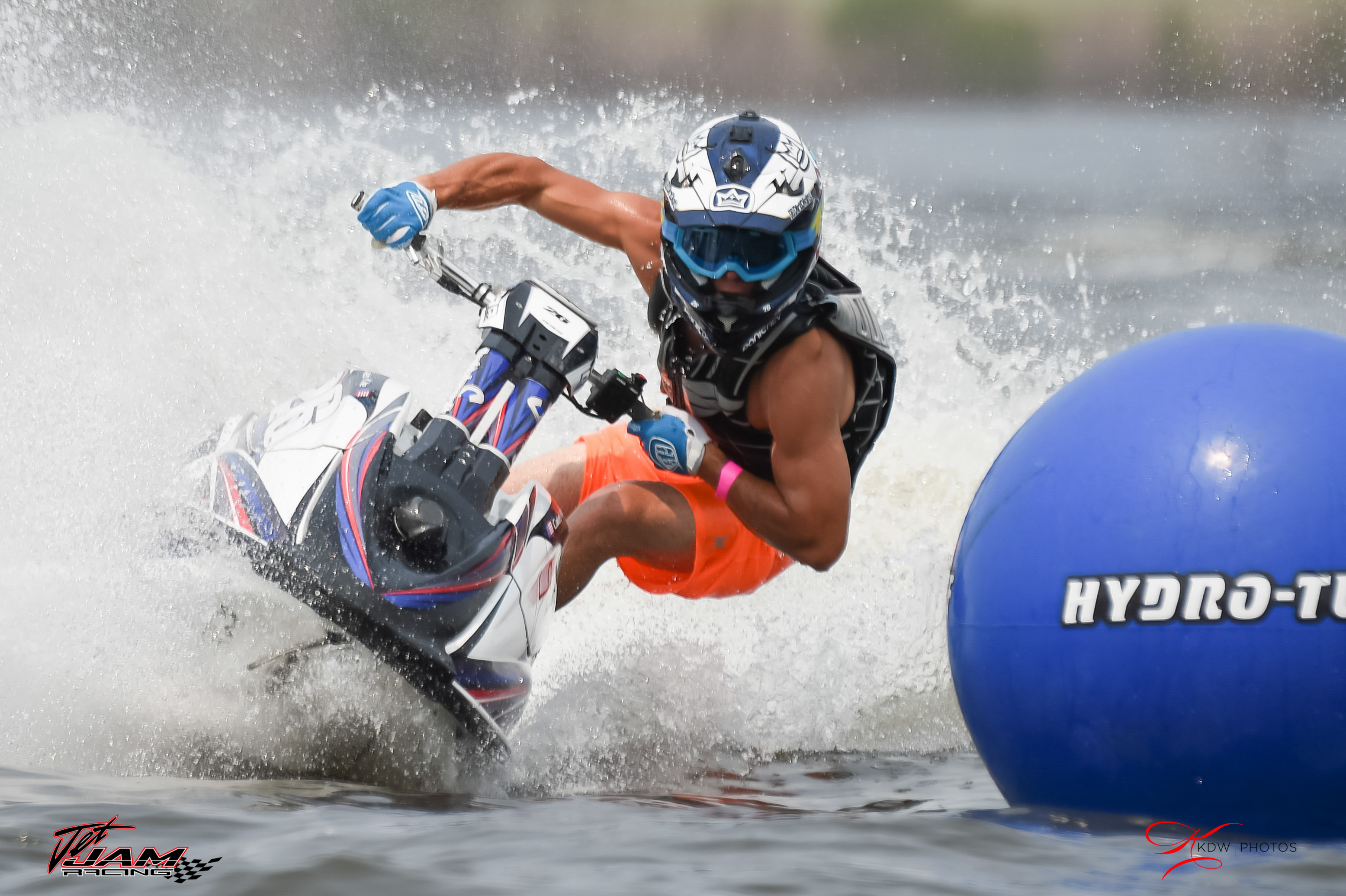
With this being the last race of the wildly successful Hydro-Turf JetJam racing series, the joy of the season and all the new friendships, was not to be over shadowed by the fact that this was it, the end of the tour. It was ever so poetic that it ended at a lake named Success in Porterville, CA.
Lake Success came with its own unique set of challenges for the Red Shirt Crew which they quickly overcame with the greatest of ease. Putting together a monumental event that will not soon be forgotten. JetJam’s sponsors Hydro-Turf and Bud Light definitely, threw down some huge support. Bud light even set up a stage for Saturday night. Exit 13, a great classic rock band from Central California, put on a great show for everyone for the end of the season party. Racers and crew alike enjoyed this awesome time together. Ever sealing many more friendships and bonds that had been formed over the year.
The fast track, with the long back straight, and sweeping turns, didn’t give the riders a second to rest or make a mistake. With so many of the classes having points chases only a few points apart, there was very little room for error. Like the season points championship in GP1 650/750 that came down to one point. James Hendry barely edged out Cory VanCleave for the overall win. Cory, however took home the season overall in his other class, 550 Vintage. At the same time the sportsmanship was showing everywhere, like racers loaning boats to one another.
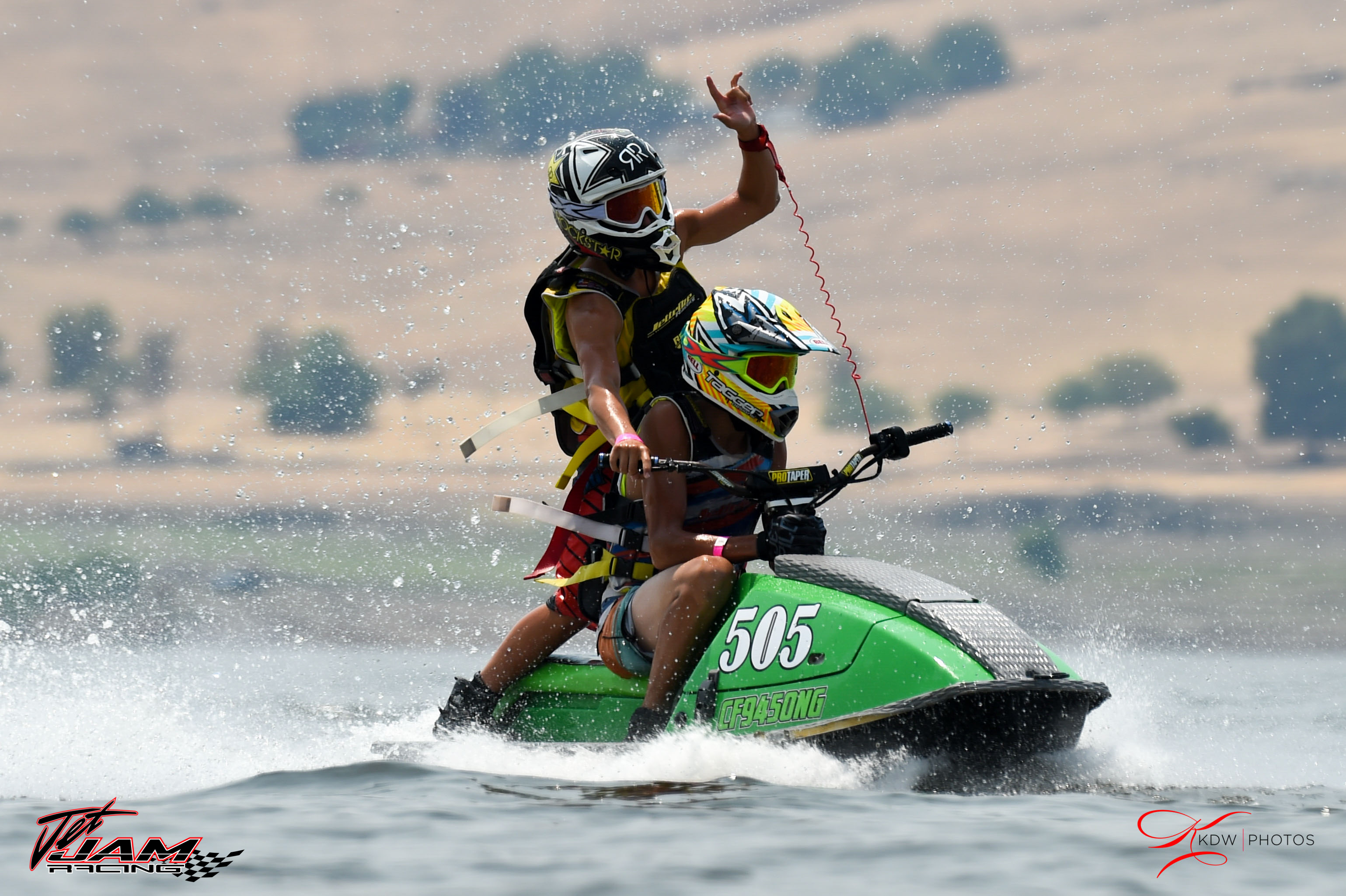
Caleb Kile, the Ski GP4 Stock season champion, jumped on the season overall Vet champions, Justin James, Bullet to race the Ski GP2 class for the first time ever and killed it. He finished 3rd on Sunday. JB Gasperone, the Ski GP1 season champion, jumped on a 550 and a 650 for a couple of races. Even Brock Austin got in on the fun racing a 650 for the first time, and not only did he not get last but he rode it in the Ski GP2 Limited class. There was also the triumphant return of Joey Pearce on the #88 boat. Joey had not raced since 2001/2002 and made quite the come back by taking 1st place in the Ski GP2 Limited and Vet Ski Open classes on Saturday.
Oh, did I mention the 2Up X2 race? A challenge was presented to the X2 class, at the awards on the last day of the Mossdale race. It was simple, two riders and a purse of $250. Lose a rider and you’re out. Saturday, Hayden Item and his passenger, Kyle Kreeger, took home the victory. With everyone having so much fun, awkwardly bouncing around the course, they decided to do it all over again on Sunday.
Jet Jam Racing definitely pulled out all the stops for the last race of the year, but they did so for the rest of the season before this as well. There was not one race this season that there wasn’t laughter and smiles all throughout the event. We should all take our hats off to Jet Jam Racing, the Red Shirt Crew and everyone that had a hand in any of this season, for bringing the heart and soul back to jet ski racing.
HydroTurf, Bud Light, Hidden Trails Motosports, River Rat Motorsports, Bodyline Swim Shop, Skat Trak, Pro Watercraft Racing, Water Craft Direct, Nprotune, Jet Renu, M&M Marine, TC Freeride, 3-2-1 Kawasaki, Blowsion, JetLift, Ryno Power, The Watercraft Journal, Team Oakley, Pro Rider Magazine, Shark Energy Drink, Devas Bling, Riva Racing, Gallaghers, Throttle Junkie News, Coach T’s BBQ, Every Kid Counts Charity, O’neill S&E, Sun Solutions, Titan Performance, Bomber Eyewear, WCWCC and Westside Media.
Article guest written by Matthew Goade All photos provided by Kenny Wong, and originals can be purchased HERE.
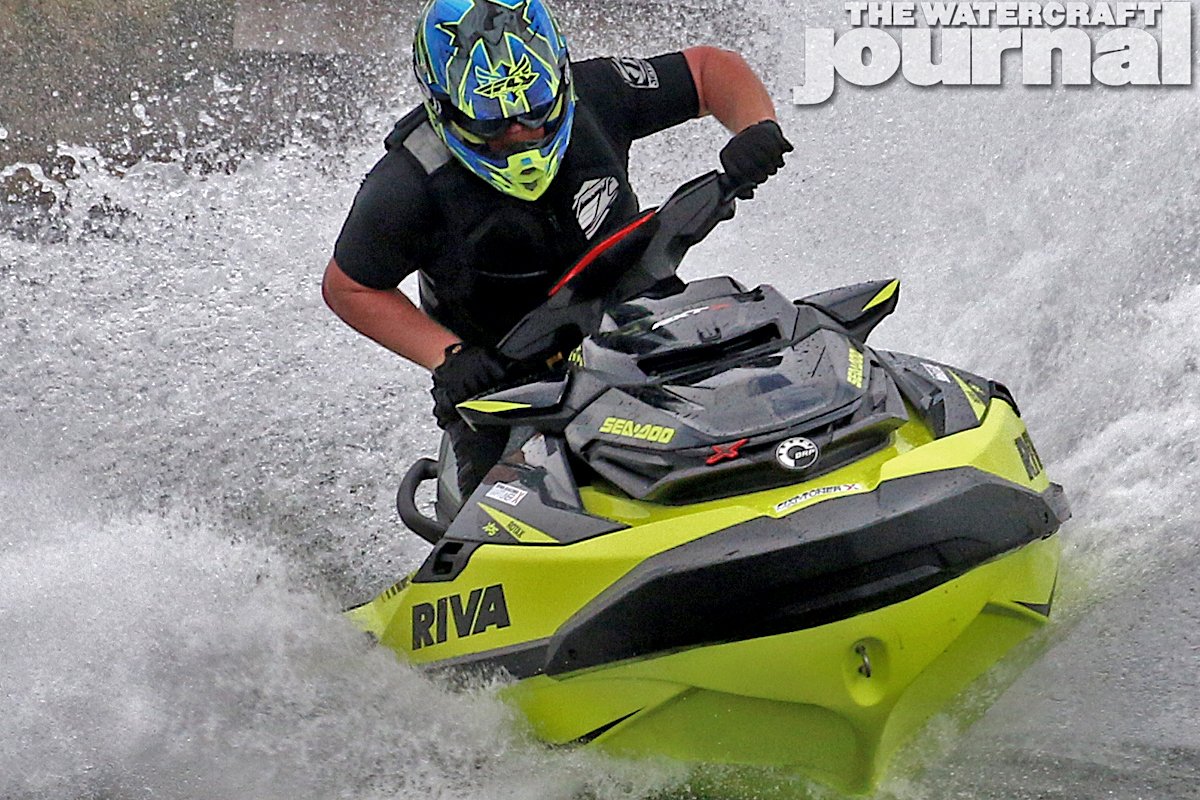
“OK, there’s something to this,” I murmured to myself, cornering the RIVA-equipped RXT-X. Having a bone-stock 2018 Sea-Doo RXT-X 300 generously in my possession for most of the year (thanks to Sea-Doo), I had become rather accustomed to how the new ST3 platform liked to behave in most conditions. In earlier reviews, I noted that the hull loves – nay, demands – to be trimmed down and throttled through the hairpins. It’s an aggressive design for sure, and those already familiar with the race-ready RXP-X will have no problem transitioning to the larger ST3. Sure, it took some getting used to initially, but once I became comfortable with the craft’s nuances, it was second nature. That is, until now.
At the time of my review, the production version of RIVA Racing’s new Pro-Series Sponsons for the 2018 RXT-X 300 weren’t quite ready. The final versions wouldn’t be made available to the general public months later, only now, late in the summer. In fact, only Sea-Doo X-Team/RIVA Racing support team rider Erminio Iantosca had raced with them during the first P1 AquaX races earlier in the season. Privately, Erminio told The Watercraft Journal, “The RIVA sponsons help make the T-X more stable on a straight line; [and] makes the ski corner way better and smoother. All around, [they] total[ly] help make the T-X handle better and creates a better feel for the rider.”
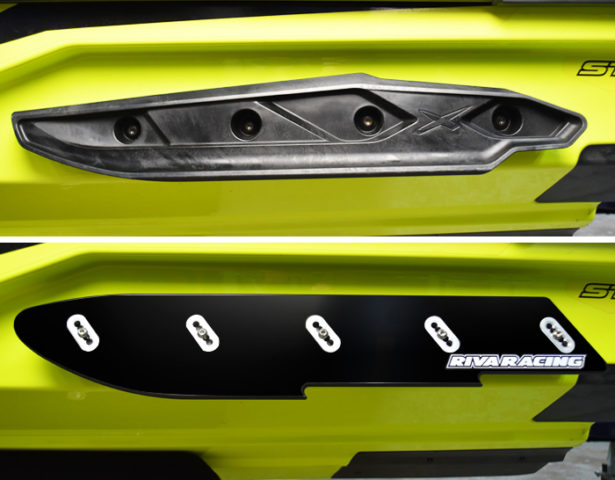
The hardest part of the development process was the fact that the new Pro-Series sponsons would not work on any other Sea-Doos using the ST3 hulls, including the GTX 230/300, Wake, or even the RXT 230. Sea-Doo had molded in a completely different bolt pattern for the RXT-X 300 unlike the other machines. This was a one-off, plain and simple. RIVA Racing’s own Dave Bamdas told me, “We went through 8 or 10 different prototype blades before settling on this design.” Precision machined from a high-strength, proprietary composite material, the blades are progressively stepped upwards (completely opposite of RIVA’s Pro-Series sponsons for the Yamaha GP1800), which helps plant the nose and mid-ships tighter to the water surface.
The 5-way adjustable blades feature billet recessed inserts, mounting it to a fixed backing plate, all attached with stainless hardware. Replacing the unusually-shaped one-piece plastic sponson, the RIVA Pro-Series radically changed the attitude of the RXT-X 300 – and all significantly for the better. Straight-line stability is a night-and-day improvement, particularly while tracking through erratic chop (which RIVA’s test lake had quickly become after 20 minutes of hot laps). Certainly snapping muscle-straining hairpins was made easier by the sponsons’ addition, but it was the predictability of the turn that impressed me most. Rather, the knife-like keel of the ST3 slit through the whitecaps like a surgeon’s scalpel. Clean and precise.
“[The] billet aluminum stabilizer wing allows you to tune lean-in handling characteristics,” Bamdas went on, touting the adjustability. While the sponsons’ legality for all IJSBA classes is a boon for racers, I felt strongly that the recreational rider would greatly benefit from a pair (myself included as the race-proven sponsons delivered such a significant improvement to handling and stability while at speed. Priced at $499.95, RIVA’s Pro-Series Sponsons for the 2018 (and up) Sea-Doo RXT-X 300 are an inexpensive way to radically transform the natural attitude and handling of the craft. In fact, I’m seeing about getting a set for my loaner until Sea-Doo pries it out of my hands next year.
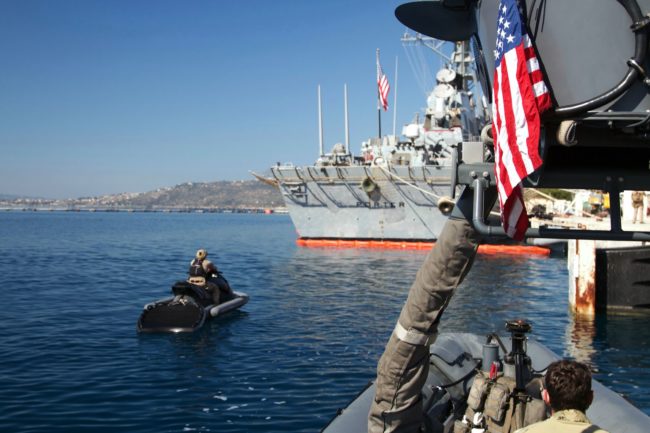
A Popular Mechanics piece informs us of a really cool United States Navy SEALs military exercise, using PWC. The SEALs located in Greece, were observed driving Yamaha personal watercraft while performing a military exercise. The training was held off the island of Crete in October 2017. It was documented in a series of images found in the Defense Video Imagery System (DVIDS). Many of the photos appearing in Popular Mechanics come from the DVIDS.
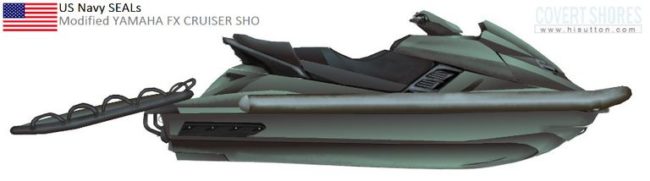
According to defense journalist H.I. Sutton, the PWC that the SEALs were riding were 2016 Yamaha FX Cruiser SHO’s. The skis were modified with inflatable collars similar to those used by rigid inflatable boats. The collar is similar to the Wing Inflatables SkiCollar, which is advertised as improving lateral stability, increasing shock absorption, and providing additional floatation.
These machines are highly maneuverable and capable of shallow water operation and they go fast! The modified version that the SEALs were using, provided room for three heavily armed men. Loaded with weapons, armor, and ammunition, the weight was well over the FX Cruiser’s 490 pound limit. Do not try this on a stock Yamaha FX Cruiser. You will find yourself sunk!
The Navy SEAL’s were also using a magnetic climbing system while conducting their training operations. The system consists of a pair of shoes and hand grips fitted with magnets. The gear allows the climber to scale sheer metal surfaces like ship hulls. The climbing can be performed quick and easy. However, the manufacturer claims the gear can only used by divers entering from the water. It seems only logical that the men were working with a modified PWC and magnetic climbing gear. This operation can prove useful for boarding vessels for inspection or infiltrating enemy warships. The SEALs are going back to their roots, which lie in the sea. They’ve been busy performing land operations since 9.11. This solid outfit is ready for anything.
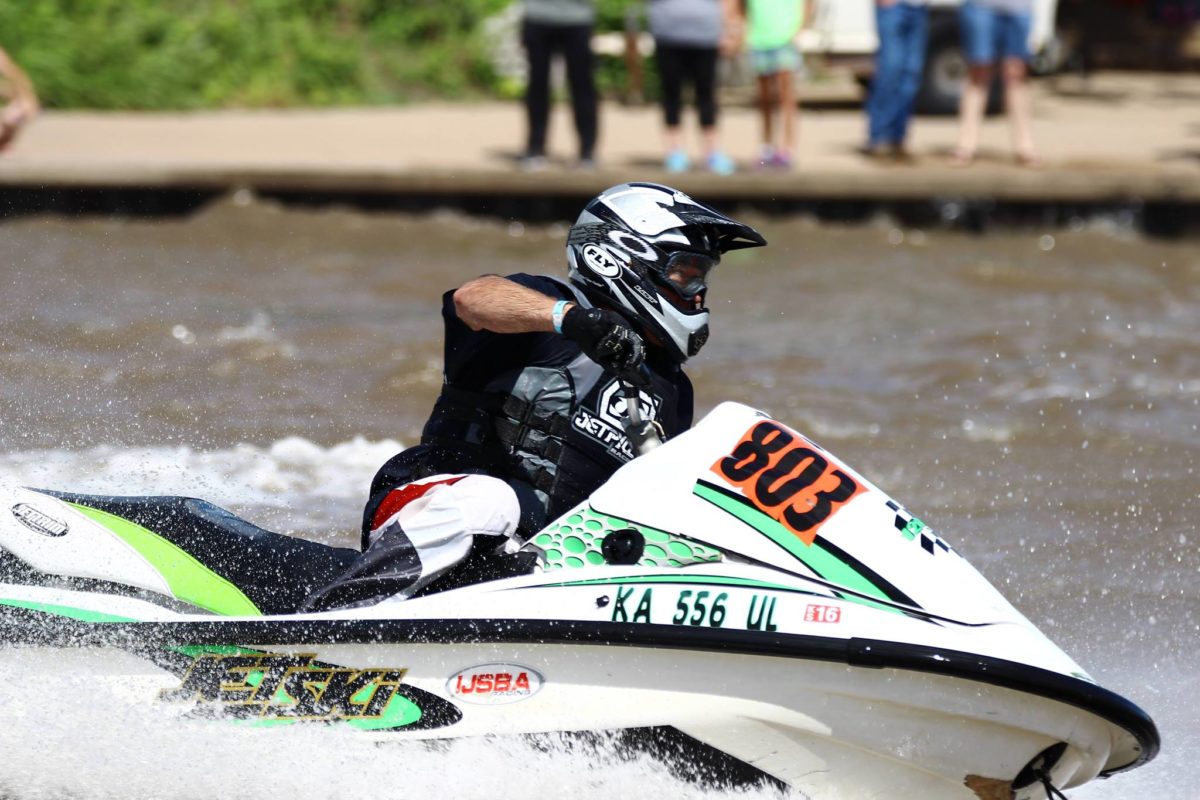
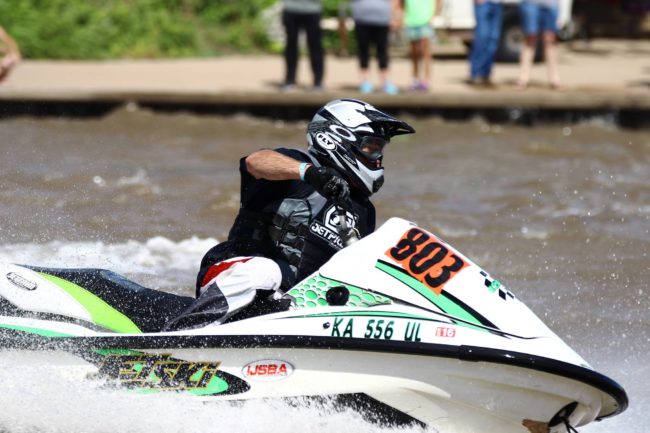
Held back on August 4 – 5, this event was the final stop of the 3,2,1 Kawasaki Watercross Tour for Nautiwater Racing. The championship as the name states, was named to honor Greg.
For those who knew Greg, he was described to have had such a smile and positive attitude that has been greatly missed by his friends and family.
According to Greg’s Obituary which we located, he passed away on January 29, 2018, surrounded by his wife, children, and family. Greg who lived in Salina, Kansas was 62 years old when he passed away.
Greg was an avid Jet Ski racer who even competed in the IJSBA Lake Havasu World Finals. He was a selfless man who was devoted to his family.
For more information on the event or to see the latest postings about future Nautiwater events, you can check out the NautiWater Facebook Page.
This story has us feeling like deja vu. Maybe that’s because back in 2015, we reported multi-time IFWA world champion Ross Champion’s custom freeride SuperJet for sale. Well now we are reporting it again.
That very custom Blowsion SuperJet piloted by world renowned Ross Champion has re-surfaced and is for sale. Just like before, it is still for sale at the same Kommander Industries dealership in Phoenix, Arizona.
Professional free rider Ross Champion is perhaps one of the ‘winningest’ free riders of all time, having won multiple world championship IFWA titles. Now is your chance to score this awesome piece of history.
The Blowsion ski built around the Yamaha SuperJet platform, is running a DASA 850 power valve motor with dual 46 Mikuni carburetors. The original design intent of this powerplant was to not only develop power quickly but also to give better fuel economy for longer free ride times. Make no mistake, this thing is a rocket.
The hull itself is a custom FP-1 vacuum infused hull made in Australia by Peter Mcloughlin (aka “Freestyle Pete”) with nose rocker and wider tray. And now you can own it. Get it while it lasts because this time it might be gone. Forever!
A supercharged race-ready watercraft had not entered the list of the top 10 best-selling personal watercraft for nearly a decade. That is, until 2017, when the Yamaha GP1800 WaveRunner came in 6th place, beating naturally-aspirated Recreation-segment machines left and right. Being the inaugural year for the GP1800, certainly the shine of newness helped bolster demand. Yet, what truly elevated the craft from being a “SVHO-powered VXR” to the sport’s winningest runabout was its design.
The done-and-dialed Super Vortex High Output 1,812cc, centrifugally-supercharged four-cylinder fitted into a NanoXcel2-molded body gave the craft a leading power-to-weight ratio. It’s adaptation to aftermarket handling and performance parts pushed it further. Tipping the scales at 769-pounds, the GP1800 is lightweight, torquey and incredibly responsive. Needless to say, racers took to this WaveRunner immediately and the podium finishes followed in kind. And they kept coming.
Currently, the GP dominates all tiers of supercharged runabout classes; particularly AquaX offshore races, the Pro Stock IJSBA and Pro Watercross classes, and most notably, major offshore endurance events like the Mark Hahn Memorial 300 and the Long Beach-to-Catalina Championships – having clenched first place twice in a row, respectively. By all observers, the machine appears relentless in its domination, and understandably so. It was ranked the third best selling PWC for the first half of 2018, coming in just 55 units behind second place’s Sea-Doo Spark Trixx (2017’s best seller).
Frankly, the GP1800 changed the landscape for Yamaha, and because of this machine, the future of the WaveRunner lineup has been directly effected. “Personal watercraft sales were strong this summer, and we exceeded expectations across the board, selling out of several of our most popular models,” noted Bryan Seti, Yamaha Watercraft’s general manager. “With this product introduction that highlights many new features and technologies never seen before in the industry, we expect to build on our momentum and continue to bring customers the best experiences on the water.”
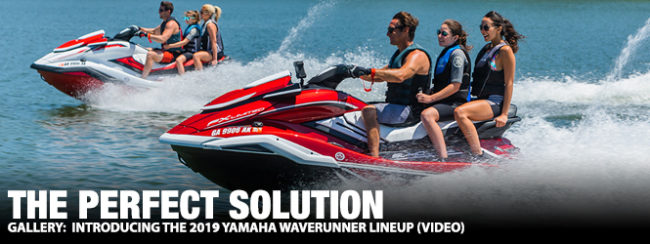
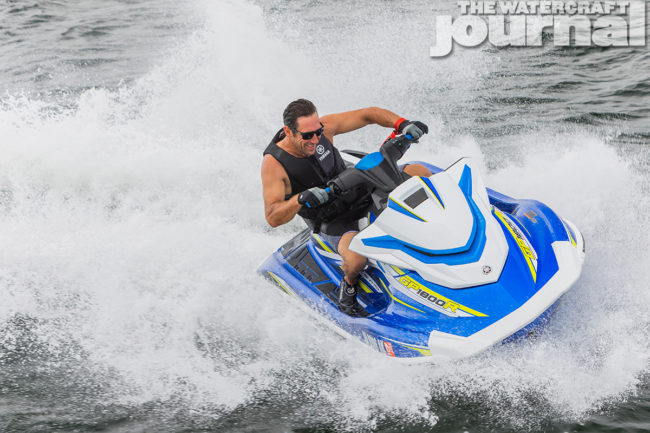
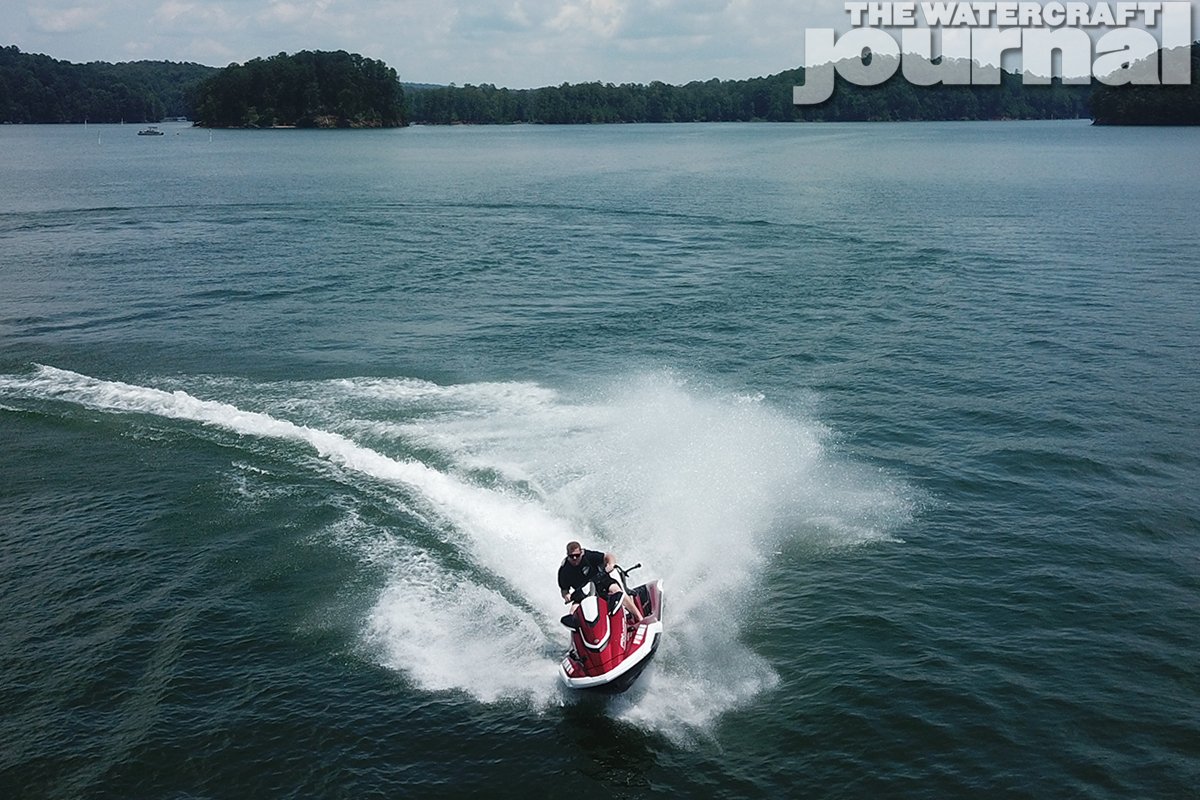
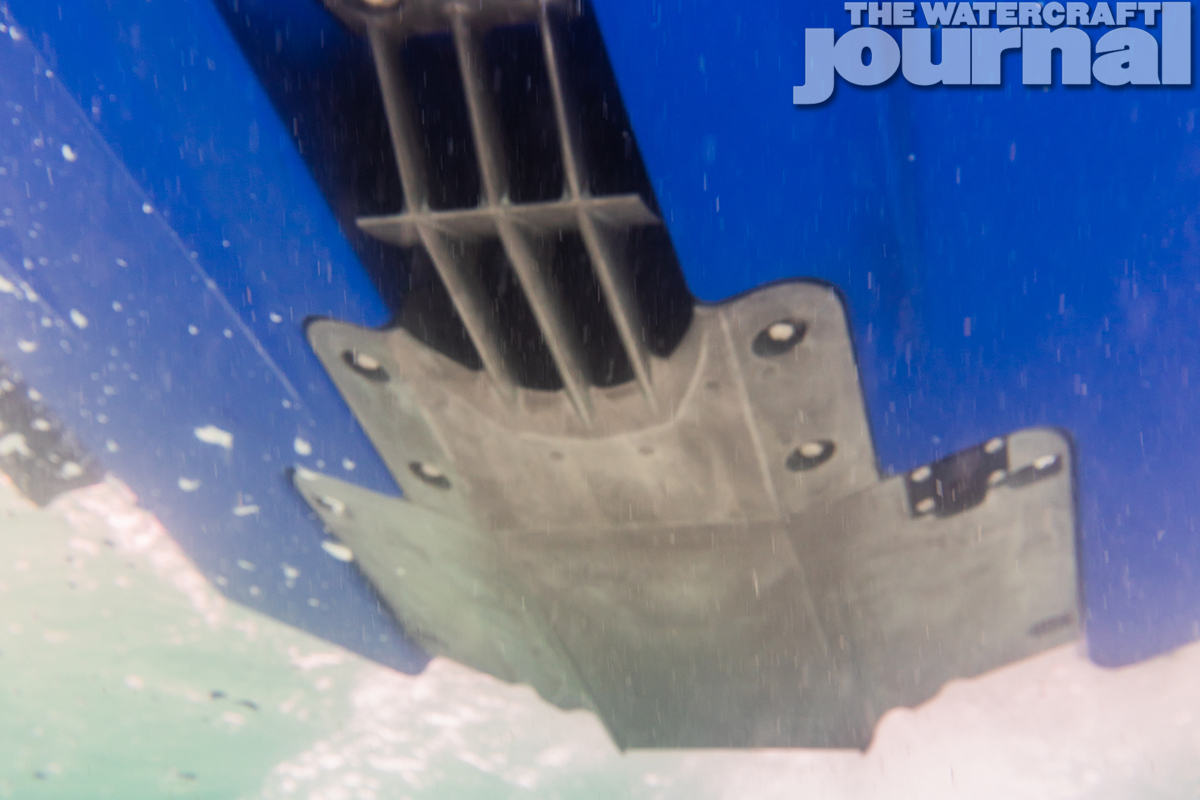
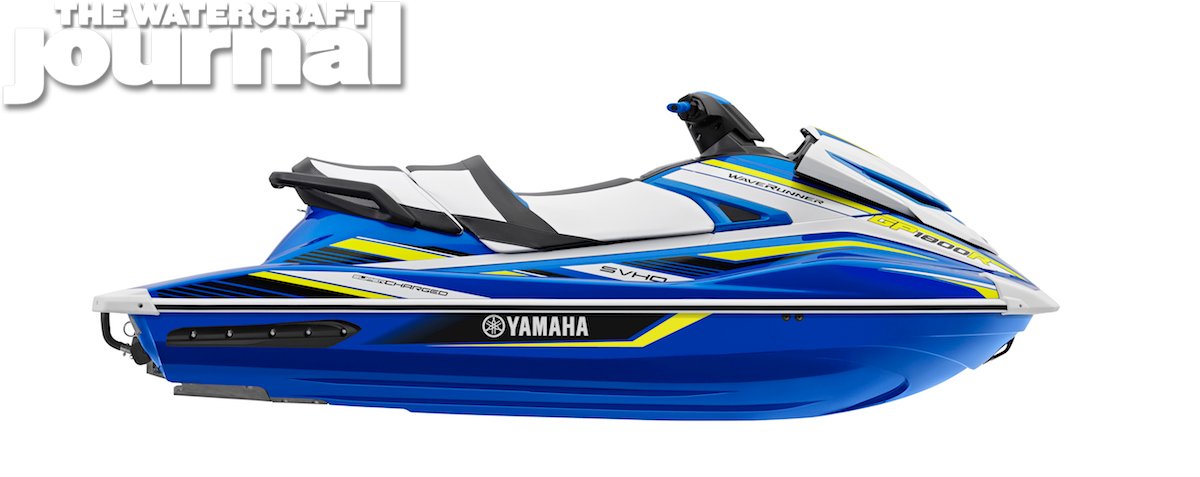
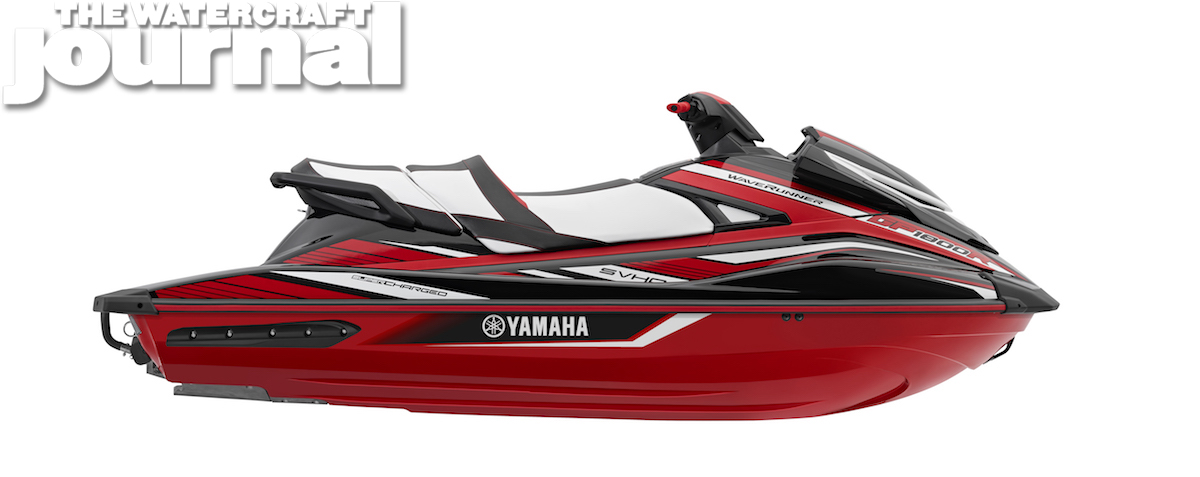
For 2019, Yamaha’s GP becomes more race-ready as the new GP1800R. That’s right, the “R” is back, baby! It’s no surprise that Yamaha works incredibly close with some of the most prestigious race teams in the world, and part of that partnership is regular feedback and input. Using what intel was provided, Yamaha upgraded the GP1800R with a top-loader intake grate and race-designed ride plate for greater precision and predictability in rough water. In fact, that word came up several times during our introduction.
“We really focused on improving predictability,” said Scott Watkins, Yamaha Watercraft’s WaveRunner Product Planner. “The new ride plate is longer to reduce bow rise when accelerating quickly. The planning surface is angled slightly for just the right amount of rocker to give the GP1800R the right riding attitude for optimum top speed. Also, the edges of the planning surface help the GP1800R track straighter at higher speeds.”
Equally, the new intake grate features a foil that feeds water to the top of the impeller to improve traction and keep the pump hooked up to maintain maximum thrust when turning. Additional improvements include hull reinforcements around the pump tunnel and redesigned brackets to battle the added force on the intake grate. New color options are only minor from last year’s offerings: Torch Red Metallic and black, and Team Yamaha Blue and white with neon yellow accents.
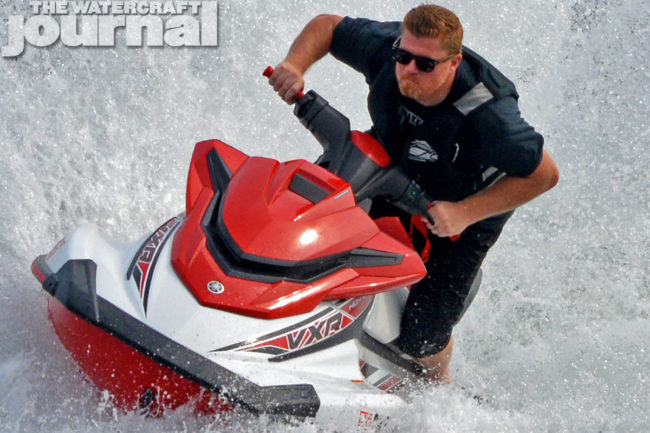
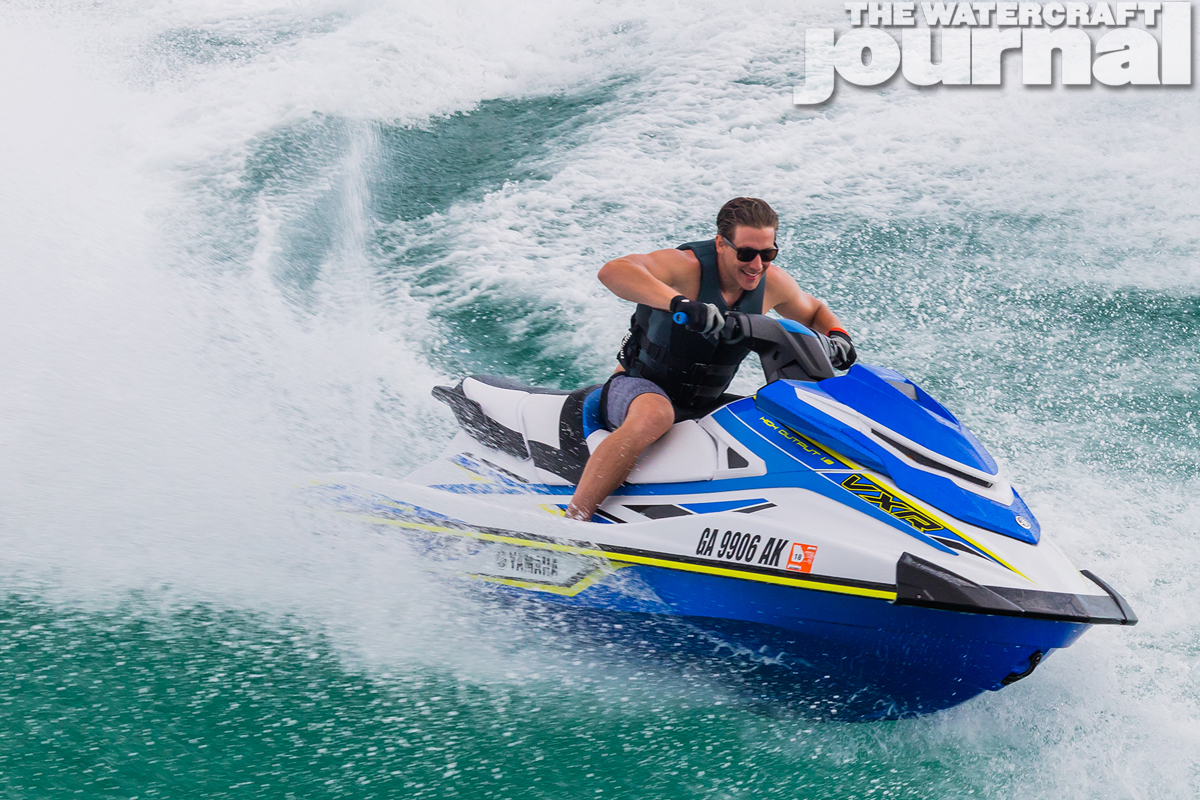
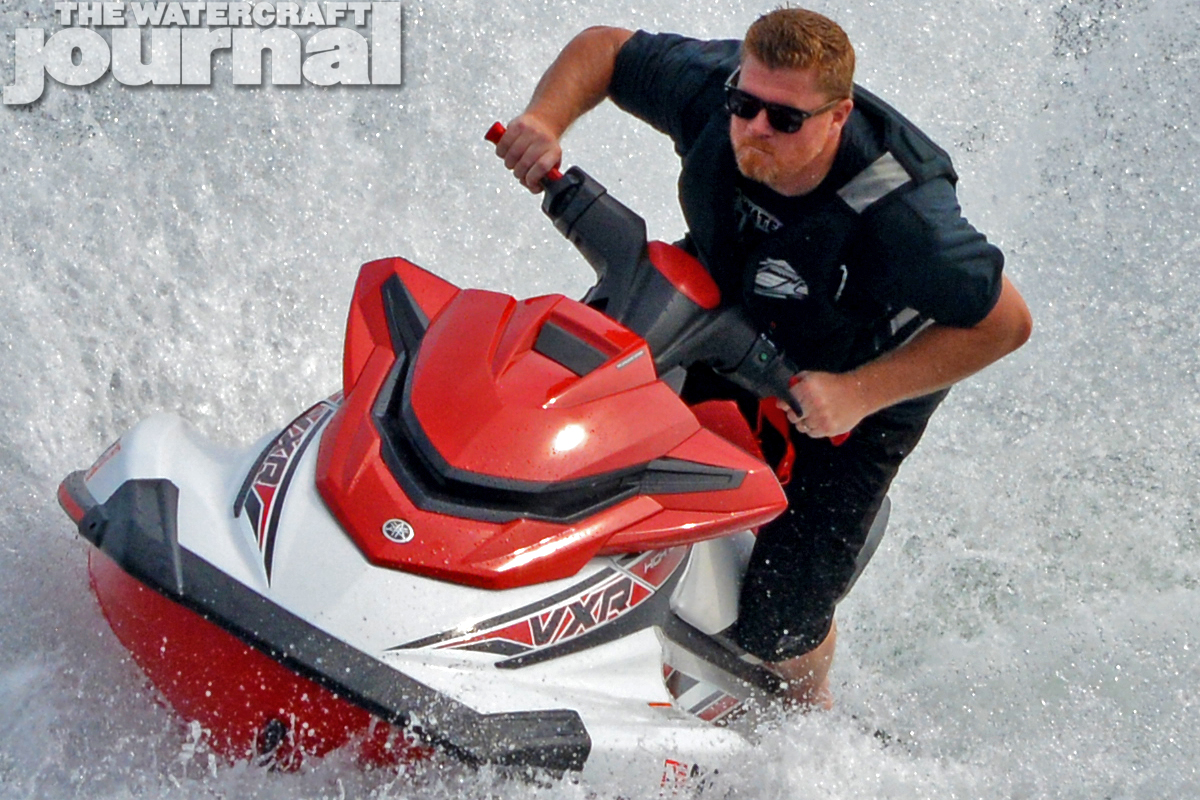
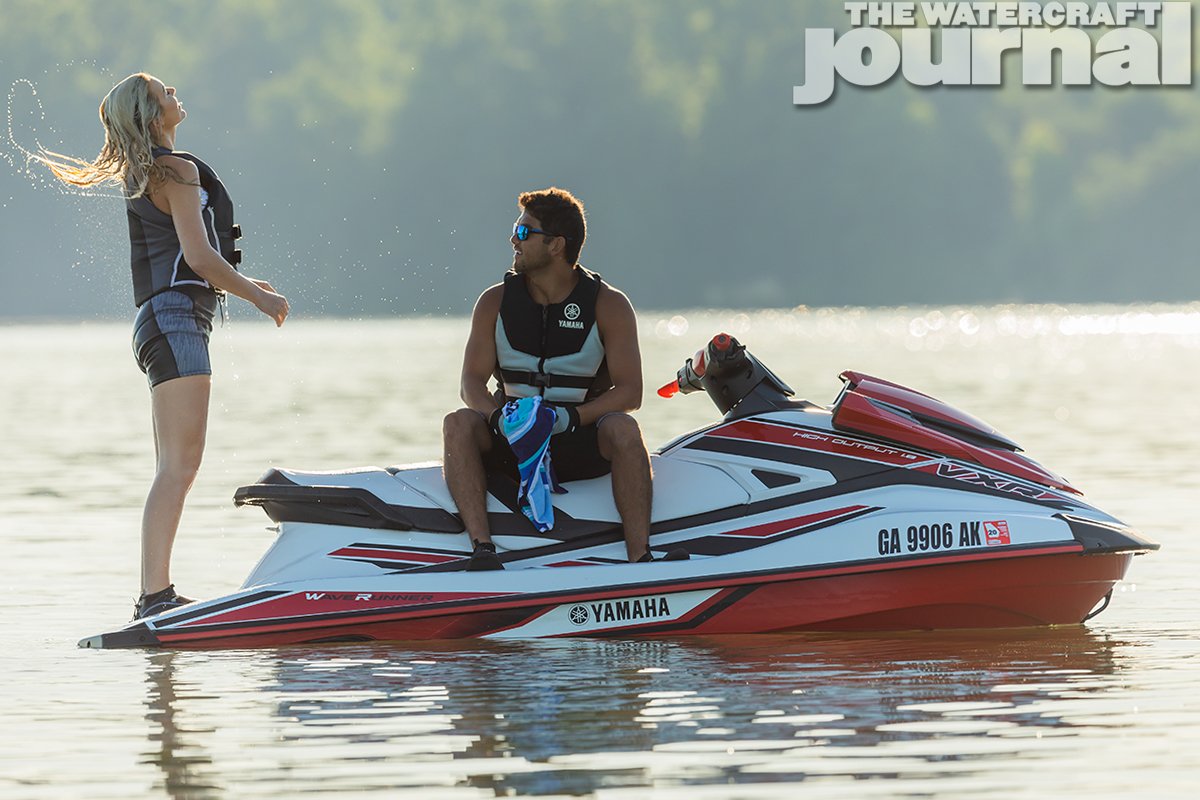
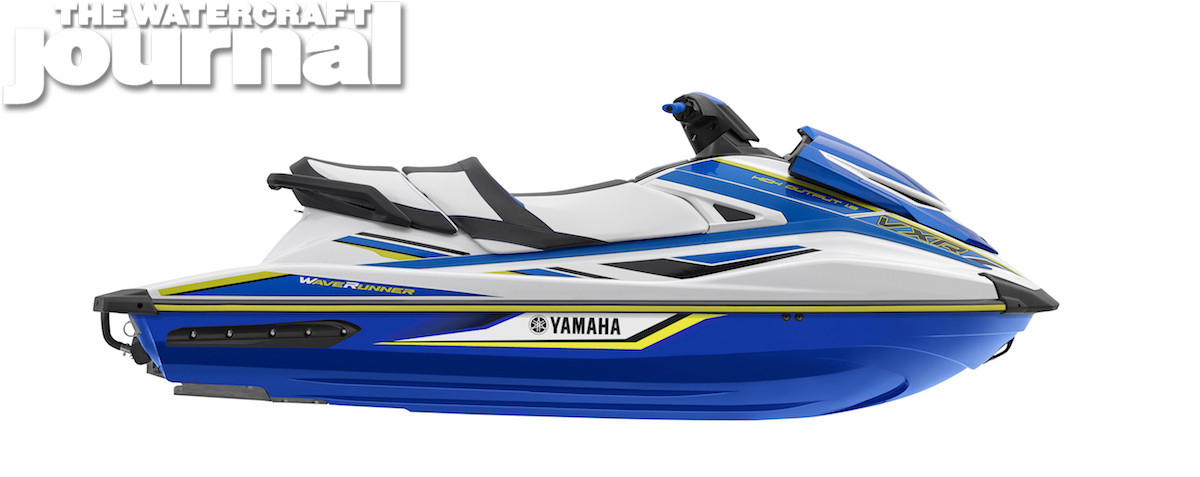
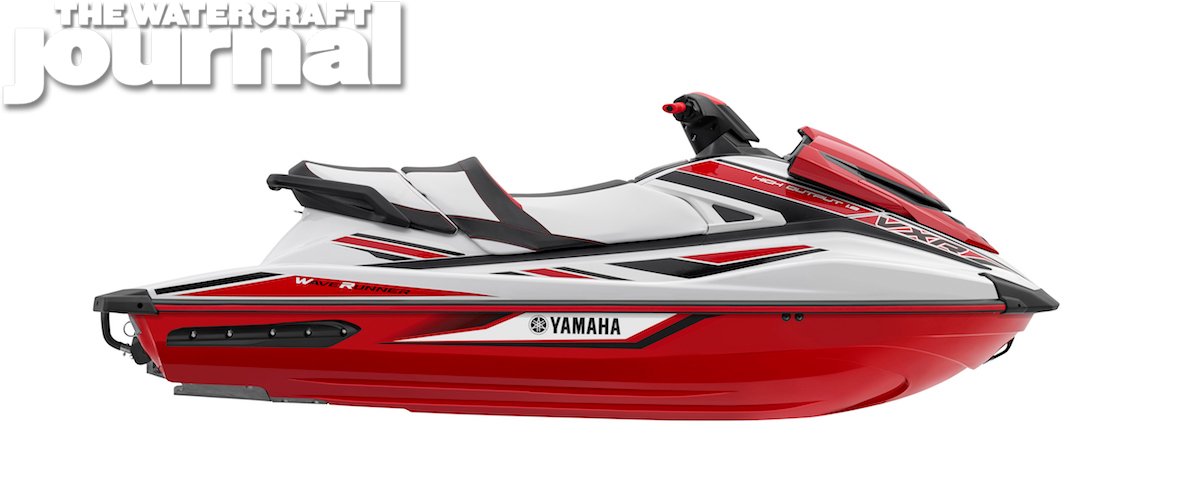
With the loss of the VXS two years ago, the VXR stands apart – especially now that Yamaha has made the VXR a naturally-aspirated version of the GP1800R. “This year we really wanted the ‘R’ to mean something,” Watkins teased, revealing the upgrades to the new 2019 VXR. Not only does the VXR receive the same redesigned intake grate and ride plate as the GP1800R, but also drops 30-pounds of weight thanks to the addition of a NanoXcel2 hull and deck. The 155mm pump remains.
“With the 2019 performance upgrades, we took designs that were proven on the race course by the best riders in the world, and made it something customers can get right out of the box,” said Watkins. “The result is a whole new character to these WaveRunners, that recreational riders and racers alike will find fuels their desire for ultra high performance experiences on the water with unbelievable handling.” Livery options are a Torch Red Metallic-and-white, and a very similar Team Yamaha Blue-neon-yellow-and-white pattern to associate the VXR to its supercharged sibling.
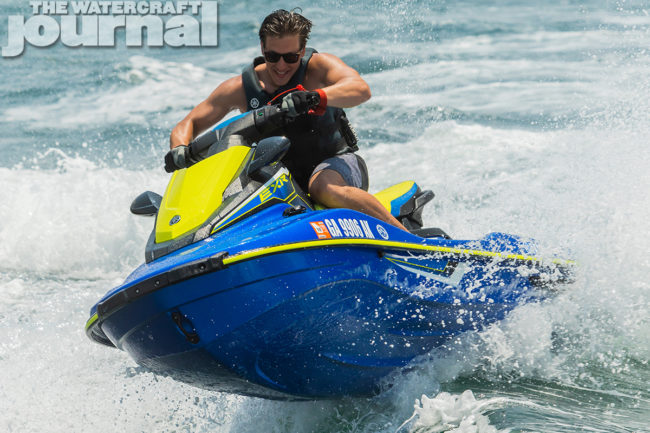
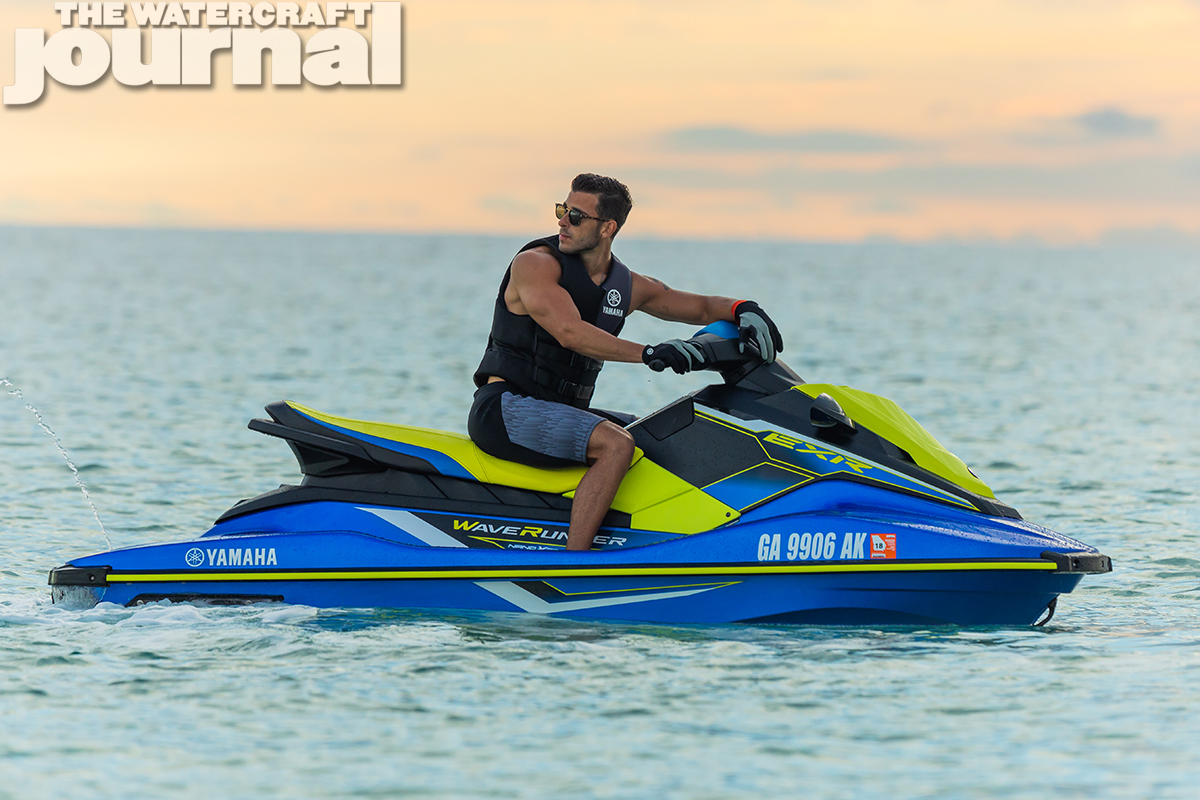
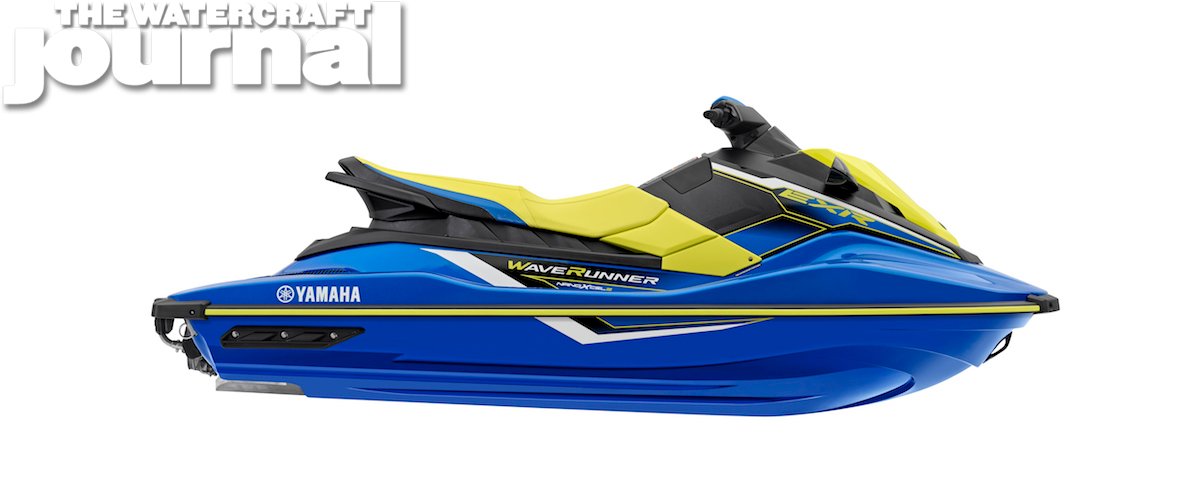
The addition to Yamaha’s race-ready lineup of “R-equipped” runabouts is the astoundingly fun EXR. The addition to Yamaha’s entry-level EX Series is almost our personal favorite of the bunch. As is with the new lineup of race-ready machines, the EXR becomes “the most affordable WaveRunner to feature Yamaha’s high-performance, super-lightweight NanoXcel2 hull and deck material,” according to Yamaha. Coming in at a scant 540 pounds – a full 60-pounds less than the EX Deluxe – it includes a top-loader intake grate and a 40mm pump extension for increased agility, handling and performance.
But weight loss wasn’t enough. The new EXR picks up a retuned engine control unit (ECU) increasing horsepower by ten percent (110-horsepower) over the rest of the EX line. “No one has developed a watercraft quite like the EXR,” continued Watkins. “With its combination of high performance and ultra light weight, it offers the best power to weight in its class, and customers are going to find that it’s a blast to ride, unlike anything else on the water today.” Look for it in a similar Team Yamaha Blue, neon yellow and white livery.
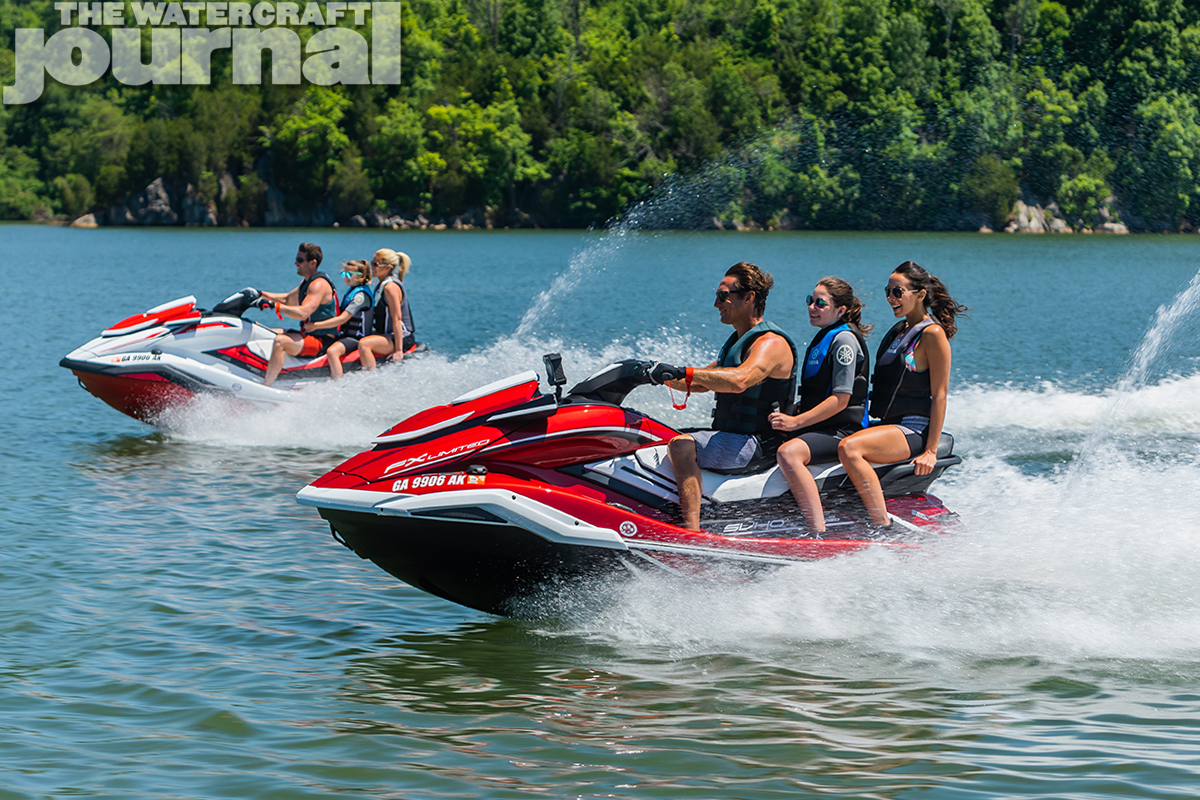
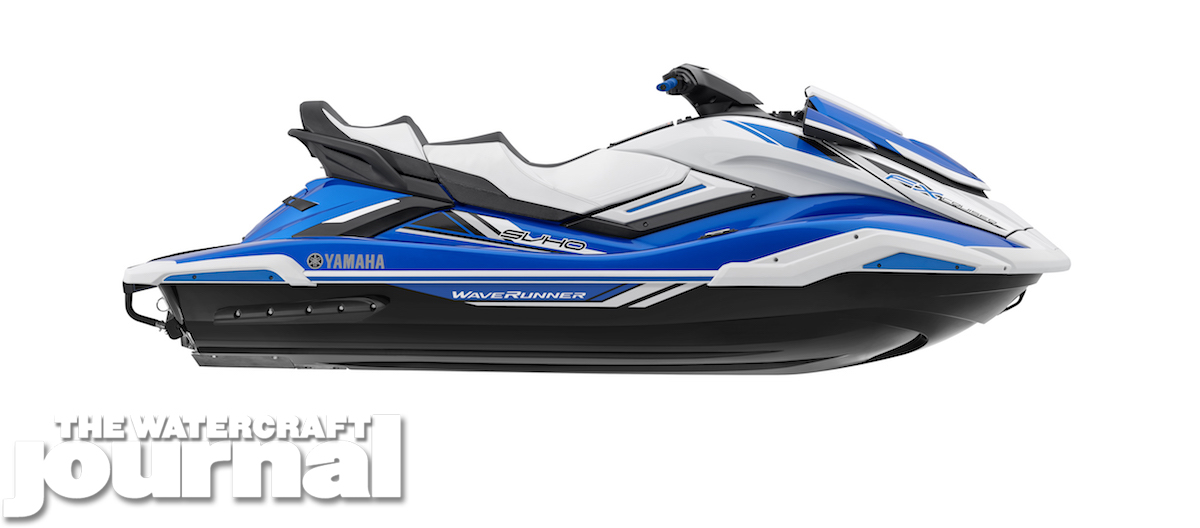
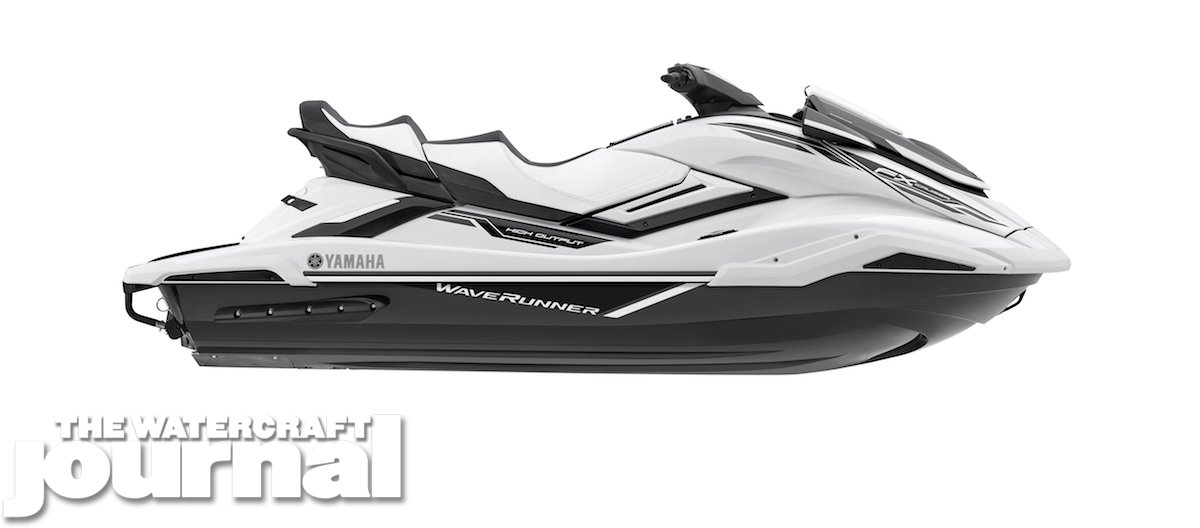
Alas, the biggest change we saved for last: a 100-percent, all-new FX WaveRunner lineup. “As the flagship of the line, we really put some thought into how to update the FX series to create unbelievable experiences on the water for our customers,” said Watkins. At first blush, the 2019 FX has quite a bit of styling DNA from the outgoing model. From the angled bow, to the arching bondline and tapering into a widened fantail with a thickly padded, wider swimstep, the new FX is sleeker and bolder than ever before. Albeit smoother than before, the design is uniquely modular with several bits of paneling and trim to break up the coloring.
Ergonomically, the FX is also improved, with self-draining footwells that are wider, and more shallow than before. Rubberized perforated siphons feed tubes that run down the hull’s length into pump. The redesigned saddle is smartly shaped for either feet-forward, or feet-under riding and features new, superior material for both grip and to stave off heat. In front, the forward storage compartment is larger, easier to access and generously molded for a soft-sided cooler bag. A new glovebox is both larger than last year’s models, padded and is completely watertight. This, with the rear wet storage and underseat screw-top bin, adds up to 44-gallons of total storage (11-gallons more than last year).
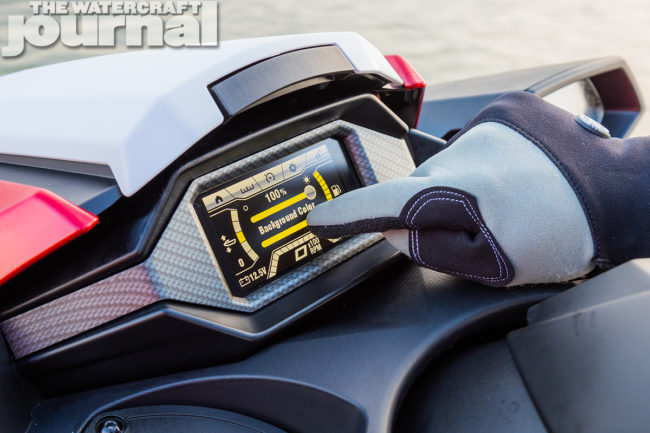
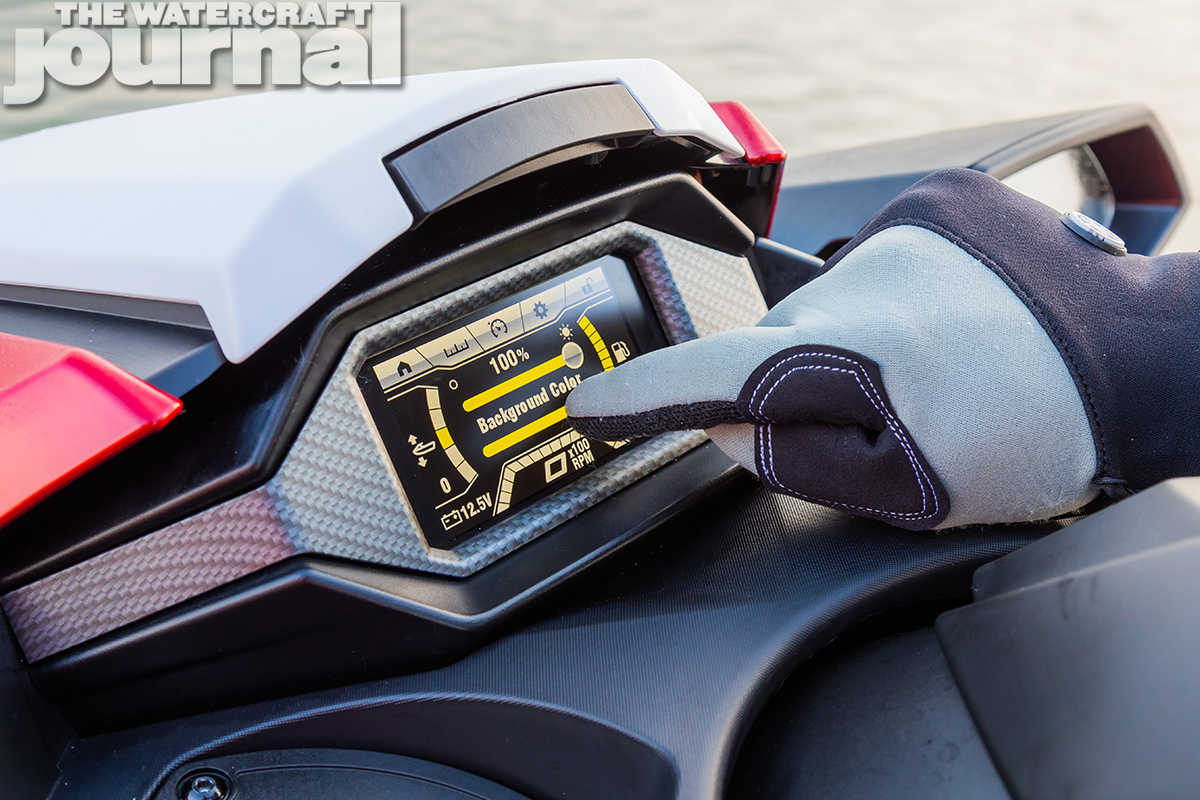
Perched ahead of the 5-point tilt-steering (equipped with Yamaha’s RiDE dual-throttle brake/reverse system) is the industry’s first full-color, touchscreen instrumentation panel. The FX’s 4.3-inch multi-color LCD touchscreen system is called “Connext” and offers “all vital system information, customized features and includes a new Drive Control technology for personalizing riding experiences.” (Drive Control permits for programming engine speeds and acceleration curves for towing, cruising, or less experienced riders.)
Watkins explained, “The new touchscreen puts more control than ever in the fingertips of the rider, with more detailed information and customization than any other watercraft in history. In addition, we know that customers like to customize their ride, and the multi-mount system allows them to make their watercraft their own, for how they plan to use it, whether they’re cruising, making videos, beaching, touring, or fishing, the capability is all there.” You can even pick the color for the gauge needles and readouts. (The touch screen function deactivates when the ski exceeds 20mph.)
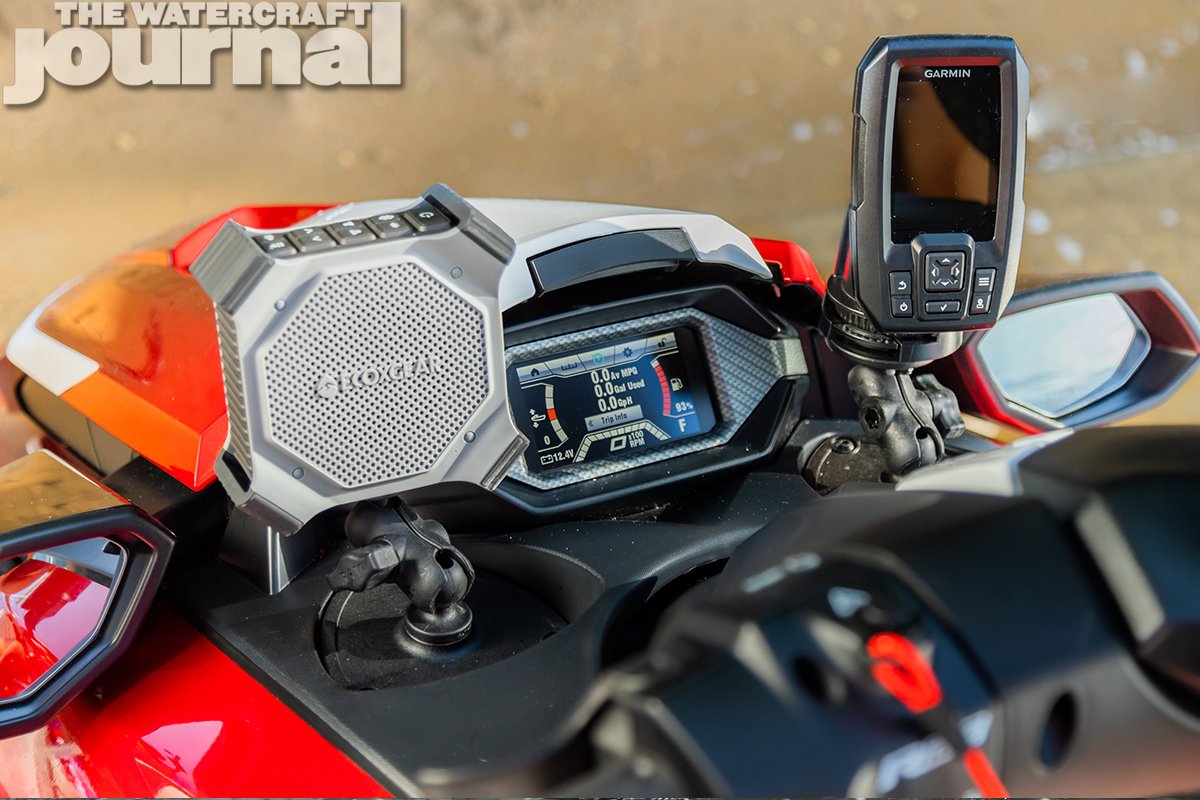
The final big feature new to the FX is the RAM Multi-Mount System. Yamaha partnered with RAM Mounts for a modular accessory system that allows for riders to personalize their watercraft through a range of accessories (including RAM mounts). These accessories include the portable ECOXGEAR waterproof wireless Bluetooth speakers and a Garmin Striker GPS fish finder and transducer. The RAM Mount pods can also be removed and replaced with a cup holder if you really liked it on the previous FX models.
All of these accessories have been made available through Yamaha’s website and accessory catalog, and are sold separately on all FX models except the FX Limited SVHO, which includes two ECOXGEAR speakers, the Garmin Striker package, and all RAM Mount hardware (in addition to a single-rider tube, inflator, 12V outlet, tube holder, tow rope, soft sided cooler, PWC cover and two dock fenders). Besides the aforementioned flagship, the rest of the FX lineup includes the supercharged FX SVHO and FX Cruiser SVHO, and normally-aspirated FX and FX Cruiser HO.
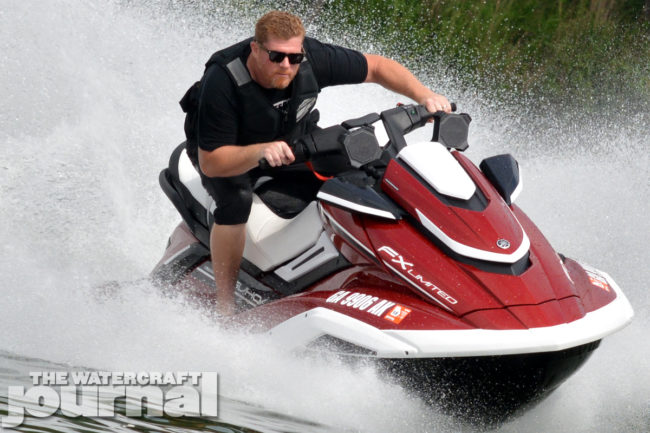
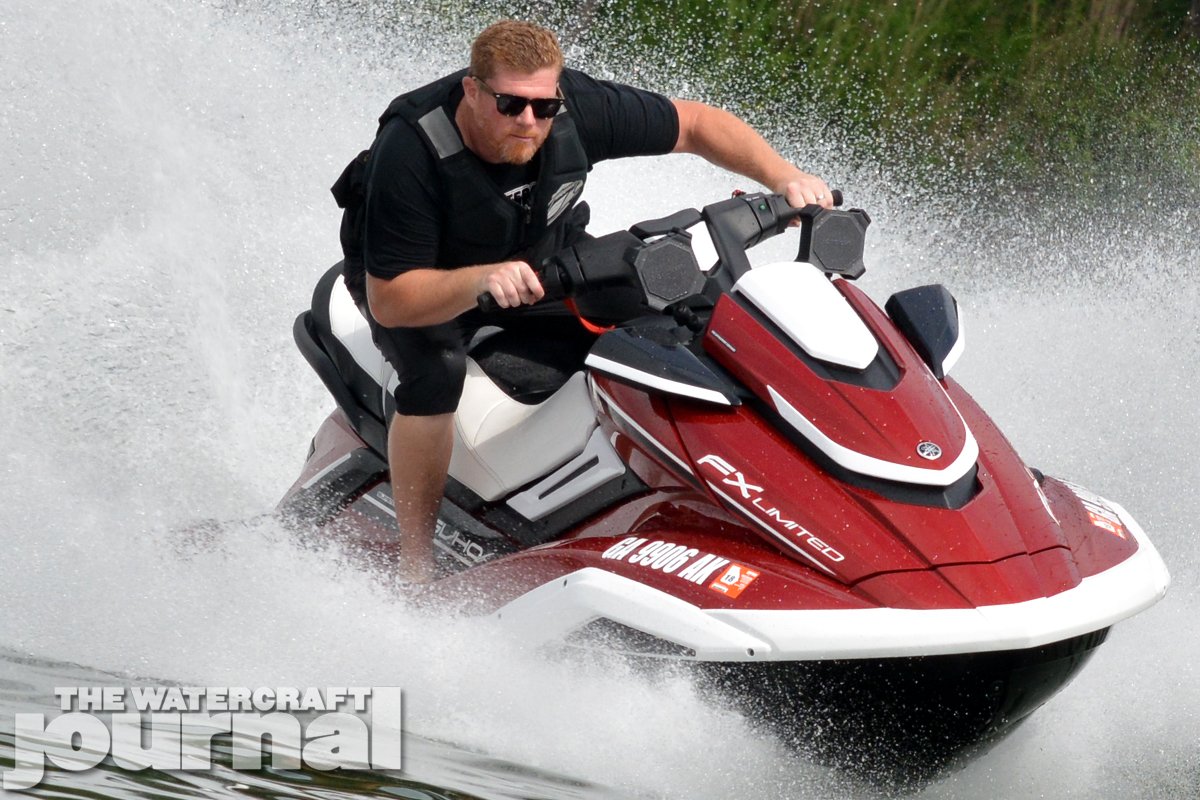
“But what about the hull?!” you ask. According to Yamaha, it was designed for “stability, predictability, and comfort in choppy water conditions.” When The Watercraft Journal talked with Scott Walkins about the redesign, he smirked, “We started with the GP1800 and went from there. Obviously, changes needed to be made but you’ll see that it handles chop really well.” And true to his word, the burgundy FX Limited SVHO we were handed did remarkably well. The craft deftly soaks up bumps and rough chatter, never once bow steering or hunting for a line. Input provided by the rider is followed with exacting precision.
Searching for a stretch of particularly trafficked water, we on the FX Limited SVHO and Greenhulk.net’s Jerry Gaddis aboard a ’19 GP1800R, conducted a trio of heads-up drag races, alternating craft. Each time, the FX bested the GP, slipping over the waves smoother than the GP, never once losing traction. Exchanging wide-eyed glances, we both judged the new FX a worthy successor to the outgoing hull. At speed, the new WaveRunner tracks true regardless of the water conditions. Noise from the ski is greatly reduced and any vibrations through the NanoXcel2 hull are muted. It feels impressively solid for being .9-inch longer and .4-inch wider and taller, and 13-pounds lighter.
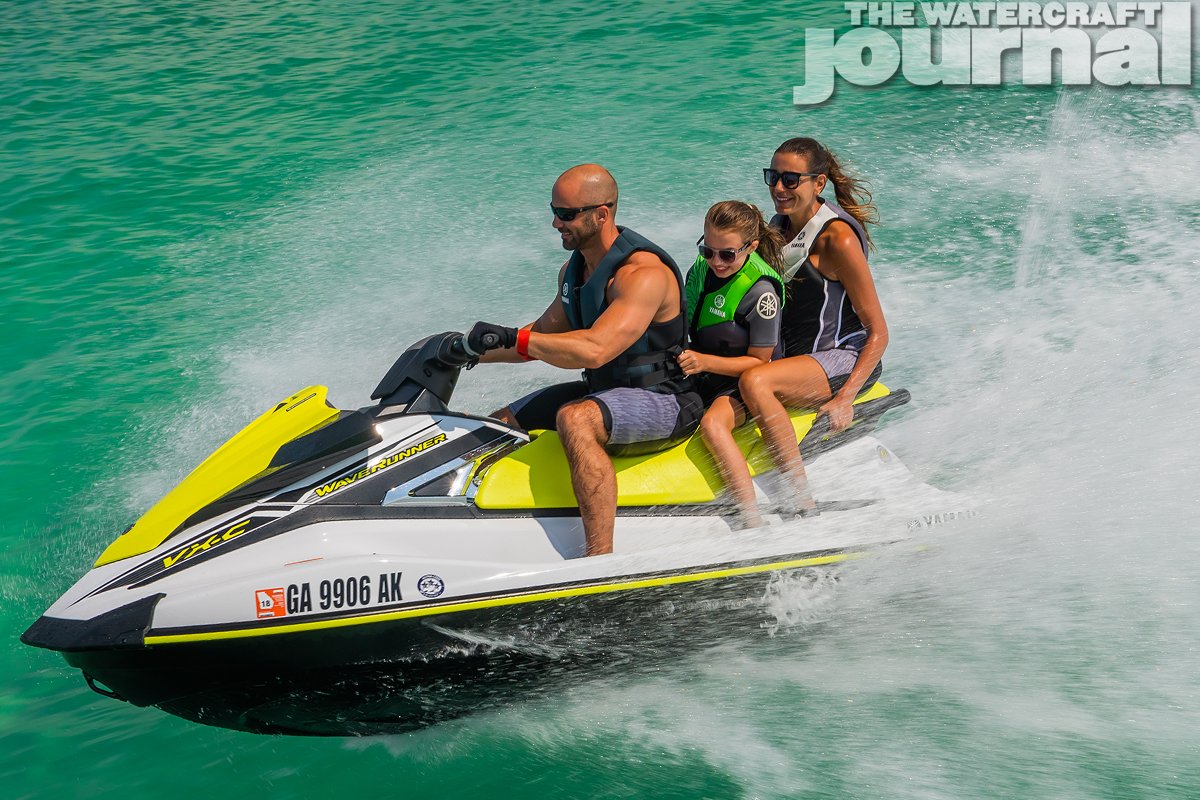
For the rest of the 2019 lineup, the VX series includes one more change, the addition of the VX-C; “C” standing for “commercial” or in layman’s terms, a stripped down, frills-free rental unit. [It’s basically a VX without RiDE. –Ed.] The rest of the Recreational segment includes the VX, VX Deluxe, VX Cruiser, VX Limited and VX Cruiser HO. EXR is joined by the EX Deluxe, the EX Sport, and EX; Yamaha’s Rec-Lite group boasting the highest first-time buyer rate in the PWC industry (54-percent!). Oh yeah, and the SuperJet remains as-is from last year…for now.
And there you have it: a complete breakdown of the 2019 Yamaha WaveRunner lineup. Of course, there’s a lot more finer details that need to be outlined in future articles, which will be found exclusively here at The Watercraft Journal and our YouTube channel in the coming weeks and months. Until that time, please enjoy the latest episode of Long Haul as we introduce you to these machines, show you how they behave in real world conditions and how their new colors pop in under the sun!
2019 Yamaha WaveRunner Reveal | Video + Photo Gallery