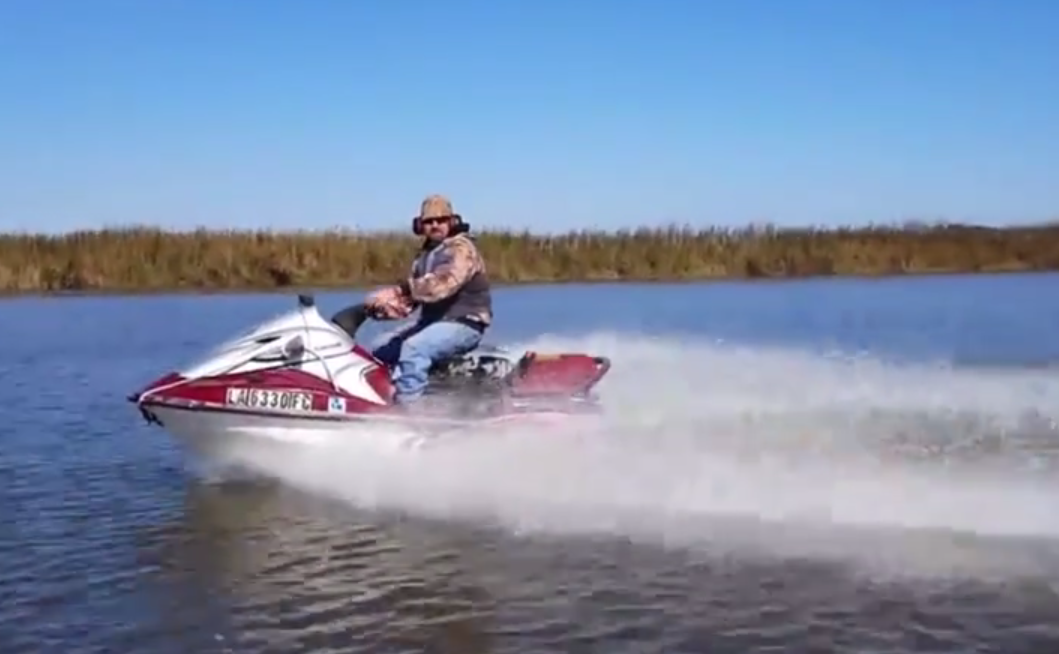
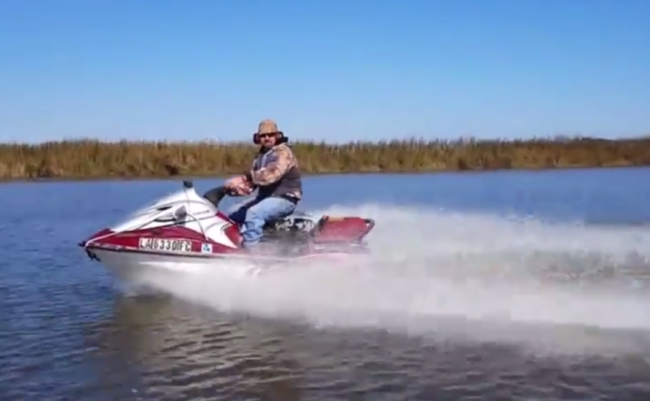
Sure we’ve seen a V8 swap in a personal watercraft before, but not like this. We’ve all heard the term “shadetree mechanic” and to call what Anthony Broussard and his father built one of those builds is a little disingenuous given all of the fabrication that went into pulling the 350 cubic inch (5.7L) small block from a late-80’s Chevrolet Silverado 1500 half-ton pickup and drop it (somehow) into the belly of a worn out 2001 Kawasaki STX 1100 DI.
It all began with Anthony’s wife discovering the STX sitting abandoned on the side of the road and letting her husband know of the find. Never to let an opportunity pass him by, Anthony picked up the ski and dragged it home. After concocting the idea of the V8 swap, a good friend, Thad, donated the engine and helped with the initial mounting process.
They began by curiously sawing off the deck above the bondrail, removing the lid and fabricating a custom engine cradle and solid motor mounts. Next, all of the engine coupler hardware needed to be designed and machined so that a stout dual chain drive could spin the custom 3/4-inch prop shaft. Leaving the engine more or less as-is, a Holley 4150-flange 650cfm. four-barrel with vacuum secondaries replaced the factory setup and provided the fuel.
Of course, a 350 is still a heck of a lot bigger than the Kawasaki 2-stroke, so quite a bit of cutting to the deck was needed to fit it and the open headers. Gone went the center seat, allowing for the back seat only, and a weird makeshift saddle on top of the carburetor putting Anthony and his legs before the exhaust (although, we can’t imagine wanting to sit directly on top of an engine).
The video slideshow documents the highlights of the build as well as a brief clip of the V8-swapped Kawasaki in action. It’s nothing too extravagant, particularly as these trucks struggled to make over 280-horsepower from the factory, but heck, open headers sounds cool on most everything so we gotta give it props.
Did you know that Cycle Springs Powersports is the single-largest dealer of Yamaha boats? Yeah well, they are, and they’re also one of the biggest dealers of personal watercraft of all brands, makes and models in not just Florida, but the whole United States. And being such an industry leader garners them a little bit of preferential treatment. How so? Well, if you’re looking at getting one of the newest 2018 models from Yamaha, Sea-Doo or Kawasaki, Cycle Springs will be one the first to make that happen.
Oh yeah, and if you’re looking for another toy to accompany your watercraft, Cycle Springs offer all your favorite brands, including Yamaha, Kawasaki, Polaris, Suzuki, Glastron, Sea-Doo and more! Add to that Cycle Springs’ amazing Lifetime Engine Warranty, their famous Money Back Guarantee on extended warranties, employee cost on accessories (on the day of sale), 50% off Pre-paid Maintenance and offering no “additional cost” protection for 500 miles of pre-owned machines, and it’s easy to see why Cycle Springs is one of the best.
But hey, the accolades don’t end there: Cycle Springs is also the winner of Yamaha’s highest dealer satisfaction awards for several years running. Known for “miles of inventory,” Cycle Springs Powersports located in Clearwater, Florida, “just minutes from Tampa and St. Petersburg. We are a full service dealership and can repair, service, and maintain most makes and models. We also carry the best powersports brands from Kawaski, Suzuki, Sea-Doo, Polaris, and Yamaha. Stop by today, and we will make sure you are treated like family.”
Wearing the proper eye wear while out on the water can make the difference between having a really fun day or even, in the worst case scenario, a possible life threatening accident. Sea blindness caused by glare reflecting off of the ocean, stinging salt spray and irritating dryness caused by riding at speed can plague anyone. That’s why it’s so important to keep your eyes protected and your visibility clear.
The Watercraft Superstore is offering a huge selection of SeaSpecs Extreme Floating Polarized Sunglasses for a super-affordable $49.95. Made with lightweight frames, polarized lenses that offer 100-percent UVA and UVB protection, and a smartly adjustable head band so that they won’t fling off your face while racing across the water, every pair of SeaSpecs come with a nice draw-string pounch to keep safe when not in use.
And we know from experience, as The Watercraft Journal put a pair of SeaSpecs to the test back in 2015, and gave the eye wear a very positive review, which you can read here. And the Watercraft Superstore has got a massive selection of lens and frame colors to choose from too. So check out the options here and pick up a pair before the next time you go out riding!
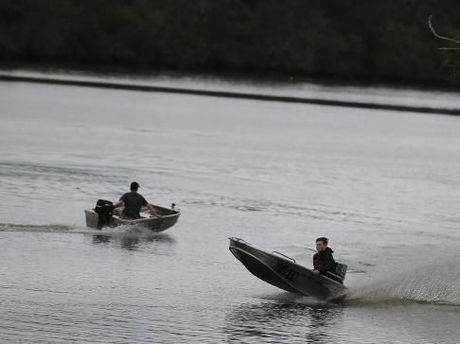
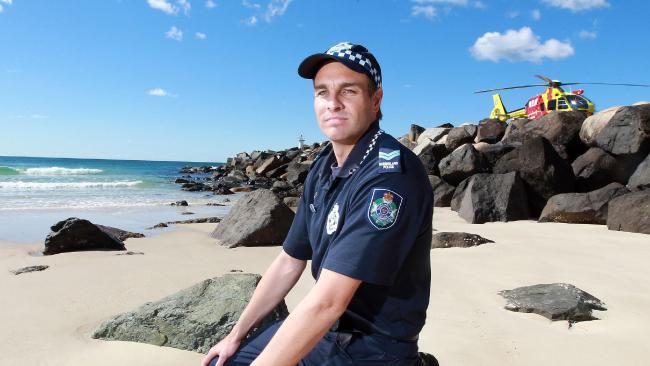
The Gold Coast of Australia is suffering another problem with jet skiers. This times it’s speeding personal watercraft riders who are on drugs. The police are coming down on these dangerous riders. According to the Gold Coast Bulletin, the police kicked off a two month crackdown in September. They quickly arrested three people. Two were on jet skis and one was in Australias version of a Jon Boat, called a “tinnie.” The water cops are running what is dubbed, Operation Whitewater.
The officers are looking to catch boat operators on drugs, juvenile boat thieves, and tinny hoons (people who soup up their boats and do “wheelies” and other crazy antics). Dangerous teen tinnie hoons are trying to fool police by disguising supercharged engines with six horsepower covers which don’t require a license.
Guys and girls who are operating their vessels under the influence or driving supercharged boats are wreaking havoc on the waterways. The three busts included one person on amphetamines and the other two had cannabis in their systems. As a result, officers from the Random Drug Testing Unit are going on patrols with the Water Police. A police helicopter is also part of the operation. Operation Whitewater is no joke!
“It has become something we need to address,” Acting Sen. Sgt Gray said. “I’m very disappointed about people driving and using drugs. It’s completely unsafe and they are going to hurt themselves or someone else.”
Referring to the recent string of boat thefts and out of control boat driving by juveniles, Sgt. Gray went on to say, “Someone is going to get killed. Parents have to take some responsibility for these kids. Their brains aren’t fully formed but they are ending up in a high-powered vessel to use.”
Operation Whitewater will be in full swing during the Christmas and New Year celebrations. If you’re going to use drugs, don’t get on the water!
Without argument, the final reveal of the 2017 Kawasaki SX-R JetSki was the single-most anticipated event in The Watercraft Journal’s four-plus-years of publishing. The telltale spike in readership every time we shared some morsel, any glimpse of imagery, any tidbit of information was like chumming the waters bloody, maddening the seas already teaming with sharks.
A couple of months before the reveal, I had a handful of cellphone pictures of the finalized SX-R clandestinely sent to me, including one of the engine, and another the pump and tray. To keep “the right people” from closing in on my informant, I tossed in a few red herrings into any article prior to its official reveal. And, true to my word, never published the pictures.
Despite a personally tumultuous relationship with standups, I too looked forward to how the world would receive the SX-R. I had grown up on 440s and 550s, recalling the thin foam padding rubbing my 9-year-old knees raw as I struggled to balance around Lakes Perris and Elsinore. Years later, I took to my brother’s ’00 SuperJet although his souped up white-and-purple 750SXi (tuned by Greg Beaver of Circuit Jet Sports) was the far faster ski.
The last standup I truly came to enjoy was an ’08 SX-R 800 – a ski I regret not purchasing while at Personal Watercraft Illustrated to this day. It was this ski – the 800 – that had me thinking I could (at least casually) ride a standup well. The new ’17 SX-R 1500 taught me differently. I wouldn’t go so far as to say that I had to “re-learn” how to ride, but I did need to learn how the ’17 SX-R wanted to be ridden.
April gave me my first taste at riding the SX-R 1500. Although given half the day to ride, most of us (the US media) couldn’t make it past half an hour. Determined not to make a (bigger) fool of myself in front of Fuzzy Boyd and Minuro Kanamori, who designed the ski, I pushed to keep riding. I think I racked up maybe 50 minutes of total ride time (most of it spent swimming back to the ski). Others fared a little better.
Unlike the comparatively impish 800 before it, the 1500 hated slow speeds. Or at least, it hated me at slow speeds. Cruising around at 30-35 was fine, but go anything less and it grew tipsy, and by a lot. Yes, at speed, the SX-R tracked like a laser-guided cruise missile. It didn’t wander, and it definitely didn’t buck. And really, the only way it wanted to corner was with me as low as possible, doubling myself forward over the handlebars, and my weight as far over the inside rail as possible.
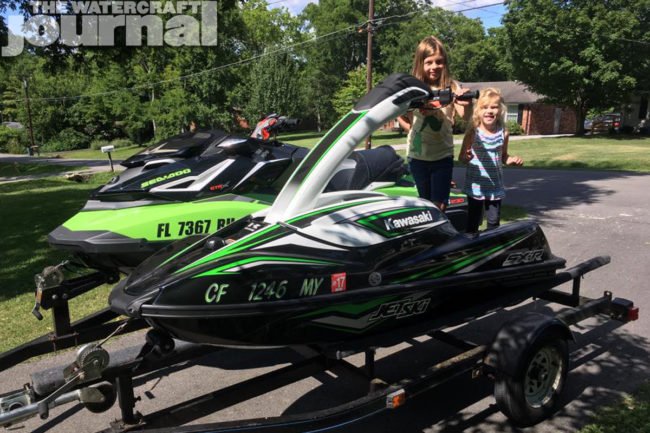
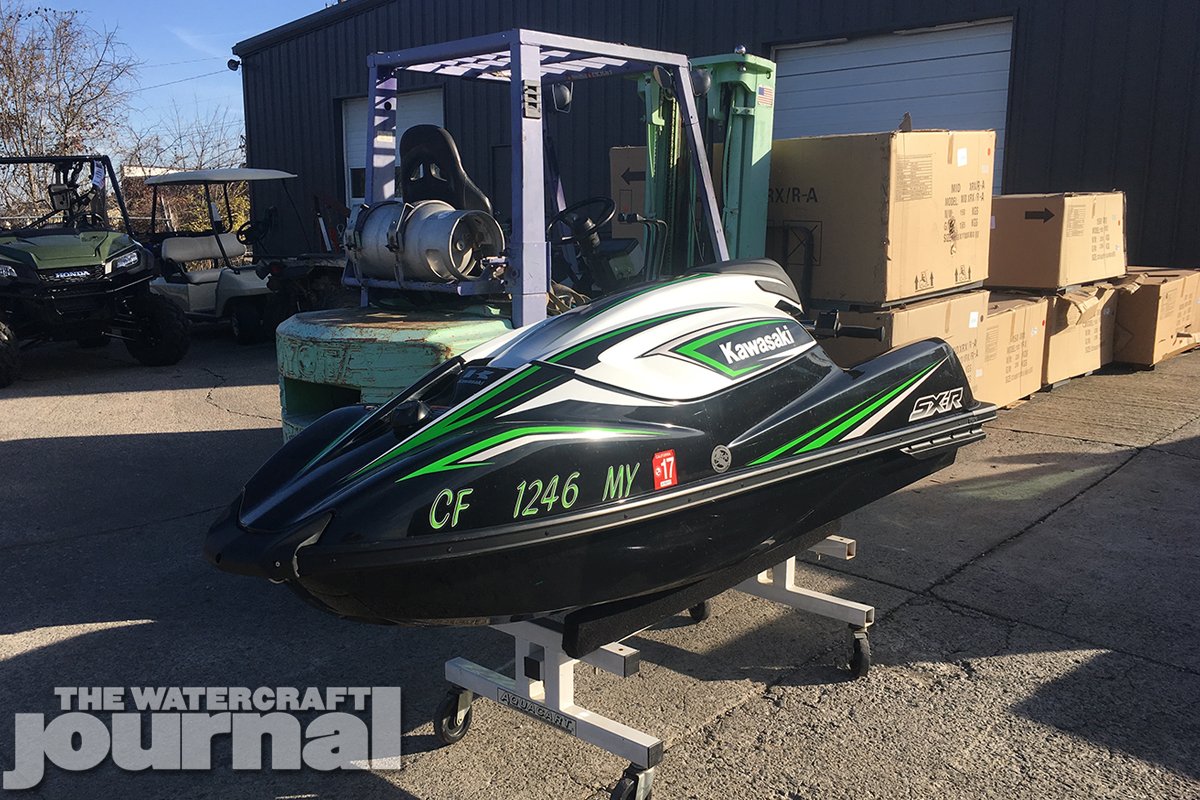
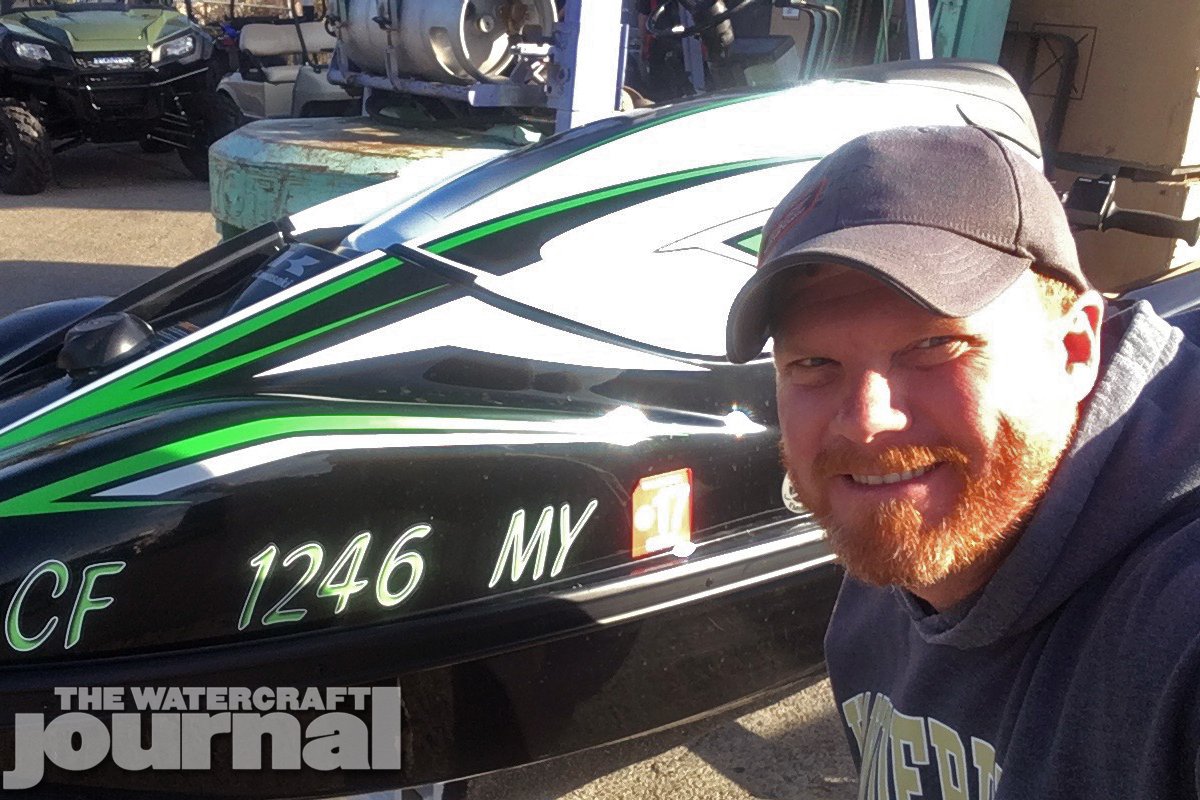
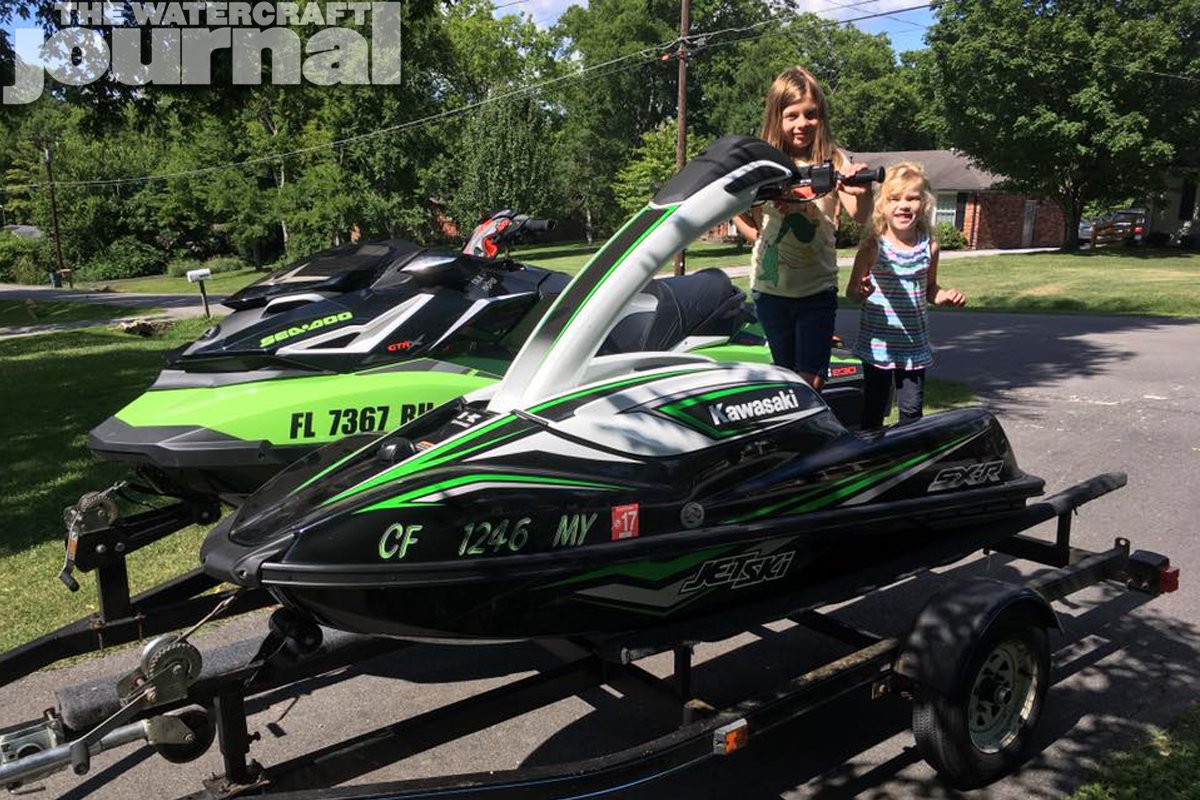
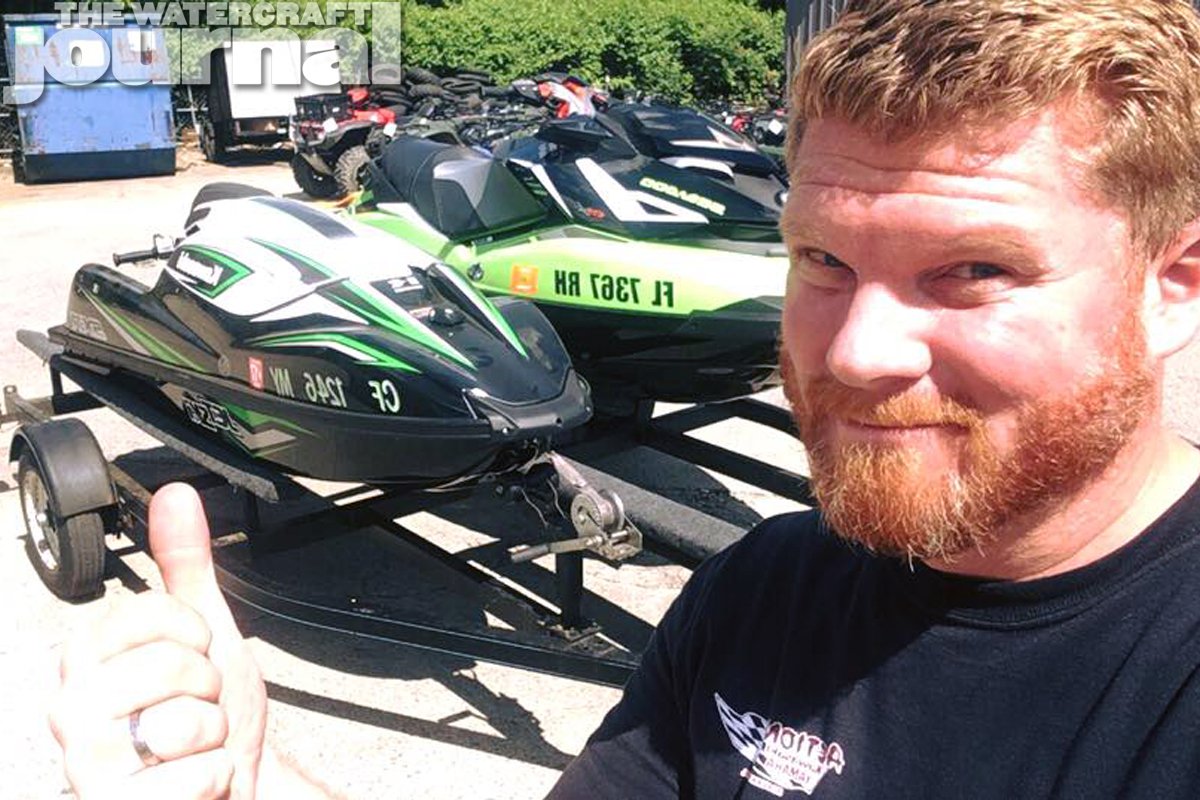
Above left: Picking up the new ’17 Kawasaki SX-R JetSki from Castle Powersports in Madison, TN. Above right: My two oldest were the first to get in the tray.
Above: I was pretty good about my self-prescribed multi-day-a-week riding regimen for a while there.
That lesson alone, was the hardest to learn. I had ridden the SX-R 1500 for about an hour in April, and received my loaner in mid-June. And in all honesty, I think I rode it maybe 3 different times that month. July and August were different though. I really tried to commit to riding it for a minimum of 25 minutes, three times a week. Not only did I want to hone my skills but just become better acquainted with the Kawi.
I’m 235-pounds and 6’2″; not exactly the build of a professional standup racer by any means; by this time I was growling to myself, “This thing was designed for jockeys” and felt myself starting to want to give up. It was becoming the first ski I had that I didn’t want to ride. Thankfully, some wisdom came from a friend who was actively riding, tuning and racing one:
“The handlepole is too damn long. You need a shorter pole – like 3 or more inches shorter. Get your body over the hood as much as you can. And get down low. Its center of gravity is too high and a rider only makes it worse.”
With that advice, I found how the SX-R liked to handle. Come in fast. Come in low. And get over that hood. Once I did, it made all the difference. And let me tell you, there is an amazing sense of satisfaction to executing a solid set of turns after weeks of failing at it. Don’t get me wrong, I was in no place to take on Dustin Motzouris, but I was at least not hating to ride anymore.
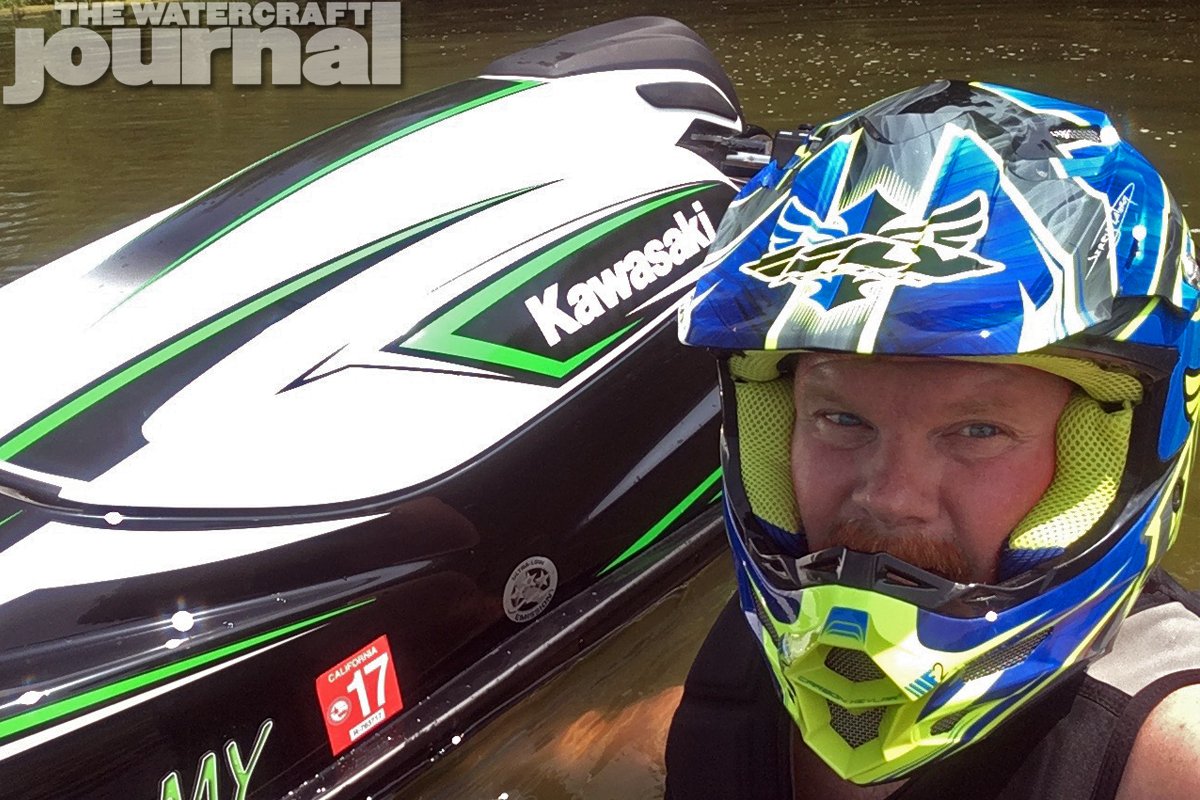
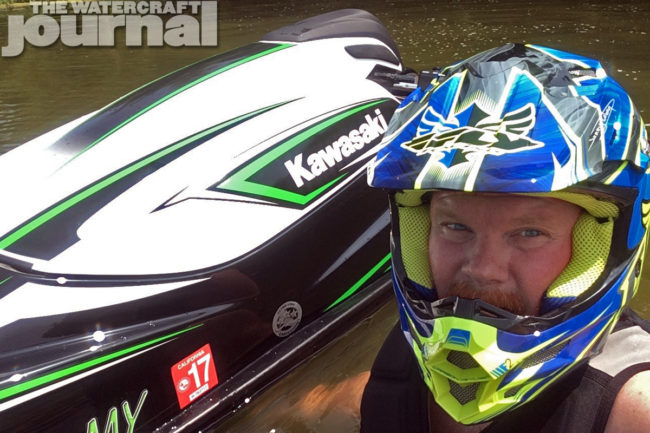
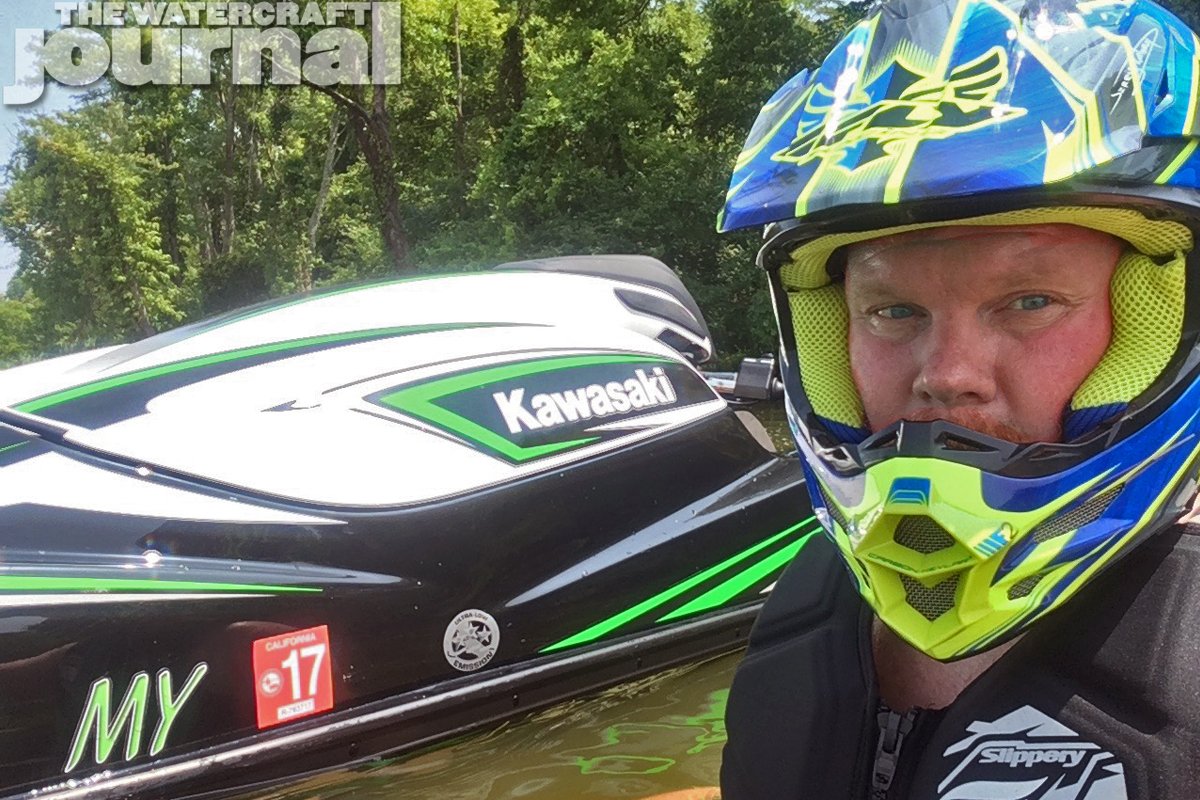
Then, in early September, while trying to reboard in deep water, my elbow slipped on the gunwale and I face-planted hard into the slick painted surface, ricocheting backwards. Gratefully, my Fly Racing helmet kept me from thousands of dollars in dental work. Then it sat. I’d say for at least a month. It saw water a handful more times between returning home from World Finals and returning it to Kawasaki late last week.
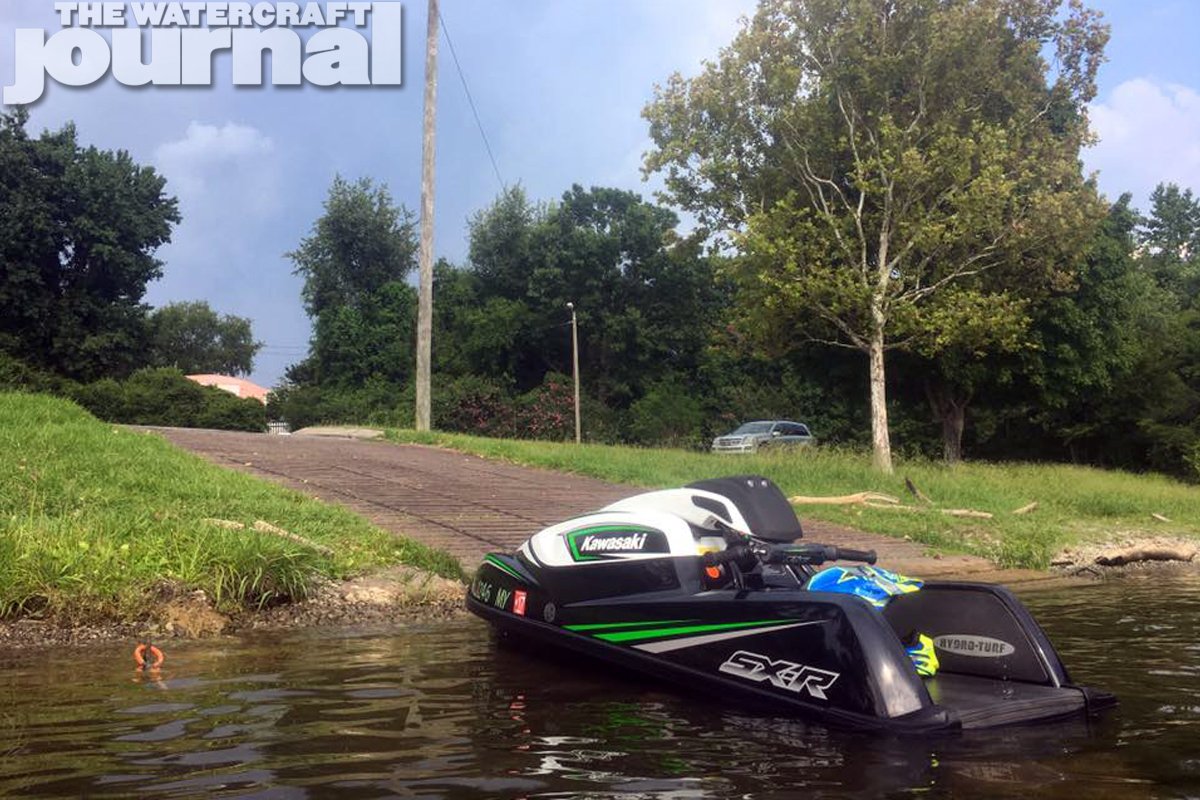
Above left: I was happy to take friends out and let them try their hand at the 160-horsepower ski. It scared the pants off of most who dared. Above right: The SX-R became a permanent fixture at the shop and the subject of a few different articles and videos.
Above: Taken right after I bounced my face off of the rail. It could’ve been a lot worse.
Anytime friends asked about it I’d happily bring it out for them to try. They’d all come back saying the same thing: “Dang! That thing’s fast!” and quickly hand me back the lanyard. Many of them were scared. And I think that’s a problem. I’ve put people on big horsepower, top performance runabouts before and received the same answer but not with the same look. This was the first time I saw people visibly shaken.
I guess this review isn’t for you hardcore standup guys. You always ride whether it’s glassy or nothing but white-capped garbage. You’d rather quit than sit. I get it. It’s cool. Rather, this is for everybody else, and I can’t help but think that Kawasaki built something that really isn’t meant for anybody else. The SX-R is a outward reminder that the days of tossing a pair of 550s and an ice chest in the bed of your Toyota are gone. The SX-R is not the light, playful dirt bike-for-the-water you remember a JetSki being. This is it’s own animal.
That being said, I still like it, but I wish I loved it (if that makes sense). Priced at $9,999, it’s the best JetSki that Kawasaki could build for such a low price and as quickly as they did. Personally, I’d like to see the SX-R stick around for a long time as I’m excited to see how the aftermarket, racers and a larger general public embraces it. Hopefully the evolution of the marketplace will bring us a tamer ski for us less skilled riders. But for now, this sport needs a standup JetSki from Kawasaki and I’m glad they’re back.
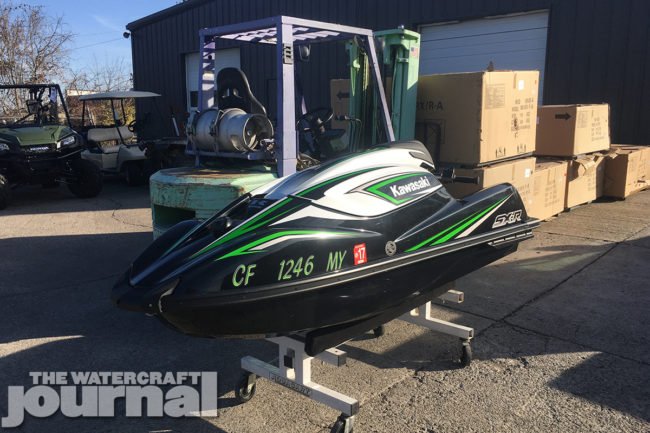
Above: After five short months and quick frankly, not enough riding, our SX-R had to be returned back to Kawasaki.
The action packed Extreme Sports Expo is happening in Dubai. It will take place at the Dubai World Trade Center, January 12th and 13th in 2018. The expo reads like an amazing adventure in itself. Reading about all the stuff that’s going to go down, has us frothing!
People involved in the extreme, action, outdoor, and adventure companies gather for this huge event. Some want to show off their new equipment. Many are there to participate in the sporting aspect. Others are in it to schmooze. It’s the place to be for making new connections and just looking around in awe.
Four other events will take place simultaneously. The Dubai Motorbike Festival and the Dubai International Bicycle Exhibition are only two of the events. One Breath; a free-diving exhibition and spearfishing expo are just a sampling of other co-events. A Photography Expo is going on as well.
This event looks exciting and sounds quite elaborate. It has everything FUN! We would expect nothing less from Dubai. Check out all the other activities on display: A Motorcycle and ATV Stunt Battle, Underwater Target Shooting Championships, Aerosports Pavilion, Land Action Sports Village, and of course a Watersports Pavilion will be set up for your enjoyment. Get the details about each activity and event here.
300 exhibitors are expected to set up and a minimum of 10,000 visitors will be in attendance. Register here so your’e not stuck waiting to get into the big show. We think tickets will go fast for this extravaganza.
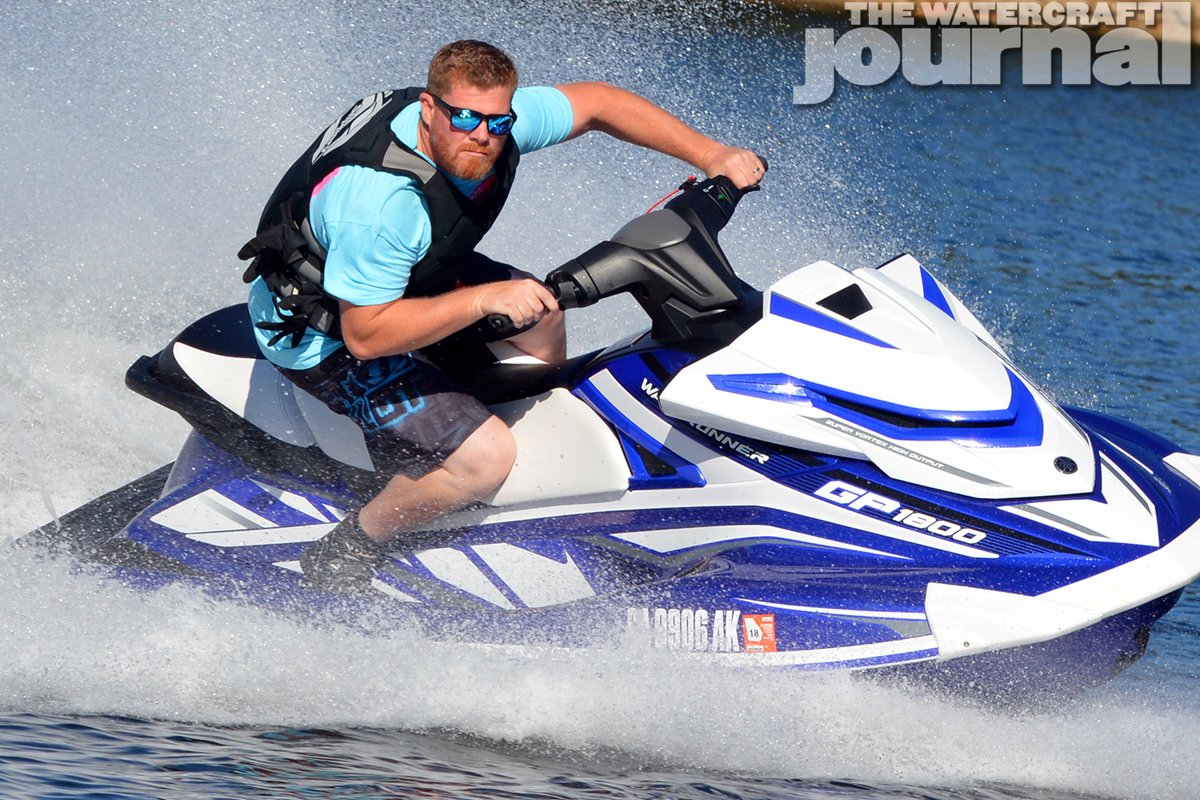
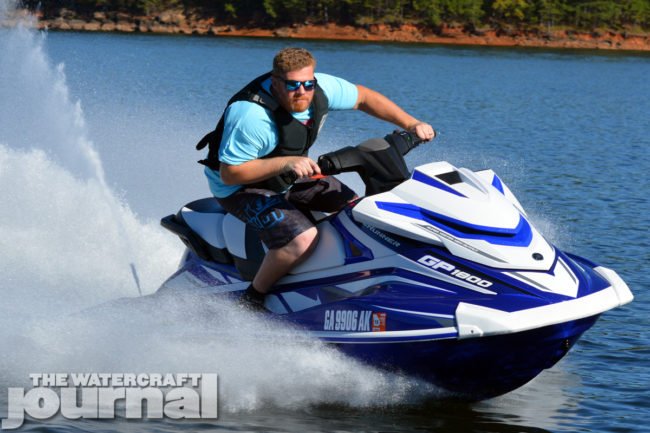
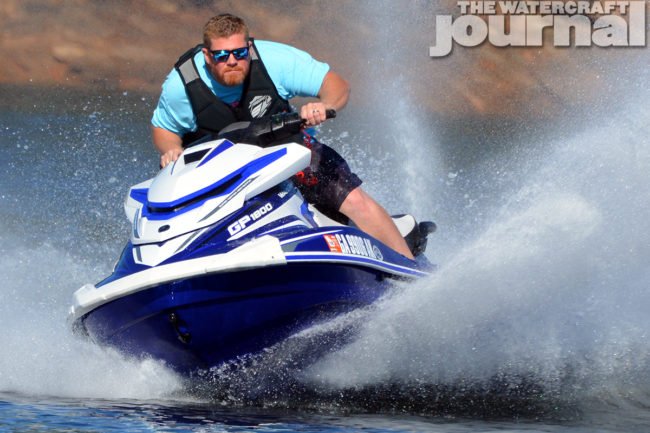
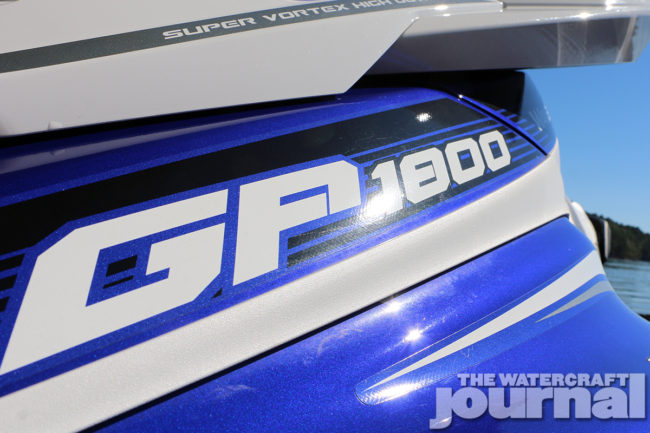
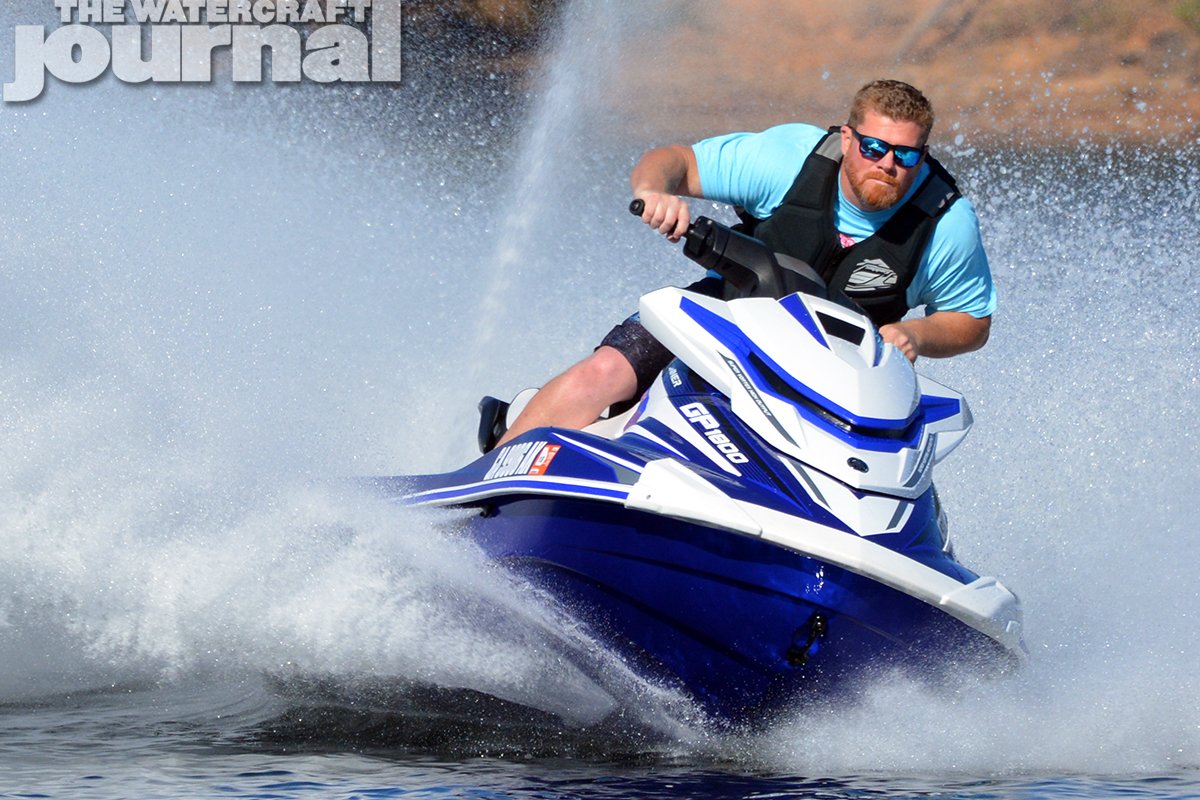
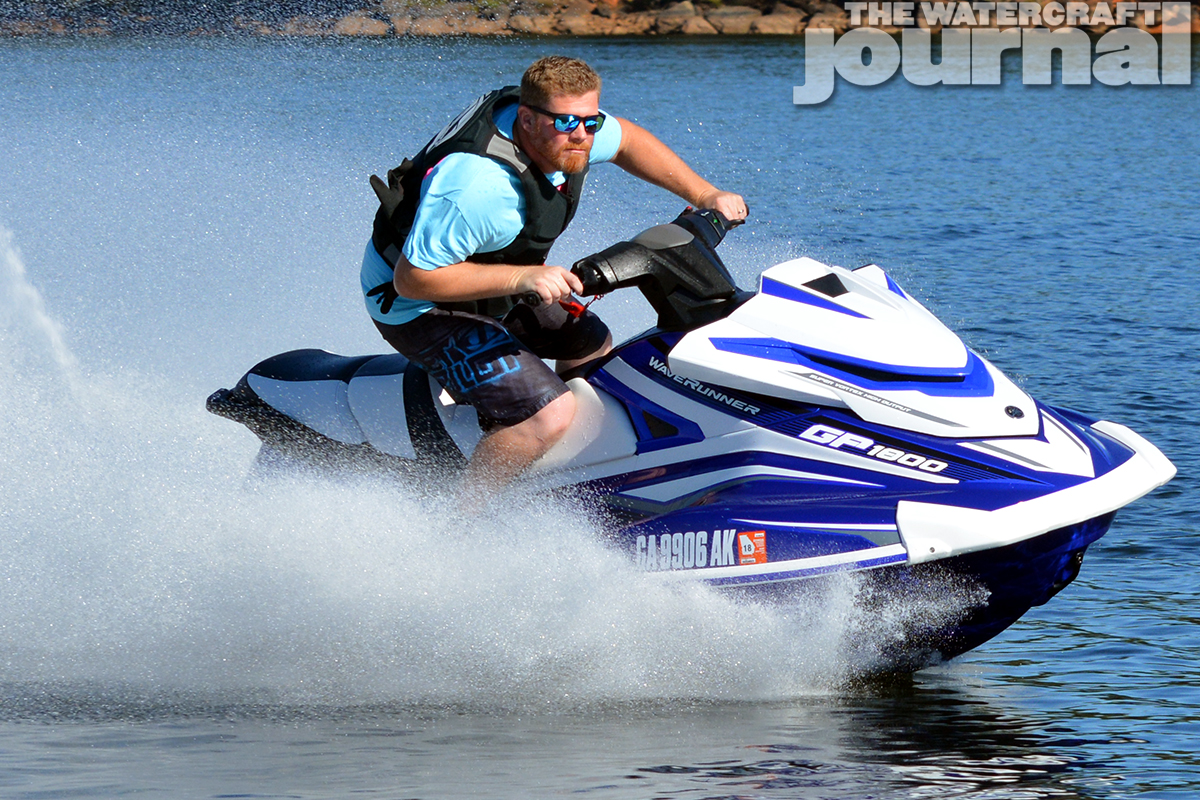
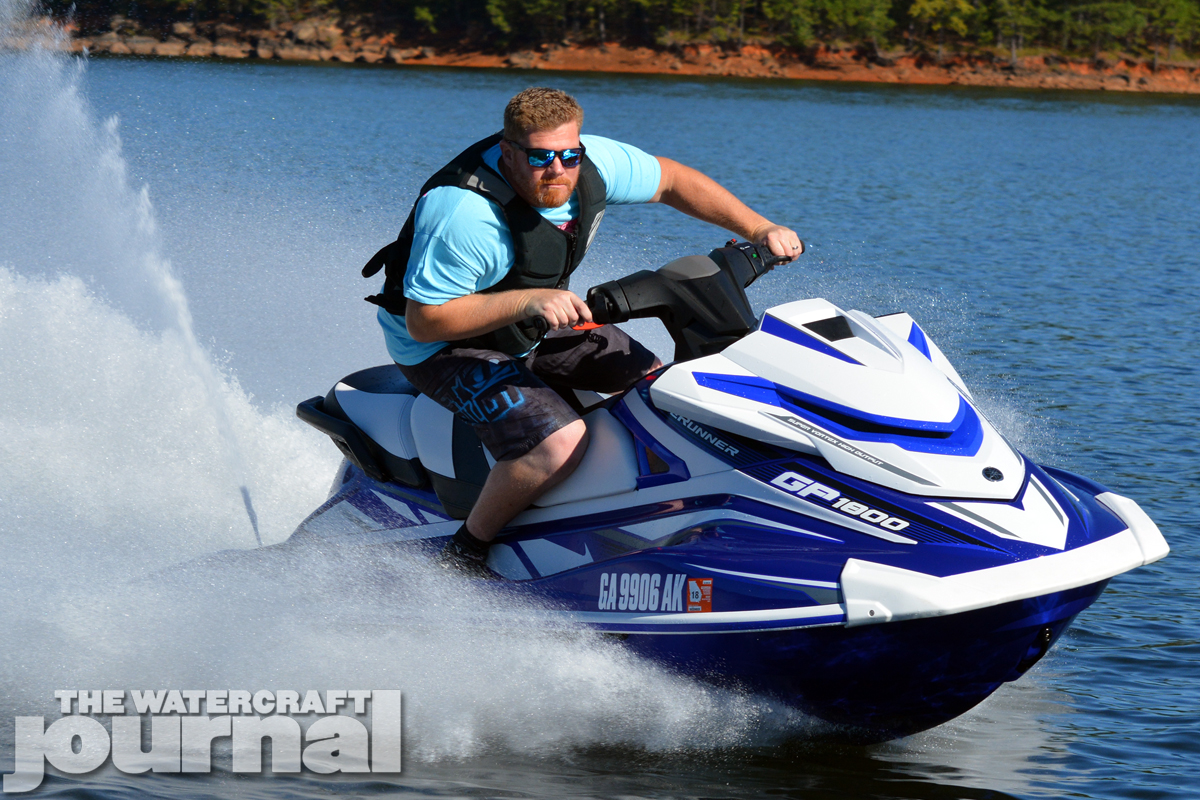
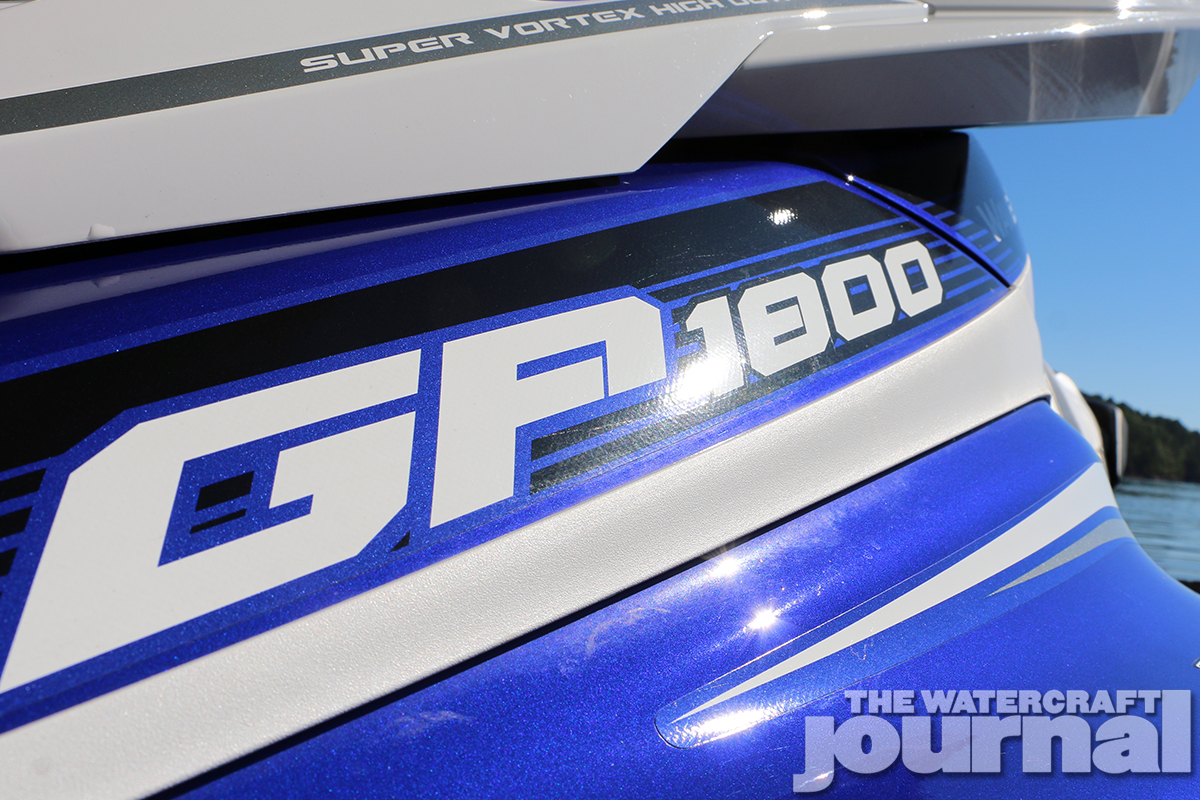
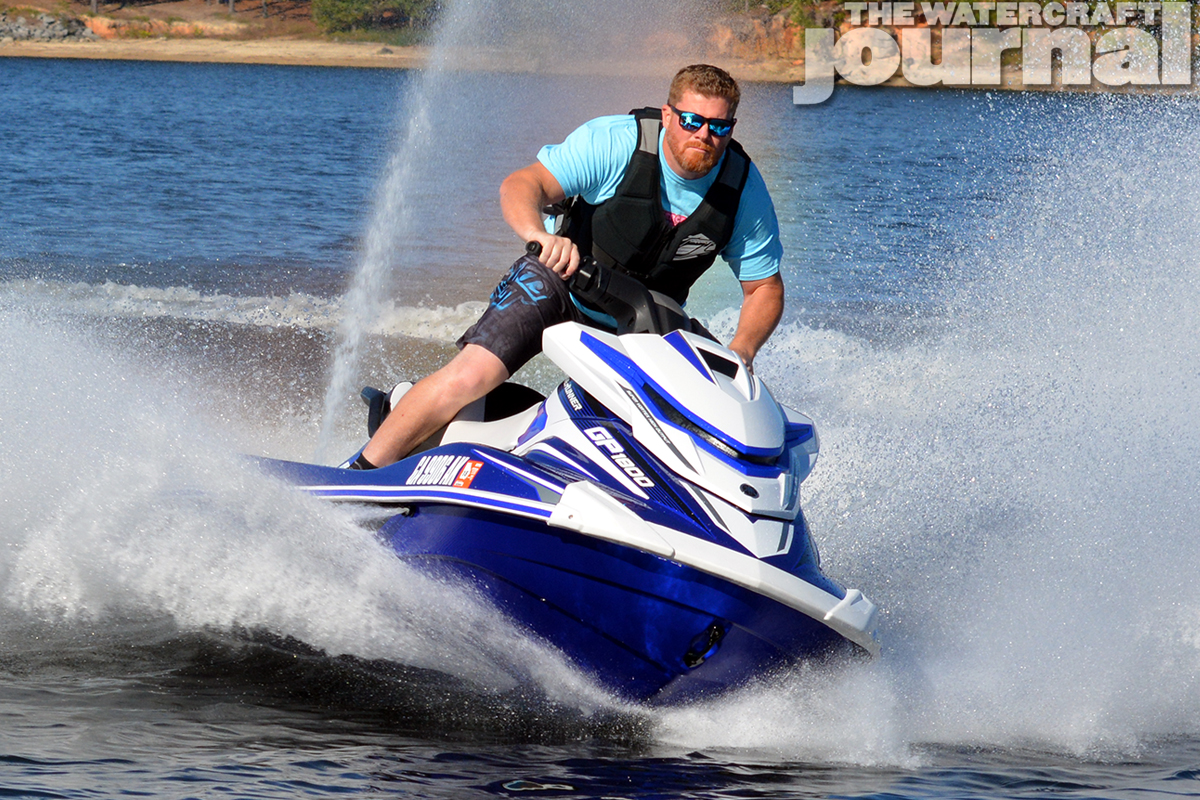
I sucked in a breath through clenched teeth as the prop bit, pushing the nose down and hard into yet another turn. Snapping the bars sharply from left to right, the muted howl of the 1,812cc Super Vortex High Output (SVHO) growled beneath the two-piece, high-bolstered bench seat. The torsional force pressed against my body, straining my arms and pulled to free my grip on the handlebars. The traction of the 160mm axial-flow pump was substantial particularly given its light weight (769-pounds dry) – this machine could hook and hook up hard. Even in spite of its shallow draft, the 11-foot long 2018 Yamaha GP1800 WaveRunner remained firmly planted to the water, that is, after toggling the electric trim down a couple of bumps. Typically, any run-of-the-mill VX WaveRunner could run at neutral trim just fine, but the GP1800 weighs a scant 2-pounds more than the VX Cruiser HO yet wields an extra 70-someodd-more horsepower, and keeping this rocket ship planted requires a bit of downforce.
Amid the heated firefight of on going horsepower wars – 300 from Sea-Doo and 310 from Kawasaki – Yamaha is perfectly content with its (unofficial) 250-horsepower from the 4-cylinder, 4-stroker SVHO engine. The dual overhead cammed, centrifugally supercharged 1.8-liter retains the crown as the largest displacement engine in the industry yet touts the lowest power output of the Big Three OE manufacturers. This though, has not dissuaded performance enthusiasts, as the SVHO has earned its keep as one of the most reliable and warmly receptive engines to aftermarket modifications. Tuners have pushed the engine’s boundaries to exceed 600-horsepower through ingenious means, including turbocharging, multiple-stage nitrous systems and even high-compression E85.
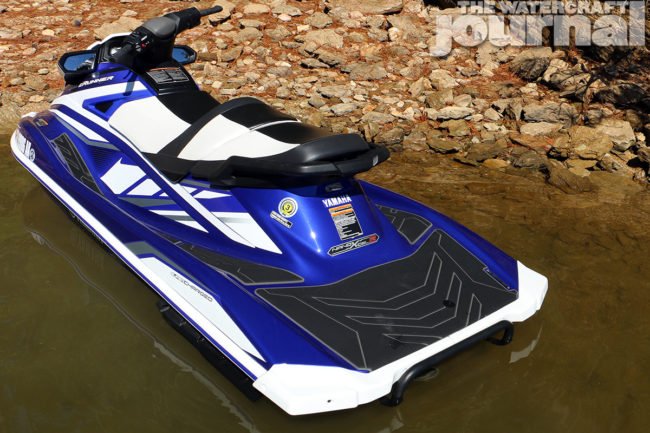
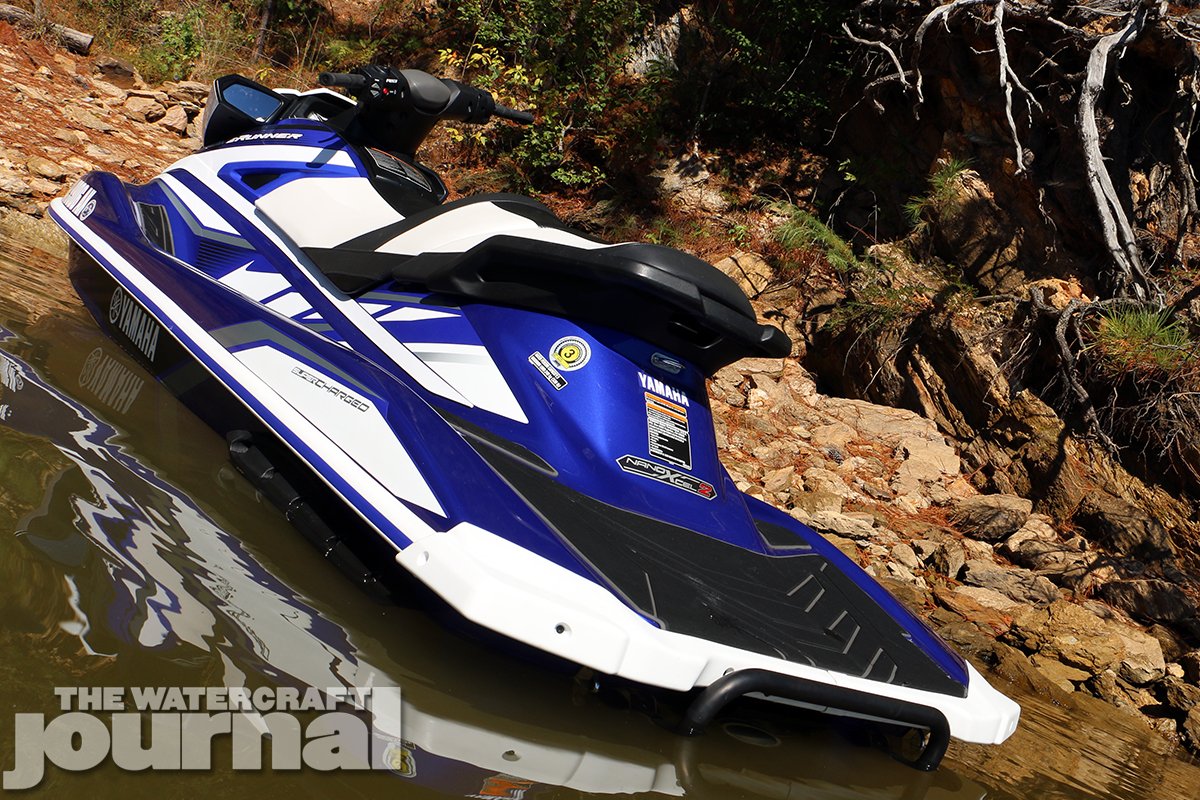
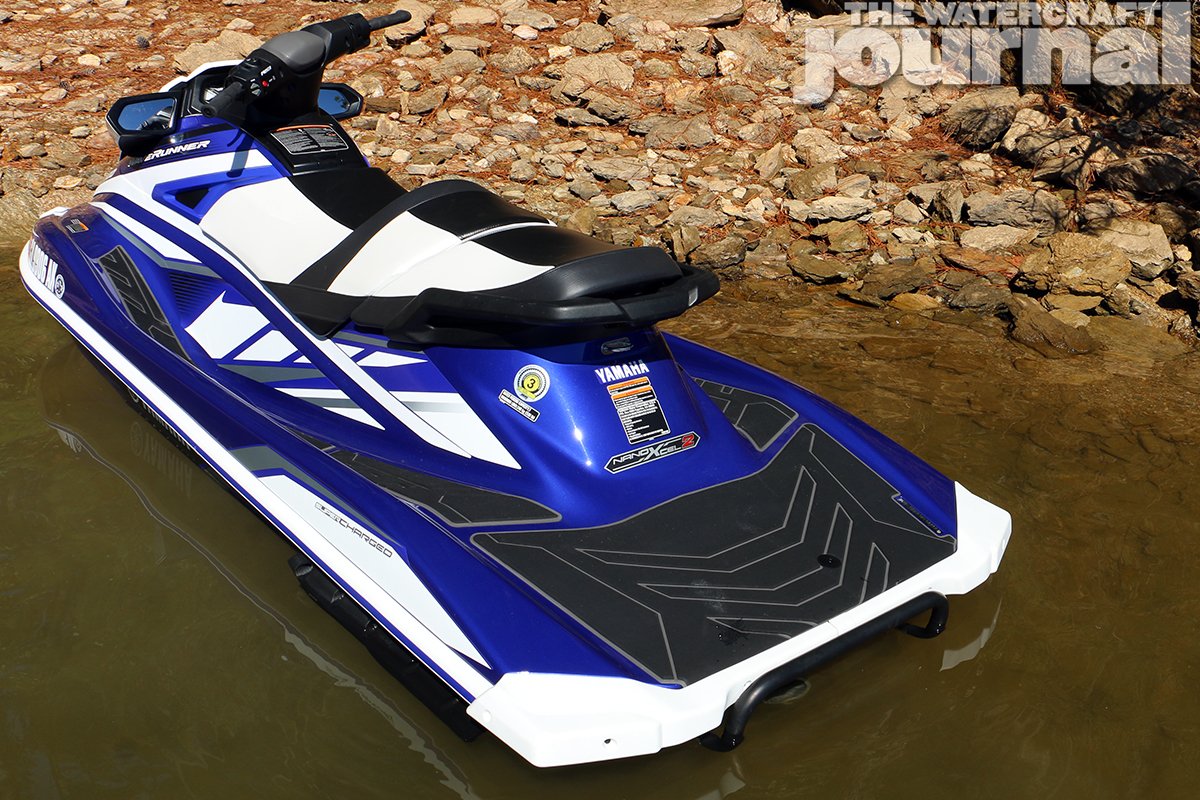
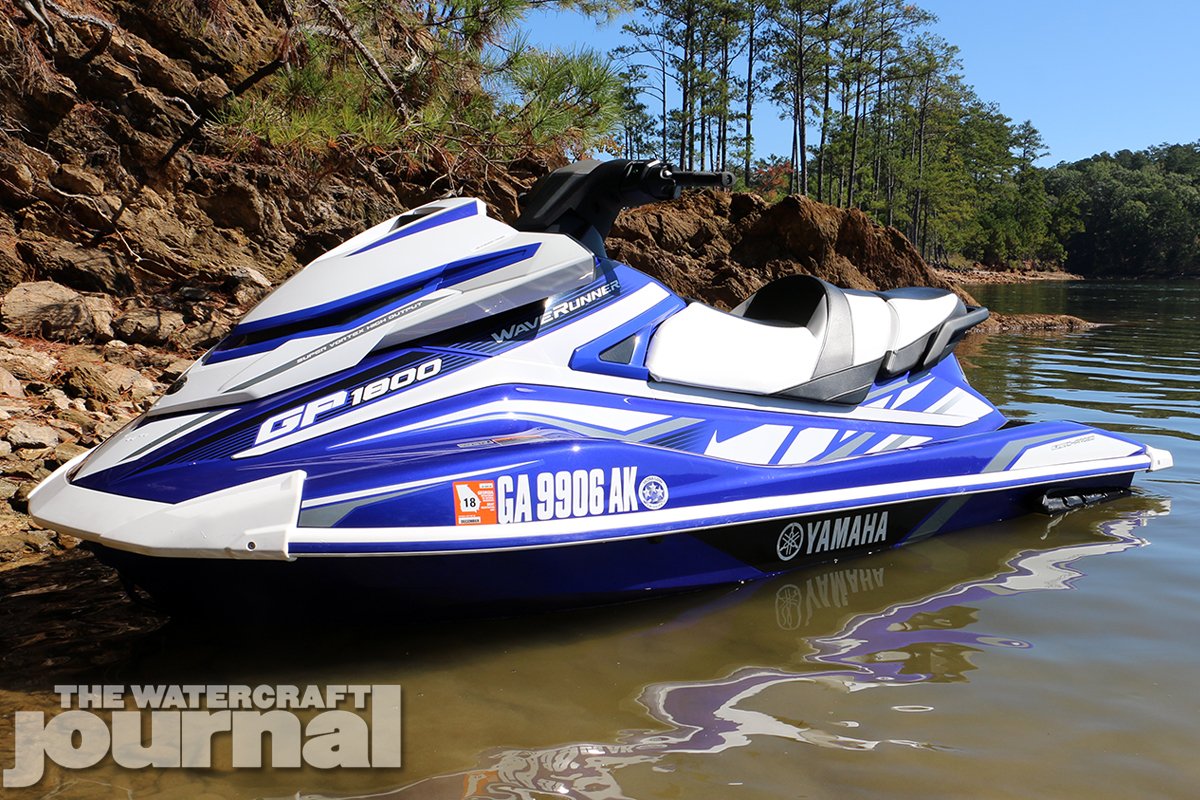
For 2018, Yamaha issued only the slightest improvements for the ’18 SVHO; first, by replacing its aluminum intake manifold with a composite plastic piece (while offering some minor weight savings, it also is cheaper to produce and allows for less heat soak and better heat dispersion), and a change made to the two-piece supercharger clam shell, but it is believed to be purely for reducing manufacturing costs. The rest of the GP1800’s powertrain remains identical to its inaugural 2017 model year and its fellow SVHO-equipped siblings in the FX line. All other changes for ’18 have been cosmetic: a choice of either Torch Red Metallic or Team Yamaha Blue, a return to non-color-matched hand grips, and white nose and transom bumpers to match the white bond rails and graphics (with black being a larger highlight trim color for the Torch Red variant).
And why should much be changed? In its introductory year, the 2017 Yamaha GP1800 was a runaway success for the brand. Not only did it manage to sell so successfully that all units produced were sold to dealers by June of this year, but it also became the 6th highest selling personal watercraft for the year (and the only supercharged runabout to enter into the Top 10 Best Selling PWC for the year as well). Add to it an unprecedented sweep of every podium for which it was entered, including several world championships at this October’s IJSBA World Finals, the continuing AquaX series and even winning the annual Long Beach-to-Catalina Offshore Championships (which up to this point had remained almost exclusively Kawasaki Ultra territory) and the GP1800 was clearly the machine to beat (or buy).
With the last few golden and tangerine leaves clinging to nearly-barren trees, I greedily embraced the opportunity to spirit away a ’18 GP1800 one brisk Fall morning on Lake Allatoona, Georgia. Wisps of fog lingered spectrally over the glassy water as my brilliant blue-and-white Yamaha slit a flawless ribbon, splitting the lake’s reflection in twain. Molded from Yamaha’s NanoXcel2 bonding material, the GP1800 rides a little high, almost anxiously at neutral, with the nose slightly wandering, urging its rider to be pointed where to lunge and set loose. That’s why trimming the nose down unlocks the GP’s progressive deadrise and pronounced keel; consider the anatomy of a knife: riding at neutral trim is akin to cutting a tomato vertically. While the long straight edge of the blade might be sharp enough to adequately do the job, angling the point and rotating the tip in a fluid motion will provide a cleaner slice with more rapidity. The GP is no blunt butcher’s cleaver, but a highly-crafted Ginsu.
With its 18.5-gallon tank nearly full and a not-so-svelte 235-pound rider, the GP1800 reached a peak Garmin GPS-confirmed speed of 68.4 miles per hour. Of course, achieving a top speed record was not the goal for today, but people like to ask. Rather, I was pushing for handling. Fixed points like buoys and fishing markers are ideal for pushing the GP1800, and I raced toward each one I could find with zig-zagging aplomb. Again, because of the diminutive size and weight of the GP, the WaveRunner doesn’t kick up the impressive roosts that larger craft do, but of course, hydrodynamics teach us that the greater the water displacement, the more drag a vessel produces, and the GP has remarkably little drag. The Watercraft Journal painstakingly reported that the GP1800 has the brand’s leading power-to-weight ratio of 0.34:1 (horsepower-to-pounds) and remains unchallenged for 2018. Any uptick in horsepower would only push that closer to 1:1.
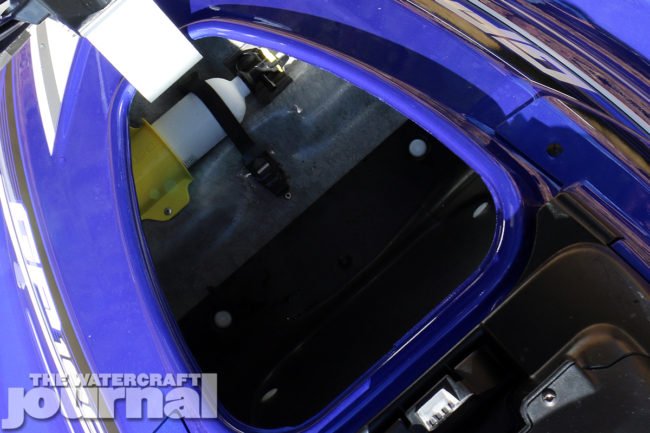
Unlike its larger FX siblings, the GP1800 is absolutely bereft of features and accessories – apart from the aforementioned electronic trim and its now standard folding swim step and RiDE dual-throttle, brake-and-reverse system. The glove box is conservative with two quasi cup holders molded into the box. The hand grips are comfortable, flat palmed, and in a natural pistol-grip configuration. The LCD screen is humble at best. A large speedometer is capped by a longitudinal tachometer and boost gauge while being flanked by a modest fuel bar and trim setting. No buttons are found to toggle through screens. No tilt or telescopic steering. No integrated cleats to tie a rope to. There’s not even a small gas strut to assist in holding open the front storage bin. I mused that Yamaha built the GP1800 with the same efficiency as Carrol Shelby built his first AC Cobras. If it doesn’t help the GP go faster or be safer, it’s dead weight.
Saying this doesn’t imply that the GP1800 is rough around the edges or slapdash in its execution. Quite the opposite. The cut-and-sew stitched seats are made from contrasting materials for better traction and ergonomics in a way that would make Gary Hart proud. The watertight, screw-top-lid watertight storage under the passenger holds tools and other valuables securely and dry. The traction mats are still made by Hydro-Turf but are the only lazer-cut mats the company makes – so don’t try to order a set. You won’t get one. The rich metallic paint is equal in quality to any car parked outside of an auto dealer’s lot. All vibrations, chatter or rattling are eerily absent. The GP1800 is as tight as a drum. In the months since taking this ’18 GP1800 home, I’ve never once needed to pull the drain plugs after a ride. Any water into the engine compartment has been from my over-zealous washing habits.
Priced at $13,999, the 2018 Yamaha GP1800 WaveRunner is also the most affordable supercharged performance runabout available from the manufacturer. Cargo space is on par with all other VX-based WaveRunners at 24.6 gallons, with much of it being in the bow and as mentioned, a small portion being tucked beneath the rear passenger bunk. There is no “Learner Key” or easily-accessible throttled-down setting (technically, there’s a “Learning” setting through the key fob and in-dash instruments but requires the Owner’s Manual to access it), so the GP1800 is truly meant to be unabashedly who it is at all times, making it as you might assume, not ideal to put your neighbor’s kids on for their first time. There truly is no duplicity in this machine’s presence: it wants to run and run hard. Sure, you can cruise it but you’d be one of the foolish few to purchase a thoroughbred race horse to use it for hoeing rows on your back acre. Use the machine for what it was meant to do and it’ll reward you for it.
We have become used to getting a few amazing looking video edits each year from the talented 36 year old Lithuanian HDScreenerX and his friends at Jet Ski Club Stavanger. Yet again they have been out filming and having fun, this time in the autumn waves in the southern part of Norway.
As you might remember we wrote an article about the Norwegian Jetski federations still ongoing struggle with Norwegian mayors trying to ban PWC use in a few local tows. The fight to get the government to lift the 5 year old 400m 5knots rule is won, and PWC are now classified as a boat with the same rules and regulations as all other vessels. This means that the PWC community now legally can use some of Norway´s epic scenery as their safe playground, and not be forced to ride up to one kilometer away from the shoreline to ride legally. And what scenery the Jet Ski Club from Stavanger has to share with use, we can only hope for more videos like this in the future.
Mind you, this is the same area the Tom Cruise just finished some of his most dramatic scenes for the upcoming Mission Impossible 6. No watercraft were used in these scenes sadly, but fear not, a taste of the Norwegian nature is only a few clicks away. Jet Ski Club Stavanger is a small riders club with boys and girls from Norway and Lithuania, and you consider yourself advised to check out all of their adventures on HDSCreenerX YouTube channel.
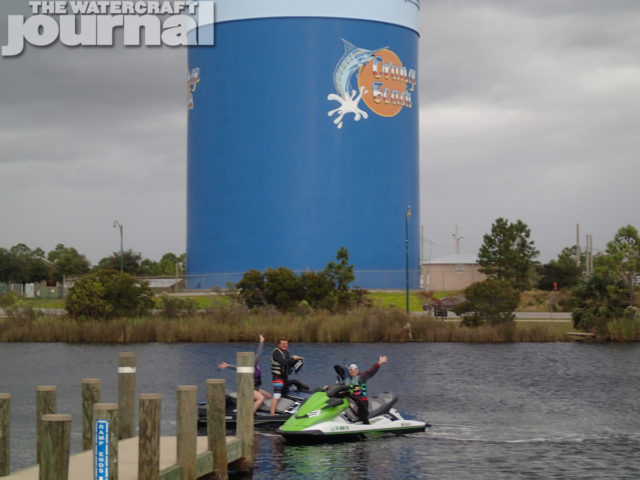
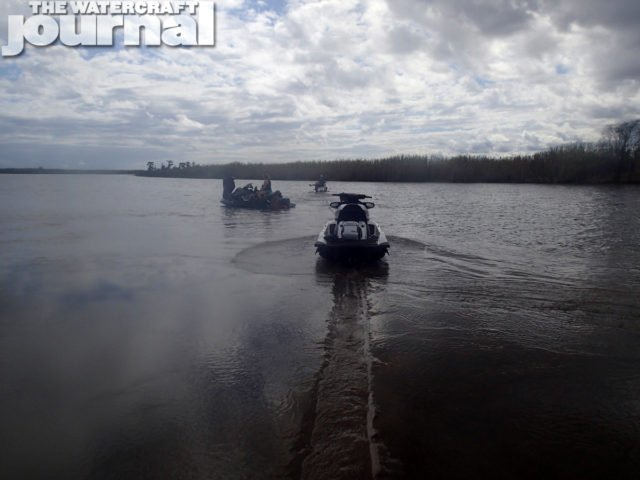
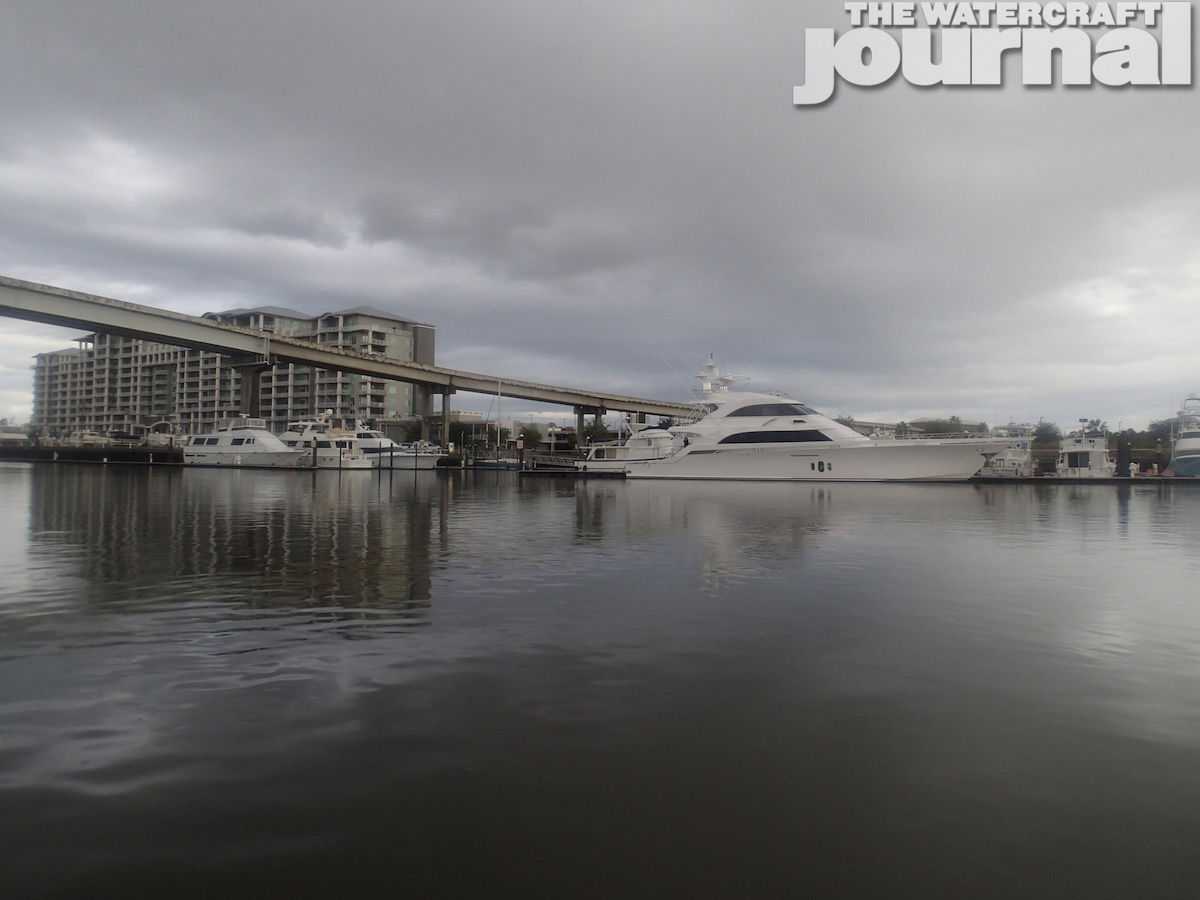
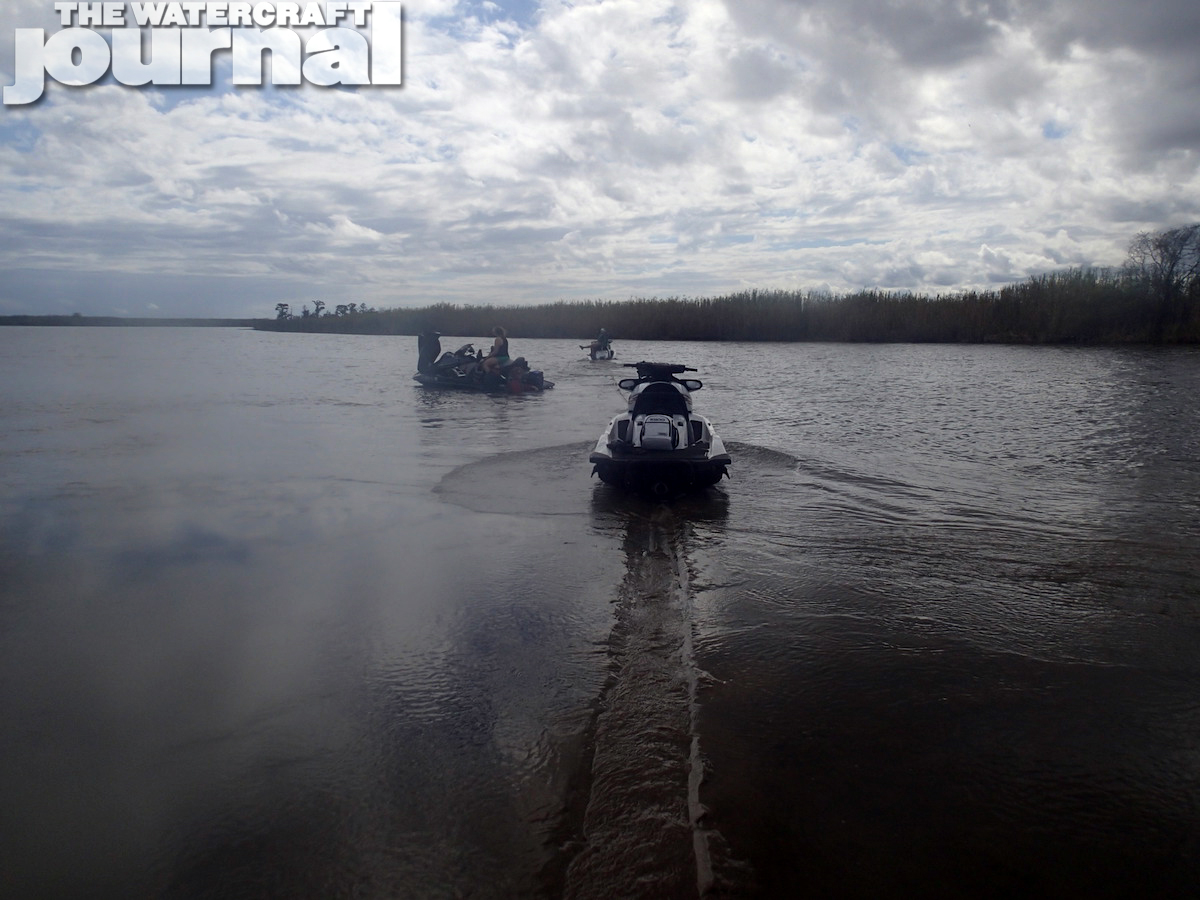
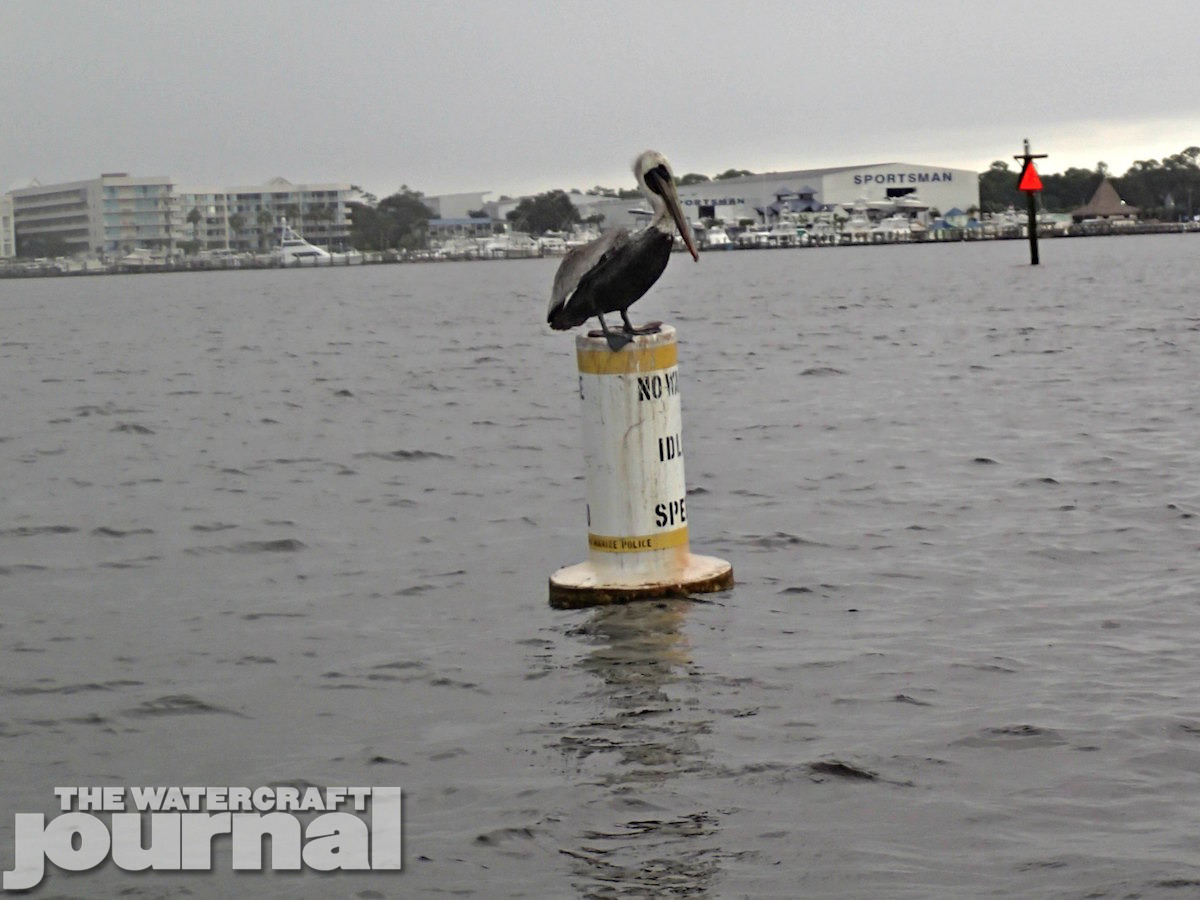
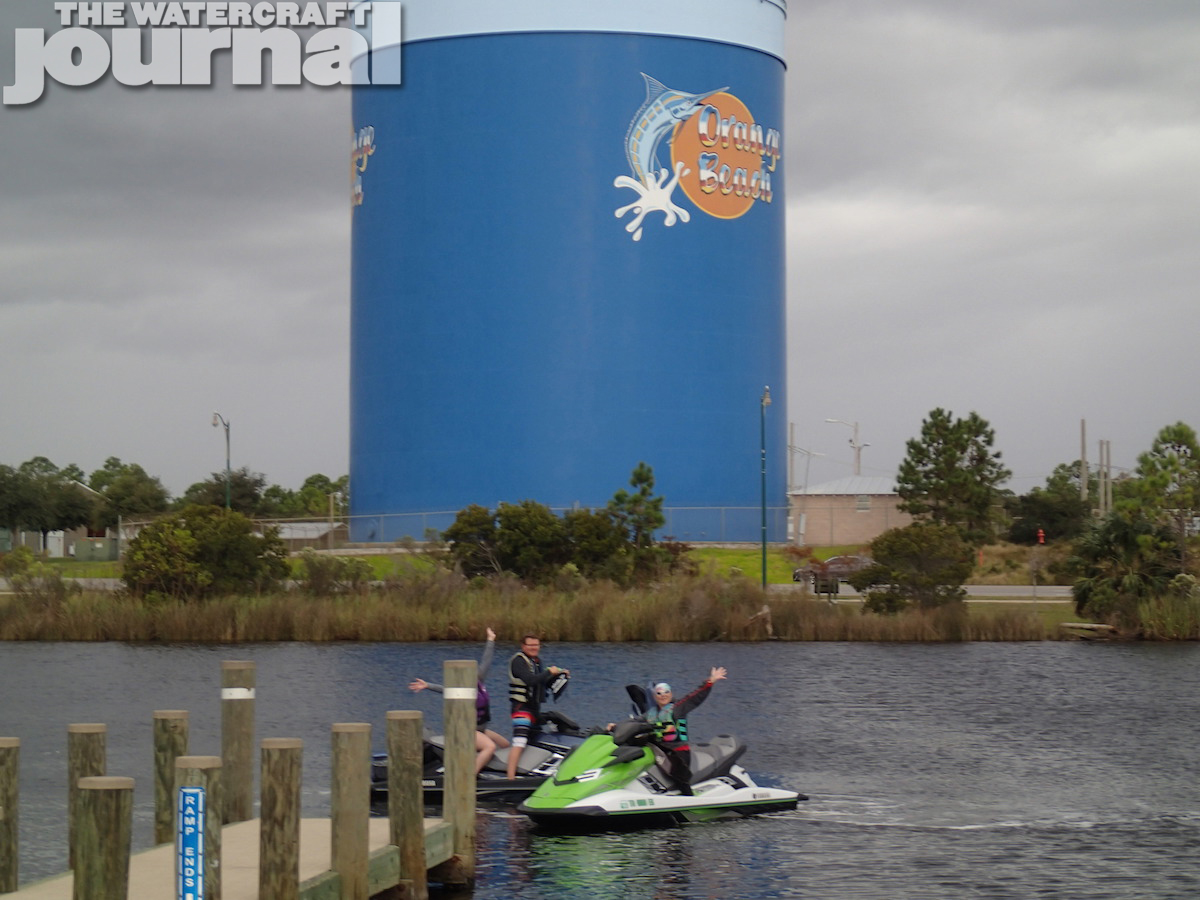
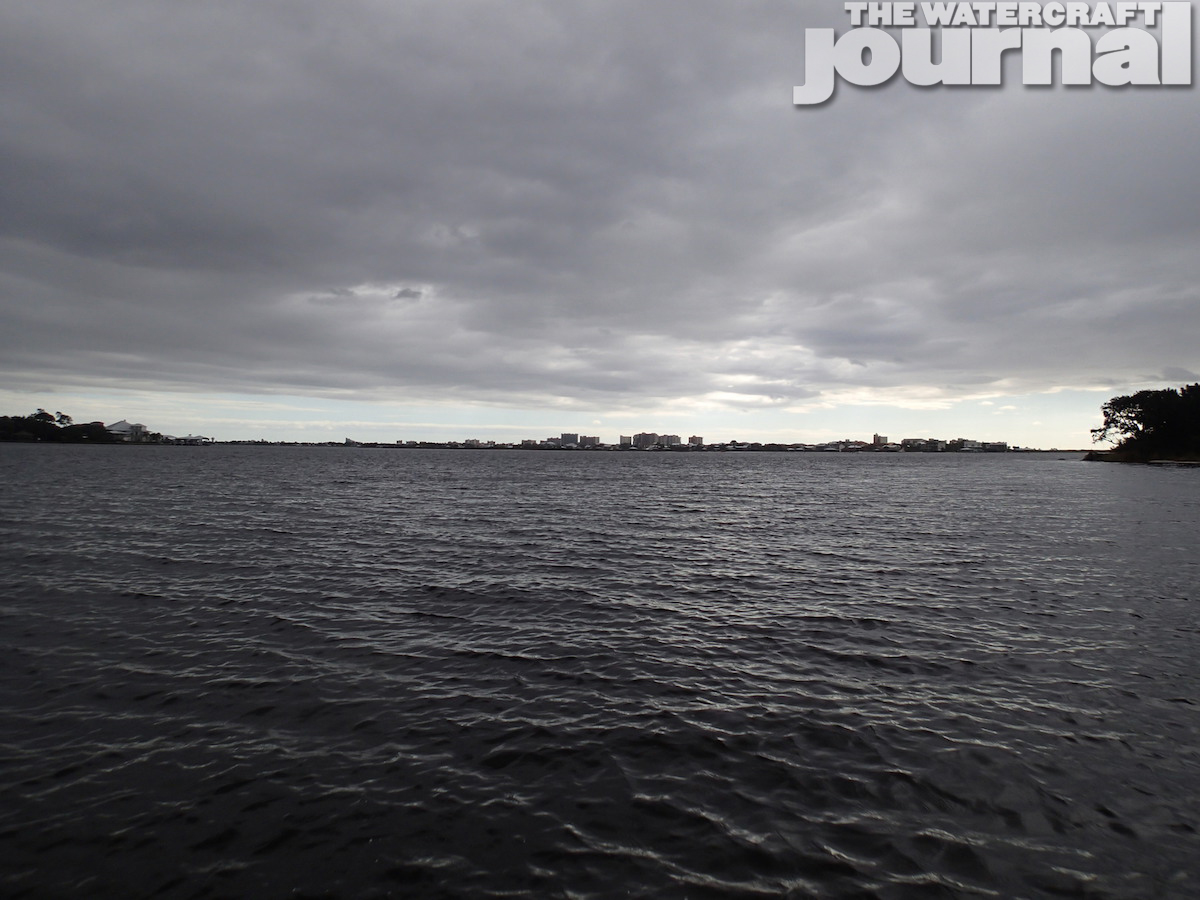
Just because we are finished with our scheduled rides for the season doesn’t mean the adventure stops; many of us continue to ride through the winter exploring new bodies of water and scoping out potential destinations for a group rides. A few weeks ago, a group of us traveled down to Orange Beach, Alabama, for the weekend to check out the local waters. Our home for the weekend was Sunswept condos; it afforded us a great view of the Gulf! The weather conditions during our stay was 65 degrees, overcast and a small craft advisory posted the entire weekend. With that, we decided to contain most of our riding to the GICW (Gulf Intercostal Waterway), a chain of inland passages along the gulf coast from Carrabelle, Florida to Brownsville, Texas.
From our location there was a free public launch ramp just about a mile’s drive called Cotton Bayou Boat Launch. There was ample room for parking, a double launch and the local police had eyes on it. Our ride plan for Friday was to go from Orange Beach to Mobile. Mobile is Alabama’s only port city, the 9th largest port in the US and is a 63-mile one-way ride from our location. As we pulled away from the launch area, the No Wake zone was brutal as it covered all of Cotton Bayou – an excruciating five miles! Finally, we made it out to the channel into Perdido Bay and headed northwest across several smaller bays until we found the entrance to the GICW. Nestled in the back and far western end of Wolf Bay, the water had been rather choppy so the protected passage was a welcome relief.
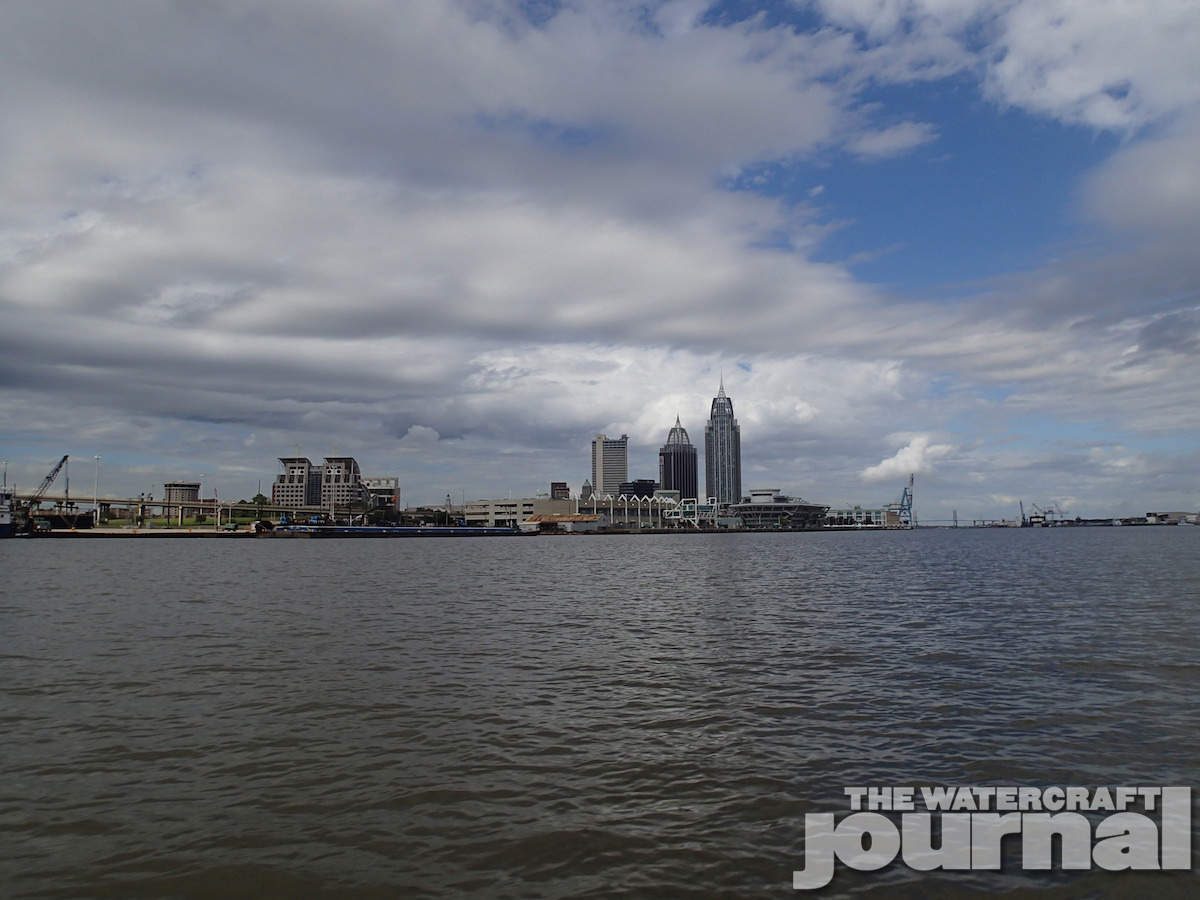
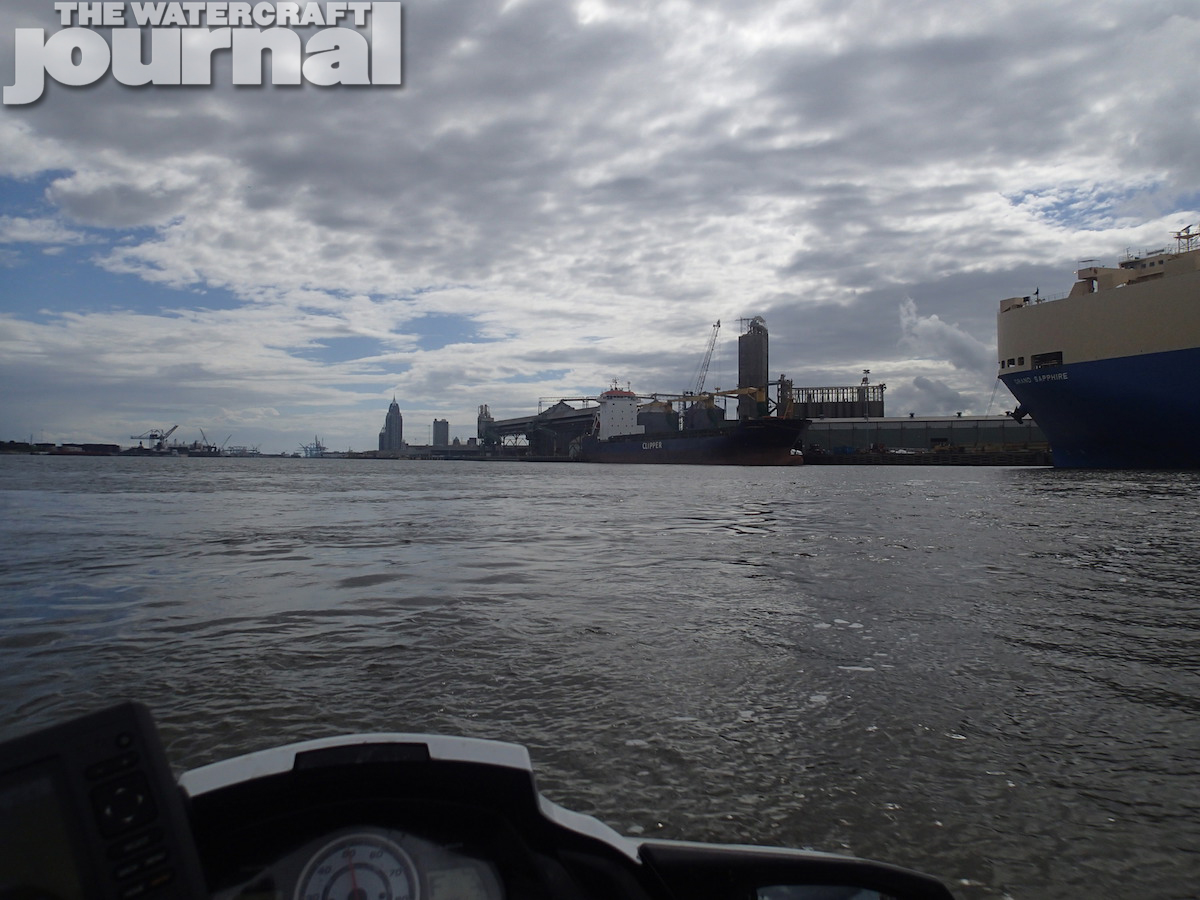
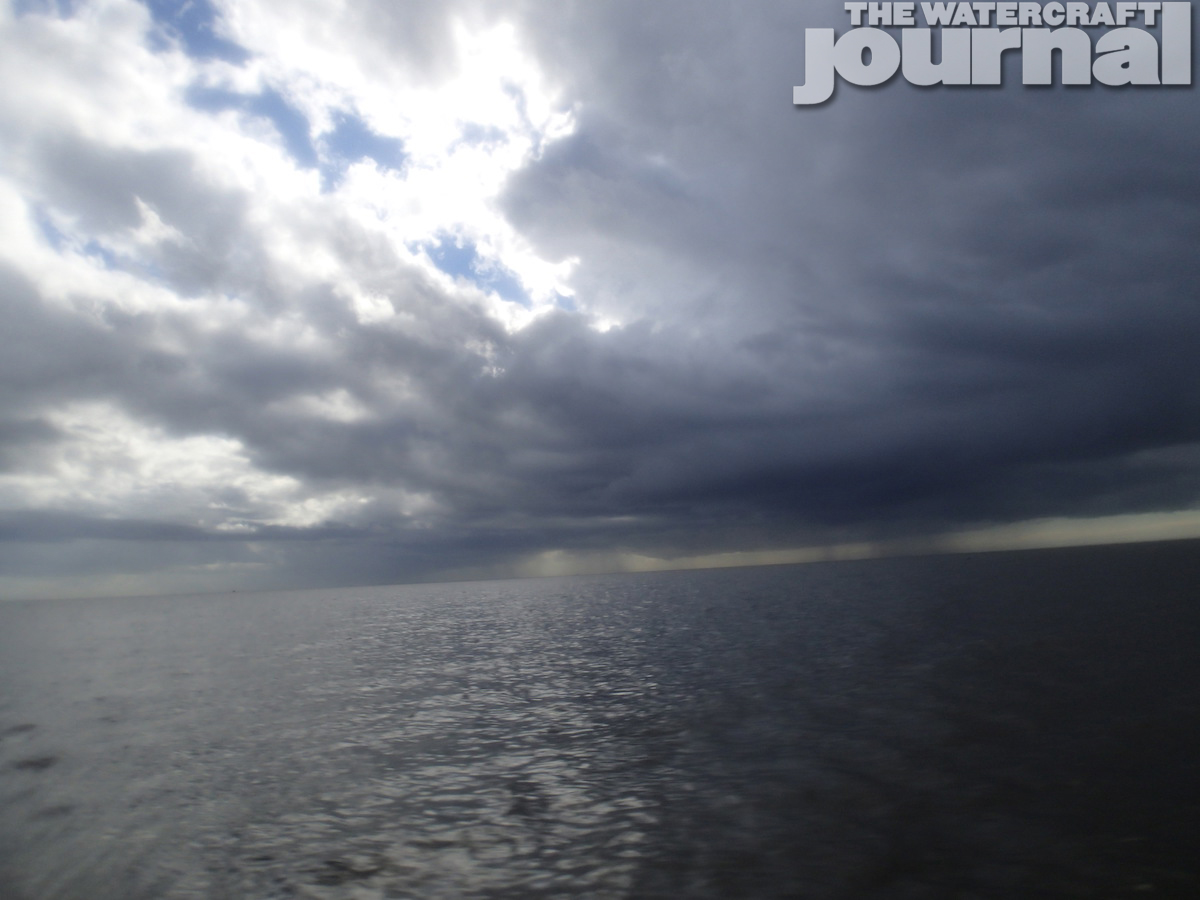
If you have never chosen to ride the intercostal you are missing some pretty cool sights and some very smooth water. Yes, the barrage of No Wake zones are a pain but it wasn’t too bad in this section. We stopped at the entrance to Mobile Bay for a water break. We had traveled 23-miles from the ramp. It was pretty early in the day and Mobile Bay looked calm. This was great news! From here it was another 36 miles to our destination, the USS Alabama. We are use to the rivers we generally transverse around the eastern US and this was a big change. We headed northwest across the bay. The water was really nice with a one foot chop. We had to be constantly adjusting our course to avoid rain showers moving across the bay. After about 20 minutes of riding we could barely see the Mobile skyline rising on the horizon. As we continued it became larger and larger.
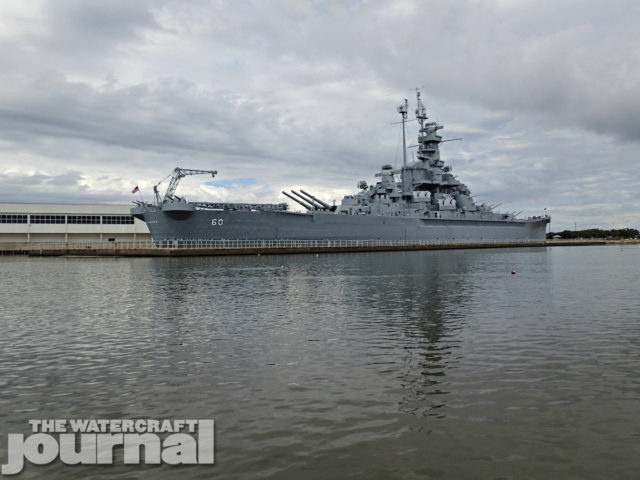
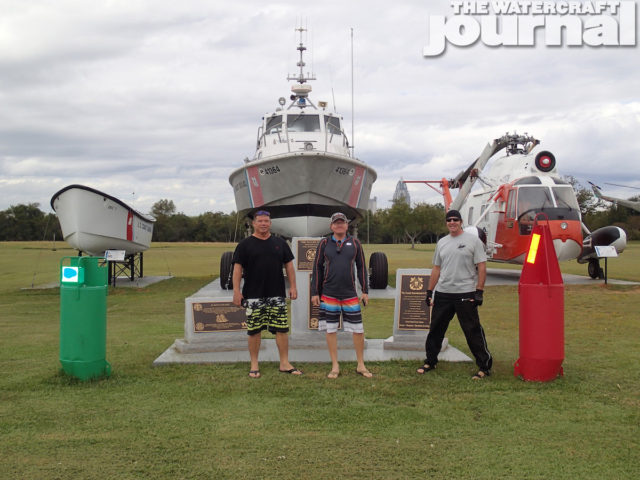
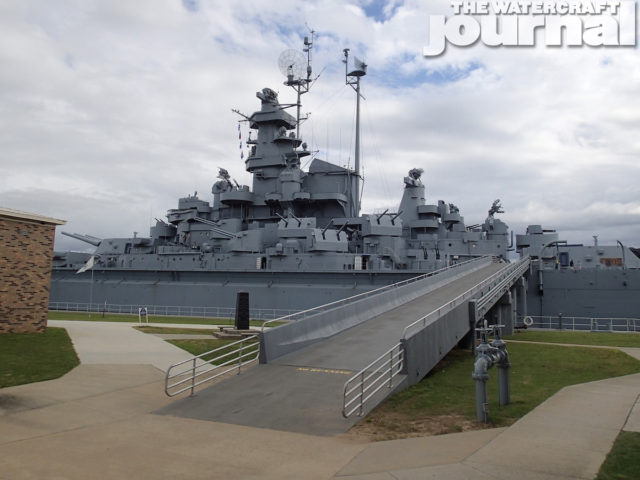
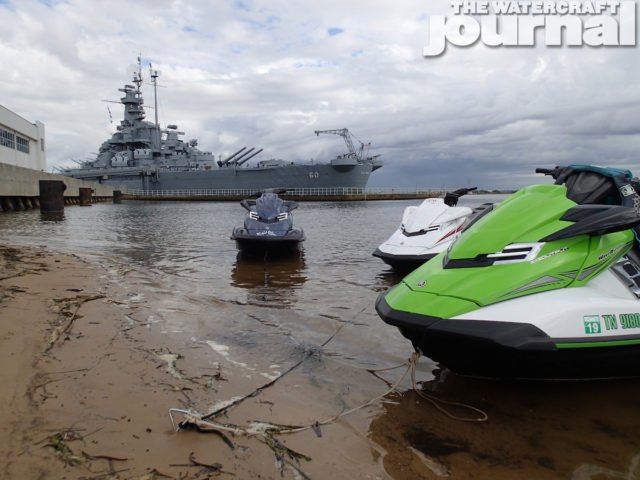
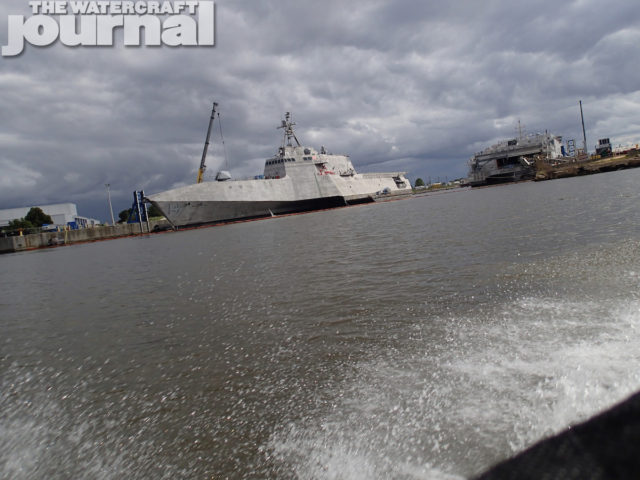
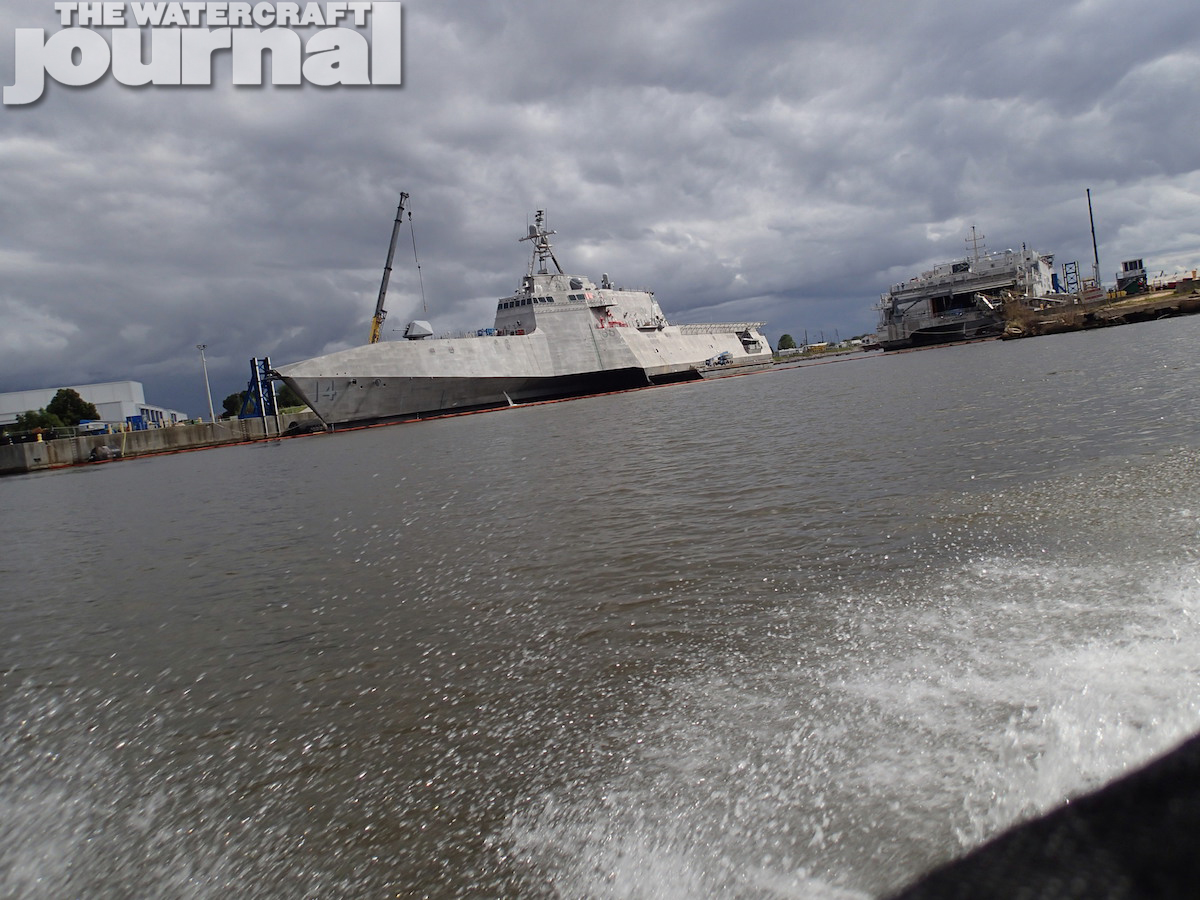
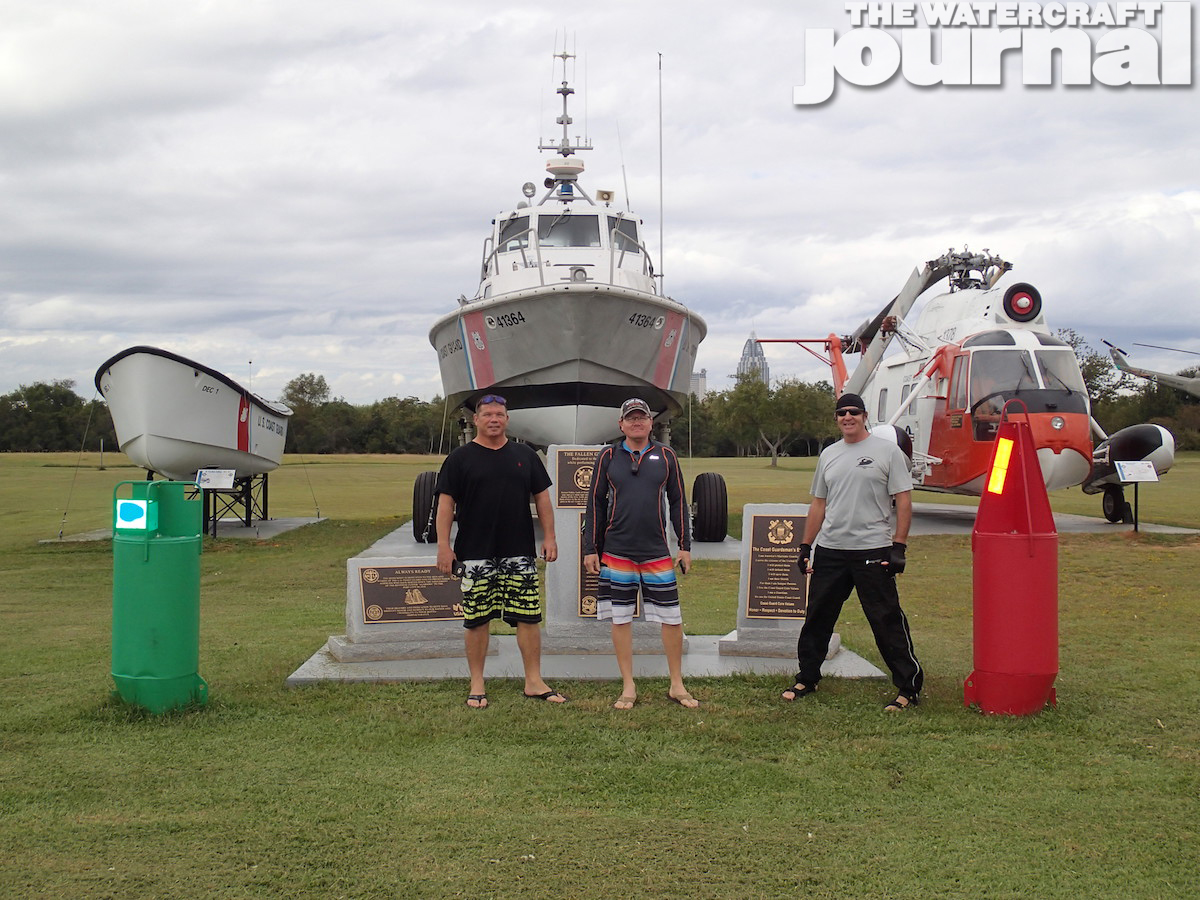
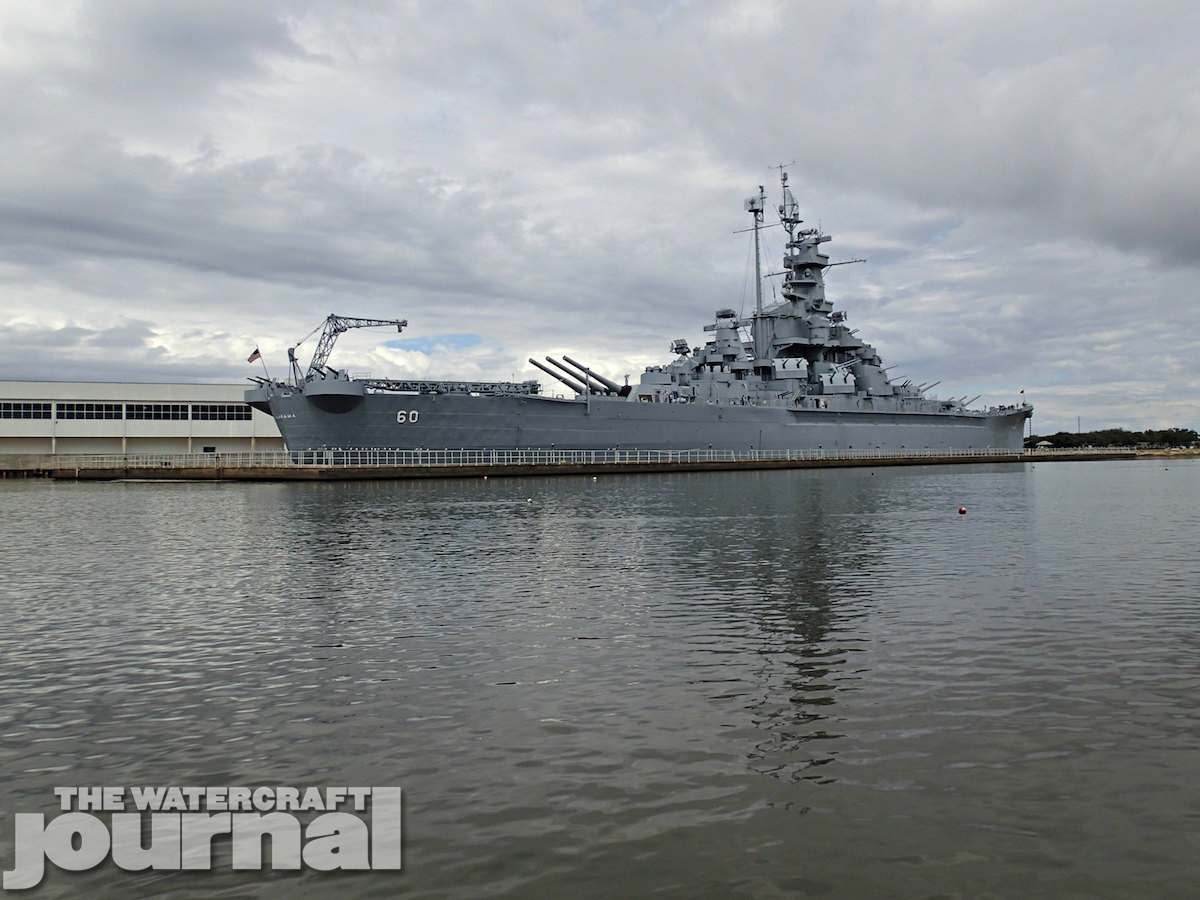
Still out running the rain, we were now up against the western shore. We passed the entrance to the port of Mobile and continued until we reached the USS Alabama. How awesome it was to be able to ride up to this magnificent warship. After a photo, we beached our skis next to a private launch on the property and took time to walk the grounds and visit the ship’s store. We returned to the skis just in time to see them get plummeted by the “Duck” – an amphibious tour vehicle – as it entered the water. Luckily we were there to recover our boats. From there we headed back to the entrance of the port (Mobile has a rich in military ship building history, with ships having been built since 1917, including the new Littoral Combat vessel). The Port of Mobile is also the end of the Tombigbee Waterway, a short cut to the Gulf and ends up back in our home waters in Tennessee.
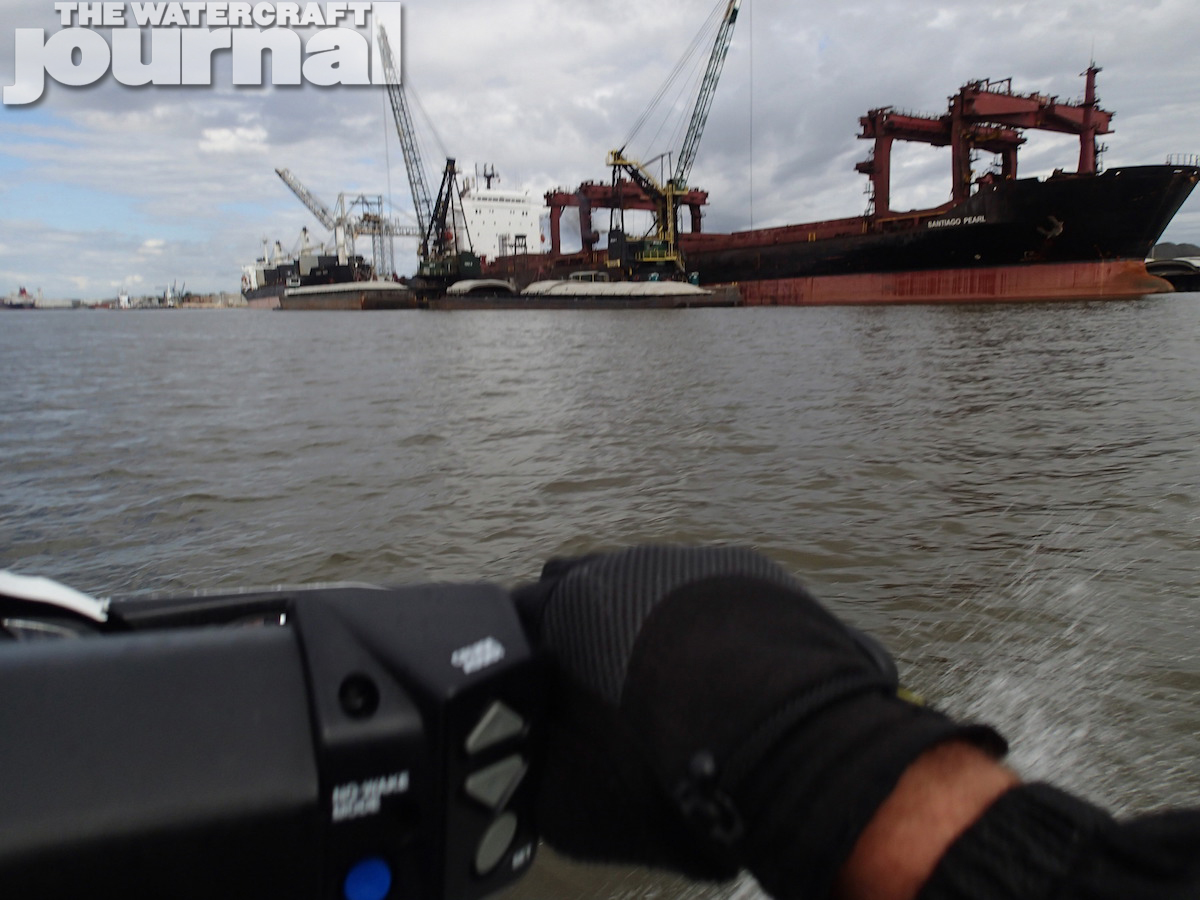
As we cruised up the waterway, it was bustling with workers on barges and ships from all ports of the world unloading cargo. We passed three new war ships under construction and are sure Big Brother had eyes on us. As we continued towards Downtown Mobile and under the bay bridge, my plan was to swing back into Silver Creek and come back down to the USS Alabama, but I miscalculated the entrance, which was a 180-degree around a power tower and found myself 100-foot deep in 8-inches of water. I reluctantly spent the next hour pulling my way back to the freedom of deeper water. After this, we decided to play it safe and return the way we came. We had traveled eight miles up the Tombigbee and needed to go back eight miles and then another seven miles to the nearest fuel, which was up the Dog River.
I knew we were pushing the fuel limits of our skis and breathed a sigh of relief when we approached the fuel dock. We just traveled 84 miles on a single tank – this was the best range I have ever got and it couldn’t have come at a better time! After we fueled all the skis, had a candy bar and a drink, we needed to head back. It was getting late in the afternoon and we had another 60 miles to the launch ramp. Pulling out of the Dog River back into Mobile Bay the wind had picked up and the one foot chop now was two-to-three foot chop. We tried to find the best line but there was none. We had to just grin and bear it. We made the most direct path possible back to the entrance to the GICW and when we arrived took a needed break. From here back to the launch ramp was a pretty smooth ride. Arriving back at the ramp as the sun was reaching the horizon was a beautiful sight. All in all the ride was an excellent day trip and I would highly recommend the journey; the many great sights and varying water conditions made for a great day!
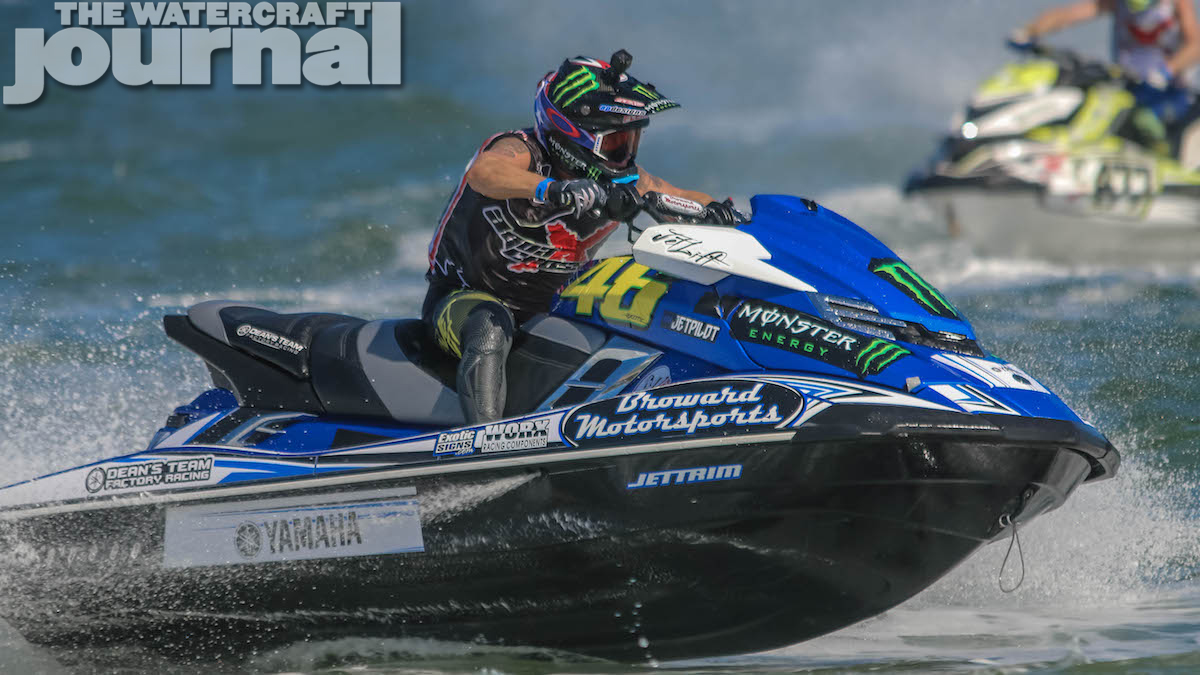
The latest news out of Yamaha racing adds to the books the dominating power of the Yamaha GP1800 and Yamaha’s incredible riders. This past final weekend of the P1 AquaX season showed total domination by Yamaha alone as its riders took the top three spots in every single Enduro Pro heat.
It was Chris MacClugage who claimed the National Enduro Pro title and he even did so despite riding with a broken leg which goes to show the shear dominating power of Yamaha riders and the GP1800. MacClugage went to Fort Lauderdale with a sizable points lead and was able to fight off enough of the competition during Enduro Pro Moto 1 and Moto 2 to claim the crown.
“This was a great inaugural year for the GP1800, dominating the national tour and IJSBA World Finals,” said Yamaha Watercraft Racing Director Scott Watkins. “And it helps to have the best riders in the sport onboard, with great support from the likes of Dean’s Team, RIVA Racing, and Broward Motorsports. I couldn’t be prouder of the commitment and dedication of all involved in this championship effort.”
The Enduro Pro position results are Chris MacClugage in first (aboard a FX SVHO) with Eric Francis in second followed by Brian Baldwin in third. For the full news story and you check out the awesome GP1800 for yourself, be sure to visit Yamaha Waverunners.