
Home Blog Page 381

Switchblade: 2015 Gibbs Quadski XL

10

QUAD1

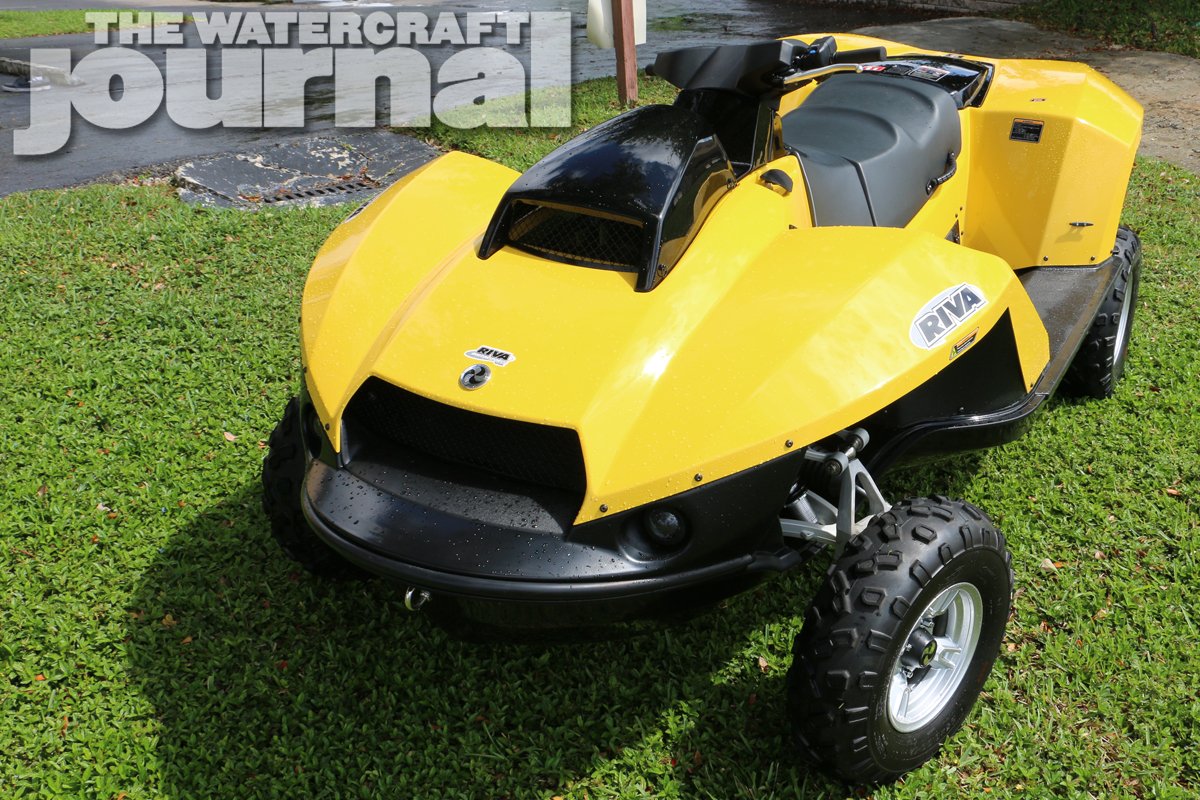
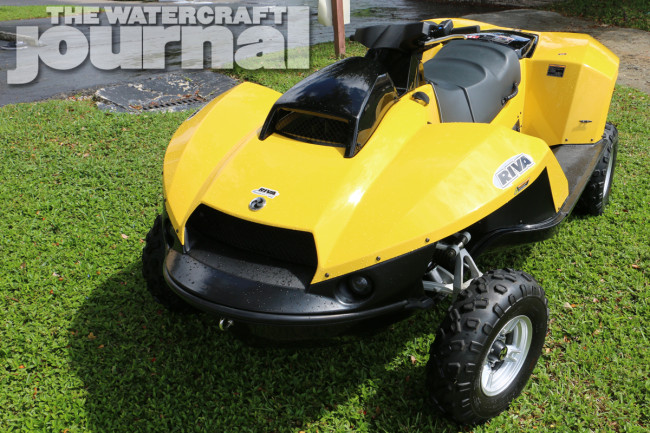
At first blush, it’s almost too much to take in. High reaching fender flares jut out at aggressive angles. A broad trapezoidal grille gapes open like a hungry maw. The footwells are deep enough to use as park benches and the wide tail could be mistaken for that of a small sport coupe if driven on the highway. On land, it stands 53-inches tall with over eight-and-a-half inches of ground clearance.

Dwarfing any personal watercraft available today, the 2015 Quadski XL is humongous. Built by Gibbs Sports Amphibians out of Auburn Hills, Michigan, the massive 140.2-inch long two-seater ATV/runabout bests its smaller one-seater sibling – the Quadski – by a full 12-inches, and is only outsized by Yamaha’s legendarily-massive 151.6-inch-long SUV 1200. Oh, and the Quadski is wide too, 62.5-inches wide in fact.
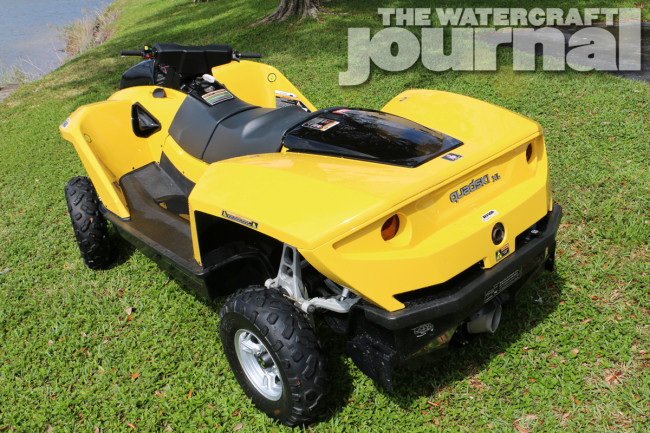
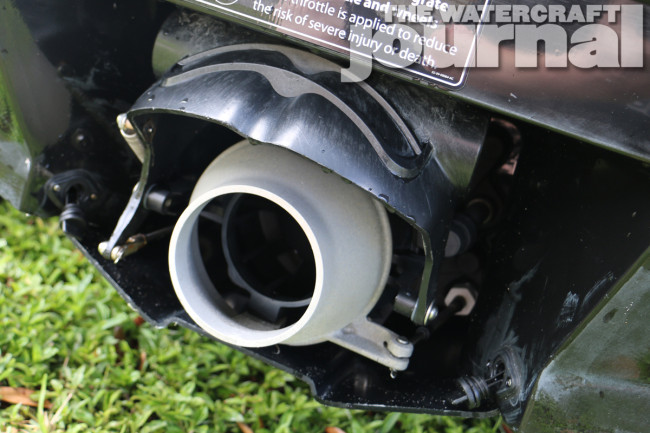
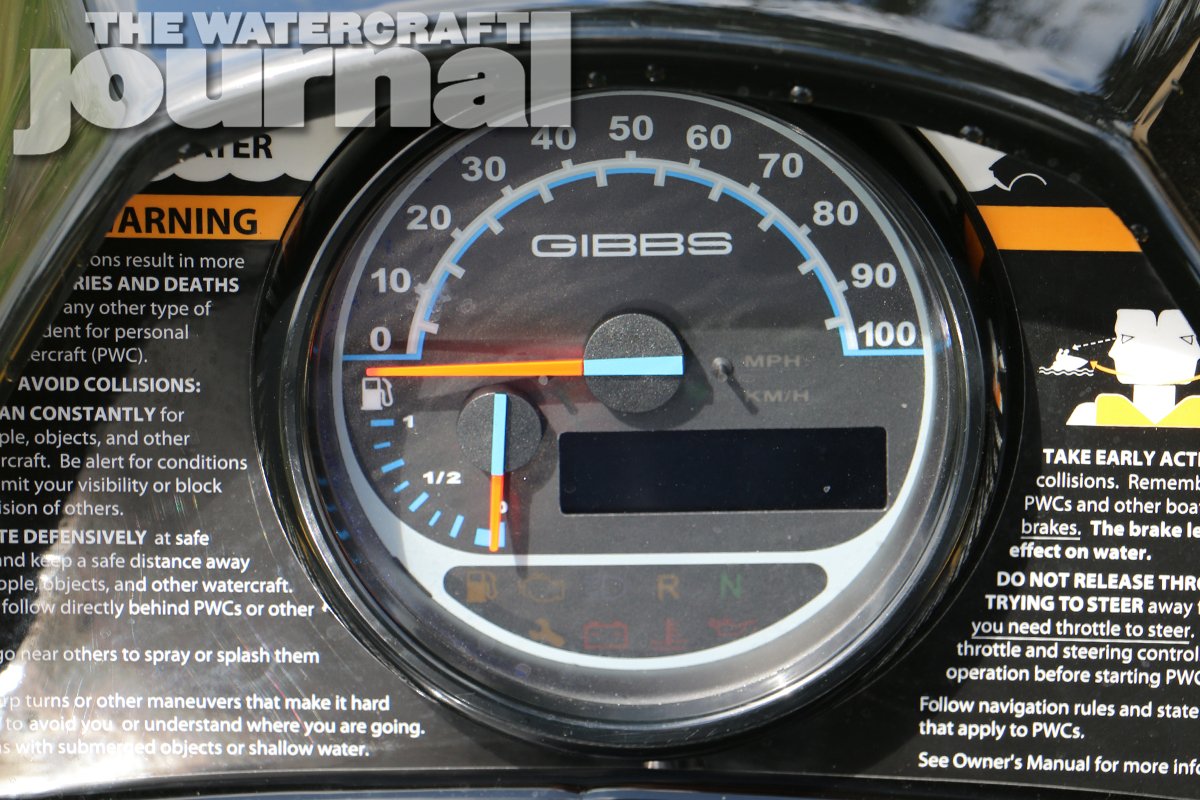
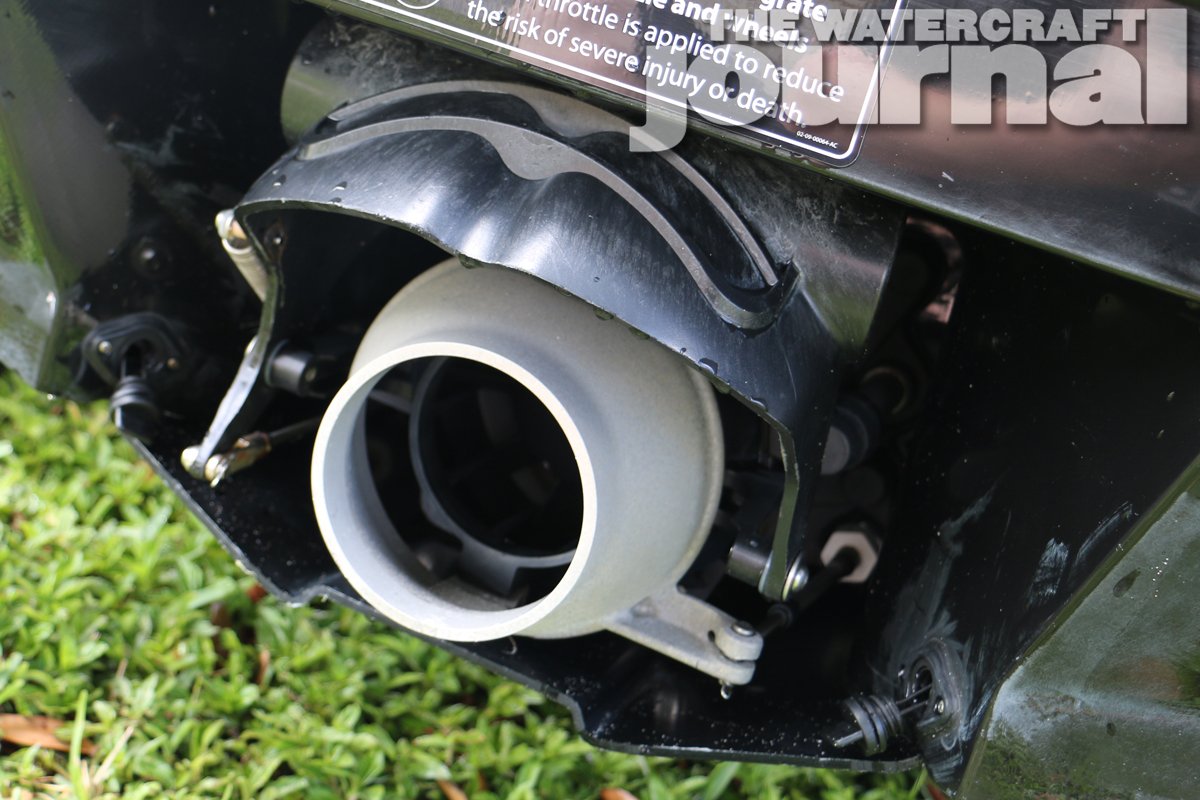
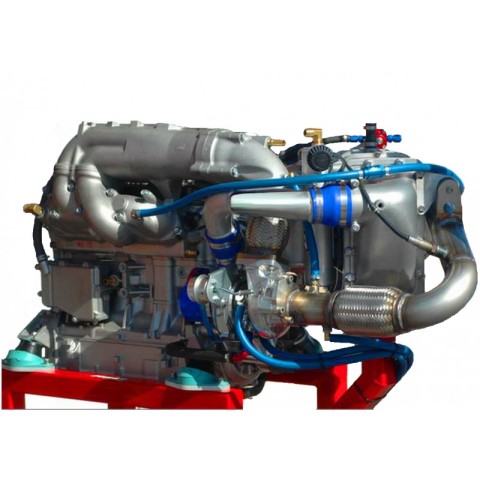
Whether shifted through a sequential, electronically-controlled gearbox with a centrifugal clutch (with an electronically-operated land reverse gear), or propelled by a proprietary lightweight jet drive pushing thrust through an 11-vane stator via a stainless steel 5-blade impeller, the BMW’s 140-horsepower K1300 (1293cc) water-cooled 4-stroke in-line 4-cylinder brings the Quadski to a maximum of 45mph, be it on land or at sea.

On terra firma, the Quadski XL is manageable, handily responding to inputs given through the wide, fixed steering. Controls are a blend of traditional ATV and PWC, which are both familiar and a little confounding, only because you find yourself forgetting that this machine is both. In fact, Gibbs instructs that the Quadski be registered as both an all-terrain vehicle and a personal watercraft.
21

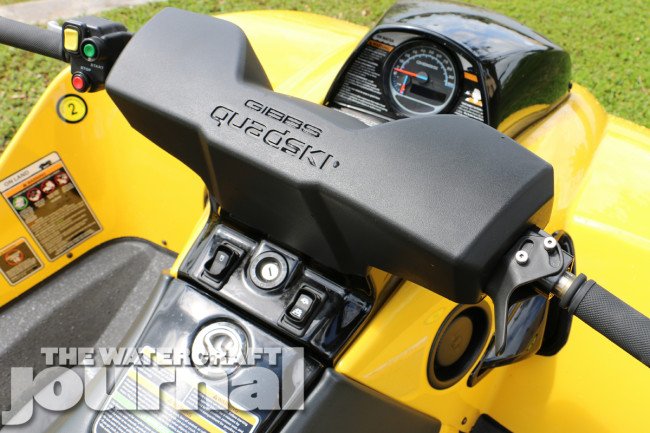
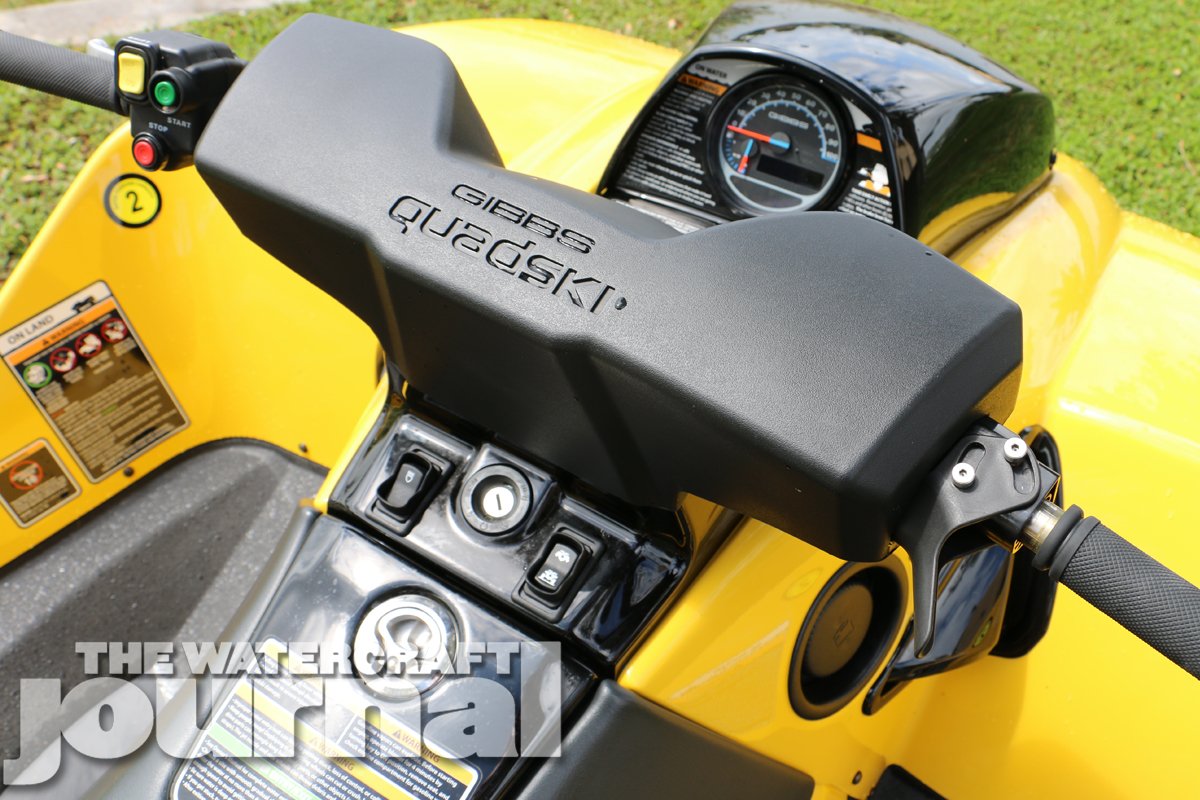
Gas is applied through a thumb throttle, and while on land, brakes are applied through a traditional left-hand lever. Gear shifts (be them up or down) are inputted through a yellow toggle switch (very similar to current Kawasaki Ultra models’ trim control), and ignition is sparked by first turning the key to “On” in the center console, and then pressing the green start button.

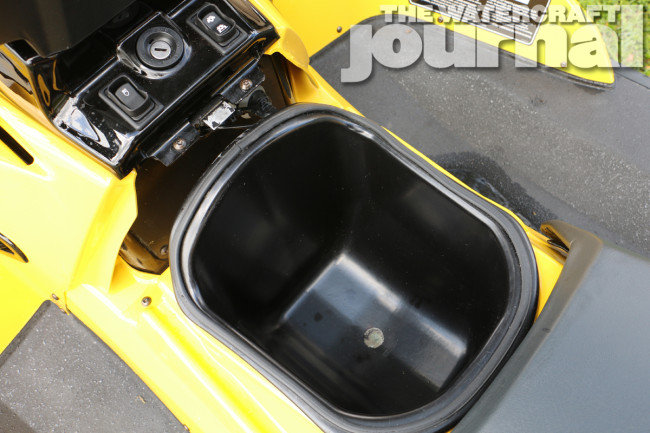
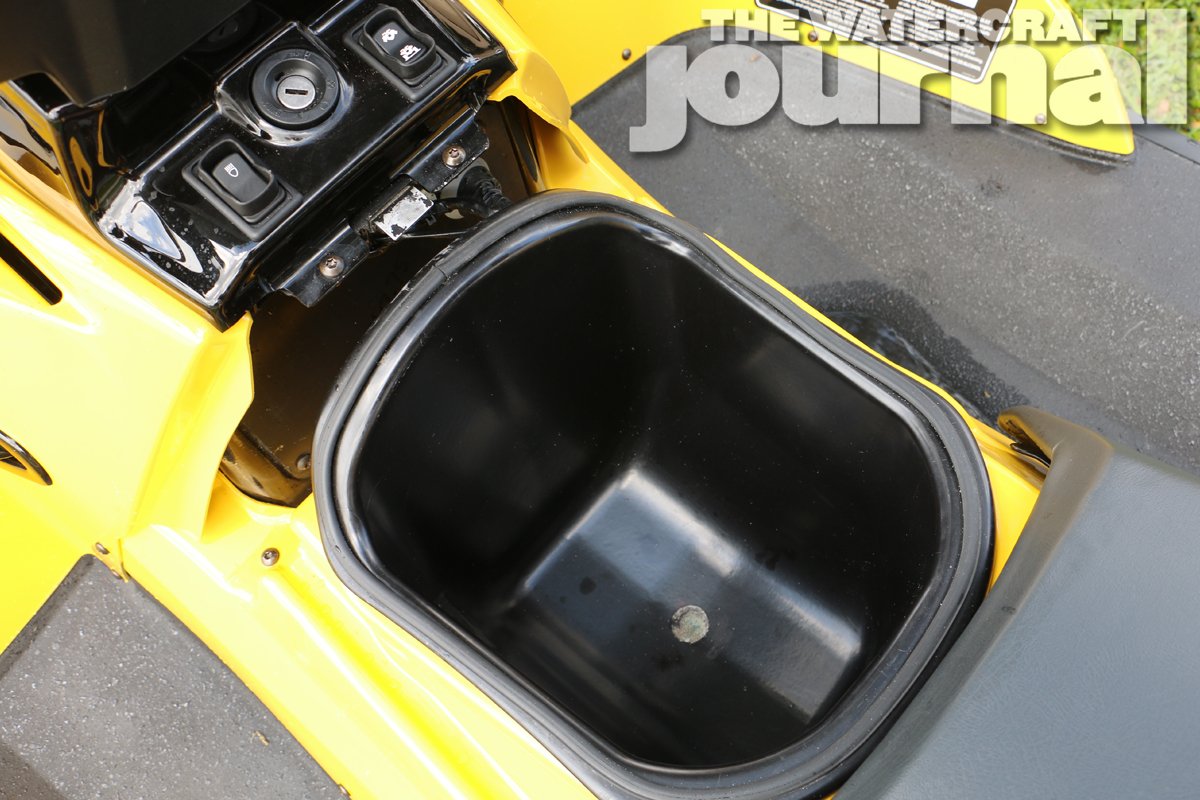
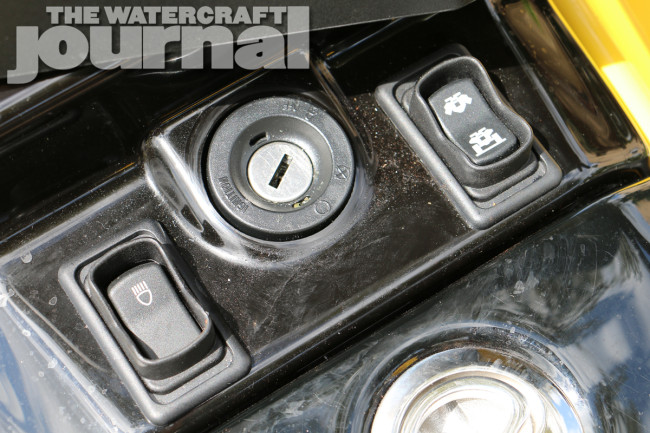
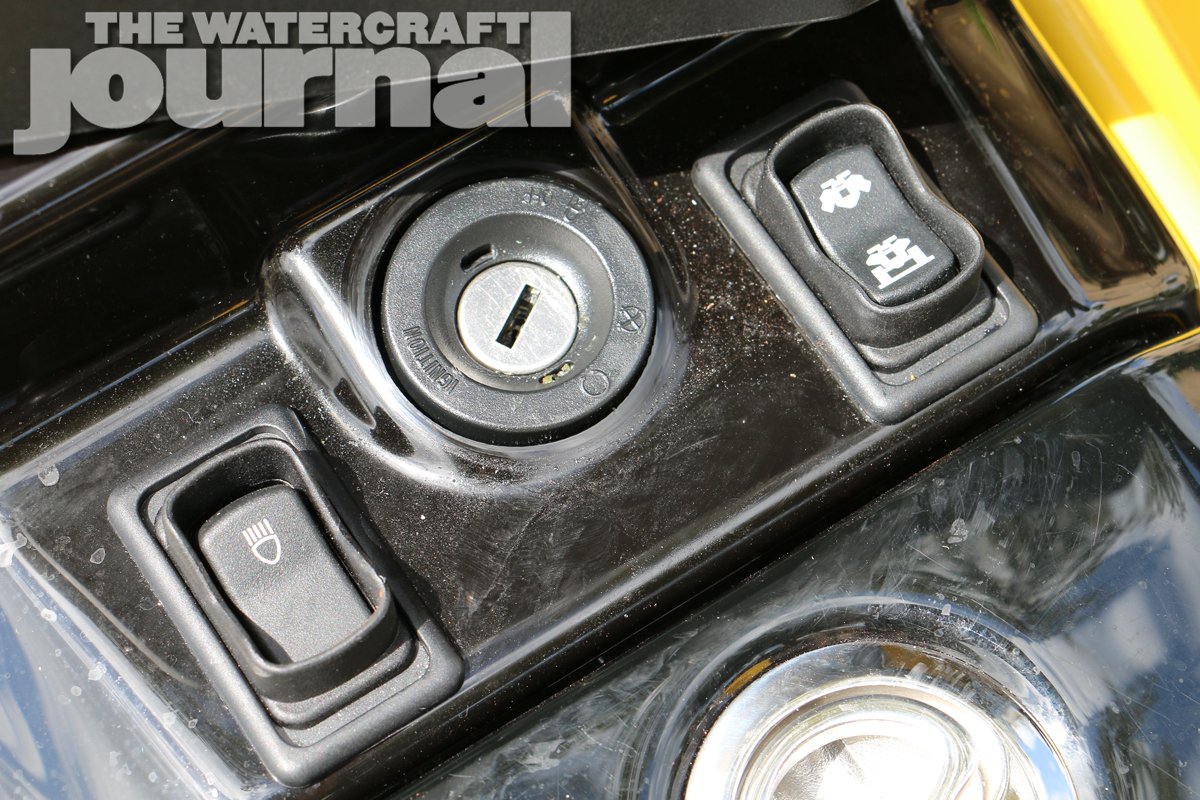
As mentioned above, an electric reverse wakens the starter and propels the Quadski backwards, but only for short 10-to-15 second internals. The toggle for the driving lights are found to the left of the keyed ignition tumbler, with the High Speed Amphibian (HSA) switch to retract and deploy the suspension to the right of it (more on that in a minute).
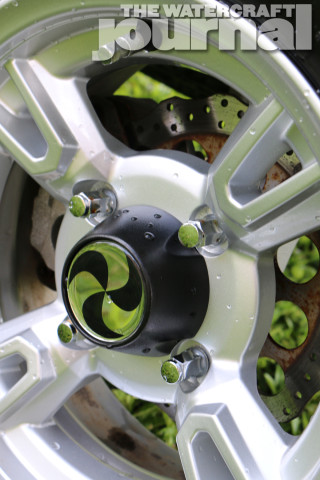
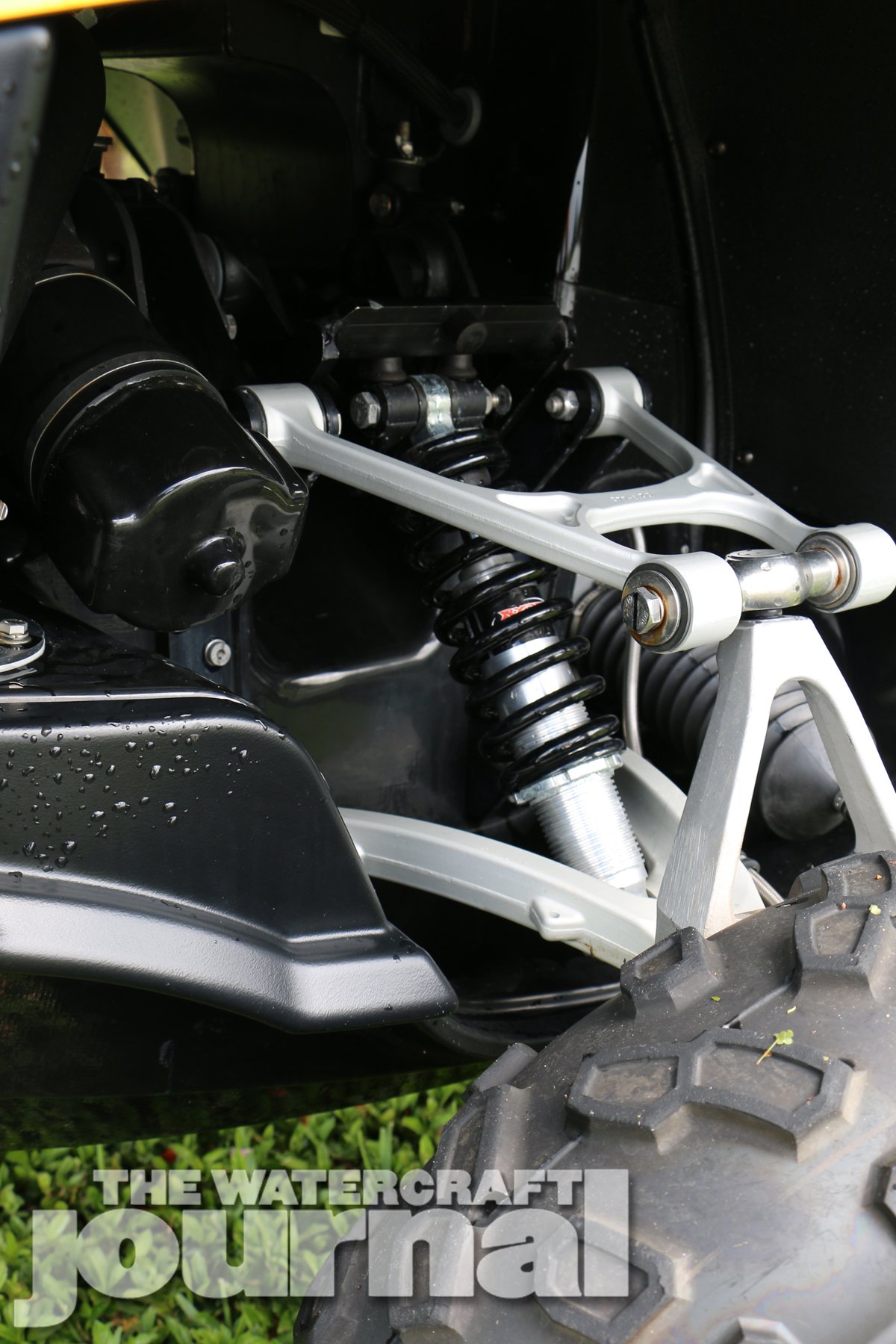
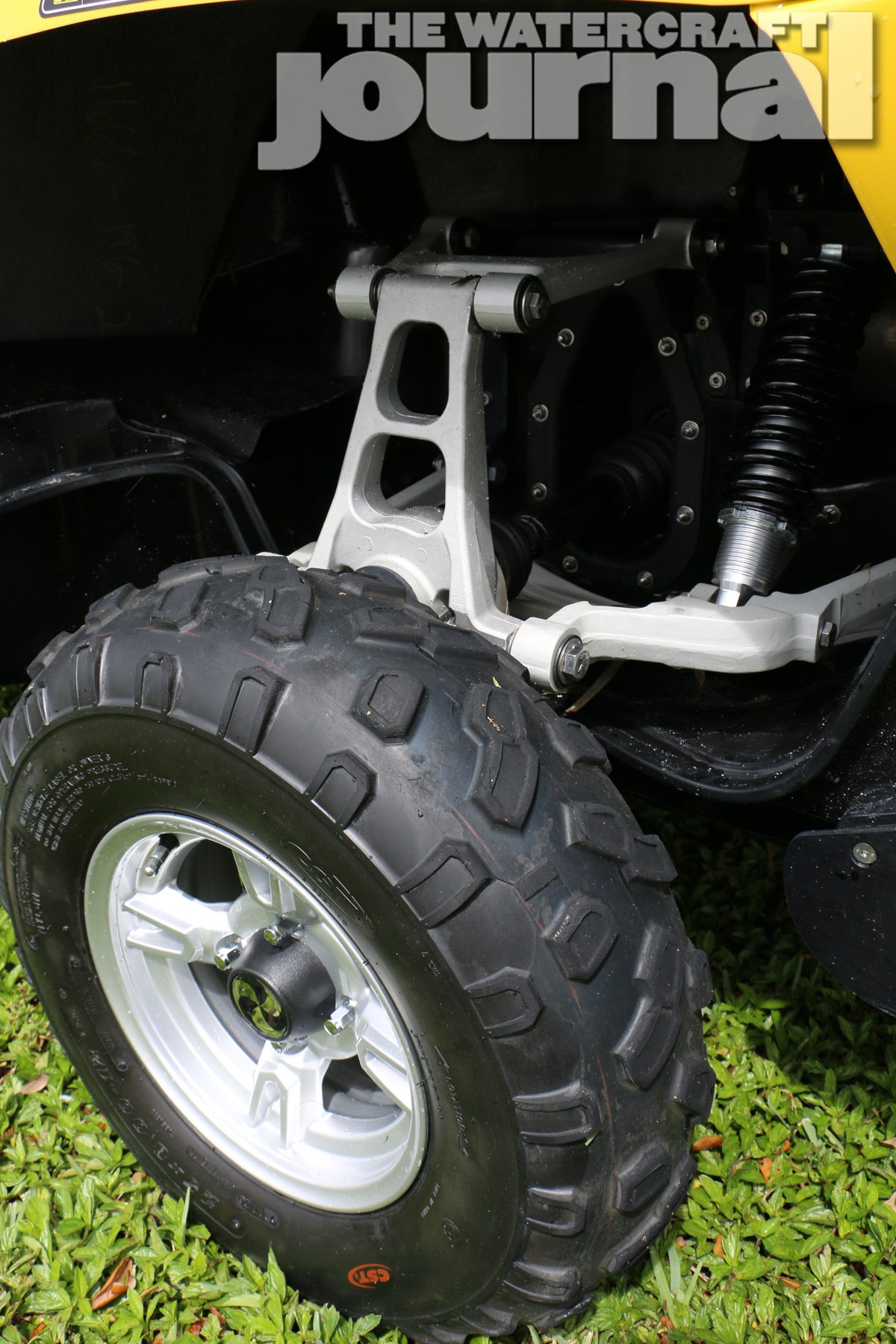
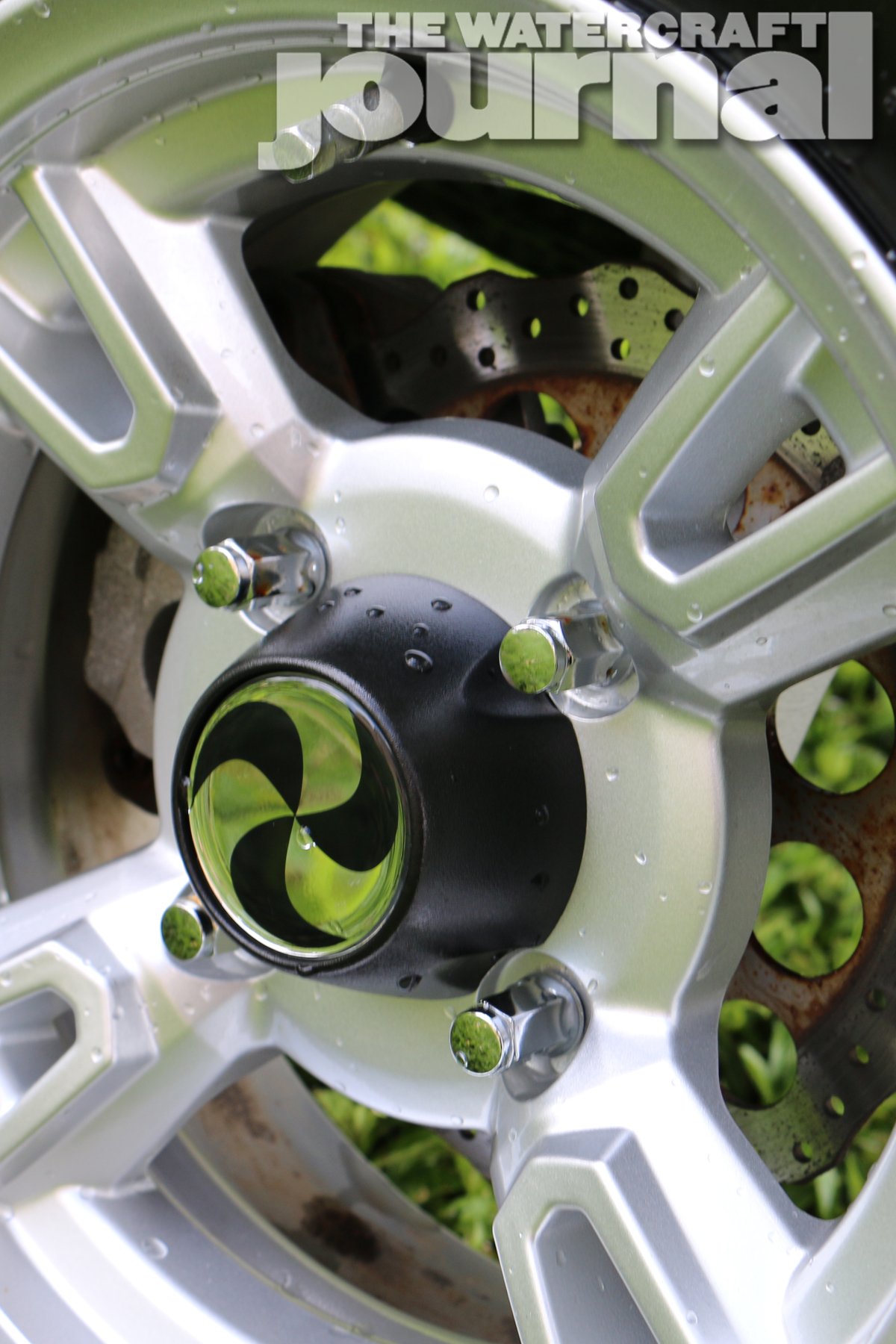
Both the Quadski and two-seater XL ride on 12-inch-tall aluminum four-spoke rims with 25x8x12 all-terrain nobbies, halted by four-wheel disc brakes and suspended on independent coil springs and hydraulic dampeners. More so than anything else, the Quadski’s innovative and entirely unique suspension is what makes this duplicitous machine so extraordinary.

We at The Watercraft Journal were honored with the opportunity to be the first to review the newly unveiled Quadski XL. Provided to us by RIVA Motorsports, the leading Quadski dealer in the US, as well as the only licensed distributor for the Southeast, we were given unprecedented access to this incredible machine. Between waves of springtime rainfall in southern Florida, we pushed this near $48,000 vehicle as far as we could.

22

Somewhat limited by it’s RWD platform and heft (an astounding 1,437lbs.), many have found the Quadski to be less than adept for off-road. We find this somewhat subjective as lifeguards and emergency services employing the Quadski regularly traverse obstacles without incident. Nevertheless, the BMW’s 87 ft. lbs. of torque adequately pulled us up the launch ramp and out of the water every time.

Our time ashore was limited to the parking lot and launch ramp (with a little bit of driving on the lawn, but don’t tell the superintendent), but once we hit the water, the lake was all ours. Our initial fears of submarining the nose down the ramp were staved by a slow initial decent. The BMW breathes through a baffled air box (similar to a Jeep snorkel), making it incredibly difficult to swamp the motor.
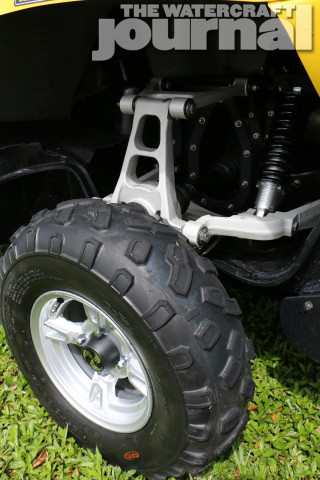
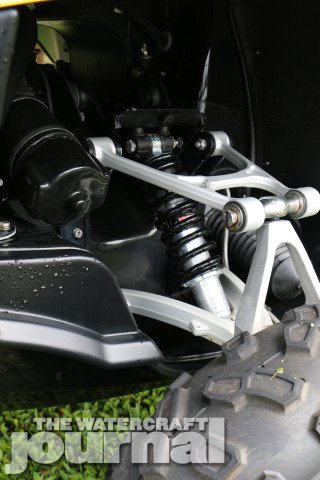
Even while on land, the prop never disengages from the gear-driven transmission, making launches instantaneous. The Quadski wades out into the lake naturally, but won’t engage full throttle until the suspension is fully retracted. Pressing the two-way toggle to “wheels up” takes 4-to-5 seconds, a chime pinging until the conversion is complete. Likewise, once the transmission is shifted to 1st gear, the Quadski is ready to rip.

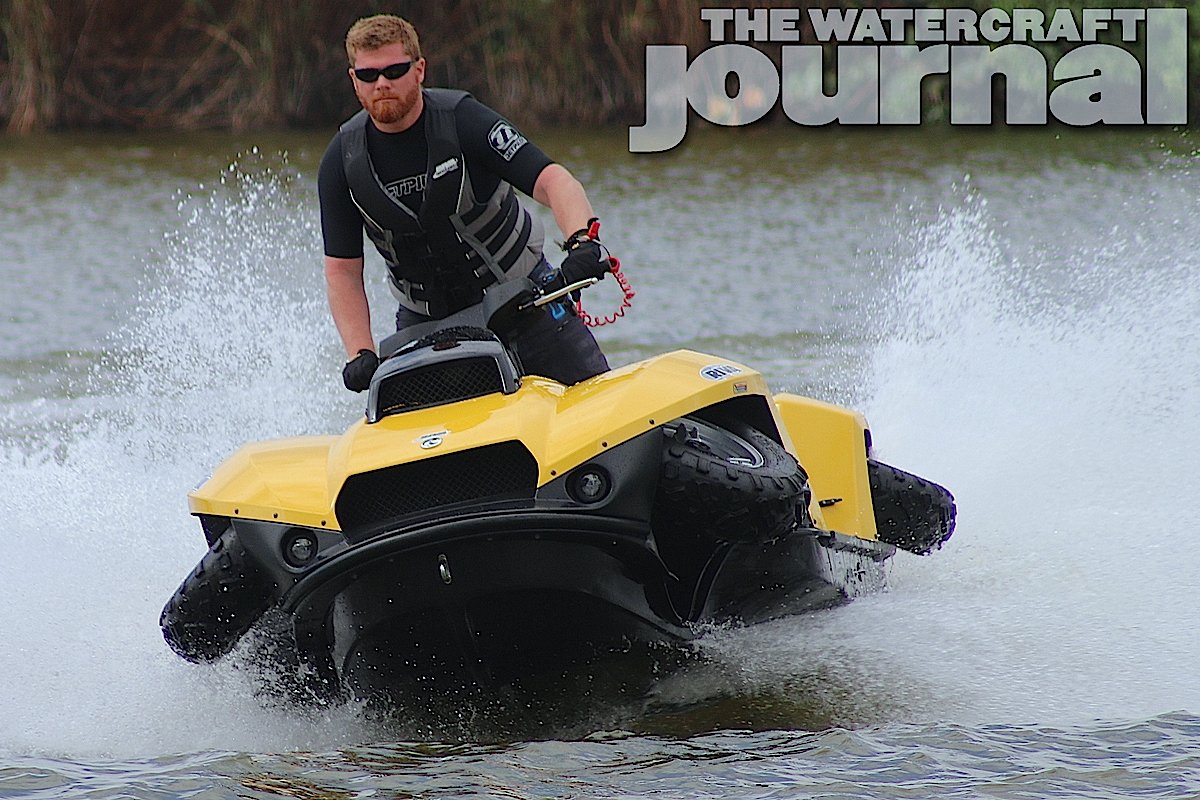
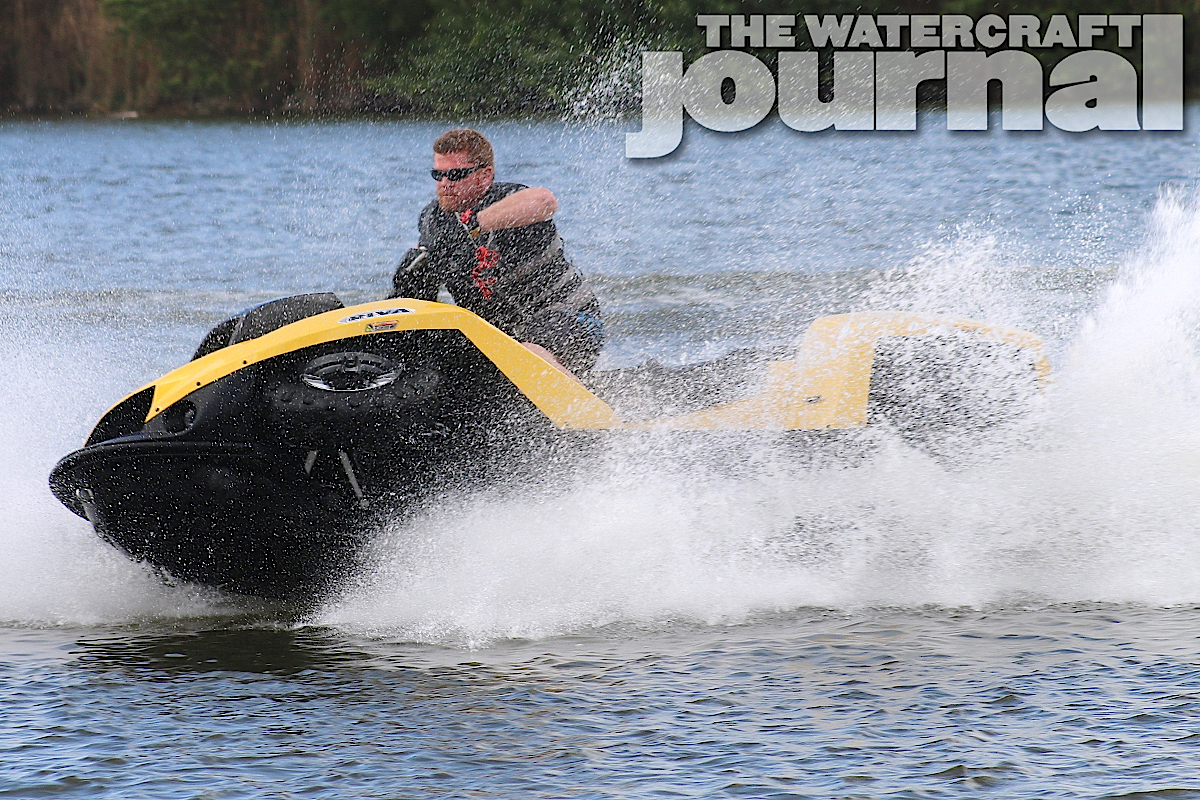
With the wheels neatly tucked in beneath the fenders, the Quadski XL quickly rises to plane. Responsiveness to throttle and cornering is muted, requiring a much more coaxing than what modern sportier watercraft provide – but again, that is to be understood given the Quadski’s bulk, weight and dual-action abilities. The ride is a wet one, and sacrifices all playfulness for Rock-of-Gibraltar steadiness.

19

The slightly tiered seat is wide and rigid, and is split covering a deep storage tub in front and conservative engine access behind. Rearward of the seat is a secondary storage compartment also housing the battery and fire extinguisher. Below the left-hand grip is a long-throw reverse lever that we found is better that keeping the Quadski stationary than actually reversing.

We noted some of the hull’s design to be reminiscent of previous Yamaha hulls in some degree, but wondered if the larger, deep-V of a Kawasaki might be better suited. The Quadski rode predictably and never wandered, but could benefit from a little more pep in its step. Large stainless steel sponsons are found behind the back wheels, and planted the tail firmly in a corner.
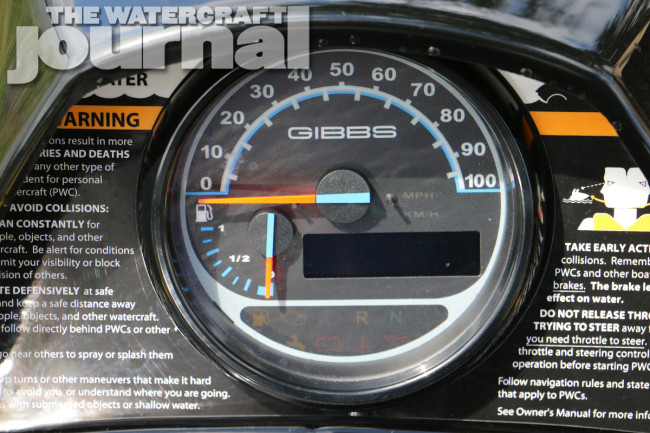
Ultimately, the Quadski XL is meant to traverse both land and water and it does so admirably well. According to our Garmin GPS, we ticked a maximum of 41mph with a 225lbs. rider and a full tank of fuel, pushing the XL’s overall weight closer to 1,800lbs. All things considered, that’s pretty dang good. Of course, the audience for this craft aren’t interested in cutting buoys or reaching break-neck top speeds, but something else entirely:

“The people who buy [the Quadski] don’t worry about the price,” RIVA Racing’s Marcos Smith explained. “[They] want to sail to the Bahamas, launch from their yacht and drive up the beach and back.” That might make several bristle with budgetary envy; yet even at close to $50,000 a piece, RIVA Motorsports manages to sell nearly two units a month. There’s a market for the Quadski and they love it. Frankly, we did too and see this culmination of engineering and ingenuity have created an impressive product.

Special thanks to RIVA Motorsports and Gibbs Sport Amphibians for use of the 2015 Gibbs Quadski XL.
8 10 9 6 2 19 11 3 1 22 7 21 14 12 5 4 13 15 16 17 18 20
<
>

Video: Jobe Sports Unveils New Omnia Kneeboard

0

maxresdefault

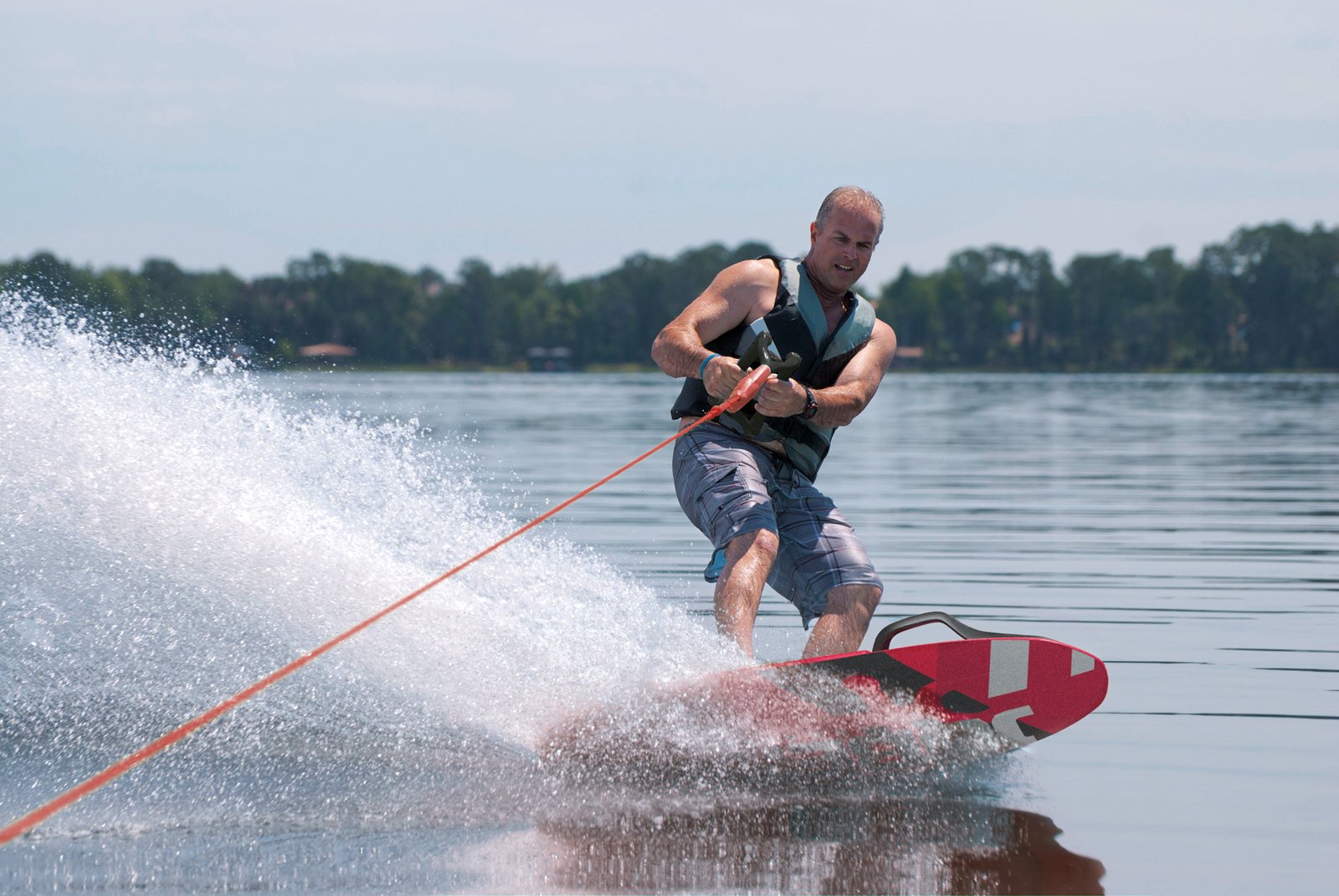
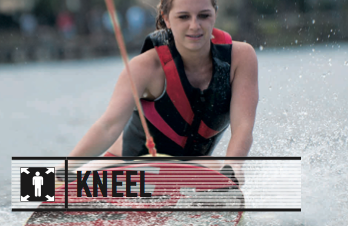
OK, admittedly once you come to learn what the new Jobe Omnia actually is, simply calling it a “kneeboard” is doing this awesome new product a big disservice. Why? Because it not only works as a kneeboard, but the Omnia is also a waterski, wakeskate and wakesurf board! (We should’ve guessed, right? It’s got “omni” in the name itself.) Designed with input from Jobe’s own professional watersports team riders, the Omnia takes the place of three or four different boards in your boat’s storage or the footwell of your PWC.

The lightweight board is compression molded out of PU foam and fiberglass making it incredibly durable and strong while keeping down the weight. The Omnia also includes an innovative feature for both beginners and more advanced riders: a handle hook, allowing riders to begin without needing to hang on to the rope itself, but the board. This also allows riders to hold on to the side grips while kneeboarding, or standing up into position.

According to the video below, no other board of this kind offers riders six different riding positions, the use of a handle hook, or the ease and accessibility of riding and enjoying the water in this fashion! Kneeboards and wakeskates have already caught on with PWC owners, and we’re certain that Jobe’s new Omnia board will be a homerun with those looking to enjoy their watercraft with friends and family.


Video: Josh Wood; The Man Who Never Gave Up

0

JoshWood-03

Josh Wood was born in Melbourne, Australia in 1981. He was riding bicycles before he could walk, skied at two years old, and rode dirt bikes when he was five. These activities led him into a life bursting with adrenaline-fueled sports.

In an interview with OZPWC, Wood was quoted saying; “We lived on 80 acres, dad built me a little moto track which I rode every night after school, and all day over the weekends, I was never off it. Around 1992, snowboarding came into my life, I found a sport that was an equal in my life to dirt bikes. As they are two very expensive sports I was forced to make a decision, we lived close to the mountains so snowboarding became my priority. I honestly feel I would have gone further with dirt bikes but we didn’t have the financial backing nor the time my parents needed to put into traveling to races.”

At the age of 15, he was given an opportunity to spend four months in the Swiss Alps as an exchange student. After graduating high school he became a professional snowboarder. Wood was between jobs at 18, living off savings, and all he wanted to do was ride and live the party lifestyle.

He was scheduled for a job interview on June 25th, 2000 and he never arrived due to a horrendous accident. Wood and his buddies built an 80-foot jump on a mountain that only had an asphalt road below. A mistake could have proven fatal; instead, lack of commitment caused Wood to sustain a terrible accident. One rule to live by is to never hesitate, a person must be fully committed when participating in extreme sports. Unfortunately, Wood hesitated as he was speeding toward the ramp and he almost lost his life because of a rookie error. He launched, rotated upside down, and landed head first onto the road below. Fortunately, he was calm, conscious, and able to tell his friends that his neck was broken.

Wood was transported to the hospital where x-rays showed C5, C6, C7, and T1 were crushed. He was a quadriplegic at this stage, paralyzed from the neck down. His doctor gave him a 3% chance of recovery, insisting he would never get out of bed because his spinal cord was so damaged. Wood felt like he had died and went on to say, “The doctors didn’t think I’d survive the 4th day”.

Wood and his mom knew that doctors could repair him, yet not heal him so they worked extremely hard to prove them wrong. Five months later, Wood, walked out of the hospital.

He had not gone for any mainstream rehabilitation; instead he trained with a physical therapist three times a week and swam everyday. Two to three years later, he was no longer using a wheelchair and within 7 months of stepping out of the chair, he rode his dirt bike. Three years after riding the dirt bike, he rode his snowboard again. He definitely proved the doctors wrong even though less than 5 % of his spinal cord functions. It is hard him physically as well as mentally.

He tells his story to groups hoping to reach at least one person whose life might change as a result of listening and hearing Wood’s words. He envisions helping people find their inner strength as a gift that he is able to provide. This gift may give someone else second thoughts about giving up and just keep pushing through life’s struggles.

“I make a big goal then I break that big goal into small goals, steps to get me to where I want to be, I celebrate every milestone and never take it for granted, mentoring 100’s of injured people over the years I’m constantly reminded to be grateful, it can always be worse off, there’s people out there that would love to have my “problems”, I don’t have much time for self-pity”, said a grateful Josh Wood.

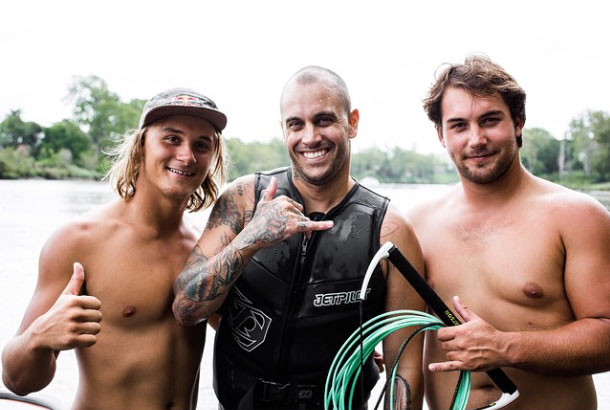
He shared his power of self-will and resilience of the human spirit in his book “Relentless: Walking against all Odds”. This is a book about not giving up nor giving in. Jet Pilot teamed up with Wood and made him an ambassador through mentoring and providing speeches, which may help people who struggle with direction and goals.

“We are going to do a collaboration T-shirt, which I will be handing out to kids to help make them feel they are a part of something. Many kids these days are dropping out of school, fighting, rebelling, turning to drugs and alcohol and unfortunately suicide, simply because they may not feel they are a part of something, their community, school, home etc. It can only take a simple gift, gesture to change a life.”

Videos: Introducing The Yamaha-Powered Rescue Runner

1

Screen Shot 2015-03-11 at 8.58.23 PM

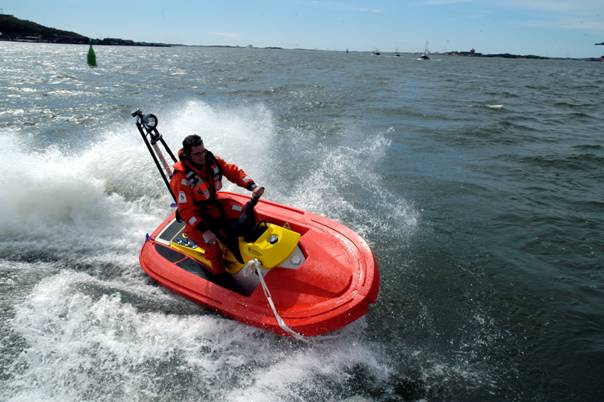
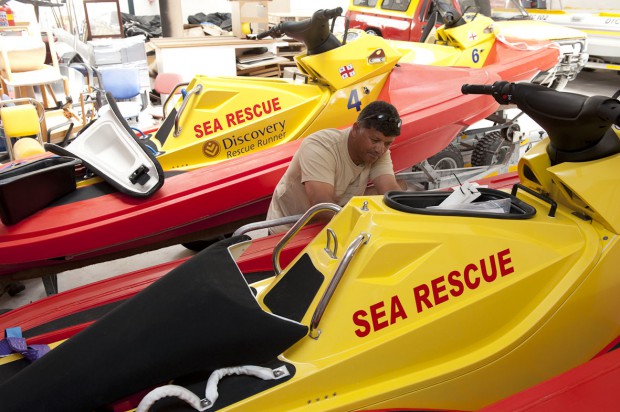
Last April, The Watercraft Journal was proud to announce the addition of the SAR (Search and Rescue) runabout to their selection of Commercial and Government vehicles. Based off of the successful GTI platform, the SAR is a capable and reliable resource for search and rescue operators across the globe. We’ve personally seen the SAR in action and applaud the purpose-built execution of the craft…but only today did we learn that the SAR is not alone.

Although not a factory-built Yamaha, rather merely employing the use of already tried-and-true Yamaha components; the boat builder Safe at Sea out of Kungälv, Sweden, designed, assembles and sells the RescueRunner. Built out of tragic loss of six crew members of the Swedish Armed Forces SuperPuma rescue helicopter H99 that crashed in 2003, the RescueRunner was designed to perform waterborne lifesaving techniques capable of saving those original six crew members.

Gathering techniques from across the globe in beach and surf rescue, the RescueRunner builds upon these and implements them in its design. Designed by Fredrik Falkman and working in development with the SSRS (Swedish Sea Rescue Society), a Yamaha WaveRunner FX140 four-stroke 140HP engine and drivetrain are used on a custom-designed hull, featuring a low aft deck for fast loading and unloading, a safety tower housing a light and enabling the RescueRunner to be transported and launched from a helicopter, and an incredibly rugged polyethylene hull that can be quickly interchanged.

You’ll notice the seat is similar to a WaveBlaster, as it only seats one, but can accommodate a larger crew when two persons are standing aft of the driver. An inspection hatch permits for quick clearing of the jet, and can be equipped with underwater search lights, an AIS-transponder, and much more. Top speed caps off at 40 knots and holds up to 70 liters, or 18-plus-gallons of fuel. All in all, the RescueRunner weighs in at 771lbs. which is impressive given its sturdy deck and reinforced hull.

Watcon 2015 Lake Michigan Surf Ride Announced

0

11046871_1542831679337836_5903453608856525802_n

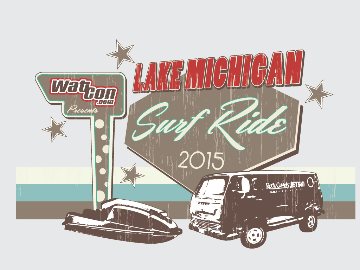
If you’re looking for a “permitted, loosely structured gathering for all types of personal watercraft enthusiasts to enjoy a weekend at the beach,” then the 2015 Watcon 2015 Lake Michigan Surf Ride is exactly what you’re looking for. Planned as a recreational ride set on the shore and waters of Lake Michigan; while it is referred to as a lake, it “really is an inland ocean.” For those who know, wave conditions can be large, which would be ideal for a surf ride of course.

As you might or might not be aware, this is the first ever Lake Michigan Surf Ride. “The weekend is open to all to come out and play in the waves like you can’t legally most of the time.”

Scheduled for Friday, August 28 through August 30th, the beach will be open to participants from 7am until 8pm each of the event. They ask that there be no noise before 7am out of respect the neighbors. All boating laws will be in affect for all riders outside of our area of operation. This will be clearly marked with event buoys. Additionally, all riders must be off the water 1/2 hour before sunset.

According to the official press release, “All watercraft will need to have an event identifying sticker on it to be in the area of operation, all riders will need to have an event wrist band on at all times with in the area of operation. This is necessary because of insurance and Coast Guard requirements. You will be able to get these at registration.

“On site weekend overnight parking is limited to RV’s, Trucks and Cars with Trailers. No tent camping. No open fires. This is a City Park located on the shores of Lake Michigan. Event Parking is located directly behind the beach parking lot in the grass area. You may use your four wheeler to bring your watercraft to the beach area, no other riding of ATV’s is allowed. Site speeds are 5 mph.”

Information for host hotel and other lodging in the area will posted shortly. “We will have a number of items donated by event sponsors for a raffle. We will contribute a portion of the proceeds of the raffle to charity, this charity will announced in the coming weeks.”

Video: Standup Jetskiers Charge Wintery River

1

Screen Shot 2015-03-10 at 10.39.42 PM

While some of you might be enjoying the endless summer provided by the southern latitudes, most of the world are still praying for the snows to ebb and the cooler temperatures to give way to some Springtime warmth. Yes, we’re all pretty much sick of winter. Thankfully, not all of us are content to be confined in our homes, hiding beneath the covers until summer comes.

We spotted a pair of daring Frenchmen bold enough to brave the cold and charge what looks to be a very chilly shallow river (dare we even say a stream?) not too far from Normandy, France. On a pair of modded Yamaha SuperJets, Emmanuel Jules and fellow skier Boris Micharoff swerve through low-hanging bows and reaching branches, exposed roots and other obstacles to come out the other end unscathed.

Boris’ GoPro provides us a unique point of perspective that was almost impossible a decade earlier. Now we get to share in the two’s exploits as they make short work of this quick jaunt. Of course, this isn’t the first of videos showcasing many of Emmanuel’s exploits, and after watching the video below, we strongly suggest you follow the above link and check out the rest of what these ski enthusiasts have been up to.

Video: Kaotik Proposes Wake Park Obstacle-Ladden PWC Racing

0

chris wall

When you get the news from the horse’s mouth, it’s best just to let the horse speak. The Watercraft Journal met up with Kaotik’s Brad Clark who let us know about a little something they’re cooking up:

“Kaotik had the pleasure of visiting Revolution Cable Park in Ft Meyers FL. Nick, the park owner welcomed us with open arms. He is very excited about the idea. I must say if your ever in the area you should def visit Revolution. They have great staff and a very fun operation.
“So this is my idea: I would like to make something new and exciting for spectators, and also to give racers and freestylers something new and challenging in a closed arena style setting.

log 1

“The first part of my concept is a heads up speed and style grudge race. Stand up racers will have a few obstacles to get through on each lap, including ramps and log jumps, and possibly a rail slide. We will run two racers at a time, and do a bracket style double elimination. The obstacles range in size, so not all of them are do or die.

“There are some very small rails close to the water and there are very tall rails. Also there are very small ramps and some ramps that are bigger and steeper then the rest. The racers can pick and choose how gnarly they want to get for the crowd. The faster they go and the more pumped they get the crowd, the more points they earn. We will be looking to do a nice cash prize for the Top 3 finishers.

“Next up will be freestyle. I would love to bring back some old school freestyle with a new twist. Again using the obstacles in the arena. Freestyle can do whatever means they want to win over the spectators. I mean who doesn’t miss seeing suicide subs under things and hand stands. What about the days watching John ‘Suicide’ Havell ride on the nose of his ski, steering and throttling with his feet riding full speed over a ramp, into a suicide sub, hence the name.

anne

“Last but definitely not least: The new Freestyle. These guys are getting crazy amplitude these days. Maybe some kind of step up competition, a foam block obstacle course that they can implement different trick as they go through. To me, it’s all about getting the crowd excited and giving them something to root for.

“Another good thing is that this will be a free event for all competitors. I believe that these guys spend enough money getting their skis ready and just getting to a event. I think cheap tickets for spectators and with some sponsor support to carry the event financially. With enough support and spectators, hopefully the cash and prizes will be great.

“If we have enough interest we will entertain the idea of different classes including Runabouts and Sports. This is a work in progress, and hopefully we can come up with something great. If you implement all of this – with some pro wake boarders – and I believe you would have one heck of a show.”

88 Motorsport Announces Kawasaki Ultra 420R Turbo

0

420R

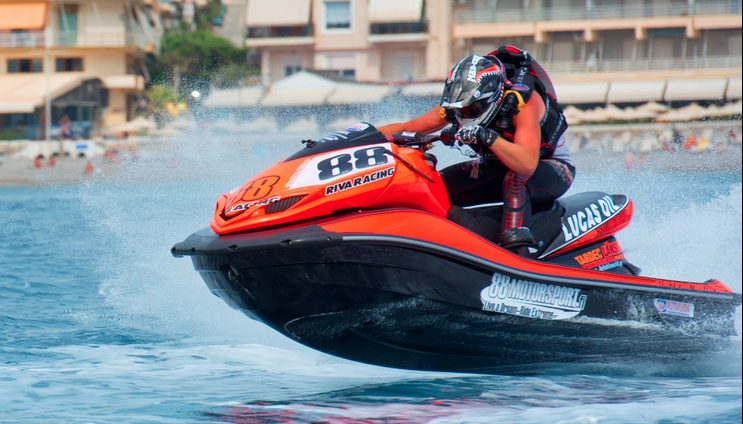
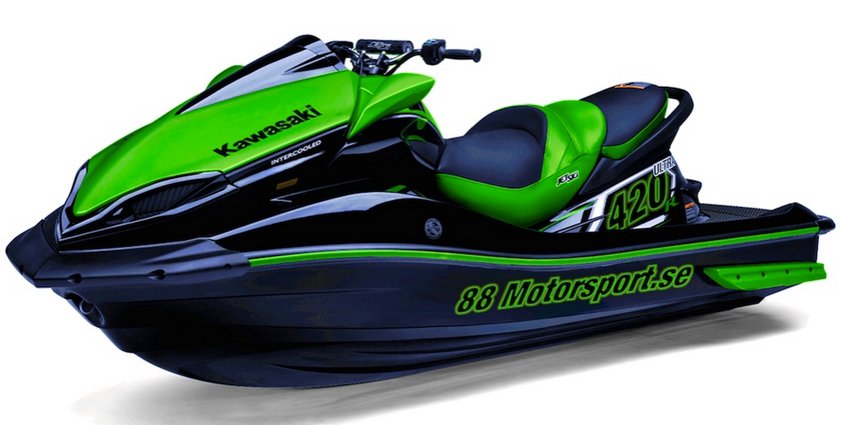
If ever there was an award for “truth in advertising,” it would go to Sweden’s 88 Motorsport and their newly released 420-horsepower turbocharged Ultra JetSki. Why? Because in perfect harmony with the company’s name, this is a Kawasaki that will hit 88 miles per hour. And if 80’s movies have taught us anything, when this thing hits 88 miles per hour, you’re gonna see some serious $#%&.

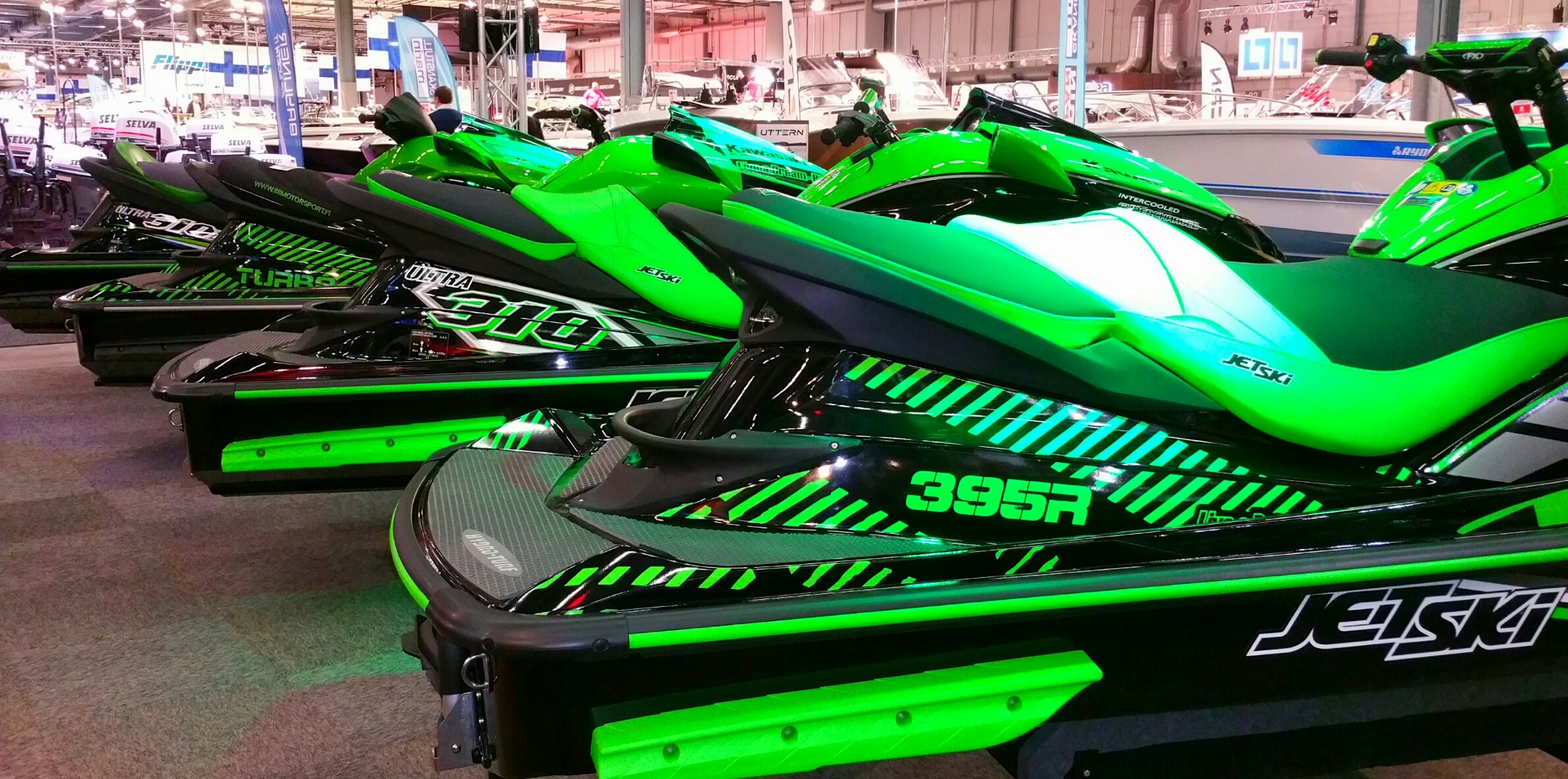
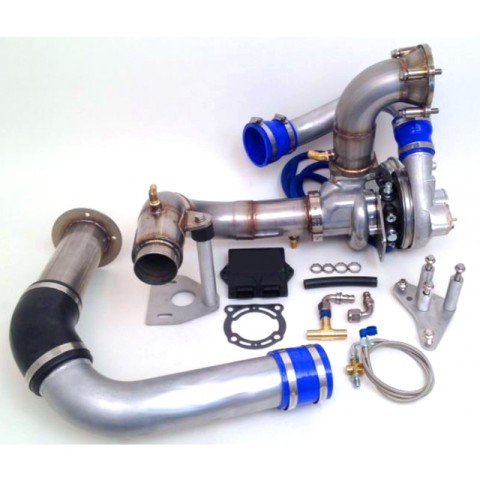
Now, don’t get us wrong. There are quite a few aftermarket turbo kits available these days for the big, brutish 310X series JetSkis, and 88 Motorsport’s kit is yet another to add to the stack. But unlike a few others out there, we’ve got some hard data on the package’s performance that we can tantalize you with, with big thanks to builder, tester and team rider Sammy Pajalin, who has brought home six wins in the Nordic Championships and three in the Finnish, as well as a bronze medal in the IJSBA World Championships.

For his race craft, Pajalin’s turbocharged Kawasaki is optimized for maximum performance, including a handlebar-mounted switch that can control boost levels. He stated, “In race(s) where it goes really high waves, [I] confine the machine [to] 360hp and in favorable conditions, can I switch to 450hp just by pressing the button.”

For 88 Motorsport customers, the turbo kit offers extreme performance in acceleration through the midrange and at top speed, achieving zero to one hundred km/h (62mph) in three seconds, and – as stated earlier – a top speed of 88-plus-mph. Pajalin also promises a reduction in fuel consumption by 30-percent!

Available with boost and build ranges between 330-to-420 horsepower, the 88 Motorsport Kawasaki 420R Turbo can be “uncorked” on the fly, allowing for lively, energetic runs at low boost, and with the hit of a button, unleash the full potential of this turbo kit. Of course, all that power doesn’t come cheap, as the Kawasaki Ultra 420R Turbo is priced at 389,990 SEK, or just over $47,000.

ultras 3

Scorched Earth: 2015 Kawasaki Ultra 310X SE JetSki

1

SE1

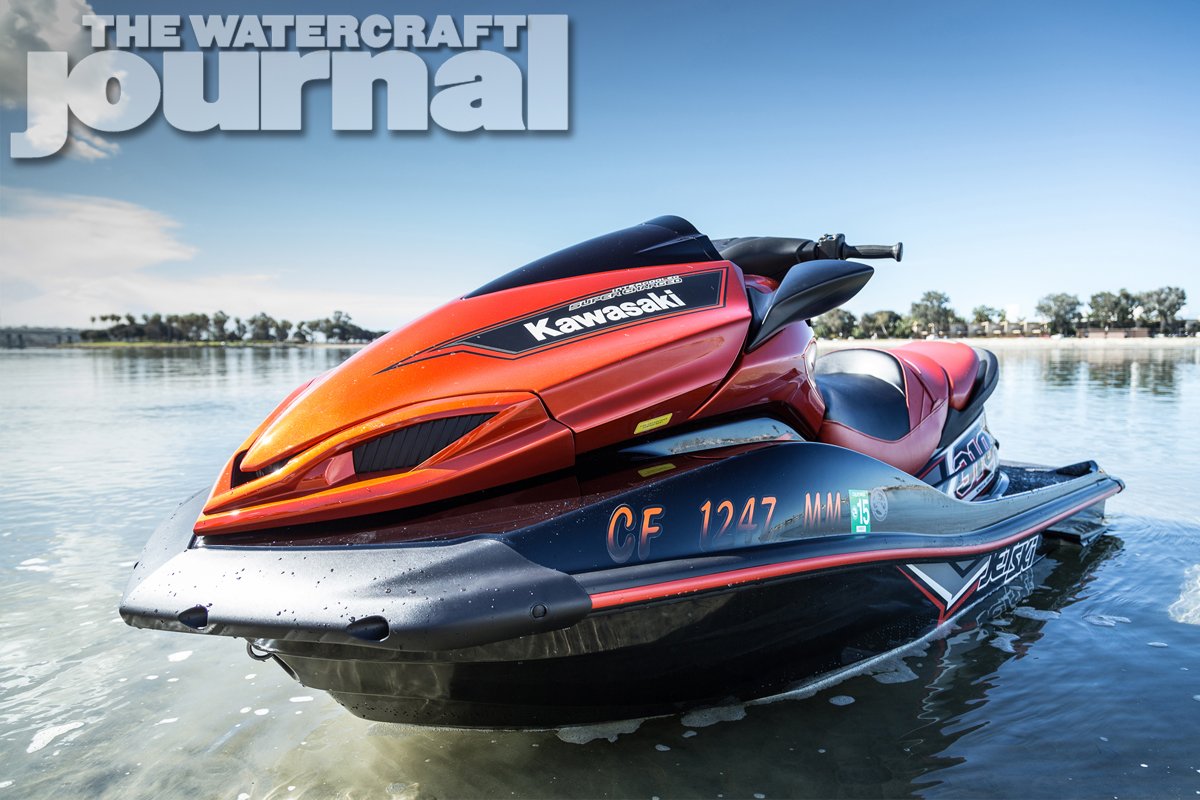
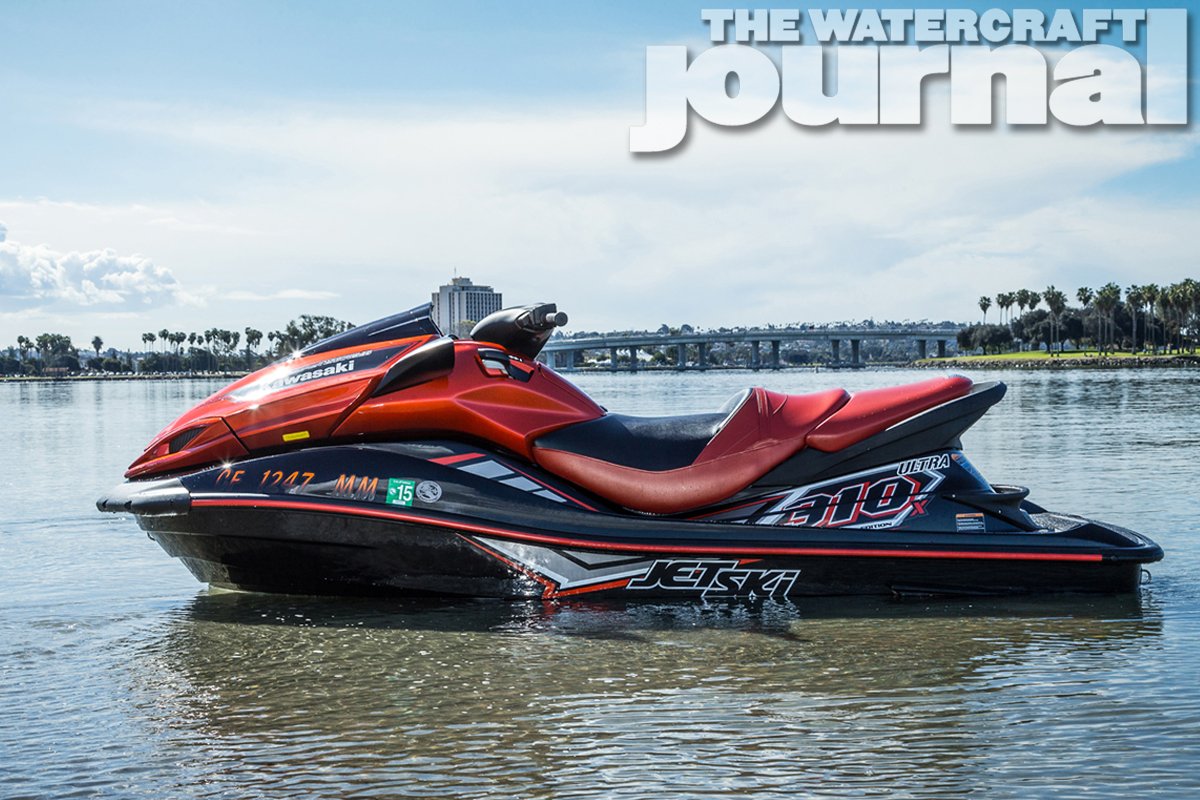
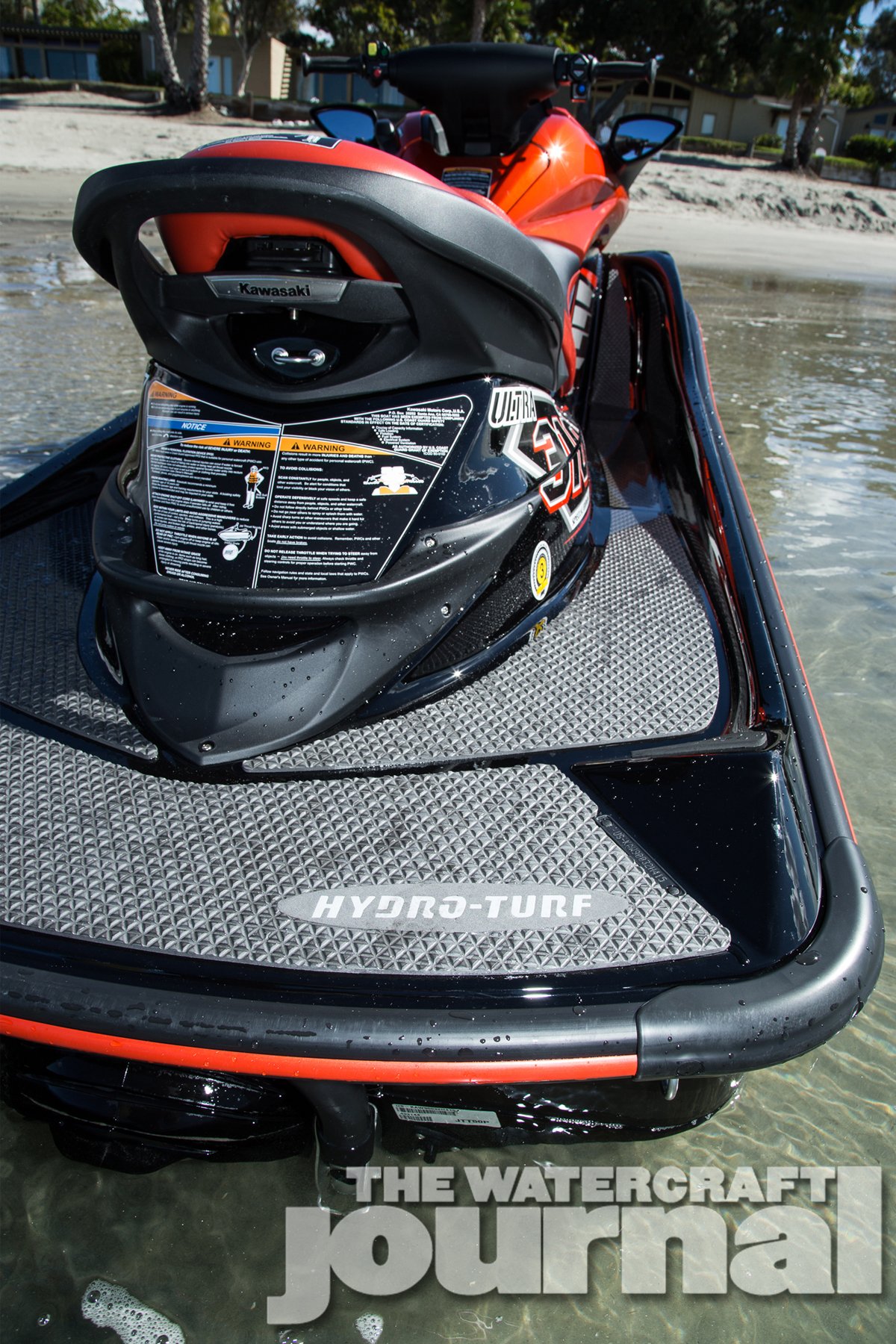
It’s difficult to adequately verbalize the sensation of manhandling a personal watercraft that simply does not want just anybody to ride it. Like the untamed, free-roaming American mustang, the unbridled power and wild spirit resonating from within the bowels, reverberating up through the seat and out of the handlebars of the 2015 Kawasaki Ultra 310X SE (Special Edition) is not unlike to those ancient Iberian horses first introduced to this continent by Spanish explorers.

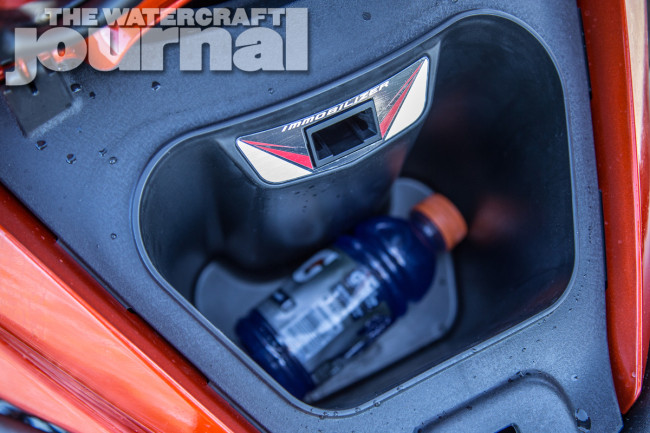
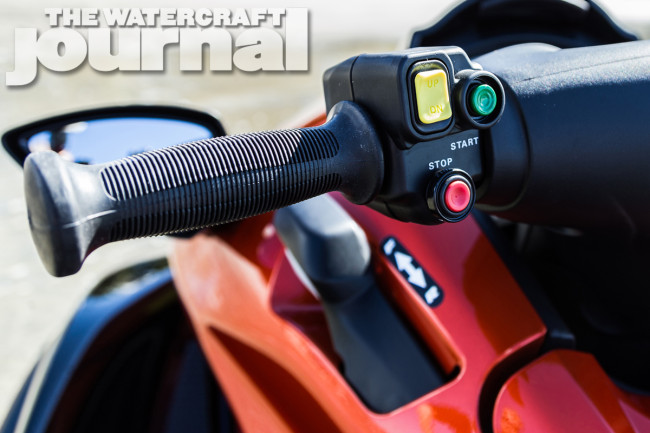
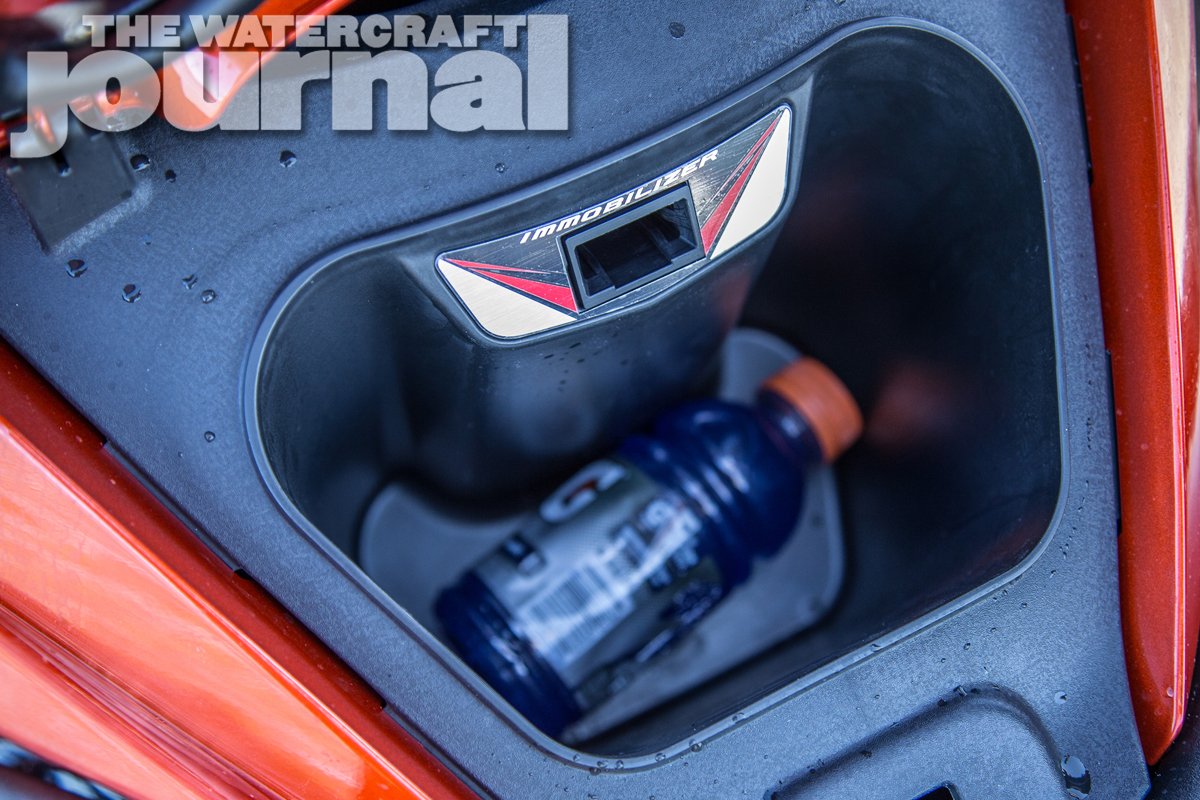
When left to its base setting and operated under the newly-minted, mint-green operation key (previous Immobilizer keys were either orange for normal operation or yellow for SLO mode), the Ultra 310X SE – as with all 310-powered supercharged Ultras – is an exhilarating ride for an experienced rider. For those a little more unseasoned, the brutish onset of a true 310-horsepower can be a white-knuckle drain-the-blood-from-your-face outing, if not a totally overwhelming exercise.

11
The Burnt Orange on the 2015 Ultra 310X SE might be familiar to Kawasaki loyalists as being the same from last year’s four-door 2014 Teryx.

This runabout comes on hard, and will continue to pull harder and higher through the 201-ft. lbs. of torque curve until the fatigue building up in your quivering index finger finally wins. Last year, the Ultra’s four-lobe Eaton TVS (Twin Vortices Supercharger) blown 1,498cc four-stroke was wholly untethered, receiving top-level improvements to engine oiling through larger oil passages for quicker oil return to the redesigned baffled pan that reduces oil windage and sloshing, and twin under-piston cooling oil jets (an improvement over the outgoing 300X’s one jet per piston).

Appropriately, the new Ultra 310 engine received redesigned lightweight cast pistons with additional ring land V-grooves. Likewise, the liquid-cooled inline four-cylinder plant thicker water jackets, increasing capacity and flow, as well as improved intake charge cooling thanks to a separate coolant loop. Last year also saw the addition of a larger capacity fuel pump for improved fuel flow volume and 500cc injectors mounted to a new long-runner intake manifold made from heat-resistant plastic, improving low-to-mid range power.

5

This equates for a truly competition-capable craft from the showroom. And this is not a superfluous statement: In the year since it’s introduction, the 310X-powered JetSkis have dominated all endurance events across the planet. A completely untouched 310R nearly clenched the second podium spot for the 2014 Long Beach-to-Catalina Offshore Championship. The American AquaX series’ 300 Class was almost exclusive Kawasaki territory. Were the Ultra 310X’s top speed not hindered by a GPS limited cap, the 310X would – and has been documented doing so – regularly reach low 70’s.

Truly, Kawasaki left nothing on the table when it came to creating the 310X series, but what exactly makes the Special Edition special? The SE bridges the gap between the race-equipped 310R and respectively-plain 310X, as well as introduces a little flavoring worthy of the luxurious 310LX. Swathed in an incredibly photogenic Burnt Orange, the metallic umber is almost more fetching than the glittering green of the aforementioned LX. The racier mats of the 310X and R are replaced by the LX’s hexagonal pattern too.

9

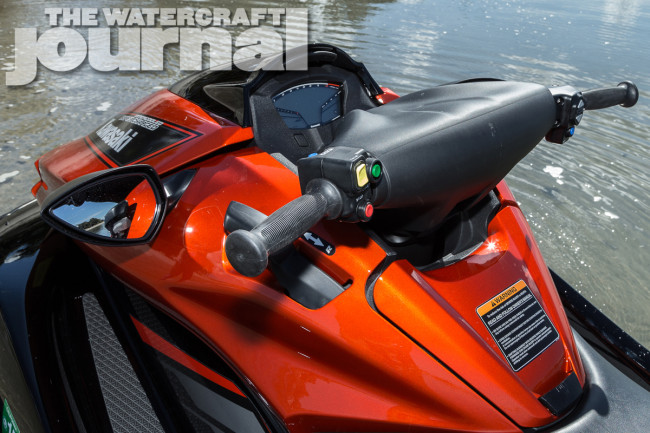
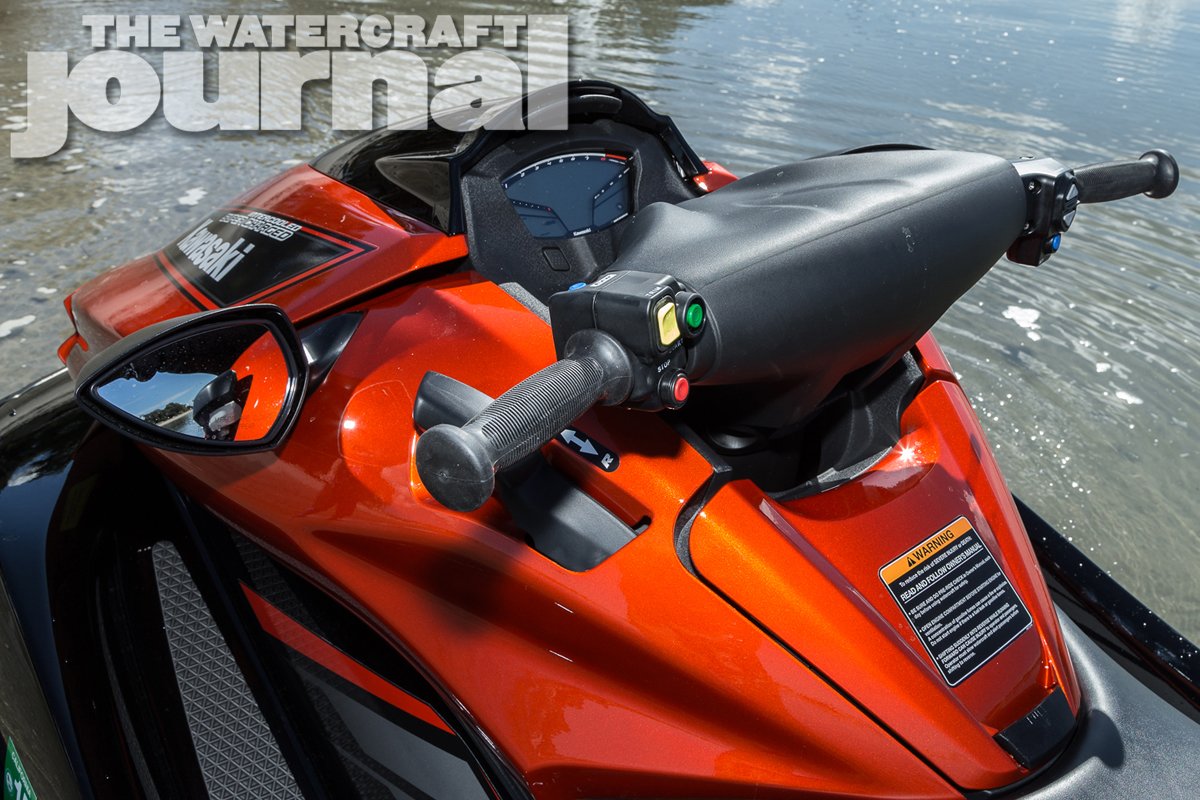
Yet, the SE retains the 310R’s narrowed and scalloped two-tone saddle, although the SE forgoes the gripper material exclusive to the R. The SE also keeps the basic five-point tilt steering found on the naturally-aspirated Ultra LX and base 310X. Apart from these characteristics, the SE is almost indistinguishable from other models. All 310-powered Ultras share identical fly-by-wire controls, replete with Cruise Control, 5mph No Wake mode, ECO mode and electronic trim toggles. A folding swimstep hangs above the massive 160mm 8-vane pump and new-in-2014 3-blade, long-cone prop.

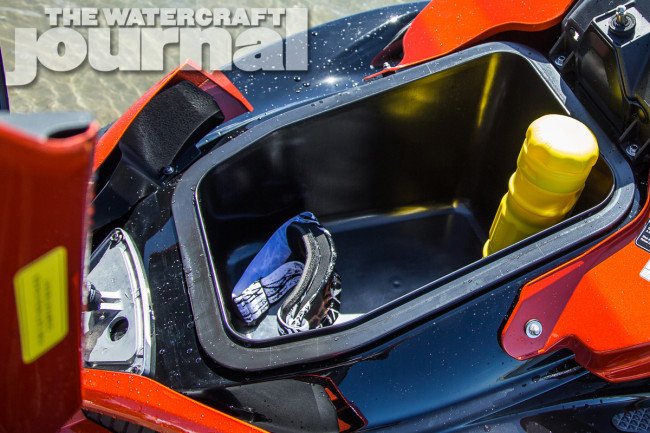
One final notch in the Special Edition’s belt is its exclusivity. International availability is almost nil, making the amber-hued Kawasaki an all the more desirable craft for Australian enthusiasts (and other nationalities). Holdovers from the 2011 improvements (bringing the previous 260X to the 300X) include the hull’s deep-V 22.5-degree deadrise, giving the Ultra it’s characteristic offshore aptitude; it’s voluminous storage (56-gallons worth) and fuel capacity (20.6-gallons), and stellar information display.

3

A mentionable quibble that materialized over the time we had with the SE was the slow responsiveness of the unusually stiff trim and Cruise Control toggles. We also longed for even the faintest of chimes to confirm the engagement of the big Kawasaki’s ECO mode, but cheered the immediacy and ease of the ski’s No Wake setting. And although the Ultra’s reverse handle design has never been better, it seems antiquated in a world where both Sea-Doo and Yamaha tout handlebar-mounted reverse levers.

Unlike that of its competitors, its ECO setting is the most spirited we’ve encountered. Using the yellow Learning Key bridles the big 310X’s output to a more comparable level with Sea-Doo’s Eco Mode. Unfortunately, switching riding preferences requires switching keys (and thereby killing and restarting the ignition) where the Sea-Doo asks only a press of a single button.

Again, the Ultra’s massive industry-leading performance might be too polarizing for some. Throttle response is scalpel-sharp and power comes on as hard as a blacksmith’s anvil. With the trim set low, the 310X bites down and cuts sharp turns without unloading the pump at wide-open speeds. Slinking an inside knee low in the footwell, resting almost flat in the saddle practically spurs the Ultra to take the turn faster, its thoroughbred plant at full sprint.

All of that said, we still can’t help but favor the Ultra 310X SE among so many other PWC. Whether galloping across calm bayshore waters or frolicking in foamy Pacific surf, the Ultra is incredibly stable, surefooted and predictable. In The Watercraft Journal’s experience, no ski in its class is less prone to searching or seeking, regardless of sea state. It’s handsome, clean design, measured contoured seat, handlebar placement and variety of power delivery makes the 310X a terribly desirable watercraft. Coating it in candied orange only makes us want it more.

2

1 2 8 11 12 3 7 6 9 5 10 13
<
>

Australian Life Savers Test Latest Products from BRP

0

slsa2

Surf Life Saving Australia (SLSA) delegates from around Australia met with Bombardier Recreational Products (BRP) representatives to test some brand new motorized products which included the latest in Sea-Doo Personal Watercraft (PWC), Evinrude E-Tec engines, and Can-Am All Terrain Vehicles (ATVs). The meeting was held in the BRP offices where new equipment and the continued support of SLSA from BRP were discussed at length. The meeting included BRP’s plans to continue their support of SLSA ‘s effort to help save lives on Australia’s beaches. This was great news for Surf Life Saving Australia.

According to a report in OZPWC, the physical testing went down when the group left the offices and traveled to the beach at Wanda to give the new Sea-Doo Spark a run, along with some new Search and Rescue Watercraft. One can only imagine the kind of rigorous riding that went down on the beach and in the water. Apparently testing went well because everything was a go and Surf Life Saving Australia was stoked that Bombardier Recreational Products would stay on board and continue to sponsor the SLSA after a continuous sponsorship of five years. BRP was honored to continue providing products to more than 160 clubs in Australia.

Anthony Bradstreet Coastal Risk and Safety Manager from Surf Life Saving Australia said, “BRP products (sic) help Australia’s surf lifesavers patrol and perform rescues with greater efficiency and rapid response. BRP understands our core mission of saving lives, and this next generation of product they are bringing to the market, will further support this mission.”

slsabrp1

“Surf Life Saving is an iconic community service across Australia. BRP’s products are well suited to the demanding surf conditions and provide the unparalleled maneuverability and high performance essential for effective beach patrols,” said Gregoire DuPont, Vice President and Regional General Manage of Bombadier Recreational Products Asia-Pacific division.

Bombardier Recreational Product is a national corporation partner with Surf Live Saving Australia and is the groups’ official powercraft provider, which is an awesome partnership for both groups. This helps insure that the SLSA will have the equipment in order to provide the best rescue operations possible, especially since BRP provides ongoing equipment maintenance to clubs and services throughout Australia. What an awesome bonus!

The Bombardier Recreational Products sponsorship was established in 2009 as integral piece of the company’s guarantee to SLSA in assisting with delivering life saving motorized equipment. BRP provides Can-Am All Terrain Vehicles, Sea-Doo Rescue Watercraft, and Evinrude Outboard Motors to Surf Life Saving Australia and products to many other groups in Australia.

This is a victory for everyone involved and it appears that the partnership will continue for a very long time because SLSA and BRP appear to have a wonderful rapport

It is great that Bombardier Recreational Products will continue to support Surf Life Saving Australia. The beaches and waters along Australia’s coasts will be safer as a result of this long time partnership.