
Home Blog Page 396

Charles Bombardier Proposes Sea-Doo Powered Remote-Controlled PWC Drones to Patrol Northwest Passage

1

Ipad+Sea-Drone+1

There were days when science fiction was the only place where warfare was conducted remotely, as pilots and strategists piloted planes, tanks and even ground troops from darkened control rooms. Today, it’s actually becoming more commonplace. Predator drones infamously patrol territories both foreign and domestic, radio-controlled bomb disposal units disarm explosives and we continue to explore the rugged terrain of Mars from the safety of NASA’s Jet Propulsion Laboratory (JPL) in Pasadena, California.

But how about the open oceans? Believe it or not, BRP Sea-Doo founding family member Charles Bombardier has conceived a sea-faring armored drone to patrol Canada’s Northwest Passage. Powered by much of the same equipment found in the latest RXT-X 260, the autonomous personal watercraft not only could save the Canadian government millions in paying for armed servicemen and women to navigate the treacherous waters, but help deter foreign infiltration.

The proposed SD-44 model (pictured) would be equipped with stabilized aquatic cameras, a powerful LED lights and active illumination technology for evening operations, a strong tow hook to pull or even lift the vehicle out of the water, a quick-connect system attached to a “spring-loaded towing cord or an electric winch. A stronger and more resistant material would be used for the hull and body to make sure the Sea-Drone could sustain impacts from floating ice and the cold weather. Kevlar fibre, for instance, could be a good candidate and there are other ways to beef up the hull.”

No plans have been made to arm the Sea-Done, so don’t expect a Sea-Doo powered miniature battleship invading your urban shoreline any time soon. Below you’ll find the original proposal by Charles Bombarier outlining the Sea-Done’s capabilities and possible usefulness to the Canadian Navy.

______________________

The concept

The Sea-Drone is an autonomous personal watercraft (PWC) concept designed to patrol the Canadian Arctic. It would roam open waters directed by a control and command center. The units would be deployed from Canadian icebreakers or Navy ships.

The background

Not long ago the Northwest Passage – a sea route through the Arctic Ocean, along the northern coast of Canada featuring multiple waterways – became a viable route for ships. In the coming year the country will likely need to explore and occupy this remote territory and use special robotic units such as the Sea-Drone to reduce risk and optimize surveillance operations.

How it works

The Sea-Drone would be based on an existing Sea-Doo model such as the RXT-X-260, but it wouldn’t have any seats or steering since it would be a robotic watercraft. It could operate autonomously or be piloted remotely.

Multiple versions were designed, and all of them are equipped with a stabilized aquatic camera, a powerful LED light and active illumination technology for evening operations.

The stabilized sea-worthy cameras would record video and images from other ships and relay them across the world by satellite or to a cell tower mounted on the main ship. The purpose of the drone would be to identify intruders and relay the video feed to the command centre.

At the front of each craft there would be a strong tow hook to pull or even lift the vehicle out of the water. At the back there would be a quick connect system attached to a spring-loaded towing cord or an electric winch. A Sea-Drone would be able to back up near another unit in distress and bring it back to the main ship or tow small boats.

A stronger and more resistant material would be used for the hull and body to make sure the Sea-Drone could sustain impacts from floating ice and the cold weather. Kevlar fibre, for instance, could be a good candidate and there are other ways to beef up the hull.

The SD-44 model, pictured, was designed with this in mind. The SD-88 model was created with packaging in mind. The marine camera could be be lowered inside the hull and units could be stacked on top of each other.

What it’s used for

The Sea-Drone would go out on two-hour patrol missions to look behind all the hidden channels and islands where the command and control ship would not venture. It could also serve to deter other ship from venturing in restricted waters. The Sea-Drone could carry an extra fuel tank or various loads such as radar sensors, military and rescue equipment.

The designer

The Sea-Drone renderings were produced by Matt Betteker, who is located in South Jultland, Denmark. He studied at the College for Creative Studies and he works as a senior designer for Lego.

Real Review: JetPilot Apex Race John & Jacket

1

6

2Admittedly, it’s difficult to write a product review on something that so few will often wear. Not so much because it’s an alien subject to many readers, but for fear of making this an argument in wetsuit’s defense. For the most part wetsuits are foreign subjects to casual personal watercraft riders – and even somewhat among those who would call themselves more active PWC enthusiasts. Despite them being antithetical to the whole notion of casual riding, wetsuits are possibly the single best piece of safety equipment you could wear besides a personal flotation device (PFD).

Apart from providing significant gains in maintaining healthy body temperatures by using your own body warmth to heat a thin membrane of water between your skin and the neoprene encasing your body, they also provide protection from external elements and insulation from potential damage. Most all sanctioned race organizers require participants wear a wetsuit or “john” (with full leggings).

1

RPM Racing Enterprises’ Ross Wallach explained, “If there was an accident where a racer was injured –  be it a collision with another rider or if he was ejected from the craft – the wetsuit helps apply pressure to the injury. What if he broke his leg? The full suit would help keep that broken bone in place better than without it.”

Again, while many if not most readers of The Watercraft Journal might not see themselves in such a high intensity situation, the thick-yet-flexible neoprene material is also used to protect sensitive areas from the impact or bodily intrusion of water from the jet wash. Equally, the protective layer of a quality wetsuit provides protection from fast-moving seaspray, insects and other debris.

3

5Now as the seasons change and temperatures begin to drop, researching the purchase of a wetsuit might be on the mind of many who plans to continue riding over the next few months. We’ve been lucky enough to spend a great deal of time with JetPilot’s Apex Race John and Jacket combination. Despite the suit’s title, the JetPilot Apex combo makes for a superior all-around suit as much as a competitive piece of equipment.

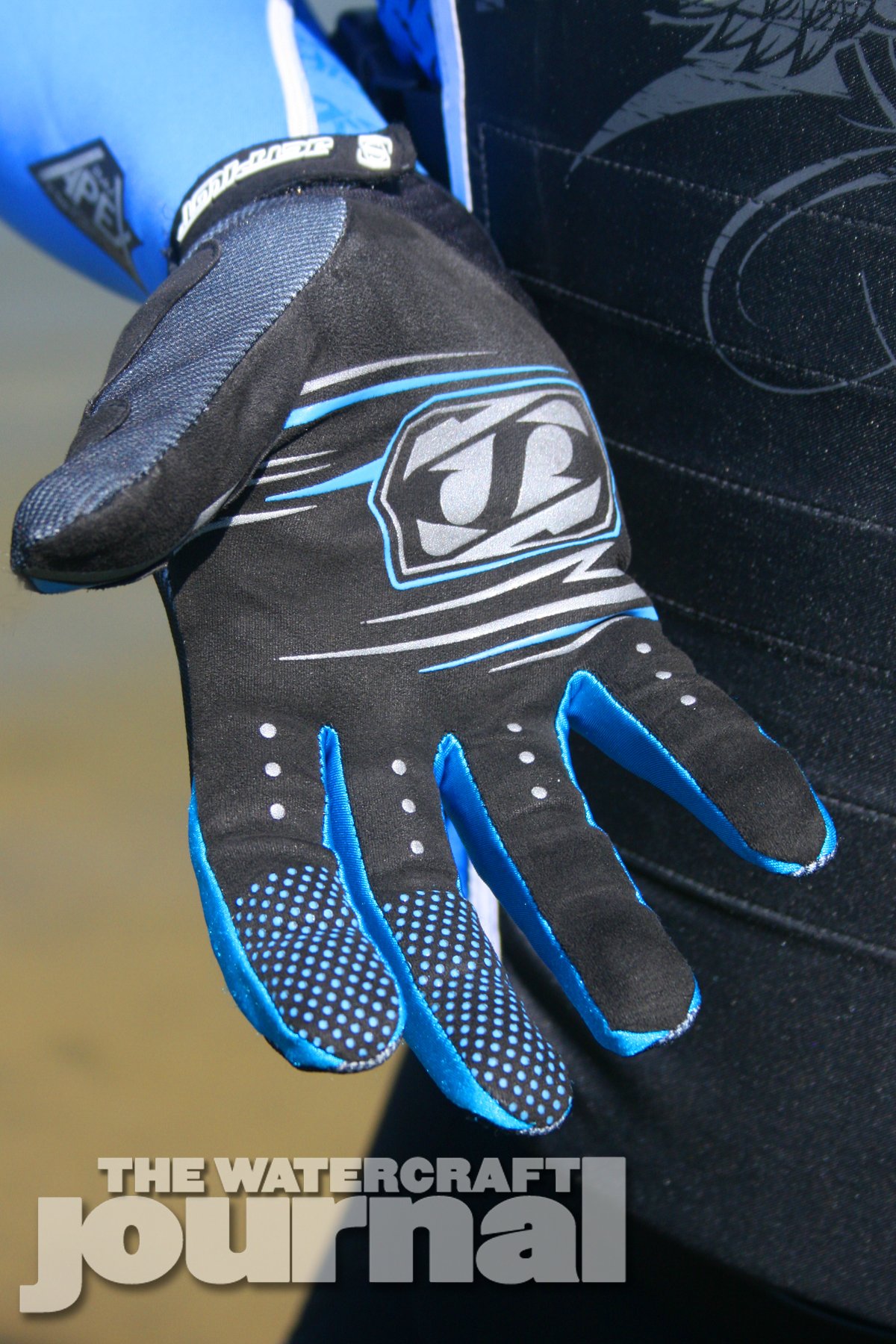
Made from JetPilot’s proprietary 2mm Flex-Lite Neoprene and Grooveskin combo, all of the suit is stitched together using the brand’s Flush-Loc Seams. JetPilot’s designers strategically placed Groove Skin Panels in high-wear contact areas as well as Outer Shin Padding for added protection for both the wearer and the suit itself.

Being a sleeveless john, access in and out of the suit is rather simple. A large-tooth zipper runs down the full length of the back, as nickle-coated ankle zippers are found running up the calves. Each zipper is also met with a Velco-strap to hold the zipper in place. The matching slip-over jacket is also made of 2mm all-Grooveskin construction and provides significant motion and mobility. We were pleased with the jacket’s ability to stretch, maintaining a comfortable fit in nearly all positions.

4

Both the Apex john and jacket were matchless in cutting down windchill while riding at speed for extended amounts of riding, and of course, blocking UV rays on sunnier days. Thankfully, JetPilot has done a masterful job in preserving the suit’s quality even over long periods of use. The screen printed logos have yet to fade, tear or crack and the rubberized traction pads have yet to show any feathering or peeling despite us using the suit nearly every chance we could.

Priced at around $240, the combination is more expensive than some, but pretty averagely priced for similar top-quality wetsuit and jacket combinations. As we’ve said before and continue to advocate, comfort and fitment will always outweigh the rest, and JetPilot makes some of the most comfortable gear you can find. That it holds up to the elements better than most and looks great are merely bonuses.

America’s Motor Sports Makes ’14 Powersports Business Power 50 Dealer List

1

10671421_709542499099516_2684754380216172453_n

For the second year in a row, America’s Motor Sports has been named as one of the Power 50 dealers in North America by Powersports Business. Making the annual Power 50 list is a major accomplishment awarded to dealerships that are “unsurpassed in business operations, professionalism, marketing tactics, customer service and more.”

Chris Watts, Vice-President and co-owner said “It’s very exciting to be part of the Powersports Business Power 50 once again, starting three years ago we were named one of the top 15 dealers in the country in the Power 15 list and now our second time in the Power 50!”

Powersports Business Editor in Chief Dave McMahon stated, “Out of the thousands of powersports dealers in North America, only the very best make the Power 50 list. These companies are the elite of the powersports industry, excelling at all aspects of their business.”

All of us at The Watercraft Journal are proud to have America’s Motor Sports (AMS) as an advertiser and applaud the Middle Tennessee chain of dealerships for this recent and much-deserved accolade. AMS is a locally owned PowerSports dealer with three locations in Nashville, Madison and Dickson, Tennessee, representing Honda, Yamaha, Kawasaki, Suzuki, Can-Am, Sea-Doo, Polaris, Victory and GEM electric vehicles. With over 32 years of experience, AMS is one of the largest and oldest Powersports dealer groups in the southeast.

Yeehaw! 2015 Pro Watercross Tour Comes to Lewisville, TX

0

512

OK, OK. So there’s some things that have yet to be fully fleshed out concerning the whole landscape of personal watercraft racing for 2015, but as contracts get finalized and evil plans are masterminded, we’re sure to be reporting a lot more in the coming weeks and months. Currently, AJ Handler has reportedly all but completely severed ties with Scott Frazier and what’s left of the IJSBA, leaving racer registration and class structure a little unclear. Handler’s Pro Watercross tour is still a “GO!” for 2015 (despite losing fan-favorite Colonial Beach, Virginia), and promises yet another awesome season.

Starting May 9th and running through the 17th, is Pro Watercross’ super-fun week of racing Florida’s panhandle – the first weekend in Pensacola followed by another two days’ of racing in Panama Beach. June’s 20-21st weekend is still “Too Be Announced,” but westernmost tour stop Sparks, Nevada returns on the 27th of the same month. This is followed by newly announced Lewisville, Texas tour stop July 17th-19th. “Lewisville Lake is a tremendous tourism asset and we’re always looking for ways to bring more visitors and activity to the lake,” explained Lewisville CVB Director James Kunke. “The Pro Watercross Tour is a great opportunity for us and we’re excited to bring such a high-profile event to the area.”

Of course, the Lewisville, TX will replace Virginia as the “The Liberty Cup” venue and will welcome more centralized and Southwestern competitors who otherwise have felt alienated by the tour’s almost exclusively East Coast venues. Of which, Georgia’s Lake Hartwell and Charleston, WV will also return for August. As mentioned earlier, much has yet to be finalized for next year, so stay tuned for the latest updates.

The Watercraft Journal By The Numbers: October 2014

1

oct1

One year ago, my friends. The Watercraft Journal was launched exactly a year ago, and we can hardly believe it’s been that long. Birthed out of the idea that personal watercraft enthusiasts around the world wanted a source for original and engaging articles on a daily basis, my wife and I emptied our savings account and created an online magazine that did exactly that – and completely free to you. With a great deal of personal sacrifice (both financially and emotionally), we dug in our heels, weathered the highs and lows, and keep the theoretical trains running on time.

Readers (and Google Analytics) will testify that The Watercraft Journal never missed a day – Monday through Friday – of publishing. Our contributors can equally echo that never a payment was missed or sent late. And best of all, our advertisers – who are responsible for keeping The Watercraft Journal from capsizing – are our biggest proponents. For their support, all of them have been repaid in increased sales, new and returning customers and expanded brand exposure. That is the blessing of a healthy, reciprocal professional business relationship. Everybody wins.

The Watercraft Journal is unlike any other personal watercraft magazine, primarily because it’s growing. Lovers of jet skis and PWC across the United States, Australia and across the globe have latched on to our magazine, relying on our dependable publishing schedule each and every day. Applying over a decade’s worth of professional motor and powersports journalism and publishing experience has given The Watercraft Journal a level of professional not found elsewhere. Our dedication to the whole industry has opened our audience to literally five times that of our closest American competitor.

Best of all, our advertising partners have come to expect the utmost in professional content to properly represent their brand. We’ll never dilute our standards for superior and family-friendly content, and our continual and perpetual growth has thankfully reflected that. Please don’t mistake this for boasting. This is renewing a promise. The Watercraft Journal has earned your trust because of our dedication to hard work, reliability and integrity; we publish fun, informative and insightful daily news, weekly product and vehicle reviews, interviews, technical “how-to’s”, shop tours and event coverage for you, every day, for free.

November 2013 to November 2014

Screen Shot 2014-11-01 at 7.32.22 AM

October 2014

Screen Shot 2014-11-02 at 12.50.45 AM

Let The Record Show
Look above. These are real numbers, as reported by Google’s data tracker, Google Analytics. Starting the recording process only a few days after our November 1st, 2013, launch date, The Watercraft Journal has welcomed a staggering 113,400-plus users to its pages. By “user,” Google records this as an unique individual person. In the world of publishing, this individual would be understood as a single sale of an issue. Interestingly enough, that only averages out to 9,451 readers a month, a number we’ve well surpassed since Spring of this year. And when the industry’s only two print titles are published semi-monthly and quarterly to a combined audience of less than 4,000 every two months, it’s very clear to see which magazine is preferred.

November 2013 – November 2014

Total unique readers: 113,419*
Total Articles Read: 339,115
Percentage of new readers: 60.7%

All-Time Top (5) Nations:
United States – 107,654
Australia – 16,903
Canada – 10,319
United Kingdom – 7,808
Japan – 3,702

Total Percentage of Mobile Device Users: 39%

October
Total number unique readers: 16,340*
Total number of articles read: 34,914
Percentage of new readers: 62.8%

Top (5) Nations in October:
United States – 12,528
Australia – 2,391
Canada – 1,084
United Kingdom – 912
France – 532

*This number is considered equal to an individual sale of a single copy of a magazine.

The Evidence Speaks For Itself
We’ve been told that The Watercraft Journal makes producing a daily personal watercraft magazine look easy. Although a very welcomed compliment, there’s few things further from the truth. Because we publish Monday through Friday, hunting down interesting and entertaining stories worth printing can be a challenge, not to mention getting them written and ready for publishing. And publishing magazine-grade content each and every day adds up in more than just expense. We’ve averaged publishing a 110-plus-page magazine’s worth of articles each month. That’s double that of our nearest competitors if you exclude our daily news and literally thousands of pictures filling over a hundred photo galleries.

Total feature articles published: 166
Total feature words published: 156,436*
Total news articles published: 323

All-Time Highest Read Article: 11,780 views

*When this number is translated to print publication standards equals 12 monthly 118-page magazines. Please note that this number does not include an average of two uniquely-written news articles published daily.

Ladies and Gentlemen of The Jury
Social Media has left an indelible mark on the world of publishing, and the whole of business for that matter. When every Tom, Dick and Harry can wear the hat of publicist, marketer and promoter all through the various feeds and pages found online, it does blur the lines of traditional marketing. The personal watercraft industry has been slow to really adopt these tools that have already dramatically increased annual revenues in other niche industries. But you can only lead a horse to water they say…. For The Watercraft Journal and on our Facebook, Twitter, Instagram, YouTube, and weekly newsletters, we help bring the magazine directly to you, the reader. And as you can see, what we’re doing works.

Total Facebook Followers: 11,137
Total Twitter Followers: 285
Total Instagram Followers: 879
Total Weekly Newsletter Subscribers: 872

We Rest Our Case
Reviewing what we’ve accomplished in such a short time, it’s hard not to celebrate even just a little bit. Initially, each month’s edition of The Watercraft Journal By The Numbers was intended to provide advertisers with an honest revelatory glimpse at the rapid assent of the industry’s fastest-growing PWC enthusiast publication. By openly showcasing our monthly audience to all of you proves we are not afraid of the double edge of the Internet sword…nor should you. For all of you advertising currently with The Watercraft Journal, we earnestly and gratefully appreciate your support. For those considering advertising or have only recently become familiar with us, we say “Welcome! Let us earn your trust, friendship and business.”

Video: Electric Quadrofoil Claims to Be The Future of PWC

0

MhJaOPZkxHThdcGNTm30DHHrEvo3dqtYAeC8SlimQso,w5T1rwulty8kTRfxqeGi3udcnjALUEl-gv_Y1ORzSA4,gcVlQU4MLRKVfrSI8VSWu9AP2nE88mDwp57FeytAt9k

OK, we’ll admit it. We’re suckers for new and frankly, weird prototype personal watercraft. Sure, you’ve seen us go on about the land and sea-ready Quadski. We’ve even rattled on about the BomBoard, which can fold up and fit in the trunk of your hatchback Honda. Heck, we even introduced you to the world’s first amphibian motorhome. But today’s post just might be a little too far off the beaten path for most folks.

Introducing the Quadrofoil, the world’s first (and only) electric hydrofoiling personal watercraft (PWC). Claimed to provide “the most economically efficient and completely environmentally friendly mode of recreational marine transportation.” The hydrofoil configuration and patented steering system allows the ‘craft to operate quietly and without disturbing the water.

Wait, what? That’s right. The Quadrofoil doesn’t produce waves or emissions. This claim makes us wonder how fast we can push the Quadrofoil through those seemingly endless “No Wake” manatee-protection zones all over Florida, but we digress. Able to top out at 40 km/h (21 knots or 24 mph) and a range of up to 100 km (54 nautical miles) on a full battery charge, the Quadrofoil isn’t going to break any top speed records, but it can be fully charged in under 2 hours, which ain’t too shabby.

According to the Quadrofoil’s official release, ” Quadrofoil is completely environmentally friendly due to electric outboard motor propulsion and special steering system, both custom developed for Quadrofoil. C-foil technology allows the watercraft to fly on water at speeds up to 21 knots cruising speed (40 km/h) and with several times better efficiency than any other personal watercraft on the market. With buoyancy force which lifts the vessel above the surface, Quadrofoil can travel with minimum drag and extremely efficient battery usage. Additionally, operating costs of 1 EUR per hour and low maintenance makes it also the most wallet-friendly PWC.”

Made available for worldwide pre-order this month, the Quadrofoil is ready for production on a limited edition basis, expected to be shipped in March 2015 on a first come, first served basis.


Video: Region 8 “Super Chicken” Kawasaki Sport Cruiser Showdown

0

jetskiscrace3

Remember back in 1991 when Kawasaki introduced the revolutionary Sport Cruiser? Sure you can; it was the ski that sat three-across on a bench seat, with a sliding steering wheel so anyone could take their turn driving. Yes, that one.

Do you also remember thinking to yourself, Wow, driving this bodacious Jet Ski with my two besties at my side would be rad and all, but I wanna race it! Yeah, probably not.

But get ready to dig out your Oakley Razor Blades and Zinka, because there is hope for the triumphant return of Kawasaki’s beloved step child in West Haven, CT, where the North East Watercraft Alliance (NEWA) recently held the IJSBA-sanctioned Savin Rock Beach Brawl PWC race.

While several dozen IJSBA Region 8 racers did compete in the event throughout the weekend of September 6th, 2014, we at The Watercraft Journal have stumbled upon the helmet cam footage of one participant’s race in the run-whatcha-brung “Super Chicken” class featuring none other than a few – you’ve guessed it – Kawasaki 650 Sport Cruisers, in all their hyper-colored and unorthodox glory.

Not only does the race look like an absolute blast, but it confirms our suspicions that there are, in fact, still seaworthy Sport Cruisers on the water to this day (in pretty good condition, to boot).

Though occasionally found on the odd “Worst PWC Ever Made” Internet list, this classically under-appreciated Jet Ski was quite sophisticated for its time. Among innovations such as storage compartments and a stable, neigh-unsinkable hull, the SC introduced the industry’s first PWC reverse system, making docking a breeze – if you could just stop fighting over the steering wheel.

Cold Storage: Why You Should Rack ‘Em Up Over Winter

1

COLD1

‘Tis the season to start preparing for the cold, dreary off-season. For those in the warmer, Southern latitudes, this is a foreign subject, so we’ll have to do a little explaining. As the seasons change from Summer to Fall, and the leaves turn from vibrant ambers and ochers and collect on the ground, so concludes ideal riding conditions for so many in the northern states.

Apart from bundling up into full suits or even clunky dry suits, with face masks and headgear to keep your nose and ears from frostbite, the majority of personal watercraft owners retire their seaworthy craft for a fair chunk of the calendar year (all the while you suntanned, smiling jerks in Florida, California and Arizona keep riding all year ’round). It’s climatic trade between rotating through four seasons for exorbitant housing costs.

5
Taking your PWC to trusted dealers – like America’s Motorsports and WMF Watercraft – for winterization and storage ensures that your watercraft will be properly prepared and protected from the harmful elements of winter.

Nevertheless, for many of us, it’s time to decide how to prepare your PWC for hibernation. While this article isn’t a systematic walk-through of how to properly winterize your runabout, it does focus on where to hole up your machine when put in stasis. See, many opt to winterize their skis at home and tuck their craft alongside the house, wrap it in a ski cover and stow it on the trailer out back or lock it up in the garage.

While this does help to save a few bucks, the potential damage done by not bringing your craft to a professional facility could add up far worse. These watercraft are chocked full of sensitive electronics, fluids and contain soft and degradable materials that doesn’t fare too well when exposed to harsh elements. Too often even covered skis can fade and discolor just by the daily heating and cooling temperatures outdoors.

2
Prior to being locked up for the off season, all winterized craft pass thorough inspections and checklists to remove any standing water, fog the engine and remove any fluids that might freeze and expand in northern climate conditions.

We visited the Middle Tennesse Sea-Doo super dealer America’s Motorsports recently, whose massive warehouse features floor-to-ceiling storage racks full of units from customers and the showroom floor that have been wrapped up for the winter. Service Adviser, Tyler Hunt explained, “All of our customers’ skis are dry stored indoors in a climate-controlled secured warehouse. You don’t have to worry about them being in your way, taking up space in your garage or sideyard, and the peace of mind knowing where its at and knowing that it’s being taken care of by trained professionals.

“Our factory-trained technicians perform a thorough inspection prior to receiving free winterization with a minimum 3-month storage. Winterization includes fogging the motor which prevents internal corrosion, cylinder lock-up, adding a fuel stabilization additive to keep the fuel from going bad and deteriorating/clogging the fuel system, remove all standing water to keep away any internal or supercharger (if applicable) damage, and the batteries are removed and charged monthly.

4
Once prepped, skis are logged and lifted high into the storage racks for safe keeping.

And finally, when you’re ready to take them home, we pull them down from our storage racks, reinstall the battery, and ‘summerize’ them so that you’re able to leave here and go straight to the water. With the ease of access to our facility, we can have you ready within two hours of calling and have your ski ready for the water.”

While some dealers offer enclosed storage, the cost of doing so might dissuade others on tighter budgets. Many dealers and shops offer outdoor storage, like WMF Watercraft. Providing the same professional-level winterization service and quality secure storage over the winter, WMF Watercraft welcomes hundreds of skis a season. And similarly, when Spring finally arrives, skis are equally prepped and readied within hours of alerting their top notch service department.

1
If choosing to keep your skis at home, make sure to use the proper equipment, like these Aquacart storage racks that not only save storage space, but are also sturdy enough to hold a full sized runabout over several months at a time.

Ultimately, if you’re insistent on keeping your skis at home, we strongly suggest bringing them indoors and in from the cold. This of course, will take up precious garage space, but will also require the right equipment – namely a quality storage stand.

The Watercraft Journal spoke with Aquacart‘s Rob Towner who emphasized, “[Our] storage stands really help with space compared to bringing a road trailer into the garage or shop. It is MUCH easier to winterize the ski when on a storage stand. Skis on stands [allow for] much more room…around the ski for storage boxes (in a tight garage), or access to the ski.”

9
Not all facilities are created equal. That is why it is important to do your own homework when it comes to trusting your PWC with others.

Towner continued, “An Aquacart model AQ-19 is trailer height (for easy transfer of [the] ski to and from a trailer) has large casters to roll wherever you need it in the garage and universal bunks to fit all PWC.”

Ultimately, proper wintertime storage is up to you, but to help maximize the most out of your investment, you cannot go wrong with putting your machine in the hands of professionals who will not only care for it, use the right tools and equipment to keep it secure, but provide the necessary service to ensure a long life of enjoyment for years to come.

12
If outside storage is more in tune with your budget, make sure that the facility you’re keeping it is regularly locked and surrounded by a secure fence, free of large overhanging trees or standing water.
7 8 3 11 6 10 12 9 1 4 2 5
<
>

Video: Eric Francis Grabs Coveted 2014 AquaX World Championship

0

10397267_371866279645326_4891051847617827942_o

With a dramatic increase in participation in 2014 from its inaugural year in 2013, the P1 AquaX American series celebrated its success and participating racers with a gala awards ceremony evening at the Daytona Speedway. Among the fanfare and festivities, top flight awards were issued to the Top 3 podium finishers of each class – 300, 250 and 200, Ski and Rookie – as well as popular awards for Rider’s Choice and Race Team.

It would be Monster Kawasaki racer Eric Francis who walked away victorious this evening, not only nabbing the coveted 2014 AquaX World Championship in the 300 Class, but also winning the best Race Team award with teammates Jeff Thornton, Anya Colley and Enrique Chia. The Watercraft Journal caught up with Francis who beamed, “My first year of [racing the whole] AquaX series was great. I formed a team with three other riders and everything worked out very good for a rookie season as a team. The teamwork and all the skis went extremely well, but I would like to plan a little better for each event, as far as ski set up and conditions.”

Although focusing solely on Florida, the AquaX series does provide racers some variety. Francis continued, “My favorite race was Daytona; it’s such a beautiful place to race with usually great racing conditions.”

In regards to the AquaX series itself, Francis had much to celebrate, “AquaX is the first series I have ever raced that supports the racers and really makes every racer feel special and wanted. The rules are simple, and they actually following there rules. AquaX is also extremely professional, and they have an incredible safety crew of 10-plus firefighters on at least six jet skis at every single race. In my eyes they should be the mold for every race series, but that’s just me.

In welcoming new potential racers, Francis encouraged, “Come race the best series on the water with simple rules and classes and probably the most affordable series there is period! No need spending $10,000 (or more) after buying a ski just to race Stock class!”

Finally, Francis let us in on his plans for 2015: “I’m going to train very hard in the off season and drop some weight and get all my Kawasakis cleaned up and ready for battle next season.” With the help of his sponsors Kawasaki, Monster Energy, Farthing Racing, Mountain Motorsports, Quakeysense, Hydro-Turf, Fly Racing and Skat-Trak, Francis is looking to retain his title for yet another year.

http://youtu.be/kgzJvHBVx7Q

Stowaways Caught Hitchhiking a Ride in PWC Transport

0

A

We could’ve started this report in a number of ways, ranging from the very Seinfeldian, “What is with the cost of traveling these days?” to the matter-of-fact, “Y’know, people love to travel long distances by personal watercraft.” But given two major (and very real) First World problems, that being illegal immigration and the threat of Ebola being supplanted into the general populous, the discovery of three stowaways found hiding in the back of a lorry (that’s Queen’s English for “truck” for your neophytes) at a Hampshire depot in Fareham.

Found as the container was being unloaded, three men – aged 33 and a 22-year-old – immediately detained by yard workers before the police could arrive. All three are reported to be in good health and are believed to be Albanian nationals, according to a report by The Southern Daily Echo. Upon questioning, the trio were reported to have climbed into the container midway through the ferry crossing to Portsmouth Harbour from Spain.

According to the account, “The 44-f00t curtained lorry trailer arrived in Portsmouth Harbour on the Brittany Ferries service from Bilbao. The jet skis were being transported from Ibiza where they were being used by riders at the Jetbou Ibiza water sports festival. The watercraft arrived in Bilbao following a 400-mile overland trip from Valencia where they had traveled from the island by another boat.”

Of course, the discovery comes just days after UK Border Force and ports officials were “tightening up controls on vessels sailing from West Africa amid the Ebola crisis.” A spokeswoman for Portsmouth Harbour refused to provide a statement to The Southern Daily Echo, saying that the UK Border Force is responsible for checking vehicles entering the port. Meanwhile, an unnamed UK Border Force spokesman said, “We work closely with the police to tackle illegal immigration and continue to strengthen the security of our border to stop those who have no right to enter the UK.”