You’d think that January would be reasonably quiet when it comes to jet skiing, right? Nope. If you’re not already prepping for the Mark Hahn Memorial 300 enduro, then you’re likely readying for any number of boat shows happening near you. Or, if you’re anything like us, you’re getting ready for the annual Daytona Freeride presented by Thrust Innovations. Considered by many as the event to eclipse the IJSBA World Finals in attendance, the Daytona Freeride has one more trick up its sleeve for 2015:
New for 2015 is Aquamoto Global Racing League race divisions. The format is simple: one day of three division racing consisting of five classes. Each division will differ in laps and scored separately. Division 1 will consist of a single moto of 10-12 laps and two classes: 800cc and GP standups. Division 2 will have 8-to-10 laps and include 550/650cc vintage standups and Open-class X2s. The final Division 3 will have 12-14 laps and welcome Open Sport class riders.
Of course, most of you will be waiting to see some of the world’s best freeriders take to the surf, and there’s nothing to worry about. You can rest assured that this year’s Daytona Freeride will be one of the best, but in between all of the aerial action, you can sink your teeth into some awesome Aquamoto closed course racing in the surf between heats – just like racing was meant to be!
It’s been a big year for Sea-Doo’s Spark. Not taking into account that the newcomer to the BRP lineup recently earned the first-annual 2014 Watercraft of The Year byThe Watercraft Journal, the Spark also recently several other accolades throughout the boating and powersports industries. Oh, and it was, y’know, the highest selling PWC in 2014. Like, by a lot.
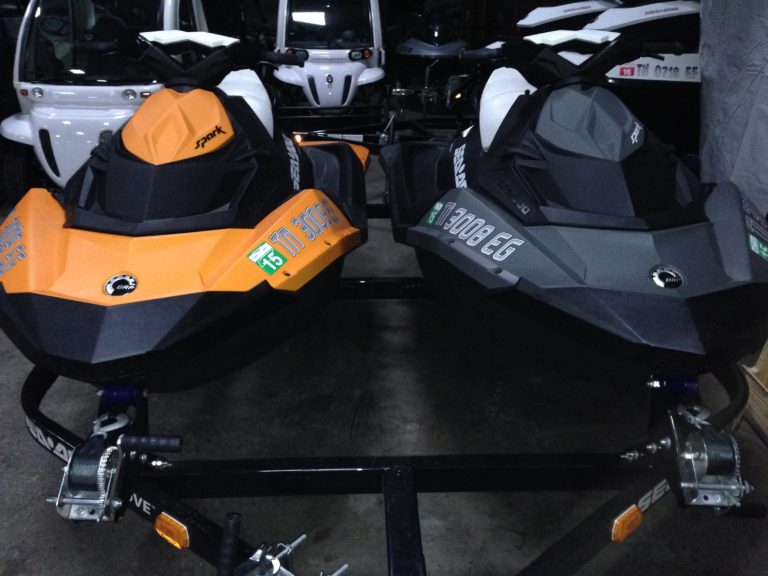
While many dealerships have plain just ran out of the lightweight Rec Lite runabouts, others – specifically middle Tennessee’s America’s Motor Sports – who not only regularly stock brand new Sparks – in a variety of colors and trim levels – but even some pre-owned units! And just this week, AMS has recently picked up this sweet pair of 2-up iBR-equipped Sparks.
Both also come with the optional 90-horsepower HO engine tune. With one in Licorice and the other in Orange Creme, both Sparks have about 10 hours each on the clock, and come fully serviced and a spotless double trailer (shown). Considering that just one new Spark equally-equipped could set you back about $7K, America’s Motor Sports’ asking price of $12,999 for the package is a friggin’ steal.
Like we’ve prompted you before, simply call Alex at (615) 767-6835, and tell him, “I saw your Spark on The Watercraft Journal,” and it can be yours.
Something new and exciting came to us in the form of tow-in wake boarding with the use of a jet ski, a pilot at the helm, and a rider holding a tow rope at the stern. Professional wakeboarders Shane Bonifay, Danny Harf, Daniel Watkins, and Shawn Watson set out for an epic adventure in Balina Beach, Australia during the early part of 2013, which we found over on The Inertia.
Throughout the video there were snippets of interviews with the participating riders which was both educational and filled with enthusiasm. Watkins discussed the main focus as a rider, which was having a good driver and being able to communicate well with him. They have to gel in order to get it right. Once a team gets the aspect of compatibility nailed down, they are on their way to getting awesome rides.
The jet ski driver must know where to put the rider in the wave and partners must be willing to make adjustments according to their skill sets, training, and knowledge of waves. After all, this is happening in an unpredictable ocean and it is relatively new. Another reason the jet ski pilot should be aware of where to drop the wakeboard rider in on a wave is to give him an opportunity to get the best ride possible. When the teams were able to get that aspect dialed in, they absolutely shredded! The pros were getting massive airs, spins, and Bonifay even tucked into a few barrels.
Watkins was not the only one who made references to “must click together” when speaking of their tow partners; the rest of the guys seemed very much in agreement when it came down to getting towed in. The sport still has a long way to go because it is so new. There is plenty of room for improvement as it evolves into something bigger, most likely a competitive scene. It will be exciting to see what happens next.
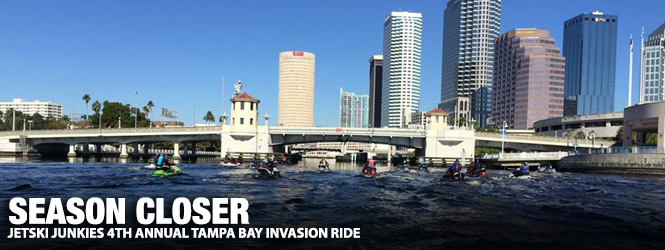
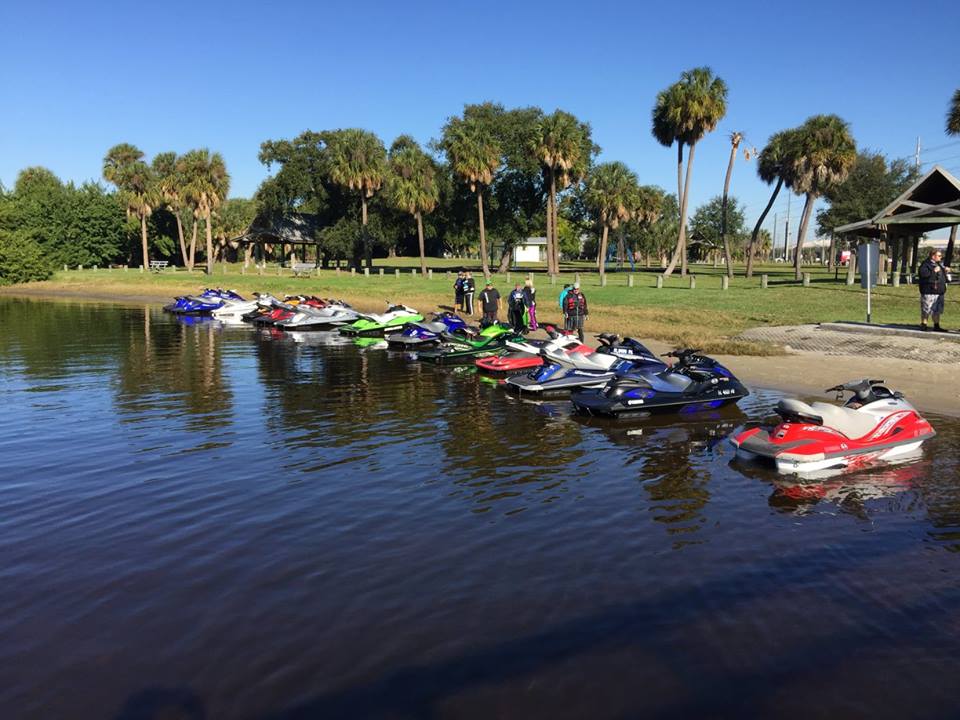
This year marked the 4th Annual Tampa Invasion Ride, hosted by Jetski Junkies USA. With 32 PWCs, one jet boat and 44 riders, it was another awesome downtown Tampa Bay invasion. The Tampa Invasion Ride is a come one, come all PWC event that brings Jet Life enthusiasts from around Florida and beyond, regardless of conditions. This year we lucked out with low 60 temperatures and sunny with 10 mph winds and 67 water temps.
The large group began from the Alafia River located in Riverview, making it’s way to Fantasy Island in Tampa Bay for a short stop. From there, the ride took us all north up the bay and right into the Port of Tampa, where we were able to check out some of the big ships at port, as well as two cruise ships, one of which was loading up to depart.
From there we rode right through the famous Channelside, Tampa’s downtown district by the water known for it’s night life and of course Tampa Bay Lightning stadium. Channelside dumps you into the Hillsborough River which makes its way right through downtown Tampa’s financial district. Our group passed NBC studios and the University of Tampa campus where you can see all the graffiti from colleges around the nation, put specifically on the walls and bridges lining the river by Rowing Teams throughout the years.
After that we passed the Children’s Museum, The Glazer, making our way under the bridge to the Straz Center where the river resumes normal operation and we ride amongst riverside homes, twisting and turning until we stop to turn back just before Lowry Park Zoo. From there it was back to Rick’s On The River, an excellent waterside restaurant with lots of floating docks for boaters.
After a short stop on the Sharktooth we kicked it back along one of the Spoil Islands before ripping through Bird Key and back into the Alafia River.
After lunch we made our way back to Tampa downtown but headed west out into Hillsborough Bay where we rode alongside Davis Islands dotted with many large and elegant homes; one in particular is Derek Jeter’s new 30,000-square foot vacation home. The ride then took us straight down Tampa Bay about 20 miles to Pine Key, also known to many as Sharktooth Island where the locals go to hang in the warmer months. We pretty much had the Island to ourselves allowing for some exploration and shell finding.
The Tampa Invasion Ride ride is to finalize every Jetski Junkies Ride year and allows us to celebrate with as many of our members as possible, during the Holiday Season. It truly is about the members and we appreciate all of them so much, not only for coming out and riding but for their contributions to the Club and the friendships that are forged throughout each year.
Let’s face it, next year’s racing landscape is looking pretty messy. AJ Handler’s separation from the IJSBA has many wondering what 2015 was going to look like, and all of the chatter coming out of those supposedly “in the know” are split whether IJSBA’s Frazier will retaliate with a National Tour of his own. While many have been left scratching their heads, Handler’s Pro Watercross Tour marches on a second new venue to his ever-growing tour: Sand Hollow State Park, St. George, Utah.
Located in southwestern Utah, St. George, Utah will be the hosting city for the fourth round of the 2015 Pro Watercross Tour held on June 27-28th. The picturesque Sand Hollow Reservoir is sure to provide some gorgeous imagery with red sandstone backdrops. This also bumps the Sparks, Nevada tour stop to June 20-21, so make sure to adjust your calendars. And while Sand Hollow State Park offers Pro Watercross members and fans a great location for PWC racing, there’s also plenty of other fun to have like ATV/off-highway vehicles (OHV) trails, camping, hiking, boating, and fishing.
Other highlights include:
• 30 mins from St. George Municipal airport
• 4 hours from Salt Lake City, UT
• 2 hours from Las Vegas, NV
• Elevation: 3,000 ft
• Surface Water Acreage: 1,322
This announcement also completes the seven-stop national tour’s 2015 schedule.
May 9-10 – Panama City Beach, FL – Boardwalk Beach Resort
May 16-17 – Pensacola Beach, FL – Pensacola Beach Gulf Pier
June 20-21 – Sparks/Reno, NV – Sparks Maria Park
June 27-28 – St. George, UT – Sand Hollow State Park
Earlier this month, possibly the biggest swell of 2014 blew into Portugal’s epic surf spot, Nazare churning up mammoth waves from Punta Galea to Jaws. As Portugal prepared for what was sure to be one of the site’s biggest sessions, big wave surfers Garrett McNamara, Ross Clarke-Jones, Hugo Vau, and Sebastien Steudtner embarked on an adventure to push their very limits.
According to a report first published on The Inertia, Red Bull team leader McNamara “lost a jet ski in 20-feet of whitewater. Andrew Cotton got smashed beyond belief, and Ross Clarke-Jones proved that once you’ve got it, you can never lose it.” The video below documents the surfer’s exploits and illustrate the sheer magnitude of the waves that pounded these watermen to a pulp.
McNamara, of course, is no stranger to the location or putting himself within arm’s reach of shirking his mortal coil. The elder statesman of big wave surfing was first believed to have ridden a 100-foot-high wave near this same spot and McNamara famously rode waves caused by the calving of ice from Alaskan glaciers almost seven years ago. It’s an incredible show of fortitude and daring, and charging into waves like these is not for everyone. But as McNamara and his compatriots have shown, locations and waves like these wouldn’t be possible without the aid of personal watercraft.
One of Europe’s most popular manufacturers of soft goods riding gear, Jobe decided to switch things up a bit for 2015 throw in some color to their products. Breaking away from last year’s collection of black and white riding gear and apparel, Jobe’s Ruthless lineup gives riders a new range of wetsuits (with new aggressive color accents).
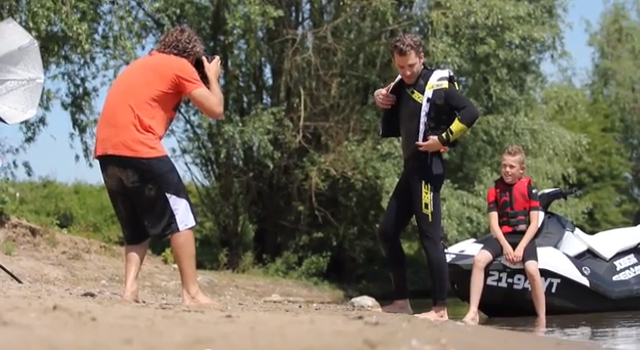
To ring in the new lineup, Jobe produced a whole new catalog of the Ruthless lineup and a series of videos to reveal their new products – like Jobe’s Ruthless Long John Men F-Flex with yellow accents. While the catalog and videos have been circulating around the Internet for a few months, Jobe recently released a fun behind-the-scenes video of the photoshoot not only highlighting the new Ruthless products, but all the fun everybody had.
In addition to the new men’s collection, the women and kids collections got new colorful designs as well. You’ll spot a few cool additions to the Jobe line like some sweet towables and even lifevests for your dog! There’s lots to be seen in the new catalog, so after you watch the video below, make sure to peruse the new Ruthless collection by clicking HERE.
It was late 2006 when Kawasaki introduced the world to its new full-sized runabout, the Ultra 250X. The sharply chiseled JetSki touted the biggest engine producing the most horsepower of any personal watercraft before it; 35HP over the closest Sea-Doo and an astounding 70HP ahead of Yamaha. Equally, the 250X unseated the brand’s STX-15F as its flagship craft, and rightly fixed Kawasaki back atop the heap of performance PWC.
It was also the first watercraft I ever rode as an editor for a jet ski magazine. It was also the first supercharged 4-stroke PWC ski I had ever ridden despite the RXT and RXP being introduced a couple of years earlier. The staccato whistle of the roots-style blower shrieked angrily in my ears with each swell I leapt over. The deep V-hull split the undulating surf like a Coast Guard Cruiser. It was a surreal experience, uprooting everything I knew a jet ski to be. It was transformative.
But that year’s IJSBA World Finals, beneath the shade of the Kawasaki racing rig’s awning, were a line up of heavily modded STXs. Why? I queried, when the Ultra was so impressive? Sure, master craftsman Les Cook had grafted the rough-water Ultra hull to the smaller 15F in perfect Frankenstein fashion, and Skip Holmes seemed to be the only tuner who could make the 250X a closed course contender; but it was only after several changes were made (bracing, weight distribution, etc.) over the following year that the Ultra could serve as a worthwhile buoy course competitor, completely making the STX-15F obsolete.
Racers have been using the STX-15F as a racing platform since it’s early days as the STX 1100. It’s time for a refresh.
Today, the STX is less of an addendum to Kawasaki’s lineup than the SuperJet is for Yamaha (rather, rumors of a new SuperJet hull and a variety of engines are being considered). As it stands, the STX is 13 years old with the only major change being the graduation from the 12F to the 15F when the first Ultra 250X was released (making the 15F seven years old). Once the gilded crown of Kawasaki’s runabouts, the STX remains as the company’s deep-discounted entry level unit sitting quietly in the background as new 310-horsepower Ultras soak in the spotlight.
But it doesn’t have to be this way.
A year ago this January, I sat with some of the biggest names in Kawasaki’s watercraft division discussing this very topic. Soaking in the balmy night air of Florida’s Duck Key resort, I pitched the possibility of a Ultra-powered STX dubbed the “STX-310R.”
Beneath the two-piece bench seat of the STX is the real estate necessary to fit the current 1.5-liter Ultra 310X powerplant. Only the slightest of changes would be necessary to shoehorn the supercharged powerhouse into the lowly ski, namely moving the ECU bulkhead forward into the front stowage bin area and reconfiguring the waterbox/intercooler/pump configuration. The latter point requires the only major modification to the powertrain.
Unchanged since swapping from the 12F to the 15F over seven years ago, the STX hull has remained the same for a dozen years.
I suggested replacing the factory’s massive vertical intercooler with a smaller-yet-equally high volume cooler from RIVA Racing (as an example), and a single high performance waterbox placed opposite the intercooler. Similarly, the STX’s 155mm pump replaced with the Ultra’s 160mm axial-flow, single stage jet pump. And, a fixed-position, exposed motocross-style neck and handlebar (identical to the 310R) could replace the staid steering system.
Besides a woefully necessary redesign of the hood and top deck, the SMC fiberglass hull could effectively remain untouched if the hull was paired with an aggressive top-loader intake grate, ride plate and adjustable sponsons. The STX is small, nimble and now touting the most horsepower in the industry. What more could you want? One featured I begged for was launch control:
Similar to the Launch Control Mode on the high tech KX450F dirt bike, the system activates a second engine map for more efficient off-the-line starts. Like the KX450F, the ski’s Launch Control Mode is activated by a button on the handlebar, where the new map (tune) slightly retards ignition timing to dial back the engine’s torque and reduce cavitation off the start, disengaging and returning to the standard engine map automatically once the rider once reaching a specified MPH.
IJSBA World Champion Craig Warner’s Votech-supercharged STX-15F is a living example of how the STX can be used to outperform Yamahas and Sea-Doos handily.
I outlined a price and availability structure that would ensure the requesat interest, hype and demand: Kawasaki would pattern the STX-310R’s release similar to the recent H2 and H2R superbike releases, teasing the ski with viral videos, slowly leaking information over several months building up to a large-scale reveal. Dealers would be encouraged to take deposits on the ski early as delivery of the units wouldn’t be for several months out.
For 2016, only 505 units would be built to meet racing homologation standards. Priced at slightly above the luxury 310LX, the STX-310R would be Kawasaki’s most advanced, aggressive and potent personal watercraft ever built. I dreamed of a small “hit squad” of hand-picked and vetted racers to campaign the new STX-310R throughout the US National Tour, patterning after Yamaha’s masterful execution of their 2014 season, clinching four National Titles.
Effectively, Kawasaki could convert their wallflower STX-15F into a race-ready, top performance machine equal (if not superior) to Yamaha’s SVHO-powered FZR and Sea-Doo’s RXP-X 260 overnight. And considering the equipment the STX-310R would come stock with, championships in closed course and HydroDrag Pro Runabout Stock classes and the AquaX series are almost a given. Of course, we fully expect the same Launch Control Mode to be made available at the very least for the Ultra 310R, as it has seen so much use in competition already.
Again, this is what I shared that one night. I think people would want it. I know I would. Wouldn’t you?
‘Tis the season folks, and we’re really happy to share that employees of Kawasaki Motors Corp., U.S.A. (as well as the company’s marketing agencies) joined together to raise funds drum up toy donations totaling nearly $15,000 for the 22nd Annual ABC7 and Southern California Firefighters’ “Spark of Love” Toy Drive.
All of the toys were donated live on ABC7 Los Angeles, with a crowd of Kawasaki employees on site to support the cause. Of course, we’re not at all surprised that a few Kawasaki-branded ride-ons, bicycles, foot-to-floor toys and much, much more for children of all ages made it into the mix either. ‘Cause c’mon, kids want to be part of Team Green too.
PowerSports Business quoted Richard Beattie, Chief Operating Officer, Kawasaki Motors Corp., U.S.A., stating, “All of the toys donated will go to children who live right here in Orange County where our company’s headquarters are based, so it makes sense that our employees would want to give back to their own community. This is the seventh year we’ve participated with Spark of Love and we look forward to many more years to come.”
All of the toys donated during the ABC7 Spark of Love toy drive are distributed to local children in need who are in the area by Southern California Fire Departments.
It’s the longest continuous offshore, open-ocean race in the United States. Also being the 20th anniversary, “Long Beach to Catalina and Back” or “LB2CAT,” is also the longest-running offshore race in the US, reaching back to the mid-1990s (that is with a short break in the mid-2000s for a couple years).
The 58-mile endurance sprint has riders racing to the Southern Californian island of Santa Catalina Island and straight back to Queensgate Harbor, Long Beach. And although the straightline course seems pretty straightforward, navigating the undulating sea state, ever-changing currents, and unexpected the elements can complicate the course in short time.
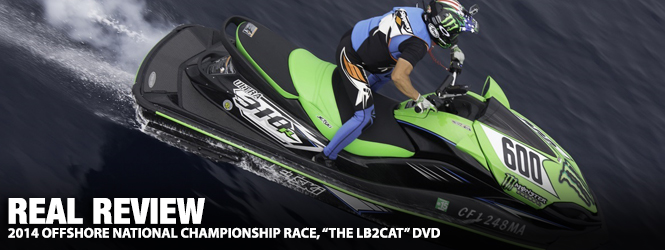
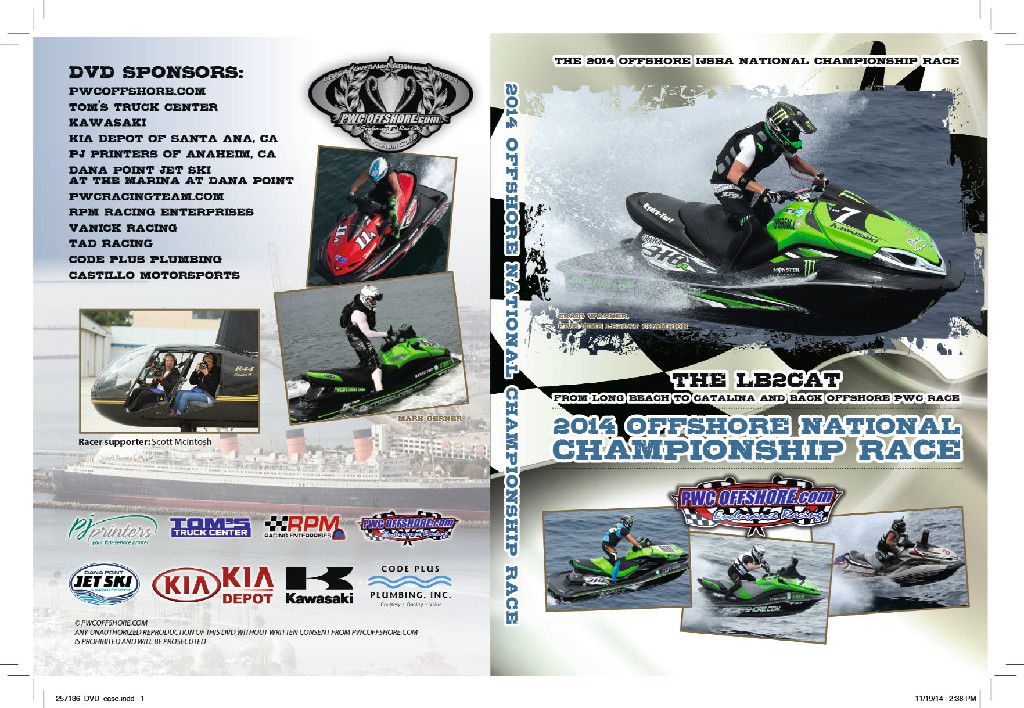
In addition to helping promote and present the event, the PWCOffshore.com crew edit together a video recap of year’s LB2CAT race. The DVD cuts between exclusive “eye-in-the-sky” helicopter footage, GoPros mounted on racer’s helmets, and pre- and post-race interviews. With a running time of nearly 80 minutes, the video documents the brutal offshore action in near real time. Commentators Ian Howard and Will Johnson provide the play-by-play with decent pacing and informative tips.
Surprisingly the focus drifts from Warner, who as not only a member of the PWCOffshore team, is also the front-runner for his fifth LB2CAT offshore championship, but hints at possible contention from Mike Klippenstien’s purportedly 90MH turbo-powered Yamaha FX SVHO and others.
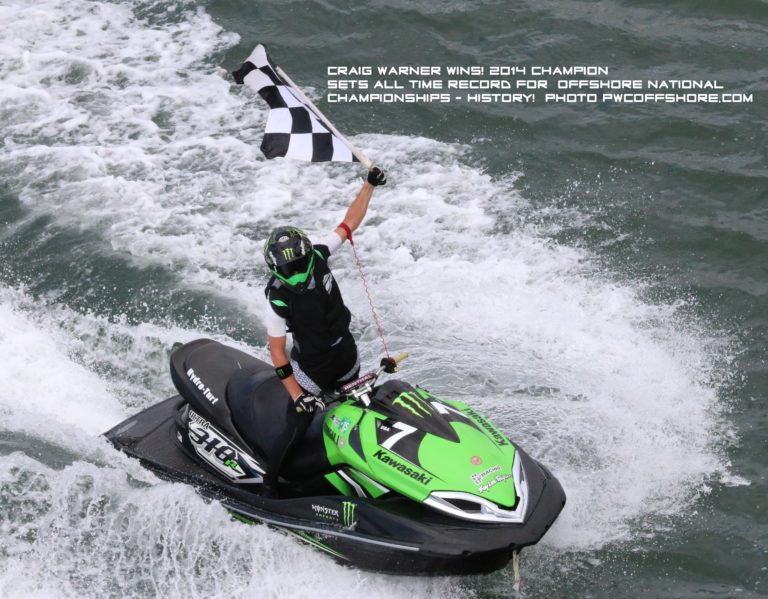
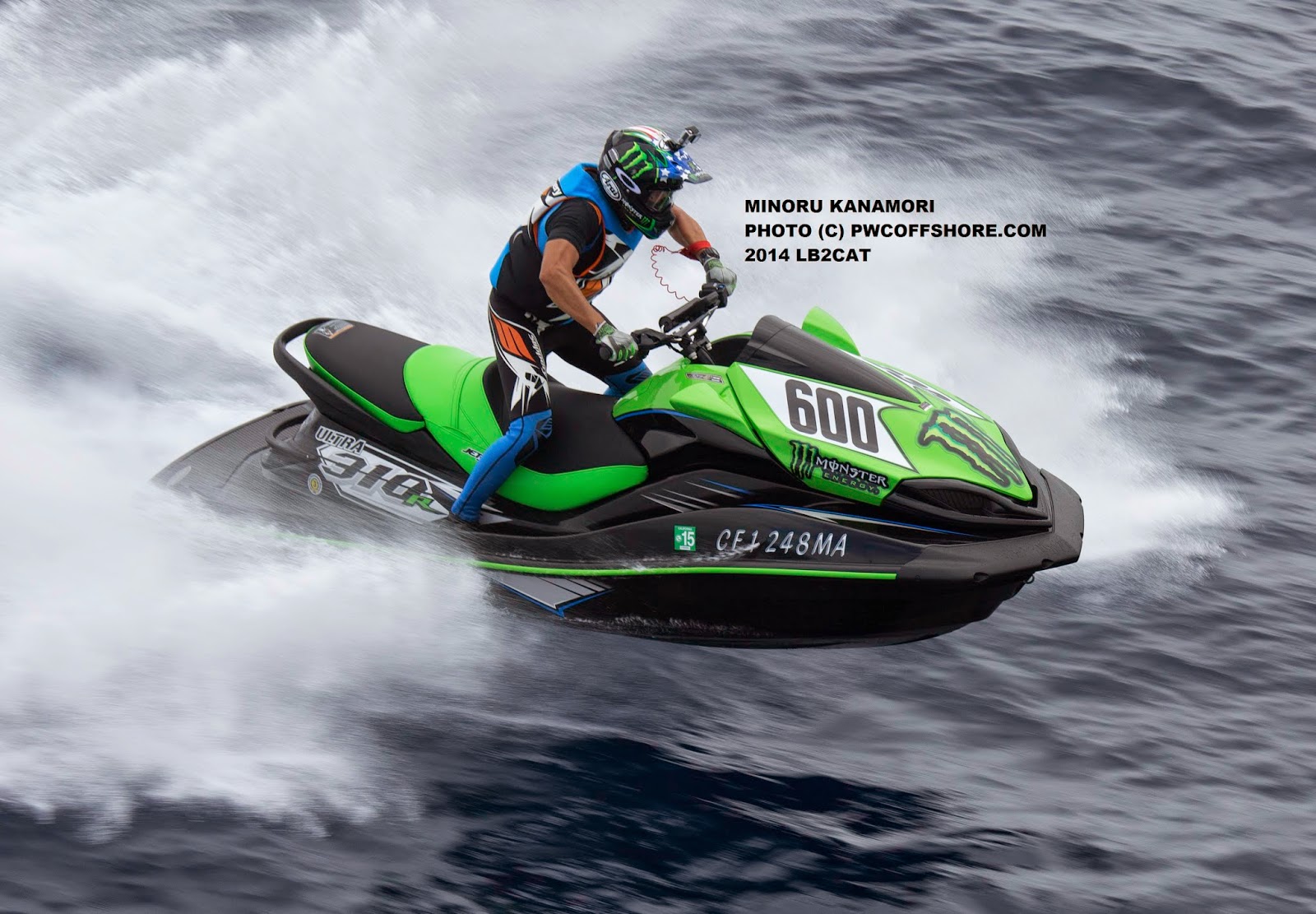
Included in that group is fellow Factory Kawasaki racer Kanamori, who masterfully pilots his showroom-stock ’14 Ultra 310R into the leader position at one point, as Warner smartly dials back his turbocharged Ultra several times throughout the race. With a world record at risk, Warner opted to preserve his ski rather than risk a DNF.
The gambit paid off, earning Warner his fifth LB2CAT win, and third consecutive win to boot. Kanamori, who needed to stop to refuel half way back to the mainland, was bested by PWCOffshore.com’s own KC Heidler in the final seconds.
Post race interviews reveal the an equal mix of exhaustion and elation in the faces of the riders. The accomplishment of completing the LB2CAT is enough to be proud, and while some were clearly fatigued, almost dizzy with exhaustion, others were visibly charged and raring to return next year.
For those interested in participating in the LB2CAT next year, this is a “must buy,” if only as a training video. You can get yours HERE. And for those looking at polishing up on your offshore and rough water riding, we also suggest picking up the DVD for the many tech tips offered throughout the video.