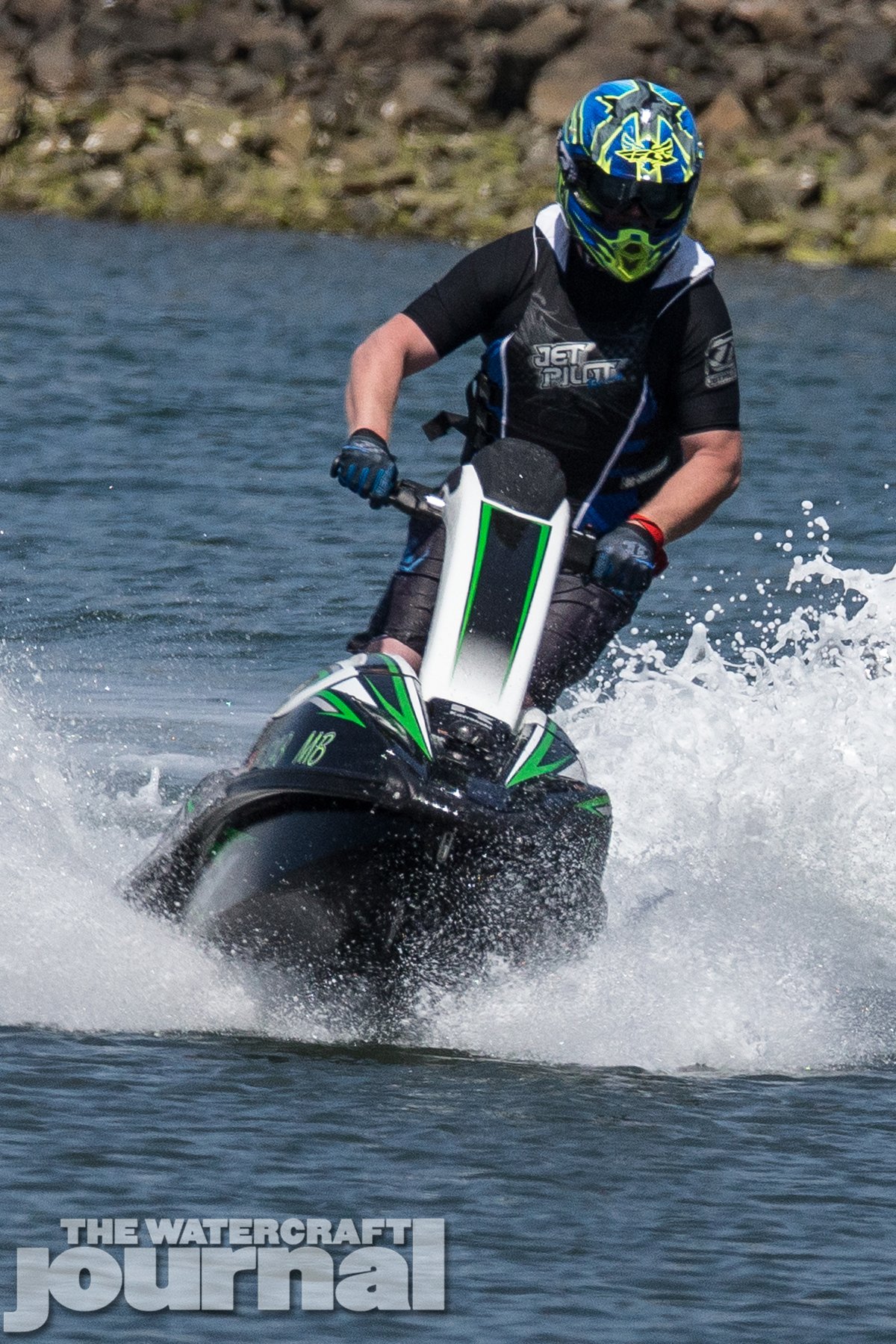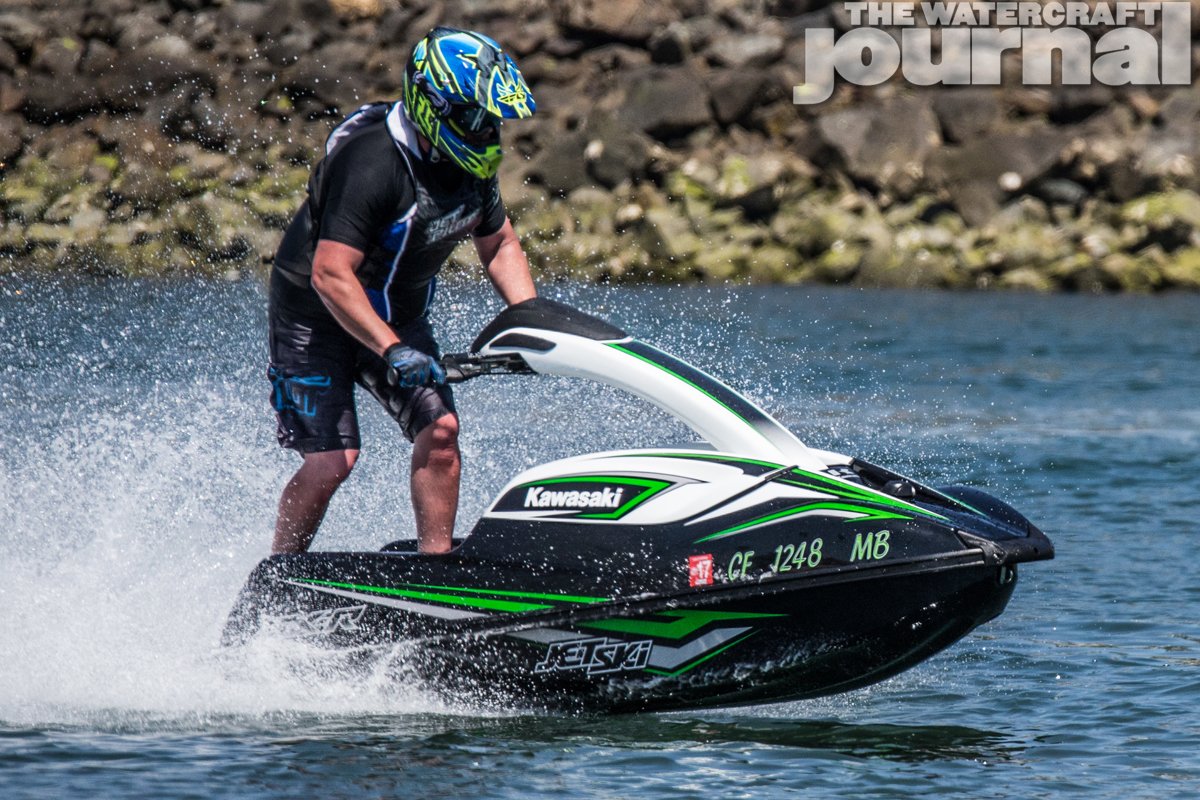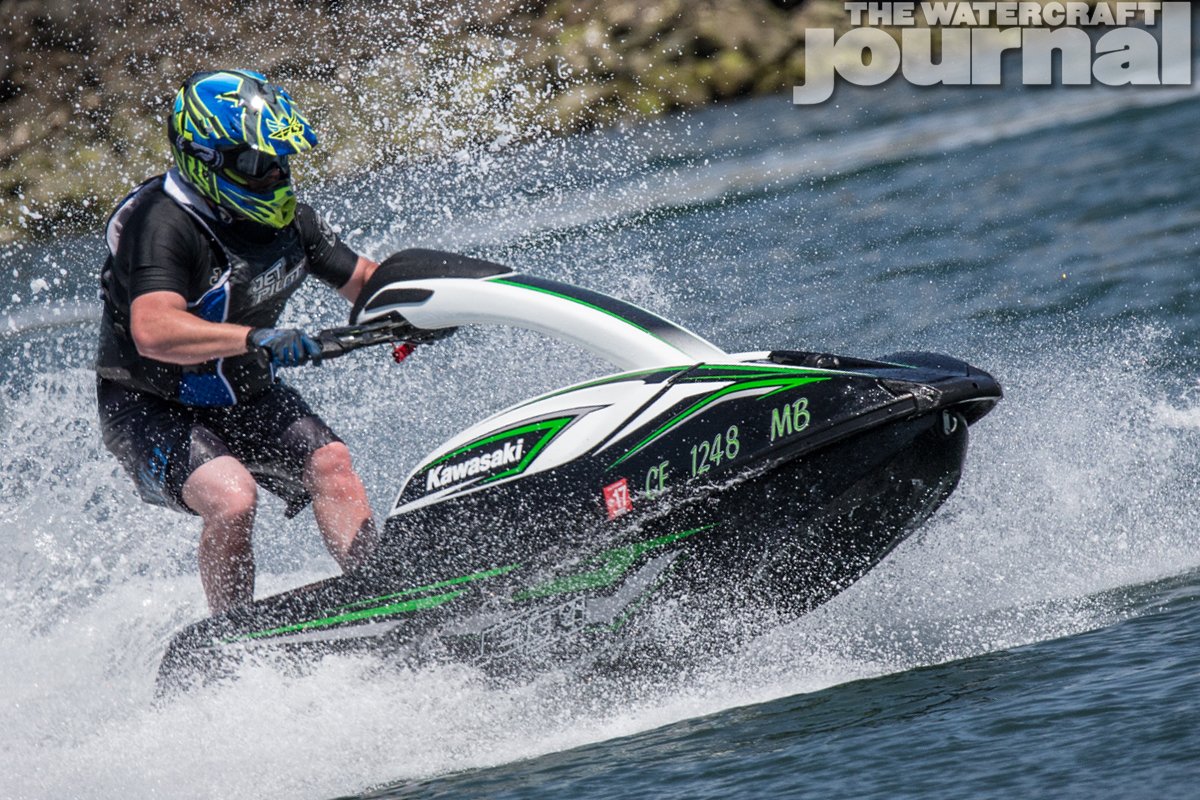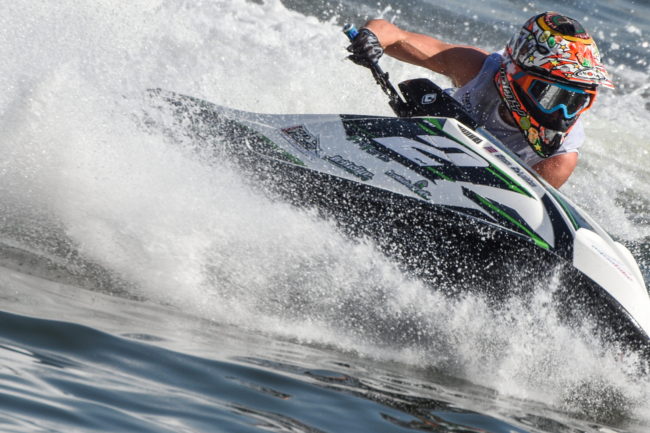

Most of you will die at a healthy old age having never needed to wear a helmet while riding a PWC. But for those few who dare to push the limits of their machines (and themselves), proper head protection is a must. Fly Racing has pushed their own limits by introducing their most advanced, best-protecting helmet yet, the F2 Carbon MIPS Retrospec.
MIPS or Multi-Directional Impact Protection System, is a patented technology developed by “some of the worldās leading researchers in biomechanics and neuroscience at the Royal Institute of Technology (KTH) and the Karolinska Institute in Sweden,” according to Fly. In the image below, you’ll see that with exactly the same speed and angle, the trauma on the brain can be very different.
Fly’s MIPS technology comes after 19 years of studies and testing by some of the worldās top researchers (and brain surgeons), all with one goal in mind: to absorb more rotational force from a multitude of angles. Because the brain is surrounded by a cushion of cerebrospinal fluid allowing it to slide slightly on impact, MIPS imitates the brainās way of protecting itself by giving the helmet its own low-friction layer between the outer shell and the liner, which also slides to absorb a portion of the energy created by an angled blow to the head. It’s pretty ingenious, actually.
Meets or exceeds the toughest safety standards on the market: Snell 2015, DOT approved for USA
MIPSĀ® low-friction layer can absorb more of the rotational force of impacts, adding more protection than other helmets can offer
Shell is constructed using state-of-the-art, aircraft grade woven Carbon fiber and KevlarĀ® composite materials, which create superior strength while remaining extremely light
Dual density EPS liner combines two layers of EPS (Expanded Polystyrene), one softer, one slightly harder to provide more progressive impact absorption for different levels of impact
Multi-port air induction cooling system includes 11 intake and 4 exhaust vents that create massive airflow to keep your head cool
Quad-vent goggle anti-fog vents above goggle eye port draw air from goggle to help clear away fog
Custom molded rubber trim with integrated nose guard helps keep rocks and debris away from your nose
Quick Release washable CoolmaxĀ® comfort liner & cheek pads absorb sweat, provide plenty of ventilation, and are easy to remove
Flow through EPS (Expanded Polystyrene) and comfort liner air system align to maximize airflow
Constructed using super-strong, lightweight machined aluminum screws, rivets, and stainless steel D-rings for superior strength and years of worry free use
Optional carbon fiber intake vent wing can be added to the helmet for increased direction of airflow on the front vents
In the video below, FLY Racing’s designer Jerry Lathrop walks us through how its new MIPS (Multi-directional Impact Protection System) low-friction layer can absorb more of the rotational force of impacts, significantly increasing protection in angled impacts. It’s pretty informative stuff and worth a watch:
“Say, ‘Thank you’,” is a phrase I’m constantly belaboring to my 3-year-old. She’s a lovely little girl who’s inherited her mother’s shyness and father’s stubbornness, meaning that as strangers pay her compliments or offer her treats, she’ll obstinately refuse to show gratitude for the kindness given. It’s not only an embarrassment to her parents, but a difficult lesson to teach. The of topic of gratitude is a particularly sensitive one for me as I too, was much like my own daughter in my early years – although nowhere near as cute. The expression of thanks is both an acknowledgement of charity rendered, but also help or assistance provided. The course of my career – and personal life, for that matter – is one of help and guidance from family, friends and complete strangers.
In truth, this magazine itself owes its name to one friend, Marc Samuelwics, while the initial push to create it goes to several key members of our industry – particularly Jerry Gaddis and Tim McKercher. Over the years, several prominent members of the personal watercraft industry have provided editorial content, event coverage, inside information pertaining to new product or other significant industry news, article ideas, and even built relationships to provide The Watercraft Journal with new and return advertising. Speaking of which, our advertisers – particularly those who have remained constant and true throughout our four-year duration (namely Jet Renu, Yamaha Motor Corp., RIVA Racing, Hydro-Turf, Sea-Doo, Jet Ski Shop and SBT, Inc.) have both blessed our company with their financial support and received returns from our loyal readership for whom we are immensely grateful.
It is because of this value on gratitude that I’ve been so vexed lately – specifically, as it pertains to the persons within our industry looking to cultivate their hobby into a career, and flourish their part-time career into something grander. Albeit irregular, we occasionally publish the full-length feature article on a shop, builder or company who isn’t an advertiser. This of course, can serve as a great boon to their budding sales and can be leveraged to build their brand when shared socially. Typically, content of this type is reserved for our supporting advertisers as they pay to receive a steady stream of editorial content highlighting their products and/or services. So when we publish such a feature for a non-advertiser, it is at our cost and expressly for their benefit, as we present their brand before our 350,000 annual readers whom might not have ever heard of them previously.
Such an instance recently occurred and the resulting story was very well received. My contributor produced some of his best work, and our readership greedily ate it up. Yet, all of this effort and expense to publish such a quality product resulted in the utmost in ingratitude, the shop owner choosing to berate my contributor about some minute inconveniences incurred by the two-man company to assist in providing some additional photography, rather than thanking us for the magnanimous work done on their behalf and at no cost (save for a little bit of time spent). I relayed the sentiment that I would happily take the article down rather than give the ingrate further exposure, but chose rather to exemplify his actions here.
Readers have bemoaned our perceived over-indulgence in one topic while supposedly ignoring another, or vociferously complained about some such nonsense while ignoring the fact that this publication comes to them entirely at no cost or inconvenience to themselves. Former advertisers have growled that their degree of editorial support was lacking despite refusing to pay for a program wherein such expected returns are contractually obliged. Others expect sudden cloudbursts of product sales to come raining down despite refusing to share (or even “Like”) the content we delivered on their behalf, despite third-party content being one of the biggest socially-accepted forms of SM posts. Companies look to press as much free publicity from us without understanding or accepting the costs accrued on our end. But then again, we are not alone.
Retailers constantly struggle with customers threatening to never return if not given a better deal than what is offered. Racers participate in local and national events at great cost to themselves with hopes that potential sponsors will value their loyalty and reward them for their reliability and performance. Transversely, sponsors are regularly abandoned on a whim when a racer is offered as little as a free pair of gloves. Returning customers walk up to the same parts department counters they’ve frequented for decades to find the usual clerk has been replaced, and with them all report erased. Somehow, someway, people have become accustomed to the idea that they deserve more than what they are getting. That their mere presence earns them some imagined special treatment. That, by the sheer task of being present warrants them more than the person next to them.
Perhaps this is the fallacy of celebrity, or the lure of social media. Our parents and better yet, their parents understood that all things worthwhile in life are earned. They are pulled from the earth with bare hands. They are chiseled from rock and stone. They are doggedly worked, hardened, brazed and polished by calloused hands and sweat-soaked brows. Time and energy are greater commodities than gold and silver, and to recognize this fact is to discover wisdom. Be aware of the time, labor and effort that others have given of themselves to boost you up. Recognize the sacrifices that others – some of whom you might never know or meet – have made so that you could live better, more comfortably or in security. Once you realize all that your fellow men have done for you, you will be far more willing to return in like. Why? Because gratitude conceives charity.
When freeriding came into the scene of jet ski riding, only a few ventured out into the rough currents to perform tricks. With custom hulls, powerful motors and superior handling, more and more riders are giving freeriding a chance. Now we see Mark Gomez pulling crazy tricks, Abraham Ho getting higher than viewers kites and Jake Bright continuing to wow the crowd. These riders along with many other are growing the sport at an extremely fast rate.
Daytona, Florida is an iconic city that thousands flock to every year for the Daytona 500 motor race. While Freeriding isnāt as big as NASCAR yet, the Daytona Freeride Competition has been going on for a few years now and it is increasing in size each year. While this is an event many people travel to, work and busy schedules do not always allow for a weekend getaway to the beach. Thankfully Spectrum Innovations was on scene for the event and was able to create one of the best videos featuring freeride.
This video was done excellently as it showed how after a long night of hanging out with the riders, they wake up early and are warming up their watercrafts. Check it out if you havenāt seen it and share it with your fellow riding buddies. They will surely think it’s as cool as we thought it was. If you would like a full recap of the Daytona Freeride check out Mark Gomezās news story here on The Watercraft Journal.
Life can throw a curveball at you at anytime which has made some people have to give up what their true passion is. Well luckily for rider Nicolas Rius he is coming back! Rius was one of the best European riders to ever race and is quite excited to be coming back for the 2017 race season. Coming back to racing requires a lot of training but Rius is looking to rekindle the competition between fellow rider and world champion Chris MacClugage.
This sparks a lot of excitement as MacClugage has won over 21 World Championships and has proven himself to be one of the best riders. But Nicolas Rius has 16 World Titles and that was back in the 90s when he was racing in Europe. In 2011, he was involved in a high speed crash and decided to retire. So coming out of retirement riding a Yamaha GP1800 will surely make a statement. With the backing of the powerhouse RIVA Racing, it will surely give Deanās Team Racing a run for its money.
This year’s 2017 race season will be full of jam packed action and it all kicks off at this year’s Mark Hahn Memorial 300 taking place this weekend in Lake Havasu, AZ where he’ll be partnering with fellow Frenchman Cyrille Lemoine to compete for the title. Next, Rius will be charging the AquaX season, beginning at Daytona Beach. Be prepared to hear about Nicolas Ruis and his epic comeback to the racing scene! Let’s hope that all racers especially Nicolas Rius have a great season and are able to remain safe and healthy.
The recent flooding in Southern California gave two-time world MotoSurf champion and Hydro-Turf rider Mark Gomez the opportunity to take to the streets of Fullerton, with one of his stand up 550 racing skis. This went down Sunday, January 22nd, in his hometown neighborhood where people along the streets were yelling for him to go faster. They got a kick out of his antics. His brother Phillip Gomez and he had waited a long time for this day and when it finally happened, brother Phillip captured the action on video, which he filmed from his truck. Good times were had by all!
Gomez wrote, “After years of my brother Philip Gomez and I waiting for the rainy day stars to align – that was for us both being home and it to be raining just hard enough to get our street gutters to flood enough so I could try to ride up our street in Fullerton, CA; we tried it before but couldn’t get it going – today, with the help of the neighborhood, I pulled it off! First attempt was filmed from the bottom of the hill, I made it all the way up my street, turned right and had to stop because of a parked car blocking my river! This second attempt got almost as far, until I clipped the curb which sent me into the shallow spot toward a soft abrupt stop, but thankfully my chin cushioned the blow (ha! ha!). Such a rad home experience.”
After checking out Mark’s Facebook page we read that it took two attempts to get the ride he was looking for on Sunday and the guys and the neighbors were stoked! Gomez does a great job navigating his way down the narrow street, and just laughs when a shallow spot shuts down his rainy day ride. Gomez has such a carefree attitude that we all absolutely love. It really shows in his riding and this day was no exception.
The annual event known to most as “JetFest” was recently renamed “2017 Blowsion Northeast John Dady Memorial PWC Rally” to celebrate the life of John Dady. Celebrating its 10th consecutive year, the Blowsion Northeast John Dady Memorial PWC Rally will “continue the traditions and standards established by former JetFest events,” as states the official Facebook page. Hosted by the Adirondack Jetski Club (AJC), an American Watercraft Association (AWA) official charter club, the AJC decided to not only use this year’s venue as an opportunity to celebrate the man who touched so many lives, but also provide for his family.
Also unique for this year, the 2017 Blowsion Northeast John Dady Memorial PWC Rally will offer an unprecedented four (4) personal watercraft (winners need not be present to win but would be responsible for shipping costs) as means to generate a substantial charitable donation for Johnās beneficiaries. Individually-numbered memorial decals have been made available through the AJC Support Member Program for purchase online and in person onsite. Online Support Member Program registration will be available at www.adkjetskiclub.org January 1, 2017 through June 1, 2017.
In a recent Facebook post, they wrote: “Available for purchase, the $20 Blowsion Northeast John Dady Memorial PWC Rally decal. All proceeds will be donated directly to John’s beneficiaries. Each decal purchased automatically enters buyers into the June 17, 2017 four (4) personal watercraft sweepstakes. Decals and official rules available exclusively at www.adkjetskiclub.org – click on the “Support Decals” tab. Special thanks to each of the stalwart event sponsor for making this tribute program possible!
“Attention participants who will be attending the event. The $20 decal purchase also covers your entry fee. However, there may be a minor additional cost of a few bucks for “day membership” of the sanctioning body which will be providing event insurance.”
Back in 1999, āCrazy Joeā Davis and his wife, Connie from New Baltimore, Michigan started racing jet skis. They started traveling all over the nation racing on the closed course circuits. From then on, they were hooked.Ā They also brought along their young children, Joe Jr. and Kristen, who were instantly hooked as well. Their infatuation with racing quickly became a lifestyle for the entire Davis family. Living on Lake St. Clair, their summers were spent entirely on the water, whether it was boating or riding jet skis.
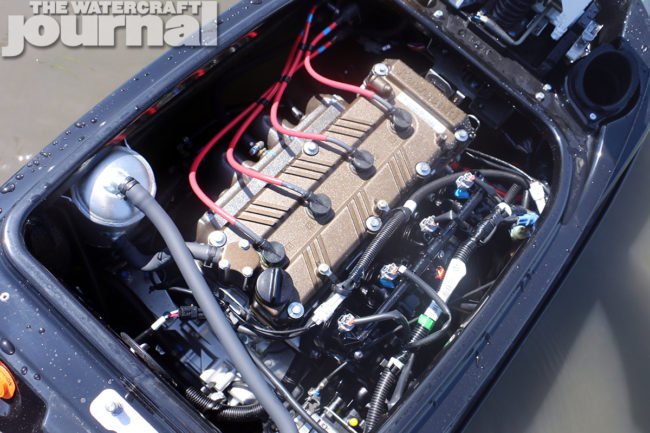
As time passed by, the racing scene in the Midwest was on a decline; less people showed up to the races and many of circuits dissolved because of lack of participation and funding. More and more people were venturing into freestyle and leaving the racing scene. This proved true for Crazy Joe and Joe Jr. as they spent more time focusing on freeriding rather than racing.Ā When the aftermarket hulls entered the industry, they both knew this was something they wanted to be apart of, but the cost deferred them from buying one of the many options out there. Already riding SuperJets, an idea sparked in their minds: Why not just make their own hull?
So, they quickly began chopping an old square nose (1990-1995) SuperJet hull they had and after some major changes, ended up with a very ugly, torpedo-like hull. Both said the torpedo hull wasnāt very practical, but the idea of creating their own hull was formed. They rode the torpedo hull for a couple months and wrote down what they liked and disliked about it. They went back to the drawing board and incorporated the changes they wanted to make. They decided to chop up another old SuperJet and this time they were more successful, but were still not satisfied. However, they started to throw every local rider on the chopped up SuperJet. They started taking opinions on the hull and starting making notes of what people said needed to be changed and what needed to be kept. As changes were made and the hull was improved, they finally had something to work off of.
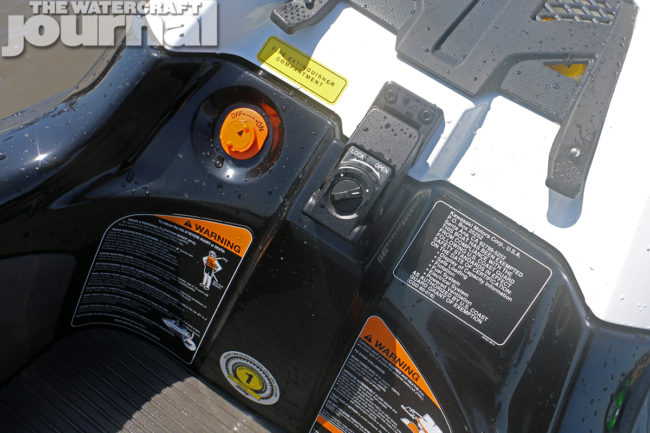
At this point, the father-son duo knew it was time to start building a mold so they could reproduce their skis. However, it wasnāt something they had done before so they reached out to a friend so they could learn from him about the plug-and-mold process. After months and months of research and practice, they had their mold. The first, few skis were tests and only ridden by Crazy Joe and Joe Jr., in order to make sure everything was right. After they had produced a couple, they began to get more quality hulls each time they made one. Eventually, they needed a name for the ski. Both of them came up with the name āBAMā which stood for āBy Any Means.ā They settled on BAM because they had a commitment to bring an affordable hull to people in the Midwest by any means.
Today, Crazy Joeās Customs is a custom paint and fiberglass repair shop and is one of the few aftermarket freestyle hull builders in the Midwest. Crazy Joeās Customs is a family run business, as both Crazy Joe and Joe Jr. run every aspect of the company whether that is production, sales and social media. Besides the BAM hull they offer custom chin pads for aftermarket handle poles, custom chin pads for the 1996 and newer SuperJet and custom footholds.
The BAM hull is priced at the entry-level $4,200 for a new fiberglass hull. The price includes the hull, hood, ride plate, foam, scupper, footholds and all mounts. This also includes a Crazy Joeās paint job. The price for the carbon hull starts at $5,600. The weight of the hulls typically can range from 40-to-84 pounds, depending on what the customer wants. Since each ski is hand built on the individual needs of the customer, those prices are subject to change depending on how you want it setup.
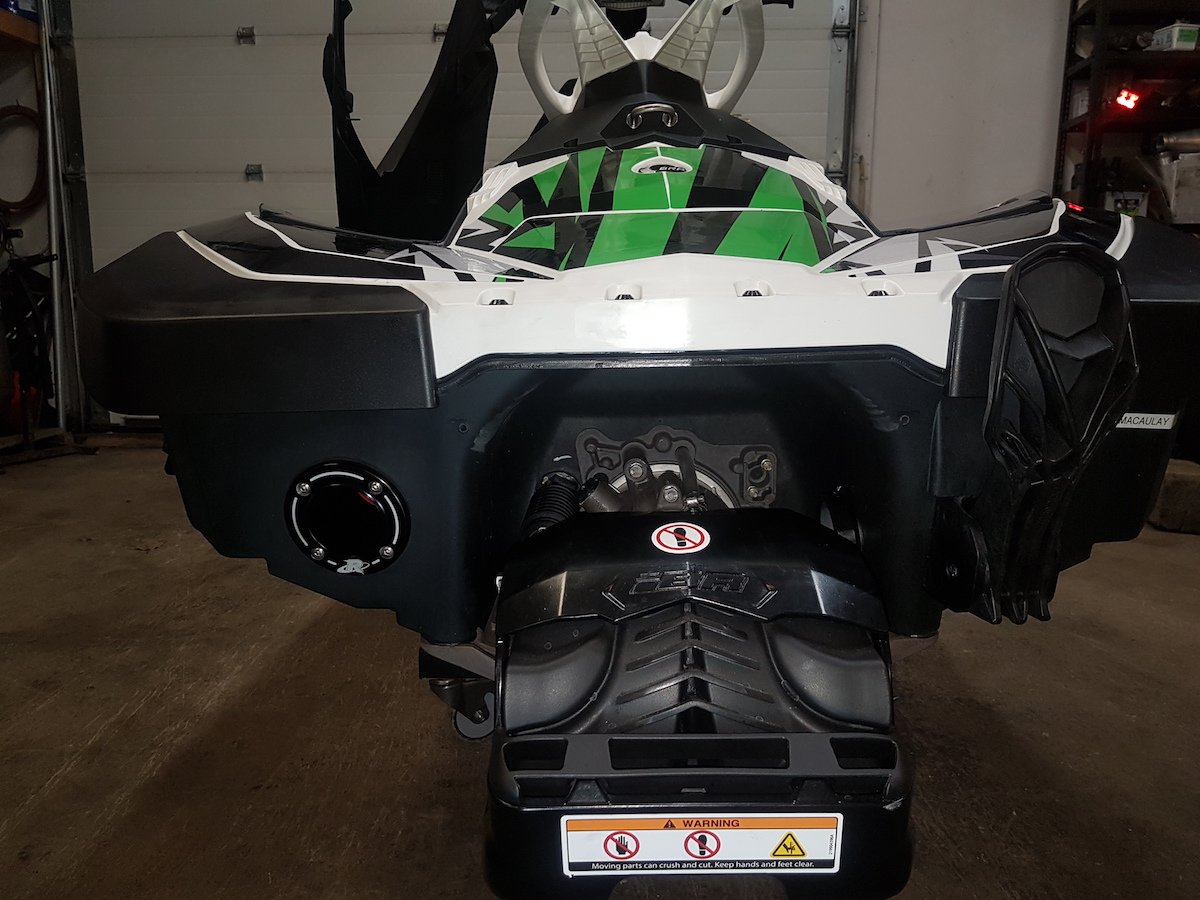
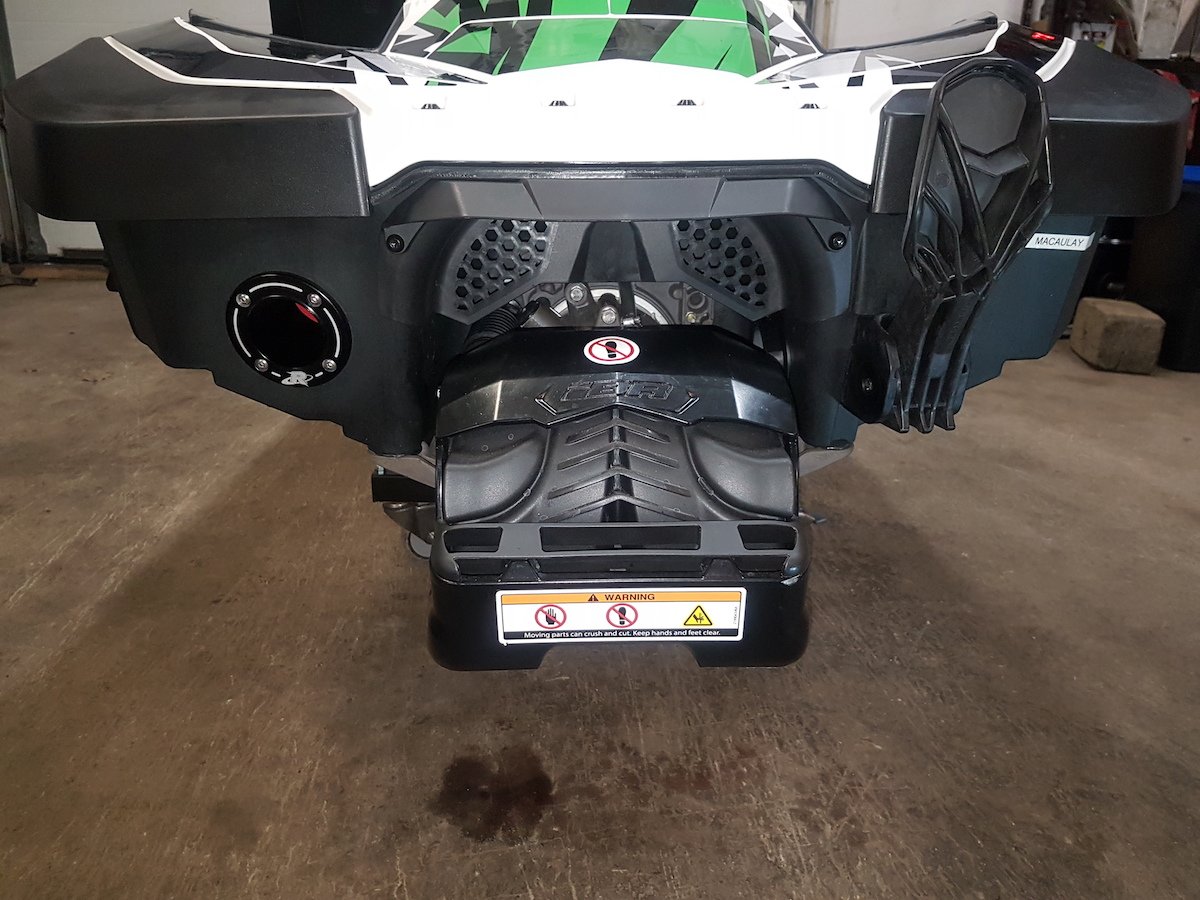
However, each hull is built with top-notch quality and the attention to detail is absolutely insane. You donāt get the long wait period for your hull to arrive or the inferior quality of some of the hull manufacturers out there. Another thing they have done is partner with KP Poles, which gives the customer an aftermarket pole at a very low price.
Every year at Wave Rave, Michiganās biggest freeride on the beautiful, sandy shores of Lake Michigan, the BAM is always the hull that you see everyone trying. Each time the person riding the BAM comes back, all you can see is a huge grin from one ear to the other. It absolutely shreds and slashes the rough surf of Lake Michigan. On flat water, it is equally impressive as it is can be flipped no problem. During an exclusive test ride, we found the best aspect of this hull is the way it planes out.
It did not have the feeling you get on most aftermarket hulls, that extreme, nose-high āsquirleynessā where it feels like you are riding a 2×4 with a powerful motor that can only flip. Riding the BAM, it just felt natural and right. You can just tell that so much R&D had been put in to make this thing perfect. It is definitely a ādo-it-allā hull. It has been proven surf worthy handling the surf down at Wave Daze and the Lake Michigan surf. However, it definitely can be a flat water hull at the same time. It would be the perfect hull for someone who is looking at getting an entry-level hull that can perform in more ways than one. Not to mention, the customer service is impeccable.
As far as changes to the BAM hull, you wonāt see much difference in 2017. āWe werenāt looking to make any visual body changes yet. We will be having some practical changes to the bottom,ā said Joe Jr. They decided on the changes after attending freerides and getting as many people on it as possible. They credit the riders who give them their honest, constructive criticisms and what they like about it. One of the two changes was made in the tray. The tray has been widened, which will allow for more room in the tray as well as cover more surface on the water. The second change was made to alter the cavities under the hulls to change the water flow. Keep an eye on their social media pages for any further updates on changes and news.
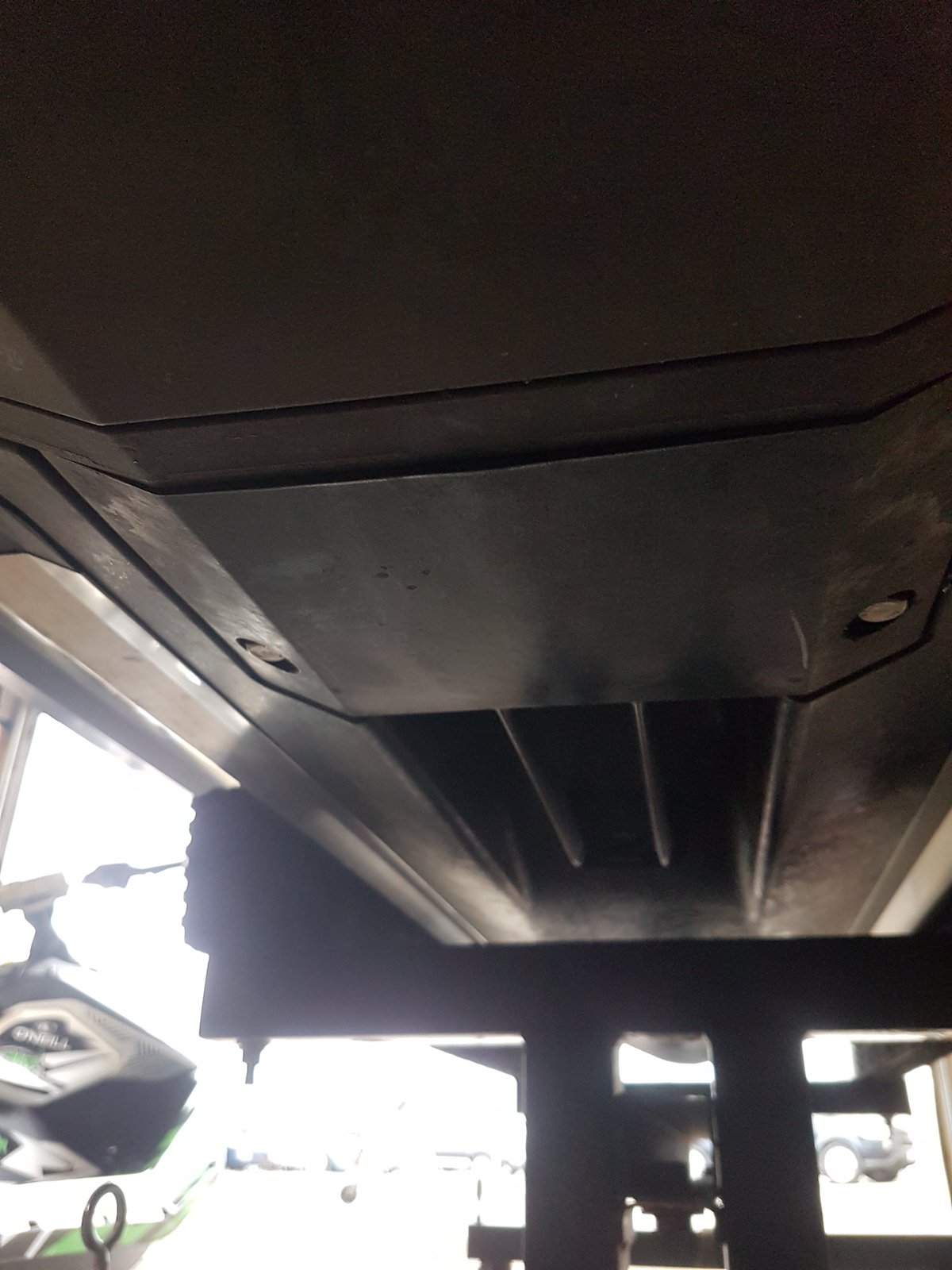
Some things to look out for would be the new hulls, white with splatter paint and the blue and black pictured, as they are the lightest hulls produced so far. The goal was to build the lightest hull possible without sacrificing strength.Ā āThe white hull with the splatter paint job is a special one, and we wanted the paint to represent that,ā Joe Jr. mentioned. They credited Art at Engine Tech Superchargers for his guidance on what motor to choose for the white hull. They chose the ET 1107, which is an absolute monster of a motor. Expect some big things from Crazy Joeās Customs with this white hull.
As for the blue hull, it is almost entirely visual carbon and is an absolute piece of art. Their rider, Alex Anulli, also will be on a new hull that will be unveiled soon. With the move to making things as light as possible and the addition of the ET 1107, it definitely hints at something big to come for 2017. Things are constantly changing at Crazy Joeās Customs so don’t be surprised if we see something ācrazy.ā To keep updated on everything Crazy Joeās Customs, please find all new info on their Facebook and Instagram feeds as well as their YouTube channel. Also, look out for them at upcoming freerides this year for test rides.
The Watercraft Journal: So what’s new with you and the Jet Renu team for 2017?
Nanette Moreno: After long consideration I have made some beneficial changes for 2017. I have decided to separate Jet Renu – Div. of Renu Chem Inc. – from our athletic program by creating Team Jet Renu Inc., a non-profit organization.
WCJ: What will be the focus of this new non-profit division of Renu Chem?
NM: My main focus is promoting the product while endorsing our athletes. By doing so I’m hoping to bring more awareness and focus on our sport. My cause has always been about the riders, and nothing’s changed! These riders spend upward of thousands of dollars on gear, parts, accessories, vehicles and entries and they don’t get enough return on their investments.
There are single parents, grandparents with fixed incomes who can’t afford skis or gear, where some of these are discounted, donated or loaned by sponsors and fellow racers, even entries are still hard to come by. Team Jet Renu helps out where it can – if it can – keeping our kids in sports and out of trouble!
WCJ: How can athletes expect this program to be ran?
NM: I run my sponsorship program like a team sports league. If we are all team players, “we win the game.” With all of my years of coaching many different sports and being team mom, I’ve found that focusing on these athletes is beneficial to any sport and that’s what my purpose is within this sport.
WCJ: That sounds like a whole lot of work to carry on your shoulders! How do you think you’ll draw in the added help needed?
NM: Our sponsorship program is growing and I am overwhelmed, however with that said, I have a lot of work to do to make it successful. This year, I’d like to run “national raffles” on a larger scale. Prize giveaways would be other types of accessories that pertain to our type of industry, added to every vehicle cleaning regimen such as pressure washers, orbital buffers along with products to go with. I’m hoping it will be fun for all of the sports industries that we sponsor and beneficial to our program.
WCJ: Besides funds from these raffles, how else do you plan to financially support this effort?
NM: Jet Renu donates 15% of sales back to our sponsorship program along with what I donate personally. Renu Chem funds advertising/promotions and product giveaways which is thousands and thousands of dollars. So it made sense to incorporate Team Jet Renu Inc. non-profit. Where I can fund raise and run raffles outside of the sports, to my circle of businesses and bring more awareness to this sport and support our sponsorship program so it can bloom.
WCJ: Where do you see this program ending? What are your goals?
NM: I’d like to see Mark Gomez on a Wheaties box and the jet ski industry acknowledged like Supercross. I’m only one voice however. Each one of my 15 products help with that. Every time I run a new product ad and endorse a new rider, I bring awareness to other brands by cross branding and cross marketing, I feel we all benefit. It’s a win-win.
WCJ: How will this effect the future of Jet Renu as a brand? Will this change how the company operates?
NM: I have decided to allow the kids run the product sales side for Jet Renu as executive representatives of Renu Chem. Inc. Jet Renu was developed and created for the jet ski industry and it only seems right that it be sold by the people that make the sport what it is.
It was only last November – a whopping three months ago – when Cuban-born Uva Perez set the world record at 114.6 mph. The closed course racer-turned-world record holder abandoned the buoys when an on-water collision nearly broke his leg. Since that time, nearly 8 years ago, Perez has been in the pursuit of setting world speed records. Heading the U Jet Team, Perez and teammates have been loyal to the Yamaha FZR SVHO platform, including retaining a fiberglass hull (although it being far from a factory stock machine).
In an interview with The Bradenton Herald, Perez spoke candidly, “The speed was always there. The problem was the condition of the water.” In exploring the topic of last November’s 114-plus-mph run further, Perez had commented online, “I want you to know that I didn’t use [nitrous] because it was too rough.” With superior conditions on the Manatee River last Saturday, Perez’s U Jet Yamaha WaveRunner achieved a staggering 118.0 miles per hour within a breakneck 3.8-seconds. And add to the fact that Perez achieved the speeds on denser salt water, compared to last November when his 114-plus-mph record was set on fresh water.
āThereās a lot of people who want to break that record,ā Perez continued, āso I wanted to set it pretty high.ā Perez and the U Jet team came to the third-annual Bradenton Area River Regatta already holding the honor of the fastest personal watercraft in the world, and was looking to retain his title with his new nitrous-fed turbocharged SVHO-powered ski. āItās faster than the other one,ā Perez smiled, āand more reliable.ā And Perez understands the need for reliability at all levels; he runs a personal watercraft shop, U Jet Ski Service, in Miami with the help of his two sons.
Since it’s introduction, Yamaha’s supercharged SVHO-powered GP1800 has been the darling of aftermarket tuners and builders. The lightweight, nimble hull, aggressive stance, and almost unnatural reception to performance tweaks and components has made the newest WaveRunner easily one of the most anticipated machines for the 2017 racing season. And no company has been more actively engaged in developing this machine to reach its full potential than RIVA Racing.
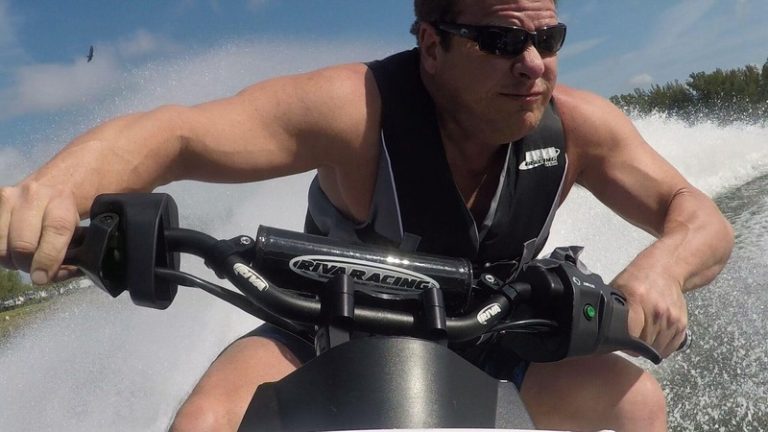
Recently, RIVA produced a quick installation video for their RIVA Yamaha GP1800/VXR/VXS Steering System Part (PT# RY20110). First debuted on RIVA Racing’s Limited Edition GP1800R specialty-built machine, the new steering system, which includes a RIVA Pro-Bar 32-inch Runabout Bars (PT# RY204) and ODI ROGUE Lock-On Grips, 130MM, no flange (PT# L31RGB-S), is an ideal fit for the performance minded GP1800 owner, as the system shaves weight while adding significantly more strength.
Typically, installation comes in around 1 1/2 hours, especially if you’re using power tools over conventional sockets and hand-twisted screwdrivers. The process does require a bit of disassembly, so make sure to take notes while watching the video or simply read RIVA’s instructions HERE. In all, the process requires very little trimming or cutting, so don’t fear about any irreversible modifications. So again, enjoy the video below and when it’s done, check out theĀ RIVA Racing Yamaha GP1800 Steering System HERE.