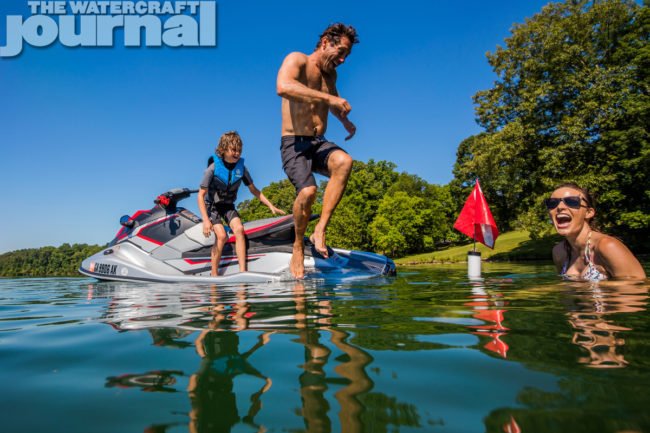
OK, so it’s the first of November many of us here in the States are still wearing shorts outside. While many of us have yet to concede that Al Gore might’ve had a point, we are enjoying what many will call an Endless Indian Summer. The leaves are changing, lawns are requiring more raking than mowing and all of us parents have already sifted through our kids’ Halloween candy to fish out the best stuff. But hey, it’s still pretty great out, so why not ride?
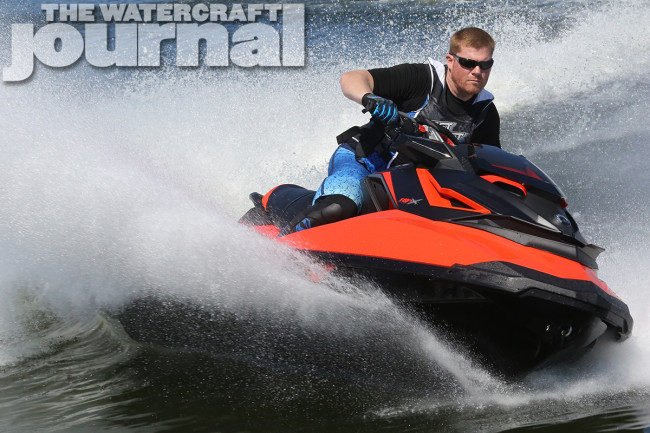
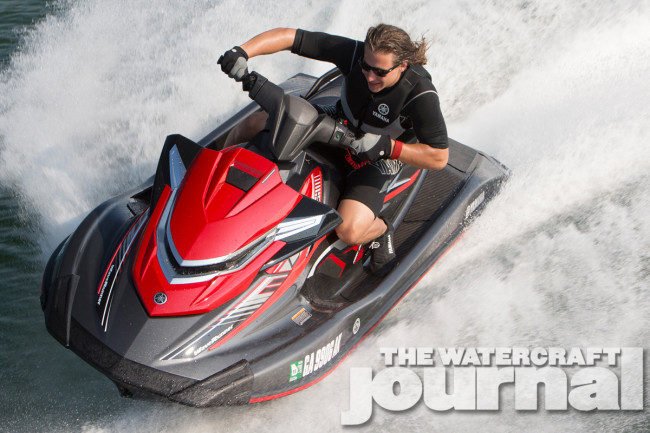
That was the idea a couple of weeks ago for the latest episode of “Long Haul,” The Watercraft Journal‘s on-going (although admittedly intermittent) video series where we give you a first-hand look at some pretty cool adventures that we get to enjoy from time to time. This go around, we got invited on a 90-plus-mile ride from Ashland City, Tennessee, down the famous Cumberland River (once canoed by frontiersmen and fur trappers, and even paddled by American folk hero Davy Crockett), into the middle of scenic downtown “Music City” itself: Nashville, Tennessee – all aboard Yamaha’s 2016 FX HO Cruiser.
You might remember that same Kawasaki-looking-green-and-white FX HO from previous rides and reports, as Yamaha was kind enough to loan us the machine for most of 2016. Anyhow, leaving from there, we double-backed and ventured into the gorgeous Harpeth River Valley with sheer rock walls and rich with autumn colors. Personally, it’s one of the most scenic rides in the South and had whistlin’ Dixie and craving a tall glass of lemonade when it was all over (or a hot bowl of grits. Insert your own preferred stereotypical Southern dish here).
Too often, the maxim, “Money can’t buy you happiness, but it can buy you more horsepower — and that’s the same thing” is the modus operandi of so many performance enthusiasts. And sure, in today’s world of non-invasive ECU reflashes, larger and far more efficient intercoolers, and no short supply of supercharger rebuilders, added horsepower is as easily attainable as ever before. [And to think, only a decade ago, the industry was decrying the influx of “big, heavy and slow” 4-strokes! -Ed] Yet, added horsepower is only as good as the craft its propelling, and no amount of additional grunt can make a heavy watercraft behave like a machine half its heft. This of course, has a great deal to do with mass effecting drag coefficients but for today’s discussion, we’re going to focus mainly on the earlier topic.
Coming to a Better Understanding
Here’s a simple example: Imagine a 1,000-horsepower car that weighed 1,000 pounds. It would have a power-to-weight ratio of 1:1 (or one-to-one) as 1,000 divided by 1,000 equals 1. Now, imagine a 1,000-horsepower car that weighs 2,000-pounds. Obviously, the second car is slower than the first, as its power-to-weight ratio is half, or .5:1, as 1,000 divided by 2,000 is a half. A 1,000-horsepower in a 3,000-pound car would be 1,000 divided by 3,000, equaling .333:1, or for every 1 horsepower there is 3 pounds of weight, and so on. So, effectively, the higher the first number in the power-to-weight ratio, the more lively the vehicle will be.
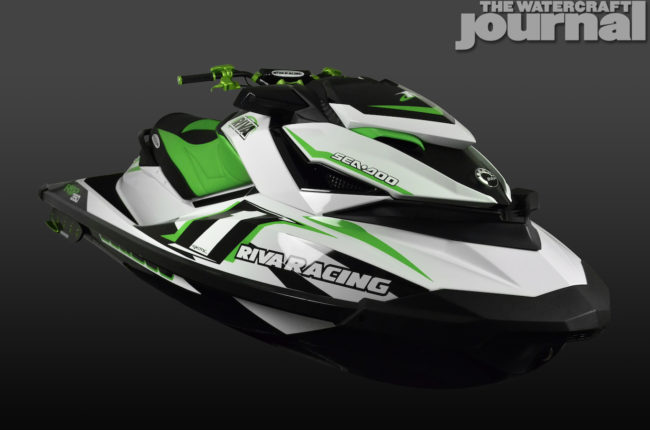
As a few functioning examples, we’ll use György Kasza’s all carbon fiber RXP-X which he rode to win a World Championship in Pro Runabout Open at this year’s IJSBA World Finals, and V-Tech Tuned’s turbocharged Sea-Doo Spark kit. In the case of V-Tech Tune’s turbocharged Spark, the numbers are rather impressive: beginning with a stock 405-pound 2-up Spark, V-Tech’s kit adds just under 20-pounds in the form of a turbo, BOV, intercooler and plumbing, pushing the weight to roughly 430-pounds. Yet, when installed and tuned to perform at its peak, the boosted Spark produces an impressive 200-horsepower. When calculated, that gives V-Tech’s Spark a power-to-weight ratio of .46:1, a number far superior to any supercharged PWC available at dealerships today (see below).
Now, to push things even further, we take a look at Kasza’s RXP-X. Hewn completely out of carbon fiber, Kasza’s Sea-Doo yields a total weight of 639-pounds. Powered by a radically tuned 1630cc Rotax 3-cylinder pressed by a fully water-jacketed Borg Warner turbocharger and factory Sea-Doo intercooler, his RXP-X is fed a diet of E100 ethanol. At wide-open, the heavily modded RXP-X is capable of a staggering 650-horsepower but was detuned to a engine-preserving 500HP for competition use. When 639-pounds is divided by 500-horsepower, we get a ratio of .78:1. When that is changed from 500 to 650-horsepower, we get an incredible 1.02:1, or literally a ratio of one-horsepower-per-pound. This of course, is what the aftermarket and professional racers can accomplish; but for 99-percent of consumers, we’re going to focus on factory equipment from here on out:
Big Power From Small Packages
In the past three years, we’ve seen quite a bit of effort in developing powerful-yet-lightweight engines. The powerplants to emerge from this trend are both groundbreaking in their technology, as well as hugely beneficial in their advancements. Sea-Doo set the wheels in motion with its ACE 900 (Advanced Combustion Efficiency) 3-cylinder, four-stroke found first in the Polytec-hewn Spark and later in the 2017 GTI and GTI SE. The all aluminum plant (as well as all subsequently-equipped ACE derivatives introduced by Rotax since 2015) employs a new plasma coating applied directly to the aluminum casing’s cylinder walls via a proprietary thermal spraying process to replace the heavy steel pressed-in sleeves.
Equally, Rotax’s redesigned cylinder head employs dual camshafts, operating the four valves-per-cylinder aiding in the ACE’s advanced combustion efficiency (get it?). A superior intake and exhaust runner with a tighter quench makes the head a winner, particularly in producing the High Output (HO) 90-horsepower tune. And aftermarket reflashes dial up the wick to 110-ponies without harm. Displacing only 998cc’s, the scant 1-liter tips the scales at merely 100-pounds, placing its power-to-weight ratio at .9:1, or 0.9-horsepower per 1 pound (that is, using the stock 90HP as our baseline). Going up from there, the ACE 1500 HO, producing an advertised 230-horsepower and weighing 194-pounds, earns a ratio of 1.2:1; the mightier ACE 300 fetching a ratio of 1.6:1 at the estimated same weight.
Last year, Yamaha’s response was the all-new TR-1 1,049cc (1-liter) 3-cylinder 4-stroke powerplant, which replaced the MR-1 4-cylinder. The new dual-overhead cammed, 3-cylinder not only provides 13-percent more horsepower (an official 125 horsepower) than the old engine, but also shaves off 20-percent of the outgoing engine’s heft, as well as an impressive 40-percent of its overall size. For 2017, the TR-1 gets a slightly modified sibling, the TR-1 EX, with a lighter, single-piece flywheel/coupler and redesigned exhaust log-style manifold, dropping the output to an even 100-horsepower. Weighing in at 124-pounds, the TR-1 wields a ratio of 1:1, and .9:1 for the lighter-yet-less powerful TR-1 EX.
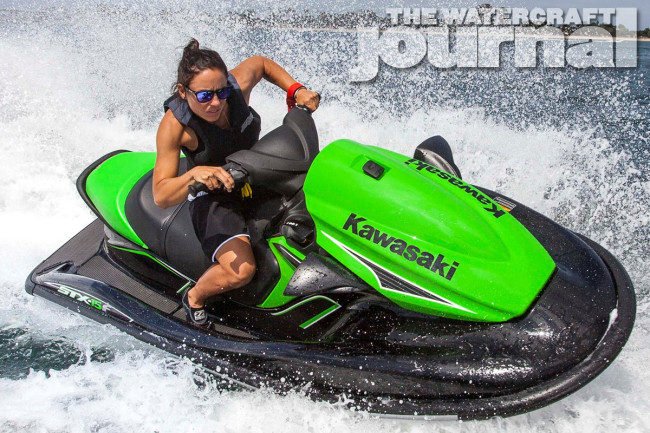
Although Kawasaki shook the motorcycle industry to its foundations with the insanely over-powered 300-horsepower supercharged 1-liter (998cc) 4-cylinder in the H2R superbike (and the subsequent street-legal H2 version touting 197 ponies), the engine that is coming in the new SX-R is the brand’s tried-and-true 1.5-liter (1,498cc) 4-cylinder four-stroke from the Ultra LX and STX-15F. Producing 160-horsepower at a spine-breaking 208-pounds, this places the Kawasaki’s ratio at .76:1, well below that of any of the above engines.
Full Scale War, Not Horsepower War
Manufacturers have learned that the easiest route to superior fuel efficiency can be found in shaving weight and holding back on engine consumption; Sea-Doo’s ’17 GTI SE ACE 900 HO is a stellar example of this. The manufacturer slashed a staggering 150-pounds from the Recreational-sized runabout by replacing the traditional FMC hull with a PolyTec one and powering it with the 90-horsepower ACE 900, dropping the machine from 790 to 640-pounds.
Of course, Sea-Doo’s PolyTec has allowed BRP to maintain its place as the only manufacturer to produce a 2-up runabout that weighs 405-pounds (a near 150-pounds less than Kawasaki’s soon-to-be-released SX-R standup). BRP has revealed – as have the tens of thousands of Spark owners have discovered – that a day’s worth of fun and thrills can be had with minimal horsepower if the craft can remain lightweight and nimble (the new freestyle-friendly Spark Trixx is founded on this principle) – and so has Yamaha in some regard, as all of the brand’s moves have been in building race-ready, supercharged runabouts with lighter materials:
Yamaha’s decision to completely retire the FZ series upset a great deal of performance enthusiasts, many belittling the new GP1800 for lacking the characteristics that so many have become accustomed to in the outgoing FZ. Yet, the brilliance was found in the light GP1800 platform: it comes in at 769-pounds – 22-pounds less than the FZR – yet with all of the power of the outgoing machine. And unlike the FZR, the GP1800 comes with features previously unavailable to its predecessor: RiDE, Yamaha’s quick-response electric trim system, and a folding swim step. (It also is significantly more affordable than the outgoing FZR; the GP’s $13,999 MSRP handily beating out the FZR’s $14,799 price tag by $800). Without those items, the GP is estimated to be a full 50-pounds less than the retired FZR.
More importantly has been Yamaha’s commitment to its NanoXcel and NanoXcel2 technology. Dedicating years of development of a “nanotechnology-engineered material” that is light yet maintains structural integrity, Yamaha engineers, “used a combination of ‘nano’ clay and glass micro-bubbles to develop a new stronger resin that uses less material. The glass micro-bubbles used in NanoXcel 2 are smaller and stronger than other filler materials, contributing to the strength, rigidity and lightweight of the new hulls and decks.” The result was an immediate 35-pound and 46-pound drop in weight from the Yamaha FZR and FX SVHO, respectively.
Although top speeds are still arbitrarily capped via throttle positioning sensors and GPS speedometers (that is, when talking strictly about factory-floor stock models), power-to-weight superiority is easily seen in radar-tested acceleration runs. While such numbers aren’t readily available without exhaustive hours and dollars spent to track each unit and correct for variances in air and water temperatures (as well as barometric pressure, etc.), we do have a breakdown of some major players in the field of performance watercraft and their power-to-weight ratios:
*All Kawasaki units are advertised with a curb weight, including full oil and gas being factored into the weight. We’ve calculated for 20 gallons of fuel at 6.183 pounds per gallon equating 124 pounds, and 5 quarts of oil, equaling 9 pounds; all totaling 133 pounds removed from each total units’ advertised curb weight.
You gotta love it when a manufacturer gets into the holidays – and Sea-Doo is always on point when it comes to showing off their festive spirit. A few years back they released their Santa Claus on a GTI video, then the Easter Bunny went for a ride down the Intracoastal Waterway a few months later. Now we’ve got “FrankenTRIXX” on a brand new Sea-Doo Spark Trixx, showing off his freestyle prowess in hopes for a tasty reward.
New for 2017, the Trixx is possibly the most unique runabout built in the last decade. Designed for flatwater freestyle fun, the Trixx comes with a redesigned vertically-adjustable aluminum steering next and handlebar setup permitting for 6-inches of rise; heavy-duty padded foot wedges, and a electronically-adjusted, re-calibrated VTS trim system with an additional 20-degrees of range.
These options give the Trixx the ability to nose-down for shooting “fountains” or rising near-vertical for tail stands, as well as a bevy of other tricks. It’s a ski meant to be shared by family and friends and the subject of playful competition for hours to come. Of course, when you’re not showing off to your pals, it’s also a Spark – meaning one of the highest-selling runabouts in the industry today, so the hours of enjoyment are limitless.
OK, we get it; it’s a little too early for department stores to start pumping Christmas carols over the loudspeakers and decorating their windows in flocking and holly. But that’s not to say that it isn’t too early to start spreading some Christmas cheer. Cycle Springs PowerSports and their Slingshot Only store dedicated to performance Polaris parts and accessories, has recently announced their intent to expand their 2nd Annual Slingshot Charity Drive after the success of last year.
Now, the Slingshot Charity Drive will carry over two days, namely Friday, November 11 and Saturday 12. More importantly, this year Cycle Springs is pleased to announce that they’ll be sponsoring more local children in need. All of the proceeds from 50/50 raffle ticket sales will go to buy gifts, clothing and other necessities for these families. “Without your help these children won’t have the Christmas that they have been dreaming of,” states Cycle Springs. “Help make this Christmas one they will remember and win something in the process.”
Here’s the original letter issued by Slingshot Only: Come join us for our 2nd Annual Slingshot Charity Drive. We will be at Innisbrook Resort in Palm Harbor, Fl. November 11th and 12th. Can’t make it? That’s okay, you can still enter the raffle for the 50/50 drawing. You will also be able to view the live drawings right from your phone or computer.
This year we are pleased to announce that we will be sponsoring more local children in need. The 50/50 proceeds will go to buy gifts, clothing and other necessities for these families. Without your help these children won’t have the Christmas that they have been dreaming of. Help make this Christmas one they will remember and win something in the process.
Purchase your 50/50 tickets here or you can just donate to a great cause. Either way you will be helping these families enjoy a wonderful Christmas. You will not be shipped your tickets. Your tickets purchased online will be identified with your order number and name and be tossed into the drawing just like tickets purchased in person.
You will be able to purchase online tickets up to Wednesday Nov 9th. Drawing will be live during the event. Check back for the live drawing times. To see all the event details or to donate please CLICK HERE!
Last week, The Watercraft Journal received a great, personally-written recap from famed freeride and freestyle athlete Tanner Thomas, who gave us a person glimpse at how he prepared and performed at this year’s IJSBA World Finals:
“I can honestly say that preparing for this 2016 World Finals was the hardest I have worked for anything in my whole life. I did not win, but that was not necessarily the main goal. What I mean by that is that we are a judged sport. Quite simply put, Joe could ride much better overall rider than Bob and still come in behind. We have no finish line, no real rules, just put on the best show.
“This year, I set out to be the best rider I could possibly be. I wanted to push myself like never before to see what I could accomplish. I asked myself many mornings, ‘How bad ass do you think you are?’ To be a professional rider of any action sport, your body, your mind and your equipment have to work together seamlessly. That can be difficult, but with almost 10 years of experience under my belt on a jet ski, I feel like I am a professional at it. I am proud of the way I feel, the way I look and the way I ride. It started by completely changing my diet, my exercise, my stretching and my focus.
“I continued chasing the best equipment and working with my team and sponsors on developing more performance and I am proud of those results as well. I am proud of these photos that I get to share with you and the spectacular tricks I am able to do flying through the air on my jet ski. Most of all, I am thankful for the doors that have opened and let me run through them. My family, friends, sponsors and supporters. I do it because I love it and it has loved me back. Despite some speed bumps along the way, I stayed focused with my team behind me and I did the absolute best that I could. We took home 6th in the world!
“Now I am getting to the point in my life of wanting different things. I have learned a lot along the way and have more ideas and ambitions than I can even begin to describe to you. As of now I am not sure exactly my plan for jet skiing in the future, but I have to make some changes. I won’t be able to chase events like I have in the past. I plan on still doing special film, demo, or show opportunities. I also plan to keep working with some of my sponsors on product development as I enjoy chasing the best. I also have some business ideas. Starting off with my TanRak Truck Rack system that I have been working with JetLift on. I am hoping to launch that around the first of the year and have my own product available for people to use. That has changed the way my life works and made every one of my season tours possible!”
So it’s that time of year again for me to load up the car with all my camera gear and drive to Cronulla in Sydney for the annual Yamaha Rip n’ Ride. This year marks its 9th year that the event has taken place. It’s come a long way from being a BBQ on the beach with a few mates.
The first stop on my way was Yamaha Motor Australia in Brisbane to pick up a couple of safety skis (both being a pair of VX Deluxes) and a foxhole (Yamaha Mt 125 motorcycle) would do the job nicely. I’m like a kid in a candy store with so many cool machines sitting here in the factory. It’s pretty hard to walk out without adding something to your Christmas list.
Back in the car and all loaded up, it was time to crank up the radio and hunker in for the long 10-hour drive to Butch’s house. Butch and his wife, Julie are the two fantastic people that make the RNR happen every year. Everything from organizing the permits, sponsors and riders, to finding room for wayward riders (and photographers) to sleep at their house. The time and effort that goes into organizing this event is huge. It’s not just those two that I would like to thank but everyone from the marshals to the people putting up the scaffolding, the lifeguards to the Yamaha boys that work tirelessly to make it happen.
For those people that haven’t heard of the RNR before, it’s a freeride event that’s open to anyone. Once entering, you go into the draw to win a brand new Yamaha SuperJet and hundreds of other prizes. Numbers are usually capped at about 100 to give everyone plenty of ride time and a good chance to take home a new WaveRunner.
The RNR is a chance for rookie riders to ride with – and not against – some of the best riders in the world. So at one point, you can be checking out a 12-year-old grommet ripping up the waves, and the next thing, you’ll look across to see the world champion Mark Gomez busting out something awesome. That’s one of the major attributes of the RNR. Young up-and-comers can ride, talk and get tips from their heroes. There is some judging that goes on during the day too; things like “Sickest trick,” “Biggest air” and “First to sink.” Awards also go to those people that go above and beyond to help out fellow riders.
For the last few years, JetPilot has put on a small competition within the RNR: the Battle of the Best. Riders are selected by an official and go head-to-head in a battle that’s judged on “Wow Factor.” So not so much the most difficulty of the tricks but more the reaction from the beach. This year, Ryan Savagee took the title just over Mick Anthony and Zane Taylor. Brock Taylor, last year’s winner, was there to present the trophies. Unfortunately, Brock is out of action with back issues and only came down as a spectator and cooler supervisor.
Every year a challenge goes out to the novice riders that have never flipped a ski: “The Cherry Popper award.” It’s a fun event to watch with a bunch of guys and girls gathering up the courage to try to flip their ski. Some coaching from Mick Anthony and some other pros helped them get around. One of the major tips is “Never let go,” and “It doesn’t hurt to land on you head.” Unfortunately, the conditions were far from ideal for the riders it get it done.
A big effort was made by James Ricardo on the ‘Blaster; he hit three waves in a row but couldn’t quite get it done. Maybe next year, bud. It was good to see a few girls out there as well. Bridget Burt, a first timer to RNR has only been riding a ski for three months and was popping super clean barrel rolls and nice 180s; she had ago at the “Cherry Popper” but couldn’t get any good waves. She is definitely someone to keep an eye on. Also 12-year-old Dean Krouskos is a natural on a ski. He would have ridden in every heat if he could have. Not even the cold weather or the messy surf could keep him from getting out in it.
It wasn’t the best conditions on Saturday, but Friday was a treat. Sunny, warm and clean waves. A great day on the water, flipping and hanging out. That’s the main reason people enter the RNR. A chance to hang out with your mates. People you probably haven’t seen since last year.
So if you would like a chance in 100 to win a new SuperJet, you better get ready for next year’s Yamaha Rip N’ Ride as its rumored to be the last. Yeah, that’s RNRX. The 10th will be the final event at Cronulla. So it’s going to be a massive farewell. Butch and Julie have done such a awesome job over the last 9 years that they deserve a rest. Hopefully, someone else will step up and make another great event for the freeride community to go to. Something just half the success of the RNR would be great.
With the latest bumper crop of Yamaha WaveRunners hitting showroom floors around the globe, it doesn’t matter whether the leaves are turning and the temperature is falling. There’s new watercraft to be checking out. And for Yamaha, the new 2017 FX Cruiser SVHO is showing all the signs of becoming a class leader. Powered by the same SVHO 1.8L supercharged Yamaha Marine Engine that’s clinched dozens of World Titles, the FX Cruiser SVHO will surely pull ahead as a performer while having comfortable ride. The FX Cruiser is every bell and whistle Yamaha has to offer, all to provide you with the ultimate ride. And its sleek design and unique features make a bold statement.
Moreover, the FX Cruiser SVHO features Yamaha’s RiDE (short for Revolutionary Intuitive Driving Experience), first introduced in late 2014 for the 2015 models, and has since been proven to be a very dependable feature that allows the driver to decelerate much quicker and easily switch to neutral and reverse. This technology makes the driving experience, riding experience, and docking experience worry-free and enable them to maintain complete control over the watercraft at all speeds.
Equally, the FX Cruiser SVHO comes with Yamaha’s class-leading lightweight NanoXcel2 hull and deck. It not only looks amazing from the outside and the excellent color choices (Black Metallic or Torch Red Metallic) but what makes it stand out is the power-to-weight ratio, its nimble maneuverability and industry-leading fuel efficiency.
Equipped with every feature possible (besides the Limited accessory package), the 2017 FX Cruiser SVHO has the power to beat your friends in any heads-up race while providing many luxury features to help you stand out. Make sure to hang tight to The Watercraft Journal for a full-length review of the 2017 Yamaha FX Cruiser SVHO, but until then, enjoy the video below:
The Watercraft Journal: This past IJSBA World Finals was particularly special for you and Dean’s Team/Factory Yamaha. How many Dean’s Team-sponsored and/or tuned PWC racers were there on the water that week? And more importantly, how many of them came home with a World Championship or podium finish?
Dean Charrier: This year was special, namely because we went in with our focus on the Stock and Spec classes, and especially the Pro Stock class. The Pro Stock class has become the most competitive runabout class as the only one with a full line on Pro weekend.
Chris MacClugage won the Pro Stock World Title this year, keeping the title on Dean’s Team and Yamaha for the third year in a row. Abdullah Al-Fadhel won another World Title winning the Pro Am Spec class, to go along with his second place finish in Pro Stock behind Macc.
Aero Aswar had a strong showing in all of his races – he finished third overall in both the Pro Stock and the Spec classes, and finished second in the Endurance race on his FX. Aqsa Aswar finished 5th in Pro Am Spec on a Stock class FZ and also 5th in the Endurance race.
Travis Zielasko won his third World Title, winning the Amateur Spec class this year. He also moved up to the Pro Stock class to give it a shot and finished 10th overall which was impressive in that stacked line up. Ali Allanjawi from Dubai came in and finished second in Amateur Spec on a Stock craft, and finished 4th in Endurance on the same FZ.
We also helped out Shante Bukes, the Women’s Runabout World Champion, and Tyler Hill, the Runabout N/A Stock World Champion on his VXR, with Dean’s Team ECU reflashes and handling components. It’s great seeing young riders like them putting so much effort out there and winning titles riding hard. Renee Hill, Tyler’s mother, grabbed two podium finishes too – third in Runabout N/A Limited on the same Stock VXR that Tyler won on, and third in Women’s Runabout.
WCJ: For many, the Pro Runabout Stock Class was a sight to behold, as Yamaha swept the Top 10 spots, with as many as EIGHT Dean’s Team racers filling the starting line. What makes this class so uniquely successful for Yamaha and Dean’s Team, over say, other manufacturer’s PWC?
DC: I touched on the Pro Runabout Stock class a bit above, about how it is a focus for Dean’s Team and all of our riders. It’s become such a prestigious class running on Pro Weekend with a full line up of quality racers and past National and World Champions. Everyone wants that Stock championship now and everyone is putting all there efforts and focus on that one title.
This year was exciting for us with mystery going into it – the rules changed a bit from last year and this is the first year I’m using my Dean’s Team ECU Peformance Reflash on all our race crafts. We finished with another sweep of the podium with Macc, Abdullah and Aero. The Dean’s Team reflash in total held down the top 4 positions, and 6 of the Top 10 positions.
I’ve been working with Yamaha and the FZ for eight years now and we’ve gotten to a point where I know exactly where the race crafts need to be for each rider. We’ve done more testing and fine tuning on the FZ than anyone in the world and the results reflect the experience and knowledge gained over the years with Yamaha.
WCJ: Dean’s Team works with some pretty stellar athletes already, so welcoming multi-multi-time World Champion Chris MacClugage to the roster must’ve been a nice addition. How did Macc’s presence influence Dean’s Team or his teammates?
DC: All of these guys have been around for years and years of racing and they all know what it takes to win. Aero, Abdullah, and Aqsa all have their World and National Titles and they know the commitment and focus needed to get another one. Travis Zielasko has came on fast and strong these past couple years with his return to racing and he has that passion to win more and more titles. Everyone does get a bit higher on their toes and a bit more off their seats when their racing with Macc.
With Chris MacClugage, it’s just not his ability as the greatest on the track in the sport, he is top of the line off of the course too. Macc takes control of opportunities and makes everything happen himself. Nothing is just handed to him, he works for and earns all of his support and sponsorship and manages everything himself. It goes way behind what you see on the track with him. He puts in as much time and effort in to winning as anyone I’ve ever seen till this day. His love for the sport and winning is really contagious.
I’ve worked with Chris before, helping him win a Pro Runabout Stock title a few years ago with Yamaha and helping him with his skis in the past. He and his family, with Rachel and little Mac and Lily, are always fun to have around the pits. Macc himself has won as much as anyone in this sport, with over 20 world titles and even more national titles. His knowledge and riding experience is unrivaled. Travis has really taken to him and has been training with him this summer since Chris has made the move back down to South Florida. All and all, Macc’s presence is always a positive to have around.
WCJ: With so many Dean’s Team-equipped/tuned skis on the water at the same time, were they all equally built, or were there differences between Macc, Abdullah and Aero’s FZRs? If so, what differences were there between them? Did you have to modify each machine to match each rider’s particular style/preferences?
DC: All of my FZ’s are pretty equally tuned for the Stock class. The main differences are in the handling components. We do testing with each rider and see where their ideal set up is. It takes several trips out to Body Beach working with each rider before the races even start to get everything perfect, but in the end you can see on the track when the set up is just right for them.
WCJ: This year also marks the last year of Yamaha’s FZR platform (since it’s launch in 2008), which is still a difficult pill for many to swallow especially after so many wins the platform earned this year. How is Dean’s Team preparing for 2017 with the GP1800? Are all Dean’s Team racers making the transition from FZR to GP, or just a few?
DC: The FZ has been great and will continue to be great. You’ll still see them out on the race course because of the success they’ve had.
The GP1800 is exciting, and with the testing we’ve done so far, we think a lot of racers will be wanting to switch over. The total weight is lighter and you can feel it in the acceleration and handling. It is more aggressive handling wise which will definitely suit some racers better.
We already have a Stock class GP1800 going 81-plus-MPH in race trim. The Dean’s Team GP1800RS model is going over 83MPH. The acceleration has been even better than what we’ve seen with the World Championship winning FZ’s we’ve built. It’s in and out of a corner faster than any set up we’ve had before.
WCJ: With all the work and preparation into this year’s World Finals behind you, what is next on the horizon for Dean’s Team?
Dean’s Team will be releasing our build of the new GP, the Dean’s Team GP1800 RaceSpec, soon to the public. Units will be available at the beginning of November. We’re working on a new decal kit for it with BP Concepts which we’re excited about releasing with the RS units.
We’re working to bring even more performance products and packages to the public. We want to help out as many riders as possible, whether they spend their weekends racing World Champions around buoys or just drag racing their friends on the lake.
The final two rounds of P1 AquaX Pro Enduro are right around the corner in November. We have Aero Aswar in the lead right now, with Mike Klippenstein also in the Top 5, and Chris MacClugage tied with him in moto wins for the season. Any of them can pull out the championship this season and I’d be willing to bet it comes down to the last moto. Should make for some exciting racing.
Next season, we have talked with a few of our riders about entering the Pro Open & GP classes. Yamaha has yet to really tap into their potential in these classes on the National Tour or World Finals with the focus being on the Stock and Spec classes. I didn’t want to do anything for Open and GP until I had the time and energy to put a full blown effort into a craft.. now that a couple of racers are showing more interest in building something to compete in those classes, there may be a couple FZ’s or GP’s on top of the podium in some other classes next year too.
WCJ: Dean, obviously there’s a lot of people who made this year’s World Finals so successful for you and Dean’s Team; here’s a chance to thank them publicly; who would you like to thank for making this such a great week?
DC: Scott Watkins and all the guys at Yamaha for all the support and daily communication that goes 365 days a year that makes this great team happen; a special thanks to both Dave Bamdas and the RIVA Racing crew, and Gary Watson and the Worx Racing crew for all their continued support to us and our Team riders, they truly are world class professionals and all their products reflect greatness; the guys that help make it happen in the pits and down on line before the race, especially Omar and my son Dustin; and of course my wife Donna for being the team’s mom and #1 fan of every rider in the pits.
Wait, a what? That’s right, a magalog. Part magazine, part catalog. When the last two major print magazines shuttered their doors – Watercraft World and Personal Watercraft Illustrated – there was a vacuum for family-friendly, consumer-focused magazine content that even the crew at Watercraft Superstore could feel.
The solution came about in an unusual way: why not make our catalog also a magazine? True to their word, each year Watercraft Superstore crams half a dozen full length, feature magazine-quality articles in to their annual catalog. There’s legitimate tech, top notch photoshoots, and some really spot-on PWC reviews in every issue.
Simply go HERE, and you can freely and easily access the whole magalog chocked full of awesome stories, a full recap from the annual Skyway Ski Show, which The Watercraft Journal has attended personally for the past four years, and of course, peruse their seemingly endless variety of watercraft toys, accessories, performance parts and useful tools, all to help magnify your enjoyment from your PWC. Check it out today!
Nowadays, horsepower controls the conversation when a new watercraft arrives on the market. While there are many speed demons out there, many people want to go out and ride in comfort. Sea-Doo has built a machine for those who want a stylish and comfortable machine without sacrificing performance. The 2017 GTX offers five different models that are crafted for you.
What is the secret to a powerful craft with comfort? The answer is providing the market with horsepower ranges from 155hp to 300hp along with the industry’s only suspension seat. Sea-Doo wanted to create a watercraft that could be ridden all day and not have the rider in the pain the next day.
Sea-Doo has spent large amounts of money to research and develop Ergolock, a seat that is both comfortable for most all rider sizes, and a cockpit that is intuitive and uncluttered. Along with that, all models of the 2017 GTX are equipped with the second version iBR. This is the industry’s only on-water brake system, and has been awarded by the United States Coast Guard. With this braking system it will stop up to 160 feet sooner that a watercraft of the same size without a braking system. To top it all off, Sea-Doo has added new handle-grips with a place to rest your palms to prevent cramping when using the throttle.
Not everybody goes out to ride for top run speeds, there is a larger population that enjoys the nice evening cruise which will be even better now with Sea-Doo’s iTC Intelligent Throttle Control that includes ECO, Touring, Sport Modes along with Cruise Control and Slow Mode. With all these intelligent features it only seemed possible with a redesigned S3 hull (Stepped, Stable, and Strong). The technology that was put into this hull has proven to be one of the best all-around full-sized hulls providing an optimal ride without sacrificing performance.
If you opt out and choose to order a non-suspension GTX you will have a much larger glove box, Sea-Doo watertight bins to have a total of 42.8 gallons of storage.
2017 Sea-Doo GTX 230hp and 300hp
This is the craft for the speed enthusiast with an eye for comfort and luxury. Boasting 230hp or 300hp via either the Rotax 1500 HO ACE or 1630 ACE engine (respectively) that has proven to be the best power-to-weight ratio available. Along with buying this top of the line luxurious craft, it comes with all accessories and will bring a smile to your face every time.
2017 Sea-Doo GTX Limited S 260hp
With this Limited GTX S, it comes equipped with 5.5-inches of suspension travel that can absorb the harshest chop. This is something that you really need to ride to fully experience the comfort. This is a great touring watercraft as it comes with everything imaginable to make your experience on the water that much better. This is the perfect watercraft for all you endurance-adventure seeking enthusiasts!
2017 Sea-Doo GTX 155hp and GTX S 155hp
This is the perfect entry watercraft that provides enough power to keep up with others while providing unbelievable comfort. This is the perfect craft because it is great on fuel consumption and is equipped with iBR, iTC and VTS.