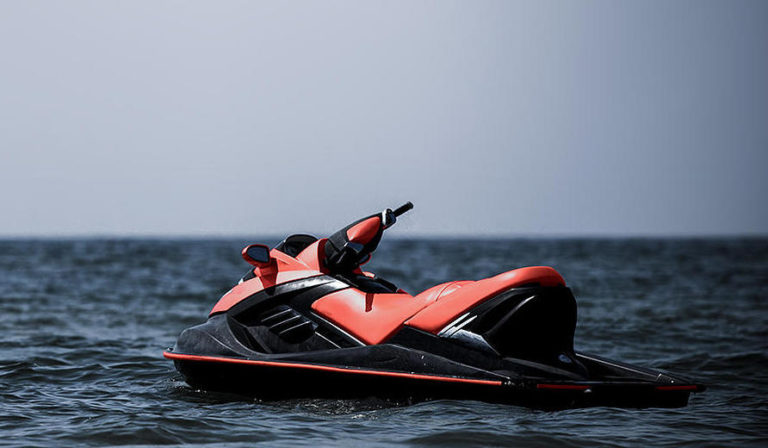
With huge thanks to loyal reader, Wade Robinson we have today’s checklist of “must have’s” when it comes to (legally) buying a used/pre-owned personal watercraft from a private party. According to Wade, “this was put together with input from vintage PWC enthusiasts as well as modern.” Nevertheless, Wade’s list passed our test and we think it’ll serve as a resource for all of us when it comes to purchasing a new-to-us PWC. Check it out:
Owner quiz at first conversation
1. Break in procedure
2. Oil type/brand
3. Flushing procedure
4. Lubricants (salt water use)
5. Pump bearings greased
6. Gas treated during storage
7. Any damage/mishaps
Tools to take with you
1. Flashlight
2. Rags
3. Compression tester
4. Jack (trailer bearings)
5. Life jacket
6. Spark plug wrench
7. Multimeter
8. Jumpstarter/spare battery
Static checks
1. Oil condition
2. Hull
3. Intake grate
4. Impeller/wear ring
5. Corrosion/rust
6. Compression
7. Oil in hull
8. Engine knock/noise
9. Spark plug condition
10. Voltage-off, starting, running
11. Taste test water for salt
Dynamic checks
1. Acceleration
2. Overall normal operation
3. Steering bearings (stiff/mushy)
4. Water in hull afterwards
Trailer checks (if sale includes trailer)
1. Bearings
2. Tires
3. Spare
4. Lights/wiring
5. Bunks
Paperwork to get/sign
1. Registration card/docs
2. Service/repair records
3. Bill of sale (ski)
4. Bill of sale (trailer)
Accessories to get
1. Owner’s manual
2. Lanyard
3. Cover
4. Tool kit
5. Fire extinguisher
6. Oil/filters/lubricants
7. Spare parts
Over a dozen years of being in power and motorsports journalism, we’ve encountered many a bottled or aerosol spray claiming to be a “waterless cleaner and protectant.” In fact, a cursory stroll through your local big chain auto parts store will introduce you to literally dozens of miracle cleaners that can do all of the work as a couple hours spent detailing your car, motorcycle or PWC. We joke that it’s the “super pill” of cleaners, claiming to help you lose weight, develop muscle and regain your youthful zeal without hitting the gym once. So, even though we’ve typically always been fans of Jet Renu’s line of products, we enter into this test with a heavy dollop of skepticism.
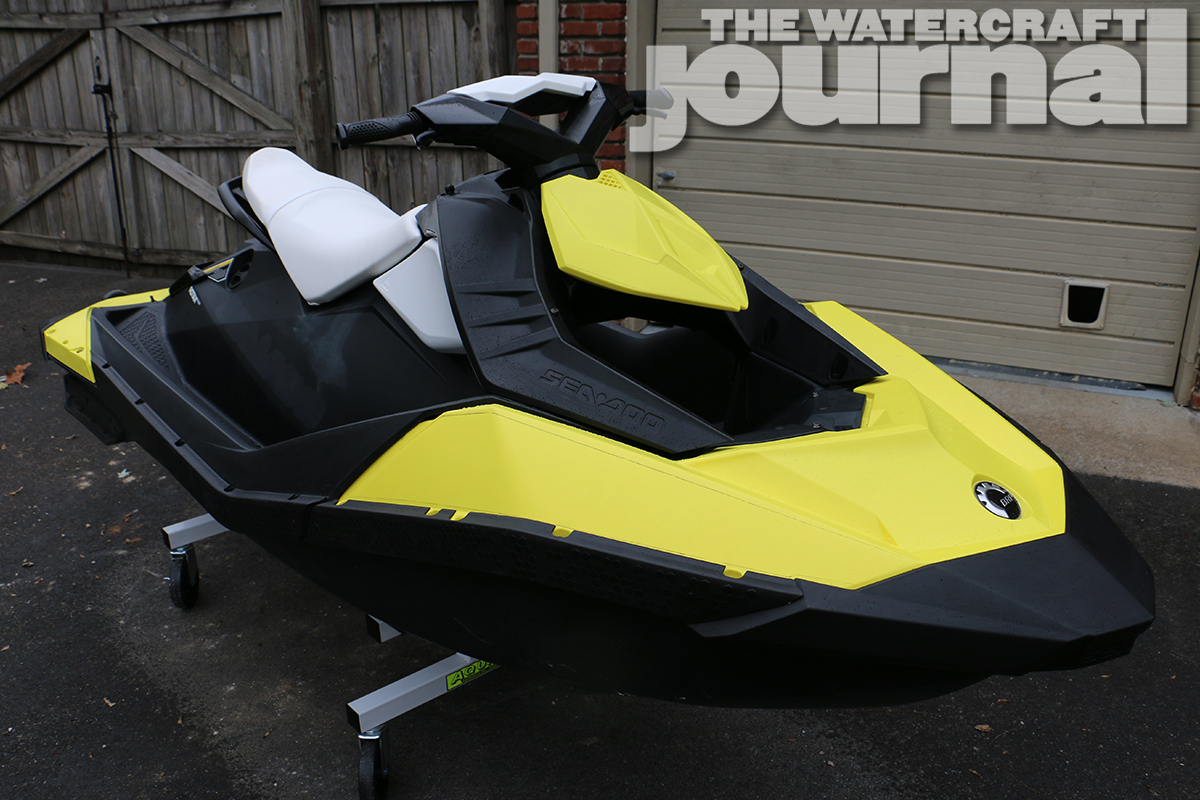
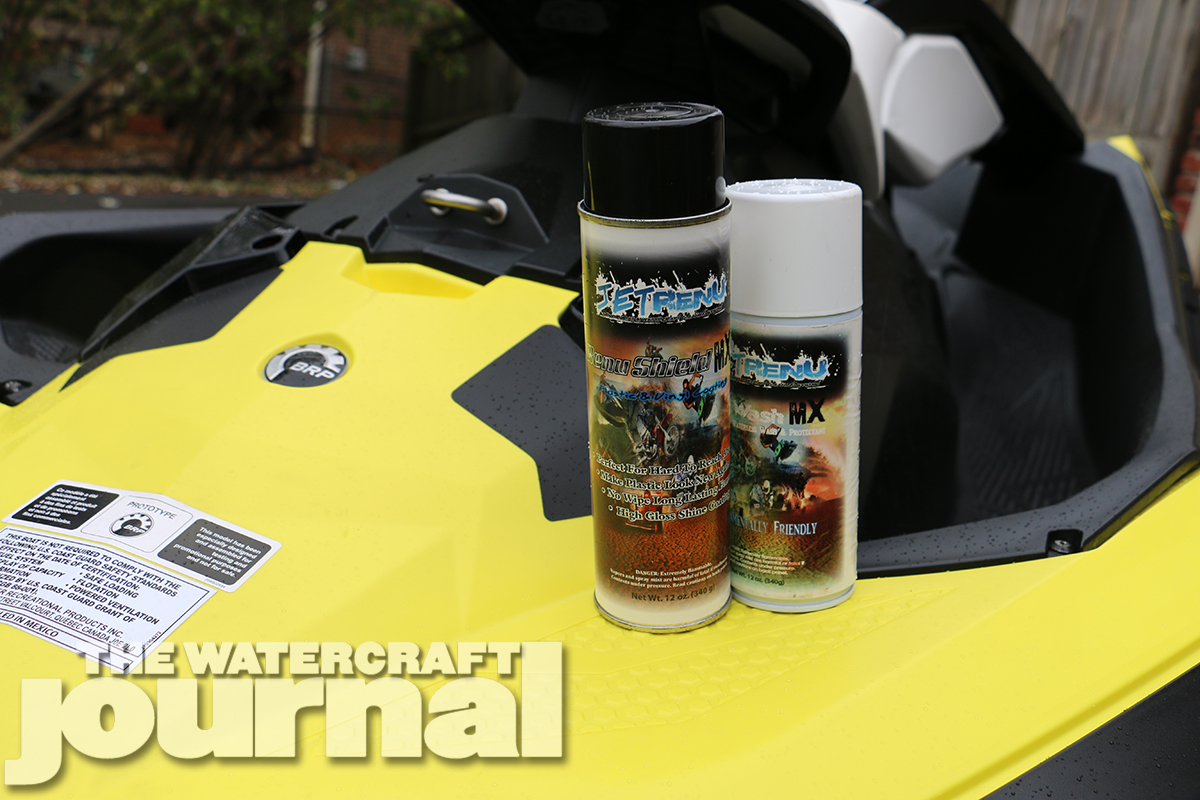
As the eagle-eyed observer might note, we’ve reviewed Jet Renu’s Dri Wash MX (12oz. aerosol can, $12.95) once before, but appropriately on the aluminum swingarm of a Kawasaki KX250F. This time around, we joined it with Jet Renu’s Renu Shield (12oz. aerosol can, $8.95) on a slightly used and abused 2015 Sea-Doo Spark. Because of the Spark’s molded PolyTec chassis and plastic components, we evaluated that the two Jet Renu products would respond not unlike the plastic fairings of a dirt bike. Moreover, it’s been noted by many Spark owners, that the black PolyTec skeleton is prone not to bleaching, but discoloring when spray waxes or other additives are used.
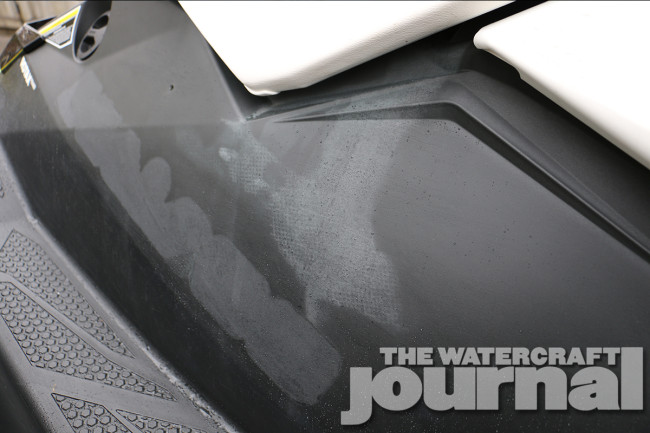
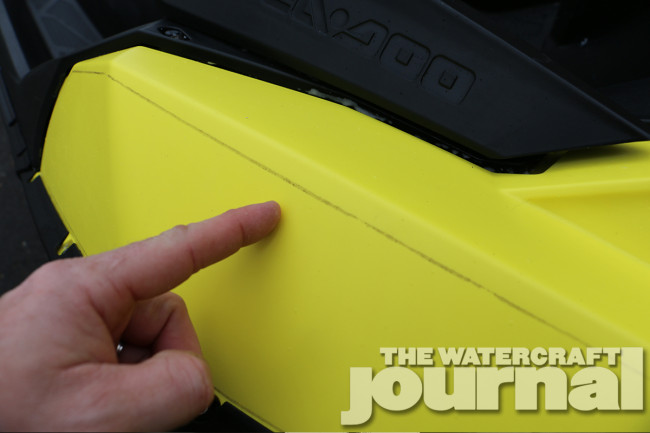
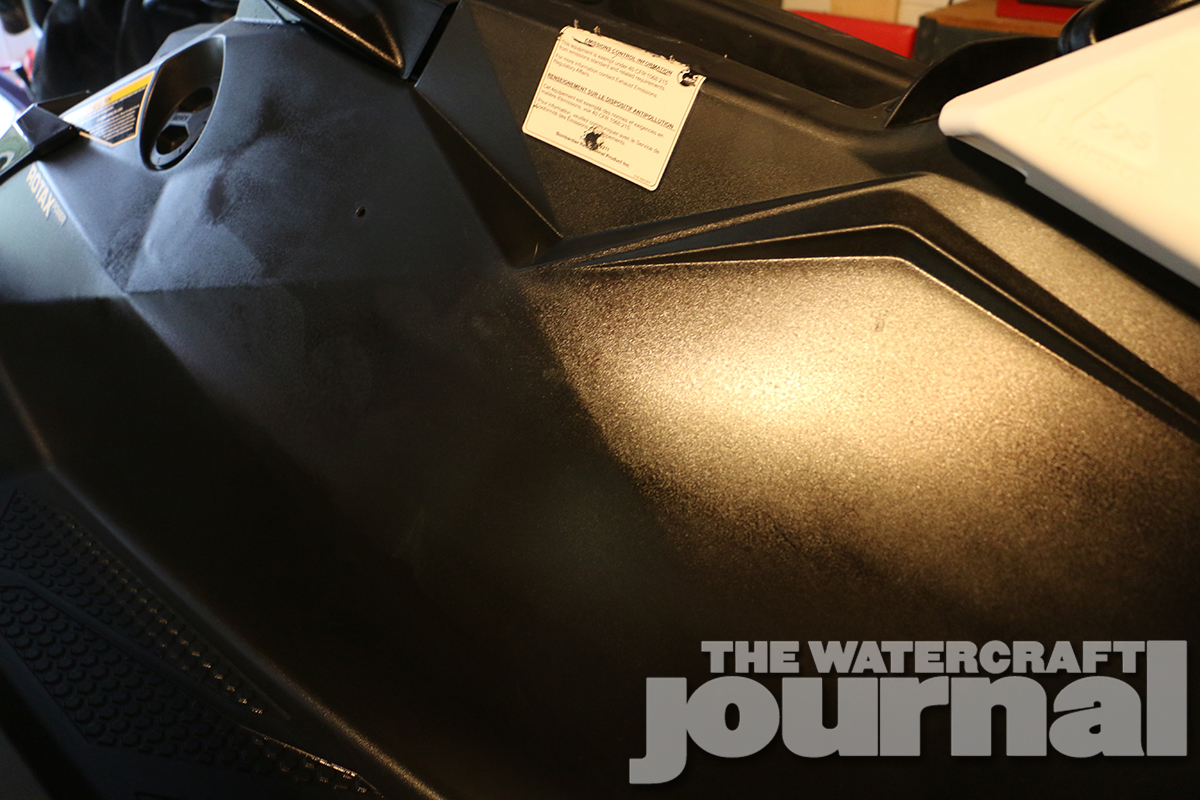
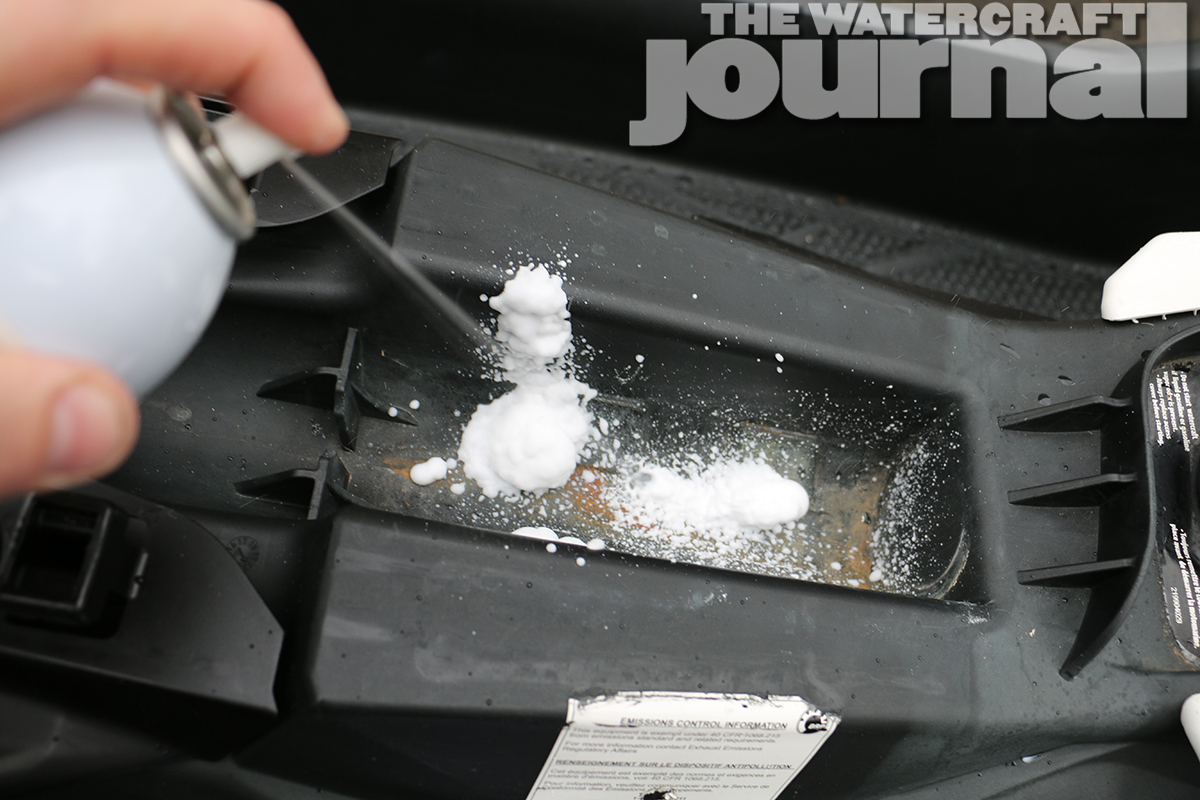
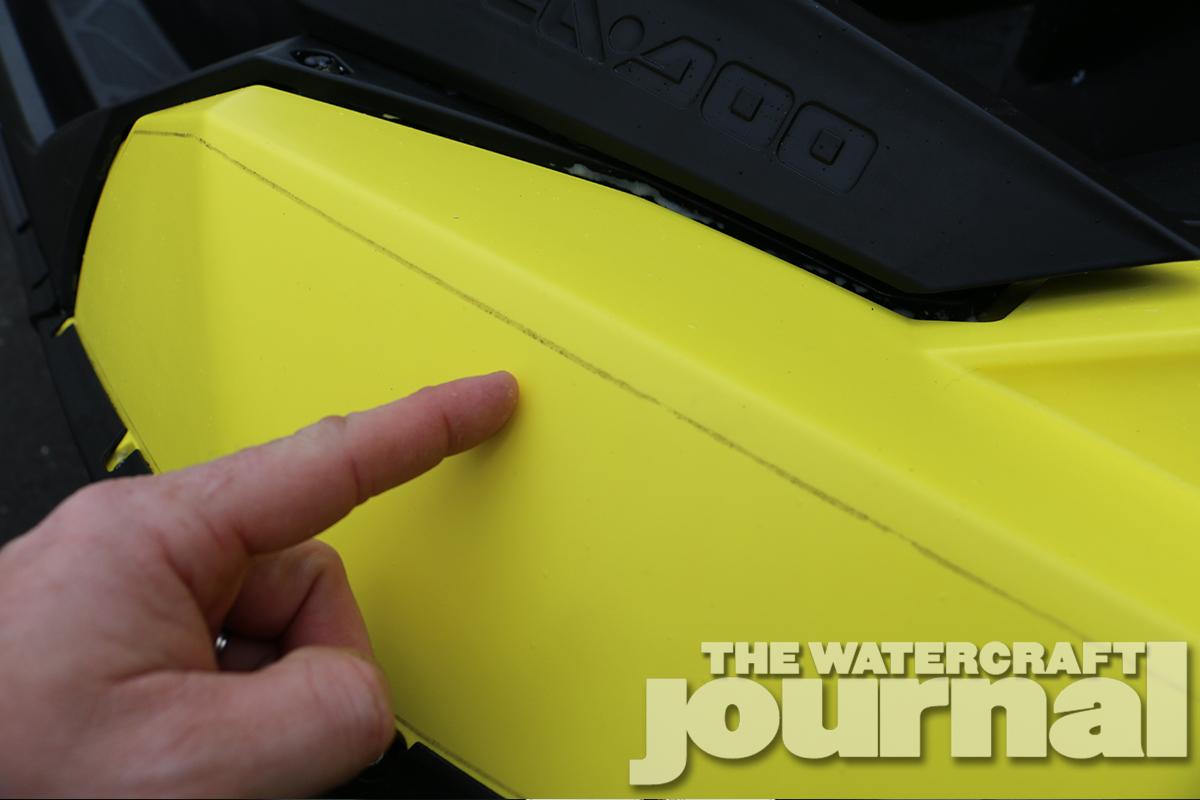
Also noteworthy, was that our Spark once brandished a complete vinyl wrap for well over a year, which upon its removal left quite a bit of residual glue and dirt outlining the edges of the now-gone wrap. With some chalky haze on the superstructure and grime ringing most of the colored paneled, we went to work with our Dri Wash. Jet Renu’s Dri Wash is a non-toxic, biodegradable cleaner developed to clean, maintain and protect most surfaces – again without the need for water. Targeted to remove waterspots, dirt and grime, it also works to remove other contaminants like bird droppings and road grime from your watercraft after towing it a long distance.
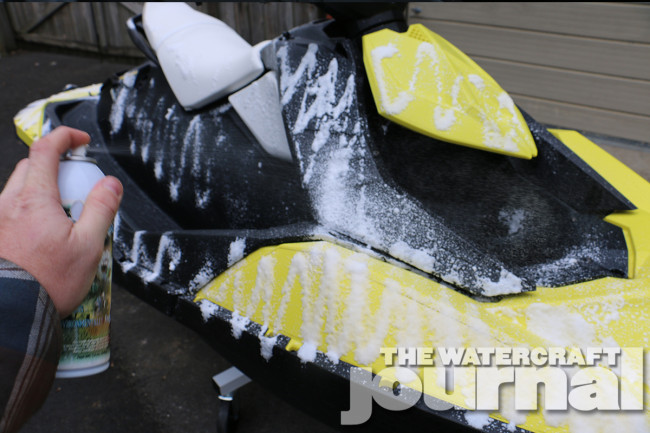
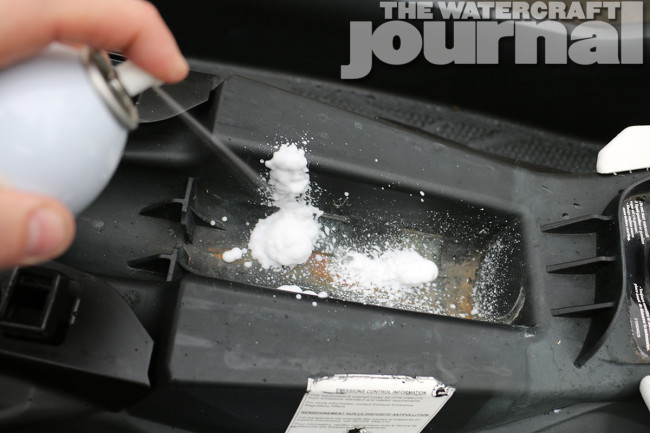
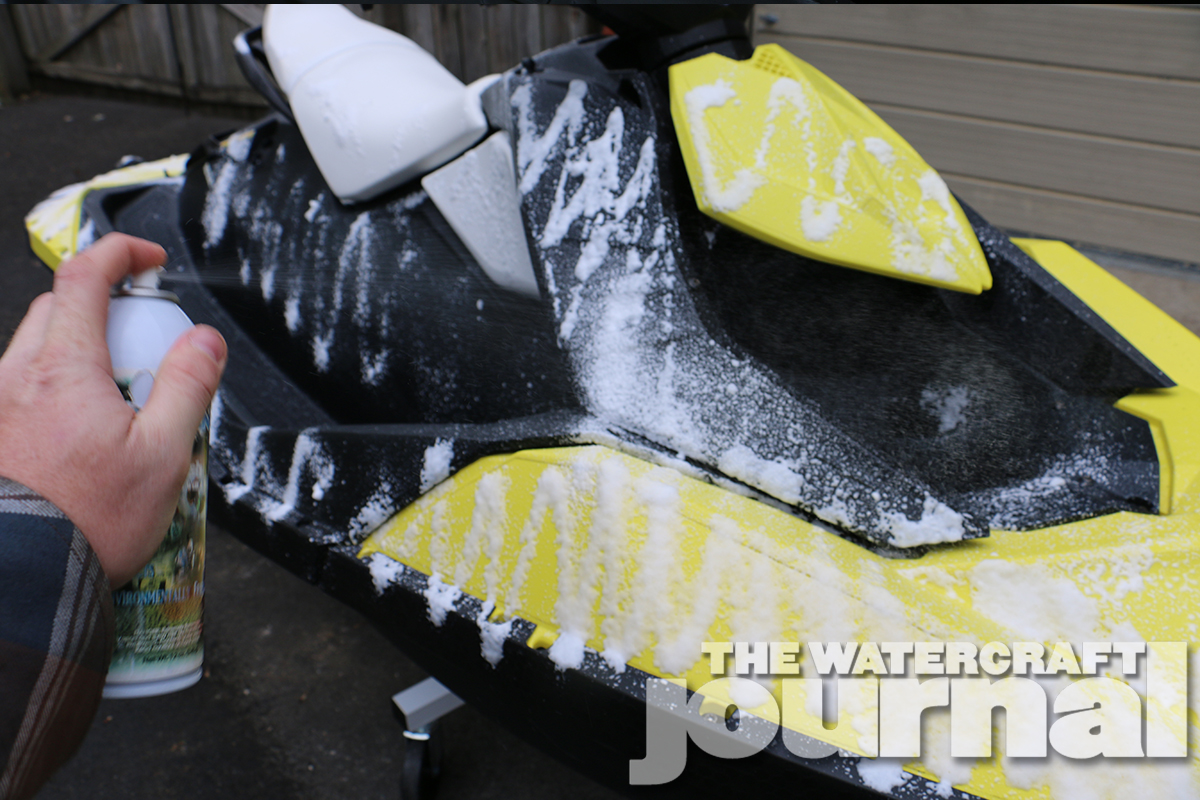
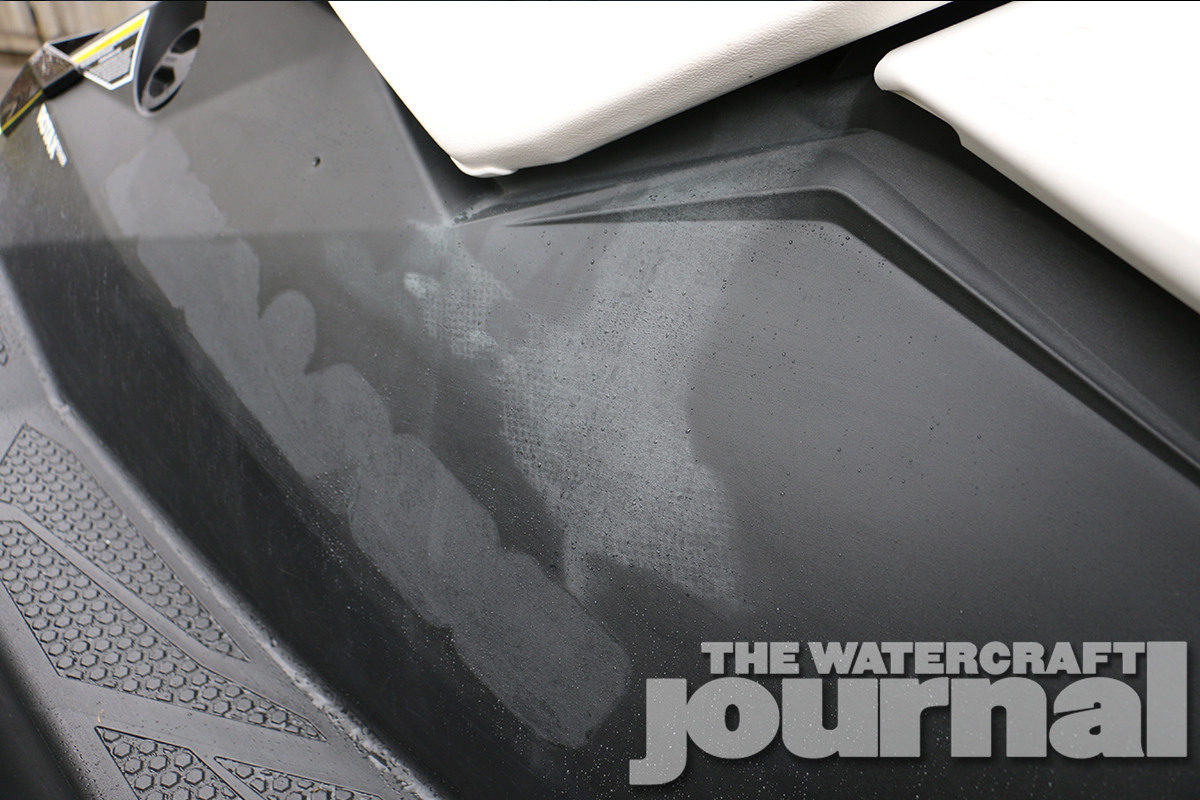
Because it’s a foamy cleaner, we sprayed the Spark in even white, frothy coats similar flocking a Christmas tree. Letting it sit let the chemicals work to break up the grime. Unfortunately, the Dri Wash MX couldn’t break up the leftover adhesive – although it did adequately clean the PolyTec Exoskel of previous spray polishes that had faded to white, returning it to a semi-gloss black. We applied some elbow grease and a little bit of Jet Renu’s Yellow degreaser, and quickly removed the glue from the Spark’s pineapple-yellow panels before wiping it down and preparing for the final pass of polish.
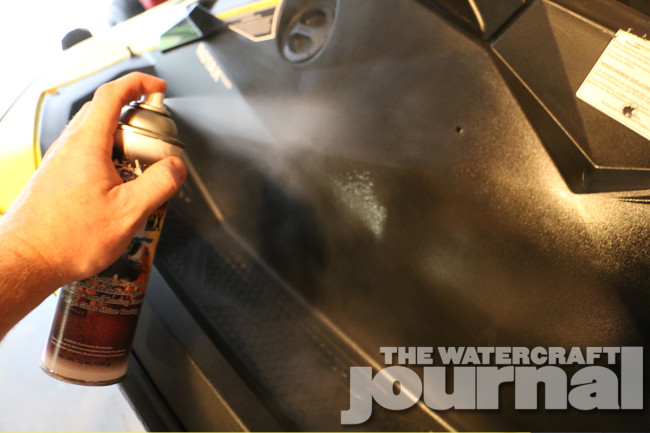
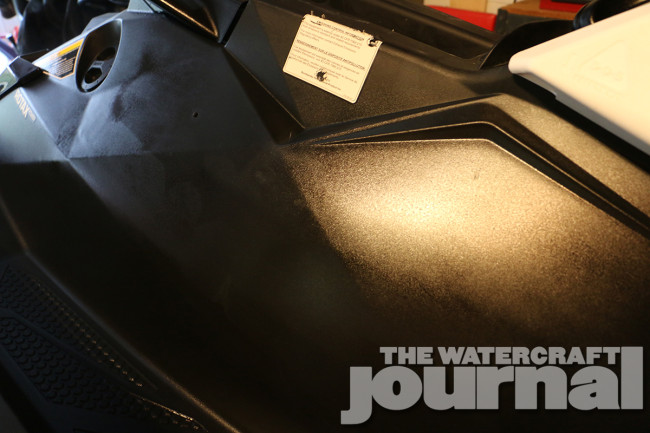
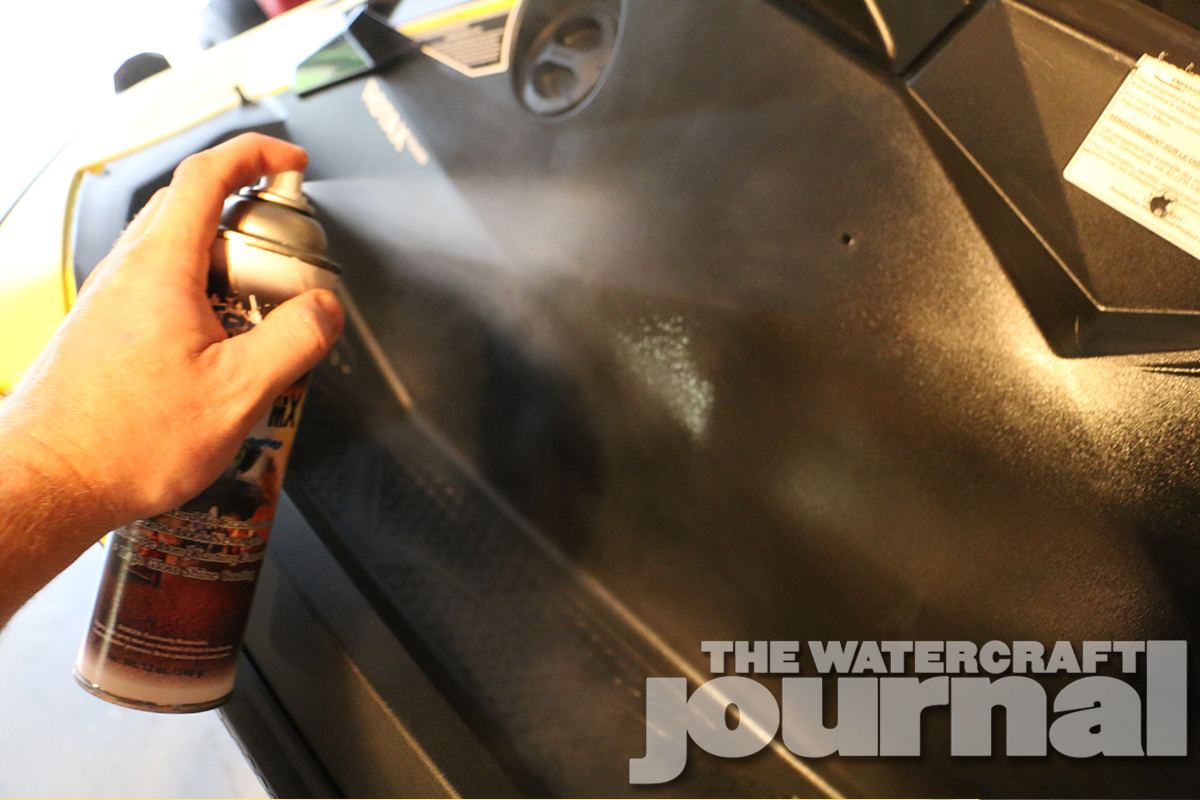
The Renu Shield MX is a clear applicant formulated for plastic and vinyl surfaces and leaves a nice, clean, non-greasy sheen. In applying it to the Spark’s black Exoskel, it went on evenly and didn’t pool or goop as other coatings tend to do. The PolyTec responded really well to the Jet Renu (much better than other products we’ve tried), and keeps a shine for more than a couple rides around the lake (although applying to the seat and footwells might make for a slippery ride). Because of the Spark’s unique build-material, traditional soaps, cleaners and polishes haven’t really worked out, but we did tend to return to the Renu Shield more often than anything else.
We’re still big believers of a wash mitt and bucket of soapy water to get your PWC spic-and-span, but for the quick touch up or last minute shine, both Jet Renu’s Dri Wash and Renu Shield are handy to keep in your trailer’s storage box.
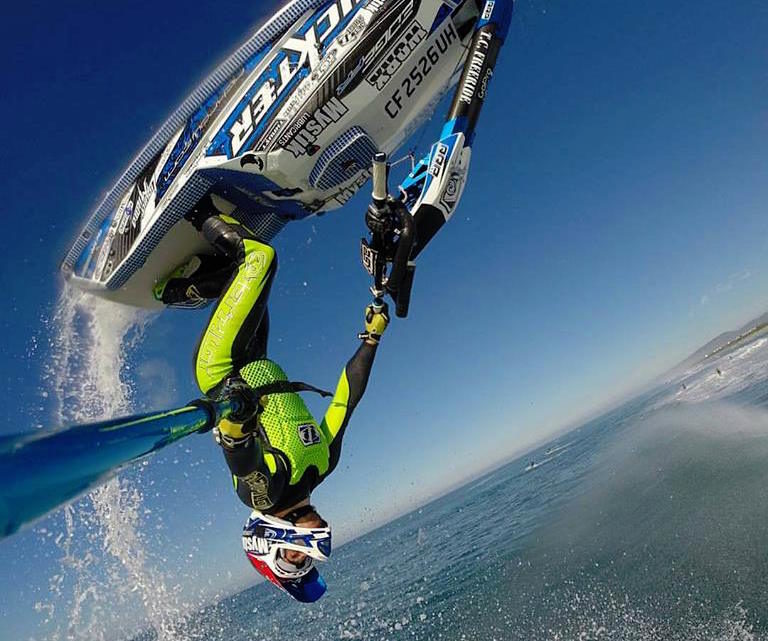
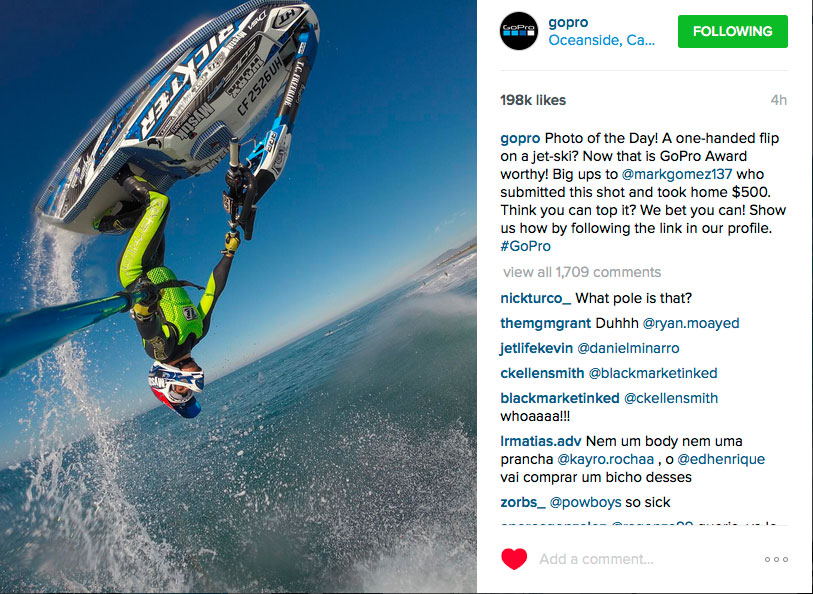
It should come as little surprise that IFWA World Champion Mark Gomez snagged the “Gopro Photo of the Day Award” this past Sunday, November 15th, earning him $500 for his sweet shot. Gomez is possibly one of the most recognized standup riders in the sport today – displaying his talents in a multiplicity of arenas, from surf riding, freeride, flatwater freestyle to closed course racing whether aboard his top-of-the-line TC Freeride Rickter or a vintage 550.
“[I’m] really thankful for the support and stoke coming from everyone at @gopro as well as everyone who is stoked on the footage. It all started with this production shot by my friend @elacayo212 and edited by @thebtown. The exposure has helped me gain momentum to gain support to accomplish the world title this year and hopefully lead to other fun opportunities doing what I love to do. So stoked today! Do what you love, keep it fun, and enjoy then ride.”
Nearly a year and a half. That’s how long Maikel Gonzalez’s incredible world record of 112 miles per hour has stood. First achieved in April of 2014 at the Greenhulk Hydrodrags (following the annual MudBug gathering of Greenhulk.net forum members in Morgan City, Louisiana) aboard the CRT Racing-built “GPRXP” known as “Blue Zone.” A full-blown conversion ski made from a modified Yamaha GPR1300 hull and deck and powered by a turbo-powered Rotax 4-tec plant.
Gonzalez told The Watercraft Journal that “Blue Zone” is “…powered by a CRT-built, turbocharged Sea-Doo 4-tec engine making in excess of 700hp but still driveable as a recreational ski. Power is delivered by a Precision Turbocharger and intercooler, but kept under control at all times by AEM performance electronics. Fuel delivery is accomplished through a custom CRT setup consisting of an E85-compatible system feeding six 2200cc injectors.”
Sponsored by AEM Performance Electronics, WWR, Gato Performance, Euro Export, Modular Wiring Solutions, Gonzalez and CRT Racing team looked to not only replicate the 112mph top speed at this past weekend’s RIVA Racing HydroDrag World Championship, but surpass it. Competing in the Unlimited class, Gonzalez’s fastest pass was a blistering 110mph – not enough to set a new record, but well enough to best his nearest competitors: Chris Caputo (107.4mph) and Jesse Gonzalez (103.6).
Gonzalez beamed with excitement writing, “CRT Miami still [has] the fastest ski [in] the world. I would like to thanks my family, my team CRT the best off the world, and a big thanks to ours sponsor that are always there for us!”
Sometimes good ideas just never get off the ground. Such is the case with Switzerland’s Aqua Quad. The machine’s a rugged appearance with its wide tires and tractor-esque front end maybe didn’t make such a big splash on the market, as the Aqua Quad doesn’t exist today. While attempting to uncover more information through the website, we found that the domain was for sale. All that remains are the two videos included below.
The Swiss claim that this is the first true four-wheel-drive amphibious quad and is useful to the Army and rescue services, as well as for personal recreation. The vehicle comes equipped with dual side mirrors, four headlights, and tail lights making it useful for night operations (while on land, of course). The Quad is outfitted with a steering set up like that of a personal watercraft which makes for easy steering.
The first video published in March of 2013, shows the cumbersome quad cruising, stopping to pick up a couple of passengers (demonstrating that the machine is a three seater), continuing downhill until reaching a body of water where the driver rides into the water. There, the fat knobby tires rise with what appears to be the push of a button linked with a hydraulic mechanism.
The amphibious vehicle slowly moves along the waterway with somewhat of a sideways bobble, indicating some lack stabilization at lower speeds. When it reaches a faster speed, it doesn’t look as difficult to stay upright. The second video is more of an introspective on the Aqua Quad factory to show its sleek assembly process and early stages of prototyping. Sadly, none of this came to be, as the Aqua Quad failed to get off the ground (so to speak).
While there’s a great deal of detail that could be poured into every step of the tips listed below, we want to share one of the most bare-bones, comprehensive check lists necessary to not only prepare your personal watercraft for a long winter’s nap, but also to properly wake it from hibernation, all courtesy of the crew at PWC Muscle (and its sister site, www.seadooforum.com). Again, it’s lengthy but worth the review:
Winterizing:
Winterizing your boat for the majority of us is the most dreaded day of the year. Warm weather is gone and so starts the wait for spring temperatures so we can hit the water again next season. Take these protective measures to assure your boat will greet you with a happy face when warm weather welcomes you again in a few months.
Standard Winterization
1) Run a fogging solution through the boat engine while it is running to protect internal parts
2) Spray a protective anti-corrosion film on the external parts of engine
3) Drain the engine block and manifolds and fill the engine with anti-freeze
4) Drain the lower unit gear oil and refill with fresh oil (stern drives only)
5) Grease all external fillings on stern drives
6) Disconnect the battery/batteries and store somewhere warm
7) Cover your boat
Optional Winterization
1) Remove spark plugs and spray oil on cylinders, then replace spark plugs
2) Change engine oil and filter
3) Remove prop and grease prop shaft
4) Add fuel stabilizer to prevent condensation in gas tank (run engine briefly to flush stabilized gas through fuel injectors and carburetor)
5) Winterize fresh water system
6) Remove outdrive and grease U-Joint
De-Winterizing Prepare Your Vessel for the Spring and Summer
So, you have got that itching spring fever to uncover the boat and get her wet for the first time this season. There is nothing worse than being gathered at the dock with a boat-load of people and you turn the key and…rrr..rrr..rrr…and nothing. It is likely this will happen if you do not take the time to de-winterize your boat. Do an inspection before setting out on the first trip of the season. To avoid any embarrassment and frustration, use the following pre-launch checklist to get your boat as ready for the boating season as you are.
Oil Check
If you did not change the engine oil when you put the boat up for the season, now is the time to do it. Make sure you change the oil filter also. Check the oil in the outdrive.
Battery Inspection
1) Reattach the cables.
2) Make sure the terminals are not corroded. If so, wipe them clean. If your battery takes water, fill it up. A dry battery is a bad battery. (I learned that the hard way.) With a battery tester, check the volts and amps. Does it have juice? If it is charged and still no luck, it may be time to buy a new battery.
Cooling System
Hopefully you drained the cooling system if you live in a cold winter climate to prevent freezing. If so, fill ‘er back up. Rinse out the strainer and check the hoses for cracks.
Fuel System
You also should have topped off the tank with gas to prevent any moisture and condensation forming in the tank and diluting the gas. Change the fuel filter. Make sure the fuel line is attached and not cracked. In the winter these hoses can become dry and brittle.
Distributor
Take the distributor cap off and clean it out. Corrosion could have occurred during the winter. Make sure all connections are restored.
Belts
Tighten the belts if needed. You should only be able to push the belt slightly down. If the belts do not fit snugly in their pulley grooves, they may be worn and in need of replacement. Belts that are not tight will wear faster because they will likely begin to slip. The alternator belt usually wears faster than the others. A sign of a worn belt is black soot somewhere in the vicinity of the pulley.
Other Things That Should Not Be Ignored:
Change the spark plugs
Lubricate the engine with WD-40
Check all hoses
Check power steering/cables
Test the bilge pump
Replace the drain plug
Check rudder and shafts
Inspect the prop
Test the horn
Test the VHF radio
Check the trim
Inspect personal flotation devices
Check the fire extinguisher expiration date
Make sure the anchor in on board
* The above de-winterizing tips are only a list of suggested things to do your boat that I’ve collected over the years. Each boat may vary as to what needs to be done to de-winterize it. For complete instructions please see your boat’s owners manual or consult your boat mechanic.
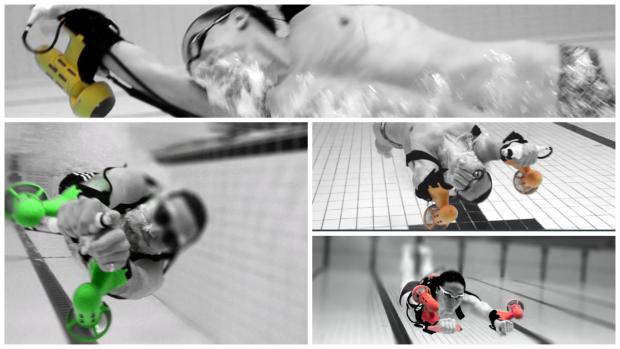
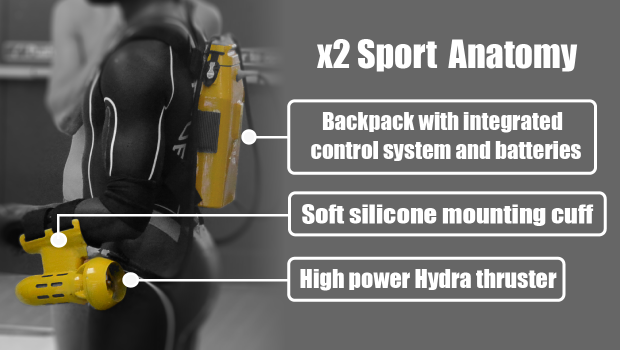
We’ve been showing you some pretty oddball stuff lately, but we’re actually really liking the idea of the x2 Sport Underwater Jet Pack. Somewhere between Sea-Doo’s Dolphin Sea Scooter and the JetLev, the x2 Sport is the ideal snorkeling toy. Basically, a wearable propulsion system, the x2 Sport is propelled by the patented wrist-mounted “Hydra thrusters” that are mounted to a pair of soft silicone mounting cuff. The two thrusters are controlled via an analogue trigger integrated into the throttle grip and powered by batteries tucked into a backpack.
Designed as a supplement to underwater divers, swimmers and snorkelers, the “x2 provides the effort, saving your precious oxygen allowing longer duration dives.” Additionally, the x2 “opens up a whole new experience in underwater acrobatics by allowing you to twist, turn and spin. You’re only limited by your imagination and the best part is that your hands will be free enabling you to stop to take photos,” according to the IndieGoGo campaign page. Thus far, they have raised over $12,000 of their $35,000 goal, which is pretty good – but it could be much better.
We really like the idea of this entrepreneurial device and think it could be a big help to recreational scuba divers and possibly even be adapted for military applications. Although you won’t boil the water at 6mph, the x2 Sport does add to the normal human’s normally-slow speed significantly. Watch the video below and see it in action. We think you’ll like the x2 as much as we do, and maybe enough to donate!
The Worldwide Stolen PWC Database has helped us put together a list of steps to take and things to check for when buying a used PWC. The last thing you want when buying a used ski is to purchase a stolen one. We have a list of precautions and procedures to check for when buying to make sure that does not happen:
Check the HIN Every watercraft comes from the factory with a HIN (Hull Identification Number). This number is unique to each ski. When purchasing a used watercraft, it is a good idea to look for evidence of tampering, as this may mean the PWC you’re looking into has been stolen. Look for signs of scratches as well as any oddities in the number itself. For example, the year of the ski is normally the last two numbers in the HIN. If you know the ski you’re looking at is a 2010, but the last two numbers of the HIN are 12, then you should probably steer clear of this PWC and the seller.
Get to Know the Seller It would also be a good idea to get to know the seller as much as possible. A visit to his/her house to look at the ski is generally a good way. While it may be tempting to simply ask to meet on the water so you can go for a test ride, it would be best to go visit the seller’s address, then ask if you could go to the water to test it.
Use an Independent HIN Checking Service There are several sites that hold marine watercraft history and reports that contain information about many different types of marine vessels. From our experience, though, this information varies substantially from site to site. It would be a good idea to make sure you are using a reputable source for your info, such as the Worldwide Stolen PWC Database. They work with many different agencies to gather up the most accurate information they can provide you with.
Commit with a Written Agreement If all the prior check out and you’re ready to make a purchase, then try to get a simple contract for the both of you to sign, just to show the agreement of sale. It does not need to be a 20 page document full of legal terms, just a simple contract stating the facts of the sale (where you both live, what is being sold, the seller is the rightful owner, etc.).
With this signed by both of you, you will have a formal agreement between you and the seller as well as an extra layer of protection for yourself. Don’t forget, verify the seller’s identity by means of an ID, driver’s license, passport, etc.
Use Common Sense While the Worldwide Stolen PWC Database is able to quickly and accurately inform you if the PWC you’re looking to purchase is registered on their database, it should only be used as another tool in your buying arsenal. Remember, unfortunately not everyone reports it to them right away when their PWC has been stolen, so we can’t pass on the warning. If the deal you’re being offered is too good to be true, it probably is.
Check if the service/repair work looks legitimate. If possible, contact the dealer who serviced it to confirm the work.
Keep in mind, sellers will expect you to be a bit skeptical when making a high value purchase. A legitimate seller will be much more comfortable answering any questions you have than somebody who has something to hide.
Throughout the 2015 racing season, the Yamaha brand really put on a show, taking numerous national and world titles in several different sanctioning bodies. You might could even say the 2015 PWC racing season was all but completely dominated by Yamaha WaveRunners. And the AquaX racing series was no different.
In the premier 300 class, Yamaha racer Mike Klippenstein showed true dedication to the sport, coming all the way from Canada to make all six AquaX rounds in FL. After a very strong season of racing, he finished the season with an astounding 56 point lead over the runner up, Eric Francis.
Though the 250 class was won by a Sea-Doo rider Eric Lagopoulos, Yamaha riders Paloma Noceda and Brian Baldwin were nipping on his heels all season. In fact, Noceda had the points lead going into the last round. She fell off her ski in the last moto of the season, though, and gave Lagopoulos the championship by two points. Never the less, Yamaha is proud of the way their riders and machines performed.
The 200 class was mostly Yamaha VXRs. In fact, all but four of the skis in the 200 class were VXRs. Travis Zielasko took the championship with a whopping 61 point lead over fellow Yamaha rider, Rob Greenwald, who took second place on the season. Also, we must mention, the Rookie Cup winner for the year was Hector Toledo, who was racing Yamaha FZR in the 300 class.
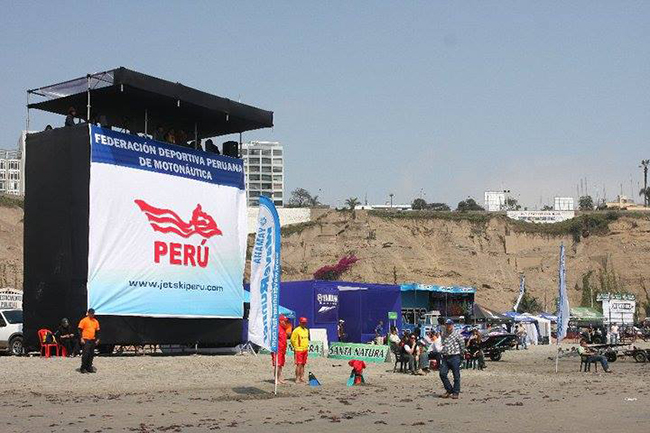
Hey! Are you unwilling to call it quits for 2015? Well, then if you’ve got a few thousand dollars lying around (or some serious frequent flyer miles you can cash in), then might we suggest crating up your favorite watercraft and hoping a flight to the World Jet Raid Championship in Peru this upcoming November 14th through the 21th. If you were on hand for the 2015 quakysense IJSBA World Finals, then you might’ve heard all of the announcements about this race, otherwise here’s the skinny:
According the IJSBA’s own website: “Jet Raid comes to Peru to joint one of the many high profile Endurance Races that are developing in 2015. Jet Raid is a mix of endurance and closed course over several days.” As of the announcement, more than 15 countries have already confirmed, with racers from Europe, North America and Asia coming to compete for the 8 days of racing. (and over 1000 kms of travel along the coast of Perou, starting in a desert Dakarian camp in Ancash.
Although the €1,000 ($1075 USD) entry fee for racers sounds steep, it does include your hotel, meals and transportation to and from the race site. Flights thought do add up, with the race being so close (upwards to $1,200), and don’t forget the cost of shipping your ski, tow vehicle and tools! Crew members’ entry is slightly less at €750 ($805 USD). Again, racing ain’t cheap and comes at a great personal expense to the racer, their crew and sponsors, so that’s why we ALWAYS want to support the few promoters who actually offer cash purses!