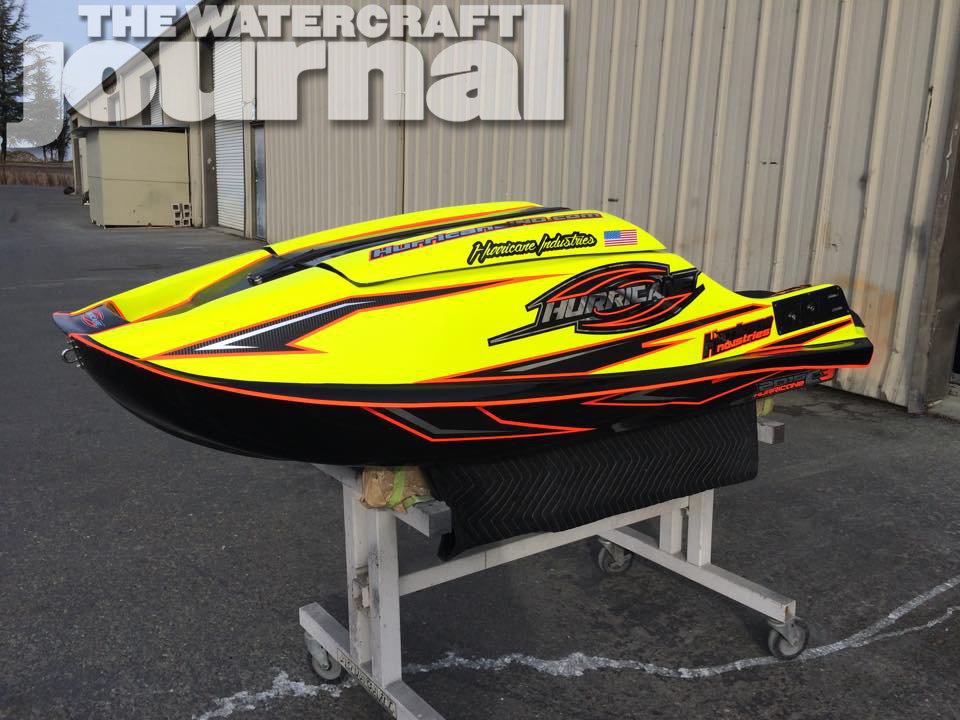
The rift between diehard standup riders and casual runabout riders has never been more expansive. As modern runabouts gravitate towards miniature sport boats replete with on board sound systems, cruise control and electronically-automated full suspension system, the good ol’ days of heaving a pair of 550s into the bed of your pickup and heading to the lake with a couple of your buddies has never felt so distant.
Many standup lovers though haven’t given up hope for the future. One such is Jimmy Strickland. The Slidell, Mississippi native pieced together a great mini movie “Wet Dreams Unleashed – the SuperJet Movie” with few good friends. “The other riders are Josh Chrisman, David Silas and Laszlo Molnar. We are pretty much a bunch southern Mississippi boys that love riding standups and motocross,” Jimmy told The Watercraft Journal.
“We mostly ride on the Jordan River in Kiln, Mississippi,” he continued. The footage as shown below, is a combination of scenes from last year’s riding season and previous ride days. “This was our first video of a bunch of old footage consisting mostly of my good friend Laszlo because he was the only one with a GoPro at the time,” Jimmy prefaced. “Now, we all have GoPros and are working on another video consisting of waves, enduro like standup riding and probably some moto.”
To be fair, there’s a little NSFW language, but that’s be expected with a bunch of friends having a good time. So until the next movie comes out, enjoy Jimmy and company’s first foray into film making below:
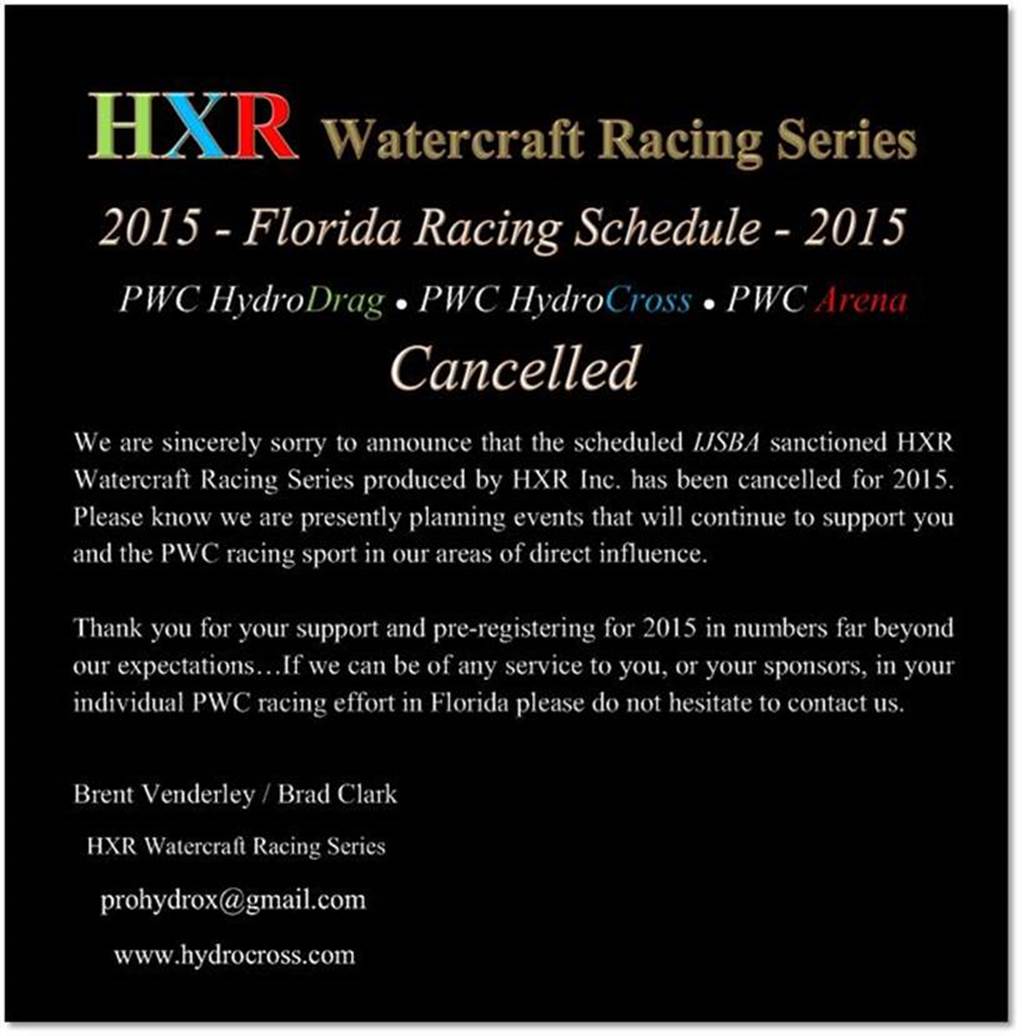
Well, this sucks. Just when you think it’s safe to start getting excited for the 2015 racing season, we get news like this: Unfortunately, all HXR Watercraft Racing Series for 2015 have been cancelled. That includes the newly announced HXR Arena Racing, HXR HydroCross Racing and HXR HydroDrag Racing series. Undoubtedly, it comes with a heavy heart for organizer and fellow racer Brent Venderley, who poured a considerable deal of blood, sweat and tears into developing the HXR series’ 2015 season into what could’ve been something massive, but alas, fate would say otherwise.
In light of significant increases in new watercraft unit sales in 2014, the interest and funding necessary to support an aggressive racing program such as what Venderley was proposing appears to have all but vanished. This news of course, comes as turmoil between sanctioning bodies and private event promoters has left many racers and spectators to query the station of organized PWC racing in the United States as a whole. With regional promoters slowly backing out of the IJSBA or racing altogether, would-be participants are left wondering whether the sport has much of a chance at all.
Here’s the original announcement:
Hello… I regret to inform you that the HXR Watercraft Racing Series for 2015 has been canceled. This cancellation includes HXR Arena Racing, HXR HydroCross Racing and HXR HydroDrag Racing as scheduled. Over the last two years of full time personal effort promoting the PWC racing sport, I have done my best to continue pushing IJSBA Region 7 racing down a path towards a professional image and an exciting, fan friendly, PWC racing program. Unfortunately the near nonexistent level of market, industry and association support has resulted in a sufficient lack of budget and resources… I personally thank every PWC racer, their crew and families and of course our sponsors who have supported me and HXR HydroCross Racing the last two years. It’s a fact; Region 7 has more passion for the PWC racing sport than I have seen anywhere on national or international circuits. I sincerely hope and plan for positive market, industry and association changes down the road… if this happens and a legitimate opportunity presents itself for a top level racing series, I will jump at the chance to bring you the great racing programs our industry deserves. Until then I am hanging it up, putting on my helmet and going racin’… Thank you all, I’ll see you on the starting line! The graphic below is being sent the morning of 1/21/2015 Brent Venderley HXR Watercraft Racing Team 813.409.1995
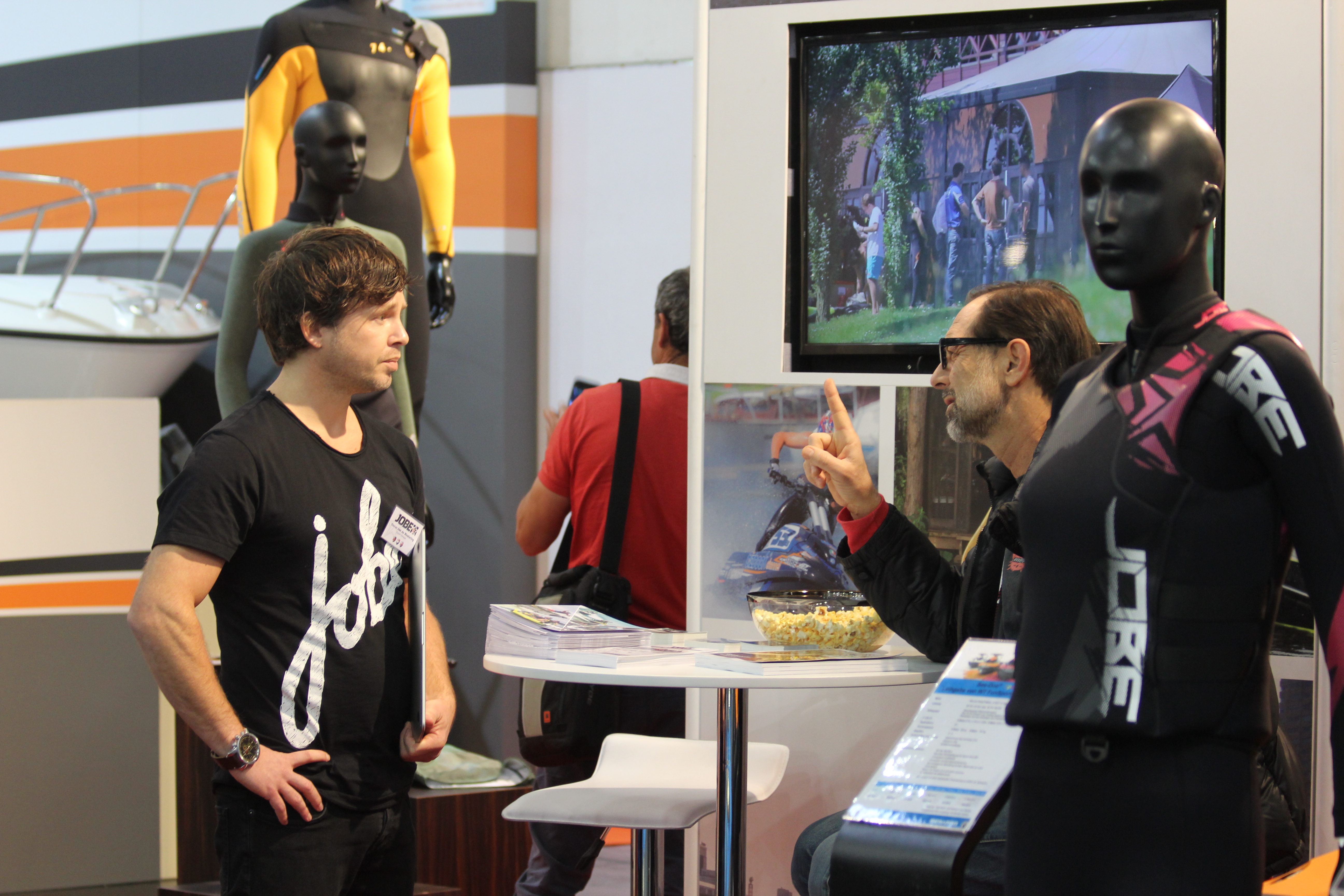
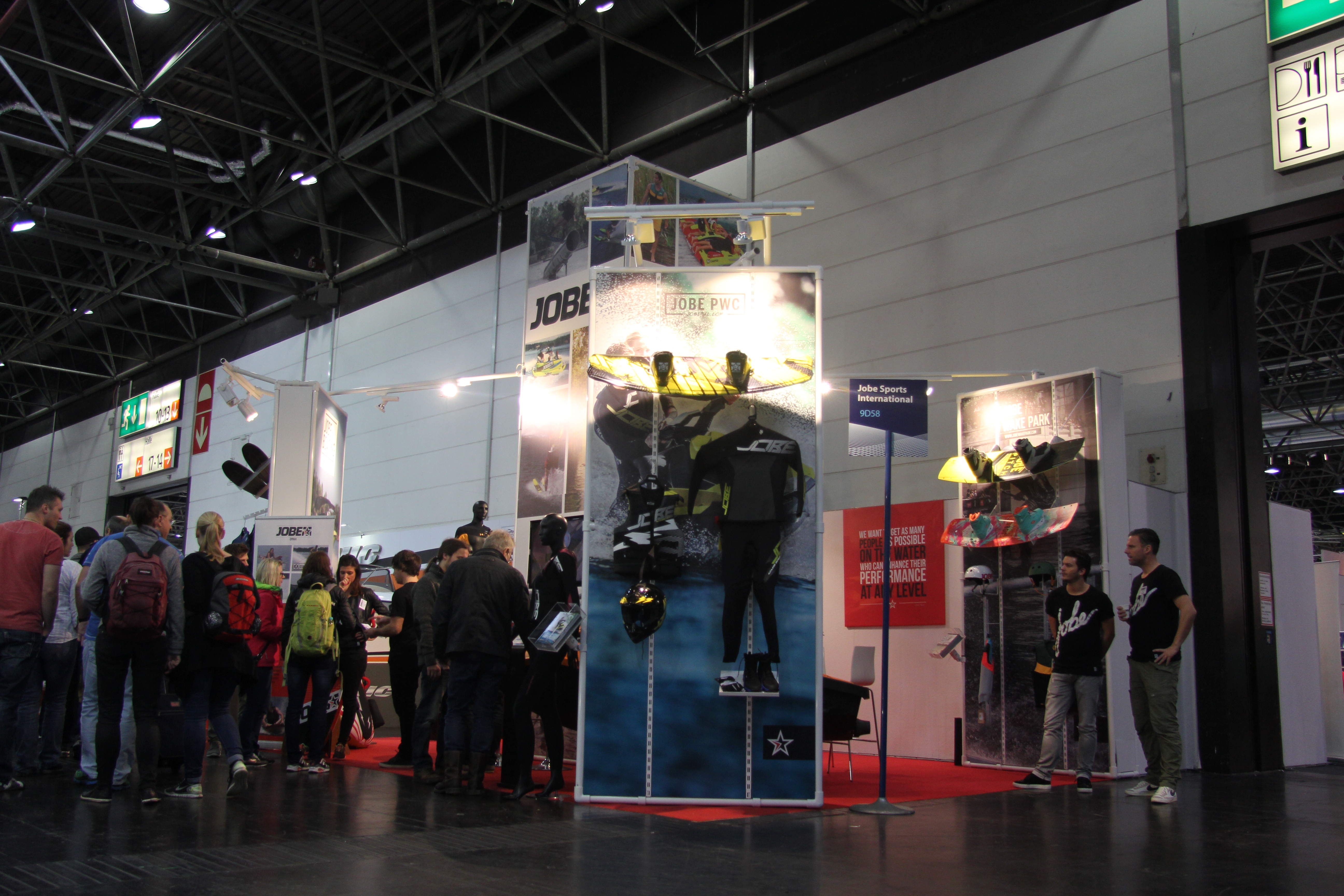
Boat show season is going off in a big way, and not just in the States. This past January 17th kicked off the beginning of the January Boot Düsseldorf boat show (until the 25th). Held at the Düsseldorf Exhibition Centre, the amazing Boot Düsseldorf is one of world’s biggest boat shows with more than “1600 exhibitors from over 50 countries” according to a release by Jobe Sports International, who has been on the scene in a big way with a huge collection of their new riding gear and equipment.
The release continues, “You can find one of Jobe’s booths in hall 9 D58 with a great deal of their new collection including the newest wetsuits, towables and PWC gear. Get your hands on the game changing and innovative Jobe Omnia, hangout with the Jobe staff and find out what 2015 is all about for Jobe.”
Wake Park team Dominik Gührs was on hand this past January 17th at the Wake Park booth.
Additionally, the Jobe SUP and Wake Park are located in Hall 1, Booth A4. The new 2015 Jobe SUP collection includes the latest in hard-shell and inflatable SUPs. And for those interested, you can get technical insight into Jobe’s new boards such as the Conflict, Grace and Pitch by the developers themselves.
Finally, with just this week left, Jobe is hosting a sticker quest for all kids visiting Boot Dusseldorf, where they’ll get the chance to win a Jobe backpack! Simply grab a sticker card at the Jobe booth in Hall 9 and receive one of the 10 pieces to complete the puzzle. Here’s a hint: You’ll find the other stickers spread over nine Jobe dealers in Hall 9 and 10, so happy hunting! Once the puzzle is completed, return your card back at the Jobe stand where a winner will be picked at the end of the day.
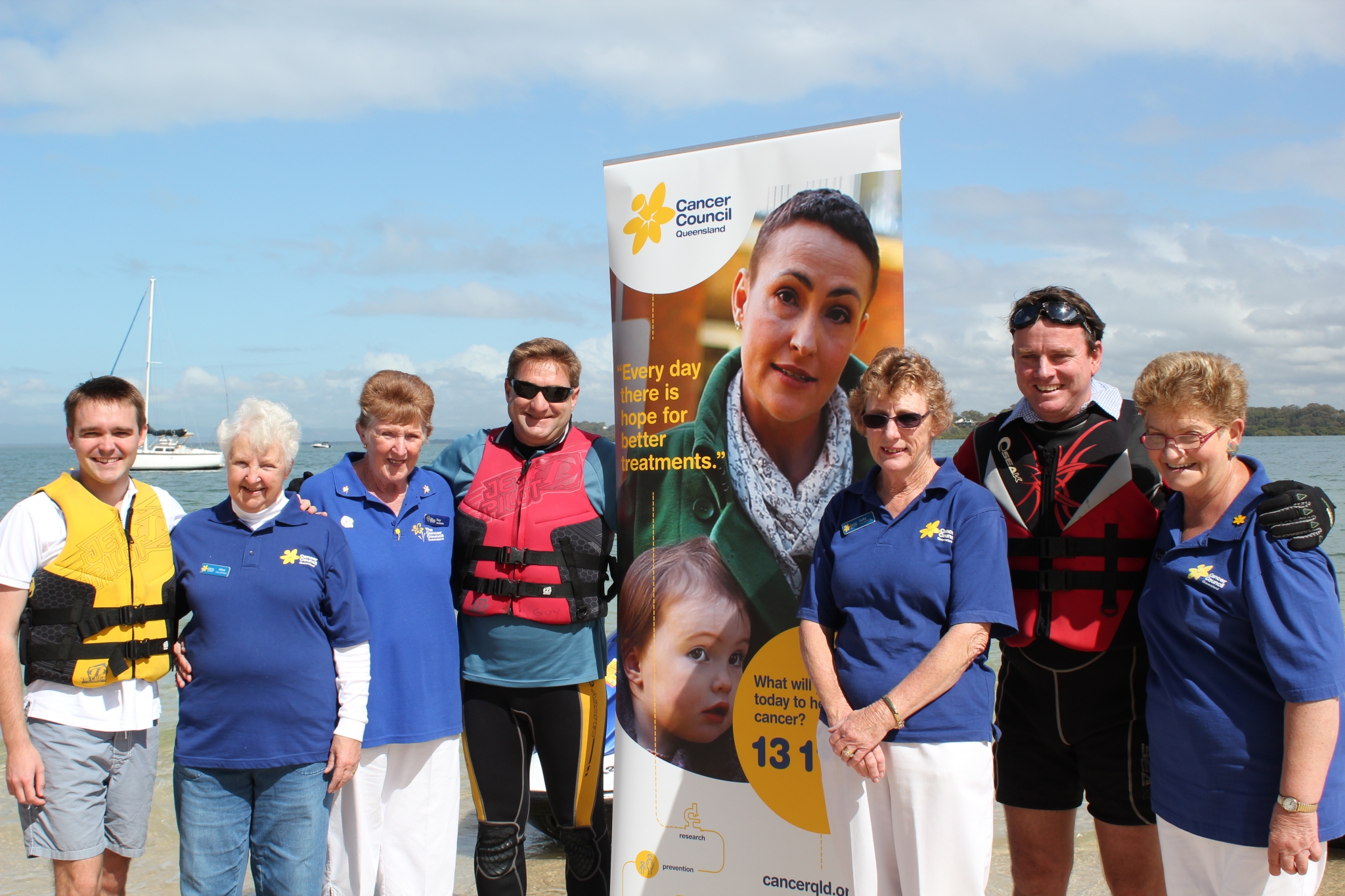
Recently, the group Jet Ski For a Cure announced that that May 1, 2015 will mark the date for a fundraiser for cancer research. A group of committed Australian personal watercraft riders will take on the daunting task of a 1,600-kilometer journey from Gold Coast to Townsville to raise money for Cancer Council Queensland. The grueling ride will take approximately 12 days to complete, including two days of rest, and several charity stops along the way.
The concept “Jetski for a Cure” was born after speaking with the Queensland Cancer Council, which is also when the decision was made to ride from the Gold Coast into Townsville, according to EveryDayHero.com. It was also noted that one in three Australians are affected by cancer.
Brendon Guy, the founder of Jet Ski Heaven, lost his first wife to cancer in 2006. He said, “Fiona was only 36 years old, this devastated my three boys and I.” He wanted to do something for cancer research after his loss so he and his mate; Peter Lee came up with Jet Ski Heaven.
Theresa Gray, who is the third member of “the crew” jumped on board so she could ride around Australia with a group and do some good in the meantime. She and her husband bought their first jet ski in 2013 and the two of them could not get on the water enough and this event offers both a long ride for a good cause. Her goal is to raise $2500 because the ride is done in stages, ten in all and she wants to raise $250 per stage.
If you would like more information about Jet Ski Heaven’s crew and the ride, please visit HERE and HERE.
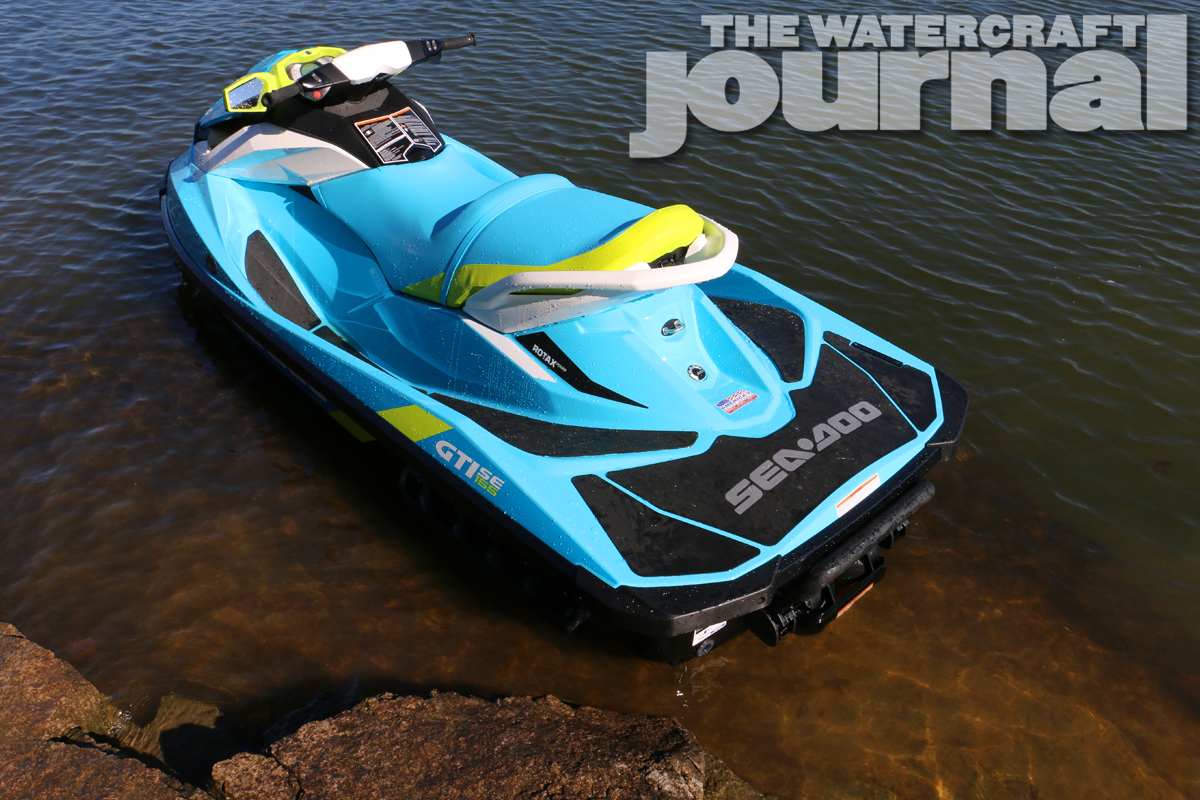
That’s a lotta blue! The new Maldives Blue replaces the more subdued outgoing hues.
When the pictures were first leaked revealing the 2015 Sea-Doo lineup, we have to admit that our initial reaction was curious at best. As Sea-Doo’s competitors doubled down on automotive-grade paints brandishing deep metallics and subdued earthy hues, the decision to swing so far afield took many by surprise. And if the Internet has taught us anything, it’s that people are resistant to change.
It was hard not to share in the hive-mind sentiment, but only when several females (both enthusiasts and passersby) mentioned their affinity for the brilliant tones did Sea-Doo’s brilliance began to gel.
Last year’s candy-colored Sparks paralleled a wave of trendy affordable-yet-fun-looking items, most obviously Apple’s budget-minded iPhone 5C. Clearly the widespread reception of the Spark influenced BRP’s tinting choices for 2015.
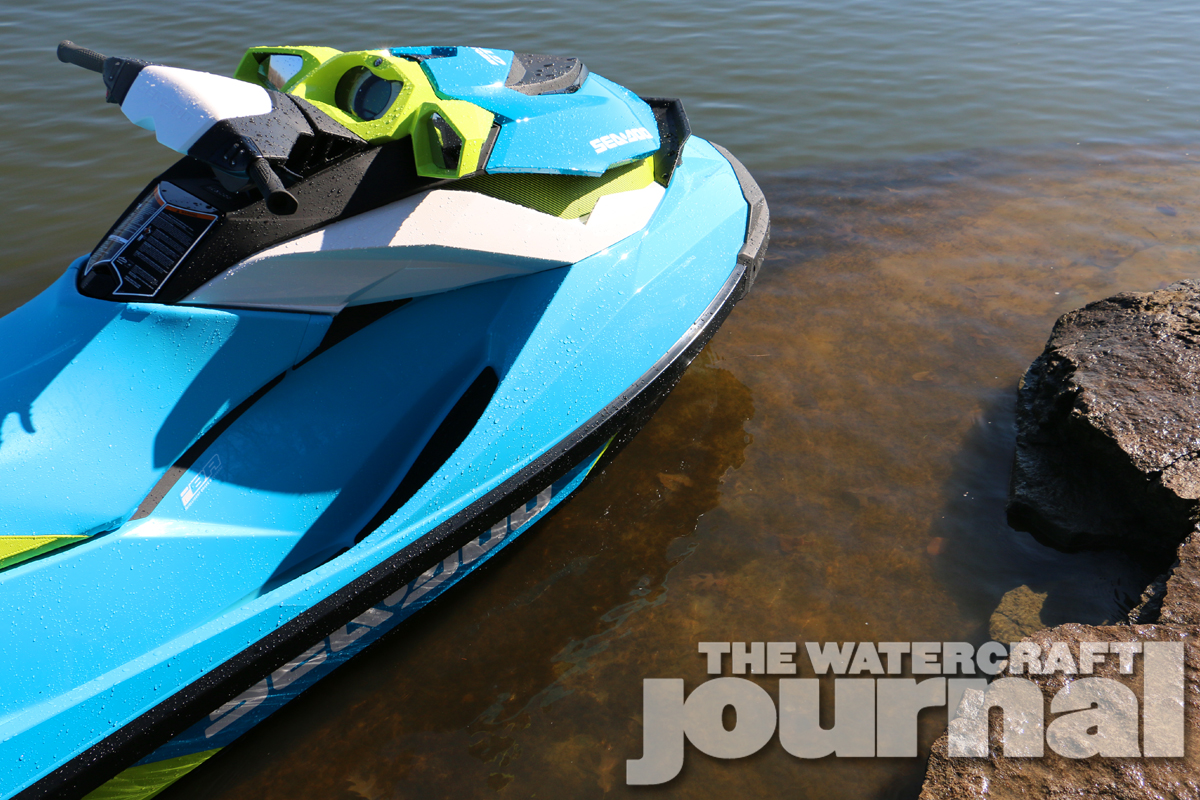
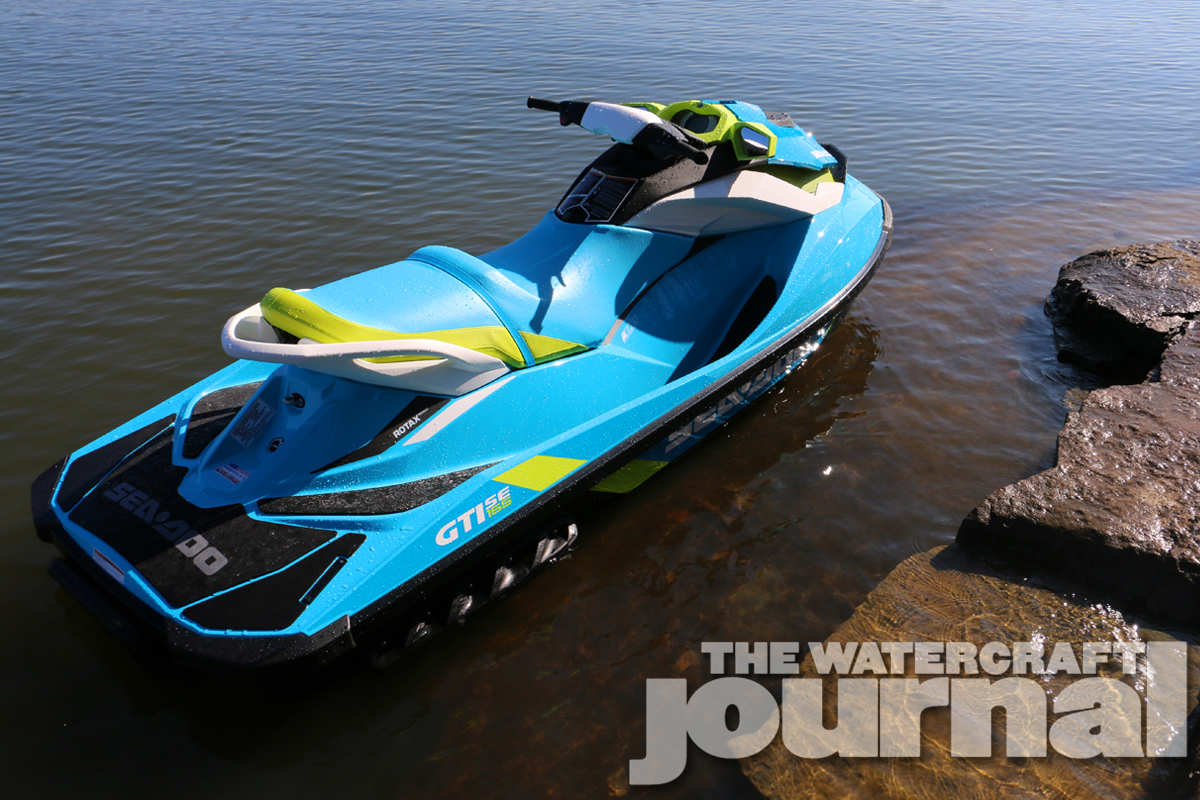
Of all of the new lineup, most dramatic were arguably Sea-Doo’s Recreation series. While the GTI 130 SE model comes available in either a retina-scorching Manta Green-and-violet or Bahamian-themed Maldives Blue-and-Manta Green livery, the higher horsepower 2015 GTI 155 SE – which we tested this day – is available only in the latter. Apart from the visible-from-space recoat (and one significant change that will get to soon), the GTI 155 SE remains predominantly unchanged.
Our 2015 unit was generously provided by Middle Tennessee’s leading Sea-Doo dealer, America’s Motor Sports. Call (615) 859-7292 to start your boating season off right!
Riding on Sea-Doo’s 132.6-inch GTI platform introduced in 2011, the hull is an impressive stable three-seater despite being the brand’s entry-level platform (except for the Spark, of course). Riding on a moderate V-hull, the ski comes to plane quickly and rarely searches while tracking through mild lake chop. The absence of long strakes running the length of the hull allow the GTI to remain a little loose in hard turns, attributing to its playful nature.
Of course, while cruising the GTI 155 SE is rock solid, stable and predictable. Being an SE (Special Edition) model, the GTI 155 SE comes equipped with BRP’s Variable Trim System, folding swim step and additional instrumentation including a fuel consumption calculator (instant and average), and a clock. All of that is in addition to a long list of standard technology including Intelligent Brake & Reverse, a closed-loop cooling system and BRP’s most under-appreciated feature, iTC permitting for Touring, Sport and ECO modes.
The GTI 155 SE comes with VTS, a folding swim step and an additional fuel consumption calculator (instant and average), and clock instrumentation.Employing a 155HP Rotax 1.5L, the naturally-aspirated plant is surprisingly potent given its economic use of 87 octane.
Priced at $11,199, the GTI 155 SE is priced for a water-loving family budget, and operating on 87 octane only makes it all the more economical. Despite our best efforts, we spent less than $30 to thoroughly top off it’s 15.9-gallon fuel tank. And, it’s worth noting that after considerable riding time, there were still a few bars of fuel left on the gas gauge. The GTI’s naturally-aspirated 1494cc Rotax is simply not that thirsty, even when pinned in Sport mode.
To which, on a very chilly January weekend, we mustered a maximum of 58mph from the GTI, all of its 155-horses stretching as far as it could go. Fussing with the VTS only hindered our speed runs, as trimming it north or south of center only slowed it. Rather, the VTS is best used for towing the kids in a raft or a wake skater (making the similarly-equipped Wake 155 all the more logical).
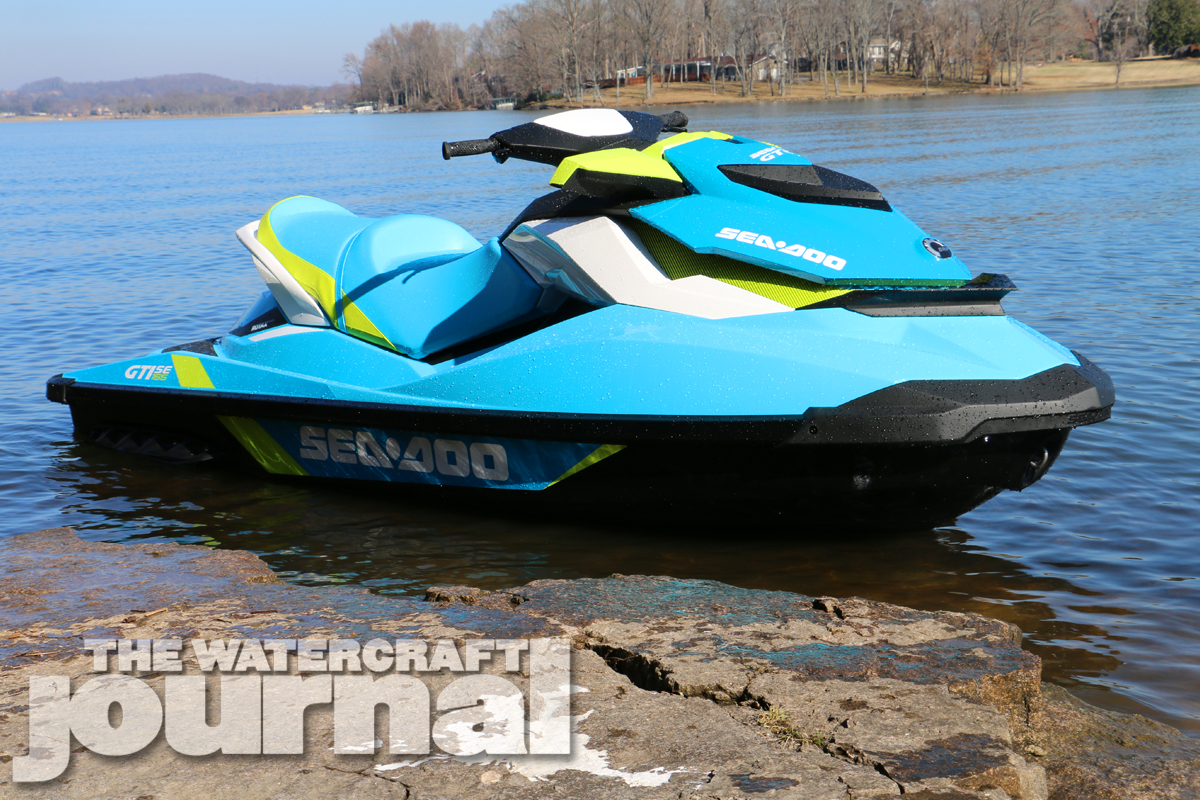
As stated above, conducting our test session in the height of winter allowed us almost exclusive access to any body of water we were willing to dip into. Unfortunately, much of the scenery available to us consisted of steely gray skies and naked hills littered with barren trees, but the brightly colored Sea-Doo lit up beneath the sun like a signal flare.
The GTI 155 SE incorporates a mild lumbar bolster for the driver and cushy seating for three.
Of which, we had only one true complaint: the blue of the hood doesn’t match the blue of the rest of the ski. Although some clear decals try to disguise the discrepancy, it is still pretty self-evident. Nevertheless, we found that no picture did the color quite the justice that a first-person account can give – so reserve your judgement until you lay eyes on it.
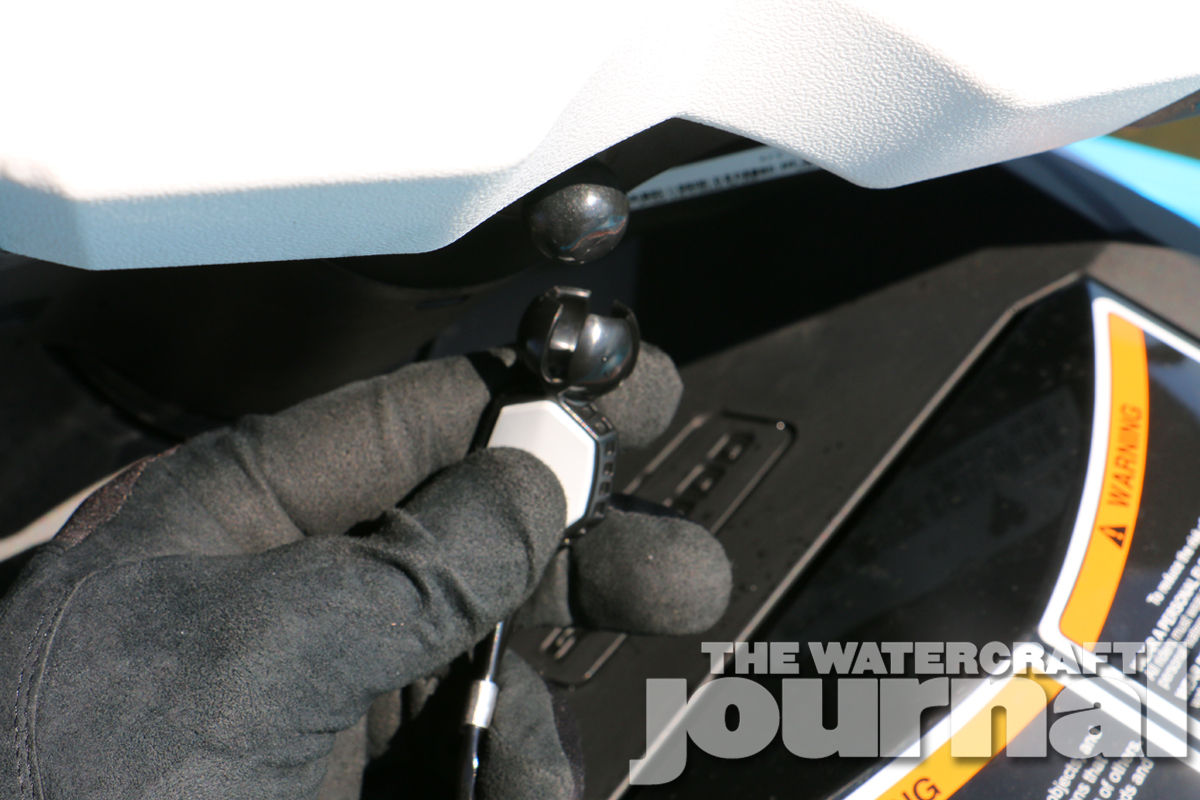
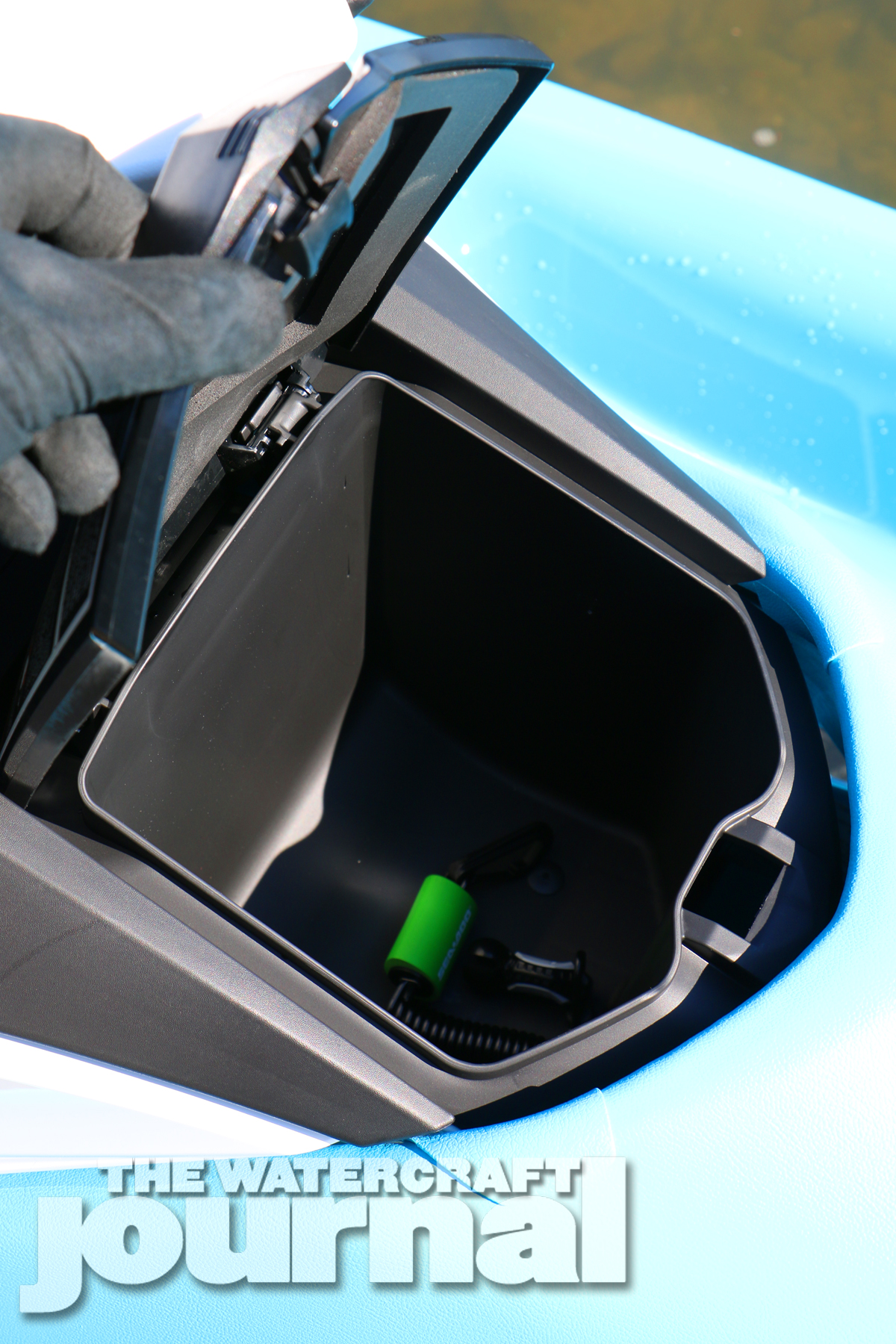
Now as mentioned earlier, there is one significant change to the GTI 155 SE, and all Sea-Doos for 2015. Replacing the previous DESS key/lanyard is a new RF DESS key. Radically improving the design with a new ball-and-socket mount, the Digitally Encoded Security System allows for easy and quick starts every time.
The likeliest of unsung changes to the 2015 lineup is the use of the new radio frequency-controlled RF DESS key, which replaces the previous magnet-strip DESS key.
Imbuing the DESS key with radio frequency technology also ensures that contact to the old DESS nodule is a thing of the past. In prior tests, we fought with the soft rubber DESS failing to make contact (giving us the affirming “double beep” permitting us to start). Now simply hook in and push “Start.” It’s that simple. Again, it’s a little detail many won’t notice, but it made a big impact on us.
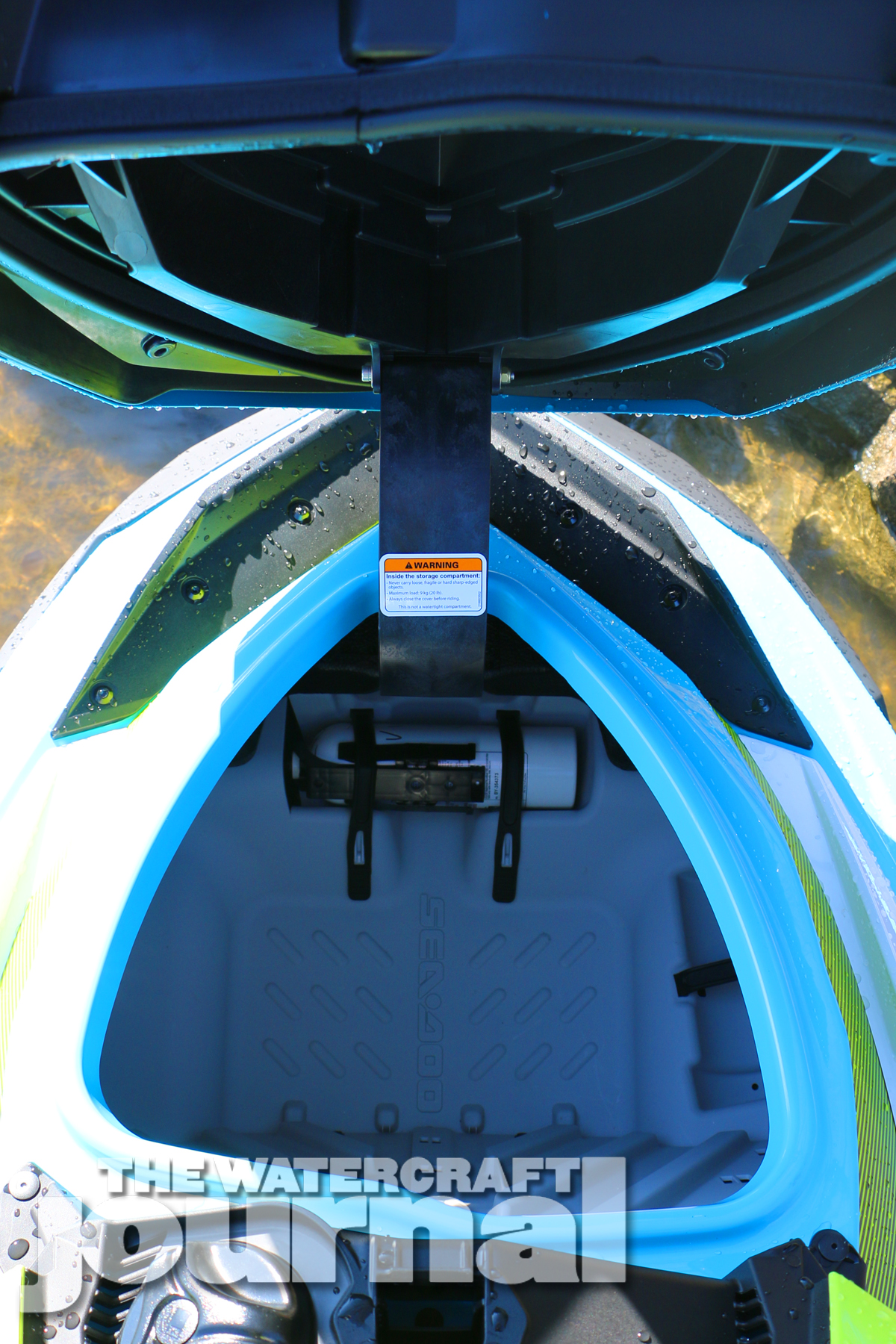
We enjoyed the GTI 155 SE – as we always have – and welcomed the new colors with a nod towards the retro colors of the 1990s. For a family watercraft, the GTI still stands strong even when compared to its half-priced Spark sibling. Offering stability, storage and comfort where the Spark plainly doesn’t, the GTI 155 SE is the right pick for those looking to stay dry while casually cruising their favorite lake or river.
The GTI 155 SE makes for a great family-friendly ski whose iTC settings permit for causal, aggressive or fuel-sipping riding modes.
The process is fairly simple: Engines create heat. Heat is transferred from the engine to the intake plenum. The air passing through the factory intercooler into the hot intake is almost immediately reheated, thereby robbing horsepower from your engine. This part is designed to keep the engine heat from transferring to the intake plenum.
For every 10-degrees the air temp is increased, one horsepower is lost. And transversely, for every 10-degrees air tempurature is decreased, one horsepower is gained, because the amount of horsepower gained is relative to the temperature of the air entering the combustion chambers.
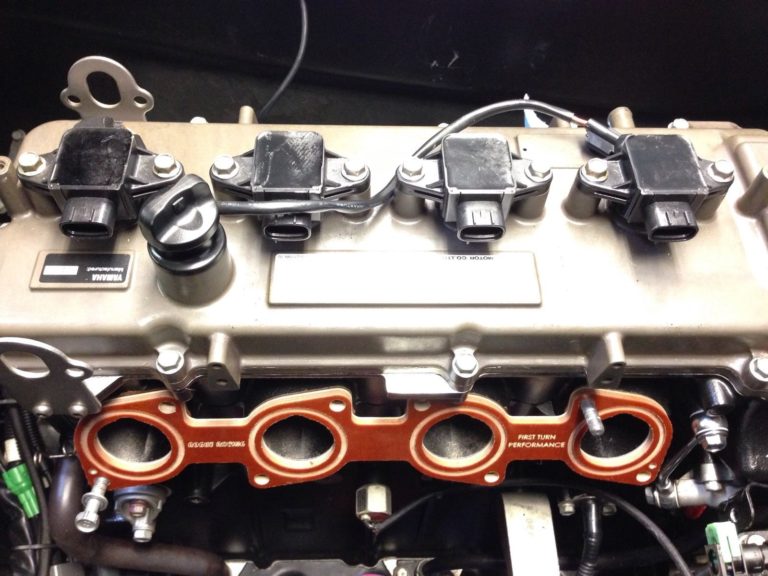
While you’re not going to feel the increase in the seat of your pants, the Rogue Racing Heat Barrier for the Yamaha four-stroke VXR/SHO/SVHO engines will decrease your intake air temps and gain you additional horsepower. Even if installed on a completely stock OEM engine, it will show positive gains. No matter the level of your build (Limited or even full-blown Pro Class), decreasing your engine’s intake temps will up your power output.
Your Heat Barrier Kit includes Rogue Racing’s Heat Barrier, new O-rings, stainless hardware, and spacers for the OEM support brackets. This is an easy install that will render you immediate results. And according to Rogue’s Ron Self, “We’ve been making these for years (since 2003) for the Kawasaki four-stroke watercraft and now are offering them for the big Yamaha four-stroke watercraft.”
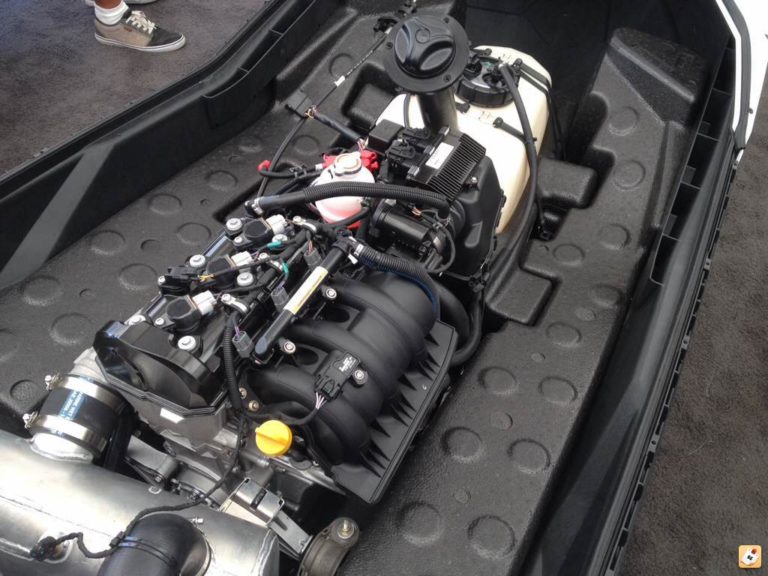
Last night, as I perused my seemingly endless news feed of Facebook posts, Instagram pics, Tweets and emails, I stopped and grinned at a small, grainy picture of an engine compartment. Filling nearly every available centimeter of space inside of a Krash Industries’ Footrocket, was a three-cylinder 900cc Rotax motor pulled from a Sea-Doo Spark. All of the factory wiring harness, linkage and hardware were present too. Obviously, changes were made to the air intake and exhaust plumbing, but for the most part, everything shown looked deceptively factory BRP.
It was bound to happen, and now the first successful installation of a Sea-Doo Spark’s ACE 900 4-stroke has now found a home in a lightweight Krash Industries’ Footrocket.
The post on the Krash Industries’ Facebook feed was captioned, “I know a lot of people have talked about this but it’s finally been done. Joe Grace has successfully fitted out a Footrocket with the ACE 900 Sea-Doo Spark running gear; could this be the solution to 2-stroke stand up emission problems?”
And yes, the team at Krash are exactly right on both accounts: the discussion of the ACE motor being shoehorned into a modern standup ski has been bandied about since the Rec Lite Runabout’s introduction; and yes, having these motors made available to the aftermarket ski builders would immediately resolve the standup’s emission issues.
These comprehensive packages are generated out of BRP’s Marine Propulsion Systems division in Sturtevant, Wisconsin, formerly the Outboard Engine division. Unfortunately, only the 1.5L Rotax package (in addition to Evinrude outboard engines) are the only powerplants available through this program.
The Rotax ACE 900 comes in either 60 or 90HP configurations. At 899cc, this four-stroke engine, with three cylinders and four valves per cylinder, is one of the most compact and lightweight engines on the market. Using BRP’s Advanced Combustion Efficiency technology, it’s also the most fuel-efficient watercraft engines in the industry.
This program was put into effect shortly after BRP announced the closure of its Sea-Doo jet boat line, and has been successful in maintaining BRP in the boating industry. But, the absence of the ACE 900 is an audible one for the many (and I mean many) aftermarket ski builders, from custom hull designers and shapers like Krash Industries, Trinity, RRP, Bullett Racing, and Hurricane Industries (not to mention several others), to performance tuner shops.
This time last year, we discussed the very idea of an ACE-powered standup ski with multi-time world champion and custom ski builder Craig Warner while touring the new Mountain Motorsports facility in Lithia Springs. “I think it’s a solid engine. It’s lightweight, compact, makes good power and is 50-state legal,” Warner explained. “The problem is that they won’t sell me one. I asked and they said I’d have to buy a Spark and gut it. That’s out of the question.”
The fact is that while there’s demand for custom-built standup skis, the quantity isn’t likely enough to quantify BRP rethinking the ACE’s inclusion in the Power Pack program. Warner estimated that even with the Spark engine, his company, WWR Products would move little over a handful of units a year. Larger volume makers like Rick Roy Products (RRP) and Krash Industries might help sway Sea-Doo’s parent company, but again, we’re looking at a very niche industry wherein an estimated 150-200 custom hulls are built in a year (less than half that of Yamaha’s SuperJet sales domestically).
Currently, the only way aftermarket hull makers and standup ski tuners are able to get their hands on a Rotax ACE 900 is to extract one from a Spark. Were BRP to offer the ACE 900 as a crate motor through their Power Pack program, it is very likely that a new swathe of standup riders could take to the water with Sea-Doo powered skis.
Yet, playing both sides of the argument, Sea-Doo has never been one to shy away from outright dominance of a small market. The 3-D and even the RXP-X are illustrations of BRP’s boldness in this matter. In drawing back the red velvet ropes surrounding the ACE and including it as part of a Power Pack package, and most importantly, letting the aftermarket hull builders and tuners purchase it in small quantities, could not only immediately ingratiate Sea-Doo to the standup ski family (a market they’ve never successfully infiltrated) but all but certainly purchase them even more desirable market share.
Thankfully, the Spark was a runaway hit, so current demand is high. Consequently, production numbers are expected to handily eclipse 2014’s. That of course, means that Rotax will be ramping up ACE 900 production for 2015 as well. It is difficult to imagine an extra 100-to-150 units upsetting the production schedule, and thereby satisfy a burgeoning demand for a small, lightweight 4-stroke engine.
Recently, amendments to the IJSBA rule book now allow for completely original hull and deck designs for certain Pro Ski classes. Although Sea-Doo won’t be developing it’s own ski, there is little stopping the OE manufacturer from taking home a litany of World Championships in Pro Ski and Freestyle classes. Again, opening up ACE 900 Power Packs to the aftermarket won’t make BRP rich, but it will win them an audience they’ve never had before.
During the last month of 2014, the JetSkiShop club headed out west of the Gold Coast 130kms, away from the saltwater and golden beaches. There at Moogerah Dam, 25 people found their new home for three days of everything that our jetski lifestyle could throw at us: from jet skiing, wake boarding, tubing, swimming, cliff diving, bonfires and camping.
The heat wave that caught us by surprise kept everyone in the water for the whole weekend with the temperature exceeding 44C. Although this fresh water dam is not the largest in Australia, it one of the most scenic landscapes. We had a selection of watercraft, from Yamaha, Sea-Doo, Kawasaki and Honda. With the age of skis dating back to early 2002, this really proved the point that it doesn’t matter which ski you ride as long as your out on the water.
Anyone wanting to get involved in this lifestyle should talk to James from Jetskishop.com. This year we celebrate 19 years the club has been cruising the waters of southeast Queensland, Australia still with some original members.
2015 Ride Calendar:
February 1st Day trip to Tangalooma
March 7 & 8 Camping weekend
April 25 & 26 Tangalooma overnight stay
August 3-7 Annual Hamilton Island trip
September 12-13 Weekend at Caloundra
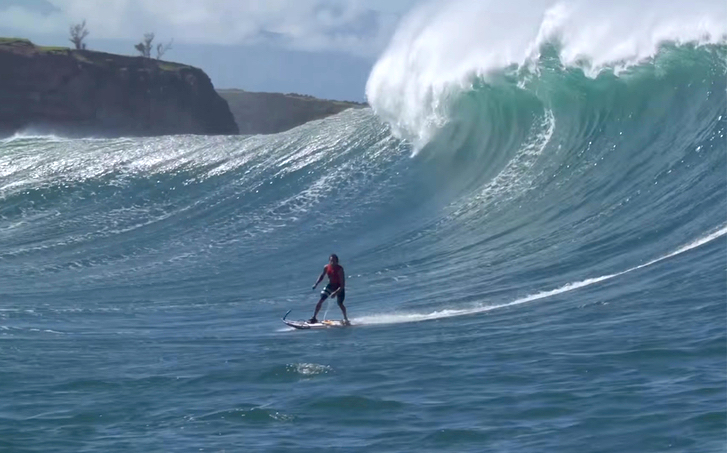
Maui local, goofy footer Kai Lenny surfed Jaws on a 6’ motorized surfboard composed of Kevlar and carbon fiber, manufactured by Jetboard. His session took place on November 12, 2014, one of the biggest days Hawaii had seen this season. After unbolting the housing to reach the motor, Lenny cranked up the built in 100cc motor like one would crank a lawn mower, placed his feet in the bindings, and cruised to the infamous break known as Jaws. He was riding waves prior to the start of a big wave contest only held when Jaws reached epic proportions and the waves had reached the proper swell height for the contest to get the green light.
As reported by The Inertia, Lenny’s motorized board enabled him to outrun huge waves that would normally plow paddle in surfers. It was cool to watch his rail-to-rail surfing on the monstrous waves. The amount of rocker in the nose of the board helped him over the ledge on the take off and the hand held throttle helped him adjust his speed only when going out and outrunning the massive white wash trying to engulf him at the end of his rides. However, the throttle did nothing for him when actually riding the waves because with the massive amount of water that came with that particular swell at Jaws, there was no backing off and slowing down. He just had to go with it hoping to survive on that speedy little board that looked like a cross between a wakeboard and a blunt nosed fish.
Lenny was quoted as saying, “it’s a cross between a jet ski and a Formula 1 car.”
It’s hard not to get too down on yourself when you see how your homemade projects turn out when compared to the stuff you see coming out of professional shops. Whether it’s a garage paint job with a little too much “orange peel” or a workbench engine build that just never seems to hold a tune, sometimes, it would appear the pros have some trade secrets that the rest of us don’t know.
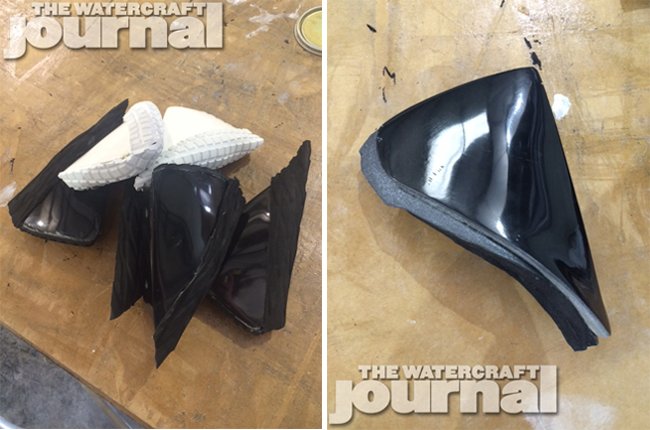
Freestyle skis like Hurricane’s C3 Competition hull feature complex contours and unique features like these foot wedges that make a Hydro-Turf installation very challenging to the casual installer.
When we finished a full Hydro-Turf installation on a 2014 Yamaha FX High Output last year, we began to wonder what it was that we were lacking. Although satisfied with our end result, we knew there were tricks of the trade that the layman could benefit from knowing – and applying to their next Hydro-Turf project. Small details that would give our next project those “finer touches” to really set our ski over the top.
For that, we thought first of which skis showed the most impressive use of custom traction mats. The answer was simple: freestyle and freeride standup skis. The complex contours and angles in the trays of these skis are a virtual nightmare to recover. Add to that lifter wedges and custom footholds to fit the particular rider, and you’ve got a project that could quickly overwhelm even a seasoned builder.
We turned to our friend, Derrick Kemnitz Jr. at Hurricane Industries. The Antioch, California company first opened its doors early in 2014, but has been working in the graphics and composite industries for several years prior to that. Offering complete aftermarket freestyle hulls and finished ski, Hurricane was a sure fit for our inside look at how to ‘turf a ski of this magnitude.
Kemnitz walked The Watercraft Journal through the preparations and installation of a complete mat kit on his C3 Competition Hurricane Hull. Made with a fully visual carbon fiber interior, visual carbon center strip, polished epoxy primer hull finish, the bare hull weighs in at roughly 40 pounds, making it one of the lightest freestyle hulls on the market.
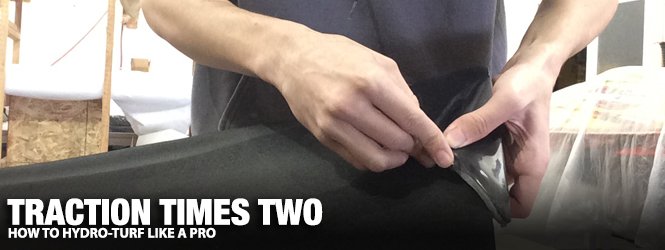
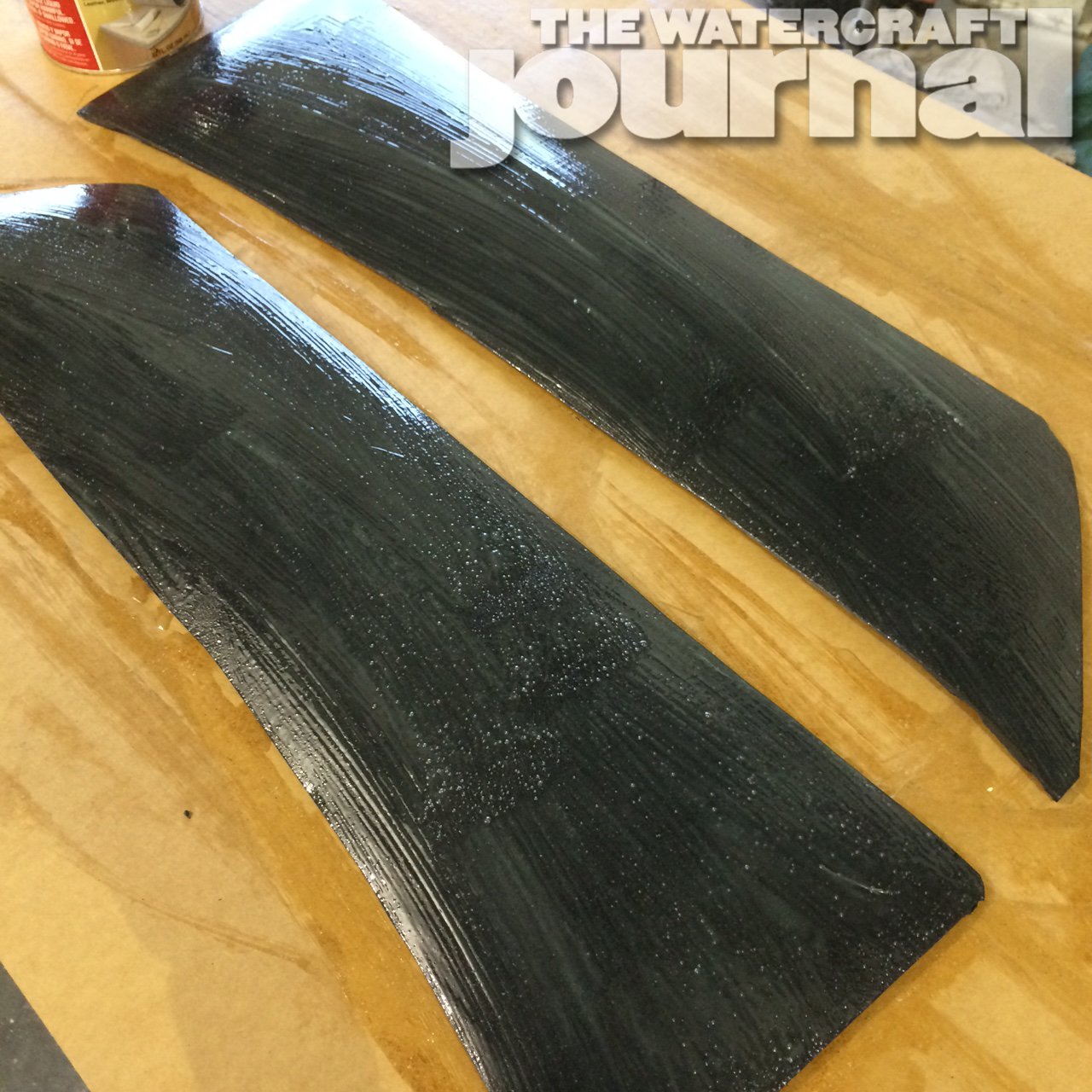
The first step to proper preparation prior to an installation is to fully clean the ski’s surface. Make sure that every surface is dry, that’s no grease or chemical residue.Use a template to trace out the piece you’re turfing. A razor blade works great for etching a cut line, then a pair of scissors are ideal for straight, clean lines.Note that we are not using the pre-cut “peel-and-stick” Hydro-Turf, but a single sheet that we cut to fit our ski.Prior to digging in, lay out all your tools and your new Hydro-Turf material. Flatten out the sheets, it makes it significantly easier to work with. You’re going to need a rubber mallet, a flat-head screwdriver and a few brand-new razor blades. A couple paint brushes and contact cement are required. (You’ll want to use the industrial grade cement in the red can. It works far more effectively than the “eco friendly” glue in the green can.)The first coat should be moderately thick and consistent. Apply to both fresh turf and the contact surface of the hull. Allow it to sit until fully dry. Foam turf will absorb glue and this first layer acts as a barrier. Your next coat should be the same as the first. Let it air dry until the cement is mildly tacky.Your third coat should be fairly thin. Wait until it develops a hazy finish and is super tacky, then it is ready to apply.With your ‘turf still tacky, start with one corner and slowly work your way across the surface area. Don’t stretch the turf, as it will shrink overtime. Use a rubber mallet to press the ‘turf down. Use your flat-head screwdriver to tuck overlaps under each other for a cleaner finish.For the foot wedges, apply the contact cement same as you would on a ski, and layer the piece you’re turfing. First apply contact cement to the top layer, same as before. Once tacky, start the top layer on a visual line, and slowly work it around the piece. Try not to stretch the turf as it can slightly shrink and ruin the finish.Some excess overlap can occur from stretching or heat. An air grinder can quickly clean up the excess ‘turf overlaps.Smooth down the under padding until it is flush and uniform and ready for the top layer. Once done, your footholds will be ready for installation in your tray.Installation of a custom kit is predicated on a few key steps: 1. Surface preparation, 2. Cutting your material to exact measurements (insuring little to no overlap), 3. Proper contact and patiently adhering to the tight corners and curves. Once finished, use acetone on a rag to clean up any excess glue (because there will be some) for a nice clean finish.
Special thanks to Hurricane Industries and Hydro-Turf. For more information for either companies and their products, please click these links.