When the first supercharged 2016 Sea-Doo 300 models came out, the immediate question was, “How fast are they?” And when not equipped with the “RS” internationally-tuned ECU, the answer is almost always “around 68.” Sure, some outlets gained a little here and a little there, but for the most part, all domestic Sea-Doos will be safely staying within constraints of the prescribed USCG agreement (unlike some other manufacturers).
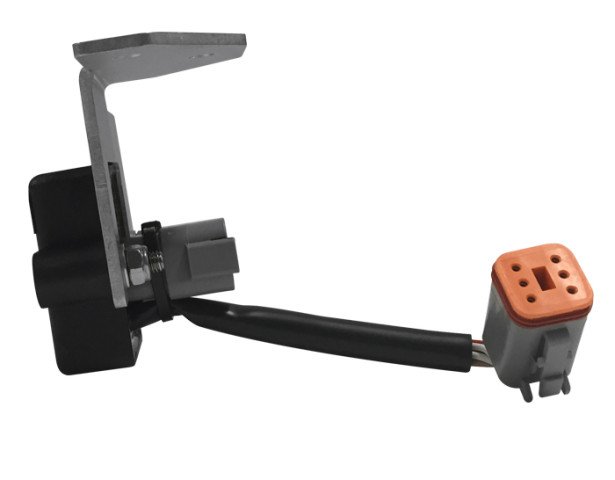
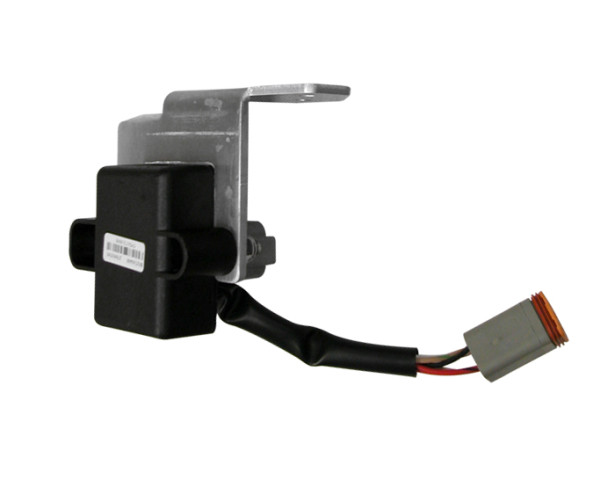
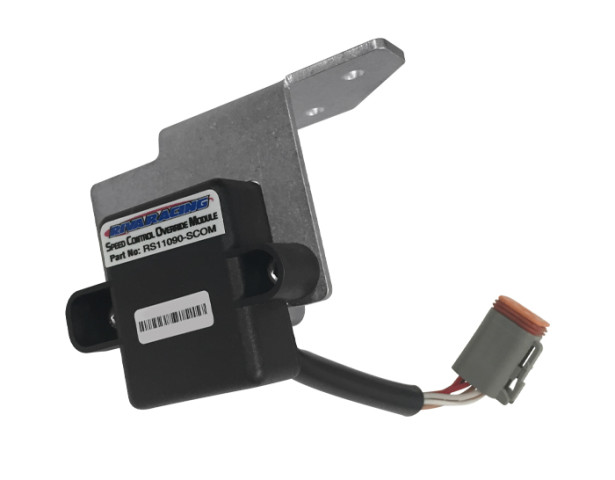
Sea-Doo does this via their state-of-the-art GPS-monitored iTC speedometers. When an iControl-equipped Sea-Doo reaches the predetermined speed, the engine’s rpms are cut, immediately backing off the throttle and scrubbing speed. Thankfully, RIVA Racing has found a workaround for the factory speed control in their RIVA Speed Control Override Module.
The RIVA Speed Control Override Module removes the restrictive GPS speed control function on Sea-Doo iControl models delivering significant increases in top speed with stock ECU. Easy to install module allows system to start in “Sport Mode” for maximum performance. “Touring Mode” can be manually selected after start up.
Removes GPS controlled speed limiter
Increases top speed utilizing stock ECU
Works on all 2016 300hp & 260hp models
Delivers 75mph top speed on 2016 RXP-X 300
Allows further top speed gains through aftermarket modifications
Allows system to start in “Sport Mode”
All original dash functions are retained
Easy plug-in installation
NOTE: Stock ECU limits peak RPM for first 5 hours of operation. Top speed increases should be measured after 5 hour break in period.
Two years ago, Sea-Doo released the Search And Rescue (SAR) Edition GTI with very little fanfare. Made specifically for branches of government specializing in coastal and waterborne rescues, the SAR Edition is specially-equipped with certain key features that make it a tremendous asset to life guards, fire departments and search and rescue teams – particularly the “secondary sponsons” ringing the hull, made from professional grade CSM (Hypalon®) for significantly more stability and buoyancy.
These are topped with new running boards, and a hull treated in a shock protective 2.8 mm elastomer coating and features a large front bumper. Add to that a new “Shallow Water Navigation Kit” including an anti-debris water intake grate, stainless steel wear ring, internal heat exchanger, and shock-protected cooling system (read: no ride plate heat exchanger), it’s truly the perfect life-saving machine.
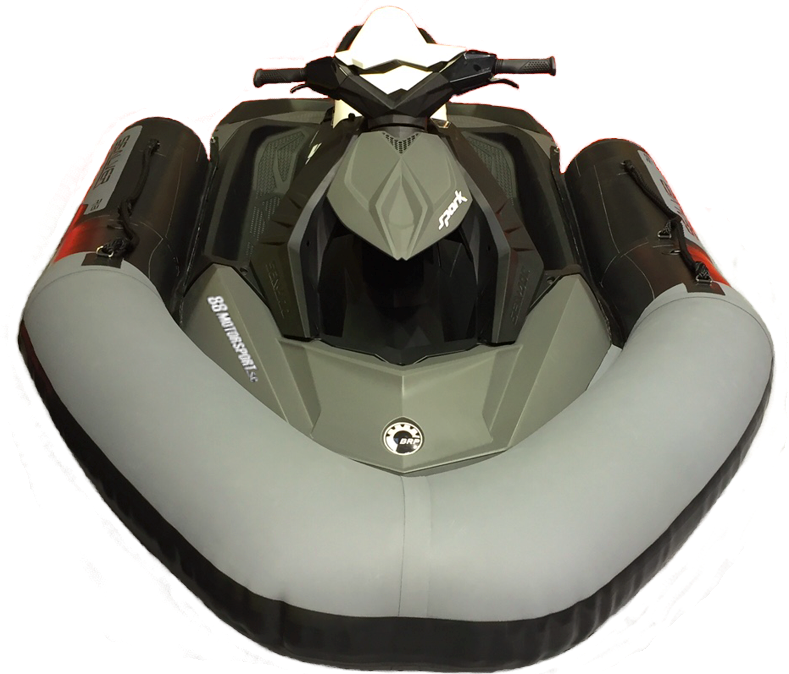
That is why the latest innovation from 88 Motorsport Sweden AB has got us so baffled. If so desired, 88 Motorsport will outfit your new Sea-Doo Spark with the SAR’s most noticeable addition: a new RIB Hypalon pontoon. The addition understandably provides significantly more buoyancy to the Sea-Doo Spark (which is also available for other models as well).
Weighing only 35 kg, the tubes made of Hypalon Neoprene 1100 Dtex ORCA, are made to be close-fitting to the PWC’s hull, and is “suitable for both professional (monitoring missions, safety and rescue) and recreational needs. It ensures you an incomparable comfort and matchless stability during your operations or your jet ski tour,” according to 88 Motorsport. The conversion comes in at just under $7,400 but does come with a 3 year warranty.
“Winner, winner! Chicken dinner! We’ve got a winner!”
In just over a month’s time, we had nearly 200 entries alone enter to be the Grand Prize winner of the first-ever WCJ 2016 Skyway Show Signup Sweepstakes. The contest was easy enough to enter: simply signup for The Watercraft Journal’s weekly newsletter. For those already signed up, they were encouraged to submit their spouse’s email address or a secondary address (such as work or the one they use for their now defunct AshleyMadison.com account). Then, after the month was over, we gathered up all the email addresses, entered them into a database that randomly selected three finalists.
And careful not to pull a Steve Harvey, we contacted each of the finalists to verify that they were entered into the contest (because some folks just wanted to get the newsletter) and to make sure they were US residents (within the lower 48 states – ’cause screw Alaska and Hawaii, right?), and randomly selected our winner! And that honor belongs to Southern Californian Kirk Mauro. As the Grand Prize winner, Kirk will be flown from sunny SoCal to Tampa, Florida, picked up and whisked away to a beachfront hotel in St. Petersburg for two days. There, Kirk will be gifted with oodles of cool swag like JetPilot riding gear, Sea-Spec goggles, and a bunch of other goodies.
But the real reason for Kirk’s presence in Florida is to be a guest judge at the Skyway Ski Show presented by The Watercraft Superstore. Joined by 5 other panelists, Kirk will get to test ride six of the latest and greatest personal watercraft models produced by Kawasaki, Sea-Doo and Yamaha (specifically the Kawasaki 310X, Sea-Doo RXP-X 300 and Yamaha FZR; and the Kawasaki STX-15F, Sea-Doo GTI SE 130, and Yamaha VX Deluxe). Kirk will also be literally wined and dined while in Florida and featured in the WCSS’s annual “magalog” catalog that publishes the results of the annual review. And all for being a loyal reader of The Watercraft Journal!
Congratulations, Kirk! We look forward to seeing you on the sand.
You’re about to make a rather big purchase on a PWC you’ve been wanting for a while now. You’re buying a sleek looking performance ski loaded down with all the bells and whistles. You don’t want your life vest to look any less cool than your new toy. Don’t be “that guy” wearing an old, ragged vest that looks like it came straight out of the ’90s. And sure, a cool, new vest would help your style, but it will also provide the proper protection.
An old PFD may have lost some of its buoyant qualities, and a cheaply made vest may fall apart when hitting the water at speed. A good, quality life vest should be both fashionable and functional. Also, a USCG (United States Coast Guard) approved vest is a requirement by law for all PWC riders.
There are many types of PFDs, making sure you pick the right one for you is important. A story published by Sea-Doo was very helpful in providing several tips. The first decision you will have to make is what material you’re wanting. You basically have three options when choosing a material. Each has their benefits and disadvantages. You can choose from nylon, neoprene, or ecoprene.
Nylon
Nylon vests are lightweight and dry quickly. They are also normally more affordable than vests made of other material, such as neoprene. A downside to nylon vests is that they are not as comfortable to the touch as a neoprene vest.
Neoprene
Neoprene vests are good for active riding styles. They will fit to your body perfectly and are usually more durable than nylon vests. They add warmth by trapping a thin layer of water between you and the foam of the vest. Also, they are much more comfortable to the touch than a nylon vest. The cons of having a nylon vest are that they take longer to dry out than vests made of other materials, and they are more expensive than nylon vests.
Ecoprene
Ecoprene is not a widely produced material, but some manufacturers, such as Sea-Doo, do make them. It is an Eco-friendly vest, made of environmentally friendly material. It is a balance between the Neoprene and Nylon, as far as characteristics go. It dries quickly, as nylon does. It doesn’t absorb much water, allows ventilation, and is 30% lighter than neoprene vests when wet. The pricing is in between nylon and neoprene. Ecoprene promises to be a well balanced PFD.
Many of you reading this month’s installment of “By The Numbers” don’t know that our parent company – Shaw Group Media – publishes a similar daily online publication but for brand-specific muscle cars and trucks named Mopar Connection Magazine. This publication, unlike The Watercraft Journal (WCJ), doesn’t require the efforts (such as this monthly feature) to educate and inform current and potential advertisers as to the legitimacy of its performance within its niche industry. Why? Primarily because it, again unlike WCJ, is not the only magazine of its kind to successfully operate within this medium. There are dozens of similar digital outlets for daily magazine-grade content that charge their readers no subscription fees, require sign-in passwords or large downloads to access their articles.
Unfortunately, such is not the case with WCJ. There are no other online publications, blogs or digital outlets that maintain any sort of comparable reliability, professionalism or readership. By either divvying up an already intimate niche of enthusiasts, or just by failing to reliably publish on a steady and dependable schedule, those intimating to be our competitors fail to access the vast majority of personal watercraft enthusiasts, thus failing their responsibility to present their supporting advertisers before the widest audience of self-identifying PWC enthusiasts as possible. And as a paying advertiser, you want your brand and products before the widest audience of potential customers as possible, don’t you?
At the first of every month, we publish “By The Numbers” primarily as a tool to inform the many companies within our industry who either have yet to consider advertising on The Watercraft Journal, or those currently considering joining our continually-growing family of supporting advertisers. For those who do come to enjoy the benefits of working with WCJ, they find measurable and evidenced results. In fact, so much so that we have written testimony of avid WCJ readers purchasing the latest models from both Sea-Doo and Yamaha upon our recommendation, as well as several of the products we’ve reviewed, from new runabouts all the way down to riding boots, gloves and battery chargers. More than any other magazine in our industry, advertising on The Watercraft Journal results in proven sales.
January 2016
May 2015
A Proven Rate of Growth
You might be looking above and wondering why exactly we’re publishing two performance reports – one from this past January and the other from May, 2015. We do so intentionally, as we want you to notice how January, 2016’s readership eclipsed that of May, 2015. When the month most noted for being the height of winter for most of the Northern Hemisphere outperforms effectively the first month of the summer season, there’s reason to take note. On every level, The Watercraft Journal is welcoming more and more readers, and at an accelerated, exponential rate. No other magazine is growing as quickly as The Watercraft Journal and that’s just the beginning.
December 2015
Total number unique readers: 19,360*
Total number of articles read: 43,309
Percentage of new readers: 60.4%
January 2016
Total number unique readers: 24,221*
Total number of articles read: 57,448
Percentage of new readers: 60%
*This number is considered equal to an individual sale of a single copy of a magazine.
The Reason We Stand Alone
The internet is a funny thing. When you prove yourself as steady as clockwork, people tend to return more often and regularly. As we publish industry news, product reviews, ride reports and more – more regularly than anywhere else – we’ve learned that PWC enthusiasts have come to depend on new and interesting content every single day. And that means we’ve got a responsibility to deliver. Unlike anybody else, The Watercraft Journal maintains a strict publishing schedule of developing and publishing new and informative content about its advertisers and their products, as well as the industry and sport as a whole.
News articles published in December 2015: 24
Feature articles published in December 2015: 13
Total feature word count: 13,947 words
News articles published in January 2015: 25
Feature articles published in January 2015: 12
Total feature word count: 11,040 words*
*When this number is translated to print publication standards equals a 102-page magazine. Please note that this number does not include an average of two uniquely-written news articles published daily.
Bringing WCJ Before Social Creatures
Many companies chose to use their social media accounts (be them personal or for business) as their sole outlet to accessing new and interested customers. Plain and simple, this is lunacy. Why? Because the people following said accounts already know who you are, and unless they are feverish return customers, you’re not getting the influx of fresh, new customers that a company needs to thrive. That’s why you need The Watercraft Journal. We are your bullhorn to the largest audience in the world. By offering our content freely and easily – whether it’s via a desktop, a laptop or a portable device, anyone can read our content. And with our Facebook, Twitter, Instagram, YouTube, and weekly newsletters, we bring our content directly to them. And that’s a huge part of our success!
December Facebook likes: 15,000
Top Five countries: United States, Australia, France, Canada, French Polynesia
We’ve Got That Going For Us
So what do you do with a quarter million annual readers with over one million page views in a year? You go up and you keep going up. We have no plans to slow down and no dreams of contentment to grapple with. We’re looking to surpass every major forum in the way of readership and expand our reach well beyond that of our core industry, helping to introduce more companies to the world of personal watercraft for our readers. Again, we’re a resource. And to be one, you need to act like one. And now more than ever is the time to get your company and products on The Watercraft Journal. To inquire more about advertising with The Watercraft Journal, please email [email protected]
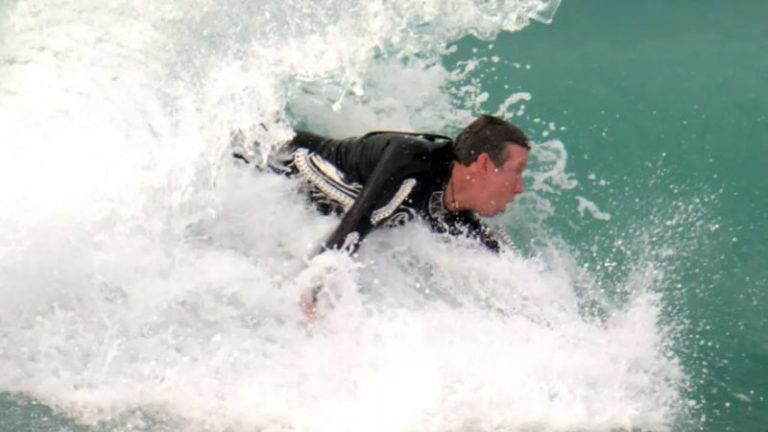
Have you ever gotten to the beach just to realize you’ve forgotten your surf or boogie board? Don’t kick yourself too much though, because there is a product that has been designed to work just like one; except your body is the board!
The WaveWrecker wetsuit comes in handy when the waves are just too tempting and you don’t have your board. It turns your body itself into its own surfboard! The WaveWrecker’s creator, Nick Gadler, hopes his uniquely modified wet suit will help boost the popularity of body surfing by making it easier for everyone to learn, without needing to use a boogie board for added buoyancy.
Over about six years, Nick has created 27 different prototypes before settling on the final design. It takes a standard wet suit and upgrades it using eleven flexible foam fins, which not only increase the user’s buoyancy, but also gives them improved directional control as they ride a wave. Sounds pretty awesome, right?
If you want one for yourself, Nick has launched a Kickstarter campaign, in hopes of raising $10,000 to help fund the production of the WaveWrecker. Just over $5,000 has been raised so far! The adult version of the suit can be pre-ordered with a donation of $350, while the kid’s version is $250. Both are expected to ship sometime in April this year.
Arena racing was a hot topic among the racing crowd in 2015, but unfortunately just didn’t happen. The organizers of PWC Arena Racing have been working hard to make sure we will have Arena Racing in 2016.
We recently got word that the racing series would in fact be taking off in the 2016 season, and are excited to announce their schedule! They will have three national championship rounds, the first on July 30th, the second the following day, July 31st, and the final round will be on the 28th of August. The Super Arena World Cup title round will be on August 27th. All rounds will take place in Las Vegas, NV.
From the looks of it, they will have classes for runabout, sport, and ski riders. The organizers have partnered with the IJSBA, so we suspect they would follow IJSBA class specifications and rules. We cannot say for sure, though. We suggest consulting the organizer, Greg Matta about class structure or any other questions you may have on the race series. His email is [email protected], or you can reach him by phone at 702-292-3647.
Age is no longer a viable excuse to not throw a leg over a PWC. Meet Frank Nelson, an 87-year-old Australian man who is still living life to the fullest. To our knowledge, Frank is the oldest current PWC rider in Australia.
Most take it easy and slow down as they come of age, but not Frank! The name on his Yamaha WaveRunner says it all: GOLD. GOLD stands for “Growing Old, Living Dangerously,” Frank said in an interview with Sunshine Coast Daily. Frank doesn’t seem to see age as a limiting factor, like some do.
Frank began his PWC endeavor when he moved from Sydney to the Australian Coast. traded up to his third PWC, a Yamaha FX SHO, about a year ago, and has been in love with it since day one.
“I’ve had boats over the years but I didn’t want another boat so I thought I’d try one of these jet skis. I bought one and I went out and thought, ‘That’s alright’. You’re so close to the water and in hot weather, it’s cool. You get a breeze off the water,” said Frank.
Frank doesn’t disclose the speeds he hits, but he does hint that he is very familiar with the Golden Beach speed limit. Sometimes, Frank will make a forty-minute trip to Bribie Island to get a cup of coffee. Sometimes, he brings the grandkids along for a trip on the ski.
“I don’t come out in May, June, July, August – I leave that – but all the rest of the time,” Frank said. Keep in mind, those are the cold months in Australia.
“I go to a lot of dams. The ones that have got cabins. I don’t camp. Bugger that. The last time I had a tent, it fell on me,” described Frank.
He’s eighty-seven years old, and still riding away. When will he park the ski? Who knows. But he did indicate he had no intentions of giving it up any time soon.
“When I stop, I’ll stop, but until such time, I’ll do as much as I possibly can, and I’m fortunate to be suffering good health.”
When 46-year old Andy Johnson of Lancashire, England decided to take his jet ski out for a spin on the flooded roads in his village, he didn’t expect a video taken of him to end up going viral on the Internet. The flooded roads of Lancashire were just too tempting of a playground for Andy to turn down. He was filmed racing underneath a railway bridge before doing a U-turn by a bus stop in the floodwater on Euxton Lane, near Chorley. Since being posted on Facebook, the video has been viewed more than 114,000 times!
The footage was captured by Kieron McLaughlin, 46, who was canoeing down the road on New Year’s Eve. “’My house backs onto that water. My wife said it sounded like they were pumping the water but when she looked, she saw the guy on the jet-ski. I went out and filmed him and the video has gone viral”, shares Kieron.
“I knew where it was flooded and it looked safe enough to jet-ski, so I was in there for about an hour. I decided to get into Euxton village because I knew it was deep enough to ski in, but wouldn’t be near homes which had been destroyed by flooding like in the village of Croston. It was just a quick blast and while I know some people weren’t too happy about it. I’ve seen people saying the video could get them to sort it out quicker. The council or whoever it is involved in sorting it out might see this,” says Andy who can’t help but point out the slow response to deal with the flooded roadways.
Sometimes it’s not about the “bling,” but if there’s some extra “bling” thrown into making your machine more reliable or perform better, then nobody is gonna complain. Not only has CNC’ed aluminum (ie. “billet”) become the norm of today’s top-of-the-line performance aftermarket parts manufacturers – thanks to its durability, lightweight, use of machining and superior finish – but it’s also become a favorite of those looking to customize the look of their prized possessions.
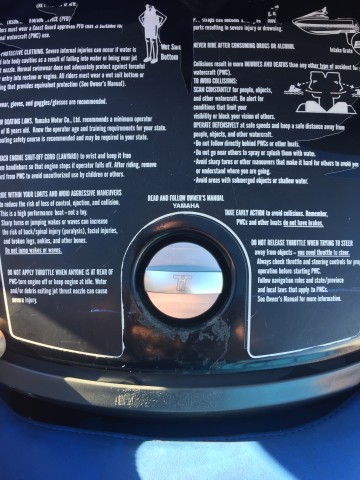
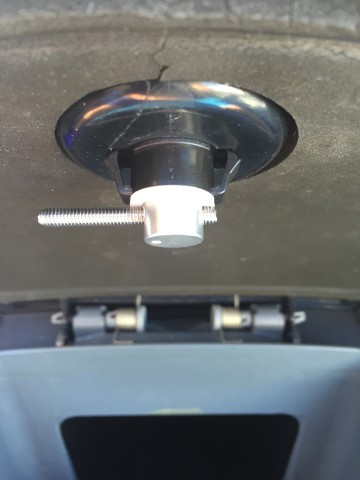
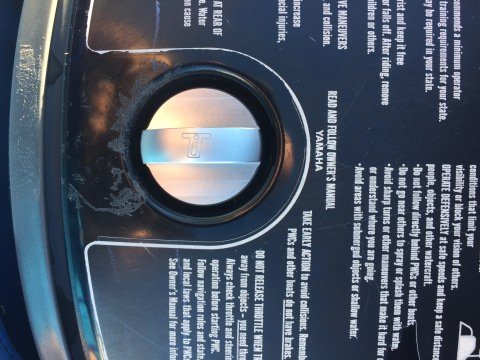
Thrust Innovations, LLC announced the new knob on its Instagram page, stating, “Here is a product we just released [and] thought it is possible you might have some interest as well. It is for Yamaha model watercraft with turn knob for [the] glove box, which is very common failure the metal bar breaks the plastic knob and won’t stay shut. Retail will be $40.”
Thrust Innovations, who excels at both of these, recently unveiled their billet aluminum Hatch Lid Lock for Yamaha WaveRunners. The new aluminum lid lock directly replaces the molded plastic piece stock to the Yamaha runabouts. The adjustable lock is made with threaded stainless so it won’t corrode while the rest of the lock is cut from aircraft-grade aluminum, replete with the iconic Thrust Innovations logo. Replacing your Yamaha hatch lock takes less than a minute and the Thrust piece can be removed and/or replaced as easily.