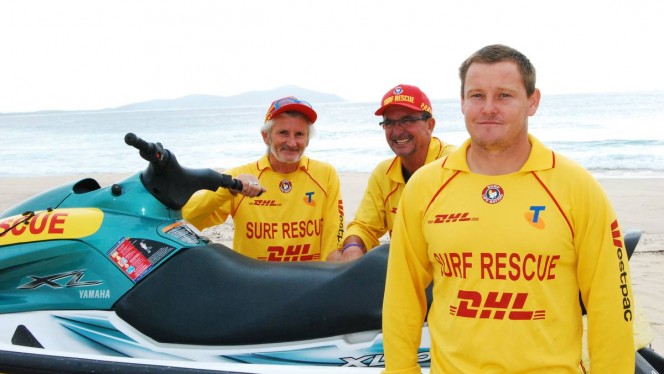
More often, we keep hearing how personal watercraft are being employed in good work, all of which is useful in preserving the rights of personal watercraft enthusiasts to enjoy their craft in waterways around the globe. Yesterday, we were made aware of Pacific Palms lifeguard Lennon Fisher, who has used his PWC to save seven lives in less than two years.
Most recently, Fisher saved one of three rock fishermen swept into treacherous seas last week. Fisher, one of several surf lifesavers connected to the Surf Life Saving NSW Lower North Coast Branch, was alerted last Wednesday of three men from Goulburn that swept from the rocks into the ocean by described a “freak wave.”
The rock platform near the Sugarloaf Point Lighthouse at Seal Rocks is a popular fishing sport. All four fishermen were swept into the water, with the fourth being the only one to swim back to the beach. Fisher and fellow lifeguard, John Gray immediately scrambled, Fisher launching a club jet ski from Boat Beach while Gray remained ashore as backup.
When Fisher arrived, he soon saw the lone man pacing up and down a rock platform. In an interview with Great Lakes Advocate, he recalled, “One guy was on the rocks, running up and down screaming and pointing in the other direction and it was then that I saw this other man clinging to rocks.”
“The man was stripped down to his undies and I realized he couldn’t physically move so I got in the water and I was able to push him up onto the ski. Then I had the drama of trying to get myself back on the ski without rolling it.”
Fisher drove the man to safety back to Boat Beach where Gray was waiting. The man pacing the rocks was air lifted by a Westpac Rescue Helicopter. He concluded, “When we got back to the beach I thought there was only one guy in the water and we had saved him but then we found out about the other man missing (Peter Oberg) so it was pretty heartbreaking to find out there’s still someone out there.”
Pacific Palms Surf Club president Kel McCredie praised Fisher saying it had been the seventh life he had saved in the past two years. “That’s the highest on the list for rescues,” McCredie said. “And they’ve all been on jet skis.”
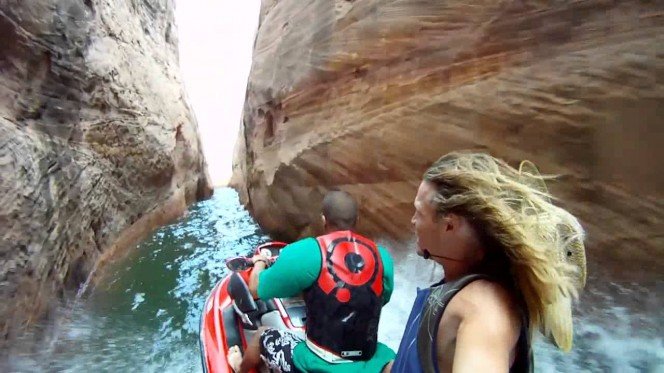
With all of the high-intensity racing, surf jumping and general hardcore action we’ve been covering lately, we’ve been feeling…well, a little exhausted! So we thought we’d unwind and take in a little video browsing on YouTube when we came across this awesome video from a couple years back.
Filmed and edited by self-described hip hop artist/wakeboarder/action sports enthusiast Collin Gee, this quick jaunt through the painted canyons of Lake Powell makes us want to pack up and head out to the Arizona/Utah border lake for a little desert session. Filmed with a GoPro HD Hero with one of GoPole’s “The bobber” mounts, we got into the groove of the bluesy tunes from musician Jake Andrews as Gee and pals careened through the canals.
Dated July 2011, Gee writes, “I am not into sit-down jetskis, I love stand up jetskis way more, but on Lake Powell sit-down jetski is so fun! My friends in the video [are] Brooke Quigley, Kyle McGroary, Eddie Valdez, Joel Hilliard, Kyle Schmidt, Jeff Hartman, Tino Santori and Ryan Bezemek.” We would also like to note that Gee and friends are briefly filmed riding without proper life vests, and at no time does The Watercraft Journal condone such action as we always want to promote safe riding.
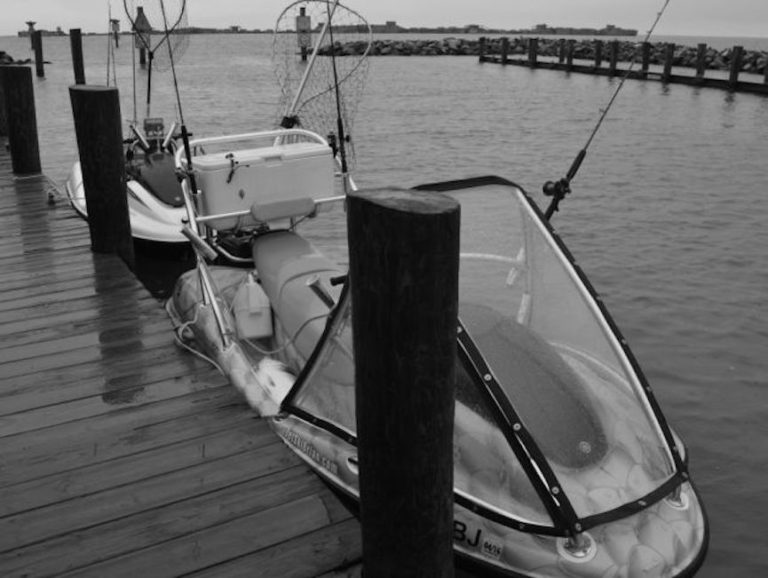
At Kiptopeke State Park, we didn’t let some rain or wind keep us from going out for a ride.
Yesterday morning, my friend Rob and I towed our rigged up jet skis from Poquoson, Virginia to Kiptopeke State Park and dropped in at the Concrete Ships of the Eastern Shore.
It hurts paying the $16 toll each way, plus the $8 ramp fee and about $20 round trip for gas. That’s $60 before I even touch the water! But on the positive side, I did not have to run across the bay in fog, rain, or 2-to-3 foot chop and I only burned two gallons on my jet ski.
We fished a couple miles off of the ships in light-to-medium rain and 40 degree temps. The 10-15 mile per hour southwest winds gave us a steady drift for eeling.
Although we did encounter some other fishermen, we were the only ones to brave the weather aboard a pair of PWC.After battling this big striped bass, I was able to net him and drag him aboard.
It was very slow fishing, but as luck would have it, a big striped bass took off with one of the eels that I had in right next to my ski. He gave me a nice run for my money, turning my ski around twice before getting close enough for me to grab him with the net. Thankfully, he was solidly hooked in the upper lip.
With the bass on board, we stayed out another hour and a half, hoping for another fish for Rob but it was simply not meant to be.
We weren’t the only ones out as we saw one lone kayaker on the lee side of the ships looking for a big one. There were also several boats around the area, but as per usual, we were the only ones fishing from a pair of jet skis.
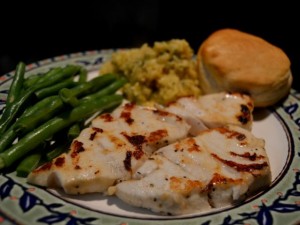
A trip to the scales would reveal this big striped bass to weigh in at 42.5 pounds, my largest catch of the season.Later that night, my catch made for quite the delicious meal of striper steaks, fresh greens and biscuits.
Back on land, I weighed the striped bass I caught at Bull Island Outdoors in Poquoson; amazingly, it went 42.5 pounds, my largest catch this season!
Looking back, my new record catch was well worth a couple hours on the water on my jet ski in the rain. Back at home, I had everything cleaned up and put away by dark. For dinner, I pan seared some thick striper steaks in herb garlic marinade for dinner. Not a bad way to end the day.
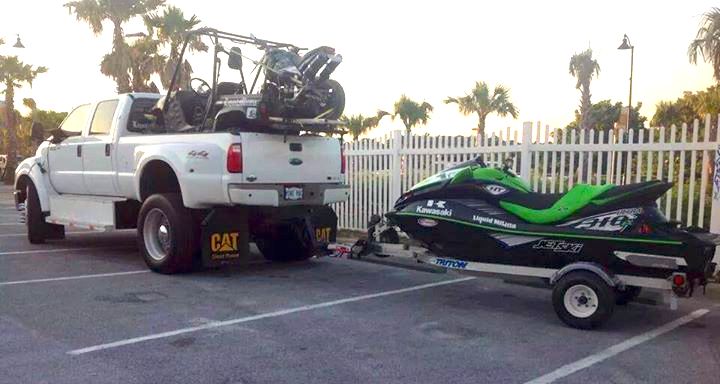
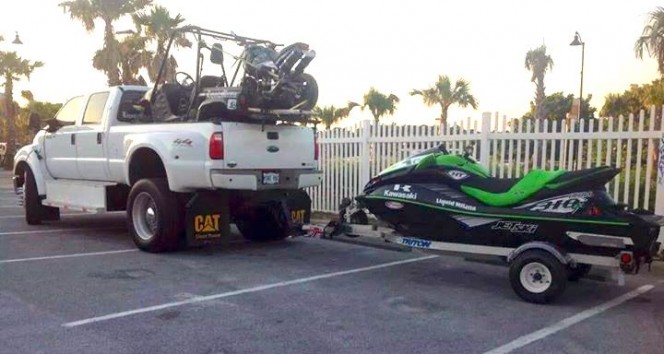
Not exactly the way to sum up an already difficult weekend, Liquid Militia rider Juan Rada came home from racing in Expert Runabout Stock class this past weekend at the Hydro-Turf Pro Watercross tour stop in Panama City Beach, FL only to find that his complete rig, UTV and bike were missing!
We hope that some eagle-eyed reader of The Watercraft Journal will spot this combo somewhere soon and alert the police. There’s quite a bit of money, time, blood, sweat and tears poured into Juan’s travel rig.
Below we’ve included the original alert as posted by Shawn Alladio:
Please Help us! Screen shot these pics and re post it please on your pages, help us to find the truck, trailer, Jetski and ATV. These were stolen at the race this weekend. Our LiquidMilitia team rider Juan Rada’s rig was stolen last night in Miami, Florida. If you see this rig call the police and help solve this crime. They stole everything you see in the pic. Please help with finding and stopping thieves like this who prey on hard working folks and ruin dreams and lives! Any information is important! Keep a watch friends! Our Team Riders were left stranded and need our help! We appreciate the Miami Dade Law Enforcement community and we’re counting on you to find these thieves! Thanks LE’s!
Watch Craigslist, dealerships be alert, any news you hear about quick sales or these items that may look similar in another color! Check with DMV to check HIN and VIN #’s before you buy. Stay alert and vigilant!
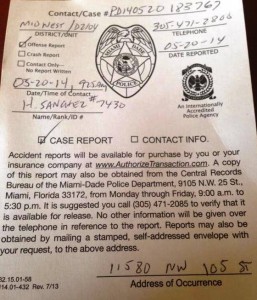
Theft occurred at 11580 N.W. 105 St, Miami FL Case #PD140520183767 Ph: 305-471-2800 Date Reported: 5-20-14
OK, before we get all sorts of emails and instant messages razzing us about what on earth we’re doing publishing a Ford Bronco on a personal watercraft magazine, just hear us out: How would you like to pilot this twin turbo Nelson Racing engine producing over 1600 horsepower across 1001 feet of water?
Well, owner and fabricator Icelandic Champion Gudbjørn Grimsson has just set the World Record for hydroplaning a four-wheeled vehicle last week and it’s awesome. According to Grimsson, “The car has a Ford 428 engine with twin turbo that can deliver up to 1640 horsepower. [It runs] Ford’s big C6 transmission [with] 9″ Ford axles front and rear.”
Of course, calling it a Bronco is a misnomer as much of the truck has been reworked, reconfigured, reinforced and re-engineered. The Volcano Race Team member shattered the record at the Formula Offroad NEZ-championship in Skien, Norway this year. While skimming a 4×4 over the water doesn’t exactly make it a personal watercraft, it does tickle one’s sides to imagine how far Grimsson could’ve gone had he had more water to cross.
For those on the beach this weekend, there was no escaping the big red-and-white Yamaha tent that housed Troy Snyder, Brian Baldwin and the Aswar brothers, Aero and Aqsa. United under the Yamaha banner, all four riders are part of Dean Charrier’s legendary “Dean’s Team,” which enjoys the perks of a very close relationship with RIVA Racing.
We snuck this shot of Troy Snyder’s ski using the yet-to-be-released offset RIVA Racing bars.
Reports state that the partnership is part sponsorship and part research and development, as the Dean’s Team riders provide the part’s developer irreplaceable first-hand input in addition to pushing each component to its very limit. With many of Yamaha’s marketing team on hand, as well as a guest engineer from Japan and the effervescent Scott “Hollywood” Watkins, all eyes were on the water.
It was leaked to The Watercraft Journal that while individual setups varied from rider to rider, all of the Dean’s Team FZRs touted some secret RIVA Racing hardware, including preproduction adjustable sponsons and a whole new, low-slung billet steering system. We spied at Snyder’s Judge Motorsports’ tuned FZR and eyed a very unique billet offset that pushed the bars forward on the new stainless neck.
But what was most intriguing was word of the skis running the new RIVA/Vipec V88R3 ECU. The next generation in engine controller software, the RIVA/Vipec is expected to offer significantly sharper throttle response, mapping capabilities and engine knock prevention (among many more features that are soon to be released to the public in the next coming weeks).
Although there’s nothing official coming from either camps, being the OEMs or any branch of the United States Armed Forces, we know that the American military is 1) the most well-funded peace-keeping mechanism to have ever existed on this spinning ball we call home and 2) is not against using any form of technology that would provide them the best tactical upper hand.
That being said, high speed insertion/extraction vehicles have been in regular use for decades. According to a report on specialoperations.com, “One example of these activities occurred during the early 80’s, when Maritime Branch personnel trained Nicaraguan Contras to use of high speed boats for attacks against Sandinista shipping. They also stood by to launch underwater sabotage attacks against ships docked in Managua’s harbor. Another example occurred in early 1991. This time Maritime Branch operators instructed US military SOF in the use of modified jet skis for a possible hostage rescue mission during Operation Desert Storm.”
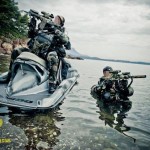
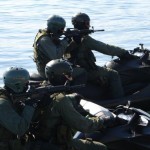
Although the post didn’t specify whether these “high speed boats” were personal watercraft, we do know that Hellenic Special Forces were recently pictured on specially-prepped smoked-out Sea-Doo RXT 215 runabouts. The Special Forces Directorate had 12 Sea-Doo RXTs ordered from Bombardier Recreational Products Inc. (BRP) for use against as counter-insurgent equipment.
Even grainy images of a seated one-man jet-driven personal watercraft allowed both “regular” blue water SEAL Teams and the counter-terrorist DEVGRU, and USMC Force Reconnaissance personnel to make quick, silent entrances and exits. Looking to put a greater emphasis on amphibious/waterborne training activities, Maritime Branch operators “receive training in conducting operations such as jet ski reconnaissance and hostage rescue operations along hostile shorelines,” according to specialoperations.com.
Even the veritable QuadSki has been seen in military/hunting camouflage livery. The versatility of the transforming QuadSki, as well as personal watercraft as a whole has not fallen on deaf ears. Even K38’s own Shawn Alladio has personally trained Navy personnel in property safety and rough water operation. It’ll be interesting to see what future history reveals about the use of PWC in the military, but until now, all we have are these shots. Enjoy!
The Watercraft Journal: Kev, you’ve got quite a few irons in the fire these days. What is Jetski Junkies – or better yet, who are the Jetski Junkies? And can you tell us a little more about how you came about creating the Jet Life brand?
Kev Hemingway: You could certainly say that. You know the question of who the Jetski Junkies are, is without a doubt, better described by our members. I believe that the words and expressions JJ members relay to others about their experiences and adventures, whether it’s a ride, overnight tour, out-of-state rally or even an expedition to another country. The stories each of them have, either individually or as a family to bring home, to tell their friends and maybe someday their grandchildren is priceless and with any luck, life changing in some way. This sets the tone for your next question about the Jet Life brand.
Jet Life became a term I used a bit when I was communicating with folks who had amazing stories or rides they had done or planned to do. These adventures seemed so epic that it was apparent to me that these folks, very much like my family, were watersport fanatics to the point that our lives twisted and wrapped itself around the sport of Jet Skiing. It became very obvious that we were eluding to the Jet Life and with a leap of faith, my wife and I trademarked the name and slowly, working through some adversity, began to put it out there. I feel Jet Life is more about PWC enthusiasts living more of a PWC influenced lifestyle and helping to spread the excitement of this awesome sport. I can’t think of a better way of doing that then with the club and creating a legacy like Jet Life for the sport.
WCJ: Steve, how did the Central Florida Jet Riders come about, and how did the CFJR become affiliated with Kev and the Jetski Junkies?
Steve Chown: My wife and I originally purchased our first set of skis back in the Spring of 2008. We enjoyed riding them but soon grew tired of the same lake rides and short river rides. We found it difficult to connect with other riders as Facebook wasn’t mainstream at the time. Like many, we used our skis less and less, and ultimately sold them due to lack of use in the Spring of 2011.
In April of 2012 we decided we really missed our skis and purchased a new Yamaha FX Cruiser SHO. Determined to get the most out of it we formed a Facebook group with several friends we had made when we previously had skis. After having the group for a few months we had a request to join from Kev Hemingway and soon realized our goals were parallel. To bring great people together to enjoy the sport to the fullest. We quickly began to share our events and plan events together.
WCJ: Steve, you mention that the CFJR isn’t a club, but a group of riders. What’s the benefit of such a loose affiliation?
SC: We had previously been a member of a few different “clubs” we had found them to be political at times which hindered their growth and got in the way of the fun. We have attracted a great bunch of people who would rather not let club politics distract from the events and riding fun. We encourage all members to be involved with planning rides/events and helping out new member as well as those who have just purchased new ski’s and are new to the sport altogether.
WCJ: What kind of attendance do your events/rides regularly see? How about attendees from outside of your group boundaries?
KH: Our format has changed a bit over the years, each time I feel the level of our club escalated. In the beginning we were lucky to get 5 or 6 riders to come out. Over the past years we have moved from just your typical local ride and social event, to exploratory riding during the week with whomever could ride to a more structured event such as destination touring once a month. In addition, we have also done expedition rides out of the country and added out of state rally this year.
Now it is a combination of all of that plus race and buoy practices for those racing or interested in racing. On any given ride the attendance could be 20–to-40 riders. Due to the ride locations, size and reach of our club, there are always folks who are not locals and most all members have opportunity to make a few rides, if not all. This is solely attributed to networking with local and out of state PWC clubs in conjunction with our JJ chapters, around the country and in Canada currently.
SC: Depending on the time of year we have had as many as 32 skis on our Silver River Ride from Leesburg, FL, to Silver Springs, FL. In the winter months it’s not uncommon to draw 8-12 skis on a chilly day in a time of year most wouldn’t consider riding. We welcome all riders and promote safe and courteous PWC operation at all times. At times, we have more than one ride choice for the same day. This way people have a choice of where to go and what area suits them best.
WCJ: So together, the Jetski Junkies and CFJR have a pretty full schedule of rides year round, huh? Kev and Steve, what has been one of your most memorable rides? (either together or separately)
KH: Yes sir! Between our two clubs alone there are rides scheduled every weekend with some spilling over into the normal week which incidentally is my favorite time to ride, less ramp and water traffic, then you add in any networking with other local or regional clubs and let’s just say, there is no shortage of riding.
The most memorable ride, speaking for my family as a whole, our most recent rally, the South Carolina Waterfall Ride has been the highlight of my 33 years jet skiing. There is no way I can write a few lines to even do it justice but this was the prelude to the first National PWC Rally hosted by both the CFJR and JJUSA. With 47 riders representing five clubs and six JJ chapters coming in from around the country, it marked for me, a lifetime achievement of club ownership.
Hopefully Steve feels the same way! [laughs] We could not have picked a better location or time for this first rally. The landfall point was Devil’s Fork State Park in Salem, SC offering all accommodations and boat ramp access to Lake Jocassee, a man made lake that sits in the foothills of the Blue Ridge Mountains offering up at least eight waterfalls ranging from small to large which are only accessible by small watercraft making PWCs the optimal vehicle to take in this Top 10 spot to visit and vacation. The breathtaking views, relaxing evenings all combined with the camaraderie of like minded people made this one of the best for my family, no one was disappointed…until we had to leave.
SC: One of the most memorable rides was The Great Okie Ride where our journey took us from the Kissimmee River near Sebring, FL across Lake Okeechobee to Stuart via the Okeechobee Waterway. We had 15-20 mph winds which made for a 22 mile ride across Lake Okeechobee in 4-6 foot seas. It was tough, but still a great time.
WCJ: Tell us about the kinds of watercraft your riders are using on your rides? Having put on so many miles on your skis (respectively), what has been your favorite?
KH: We have a wide variety of watercraft being run, most of them are four strokes and range in the years with a good mix of late model skis I would say. Yamaha and Sea-Doo were more prevalent up until 2013 and now we are seeing a larger influx of Kawasaki machines and Honda still has many machines out there as well.
I have personally been fortunate enough to have either owned or ridden about every machine manufactured to date and not one has every one thing you want. The machine that has come the closest to fitting my particular need is the Kawasaki 310 and regardless of model, the machine in itself lends more to the touring rider from 3 major perspectives: 1) The ride of the hull in rough water, 2) The large stock fuel tank at 21.6 gallons and 3) The massive, body smuggling storage it offers.
In ECO mode, the Kawasaki 310 is averaging nearly 5.5mpg on a 310hp SC engine. For myself, who travels and tours 100-plus miles minimum in one shot, all of the before mentioned features are assets. I also have the luxury of the amazing stereo system and cruiser seat with it’s new heat deflecting material which puts it over the top.
SC: We have members with all makes and models, stand-ups, two strokes all the way up to the state of the art machines. Sea-Doo, Yamaha, Kawasaki, Honda, and I think I’ve seen a Polaris or two! I have personally owned Kawasaki, Sea-Doo, and Yamaha and they all make a quality machine. Each bringing something unique to the table. So far I have enjoyed my Yamaha the most.
Having put approximately 1,500 miles on it since purchase, it has served me well. We have seen many members regardless of brand, customizing their skis like never before. Usually people add performance mods but we’ve seen a huge spike in “bling” upgrades. People are having custom seats made as well as new vinyl lettering. Some have completely altered the factory graphics to personalize their ride.
WCJ: How extensive is the planning for a Jetski Junkies event/location ride? Is it like a one-time fee/vacation package or an impromptu group of friends riding together?
KH: That’s a great question and I will start by stating that I think a good portion of our Club success has come down to the planning. As stated above we have a few different layers within the ride structure so that determines what and how much planning is required.
Take for example, if it’s just a day ride, one tanker as we like to call it, that means we are most likely riding an area we are familiar. We plan on 70–to-100 miles so we plan accordingly for fuel and we already know if there is fuel on the water, etc. On any Tour or destination ride this requires weeks, sometimes months of planning, obviously not eight hours a day, five days a week but long nights when those stupid reality shows are crushing the TV is when I do 90% of my planning.
The average tour requires logistics, distance and mapping, GPS waypoints, marinas, fuel, ramps, food, destination hotel/resort, rental buggies/cars or taxi/shuttles, dinner, etc. Then you move into the rally which is months of planning and adjustment and continued follow up with both Sponsors and Riders. Lastly the Expeditions, these are the year long crushers that are so full of unknowns that no matter how much planning, prepping and effort may or may not matter. These are the trips out of country, ex. US to the Bahamas. For the one tankers and tours, everyone is pay as you go although we plan it all out, we give our members all the info to make their own arrangements. The rally and expedition trips are a bit more planning and require deposits which are needed to make arrangements on behalf of the Members as neither JJUSA nor CFJR have mandatory yearly membership dues and we work solely on our love and passion for the Sport.
SC: Most of our rides are informal and planned about a week in advance. We usually have at least two planned rides per month. Often time more in the warmer months. We have begun planning overnight and out of state rides recently with great success.
WCJ: As you mentioned Kev, recently, Jetski Junkies and CFJR went on a pretty big adventure to South Carolina. What made you pick that location What made it particularly attractive for a jet ski trip? Tell us about the trip – how long did you spend, what landmarks did you see, etc?
KH: A couple of our Members live relatively close and camp near by there quite a bit. They had posted pics of themselves on Lake Jocassee and the pics were amazing! After some research I tried to put together a quick impromptu ride in October during foliage season amongst a few other large rides we had planned, so it just didn’t work.
Well, Steve also saw those pics and we got together on face book and decided to reach out to the other local Clubs to see about setting up a ride and a few months later the Rally was initiated. The details came together in about three months and of course an evolution process took place during that time as more and more focus was put on the location. We were finding out about all the area had to offer and how amazing and beautiful it is and how it would make for one heck of a family retreat, thus the rally was born. The trip was May 1–4, 2014 with arrival Thursday May 1 for most. A welcome reception was hosted that evening with food and spirits to thank everyone for the long journey to come together. We had amazing stand alone Villas overlooking the lake for most as well as both RV and tent camping for others.
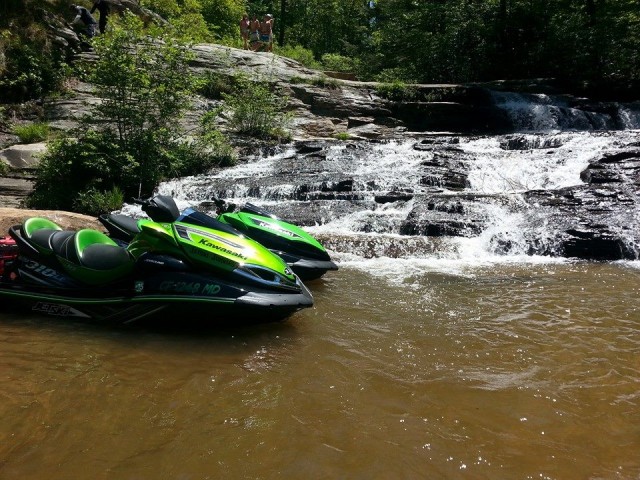
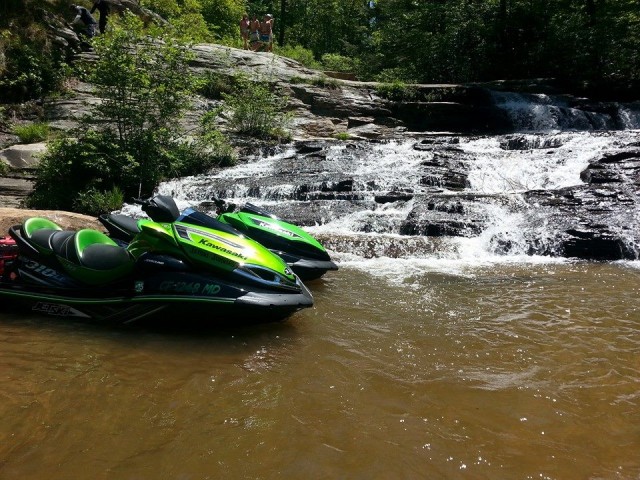
Friday, we rode Lake Jocassee approximately 60-plus miles hugging the shoreline and scavenging for as many waterfalls as we could find rushing down off the Blue Ridge Mountains. We took in at least nine waterfalls, some large enough to ride our watercraft right in and under, nothing compares to this, nothing. The most amazing part about this lake is it was man made for hydro-energy reasons and has depths reaching 300-feet yet still offering many sandy beach retreats and virtually no homes or business dotting the shoreline, just pristine shores and lots of wilderness and privacy. After an amazing day on the water, most of us got some eats and then headed over to the campsites for a campfire social, just an amazing way to end the day.
Saturday took us all to Lake Keowee, just a few short miles away from Devil’s Fork State Park. Lake Keowee is separated from Lake Jocassee by a 300-foot dam and is approximately 20 miles long yet offering nearly 300 miles of shoreline. Lake Keowee, not as noted for waterfalls although there are some, is better recognized for all the massive and beautiful homes dotting the shoreline as well as all the small islands throughout the lake with beautiful sandy beaches you can ride right up to and hang out for the day. Another 70 miles that day just cruising and exploring the aqua green waters and taking in a very cool waterfall and finding jump off rock where the locals cliff dive. If that wasn’t great enough, the day ended back at the CFJR HQ for a pulled pork BBQ dinner & dessert combined with Awards, Prizes and lots of swag! Sunday everyone left out on their own wrapping up one of my most memorable Jet Ski trip experiences.
SC: Last October I saw a member who lives in the Carolina’s post a photo of herself on her ski in front of a waterfall. She mention it was in South Carolina. I show my wife the photo and said “We’ve got to get a group trip up there!” We asked Kev if he’d be interested in joining us with his group and six months later we had over 30 skis on Lake Jocassee from as far away as Texas and New Jersey. The location was perfect.
Devil’s Fork State Park, Lake Jocassee with at least eight waterfalls accessible by ski, the Smoky Mountains and the Nantahala National Forest as the backdrop. It was a no brainer! Witnessing 80-foot high Laurel Fork Falls from a PWC in the waters of Lake Jocassee is a once-in-a-lifetime shot. Crossing from SC to North Carolina to see the Keowee Toxaway cable bridge was breathtaking as well.
WCJ: Do your groups have any more combined out-of-state rides planned? What does 2014 hold?
SC: We are currently working on an annual national trip that I will let Kev explain in detail. [laughs] We will continue to ride together locally and on overnight and out of state rides!
KH: Yes, actually we have an expedition to the Bahamas this June planned as well as a combo RV/jet ski tour to New England and back which will bring us to Lake Hartwell in SC, Lancaster, PA and Lake Sunapee in NH. The Fall will bring our annual Atlantic Coast tour, which is Ormond Beach to Jekyll Island, GA with a bonus Atlantic Coast tour, which will be Jekyll Island to Hilton Head, SC being planned currently and then the Jetski Junkies hold it’s annual Tampa Invasion ride bringing together Florida clubs and riders to do a 50 mile insertion ride right into downtown Tampa.
Last year we totaled nearly 40 PWCs and hope to add a few more this year. In addition to that both Steve and Michelle of CFJR as well as Angi and myself for JJUSA are in full on planning mode for next year’s National PWC Rally to be held in one of the most sought after ride locations in the United States, New York, New York, respectfully dubbed “Freedom Ride 2015”. All of the info can be found on the website and on Facebook. We hope to continue in planning, hosting and rallying members and riders from around the country to plan and attend the National PWC Rally each and every year.
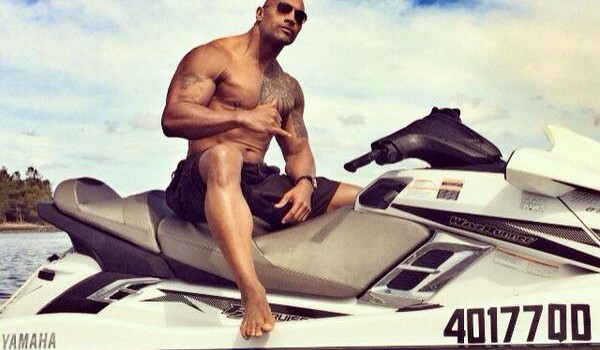
Before the safety police get all uppity, this is not another case of a “celebrity too cool to wear a life vest.” This is clearly a posed, professionally-taken image for Dwayne “The Rock” Johnson’s Instagram account (it’s actually a pretty awesome thread. You should subscribe).
Captioned, “Where we’re going, we don’t need roads” with the hashtag “#GoldCoastRidin”, The Rock took to the waters of Australia’s Gold Coast in between days on the set of his newest big budget blockbuster “San Andreas” a earthquake-themed disaster flick titles after the titular Southern Californian fault line.
The shot of the 41-year-old aboard a Pearl White Yamaha FX HO was grabbed in Queensland a couple of weeks ago and has made the rounds on various media outlets. The former professional footabll player-turned professional wrestler-turned action movie star began filming a couple of weeks ago. The thriller follows a helicopter pilot who has to trek across the state to find his estranged daughter, due to hit theaters in 2015.
According to The Daily Mail, “This all follows a landmark year for the actor, as between Fast & Furious 6, Pain & Gain, G.I. Joe: Retaliation and Snitch, he became 2013’s highest grossing Hollywood performer, with a combined total of $1.3billion in box office receipts.”
Sometimes, you just plain miss out on something awesome. And this year’s National PWC Rally hosted by Jetski Junkies and CFJR (Central FL Jet Riders) was definitely one of these. The location for this awesome three night, four day trip featured two full days of riding around South Carolina’s Devil’s Fork State Park, nestled in the foothills of the Blue Ridge Mountains.
Riders were met with a welcome reception, before enjoying days of amazing riding around Lake Jocassee and Lake Keowee. There, riders were provided with a campsite social and served a pulled pork BBQ dinner (with dessert) and treated with no shortage of swag, prizes and gifts.
The backdrop for all the pictures you see of the new 2014 Sea-Doo models, Lake Jocassee is best known for an abundance waterfalls dotting the shores. Nearly 300 feet lower is Lake Keowee, separated by a man-made dam. Keowee is lined with, as Jetski Junkies’ Kev Hemingway puts, “ridiculous yet beautiful homes, new age castles, some waterfalls but mostly for the amount of islands dotted all throughout the lake.”
Enjoy the video recap of the near-week long trip and try not to turn green with envy.







 Not exactly the way to sum up an already difficult weekend, Liquid Militia rider Juan Rada came home from racing in Expert Runabout Stock class this past weekend at the



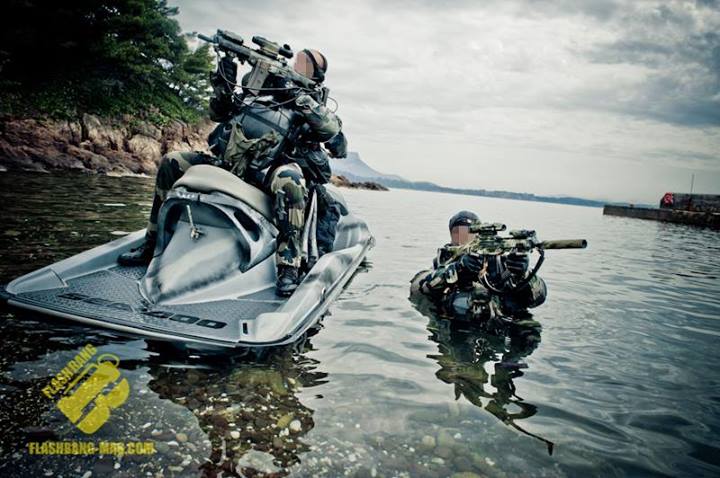
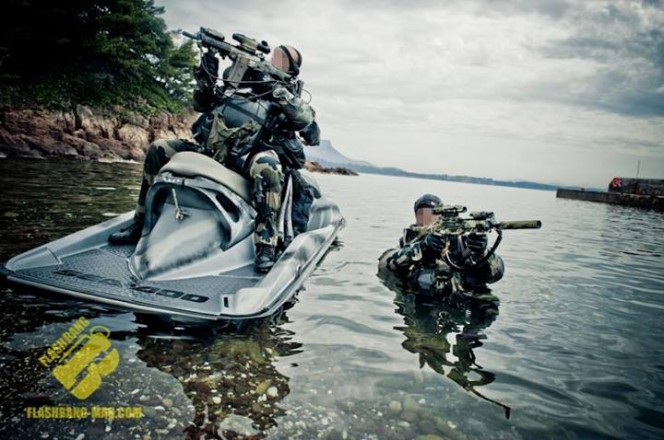
 Although the post didn’t specify whether these “high speed boats” were personal watercraft, we do know that Hellenic Special Forces were recently pictured on specially-prepped smoked-out Sea-Doo RXT 215 runabouts. The Special Forces Directorate had 12 Sea-Doo RXTs ordered from Bombardier Recreational Products Inc. (BRP) for use against as counter-insurgent equipment.