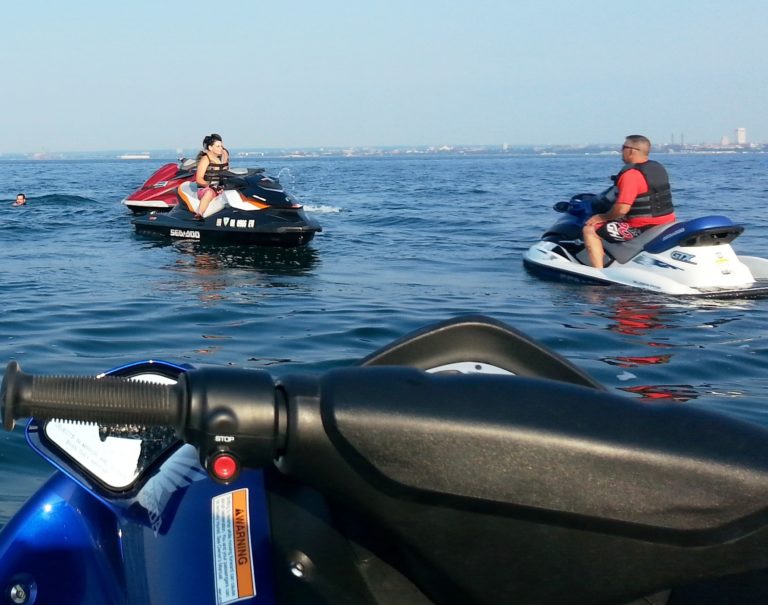
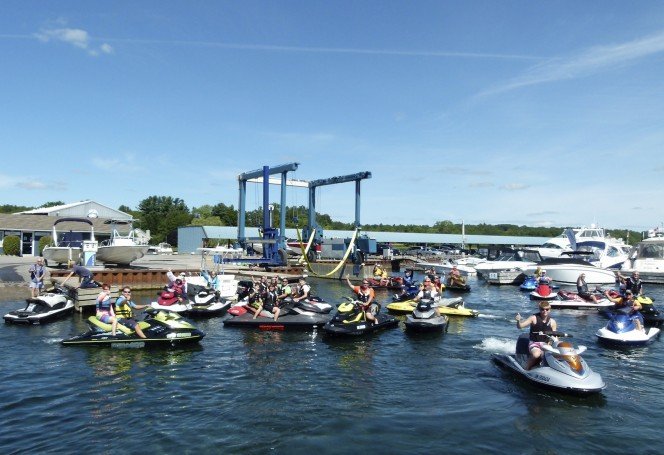
If you fancy yourself a PWC rider worthy of a big challenge, we think we’ve got exactly what you’re looking for. The Grand Tour to Benefit Leader Dogs for the Blind is an exciting three-day, 350-mile ride across Lake Michigan, from Mackinaw City to Holland.
Based in Michigan, the privately funded Leader Dogs Organization trains guide dogs for persons in need nationwide at no cost to the recipient. The Grand Tour has raised more than $250,000 in its 16 years. As this is a charity fundraiser, each rider must raise at least $500 to participate, as well as cover the costs of fuel and hotel; most meals are provided.
For 2014, the Grand Tour will begin in Holland Wednesday, August 6. From there, the skis are loaded into a tractor trailer and driven to Mackinaw City. Beginning Thursday, August 7, with 110 mile ride from Mackinaw City to Traverse City. Friday, will be another 149 miles to Ludington. With a nice relaxing 90 mile trek Saturday back to Holland, for a banquet and party.
Best of all, the Grand Tour carries on rain or shine, unless inclement weather poses safety concerns. The ride has never been totally cancelled, and when the ‘all clear’ comes, we are back on the water. For more information and details, visit www.grandtour.org, email us at [email protected].
Get get you excited to participate, make sure to check out the video from 2012 below:
As a followup to the previous announcement reported here at The Watercraft Journal, 18-time IJSBA World Champion Chris MacClugage will be participating in the globe-trotting UIM Aquabike World Championship, kicking off in Doha, Qatar this March. Late last night, the 40-year-old racer provided a great peek into his race schedule, plans, preparedness, training regiment and weapon of choice for the worldwide series.
Here’s the original announcement:
Hello Macc Racing fans!
First of all we are excited to have another stellar 2014 race program in progress! The best thing that got our year going was that Rachel and I welcomed our new daughter into the world on December 30, which also happens to be my birthday. Looks like we have 2 birthdays to double our family fun and we are really happy with our little baby girl. Our son now has a little sister he can be proud of as we are.
The first week of January I started my training regime. Training is the most important part of race preparedness apart from equipment selection. This same week I received an email from Alec Cavallero from aquabike.net.
For those of you who do not know him, let me tell you who he is. He is the promoter of the UIM personal watercraft race tour. He had invited me to race their entire UIM series. My wife Rachel and I discussed the possibilities and we both decided this was a great fit for Macc Racing and our supporting sponsors.
This series take Macc Racing to 5 stops around the world over the course of the 2014 race season. The UIM series is set up similar to Motogp.com, but a lot less stops involved. It’s the first big news for PWC fans who love the racing aspect.
In order to race for the UIM I had to renew my APBA license and also get a UIM competition license. The APBA also wrote a letter endorsing my professional status as a competitor. Looks like we are ready!
I will be racing a fully equipped Bullett V2 with a Kawasaki 1200cc engine.
UIM rules allow for a 1300cc, but we did not have enough time to build one. We will have one ready to go however for the second round in Milan, Italy. What a great place to have a race! Rusty Gewecke will be flying to the races with me and occasionally my wife Rachel and kids, all I need is to get our daughter her passport and off we go!
I have been training hard to get ready for this championship. My training regime has gotten solid and I’m happy with the results I’ve been getting in my pacing these past 2 months. I am the first ever USA rider to compete in this series. It should be and exciting time.
In order to compete at this level and be able to fly to the events I had to come with a decent budget. This year once again Monster Energy is my number one sponsor. Just like a title sponsor at race events, Monster Energy has a strong commitment to working with the worlds’ greatest athletes and venues. I appreciate their continued support of myself and Macc Racing. I am fortunate to have acquired a new sponsor for 2014! Check out Eurofin: www.eurofingroup.ch. Eurofin has helped make it possible to attend this amazing UIM world tour.
I have signed with a new wetsuit company: Optimum Racing. I am very excited to be working closely with Fred and to help develop new products. It’s nice to be with a company that is solely interested in jet skiing. At this point my Bullett v2 will be departing from Lake Havasu, Arizona, USA on the 24th and heading towards it final destination in Doha Qatar which is the Middle East for the first round of the tour. I will be departing on the second of March to catch up with the equipment and tune everything when we arrive on scene. I am very excited to be a part of this professional tour and hope to do the USA proud!
As the northern hemisphere slowly crawls out from the battering it got from a prolonged winter into spring, the event announcements continue to pour in, providing us with warm thoughts of fun on the water. As part of the good news, we’re very excited to announce the first of the TELUS Ride For Dad charity rides.
Scheduled for July 12, in Rideau Ferry Harbour in Ontario, Canada, the day of riding will include a catered lunch, poker run, prizes and a while lot more all while raising money to fight prostate cancer. The Ride For Dad series has raised over 13 million dollars for the Prostate Cancer Fight Foundation since 2000. Working to support prostate cancer research and awareness in the same communities where the rides are held, TELUS Ride For Dad is saving lives while helping get the most from life.
According to their site, “We raise funds through large scale one-day motorcycle, snowmobile, watercraft and ATV ride events and through ongoing public fundraising throughout the year. TELUS Ride For Dad events take place in multiple cities across Canada, representing every Canadian province.”
For more information and how to participate, contact Rob O’Donnell at [email protected]
[I’ll preface this by apologizing, as I know what I’m about to say will likely infuriate the most passionate of racing enthusiasts. It’s been a lifetime’s worth of experience to teach me that I have an uncanny talent for enraging people, so again, you’ve been warned. -Ed.]
People say “racing is dead.” I disagree. Racing is not dead, it’s just irrelevant. I say this without intent to discredit the talent, training and dedication of the many passionate racers who faithfully pay their dues both figuratively and literally. I say it as a reflection of its current health. The sad reality is that personal watercraft racing is teetering on its last leg.
But it can be big again and with very little effort. And I believe I know how.
The topography of PWC racing has changed since 1991. The machines are far bigger and faster than the 550s of years past. Last year’s AquaX in the US steadily grew with each tour stop. Racers like Scott Dawley raced on a bone stock runabout against pros and novices alike.
Racing mattered most when it translated into unit sales, and it is no coincidence that racing’s apex paralleled the industry’s all-time height in unit sales. The two are intrinsically tied. As an illustration, consider this cyclical chain of cause and effect:
Step 1) Imagine there is a new found consumer interest in personal watercraft – for whatever reason. The new broad consumer appeal immediately translates into a spike in PWC sales. OE’s and dealerships see immediate profitability.
Step 2) A rise in watercraft sales invites more people to modify their skis (because it’s human nature to want to go faster), therefore encouraging the growth of an aftermarket. A vibrant aftermarket rightly influences the next generation of OE product, thereby providing superior vehicles. (We have all seen this happen firsthand, most recently with the SVHO Yamaha and 310-horsepower Kawasaki.)
Step 3) An increase in performance-bred watercraft, dramatically increased gains by the OE’s and aftermarket paired and a new swollen population of PWC enthusiasts consequently results in increased attendance in existing local and regional racing events. This encourages new promoters to provide more and larger events wherein newcomers can compete.
Step 4) With vibrant dealer sales, OE’s begin pouring extra marketing dollars into encouraging new additional sales, as well as creating stronger brand loyalty and awareness. The more successful aftermarket companies do likewise. This results in greater event support, larger venues, bigger racer payouts, and increased public interest and racer participation…which in turn, leads to greater interest in PWC and consequently, sales.
Even Sea-Doo’s Tim McKercher took to the water last year on a 215hp supercharged GTR. McKercher spoke very highly of the format, explaining that the factory stock format encouraged more participants than the “big dollar” race skis.
The burning ember that gave life to this chain of events 40 years ago was the introduction of the first JetSki. The newness of the vehicle gave birth to an industry. And following the exact model I outlined above, from 1991 to 1995, jet ski racing saw its highest numbers of events, tours, racers, participants, spectators and sponsorship dollars as sales peaked at 200,000 units sold annually (1995).
But by the late 1990s, the aftereffects of decades of bad behavior, concerns of environmental impact and a general malaise on behalf of the organizing bodies resulted in a steady decline which nearly snuffed out the once out-of-control brush fire that that one initial spark ignited. It was only due to steeled dedication and determination of those wholly dedicated to this industry that PWC racing has held on at all.
But I fear that it can’t last much longer as is. Preliminary sales reports of narrowly surpassing 29,000 units sold and less than 900 paying members of the IJSBA for 2013 convinces me that if something doesn’t change soon, we won’t see the “comeback” we all dream of. And right now, I don’t see anyhing on the horizon that will parallel the same level of catalyst as the initial standup JetSki.
Rather than trying to rekindle the same flame that ignited the sport over 30 years ago, its best that we artificially arouse the aforementioned cause and effect cycle that’s already in motion, like push-starting an old VW Beetle. Thankfully, we’re already a few steps into my earlier example as the OE’s and aftermarket have never produced better, more race-ready quality products.
What is needed are enough people racing to get the attention of the OE’s. But there’s the rub: purchasing a new runabout is expensive, and racing is only more so. The deterrents are too many, while the rewards are too little. Thereby, racer attendance is low. So, how do you mitigate the cost of racing to encourage more participation? Easy. Manufacturer Stock Classes.
Manufacturer Stock classes aren’t anything new, and have been successfully executed at the Long Beach-to-Catalina Offshore Championship, the legendary Mark Hahn Memorial Havasu 300, and of course, is the standard rule setting for all AquaX race events. By restricting modifications to a near, if not total minimum, enthusiasts are left to battle brand-against-brand, racer-against-racer rather than against each others’ pocketbook.
Frankly put, the OE’s hardly care about the Open and GP classes. Sure, they’re happy when it’s their ski is on the podium, but don’t expect them to greedily pursue it. Heck, even Limited is too far removed from what’s offered on showroom floors. No. The manufacturers will only care about racing when the skis participating are nearly identical to what the regular customer can purchase.
The average age of a PWC racer isn’t far from that of a PWC buyer, 43 years old, which unlike motocross, is twice that age. Local and regional races need to be crafted accordingly.
And I feel very strongly that the AquaX series has all of the DNA necessary to reignite this cycle. Its tightly controlled three-tiered class system, tech inspection and commitment to fun and safety is the right formula. As pointedly as possible, the OE’s are stupid not to support the AquaX with as much as their budgets can allow. Consider the following:
Step 1) All local and regional promoters offer Manufacturer Stock classes with reduced entry fees. Lower costs entice new grassroots racers, youth and racers from other classes to participate. Increased entry fees permit larger payouts, encouraging more participants yet.
Step 2) As more and more participants enter Manufacturer Stock classes, the OE’s begin taking notice and supplementing the events with larger payouts. This in turn, lures in more racers (new and old) to the class. More racers wanting to participate purchase new units.
Step 3) An increase in sales directly tied to additional Manufacturer Stock entries encourages vigorous OE and dealer support, thereby provoking promoters to host more events and open up larger venues. This draws in broader public appeal, welcoming new watercraft owners and rekindling interest with previous PWC owners.
Step 4) More public appeal converts into an increase in unit sales. OE’s and dealerships see immediate profitability.
Addendum: It has come to my attention that for 2014, the US series of the AquaX has completely recanted from its “Box Stock” policy and has caved to pressures from individuals (and most likely manufacturers as well) to better “level the playing field.” Of course, as we all know, the only people who cry for the playing field to be leveled, want the rules changed in their favor. So, I guess I must retract my outright support for AquaX and remain solidly behind RPM Enterprise’s Ross Wallach’s Manufacturer Stock class rules. Manufacturer Stock should remain stock. What a shame.
It’s been a very busy winter for our friends at WMF Watercraft. The Millsboro, Delaware PWC and boat dealer has seen a tremendous spike in pontoon and dayboat sales despite the chilled-to-the-bone off season months. But not all of the attention has gone towards the big family cruisers. Nope, WMF made a huge splash during these past months’ boat shows with their wild Geico Powersports-themed RXP-Xs.
The trio of custom Sea-Doos made the show circuit across the nation alongside the insane offshore race boat, Miss Geico. Featuring custom wraps, painted panels, Jettrim seats and a slew of RIVA Racing goodies, the WMF-built Sea-Doos were huge attention grabbers. But that’s what WMF does best. Besides a full service PWC and boat dealer with an attentive staff of fellow enthusiasts, WMF also features a very capable crew of technicians who can build, repair and customize your personal watercraft to your desire.
Be it a pre-owned ski or used, new parts or old, vintage carburetor rebuilds or salvage parts, WMF Watercraft is the East Coast’s answer to your performance needs. That is why we at The Watercraft Journal are so excited to announce that WMF Watercraft has partnered with the internet’s fastest growing PWC magazine to bring you more technical how-to articles, more insight on repair and maintenance and much, much more for 2014.
The success of the program led de Schipper to form his own business with a colleague Sierd de Vries. The company, Shore Monitoring & Research, has now been operating for five years. Together, their research has garnered plenty of business and notoriety around the world.
In a fantastic example of irony, a Dutch PhD candidate at TU Delft and researcher has spent the last three and a half years on a jet ski taking measurements along the Dutch coast to measure abnormal effects on currents caused by suppletion. Matthieu de Schipper will be awarded his PhD at TU Delft for his work measuring the aftereffects of a process wherein tons of sand are being deposited on Dutch beaches in order to preserve the coastline and compensate coastal erosion.
Created as a countermeasure to predicted rises in the sea-level due to global warming, de Schipper wanted to discover how large-scale suppletion affects the height variation in the seabed level along the coast. This was particularly timely, as substantial height variations can cause abnormal currents, endangering swimmers.
In an interview with TU Delft, de Schipper stated, “An important question prior to implementing a suppletion project is how the alongshore variability will evolve. For three and a half years we took measurements of the topography of a nourished Dutch beach – the Vlugtenburg beach at ‘s-Gravenzande. Every month we mapped the depth of water in an area of sea measuring 1.8 km by 1.2 km. We took measurements every 70 to 80 metres.”
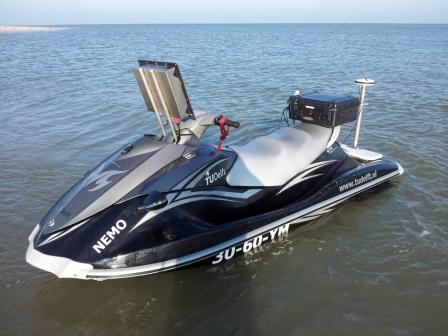
To accomplish this, de Schipper used a Yamaha WaveRunner fitted with a survey system. Being a watersports and surfing enthusiast, the use of the ski was only common sense. He said, “That is what gave me the idea for carrying out the research in this way. The advantage of the jet-ski system is that it’s very flexible. It can be set up fairly quickly. Normally, measurements are taken from boats, but that’s much more time-consuming.”
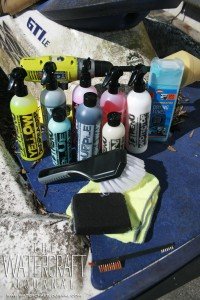
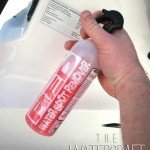
We put all of Jet Renu’s weapons to work on our filthy ’02 GTI LE, including Jet Renu’s Yellow degreaser, Green vinyl cleaner, Purple wash, Red waterspot remover, Pink polish, White protectant, Tan cleaning wax and Blue plastic polish.
If there’s one thing we pride ourselves on here at The Watercraft Journal is really beating on our test subjects for our weekly reviews. Be it a brand spankin’ new personal watercraft that we flog relentlessly for a day or two (or more), or some really nice riding gear or fancy products that come our way, we really push these products to their limits. You might think that we’re a little too rough, but we need to cram in as much wear and tear in a short time to provide you the real results.
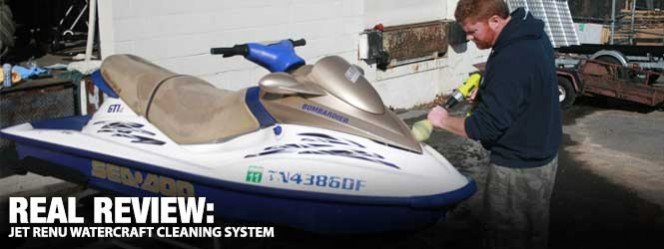
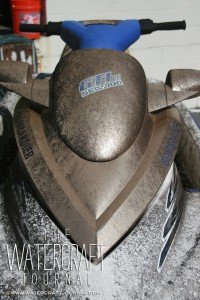
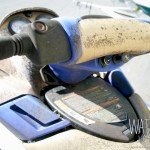
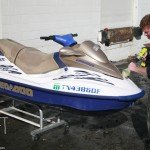
That being said, when we received a big ol’ box from our friends at Jet Renu, we knew exactly what we were going to do for our first product test. Our subject was a long forgotten 2002 Sea-Doo GTI LE sitting in the back lot of America’s Motorsports’ Madison, Tennessee location. Parked for years beneath a tree on a trailer with flat tires, it collected leaves, mold, rain and ice. There it was left to die.
The line of Jet Renu cleaning and detailing products were likely never designed to tackle something this heinous, as most of the cleaners and degreasers the company sells are purposefully gentle on the fairer materials like vinyls, plastics and decals. Nevertheless, we wanted to push the restorative attributes of the entire Jet Renu line to see just how far we could go.
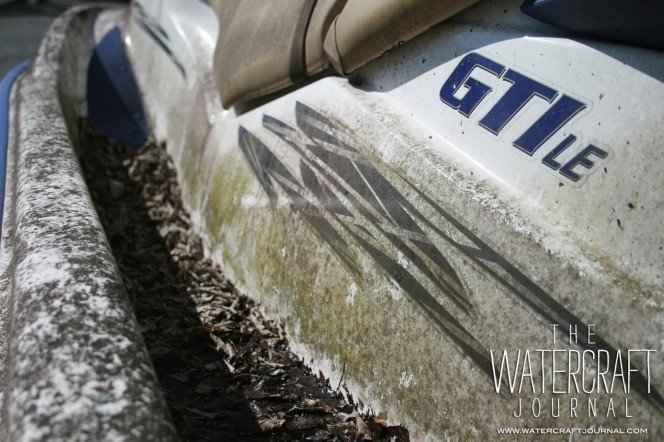
Thankfully fished from out of the water but left to rot on a trailer beneath a grove of trees in the backlot of a dealership service yard, this lowly ’02 Sea-Doo GTI LE was coated in a layer of mossy mildew, grime and filth than we imagined would prove too durable for Jet Renu’s products to pierce.Every personal watercraft is composed of a variety of different materials with their own specific surfaces. Thankfully, we found Jet Renu’s complete watercraft cleaning system to meet and master each of those.Initially, we couldn’t see what condition the actual Sea-Doo was in. We started by coating the runabout in semi-caustic Yellow degreaser.
To properly tackle a job this intense, we employed all of Jet Renu’s products provided, including their Yellow degreaser, Green vinyl cleaner, Red waterspot remover, Purple wash, Pink polish, White protectant, Tan cleaner wax, and Blue plastic polish, as well as a medium-strength bristle brush, a fine detail brush, a water absorbent towel, several microfiber towels, an applicator pad, and a portable electric drill with a foam polishing cone.
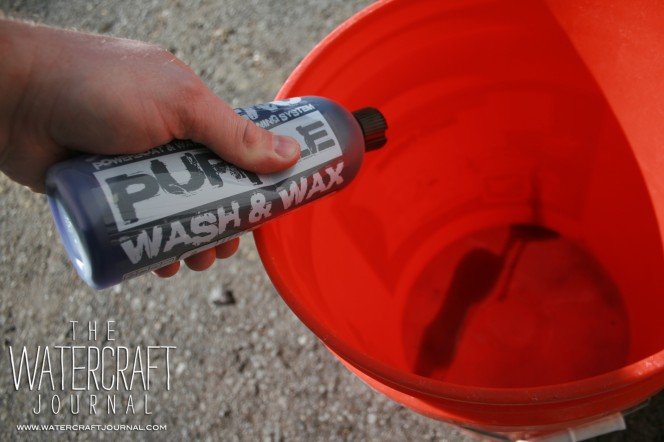
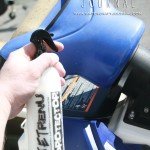
As we waited for the hose to fill our 5-gallon with Jet Renu’s Purple boat wash, we sprayed a generous amount of the Yellow degreaser over the entirety of the ski. We wanted the semi-caustic solution to start breaking up the mold and mildew that had been allowed to grow over the years.
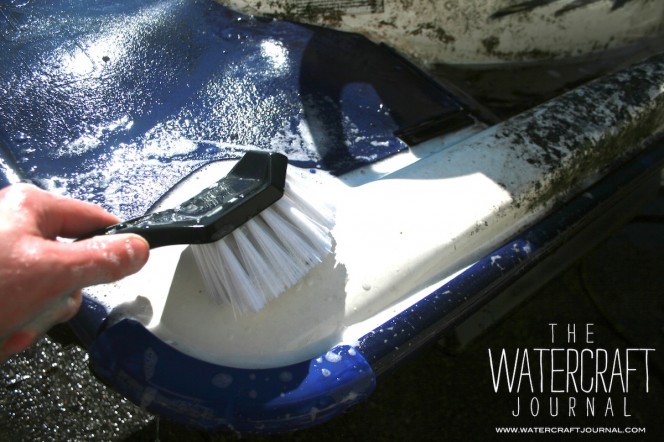
With our bucket filling with suds, we adjusted our hose nozzle to “jet” and began spraying off the first of many, many layers of grime and the degreaser. Next we forewent our wooly wash mitt and used our bristle brush to scrub every exposed inch of the Sea-Doo runabout.
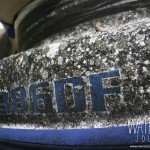
Those aren’t barnacles, but mold and mildew left to fester and grow over years of neglect. When we choose a crucible to test the products in our Real Reviews, we make ’em tough.The gunwales were left full of leaves over the seasons, leaving a near-cemented layer of natural compost glued to the rubberized Sea-Doo mats. A lot of high pressure spraying, soap and scrubbing were needed to strip them clean.Key to our multilevel detailing was spraying down the ski with the Red waterspot remover. The chemical in Red helps break down the calcified build up.
The Yellow, Purple and Red (waterspot remover) all managed to strip years of Mother Nature from the while deck, multicolored decals and gold and purple plastics. Beneath the mold we uncovered damage to the gel coat and paint that would otherwise have gone unnoticed.
We found that the Green vinyl cleaner (which we found to be not too far removed from common “Simple Green”) was a little too mild to truly remove any discoloration on the seats. It did manage to clean the vinyl’s surface but not undue the long term effects of prolonged exposure to the elements.
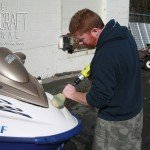
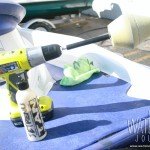
With the ski properly cleaned, the white gel coat required a significant amount of buffing. Using a portable electric drill and a conical buffing pad, we used nearly half a bottle of Jet Renu’s Tan cleaning wax. Unlike many waxes or polishes, cleaning waxes are one part rubbing compound, one part wax. Their grittiness is what removes discoloration, staining and scuffs while its wax leaves a clean, smooth surface.
Because of the obscene level of neglect our Sea-Doo GTI LE was in, we went through a couple of buckets of soapy water. The Purple wash proved itself a worthy foe to the grime that had calcified on this ski.Only a medium to strong-bristled brush could manage to break the ski’s gel coat free of all of the blackened mold that clung to it.The footwells cleaned up after a couple of passes with the scrub brush, the Yellow degreaser and a lot of Purple wash soap.
We found the Tan to be far too gentle to extract all of the discoloring from the porous surface. Of course, this level of cleaning wax is meant for general aesthetic maintenance, not repair or restoration like what we were doing here. A harsher grit compound would be needed to really bring back the luster of the original gel coat, but we found the Tan to be a suitable tool in our effort.
Using a microfiber towel to wipe down the ski, we next passed over all of the plastics with Jet Renu’s Blue plastic polish. This has little to no grit, so it won’t scratch or haze the soft surfaces or thinner paint used on hoods, cowlings and other plastic panels. The Blue also works as a good second coat of wax if you’re looking to really bring out the shine in your watercraft.
We used the White protectant on all of the natural plastic and vinyl components like the rear handrail, handlebars, grips and steering pad. We also used it to bring back the natural shine of the plastic traction mats, bondrail bumper and sponsons that had since faded over the years.
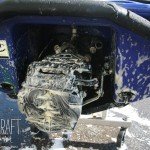
A liberal amount of Jet Renu’s Yellow degreaser wasn’t enough to really clean up our gunked up pump. After a few passes with the Yellow and our scrubber, we finally resorted to a heavy duty mildew and mold remover.Although a little too gentle to remove all of the discoloring from the ski’s stained and porous surface, we did find that the Tan gel coat cleaner and wax to be a suitable tool in our effort after multiple passes.Amazingly, the Jet Renu cleaning system quickly shaved off decade’s worth of neglect to reveal a pretty attractive Sea-Doo.
All in all, what we discovered the entire Jet Renu watercraft cleaning system to be a great off-the-shelf package for washing, cleaning and polishing a well-maintained, well-loved personal watercraft. Our neglected ugly duckling ’02 Sea-Doo GTI LE – be it long forgotten and left to rot in a backlot – revealed itself to be quite the swan after a day’s work.
We’d like to take another pass at with with some stronger abrasives and cutting compounds before making another round with Jet Renu’s polishes and waxes, we know we can really pull the luster back out of this unit, but we’ll save that for another technical article.
Again, we were very satisfied with how well the Jet Renu cleaners worked, their pleasant smells (that’s always a plus) and how easily they organically broke down when sprayed off of the driveway. We want to be environmentally-minded with chemicals like these as we know most of you do most of your washing after a ride at the launch ramp.
Let’s face it, many of you won’t spend the time to dutifully detail your personal watercraft with the time and care you might dedicate to your car, truck or motorcycle. What we do hope is that you regularly wash it down after each ride, as to maintain its natural luster. And for that, we strongly recommend carrying Jet Renu’s Purple wash and their Pink waterspot remover and polish combination as a bare minimum.Our final result is something to be proud of. From the dirties, nastiest personal watercraft we could find to a pretty clean turnkey cruiser, the Jet Renu lineup helped bring this oldie-but-goodie back from the dead.
If you’re into jet ski racing, we really sincerely hope you love Florida. The panhandle state has quickly become the go-to state for personal watercraft and watersports competition in the last year and it’s only building up to be even bigger for 2014. Even as last week’s Pro Hydro-X Tour announced its reduced and redesigned format and we all eagerly anticipate the dates and locations for this year’s AquaX series, AJ Handler and the family at UWP have made a pretty big announcement:
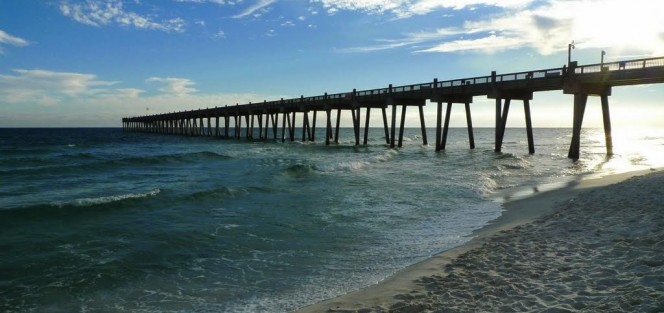
The Pro Watercross Tour is foregoing last year’s Lake Charles, LA location and has opted for the far more touristy Pensacola Beach for the first round of the UWP-IJSBA National Tour. Kicking off May 10th and 11th, the Grand Prix of Watercross weekend promises plenty of non-stop family-friendly action. Scheduled to be held just east of the Pensacola Beach Pier (one of the longest piers in the Gulf of Mexico), the event hopes to pack the pier and shoreline with plenty of spectators and racers alike.
What’s most interesting about the announcement is that the Pensacola Beach, Florida event is only one week before the Panama City Beach’s Super Cup of Watercross on the following weekend, May 16-17. This purposeful scheduling of two consecutive weekends of racing only one hour from each other ensures that racers, crews and manufacturers will be present for the whole week. The Watercraft Journal intends to attend all week as well, so if at Santa Rosa Island or on the beach in Panama, we’ll see you there!
With the 10th annual Mark Hahn Memorial Havasu 300 happening this very weekend, all of the pieces are quickly falling into place. Before the racers charge the Lake Havasu shoreline at Crazy Horse commencing the 300-mile enduro, one big announcement comes after an equally big announcement from a couple of months ago:
Villon Clothing’s CEO Mark Quavillon stated, “Adding such a recognizable name to Villon Clothing is a step in the right direction while rooting the brand in the watercraft racing world.”
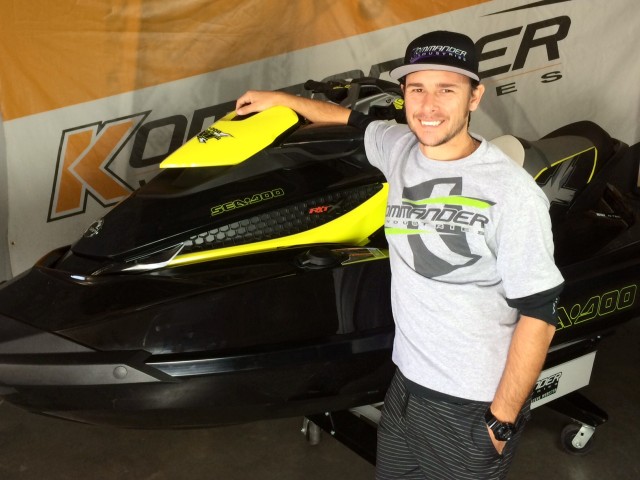
Expect to see Motzouris in action this weekend at the Mark Hahn 300. He’ll be tearing up the lake with teammate Jared Moore aboard their Kommander Industries-prepped ’13 Sea-Doo RXT-X. After that, Motz will compete throughout the year in the Pro Ski Open and GP classes on a specialty-built Kommander Industries/Sea-Doo Centre stand up and a few endurance races on the Sea-Doo RXT-X.
There’s nothing like starting off of the right foot, and at the Miami Boat Show Sea-Doo did exactly that, receiving the National Marine Manufacturers Association (NMMA) Innovation Award – for a sixth time – for the all new Sea-Doo Spark watercraft.
The award was issued for the creative use of new materials, processing and manufacturing as well as opening up a whole new demographic of buyers to the marketplace thanks in large part due to the Spark’s entry price of $4,999.
The Spark continues to draw in new and curious buyers and looks to be a runaway hit for 2014. Here’s the original announcement made earlier today:
Miami, FL, February 13, 2014 – BRP’s Sea-Doo Spark watercraft adds a sixth National Marine Manufacturers Association (NMMA) Innovation Award in six years to the company’s collection of marine industry accolades.
NMMA Innovation Award judges noted, “The Sea-Doo Spark is expanding the entry level of boating. At half the weight and half the price, you can still have all the fun on the water. “ Hours after my ride I could still taste the adrenaline,” said Ann Dermody, member of the judging panel.
The Sea-Doo Spark watercraft features a nimble and compact design thanks to an all-new Exoskel architecture and the use of a new, lightweight, durable and recyclable Polytec material. The mould-injected process allowed BRP designers to implement new concepts in the area of shape and structure leading to a unique look and offering an equally refreshing way to play on the water. The most accessible new watercraft on the market, the 2014 Sea-Doo Spark PWC, costs nearly 40% less than its closest competitive model* and is the most fuel-efficient watercraft in the industry**.
“BRP saw an opportunity to develop a more accessible watercraft for the next generation of boaters and filled that need with the introduction of the Sea-Doo Spark,” said Yves Leduc, vice-president and general manager, North America division. “The development of the Sea-Doo Spark model challenged everything we knew about building watercraft. Winning the NMMA Innovation award is a tribute to BRP’s success in answering this challenge through advanced concepts and processes that will have a positive influence on all future watercraft design.”