Yamaha Marine has not only been hard at work pumping out new watercraft units, but they have also made huge strides in Congress with conservation initiatives.
Their efforts have proven victorious because between 2020 and 2021, three significant conservation bills were signed into law. These include the Save Our Seas 2.0 Act, the Great American Outdoors Act and the Descend Act.
Check out the press release below for more information: Yamaha Marine, along with trade and conservation organizations, worked last year during the 116th Congress to ensure the conservation of U.S. waterways, promote responsible angler practices and increase access to federal land and waterways. The legislation signed into law in 2020 and early 2021 is the result of efforts from many entities promoting conservation and sustainability while achieving access for fishing and boating.
“The legislative victories of 2020 prove that advocacy works,” said John O’Keefe, Senior Specialist, Government Relations, Yamaha U.S. Marine Business Unit. “They also prove that even in a difficult year there is room for bi-partisan agreement and consensus among groups that might not always see eye-to-eye.”
Three of the most significant bills signed into law in 2020 and early 2021 are the Save Our Seas 2.0 Act, the Great American Outdoors Act and the Descend Act, all long supported by the recreational fishing and boating community and the result of many trips to the Hill to lobby the House, Senate and Executive Branch as well as strong advocacy efforts from the marine industry.
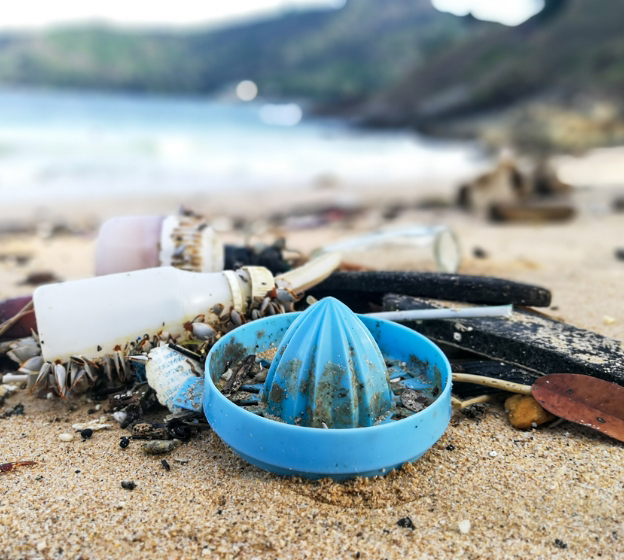
The Save Our Seas 2.0 Act aims to mitigate and remove marine debris, incentivize international engagement on marine debris and strengthen domestic waste management infrastructure to prevent the creation of new marine debris. The bill follows the success of the first Save Our Seas Act and allows for increased authority and funding to protect our nation’s waterways and coastlines from plastic trash. The law expands the ability for the Environment Protection Agency (EPA) and local governments to capture plastic trash in municipal stormwater systems before it escapes into the surrounding streams, rivers, wetlands, and marshes.
The Great American Outdoors Act permanently funds the highly successful Land and Water Conservation Fund which, for the past five decades, has helped provide access to recreational areas, trails and waterways throughout the nation. Importantly for the sportfishing industry, the Great American Outdoors Act ensures that $15 million annually is dedicated to expanding public access for fishing and other forms of outdoor recreation. It also creates the “National Parks and Public Land Legacy Restoration Fund.” This program will provide $9.5 billion over five years to the National Park Service, Bureau of Land Management, U.S. Fish and Wildlife Service and U.S. Forest Service (USFS) to improve trails, campgrounds, roads, visitor centers and other infrastructure.
The Descend Act, passed in early Jan., 2020, requires recreational (including charter boats) and commercial anglers to have on board a venting tool or descending device that is rigged and ready for use while fishing for reef fish in Gulf of Mexico federal waters. These devices allow anglers to practice successful catch-and-release methods that help ensure our fisheries are healthy and sustainable for future generations.
Additional bills signed into law in 2020 that serve to protect our environment while allowing for growth with the recreational boating and angling communities are: the American Conservation Enhancement Act, the Restore Our Parks Act, Great Lakes Restoration Initiative, the Great Lakes Environmental Sensitivity Act, the Coordinated Ocean Observation and Research Act, the Digital Coast Act, the Amend Nutria Eradication and Control Act and the Protect and Restore America’s Estuary Program.
Yamaha Marine products are marketed throughout the United States and around the world. Yamaha Marine U.S. Business Unit, based in Kennesaw, Ga., supports its 2,400 U.S. dealers and boat builders with marketing, training and parts for Yamaha’s full line of products and strives to be the industry leader in reliability, technology and customer service. Yamaha Marine is the only outboard brand to have earned NMMA®’s C.S.I. Customer Satisfaction Index award every year since its inception.
Although a great standup ski for the modern 21st century PWC enthusiast, many more seasoned “hardcore” riders are discovering that the 2021 Yamaha SuperJet has a lot of ground to cover in order to be competitive on the closed course. Keeping it hooked up, battling back cavitation and simply getting the standup in to the 60’s is a battle that many of the industry’s best minds are waging.
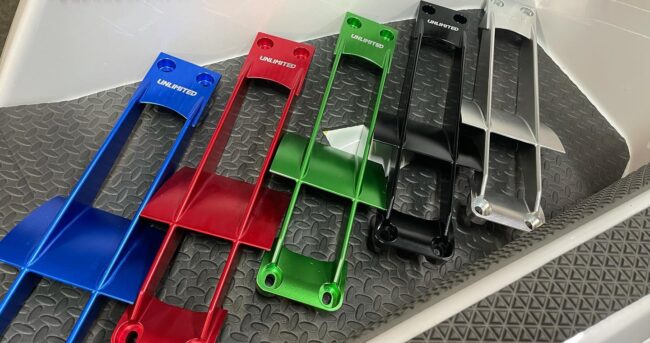
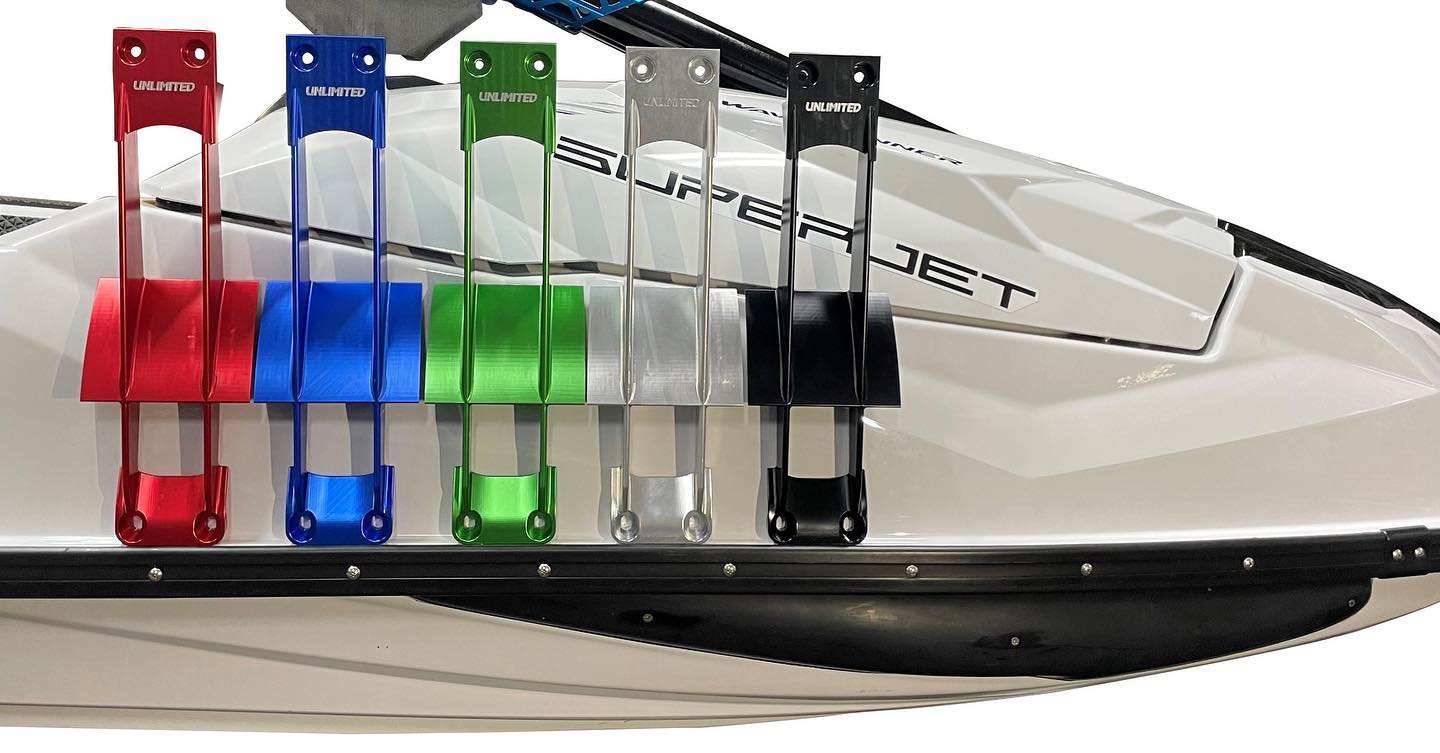
One such is Japan’s Unlimited PWC. Backed with a team of sponsored riders, the Unlimited PWC crew have been slaving over these key issues and have recently released the first of many salvos to bring the SuperJet up to snuff – a billet top-loader intake grate.
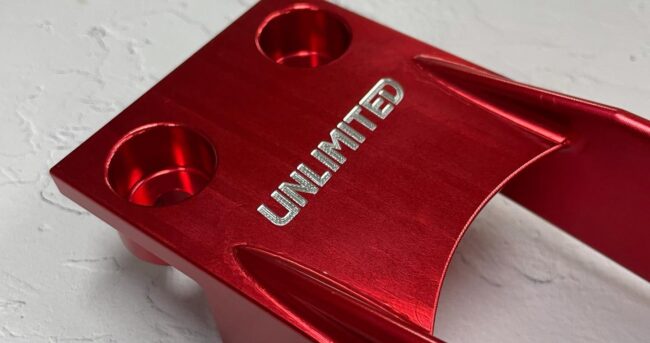
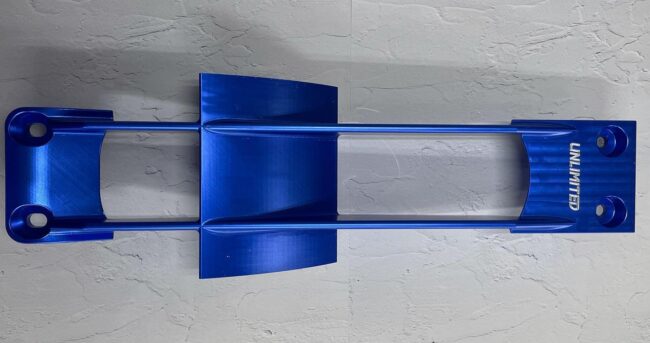
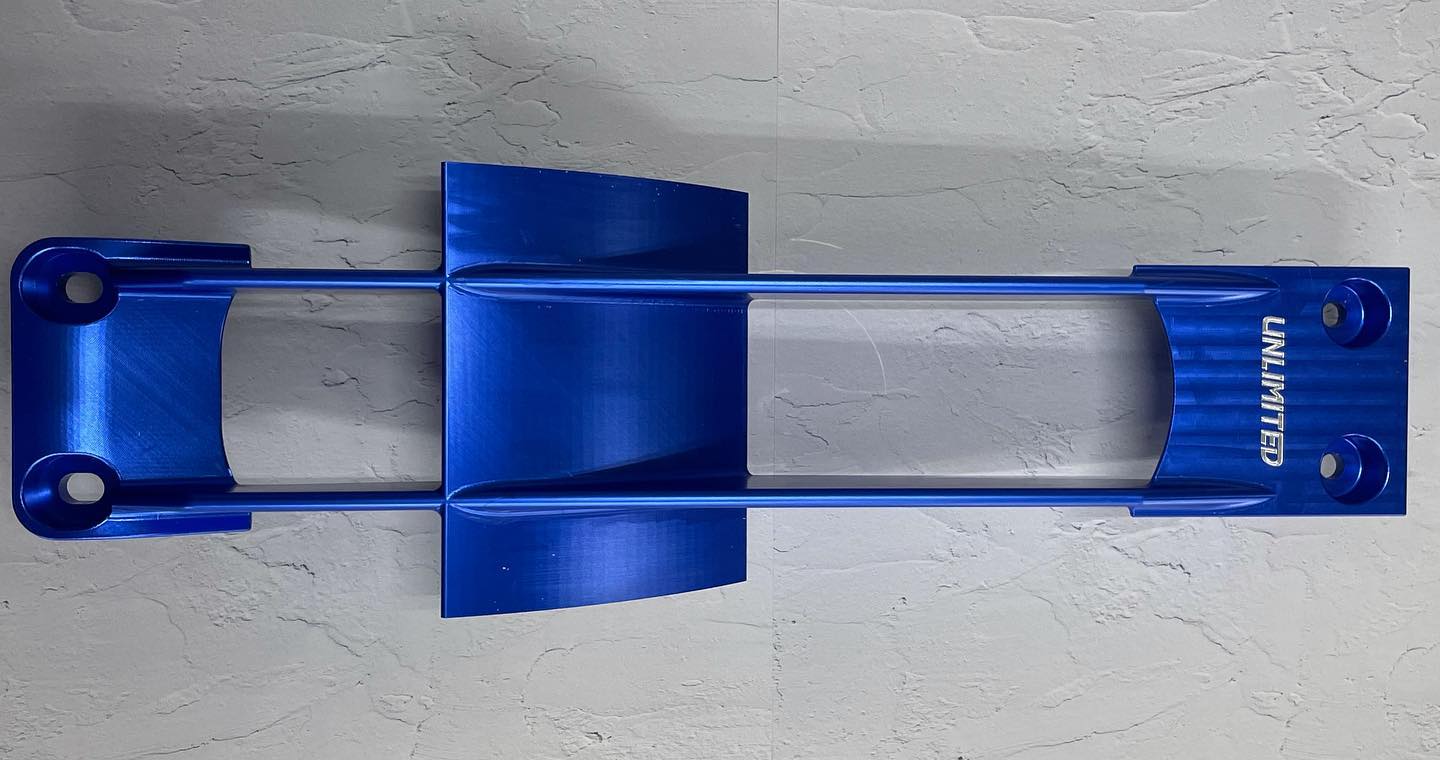
Priced at $440 USD, each billet intake grate comes anodized in one of four colors (or raw aluminum). Unlimited’s own Akihiko “Aki” Ito explained, “It is designed to take in water smoothly even on rough or flat water. We test the best condition with hook-up handling performance and top speed does not drop.”
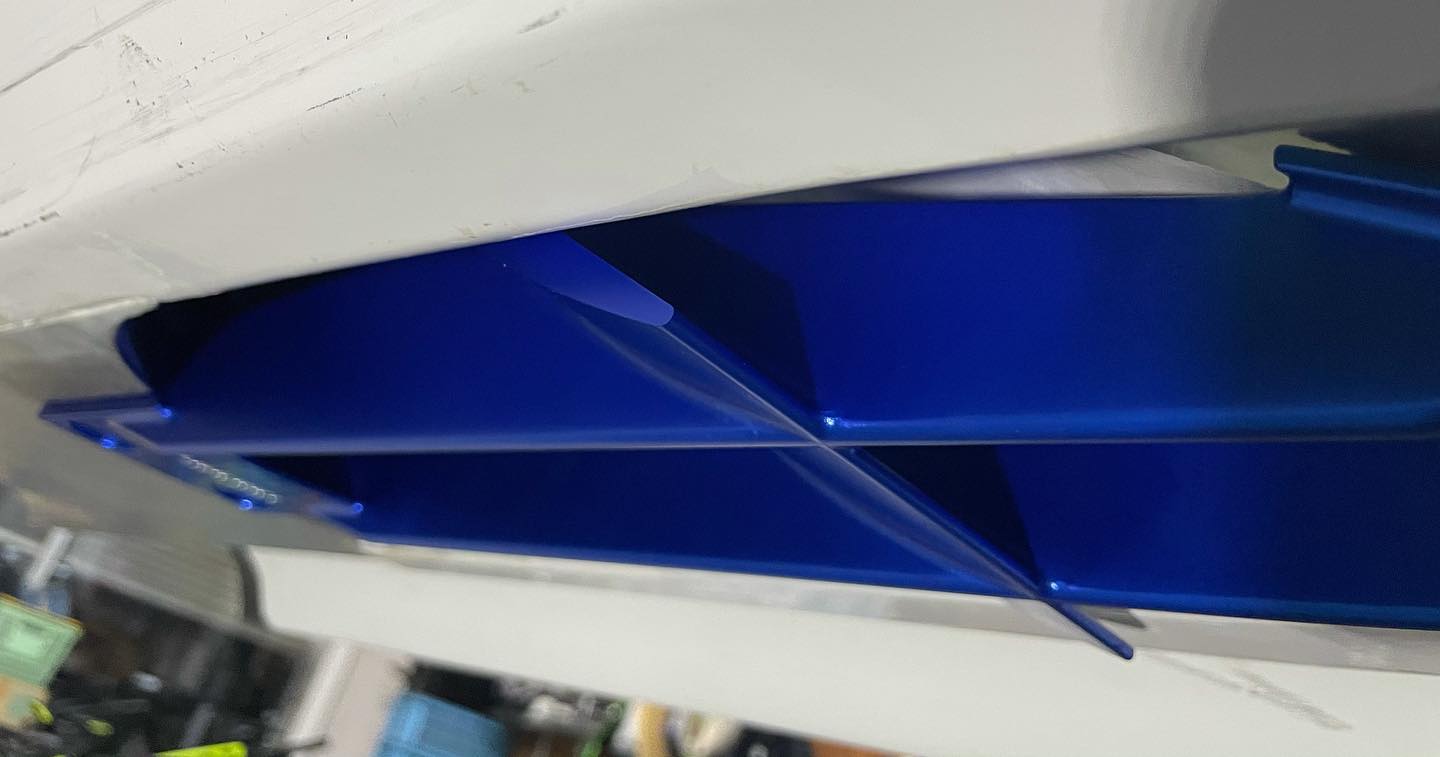
The new Unlimited PWC Billet Intake Grate features a full-width convex wing design that dramatically increases hookup. Equally, the large inflow of water improves maximum speed; the aggressive “chip” and elongated runners sharpen turning and handling in rough waters. Aki concluded, “It’s ideal for free riding as well as racing purposes as cavitation is significantly reduced.”
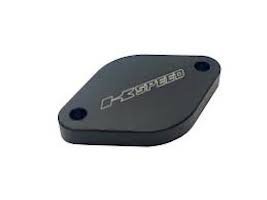
If your Kawasaki Ultra experiencing boost bleed and you are in search of a solution, check out Brisbane Kawasaki. They will get you fixed up with a Kspeed precision engineered Waste Gate Block-Off plate. It is made from aerospace grade aluminum and will fit Genuine Kawasaki Ultra 250,260, 300, and 310 models. This kit is designed to block-off the inconsistent OEM waste gate, allowing you to harness that leaking power.
The Kspeed Waste Gate Block-Off will ensure that you don’t lose any extra boost and will eliminate the lag when getting on the throttle. It is a great application for stock jet skis that are showing loss of pressure on the instrument panel’s boost gauge.
The kit will allow the supercharger to deliver its full potential by making sure that the supercharger doesn’t prematurely lose pressure from a leaking waste gate. The Kspeed Waste Gate will ensure that your supercharger operates at a full boost.
The waste gate is a must have if you are replacing lower boost pulleys with higher fitting pulleys. It will ensure that you aren’t losing that extra boost out the OEM waste gate. This applies to stock PWC.
The kit includes the Genuine Kawasaki gasket, stainless Allen key bolts, air box block-off cap, and installation instructions. The Kspeed Ultra Waste Block Off Plate is available right now for 6% off. It is $69.00 in AUD and $54 in USD. Check it out!
Yamaha Rightwaters is an organization that promotes environmental stewardship through education, partnership, and advocacy among other things.
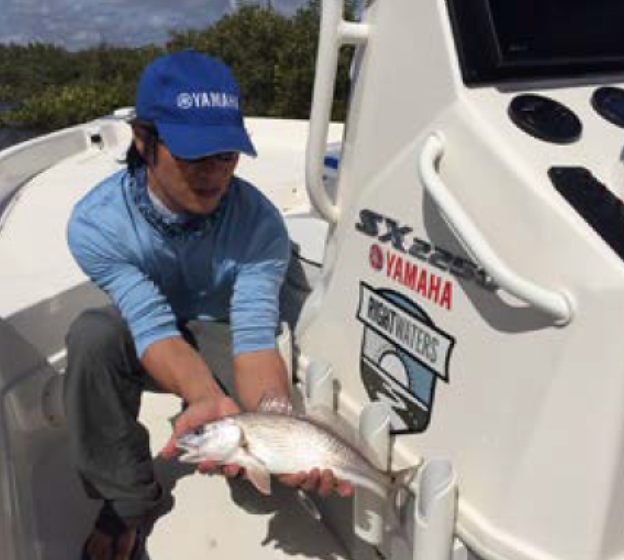
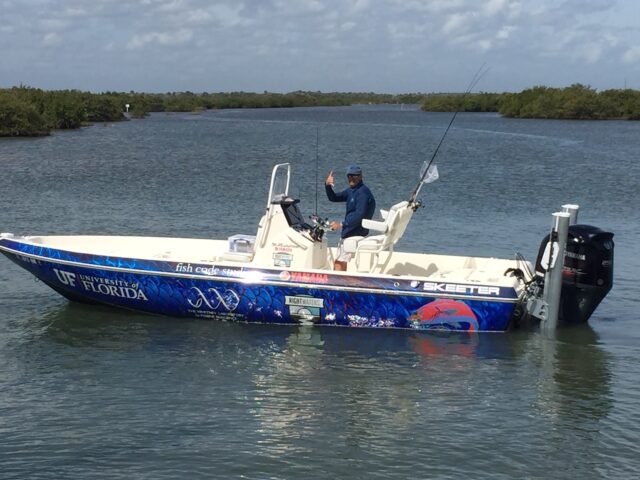
In their latest environmental campaign, Yamaha Rightwaters teams up with Skeeter boats to provide a boat to the University of Florida. A team of University Marine Bioscience Researchers will use the new boat to conduct a study on redfish activities.
To learn more about the activities, continue reading the information from Yamaha below:
Yamaha Rightwaters is teaming up with Skeeter Boats to provide a SX2250 center console boat with a 250-horsepower Yamaha V MAX SHO outboard to the University of Florida. Scientists in the University’s Whitney Laboratory for Marine Bioscience will use the boat and outboard to conduct a study on redfish activities and numbers to gather better data on the species in Northern Florida.
“The root of successful conservation begins with in-depth knowledge of the species and areas you are trying to protect,” said Dr. Jimmy Liao, Ph.D., marine biologist focusing on fish sensing and fish behavior at the University of Florida. “We will use this boat and outboard to tag and track the behavior of redfish in a 35-mile radius of northeastern Florida. The more data we collect, the better our understanding of the redfish becomes, and with that understanding comes the ability to better manage the fishery. The Yamaha Rightwaters and Skeeter teams recognize the important relationship between conservation and growth in the recreational fishing and boating industry, and we are grateful for the support.”
The University of Florida’s redfish study has three components. The first is tagging the fish to get a better idea of the exact number in the area. The second is studying the migration patterns of the fish to determine which habitats are preferred by the adult breeders and which make good nursery sites for the juvenile fish. The acoustic tags the scientists use can pick up signals from Canada to Cuba. Finally, the third aspect of the program focuses on seeding fisheries with redfish bred by the University and tracking the number of juveniles that return to the fisheries.
“Scientific research is one of the four cornerstones of the Yamaha Rightwaters mission,” said John O’Keefe, Senior Specialist, Government Relations, Yamaha Marine U.S. Business Unit. “This redfish study currently underway at the University of Florida will give state officials the information they need to manage this fishery properly so that it may grow in a healthy sustainable manner and continue to be enjoyed for generations to come.”
Yamaha Rightwaters is a national sustainability program that encompasses all of Yamaha Marine’s conservation and water quality efforts. Program initiatives include habitat restoration, support for scientific research, mitigation of invasive species, the reduction of marine debris and environmental stewardship education. Yamaha Rightwaters reinforces Yamaha’s long-standing history of natural resource conservation, support of sustainable recreational fishing and water resources and Angler Code of Ethics, which requires pro anglers to adhere to principles of stewardship for all marine resources.
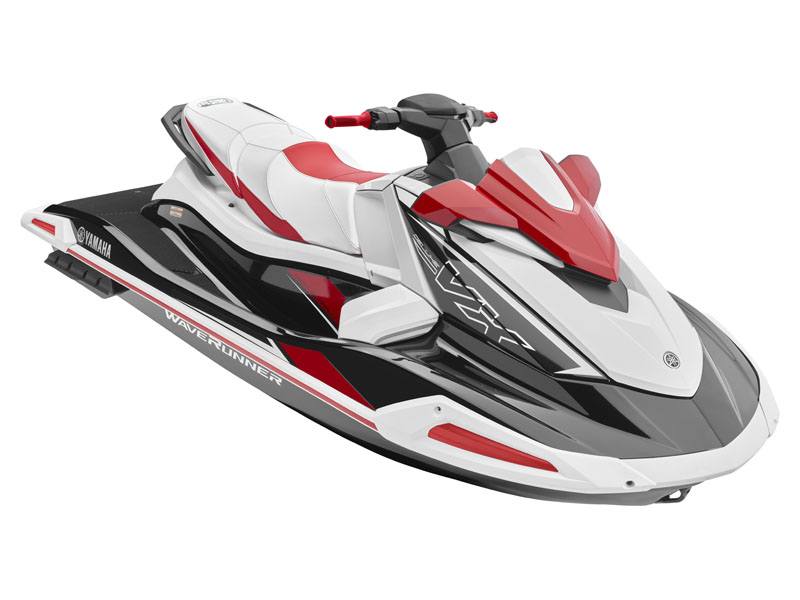
If so, now is the time to take the plunge and purchase a new Yamaha WaveRunner. Check out these special offers on Yamaha WaveRunners from Cycle Springs Powersports. No payments for 90 days for qualified buyers on the purchase of a new 2015-2021 Yamaha WaveRunner. You won’t even need a down payment or trade in for this offer.
Take advantage of 3.99% APR for 36 months. This offer is available to tier A1 credit customers who finance through Yamaha Financial Services. Get payments as low as $29.52 per $1000 financed, regardless of down payment. Higher financing rates apply for buyers with lower credit ratings.
If you need two WaveRunners, Cycle Springs and Yamaha have you covered with 6.49% APR for 96 months. This offer is geared toward A1 credit customers who finance through Yamaha Financial Services. Score payments as low as $13.38 a month per $1000 financed, regardless of down payment.
All the Yamaha Perfect Choice Sales Event deals are based on approved credit. The better the score, the better the interest rate. The offers apply to select models available in retail stock and the buyer must take delivery by June 30, 2021. Contact Cycle Springs for complete details and qualifications and to check out the select models on sale.
Cycle Springs Powersports can be contacted by submitting their online form, calling them at 727.771.1211, or stop in and see them at their Clearwater, FL location.
As we celebrated Earth Day this year, Yamaha would like to remind everyone what we can do to practice green boating. These 10 Best Practices For Boaters come courtesy of Discover Boating.
Some of these tips include preventing oily discharges. Clean up any oil spills when doing an oil change and be sure to properly dispose of old oil. For those folks still riding an old 2-stroke WaveRunner or boat, consider switching to a newer 4-stroke model.
Be sure to prevent fuel spills when re-filling your gas tank. When topping off your gas tank, stop filling immediately when the fuel nozzle cuts off and don’t add more gas to the filler neck since expanding fuel can cause it to spill out.
Minimize maintenance on the water or having to call for a tow. Having to call for a tow causes not only unnecessary expense to your wallet, but also to the environment. Instead, plan ahead and take preventative maintenance measures.
When you’re out on the water, it’s natural to want to relax with friends and family by enjoying some mid-afternoon snacks and drinks. When you’re finished, be sure to save your trash and dispose of it properly when you return to dry land.
Another great tip is to know the water you are operating in and what kind of marine life might be below the surface. For example, try to avoid operating in shallow waters where marine mammals live. Also avoid dropping anchor into coral reef or protected areas.
For more great tips, head over to the link above so that we can all enjoy the water while protecting our environment.
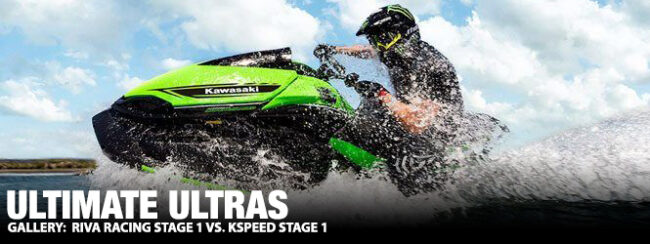
It wasn’t all that long ago that pushing a Kawasaki Ultra 300 or 310 into the 70’s required a great deal of effort. Professional offshore champions like Jean-Bruno Pastorello and Craig Warner piloted 80-mile per hour Ultra JetSkis to dozens of top-of-the-podium finishes; but the degree of modification and budget to replicate such a build was well beyond that of the typical performance enthusiast or privateer racer.
Exotic turbocharging kits, ECUs costing thousands of dollars, camshaft swaps and aftermarket pistons were what was required to unleash the industry’s most powerful PWC to race-winning speeds. At least, that’s what most people thought. Several manufacturers like TBM, R&D Racing and Worx Racing each offered their solutions as well – but few found the results they were hoping for.
In a recent episode of The Watercraft Journal’s weekly “Sunday Night Sessions” podcast, we discussed two of the “Stage 1” offerings from industry’s leaders in performance Kawasaki tuning: RIVA Racing and Kspeed. First, it bears noting that “Stage 1” is an arbitrary term; there is no universal definition for what constitutes a “Stage 1” package. What one manufacturer may offer in their Stage 1 kit might offer radically from another manufacturer.
Secondly, the prices and performance results we list in this article are directly taken from the retailers’ respective websites. We have not privately tested these, nor claim these to be definitive truth (as a point of reference, we know that RIVA regularly “sandbags” their top speed numbers as others may not be able to replicate RIVA’s ideal testing conditions). Either way, this data published below will be hyperlinked to the appropriate websites for you to see for yourself.
RIVA Racing Kawasaki Ultra 310 Stage 1 Kit
For RIVA’s initial testing, the as-is factory Ultra 310X recorded a top speed of 67mph at 7,400rpm. When upgraded with their Stage 1 kit, the same Ultra 310X recorded a maximum GPS-recorded speed of 73mph at 7,800rpm. Additionally, RIVA notes that air temps were 75º, the tank was 1/3-full (6-plus gallons estimated) and trim set at neutral – all pretty much ideal testing conditions on RIVA’s private testing lake as noted earlier.
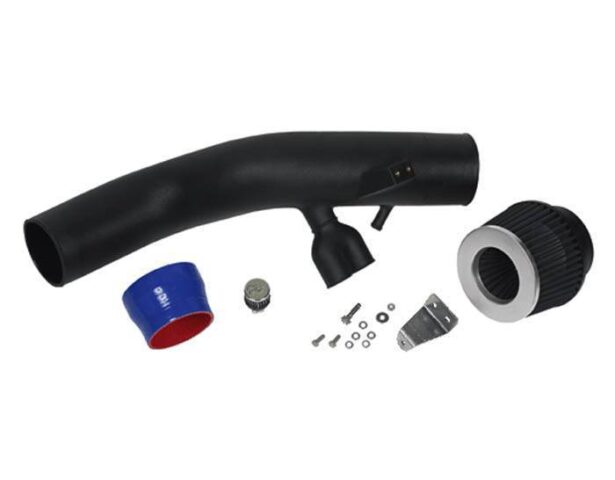
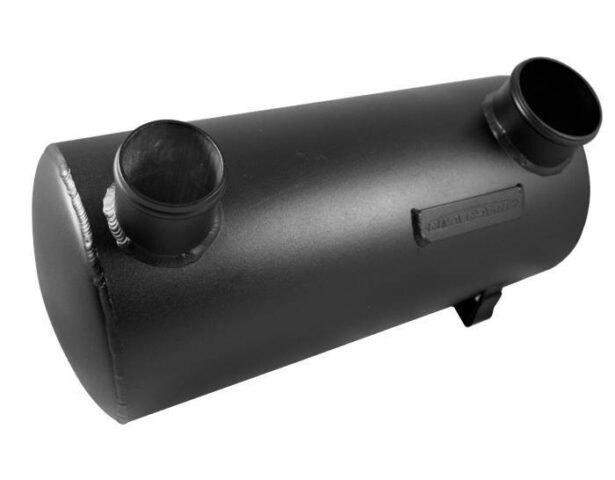
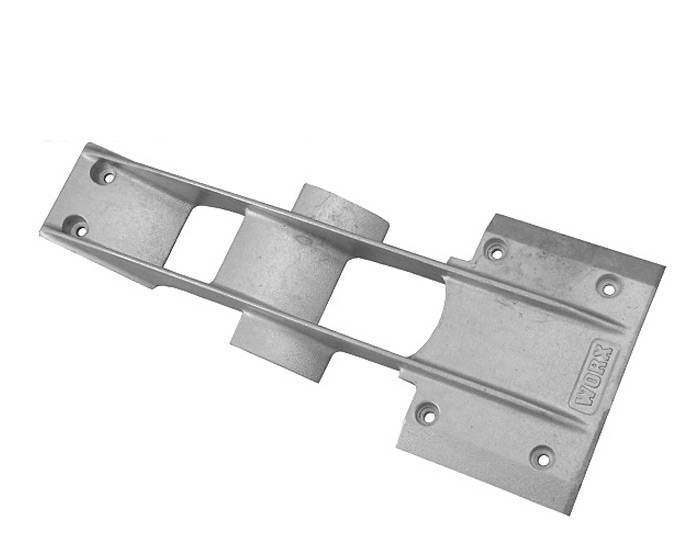
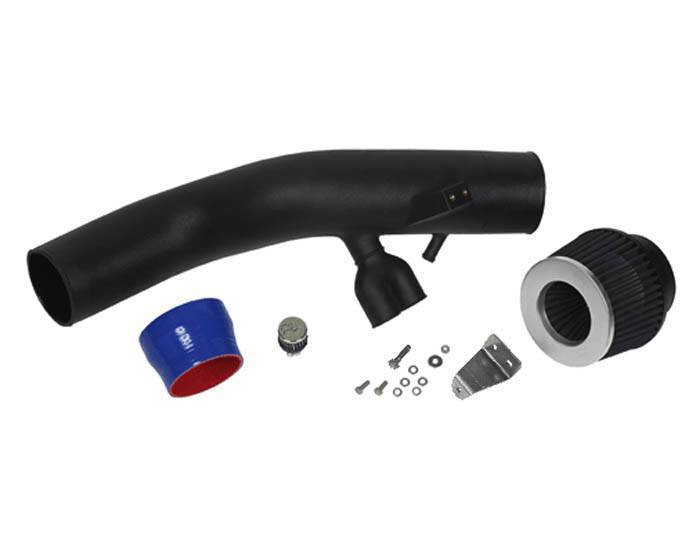
Equally, RIVA includes Worx Racing’s Kawasaki Ultra 300/310 Intake Grate (PT# WR236) and a TBM Kawasaki Ultra Ride Plate (PT# TBM123-UL3). These 8 items radically open up the 1.5-liter’s fresh air access as well as freeing up its exhaust flow. Equally, the sponsons, intake grate and ride plate completely revise the Ultra’s handling and tracking characteristics – all helping the big JetSki corner sharper and track through ocean chop easier.
Kspeed Kawasaski Ultra 300/310 Stage 1 Kit
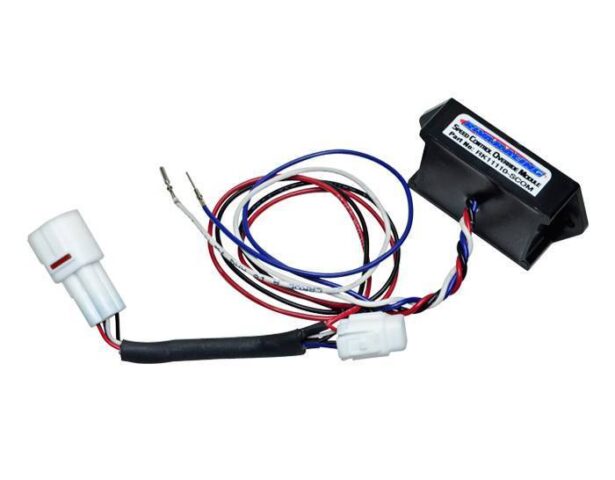
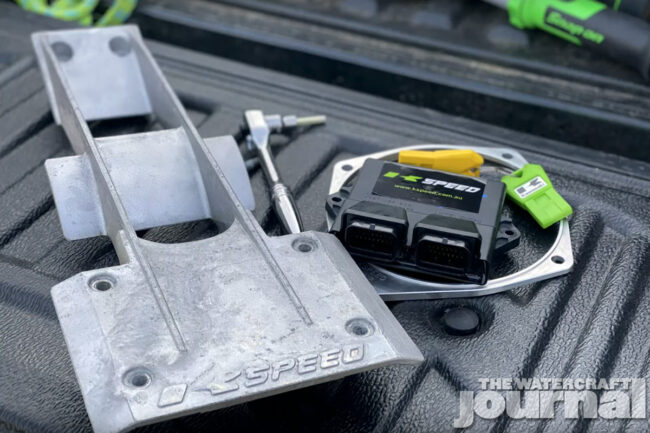
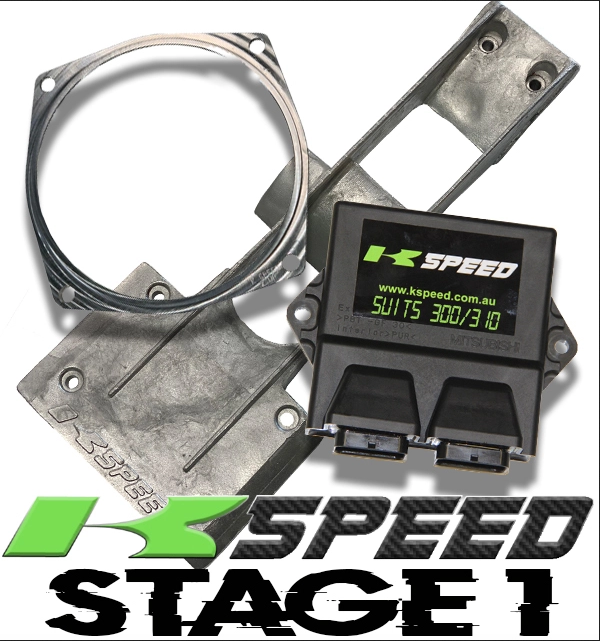
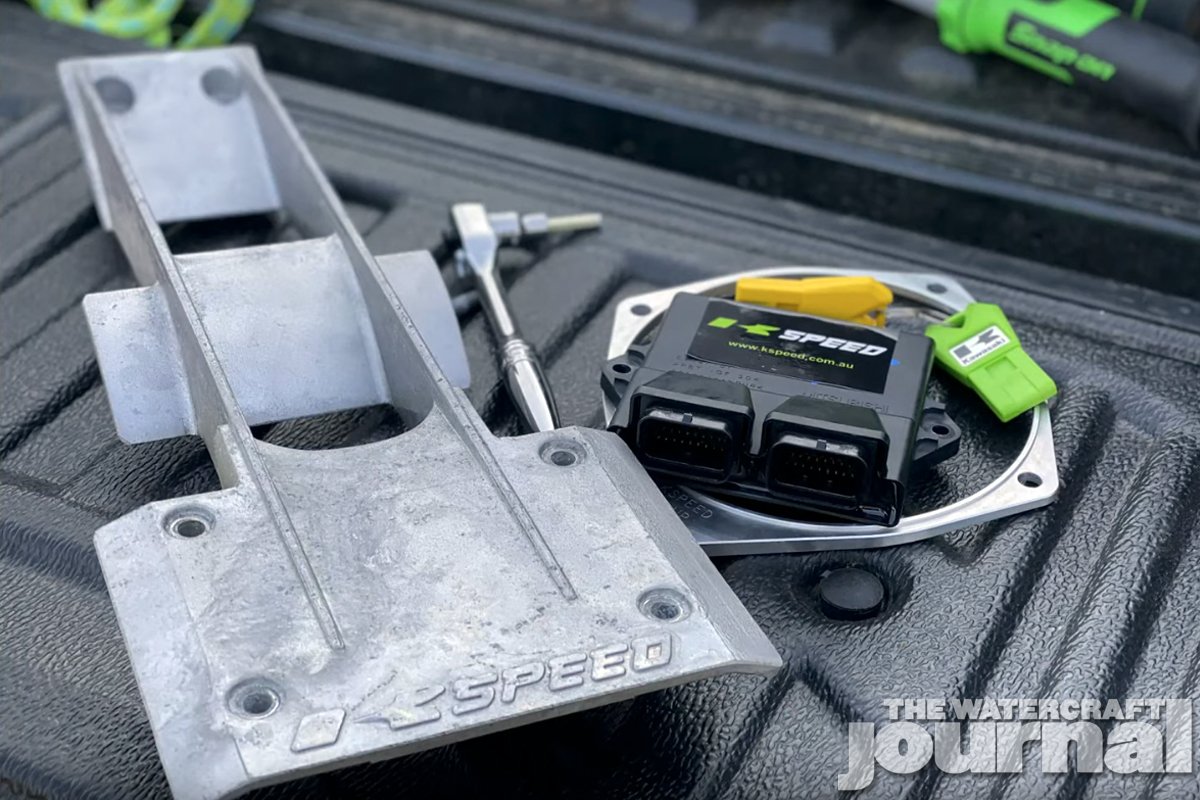
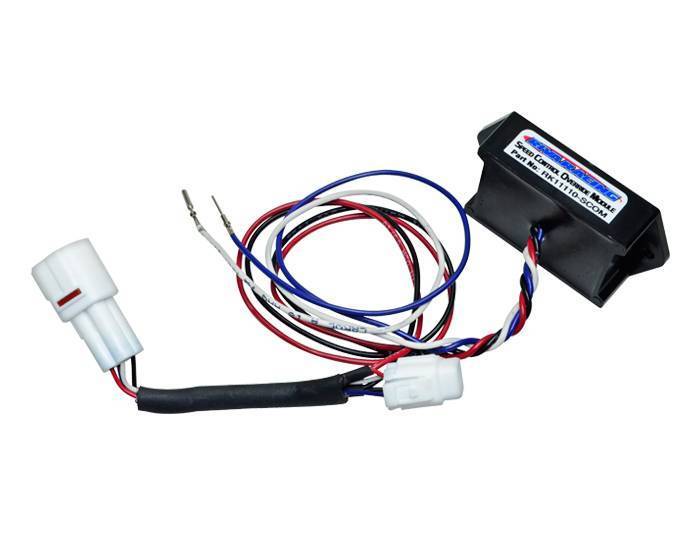
The performance branch of Brisbane Kawasaki notes a slightly better baseline for the Ultra 310X, recording 68mph at 7,600rpm – the perimeters of the weather conditions not withstanding. Unlike RIVA Racing, who wires in a speed control override module (SCOM), Kspeed simply reflashes the factory ECU, bumping the rev limiter up and completely re-mapping the timing and fuel curves, as well as removing the speed limiter, and in the case of the 310, traction control.
This new tune results in crisper throttle response, sharper acceleration and a more efficient fuel burn giving the Ultra a 10-percent (or 30-plus) horsepower gain. Together with just two more parts – Kspeed’s 2-degree Pump Wedge and Kspeed’s Intake Grate – Kspeed is reporting speeds of 77mph at 7,900rpm. The other two Kspeed components radically change the angle of water entry as well as the exit angle of the pump, lifting the bow and better planting the tail of the hull.
“Better hookup, better hole shot and a far less loss of speed when traveling in rough conditions” together with increasing “mechanical lift” as the hull generates less drag gives the Kspeed Stage 1 kit the added speed over RIVA’s offering. That, and the bargain-basement asking price of $1,200.00 AUD (totaling $927 USD) truly puts the Kspeed package over the top – at least when it comes to measuring top speed. You might be asking, what about handling/cornering?
KSPEED Ultra Racing Sponsons
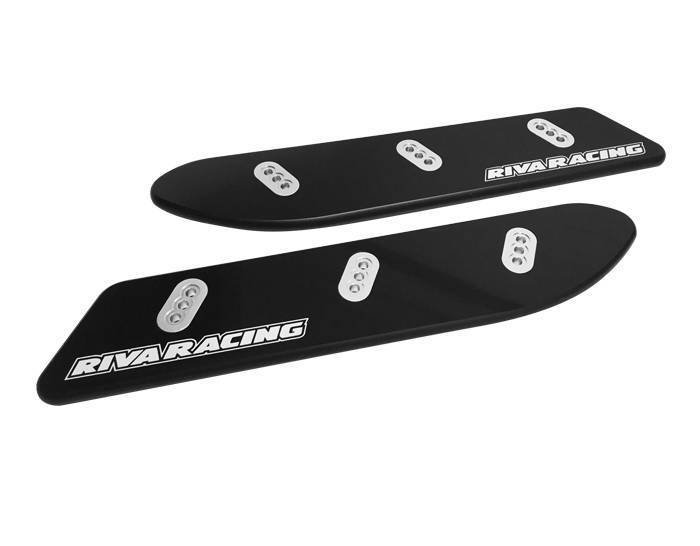
If somehow dishing out $930 bucks for an Ultra 310X that runs 77mph just isn’t enough to tickle ya, Kspeed’s fully-adjustable milled billet alloy Racing Sponsons are what your Kawasaki Ultra (LX, 250, 260, 300 or 310) needs. Whether it’s for maximum tracking control in open ocean surf or executing tight hairpin turns, Kspeed’s CNC-machined sponsons offer an incredible 48 different place settings. Priced at $950.00 AUD ($734 USD), these black anodized sponsons promise to be everything the professional racer or performance enthusiast need.
Even tacking on the extra $734 to the Stage 1 kit’s $927 asking price, the combined $1,660 is still well below the cost of RIVA Racing’s Stage 1 kit – and offers great acceleration, tracking and of course, top speed. Sure, you’re getting far less parts (full exhaust, air intake and ride plate), but Kspeed claims to have the “other guys” beat cold. While we’d certainly love to perform the shootout between the two packages personally, getting both the parts and a test unit is going to have to wait as paying customers are lining up to fork over good money to go really fast on their Kawasaki JetSki.
There are fewer environments more diverse to enjoy aboard your personal watercraft than in the open ocean. It’s also the playground best suited to push the abilities of your machine as well as your own skills – so be prepared for a challenge if ol’ King Neptune decides to churn up the sea-state a little bit! Whether exploring, surf riding, fishing or racing – ocean riding is some of the best there is.
As fun as the ocean may be, the caustic nature of saltwater can quickly corrode sensitive materials, untreated metals and soft, pliable plastics. That’s not to say you can’t enjoy your watercraft offshore, it’s just that you’re going to want to follow certain steps to properly clean and maintain your machine so it’ll continue to operate at its optimal level.
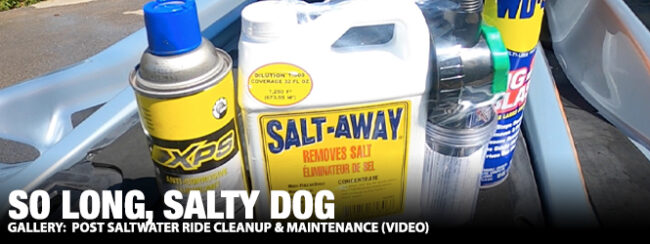
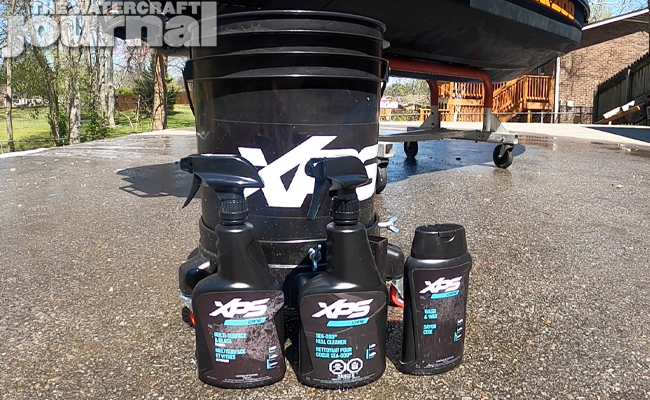
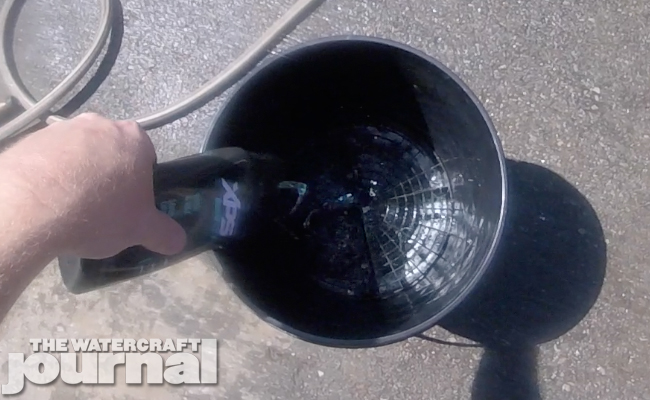
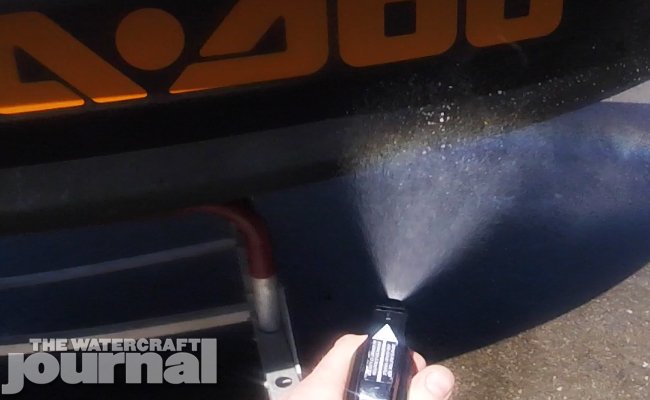
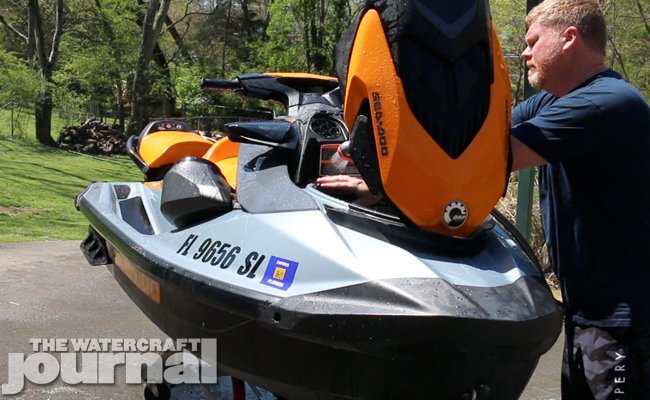
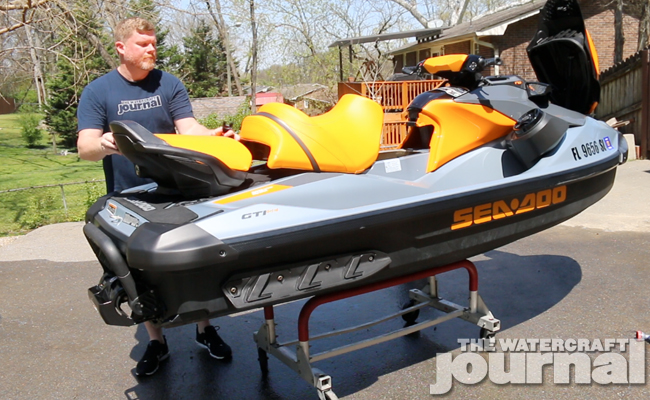
Above Left: Essential to preserving your PWC is proper care and maintenance of its more sensitive surfaces. Salt-Away is one of the most common chemical treatments for post-salt water cleaning, and it comes with its own distributing/diluting hose attachment. Whether you’re cleaning a Sea-Doo or other brand, XPS is a quality brand of spray lubricant. We also like WD-40’s “Big Blast” nozzle. Above right: We also strongly suggest keeping spray cleaners, or a bottle of boat wash/wax. We used XPS’ total “Care” line for our 2020 GTI SE 170 used here.
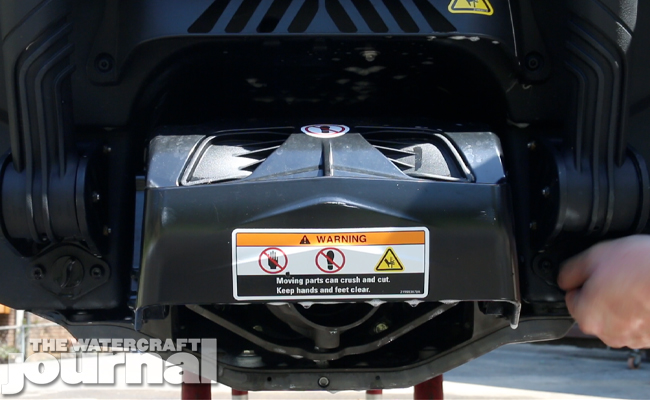
Above: Step 1 is once you’ve reloaded your PWC on your trailer and pulled up to a good spot at the marina, is to unthread your drain plugs.
Thankfully, much of this can be done at the launch ramp with your ski on your trailer. Here we’re going to detail a sequence of steps to take to properly wash, treat and protect your personal watercraft (both inside and out) in between your adventures on the open ocean. None of the steps illustrated require any special tools, equipment or solvents.
The basic items you’ll need are a bottle of Salt-Away, a threaded chemical-distributing/diluting hose attachment, a spray can of XPS Anti-Corrosive Lubricant and/or a can of WD-40 with the “Big Blast” spray attachment. You’ll also need access to a garden hose, a wash bucket, boat wash or soap, degreaser and multi-use cleaner. Also don’t forget a wash mitt and some towels to dry off your ski.
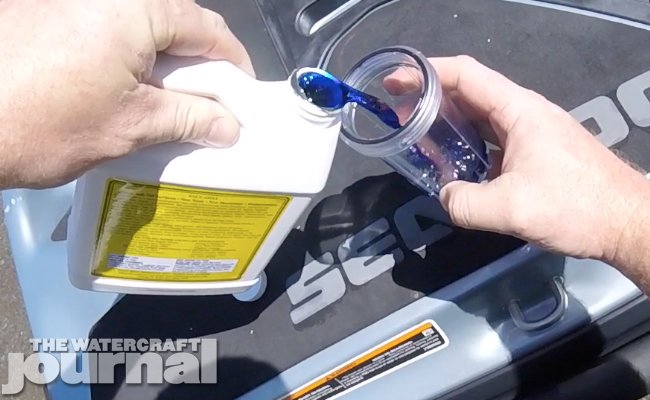
Above: Depending on the level of salt residue, you might want to measure out a more potent mixture of Salt-Away. Thankfully, Salt-Away provides mixture ratios on the label, which are easy to follow using the marked reservoir bottle.
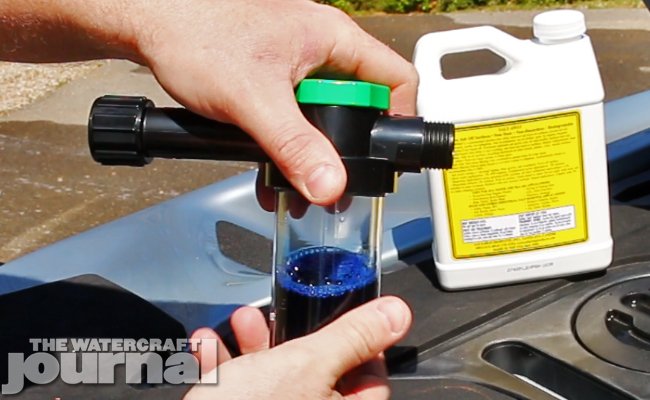
Above: Depending on whether you have a Yamaha fitment or short hose attachment, installing your Salt-Away distributor may require you threading the reservoir bottle after you’ve attached the distributor first (having to clear the folding swim step or trim tab). Once installed, add the reservoir bottle and thread the hose on.
If you’re planning on doing this process just as you come in, most municipal launch ramps will have public access to fresh water spigots. Just pull up nearby, pull the hose from your trailer’s storage box and begin rinsing off the saltwater before it dries into hard waterspots all over your ski. You can choose to wash your watercraft down now or flush out the engine and waterbox. It really doesn’t matter – so we chose the latter.
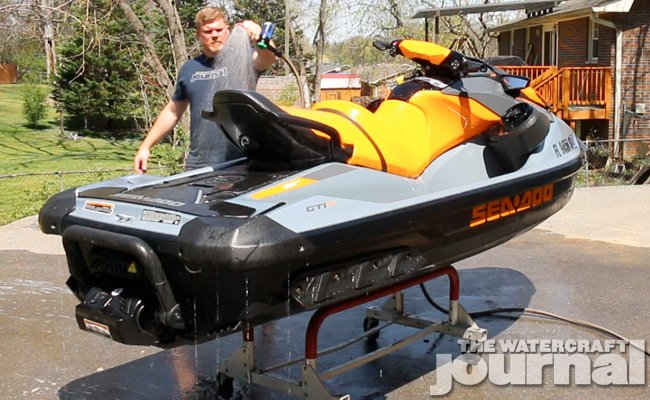
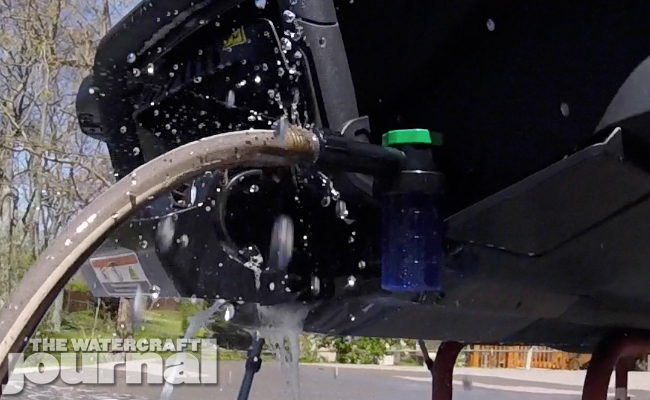
Flushing your ski is pretty easy. First, we filled up the reservoir to our hose attachment with straight Salt-Away (it’ll dilute on it’s own). Properly installing this to the hose fitting on the rear transom depends on whether you have a folding swim step or not. If you watercraft doesn’t have one, like our RXP-X 300 shown here, it spins on pretty effortlessly. If your ski does have one like this Sea-Doo GTI SE 170, you’ll want to install the attachment first and then screw on the reservoir cup before attaching on the hose.
Above Left: Per Sea-Doo’s owner manual, ignite the engine prior to turning on the hose. Turning the hose on before the engine and pressurize the exhaust system without the engine being able to evacuate the water. Above right: With the engine running, quickly turn the hose on, pumping fresh water through the exhaust system. Let the reservoir pump fresh water for 10-15 seconds minimum before switching the green selector over to Salt-Away.
Above: With Salt-Away pumping through the exhaust system, give the throttle a little squeeze (no more than 3,000rpm) for 3-5 seconds at a time. You should run Salt-Away for 30-45 seconds before switching back to fresh water for another 15-20 seconds. Then, turn off the water supply. Rap the throttle once more to purge the waterbox. All of this should take less than 2 minutes total. Do not operate your Sea-Doo out of the water for more than 2 minutes, as this can overheat your carbon ring seal and damage this very sensitive component.
Next, turn on the water (all the way to full for maximum pressure) and let it begin to fill. Fire up your watercraft’s engine and let it idle a little before bringing the RPM up to about 2,000-3,000 for a second or two at a time – there’s no reason to really wring it out. Because we’re working on a Sea-Doo, don’t operate the engine for longer than 30-45 seconds at a time. Prolonged use out of the water can prematurely wear the carbon ring seal, so we only do a couple short bursts.
Once done, we turn off the hose and rap on the running engine’s throttle once or twice to purge the exhaust. We won’t be able to get all of the water out of the waterbox, but that’s OK since the Salt-Away infused water will help keep salt deposits from forming inside. Next, we unthread the hose attachment from the transom and reattach it to the hose along with a good spray nozzle.
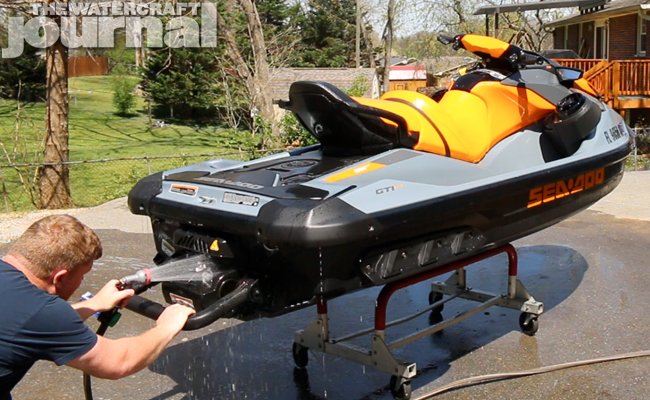
Above: With our reservoir removed from the transom, we attach a common garden hose nozzle and continue spraying down the outside of the PWC with Salt-Away as saltwater deposits can mar and discolor many of the sensitive surfaces. Also spray around the inside of the pump tunnel to spray down the linkage and fixtures.
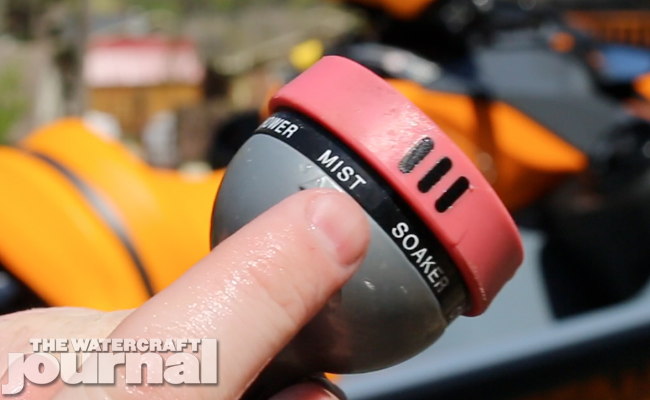
Above: With our nozzle set to MIST we gently mist down the engine compartment. There is no reason to douse the inside of your engine compartment – particularly as electrical components do not respond well to being drowned. Note we also cover our battery and terminals with a small towel to keep them dry. Once done with the Salt-Away, switch the distributor back to WATER and mist the engine compartment with fresh water.
Then we hosed down both the exterior of the Sea-Doo with our Salt-Away sprayer, as well as gently misting the engine compartment. For Sea-Doos so equipped it’s not totally necessary to remove the inspection cover unless you see quite a bit of saltwater in the bottom of the engine compartment or heavy deposits on the engine itself. Otherwise, spraying a steady mist for a few seconds will suffice. (And if your engine has a plastic decorative cover, make sure to remove that now. You can put it back on after you’ve washed and oiled your engine down.)
With that, we poured what little Salt-Away was left in our reservoir into our wash bucket (which wasn’t much) as well as a half cup of XPS Care Wash & Wax. But before we went to town with our soapy wash mitt, we applied a generous coat of XPS Care Hull Cleaner to our GTI. The hull cleaner is a strong, penetrating cleaner formulated specifically for Polytec hulls. XPS suggests letting it soak for a few minutes before scrubbing and spraying it off.
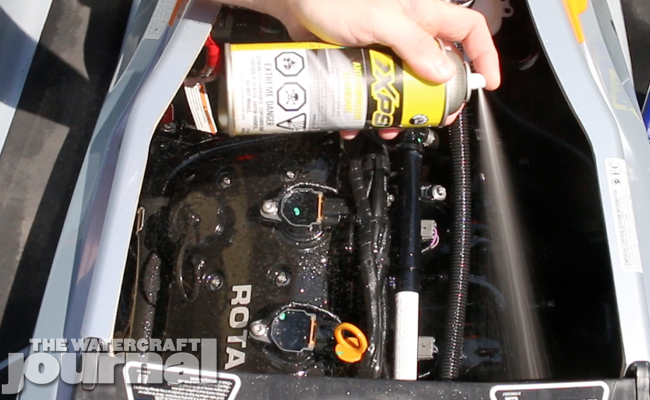
Above: Albeit out of sequence in the video, take this opportunity to generously coat your engine compartment, hoses and hardware with spray lubricant. These lubricants disperse corrosive moisture (water) and coat the surfaces in a protective layer. Contrary to internet gurus, neither WD-40 or XPS have any detergents that will deteriorate rubber or plastics.
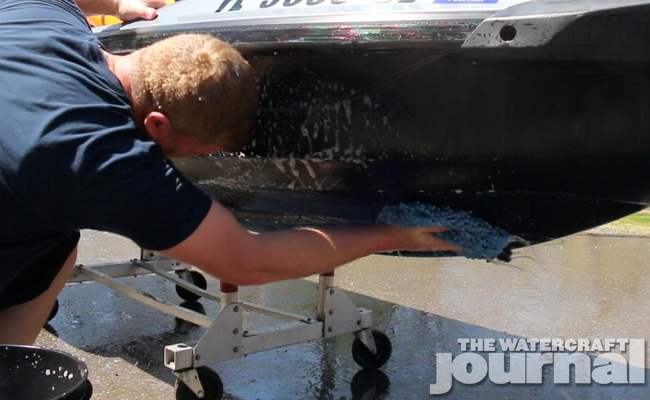
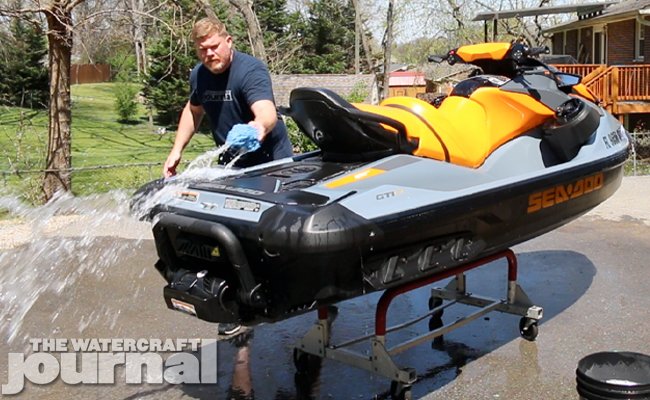
Above Left: We poured a cup of XPS Care Wash & Wax into our XPS wash bucket (as well as a little leftover Salt-Away for good measure) and filled it to a lather. Above Right: Using a microfiber wash mitt, we began lathering down our GTI SE 170. Hand washing your ski will break up dried-on salt deposits that spraying (even with a pressure washer) can’t dilute. Always wash by hand when you can.
With a nice healthy lather, we soaped down every surface of our watercraft – working our way from top to bottom, including the hull from beginning to end. Simply spraying your ski down – even with a pressure washer – isn’t enough to break hard, baked on salt deposits. A wash mitt and some elbow grease are your only tools here.
Finally, we hosed down our Sea-Doo with fresh water. With our mitt, we manually paddled the gallons of water that had accrued in the footwells. (This process alone assures us that Sea-Doo’s engineers are not forced to use the products they design in the “real world” or footwell drains would’ve been made standard equipment years ago.) With a final pass of our spray nozzle (including another misting of the engine compartment), it’s time to begin drying.
Above Left: Prior to scrubbing down our Sea-Doo, we applied a generous coat of XPS Care Hull Cleaner. Formulated specifically for Sea-Doo’s Polytec and Polytec 2 hulls, this a pretty caustic cleanser that breaks up stains and contaminants that have embedded into the Polytec’s porous surface. Above Right: XPS instructs to let the Hull Cleaner soak for 4-5 minutes before scrubbing with a mitt or towel, or spraying down with a pressure washer. We opted for the prior option.
It’s always a good idea to keep dry towels or a chamois in your trailer’s storage bin if you have one. We’ve have tremendous success with the Waves Micro Towels, which are super absorbent and always soft to the touch. Now is a good time to wipe around the edges where the front hood seals and your seats.
Lastly, grab your favorite penetrating spray lubricant and generously spray basically anything metal or rubber inside of the engine compartment. Equally, shoot a little on the steering cable, hinges and front shock, as well as inside and around the pump, intake grate and ride plate. This will coat it all with a protective film until the next time you hit the water.
Above Left: Although we love Sea-Doo’s Ergolock seating, the voluminous footwells have no easy way to get the water out besides paddling gallons out of the back. With our mitt, we pushed all of our soapy water out before a final fresh water rinse. Above Right: After soaping down our PWC, we rinsed off the suds, careful to get all of the edges and corners, including the inside lip around the storage bin.
Above: Using a water absorbent chamois to dry our Sea-Doo, we leave our PWC’s hood and engine compartment open to air dry inside of the garage. Obviously, you can’t do this while at the marina but once you get back home. If your skis are not stored indoors, leave them out to air dry for at least 2-3 hours before covering them with a UV-protective cover.
Once home, you’ll want to pop the hood open again, as well as stand the seats up so that the engine compartment can air out. If you can, place a thick wood block or brick beneath your trailer’s front caster to tilt it up at an angle several inches. This will allow any remaining water to seep out of the open drain plugs.
Lastly, if you don’t keep your watercraft inside and plan to store it outdoors, please keep it protected with a good UV-blocking ski cover as plastics and soft materials can quickly fade and crack under the blistering sun. All of these steps will ensure that your personal watercraft will continue looking great and live for many more years of open ocean enjoyment.
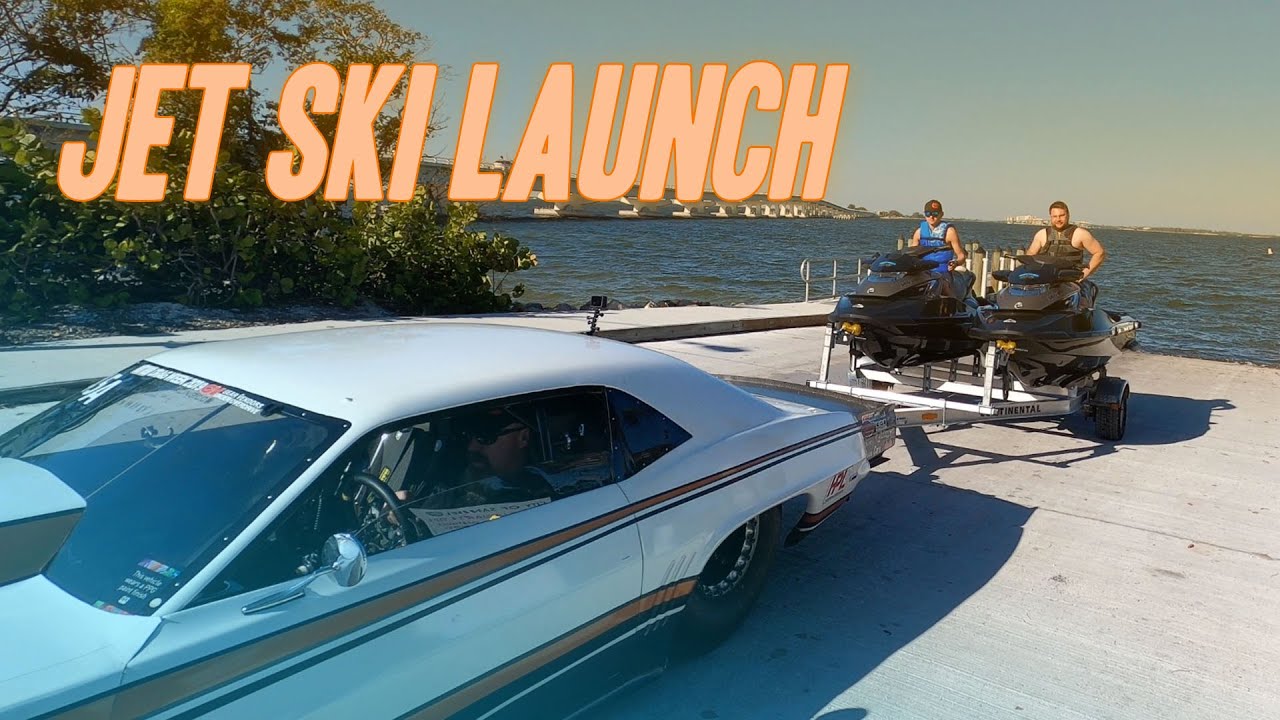
On this edition of “things you’ve never seen before” an NHRA dragster drives to the boat ramp and makes a launch. This time it’s not a launch down the race track but instead it is launching a pair of Sea-Doo watercraft.
This is no ordinary dragster though. It’s equipped with headlights, turn signals, mirrors and everything necessary to make it the world’s quickest street legal car.
On the drag strip, this 4,000 horsepower car will make a quarter mile pass within six seconds. When not at the drag strip though, racer Tom Bailey hooks up a pair of Sea-Doo GTX 260’s to the tow hitch and trailers them to the local boat ramp.
Yup, that’s something we have not seen before and we’re pretty sure you haven’t either. So how does it accomplish this task? Well just like any other road-going vehicle except that you have to contend with a lot of attention from the public and the police.
With limited rear-view visibility, it seems a bit more difficult backing the ski’s into the water and we’re pretty sure that Tom is doing everything possible to not get those rear tires into the water. Even when pulling the ski’s out of the water, the dragster is doing burnouts all the way out of the ramp area.
So check out the video for yourself. It might be the only time you every see something like this.
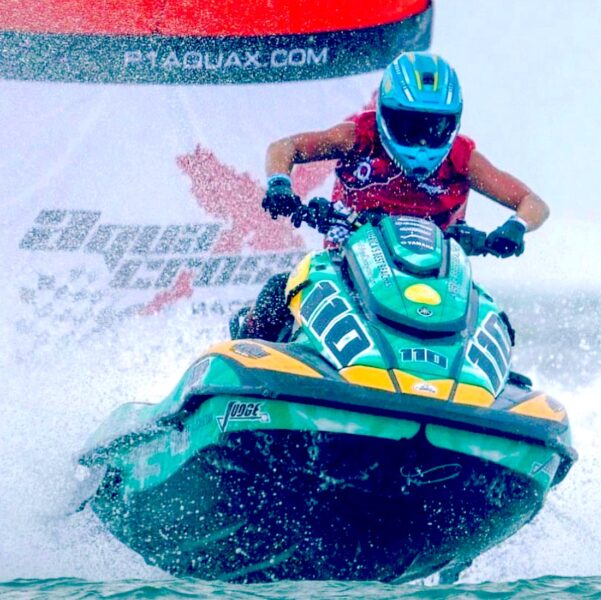
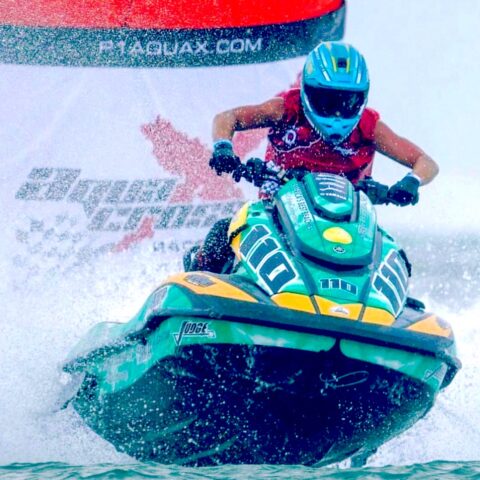
The first round of P1 AquaX kicked off this past weekend, and Yamaha WaveRunners has a lot to celebrate after the tour opener held in Daytona Beach. Saturday’s conditions were enough to weed out many of the contenders who simply did not have the mettle to handle the challenging surf. Others found the limits of their chosen watercraft to be too much and promptly backed out of Sunday’s motos.
Either way, athletes piloting Yamaha WaveRunners – be them supercharged SVHO-powered FX and GP runabouts, naturally-aspirated GP HO’s and even the 2021 SuperJet making its racing debut – all took top spots in the weekend’s results. In fact, most class podiums were entirely that, all Yamaha – verifying that the brand with the tuning forks has what it takes to dominate the rough stuff.
Here’s what Yamaha Motor Corp. USA wrote:
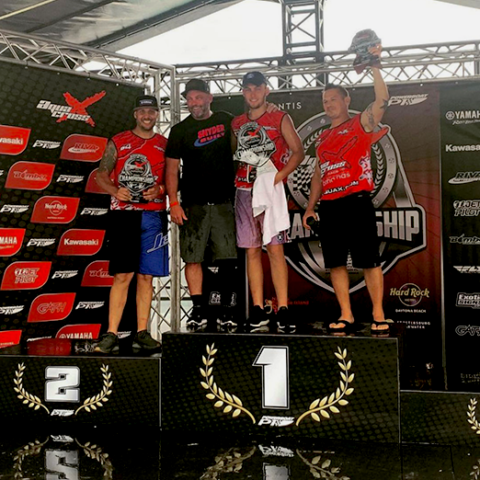
Pro Enduro rookie and Yamaha FX SVHO rider Tory Snyder impressed at Round 1 of the P1 AquaX tour in Daytona Beach, Florida; finishing first overall in front of fellow Yamaha riders Eminio Iantosca (Yamaha FX SVHO) and Chris MacClugage (Yamaha GP1800R SVHO), respectively.
All total, Yamaha watercraft racers dominated the rough Florida surf, with nine riders finishing in the top 10 overall of the premier Pro Enduro class.
Yamaha riders also swept the AM 300 class, finished 1-2 in the AM 200 class, finished 1-2 in the Sprint SE class, swept the Sport GP class, and the all-new four-stroke SuperJet finished third in its P1 AquaX racing debut. Congratulations to Broward Motorsports, Dean’s Team/Snyder Built, RIVA Racing, and all of the riders and families that make watercraft racing such a great sport.
P1 AquaX Pro Enduro racing action return May 20-23 in Cocoa Beach, Florida.






 The Kspeed Waste Gate Block-Off will ensure that you don’t lose any extra boost and will eliminate the lag when getting on the throttle. It is a great application for stock jet skis that are showing loss of pressure on the instrument panel’s boost gauge.